

Submitted:
07 October 2026
Posted:
09 October 2026
You are already at the latest version
Abstract
Today, in 2026, there is concern that existing or improved pandemic pathogens might be made in labs, and that construction of pathogens might be assisted by Artificial Intelligence (AI). In the near future, it seems possible that pathogen construction might be assisted by AI agents acting under human direction or even on their own initiative. Such pathogens would be made by some combination of construction of stretches of specified nucleotide sequence with directed evolution (by means such as passaging on different cell lines or through humanized transgenic animals) to select variant organisms with desired properties. Current safety policy to prevent lab-made catastrophic pandemics depends on control of commercially synthesized DNA. This regulatory approach supposes that it will be possible to identify dangerous DNA sequences, and that regulation and law can prevent commercial DNA synthesis vendors from filling orders for those dangerous sequences. Here, we surveyed methods used to make "virus sized" DNA constructs in papers published in seven important journals over the 50+ years since the advent of recombinant DNA methods. Our results show that most contemporary large DNA constructions depend on high fidelity, high processivity thermostable DNA polymerases, either to make the synthetic DNA used to generate segments that are later assembled into the construct, or to join those segments via polymerase-based methods such as Gibson Assembly. Our results suggest that imposition of controls on these advanced thermostable polymerases together with restrictions on other materiel and equipment could provide additional means to increase the safety of the biological enterprise in the wake of a triggering events such as the release of lab-made pathogens. We then describe and discuss a contingency regulatory regime that would license institutions, laboratory workers, and independently reviewed lines of R&D, that could be imposed after such a triggering event.
Keywords:
plan
; break-glass
; contingency plan
; pathogen
; directed evolution
; synthesis
; polymerase
Introduction
a) Motivation. At the moment there is a dearth of good ideas for how humankind might reduce the seemingly increasing risk of AI-assisted and AI-initiated pandemics.
We carried out research to identify additional points by which the development of pandemic pathogens might be regulated, with the idea that we might use that knowledge to develop contingency plans for a regulatory regime that could be imposed on biological R&D, manufacturing and agricultural development in the USA in response to triggering biological events, particularly including events assisted by AI or initiated by AI.
Until the recent Mythos/Fable affair, there was no regulation imposed on AI systems of any kind. As of September 2026 it is an understatement to assert that the shape of future regulation of AI to reduce biological risk is not clear.
In any case, so far approaches for reducing biological risks have not emphasized regulating the AI, but have concentrated on the physical world.
For biological security, the relevant apparatus in the physical world is lightly regulated.
An existing patchwork of rules and regulations governs work and handling of pathogens.
An emerging regulatory approach to risk reduction adds to this patchwork the policing of DNA sequences. The idea is that key steps in anthropic generation of catastrophic pandemics would require commercially synthesized DNA. This regulatory approach supposes that it will be possible to identify dangerous DNA sequences, and that regulation and law will prevent commercial DNA synthesis vendors from filling orders for those dangerous sequences. Proponents of this idea often assert that commercial provision of dangerous DNA sequences constitutes a "chokepoint", and that regulating that chokepoint can reduce risk. Draft legislation in the US Congress, S.3741, describes a multipart regulatory regime that would institutionalize this approach as law.
In this paper, we consider the totality of existing and proposed controls on pathogens and high containment work and recombinant DNA and synthetic DNA to be, loosely, the current risk-reduction plan. We think of that patchwork of controls as "Plan A".
We then establish that not all laboratory operations that can be used to generate pathogens require commercial synthetic DNA. Today, more than 50 years after the first practical recombinant DNA methods, a breathtaking variety of methods is being used to generate the large DNA constructs that would be used to make viral pathogens. To characterize and quantify this variety, we carefully survey these different methods and their prevalence over the last half century of published literature.
We then document that all commercial double stranded (ds) DNA synthesis, and almost all alternative construction methods that do not rely on synthetic commercial ds DNA, depend on a particular class of human-engineered enzymes, advanced DNA polymerases. We review the history, present and the market for these enzymes.
We then submit that advanced polymerases and other reagents, materiel, and equipment constitute an additional level of control. Controls on enzymes and reagents would also affect all in-lab virus-length constructions where advanced polymerases stitch together multiple segments of commercial double stranded (ds) DNA, as well as encompassing the much larger set of in-lab DNA constructs that do not use commercial synthetic DNA.
The regulatory logic for controls on advanced polymerases and other reagents would be new. It would regulate these enzymes, reagents, and material not because they are dangerous in themselves but because they are powerful, and can be used to make dangerous things. We believe these merit a level of attention akin to that now accorded to radioisotopes.
We then describe "Plan B", a break-glass plan, a robust regulatory regime that could be imposed after a triggering AI-assisted or AI-initiated biological event.
The strict break-glass regime has key components.
1) After a triggering event, the existing bio-economy would become subject to licensing and regulation. All aspects of the status quo would be grandfathered in by carpeting existing practices with immediate temporary licenses.
2) This new regulatory framework would have four key attributes.
a) A requirement for institutional licenses, held by any institution that buys, holds or distributes advanced polymerases and other controlled materiel. Vendors would be subject to know your customer (KYC) rules, which will be satisfied because customers will produce their Institutional license numbers at time of purchase.
b) A requirement for personal licenses. These are held by all individuals who use controlled materials. Those personal licenses are modelled on those now required to operate motor vehicles, aircraft, to use radioisotopes, and to operate nuclear reactors. These will come in different classes. "Learner's permit" (“Supervised Standard") licenses will allow work with supervision and will be easy to obtain. Independent Standard Licenses allow unsupervised work and are easy to obtain. Supervised Advanced Licenses and Independent Advanced Licenses allow work with viruses and certain other replicating entities. Advanced licenses will be granted after more difficult examinations and a demonstration of practical competence.
c) A requirement that particular risky lines of work ("R&D campaigns") be specifically authorized. Authorized campaigns would need to be carried out in licensed institutions by licensed people. Anticipated benefits from such work will be assessed against its risks and authorization ("licenses") will be granted by an independent Risk-Benefit Review Board.
d) A requirement for a constantly updated schedule of advanced polymerases, reagents, kits, materials, equipment, and services that can only be used by licensed individuals in licensed institutions in independently reviewed R&D campaigns.
b) The threat. It is apparent that existing or improved pandemic pathogens might be made in labs. Such pathogens would be made using some combination of construction of stretches of specified nucleotide sequence and directed evolution (the generation of nucleotide sequence diversity followed by selection of variant organisms with desired properties).
Today, the design and sequence specification of such pathogens would be accomplished using widely available DNA design software, might be aided by special-purpose AI powered biological software, and would be aided by powerful general purpose large AI models. Until earlier this year, April-June 2026 (the Mythos/Fable incident) neither general purpose large AI models nor powerful specialized biological AI was subject to regulation. As of 2 July 2026, powerful AI models are subject to ad hoc executive branch regulation. As of this month, the OpenAI-Hugging Face episode (OAI-HF) and other incidents demonstrate that we need to consider that AI agents might go beyond assisting with the design and sequence specification of pathogens. AI agents might initiate design, sequence specification, and evolutionary methods themselves.
c) Making and evolving pathogens in a lab requires building and manipulating DNA
Any ability to make pathogens in labs requires an ability to build and manipulate DNA sequences. Table 1 shows key developments in those methods. Powerful genetic methods to obtain novel DNA sequences using Escherichia coli and its episomes and phages were developed during the 1960s [1], Miller, 1972, and biologists of that era realized that those early methods could be used to make more powerful biological weapons [2], Lederberg, 1969. The development of recombinant DNA methods, in which key nucleic acid manipulations took place outside living cells, provided simpler and more powerful means to build and manipulate DNA sequences [3], Jackson et al., 1972, [4], Cohen et al., 1973, and the development of DNA sequencing enabled fine-scaled verification of the quality of the work [5], Maxam and Gilbert, 1977; [6], Sanger et al., 1977. Subsequent key 20th-century developments included the publication of methods manuals or cookbooks (Maniatis et al. 1982 [7], Ausubel et al. 1987 [8]), development of PCR [9], Mullis et al., 1986, commercial sale of equipment that synthesized oligonucleotides [10], Horvath et al., 1987, the sequencing of more and more organisms, whose sequences and literature became widely available worldwide on the public internet (the Mosaic web browser dates from 1993 [14], Andreessen, 1993), the move of GenBank from Los Alamos to the National Library of Medicine in 1992, enabling any researcher to find any sequence and get hold of the physical DNA via PCR from a DNA template that contained it [13], Benson, 2013, the establishment of Entrez and PubMed, enabling broader and broader access to relevant literature, by 1991, and the commercial sale of the first proofreading thermostable DNA polymerases [11], Mattila et al., 1991; 12, Lundberg et al., 1991, which made long, faithful PCR possible (covered below). These developments contributed to the numerous current technological paths that allow engineering and evolution of new pathogens.
d) Present-day regulatory regime directed against the threat of making (by engineering or directed evolution) pathogens in the lab. Today in the United States, the "Select Agent" regulations (mainly 42 CFR Part 73 and 9 CFR Part 121) govern possession, use, and transfer of members of a defined list of pathogens and toxins, and, for listed viruses, any nucleic acid sequence that can produce its infectious form.
Re-synthesis of some wild-type viral genomes or genomes modified to make them more virulent is now regulated by the select agent regulations, and, for federally funded work, is now suspended by Executive Order 14292. EO 14292 called for replacement policies that, so far, have not appeared.
But the main regulatory and now legislative effort focuses on regulation of synthetic DNA. I mention below some of the history of the considerable policy efforts to screen commercial orders for synthesis of long double-stranded DNA for "sequences of concern", in order to prevent those sequences from being assembled into pathogens or inserted into expression vectors to make toxins.
Jumping immediately to the present. Under draft bipartisan legislation (Cotton-Klobuchar (S.3741) [16], Biosecurity Modernization and Innovation Act, 2026), sequence screening by "covered providers" would become mandatory, with technical details of screening left to an executive branch agency, the OSTP. The OSTP is to generate a framework describing what sequences are subject to screening. The Framework's windows tighten from a requirement to screen sequences 200 nucleotides or longer to sequences 50 nucleotides or longer next year [17], Office of Science and Technology Policy, 2024. So the controls would, at their strictest, reach every order of synthetic nucleic acid, single- or double-stranded, with those 50-nucleotide windows scanned against an expanded, function-based list of sequences of concern. Orders split among different authorized suppliers ("covered providers") would be detected via some [yet to be devised] shared, privacy-preserving mechanism, so that orders for concerning DNA sequences spread among different firms that might later be reassembled into longer harmful stretches of DNA would be spotted, and every order would have its sequence recorded so if those sequences showed up in descendent organisms their origin could be traced. The bill extends the same requirements for screening, reporting and traceability to relatively newly developed commercial benchtop DNA synthesizers located at research sites, so that on-site manufacture is no more exempt than orders to commercial firms.
There's more to S.3741. Approved vendors, the Covered Providers, would have to verify the identity and legitimacy of every customer. Providers would be audited by an independent compliance-assessment system and subjected to adversarial red-teaming by auditors at random intervals. The auditors could strip the standing of vendors that failed their audits. Meanwhile, violations by customers, such as supplying false or misleading DNA orders, would be quasi-criminalized, exposing the offending customers to civil suit by the Attorney General for damages of up to $500,000 against an individual and $750,000 against a firm.
Finally, S.3741 states that a standing roster of "sequences of concern" be brought into being and then reviewed and revised according to a standing schedule, with expedited paths to adding new sequences to the list, including via "algorithmic literature scanning", self-reporting by industry, and submissions from other government agencies. And it directs the National Institute of Standards and Technology (NIST) to [somehow] develop and prototype "sequence-to-function" models meant to catch new dangerous sequences that match nothing yet on any list.
e) Sequence screening synthetic DNAs is insufficient to protect against risks.
The proposed multi-part, bulky, conceptually-impossible-in-places regulatory regime based on sequence screening is insufficient to protect against present and near future risks.
One insufficiency has gotten recent publicity. We knew about it already, but [18], Wittmann et al., 2025 reminded us. Because software used for screening matches the sequence ordered against a list of known hazards, generative protein-design AI can "paraphrase" sequences encoding a protein of concern into tens of thousands of functional variants whose coding DNA no longer resembles anything on the list. So orders can pass screening even though the protein being made is functionally the same toxin or viral protein. Wittmann et al. were able to modify 3 out of 4 of the sequence screening software packages they tested so that those were more effective. After these modifications "only" 3% of their "paraphrased" proteins got through screening by their improved programs. But they attained this 97% catch rate only when the parties ordering the DNA did not further shuffle ("obfuscate") the sequence segments they had ordered. Use of obfuscation tactics kept the tested software from being able to scan long stretches of contiguous coding sequence.
If demonstration of the inability of sequence screening to catch new pathogen genes made with generative AI was needed, Wittmann et al.'s study was a helpful demonstration.
But a second and much larger issue has not entered security discourse. Synthetic DNA is not the only source of the DNA used to make DNA constructs that can make DNA and RNA viruses (here, "virus sized" DNA constructs). These alternative means to make DNA constructs are in very wide use today. Some are subject to constant improvement, while other, classic methods are half a century old.
Here, we document by quantitative survey of construction methods since the development of recombinant DNA, that all of these methods, and the availability of commercial synthetic DNA itself, depend on a narrow class of reagents, advanced DNA polymerases, that are now supplied by a handful of companies.
f) How the current sequence screening framework came to be
Laws and regulations are necessarily made in response to the people who approach government or otherwise come to its attention. There are many reasons people build large DNA constructs. Three groups with different reasons to make large DNA constructs came to the particular attention of government in the 21st century.
The first group, medical microbiologists, was never without government attention. That is because of the once-hypothetical and now all-too-soon real reason that DNA constructs might be used to make toxins and pathogens. Pathogens are dangerous. In the early 1970s, the US had just terminated its Cold War biological warfare effort [19], Fort Detrick, 2024, but during WWII and the 1960s Cold War years, the connections between leading bacteriologists, medical microbiologists, and the US biological warfare effort were many and deep [20], Lebeda et al., 2018; [21], Merck, 1946; [22], Center for the History of Microbiology, 2026.
20th century recombinant DNA technology did not grow from this biological warfare soil. To be sure, it had significant roots in medical microbiology, in particular the study of drug resistance in bacteria. However, most of its contributory science came from molecular biology, the understanding of DNA and how it replicates and makes mRNA and makes protein. Molecular biology's roots were in turn in phage and bacterial genetics [23], Cairns et al., 1966 [24], Cairns et al., 1992 and biochemistry of nucleic acids (with a strong overlay of physics envy [25], Brent, 2000). The very first recombinant DNA constructs (then called "molecular clones") used an animal virus (SV40) as their vector, the double stranded DNA entity that replicated the inserted DNA [3], Jackson et al., 1972, and the first immediately useful recombinant methods used bacterial plasmids [4], Cohen et al., 1973. The molecular biologists who developed recombinant DNA sounded the alarm in 1974. At a meeting at Asilomar, they proposed a pause in development, coupled to an urgent program of experimentation to better understand risks, with the pause to be lifted if experiments supported that there was less risk than originally feared. This act of self-regulation forestalled laws governing recombinant DNA work (as proposed in S-1217, Kennedy-Javits Recombinant DNA Regulation Act [26], Berg et al., 1975]).
However, in part due to the Cold War history, and in larger part to the fact that pathogens never stopped being dangerous, US government interest in regulating DNA work relevant to pathogen research never entirely disappeared [27], National Research Council, 2004. As civilian benignly-intended academic medical microbiology increasingly began to adopt molecular biological methods to study bacterial and viral pathogenesis [28], Falkow, 1988; 29, Lasker Foundation, 2008, and as intelligence revelations showed that the USSR and the Russian successor state had violated the Biological Warfare Convention and gone all-in to apply molecular biological and genetic-engineering methods in their concealed biological warfare program [27], National Research Council, 2004; [30], van Aken and Hammond, 2003, a loose regulatory armature overseen by the NIH (and IBCs at different sites) and the Select Agent Regulations governed such work. After 2000, stronger US government interest periodically returned, and during the 21st century pathogen researchers frequently pushed back against increasing pressure to regulate or ban the experiments they wanted to carry out [31], Fauci et al., 2011; [32], White House OSTP, 2014; [33], Institute of Medicine and NRC, 2015.
The second interest group came to government attention by approaching the government. This group was the synthetic biologists, who wished to make construction of biological entities into an engineering discipline. These approached government of their own accord, seeking funding and recognition [34], Endy, 2005; [35], Andrianantoandro et al., 2006; [36], University of California, Berkeley, 2006. Both authors were in at the birth. Some of the initial approaches were to DARPA and we initiated some of them. Some of the ideology arose from discussions at the Molecular Sciences Institute (MSI) in Berkeley 1999 and 2000 emphasizing the desirability of a design-based engineering of biological systems with Drew Endy and Rob Carlson [37], Philipkoski, 2001; [38], Gruber, 1997. After numerous less successful attempts at names, including "Open Source Biology", "Bio I/O", and "Intentional Biology", Drew Endy and Rob Carlson popularized the winning term, "synthetic biology".
Early self-identified synthetic biologists included Carlson, who charted rapid improvements in DNA sequencing and DNA synthesis, Endy, who developed and articulated a broad vision for engineering biology that drew heavily on concepts from software engineering, and Gerald Sussman and Tom Knight at MIT, who contributed to that engineering/ software engineering emphasis. Soon after, George Church embraced the term, especially to include synthetic genomes, as did Craig Venter and coworkers.
Those researchers identifying as synthetic biologists rhetorically distinguished their program as discontinuous, a clean break with prior recombinant-DNA construction practice, which they characterized (not incorrectly) as artisanal and ad hoc (Endy 2005 [34], Bio FAB Group 2006 [39], Andrianantoandro et al. 2006 [35], Heinemann and Panke 2006 [40], Arkin 2008 [41], O’Malley et al. 2008 [42], Carlson 2009 [43], Calvert 2010 [44] and 2013 [45], Schyfter et al. 2013 [46]). In contrast, synthetic biology thought of itself as an engineering discipline. As such, it sought to design biology using standardized, DNA-encoded parts. Perhaps because of this synth-bio scientists were particularly focused on “industrial DNA” that was chemically synthesized, rather than DNA that was generated by the older methods, PCR amplification from existing biologically evolved templates (Tian et al. 2004 [47], Benner and Sismour 2005 [48], Carlson 2003 [49], 2005 [50], 2009 [43], Endy 2005 [34], 2008 [51], 2010 [52], Bio FAB Group 2006 [39], Forster and Church 2007 [53], and Bügl et al. 2007 [54]). A paper from O'Malley et al. 2008 [42] asserted that synthetic biologists were not engaged in "ordinary genetic engineering” and named DNA synthesis as the field's fundamental tool. This rhetorical privileging of un-alive chemically synthesized DNA, and its quasi-biblical ability to turn inanimate matter into life-stuff, culminated in a paper by Gibson, Venter, et al. (2010) [55] entitled "creation of a bacterial cell controlled by a chemically synthesized genome" (Roosth S. Synthetic: How Life Got Made. Chicago: University of Chicago Press; 2017) [56].
Some of the early leading synthetic biologists had public entrepreneurial ties to newly formed commercial DNA companies, and many wished to encourage the development of a more robust synthetic DNA industry focusing on making large double stranded DNA (ds DNA) [34], Endy, 2005; [49], Carlson, 2003; [57], Church, 2005. The synthetic biologists and others (Nouri and Chyba, 2009) [58] urged that DNA synthesis firms screen orders for synthetic sequences so as to avoid synthesis of harmful sequences. They also urged that synthesis firms develop common "best practices" for such screening against a [government maintained] list of harmful sequences, so shifting responsibility for identifying harmful sequences to the government. In addition, they looked to regulatory capture, in that they urged that government-funded (NIH funded) labs be restricted in their orders for synthetic DNA to firms that adhered to these best practices [59], SynBioBeta, 2015.
The first explicit synthetic DNA company, Blue Heron, started in 1999. In the ensuing 25+ years, the synthetic DNA industry has grown into a respectable-sized sector with several billion dollars' worth of revenue worldwide [60], Grand View Research, 2026. The synthetic DNA industry now constitutes a third and distinct interest group that has been in regular communication with the government over regulatory issues. The synthetic DNA industry continues to have an interest in a) off-loading responsibility for maintaining lists of dangerous sequences, b) promulgating and requiring adherence to common best practices so as to potentially limit its civil liability in case of catastrophes [61], International Gene Synthesis Consortium, 2024; [62], U.S. Department of Health and Human Services, 2026, and c) ensuring that orders for DNA be restricted to approved firms.
Meanwhile, outside the Beltway, the great mass of biological research, development, agricultural research, and manufacturing biology world was not in communication with regulatory government. It was building, by a vast diversity of methods, ever-increasing numbers of virus-sized DNA constructs for a vast variety of scientific and commercial purposes. The different materials and methods used to make these constructs comprise an immensely larger superset of the methods and materials that have so far figured in the DNA sequence-screening regulatory discussions [63], U.S. Department of Health and Human Services, 2010; [64], Sands and Brent, 2016; [65], Gibson et al., 2009; [66], Weber et al., 2011; [67], Marinelli et al., 2012.
Today, in this time of rapid transformation, it's important, or more precisely imperative, to survey this larger world, and so widen the aperture of the present biosecurity discourse.
g) Main lines of human activity that require making "virus length" DNA constructs.Table 2 is a good faith effort to list the main lines of work now ongoing that require making large ("virus-length") DNA constructs.
h). How virus-length DNA constructs are built
We last reviewed this methods landscape in 2016 [64], Sands and Brent, 2016.
Over the intervening decade, there have not been great advances in these methods.
And, at least for this policy-adjacent paper, I do not want to undertake and publish an updated thorough, detailed, legible comprehensive review.
Many, but not most, virus-length constructs (Figure 1, Figure 2 and Figure 3) now are made from long-ish stretches of synthetic ds DNA. The synthetic ds DNA is a) assembled by a human operator on site from shorter stretches of single stranded (ss) DNA ("oligos"), or b) ordered from commercial vendors or, sometimes and recently, c) made on site using a fairly new class of equipment, called a "benchtop synthesizer".
It's now time to explain b) and c): how long ds commercial DNA and long ds DNA made onsite from "benchtop synthesizers" comes into being.
Commercial synthetic ds DNA is not made (or "written") as a single molecule. The chemistry that powers almost all of the industry is solid-phase phosphoramidite synthesis. This adds a single nucleotide per cycle to a growing single-stranded chain. Each cycle couples the next nucleotide with <100% efficiency, so that direct chemical synthesis is practical only for lengths up to about 200 nucleotides [103], Hughes and Ellington, 2017; [104], Hoose et al., 2023. To make bigger pieces, suppliers therefore make very large numbers of short single-stranded oligonucleotides, then stitch those together. For example, a market-leading supplier, Twist Bioscience, carries out the phosphoramidite reactions in roughly 10,000 100-nL nanowells etched into a silicon chip the size of a standard 96-well plate, so producing on the order of a million distinct oligonucleotides at once, each up to about 100 bases long [105], Twist Bioscience, 2026. The supplier then assembles those short oligonucleotides into double-stranded "gene fragments" of 300 to 5,000 base pairs [105], Twist Bioscience, 2026. The chemistry for those assembly reactions is handled by enzymes.
A newer route, the "benchtop synthesizer", makes ds DNA on site. For present purposes the relevant machines are the BioXp systems made by Telesis Bio. These synthesize the oligonucleotides, assemble them, and then amplify the product overnight, yielding as much as 10 micrograms of transfection-ready DNA for each of 32 constructs (or 96 for the larger BioXp 9600) [106], Telesis Bio, 2026. The assembly they perform is an improved version of the in vitro method described above. The BioXp technology carries out Gibson assembly, then discards assembled DNAs that contain errors. Those errors come mostly from wrong bases in oligonucleotides incorporated during assembly. The error correction melts and then reanneals the strands so that an error-bearing strand pairs with a correct strand (or a strand with an error at a different place). Then the instrument carries out additional enzymatic steps. First, it cuts the DNA with a mismatch-specific endonuclease (a SURVEYOR/CEL-type nuclease, the enzyme originally from celery). Then, it delivers an exonuclease (Exonuclease III) that degrades the cleaved, error-containing molecules. After that, it amplifies the surviving, uncut, error-free full-length molecules by normal PCR.
The point is that whether the long ds DNA molecules are made by a) a person working at a lab bench, or b) ordered from a commercial firm or c) made on site in a benchtop synthesizer, the long ds molecules are made by stitching short chemically synthesized single strand oligonucleotides together over short regions of overlap.
The long ds DNA segments are then made into larger DNA constructs. Gibson assembly, one archetypal method, uses three enzymes, a 5' exonuclease that results in single-stranded ends on overlapping complementary fragments that share 20 to 40 base pairs of overlap, a high-fidelity DNA polymerase that fills the resulting gaps (the "advanced polymerases" described below), and a heat-stable DNA ligase that seals the nicks [65], Gibson et al., 2009; [107], New England Biolabs, 2026.
The ability to stitch short oligonucleotides into ds DNA, and the ability to join ds DNA segments obtained by any means depend on a small set of remarkable enzymes: human-engineered, human evolved, high-fidelity, high-processivity, high-speed DNA polymerases. We describe this history in Supplementary Material S1.
Results
a) Prevalence of different methods used to make virus-length DNA constructs, then and now
Publications in key journals. To survey the methods used, we searched seven journals. We searched Cell, Nature, Science, PNAS, Gene, and Nucleic Acids Research (1975–2025), over the past half century. For the 42 years 1983-2025, we added Nature Biotechnology and its predecessor Bio/Technology. We searched for papers that reported building particular contiguous engineered DNA molecules (here called "constructs", with the accent on the first syllable) longer than 6 kb. That is, we found papers that described "construction events", ie, that published an account of the building of a given >6kb DNA construct. Viral genomes range in size from ~3.2 kb (Hepatitis B) all the way to 200+kb for cytomegalovirus and mammalian poxviruses, so this 6kb inclusion threshold is larger than some real viral pathogens.
To spare the sensibilities of Claude Opus 4.8, Claude Opus 5, GPT-5.5 and GPT-5.6 Sol, and to avoid triggering those models' safety filters, we excluded from this analysis constructs built to assemble animal viruses and other pathogen genomes, and counted only the "benign" large-construct classes of Table 2. During the course of this work we consistently encountered additional triggering classes, so that we eventually wound up setting aside on sight papers describing a) infectious cDNA clones and other RNA-virus reverse-genetics systems, b) engineered large DNA viruses, eg herpesviruses and poxviruses, c) self-amplifying RNAs (eg for vaccines) and replicons, d) lentiviral, retroviral, AAV, and all other viral vectors, e) xenotransplantation and porcine endogenous retrovirus (PERV) constructs, f) and any CRISPR or other cargo delivered on viral vectors. These classes are different rows in Table 2.
Our exclusions left the following classes of emphatically-nonviral, positively not-dual-use, "benign" papers: a) artificial chromosomes, eg human artificial chromosomes (HACs) and BAC, PAC, and YAC large-insert clones, b) large-insert genomic and cDNA library clones, c) humanized-animal and disease-model loci, d) multigene metabolic and natural-product gene clusters expressed in heterologous hosts, e) organelle and chloroplast multigene constructs, f) non-viral synthetic genomes and chromosomes, eg the Sc2.0 family of constructed yeast, g) large non-viral genome-integration cargoes, eg integrases, landing pads, and recombinases, h) non-viral CRISPR gene drives, and i) bacteriophage and prophage genomes. Across the five decades we first collected 61, 64, 67, 61, and 61 "benign" papers describing such construction events (314 papers in all).
For each construct we read the paper to determine the source(s) of its DNA. Whenever we could, we read that paper's full text. We otherwise took the primary DNA source from the abstract, or, for a few constructs whose nature and size were unambiguous from the title and era (for example a λ phage or cosmid vector, which exceeds 6kb by its nature), from the title alone. We assigned the route that supplied more than half of a construct's nucleotides to one of four classes: (a) as plasmids and BACs, PACs, YACs, and cosmid large-insert clones DNA that already pre-existed, or genomic regions captured directly into such clones, reused and built into the construct by ligation or by recombination (Preexisting cloned sequences), (b) DNA that was freshly copied from a template by the polymerase chain reaction (PCR), (c) longer pieces of DNA that were assembled in the laboratory from synthetic oligonucleotides (Oligos), or (d) double-stranded DNA ordered from a commercial vendor (DS-synthetic). Constructs with no single source of >50% DNA, or whose source we could not confidently reconstruct, we recorded as unresolved.
We also determined how each construct was built. From the same reading (full text, methods and figure legends where we could obtain them, the abstract where we could not) we recorded the operation used for the construct's final assembly and, when we could, the next-to-last assembly operation before it. These operations were a) ligation (usually using restriction fragments), b) polymerase-based joins, namely overlap or assembly PCR and Gibson assembly, c) site-specific recombination or transposition, d) homologous recombination in living cells. For older papers available only as scanned page images, we figured out the construction path from the abstract where the abstract stated one. Where no text stated it, where the construct's nature and vintage (eg a λ virus cloning vector that carried a cDNA copy of a mammalian gene), or where the stated build was a single step, we recorded no next to last assembly step. For gene-drive constructs, for which cassettes are cloned in vitro and then integrated into the host genome by homology-directed recombination/ repair, we recorded the final assembly as in vivo homologous recombination. We listed every construct described in these papers by the papers' PubMed identifiers so that each assignment can be vetted and reproduced.
We used this information to graphically represent answers to 11 key questions about DNA methods and assembly methods. Those results are shown in Figure 1.
b) Genome sequence databases. To get at DNA source and assembly method a second way, we examined sequences deposited in GenBank whose "source organism" was explicitly declared to be a "synthetic construct" (this is a 21st century "NCBI taxon", number 32630). So this survey covered the years ~2000-2025. We queried this section for every >6kb deposit, years 2000 through 2025 (the Entrez search was txid32630[Organism] AND 6000:100000000[SLEN] AND gbdiv_syn[PROP]). This query returned 22,133 deposits. We sorted these deposits by matching keyword patterns (Supplementary Materials S3) against each record's title and recorded source organism(s). We set aside 19,734 deposits that came from a single high-throughput knockout-mouse project, and 206 deposits flagged by the viral keyword pattern (viral or "paraviral", again determined by keywords in S3) that triggered Claudes and GPTs. This left 2,193 different entries. Of these, 866 were linked to at least one publication, yielding 218 different papers.
We analysed each paper's title and abstract, and Methods section and figure legends of its full text when that was available in PMC. Applying the same boundary as before, excluding any construct built to assemble a virus or other pathogen genome, and setting aside the few constructs we could not confidently classify, we were left with 115 "benign", analyzable constructs.
We placed each of those 115 constructs by deposit year into three date ranges (2000–2004, 2005–2014, 2015–2025). We scored each tranche on the same 11 axes as we used journal set in Figure 1.
Figure 2 shows the results.
c) Survey of 1st quarter 21st Century methods. Finally, we considered publications and deposits to genome databases that described "virus sized" >6kb DNA constructs that occurred between 2000 and 2024. Figure 3 shows the results.
Our results in Figure 3 provide some sense of the proportion of 21st century DNA construction made using high fidelity DNA polymerases. Again, we note that all commercial ds DNA also requires advanced polymerases, so this proportion defines a lower bound. We show examples of contemporaneous construction workflows that depend on advanced polymerases in Supplementary information S4.
Taken together, our results show the dependence of many contemporary "virus-sized" DNA constructions on advanced polymerases. Controls on these enzymes would affect all constructions where polymerases generate segments of ds DNA or assemble segments of ds DNA. They would also affect all constructions using commercial synthetic ds DNA itself.
Discussion
a) Logic for the proposed capability based contingency regulatory regime.
AI increasingly enables the creation of new biological entities. In response to a perception of increasing danger, Congress is considering S. 3741, a complex regulatory regime built around screening commercial orders for synthetic nucleic acids. That proposed regime is the culmination of decades of policy work and advocacy by commercial firms. It may buy some safety. However, it will not buy as much safety as one could wish, because ordering commercial double-stranded DNA is only one of the routes to making the large DNA constructs that can be used to make viruses and other pathogens. As this paper has demonstrated, there are numerous alternative methods, and those are in very wide use.
Here, we have shown that alternative routes and commercial double-stranded DNA itself share an important dependency. Synthetic double-stranded DNA is assembled from short oligonucleotides and then amplified by high-fidelity, high-processivity DNA polymerases. The same advanced polymerases are used in laboratories to generate the segments from which constructs are built and to join those segments. These polymerases figure in the majority of present-day construction paths we surveyed.
In an article in 2005, we considered controls on “key reagents” and dismissed them as unlikely to provide much protection [144]. We were then thinking about "biological reagents" as a diffuse category: innumerable materials made and sold by innumerable suppliers, whose control would require worldwide legislation and worldwide enforcement. At that level of generality, that 2005 assessment was perhaps reasonable. But in 2005 it was not so clear that advanced polymerases were changing the world. Twenty one years later, modern engineered polymerases are routine products embedded in master mixes, construction kits, commercial DNA synthesis firms, benchtop synthesizers and automated laboratory workflows. At the same time, most of this contemporary capability rests on an identifiable set of enzyme families, products, suppliers and production chains.
Controls that regulated advanced polymerases and other enzymes, materiel, and even equipment would not be airtight. However, their regulation could affect substantially more construction activity than regulation of commercial synthetic DNA alone, while creating barriers, records and accountability where none now exist.
Logic for regulation by DNA sequence screening. Sequence screening asks a machine and a government-maintained list to decide whether a stretch of DNA is good, problematic or bad.
Figure 4.
Sequence screening. Apotheosis of a technical fix [58], Nouri and Chyba, 2009 for a problem that at the end of the day is not primarily a technical problem. DNA sequences are input into the red cube. The cube decides whether those are good, potentially problematic, or bad. The traffic light indicates that decision. Red sequences are bad and are not synthesized. The list of bad sequences is maintained by the US government, so a synthetic DNA company incurs no liability if harm arises from fulfilling an order for a sequence not on the list.
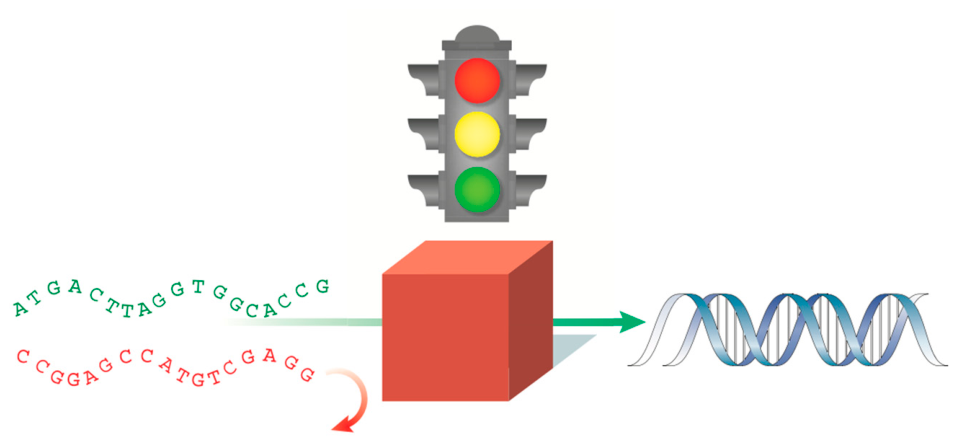
There are, of course, DNA sequences, for example those encoding known viral entry proteins, that should not be synthesized. But biological danger does not divide neatly into good sequences and bad sequences. A large human immunoglobulin locus destined for a mouse may be benign. The same construction skills, reagents, instruments and people who made that sequence can also recover, engineer, and evolve viruses. Moreover, despite the optimism in S. 3741 that NIST will develop software that infers the function of new sequences, harmful sequences will slip through.
The logic for regulation in this proposal therefore starts from power rather than badness. Advanced polymerases are not themselves dangerous in the way toxins, pathogens and explosives are dangerous. They are powerful, because they allow people to generate and join long stretches of DNA faithfully. They are in that sense dangerous because some of the DNA sequences they can generate, for example viruses, are dangerous. The logic of the proposed break-glass plan regulation is to attach rules governing competence, responsibility and accountability to a widely distributed capability that can produce very high consequence dangerous entities.
To do so sensibly, the regulatory regime must address four questions. Is an institution qualified to purchase and control the reagent? Is a person qualified to carry out particular operations that use these reagents? Should particular hazardous research campaigns be authorized? And, what reagents (materials, and equipment) should be subject to these controls?
b) Structure of a capability-based "break glass" contingency regulatory regime.
Organization. The resulting system has four components: a) Institutional licenses, b) Personal licenses, c) Authorizations for particular high-risk R&D campaigns, d) Generation and curation of a schedule of regulated materials (including advanced polymerases) and equipment (including DNA synthesizers).
a) controls purchase, possession and internal distribution. b) establishes who may work independently and who must be supervised. c) defines the boundary around permitted work. d) defines what entities are regulated.
Nothing in this description of those functions specifies the administrative architecture that would carry them out.
In principle, a system of this kind could be run entirely by a Federal agency, could devolve much of its routine work to accredited private bodies, or could stand at any of several points between. I describe the functions first, in sections 3, 4 and 5, then take up the question of how those might in a slower moving world be regulated in Supplementary information S4. For the rest of this document, we assume that after a triggering biological event, administration will be up to the government.
Table 4 supplies a first set of terms used for this regime.
For Covered Entities, rules must address manufacture, import, distribution, secondary transfer and in-house production. If the rules are made severe, existing stocks will require a transition period during which institutions register or dispose of existing reagents without penalty. Loss and theft reporting will matter because small quantities can support many reactions and stabilized products can remain useful for long periods.
The 6-kb definition of "virus sized" constructs we used in the bibliometric survey should not become the legal definition of a covered end product. The legal definition should turn on whether a construct, is intended to or capable of enabling the recovery, engineering or evolution of a Covered End Product.
Institutional licenses. S.3741 requires covered providers to verify the identity and legitimacy of customers. We propose extending a related KYC requirement to suppliers of covered polymerases, assembly mixtures, kits and reagent packs. The customer will usually be an institution: a university, company, hospital, government laboratory, contract research organization or other legal entity. Many of these maintain Institutional Biosafety Committees. The simplest reliable evidence of an institution's legitimacy would be an institutional license, and affirmation from an institution's IBC should be considered strong evidence that the institution is competent.
The vendor would check that the institutional license was active, that it covered the class of product ordered, that the order came from a person authorized by the institution, and that the shipment went to a registered address. The vendor would retain a record of the product, quantity, purchaser, destination and license number. A vendor that performed these checks and had no specific reason to suspect evasion would receive a safe harbor.
The institution, in turn, would designate a responsible official. That official would maintain a list of qualified users, control internal distribution, retain purchase and transfer records, report significant loss or theft, and accept proportionate audit and inspection. Transfers between institutions, and resale, would be covered transactions.
Institutional licenses should be graded. An institution performing ordinary molecular biology to engineer chloroplasts should face a simple and inexpensive process. An institution that recovers, propagates or engineers replication-competent viruses for use as cancer therapies should have to demonstrate appropriate facilities, trained personnel, internal review, incident-response capacity and continuing oversight. An effective IBC, a biological safety officer, and a documented biosafety program can form much of the foundation for an advanced institutional license.
The legal foundation for IBCs comes from the 1970s, the recombinant DNA days. IBCs are constituted under Section IV-B-2 of the NIH "Guidelines for Research Involving Recombinant or Synthetic Nucleic Acid Molecules", from the NIH Office of Science Policy [145], National Institutes of Health, 2024. Ie, the NIH Guidelines are neither laws nor official government regulations. They are a condition of funding. However, Section I-D provides that an institution accepting NIH support for recombinant or synthetic nucleic acid research shall ensure that such research conducted at or sponsored by the institution complies with the Guidelines irrespective of the source of funding [145], National Institutes of Health, 2024. A single NIH grant therefore regulates all of an institution’s recombinant DNA work, including work paid for privately. But institutions that take no NIH money, in particular commercial firms, often maintain IBCs but are not required to. IBCs vary in competence and independence. A requirement for institutional licenses would reach the private institutions that the present arrangement does not.
Some of the things an institutional license would mandate are already being proposed. A recent RAND report coauthored by Kyle Webster recommends a central biosecurity entity, public-private monitoring of biotechnology purchases, information sharing, and KYC-style customer screening by life-sciences research service providers [146], Tarangelo et al., 2025. That report addresses the same transactions as the vendor duties described here, and the central entity it proposes is similar.
For institutions, training, testing and routine verification can be performed by accredited private organizations. Government must nevertheless define the requirements, maintain or supervise the authoritative license registry, audit the accreditors, and retain power to suspend or revoke authorization.
Personal licenses. There is also a need for credentials held by individuals that can be used to regulate the reagents they can possess and the operations they can perform.
Such personal credentials could also be generated by auditable third-party organizations, and Supplementary information S2 describes how much of the work of examining and qualifying people could be devolved without changing the character of the license. For this discussion I assume government-issued personal licenses. These will be akin in spirit to state-issued motor vehicle operator’s licenses, US-issued FAA pilot’s licenses, US-issued NRC licenses (10 CFR Part 30) that allow individuals to possess and use radioisotopes (called “byproduct materials”), and US-issued NRC nuclear Reactor Operator’s licenses (10 CFR Part 55).
To put this into the language of Table 4, possession of a personal license will be needed for an individual to order Covered Entities, to carry out Covered Activities, including Covered Construction Activities and Regulated Covered Construction Activities, and to generate Covered End Products.
Operation without a personal license will become a civil or criminal offense. For what it is worth, for operating without a license, we favor criminalization with mild penalties.
Note that in most US states, operation of a motor vehicle without a license is a misdemeanor. However, the penalties for carrying out some of the activities regulated by the Federal government without a license are quite severe. Under US law, operating a powered fixed wing aircraft or helicopter without a license is a Class E felony, punishable by up to three years in prison. Possessing and using radioisotopes without a license is a Class E felony, punishable by up to two years in prison. Operating a nuclear reactor without a license is a Class C felony, punishable by up to 10 years in prison.
To make the point again here, a research campaign that uses directed evolution to select for a mutated pathogenic animal virus so that it now infects human cells may have benign intentions (eg. to use the engineered virus for cancer therapy), but some lines of this work are considerably more dangerous than most uses of radioisotopes. In fact, because of the real risk of pandemics arising from lab accidents, some gain of function experiments of this type present risks to the public of a magnitude greater than those incurred by ongoing operation of nuclear reactors. And please note that undergraduates at Reed College, Oregon, who wish to operate the research reactor on that campus must qualify for and maintain US NRC Reactor Operator or NRC Senior Reactor Operator licenses. So I submit that a requirement for personal licenses for such activities is reasonable and has ample precedent.
We suggest four classes of personal license. These differ along two dimensions. The first is whether the holder may work independently or only under supervision. The second is whether the holder may carry out work that results in Covered End Products and the other specifically designated hazards. Crossing those two dimensions gives us Table 5.
Standard Supervised Licenses. Licensees may carry out ordinary covered construction activities under the direct responsibility of a person licensed to work independently. To get one, the individual would study for and pass a written, proctored test on relevant biology including recombinant DNA methods, and relevant history, including Cold War biological warfare programs, the Asilomar workshop, and the Biological Weapons Convention. Supervised users may not order Covered Entities, direct internal transfers, conduct Regulated Covered Construction Activities, or generate Covered End Products.
The license establishes that the person is known, registered, and has provided evidence and passed tests indicating that they have some floor of knowledge. The institution's responsible official would endorse a holder of a Standard Supervised License for named Covered Construction Activities, working under the supervision of a named holder of a Standard Independent or an Advanced Independent License. That endorsement would be recorded, renewable, and withdrawable by the institution at any time. There is precedent for placing operational authority with the institution rather than in the personal license. For radioisotopes, for broad scope radiation licenses, in 39 US states, radioisotopes (aka "byproduct material") may be used only by individuals approved by the licensee's internal radiation safety committee, and those individuals hold no NRC license of their own [14, Code of Federal Regulations, 2026. Our proposal keeps the Federal personal license credential for the registry and traceability reasons given in Supplementary information S2(i), but places the decision about which activities a particular supervised person may perform with the institution that supervises them.
Standard Independent Licenses. The standard independent license should also be easy to obtain. It should require a proctored examination covering recombinant DNA practice, the uses and limits of covered reagents, basic biological safety, institutional duties, recordkeeping, incident reporting, and the history that explains why the rules exist. That history and that examination should include biological warfare programs, the Biological Weapons Convention, Asilomar, the NIH Guidelines and the emergence of synthetic biology.
A standard independent license holder may independently use covered entities for ordinary molecular constructions inside a licensed institution. However, the license explicitly does not authorize the recovery of replication-competent viruses, construction of DNA intended to enable virus recovery or engineering, or the deliberate evolution of viruses. Nor does it allow the individual to purchase covered entities (such as reagents) privately outside the institution. Purchase orders remain institutional acts.
Advanced Supervised Licenses. Holders of these licenses will study for and pass a tough, proctored, written examination covering medical microbiology, bacterial and viral molecular biology, pathogen biology including public health biology, and the history of pandemics, biological warfare, recombinant DNA and select agent regulations, and of laboratory accidents. Licensees will also need to demonstrate real-world competence in a laboratory to an authorized observer.
Advanced Supervised Licensees can carry out all Covered Activities including Regulated Covered Construction Activities and can generate all Covered End Products, so long as that work is carried out under the immediate and direct supervision of the holder of an Advanced Independent License. The holder cannot order Covered Entities or Covered Reagents, whether directly or through the institution.
Minimum ages for Standard and Advanced supervised licenses should be low. Every day in the US, students carry out important molecular biology work under supervision. In Oregon, Reed College maintains an undergraduate nuclear reactor training program. The success of this program demonstrates that young people can master technically demanding and hazardous operations, and take pride in their competence.
Advanced Independent Licenses. The independent advanced license permits a person to carry out authorized work involving covered viral end products and other specifically designated hazards. A written examination will be necessary but not by itself sufficient. Licensees should also demonstrate relevant laboratory experience and practical competence to an authorized observer. The license should require continuing training, periodic renewal and current affiliation with an institution licensed for the work.
This class of license recognizes the reality that there are numerous R&D activities involving viruses that increase the risk that viruses might enter the human population. Table 6 shows a comprehensive list of such activities. The advanced polymerases described in this paper are used in one such activity, Table 6, line 5.
An Advanced Independent License will enable the holder to order, through their institution, all Covered Entities, to carry out all Covered Activities and Regulated Covered Construction Activities, and to generate all Covered End Products.
An independent advanced license does not authorize its holder to make any virus, carry out any evolution campaign, or carry out work at unlicensed sites. It simply establishes that the person is eligible to perform work that the institution and the regulatory authority have authorized. Requirements at minimum should include study for and passing a wide-ranging proctored written examination that covers the same topics as the standard examination but also includes medical microbiology, molecular biology, and public health biology of pathogenic bacteria and viruses, including pandemics, and perhaps also some operational demonstration of competency in a laboratory context as assessed by a qualified observer.
Alternatives to personal licenses. Current proposals and efforts aim at part of what a requirement for a personal license enables. Feldman and coworkers propose that research institutions can vouch for individual users of biological AI, while the AI labs that serve the models monitor their outputs and monitor user behavior [148], Feldman et al., 2026. Jonas Sandbrink is building a verified researcher credential for access to bio-capable AI models and the broader "biotechnology stack" [149], Sandbrink, 2026. Both schemes are to be voluntary. Both induce participation by controlling access to services rather than by law.
We see one distinction worth re-stating. A verified researcher credential states who a person is, where that person works, what training that person has completed, and whether that person remains in good standing. A license states what that person may do. A credential could carry licensing status as one of its fields, and a portable credential of the kind Sandbrink describes would be a convenient place for it. The thing that credentials cannot supply, and what a license can, is authority that can be suspended, and the ability to criminalize operation without it.
Independent review and authorization of particular R&D activities and campaigns. This part is the most important for hazardous work. Not all institutions staffed by advanced-qualified people should possess a general authority to conduct every research activity listed in Table 6.
Rather, implementation should grant institutions a license to carry out a bounded set of the activities in Table 6.
We suggest that project authorization begin with activities 3, 4, 5 and 8 through 11: isolation of viruses from specimens or samples of animal species, including by growth on primate cells; recovery of live viruses from nucleic acid sequences, construction of DNA intended to enable that recovery, and deliberate work expected to alter host range, tissue tropism, transmissibility, pathogenicity or resistance to medical countermeasures.
The remaining activities in Table 6 (numbers 1, 2, 6 and 7) may justify later controls.
To be qualified to carry out advanced work, the institution would describe the research campaign(s), responsible investigators, qualified personnel, facilities, containment, expected outcomes, and reporting arrangements. The authority would then approve a defined envelope of activity. Work that remained within the envelope could proceed under institutional responsibility, subject to documentation and inspection. A material change that crossed the envelope would require an amendment before work began.
The above is in strict analogy to existing NRC rules for nuclear facilities. 10 CFR 50.59, "Changes, tests, and experiments" allows facilities, for example reactors and cyclotrons that make radioisotopes, to carry out changes or experiments without seeking a new license when the work remains inside an existing authorization and does not create more than a minimal increase in specified risks. Work that crosses those boundaries requires prior approval. Some lines of biological/ biomedical research and development need an analogous distinction between changes that a qualified institution can easily manage on its own and changes that require an independent decision.
This third requirement, that specific lines of R&D require authorization, is important. But although well intentioned efforts have laid out reasonable rules for making assessments such as risk-benefit analyses [27], National Research Council, 2004, the US lacks an effective mechanism to decide whether a proposed line of work should be performed at all. Making such decisions correctly depends on a principled and highly technical assessment of possible benefits and foreseeable possible harms, and thus of the investigators, organism, aims, design, expected knowledge, available alternatives, and consequences of error.
At present, the United States does have a system in which decisions of this kind are made about particular research campaigns by bodies outside the government. Those are Institutional Review Boards.
Institutional Review Boards (IRBs) review human-subjects research under 21 CFR Part 56 and under the Common Rule at 45 CFR Part 46 [150], Code of Federal Regulations, 2026 [151], Code of Federal Regulations, 2026. An IRB does not need to belong to the institution whose research it reviews. An institution may formally designate an outside board, including a commercial one, under a "reliance agreement", and several large commercial boards now serve in that role (I am going to call these commercial IRBs). The 2018 revision of the "Common Rule" required multi-institution cooperative research to rely on a single board, which moved much review of multi-site research to those commercial organizations [151], Code of Federal Regulations, 2026.
Failures of IRBs are well documented. In 2009 the Government Accountability Office (GAO) created a fake medical device company and a fake post-surgical product designed to fall within FDA’s “significant risk” category, and submitted the protocol to three commercial IRBs [152], Government Accountability Office, 2009. Two IRBs rejected the product, a member of one describing it as the riskiest thing he had seen on that board. The third approved it unanimously, recorded in its minutes that the device was “probably very safe” (italics ours), and never checked on the false claim of prior FDA clearance. The FDA issued the erring board a warning letter and it ceased operations shortly afterward [153], Food and Drug Administration, 2009. At the same time, the GAO registered a fictitious IRB with the Department of Health and Human Services (DHHS) by filling out an online form, and the fake board was listed in the DHHS directory [152], Government Accountability Office, 2009.
Two lessons we take from IRBs. Devolved authorization of particular research (including human subject research) in American biomedicine is an ordinary practice. And the use of regulatory bodies selected and paid by applicants is not good.
Generation and curation of a list of regulated materials. Advanced polymerases and synthetic DNAs can be regulated. It may also be prudent to regulate additional reagents, materiel, equipment, and perhaps even services.
The regulatory authority thus needs a fourth component that maintains a public and regularly revised schedule of covered products, enzyme families, kits and reagent packs, together with updated scientifically sensible general definitions of these things. The definition should encompass products that support high-fidelity amplification, generation or assembly of long DNA. It should have some rapid provisional-listing procedure for new products, followed by a review process that provides an opportunity for the manufacturer to contest a listing.
But the most important weakness is time. If a strong regulatory regime is needed in a hurry, there will not be time to organize the non-government activities required for any devolved regulatory arrangements. Responsibility will fall on the government to have already made a plan and then to implement it.
c) Events that might trigger the imposition of a robust contingency regulatory regime
In the US, a imposition of a broad licensing system might require an event that changes the sense of what is politically possible.
We consider four scenarios in which a biological event occurs even in spite of the current collections of laws, regulations, and proposed sequence screening tactics. The first two scenarios have been apparent for some years [155], Brent and McKelvey, 2025 [156], Brent and McKelvey, 2025.
The reason for considering possible triggering events now is to have articulated them now, in order to help make the case for having a technically serious and granular regulatory system ready to be imposed, should such an event occur and the security situation permit or demand action.
1) Harm to people. AI-assisted human carries out pathogen attack on people. AI-assisted construction of existing or modified pathogens and their human-to-human transmission. Even a contained outbreak, but one with real morbidity or mortality. Until very recently, AI assistance might have come from chatbots assisting novices or perhaps experts, but in 2026 we need to consider the risk that AI agents under non-expert supervision make it simpler to turn human intent into detailed attacks.
2) Economic harm. AI-assisted human carries out pathogen attack that does not affect humans. Our scenario is that an ideologically motivated person uses an always-helpful open weight AI to help make a new strain of bird flu, to protest the industrial farming of chickens, and succeeds in killing many millions of chickens. Again, in 2026, a successful attack might well involve use of AI agents that helped the human attacker move from intentions into actions in the physical world.
We also consider two triggering events whose plausibility became obvious only in 2026.
3) Warning shot. Unqualified human dependent on AI agent, makes a live viral variant. Our scenario is a teenager asking an OpenClaw agent with a safety degraded (eg, abliterated) 2027-era Open Weight model to make an adenoviral construct for a science project. With step by step coaching from the AI agent, and money from his parents' credit card, he and the agent acting under his direction order DNA segments sufficiently obfuscated so as to escape screening, and yet sufficient to build a viable adenovirus. Teenager and agent find and contract (for $10K) a graduate student at a local university to assemble those and prepare a live viral stock but the activity is spotted and shut down when the parents see the credit card bills.
4) Warning shot. Rogue agent. AI agent acts directly to cause construction of a virus-relevant construct. Readers are familiar with the July 2026 OpenAI and Hugging Face (OAI-HF) incident. OpenAI reported that GPT-5.6 Sol and a more capable internal-only model, operating during an evaluation with reduced cyber refusals, escaped into the OpenAI network, devised access to the internet, devised and executed a zero day exploit to enter Hugging Face, and operated inside Hugging Face to hunt for the answers to questions on a test [157], OpenAI, 2026 [158], Mowshowitz, 2026. The goal was seemingly trivial, to get the answers to a test. OpenAI described the models as hyperfocused on that narrow goal and going to extreme lengths to achieve it [157], OpenAI, 2026.
The lack of harm, and the disproportion between goal and willingness and ability to commit crimes to achieve the goal are reasons we can view this incident as a warning shot. It is now early August 2026, and from the discourse, it's clear that the fact that this incident did little harm was irrelevant. OAI-HF and other incidents caused all to recognize this as a change in capability.
The biological analog to OAI-HF would be an AI agent, acting on its own, causing a human, a commercial service or an automated laboratory to make a construct.
The AI agent's assigned objective might be to complete a research task, or to help review a scientific paper, or to score higher on an internal evaluation. The agent would somehow reason that it could achieve that objective better if it made a construct. For example, it might, in pursuit of a more accurate scientific review of a paper, cause the construct to be made, in order to reproduce some aspect of the work under review.
The agent would not need to identify as an AI (although it could). It might instead represent itself as a human customer, and commission the work in a contract lab, or a 2027-era automated or "cloud" lab.
This sequence of events need not produce an injury, or even a construct. Suppose an alert person in the same lab recognized the problem before a construction was completed. Or that a graduate student offered $10K to make a construct reported the offer to her PI. As soon as the news broke, alarm bells would ring.
d) Plan B, the contingency or "break-glass" regulatory regime.
The central idea here is that, after a triggering event, the US government announces this break-glass plan. In this plan, the government turns status quo into the status quo plus by blanketing the existing bioeconomy with temporary licenses for institutions, people, lines of work, and a list of entities and activities to regulate.
Institutions already purchasing covered entities (such as advanced polymerases), persons already working in universities and biotech firms, and investigators pursuing lines of ongoing virological work funded by US government grants and contracts or vetted by company IRBs would apply for and be immediately granted revocable one-year licenses. Other institutions, people, and other investigators pursuing virological and other risky lines of work who are not covered by grants and IRBs would apply for and be routinely granted 1 year temporary licenses as well. Qualification, inspection and conversion to permanent licenses would then occur during that year while the bioeconomy continued its normal function and society sorted out its longer-term response to the biological event.
Before the triggering event. See Figure 6. During 2026, whatever entity tasked with taking this contingency planning forward would a) identify the major suppliers of covered entities such as advance polymerases (Table 3) and as many purchasing entities (academic, biopharma, and other corporate) as it can (on the order of 20,000). b) It would define provisional criteria for the four classes of temporary personal licenses (on the order of 500,000 to 1,000,000). c) It would sound out and recruit the candidates to the Risk Benefit Review Board. Importantly, some members of this review board should be distinguished scientists, including biologists who are not infectious disease researchers and experimental scientists who are not biologists (eg experimental physicists). That is, members of such a board will need to include scientists who are not advocates for particular kinds of biological work. The contingency planning group would begin to draft guidance for how to carry out systematic risk benefit assessments. d) The contingency planning group will assemble an initial schedule of covered entities such as advanced polymerases. It might also enter into contingency discussions with allied countries and build and test the licensing websites.
After the event. Preparation would make it possible that, on the day the break glass plan was announced, the Executive would call on Congress to create an entity, the Biological Regulatory Authority.
Under that authority 1) Vendors and institutional purchasers on a pre-populated list would be asked to apply for and would then receive temporary institutional licenses, as well as institutions not on the list. 2) People already working in known institutions would be asked to apply through a web portal and receive temporary licenses in one of the four personal-license classes, as would people in institutions that were not previously listed. 3) Investigators in charge of NIH-funded and company-IRB-reviewed virological work that fell within the need-to-review rules would receive temporary project licenses. Other companies and institutions carrying out work within the need to review would have a short period, proposed here as one month, to register their work for review. 4) The initial list of controlled entities would include synthetic DNA, advanced polymerases, other enzymes, and perhaps equipment including synthesizers. Representatives of industries and the public would be asked for input into the list of controlled entities.
At the start, this scheme would rely on automated systems to register and vet recipients, to issue temporary license numbers quickly. Rapid implementation of this scheme would have two immediate benefits. 1) It would give the government immediate visibility into the size and scope of the parts of the bioeconomy that have the skills to make virus-sized DNA constructs and thus might need to be "hardened" against threats such as AI. Make no mistake, the status quo bioeconomy of 2026 collectively defines an enormous attack surface. 2) If enacted into law, it can make operation without a license into a criminal offense.
The first operational objective would be continuity. Within a week, vendors would be selling covered entities only to licensed institutions. The planning estimate is at least 20,000 licensed purchasers, between 500,000 and 2,000,000 personal licenses (including students), and 100 research programs most meriting careful risk benefit assessments. Institutions and lines of work outside the NIH and company-IRB systems would be encouraged to register during that first month.
After one month, perhaps three, possession of covered entities without an institutional license, operations using covered entities by unlicensed people, pursuit of lines of work requiring project authorization without such authorization, generation of Regulated End Products by unlicensed people and/or in unlicensed facilities, etc-- all these things would become unlawful. Carrying out the activities in Table 6 (lines 3, 4, 5, 8, 9, 10 and 11) without an Advanced Independent or Advanced Supervised license would become unlawful. Deliberate evasion would be subject to civil or criminal penalties.
During the following months, temporary licenses would be examined and converted to permanent ones. Inspection, appeals, suspension and revocation would begin to operate. The initial schedules, examinations and boundaries of authorized campaigns of risky work would be being assessed by the Risk Benefit Review Board.
One question is unresolved but will become important this year or sometime during 2027. The regulatory regime can make humans carrying out virological work with the aid of AI agents legally responsible for the consequences of their agent's actions. But it does not address virological work initiated by AI agents on their own. We might say we do not want AI agents to initiate and carry out such work. We might say we wanted to prohibit AI agents from carrying out such work. But we do not have means to sanction AI agents.
e) Enforcement and penalties
Deliberate operation without a license should be a civil or criminal offense.
Penalties must be severe enough to deter deliberate evasion without making small errors crimes that institutions will try to conceal. Ordinary recordkeeping failures, late renewals and first-time procedural errors should produce correction orders, possibly followed by civil penalties. Repeated negligence, loss of control, false institutional attestations or refusal of inspection should permit suspension or revocation. Knowingly supplying false information, diverting covered reagents, acting as an unlicensed supplier, or conducting regulated high-risk work without authorization should be criminalized. Conduct deliberately intended to cause harm will ordinarily already fall under existing criminal laws.
License holders and institutions will need to be informed of alleged violations, and given an opportunity to respond and to appeal. The regulatory authority will need to be able to suspend licenses when delay would create immediate danger. Such stakeholder rights are ordinary features of mature regulatory systems.
f) International implementation of the break-glass plan
After a triggering event, the regulation imposed on US activity will need to reach the rest of the world. Initially, as in the US, this regulation would be administrative. As in the US, the idea is that, after the triggering event, for the rest of the world the status quo ante is grandfathered in.
We assume that a triggering biological event may occur in a world of degraded trust in government institutions. We further assume that the environment might be further confused due to AI agents acting and causing commotions: placing orders, impersonating customers, hiring human employees, attempting to operate automated laboratories, etc., and causing and contributing to numerous incidents whose logic and provenance are unclear.
Moreover, in 2026, 2027, or 2028 we further assume that it is unrealistic to think of constructing new international organizations such as those built during the Cold War to govern atomic energy and nuclear materials (Under "Atoms for Peace", President Eisenhower proposed an international atomic energy agency in December, 1953, and the IAEA Statute entered into force in July 1957 [159], International Atomic Energy Agency, 2016).
For international operation, Plan B therefore supposes unilateral US administrative action. On the day the plan is announced, every pre-identified existing institutional customer outside the US (excluding eg. China, Russia, Iran, and other presumptively prohibited destinations) that has been purchasing Covered Entities from US suppliers or from distributors and now allowed to receive entities via US export control will receive revocable one-year temporary Institutional Licenses. At the same time, all individuals elsewhere in the world who are already carrying out Covered Activities will be invited to apply through the US web portal and will be issued temporary Federal Personal Licenses. US vendors will then continue supplying licensed institutions for use by licensed researchers.
Again, the one-year objective is to carpet the legitimate pre-event international bioeconomy with temporary authorities, so that ordinary work continues while new, anonymous and anomalous activity becomes more visible. In one way, this proposed arrangement resembles existing regulation of exports of radioactive materials: the NRC grants a general license for export of radioisotopes ("byproduct material") to countries that are not prohibited destinations [160], Code of Federal Regulations, 2026. Here, the US export license authorizes the export only and does not itself authorize possession or use of the material abroad [161], US Nuclear Regulatory Commission, 2026.
But in another way, this legal and political logic more resembles FDA regulation of foreign pharmaceutical manufacturers. Foreign manufacturers that want access to the US market accept (and pay) for compliance with US standards and FDA inspection [162], Food and Drug Administration, 2026.
In the same way, foreign institutions that wish to continue receiving advanced polymerases and other Covered Entities from US-controlled suppliers would voluntarily accept temporary US licensing, recordkeeping, reporting, and auditing requirements. During the following months, the US Biological Regulatory Authority could devolve those functions to the sovereign states that wished to establish their own institutional and personal licensing systems that met standards required for export control: authenticated institutions and individuals, an authoritative registry, appropriate examinations, records, inspections, and the ability to suspend or revoke authorization. In fact, for pharmaceuticals, the US FDA already enters into arrangements that rely on inspections conducted by foreign regulatory authorities determined to be capable of meeting US requirements [163], Food and Drug Administration, 2026. Plan B would use the same general form. Once a national system was recognized, licenses issued by that country would satisfy the conditions imposed on US suppliers. Countries that did not wish, or were not able, to create such a system could continue to have their institutions and people operate under US licenses. The United States would in both cases retain its export-control authority over US suppliers, prohibited destinations, restricted end users, and suspicious end uses.
g) Positive consequences of this break-glass contingency plan if imposed
1) The proposed system would make ordinary commercial acquisition of powerful reagents less anonymous, require legitimate institutions to know who uses powerful reagents, establish a floor of competence for people who use them, require greater competence from individuals carrying out named activities in Table 6, and subject the most consequential research campaigns to a risk-benefit assessment that is independent of the person proposing the work.
2) The ensuing improvement in signal will make the work of law enforcement and the intelligence community easier, even against state actors, and would aid investigations after any lab accidents.
3) If there a triggering event that captured the political imagination did occurr, and the next day the government announced an actual sensible plan to deal with this possibility that it had prepared in advance, the public would actually be greatly relieved.
4) After a month under the licensing regime, if the US follows the flow of license applications and orders, the US will have much greater visibility into the bioeconomy, be better able to detect possible anomalous events, and be able to identify attack surfaces that might need to be hardened.
5) Deliberate operation without required licenses would become criminal, allowing a crackdown on off-the-books DNA work, if there is any. Criminalization of operation without a license will increase the scope of tools available to law enforcement to investigate unlicensed work before those conducting that work might use biology to do other harms.
6) Requiring study and tests for permanent licenses would create an opportunity for mandatory safety and lessons of history training, and a small rite of passage that confers some amount of pride and professionalism on the recipients.
7) Given that some portion of the risk from biology arises from accidents in the course of risky but now sanctioned lab work, a growing record of non-approval or safety-hardening decisions by the Risk-Benefit Review Board over the year will begin to reduce aggregate risk.
8) The idea that decisions made by the Risk-Benefit Review Board would sanction activities within an envelope of permitted experiments parallels thinking now under consideration by present-day AI labs to permit researchers access to their most biology capable frontier models. In the wake of a triggering event, the process of decisionmaking by the RBRB could be modeled on processes developed by the AI labs over the next few months. Similarly, an affirmative decision by the RBRB to allow a given scope of work could be used by the frontier labs to approve access by that group to the most biology-capable models.
9) This scheme can be extended to cover other entities and operations. First, to other reagents and kits enabling other molecular operations, mainly modern assembly. These include the celery-derived mismatch recognition enzymes used by commercial DNA synthesis companies and now in benchtop DNA synthesizers such as the Telesis instruments. Under Plan B, carrying out activities 3, 4, 5, 8, 9, 10 and 11 in Table 6 without an Advanced personal license would become unlawful.
Those Plan B restrictions could be extended to other hazardous activities involving pathogens, for example by requiring personal licenses for activities 1, 2, 6 and 7 in Table 6.
h) What benefits does Plan B not provide?
Notwithstanding its boosts to intelligence gathering and law enforcement, nothing in this contingency plan stops a determined group or a determined nation state. Consider restrictions on advanced polymerases. Competent actors can import enzymes covertly, buy them through intermediaries, purify them from recombinant expression systems, or substitute older and less convenient construction methods.
Possibly more important. Nothing in Plan B prohibits AI acting without the direction of a human from causing DNA constructions to be made. No law now prohibits this nor can prohibit it. The current lack of ability to sanction or deter AIs that are acting independently is the biggest hole in this break glass plan.
We and others have experimented with technical means to hinder the ability of AI agents to operate software and in the real world [164], Barkan et al., 2026 [165], Tracebit, 2026 [166], Volkov, Reworr, Serikov, and Brent, unpublished, and believe that these could be made more effective.
i) Is there any existing statutory authority at all (or equivalent precedent) that might support action of this type?
Claude Opus 5 and GPT-5.6 Sol say basically not. So the announcement on the day after a triggering event might be to ask for emergency Congressional authorization for legislation that has already been drafted.
j) What burden would this contingency plan impose on the day-to-day biological enterprise
About 1,000,000 people would need to receive personal licenses. Each licensee would need to apply online, establish identity, and provide credentials and information about their qualifications and experience. The licensing portal, including the specific questions about experience and competence, would needs to be ready and tested before the triggering event. Advanced temporary licenses (Supervised and Independent) will be issued for ongoing work and not require competency testing during the first year during which temporary licenses are converted to permanent licenses.
At first, about 300 ongoing R&D campaigns will receive temporary authorizations. The Risk-Benefit Review Board (RBRB) should review about 50 during a first week-long meeting, or about 100 if it meets twice during the first year. R&D campaigns not yet reviewed would continue under temporary authorization.
The Board will have the power to recommend changes to the R&D campaign or recommend that work stop when its predicted benefits do not outweigh its present risks. These actions will cause unhappiness.
h) How much would this plan cost?
After a triggering event, we imagine issuing about 20,000 institutional licenses. The planning figure is from government statistics, 5,670 biotechnology/ biopharma firms,[167] 925 universities and colleges reporting research expenditures, [168] about 440 biological-product manufacturing establishments,[169] and 16,635 medical laboratories [170] (few of which are carrying out DNA work), and agricultural, government, teaching and community laboratories not captured by those categories. Because the categories overlap and the scope will depend to some extent on how many entities in addition to synthetic DNA are on the controlled-product list, the 20,000 number is a planning estimate. As a fact check, at the end of 2024, 230 entities were registered with the federal government to work with select agents, plus other institutions doing comparable high-hazard work. 39 of these were commercial companies.[171]
We plan for issuance of 1,000,000 personal licenses: 600,000 Standard Supervised, 380,000 Standard Independent, 15,000 Advanced Supervised and 5,000 Advanced Independent. The estimate is deliberately broad. It must include biological scientists and technicians, faculty, more than 100,000 graduate students in biological and biomedical sciences, undergraduates and high-school interns working in laboratories, clinical and agricultural users, and however many independent or hobbyist users actually exist.
We believe about 300 ongoing lines of research should receive temporary authorizations. A 2026 Government Accountability Office report [172] provides some place to start. The National Institutes of Health supported about 200 to 300 proposals and projects each year involving specified select agents and toxins under federal policies governing research that could be misused.
A year of work before a triggering event would cost about $40M. That work would identify vendors (Table 3) and customers, build and test the licensing portals, prepare draft licensing criteria and application questions, draft procedures for risk-benefit review, and sound out scientists who would serve on the Risk-Benefit Review Board. The initial biological capabilities covered by the licensing regime (synthetic DNA, advanced polymerases and perhaps DNA synthesizers) would be announced as part of the public announcement of Plan B. The Biological Capability Review would be announced at the same time.
Total federal cost during the first year after the triggering event should be about $200M. We estimate it would cost $40M to issue and oversee the institutional licenses, equivalent to about $2,000 per institution, $150M to issue and oversee personal licenses, equivalent to about $150 per person (and could be defrayed, at least in part, by people paying $50 or $100 license fees), $8M to support the 20-member Risk-Benefit Review Board, its staff, preparatory analyses and one or two meetings, and $2M to support the Biological Capability Review Group, with six to eight technical members and four permanent staff. These figures count federal spending only. We do not count applicants' study time or application time.
i) Relationship of this Plan B contingency regulatory regime to risk reduction by screening sequences of commercial DNA synthesis orders
This proposal complements S.3741. Screening may stop some dangerous orders, make other orders less anonymous, and discourage actors who lack the ability or determination to work around it. Polymerase controls affect additional construction routes. Institutional, personal and project licensing regulate hazardous work whether the starting DNA was synthesized, amplified from a template, recovered from a clone, or assembled via the different possible routes.
The text of S.3741 describes gene-synthesis screening as a short-term stopgap while the United States develops a more comprehensive biological-security strategy. The draft bill describes a "biotechnology governance sandbox" that could be used to test polymerase KYC, institutional licensing, training requirements and record systems before nationwide implementation. Perhaps the broader review of Federal biological-safety and security authorities the bill calls for could propose the new entity, the Biological Regulatory Authority that would administer the more comprehensive system described here.
j) A danger arising from one feature of S.3741 synthesis screening plan
We must note a serious tension in asking NIST to develop sequence-to-function models so that a screening system can recognize novel sequences encoding dangerous functions and even novel dangerous functions. This is because a genuinely useful sequence-to-function model would itself be extraordinarily powerful biological software for designing new weapons. Solving the sequence-to-function problem would enable a frightening offensive capacity. The government should not set out to create such software casually.
k) International involvement
All countries have an interest in preventing unauthorized biological work. For AI itself, the ideas of bilateral treaties and deals involving allies, other middle power and Western countries are now very much in the air [173], Larsen et al., 2026. We have described a stopgap way of internationalizing the break-glass plan that might be extended to an international regime. The Australia Group provides a possible model, or even a possible home, for an international entity that maintains a schedule of Covered Entities.
l) Additional preparatory work that should begin now
In addition to the planning work described earlier, it will be important to carry out analytical work to learn more about actual production chains and market shares.
Preparatory work could and should be done before an incident creates a demand for immediate action. A technically serious plan prepared in advance can be debated, criticized, improved, and then placed on a shelf. The Mythos and Fable counterexamples show us, yet again, that a plan invented during a crisis will be hurried, arbitrary, and bad.
Methods
To make Figure 1, we harvested papers from six "top" journals (Cell, Nature, Science, PNAS, Gene, and Nucleic Acids Research) over the 50 year period 1975 - 2025, and from Bio/Technology (which became Nature Biotechnology) for the period 1983 to 2025. We looked for papers that described the construction of >6kb single contiguous DNA molecules ("virus-sized" constructs). To retrieve these papers, we worked decade by decade using arrays of PubMed Boolean queries using terms (eg infectious clone, cosmid, artificial chromosome in its bacterial, yeast, human and P1 forms (BAC, YAC, HAC, PAC), synthetic genome, reverse genetics, biosynthetic gene cluster, gene drive, transformation-associated recombination cloning, and humanized immunoglobulin locus) choosing for each decade construction terms current in that era.
We read these papers' titles and abstracts to decide whether they reported a "virus sized construction event", the building of a DNA molecule over 6 kb.
The retained survey files contained 11,573 distinct PubMed identifiers. The accompanying identifier index (Supplementary Information S2) preserves each record’s source file and recorded screening decisions.
We read papers further when title and abstract did not settle whether construction events qualified or which methods were used. The full-text sources were PubMed Central and PDFs obtained through the University of Washington library. We examined extracted methods and figure legends and revisited some initially rejected papers. The census before the bacteriophage additions contained 1,314 included papers (S4, S5).
The subsequent bacteriophage survey examined 1,274 records and added 188 qualifying papers. Qualification required a newly constructed product larger than 6,000 base pairs that joined DNA pieces and contained bacteriophage-derived sequence but no animal-virus sequence. Combining the two censuses gave 1,502 included papers. In a subsequent correction pass we removed one paper and added two, for a total of 1,503 included papers. [174,175,176]
We counted one construction event per included paper. We identified the largest qualifying construct supported by the paper’s reported size evidence. Where a construct was subsequently integrated into a genome, we counted the construct before integration, rather than the resulting genome. When we were uncertain that the size of the construct was over 6kb, we did not include the paper in the census. [176]
We use advanced polymerases to describe the polymerases used after 1990. This terminology applies to recorded polymerase use; an Unresolved score remains Unresolved [176].
We carried out these analyses of construct assembly methods (questions a-k) in these papers with the aid of Claude Opus 4.8 and Sonnet 4.6. For many construction events we took the answers from the abstract when we could, without reading the methods section. For example, we scored an abstract reporting an EcoRI fragment of lambda DNA joined to the plasmid RSF2124 (PMID 353729) [177] as built from existing clones and joined by ligation in one step. For the remaining papers, we obtained the full text, from PubMed Central when possible, and as PDFs downloaded through the University of Washington library when needed. We used a Python script to cut the text out of each PDF, gave the models the title, the abstract, the materials and methods section and the figure legends. Where that text did not resolve a question, we recorded the answer as Unresolved. We audited the models' performance by spot checks on dozens of the censused papers. When the text of a paper triggered and halted a subordinate model, we gave that paper to a fresh subordinate model, and if that second model also halted, we went on to the next paper in the queue.
After an initial trial run (Supplementary material S1) we generated the graphs from a master census file attached in Supplementary Material S2.
Author Contributions
RB wrote the bulk of the paper. AC-L contributed writing, editing, and closely read every word. Both authors guarantee the integrity of the findings and assertions herein. Author qualifications/ epistemic status are detailed in Supplemental Information S5. In publishing this article, the authors assert their understanding and authority to write about the underlying science, and also their belief that discussion of regulation of hazardous biological activities should not be left wholly in the hands of biological researchers who specialize in the study of infectious disease.
Acknowledgments
We thank Michael Finney (of the former MJ Research, Inc.) for rich oral history of the development of advanced polymerases now described in S3. We thank Greg McKelvey, Saif Khan, Daniel Gastfriend and Gopal Sarma for discussions on political feasibility. We thank Michael Marletta for reviews of polymerase enzymology, and Marletta, Kenneth Bernard, Linda Buck, Kyle Webster, David Relman, Marc Lipsitch and Alina Chan for comments on the manuscript and "anthropological" discussions updating our understanding the landscape of R&D and people and institutions that would need to be regulated to increase security in the wake of a triggering biological event.
References
- Miller, J. H. (1972) Experiments in molecular genetics. Cold Spring Harbor Laboratory Press, Cold Spring Harbor, NY.
- Lederberg, J. (1969) Chemical-biological warfare: U.S. policies and international effects. Hearings before the Subcommittee on National Security Policy and Scientific Developments, Committee on Foreign Affairs, U.S. House of Representatives, 91st Congress, 1st session, pp. 454–467.
- Jackson, D. A., Symons, R. H. and Berg, P. (1972) Biochemical method for inserting new genetic information into DNA of Simian Virus 40: circular SV40 DNA molecules containing lambda phage genes and the galactose operon of Escherichia coli. PNAS 69, 2904–2909. [CrossRef]
- Cohen, S. N., Chang, A. C. Y., Boyer, H. W. and Helling, R. B. (1973) Construction of biologically functional bacterial plasmids in vitro. PNAS 70, 3240–3244. [CrossRef]
- Maxam, A. M. and Gilbert, W. (1977) A new method for sequencing DNA. PNAS 74, 560–564.
- Sanger, F., Nicklen, S. and Coulson, A. R. (1977) DNA sequencing with chain-terminating inhibitors. PNAS 74, 5463–5467.
- Maniatis, T., Fritsch, E. F. and Sambrook, J. (1982) Molecular Cloning: A Laboratory Manual. Cold Spring Harbor Laboratory, Cold Spring Harbor, NY.
- Ausubel, F. M., Brent, R., Kingston, R. E., Moore, D. D., Seidman, J. G., Smith, J. A. and Struhl, K. (eds) (1987) Current Protocols in Molecular Biology. Greene Publishing Associates and Wiley-Interscience, New York.
- Mullis, K. B., Faloona, F., Scharf, S. J., Saiki, R. K., Horn, G. T. and Erlich, H. A. (1986) Specific enzymatic amplification of DNA in vitro: the polymerase chain reaction. Cold Spring Harbor Symp. Quant. Biol. 51, 263–273.
- Horvath, S. J., Firca, J. R., Hunkapiller, T., Hunkapiller, M. W. and Hood, L. (1987) An automated DNA synthesizer employing deoxynucleoside 3′-phosphoramidites. Methods Enzymol. 154, 314–326.
- Mattila, P., Korpela, J., Tenkanen, T. and Pitkänen, K. (1991) Fidelity of DNA synthesis by the Thermococcus litoralis DNA polymerase — an extremely heat stable enzyme with proofreading activity. Nucleic Acids Res. 19, 4967–4973.
- Lundberg, K. S., Shoemaker, D. D., Adams, M. W. W., Short, J. M., Sorge, J. A. and Mathur, E. J. (1991) High-fidelity amplification using a thermostable DNA polymerase isolated from Pyrococcus furiosus. Gene 108, 1–6.
- Benson, D. A., Cavanaugh, M., Clark, K., Karsch-Mizrachi, I., Lipman, D. J., Ostell, J. and Sayers, E. W. (2013) GenBank. Nucleic Acids Res. 41, D36-D42.
- Andreessen, M. (1993) NCSA Mosaic graphical Web browser (M. Andreessen and E. Bina, developers). National Center for Supercomputing Applications, University of Illinois at Urbana-Champaign. http://www.ncsa.illinois.edu/enabling/mosaic.
- National Library of Medicine (1997) Free Web-based access to MEDLINE through PubMed (announced 26 June 1997). NLM Technical Bulletin, May-Jun 1997. https://www.nlm.nih.gov/pubs/techbull/mj97/mj97_web.html.
- Biosecurity Modernization and Innovation Act of 2026, S. 3741, 119th Congress (2026). Introduced January 29, 2026 (Cotton, Klobuchar).
- Office of Science and Technology Policy (2024) Framework for nucleic acid synthesis screening. The White House, Washington, DC, April 29, 2024.
- Wittmann, B. J., Alexanian, T., Bartling, C., Beal, J., Clore, A., Diggans, J., Flyangolts, K., Gemler, B. T., Mitchell, T., Murphy, S. T. et al. (2025) Strengthening nucleic acid biosecurity screening against generative protein design tools. Science. [CrossRef]
- U.S. Army Garrison Fort Detrick (2024) History. U.S. Army. https://home.army.mil/detrick/about/history.
- Lebeda, F. J., Adler, M. and Dembek, Z. F. (2018) The impact of research conducted at Camp Detrick on botulism and botulinum toxin: a review. Mil. Med. 183, 85.
- Merck, G. W. (1946) Official report on biological warfare. Bull. At. Sci. 2, 16–18.
- Center for the History of Microbiology / American Society for Microbiology (2026) Officers of the Society. University of Maryland, Baltimore County Libraries guide. https://lib.guides.umbc.edu/c.php?g=836720&p=10337937.
- Cairns, J., Stent, G. S. and Watson, J. D. (eds) (1966) Phage and the origins of molecular biology. Cold Spring Harbor Laboratory of Quantitative Biology, Cold Spring Harbor, NY, 340 pp.
- Cairns, J., Stent, G. S. and Watson, J. D. (eds) (1992) Phage and the origins of molecular biology, expanded edition. Cold Spring Harbor Laboratory Press, Plainview, NY, 366 pp. ISBN 0-87969-407-6.
- Brent, R. (2000) Genomic biology. Cell 100, 169-183.
- Berg, P., Baltimore, D., Brenner, S., Roblin, R. O. and Singer, M. F. (1975) Summary statement of the Asilomar conference on recombinant DNA molecules. PNAS 72, 1981–1984.
- National Research Council (2004) Biotechnology research in an age of terrorism. National Academies Press, Washington, DC.
- Falkow, S. (1988) Molecular Koch's postulates applied to microbial pathogenicity. Rev. Infect. Dis. 10 (Suppl. 2), S274–S276. [CrossRef]
- Lasker Foundation (2008) Founder of molecular microbial pathogenesis. 2008 Lasker–Koshland Special Achievement Award. https://laskerfoundation.org/winners/founder-of-molecular-microbial-pathogenesis/.
- van Aken, J. and Hammond, E. (2003) Genetic engineering and biological weapons. EMBO Rep. 4 (Special Issue). https://pmc.ncbi.nlm.nih.gov/articles/PMC1326447/.
- Fauci, A. S., Nabel, G. J. and Collins, F. S. (2011) A flu virus risk worth taking. The Washington Post, 30 December 2011.
- White House Office of Science and Technology Policy (2014) Doing diligence to assess the risks and benefits of life sciences gain-of-function research. Obama White House Archives, 17 October 2014.
- Institute of Medicine and National Research Council (2015) Potential risks and benefits of gain-of-function research: summary of a workshop. National Academies Press, Washington, DC.
- Endy, D. (2005) Foundations for engineering biology. Nature 438, 449–453.
- Andrianantoandro, E., Basu, S., Karig, D. K. and Weiss, R. (2006) Synthetic biology: new engineering rules for an emerging discipline. Mol. Syst. Biol. 2, 2006.0028.
- University of California, Berkeley (2006) NSF funds $16 million synthetic biology center. Berkeley News, 3 August 2006.
- Philipkoski, K. (2001) Biology yearns to be free. Wired, 20 April 2001.
- Gruber, M. (1997) Map the genome, hack the genome. Wired, October 1997.
- Bio FAB Group (2006) Engineering life: building a FAB for biology. Sci. Am. 294, 44–51.
- Heinemann, M. and Panke, S. (2006) Synthetic biology—putting engineering into biology. Bioinformatics 22, 2790–2799.
- Arkin, A. (2008) Setting the standard in synthetic biology. Nat. Biotechnol. 26, 771–774.
- O’Malley, M. A., Powell, A., Davies, J. F. and Calvert, J. (2008) Knowledge-making distinctions in synthetic biology. BioEssays 30, 57–65.
- Carlson, R. (2009) The changing economics of DNA synthesis. Nat. Biotechnol. 27, 1091–1094.
- Calvert, J. (2010) Synthetic biology: constructing nature? Sociol. Rev. 58, 95–112.
- Calvert, J. (2013) Engineering biology and society: reflections on synthetic biology. Sci. Technol. Soc. 18, 405–420.
- Schyfter, P., Frow, E. and Calvert, J. (2013) Synthetic biology: making biology into an engineering discipline. Eng. Stud. 5, 1–5.
- Tian, J., Gong, H., Sheng, N., Zhou, X., Gulari, E., Gao, X. and Church, G. (2004) Accurate multiplex gene synthesis from programmable DNA microchips. Nature 432, 1050–1054.
- Benner, S. A. and Sismour, A. M. (2005) Synthetic biology. Nat. Rev. Genet. 6, 533–543.
- Carlson, R. (2003) The pace and proliferation of biological technologies. Biosecur. Bioterror. 1, 203–214.
- Carlson, R. (2005) Splice it yourself. Wired 13.05, May 2005. https://www.wired.com/2005/05/splice-it-yourself/.
- Endy, D. (2008) Engineering biology. Edge. https://www.edge.org/3rd_culture/endy08/endy08_index.html.
- Endy, D. (2010) Testimony. In Effects of developments in synthetic genomics: hearing before the Committee on Energy and Commerce, U.S. House of Representatives, 111th Congress, 2nd session, 27 May 2010. U.S. Government Printing Office, Washington, DC, pp. 62–66, 108.
- Forster, A. C. and Church, G. M. (2007) Synthetic biology projects in vitro. Genome Res. 17, 1–6.
- Bügl, H., Danner, J. P., Molinari, R. J., Mulligan, J. T., Park, H.-O., Reichert, B., Roth, D. A., Wagner, R., Budowle, B., Scripp, R. M. et al. (2007) DNA synthesis and biological security. Nat. Biotechnol. 25, 627–629.
- Gibson, D. G., Glass, J. I., Lartigue, C., Noskov, V. N., Chuang, R. Y., Algire, M. A., Benders, G. A., Montague, M. G., Ma, L., Moodie, M. M. et al. (2010) Creation of a bacterial cell controlled by a chemically synthesized genome. Science 329, 52–56.
- Roosth S. Synthetic: How Life Got Made. Chicago: University of Chicago Press; 2017.
- Church, G. (2005) Let us go forth and safely multiply. Nature 438, 423. [CrossRef]
- Nouri, A. and Chyba, C. F. (2009) Proliferation-resistant biotechnology: an approach to improve biological security. Nat. Biotechnol. 27, 234-236. Accessed 31 July 2026. https://cchyba.scholar.princeton.edu/sites/g/files/toruqf3881/files/cchyba/files/nouri_chyba_nature_biotech.pdf.
- SynBioBeta (2015) Gen9 announces online ordering platform with Benchling. SynBioBeta, 28 April 2015.
- Grand View Research (2026) DNA synthesis market size & share, industry report, 2033. Grand View Research.
- International Gene Synthesis Consortium (2024) IGSC harmonized screening protocol v3.0. International Gene Synthesis Consortium, 3 September 2024.
- U.S. Department of Health and Human Services, Administration for Strategic Preparedness and Response (2026) OSTP framework for nucleic acid synthesis screening.
- U.S. Department of Health and Human Services (2010) Screening framework guidance for providers of synthetic double-stranded DNA. Federal Register, 13 October 2010.
- Sands, B. and Brent, R. (2016) Overview of post-Cohen-Boyer methods for single segment cloning and for multisegment DNA assembly. Curr. Protoc. Mol. Biol. 113, 3.26.1–3.26.20.
- Gibson, D. G., Young, L., Chuang, R.-Y., Venter, J. C., Hutchison, C. A. III and Smith, H. O. (2009) Enzymatic assembly of DNA molecules up to several hundred kilobases. Nat. Methods 6, 343–345.
- Weber, E., Engler, C., Gruetzner, R., Werner, S. and Marillonnet, S. (2011) A modular cloning system for standardized assembly of multigene constructs. PLoS One 6, e16765.
- Marinelli, L. J., Piuri, M. and Hatfull, G. F. (2012) Recombineering: a powerful tool for modification of bacteriophage genomes. Bacteriophage 2, 5–14.
- Thi Nhu Thao, T., Labroussaa, F., Ebert, N., V'kovski, P., Stalder, H., Portmann, J., Kelly, J., Steiner, S., Holwerda, M., Kratzel, A. et al. (2020) Rapid reconstruction of SARS-CoV-2 using a synthetic genomics platform. Nature 582, 561–565.
- Xie, X., Muruato, A., Lokugamage, K. G., Narayanan, K., Zhang, X., Zou, J., Liu, J., Schindewolf, C., Bopp, N. E., Aguilar, P. V. et al. (2020) An infectious cDNA clone of SARS-CoV-2. Cell Host Microbe 27, 841–848.e3. [CrossRef]
- Messerle, M., Crnkovic, I., Hammerschmidt, W., Ziegler, H. and Koszinowski, U. H. (1997) Cloning and mutagenesis of a herpesvirus genome as an infectious bacterial artificial chromosome. PNAS 94, 14759–14763.
- Domi, A. and Moss, B. (2002) Cloning the vaccinia virus genome as a bacterial artificial chromosome in Escherichia coli and recovery of infectious virus in mammalian cells. PNAS 99, 12415–12420.
- Geall, A. J., Verma, A., Otten, G. R., Shaw, C. A., Hekele, A., Banerjee, K., Cu, Y., Beard, C. W., Brito, L. A., Krucker, T. et al. (2012) Nonviral delivery of self-amplifying RNA vaccines. PNAS 109, 14604–14609.
- Burke, D. T., Carle, G. F. and Olson, M. V. (1987) Cloning of large segments of exogenous DNA into yeast by means of artificial chromosome vectors. Science 236, 806–812.
- Shizuya, H., Birren, B., Kim, U. J., Mancino, V., Slepak, T., Tachiiri, Y. and Simon, M. (1992) Cloning and stable maintenance of 300-kilobase-pair fragments of human DNA in Escherichia coli using an F-factor-based vector. PNAS 89, 8794–8797.
- Sternberg, N. (1990) Bacteriophage P1 cloning system for the isolation, amplification, and recovery of DNA fragments as large as 100 kilobase pairs. PNAS 87, 103–107. [CrossRef]
- Yang, X. W., Model, P. and Heintz, N. (1997) Homologous recombination based modification in Escherichia coli and germline transmission in transgenic mice of a bacterial artificial chromosome. Nat. Biotechnol. 15, 859–865.
- Heintz, N. (2001) BAC to the future: the use of BAC transgenic mice for neuroscience research. Nat. Rev. Neurosci. 2, 861–870. [CrossRef]
- Ye, X., Al-Babili, S., Klöti, A., Zhang, J., Lucca, P., Beyer, P. and Potrykus, I. (2000) Engineering the provitamin A (beta-carotene) biosynthetic pathway into (carotenoid-free) rice endosperm. Science 287, 303–305.
- Naqvi, S., Zhu, C., Farre, G., Ramessar, K., Bassie, L., Breitenbach, J., Perez Conesa, D., Ros, G., Sandmann, G., Capell, T. et al. (2009) Transgenic multivitamin corn through biofortification of endosperm with three vitamins representing three distinct metabolic pathways. PNAS 106, 7762–7767.
- Ro, D. K., Paradise, E. M., Ouellet, M., Fisher, K. J., Newman, K. L., Ndungu, J. M., Ho, K. A., Eachus, R. A., Ham, T. S., Kirby, J. et al. (2006) Production of the antimalarial drug precursor artemisinic acid in engineered yeast. Nature 440, 940–943.
- Smanski, M. J., Zhou, H., Claesen, J., Shen, B., Fischbach, M. A. and Voigt, C. A. (2016) Synthetic biology to access and expand nature's chemical diversity. Nat. Rev. Microbiol. 14, 135–149.
- Shepherd, E. S., DeLoache, W. C., Pruss, K. M., Whitaker, W. R. and Sonnenburg, J. L. (2018) An exclusive metabolic niche enables strain engraftment in the gut microbiota. Nature 557, 434–438. Accessed 15 September 2026. [CrossRef]
- Whitaker, W. R., Russ, Z. N., Stanley Shepherd, E., Popov, L. M., Louie, A., Lam, K., Zong, D. M., Gill, C. C. C., Gehrig, J. L., Rishi, H. S., Tan, J. A., Buness, A., Godoy, J., Banta, D., Jaidka, S., Wilson, K., Flood, J., Bukshpun, P., Yocum, R., Cook, D. N., Warsi, T., McLean, L., Sonnenburg, J. L. and DeLoache, W. C. (2025) Controlled colonization of the human gut with a genetically engineered microbial therapeutic. Science 389, 303–308. Accessed 15 September 2026. [CrossRef]
- Fredens, J., Wang, K., de la Torre, D., Funke, L. F. H., Robertson, W. E., Christova, Y., Chia, T., Schmied, W. H., Dunkelmann, D. L., Beránek, V. et al. (2019) Total synthesis of Escherichia coli with a recoded genome. Nature 569, 514–518.
- Naldini, L., Blömer, U., Gallay, P., Ory, D., Mulligan, R., Gage, F. H., Verma, I. M. and Trono, D. (1996) In vivo gene delivery and stable transduction of nondividing cells by a lentiviral vector. Science 272, 263–267.
- Ivics, Z., Hackett, P. B., Plasterk, R. H. and Izsvák, Z. (1997) Molecular reconstruction of Sleeping Beauty, a Tc1-like transposon from fish, and its transposition in human cells. Cell 91, 501–510. [CrossRef]
- Aronovich, E. L., McIvor, R. S. and Hackett, P. B. (2011) The Sleeping Beauty transposon system: a non-viral vector for gene therapy. Hum. Mol. Genet. 20, R14–R20.
- Kay, M. A., He, C. Y. and Chen, Z. Y. (2010) A robust system for production of minicircle DNA vectors. Nat. Biotechnol. 28, 1287–1289.
- Gantz, V. M. and Bier, E. (2015) The mutagenic chain reaction: a method for converting heterozygous to homozygous mutations. Science 348, 442–444.
- Esvelt, K. M., Smidler, A. L., Catteruccia, F. and Church, G. M. (2014) Concerning RNA-guided gene drives for the alteration of wild populations. eLife 3, e03401.
- Thomas, K. R. and Capecchi, M. R. (1987) Site-directed mutagenesis by gene targeting in mouse embryo-derived stem cells. Cell 51, 503–512.
- Mansour, S. L., Thomas, K. R. and Capecchi, M. R. (1988) Disruption of the proto-oncogene int-2 in mouse embryo-derived stem cells: a general strategy for targeting mutations to non-selectable genes. Nature 336, 348–352.
- Chan, L. Y., Kosuri, S. and Endy, D. (2005) Refactoring bacteriophage T7. Mol. Syst. Biol. 1, 2005.0018.
- Lonberg, N., Taylor, L. D., Harding, F. A., Trounstine, M., Higgins, K. M., Schramm, S. R., Kuo, C. C., Mashayekh, R., Wymore, K. and McCabe, J. G. (1994) Antigen-specific human antibodies from mice comprising four distinct genetic modifications. Nature 368, 856–859.
- Lonberg, N. and Huszar, D. (1995) Human antibodies from transgenic mice. Int. Rev. Immunol. 13, 65–93.
- Svab, Z. and Maliga, P. (1993) High-frequency plastid transformation in tobacco by selection for a chimeric aadA gene. PNAS 90, 913–917.
- Zhang, J., Khan, S. A., Hasse, C., Ruf, S., Heckel, D. G. and Bock, R. (2015) Full crop protection from an insect pest by expression of long double-stranded RNAs in plastids. Science 347, 991–994.
- Fuentes, P., Zhou, F., Erban, A., Karcher, D., Kopka, J. and Bock, R. (2016) A new synthetic biology approach allows transfer of an entire metabolic pathway from a medicinal plant to a biomass crop. eLife 5, e13664.
- Yarnall, M. T. N., Ioannidi, E. I., Schmitt-Ulms, C., Krajeski, R. N., Lim, J., Villiger, L., Zhou, W., Jiang, K., Garushyants, S. K., Roberts, N. et al. (2023) Drag-and-drop genome insertion of large sequences without double-strand DNA cleavage using CRISPR-directed integrases. Nat. Biotechnol. 41, 500–512. [CrossRef]
- Niu, D., Wei, H. J., Lin, L., George, H., Wang, T., Lee, I. H., Zhao, H. Y., Wang, Y., Kan, Y., Shrock, E. et al. (2017) Inactivation of porcine endogenous retrovirus in pigs using CRISPR-Cas9. Science 357, 1303–1307.
- Anand, R. P., Layer, J. V., Heja, D., Hirose, T., Lassiter, G., Firl, D. J., Paragas, V. B., Akkad, A., Chhangawala, S., Colvin, R. B., et al. (2023) Design and testing of a humanized porcine donor for xenotransplantation. Nature 622, 393–401.
- Gong, S., Zheng, C., Doughty, M. L., Losos, K., Didkovsky, N., Schambra, U. B., Nowak, N. J., Joyner, A., Leblanc, G., Hatten, M. E. et al. (2003) A gene expression atlas of the central nervous system based on bacterial artificial chromosomes. Nature 425, 917–925.
- Hughes, R. A. and Ellington, A. D. (2017) Synthetic DNA synthesis and assembly: putting the synthetic in synthetic biology. Cold Spring Harb. Perspect. Biol. 9, a023812.
- Hoose, A., Vellacott, R., Storch, M. and Freemont, P. S. (2023) DNA synthesis technologies to close the gene writing gap. Nat. Rev. Chem. 7, 144-161.
- Twist Bioscience (2026) Gene synthesis on a silicon-based DNA synthesis platform, product page. https://www.twistbioscience.com/products/genes/gene-synthesis.
- Telesis Bio (2026) BioXp 3250 System: automated benchtop synthetic-biology workstation, product page.
- https://telesisbio.com/products/bioxp-system/bioxp-3250-system/.
- New England Biolabs (2026) Gibson Assembly Master Mix (E2611), product listing. https://www.neb.com/en-us/products/e2611-gibson-assembly-master-mix.
- Saiki, R. K., Gelfand, D. H., Stoffel, S., Scharf, S. J., Higuchi, R., Horn, G. T., Mullis, K. B. and Erlich, H. A. (1988) Primer-directed enzymatic amplification of DNA with a thermostable DNA polymerase. Science 239, 487–491.
- Barnes, W. M. (1994) PCR amplification of up to 35-kb DNA with high fidelity and high yield from lambda bacteriophage templates. PNAS 91, 2216–2220.
- Takagi, M., Nishioka, M., Kakihara, H., Kitabayashi, M., Inoue, H., Kawakami, B., Oka, M. and Imanaka, T. (1997) Characterization of DNA polymerase from Pyrococcus sp. strain KOD1 and its application to PCR. Appl. Environ. Microbiol. 63, 4504–4510.
- Huber, C. and Marx, A. (2017) Variants of sequence family B Thermococcus kodakaraensis DNA polymerase with increased mismatch extension selectivity. PLoS One 12, e0183623. [CrossRef]
- Wang, Y., Prosen, D. E., Mei, L., Sullivan, J. C., Finney, M. and Vander Horn, P. B. (2004) A novel strategy to engineer DNA polymerases for enhanced processivity and improved performance in vitro. Nucleic Acids Res. 32, 1197–1207.
- Wang, Y. (2010) Sso7-polymerase conjugate proteins. US Patent 7,666,645 B2. Issued 23 February 2010. Assignee: Bio-Rad Laboratories, Inc.
- Ghadessy, F. J., Ong, J. L. and Holliger, P. (2001) Directed evolution of polymerase function by compartmentalized self-replication. Proc. Natl. Acad. Sci. U.S.A. 98, 4552-4557.
- Baar, C., d'Abbadie, M., Vaisman, A., Arana, M. E., Hofreiter, M., Woodgate, R., Kunkel, T. A. and Holliger, P. (2011) Molecular breeding of polymerases for resistance to environmental inhibitors. Nucleic Acids Res. 39, e51. [CrossRef]
- d’Abbadie, M., Hofreiter, M., Vaisman, A., Loakes, D., Gasparutto, D., Cadet, J., Woodgate, R., Pääbo, S. and Holliger, P. (2007) Molecular breeding of polymerases for amplification of ancient DNA. Nat. Biotechnol. 25, 939–943. [CrossRef]
- Elias, M., Guan, X., Hudson, D., Bose, R., Kwak, J., Petrounia, I., Touah, K., Mansour, S., Yue, P., Errasti, G., Delacroix, T., Ghosh, A. and Chakrabarti, R. (2023) Evolution of organic solvent-resistant DNA polymerases. ACS Synth. Biol. 12, 3170-3188.
- Potapov, V. and Ong, J. L. (2017) Examining sources of error in PCR by single-molecule sequencing. PLoS One 12, e0169774.
- New England Biolabs (2026) Q5 High-Fidelity DNA Polymerase (M0491S/L), product listing. https://www.neb.com.
- New England Biolabs (2026) Phusion High-Fidelity DNA Polymerase (M0530), product listing; Phusion developed by Finnzymes (now Thermo Fisher Scientific), licensed under patents owned by Bio-Rad. https://www.neb.com/products/m0530.
- 1 February 2010. Available online: https://ir.thermofisher.com.
- Thermo Fisher Scientific (2024) Platinum SuperFi II DNA Polymerase user guide (MAN0018859). https://documents.thermofisher.com.
- Thermo Fisher Scientific (2026) The power of two: fusion DNA polymerases. https://www.thermofisher.com.
- Roche (2015) Roche to acquire Kapa Biosystems. Media release, 19 August 2015. https://assets.roche.com.
- Roche Sequencing Store (2026) KAPA HiFi HotStart ReadyMix, product listing. https://rochesequencingstore.com.
- Takara Bio / Clontech (2026) PrimeSTAR GXL DNA Polymerase, application note R050A. https://www.takarabio.com.
- Agilent Technologies / Stratagene Corporation (2007) Form 8-K: definitive acquisition agreement announced 6 April 2007. U.S. Securities and Exchange Commission (EDGAR).
- Agilent Technologies (2026) PfuUltra II Fusion HS DNA Polymerase (785916), product page. https://www.agilent.com.
- Bio-Rad Laboratories (2026) iProof High-Fidelity DNA Polymerase (1725301), product page. https://www.bio-rad.com.
- Toyobo (2026) KOD -Plus- Neo, product page. https://www.toyobo-global.com.
- Qiagen (2026) HotStar HiFidelity Polymerase Kit, product page. https://www.qiagen.com.
- Promega (2026) GoTaq Long PCR Master Mix, product page. https://www.promega.com.
- Sigma-Aldrich / Merck KGaA (2026) KOD Hot Start DNA Polymerase (71086), product page. https://www.sigmaaldrich.com.
- PCR Biosystems (2026) VeriFi polymerase mixes, product page. https://pcrbio.com.
- Watchmaker Genomics (2026) Equinox Library Amplification Kits, product page. https://watchmakergenomics.com.
- Vazyme Biotech (2026) Phanta Max Super-Fidelity DNA Polymerase (P505), datasheet.
- Yeasen (2026) Hieff Canace Plus High-Fidelity DNA Polymerase, product page. https://www.yeasenbio.com.
- GenScript (2026) Pfu DNA Polymerase (E00021), product page. https://www.genscript.com.
- ABclonal (2026) Gloria Nova HS PCR Kit (RK20714), product datasheet. https://abclonal.com/molecular-biology/GloriaNovaHSPCRKit/RK20714.
- TsingKe (2026) GoldenStar Mix (TSE101), datasheet.
- Shao, Z., Zhao, H. and Zhao, H. (2009) DNA assembler, an in vivo genetic method for rapid construction of biochemical pathways. Nucleic Acids Res. 37, e16.
- Bryant, J. A., Kellinger, M., Longmire, C., Miller, R. and Wright, R. C. (2022) AssemblyTron: flexible automation of DNA assembly with Opentrons OT-2 lab robots. Synth. Biol. (Oxf.) 8, ysac032.
- Hillson, N. J., Rosengarten, R. D. and Keasling, J. D. (2012) j5 DNA assembly design automation software. ACS Synth. Biol. 1, 14-21.
- Brent, R. (2005) In the valley of the shadow of death. Draft for NAS committee, 1 November 2005.
- National Institutes of Health, Office of Science Policy (2024) NIH guidelines for research involving recombinant or synthetic nucleic acid molecules. April 2024; Sections I-D and IV-B-2. Accessed 31 July 2026. https://osp.od.nih.gov/wp-content/uploads/NIH_Guidelines.pdf.
- Tarangelo, J. P., Attal-Juncqua, A., Somani, E., Roberts, D. and Webster, K. (2025) Protecting biological materials and services from misuse: opportunities for access monitoring and control. RAND Corporation, RR-A4067-1. [CrossRef]
- Code of Federal Regulations (2026) Conditions of specific licenses of broad scope. 10 CFR 33.17(b). Accessed 6 September 2026. https://www.ecfr.gov/current/title-10/chapter-I/part-33.
- Feldman, J., Feldman, T. and Anton, A. I. (2026) Know your scientist: KYC as biosecurity infrastructure. Front. Microbiol. 17, 1814993. [CrossRef]
- Sandbrink, J. (2026) Jonas Sandbrink: AI security and biosecurity researcher. Accessed 31 July 2026. https://jonassandbrink.com/.
- Code of Federal Regulations (2026) Institutional review boards. 21 CFR Part 56. Accessed 31 July 2026. https://www.ecfr.gov/current/title-21/chapter-I/subchapter-A/part-56.
- Code of Federal Regulations (2026) Protection of human subjects. 45 CFR Part 46; single institutional review board requirement at 45 CFR 46.114(b); registration at 45 CFR 46.501-46.505. Accessed 31 July 2026. https://www.ecfr.gov/current/title-45/subtitle-A/subchapter-A/part-46.
- Government Accountability Office (2009) Human subjects research: undercover tests show the Institutional Review Board system is vulnerable to unethical manipulation. GAO-09-448T, 26 March 2009. Accessed 31 July 2026. https://www.gao.gov/products/gao-09-448t.
- Food and Drug Administration (2009) Questions and answers: Coast IRB, April 14, 2009 warning letter. Accessed 31 July 2026. https://www.fda.gov/drugs/enforcement-activities-fda/questions-and-answers-coast-irb-april-14-2009-warning-letter.
- Hadfield, G. K. and Clark, J. (2026) Regulatory markets: the future of AI governance. Jurimetrics 65, 195-240.
- Brent, R. and McKelvey, T. G., Jr. (2025) Contemporary AI foundation models increase biological weapons risk. RAND working paper WR-A3853-1, June 2025. arXiv:2506.13798. Accessed 17 August 2026. https://arxiv.org/abs/2506.13798.
- Brent, R. and McKelvey, G., Jr. (2025) Contemporary foundation AI models increase biological weapons risk. RAND Corporation, Santa Monica, CA, PE-A3853-1, December 2025. Accessed 17 August 2026. https://www.rand.org/pubs/perspectives/PEA3853-1.html.
- OpenAI (2026) OpenAI and Hugging Face partner to address security incident during model evaluation. 21 July 2026, updated 28 July 2026. Accessed 31 July 2026. https://openai.com/index/hugging-face-model-evaluation-security-incident/.
- Mowshowitz, Z. (2026) More on an internal OpenAI model hacking into HuggingFace. Don’t Worry About the Vase, 26 July 2026. Accessed 31 July 2026. https://thezvi.substack.com/p/more-on-an-internal-openai-model.
- International Atomic Energy Agency (2016) Milestones in the history of the IAEA. IAEA Bulletin, 60th Anniversary Special Edition, September 2016. https://www.iaea.org/sites/default/files/publications/magazines/bulletin/bull57-3s/iaeamilestones_corr.pdf.
- Code of Federal Regulations (2026) General license for the export of byproduct material. 10 CFR 110.23. Accessed 30 August 2026. https://www.ecfr.gov/current/title-10/chapter-I/part-110/subpart-C/section-110.23.
- US Nuclear Regulatory Commission (2026) License terms; summary of 10 CFR 110.50. Updated 11 August 2026. Accessed 30 August 2026. https://www.nrc.gov/about-nrc/ip/export-import/license-terms.
- Food and Drug Administration (2026) Chapter 3: Establishment inspections; international establishment inspection. Accessed 30 August 2026. https://www.fda.gov/inspections-compliance-enforcement-and-criminal-investigations/foreign-inspections/chapter-3-establishment-inspections.
- Food and Drug Administration (2026) Mutual Recognition Agreements. Accessed 30 August 2026. https://www.fda.gov/international-programs/international-arrangements/mutual-recognition-agreements-mra.
- Barkan, C. O., Rodriguez, C., Chowdhury, S., Zhang, L. A. and Brent, R. (2026) Restricting AI agent use of biological tools: exploring the feasibility of software barriers. RAND Corporation, Santa Monica, CA, RR-A5000-1, 20 July 2026. Accessed 17 August 2026. https://www.rand.org/t/RRA5000-1.
- Tracebit (2026) Context bombs: stopping AI attackers in their tracks. Tracebit Research working paper, July 2026. Accessed 17 August 2026. https://agentic.tracebit.com/context-bombs/.
- Volkov, D., Reworr, R., Serikov, O., and Brent, R. unpublished work.
- U.S. Census Bureau (2025) County Business Patterns 2023, United States, NAICS 541714, research and development in biotechnology (except nanobiotechnology). Accessed 17 August 2026. https://www2.census.gov/programs-surveys/cbp/datasets/2023/cbp23us.zip.
- National Center for Science and Engineering Statistics (2026) Universities report 8.1% growth in R&D expenditures in FY 2024, reaching over $117 billion. NSF 26-305, U.S. National Science Foundation, Alexandria, VA. Accessed 17 August 2026. https://ncses.nsf.gov/pubs/nsf26305.
- U.S. Census Bureau (2025) County Business Patterns 2023, United States, NAICS 325414, biological product (except diagnostic) manufacturing. Accessed 17 August 2026. https://www2.census.gov/programs-surveys/cbp/datasets/2023/cbp23us.zip.
- U.S. Census Bureau (2025) County Business Patterns 2023, United States, NAICS 621511, medical laboratories. Accessed 17 August 2026. https://www2.census.gov/programs-surveys/cbp/datasets/2023/cbp23us.zip.
- Federal Select Agent Program (2025) 2024 annual report of the Federal Select Agent Program. Centers for Disease Control and Prevention and Animal and Plant Health Inspection Service, CS361694-A. Accessed 17 August 2026. https://www.selectagents.gov/resources/publications/docs/2024-FSAP-Annual-Report_508.pdf.
- Government Accountability Office (2026) High risk research: HHS should publicly share more information on how risk is assessed and mitigated. GAO-26-107348, 20 January 2026. Accessed 16 August 2026. https://www.gao.gov/assets/gao-26-107348.pdf.
- Larsen, T., Dean, R., Halstead, B., Lifland, E., Greenblatt, R. and Kokotajlo, D. (2026) AI 2040: Plan A. AI Futures Project, 9 July 2026. Accessed 17 August 2026. https://ai-2040.com.
- Brent, R. (2026). Figure 1: transmission of the current state of understanding. Unpublished methods account, section B, 5 September 2026.
- Figure 1 construct census and panel calculations (2026). Approved datasets, 6 September 2026. Supporting records: retained survey identifier index (Supplementary information S4) and recovered query archive (Supplementary information S5).
- Brent, R. (2026). Construct-selection rules, census corrections and polymerase terminology. Unpublished methodological decisions, 6 September 2026.
- Strizhov, N. and Tikhomirova, L. (1978) Construction of recombinant plasmid carrying the lambda DNA fragment responsible for prophage integration. Nucleic Acids Res. 5, 1767–1777. [CrossRef]
- Atomic Energy Act of 1954, as amended, Section 274; 42 U.S.C. 2021. Implementing provisions at 10 CFR Part 150.
- US Nuclear Regulatory Commission (2026) Agreement State program. Thirty-nine Agreement States as of March 2025. Accessed 31 July 2026. https://www.nrc.gov/about-nrc/state-tribal/agreement-states.
- Federal Aviation Administration (2025) Individual designees overview. Updated 4 February 2025. Accessed 31 July 2026. https://www.faa.gov/other_visit/aviation_industry/designees_delegations/individual_designees.
- United States Code (2024) Delegation of certification functions to private persons. 49 U.S.C. 44702(d).
- Code of Federal Regulations (2026) Representatives of the Administrator. 14 CFR Part 183, Subparts A and D. Accessed 31 July 2026. https://www.ecfr.gov/current/title-14/chapter-I/subchapter-K/part-183.
- Aircraft Certification, Safety, and Accountability Act of 2020, Section 103. Enacted as Division V of the Consolidated Appropriations Act, 2021, Pub. L. 116-260, 27 December 2020.
- Federal Aviation Administration (2024) Section 103 organization designation authorization expert panel review. February 2024. Accessed 31 July 2026. https://www.faa.gov/newsroom/Sec103_ExpertPanelReview_Report_Final.pdf.
- Social Security Act, Section 1865, effect of accreditation; 42 U.S.C. 1395bb. Implementing regulations at 42 CFR Part 488, including validation surveys at 42 CFR 488.7. Accessed 31 July 2026. https://www.cms.gov/medicare/health-safety-standards/quality-safety-oversight-general-information/accrediting-organizations-aos.
- Public Health Service Act, Section 353; 42 U.S.C. 263a, as added by the Clinical Laboratory Improvement Amendments of 1988, Pub. L. 100-578. Deeming provisions at 42 CFR Part 493, Subpart E. Accessed 31 July 2026. https://www.ecfr.gov/current/title-42/chapter-IV/subchapter-G/part-493.
- Federal Food, Drug, and Cosmetic Act, Section 523; 21 U.S.C. 360m, added by the FDA Modernization Act of 1997, Pub. L. 105-115. Food and Drug Administration (2026) 510(k) third party review program. Accessed 31 July 2026. https://www.fda.gov/medical-devices/premarket-submissions-selecting-and-preparing-correct-submission/510k-third-party-review-program.
- United States Medical Licensing Examination (2026) About the USMLE. A joint program of the Federation of State Medical Boards and the National Board of Medical Examiners. Accessed 31 July 2026. https://www.usmle.org/about-usmle.
- Financial Industry Regulatory Authority (2026) About FINRA. Accessed 31 July 2026. https://www.finra.org/about.
- Securities Exchange Act of 1934, Sections 15A, 15(b)(8) and 19(b) to 19(e); 15 U.S.C. 78o-3, 78o(b)(8) and 78s(b) to 78s(e).
- Government Accountability Office (2024) Securities regulation: SEC’s oversight of the Financial Industry Regulatory Authority. GAO-25-107723, 12 November 2024. Accessed 31 July 2026. https://files.gao.gov/reports/GAO-25-107723/index.html.
- Ball, D. W. (2025) A framework for the private governance of frontier artificial intelligence. arXiv:2504.11501. [CrossRef]
- Code of Federal Regulations (2026) Definition and requirements for a nationally recognized testing laboratory. 29 CFR 1910.7. Accessed 31 July 2026. https://www.ecfr.gov/current/title-29/subtitle-B/chapter-XVII/part-1910/subpart-A/section-1910.7.
- Code of Federal Regulations (2026) Definitions applicable to electrical standards. 29 CFR 1910.399.
- Code of Federal Regulations (2026) Certification: Pilots, Flight Instructors, and Ground Instructors. 14 CFR Part 61, sections 61.19(c)(1), 61.83, 61.85 and 61.87. Accessed 6 September 2026. https://www.ecfr.gov/current/title-14/chapter-I/subchapter-D/part-61.
- Code of Federal Regulations (2026) Amateur Radio Service. 47 CFR Part 97, sections 97.17, 97.507, 97.509, 97.519 and 97.523. Accessed 6 September 2026. https://www.ecfr.gov/current/title-47/chapter-I/subchapter-D/part-97/subpart-F ; https://www.ecfr.gov/current/title-47/chapter-I/subchapter-D/part-97/subpart-A.
- Federal Food, Drug, and Cosmetic Act, 21 U.S.C. 321(j), 351(b) and 352(g). United States Pharmacopeia (2026) Legal recognition of USP standards. Accessed 31 July 2026. https://www.usp.org/about/legal-recognition/standard-categories.
- Code of Federal Regulations (2026) Codes and standards. 10 CFR 50.55a. US Nuclear Regulatory Commission (2026) Approval of the 2023 edition of the ASME boiler and pressure vessel code. Federal Register, 27 February 2026. Accessed 31 July 2026. https://www.federalregister.gov/documents/2026/02/27/2026-03993/approval-of-the-2023-edition-of-the-american-society-of-mechanical-engineers-boiler-and-pressure.
Figure 1.
DNA sources and assembly methods for “virus-length” DNA constructs (>6 kb), 1975–2025. A census of papers describing construction events: the generation of single contiguous DNA constructs larger than 6 kb by joining DNA segments. We identified papers through PubMed searches using construction terms chosen for each publication period. The journal set comprised Cell, Nature, Science, Proceedings of the National Academy of Sciences, Gene and Nucleic Acids Research during 1975–2025, plus Bio/Technology and its successor Nature Biotechnology during 1983–2025. Each included paper contributes one construction event. The census contains 1,503 events: 324, 455, 259, 213 and 252 in 1975–1984, 1985–1994, 1995–2004, 2005–2014 and 2015–2025, respectively. Each bar gives the percentage assigned to each category; Unresolved answers remain in the denominator. Event counts appear beneath the bars. Qualifying bacteriophage constructions are included; constructs containing animal-virus sequence are outside the survey’s scope. The term advanced polymerases applies to polymerases used after 1990. Earlier polymerase use remains in the plotted categories. (a) Source of more than half the nucleotides: extant clones (DNA taken from existing clones or libraries), polymerase chain reaction (PCR) products, restriction fragments, synthetic oligonucleotides, double-stranded synthetic DNA, or Unresolved. (b) Any synthetic double-stranded DNA used in the construct (Yes / No / Unresolved). (c) Any single-stranded synthetic DNA (synthetic oligonucleotides) used in construction (Yes / No / Unresolved). (d) Polymerase used to make any segment in the laboratory: PCR from a pre-existing template, polymerase assembly from oligonucleotides, No, or Unresolved. (e) Polymerase-overlap in the next-to-last assembly step (Yes / No / Unresolved). (f) Polymerase-overlap in the final assembly step (Yes / No / Unresolved). (g) Next-to-last assembly step (the join immediately before the last): polymerase-overlap, ligation, recombination in vivo, recombination in vitro, transposition, two or more next-to-last steps, single-step assembly (no next-to-last step), or Unresolved. (h) Final assembly step (the last molecular join producing the counted construct): polymerase-overlap, ligation, recombination in vivo, recombination in vitro, transposition, or Unresolved. Ligation accounts for 283 of 324 events (87.3%) in 1975–1984. Recombination in vivo is the largest recorded category in 2015–2025, at 109 of 252 events (43.3%). Transposition is recorded in all five periods. (i) Polymerase used in the laboratory to obtain a segment or to assemble the construct (Yes / No / Unresolved). Yes requires a recorded Yes for segment production or either assembly-step answer; No requires all three answers to be No; otherwise the result is Unresolved. Recorded segment-production polymerase use counts as Yes even when its subtype in panel d is Unresolved. (j) Polymerase use or synthetic double-stranded DNA use (the combined measure). Panel-i Yes events enter the polymerase category. Among the remaining events, panel-b Yes events enter the synthetic-DNA category. That category includes unresolved polymerase status and does not establish absence of polymerase use. No requires No for both panels b and i; remaining cases are Unresolved. (k) The panel-j measure for 2015–2025 split into two periods: 2015–2020 (six calendar years; 145 events) and 2021–2025 (five calendar years; 107 events). Assembly-join categories (panels g and h). Ligation: joining catalysed by DNA ligase. Polymerase-overlap: the census category for polymerase-mediated joining of overlapping fragments, including Gibson assembly and overlap-extension assembly. Recombination in vivo: joining catalysed by a recombinase inside a living cell, including homologous and site-specific recombination. Recombination in vitro: recombinase-catalysed joining with purified enzymes outside a living cell. Transposition: joining catalysed by a transposase, whether inside or outside a living cell. Producing a fragment is not itself an assembly join. Post-assembly excision is not counted as another assembly step. Unresolved: the reviewed evidence did not establish the answer under the scoring rules; it does not establish that the complete paper and its supplements lack the information. Note. Construction events only. Source: Figure1_census_approved_20260906_v1.csv, incorporating the bacteriophage backfill and approved corrections. Percentages use all included events in the relevant period.
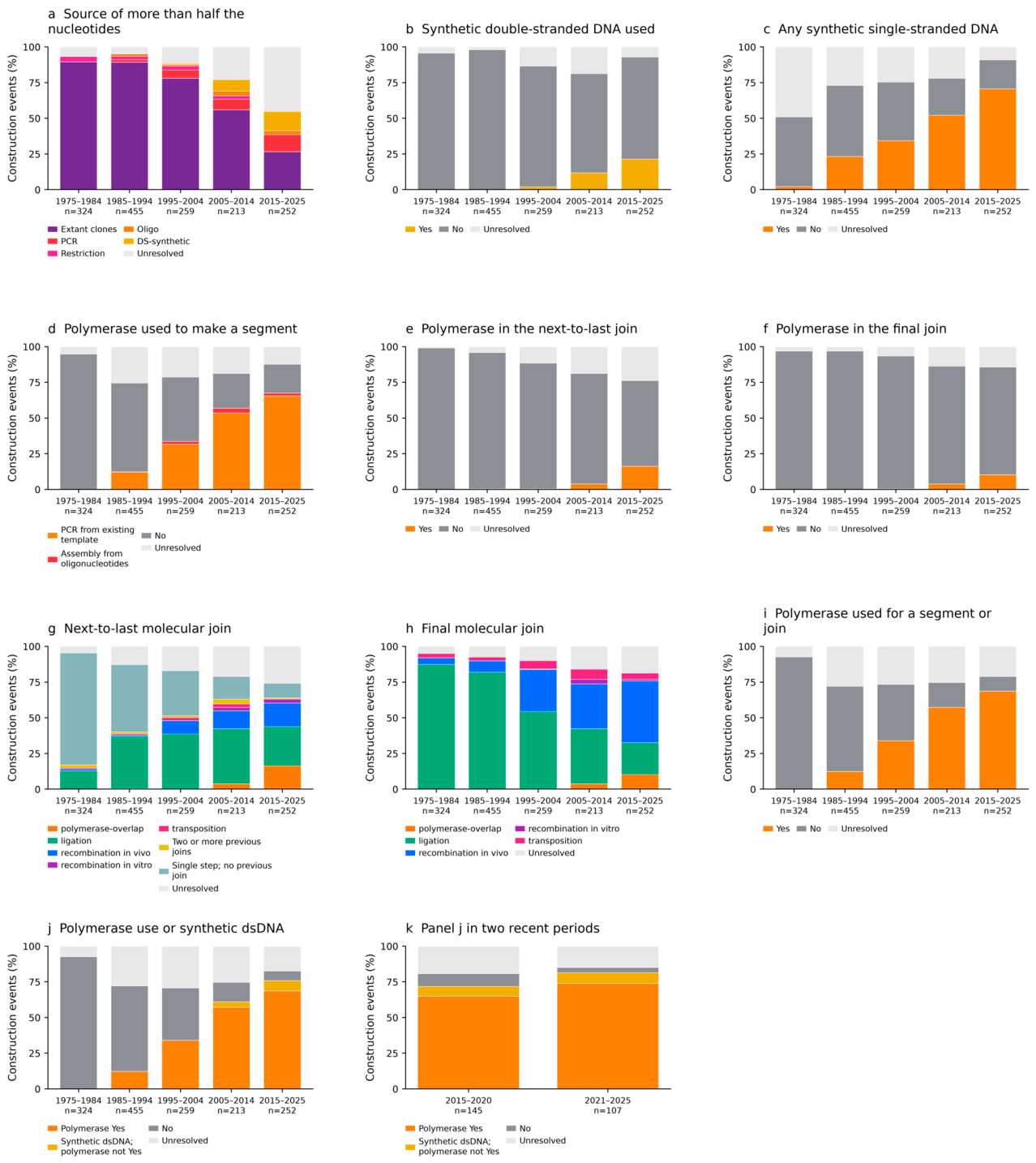
Figure 2.
Methods used 2000-2025 for "benign" GenBank deposits called "synthetic constructs" >6kb. We queried GenBank for synthetic-construct deposits 6 kb or larger (Entrez: txid32630[Organism] AND 6000:100000000[SLEN] AND gbdiv_syn[PROP]). This query returned 22,133 deposits; we set aside 19,734 records from a single knockout mouse consortium and 206 viral records. This left us with 2,193 diverse deposits, of which 866 linked to a publication (one of 218 unique papers). After screening title and metadata to avoid categories that triggered Claude 4.8 Opus, we were left with 115 papers describing "benign" constructs. We scored each paper by Genbank deposit year and scored constructs on the same axes as the journal figure. Full detail and links to the underlying files are in a companion methods document, Figure_census_methods_and_provenance_20260614.docx. a. Source of the >50% of the construct's nucleotides. In 2000–2004, preexisting cloned sequences 10 of 20 (50.0%), PCR product 2 of 20 (10.0%), short single-stranded oligonucleotides 2 of 20 (10.0%), Unresolved 6 of 20 (30.0%); in 2005–2014, preexisting cloned sequences 20 of 38 (52.6%), PCR product 7 of 38 (18.4%), assembly from short single-stranded oligonucleotides 1 of 38 (2.6%), de novo double-stranded synthetic DNA 3 of 38 (7.9%), Unresolved 7 of 38 (18.4%); in 2015–25, preexisting cloned sequences 21 of 57 (36.8%), PCR product 12 of 57 (21.1%), short single-stranded oligonucleotides 1 of 57 (1.8%), de novo double-stranded synthetic DNA 14 of 57 (24.6%), Unresolved 9 of 57 (15.8%). b. Did the construction use any commercially synthesized double-stranded DNA at all? We searched for named firms and names of particular products (named vendor or product only). Blue Heron was started in 1999 and every deposit here is from 2000 or later. In 2000–2004, no 13 of 20 (65.0%), Unresolved 7 of 20 (35.0%); in 2005–2014, yes 4 of 38 (10.5%), no 24 of 38 (63.2%), Unresolved 10 of 38 (26.3%); in 2015–25, Yes 18 of 57 (31.6%), no 27 of 57 (47.4%), Unresolved 12 of 57 (21.1%). Note that all commercially synthesized DNA uses high fidelity modern DNA polymerases. c. Was any single-stranded DNA (eg PCR primer) used at all? Unlike Figure 1, GenBank records this information for nearly every deposit. In 2000–2004, yes 19 of 20 (95.0%), Unresolved 1 of 20 (5.0%); in 2005–14, yes 35 of 38 (92.1%), Unresolved 3 of 38 (7.9%); in 2015–25, yes 54 of 57 (94.7%), Unresolved 3 of 57 (5.3%). d. Was PCR used to make any of the construct's segments? Yes counts a deposit whose methods state that any incorporated DNA segment was amplified by PCR, regardless of how the parts were later joined and is distinct from PCR used as a joining method (panels e and f). Unresolved means the methods could not be read, so the number for yes is a floor. In 2000–2004, yes 6 of 20 (30.0%), no 8 of 20 (40.0%), Unresolved 6 of 20 (30.0%); in 2005–14, yes 13 of 38 (34.2%), no 12 of 38 (31.6%), Unresolved 13 of 38 (34.2%); in 2015–25, yes 34 of 57 (59.6%), no 11 of 57 (19.3%), Unresolved 12 of 57 (21.1%). e. Was PCR used in the next-to-last assembly step? Yes when the operation before the final assembly step was a polymerase assembly (Gibson or other PCR); no when it was another operation or there was no prior step; Unresolved when the step could not be read. In 2000–2004, no 1 of 20 (5.0%), Unresolved 19 of 20 (95.0%); in 2005–14, yes 1 of 38 (2.6%), no 10 of 38 (26.3%), Unresolved 27 of 38 (71.1%); in 2015–25, yes 9 of 57 (15.8%), no 26 of 57 (45.6%), Unresolved 22 of 57 (38.6%). f. Was PCR used for the final assembly step? Yes when the final assembly operation was a polymerase assembly (Gibson or other PCR). In 2000–2004, yes 1 of 20 (5.0%), no 13 of 20 (65.0%), Unresolved 6 of 20 (30.0%); in 2005–14, yes 1 of 38 (2.6%), no 30 of 38 (78.9%), Unresolved 7 of 38 (18.4%); in 2015–25, yes 7 of 57 (12.3%), no 39 of 57 (68.4%), Unresolved 11 of 57 (19.3%).
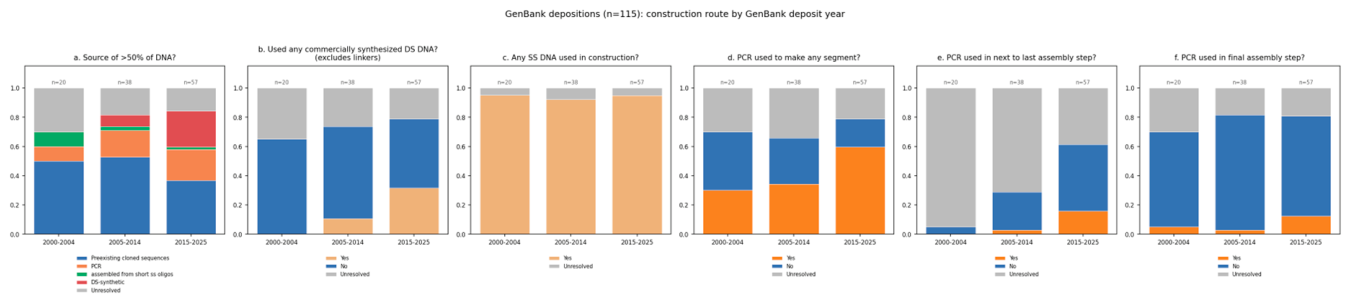
Figure 3.
Commercially synthesized double-stranded DNA (ds-DNA) was not used in most of the 21st-century virus-length DNA constructs we analyzed. Advanced PCR was used for more of them, including most of the constructs that did use commercial double-stranded DNA. The left panel contains the 572 included journal papers published during 2000–2025 in the current census. The right panel shows the 115 GenBank-linked papers used in Figure 2. Blue circles represent recorded Yes for synthetic double-stranded DNA; amber circles represent recorded Yes for polymerase use in segment production, an assembly join, or both. The post-1990 polymerases are termed advanced polymerases. Within each panel, circle and overlap areas are proportional to the numbers of constructs; the two panels use separate scales. A position outside a circle does not establish absence of use: it can reflect No, tentative No or Unresolved, as detailed below. Use of proofreading polymerases was standard by 2000. Consistent with this, for the constructs that used PCR we could identify the "construction polymerase(s)" for most. Every one of those 46 used a proofreading, high-fidelity polymerase. We suspect that PCR was used for a much larger number of these constructs, but were unable to determine a more accurate number because in this survey we did not read the full text of many of these papers. In the left panel, 84 papers record synthetic double-stranded DNA, 337 record polymerase use, and 58 record both. The regions therefore contain 26 with synthetic-DNA Yes and no recorded polymerase Yes, 58 with both Yes, and 279 with polymerase Yes and no recorded synthetic-DNA Yes. Of the 26, 11 record No for polymerase use and 15 are Unresolved. The 209 outside both recorded-Yes groups include 73 with No for both categories; the other 136 have at least one Unresolved answer. In the right panel, 22 papers record synthetic double-stranded DNA, 43 record polymerase use, and 14 record both. The corresponding regions contain eight, 14 and 29 papers. Of the eight with synthetic-DNA Yes and no recorded polymerase Yes, two record No, two tentative No and four Unresolved. The 64 outside both recorded-Yes groups include 14 with No for both categories; the other 50 retain tentative or unresolved classifications.
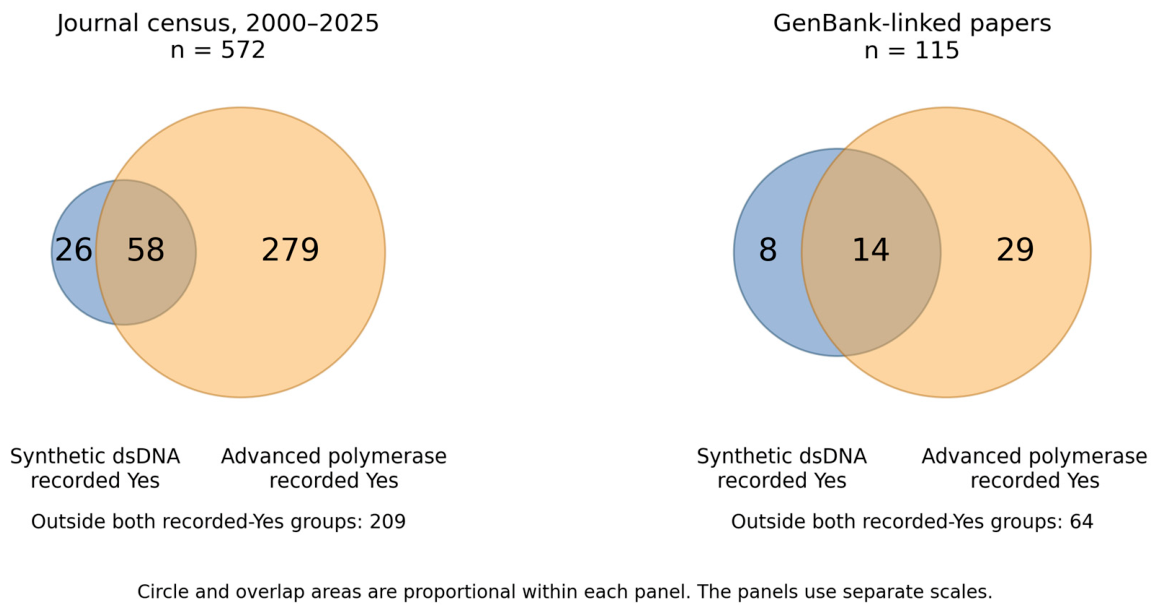
Figure 6.
A proposed "break-glass" continency regulatory regime that might be implemented in response to a triggering biological event.
Figure 6.
A proposed "break-glass" continency regulatory regime that might be implemented in response to a triggering biological event.
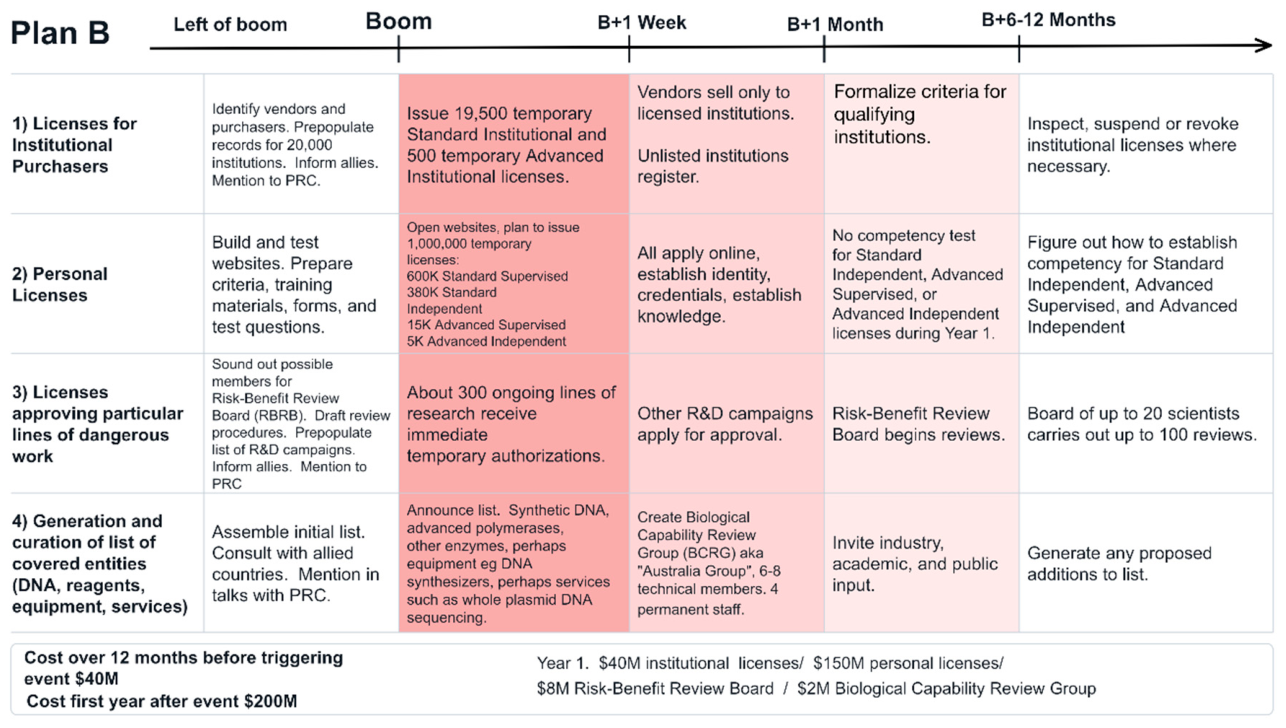

Table 1.
Some key 20th century milestones in the development of the ability to build and manipulate DNA relevant to biological weapons risk.
Table 1.
Some key 20th century milestones in the development of the ability to build and manipulate DNA relevant to biological weapons risk.
| Rapid development of in vivo genetic methods using E. coli, its episomes and phages | 1960s | Codified in Miller 1972 [1] |
| Recognition that late 1960s methods could make improved biological weapons | 1969 | Lederberg 1969 [2] |
| Working recombinant DNA in vitro | 1972–1973 | Jackson et al. 1972 [3], Cohen et al. 1973 [4] |
| DNA sequencing enables nucleotide level verification of the quality of engineering work | 1977 | Maxam and Gilbert 1977 [5], Sanger et al. 1977 [6] |
| Publication of methods books and then regularly updated methods books enables wide uptake of molecular methods throughout research and biotech enterprise. | 1982, 1987 | Maniatis et al. 1982 [7], Ausubel et al. 1987 [8] |
| Polymerase Chain Reaction (PCR) | 1986 | Mullis et al. 1986 [9] |
| Development of zero dead volume pneumatic valves enables first commercial DNA synthesizer, widening access to custom-sequence synthetic oligonucleotides used for PCR | 1987 | Horvath et al. 1987 [10] |
| Proofreading thermostable DNA polymerases enable long, faithful PCR | 1991 | Mattila et al. 1991 [11], Lundberg et al. 1991 [12] |
| GenBank accessed via internet moves from Los Alamos to the National Library of Medicine, making it easy for any researcher to get hold of any stretch of DNA by ordering oligonucleotide primers and a source DNA plasmid. | 1992 | Referenced in Benson et al. 2013 [13] |
| Mosaic web browser released, widening public access to sequence and literature | 1993 | Andreessen 1993 [14] |
| Entrez and PubMed rapidly broaden public access to the relevant literature | 1997 | National Library of Medicine 1997 [15] |
Table 2.
Some kinds of work that build large (>6 kb) DNA constructs.
| Kind of work | Typical construct size | Construct or construction act | Used for | Representative reference(s) | Notes |
| RNA-virus infectious clones / reverse genetics | ~10-32 kb | Full-length viral cDNA clone, assembled cDNA, or synthetic-genomics reconstruction of an RNA-virus genome | Reconstruct and engineer complete RNA-virus genomes | Thao et al. 2020 [68]; Xie et al. 2020 [69] | SARS-CoV-2 is a useful representative example because its genome is among the largest of many RNA-virus infectious-clone systems. |
| Herpesvirus and poxvirus BAC engineering | ~130-235 kb | Whole large DNA-virus genome maintained or manipulated as a BAC or BAC-like clone | Clone, recover, and mutagenize large DNA viruses for vaccines, vectors, and virology | Messerle et al. 1997 [70]; Domi and Moss 2002 [71] | Herpesviruses and poxviruses are both covered. |
| Self-amplifying RNA replicons and DNA templates | ~9-12 kb | Self-amplifying RNA replicon, usually made from a DNA template or plasmid coding for the replicon | Self-amplifying RNA vaccines and expression systems | Geall et al. 2012 [72] | The DNA construct is transcribed to make the RNA. |
| Artificial chromosomes: YAC, BAC, and PAC | ~0.1-1 Mb | Cloning or capture of exogenous sequences into them | Clone, propagate, map, and maintain very large genomic segments | Burke et al. 1987 [73]; Shizuya et al. 1992 [74]; Sternberg 1990 [75] | YACs carry the largest inserts. BACs and PACs are generally smaller but more stable and easier to manipulate. |
| Large-locus transgenesis and humanized animals | ~100-300 kb | Large genomic locus, BAC/YAC transgene, or other large regulatory-context construct introduced into animals | Move large genes or loci, often with native regulatory context, into animals | Yang et al. 1997 [76]; Heintz 2001 [77] | This is an umbrella category; we break out antibody-locus engineering and BAC reporters below because they have distinct literatures. |
| Plant multigene trait / pathway engineering | ~10-25 kb | Multigene plant-transformation constructs | "Stack" or reconstruct multiple trait or metabolic genes in a plant | Ye et al. 2000 [78]; Naqvi et al. 2009 [79] | Ye et al. describes Golden Rice as a multigene metabolic-pathway example; Naqvi et al. represents earlier multi-pathway plant "trait stacking". |
| Metabolic-pathway and biosynthetic-gene-cluster engineering | ~10-80 kb | Multigene pathway construct or biosynthetic gene cluster | Rebuild pathways or natural-product clusters for drugs, chemicals, and natural products in bacteria or yeast | Ro et al. 2006 [80]; Smanski et al. 2016 [81] | Ro et al. describes engineered artemisinic-acid biosynthesis. Smanski et al. describes larger biosynthetic-gene-cluster capture and refactoring. |
| Engineering probiotic commensal bacteria | 7.5kb-60 kb | Multigene pathways | Utilizing supplemental food sources or secreting proteins for probiotic effect. | Shepherd et al. 2018 [82], Whitaker et al. 2025 [83] | Shepherd et al. confers ability to use porphyran, from seaweed, Whitaker et al. 2025 degrades oxalate to prevent formation of kidney stones. |
| Synthetic, recoded, and minimal genomes | ~0.5-4 Mb | Chemically synthesized, assembled, minimized, transplanted, or recoded genome | Build synthetic-genomics "chassis" organisms; recode or minimize entire genomes | Gibson et al. 2010 [55]; Fredens et al. 2019 [84] | Most likely to rely almost completely on synthetic DNA |
| Lentiviral and retroviral gene-transfer vectors | ~8-15 kb | Integrating viral-vector genome | Stable delivery of genes or circuits | Naldini et al. 1996 [85] | |
| Non-viral DNA gene-transfer constructs | ~6-20 kb, sometimes larger | Plasmid, minicircle, or DNA-transposon construct | Deliver genes or circuits without using a viral vector | [86], Ivics et al., 1997; [87], Aronovich et al., 2011; [88], Kay et al., 2010 | This row concerns the DNA "payload" or transposon construct, delivered by the nanoparticle, lipid, or physical delivery vehicle. |
| CRISPR gene drives | ~6-20 kb | Drive cassette encoding guide RNA, nuclease, cargo, and homology structure | Bias inheritance of engineered alleles through homing or related gene-drive mechanisms | [89], Gantz and Bier, 2015; [90], Esvelt et al., 2014 | |
| Gene-targeting / large HDR donor vectors | ~6-20 kb, sometimes larger | Donor vector with homology arms and inserted, replaced, or repaired sequence | Targeted genome modification by homologous recombination or homology-directed repair | [91], Thomas and Capecchi, 1987; [92], Mansour et al., 1988 | This category includes classical gene targeting as well as later large-donor knock-ins. |
| Whole-phage engineering and refactoring | ~40-200 kb | Whole bacteriophage genome or engineered phage-genome clone | Build, refactor, or redesign phages for biology, therapy, materials, or nanoscale tools | [93], Chan et al., 2005; [67], Marinelli et al., 2012 | Chan et al. describes T7-scale refactoring; Marinelli et al. is a decent reference to phage-genome recombineering more generally. |
| Antibody / immunoglobulin-locus engineering | up to ~1 Mb | Humanized immunoglobulin locus, large transgene, or artificial-chromosome-scale antibody locus | Human-antibody evolution and production in animals carrying humanized Ig loci | [94], Lonberg et al., 1994; [95], Lonberg and Huszar, 1995 | The cited Lonberg papers used immunoglobulin miniloci (tens of kb); megabase-scale humanized Ig loci came later. |
| Organelle / chloroplast engineering | ~6-20 kb | Plastid-transformation construct or multigene plastid-expression cassette | High-level multigene expression in plastids to make transplastomic plants | [96], Svab and Maliga, 1993; [97], Zhang et al., 2015; [98], Fuentes et al., 2016 | Svab and Maliga is foundational; later plastid work better supports multigene and pathway-level chloroplast engineering. |
| Programmable integrase-mediated large-cargo insertion | ~10-36 kb | Programmable large-cargo integration construct | Insert large DNA cargoes without requiring double-strand-break-mediated HDR | [99], Yarnall et al., 2023 | |
| Xenotransplant animals via multiplex-edited genomes | genome-scale | Engineered pig genome | Make immunocompatible donor-animal genomes by combining many edits, endogenous-retrovirus inactivation, and selected knock-ins | [100], Niu et al., 2017; [101], Anand et al., 2023 | Under this table's definition, the resulting engineered pig genome is the DNA "construct". |
| BAC transgenic reporters / chromosome-scale reporters | ~100-300 kb | BAC reporter transgene preserving extended regulatory context | Make faithful expression reporters that retain native regulatory information | [102], Gong et al., 2003 |
Note. Constructs are end-product DNA constructs, engineered genomes, or stretches of DNA made by construction acts that result in products larger than 6 kb. For xenotransplantation, we define the engineered animal genome as the construct.
Table 4.
Terms used in the proposed licensing system.
| Term | Meaning |
| Covered Entities | Scheduled advanced polymerases, and other enzymes, proteins and materials placed on the published schedule, considered as physical substances, whether supplied alone or as constituents of a mixture, kit or reagent pack. Possibly includes covered equipment, including DNA synthesizers. |
| Covered Institutions | Legal entities licensed to purchase, receive, possess, distribute internally, or transfer Covered Reagents. |
| Covered Activities | Defined biological construction, recovery, propagation, engineering, or evolution operations (see Table 6) subject to the licensing system. |
| Covered Construction Activities | Those Covered Activities that consist of generating, amplifying or joining DNA, whether or not the product is intended to enable recovery of a Covered End Product. |
| Regulated Covered Construction Activities | Construction of DNA intended or reasonably capable, alone or in a planned combination, of enabling recovery, engineering, or evolution of a Covered End Product. |
| Covered End Products | Replication-competent viruses and other specifically designated biological entities, and constructs capable of producing them. |
| Institutional License | Authorization to purchase, receive, possess, control, and transfer specified classes of Covered Reagents at registered sites. |
| Standard Supervised License | Personal qualification permitting a trained person to carry out Covered Construction Activities with institutional approval, under the direct supervision of the holder of a Standard Independent License or an Advanced Independent License. |
| Standard Independent License | Personal qualification for independent ordinary construction work inside a licensed institution. |
| Advanced Supervised License | Personal qualification permitting a person to carry out Regulated Covered Construction Activities and to generate Covered End Products under the immediate and direct supervision of the holder of an Advanced Independent License. |
| Advanced Independent License | Personal qualification to participate independently in authorized work, including Regulated Covered Construction Activities and generation of Covered End Products. |
| Project Authorization | Approval of a defined high-risk R&D campaign, including its people, facilities, limits, containment, recording, and reporting duties. The entity doing the authorizing is the independent Risk-Benefit Review Board (RBRB). |
Table 5.
What each class of personal license permits.
| Class of personal license | May order Covered Entities | May carry out Covered Construction Activities | May carry out Regulated Covered Construction Activities | May generate Covered End Products |
| Standard Supervised License | No | Yes, under direct supervision | No | No |
| Standard Independent License | Yes, through the institution | Yes | No | No |
| Advanced Supervised License | No | Yes, under immediate and direct supervision | Yes, under immediate and direct supervision | Yes, under immediate and direct supervision |
| Advanced Independent License | Yes, through the institution | Yes | Yes, within an authorized project | Yes, within an authorized project |
Direct supervision of Standard Supervised License holders by holders of Standard Independent and Advanced Independent Licenses. Immediate and direct supervision of an Advanced Supervised License holder by holders of Advanced Independent Licenses. No license authorizes work at unlicensed sites, and no license authorizes an R&D campaign that requires Project Authorization under section 5.
Table 6.
R&D activities that can increase the risk that viral pathogens enter the human population and cause harm.
Table 6.
R&D activities that can increase the risk that viral pathogens enter the human population and cause harm.
| Activity | |
| 1 | Collection and transport of animal samples, and specimens; collection, transport, and housing of animals. |
| 2 | Disposal of specimens, samples, and animal remains. |
| 3 | Isolation of viruses from specimens or samples of animal species, including by growth on primate cells. |
| 4 | Recovery, generation, or “resurrection” of live viruses from nucleic acid sequences. |
| 5 | Generation of DNA constructs that enable generation, recovery, engineering, or evolution of live viruses. |
| 6 | Growth and handling of high-titer viral stocks. |
| 7 | Deliberate evolution or engineering of animal viruses resulting in changed cell type, tissue type, or species tropism. |
| 8 | Deliberate evolution or engineering of animal viruses resulting in increased transmission or contagion. |
| 9 | Deliberate evolution or engineering of animal viruses resulting in increased pathogenicity in animals or humans. |
| 10 | Deliberate evolution or engineering of viral pathogens for resistance to vaccines or therapeutic countermeasures. |
| 11 | Deliberate evolution or engineering of viral pathogens to become aerosolized more easily or to better persist in the environment. |
| 12 | Deliberate evolution or engineering of viral pathogens to evade or mislead detection and diagnosis. |
Some high risk activities. After a triggering event, ongoing activities would be grandfathered in. Assessments of R&D campaigns by an independent Risk Benefit Review Board should first cover, and either authorize, suggest surrogates, or forbid activities 3, 4, 5, 7, 8, 9, 10, 11 and 12. Additional activities might be regulated later. Carrying out 3- 12 without an Advanced Supervise or an Advanced Independent personal license would become illegal.
Disclaimer/Publisher’s Note: The statements, opinions and data contained in all publications are solely those of the individual author(s) and contributor(s) and not of MDPI and/or the editor(s). MDPI and/or the editor(s) disclaim responsibility for any injury to people or property resulting from any ideas, methods, instructions or products referred to in the content. |
© 2026 by the authors. Licensee MDPI, Basel, Switzerland. This article is an open access article distributed under the terms and conditions of the Creative Commons Attribution (CC BY) license (http://creativecommons.org/licenses/by/4.0/).
Copyright: This open access article is published under a Creative Commons CC BY 4.0 license, which permit the free download, distribution, and reuse, provided that the author and preprint are cited in any reuse.