

Submitted:
29 September 2026
Posted:
08 October 2026
You are already at the latest version
Abstract
Artificial intelligence is approaching a problem that cannot be reduced to the accumulation, retrieval, or representation of knowledge: heterogeneous bodies of knowledge must be assembled so that their local semantics can differ while their deeper structural relations remain operationally compatible. This paper proposes Artificial Science as a framework for this problem. Its central premise is that Integration Scienceidentifies portable mathematical structures across scientific domains, whereas Artificial Science converts such structural portability into executable mechanisms of knowledge transformation, composition, control, and stabilization. We develop the first unified model of this program throughgauge-symmetry knowledge assembly and formulate it as a theory of Big Knowledge Dynamics. The framework begins with a global-to-local geometric architecture in which knowledge contexts form a base space, structural symmetries act on internal representations, and connections, covariant derivatives, curvature, and holonomy govern transport across changing local frames. Within this architecture, four mechanism-specific sectors form a staged knowledge dynamics. provides the minimal model of covariant single-charge knowledge transport; provides a non-Abelian model of internally mediated multi-component assembly; supplies a doublet control architecture for externality-driven state transformation; and spontaneous symmetry breaking together with Higgs-like stabilization provides a model of locally stable yet adaptive rational organization. These sectors are not asserted to be ontologically identical to physical gauge theories. Their role is structural: each supplies a mathematically constrained interface that can be mapped into domain-specific knowledge systems and re-grounded in their own semantics. We combine these mechanisms into a staged assembly operator, ABKD = Sstab ∘ XSU(2) ∘ BSU(3) ∘ TU(1), representing transport, internal binding, externally induced transformation, and stabilization. The model separates representation change from content change, local curvature from global memory, internal mediation from external control, and stability from rigidity. Finally, we formulate a machine-facing layer in which formal objects are translated into computational objects, experimental manipulations, observable metrics, and falsifiable predictions. Gauge symmetry is thereby recast not as an analogy imported from physics but as a candidate structural technology for operational knowledge assembly. Artificial Science is proposed as the science of converting portable deep structures into executable and testable knowledge dynamics.
Keywords:
Artificial Science
; Integration Science
; Big Knowledge Dynamics
; knowledge assembly
; gauge symmetry
; U(1)
; SU(3)
; SU(2)
; spontaneous symmetry breaking
; Higgs mechanism
; holonomy
; machine experiment
; falsifiability.
1. Artificial Science and the Problem of Knowledge Assembly
Artificial intelligence has advanced rapidly in the accumulation, retrieval, transformation, and generation of knowledge. Yet increasing scale does not by itself solve a deeper problem. Knowledge that is simultaneously available within one computational system is not necessarily structurally integrated, and knowledge that is structurally integrated is not necessarily dynamically assembled. This distinction motivates the point of departure of Artificial Science. Earlier work in this program distinguished knowledge accumulation, knowledge integration, and knowledge assembly as three non-equivalent levels (Yang & Fu, 2026a). Knowledge accumulation concerns the amount of available content; knowledge integration concerns relations and shared structures among bodies of knowledge; knowledge assembly goes further by requiring heterogeneous knowledge structures to be transported, compared, coupled, recombined, differentiated, and stabilized while preserving what must remain invariant and allowing what must remain local to vary.
We therefore begin from the strict separation
This separation is not terminological. It identifies three different scientific problems.
Accumulation asks whether information or representations can be stored and accessed. Integration asks whether relations, common forms, or higher-order regularities can be recognized across previously separated knowledge domains. Assembly asks a stronger question:
The difficulty lies in the word dynamically. Knowledge assembly is not achieved merely by placing heterogeneous representations in one architecture. The assembled system must specify how one local structure is compared with another, how transformations between local frames are controlled, how internal components are coupled, how external interventions alter an assembled state, how path history is retained, and how a transformed system becomes stable without becoming rigid.
This paper proposes that these questions define a distinct scientific problem.
1.1. From Knowing to Assembling
A conventional description of an intelligent system often begins with the question:
What does the system know?
Artificial Science adds a second question:
What can the system do with differently structured knowledge?
And Big Knowledge Dynamics adds a third:
How does the structural state of knowledge change during such operations?
The progression is therefore
The first level concerns knowledge content. The second concerns relations and invariant organization. The third concerns lawful transformations of such organization.
The central claim of this paper is that the third level cannot be reduced to the first two. A system may contain many knowledge blocks without knowing how to compose them. It may discover correspondences between domains without possessing a principled transformation between them. It may transform one representation into another without preserving the structural relation that made the original representation meaningful.
Knowledge assembly therefore requires more than representation learning. It requires a theory of transformation under structural constraint.
This motivates the working definition used throughout this paper:
Artificial Science is the study and construction of executable transformations by which portable deep structures are converted into machine-realizable, experimentally testable, and dynamically composable knowledge systems.
The definition has four parts. First, Artificial Science concerns deep structures, rather than surface resemblance alone. Second, such structures must be portable, meaning that their relevant relations can be mapped across domains. Third, portability must be converted into executable transformations, rather than remaining descriptive correspondence. Fourth, those transformations must ultimately admit machine realization and experimental test.
Artificial Science therefore begins where structural comparison becomes structural operation.
1.2. Artificial Science Is Not Interdisciplinary Analogy
The present proposal must be distinguished from a looser use of interdisciplinary analogy.
If two domains use similar vocabulary, this does not establish a structural relation. If two theories invoke the same group name, this does not establish equivalence. If two systems contain three components, this does not make them SU(3) systems. If two processes exhibit path dependence, this does not make them instances of the same gauge dynamics.
Distinct domains may differ substantially in empirical objects, terminology, methods, and semantics, even when they possess a common structural organization. Sharing labels such as U(1), SU(2), or SU(3) is insufficient; a substantive cross-domain claim must specify what is preserved, such as a group action, representation, invariant, homomorphism, isomorphism, covariant relation, or some weaker structure-preserving correspondence.
Artificial Science adopts this restriction as a methodological boundary.
We do not assume
i = j
for distinct knowledge domains i and j.
Nor do we assume that a map
Φij:i → j
is scientifically meaningful merely because it can be written.
The meaningful question is instead:
Thus, the burden of an Artificial Science model is higher than the burden of analogy. It must identify a structural object, specify the transformation acting on it, state the invariants or covariant relations that survive, identify what changes under re-grounding, and indicate what observations would distinguish successful assembly from failure.
This is the first methodological discipline of Artificial Science:
Claim-status convention. Throughout this paper, five levels of assertion are kept distinct: (i) definitions introduced by the present framework; (ii) inherited mathematical facts from gauge theory; (iii) structural models that transfer selected relations into knowledge systems; (iv) empirical hypotheses that require machine or behavioral tests; and (v) machine laws, a status reserved for reproducible relations established across specified systems and conditions. No structural correspondence is treated as an empirical law merely because the source mathematics is established.
1.3. From Integration Science to Artificial Science
The present program grows directly from Integration Science.
Integration Science seeks cross-domain mathematical structure without requiring semantic identity (Yang, 2024b). Its premise is that disciplines with different empirical objects may nevertheless exhibit transferable symmetry, geometry, logic, topology, dynamics, or other invariant organization. Artificial Science makes a different move.
Integration Science asks:
What deep structure is shared?
Artificial Science asks:
What can be operationally done with the shared structure?
The transition is therefore
Or, in functional form,
The present paper makes that transition explicit and systematic.
1.4. Big Knowledge Dynamics
Once portable structure becomes operational, a further question arises: how should the resulting transformations themselves be organized?
This paper proposes Big Knowledge Dynamics as the mathematical layer of Artificial Science concerned with the lawful transformation of assembled knowledge structures.
At its most general level, Big Knowledge Dynamics studies how knowledge
under structural constraints.
These functions correspond to progressively richer problems:
The gauge-symmetry program developed in the present series provides the first concrete realization of this sequence. The global architecture is supplied by bundle, connection, curvature, and holonomy structures; U(1) supplies the minimal model of covariant transport; SU(3) supplies a non-Abelian model of internally mediated binding; SU(2) supplies a control architecture for externally induced transformation; and symmetry selection together with Higgs-like stabilization supplies the local stability layer.
This sequence is not asserted to reproduce the temporal development of physical gauge interactions, nor is it a claim that artificial intelligence literally instantiates the Standard Model. It is an Artificial Science architecture: a staged organization of mathematically distinct knowledge-assembly functions.
1.5. Gauge Symmetry as Structural Technology
Gauge symmetry is used here because it provides a disciplined language for distinguishing what changes from what should remain structurally invariant.
A local frame may change without changing the underlying relation. A transported state may accumulate path-dependent structure. Different internal operations may fail to commute. External interventions may move a state between locally organized regimes. A system may settle into a stable configuration while retaining admissible degrees of freedom.
These are not merely physical questions. They are general transformation problems.
The guiding methodological claim is therefore not
AI is a gauge field theory,
but rather
Gauge symmetry is the first structural technology of the program, not its final boundary.
2. From Integration Science to Operational Structural Portability
Artificial Science presupposes that some structures can be transferred across domains without transferring the entire semantics of those domains. This presupposition must be stated carefully.
Let
1,2,…,n
denote distinct knowledge domains. Their empirical objects may differ. Their observational vocabularies may differ. Their measurement procedures may differ. Their ontologies may differ. Their local representations may differ.
Accordingly,
i ≠ j
should be regarded as the default rather than the exception.
The possibility of Artificial Science begins not from identity of content, but from partial invariance of structure.
2.1. Shared Structure Without Semantic Identity
Suppose a domain i contains some designated structural object Si, and another domain j contains Sj. A scientifically meaningful relation between the two does not require
Si = Sj.
It requires instead an explicitly specified map
Φij:Si → Sj
together with a statement of what the map preserves.
The preserved object may be a group action, invariant, algebraic relation, logical entailment pattern, geometric quantity, topological obstruction, dynamical relation, or some weaker equivalence class.
Hence the foundational question is:
The present paper adds an operational requirement:
Thus, structural discovery and structural operation are distinct stages.
2.2. Structural Portability
We define structural portability as the capacity of a designated mathematical organization to be mapped across distinct knowledge domains while preserving specified relations.
Let
Si ⊆ i
denote the designated structural subspace of domain i, and let 𝔖 denote a common structural interface. For each domain, suppose there exists a map
Φi:Si → 𝔖.
Structural portability requires more than the existence of Φi. It requires a preservation condition.
If Ri is a designated relation in Si, and R is the corresponding relation in 𝔖, then schematically
Φi(Ri) = R,
or, more generally, the relevant diagram must commute up to the stated equivalence relation.
For a group action, for example,
Φi(ρi(g)s) = ρ(g)Φi(s).
For a differential structure, one may instead require compatibility of the form
DΦi(s)∼Φi(Dis),
where the precise meaning of ∼ depends on the domain map, bundle map, representation, and pullback structure.
The point is not to impose one universal preservation equation. The point is that the preservation rule must be stated.
Principle 1. Structural Portability Principle
A cross-domain mathematical structure is a candidate Artificial Science resource only when the domain-to-interface mapping explicitly identifies the relations that are preserved, transformed, or re-grounded.
2.3. Structural Lift and Semantic Re-Grounding
The essential operation of Artificial Science is not direct domain identification.
We do not generally require
i → j
as a direct semantic transformation.
Instead, the process is mediated by a shared structural interface:
The first map, Φi, is a structural lift. It extracts the designated transferable organization from the source domain.
The second map, Γj, is a semantic re-grounding. It realizes that organization within a target domain whose empirical meaning may differ from the source.
This distinction is fundamental.
If one writes only
i≅j,
the claim is generally too strong.
If one writes only
i∼j,
the claim is generally too weak.
Artificial Science instead asks which part of i can be lifted into a reusable structural coordinate system and then realized inside j without erasing domain-specific semantics.
Thus,
2.4. From Structural Portability to Assembly Operators
Structural portability by itself is still static.
Artificial Science requires one further step:
Let 𝔖 be a portable structural interface. An assembly operator
𝒜:𝔖 → 𝔖
acts on states represented within that interface.
The scientific content lies in the rule governing 𝒜: what is invariant, what changes, whether the operation depends on path or order, how external controls enter, whether residual memory remains, and whether the resulting state is stable.
This converts the earlier structural sequence into a stronger Artificial Science sequence:
2.5. Four Levels of Cross-Domain Claim
To prevent overstatement, we distinguish four levels of cross-domain relation.
At the weakest level is analogy:
Si∼Sj.
This states resemblance but provides no preservation theorem or operational map.
A stronger level is structural correspondence:
Φi:Si → 𝔖, Φj:Sj → 𝔖,
with some explicitly preserved relation.
A stronger level still is covariant compatibility, where operations in different domains agree under a common transformation structure:
DΦi∼ΦiDi.
The strongest level relevant to the present program is operational assemblability, where the common structure supports an executable transformation whose behavior can be measured in both source and target realizations.
Schematically,
This ordering should not be interpreted as claiming that every scientific relation must reach the final level. Some correspondences may remain descriptive. Others may support mathematical comparison but not machine implementation.
Artificial Science concerns the upper end of this hierarchy.
2.6. The Global-to-Local Structural Principle
Gauge symmetry supplies the first concrete realization of structural portability because it naturally distinguishes a shared global structure from local realizations.
Suppose a family of knowledge systems shares a structural group G.
The Artificial Science model does not begin by assuming arbitrary local gauge transformations. It begins by identifying the common structural group and then asking how that structure is locally represented.
Principle 2. Global-to-Local Structural Principle
For cross-domain knowledge assembly, identification of a common structural group precedes the construction of domain-dependent local transformation rules.
This principle is methodological rather than a universal theorem about the historical or logical origin of physical gauge symmetry.
In the present context,
Without a common structural reference, local covariance across disciplines has no defined object.
Thus,
But the converse does not automatically hold:
Shared structure does not imply complete assemblability.
Assemblability requires further compatibility conditions.
2.7. Artificial Science as a Two-Stage Transformation
We may now summarize the conceptual transition from Integration Science to Artificial Science in two stages.
The first stage is epistemic:
The second stage is operational:
Hence,
should be understood not as a taxonomy of disciplines but as a transformation in scientific function.
Integration Science tells us what can travel.
Artificial Science tells us how it travels, combines, changes, and stabilizes.
Big Knowledge Dynamics then supplies the mathematical description of that motion.
3. Big Knowledge Dynamics: A Unified Geometric Architecture
The preceding sections identified the scientific problem of Artificial Science and the methodological transition from structural portability to operational assemblability. We now require a mathematical arena in which these ideas can be expressed without collapsing distinct knowledge domains into one another.
The purpose of this section is not to derive a new physical gauge theory. It is to define a common geometric language in which heterogeneous knowledge systems can be compared, transported, coupled, transformed, and stabilized while preserving explicitly designated structural relations.
The central object will be called a Big Knowledge Dynamical Architecture.
At the most general bookkeeping level, we write
The tuple 𝔅 should not be interpreted as asserting that every artificial or cognitive system literally possesses a physical principal bundle, gauge bosons, or a Higgs field. It provides a formal architecture in which structurally distinct mechanisms may be represented using one disciplined language.
Its purpose is to distinguish, within one framework, where knowledge is situated, how local frames differ, how states are transported, how transport fails to commute, what remains after a closed path, how states transform, and how stable organization emerges.
Sector-separation rule. The symbol G in the global architecture is a placeholder for the structural group relevant to a specified sector. The U(1), SU(3), and SU(2) sectors developed below are not assumed to be one physical gauge group, nor are they silently identified with U(1) x SU(2) x SU(3). Unless an explicit product-group construction and representation are supplied, they should be read as distinct sector-specific geometries connected by Artificial Science interface maps.
These distinctions supply the common mathematical background for the U(1), SU(3), SU(2), and stabilization sectors developed below.
3.1. Knowledge Base Space
Let K denote a space of admissible knowledge contexts. A point
x ∈ K
may represent, depending on the realization, a task context, disciplinary location, agent state, representational regime, environmental condition, or other coordinate relevant to the knowledge system under study.
The interpretation of x is domain-dependent. Accordingly, K is not assumed to be a physical spacetime manifold. Its role is structural: it provides the base over which local representations vary.
We therefore take the first layer of Big Knowledge Dynamics to be
A change x → x' may alter the local representation of knowledge without necessarily altering the structural content being represented.
This distinction will later allow us to separate frame change from content change.
3.2. Principal Knowledge Bundle
Let G be a structural group associated with a family of admissible local transformations.
We introduce a principal bundle
with structure group G, schematically denoted P(K,G).
The fiber over x,
Px = π−1(x),
contains the admissible structural frames associated with that context.
A local knowledge domain is not identified with a fiber itself. Rather, a local domain or representation is described through a local section or local trivialization. Let
si:Ui → P, Ui ⊆ K.
The section si chooses a local frame over Ui.
Thus,
The bundle formalism allows both to coexist.
3.3. Associated Knowledge States
Let
ρ:G → GL(V)
be a representation of G on a vector space V. The corresponding associated bundle is
A local knowledge state may then be represented by a local section
Ψi:Ui → E.
This does not imply that every knowledge representation must literally be a vector in a fixed physical Hilbert space. Rather, it provides a sufficiently general formal setting for the gauge sectors developed later.
The pair (G,ρ) performs two different jobs: G specifies which structural transformations are admissible, whereas ρ specifies how those transformations act on the state space under consideration.
Thus,
G_i ≃ G_j does not imply ρ_i ≃ ρ_j.
A valid assembly claim must specify both the structural group and the relevant representation.
3.4. Connection and Local Knowledge Potentials
A principal connection on P is represented by a Lie-algebra-valued one-form
where 𝔤 = Lie(G).
Given a local section si, the corresponding local connection one-form is
The Ai are local representatives of the same global connection.
If two local sections are related on an overlap by sj = sihij, with
hij:Ui ∩ Uj → G,
then the local connection forms transform according to
This equation is fundamental for Artificial Science. It states that the local potential is representation-dependent, whereas the connection structure is global.
Hence,
3.5. Covariant Comparison
Ordinary differentiation cannot, in general, compare locally represented states in a frame-independent way. We therefore introduce a covariant derivative. In an abstract convention, let
where ρ*:𝔤 → 𝔤𝔩(V) is the induced Lie-algebra representation.
The precise signs and coupling constants used in particular physical sectors may differ. For example, later U(1) and SU(3) realizations may employ conventions such as
Dμ = ∂μ + iqAμ
or
Dμ = ∂μ − igAμ.
The abstract role of D is more general:
Principle 3. Covariant Comparison Principle
A cross-domain difference should not be interpreted as a structural change until the corresponding frame transformation has been accounted for.
3.6. Parallel Transport
Let
γ:[0,1] → K
be a path in the knowledge base space. The connection determines parallel transport along γ.
In a local representation,
For Abelian structures, path ordering may be unnecessary. For non-Abelian structures, it is generally essential.
The transported state is
Ψ(1) = UγΨ(0).
This gives Big Knowledge Dynamics its first genuinely dynamical notion:
Different paths may correspond to different sequences of disciplinary transformations, task transitions, representational changes, agent interactions, or interventions. Thus a knowledge state can depend not only on its endpoint, but on the route by which that endpoint was reached.
This is the mathematical entrance to structural memory.
3.7. Curvature
The curvature of the connection is
For an Abelian structure, A∧A = 0, so F = dA. For a non-Abelian structure, A∧A is generally nonzero, and the commutator structure contributes essentially to curvature.
In local coordinates,
Fμν = ∂μAν − ∂νAμ + [Aμ,Aν]
in the present abstract convention.
Curvature has a precise geometric role:
This statement should not be weakened into the claim that every observed order effect is curvature. Finite operations may fail to commute for reasons that must be modeled explicitly. Curvature becomes the relevant object only when those operations arise from the specified connection.
3.8. Holonomy and Structural Memory
Let C be a closed loop based at x ∈ K. Parallel transport around C yields
If Hol(C) = I, the state returns to itself up to the relevant equivalence. If Hol(C) ≠ I, a residual transformation remains.
This residual transformation is the geometric basis for what we call structural path memory.
A flat connection, F = 0, has trivial restricted holonomy around contractible loops under the usual conditions, but nontrivial full holonomy may still occur on a non-simply-connected base space.
Hence,
This statement will later become important for long-horizon reasoning, cyclic transformation, topological obstruction, and global knowledge memory.
3.9. Two Geometric Axes
The first is a geometric transport axis:
The second is an internal structural axis:
The first asks how knowledge moves. The second asks what internal structure is moving and transforming.
Their intersection defines the intended scope of Big Knowledge Dynamics:
This is a conceptual decomposition, not an algebraic equality.
3.10. Total Knowledge Connection
Suppose K carries an affine or metric structure with connection ∇aff, and let ∇gauge denote the internal connection acting on the associated knowledge bundle.
We define a Total Knowledge Connection by
The affine part describes how the context space itself is navigated. The gauge part describes how internal knowledge coordinates transform during that navigation.
Thus where the system moves and how its internal knowledge state transforms can be modeled jointly without being identified.
3.11. The unified Big Knowledge Object
We may now interpret the components of
𝔅 = (K,P,G,ρ,ω,D,F,Hol,,).
They represent, respectively, knowledge-context space, global structural bundle, admissible structural transformations, action on knowledge states, global connection, covariant comparison, local assembly curvature, global path memory, admissible transformation dynamics, and stabilization structure.
The first eight objects define the common geometric arena. The last two prepare the transition from geometry to dynamics.
Here will be progressively specialized into transport, binding, and externally driven transformation, while will later describe symmetry selection and local stabilization.
This leads naturally to the staged architecture
This sequence is an organizational decomposition of four distinct structural functions, not yet a universal dynamical law.
3.12. From Geometry to Mechanism
The geometry does not by itself tell us what a knowledge system will do. It tells us what a well-defined transformation architecture must keep track of.
In particular, it separates state from frame, local change from global memory, transport from internal interaction, and transformation from stabilization.
These distinctions are the mathematical prerequisites for the mechanism-specific sectors that follow.
4. U(1): Covariant Knowledge Transport
The general architecture of Big Knowledge Dynamics distinguishes local representation from structural content, connection from curvature, and transport from transformation. We now introduce the first mechanism-specific sector.
The simplest nontrivial case is Abelian transport under U(1). Its importance does not lie merely in mathematical simplicity. It supplies the minimal setting in which a knowledge state can change local phase or frame while preserving a designated structural relation.
The role of the U(1) sector is therefore not internal binding, external control, or stabilization. Its primary function is covariant transport.
We denote this transport layer by
Its defining problem is:
4.1. The Minimal Abelian Transport Structure
Let a local knowledge state be represented by Ψ(x). Under a local U(1) transformation,
We introduce
with
Then
The significance of this relation for Artificial Science is structural rather than electromagnetic. A local representation may change, but the transformation law of the covariant derivative remains controlled.
Principle 4. Covariant Transport Principle
A knowledge state may change local representation without constituting a change of designated structural content, provided the transformation is compatible with the relevant covariant transport rule.
4.2. Single-Charge Knowledge Blocks
We represent a local single-charge knowledge block in compressed form as
The entries denote the local knowledge state, charge-like source, local dynamical phase, local connection, local curvature, and sourced dynamical flow. The tuple should not be interpreted as claiming that every knowledge domain possesses literal electric charge or electromagnetic current. Its purpose is to expose the part of the local dynamics that can participate in a common Abelian transport structure.
The shared object is therefore not domain content. It is the transport architecture.
4.3. The U(1) Knowledge-Assembly Interface
Let 𝔘1 denote the common Abelian interface:
For each domain i, let Φi denote the semantic structural lift from the local knowledge block into the shared interface:
A target domain j is reached not by assuming direct identity but by semantic re-grounding:
This is the first concrete realization of structural lift followed by semantic re-grounding.
4.4. U(1)-Assemblability
A map into a common interface is not sufficient. Let
fi:i →
be the relevant base-space map on the designated shared subspace, and let be a U(1)-equivariant bundle/state map covering fi.
The following compatibility conditions may then be examined.
First, equivariance of the group action:
Second, compatibility of covariant differentiation:
Third, curvature compatibility:
whenever the geometry is defined so that this pullback relation is meaningful.
Fourth, closed-loop transport compatibility:
where ∼ denotes the equivalence appropriate to the representation.
Definition 1.
U(1)-Assemblability
Two single-charge knowledge blocks are U(1)-assemblable relative to a specified structural subspace when compatible base maps and U(1)-equivariant structural maps preserve the designated group action and covariant transport relations. A stronger form additionally preserves curvature and holonomy.
Thus,
4.5. Abelian Parallel Transport
Let C:[0,1] → be a path. The Abelian parallel-transport factor may be written as
Because U(1) is Abelian, no path-ordering operator is required.
We therefore identify the transport operator schematically as
Its role is to carry a structurally defined state across changing local frames.
4.6. Open Paths and Closed Loops
For an open path C:x0 → x1, the transport operator depends on endpoint frames and is gauge-covariant rather than gauge-invariant.
For a closed loop C,
If Hol(C) = 1, the closed transport is structurally trivial. If Hol(C) ≠ 1, a residual phase remains.
Thus we obtain the first operational distinction between endpoint identity and history identity. Two trajectories may return to the same nominal context while retaining different structural histories.
4.7. Local Flatness and Global Memory
For the Abelian U(1) sector, the curvature is
F = dA.
When
F = 0,
the connection is locally flat. Local flatness, however, does not in general imply globally trivial parallel transport. If the relevant region of the knowledge base space is not simply connected, a flat connection may still possess nontrivial holonomy around a non-contractible closed loop.
Accordingly,
for every closed loop C.
More precisely, vanishing curvature implies trivial holonomy for sufficiently small contractible loops under the usual regularity conditions, whereas global topology may still permit a nontrivial holonomy representation
Hol:π1(K,x) → U(1).
This distinction is particularly important for Big Knowledge Dynamics. A system may exhibit no detectable local curvature along a collection of pairwise transformations and yet retain a residual transformation after completing a non-contractible global cycle.
Thus,
Equivalently,
In an Artificial Science interpretation, this means that a sequence of local knowledge transformations may appear individually consistent while the complete trajectory through knowledge space still carries information about its history. The memory is then not attributable to a local mismatch alone; it belongs to the global organization of the transport process.
This observation establishes an important distinction between local assembly error and global structural memory. Nontrivial holonomy need not constitute an error. It may instead encode legitimate path-dependent information. Whether such residual structure is desirable, irrelevant, or disruptive must be determined relative to the intended assembly objective and the observable defined for the system.
Accordingly,
4.8. Dynamical Phase, Berry-Type Phase, and Gauge Holonomy
Three phase-like quantities must be distinguished.
First, a dynamical phase may arise from local evolution. Second, a Berry-type geometric phase may arise from adiabatic transport through a parameterized family of states (Berry, 1984). Third, a gauge holonomy arises from parallel transport under the connection around a closed loop.
Let |ψ(λ)⟩ be a normalized state family over parameter space. The Berry connection is
For a closed loop C,
These quantities may be related in particular models, but they are not identical by definition. A Berry-type phase should not be identified with knowledge-gauge holonomy unless a specific line-bundle identification or pullback relation has been established.
Thus,
in general.
4.9. The Transport Criterion
Let a state Ψi be structurally lifted from a source domain, transported through a sequence of local frames, and re-grounded in a target domain.
The transport is structurally successful when the designated invariant or covariant relations are preserved under that sequence. Symbolically,
for the designated invariant , or more generally when the designated relation is preserved up to the stated covariant equivalence.
This gives a precise meaning to
4.10. Transport Failure
We call transport failure any case in which a knowledge state is moved across local frames but the designated structural relation is not preserved.
Possible cases include frame mismatch, phase inconsistency, curvature-induced path distortion, nontrivial residual holonomy incompatible with the task objective, or semantic re-grounding error.
Not every nontrivial holonomy is a failure. A residual phase may encode legitimate structural memory.
Thus,
4.11. The Machine-Facing Interpretation
A local frame may correspond to a model representation, adapter, prompt context, latent coordinate system, task-specific embedding, or domain-specific module. A connection-like mechanism specifies how representations are translated or aligned across such frames. A transport operator specifies how a state is moved.
A closed-loop experiment may take the form
K1 → K2→…→Kn → K1.
If the final state differs from the initial one, a residual path effect can be measured, for example by
Δloop = D(Ψfinal,Ψinitial).
The experimental question is not simply whether the output changed, but whether the designated structural relation survived the transport.
4.12. Why U(1) Is Only the First Layer
The U(1) mechanism explains how a knowledge state may be transported covariantly through changing local frames. It does not yet explain how several internally coupled components dynamically bind into one structure.
The next question is therefore:
That question marks the transition from Abelian transport to non-Abelian internal assembly.
5. SU(3): Non-Abelian Internal Binding
The U(1) sector provides the minimal mechanism of covariant knowledge transport. Transport alone, however, does not explain how several internally coupled components become one dynamically organized system.
We therefore move from transport to internal binding:
The importance of SU(3) does not lie merely in the fact that its fundamental representation is three-dimensional. The decisive change is noncommutativity.
We denote this internal-binding sector by
Its defining question is:
5.1. SU(3) As a Structural Scaffold
Quantum chromodynamics supplies the mathematical scaffold for this sector. The relevant non-Abelian gauge structure and asymptotic-freedom background are standard results (Yang & Mills, 1954; Gross & Wilczek, 1973; Politzer, 1973; Peskin & Schroeder, 1995). The relevant inherited structures include a three-dimensional fundamental representation, a non-Abelian gauge group, Lie-algebra-valued connections, noncommuting generators, path-ordered transport, curvature containing a commutator term, internally mediated interaction, and composite-state organization.SU(3)
The claim of Artificial Science is not
knowledge systems are QCD systems.
It is narrower:
A physical gluon, a psychological mediator, and a linguistic mediator are not semantically identical objects. What may be portable is the role played by mediation inside a noncommuting internal dynamics.
5.2. The Non-Abelian Internal State
Let
Ψ ∈ ℂ3
denote a state in the fundamental representation of SU(3). Under a local transformation,
Let TA, A = 1,…,8, denote generators of 𝔰𝔲(3), with
The local connection is
Using the convention adopted for this sector,
The curvature is
Equivalently,
The commutator term is the essential departure from the Abelian sector. It means that internal transformation structure itself may contribute to curvature.
5.3. From Multiplicity to Mediated Unity
A system containing several components is not thereby an assembled system. Multiple modules, representations, or agents become one organized dynamical unit only when a rule governs their interaction.
Principle 5. Mediated Unity Principle
Multiple internal components form a dynamically assembled knowledge system only when their relations are governed by an explicit mediation structure.
In compressed form,
The mediator is not a fourth member of the triplet. It is the mechanism through which relations among components become dynamically organized.
5.4. Internal Coordinates
We use the state architecture
with three structurally distinct indices. The index a denotes the color-like internal coordinate on which SU(3) acts; f denotes a flavor-like constituent type; and g denotes a generation-like or intensity-like coordinate.
These must not be collapsed:
in structural role.
A three-level empirical pattern does not become physical generation structure merely because both have cardinality three. The relation must be stated as structural reuse.
5.5. Non-Abelian Parallel Transport
For a path C, the transport operator is
Unlike the U(1) case, path ordering is generally indispensable because the connection evaluated at different positions need not commute.
Thus,
Principle 6. Order-as-Structure Principle
In a non-Abelian knowledge-assembly process, the order of internal transformations may be part of the assembled state itself.
Equivalently,
5.6. Finite Order Sensitivity
Let two finite internal operations be represented by UA and UB. A group-level diagnostic is
If CAB = I, the operations commute. If CAB ≠ I, the system displays finite order sensitivity.
For a state Ψ, define
Finite order sensitivity must not automatically be identified with curvature. Finite noncommutativity is a property of transformation composition; curvature is the infinitesimal obstruction associated with a specified connection.
Therefore,
5.7. Curvature and Interaction-Generated Geometry
The covariant derivatives satisfy
Thus curvature measures the infinitesimal failure of covariant derivatives to commute. In the non-Abelian case, internal interaction can contribute directly to assembly geometry.
For Artificial Science, the structural interpretation is:
This is a stronger form of structural memory than in the Abelian transport sector.
5.8. Non-Abelian Holonomy
For a closed loop C,
Under a gauge transformation,
Therefore a raw holonomy matrix is frame-dependent. Gauge-invariant comparison should instead use the conjugacy class or suitable class functions such as
5.9. The SU(3) Assembly Interface
We define the non-Abelian interface schematically as
The symbol denotes the domain-specific mediation structure. It is not part of standard gauge geometry in the same sense as G, D, or F; it is an Artificial Science semantic-interface component used to mark the mechanism that plays the mediating role in a particular realization.
5.10. Weak and Strong Assemblability
A pair of knowledge blocks is weakly SU(3)-assemblable when its selected triplet structures admit equivariant maps preserving the group action:
Strong assemblability additionally requires compatibility of covariant transport and, where appropriate, curvature and holonomy.
If fi:i → is the relevant base map, curvature comparison must be formulated through the corresponding pullback geometry. Closed-loop holonomy should be compared through conjugacy-class data or characters rather than raw matrices in unrelated frames.
Therefore,
5.11. Composite States and Constituent Structure
A non-Abelian assembly model must distinguish constituent composition from internal gauge state.
In QCD, uud and udd describe flavor composition. They do not specify the color state. The color indices of a baryonic state are combined into a singlet through
Accordingly, when Artificial Science reuses proton-like or neutron-like constituent patterns, it uses a composition and dominance scaffold, not a literal physical color state.
Thus,
5.12. Fractional Contribution and Dominance
At the Artificial Science level, the portable statement is:
Let q1,q2,q3 denote constituent contributions. Then schematically,
The important distinction is between dominance and purity. A state may be dominated by one component while retaining nonzero contributions from others.
Hence,
5.13. Internal Binding as an Operator
Let
Ψ = (ψ1,ψ2,ψ3)
denote a triplet of internal components. Internal binding requires a mediation structure and an interaction operator SU(3):
The output is not mere concatenation. It is a state whose subsequent evolution depends on relations among its constituents.
Thus,
5.14. Binding Failure
We call binding failure a case in which multiple internal components are combined but fail to form a coherent dynamical structure under the designated mediation rule.
Possible signatures include uncontrolled internal conflict, order instability, mediator failure, inconsistent composite observables, uncontrolled curvature growth, or loss of designated invariant relations.
Noncommutativity itself is not failure. It is a structural resource.
Thus,
Rather,
5.15. Machine-Facing Interpretation
Suppose an AI architecture contains three interacting modules M1,M2,M3 linked through a mediation mechanism . One may compare MA∘MB with MB∘MA.
At the behavioral level, define
A nonzero value indicates order dependence. But this alone does not establish an SU(3)-type gauge architecture. A stronger test would require demonstrating that the operations instantiate the specified algebra, that infinitesimal order effects admit a connection-curvature interpretation, and that reproducible closed cycles generate the predicted holonomy structure.
Thus,
5.16. The Role of Mediation in Artificial Systems
A mediator is not merely another input variable. It is the mechanism through which otherwise distinct internal components become dynamically coupled.
In machine systems, candidate mediation mechanisms might include a shared latent routing layer, cross-attention, message passing, a constraint solver, a common workspace, a controller, or a structured interface among specialized modules.
These mechanisms do not become SU(3)-type mediators merely because they mediate. They become relevant to the present theory only if the associated transformations satisfy the required structural relations.
Thus,
unless the algebraic and geometric structure is demonstrated.
5.17. Non-Abelian Internal Binding Principle
Principle 7. Non-Abelian Internal Binding Principle
A multi-component knowledge system becomes dynamically assembled when its internal components are coupled through a mediation structure whose transformations are order-sensitive, representation-controlled, and compatible with the designated non-Abelian geometry.
The structural sequence is
This is the second mechanism of Big Knowledge Dynamics.
5.18. Possible Scale Dependence of Knowledge Coupling
Physical non-Abelian gauge theory possesses an additional important property: asymptotic freedom (Gross & Wilczek, 1973; Politzer, 1973). The present Artificial Science framework does not transfer this property directly into Big Knowledge Dynamics.
Such a transfer would first require a clear Artificial Science interpretation of scale. In a knowledge system, the relevant scale might refer to representational resolution, structural granularity, modular decomposition, or another independently defined level of organization. It would also require an effective measure of coupling among internal knowledge components and a reproducible method for determining how that coupling changes when the chosen scale changes.
Only after these quantities are operationally defined would it become meaningful to ask whether knowledge coupling exhibits a systematic scale dependence analogous in structure to the running coupling of non-Abelian gauge theory.
A future theory could therefore investigate the following possibility: at sufficiently fine structural resolution, internal knowledge components may behave with greater relative autonomy, whereas at coarser collective levels their effective coupling may become stronger. Such a pattern could be relevant to modular artificial systems in which specialized subsystems preserve local independence while participating in more strongly organized global behavior.
The present theory does not assert that such a scale law exists. In particular, non-Abelian knowledge assembly by itself does not imply knowledge asymptotic freedom. The existence, direction, and functional form of any scale-dependent coupling would have to be established theoretically and tested computationally or empirically.
If future work succeeds in defining a knowledge-resolution scale, an effective knowledge coupling, and a reproducible law governing their relation, then an Artificial Science analogue of a running coupling - and possibly of asymptotic freedom - could be formulated as a genuine component of Big Knowledge Dynamics rather than as an imported physical metaphor.
For the present paper, the question is deliberately left open.
5.19. From Internal Binding to External Transformation
The SU(3) sector solves a problem that the U(1) sector does not: how multiple internal components become one organized state. It does not yet explain what happens when an already assembled system is acted upon by an external intervention.
We therefore move from internal binding to externality-driven transformation. Within the staged architecture of this paper, the next structural transition is
This ordering is functional rather than a hierarchy of group complexity.
6. SU(2): Externality-Driven State Transformation
The SU(3) sector describes how internally differentiated components may become dynamically bound through non-Abelian mediation. Yet an assembled state is not a closed world. Knowledge systems operate under changing environments, new instructions, social influences, task demands, policy interventions, competing agents, and externally supplied information.
The next problem is therefore not internal binding but externally induced change.
We move from
The SU(2) sector provides the structural scaffold for this problem. It is used as a mathematically disciplined control architecture for two-state coupling, externally induced transition, order-sensitive intervention, post-transition memory, and open-system dynamics, not as a claim that cognition, economics, or AI literally instantiate electroweak physics.
A further boundary is required. The two-state Artificial Science doublet is not identified with proton-neutron isospin, and the present SU(2)-type control model is not a reconstruction of the full electroweak SU(2)_L x U(1)_Y theory. The transferable content is the disciplined two-state transformation structure, not the physical ontology of weak interactions.
We denote this transformation sector by
Its defining question is
6.1. The Doublet State
Let
denote a two-component structural state. The notation P and N is abstract at the Artificial Science level. In particular realizations the components may denote active versus standing-by states, achievement versus fear-dominant configurations, alternative decision regimes, or other domain-specific doublets.
For state-level analysis we may use
where r is a Bloch-type state vector and σ = (σx,σy,σz) denotes the Pauli basis.
This does not imply that the artificial system is literally a quantum two-level system. It supplies a compact geometry for controlled two-state transformation.
6.2. Externality as Control
Let denote a domain-specific externality space. An external intervention e ∈ is not itself an element of SU(2). It must first be structurally lifted into the control algebra.
We introduce
A convenient representation is
The corresponding reversible transformation is
Thus,
The map Λ is the bridge between them.
6.3. Open-System Transformation
Real knowledge systems are not perfectly reversible. External intervention may be accompanied by forgetting, noise, dissipation, memory accumulation, latent-state drift, or residual effects.
Accordingly,
where H0 specifies baseline evolution, H represents external control, R is a residual-memory variable, and collects irreversible or history-sensitive effects.
This performs an important conceptual separation:
6.4. Observable State
For a two-state architecture, a simple observable is
Then
measures the degree to which the current state occupies the designated P-like sector.
Principle 8. Operational State Principle
A latent knowledge state becomes experimentally meaningful only through a declared observation rule.
Thus,
6.5. Externality Susceptibility
Let the magnitude of an intervention be parameterized by ϵ. We may define an externality susceptibility schematically as
or by a finite-difference analogue when differential structure is unavailable.
A high value of χE indicates strong response to small perturbation. A low value indicates local resistance.
This yields a machine-relevant distinction between sensitivity and stability.
6.6. Intervention Order
For two interventions A and B, define
At the state level,
An order-sensitivity observable may be defined as
In SU(3), order concerns internal binding. In SU(2), order concerns the sequence of external interventions.
Thus,
6.7. Residual Memory
An external intervention may end while its consequences persist. We therefore enlarge the state to
Here ρt is the current doublet state and Rt records residual memory.
This allows us to separate current state from history carried by the state.
6.8. Externality Curvature and Closed-Loop Memory
Let eμ parameterize a family of external interventions. A connection on the intervention space may be written as
A = Aμ(e)deμ.
Its curvature is
Closed intervention cycles generate holonomy
For SU(2), a gauge-invariant scalar may be constructed from the trace:
A corresponding loop-memory quantity may be defined as
These objects formalize the question of whether a closed sequence of interventions leaves a residual structural effect.
6.9. Transformation Failure
We call transformation failure a case in which external intervention changes the system in a way incompatible with the intended control objective.
This may include excessive susceptibility, uncontrolled order effects, excessive residual burden, instability under repeated intervention, failure to reach the intended state, or long-horizon drift.
External responsiveness itself is not failure.
Thus,
6.10. Externality-Driven Transformation Principle
Principle 9. Externality-Driven Transformation Principle
An assembled knowledge system is adaptively transformable when domain-specific externalities can be mapped into controlled state transformations whose immediate effects, sequence dependence, residual memory, and long-horizon consequences are separately measurable.
The mechanism can be summarized as
This is the third mechanism of Big Knowledge Dynamics.
But transformation alone is insufficient. A system that can change but cannot settle remains unstable.
7. Symmetry Selection, Ordinary Rationality, and Higgs-like Stabilization
The preceding sectors describe how knowledge moves, binds, and changes. A final structural problem remains: why should an assembled and transformed knowledge system settle into a stable local organization rather than continue to drift?
We denote the stabilization sector by
Its defining problem is
7.1. The Stabilization State
The state is represented by
where Φ is the current rational or organizational configuration, M is history or memory, and S is social, contextual, or affective structure.
This separation prevents several distinct effects from being collapsed into one scalar potential. In particular, history-dependent effects such as sunk cost should not simply be treated as static terms in a memoryless potential.
7.2. Effective Landscape and State Selection
A minimal symmetric scaffold may be written as
Let Φ0 be a selected configuration. Its stabilizer subgroup is
The orbit of the selected state is
The entire vacuum set need not consist of one single group orbit. Thus the theory uses symmetry selection as a local organization principle without overclaiming global uniqueness.
7.3. Global Symmetry Breaking and Gauge-Higgs Stabilization
Two distinct mechanisms must be separated.
In a global symmetry-breaking model, a system selects one region of a degenerate set of states (Goldstone, 1961; Goldstone, Salam, & Weinberg, 1962).
In a gauge-coupled Higgs or BEH-type model, local gauge redundancy is not literally an observable physical symmetry that breaks in the naive sense (Englert & Brout, 1964; Higgs, 1964; Guralnik, Hagen, & Kibble, 1964; Elitzur, 1975). The physically relevant description concerns the organization of degrees of freedom and the resulting mass or resistance structure.
Accordingly, Artificial Science should distinguish:
7.4. Stabilization Dynamics
A minimal restoring dynamics may be represented as
where VOR is an effective ordinary-rationality landscape and u(t) represents incoming perturbation or control.
Near a selected state Φ0, let ΔΦ = Φ − Φ0. Linearized dynamics may be written
A candidate local relaxation measure is
with the warning that strongly non-normal K can display important transient behavior even when all eigenvalues have positive real part.
7.5. Anisotropic Resistance
A central consequence of Higgs-like stabilization is that not all transformation directions need have equal cost.
In a gauge-coupled model, the effective gauge-field mass matrix may be represented schematically as
up to normalization convention.
Artificial Science interprets this not as literal particle mass, but as an anisotropic resistance spectrum over transformation directions.
This yields an important principle:
A good artificial system should strongly resist irrelevant or destructive perturbations while remaining responsive along information-bearing directions.
7.6. Ordinary Rationality
The inherited ordinary-rationality program identifies eight principles: high selectivity, subjective certainty, taking null actions, sunk costs, hesitation, better life, face, and emotions.
At the Artificial Science level, we do not require every machine to implement these eight principles literally. Instead, they motivate functional questions about selection, commitment, inaction, memory, metastability, directional improvement, social feedback, and accumulated affective or contextual state.
We therefore define:
An artificial agent exhibits ordinary rationality when it possesses a locally stable cognitive-behavioral baseline that preserves designated structural invariants under non-informative perturbation, permits controlled reconfiguration under structurally significant information, retains bounded memory of relevant history, and avoids uncontrolled long-horizon drift.
7.7. Stability Versus Adaptation
Suppose the environment is unchanged and an uninformative perturbation moves the system away from Φ0. A stable system should tend to return.
But suppose the environment itself changes. Then return to the previous state may be maladaptive. The correct behavior may instead be transition to a new basin.
Thus,
Stable intelligence must know when to return and when to leave.
7.8. Recoverability, Adaptation Threshold, and Return Time
Let Rrec measure recoverability after admissible perturbation. Let Acrit denote a perturbation threshold required to force basin escape, relative to a declared intervention family and time horizon. Let Treturn measure settling or return time after perturbation.
These quantities become meaningful only relative to a chosen state representation, metric, intervention family, observation rule, and equivalence criterion.
A candidate stable-adaptability region can therefore be represented schematically by
The point is not a universal numerical threshold. It is the simultaneous requirement of local stability, sufficient recoverability, and a finite adaptation barrier.
7.9. Observation and Identifiability
Since Φ, M, and S are typically latent variables, experimental work requires an observation map
where Y may include outputs, probe responses, action distributions, internal activations, trajectories, or other declared observables.
If two latent parameterizations yield indistinguishable observations under the declared interventions, they should be treated as observationally equivalent.
Principle 10. Observable Stabilization Principle
A claim about latent stability is scientifically meaningful only relative to declared perturbations, metrics, observation maps, and equivalence criteria.
7.10. Stabilization Failure
We call stabilization failure any case in which a transformed system cannot maintain or recover an appropriate local organization.
Both extremes are failures:
The target is
7.11. Symmetry-Constrained Adaptability Principle
Principle 11. Symmetry-Constrained Adaptability Principle
A knowledge system is stably intelligent when it preserves selected structural invariants against irrelevant perturbation while permitting controlled transition under structurally significant change.
Hence,
8. The Unified Gauge-Symmetry Assembly Model
We can now perform the step that none of the component papers, taken separately, could accomplish.
The four mechanisms are not merely adjacent analogies. They form a staged grammar of knowledge assembly:
Placed inside the global architecture established in Section 3, this yields the first unified gauge-symmetry model of Big Knowledge Dynamics.
8.1. The Staged Assembly Operator
Define the Big Knowledge Assembly operator schematically by
The four components have distinct functional roles: U(1) is covariant transport; SU(3) is internally mediated binding; SU(2) is externality-driven transformation; and stab is symmetry-constrained stabilization.
The composition symbol is structural. It does not assert that every artificial system must execute four literal computational modules in this temporal order. Rather, it expresses the functional completeness of the assembly problem.
Composition rule. The composition symbol in the staged operator denotes functional staging after the output of one sector has been mapped into the admissible state space of the next. It is therefore shorthand for interface-mediated composition, not ordinary multiplication of operators acting on one fixed Hilbert space or one common gauge representation. A concrete implementation must specify those interface maps.
A knowledge system must answer four questions: How can knowledge move? How can internal components become one organized system? How can that system change under external influence? How can the changed system become stably adaptive?
The resulting architecture should therefore be read as a typed composition: transport, binding, transformation, and stabilization are different operations with different state variables and empirical signatures. Their unification is functional and architectural, not an assertion that their source gauge groups are interchangeable.
8.2. The Assembly Cycle
The sequence becomes more powerful when recognized as a cycle rather than a one-pass pipeline. A stabilized state becomes the starting point for the next round of transport, binding, and transformation.
Thus,
Repeated application yields
This turns Big Knowledge Dynamics from a static taxonomy into a theory of evolving knowledge organization.
8.3. Four Conserved Distinctions
The unified model depends on preserving four distinctions throughout the assembly cycle:
These distinctions function as conceptual invariants of the theory.
8.4. Assembly-State Decomposition
At a given stage t, let the total state be represented abstractly by
where Xt denotes representational/contextual position, It denotes internal organization, Et denotes current external-control conditions, Rt denotes residual/path memory, and St denotes stabilization state.
The exact coordinates are realization-dependent. The purpose of the decomposition is functional: it ensures that a difference caused by frame change is not confused with one caused by internal rebinding, external intervention, residual accumulation, or basin change.
8.5. Four Failure Classes
The unified model naturally generates four primary failure modes:
- Transport failure: the intended invariant is lost during movement across local frames.
- Binding failure: internally differentiated components fail to form a controlled composite state.
- Transformation failure: external intervention produces uncontrolled, unintended, or poorly measurable change.
- Stabilization failure: the transformed state either drifts uncontrollably or becomes rigid and unable to adapt.
Thus,
Artificial Science is no longer asking only whether an AI answer is correct. It asks where in the assembly dynamics failure occurred.
8.6. Local and Global Assembly
A system can be locally successful yet globally defective. Pairwise mappings may preserve their intended relations while a long cycle accumulates nontrivial holonomy. Individual modules may work correctly while their ordering produces unwanted composite behavior. A control step may be locally effective while residual memory creates later drift. A stable local basin may be individually robust while globally trapping the system in an obsolete organization.
Thus,
Local correctness does not imply global assemblability.
This is one of the most important consequences of the unified theory.
8.7. The Artificial Standard Model as Functional Architecture
The phrase Artificial Standard Model is retained only as the historical programmatic label for this sequence. The more precise object developed here is an Artificial Gauge-Assembly Architecture: a functional organization of transport, binding, external transformation, and stabilization. It does not assert that AI reproduces the physical Standard Model or that the sector order is a hierarchy of gauge-theoretic complexity.
Accordingly,
This is an Artificial Science reconstruction, not a physical identification.
8.8. Big Knowledge Dynamics
The unified model permits a concise definition:
Big Knowledge Dynamics is the study of how structurally portable knowledge states are transported, internally assembled, externally transformed, globally remembered, and locally stabilized under explicitly declared structural constraints.
Gauge symmetry supplies the first complete worked architecture. The same Artificial Science program can later ask whether relativistic, topological, linguistic, metalogical, or other deep structures can be converted into additional operational technologies.
9. Machine Realization, Experimental Metrics, and Falsifiability
A mathematical structure becomes an Artificial Science mechanism only when it can, at least in principle, be connected to machine objects, interventions, observations, and possible failure.
This section introduces the experimental translation rule:
This is the point at which Big Knowledge Dynamics leaves pure structural theory and enters machine science.
9.1. Experimental Object
For any proposed mechanism, the first question is:
Candidate objects may include a latent representation, prompt-conditioned state, recurrent memory state, agent configuration, modular network state, routing state, knowledge graph state, controller state, or observable input-output distribution.
The theory should not infer the machine object retrospectively from results. It should be declared before the relevant test.
9.2. State
The second question is:
A state may be directly observable or latent. If latent, the experiment must specify an observation map
:Z → Y.
Different latent descriptions that are observationally indistinguishable under the declared intervention family should not be treated as empirically distinct without additional evidence.
9.3. Operation
The third question is:
For the four sectors:
U(1): frame or domain transport,
SU(3): internal composition or mediation,
SU(2): external intervention,
stabilization: perturbation and recovery.
These operations should be implemented in machine-reproducible form.
9.4. Measurement
The fourth question is:
For transport, one may measure loop residual or invariant preservation:
For internal binding, one may measure order sensitivity:
For external transformation, one may estimate susceptibility χE, intervention-order sensitivity , and long-horizon drift ΔT.
For stabilization, one may estimate Rrec, Acrit, and Treturn.
9.5. Minimal Falsification Criterion
Every proposed Artificial Science mechanism must specify what observation would count against it. A structural correspondence that can accommodate any result is not yet an empirical theory.
For U(1), failure may occur if the proposed invariant is not preserved under the declared transport. For SU(3), failure may occur if the predicted order structure or mediation dependence is absent. For SU(2), failure may occur if externally induced transitions do not follow the proposed control organization. For stabilization, failure may occur if the predicted recovery, threshold, or anisotropic response is not observed.
Principle 12. Falsifiable Assembly Principle
A proposed Artificial Science mechanism becomes empirically substantive only when its declared structural relations exclude some possible observations.
This principle separates formal elegance from empirical adequacy.
9.6. The Minimal Experiment Matrix
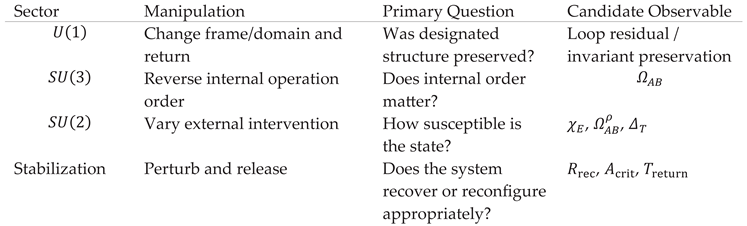
This matrix marks the transition from theoretical architecture to experimental program.
9.6.1. A Minimal Order-Effect Experiment
A minimal falsifiable implementation can be constructed without first building a new model architecture. Fix an initial machine state rho_0, two interventions A and B, the model version, decoding parameters, task content, and random-seed policy. Run the two sequences A followed by B and B followed by A, and compare the resulting states or declared behavioral observables with a preregistered distance D. The order statistic is Omega_AB = D(T_B T_A(rho_0), T_A T_B(rho_0)). A nonzero result establishes an order effect, not yet a gauge curvature. The stronger non-Abelian claim additionally requires a specified connection, a reproducible transformation algebra, and evidence that the finite-order effect is compatible with the corresponding local curvature structure.
This design supplies a decisive methodological control: the same starting state and the same two operations are used in both conditions; only their order changes. It therefore separates generic performance differences from the specific prediction that sequence can belong to the structure of an assembled state.
9.7. From Model Analogy to Machine Law
The strongest possible outcome would be a progression through four levels:
Not every proposal will reach the final level, nor should it be forced to. Artificial Science gains rigor by allowing some hypotheses to fail or remain incomplete.
A machine law is earned only when the relevant variables, interventions, and relationships are reproducible across appropriate systems and conditions.
Accordingly, the present paper should be read as a foundational formal framework with explicit empirical commitments. It proposes candidate mechanisms and diagnostics; it does not report completed machine experiments establishing the full gauge-assembly architecture as an empirical law.
10. Principles of Artificial Science and the Big Knowledge Program
The unified gauge-symmetry model can now be viewed from a broader perspective.
The objective of this paper has not been to enlarge the vocabulary of artificial intelligence with terms borrowed from theoretical physics. Its objective has been to demonstrate a method.
Relative to the five precursor studies, the novelty of the present paper lies in the unified typed architecture, the explicit separation of sector functions, the interface-mediated staged operator, the cross-sector failure taxonomy, and the common machine-facing falsification layer. The component gauge mechanisms are inherited and tightened; their integration into one operational Artificial Science grammar is the new theoretical contribution.
Integration Science identifies portable deep structures across domains. Artificial Science asks whether those structures can be converted into operational mechanisms. Big Knowledge Dynamics asks how such mechanisms move, compose, transform, remember, and stabilize knowledge.
The resulting program is therefore
Integration Science → Structural Portability → Artificial Science→ Big Knowledge Dynamics → Machine Experiment
10.1. Twelve Principles
The argument of this paper can be summarized in twelve principles.
Principle 1 - Structural Portability. A cross-domain structure becomes an Artificial Science resource only when the relations preserved, transformed, or re-grounded are explicitly stated.
Principle 2 - Global-to-Local Structure. A common structural reference is required before domain-dependent local covariance can be meaningfully compared.
Principle 3 - Covariant Comparison. A representational difference should not be interpreted as structural change until local-frame transformation has been accounted for.
Principle 4 - Covariant Transport. Knowledge may move across changing local representations while designated structural relations remain transportable.
Principle 5 - Mediated Unity. Multiplicity alone does not produce an assembled system; dynamic mediation is required.
Principle 6 - Order as Structure. In non-Abelian assembly, transformation order may itself belong to the structure of the state.
Principle 7 - Non-Abelian Internal Binding. Internal components become dynamically assembled through order-sensitive, representation-controlled, mediated interaction.
Principle 8 - Operational State. A latent state becomes scientifically meaningful through a declared observation rule.
Principle 9 - Externality-Driven Transformation. Adaptive systems must support controlled state change under domain-specific external influence.
Principle 10 - Observable Stabilization. Claims about latent stability require declared perturbations, metrics, observation maps, and equivalence criteria.
Principle 11 - Symmetry-Constrained Adaptability. Stable intelligence preserves relevant structure without suppressing informative change.
Principle 12 - Falsifiable Assembly. An Artificial Science mechanism becomes empirically substantive only when it excludes possible observations.
Together these principles define the methodological core of the present theory.
10.2. The Deep Transition
The transition proposed in this paper can be compressed into three scientific levels:
The first belongs primarily to Integration Science. The second marks the beginning of Artificial Science. The third turns Artificial Science into an empirical and engineering program.
Thus,
But it does not end there. It matures when structural operation becomes experimentally accountable.
10.3. Beyond Gauge Symmetry
Gauge symmetry is only the first completed structural technology in this program.
For any candidate structure, Artificial Science asks:
Future developments may extend Big Knowledge Dynamics toward relativistic structures, language architecture, metalogic, topology, multi-agent interaction, or other domains without requiring them to be reduced to the gauge model established here.
10.4. From Theory to Engineering
The present framework suggests a direct engineering decomposition:
A future artificial system need not instantiate these as four literal software modules. But any architecture claiming general knowledge assembly must solve their functional equivalents.
A model may be strong at transport but weak at binding. It may bind knowledge effectively but be excessively susceptible to external perturbation. It may transform flexibly but fail to stabilize. It may be stable but unable to escape obsolete states.
Big Knowledge Dynamics turns these from vague performance impressions into distinct scientific questions.
10.5. From Theory to Experiment
The same framework gives an experimental progression:
This progression provides the bridge between formal theory and machine experimentation. It also establishes a research discipline: every new structural proposal should ultimately specify these four items before claiming empirical realization.
10.6. From Theory to Knowledge Production
Artificial Science also changes the organization of research itself.
If portable structure can be turned into explicit operators and those operators can be implemented and experimentally tested, then theory construction, machine design, experimentation, and knowledge revision become parts of one loop:
The knowledge generated by the loop is not simply accumulated. It changes the structure of the next round of inquiry.
Artificial Science is therefore itself a knowledge-assembly process.
10.7. Conclusions
This paper has developed gauge symmetry from a cross-disciplinary mathematical structure into a staged model of Artificial Science.
The complete sequence is
Global Architecture → U(1) Transport → SU(3) Binding→ SU(2) Transformation → Symmetry-Constrained Stabilization
The sequence is functional rather than a hierarchy of physical gauge groups. Its purpose is to describe four distinct problems of knowledge assembly inside one geometric and dynamical architecture.
The resulting Big Knowledge Dynamics model can be summarized by
The operator is not proposed as a universal physical law of artificial intelligence. It is a formal statement of the staged functional architecture developed in this paper. Its scientific status depends on successful structural mapping, machine realization, measurement, and falsification.
The central transition can finally be stated in its simplest form:
Artificial Science converts them into executableknowledge dynamics.
And the governing problem of Big Knowledge Dynamics is therefore:
How can knowledge move, bind, change, remember,and stabilize without losing the structure that makes it knowledge?
That question defines the program begun here.
References
- Baez, J. C.; Muniain, J. P. Gauge Fields, Knots and Gravity; World Scientific, 1994. [Google Scholar]
- Berry, M. V. Quantal phase factors accompanying adiabatic changes. Proc. R. Soc. Lond. A 1984, 392, 45–57. [Google Scholar] [CrossRef]
- Elitzur, S. Impossibility of spontaneously breaking local symmetries. Phys. Rev. D. 1975, 12, 3978–3982. [Google Scholar] [CrossRef]
- Englert, F.; Brout, R. Broken symmetry and the mass of gauge vector mesons. Phys. Rev. Lett. 1964, 13, 321–323. [Google Scholar] [CrossRef]
- Frankel, T. The Geometry of Physics: An Introduction, 3rd ed.; Cambridge University Press, 2011. [Google Scholar]
- Goldstone, J. Field theories with “superconductor” solutions. Il Nuovo Cim. 1961, 19, 154–164. [Google Scholar] [CrossRef]
- Goldstone, J.; Salam, A.; Weinberg, S. Broken symmetries. Phys. Rev. 1962, 127, 965–970. [Google Scholar] [CrossRef]
- Gross, D. J.; Wilczek, F. Ultraviolet behavior of non-Abelian gauge theories. Phys. Rev. Lett. 1973, 30, 1343–1346. [Google Scholar] [CrossRef]
- Guralnik, G. S.; Hagen, C. R.; Kibble, T. W. B. Global conservation laws and massless particles. Phys. Rev. Lett. 1964, 13, 585–587. [Google Scholar] [CrossRef]
- Higgs, P. W. Broken symmetries and the masses of gauge bosons. Phys. Rev. Lett. 1964, 13, 508–509. [Google Scholar] [CrossRef]
- Kobayashi, S.; Nomizu, K. Foundations of Differential Geometry; Interscience, 1963; Vol. I. [Google Scholar]
- Nakahara, M. Geometry, Topology and Physics, 2nd ed.; Institute of Physics Publishing, 2003. [Google Scholar]
- Peskin, M. E.; Schroeder, D. V. An Introduction to Quantum Field Theory; Addison-Wesley, 1995. [Google Scholar]
- Politzer, H. D. Reliable perturbative results for strong interactions? Phys. Rev. Lett. 1973, 30, 1346–1349. [Google Scholar] [CrossRef]
- Yang, C. N. Integral formalism for gauge fields. Phys. Rev. Lett. 1974, 33, 445–447. [Google Scholar] [CrossRef]
- Yang, C. N.; Mills, R. L. Conservation of isotopic spin and isotopic gauge invariance. Phys. Rev. 1954, 96, 191–195. [Google Scholar] [CrossRef]
- Yang, Y. Principles of Economic Externality Dynamics: Economic Dynamics and the Standard Model (V). J. Electr. Electron. Eng. 2024a, 3, 1–13. [Google Scholar] [CrossRef]
- Yang, Y. Principles of Integration Science: Its Content, Methods, and Significance. Preprints 2024b. [Google Scholar] [CrossRef]
- Yang, Y. Principles of Market Dynamics: Economic Dynamics and Standard Model (II). Preprints 2024c. [Google Scholar] [CrossRef]
- Yang, Y. Principles of Reasoning Dynamics; Preprints, 2024d. [Google Scholar] [CrossRef]
- Yang, Y. Principles of the Sub-Econ Dynamics: The Econ-Dynamics and the Standard Model (III). Preprints 2024e. [Google Scholar] [CrossRef]
- Yang, Y. The Topics, Methods, and Significance of a Higher Cognition Theory; Preprints, 2024f. [Google Scholar] [CrossRef]
- Yang, Y. Maxwell and Artificial Intelligence: Preliminary QED Models of AI (LLM) Dynamics. Preprints 2025a. [Google Scholar] [CrossRef]
- Yang, Y. Maxwell Equations and Artificial Intelligence with Thought Experiments. Preprints 2025b. [Google Scholar] [CrossRef]
- Yang, Y.; Braine, M. D. S.; O’Brien, D. P. Some empirical justifications of one mental predicate-logic model. In Mental Logic; Braine, M. D. S., O’Brien, D. P., Eds.; Lawrence Erlbaum Associates, 1998; pp. 333–368. [Google Scholar]
- Yang, Y.; Fu, X. Gauge Symmetry Structures and Big Knowledge Assembly Dynamics: Principles of Artificial Science I (1); Preprints, 2026a. [Google Scholar] [CrossRef]
- Yang, Y.; Fu, X. Single-Charge Knowledge-System Assembly and U(1) Symmetry: Principles of Artificial Science I (2); Preprints, 2026b. [Google Scholar] [CrossRef]
- Yang, Y.; Fu, X. Three-Charge Knowledge-System Assembly and SU(3) Symmetry: Principles of Artificial Science I (3). Preprint manuscript. 2026c. [Google Scholar] [CrossRef]
- Yang, Y.; Fu, X. Doublet Knowledge-System Assembly and SU(2) Symmetry: Principles of Artificial Science I (4). Preprint manuscript. 2026d. [Google Scholar] [CrossRef]
- Yang, Y.; Fu, X. Ordinary Rationality, the Higgs Mechanism, and Spontaneous Gauge-Symmetry Breaking: Principles of Artificial Science I (5). Preprint manuscript. 2026e. [Google Scholar] [CrossRef]
Disclaimer/Publisher’s Note: The statements, opinions and data contained in all publications are solely those of the individual author(s) and contributor(s) and not of MDPI and/or the editor(s). MDPI and/or the editor(s) disclaim responsibility for any injury to people or property resulting from any ideas, methods, instructions or products referred to in the content. |
© 2026 by the authors. Licensee MDPI, Basel, Switzerland. This article is an open access article distributed under the terms and conditions of the Creative Commons Attribution (CC BY) license (http://creativecommons.org/licenses/by/4.0/).
Copyright: This open access article is published under a Creative Commons CC BY 4.0 license, which permit the free download, distribution, and reuse, provided that the author and preprint are cited in any reuse.