

Submitted:
06 October 2026
Posted:
08 October 2026
You are already at the latest version
Abstract
Aided phytostabilization—combining soil amendments with tolerant vegetation—has proven effective improving soil properties and reducing potentially toxic elements (PTE) mobility in polluted soils, yet long-term studies are scarce. This study evaluates the 10-year evolution of an undergoing (aided) phytostabilization field trial at a former Cu mine in Touro (NW Spain), comparing different strategies for soil recovery and PTE immobilization. The mine soil (Spolic Technosol) was extremely acidic, nutrient-depleted, and virtually devoid of vegetation. Three amendments—compost (PC) and two technosols (PT1, PT2)—were assayed. Three planting treatments—Agrostis capillaris, AGR; Salix viminalis, SAL; unplanted, UNP—were established. Soil samples were collected before amendment applications and 1, 2, 3, 6 and 10 years after, then analyzed for pH, total C and N, POlsen, CECe and exchangeable cations, pseudo-total and readily available PTEs. All amendments immediately improved soil fertility and mitigated Cu availability (up to 3 orders of magnitude), thereby enabling vegetation establishment. Different amendments led to distinct initial trajectories that gradually converged toward a common pattern of long-term soil recovery. Aided phytostabilization effectively restored mine soil functionality for over a decade, but amendment choice should be aligned with site-specific recovery objectives and monitoring plans.
Keywords:
mine soils
; potentially toxic elements
; phytostabilization
; soil amendments
; sewage sludge
; compost
; technosols
; long-term restoration
1. Introduction
Mining and processing of mineral resources enable human socio-economic development. However, they also lead to significant socio-environmental degradation, particularly in open-pit operations and where environmental regulation, waste management, or post-closure restoration are inadequate [1]. Mining activities cause extensive environmental destruction, with severe and recurring impacts on soil, such as subsidence, sealing, generation of abrupt topography, compaction, erosion, and chemical contamination, particularly from potentially toxic elements (PTE) [1,2]. These elements, which include metals and metalloids such as As, Cd, Cr, Cu, Ni, Pb, Se and Zn (among others) occur naturally in the soil, but mining activity alters their concentration, distribution, and mobility, leading to potential environmental risk [3,4]. Often in metal mining, the exposure of sulfides promotes oxidation processes that may cause severe acidification in the environment, further increasing Fe and PTE solubility [5,6,7]. As a result, many metal mining soils exhibit high toxicity and infertility, with low organic matter content, low cation exchange capacity and water-holding capacity, and low biodiversity [8,9,10]. Global mining land use is estimated at 101,583 km2 and, due to digital and energy transitions’ growing demand for strategic minerals, it is expanding at the faster rate ever in History [11]. Metal mining is a substantial and critical component of this footprint and represents one of the main pressures on global biodiversity decline [12].
The negative impacts of mining call for the implementation of sustainable restoration strategies. In this context, phytoremediation was proposed as an ecological restoration strategy aimed at reducing the environmental risk posed by degraded sites through the use of plants and related agronomic practices. It generally involves establishing an in situ vegetation cover that harnesses solar energy through photosynthesis. That vegetation can simultaneously reduce PTE availability and mobility, produce valuable biomass, and contribute to the development of soil functionality with minimal energy input [13,14,15]. Therefore, it represents a less intensive alternative – both economically and environmentally – than conventional techniques (e.g., excavation, containment, and chemical extraction of contaminants), and its implementation is supported by various scientific societies, such as the International Phytotechnology Society, the Society of Environmental Toxicology and Chemistry (SETAC), and the Society for Ecological Restoration [16]. However, its application requires site-specific studies, appropriate plant selection (species and intraspecific variation) and management techniques, as well as medium-to-long-term maintenance and monitoring [10,17,18].
Among phytoremediation strategies, phytostabilization aims to establish a stable vegetation cover to promote the retention of pollutants in the soil, thereby reducing their mobility, bioavailability, and dispersion into other environmental compartments [13,14]. Certain herbaceous species – for example, within the genus Agrostis – and woody species from genera such as Salix and Populus have drawn significant interest in phytostabilization projects due to their tolerance to PTE pollution, ability to thrive in oligotrophic soils, and high productivity [15,18,19]. Particular plant traits such as the restriction of pollutants’ translocation into above-ground biomass, or its retention in the rhizosphere or underground organs are specifically selected [10,17,20].
In degraded sites, adverse soil properties hinder the establishment of vegetation cover. Therefore, aided phytoremediation, that is phytoremediation assisted by soil amendments, has been proved as an effective strategy for improving soil conditions and mitigating the bioavailability of PTEs [13,14,21,22]. Liming agents, such as phosphates and apatite, Fe-, Al-, Mn-(hydr)oxides, biomass ashes, paper mill sludge, and organic wastes have been widely used in various remediation, including phytostabilization, trials [23,24,25,26]. These amendments can correct physical, chemical, and biological limitations through processes such as particle aggregation, moisture retention, acid neutralization, the addition of organic matter and nutrients, and/or the immobilization of PTEs (by adsorption, precipitation, organic complexation, or incorporation into poorly soluble mineral phases), among others. Among organic soil amendments, compost stands out for its multifunctionality: supplying carbon and nutrients, improving soil structure, buffering pH, and creating stable organometallic complexes [10,18,23,27]. In recent years, this approach has been expanded through the design of complex amendments and technosols derived from organic, mineral, or industrial byproducts and waste materials [28,29]. These amendments can be formulated to perform specific functions, such as regulating pH, supplying basic cations, increasing cation exchange capacity, improving water retention, or immobilizing PTEs [30]. Thus, the use of compost and designed technosols allows for soil restoration coupled with waste recovery opportunities, in line with the principles of the circular economy and carbon sequestration [31]. However, these materials may also contain PTEs or other hazardous components [32,33], so their effectiveness must be evaluated not only in terms of initial soil improvement but also with regard to the long-term stability of their effects.
The development of a vegetation cover also promotes gradual recovery of the edaphic ecosystem’s functionality. Plants physically stabilize the soil, reduce erosion, activate biogeochemical cycles, increase organic carbon inputs, and can improve soil structure and microbial activity [10,13,18,34]. When these processes are integrated, in an aided phytoremediation framework, with harvesting, the approach aligns with the concept of phytomanagement, understood as the sustainable management of contaminated sites that combines risk reduction, ecological restoration, and the generation of environmental or productive value [15,35,36]. In the case of woody species, their management in short-rotation systems can also facilitate the use of biomass for material or energy purposes [14,15], provided that the risk associated with the accumulation of PTEs is properly assessed.
On the other hand, time is an important factor to consider. Although amendments can lead to rapid improvements in pH, fertility, and PTE availability, the functional recovery of mine soils is typically slow and depends on complex environmental dynamics (e.g., plant-soil interaction, edaphic processes, weather patterns). Therefore, long-term monitoring is essential [15], especially in mine soils, which exhibit high spatial heterogeneity associated with both the original arrangement of materials and earthworks during mining operations and restoration efforts [9,18].
The effect of soil amendments and vegetation on soil properties in mining environments has been evaluated by various authors; however, most of these studies have been conducted under greenhouse conditions or over relatively short periods of time [10,13,24,28,37,38]. Long-term field studies are less common and, in many cases, are based on one-time sampling or chronosequences established across different areas [39,40]. In this context, periodic monitoring of the same plots is particularly useful for tracking processes, limiting the effect of spatial variability, and strengthening the robustness of the conclusions. This study evaluates the long-term evolution of a hyperacidic mine soil – poor in organic matter and nutrients but high in Cu – following the application of various aided phytostabilization strategies. Particularly, the study compares the effects of a compost-based organic amendment and two technosols on general soil properties, plant nutrients and available PTE fractions. It also analyzes the role of different vegetation covers in the system’s evolution. The initial hypothesis is that soil amendments immediately improve fertility conditions and reduce the availability of PTEs, but that the persistence of these effects depends on the type of amendment, the presence of vegetation, and the temporal evolution of the soil-plant system.
2. Materials and Methods
2.1. Location
The trial was conducted on a mine spoil heap in a former copper mine at Touro municipality (A Coruña, northwestern Spain; ETRS89 datum: 42° 52’ 34” N, 8° 20’ 40” W), being part of “PhytoSUDOE” network of phytomanaged sites (Phy2SUDOE Project, SOE4/P5/E1021). The climate is Atlantic oceanic, with average annual temperatures and precipitation of 13.0 °C and 1787 mm [41]. Geologically, the place is located in the Fornás unit, within Órdenes complex, in Galicia-Trás-os-Montes zone, consisting of diverse metamorphosed basalts (amphibolites) and siliciclastic sequences (schist rocks to paragneiss) attributed to the Precambrian–Paleozoic transition. The composition and grain size of the amphibolites vary greatly, but they generally contain amphibole (hornblende), chlorite, garnet (almandine), pyroxene, quartz, and biotite. Ore mineralization, consisting of pyrrhotite, chalcopyrite, sphalerite and pyrite, is mainly associated with coarse-grained, Ca-poor, Fe-rich garnet-bearing amphibolites, which gradually transition into unmineralized amphibolites and paragneiss [42]. Mining activity began in the early 1970s with the open-pit mining site of Arinteiro, later expanding to Vieiro, Bama, and Brandelos. Between 1973 and 1986, “Rio Tinto Patiño S.A.” extracted 21 Mt of ore materials (0.61 % de Cu), generating 38 Mt of excavation debris and 28 Mt of processing residues (differential flotation of chalcopyrite), which were deposited in mine spoil heaps and flotation tailings, respectively. The ore reserves have recently been estimated at 103 Mt (0.41% Cu) [43].
The oxidation of sulfides resulted in hyperacidic (pH 2 to 3) and hyperoxidizing (Eh > 500 mV) soils and waters, with high electrical conductivity (EC) and high concentration of sulfate, Fe and Al, and trace elements, which were assayed in different areas since the 1990s [44,45,46,47,48]. Specifically, this trial was conducted at the Arinteiro Site. The place showed signs of active oxidation near the surface, and plant growth was virtually nonexistent. The mine soil (Spolic Technosol (dystric, episkeletic)) [49] showed no horizon differentiation, had high gravel content, and was depleted in organic matter and nutrients; it was extremely acidic and had a low effective cation exchange capacity (CECe), dominated by Al3+ and H+ [49]. Furthermore, Cu content far exceeded the Generic Reference Level [50] of natural soils in the area.
2.2. Experimental Design
2.2.1. Application of Soil Amendments
The experiment began in spring 2011. The selected area of study (0.1 ha) was mechanically tilled (50 cm) and parceled into three plots, one amendment each: mature organic compost (PC) (made from urban sewage sludge and bark chips) and two technosol mixtures (PT1 and PT2). The technosols were produced by combining organic waste (anaerobic and aerobic municipal sewage sludge) and alkaline inorganic by-products (fly ash from biomass combustion and paper mill dregs). Each technosol contained a repurposed industrial by-product as a specific conditioner: Fe (hydr)oxides rich mixture (T1) and Al (hydr)oxides rich mixture (T2). All three soil amendments were manufactured, characterized, and incorporated by “Tratamientos Ecológicos del Noroeste (TEN S.L.)”, a local SME company dedicated to waste recycling and the production of organic fertilizers and soil amendments. The application rates were equivalent to 250 kg of amendment per Mg of minesoil in the first 30 cm. The plantation subplots were laid out, but the selected vegetation was not introduced immediately. Instead, the soil mixture was allowed to settle and equilibrate for approximately six weeks. The surrounding unamended mine tailings served as the negative amendment control (UNT).
2.2.2. Establishment of Plant Species
Each experimental plot was again parceled into 5 m × 5 m planting subplots, and three randomized replicates were established for two metal-tolerant crops and its control. On one hand, Agrostis capillaris (L.) cv. Highland was sown at a rate of 250 kg ha-1 (AGR), using commercially available seeds. On the other hand, rooted clonal cuttings of Salix viminalis (L.) were planted at a rate equivalent to 10,000 cuttings ha-1. These cuttings were obtained from local specimens naturally adapted to the environmental conditions (high levels of trace elements, climate, biological agents, etc.). In addition, three subplots were left unplanted (UNP) in each plot as negative planting control. The introduction of vegetation was not attempted on unamended soils, as plant development was severely impaired on these unamended soils. Between 2012 and 2015, established vegetation was harvested and all subplots mechanically weeded. The established plants were able to regenerate vegetatively after cutting, while the UNP areas were left to develop naturally thereafter.
2.3. Soil sampling and Analysis
Before applying any treatment, five soil samples (0 – 20 cm deep) were randomly collected from each plot; these were combined to obtain a composite sample and establish the initial soil conditions (t0). To monitor subsequent soil changes, soil samples were similarly collected from each subplot (5 m × 5 m) and the surrounding UNT control in 2012, 2013, 2014, 2017, and 2021 (t1, t2, t3, t6, t10, respectively). The samples were collected removing the litter layer and using unpainted stainless-steel shovels. They were stored and transported to the laboratory in polyethylene bags. Systematically, soil samples were dried at room temperature, sieved (< 2 mm), and homogenized for subsequent analysis, always using the equivalent analytical methods and equipment.
Soil pH was measured in H2O ultrapure and 0.1 M KCl in suspension 1:2.5 (w/v) using a Metrohm 632 pH meter. Total C and N (CT, NT) were analyzed by combustion using an elemental analyzer (CHN-1000, LECO Corp., St. Joseph, MI). Exchangeable cations (Ca2+, Mg2+, Na+, K+, Al3+) were extracted with unbuffered 1 M NH4Cl (1:20 w/v, 16 h equilibration) and measured by optical emission spectrometry (ICP-OES, Vista-PRO, Varian). The CECe was calculated as the sum of the exchangeable cations [51]. Additionally, NH4Cl-extracted H+ was determined by titration whenever extraction pH was below 4.5. Available phosphorus (POlsen) was extracted using the Olsen [52] method (0.5 M NaHCO3, pH 8.2, 1:20 w/v, 30 min agitation) and determined by colorimetry of the phosphomolybdate complex [53] using a Biochrom Libra S60 spectrophotometer. The pseudo-total elemental concentration ([E]T) was determined in 0.5 g of ground soil, following oxidation (H2O2) and subsequent acid digestion (HNO3:HCl, 1:3) in a microwave-accelerated reaction system (MarsXpress; CEM Corp., USA, or ETHOS, MILESTONE; Italy) in PFA Teflon vessels at 190 ºC, 9 bar, and 45 min. The readily available fraction ([E]RA) was estimated by extraction with 0,1 M NaNO3 or 1 M NH4NO3 (2:5 w/v soil:solution, 2 h agitation). PTE concentrations (Cd, Co, Cr, Cu, Mn, Ni, Pb, and Zn, both pseudo-total and readily available) were analyzed by ICP-OES (Vista-PRO, Varian). A certified soil standard (ISE 979 Renzina Soil) was used as quality control. Al and Fe (pseudo-total) were also analyzed after acid digestion.
2.4. Statistics
Initial data processing was performed using Microsoft Excel, and statistical analyses were conducted in RStudio (2026.04.0; R version 4.6.0). Unless otherwise specified, the threshold for statistical significance was set at p = 0.05.
The temporal dynamics of soil properties were analyzed using generalized linear models (GLM) based on generalized least squares (GLS), implemented with the package nlme [54,55] in R. In amended soils, the models included the factors Amendment and Plantation as categorical predictors, three levels both (Amendment: PC, PT1, and PT2; Plantation: UNP, AGR, and SAL), as well as Time as a continuous predictor. The effects of the categorical factors were estimated using zero-sum contrasts (contr.sum), while the temporal evolution was evaluated using polynomial contrasts (contr.poly). Since the inclusion of untreated soils (UNT) resulted in trivial differences that masked the effects between treatments, separate models were fitted for each response variable: one considering only the amended soils and another restricted to the UNT control.
All models were evaluated and adjusted iteratively to satisfy the assumptions of normality of the residuals, homoscedasticity, and minimization of Akaike’s Information Criterion (AIC). The diagnosis was performed through graphical and analytical scrutiny using the package performance [56]. Whenever necessary, time-dependent variance structures and/or logarithmic transformations of the response variables were incorporated. The final models were recalculated using restricted maximum likelihood (REML), and the overall explanatory fitness was estimated using a coefficient of determination (R²) calculated as one minus the ratio of residual to total observed variance.
The significance of the main effects and their interactions was assessed using marginal Wald χ² tests applied to the fitted GLS models, analogous to a Type III ANOVA. In addition to p-values, partial quadratic omegas (ω²) were calculated as approximate effect size estimators, i.e., the magnitude of the effect of each factor (and interaction) on the variance explained by the model. Marginal predictions and their confidence intervals (95%) were obtained using the package emmeans [57] and were plotted alongside the observed values.
Multivariate relationships among soil variables were explored using principal component analysis (PCA) in the FactoMineR environment [58,59,60]. The first three principal components were retained; together, they explained 74.0% of the total variance and were the only ones with an individual contribution greater than 10%. The variables and samples were plotted on two-dimensional plots defined by pairs of principal components. In addition, the distribution of the samples according to the factors Amendment, Plantation and Time was explored using labels, colors, and confidence ellipses.
3. Results
3.1. Short-Term Effects of Amendments on Soil Physicochemical Properties
The mine soil in the study area prior to amendment (PC t0, PT1 t0, and PT2 t0, Table 1) was extremely acidic (pHH2O 2.7 to 3.6, on average), low in organic matter (CT ≤ 1.0%) and nutrients (NT ≤ 0.10%, POlsen ≤ 4.0 mg kg-1). The CECe was low, and the exchange complex was dominated by H+ and Al3+, with base saturation below 20% (on average). The pseudo-total contents of PTEs showed high spatial variability, but high concentrations of MnT (787 – 848 mg kg-1) and CuT (567 – 630 mg kg-1) were found, followed by ZnT (117 – 132 mg kg-1), CrT (89 – 103 mg kg-1), NiT (40 – 51 mg kg-1), PbT (16 – 18 mg kg-1), and CdT (≤ 2 mg kg-1). As for the readily available fractions, the highest values were observed for Cu (CuRA, 51 – 108 mg kg-1) and Mn (MnRA, 29 – 94 mg kg-1).
Compost application significantly improved soil acid-base conditions and fertility. One year after its incorporation (PC t1, Table 1), compost greatly increased soil pH (pHH2O 5.3 ± 0.2), CT and NT content (7.5 ± 1.0% and 0.5 ± 0.1%, respectively), as well as POlsen, whose content increased nearly 100-fold on average (285 ± 44 mg kg-1). The application of compost also notably increased CECe up to 40.7 ± 2.7 cmolc kg-1 and completely altered the composition of the exchange complex. Exchangeable acidity (H+ and Al3+), which was dominant in the unamended soil, was replaced by Ca2+ as the dominant cation (37.7 ± 2.3 cmolc kg-1), accompanied by smaller amounts of Mg2+ and K+ (2.9 ± 0.6 and 1.0 ± 0.2 cmolc kg-1, respectively). As a result, base saturation exceeded 90% (on average). The application of compost did not alter the pseudo-total concentration of Cu (CuT) but drastically reduced its availability (CuRA = 3.8 ± 1.6 mg kg-1). In addition, an important increase was observed in pseudo-total Mn, Zn, and Pb (MnT, PbT, and ZnT), although their availability was very low (MnRA = 7.6 ± 1.7, ZnRA = 4.6 ± 1.1 mg kg-1) or undetectable (PbRA).
At the same time, the application of technosols also significantly improved soil fertility parameters, although with some differences compared to compost. Thus, both mixtures showed a more pronounced increase in pH (pHH2O 7.0 ± 0.2 and 6.8 ± 0.2, in PT1 t1 and PT2 t1, respectively), in CECe (41.4 ± 2.2 and 58.5 ± 2.1 cmolc kg-1, PT1 t1 and PT2 t1) and exchangeable bases, particularly Ca2+ (36.6 ± 1.7 and 53.9 ± 1.9 cmolc kg-1, PT1 t1 and PT2 t1) and K+ (1.7 ± 0.2 and 2.0 ± 0.2 cmolc kg-1, PT1 t1 and PT2 t1). In contrast, the increase in CT (3.7 ± 0.4 and 4.4 ± 0.4 %, PT1 t1 and PT2 t1), NT (0.25 ± 0.04 and 0.32 ± 0.03 %, PT1 t1 and PT2 t1), and POlsen (187 ± 45 and 132 ± 16 mg kg-1, PT1 t1 and PT2 t1) was lower than in compost treated soil. Similarly to compost, technosols increased MnT, ZnT (PT2 only), and PbT content, although this increase was more pronounced for MnT (1663 ± 82 and 1926 ± 93 mg kg-1, PT1 t1 and PT2 t1) and less so for PbT and ZnT. A relative decrease in the concentration of CuT was also observed (267 ± 32 and 421 ± 83 mg kg⁻¹, PT1 t1 and PT2 t1). Similar to the results observed with compost, the availability of PTEs was reduced to very low levels with the application of technosols.

Table 1.
Main soil physicochemical properties, metal contents (pseudo-total) and PTE availability (NaNO3-extractable) at the trial plots before (t0) and after one year (t1) of being amended with compost (PC) and technosols (PT1, PT2).
Table 1.
Main soil physicochemical properties, metal contents (pseudo-total) and PTE availability (NaNO3-extractable) at the trial plots before (t0) and after one year (t1) of being amended with compost (PC) and technosols (PT1, PT2).
| PC | PT1 | PT2 | ||||||
|---|---|---|---|---|---|---|---|---|
| t0 | t1 | t0 | t1 | t0 | t1 | |||
| pH H2O | 3.13 ± 0.03 | 5.29 ± 0.24 | 2.81 ± 0.03 | 6.98 ± 0.20 | 2.96 ± 0.04 | 6.77 ± 0.19 | ||
| pH KCl | 3.02 ± 0.03 | 5.11 ± 0.23 | 2.62 ± 0.03 | 6.72 ± 0.16 | 2.69 ± 0.04 | 6.73 ± 0.17 | ||
| CT (%) | 0.39 ± 0.09 | 7.50 ± 1.02 | 0.69 ± 0.10 | 3.68 ± 0.43 | 0.50 ± 0.05 | 4.45 ± 0.37 | ||
| NT (%) | 0.1 ± 0.01 | 0.52 ± 0.10 | 0.10 ± 0.01 | 0.25 ± 0.04 | 0.10 ± 0.00 | 0.32 ± 0.03 | ||
| POlsen (mg kg-1) | 2.0 ± 0.0 | 285.1 ± 44.1 | < loq | 186.6 ± 45.2 | < loq | 132.0 ± 16.2 | ||
| CECe (cmolc kg-1) | 23.7 ± 5.6 | 40.7 ± 2.7 | 29.3 ± 9.7 | 41.4 ± 2.2 | 19.5 ± 3.8 | 58.5 ± 2.1 | ||
| H+ | 9.1 ± 1.8 | - | 15.3 ± 4.2 | - | 9.9 ± 1.7 | - | ||
| Al3+ | 9.6 ± 2.0 | 0.4 ± 0.4 | 8.4 ± 2.2 | 1.0 ± 0.9 | 7.0 ± 1.1 | < loq | ||
| Ca2+ | 3.0 ± 1.0 | 37.7 ± 2.3 | 2.8 ± 1.0 | 36.6 ± 1.7 | 3.0 ± 0.9 | 53.9 ± 1.9 | ||
| K+ | < loq | 1.0 ± 0.2 | < loq | 1.7 ± 0.2 | < loq | 2.0 ± 0.2 | ||
| Mg2+ | 2.0 ± 0.8 | 2.9 ± 0.6 | 1.2 ± 0.5 | 2.6 ± 0.2 | 1.2 ± 0.4 | 2.5 ± 0.1 | ||
| Pseudo-total concentrations | ||||||||
| (g kg-1) | ||||||||
| AlT | 45.7 ± 0.8 | 38.4 ± 1.2 | 40.0 ± 1.0 | 34.8 ± 0.6 | 36.9 ± 0.6 | 40.9 ± 1.2 | ||
| FeT | 108.1 ± 2.7 | 67.0 ± 4.2 | 108.2 ± 2.6 | 58.1 ± 6.0 | 103.7 ± 1.6 | 56.6 ± 7.5 | ||
| (mg kg-1) | ||||||||
| MnT | 848.4 ± 15.0 | 1127.4 ± 39.7 | 787 ± 15.5 | 1662.6 ± 81.7 | 828.2 ± 19.1 | 1925.7 ± 93.5 | ||
| CuT | 567.7 ± 34.0 | 499.8 ± 33.6 | 622.7 ± 47.7 | 267.3 ± 32.3 | 629.8 ± 42.8 | 420.6 ± 83.4 | ||
| ZnT | 131.6 ± 4.6 | 339.6 ± 38.9 | 131.2 ± 11.6 | 140.6 ± 16.3 | 117.3 ± 4.1 | 191.6 ± 8.5 | ||
| NiT | 51.3 ± 6.4 | 65.5 ± 17.0 | 47.5 ± 8.6 | 31.8 ± 2.1 | 40.2 ± 7.1 | 33.0 ± 1.9 | ||
| CrT | 102.9 ± 5.9 | 92.2 ± 4.8 | 94.3 ± 3.1 | 79.2 ± 18.1 | 89 ± 2.8 | 74.4 ± 6.5 | ||
| PbT | 16.2 ± 0.4 | 53.5 ± 7.2 | 17.7 ± 0.8 | 33.2 ± 2.7 | 17.6 ± 0.3 | 43.7 ± 3.4 | ||
| CdT | 1.5 ± 0.1 | 1.0 ± 0.2 | 1.7 ± 0.1 | 1.5 ± 0.1 | 1.6 ± 0.1 | 0.8 ± 0.2 | ||
| NaNO3-extractable (mg kg-1) | ||||||||
| MnRA | 93.9 ± 8.0 | 7.6 ± 1.7 | 52.1 ± 7.5 | 3.2 ± 1.5 | 28.8 ± 2.1 | 2.5 ± 1.2 | ||
| CuRA | 51.5 ± 9.5 | 3.8 ± 1.6 | 107.8 ± 13.8 | 1.4 ± 0.5 | 67.3 ± 5.4 | 1.9 ± 0.8 | ||
| ZnRA | 19.1 ± 2.7 | 4.6 ± 1.1 | 36.6 ± 8.9 | 0.8 ± 0.0 | 20.2 ± 2.7 | 0.9 ± 0.6 | ||
| NiRA | 8.4 ± 1.1 | 0.9 ± 0.3 | 13.1 ± 2.1 | 0.4 ± 0.2 | 7.7 ± 0.9 | 0.3 ± 0.1 | ||
| CrRA | 0.1 ± 0.0 | < loq | 0.5 ± 0.1 | < loq | 0.3 ± 0.0 | < loq | ||
| CdRA | 0.1 ± 0.0 | < loq | < loq | < loq | 0.1 ± 0.0 | < loq | ||
| loq, limit of quantification: 0.01 cmolc kg-1 Al3+, K+; 0.04 cmolc kg-1 Na+; 0.01 mg kg-1 Cr, Pb, Cd; 0.2 mg kg-1 POlsen; | ||||||||
| excahgeable Na+ and PbRA always < loq | ||||||||
| significance levels: | ||
| nse p > 0.05 | ||
| * p < 0.05 | ||
| ** p < 0.01 | ||
| *** p < 0.001 | ||
3.2. Medium-to-Long-Term Evolution of Soil Physicochemical Properties
The temporal dynamics of soil parameters were studied using GLS models. Table 2 shows the main statistical descriptors, and Figure 1 and Figure 2 illustrate the dynamics of most characteristic properties over a ten-year period. Pb (PbT, PbRA) and Cd (CdT, CdRA) and pHKCl did not show any meaningful change over time, thus they were excluded from the evolutionary analysis.
In the untreated controls (UNT), there was virtually no temporal variation in pHH2O or in the (pseudo-)total content of most of the elements analyzed (CT, NT, AlT, CuT, PbT, CdT). There were significant changes (p < 0.05) for POlsen, CECe, and the exchangeable cations (K+, Mg2+, Ca2+, and Al3+), as well as for FeT, Mn (MnT, MnRA), Zn (ZnT, ZnRA), and CuRA (Table 2). POlsen (Figure 1D), exchangeable K+, and FeT increased slightly over time, while the rest of the parameters tended to decrease, sometimes abruptly (Figure 2). Overall, the UNT soils acquired certain nutrients and became enriched in FeT (p < 0.001), while indicators related to particle retention and solubility – such as CECe (Figure 2A,B) and the labile fractions (Figure 2C,D), decreased progressively (p < 0.001) along with some total PTEs, such as ZnT (p < 0.001) and MnT (p = 0.020).
The evolution of the treated soils was more complex, with significant effects of the various factors (Amendment, Time, and Plantation) and their interactions. Most of the variation in soil parameters was explained independently by Amendment and Time factors (Table 2). The Amendment factor explained significant differences (p < 0.01) in all parameters analyzed, except for exchangeable Mg2+, while Time was particularly relevant (p < 0.001) for CT, NT, POlsen, CECe, exchangeable Mg2+ and Ca2+, and MnT. CT and NT increased overtime in all treatments (Figure 1B,C), while the remaining parameters showed a decrease (Figure 1D and Figure 2). Other parameters showed either insignificant/ negligible temporal change (pHH2O, exchangeable K+ and Al3+, AlT, FeT, CuT, MnRA), or poor correspondence between model predictions and observed variability (ZnT, CuRA, ZnRA).
The reciprocal modulation between the Amendment and Time factors – A*T interaction – was particularly significant (p < 0.001) for NT, CECe, exchangeable cations, and AlT (Table 2). Statistical scrutiny of this interaction reveals differences in the temporal dynamics among amendments. NT increased more rapidly in PC than in the technosols-amended plots (Figure 1C), remaining around 0.50% during the first three years and doubling over the following seven years. In contrast, in both technosols, NT remained around 0.35% during the first six years and increased by only 0.10% during the t6 – t10 period. CECe showed a relatively faster decline in PT2 – which started from higher initial values due to the Amendment effect – than in PC and PT1 (Figure 2A). The overall downward trend, associated with Time, appears to converge toward values around 20 cmolc kg-1 after 10 years (t10). Exchangeable cations followed approximately the same trends as CECe; however, Mg2+ remained relatively stable throughout the series (Mg2+ ≈ 2.00 cmolc kg-1; Figure 2B), as well as K+ in PC (K+ ≈ 1.00 cmolc kg-1; data not shown). The statistically significant decrease in AlT was only observable in PT2 between t3 and t10 (data not shown). For the remaining parameters, the A*T interactive effect had little or no influence. CT and CuRA, key parameters in this study, were A*T influenced to some extent (p < 0.01) resulting in a faster increase in CT in PC (Figure 1A) and minimal fluctuations in CuRA (Figure 2C). CT increased, on average, by 4.4% in PC over the whole period, and by 1.0 – 2.0% in technosols-amended soils starting at t6. Considering the NT trends described above, the C:N ratio decreased by 4.7 points in PC, by 2.3 in PT1, and by 1.8 in PT2, eventually converging to values close to 12. CuRA decreased slightly in both mean concentration and dispersion in the technosols-amended plots from t1 to t3. It subsequently increased from t3 onward, reaching lower levels in PC and higher levels especially in PT2. Nevertheless, CuRA remained close to 1.0 mg kg-1 throughout the trial.
The plants (Plantation factor) had statistically significant effects on various parameters (Table 2). Although, in general, these effects were of lesser magnitude or were closely associated with other factors, particularly Time. Thus, P*T interaction was statistically relevant (p < 0.001) for CT and NT, CECe, exchangeable Mg2+ and Ca2+, CuT, CuRA and ZnT. Figure 1B shows these distinct dynamics on CT. The A. capillaris (AGR) planted plots tended to show early (t1 – t3) increases in CT, whereas in S. viminalis (SAL the increases in CT started later but showed a sharper rise. Paradoxically, the control without planting (UNP) also experienced a general increase in CT; however, this increase was more delayed and less consistent than in AGR or SAL. By the end (t10), CT tended to converge in PC plots toward values around 12% regardless of the Plantation treatment. A similar trend was observed in PT1, where UNP and AGR converged toward the same CT value (5%) at t10. Nevertheless, in SAL (PT1 and PT2), as well as in AGR (PT2), CT eventually diverged from UNP toward 6%. NT evolved similarly to CT (Figure 1C), although it increased more rapidly, resulting in a decrease in the C:N ratio parallel to the increase in CT starting approximately at t1 in AGR, at t3 in SAL, and at t6 in UNP, reaching values close to 12. On the other hand, CECe decreased (Figure 2A), more rapidly and from higher initial values in AGR, especially in PC and PT1, finally converging toward UNP levels around t10. The trend was practically identical for exchangeable Ca2+, since it accounted for approximately 80% of the CECe, and it was similar for exchangeable Mg2+ (Figure 2B). Introduced vegetation was associated with only marginally higher CuRA and lower ZnT values than in UNP plots. Complex effects detected for these parameters should be interpreted cautiously because their models had relatively low coefficients of determination (R2 < 0.4).
Finally, the main statistical differences associated with the three-way interaction (A*P*T, Table 2) were the variations in CT and NT. The model indicates that Time was the most important factor for CT, followed by Plantation, while Amendment acted primarily as a modulator. Figure 1B summarizes this pattern, showing that the predominant trend was the progressive accumulation of CT in all soils – more intense or earlier in those with introduced vegetation, greater in PC than in technosols-amended plots, and at different rates depending on the amendment and planting regime. NT shared with CT the predominance of the Time and Plantation effects, although it differed in the A*P interaction which was equal in magnitude to the isolated Plantation effect. Other parameters also showed three-way interaction effects, but the separate single factors or two-way interactions more adequately explained their variation.
3.3. Multivariate Analysis
Principal Component Analysis (PCA) accounted for 73,7% of the total variance with the first three principal components (CP), clearly identifying the Time and Amendment factors on soil response and evolution; from this perspective Plantation was less relevant. The first component (CP1, 42,3% of the total variance) was positively associated with variables indicative of fertility (pH, CECe, exchangeable Ca2+ and K+, CT and NT, and POlsen), as well as MnT and ZnT (Figure 3A,C). On the other hand, the negative loading of CP1 was associated with total metals (FeT, CuT) and all readily available PTEs, which were characteristic of the untreated mine soil (Table 1). The second component (CP2, 17,3% of the total variance) was positively associated with cation exchange capacity (CECe) and exchangeable cations, especially with exchangeable Mg2+, as well as POlsen, MnT, and all readily available PTEs. CP2 was negatively associated with Time included as a supplementary variable (Figure 3A). CP2 arranges the samples chronologically and reflects soil evolution, with a progressive loss of the most mobile elements and a clear distinction between the early years (t0 – t3), located in the positive range of the axis, and the later years (located in the negative range). Plotting the samples on the CP1 – CP2 plane (Figure 3B) places 2011 soils (prior to treatment) at the most negative end of CP1 and those from 2012 (PC, PT1, and PT2) at the most positive end, reflecting how the amendments rapidly changed the initial system. The third component (CP3, 14,1% of the total variance) was positively associated with CT, NT, POlsen, and ZnT, and negatively with pH, CECe, exchangeable Ca2+ and K+, AlT, and MnT (Figure 3C). Sample projection onto the CP1 – CP3 plane (Figure 3D) shows a clear distinction between soil amendments, and it is interpreted as a gradient of organic matter, fertility, and introduced PTEs.
4. Discussion
4.1. Amendments Rapidly Transform Heavily Degraded Soil Into a Functional System
The application of soil amendments to soils affected by mining is a widely used strategy to reduce toxicity from PTE, improve fertility, and facilitate plant establishment in aided phytostabilization systems. In acidic soils, such as those studied in this work, the use of alkalizing materials is particularly important, since neutralizing extreme acidity reduces metal solubility, enhances nutrient availability, and improves soil functionality [10,25]. This initial correction of soil limitations is, in many cases, a prerequisite for the establishment of a functional phytomanagement system [15,18,48,61,62].
The results of this study confirm this function of soil amendments. The mine soil (UNT) exhibited extreme acidity, low levels of CT, NT and POlsen, low CECe, and high concentrations of total and readily available metals and PTE, especially Cu (CuT, CuRA). Following the application of compost or technosols, the soil system shifted toward neutrality, with higher carbon and nutrient (N, P, Ca, Mg, K) contents, an increase in CECe, and a drastic reduction in the availability of Cu and other PTEs. Multivariate analysis summarizes this transformation in a gradient associated with CP1, which clearly separated the acidic, metal-rich mine soil from the amended soils, which were more fertile and less phytotoxic. This finding is consistent with other studies on soils and waters affected by acid mine drainage, in which pH neutralization was associated with a decrease in the mobility of PTEs and a general improvement in soil properties [5,7,63]. Acidity adjustment directly affects the speciation and mobility of metals, as well as nutrient availability, soil physical structure, and microbiological activity [25,26,61,64]. In the present study, the decrease in CuRA was particularly marked, with levels in the amended soils two or three orders of magnitude lower than those observed in UNT. Conversely, CuT decreased by only half at most. This indicates that the amendments not only led to a relative dilution of the total content of Cu, owing to their low content of this element, but also substantially altered its reactivity and environmental risk.
4.2. The different Amendments Lead to Distinct Initial Trajectories Depending on Their Composition
Although all amendments clearly improved soil conditions, the results show that their functional improvement was unique. In fact, the multivariate analysis identified a gradient associated with the type of amendment, determined by differences in specific elements, pH and CECe. This pattern indicates that the composition of the applied materials exerted a strong and lasting influence on the system’s properties, even when the different amendments partially shared the use of certain components, such as sewage sludge.
The compost treatment (PC) was characterized by higher levels of CT, NT, POlsen, and, to a lesser extent, exchangeable Mg2+. In this regard, its soil-amending effect was primarily associated with a higher input of organic matter and nutrients, which is consistent with the composition of composts produced from similar organic waste, which are generally rich in C, N, P, and other macronutrients [23,26]. The 7 – 8% CT level initially achieved in the PC plots (t1) falls within the bioclimatic equilibrium range of natural soils in the area [65]. This content in organic matter is uncommon in the untreated mine soils of the area, but it could be maintained due to the enhanced nutrient status via vegetation inputs in the long-term.
In addition, in this study an increase in ZnT (and, to a lesser extent, MnT and PbT) was observed following compost application. Fagnano et al. [18] noted that in agricultural soils sewage sludge addition can contribute secondary PTEs, particularly Zn, Cd, or Pb, but the associated risk depends on specific agricultural practices, such as application rate, frequency of applications, pH control, and land use. Furthermore, composting promotes the stabilization of organic matter, reduces the proportion of dissolved organic matter, and can decrease the risk of PTE mobilization through soluble complexation. This stabilization is particularly relevant in soils contaminated with Cu, Pb, or As, where immature organic materials can temporarily increase PTE mobility [66,67]. Here, PTE availability remained at low levels suggesting that the elements introduced by the soil amendments were stabilized, likely associated with organic matter, colloidal surfaces, or low-solubility phases. Therefore, in this context – nonagricultural soils with controlled pH and very low PTE availability – the immediate risk appears limited, but should continue to be monitored [68].
The technosols applied in PT1 and PT2, meanwhile, exhibited a stronger alkalizing effect than compost, reaching significantly higher levels of pH, CECe, as well as exchangeable Ca2+ and K+. These effects are related to the use of basic/alkaline residues and reactive mineral materials, including biomass ash, carbonates bound to paper mill sludge, and Fe or Al (hydr)oxides, capable of neutralizing acidity. The dissolution of basic salts (such as CaCO3) or alkaline hydroxides (such as KOH) provides nutrients, raises the pH, and increases the negative charge of colloidal amphoteric surfaces, which increases cation retention and contributes to the immobilization of PTEs [17,21,69]. Other authors reported similar pH increases following the application of biomass ash (or limestone amendments) to PTE-contaminated soils, correlating this with a decrease in the bioavailable fraction due to precipitation, adsorption, and complexation processes [22,24]. Furthermore, Al and Fe (hydr)oxides provide highly reactive mineral surfaces that can promote the sorption and retention of PTEs and macronutrients [7,21,70].
However, the increased pH of the technosols was accompanied by an increase in total concentrations of some elements, particularly Mn and Al (PT2). This result suggests a contribution from the starting materials, likely linked to ash and other components rich in these elements (e.g., aluminum industry waste in PT2). Even though their readily available fractions remained very low, the overall increase indicates that the recovery of industrial waste in technosols must be carefully evaluated. Complex amendments can very effectively improve fertility and reduce the mobility of PTEs, but they can also introduce secondary elements whose stability will depend on changes in pH, organic matter, redox conditions, and the biological functioning of the system [10,15,26].
The combination of organic and inorganic materials in technosols offers potential advantages, nevertheless. Organic materials provide binding sites for PTEs and sources of carbon and nutrients, while mineral components can promote flocculation, the stabilization of organic matter, and the immobilization of PTEs through oxides, hydroxides, or organomineral complexes [10,15,26]. Some authors [27,67] suggested that best organic amendments for PTE-contaminated soils are those that mature in situ, allowing PTE associated with low-molecular-weight molecules (especially Cu) to be incorporated into increasingly larger structures. However, there is a risk of aqueous-phase mobility of these low-molecular-weight molecules, especially when they are rich in carboxyl groups [69], or transfer to the food chain through bioaccumulation in plant biomass [18,68]. Technosols, in contrast to compost, were designed so that the inorganic components would modulate the stabilization of the organic components in situ. Cations with high charge-to-radius ratios, such as Ca2+, Al3+, and Fe3+, promote the flocculation of organic matter [69,71]. Al and Fe cations and (hydr)oxides can participate in the formation of organometallic complexes that stabilize organic matter, making it more recalcitrant, while also immobilizing PTEs and increasing the stability of aggregates [65,72,73,74]. These synergistic effects were not obvious in the short term, but they were expected in the long term.
4.3. Remediation Processes Continue up to Ten Years
One of the most significant findings of this trial is the confirmation that the amended soils did not reach a steady state after the initial intervention but continued to evolve throughout the entire follow-up period. This observation is particularly important because, as noted in literature, medium-to-long-term field studies remain very scarce compared to laboratory, greenhouse, or short-term experiments [10,15,24,37,38]. The trends observed in this trial confirm that the effectiveness of aided phytoremediation cannot be assessed solely based on the early effects of the amendments.
The multivariate analysis revealed a temporal dimension (CP2) characterized by the progressive decline of certain nutrients, exchangeable cations, and bioavailable PTEs (which remained low throughout the experiment). In UNT, the decrease in CuRA and other PTEs labile pools can be interpreted as natural local attenuation, likely associated with leaching processes favored by the high soil acidity and rainfall in the study area. However, this apparent local decrease does not imply effective environmental recovery, as the mobilization of PTEs can lead to the transfer of contamination to surface or groundwater. This limitation is one of the main weaknesses of natural attenuation processes in mining systems: they can partially reduce the local concentration of contaminants, but over long-time scales and with a persistent risk of dispersion [7].
In the treated soils, the temporal evolution was marked by a decline in CECe, exchangeable bases, POlsen, and, in some cases, MnT, which converged toward the same point in all treatments. This trend can be explained by a combination of leaching processes, plant uptake, transformation of the reactive phases of the amendments, and a gradual adjustment toward a new soil equilibrium. The PT2 soil showed a more rapid decline in CECe and bases, likely because it started from higher initial values. Similarly, POlsen tended to converge from initially very high values, especially in PC. This proportionality between initial value and rate of change suggests that the long-term evolution trajectories across the different treatments are defined by different rates within similar mechanisms, rather than by clearly distinct mechanisms. Some of the properties induced by the amendments would undergo gradual attenuation toward a common equilibrium, consistent with the edaphoclimatic conditions of the area.
The most representative natural soils in the area (Haplic Umbrisol, WRB, 2015) are generally acidic (pHH2O 4.5 – 5.5), with low CECe (bellow 10 cmolc kg-1), a desaturated exchange complex dominated by Al3+, and very low chemical fertility (especially P and K) [75]. After ten years, the pH of the treated soils remained around neutral, the CECe tended toward values bellow 20 cmolc kg-1, the exchangeable complex was still dominated by bases, and the POlsen content remained high (especially in PC, 133 ± 6 mg POlsen kg-1). This indicates that, although there was a gradual loss of alkalinity, basic cations, and nutrients, the soil-improving effect of the amendments persists in the long term. The system may continue to evolve toward a gradual loss of bases, but as long as the pH remains buffered, the equilibrium value of CECe should remain reliably high.
4.4. Introduced Vegetation Influences Recovery, Although Its Effect Is Partially Masked
The Plantation effect was statistically significant for various edaphic variables, although, in general, it was of lesser magnitude than the effect Amendment or Time. This hierarchy is consistent with an initially hostile system, in which the chemical correction imposed by the amendments is the main driver of restoration. However, plants clearly modulated the evolution of CT, NT, POlsen, CECe, indicating the significant role of vegetation dynamics in post-soil-amendment biogeochemical evolution.
When interpreting the Plantation effect, it should be noted that the unplanted plots (UNP) were colonized early on by adventitious herbaceous plants. This colonization was favored by the initial fertility surge generated by the amendments. Furthermore, after the initial period (t3), the agronomic practice of weed control recommended in phytomanagement systems [14] ceased. Consequently, the UNP treatment does not represent soil without vegetation, but rather a scenario of spontaneous colonization, which reduces the statistical contrast between planting treatments.
One of the most sensitive variables to the interaction among amendment, vegetation, and time was CT. In PC, a sustained accumulation of CT was observed, with an apparent internal convergence toward values close to 12%. This dynamic might be explained by the greater initial contribution of nutrient rich organic matter from the compost, with the subsequent recycling and incorporation of carbon via necromass (plant and microbial). In the early years, differences in CT in the PC plots were associated with the driving effect of A. capillaris in AGR plots, whereas the gradual introduction of adventitious herbaceous plants in the UNP and SAL plots, together with the development of S. viminalis, favored convergence among the different vegetation covers toward the end of the experiment. In PT1 and PT2, net increases in CT occurred later and were more moderate, with values close to 5% in plots dominated by herbaceous plants (UNP and AGR) and slightly higher in those planted with S. viminalis (SAL). This suggests that the combined presence of woody and herbaceous vegetation may promote greater carbon accumulation in the medium term. The parallel evolution of CT and NT, and the convergence of the C:N ratio toward values close to 12 suggest a progressive biogeochemical stabilization of organic matter consistent with the dynamics of organic matter in natural soils of the region [65].
The faster accumulation of organic matter in PC plots could indicate greater early biological activity and a greater contribution of microbial necromass to stabilized carbon. This interpretation is consistent with the results of Touceda-González et al. [48], who observed (in the same PC plots used in this trial) a marked increase in enzymatic activity at the start of the experiment, including high urease activity, indicative of an intensification of the N cycle. Although they assumed that compost introduced microorganisms and enzymes not previously present in the mining waste, enzymatic activity remained stable or even increased over time (3 years), raising the hypothesis that the addition of compost facilitated the establishment of stable and active microbial populations in the mine soils. Tica et al. [25] also noted the sensitivity of microbiological activity to the availability of PTEs and nutrients, which reinforces the idea that the initial soil improvement may have rapidly activated key microbial processes. The relative immaturity of the sludge incorporated into the technosols may have resulted in a less stable microbial community, with poorer biogeochemical recycling capacity, reduced potential for symbiosis, or a higher presence of phytopathogenic microorganisms in PT1 and PT2. Further specific analysis would clarify whether this apparent buildup of organic carbon is solely a consequence of greater influx of fresh (and labile) C or reflects effective stabilization in recalcitrant forms [76,77].
The dynamics of CECe and POlsen also suggest an interaction between plant activity, nutrient recycling, and system losses. The Plantation factor (and its interactions) was more significant than the A*T interaction in POlsen, suggesting a significant modulation of phosphorus dynamics by vegetation. In contrast, Plantation is a secondary factor in CECe. However, in AGR plots an early response was observed, consistent with rapid root colonization of introduced A. capillaris, initial nutrient mobilization, and subsequent uptake during growth. During the first few years, part of the biomass was removed for a study of plant productivity [48], which may have limited the return of nutrients to the soil and contributed to the subsequent decline in POlsen and exchangeable bases. Starting in the early years, the incorporation of spontaneous biomass may have promoted some internal recycling, although this was not necessarily sufficient to compensate for losses due to leaching, occlusion, or export via plant tissues. Furthermore, Touceda-González et al. [48] observed that nutrient concentrations in A. capillaris and in the leaves of S. viminalis tended to decrease over time, likely reflecting an initial surge in nutrient uptake followed by a subsequent phase of growth and dilution due to an increase in structural elements.
Differences between compost and technosols may also have directly affected plant development. Although the technosols provided greater acid neutralization and a higher initial cation exchange capacity (CECe), their pH – which was slightly alkaline – may have been suboptimal for the acid-adapted species used in the experiment. Likewise, a nutritional imbalance caused by excess Ca²⁺ or potentially phytotoxic levels of Mn may have limited plant establishment in PT1 and PT2. Nutrient imbalance may reduce water-use efficiency in some plants [61]. Although not a limiting factor, POlsen in technosols-amended plots was lower than in PC, perhaps reflecting microsite-level retention of available P on highly reactive surfaces of ash, Fe or Al (hydr)oxides [70]. PC also exhibited more favorable physical properties, including lower bulk density and higher water-holding capacity [78], which may have enhanced plant resilience to water stress. This aspect is relevant, as water efficiency is considered critical for the sustainability of phytomanagement systems [14,15,61].
5. Conclusions
This study confirms that aided phytostabilization can transform a hyperacidic, infertile, and phytotoxic mine soil into a functional soil system for at least a decade. The soil amendments rapidly corrected the acidity, increased fertility, and immobilized potentially toxic PTEs in situ, thereby enabling vegetation establishment and the subsequent evolution of the soil-plant system. These changes are consistent with the objectives of phytomanagement to reduce environmental risk, promote ecological recovery, and create conditions for the provision of ecosystem services, such as soil stabilization, carbon sequestration, and potential biomass production.
The results also suggest that under the same climatic conditions the dynamics of different amendments tend to converge toward a common long-term equilibrium. Their short-to-medium-term evolution differs, nevertheless, and distinct strategies led to distinct soil trajectories. From an applied perspective, therefore, the choice of amendment should align with the priority short- and long-term objectives. Compost is suitable when the goal is to increase nutrient fertility, soil organic carbon, and biological activity early on. Designed technosols offer greater pH control, higher cation exchange capacity, and more diverse mechanisms for PTE fixation; therefore, they can be useful in scenarios where acid neutralization and short-term PTE stabilization are priorities. However, the use of waste materials – both in compost production and in technosols formulation – requires careful monitoring regarding secondary PTEs (Al, Mn, Pb, Zn) and their long-term behavior.
The study also emphasizes that the effectiveness of an intervention should not be evaluated solely in the short term. The amendments produced rapid improvements, but the system continued to evolve over a decade, with progressive losses of certain cations and nutrients, differential carbon accumulation, and changes in Cu availability. Therefore, phytomanagement programs should incorporate long-term monitoring plans, focusing not only on plant survival/growth or total PTE concentrations, but also on functional soil indicators such as pH, CECe, exchangeable bases, CT, NT, POlsen, and readily available fractions of PTEs.
Finally, the differences observed between soil treatments and plantation types indicate that the mechanisms controlling the system’s evolution are complex and partially dependent on the interaction among materials, vegetation, and local conditions. Future work should delve deeper into the dynamics PTE, C, N, and P fractions, the mineralogy of reactive phases, the formation of organomineral complexes, and microbial activity. To comprehensively evaluate the phytomanagement system over the long term, it would also be necessary to expand monitoring to other key compartments – particularly runoff and leachate, as well as the plant ionome – in order to assess the system’s environmental stability and the actual potential for biomass recovery.
Author Contributions
Conceptualization, M.R., V.A., B.R., P.K., A.P., C.M.; Methodology, M.R., V.A., B.R., P.K., A.P., C.M.; Validation, M.R., B.R., P.K., C.M.; Formal Analysis, M.R., B.R., P.K., C.M.; Investigation, M.R., V.A., B.R., P.K., A.P., C.M.; Resources, B.R., P.K., A.P., C.M.; Data Curation, M.R., V.A., B.R., P.K., A.P., C.M.; Writing – Original Draft Preparation, M.R., C.M.; Writing – Review & Editing, M.R., V.A., B.R., P.K., A.P., C.M.; Visualization, M.R., C.M.; Supervision, M.R., V.A., B.R., P.K., A.P., C.M.; Project Administration, B.R., P.K., C.M.; Funding Acquisition, M.R., V.A., B.R., P.K., A.P., C.M.. All authors have read and agreed to the published version of the manuscript.
Funding
This study was funded by the European projects Phytosudoe (SOE1/P5/E0189) and Phy2SUDOE (SOE4/P5/E1021). M.R. received a research grant from the Deputación da Coruña (BINV-SX 2025), and V.A. received a Ramón y Cajal grant (RYC2021-033370-I, Spanish Ministry of Science and Innovation).
Data Availability Statement
Data will be made available on request.
Acknowledgments
The authors would like to acknowledge the technical support provided by Francisco Casás Sabarís and the critical review of the manuscript by Carmen Trasar-Cepeda. This work is dedicated to the memory of Dr. Petra S. Kidd, who passed away during its preparation.
Conflicts of Interest
The authors declare no conflict of interest.
Abbreviations
The following abbreviations are used in this manuscript:
| PTE(s) | Potentially toxic element(s) |
| CECe | Effective cation exchange capacity |
| PC | Plots amended with compost |
| PT1 | Plots amended with Technosol 1: Fe (hydr)oxides rich |
| PT2 | Plots amended with Technosol 2: Al (hydr)oxides rich |
| SME | Small/medium sized enterprise |
| UNT | Untreated mine soil |
| AGR | Agrostis capillaris (L.) cv. Highland sown subplots |
| SAL | Salix viminalis (L.) planted subplots |
| UNP | Control subplots without implantation |
| POlsen | Available phosphorus (Olsen method) |
| GLS | Generalized linear least squares model |
| PCA | Principal component analysis |
| CP | Each component from PCA |
References
- Worlanyo, A.S.; Jiangfeng, L. Evaluating the Environmental and Economic Impact of Mining for Post-Mined Land Restoration and Land-Use: A Review. J. Environ. Manag. 2021, 279, 111623. [Google Scholar] [CrossRef]
- Zine, H.; Hakkou, R.; Papazoglou, E.G.; Elmansour, A.; Abrar, F.; Benzaazoua, M. Revegetation and Ecosystem Reclamation of Post-Mined Land: Toward Sustainable Mining. Int. J. Environ. Sci. Technol. 2024, 21, 9775–9798. [Google Scholar] [CrossRef]
- Ali, H.; Khan, E.; Sajad, M.A. Phytoremediation of Heavy Metals—Concepts and Applications. Chemosphere 2013, 91, 869–881. [Google Scholar] [CrossRef]
- Zhang, F.; Li, H. Effects of Landscape Restoration on Migration of Lead and Cadmium at an Abandoned Mine Site. Front. Environ. Sci. 2022, 10, 1057961. [Google Scholar] [CrossRef]
- Marchand, E.A.; Plumb, P. Minerals and Mine Drainage. Water Environ. Res. 2005, 77, 1858–1927. [Google Scholar] [CrossRef]
- Martín, F.; Diez, M.; García, I.; Simón, M.; Dorronsoro, C.; Iriarte, Á.; Aguilar, J. Weathering of Primary Minerals and Mobility of Major Elements in Soils Affected by an Accidental Spill of Pyrite Tailing. Sci. Total Environ. 2007, 378, 49–52. [Google Scholar] [CrossRef]
- Luo, C.; Routh, J.; Dario, M.; Sarkar, S.; Wei, L.; Luo, D.; Liu, Y. Distribution and Mobilization of Heavy Metals at an Acid Mine Drainage Affected Region in South China, a Post-Remediation Study. Sci. Total Environ. 2020, 724. [Google Scholar] [CrossRef]
- Lago-Vila, M.; Arenas-Lago, D.; Andrade, L.; Vega, F.A. Phytoavailable Content of Metals in Soils from Copper Mine Tailings (Touro Mine, Galicia, Spain). J. Geochem. Explor. 2014, 147, 159–166. [Google Scholar] [CrossRef]
- Monterroso, C.; Rodríguez, F.; Chaves, R.; Diez, J.; Becerra-Castro, C.; Kidd, P.S.; Macías, F. Heavy Metal Distribution in Mine-Soils and Plants Growing in a Pb/Zn-Mining Area in NW Spain. Appl. Geochem. 2014, 44, 3–11. [Google Scholar] [CrossRef]
- Sánchez-Castro, I.; Molina, L.; Prieto-Fernández, M.-Á.; Segura, A. Past, Present and Future Trends in the Remediation of Heavy-Metal Contaminated Soil - Remediation Techniques Applied in Real Soil-Contamination Events. Heliyon 2023, 9, e16692. [Google Scholar] [CrossRef]
- Maus, V.; Giljum, S.; da Silva, D.M.; Gutschlhofer, J.; da Rosa, R.P.; Luckeneder, S.; Gass, S.L.B.; Lieber, M.; McCallum, I. An Update on Global Mining Land Use. Sci. Data 2022, 9, 433. [Google Scholar] [CrossRef]
- Giljum, S.; Maus, V.; Sonter, L.; Luckeneder, S.; Werner, T.; Lutter, S.; Gershenzon, J.; Cole, M.J.; Siqueira-Gay, J.; Bebbington, A. Metal Mining Is a Global Driver of Environmental Change. Nat. Rev. Earth Environ. 2025, 6, 441–455. [Google Scholar] [CrossRef]
- Vangronsveld, J.; Herzig, R.; Weyens, N.; Boulet, J.; Adriaensen, K.; Ruttens, A.; Thewys, T.; Vassilev, A.; Meers, E.; Nehnevajova, E.; van der Lelie, D.; Mench, M. Phytoremediation of Contaminated Soils and Groundwater: Lessons from the Field. Environ. Sci. Pollut. Res. 2009, 16, 765–794. [Google Scholar] [CrossRef]
- Kidd, P.; Mench, M.; Álvarez-López, V.; Bert, V.; Dimitriou, I.; Friesl-Hanl, W.; Herzig, R.; Janssen, J.; Kolbas, A.; Müller, I.; Neu, S.; Puschenreiter, M.; Vangronsveld, J. Agronomic Practices for Improving Gentle Remediation of Trace Element-Contaminated Soils. Int. J. Phytoremediation 2015, 17, 1005–1037. [Google Scholar] [CrossRef]
- Moreira, H.; Pereira, S.I.A.; Mench, M.; Garbisu, C.; Kidd, P.; Castro, P.M.L. Phytomanagement of Metal(Loid)-Contaminated Soils: Options, Efficiency and Value. Front. Environ. Sci. 2021, 9. [Google Scholar] [CrossRef]
- Quintela-Sabarís, C.; Marchand, L.; Kidd, P.S.; Friesl-Hanl, W.; Puschenreiter, M.; Kumpiene, J.; Müller, I.; Neu, S.; Janssen, J.; Vangronsveld, J.; Dimitriou, I.; Siebielec, G.; Gałązka, R.; Bert, V.; Herzig, R.; Cundy, A.B.; Oustrière, N.; Kolbas, A.; Galland, W.; Mench, M. Assessing Phytotoxicity of Trace Element-Contaminated Soils Phytomanaged with Gentle Remediation Options at Ten European Field Trials. Sci. Total Environ. 2017, 599–600, 1388–1398. [Google Scholar] [CrossRef]
- Becerra-Castro, C.; Álvarez-López, V.; Pardo, T.; Rodríguez-Garrido, B.; Cerdeira-Párez, A.; Prieto-Fernández, Á.; Kidd, P.S. Phytomanagement of Metal-Rich and Contaminated Soils. In Strategies for Bioremediation of Organic and Inorganic Pollutants; CRC Press: Boca Raton, FL, USA, 2018; pp. 215–242. [Google Scholar]
- Fagnano, M.; Visconti, D.; Fiorentino, N. Agronomic Approaches for Characterization, Remediation, and Monitoring of Contaminated Sites. Agronomy 2020, 10, 1335. [Google Scholar] [CrossRef]
- Capuana, M. Heavy Metals and Woody Plants—Biotechnologies for Phytoremediation. iForest 2011, 4, 7–15. [Google Scholar] [CrossRef]
- Kabata-Pendias, A. Trace Elements in Soils and Plants, 4th ed.; CRC Press: Boca Raton, FL, USA, 2010; ISBN 978-1-4200-9370-4. [Google Scholar]
- Bolan, N.; Kunhikrishnan, A.; Thangarajan, R.; Kumpiene, J.; Park, J.; Makino, T.; Kirkham, M.B.; Scheckel, K. Remediation of Heavy Metal(Loid)s Contaminated Soils – To Mobilize or to Immobilize? J. Hazard. Mater. 2014, 266, 141–166. [Google Scholar] [CrossRef]
- Acosta, J.A.; Abbaspour, A.; Martínez, G.R.; Martínez-Martínez, S.; Zornoza, R.; Gabarrón, M.; Faz, A. Phytoremediation of Mine Tailings with Atriplex Halimus and Organic/Inorganic Amendments: A Five-Year Field Case Study. Chemosphere 2018, 204, 71–78. [Google Scholar] [CrossRef]
- Tandy, S.; Healey, J.R.; Nason, M.A.; Williamson, J.C.; Jones, D.L. Remediation of Metal Polluted Mine Soil with Compost: Co-Composting versus Incorporation. Environ. Pollut. 2009, 157, 690–697. [Google Scholar] [CrossRef]
- Ruttens, A.; Adriaensen, K.; Meers, E.; De Vocht, A.; Geebelen, W.; Carleer, R.; Mench, M.; Vangronsveld, J. Long-Term Sustainability of Metal Immobilization by Soil Amendments: Cyclonic Ashes versus Lime Addition. Environ. Pollut. 2010, 158, 1428–1434. [Google Scholar] [CrossRef]
- Tica, D.; Udovic, M.; Lestan, D. Immobilization of Potentially Toxic Metals Using Different Soil Amendments. Chemosphere 2011, 85, 577–583. [Google Scholar] [CrossRef]
- Asemaninejad, A.; Langley, S.; Mackinnon, T.; Spiers, G.; Beckett, P.; Mykytczuk, N.; Basiliko, N. Blended Municipal Compost and Biosolids Materials for Mine Reclamation: Long-Term Field Studies to Explore Metal Mobility, Soil Fertility and Microbial Communities. Sci. Total Environ. 2021, 760, 143393. [Google Scholar] [CrossRef]
- Soler-Rovira, P.; Madejón, E.; Madejón, P.; Plaza, C. In Situ Remediation of Metal-Contaminated Soils with Organic Amendments: Role of Humic Acids in Copper Bioavailability. Chemosphere 2010, 79, 844–849. [Google Scholar] [CrossRef]
- Santos, E.S.; Abreu, M.M.; Macías, F. Rehabilitation of Mining Areas through Integrated Biotechnological Approach: Technosols Derived from Organic/Inorganic Wastes and Autochthonous Plant Development. Chemosphere 2019, 224, 765–775. [Google Scholar] [CrossRef]
- Arán, D.; Santos, E.S.; Abreu, M.M.; Antelo, J.; Macías, F. Use of Combined Tools for Effectiveness Evaluation of Tailings Rehabilitated with Designed Technosol. Environ. Geochem. Health 2022, 44, 1857–1873. [Google Scholar] [CrossRef]
- Fernández-Caliani, J.C.; Fernández-Landero, S.; Giráldez, M.I.; Hidalgo, P.J.; Morales, E. Unveiling a Technosol-Based Remediation Approach for Enhancing Plant Growth in an Iron-Rich Acidic Mine Soil from the Rio Tinto Mars Analog Site. Sci. Total Environ. 2024, 922, 171217. [Google Scholar] [CrossRef]
- Forján, R.; Rodríguez-Vila, A.; Cerqueira, B.; Covelo, E.F.; Marcet, P.; Asensio, V. Comparative Effect of Compost and Technosol Enhanced with Biochar on the Fertility of a Degraded Soil. Environ. Monit. Assess. 2018, 190, 111–125. [Google Scholar] [CrossRef]
- Alvarenga, P.; Mourinha, C.; Farto, M.; Santos, T.; Palma, P.; Sengo, J.; Morais, M.C.; Cunha-Queda, C. Sewage Sludge, Compost and Other Representative Organic Wastes as Agricultural Soil Amendments: Benefits versus Limiting Factors. Waste Manag. 2015, 40, 44–52. [Google Scholar] [CrossRef]
- Sulejmanović, J.; Omerbegović, N.S.; Kubatlija, J.; Nuhanović, M.; Džajić-Valjevac, M.; Jurković, J.; Šehović, E. Comprehensive Physicochemical Investigation of Red Mud from an Aluminium Industry Landfill: Environmental Risks and Valorisation Potential as a Secondary Raw Material. Environ. Monit. Assess. 2026, 198, 240. [Google Scholar] [CrossRef]
- Pardo, T.; Clemente, R.; Epelde, L.; Garbisu, C.; Bernal, M.P. Evaluation of the Phytostabilisation Efficiency in a Trace Elements Contaminated Soil Using Soil Health Indicators. J. Hazard. Mater. 2014, 268, 68–76. [Google Scholar] [CrossRef]
- Gomes, H.I. Phytoremediation for Bioenergy: Challenges and Opportunities. Environ. Technol. Rev. 2012, 1, 59–66. [Google Scholar] [CrossRef]
- Burges, A.; Alkorta, I.; Epelde, L.; Garbisu, C. From Phytoremediation of Soil Contaminants to Phytomanagement of Ecosystem Services in Metal Contaminated Sites. Int. J. Phytoremediation 2018, 20, 384–397. [Google Scholar] [CrossRef]
- Xiong, J.; Madejón, P.; Madejón, E.; Cabrera, F. Assisted Natural Remediation of a Trace Element-Contaminated Acid Soil: An Eight-Year Field Study. Pedosphere 2015, 25, 250–262. [Google Scholar] [CrossRef]
- Rocco, C.; Agrelli, D.; Coppola, I.; González, I.; Adamo, P. Native Plant Colonization of Brownfield Soil and Sludges: Effects on Substrate Properties and Pollutant Mobility. J. Soils Sediments 2018, 18, 2282–2291. [Google Scholar] [CrossRef]
- Rivas-Pérez, I.M.; Fernández-Sanjurjo, M.J.; Núñez-Delgado, A.; Monterroso, C.; Macías, F.; Álvarez-Rodríguez, E. Evolution of Chemical Characteristics of Technosols in an Afforested Coal Mine Dump over a 20-Year Period. Land Degrad. Dev. 2016, 27, 1640–1649. [Google Scholar] [CrossRef]
- Castellanos-Barliza, J.; León-Peláez, J.D. Soil Recovery in a Chronosequence of Revegetated Coal Mine Spoils in Colombian Drylands: A View from the Assessment of Physical-Chemical and Biological Properties. Geoderma Reg. 2023, 33, e00652. [Google Scholar] [CrossRef]
- Agencia Estatal de Meteorología (AEMET). Valores climatológicos normales: Santiago de Compostela Aeropuerto. Available online: https://www.aemet.es/es/serviciosclimaticos/datosclimatologicos/valoresclimatologicos?k=gal&p=15&l=1428 (accessed on 16 September 2026).
- Arias, M.; Nuñez, P.; Arias, D.; Gumiel, P.; Castañón, C.; Fuertes-Blanco, J.; Martin-Izard, A. 3D Geological Model of the Touro Cu Deposit, a World-Class Mafic-Siliciclastic VMS Deposit in the NW of the Iberian Peninsula. Minerals 2021, 11, 85. [Google Scholar] [CrossRef]
- Technical Report On the Mineral Resources and Reserves of the Touro Copper Project. Available online: https://atalayamining.com/wp-content/uploads/2020/01/NI-43-101-Technical-Report-for-Proyecto-Touro.pdf (accessed on 7 January 2021).
- Calvo de Anta, R.; Pérez Otero, A. Soils Affected by Acid Mine Waters in Galicia (N.W. Spain). Water Air Soil Pollut. 1994, 73, 247–263. [Google Scholar] [CrossRef]
- Álvarez-Rodríguez, E.; Fernández-Sanjurjo, M.J.; Otero, X.L.; Macías, F. Aluminium Geochemistry in the Bulk and Rhizospheric Soil of the Species Colonising an Abandoned Copper Mine in Galicia (NW Spain). J. Soils Sediments 2010, 10, 1236–1245. [Google Scholar] [CrossRef]
- Asensio, V.; Vega, F.A.; Andrade, M.L.; Covelo, E.F. Tree Vegetation and Waste Amendments to Improve the Physical Condition of Copper Mine Soils. Chemosphere 2013, 90, 603–610. [Google Scholar] [CrossRef]
- Vega, F.A.; Covelo, E.F.; Andrade, M.L. Limiting Factors for Reforestation of Mine Spoils from Galicia (Spain). Land Degrad. Dev. 2005, 16, 27–36. [Google Scholar] [CrossRef]
- Touceda-González, M.; Álvarez-López, V.; Prieto-Fernández, Á.; Rodríguez-Garrido, B.; Trasar-Cepeda, C.; Mench, M.; Puschenreiter, M.; Quintela-Sabarís, C.; Macías-García, F.; Kidd, P.S. Aided Phytostabilisation Reduces Metal Toxicity, Improves Soil Fertility and Enhances Microbial Activity in Cu-Rich Mine Tailings. J. Environ. Manag. 2017, 186, 301–313. [Google Scholar] [CrossRef]
- IUSS Working Group WRB. World Reference Base for Soil Resources 2014, Update 2015: International Soil Classification System for Naming Soils and Creating Legends for Soil Maps. In World Soil Resources Reports No. 106; FAO: Rome, Italy, 2015; ISBN 978-92-5-108369-7. [Google Scholar]
- Macías, F.; Calvo de Anta, R. Niveles Genéricos de Referencia de Metales Pesados y Otros Elementos Traza en Suelos de Galicia; Xunta de Galicia, Consellería de Medio Ambiente e Desenvolvemento Sostible: Santiago de Compostela, Spain, 2009; ISBN 978-84-453-4664-8. [Google Scholar]
- Peech, M.; Alexander, L.T.; Dean, L.A.; Reed, J.F. Methods of Soil Analysis for Soil-Fertility Investigations. In U.S. Department of Agriculture Circular 757; U.S. Department of Agriculture: Washington, DC, USA, 1947. [Google Scholar]
- Olsen, S.R.; Cole, C.V.; Watanabe, F.S.; Dean, L.A. Estimation of Available Phosphorus in Soils by Extraction with Sodium Bicarbonate. In U.S. Department of Agriculture Circular 939; U.S. Department of Agriculture: Washington, DC, USA, 1954. [Google Scholar]
- Murphy, J.; Riley, J.P. A Modified Single Solution Method for the Determination of Phosphate in Natural Waters. Anal. Chim. Acta 1962, 27, 31–36. [Google Scholar] [CrossRef]
- Pinheiro, J.C.; Bates, D.M. Mixed-Effects Models in S and S-PLUS; Springer: New York, NY, USA, 2000. [Google Scholar] [CrossRef]
- Pinheiro, J.; Bates, D.; R Core Team. Nlme Linear Nonlinear Mix. Eff. Model., R Package Version 3.1-169; 2026. [CrossRef]
- Lüdecke, D.; Ben-Shachar, M.S.; Patil, I.; Waggoner, P.; Makowski, D. Performance: An R Package for Assessment, Comparison and Testing of Statistical Models. J. Open Source Softw. 2021, 6, 3139. [Google Scholar] [CrossRef]
- Lenth, R.; Piaskowski, J. Emmeans Estim. Marg. Means Aka Least-Sq. Means, R Package Version 2.0.3; 2026. [CrossRef]
- Le, S.; Josse, J.; Husson, F. FactoMineR: An R Package for Multivariate Analysis. J. Stat. Softw. 2008, 25, 1–18. [Google Scholar] [CrossRef]
- Vaissie, P.; Monge, A.; Husson, F. Factoshiny: Perform Factorial Analysis from 'FactoMineR' with a Shiny Application, R Package Version 2.7; 2025. [CrossRef]
- Kassambara, A.; Mundt, F. factoextra: Extract and Visualize the Results of Multivariate Data Analyses; R Package Version 2.0.0. 2026.
- Conesa, H.M.; Franco, J.A.; Ceacero-Moreno, M.; Martínez-Sánchez, J.-J.; González-Alcaraz, M.N.; Álvarez-Rogel, J. Response of Field-Grown Native Plant Species to a Combined Amendment for Phytomanaging Metal(Loid)-Mine Tailings. Plant Soil 2026, 518, 1431–1447. [Google Scholar] [CrossRef]
- Mahmud, M.N.; Al Kafi, A.; Sharmin, S.; Muniza, N.T.; Tahara, T.; Raidah, R.; Batool, R.; Islam, M.M. Phytoremediation of Contaminated Soils: Current Trends and Future Prospects. Earth Crit. Zone 2026, 3, 100072. [Google Scholar] [CrossRef]
- Vasilatos, C.; Koukouzas, N.; Alexopoulos, D. Geochemical Control of Acid Mine Drainage in Abandoned Mines: The Case of Ermioni Mine, Greece. Procedia Earth Planet. Sci. 2015, 15, 945–950. [Google Scholar] [CrossRef]
- Wang, Y.; Pan, F.; Wang, Q.; Luo, J.; Zhang, Q.; Pan, Y.; Wu, C.; Liu, W. The Effect of Different Remediation Treatments on Soil Fungal Communities in Rare Earth Tailings Soil. Forests 2022, 13, 1987. [Google Scholar] [CrossRef]
- Calvo de Anta, R.; Luís, E.; Febrero-Bande, M.; Galiñanes, J.; Macías, F.; Ortíz, R.; Casás, F. Soil Organic Carbon in Peninsular Spain: Influence of Environmental Factors and Spatial Distribution. Geoderma 2020, 370, 114365. [Google Scholar] [CrossRef]
- Rossi, G.; Beni, C. Effects of Medium-Term Amendment with Diversely Processed Sewage Sludge on Soil Humification—Mineralization Processes and on Cu, Pb, Ni, and Zn Bioavailability. Plants 2018, 7, 16. [Google Scholar] [CrossRef]
- Dong, Y.; Yu, B.; Jia, Y.; Xu, X.; Zhou, P.; Yu, M.; Liu, J. Influence of Sewage Sludge Compost on Heavy Metals in Abandoned Mine Land Reclamation: A Large-Scale Field Study for Three Years. J. Hazard. Mater. 2025, 486, 137098. [Google Scholar] [CrossRef]
- Tai, Y.; Li, Z.; Mcbride, M.B. Natural Attenuation of Toxic Metal Phytoavailability in 35-Year-Old Sewage Sludge-Amended Soil. Environ. Monit. Assess. 2016, 188. [Google Scholar] [CrossRef]
- Römkens, P.F.A.M.; Dolfing, J. Effect of Ca on the Solubility and Molecular Size Distribution of DOC and Cu Binding in Soil Solution Samples. Environ. Sci. Technol. 1998, 32, 363–369. [Google Scholar] [CrossRef]
- Chen, L.; Quan, X.; Gao, Z.; Kong, Z. A Composite Fe–C/Layered Double Oxides (Fe–C/LDO) Carrier Fabrication and Application for Enhanced Removal of Nitrate and Phosphate from Polluted Water with a Low Carbon/Nitrogen Ratio. J. Clean. Prod. 2022, 352. [Google Scholar] [CrossRef]
- Nierop, K.G.J.; Jansen, B.; Verstraten, J.M. Dissolved Organic Matter, Aluminium and Iron Interactions: Precipitation Induced by Metal/Carbon Ratio, pH and Competition. Sci. Total Environ. 2002, 300, 201–211. [Google Scholar] [CrossRef]
- Zhao, J.; Chen, S.; Hu, R.; Li, Y. Aggregate Stability and Size Distribution of Red Soils under Different Land Uses Integrally Regulated by Soil Organic Matter, and Iron and Aluminum Oxides. Soil Tillage Res. 2017, 167, 73–79. [Google Scholar] [CrossRef]
- Bertsch, P.M.; Seaman, J.C. Characterization of Complex Mineral Assemblages: Implications for Contaminant Transport and Environmental Remediation. Proc. Natl. Acad. Sci. USA 1999, 96, 3350–3357. [Google Scholar] [CrossRef]
- Donisa, C.; Mocanu, R.; Steinnes, E. Distribution of Some Major and Minor Elements between Fulvic and Humic Acid Fractions in Natural Soils. Geoderma 2003, 111, 75–84. [Google Scholar] [CrossRef]
- Macías, F.; Calvo, R. Atlas de Galicia. Los Suelos. In Atlas de Galicia. Tomo I: Medio Natural; Precedo, A., Sancho, J., Eds.; Consellería de Presidencia, Xunta de Galicia: Santiago de Compostela, Spain, 2001; pp. 173–217. [Google Scholar]
- Etesami, H. Microbial necromass as the central architect of soil carbon: Reconciling plant inputs, microbial processing, and mineral stabilization in a critical synthesis. Sustain. Chem. Clim. Action 2026, 9, 100221. [Google Scholar] [CrossRef]
- Silveira, M.L.; Comerford, N.B.; Reddy, K.R.; Cooper, W.T.; El-Rifai, H. Characterization of soil organic carbon pools by acid hydrolysis. Geoderma 2008, 144, 405–414. [Google Scholar] [CrossRef]
- Monterroso, C.; Paradelo, R.; Romero, M.; Guerra, A.; Álvarez, V.; Prieto, Á.; Rodríguez, B.; Kidd, P. Restoration of Mine Tailings with Organic Amendments and Plant Species: Impact on the Physical Properties of the Soil. Rev. Ciênc. Agrár. 2022, 45, 632–635. [Google Scholar] [CrossRef]
Figure 1.
Modelled temporal change of (A) pH (pHH2O), (B) total carbon (CT %), (C) total nitrogen (NT %) and (D) available phosphorus (POlsen) during the trial span (10 years) at the mine soils untreated (UNT) or amended with compost (PC), Fe-(hydr)oxides-conditioned technosol (PT1) and Al-(hydr)oxides-conditioned technosol (PT2). Colored symbols represent observed data according to Plantation treatment (AGR (green circles) = sown with Agrostis capillaris, SAL (blue triangles) = planted with Salix viminalis, UNP (orange squares) = unplanted control, UNT (grey diamonds) = untreated control). Lines and shadows show estimated trends and confidence intervals (95%) according to the model (GLS) following the same color scheme.
Figure 1.
Modelled temporal change of (A) pH (pHH2O), (B) total carbon (CT %), (C) total nitrogen (NT %) and (D) available phosphorus (POlsen) during the trial span (10 years) at the mine soils untreated (UNT) or amended with compost (PC), Fe-(hydr)oxides-conditioned technosol (PT1) and Al-(hydr)oxides-conditioned technosol (PT2). Colored symbols represent observed data according to Plantation treatment (AGR (green circles) = sown with Agrostis capillaris, SAL (blue triangles) = planted with Salix viminalis, UNP (orange squares) = unplanted control, UNT (grey diamonds) = untreated control). Lines and shadows show estimated trends and confidence intervals (95%) according to the model (GLS) following the same color scheme.
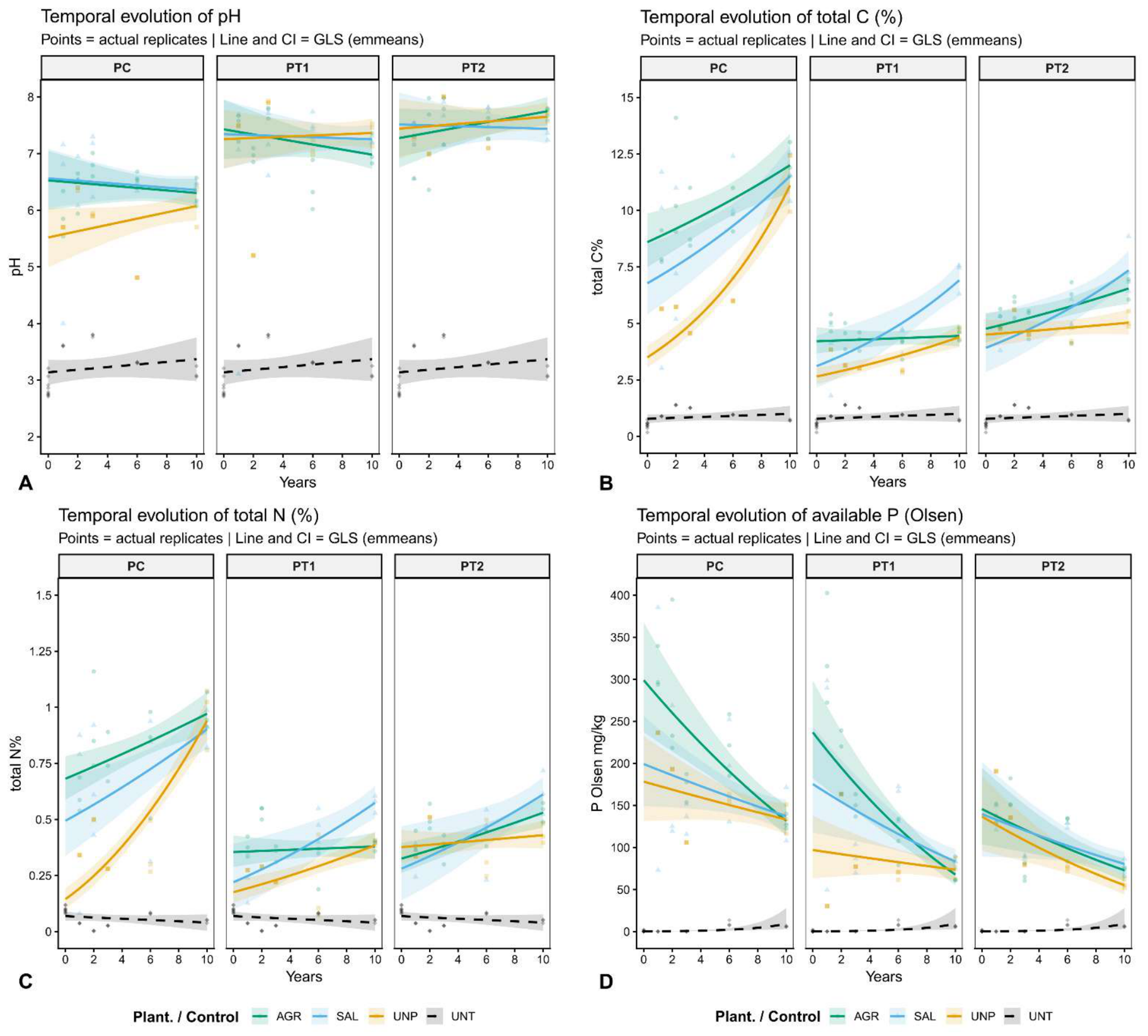
Figure 2.
Modelled temporal change of (A) effective cantion exchange capacity (CECe), (B) exchangeable Mg2+, (C) available Cu (CuRA) and available (D) Zn (ZnRA) during the trial span (10 years) at the mine soils untreated (UNT) or amended with compost (PC), Fe-(hydr)oxides-conditioned technosol (PT1) and Al-(hydr)oxides-conditioned technosol (PT2). Colored symbols represent observed data according to Plantation treatment (AGR (green circles) = sown with Agrostis capillaris, SAL (blue triangles) = planted with Salix viminalis, UNP (orange squares) = unplanted control, UNT (grey diamonds) = untreated control). Lines and shadows show estimated trends and confidence intervals (95%) according to the model (GLS) following the same color scheme.
Figure 2.
Modelled temporal change of (A) effective cantion exchange capacity (CECe), (B) exchangeable Mg2+, (C) available Cu (CuRA) and available (D) Zn (ZnRA) during the trial span (10 years) at the mine soils untreated (UNT) or amended with compost (PC), Fe-(hydr)oxides-conditioned technosol (PT1) and Al-(hydr)oxides-conditioned technosol (PT2). Colored symbols represent observed data according to Plantation treatment (AGR (green circles) = sown with Agrostis capillaris, SAL (blue triangles) = planted with Salix viminalis, UNP (orange squares) = unplanted control, UNT (grey diamonds) = untreated control). Lines and shadows show estimated trends and confidence intervals (95%) according to the model (GLS) following the same color scheme.
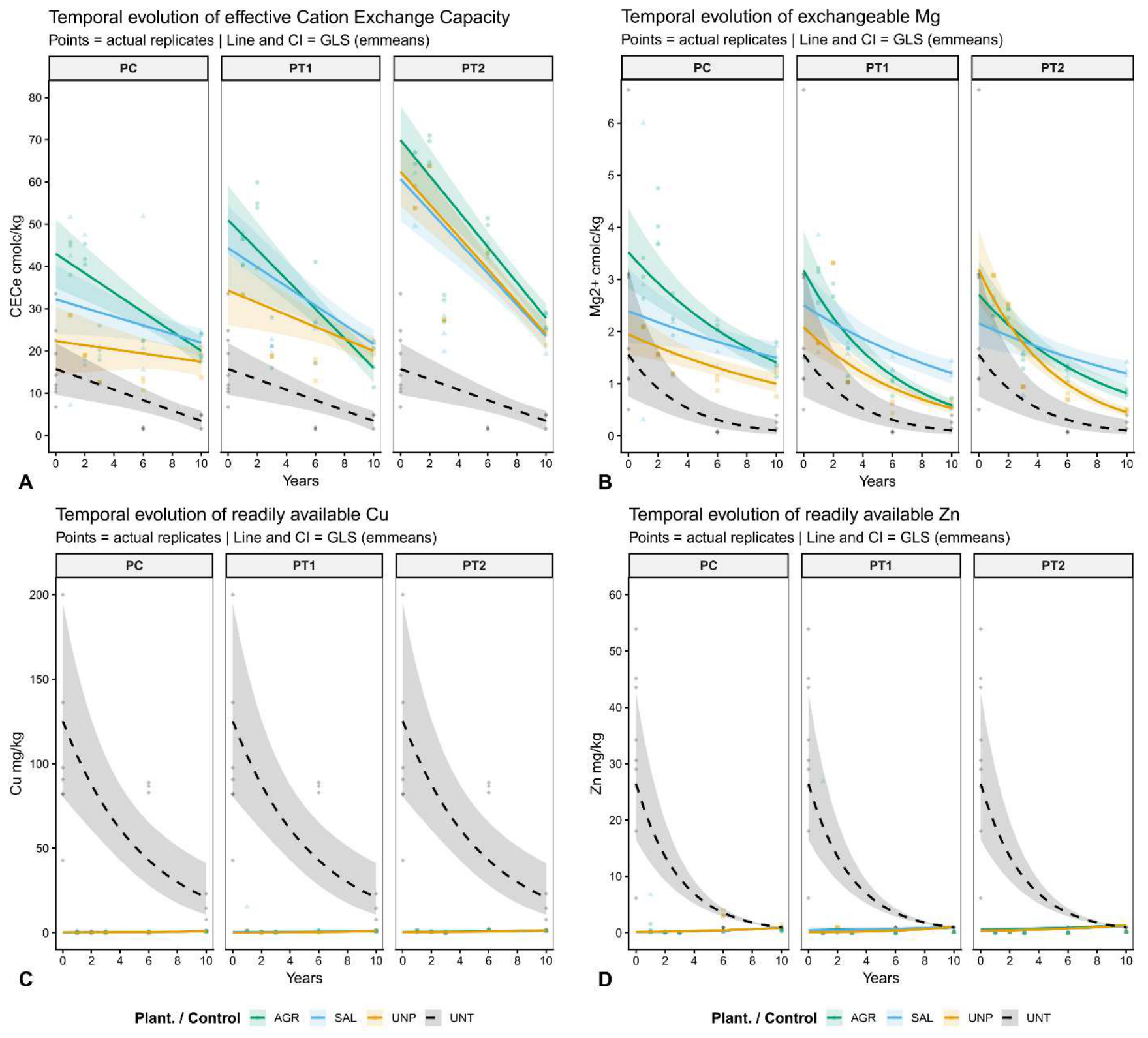
Figure 3.
Visual representation of the first three principal components (CP1, CP2, CP3) from the Principal Component Analysis (PCA). Top panel: CP1 – CP2 plane showing variables (A) and sample distribution (B). Bottom panel: CP1 – CP3 plane showing variables (C) and sample distribution (D). Elemental symbols denote (pseudo-)total contents; “CEC” denotes effective cation exchange capacity (CECe) or, as suffix, exchangeable bases and Al; “pH” denotes pHH2O; “P_Olsen” denotes available phosphorus (Olsen method) and ”RA” denotes readily available (NaNO3- or NH4NO3-extractable) fractions. Factor Time was included as a supplementary variable. “Year” groups samples by sampling campaign (2011, before amendment application; 2012, 2013, 2014, 2017 and 2021). “Amend.” groups samples according to Amendment: untreated (UNT), compost (PC), Fe-(hydr)oxides-conditioned technosol (PT1) and Al-(hydr)oxides-conditioned technosol (PT2). Ellipses represents 95% confidence regions based on the covariance around the group centroids.
Figure 3.
Visual representation of the first three principal components (CP1, CP2, CP3) from the Principal Component Analysis (PCA). Top panel: CP1 – CP2 plane showing variables (A) and sample distribution (B). Bottom panel: CP1 – CP3 plane showing variables (C) and sample distribution (D). Elemental symbols denote (pseudo-)total contents; “CEC” denotes effective cation exchange capacity (CECe) or, as suffix, exchangeable bases and Al; “pH” denotes pHH2O; “P_Olsen” denotes available phosphorus (Olsen method) and ”RA” denotes readily available (NaNO3- or NH4NO3-extractable) fractions. Factor Time was included as a supplementary variable. “Year” groups samples by sampling campaign (2011, before amendment application; 2012, 2013, 2014, 2017 and 2021). “Amend.” groups samples according to Amendment: untreated (UNT), compost (PC), Fe-(hydr)oxides-conditioned technosol (PT1) and Al-(hydr)oxides-conditioned technosol (PT2). Ellipses represents 95% confidence regions based on the covariance around the group centroids.
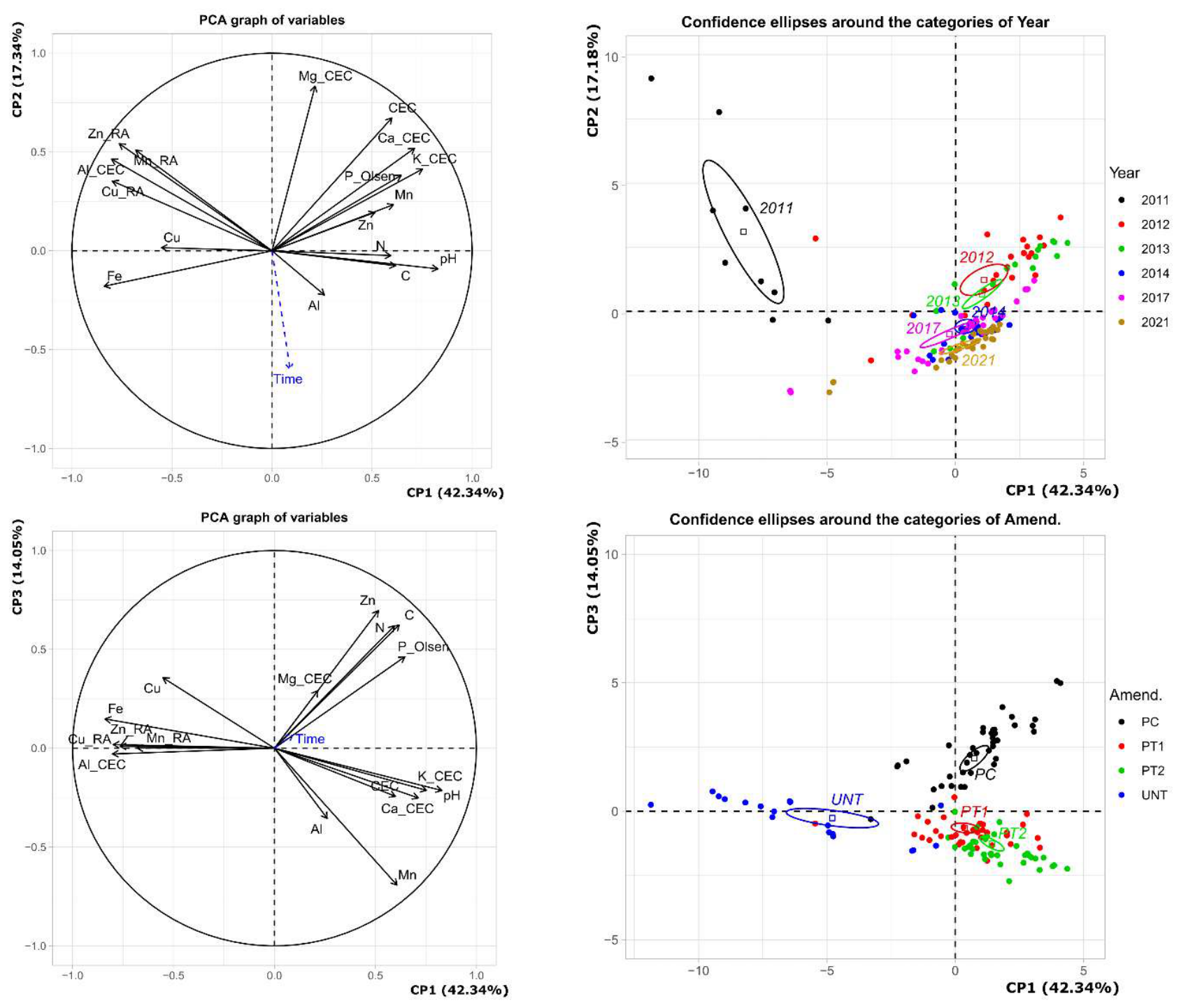
Table 2.
Coefficient of determination (R²) of the modelled (GLS) soil parameters and partial effect size (ω², 95% confidence interval) of the factors (Amendment, Plantation, Time) and their interactions. Significant effects (Wald χ²) are specified with asterisks according to three levels (see footnote). The rightmost column provides the statistical significance of Time effect for the parameters measured in untreated (UNT) soils.
Table 2.
Coefficient of determination (R²) of the modelled (GLS) soil parameters and partial effect size (ω², 95% confidence interval) of the factors (Amendment, Plantation, Time) and their interactions. Significant effects (Wald χ²) are specified with asterisks according to three levels (see footnote). The rightmost column provides the statistical significance of Time effect for the parameters measured in untreated (UNT) soils.
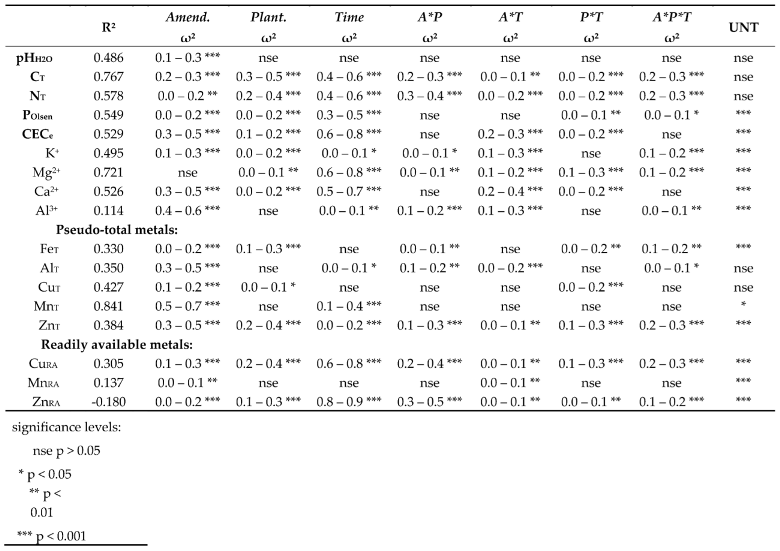
Disclaimer/Publisher’s Note: The statements, opinions and data contained in all publications are solely those of the individual author(s) and contributor(s) and not of MDPI and/or the editor(s). MDPI and/or the editor(s) disclaim responsibility for any injury to people or property resulting from any ideas, methods, instructions or products referred to in the content. |
© 2026 by the authors. Licensee MDPI, Basel, Switzerland. This article is an open access article distributed under the terms and conditions of the Creative Commons Attribution (CC BY) license (http://creativecommons.org/licenses/by/4.0/).
Copyright: This open access article is published under a Creative Commons CC BY 4.0 license, which permit the free download, distribution, and reuse, provided that the author and preprint are cited in any reuse.