
Submitted:
05 October 2026
Posted:
08 October 2026
You are already at the latest version
Abstract
The present study investigated the potential mediating effects of the Big Five personality traits between emotion regulation strategies (cognitive reappraisal and expressive suppression) and conflict management styles. Statistical analyses were conducted on a sample of emerging adults (N = 373; 18–23 years) using the Jamovi software package. Multiple linear regression and mediation analyses showed that cognitive reappraisal and expression suppression did not significantly pre-dict conflict management styles (p>.05). Moreover, the indirect effects of big five personality traits were not statistically significant, all bootstrap confidence intervals crossed zero. Thus, the null hypotheses were accepted. Nevertheless, it is axiomatic that defining the boundary conditions of socio-emotional competencies is crucial to advance this field of study. The non-significant findings suggested that internal self-regulation processes and external conflict tactics may operate through separate psychological pathways during emerging adulthood, a developmental period marked by systemic changes and continued neurological development. Essentially, these findings clarified the distinct empirical landscape of this demographic that suggested important clinical utility, not a conceptual failure. In conclusion, the present study contributed important parameters to the ex-isting body of knowledge, showing that tactical conflict modes in youth may be determined by immediate situational variables and may not be structurally mediated by stable dispositional traits.
Keywords:
personality traits
; emotion regulation
; conflict management
; conflict resolution
1. Introduction
The association between emotion regulation and conflict management is firmly rooted in psychological literature. Research carried out in this area have delineated how individuals managed conflicts through employing specific emotional regulation strategies, which impacted the quality and longevity of their relationships along with their psychological well-being. In this context, personality traits have surfaced as an underlying mechanism, illustrating the individual differences that persisted while employing different regulatory as well as conflict management strategies (Chen & Liao, 2021). There is substantial theoretical and empirical evidence that elucidated the role that personality traits played for determining individuals’ emotion regulation styles, based on Gross’s extended process model of emotion regulation and the Big Five personality framework (Hughes et al., 2020).
Emotion regulation is referred to how individuals coerce which emotions they have, when they have them, and how they experience and exhibit these emotions. Here individuals have adopted cognitive as well as behavioural strategies to regulate their emotional experiences (Gross & John, 2003). Emotion regulation can be viewed as one of the predominant skills necessary to effectively navigate through life’s experiences, whilepositively impacting an individual’s socio-emotional, psychological as well as physical well-being.
Another life skill imperative for a balanced well-being is effective conflict management abilities that has shaped an individual’s quality of interpersonal relationships, impacting their level of emotional stability and equanimity. Conflict management strategies have been regarded as intricate responses that individuals employ, when confronted with altercations with others (Kłusek-Wojciszke, B., & Grodzicki, J., 2018). These strategies are required to maintain healthy social relationships impacting an individual’s psychological as well as emotional well-being.
Existing scientific literature has stated the nexus between emotion regulation and conflict resolution styles, discerning the influence of emotion regulation as pivotal to manage interpersonal conflicts productively (Laslo-Roth, R., & Rosenstreich, E., 2017). When faced with a conflict, an individual undergoes five phases of the emotional arousal cycle — trigger, escalation, crisis, de-escalation, and post-crisis depression. Here emotional under-regulation (where the person is overwhelmed by their emotion) and emotional over-regulation (where the person avoids, numbs out, or shuts down) both become challenging while resolving a dispute (Kaplan, S.G. & Wheeler, E.G., 1983); (Breakwell, G.M., 1997). The principal of emotional arousal cycle has represented a bio-psycho-social phenomenon, with a neurological basis, moulded by developmental history and personality, and which can be adopted to build intervention — both at the intrapersonal level through effective emotion regulation skill-building as well as at the interpersonal level through empathic, contextually aware de-escalation practices.
This nexus between emotion regulation and conflict management styles can be further corroborated by a research that inferred how employment of adaptive emotion regulation strategies which is often associated with emotional intelligence, allowed individuals to employ constructive conflict resolution styles, resulting in better behavioural as well as emotional outcomes (Zhang et al., 2024). Another study conducted among 878 Portuguese teachers revealed that those with greater emotion regulation ability primarily adopted integrated and adopted strategies for managing classroom conflicts, resulting in favourable consequences (S. Valente et al. 2022). Contrary to this, a systematic review that consolidated 29 studies based on emotional intelligence, concluded the predominant role of emotional intelligence required to resolve conflict effectively, with emphasis on emotional intelligence rather than on regulation specifically (M. Winardi et al. 2021).
Nevertheless, the association between emotional regulation strategies with psychosocial factors, though not directly has shown to help measure conflict management styles among young adults (Humna Azhar et al. 2019). Conversely, studies have also determined that challenges in emotion regulation are linked with less effective conflict resolution styles, negatively impacting the relationship satisfaction and causing mental health issues that result in psychological and physical distress among individuals (Bulbul et al., 2024).
Stating this, it is also essential to consider the innate personality traits held by individuals that have shown to influence their emotional regulatory strategies. Substantial evidence have elicited how the big five personality traits predisposes individuals towards adoption of specific adaptive as well as maladaptive coping strategies such as cognitive reappraisal or expression suppression respectively (Doménech et al., 2025).
Individuals on a higher spectrum of Personality traits such as openness, conscientiousness and extroversion have predisposed individuals to employ cognitive reappraisal as an adaptive coping strategy to regulate oneself as opposed to expression suppression, a maladaptive coping strategy which is specifically utilized among individuals high on the trait of neuroticism, (Ziwen Zhu et al., 2023). With regard to agreeableness as a personality trait belonging to the Big five personality trait model, there have been mixed results with regard to its predisposition towards expression suppression as well as cognitive reappraisal with variation occurring due to cultural and situational factors that mediate the influence of such a trait on emotion regulation strategies adopted by individuals, (Karmakar & Ghosh 2023).
In the context of conflict resolution styles and personality traits, individuals high on neuroticism were predisposed towards employing more of withdrawal or avoidance strategies rather than positive problem-solving strategies (integrating), whereas individuals high on conscientiousness have reported to promote interpersonal interactions by mitigating the negative influence of neuroticism, a finding that has portrayed the complexity of simple mediation models and is suggestive of the interactive patterns of personality traits (Quek et al., 2025).
Scientific evidence has consistently demonstrated the link between personality traits and conflict resolution styles with similar outcomes whereby, individuals high on neuroticism and agreeableness had a predisposition towards adopting an avoiding style to resolve conflicts. Whereas, personality traits related to extroversion, openness to experience, conscientiousness along with agreeableness were positively linked to a compromising style. Agreeableness was also seen positively associated with an obliging style. Furthermore, agreeableness, extroversion, openness to experience, and conscientiousness bared a positive correlation with an integrating style, while neuroticism showed a negative correlation with this style (Tehrani & Yamini 2020), ( Barańczuk, 2019). As seen, the moderator analysis demonstrated different patterns about the relationship between agreeableness and compromising style of conflict management, as well as differing results for neuroticism. Contrary to these results, another research stated mixed reviews about how cognitive abilities were more consistent compared to personality traits for solving conflicts, with certain personality traits potentially affecting conflict resolution across situations (Völker et al., 2025).
These contrary views and potential knowledge gaps in the existing literature with regard to the association between emotion regulation, conflict management, and personality traits substantiated the need to undertake a detailed investigation, aimed at providing vital insights for clinical translation as well as value addition towards the existing body of science.
Rationale for the Study
Effective emotion regulation is necessary for psycho-socio functioning and catalyzing executive functioning in areas related to decision making and impulse control, that enhances the quality of intrapersonal as well as interpersonal skills, while constructive conflict management promotes reconciliation and facilitates relationship management, strengthening the communication and productivity of individuals, promoting their personal as well as professional growth, which is imperative in order to support individuals to develop emotional equilibrium and lead a balanced and fulfilled life. Additionally, the personality taxonomy forms a crucial foundation for clinicians to develop effective treatment plans, whereby it is axiomatic to consider its potential impact on socio-emotional competencies. Considering the paramount significance of these constructs as diagnostic and prognostic value additions to treatment planning along with value addition to the existing empirical base, and overall well-being, suggests advancing a in-depth study within this specialized discipline.
2. Materials and Methods
Research Methodology Objectives:
- To present the status of emotion regulation strategies, conflict management styles and personality traits prevalent in this sample of population under study.
- To predict conflict management styles from emotion regulation strategies.
- To examine the mediating effect of personality traits on emotion regulation and conflict management styles.
Study Design: A Cross-sectional design was employed, utilizing Mediation Analysis to test the mediating effects of the Big Five personality traits on the emotion regulation strategies and conflict management styles, using JAMOVI software.
Variables under study:
Independent variables – IV 1: Cognitive reappraisal; IV 2: Expression suppression. Dependent variables – DV 1: Competing; DV 2: Accommodating; DV 3: Avoiding; DV 4: Collaborating; DV 5: Compromising.
Mediator variables – MV 1: Openness to experience; MV 2: Conscientiousness; MV 3: Extraversion; MV 4: Agreeableness; MV 5: Neuroticism
Hypothesis:
Null hypothesis (H0 1): The emotion regulation strategies (cognitive reappraisal and expression suppression) would not have an individual and combined effect on the conflict management styles (compromising, collaborating, competing, avoiding and accommodating), which means emotion regulation strategies would not predict the choice of conflict management styles that are employed by this sample of population.
Alternate hypothesis (Hₐ 1): The emotion regulation strategies (cognitive reappraisal and expression suppression) would have an individual and combined effect on the conflict management styles (compromising, collaborating, competing, avoiding and accommodating), which means emotion regulation strategies would predict the choice of conflict management styles that are employed by this sample of population.
Null hypothesis (H0 2): The Big 5 Personality traits (OCEAN) shall not have a significant mediating effect on emotion regulation strategies (cognitive reappraisal and expression suppression) as well as conflict management styles (compromising, collaborating, competing, avoiding and accommodating) in this sample of population.
Alternate hypothesis (Hₐ 2): The Big 5 Personality traits (OCEAN) shall have a significant mediating effect on emotion regulation strategies (cognitive reappraisal and expression suppression) as well as conflict management styles (compromising, collaborating, competing, avoiding and accommodating) in this sample of population.
Operational definitions for the Big Five personality traits, (Costa and McCrae, 1992):
- Openness to Experience—Openness to experience refers to the degree to which an individual is creative, enterprising, explorative, and broad-minded. It incorporates an inclination towards novel encounters with a liking towards variety and change.
- Conscientiousness—Conscientiousness is marked by a predisposition towards being organized, responsible, goal-oriented, disciplined, and dependable. Individuals high in this trait tend to possess an inclination towards planning and hard work over spontaneity.
- Extraversion—Individuals high on this trait often seek stimulation and are high in energy. They are predisposed towards being sociable and assertive and enjoy being with others.
- Agreeableness—Agreeableness is the propensity to be empathetic, harmonious, and confiding towards others. Individuals high on this trait are predisposed towards being benevolent with a preference for social cohesion and a peaceful coexistence.
- Neuroticism—Neurotic individuals have a propensity towards negative emotions such as depression, anxiety, and anger that enhance their levels of emotional distress. Individuals high on neuroticism are usually characterized as being emotionally unstable, with a tendency to engage in maladaptive coping strategies, limiting their capacity to effectively regulate themselves.
Operational definitions for expression suppression and cognitive reappraisal as emotion regulation strategies, (John & Gross, 2004):
- Expression Suppression—Expression suppression is a maladaptive emotion regulation strategy whereby individuals make conscious attempts to control their facial expressions, body language, and verbal cues in order to conceal their true feelings from others.
- Cognitive Reappraisal—Cognitive reappraisal is an adaptive emotion regulation strategy that presupposes altering one’s thoughts surrounding the situation (cognitive restructuring/modifying) to alter its emotional impact.
Operational definitions for five distinct Kilmann conflict management styles based on two dimensions - assertiveness and cooperativeness, ( Hinteregger and Schwab, 2022):
- Competing (Assertive, Uncooperative): This style is characterized by a strong focus on one’s own goals and needs, often at the expense of others. Individuals using this style prioritize winning and may use power or forceful tactics to achieve their objectives. Operationally, this can be measured by the frequency of aggressive communication, refusal to compromise, or dominance in discussions.
- Accommodating (Unassertive, Cooperative): Individuals who adopt this style prioritize the needs and goals of others over their own. They may give in to others’ demands to maintain harmony in the relationship. This style can be assessed through behaviours such as yielding, making concessions, and actively seeking to please others.
- Avoiding (Unassertive, Uncooperative): This style involves sidestepping conflict entirely, either through withdrawal or postponement. Individuals using this style may ignore the conflict, change the subject, or physically leave the situation. Operationally, this can be measured by the tendency to avoid discussions about disagreements or delaying resolution efforts.
- Collaborating (Assertive, Cooperative): This style seeks a win-win situation by addressing the needs and concerns of all parties involved. It involves open communication, sharing information, and jointly developing solutions. This can be operationally defined by the frequency of joint problem-solving efforts, brainstorming sessions, and mutual respect in discussions.
- Compromising (Moderately Assertive, Moderately Cooperative): This style involves finding a middle ground where both parties give up something to reach an agreement. It is characterized by negotiation and finding solutions that partially satisfy both sides. Operationally, this can be assessed by the extent to which individuals engage in bargaining, making concessions, and reaching agreements that are acceptable to all parties.
Sample design:
Study Participants (Sample size, sampling method, inclusion and exclusion criteria): Post data cleaning, a total sample of 373 participants was selected through Purposive sampling technique.
Inclusion criteria: Participants studying graduate and postgraduate courses at the university level, in the age group of 18-23 years, and fluent in the English language were selected for the purpose of this research.
Exclusion criteria: Participants with a history of any form of severe disabilities were excluded for the purpose of this study.
Data collection tools: Data collection booklets that constituted the Sociodemographic Questionnaire, Emotion Regulation Questionnaire, NEO-Five Factor Inventory and Thomas-Kilmann Conflict Mode Instrument (TKI) questionnaires were distributed to all those students who provided their consent to participate in the study, which took 20-25 minutes to complete. Pivotal information applying to the research study, along with the confidentiality clause, was communicated among the participants.
Sociodemographic Sheet: Customized questionnaires were created to collect participant information pertaining to their name, age, gender, education level, ethnicity, and location.
Emotion Regulation Questionnaire (ERQ): James Gross and Oliver John (2003) created the ERQ, a 10-item self-report tool, to measure how often people use two specific emotion regulation strategies: Cognitive Reappraisal and Expressive Suppression. The author reported high reliability, with Cronbach’s alpha usually between 0.75 and 0.82 for reappraisal and between 0.68 and 0.76 for suppression in different samples with the test-retest reliability of 0.69 over three months.
The NEO-Five Factor Inventory (NEO-FFI) is a shorter version of the NEO PI-R called the “Five-Factor Inventory” or “Five-Factor Model” (FFM). This psychometric assessment assesses individuals on the basis of the five main personality traits: neuroticism, extraversion, openness to experience, agreeableness, and conscientiousness. It consists of 60 items (12 items per domain). The inventory usually uses a 5-point Likert scale that goes from “Strongly Disagree” to “Strongly Agree.” It is self-reported and short, so it can usually be done in 10 to 15 minutes. This tool generally has high reliability and validity, with Cronbach’s alpha values (internal consistency) often between 0.70 and 0.90. However, the Openness to Experience (O) subscale may have lower reliability (around 0.40-0.60). Test-retest reliability is also strong, which means that the results stay the same over time. Validity is bolstered by consistent correlations with other personality assessments and its capacity to encapsulate the Big Five traits, although some studies have observed variations in factor structure across cultures, particularly regarding Agreeableness and Extraversion.
Thomas-Kilmann Conflict Mode Instrument (TKI): The Thomas-Kilmann Conflict Mode Instrument (TKI) categorizes five main styles of managing conflict, based on levels of assertiveness and cooperativeness.
- “Competing” is characterized by high assertiveness and low cooperativeness and focuses on achieving one’s goals at the expense of other, effective in urgent situations or when quick decisions are required.
- “Accommodating” involves low assertiveness and high cooperativeness and prioritizes the interests of others over one’s own, useful when preserving relationships is more important than the conflict outcome.
- “Compromising” balances moderate assertiveness and cooperativeness and aims for a solution that meets some needs of both sides, is ideal for situations with time constraints or when a temporary resolution is necessary.
- “Collaborating” demonstrates high assertiveness and high cooperativeness and strives for a win-win outcome by addressing the needs of all involved parties. Best for complex problems where a cooperative effort yields better results.
- “Avoiding” exhibits low assertiveness and low cooperativeness and involves evading the conflict, either by withdrawing or delaying, appropriate for minor issues or when the potential consequences of engagement are too high.
The TKI is a well-established and generally reliable tool for assessing conflict management styles and its validity is supported by numerous studies, particularly regarding its construct validity and ability to differentiate between conflict modes.
Ethical consideration
Ethical approval for the study was obtained from the Reva Institutional Ethics Committee (RIEC) prior to data collection (Approval No.: - 007/2025). The study adhered to the ethical standards outlined by the American Psychological Association (APA, 2017), ensuring participants’ rights to anonymity, confidentiality, and voluntary participation. Participants were informed of their right to withdraw at any stage without any consequences. To systematically manage self-report constraints and counteract common method variance, proactive procedural remedies were integrated directly into the deployment phase. Data collection intervals were structured to introduce temporal and psychological separation, with evaluations distributed across distinct environmental settings. Furthermore, participants completed an informed consent form explicitly detailing their right to withdraw from the research trial at any time without penalty. All collected data were securely coded and anonymized to protect participant identity.
Statistical Analysis
The data obtained from 373 participants was analyzed using Jamovi software package. Statistical analysis tools included “reliability analysis”, “descriptive statistics”, “correlation analysis”, “multiple regression analysis”, and “mediation analysis”. The findings are presented systematically which addressed the research objectives and tested the proposed hypotheses.

Table 1.
ERQ Reliability Statistics.
| Reliability Statistics | |
| Cronbach’ s Alpha | N of Ite ms |
| .727 | 10 |
Reliability Analysis (Cronbach’s Alpha) Emotion Regulation Scale
Ten items Emotion Regulation Scale (ERQ) was applied, and the Cronbach’s alpha coefficient was 0.727 and it was an acceptable internal consistency reliability. The alpha value was greater than the suggested value of 0.70 and it was evident that the scale had good scale consistency in the context of the participants. This suggested that the items are sufficiently related and collectively assessed the intended construct. The reliability coefficient indicated that the instrument was suitable for use in subsequent statistical analysis including correlation, regression and mediation analysis. Therefore, the ERQ can be considered as a reliable measure to assess emotion regulation in the present study.
Table 2.
Item Total Statistics for ERQ.
| Item-Total Statistics | ||||
| Scale Mean if Item Delete d | Scale Varianc e if Item Deleted |
Corrected Item-Total Correlatio n | Cronbach’ s Alpha if Item Deleted | |
| V 41 | 42.53 | 86.151 | .319 | .716 |
| V 42 | 41.89 | 83.217 | .398 | .703 |
| V 43 | 42.63 | 84.965 | .340 | .713 |
| V 44 | 43.03 | 87.316 | .256 | .726 |
| V 45 | 42.35 | 83.436 | .379 | .706 |
| V 46 | 42.46 | 79.895 | .465 | .692 |
| V 47 | 42.40 | 83.757 | .400 | .703 |
| V 48 | 42.40 | 82.609 | .462 | .694 |
| V 49 | 42.41 | 82.133 | .423 | .699 |
| V 50 | 42.64 | 83.636 | .426 | .699 |
The item total statistics indicated that all ten items contributed positively to the overall reliability of the Emotion Regulation Scale. The corrected item total correlations ranged from 0.256 to 0.465 which suggested acceptable relationships between individual items and total scale score. Although item V44 showed the lowest correlation (0.256), it remained within an acceptable range. Furthermore, the Cronbach’s alpha of item deleted values ranged from 0.692 to 0.726 which did not exceed the overall alpha of 0.727. Therefore, removing an individual item would not improve the reliability of the scale and all the ten items were retained for subsequent analysis.
Big Five Personality Inventory
Table 3.
Big Five Personality Inventory Reliability Statistics.
| Reliability Statistics | |
| Cronbach’ s Alpha | N of Items |
| .774 | 60 |
The Big Five Personality Inventory (NEO-FFI) consisted of 60-item reliability analysis that yielded Cronbach’s alpha coefficient (0.774), indicating good internal consistency reliability. When the alpha value for the inventory becomes greater than the recommended value of 0.70, it is considered to have good reliability in measuring the personality characteristics of the respondents. This finding suggested that the items consistently measured the underlying personality dimensions of Openness, Conscientiousness, Extraversion, Agreeableness, and Neuroticism. Thus, for the next steps in the present study (correlation analysis, regression analysis, and mediation analysis), this instrument was shown to be reliable and suitable.
Descriptive Statistics
Table 4.
Descriptive Statistics.
| Descriptives | ||||||||
| Cogniti ve Reappr aisal | Expressi on Suppres sion | Opennes s | CONSCI ENTIOU SNESS | EXTRAV ERSION | AGREEAB LENESS | NEUROT ICISM | TKI | |
| N | 373 | 373 | 373 | 373 | 373 | 373 | 373 | 373 |
| Missing | 0 | 0 | 0 | 0 | 0 | 0 | 0 | 0 |
| Mean | 4.65 | 4.53 | 4.39 | 4.69 | 4.45 | 4.26 | 4.35 | 14.4 |
| Median | 4.67 | 4.75 | 4.40 | 4.67 | 4.50 | 4.27 | 4.33 | 15 |
| Standard deviation | 1.16 | 1.33 | 0.841 | 0.852 | 0.760 | 0.723 | 0.805 | 4.55 |
| Minimum | 1.00 | 1.00 | 1.60 | 2.17 | 1.40 | 2.36 | 1.58 | 0 |
| Maximum | 7.00 | 7.00 | 11.7 | 7.50 | 6.20 | 7.00 | 6.92 | 29 |
Descriptive statistics was computed to summarize the distribution and central tendency of the study variables based on 373 complete responses, post data cleaning ensuring that no missing data recorded for any variable. This indicated that all participants included in the analysis provided complete information on emotion regulation strategies, personality traits, and conflict management. The descriptive results provided an overview of the characteristics of the study sample before conducting the inferential analyses. Emotion regulation variables had a mean score of Cognitive Reappraisal = 4.65 (SD = 1.16), and Expression Suppression = 4.53 (SD = 1.33). The results suggested that both emotion regulation strategies were moderately to relatively high for participants. The median values were both 4.67 and 4.75 whereas the mean values were 4.53 and 4.56, respectively, indicating fairly balanced distributions of responses. For the Big Five personality traits, Conscientiousness exhibited the highest mean score (M = 4.69, SD= 0.85), followed by Extraversion (M = 4.45, SD = 0.76), Openness (M = 4.39, SD = 0.84), Neuroticism (M = 4.35, SD = 0.81), and Agreeableness (M = 4.26, SD = 0.72). The moderately low variance for measures indicated moderate variations in the participants’ personality traits. The mean score for the Thomas-Kilmann Conflict Management (TKI) score was 14.40 (SD = 4.55), the median score was 15, and the range was 0–29. The conflict handling tendencies of participants varied regarding the TKI, and was more flexible than other study variables showed. The descriptive statistics showed overall moderate emotion regulation and personality trait levels shared by the participants, and significant levels of variation in conflict management behaviour. This provided a suitable basis for the subsequent correlation, regression, and mediation analyses.
Correlation Analysis
Table 5.
Correlation Matrix.
| Correlation Matrix | |||||||||
| TKI | NEUR OTICIS M | AGREE ABLEN ESS | EXTR AVERS ION | CONSCIE NTIOUSN ESS | Openne ss | Expres sion Suppre ssion | Cognitive Reappraisal | ||
| TKI | Pears on’s r | — | |||||||
| df | — | ||||||||
| p-value | — | ||||||||
| NEUROTI CISM | Pears on’s r | 0.057 | — | ||||||
| df | 371 | — | |||||||
| p-value | .272 | — | |||||||
| AGREEA BLENESS | Pears on’s r | 0.008 | -0.068 | — | |||||
| df | 371 | 371 | — | ||||||
| p-value | .879 | .188 | — | ||||||
| EXTRAV ERSION | Pears on’s r | 0.062 | -0.003 | -0.039 | — | ||||
| df | 371 | 371 | 371 | — | |||||
| p-value | .231 | .951 | .449 | — | |||||
| CONSCIE NTIOUSN ESS | Pears on’s r | -0.029 | -0.127 | 0.268 | 0.207 | — | |||
| df | 371 | 371 | 371 | 371 | — | ||||
| p-value | .570 | .014 | <.001 | <.001 | — | ||||
| Openness | Pears on’s r | -0.046 | -0.006 | 0.167 | -0.009 | 0.196 | — | ||
| df | 371 | 371 | 371 | 371 | 371 | — | |||
| p-value | .375 | .902 | .001 | .858 | <.001 | — | |||
| Expression Suppressio n | Pears on’s r | 0.023 | -0.036 | 0.084 | 0.031 | 0.084 | -0.011 | — | |
| df | 371 | 371 | 371 | 371 | 371 | 371 | — | ||
| p-value | .657 | .492 | .107 | .553 | .105 | .840 | — | ||
| Cognitive Reappraisa l | Pears on’s r | 0.022 | -0.041 | 0.095 | 0.180 | 0.159 | -0.113 | 0.341 | — |
| df | 371 | 371 | 371 | 371 | 371 | 371 | 371 | — | |
| p-value | .678 | .431 | .066 | <.001 | .002 | .029 | <.001 | — | |
A Pearson correlation analysis was conducted to examine the relationships among emotion regulation strategies, the Big Five personality traits and conflict management (TKI). However, results identified that the conflict management (TKI) had an insignificant relationship with any of the study variables. Specifically, TKI was not significantly associated with Cognitive Reappraisal (r = 0.022, p =.678), Expression Suppression (r = 0.023, p =.657), Openness (r = -0.046, p =.375), Conscientiousness (r = -0.029, p =.570), Extraversion (r = 0.062, p =.231), Agreeableness (r = 0.008, p =.879), and Neuroticism (r = 0.057, p =.272). The results confirmed that there were no significant links between the strategies for regulating emotion and the behaviour in conflict management and between the personality traits and the behaviour in conflict management. No significant correlations were found between the variables measured in this study and TKI, but there were a few significant correlations between the mediator variables and the independent variables. When analyzing links between Emotion Regulation strategies, there was a medium positive association between the cognitive reappraisal and the expression suppression ER (r = 0.341, p < .001). Cognitive Reappraisal was also positively correlated with Extraversion (r = 0.180, p < .001) and Conscientiousness (r = 0.159, p = .002), and weakly, negatively correlated with Openness (r = -0.113, p = .029). Among the personality traits, Conscientiousness was positively correlated with Agreeableness (r = 0.268, p < .001), Extraversion (r = 0.207, p < .001), and Openness (r = 0.196, p < .001). Furthermore, Agreeableness was positively correlated with Openness (r = 0.167, p = .001) and Neuroticism was weakly negatively correlated with Conscientiousness (r = -0.127, p = .014). Hence, the results showed that there were significant relationships among some of the predictor variables and no significant relationships between the predictor variables and conflict management.
Regression Analysis
Table 6.
Regression Model.
| Model Fit Measures | ||
| Mo del | R | R2 |
| 1 | 0.0273 | 7.46e-4 |
| Note. Models estimated using sample size of N=373 | ||
The model fit measures indicated quite a weak relationship between the independent and dependent variable. The regression model produced a correlation coefficient of R = 0.0273 which suggested a negligible association between emotion regulation strategies and conflict management. The coefficient of determination (R2 = 0.000746) indicated that the model explained only 0.07% of the variance in conflict management (TKI) scores among the 373 participants. This extremely low explanatory power suggested that Cognitive Reappraisal and Expression Suppression contributed minimally to predict conflict management behaviour. Therefore, the overall regression model demonstrated poor model fit and limited predictive capability.
Table 7.
Multiple Linear Regression.
| Model Coefficients - TKI | ||||
| Predictor | Estimate | SE | t | p |
| Intercept | 13.8414 | 1.101 | 12.567 | <.001 |
| Cognitive Reappraisal | 0.0607 | 0.216 | 0.281 | .779 |
| Expression Suppression | 0.0608 | 0.189 | 0.322 | .748 |
A multiple linear regression analysis was conducted to examine whether Cognitive Reappraisal and Expression Suppression significantly predicted conflict management (TKI). The regression coefficient values showed that both predictors were not a significant contributor to the conflict management behaviour. There was non-significant positive correlation between cognitive reappraisal and TKI conflict management strategies (B = 0.0607, SE = 0.216, t = 0.281, p = .779), which suggested that no significant effect would be found if cognitive reappraisal increased within the participants, increasing the score on the conflict management scale. Likewise, in terms of the use of expression suppression, there was a positive but not significant effect (B = 0.0608, SE = 0.189, t = 0.322, p = .748) such that expression suppression did not significantly affect the choice of conflict management strategy. The intercept of the regression model was statistically significant (B = 13.8414, SE = 1.101, t = 12.567, p < .001), which indicated the expected level of conflict management when both predictor variables are fixed at zero. However, the significance of the intercept does not indicate meaningful predictive effects of the independent variables. The regression coefficients indicated that all of the participants’ scores on the Cognitive Reappraisal and Expression Suppression subscales have low predictive power for conflict management styles. Thus, no predictive relationship has been found between emotions regulation strategies and conflict management styles, and the null hypothesis (H01) is accepted while the alternative hypothesis (H1) is rejected.
Mediation Analysis
Table 8.
Mediation Model.
| Models Info | |||||
| Mediators Models | |||||
| m1 | Openness ~ Cognitive Reappraisal + Expression Suppression | ||||
| m2 | CONSCIENTIOUSN ESS ~ Cognitive Reappraisal + Expression Suppression |
||||
| m3 | EXTRAVERSION ~ Cognitive Reappraisal + Expression Suppression |
||||
| m4 | AGREEABLENESS ~ Cognitive Reappraisal + Expression Suppression |
||||
| m5 | NEUROTICISM ~ Cognitive Reappraisal + Expression Suppression |
||||
| Full Model | |||||
| m6 | TKI ~ Openness + CONSCIENTIOUSN ESS + EXTRAVERSION + AGREEABLENESS + NEUROTICISM + Cognitive Reappraisal + Expression Suppression |
||||
| Indirect Effects | |||||
| IE 1 | Cognitive Reappraisal ⇒ Openness ⇒ TKI | ||||
| IE 2 | Cognitive Reappraisal ⇒ CONSCIENTIOUS NESS ⇒ TKI | ||||
| IE 3 | Cognitive Reappraisal ⇒ EXTRAVERSION ⇒ TKI |
||||
| IE 4 | Cognitive Reappraisal ⇒ AGREEABLENESS ⇒ TKI |
||||
| IE 5 | Cognitive Reappraisal ⇒ NEUROTICISM ⇒ TKI | ||||
| IE 6 | Expression Suppression ⇒ Openness ⇒ TKI | ||||
| IE 7 | Expression Suppression ⇒ CONSCIENTIOUS NESS ⇒ TKI | ||||
| IE 8 | Expression Suppression ⇒ EXTRAVERSION ⇒ TKI |
||||
| IE 9 | Expression Suppression ⇒ AGREEABLENESS ⇒ TKI |
||||
| IE 10 | Expression Suppression ⇒ NEUROTICISM ⇒ TKI | ||||
| Sample size | N | 373 | |||
A multiple mediation model was used to explore if the Big Five personality traits (Openness, Conscientiousness, Extraversion, Agreeableness, Neuroticism) mediate between emotion regulation strategies (Cognitive Reappraisal and Expression Suppression) and conflict management strategies (TKI). Five separate mediator models (m1–m5) were estimated, followed by a full mediation model (m6) that included all mediators and independent variables simultaneously. The analysis also estimated 10 indirect effects to assess the mediating pathways from the two emotion regulation strategies to conflict management through each personality trait. In the mediation model sample consisted of 373 participants.
Figure 1.
Statistics Diagram.
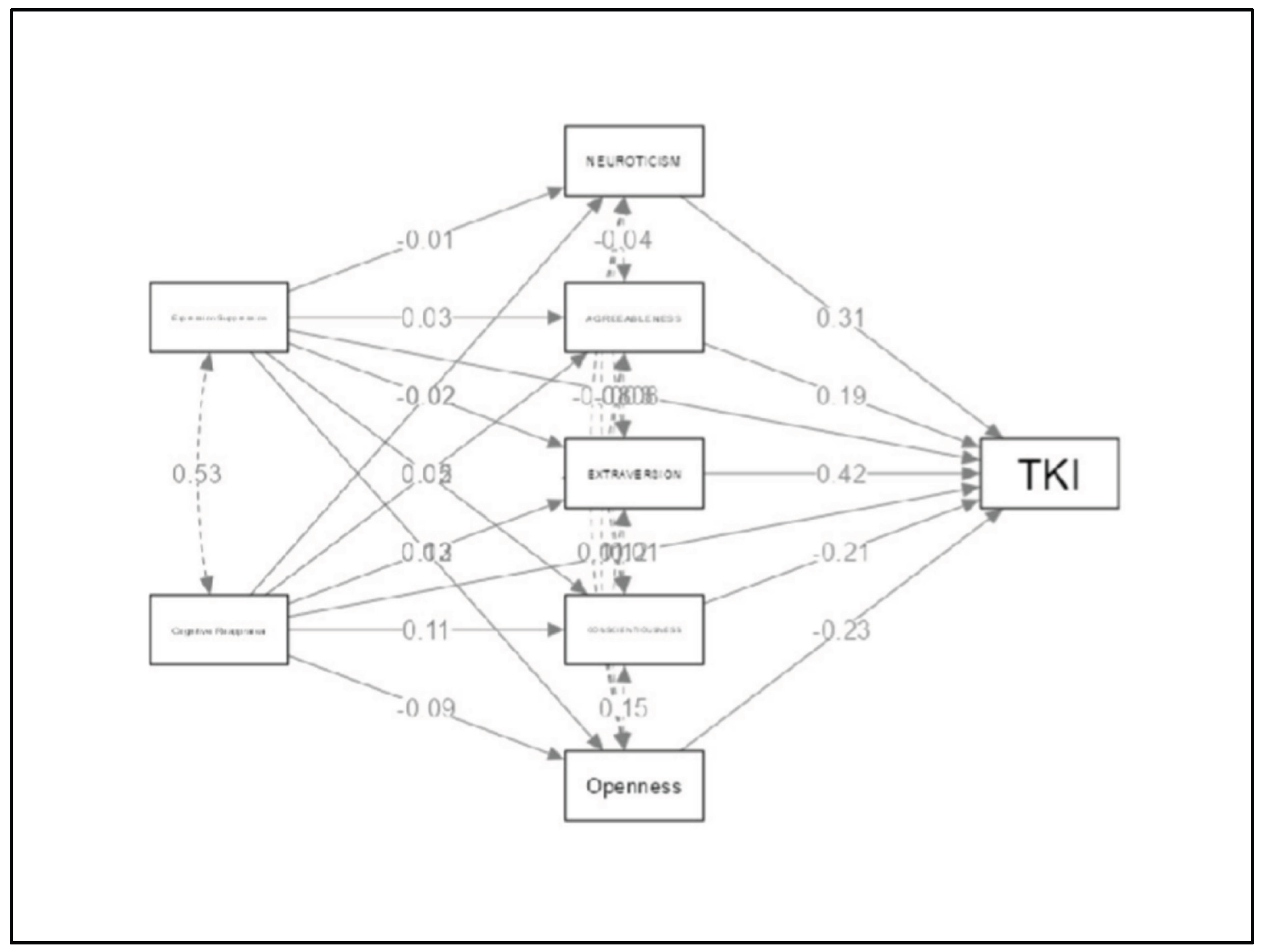
This statistical diagram shows the proposed multiple mediation model with the Cognitive Reappraisal and the Expression Suppression as independent variables, the Big Five personality traits as mediators and the TKI conflict management styles as the dependent variable. The model depicted the direct and indirect pathways estimated in the mediation analysis, providing a visual representation of the relationships examined among the study variables.
Table 9.
Mediation Model - Indirect and Total Effects.
| Indirect and Total Effects | ||||||||
| 95% C.I. (a) | ||||||||
| Type | Effect | Estimate | SE | Lower | Upper | β | z | p |
| Indirect | Cognitive Reappraisal ⇒ Openness ⇒ TKI | 0.02026 | 0.02744 | -0.0401 | 0.0753 | 0.00518 | 0.7384 | .460 |
| Cognitive Reappraisal ⇒ CONSCIENTIOUSN ESS ⇒ TKI | -0.02247 | 0.03351 | -0.1089 | 0.0478 | -0.00574 | -0.6704 | .503 | |
| Cognitive Reappraisal ⇒ EXTRAVERSION ⇒ TKI | 0.05262 | 0.04292 | -0.0402 | 0.1771 | 0.01345 | 1.2260 | .220 | |
| Cognitive Reappraisal ⇒ AGREEABLENESS ⇒ TKI |
0.00880 | 0.01728 | -0.0363 | 0.0606 | 0.00225 | 0.5092 | .611 | |
| Cognitive Reappraisal ⇒ NEUROTICISM ⇒ TKI | -0.00699 | 0.01355 | -0.0565 | 0.0335 | -0.00179 | -0.5160 | .606 | |
| Expression Suppression ⇒ Openness ⇒ TKI | -0.00453 | 0.00974 | -0.0339 | 0.0398 | -0.00133 | -0.4654 | .642 | |
| Expression Suppression ⇒ CONSCIENTIOUSN ESS ⇒ TKI | -0.00452 | 0.00976 | -0.0420 | 0.0209 | -0.00132 | -0.4630 | .643 | |
| Expression Suppression ⇒ EXTRAVERSION ⇒ TKI | -0.00831 | 0.01444 | -0.0602 | 0.0278 | -0.00243 | -0.5754 | .565 | |
| Expression Suppression ⇒ AGREEABLENESS ⇒ TKI |
0.00590 | 0.01213 | -0.0205 | 0.0551 | 0.00173 | 0.4866 | .627 | |
| Expression Suppression ⇒ NEUROTICISM ⇒ |
-0.00461 | 0.01121 | -0.0416 | 0.0255 | -0.00135 | -0.4112 | .681 | |
| TKI | ||||||||
| Compon ent | Cognitive Reappraisal ⇒ Openness | -0.08946 | 0.03955 | -0.2361 | 0.0325 | -0.12375 | -2.2621 | .024 |
| Openness ⇒ TKI | -0.22647 | 0.28992 | -0.8738 | 0.2490 | -0.04186 | -0.7812 | .435 | |
| Cognitive Reappraisal ⇒ CONSCIENTIOUSN ESS |
0.10768 | 0.03980 | 0.0102 | 0.2080 | 0.14707 | 2.7056 | .007 | |
| CONSCIENTIOUSN ESS ⇒ TKI | -0.20866 | 0.30153 | -0.8117 | 0.3971 | -0.03906 | -0.6920 | .489 | |
| Cognitive Reappraisal ⇒ EXTRAVERSION | 0.12532 | 0.03535 | 0.0445 | 0.2065 | 0.19196 | 3.5449 | <.001 | |
| EXTRAVERSION ⇒ TKI |
0.41986 | 0.32133 | -0.3535 | 1.1606 | 0.07008 | 1.3066 | .191 | |
| Cognitive Reappraisal ⇒ AGREEABLENESS | 0.04689 | 0.03400 | -0.0325 | 0.1277 | 0.07550 | 1.3789 | .168 | |
| AGREEABLENESS ⇒ TKI |
0.18770 | 0.34253 | -0.4752 | 0.9103 | 0.02980 | 0.5480 | .584 | |
| Cognitive Reappraisal ⇒ NEUROTICISM | -0.02250 | 0.03807 | -0.1150 | 0.0738 | -0.03253 | -0.5912 | .554 | |
| NEUROTICISM ⇒ TKI |
0.31065 | 0.29387 | -0.2800 | 0.8788 | 0.05495 | 1.0571 | .290 | |
| Expression Suppression ⇒ Openness | 0.02002 | 0.03455 | -0.0696 | 0.1223 | 0.03170 | 0.5794 | .562 | |
| Expression Suppression ⇒ CONSCIENTIOUSN | 0.02166 | 0.03477 | -0.0501 | 0.0950 | 0.03386 | 0.6229 | .533 | |
| ESS | ||||||||
| Expression Suppression ⇒ EXTRAVERSION | -0.01979 | 0.03089 | -0.0878 | 0.0503 | -0.03471 | -0.6409 | .522 | |
| Expression Suppression ⇒ AGREEABLENESS | 0.03144 | 0.02971 | -0.0289 | 0.0950 | 0.05794 | 1.0582 | .290 | |
| Expression Suppression ⇒ NEUROTICISM | -0.01484 | 0.03326 | -0.0864 | 0.0534 | -0.02456 | -0.4464 | .655 | |
| Direct | Cognitive Reappraisal ⇒ TKI | 0.00848 | 0.22185 | -0.4411 | 0.4729 | 0.00217 | 0.0382 | .970 |
| Expression Suppression ⇒ TKI | 0.07692 | 0.18764 | -0.3174 | 0.4473 | 0.02251 | 0.4099 | .682 | |
| Total | Cognitive Reappraisal ⇒ TKI | 0.06070 | 0.21566 | -0.3617 | 0.4844 | 0.01552 | 0.2814 | .778 |
| Expression Suppression ⇒ TKI | 0.06084 | 0.18842 | -0.3193 | 0.4287 | 0.01780 | 0.3229 | .747 | |
| Note. Confidence intervals computed with method: Bootstrap percentiles | ||||||||
| Note. Betas are completely standardized effect sizes | ||||||||
The mediation analysis using bootstrap percentile confidence intervals revealed that none of the indirect effects were statistically significant (all p > .05), and all 95% confidence intervals included zero, indicated the absence of significant mediation. While cognitive reappraisal significantly predicted Openness (p = .024), Conscientiousness (p = .007) and Extraversion (p < .001), none of these personality traits significantly predicted TKI scores. Likewise, there was no significant prediction for any of the personality traits with Expression Suppression. Additionally, direct and indirect effects of Cognitive Reappraisal and Expression Suppression on TKI were not significant (all p > .05, respectively). Therefore, the findings indicated that the Big Five personality traits did not mediate the relationship between emotion regulation strategies and conflict management, leading to the acceptance of the null hypothesis (H02) and the rejection of the alternative hypothesis (H2).
ANOVA Analysis
Table 10.
One -way ANOVA.
| One-Way ANOVA (Welch’s) | ||||
| F | df1 | df2 | p | |
| TKI | 0.530 | 3 | 9.58 | .672 |
A Welch’s one-way ANOVA was conducted to examine whether conflict management (TKI) scores differed significantly across the categories of the grouping variable. The analysis indicated no statistically significant differences in TKI scores, F(3, 9.58) = 0.530, p = .672. Since the obtained p-value was greater than the significance level of 0.05, the null hypothesis of equal group means could not be rejected. The results indicated that no statistically significant differences were observed in participants’ conflict management behaviour across the categories included in the analysis. So, these differences in mean TKI scores between the groups were probably due to chance and not a real difference. As the overall ANOVA result was non-significant, there was insufficient evidence to conclude that conflict management differed significantly among the four groups included in the study.
Post Hoc Analysis
Table 11.
Post Hoc Test.
| Games-Howell Post-Hoc Test – TKI | |||||
| 1 | 2 | 3 | 4 | ||
| 1 | Mean difference | — | 1.02 | 1.619 | 0.775 |
| p-value | — | .989 | .961 | .995 | |
| 2 | Mean difference | — | 0.598 | -0.247 | |
| p-value | — | .659 | .991 | ||
| 3 | Mean difference | — | -0.845 | ||
| p-value | — | .772 | |||
| 4 | Mean difference | — | |||
| p-value | — | ||||
The Games–Howell post hoc test was performed between the four groups to check pairwise differences in the conflict management scores (TKI). Games–Howell procedure would be used if group variances and sample sizes are unequal. There were no statistically significant (all p > .05) differences between any of the pairwise comparisons. Specifically, the comparisons between Group 1 and Group 2 (mean difference = 1.02, p = .989), Group 1 and Group 3 (mean difference = 1.619, p = .961), Group 1 and Group 4 (mean difference = 0.775, p = .995), Group 2 and Group 3 (mean difference = 0.598, p = .659), Group 2 and Group 4 (mean difference = -0.247, p = .991), and Group 3 and Group 4 (mean difference = -0.845, p = .772) were all non-significant. All of these corroborate the non-significant Welch’s ANOVA result and indicate that no significant difference was found between the scores of the four groups on the conflict management skills.
3. Results “Summary of Hypothesis Testing”
3.1. Hypothesis 1
Null Hypothesis (H01): The emotion regulation strategies (cognitive reappraisal and expression suppression) would not have an individual and combined effect on the conflict management styles (compromising, collaborating, competing, avoiding, and accommodating), which means emotion regulation strategies would not predict the choice of conflict management styles employed by this sample of the population.
Alternate Hypothesis (H1): The emotion regulation strategies (cognitive reappraisal and expression suppression) would have an individual and combined effect on the conflict management styles (compromising, collaborating, competing, avoiding, and accommodating), which means emotion regulation strategies would predict the choice of conflict management styles employed by this sample of the population.
3.1.1. Interpretation
Based on the results from the multiple linear regression analysis, neither Cognitive Reappraisal nor Expression Suppression was found to significantly predict conflict management, with both independent variables having non-significant regression coefficients (p > .05). Only 0.07% of the variance in conflict management was accounted for by the regression model (R2 = 0.000746), suggesting extremely weak predictability. Likewise, based on the result from the correlation analysis, there was no significant association between emotion regulation strategies and conflict management. There is therefore no sufficient statistical basis to reject the null hypothesis. Consequently, H01is accepted but H1 is rejected, suggesting that emotion regulation strategies do not have a significant effect on conflict management.
3.2. Hypothesis 2
Null Hypothesis (H02): The Big Five personality traits (OCEAN) shall not have a significant mediating effect on emotion regulation strategies (cognitive reappraisal and expression suppression) as well as conflict management styles (compromising, collaborating, competing, avoiding, and accommodating) in this sample of the population.
Alternate Hypothesis (H2): The Big Five personality traits (OCEAN) shall have a significant mediating effect on emotion regulation strategies (cognitive reappraisal and expression suppression) as well as conflict management styles (compromising, collaborating, competing, avoiding, and accommodating) in this sample of the population.
3.2.1. Interpretation
Results from the multiple mediation analysis showed that none of the indirect effects mediated by Big Five personality traits was statistically significant, because all the confidence intervals obtained using the bootstrapping technique included zero and all the p-values exceeded .05. While the results revealed that Cognitive Reappraisal had a significant predicting effect on Openness, Conscientiousness, and Extraversion, none of the personality factors significantly predicted conflict management. Expression Suppression did not significantly predict any of the personality traits either. Moreover, the direct and total effects of emotion regulation strategies on conflict management were not significant. Hence, the hypothesis regarding the mediating effects of Big Five personality traits has not been confirmed by the results. Accordingly, H02 is accepted, while H2 is rejected, indicating that the Big Five personality traits did not significantly mediate the relationship between emotion regulation strategies and conflict management in the present study.
4. Discussion
The primary objective of this investigation was to evaluate the structural pathways through which emotion regulation strategies influence conflict management styles, specifically examining the potential mediating role of the Big Five personality traits. Contrary to initial hypotheses, statistical evaluations executed within Jamovi substantiated a lack of significant direct or indirect effects across all tested variables. While these results appeared inconclusive at first glance, they might hold paramount significance for resolving discrepancies within this specialized discipline. By demonstrating that personality factors do not bridge emotional regulation and conflict resolution within the given context, these findings offered potential theoretical, developmental and methodological clarifications that are elaborated below:
- Theoretical Justification of Non-Significant Paths
As established by these results, within the emerging young adult cohort (ages 18–23), the traditional assumptions of dispositional mediation may not hold true. Existing evidence has consistently demonstrated that internal socio-emotional competencies and external conflict styles are not entirely autonomous but are functionally linked, (Sharif & Shehzadi, 2023; M Aghajani et al., 2026; Cheng et al., 2024). However, in this context, the data lend credence to the perspective that internal socio-emotional competencies and external behavioural conflict styles function autonomously during transitional life stages. As empirically recognized, emotion regulation is an internal, cognitive-affective management process whereas, conflict management, especially as measured by the Thomas-Kilmann Conflict Mode Instrument (TKI), manifests as an external, interpersonal behavioural choice, (Waithaka, 2014). They operate on entirely different planes. This structural independence highlighted that tactical negotiation of conflict in young adults may be highly context-dependent, shifting the empirical focus from rigid trait models to dynamic, situational frameworks of human behaviour. Therefore, the lack of a mediating effect by the Big Five personality factors indicated that the bridge between internal regulation and external conflict styles is not rigidly controlled by stable, baseline “dispositional traits”, instead internal affect control and tactical conflict choices appeared to function via independent pathways.
- 2.
- Developmental Justification
Emerging adulthood is assayed by profound identity exploration, systemic life transitions, and continued neurobiological maturation of the prefrontal cortex, (Pfeifer & Berkman, 2017; Shkursky, 2025; Qu et al., 2018; Barrasso-Catanzaro & Eslinger, 2016). Even though other empirical studies have suggested prosocial orientation to be associated with personality traits, which is being translated into conflict behaviours across diverse social environments, (Basiet al., 2009; Ma, 2005; Priyadarshini, 2017), concurrent findings have also delineated that, the young adults’ conflict management choices (TKI) are usually experimental and driven by peer pressure, academic hierarchies, or situational adaptation, rather than being locked down by stable Big Five personality traits, (Callanan et al., 2006; Faulconbridge, 2021; Guiomar et al., 2025; Arif & Czukor, 2020; Wiebe et al., 2018; Nowakowska, 2020).
The data also reveals that personality traits may establish baseline preferences that predict conflict style tendencies across situations, with Agreeableness and Extraversion showing the most consistent and substantial effects. However, these dispositional influences are substantially modulated by contextual factors, particularly relationship type, perceived power differentials, and peer norms. Young adults possess considerable strategic flexibility, while adapting their conflict resolution styles based on situational demands even when these adaptations have shown to contradict personality-predicted preferences, (Arif & Czukor, 2020; Callanan et al., 2006).
- 3.
- Social context justification
Notably, this developmental window has shown to increase the effects of peers and experimentation. In young adulthood, individuals are developing stable personality structures, along with facing new social contexts that require behavioural flexibility. This developmental context leads to increased sensitivity to peer norms, status concerns, and social evaluation, which consequently shape conflict management choices in ways that may differ from the patterns seen in older adults with more rigid behavioural repertoires.
Moreover, academic hierarchies have created dynamics in which challenges to authority elicit unexpectedly competitive responses that may reflect young adults’ developmental needs for autonomy and identity assertion. This pattern differs from workplace hierarchies, where subordinates may be more deferential. It can be suggested that educational contexts legitimize challenges to authority in ways that shape conflict norms and expectations.
- 4.
- Gender & Culture based justification
Empirical studies have demonstrated how gender and culture work together with personality, context, and hierarchy to create different patterns of conflict management. Studies undertaken in the Indian context have demonstrated female participants adopting accommodating or avoidant strategies in handling interpersonal friction. This behavioural pattern is quite logical within the frame of traditional gender socialisation in India. From a sociological point of view, one can hypothesise that women are systematically socialised to appreciate family cohesion, relational harmony, and collective face-saving rather than individual assertion.
Conversely, literature delineates how men were significantly more likely to use competitive and aggressive strategies of conflict. This is mediated by patriarchal norms that explicitly equate masculine identity with authority, autonomy, and direct confrontation. Therefore, women were more likely to view conflict in terms of a relational approach, trying to maintain the bond at the expense of a personal concession, while men are more likely to see conflict as a zero-sum game in which one party must dominate, (Sharma, 2017; Jha, 2014; Croucher, 2013; Afroz & Ahmed, 2025). Thus, it can be inferred that though personality effects are seen to be very consistent across cultures but cultural values as well as gender differences have shown to influence the interpretation of situational demands and the appropriateness of different conflict strategies, which serves as a potential justification towards the results of this study.
Methodological Justifications
To corroborate the analytical outputs, it is also critical to consider the distinct nature of the Thomas-Kilmann Conflict Mode Instrument (TKI). While the Big Five personality factors capture stable, broad behavioural tendencies, conflict management styles represent highly dynamic, context-dependent tactical choices. As discussed, the results indicated that an individual’s tactical arbitration in the context of this study may be predominantly determined by immediate situational variables, such as power dynamics or psychosocial outcomes; rather than being structurally mediated by baseline personality traits or baseline cognitive reappraisal mechanisms.
Therefore, it is plausible to deduce that these statistically non-significant results lend weight to the assertion that internal self-regulation mechanisms and external conflict tactics may operate via independent pathways in youth. Rather than indicating a conceptual failure, these findings could deliver valuable parameters to the existing theoretical framework by demonstrating that the Big Five personality traits do not yet serve as a rigid bridge between internal affect regulation and external conflict resolution in a young adult cohort. Subsequently, delineating these developmental parameters could reveal significant clinical utility for designing age-specific, socio-emotional interventions.
Limitations
Emerging adulthood, 18 to 23 years of age, is a time of rapid psychosocial change. Thus, they are likely to over-report socially approved behaviours such as cognitive reappraisal and under-report expression suppression. Also, the neurobiological substrates of self-awareness are still developing in this population. Participants’ self-ratings may simply reflect their ideal notions of behaviour and not their actual behaviour in the real world.
In addition to this, the sample’s homogeneity constrains its external validity. This study’s focus on the 18- to 23-year-old age group provided important insights into emerging adulthood and its narrow developmental window that did not allow to generalize the results to the public. Older populations established occupationally may not follow the same pathways.
However, to systematically reduce the likelihood of common method variance, specific procedural remedies were included a priori in the study design. We did not use a uniform survey layout, but three instruments that have naturally different scale formats, different scale steps and independent anchor systems. The NEO-FFI specifically assesses stable personality traits on a 5-point Likert scale of agreement. Conversely, the Emotion Regulation Questionnaire (ERQ) changes the granularity to a 7-point scale and focuses on the frequency and expression of emotions. Finally, the Thomas-Kilmann Conflict Mode Instrument (TKI) completely departs from the traditional Likert format by employing a forced-choice ipsative design to isolate tactical conflict styles. By combining these structural properties and anchor frameworks, the study design inherently disrupted repetitive response patterns. These proactive procedural variations have provided some important protections for the data against common method bias, but the cross-sectional reliance on self-report data is an inherent limitation of this line of inquiry.
The Jamovi software supported the absence of the mediation effect, but one measurement point cannot reflect how an emerging adult dynamically applies conflict tactics in real time. Future research needs to tackle these discrepancies by incorporating objective behavioural observations or multi-source assessments (e.g., peer or supervisor reports) to circumvent the limitations of self-appraisals.
Future directions
Future research is needed to move beyond transitional age groups and toward established adult populations to see if the stabilization of personality traits over time creates a meaningful mediating structure. Moreover, multi-method assessments (e.g., self-report measures plus behavioural or situational stress tests) may disentangle the interplay of state-like emotion regulation and trait-like personality factors. Additionally, the adaptation of this model to different developmental and professional contexts could also be favourable for the growth of the corpus of existing knowledge and the maximization of its translational utility in therapeutic and organizational interventions. Naturally, examining these relationships in an emerging adult population (ages 18–23) further delineates boundaries of psychosocial functioning during transitional life phases.
Implications
Paradigm modifications - These findings in psychosocial research put into question the traditional notion that enduring personality traits constitute a universal link between internal affect control and external social behaviour. In developmental psychology, we improve our current understanding of structural mechanics by demonstrating a clear decoupling of these variables in 18–23-year-olds. It demonstrates that tactical interpersonal decisions (e.g., as measured by the TKI) in emerging adulthood are highly fluid and context-dependent rather than rigidly predetermined by one’s baseline Big Five profile. Thus, this study adds important boundary conditions to the existing literature that frameworks about emotion regulation and conflict styles cannot take a one-size-fits-all approach across different age groups.
Practical and Clinical Significance - From a pragmatic point of view, the mapping of these developmental boundaries has significant clinical utility and translational relevance to therapeutic interventions. Mental health practitioners and educational counsellors should not generally or broadly intervene in internal self-regulation mechanisms and external conflict choices in youth. Rather, socio-emotional training programs must be dual-focused. Improving a young adult’s internal cognitive reappraisal should not be assumed by clinicians to be a guarantee of improvement in his ability to resolve real-world conflict.
Rather, interventions must explicitly combine internal affect management with external, situation-specific tactical skills training. These findings strongly support the use of manualized, age-appropriate therapeutic modalities such as integrated art or narrative therapies that actively target behavioural expressions such as expression suppression. In this study, we have provided a clear direction for developing more effective counselling frameworks that are context-aware and promote holistic well-being throughout life transitions, as tactical behaviours can be highly malleable irrespective of the rigid personality structures of youth.
5. Conclusion
To confirm the above, statistical analysis through Jamovi software was conducted. The results showed that the Big Five personality traits did not significantly mediate the relationship between strategies of emotion regulation and styles of conflict management. These non-significant paths are contrary to the initial assumptions, but the findings provided important theoretical clarity. Internal cognitive affect regulation and external interpersonal conflict tactics are independent in an emerging adult cohort (ages 18-23). This structural independence suggested that in transitional life periods, tactical conflict modes in young adults are determined by imminent situational factors, not by consistent dispositional characteristics.
The ultimate specification of these empirical boundaries is of great clinical utility and practical medical relevance for psychosocial health. Instead of disregarding the data as inconclusive, this study contributes to the existing literature by delineating the limits of personality frameworks in emerging adulthood. These parameters are well suited to the design of targeted, age-specific, socio-emotional interventions, and advice to propel future research toward dynamic, context-dependent models of behavioural functioning.
Funding
This research study received no specific grant, institutional financing, or external financial backing from any funding agency in the public, commercial, or not-for-profit sectors. The project was entirely self-funded by the authors.
Data Availability Statement
The raw statistical datasets generated and analyzed during the current study are not publicly deposited due to participant privacy and ethical anonymity constraints. However, the data that support the findings of this study are available from the corresponding author upon reasonable academic request.
Acknowledgments
The authors express their sincere gratitude to the faculty members of the Department of Psychology at REVA University for their invaluable guidance, constant feedback, and institutional support throughout this research endeavour. We are profoundly grateful to the young adult participants who voluntarily dedicated their time to engage with this study. Additionally, the primary author extends deepest appreciation to Dr. Anand Siddaiah for his vital mentorship and academic supervision during the development of this doctoral work. During the preparation of this manuscript, the authors utilized digital software and generative artificial intelligence tools, specifically Grammarly, Chatly, and Elicit, solely for the purposes of literature optimization, language polishing, grammar verification, and improving the overall academic flow of the text. Following the use of these services, the authors critically reviewed, edited, and humanized the content as required. The authors take full institutional and academic responsibility for the integrity, validity, and factual accuracy of the final compiled manuscript.
Conflicts of Interest
The authors declare that this research was conducted in the absence of any commercial, financial, professional, or personal relationships that could be construed as a potential conflict of interest.
References
- Afroz, S., & Ahmed, F. (2025). Exploring psychosocial influences on adult conflict resolution style: A literature review [Preprint]. Zenodo. [CrossRef]
- Aghajani, M., Hannapel, M., Henderson, T., & Chow, C. M. (2026). Emotion dysregulation and conflict resolution styles in mother–adolescent girl dyads. Journal of Family Psychology. Advance online publication. [CrossRef]
- Arif, A. G., & Czukor, G. (2020). Authority, personality and its effects on conflict resolution behaviour among students of Istanbul Bilgi University. UMT Education Review, 3(2), 1–28. [CrossRef]
- Azhar, H., Baig, Z., Koleth, S., Mohammad, K., & Petkari, E. (2019). Psychosocial associations of emotion-regulation strategies in young adults residing in the United Arab Emirates. PsyCh Journal. [Volume, issue, and page numbers not provided in manuscript].
- Barańczuk, U. (2019). The five factor model of personality and emotion regulation: A meta-analysis. Personality and Individual Differences, 139, 217–227. [CrossRef]
- Barrasso-Catanzaro, C., & Eslinger, P. J. (2016). Neurobiological bases of executive function and social-emotional development: Typical and atypical brain changes. Family Relations, 65(1), 108–119. [CrossRef]
- Basim, H. N., Çetin, F., & Tabak, A. (2009). Beş faktör kişilik özelliklerinin kişilerarası çatışma çözme yaklaşımlarıyla ilişkisi [The relationship between Big Five personality traits and interpersonal conflict resolution approaches]. Turk Psikoloji Dergisi, 24(63), 20–34. https://app.trdizin.gov.tr/makale/T1RBMk1UTXo/bes-faktor-kisilik-ozelliklerinin-kisilerarasi-catisma-cozme-yaklasimlariyla-iliskisi.
- Breakwell, G. M. (1997). Coping with aggressive behaviour. BPS Blackwell. Bülbül, K., Odaci, H., & Türkkan, T. (2024). Examination of the relationship between.
- conflict resolution styles and marital satisfaction: The mediating role of emotion regulation difficulties. Journal of Family Social Work, 27(3–4), 60–74. [CrossRef]
- Callanan, G. A., Benzing, C., & Perri, D. F. (2006). Choice of conflict-handling strategy: A matter of context. The Journal of Psychology, 140(3), 269–288. [CrossRef]
- Chen, W.-L., & Liao, W. (2021). Emotion regulation in close relationships: The role of individual differences and situational context. Frontiers in Psychology, 12, Article 697901. [CrossRef]
- Cheng, W. Y., Cheung, R. Y. M., & Chung, K. K. H. (2024). The role of family conflict and cohesion in adolescents’ social responsibility: Emotion regulation ability as a mediator. PLOS ONE, 19(9), Article e0311265. [CrossRef]
- Costa, P. T., Jr., & McCrae, R. R. (1992). The five-factor model of personality and its relevance to personality disorders. Journal of Personality Disorders. [Volume, issue, and page numbers not provided in manuscript].
- Croucher, S. M. (2013). Self-construals, conflict styles, and religious identification in India. International Journal of Conflict Management, 24(4), 421–436. [CrossRef]
- Doménech, P., Mestre-Escrivá, M. V., & Tur-Porcar, A. M. (2025). Personality traits and emotion regulation in adolescence. Behavioral Psychology/Psicología Conductual, 33(2). [CrossRef]
- Faulconbridge, O. (2021). Managing interpersonal conflict: Adolescents with and without intellectual disabilities [Master’s thesis, University of Western Ontario]. Western University.
- Electronic Thesis and Dissertation Repository. https://ir.lib.uwo.ca/cgi/viewcontent.cgi?article=10554&context=etd.
- Fernandes, B., Newton, J., & Essau, C. (2021). The mediating effects of self-esteem on anxiety and emotion regulation. Psychological Reports. [Volume, issue, and page numbers not provided in manuscript].
- Gross, J. J., & John, O. P. (2003). Individual differences in emotion regulation: An integrative review. Journal of Personality, 70(1), 151–185.
- Guiomar, P., & Silva, A. M. C. (2025). Gestão de conflitos interpessoais pelos estudantes do ensino superior: Revisão sistemática de literatura [Interpersonal conflict management by higher education students: A systematic literature review]. Revista Portuguesa de Educação, 38(2). [CrossRef]
- Hughes, D. J., Kratsiotis, I. K., Niven, K., & Holman, D. (2020). Personality traits and emotion regulation: A targeted review and recommendations. Emotion, 20(1), 63–67. [CrossRef]
- Javaid, Z. K., Saleem, A., Razia, N., & Ayesha. (2024). Emotional intelligence and aggression among young adults: A systematic review. Journal of Policy Research. [Volume, issue, and page numbers not provided; surname missing for author “Ayesha”].
- Jha, S. (2014). Gender perspective on conflict resolution styles of aspiring Indian managers [Unpublished manuscript]. Social Science Research Network. https://papers.ssrn.com/sol3/papers.cfm?abstract_id=2442759.
- John, O. P., & Gross, J. J. (2004). Healthy and unhealthy emotion regulation: Personality processes, individual differences, and life span development. Journal of Personality, 72(6), 1301–1334.
- Kaplan, S. G., & Wheeler, E. G. (1983). Survival skills for working with potentially violent clients. Social Casework, 64(6), 339–346.
- Karmakar, R., & Ghosh, A. (2023). Relationship between personality traits and emotion regulation among adolescent athletes. Psychological Science and Education, 28(2), 83–94. [CrossRef]
- Khare, D. (2020). Effect of emotion regulation on self-esteem and academic self-efficacy among young adults. [Source incomplete — journal name, volume, issue, and page numbers not provided in manuscript].
- Kłusek-Wojciszke, B., & Grodzicki, J. (2018). Balancing of self-interests versus other-interests and five styles of conflict resolution. SHS Web of Conferences, 57, Article 01018. [CrossRef]
- Laslo-Roth, R., & Rosenstreich, E. (2017). Emotion regulation, cognitive closure and compliance of spouses in relationship conflict. Advances in Social Sciences Research Journal, 4(18). [Page numbers not provided in manuscript].
- Ma, Z. (2005). Exploring the relationships between the Big Five personality factors, conflict styles, and bargaining behaviors [Working paper]. Social Science Electronic Publishing. [CrossRef]
- Navon-Eyal, M., & Ben-Ari, O. (2020). Can emotion regulation explain the association between age and driving styles? Transportation Research Part F: Traffic Psychology and Behaviour. [Volume, issue, and page numbers not provided in manuscript].
- Nowakowska, I. (2020). Prosociality in relation to developmental tasks of emerging adulthood. [Journal name not provided in manuscript], 2020(4), 15–25. [CrossRef]
- Paul, S., & Vijayan, D. (2024). A study on birth order, perceived parenting styles and emotional regulation amongst young adults. World Journal of Advanced Research and Reviews. [Volume, issue, and page numbers not provided in manuscript].
- Pfeifer, J. H., & Berkman, E. T. (2017). Self and identity development in adolescence [Preprint]. [CrossRef]
- Polatov, A. N., & Pavlovets, I. V. (2022). Theoretical analysis of conflict management in the perspective of urban society. International Journal Papier Public Review, 3(1), 1–6.
- Priyadarshini, S. (2017). Effect of personality on conflict resolution styles. IRA-International Journal of Management & Social Sciences, 7(2), 196–207. [CrossRef]
- Qu, Y., Pomerantz, E. M., McCormick, E. M., & Telzer, E. H. (2018). Youth’s conceptions of adolescence predict longitudinal changes in prefrontal cortex activation and risk taking during adolescence. Child Development, 89(3), 773–783. [CrossRef]
- Quek, F. Y. X., Yang, H., & Hartanto, A. (2025). Neuroticism predicts constructive conflict resolution styles in conscientious individuals: Evidence from self-reports and observer ratings. Journal of Research in Personality, 117, Article 104625. [CrossRef]
- Sharif, A. R., & Shehzadi, A. (2023). Effects of perceived intrapersonal problem-solving and social competence on emotional regulation in adolescents. Journal of Shifa Tameer-e-Millat University, 5(2), 104–113. [CrossRef]
- Sharma, N. (2017). Adolescent dissent and conflict resolution in the Indian context. In [Book editor(s) and title not provided in manuscript] (pp. 79–92). Springer. [CrossRef]
- Singh, R., Thapliyal, C., & Chowdhury, K. (2021). Emotion regulation, parenting style, and satisfaction with life in adults. Webology. [Volume, issue, and page numbers not provided in manuscript].
- Thomas, K. W., & Kilmann, R. H. (1974). Thomas-Kilmann conflict mode instrument. TKI Publications.
- Valente, S., Lourenço, A., Derakhshan, A., Németh, Z., & Almeida, L. (2022). Teachers’ emotion regulation: Implications for classroom conflict management. Australian Journal of Teacher Education. [Volume, issue, and page numbers not provided in manuscript].
- Völker, J., Schlegel, K., & Mortillaro, M. (2025). Personality traits and cognitive abilities in conflict management: Preliminary insights from a situational judgment test of emotional intelligence. Journal of Intelligence, 13(11), Article 143. [CrossRef]
- Waithaka, A. G. (2014). Conflict handling styles among college students: The influence of conflict training, personality, and family conflict resolution [Doctoral dissertation, Liberty University]. Liberty University Digital Commons. https://digitalcommons.liberty.edu/cgi/viewcontent.cgi?article=1946&context=doctoral.
- Wiebe, D. J., Berg, C. A., Mello, D., & Kelly, C. S. (2018). Self- and social-regulation in type 1 diabetes management during late adolescence and emerging adulthood. Current Diabetes Reports, 18(5), Article 23. [CrossRef]
- Winardi, M., Prentice, C., & Weaven, S. (2021). Systematic literature review on emotional intelligence and conflict management. Journal of Global Scholars of Marketing Science. [Volume, issue, and page numbers not provided in manuscript].
- Zhang, Q., Lin, Y., Zhang, Y., & Yang, S. (2024). The influence of different conflict management styles on depressive symptoms in employees: The mediating role of emotional exhaustion. Frontiers in Public Health, 12, Article 1407220. [CrossRef]
- Zhu, Z., Qin, S., Dodd, A., & Conti, M. (2023). Understanding the relationships between emotion regulation strategies and Big Five personality traits for supporting effective emotion regulation tools/interventions design. Advanced Design Research, 1(1), 38–49. [CrossRef]
Disclaimer/Publisher’s Note: The statements, opinions and data contained in all publications are solely those of the individual author(s) and contributor(s) and not of MDPI and/or the editor(s). MDPI and/or the editor(s) disclaim responsibility for any injury to people or property resulting from any ideas, methods, instructions or products referred to in the content. |
© 2026 by the authors. Licensee MDPI, Basel, Switzerland. This article is an open access article distributed under the terms and conditions of the Creative Commons Attribution (CC BY) license.
Copyright: This open access article is published under a Creative Commons CC BY 4.0 license, which permit the free download, distribution, and reuse, provided that the author and preprint are cited in any reuse.