

Submitted:
06 October 2026
Posted:
08 October 2026
You are already at the latest version
Abstract
This study introduces the Principle of Conditional Cultural Adaptiveness, establishing that the evolutionary performance of cultural strategies depends strictly on environmental state variables and shifts through equilibrium migration as those macro-conditions change. Modernity is formally conceptualized not as cultural erosion, but as equilibrium migration between state-dependent optima. Existing scholarly interpretations of Javanese maternal domesticity and the construct of kanca wingking frequently emphasize patriarchal gender hierarchies, symbolic cosmology, or moral norms without formally modeling how domestic practices dynamically adjust to resource volatility, environmental hazards, and shifting household bargaining power. We develop an environment-dependent game-theoretic framework linking selected maternal instructions to material resource allocation, homeostatic regulation, risk management, health capital investment, cultural information transmission, and costly signaling. By integrating ethnographic philology with evolutionary game theory, bargaining theory, dynamic optimization, and eco-evolutionary feedback modeling, this research provides a formal computational social science framework for representing cultural persistence and transformation while explicitly differentiating stable household equilibria from equitable distributions of welfare.
Keywords:
game theory
1. Introduction: From Domestic Custom to Conditional Strategy
The traditional socialization of Javanese women has historically been understood through cultural constructs such as kanca wingking, which translates literally to the companion at the back of the house, and maternal instructional codes known as piwulang. Qualitative scholarship has extensively documented how matriarchs transmit domestic expectations through generations, establishing norms surrounding kitchen governance, speech registers, and marital poise [1,2]. However, purely static cultural interpretations often treat these practices as rigid patriarchal mandates or invariant traditional customs, failing to explain how household routines adapt when faced with external socio-economic perturbations [3,4]. Human behavioral ecology and contemporary cultural evolution demonstrate that behavioral diversity reflects environmentally contingent strategy sets rather than invariant traits. This paper addresses a central research question: under what environmental conditions can selected Javanese maternal domestic practices be modeled as adaptive household strategies, and under what conditions do their modeled advantages disappear or reverse?
To establish this conditional framework, we bridge three distinct bodies of literature that have previously remained isolated: computational social science, cultural evolution, and household economics. The first is the qualitative and philological literature on Javanese domesticity, which examines what cultural codes mean to their practitioners [5,6,7]. The second is household economics and institutional analysis, which investigates the functional social roles played by domestic organization [8,9,10,11]. The third is formal evolutionary game theory and dual-inheritance theory, which identify the precise parameter spaces under which behavioral strategies can persist against competing alternatives [12,13,14,15]. Rather than asserting that traditional practices represent universally optimized biological adaptations, this study formalizes selected domestic routines as state-dependent strategy candidates. By defining environmental state variables, deriving equilibrium conditions, and modeling modernization as an equilibrium migration between distinct state-dependent optima, we provide a computational social science framework for representing cultural persistence and transformation without resorting to simplistic narratives of linear erosion.
To maintain analytical rigor, our investigation addresses five interrelated research questions. We examine how qualitative maternal instructions can be translated into formal strategy vectors, how environmental shocks alter their expected payoffs, and under what parametric conditions these strategies generate stable cooperative outcomes. Furthermore, we investigate how modernization shifts household coordination systems between alternative economic equilibria, and explicitly identify the conceptual boundaries where game-theoretic models cease to explain cultural phenomena adequately. This final objective serves as an essential theoretical guardrail, preventing the reduction of complex spiritual, moral, and historical experiences into mere fitness-maximizing calculations.
2. Literature Review and Theoretical Foundations
The study of Javanese maternal domesticity is grounded in a rich ethnographic foundation that documents how gender, authority, and domestic governance intersect across historical epochs. Classical ethnographies document the central role of female matriarchs in managing household budget reserves, organizing ritual feasts, and socializing young women into refined behavioral registers [2,16,17,18]. Philological studies of eighteenth- and nineteenth-century instructional literature, such as Serat Wulang Putri composed by Nyi Adisara, reveal that domestic labor was historically framed not as menial subordination, but as a formal domain of moral and material custodianship [6,7]. In this paper, Nyi Adisara’s instructional teachings are interpreted through a game-theoretic lens rather than asserted as intentional game-theoretic designs, explicitly acknowledging that traditional didactic texts primarily articulated moral, aesthetic, and spiritual virtues. Modern gender analyses further demonstrate that Javanese women exercise substantial informal economic power through market trade and household financial control, challenging simplistic binary views of domestic subjection [1,19].
To model the intergenerational transmission of these domestic routines without falling into genetic determinism, we draw upon dual-inheritance theory and modern cultural evolution scholarship [12,13,20,21,22,23,24]. Maternal piwulang is conceptualized as vertically transmitted cultural information acquired through social learning, apprenticeship, and observational imitation. Culturally inherited behavioral strategies accumulate across generations, allowing human populations to adapt to complex local environments far more rapidly than genetic evolution permits [22,25]. By formalizing domestic transmission as a social learning process governed by cultural selection pressures, we draw upon frameworks that explain how population-level cultural equilibria shift under varying ecological and structural constraints.
Formal modeling of these transmission dynamics requires evolutionary game theory and bounded rationality frameworks [14,26]. In an evolutionary game, individual strategies interact within a population, and their relative payoffs determine whether a strategy expands or contracts over time. An Evolutionary Stable Strategy represents a behavioral policy that, once adopted by a population, cannot be invaded by an alternative mutant strategy. Because human decision-makers operate under cognitive and information constraints, strategies often take the form of fast and frugal heuristics rather than exhaustive mathematical calculations. Bounded rationality models demonstrate how simple rule-of-thumb taboos can achieve near-optimal survival outcomes in hazardous environments without requiring explicit analytical reasoning by the agent [26].
A critical advancement in theoretical ecology and cultural dynamics is the integration of eco-evolutionary feedbacks, wherein strategy payoffs depend dynamically on environmental conditions, while population-level strategy choices simultaneously modify those environmental conditions [15,27,28,29]. Instead of assuming a static payoff function , our model adopts the environment-dependent formulation , coupled with an environmental state equation . This formulation captures how household resource depletion, market expansion, or social atomization alters the utility of traditional practices, while collective household behaviors alter community-level social density and resource availability.
Complementing evolutionary game theory, cooperative household bargaining models provide the mathematical mechanics for relational decision-making between spouses [8,9,10,11,30]. Standard Nash bargaining formulations specify that household surplus distribution depends on the relative threat points or disagreement payoffs of each partner. In a domestic context, these threat points represent the individual utility each partner would achieve if cooperative bargaining breaks down. By modeling disagreement outcomes as endogenous functions of external labor opportunities, female market autonomy, and social support networks, household bargaining theory explains how shifts in the macro-environment alter internal household resource allocation and decision-making power.
Finally, we establish strict guardrails regarding the use of biological systems as analytical analogies. Household systems operate with dynamic properties reminiscent of biological organisms, demonstrating energy processing, buffer stock accumulation, and homeostatic regulation against external shock. However, households are adaptive social systems composed of individual agents with distinct interests, not single biological organisms bound by genetic identity [21,23]. Terms such as resource metabolism, homeostasis, and somatic maintenance are employed strictly as analytical abstractions to describe physical resource transformations, volatility reduction, and human capital investments, avoiding literal biological reductionism.
3. Unified Conceptual Framework and Conditional Adaptiveness
The core theoretical contribution of this study is a unified environment-strategy framework that formalizes domestic decision-making as a state-dependent optimization problem. We define the multidimensional environmental state vector at time t as , where represents household income and resource availability, represents prevailing price volatility and resource pressure, measures internal domestic stress and volatility, captures local community social density, represents female market labor opportunities, and reflects the strength of reciprocal social networks. The state vector fully parametrizes the external constraints and opportunities confronting the household coordination system at any given moment.
Concurrently, we define the household strategy vector as , incorporating specific behavioral domains derived from Javanese maternal pedagogy. Specifically, represents kitchen resource transformation policies, denotes precautionary reserve allocation (ngenthing), captures marital bargaining and emotional regulation strategies (garwa and pengadem), specifies linguistic register transmission (unggah-ungguh), represents status and character signaling (batik tulis), and denotes reciprocal redistribution investments (slametan). The dynamic performance or payoff of this strategy vector is defined by the master function , yielding the optimal state-dependent strategy condition .
Equation (1) establishes the Principle of Conditional Cultural Adaptiveness as a formal definition. The principle dictates that a cultural strategy vector possesses no universal or invariant utility value; its evolutionary performance depends strictly on environmental state variables that alter payoff structures and dictate equilibrium strategy selection. To maintain strict epistemological clarity, we separate the observed cultural practice (X) from the analytical model (M) and the modeled outcome (), expressed formally as . Consequently, executing strategy within environmental state generates negative net utility, explaining why traditional practices that were highly functional under historical conditions can become maladaptive when macro-environmental constraints shift.
The closed feedback loop illustrated in Figure 1 summarizes the master theoretical architecture of this study. The prevailing environmental state parametrizes the payoff matrix , which determines the optimal state-dependent strategy vector . Executing this strategy generates household outcomes that subsequently modify future environmental conditions through resource consumption, social network density changes, and institutional feedback. Crucially, the mathematical models presented in this framework should be understood as hypothesis-generating devices rather than empirical demonstrations of historical causation. The equations specify formal logical dependencies between environmental variables and strategy payoffs; whether historical or contemporary Javanese households consciously or unconsciously optimized along these precise mathematical trajectories remains an empirical question to be evaluated through quantitative and ethnographic field data.
4. Material Adaptation: Resource Metabolism, Pawon, Ngenthing, and Celengan
The material foundation of the Javanese household centered around the pawon (kitchen) can be formalized as an open thermodynamic system that transforms raw resource inputs into human energy and somatic maintenance. This mapping serves as a safe analytical analogy, comparing household resource processing to metabolic energy allocation without making historical claims that Javanese women invented culinary practices due to metabolic theory. Maternal pedagogy trains daughters in spice preservation, grain storage, and slow-cooking culinary methods [1,16]. Within the model, these traditional preservation practices are represented as a reduction in the effective decay parameter , thereby extending the lifespan of stored household resources [28]. As specified in Equation (2), we model the time evolution of stored physical and food resources within the kitchen through the differential equation:
where represents incoming raw resource flows, denotes daily household food consumption, represents the maintenance cost of processing food, and symbolizes the natural spoilage rate.
To model how households buffer against stochastic environmental shocks, Javanese maternal instruction regarding ngenthing-setting aside secret financial reserves (celengan)-is formalized as a dynamic precautionary savings policy [1,31]. We specify this behavior using the dynamic programming model in Equation (3):
subject to the state transition constraint , where represents stochastic household income subject to environmental shocks , represents the discretionary reserve allocation set aside by the matriarch, is the immediate utility derived from consumption, and is the time discount factor. From this dynamic optimization model in Equation (3), we derive our first explicit mathematical hypothesis in Equation (4) regarding precautionary reserve allocation under environmental volatility:
Hypothesis 1 in Equation (4) predicts that as income volatility increases, the optimal discretionary reserve set aside by the matriarch increases monotonically to prevent household asset collapse.
The computational simulation rendered in Figure 2 illustrates the performance of this precautionary reserve policy under severe environmental shocks. As depicted in the simulation trajectory, the household experiences two distinct shock windows at and , during which incoming income drops precipitously. Under a rigid consumption policy where reserve allocation is zero () and consumption remains fixed at , household reserves collapse to zero during both shock windows, leaving the household exposed to severe resource deficits. Conversely, under the adaptive ngenthing policy where consumption and savings dynamically adjust to current reserve levels, the household accumulates buffer stock during high-income periods and releases those reserves during environmental downturns. The simulation demonstrates Proposition 1: adaptive reserve policies outperform fixed-consumption policies in the model when consequential environmental shocks occur.
Beyond household-level savings, material adaptation involves symbolic market exchanges such as the dodol dawet ritual conducted during pre-wedding ceremonies [2,16]. In this ritual, the mother of the bride symbolically sells a sweet coconut beverage to guests in exchange for clay coins (kreweng). Within our framework, dodol dawet is modeled as a hypothesis regarding ritualized exchange and liquidity management. By executing a public market transaction within a ceremonial context, the matriarch symbolically demonstrates financial competence and reinforces reciprocal economic obligations across the local community network.
5. Relational Adaptation: Homeostasis, Garwa, Pengadem, and Bargaining
Relational stability between spouses in a traditional Javanese household is governed by the conceptual framework of garwa, an abbreviation of sigaraning nyawa, meaning the two halves of a single soul. We model this marital partnership using a cooperative Nash bargaining framework where spousal surplus is jointly maximized according to the objective function in Equation (5) [9,10,30]:
where and represent resource allocations to husband and wife, denotes relative bargaining power, and and represent individual disagreement threat points [7,8]. Crucially, we make disagreement payoffs endogenous to environmental conditions such that and , where represents female wage earning capacity and M captures external market opportunities [1,8]. From this bargaining framework in Equation (5), we formulate our second hypothesis in Equation (6) regarding spousal resource allocation:
Hypothesis 2 in Equation (6) predicts that any environmental expansion in female outside market options or autonomous earning capacity raises the disagreement payoff , automatically shifting the cooperative Nash allocation toward greater female decision-making authority.
Figure 3 illustrates how environmental shocks reconfigure the household Pareto frontier and alter bargaining outcomes. Under an abundant environmental state with total resources , the Pareto frontier expanded outward allows for a high-utility Nash equilibrium . When environmental stress contracts total resources to in state , and female outside market options drop from to , the threat point shifts inward. The resulting vector shift moves the bargaining equilibrium to , re-allocating household surplus to maintain spousal cooperation under constraint. This shift demonstrates that marital resource allocation dynamically tracks environmental state changes rather than remaining fixed by normative decree.
When external shocks introduce severe interpersonal volatility into the household, Javanese maternal pedagogy emphasizes the cooling role of the wife, known as pengadem [32]. A woman is trained to exercise stoic emotional regulation (sumeleh) to prevent non-cooperative conflict escalation. To maintain epistemological rigor, we emphasize that household conflict regulation can be represented mathematically using homeostatic dynamics, avoiding any historical claim that women were taught sumeleh because homeostasis maximizes biological fitness. Within the model, domestic volatility is represented as an open feedback system governed by the differential equation in Equation (7):
where represents external stress impulses introduced into the home, and represent emotional dampening efforts exerted by wife and husband, and are their respective dampening efficiency coefficients, and represents natural stress dissipation. We formulate our third hypothesis in Equation (8) regarding homeostatic volatility reduction:
Hypothesis 3 in Equation (8) predicts that higher maternal dampening efficiency significantly reduces maximum domestic volatility spikes during external shocks, protecting system stability.
The simulation in Figure 4 tracks domestic volatility during an acute stress shock impulse applied between and . Under an unregulated feedback scenario where maternal dampening efficiency is minimal (), domestic stress spikes dramatically, exceeding a critical threshold where cooperative bargaining breaks down and system volatility remains elevated long after the shock ends. Conversely, when active pengadem dampening () is applied under Equation (7), domestic volatility is suppressed during the shock window and rapidly decays back to baseline. This supports Proposition 2: regulatory emotional strategies yield their greatest modeled value when stress impulses are temporary, allowing active dampening to return the household coordination system to a stable cooperative zone.
Complementing emotional dampening, the Javanese code of mikul dhuwur mendhem jero instructs family members to publicly elevate parent merits while burying family flaws deep within the private domain [18,32]. In our framework, this practice is modeled as strategic information management and selective external disclosure. By suppressing internal domestic disputes from public view, the household protects its reputation and social credit rating (), which directly governs access to community insurance networks during financial emergencies.
6. Informational Adaptation: Risk Heuristics, Language, and Transmission
Maternal instruction frequently employs folk taboos known as gugon tuhon to regulate behavior through symbolic warnings, such as forbidding young women from singing in the kitchen or sitting in doorways [5]. Rather than asserting that all folk taboos represent universal survival adaptations, we state more precisely that certain taboos can be modeled as low-cognitive-cost heuristics under uncertainty [26]. As expressed in Equation (9), an agent chooses an action a by evaluating its expected utility under probability weighting:
where represents baseline operational benefit, represents catastrophic loss from environmental hazards (such as burns, infection, or structural injury), and represents the perceived hazard probability.
Figure 5 maps the expected utility differential under Equation (9) across environmental hazard severity and target cognitive capacity K. The dashed contour line identifies the switching boundary where . When training young children with low cognitive capacity () in high-hazard domestic environments (), the cognitive cost of explicit analytical explanation is prohibitively high. In this region, simple gugon tuhon taboos dominate deliberative instruction by providing low-cognitive-cost behavioral compliance that protects the agent from high-severity hazards. As cognitive capacity expands, the optimal strategy crosses the switching boundary into the deliberation zone, proving that folk taboos represent situationally optimal risk heuristics within the model.
In addition to risk management, Javanese mothers socialized daughters to master the multi-tiered language system of unggah-ungguh, transmitting refined speech registers (Krama Inggil) to children [2]. We explicitly recognize that Krama carries rich identity, aesthetics, etiquette, and social hierarchy; our model does not reduce language to friction minimization alone, but examines its interactional coordination consequences. We formalize the population-level dynamics of linguistic register adoption using the replicator differential equation in Equation (10) [13,14]:
where p represents the proportion of individuals adopting refined language (Krama), represents informal language usage (Ngoko), and and represent their respective environmental fitness payoffs. We formulate our fourth hypothesis in Equation (11) regarding social density and linguistic register persistence:
Hypothesis 4 in Equation (11) predicts that as local community social density increases, the coordination payoff expands, elevating the equilibrium adoption level of refined speech.
The phase trajectories rendered in Figure 6 under Equation (10) illustrate how local social density (E) dictates linguistic stability. Under high social density , the coordination payoffs of refined speech exceed enforcement costs, creating a stable Evolutionary Stable Strategy (ESS) at . Under medium social density , the system exhibits bistable dynamics with an unstable tipping threshold at . Under urban atomized density , coordination benefits collapse, causing the rate of cultural change to remain negative across all adoption levels, driving the population toward . This validates Proposition 3: cultural language rules persist only where coordination and risk-management payoffs exceed learning, enforcement, and opportunity costs.
Spatial organization within traditional Javanese architecture, particularly the sacred central room (senthong tengah) dedicated to the rice goddess Dewi Sri, complements linguistic instruction [16]. We analyze the senthong tengah primarily as a physical embodiment of spatial order, symbolic boundaries, and storage governance. By assigning sacred status to the central room, maternal pedagogy establishes strict access controls over household grain seed reserves, protecting essential capital from premature consumption or pest contamination.
7. Health Capital, Cooperation, and Investment
Maternal pedagogy serves as a primary transmission mechanism for indigenous ethnomedical knowledge, specifically the formulation and administration of herbal remedies (jamu) [2,19]. To formalize this ethnomedical domain, we model the time evolution of maternal health capital stock as an open accumulation process in Equation (12):
where represents the vertically transmitted stock of ethnomedical knowledge (jamu literacy), represents physical resource allocations to health maintenance, is a health capital production function exhibiting positive marginal returns (), and represents biological health depreciation.
Furthermore, we model maternal-child health coupling in Equation (13) by specifying infant health capital as a dependent function of maternal health status, nutritional transfer, and ethnomedical care:
where captures intergenerational health spillovers, and denotes infant health vulnerability. To avoid uncritically assuming biomedical efficacy, our framework explicitly separates the cultural transmission fidelity of herbal recipes from their clinical effectiveness, evaluating jamu usage as a culturally situated investment in maternal and child health capital.
Complementing health capital accumulation, postpartum allocation protocols-including abdominal binding (stagen), herbal pastes (tapel), and prescribed dietary restrictions-are modeled using parental investment theory [33]. Within the model, a matriarch optimizes total reproductive utility as expressed in Equation (14):
subject to the resource constraint , where represents postpartum investment, represents investment in older offspring, represents general household upkeep, and represents the direct opportunity cost of post-natal care.
Inter-household cooperation in Javanese villages is periodically reinforced through ceremonial communal feasts known as slametan [16,17]. Rather than assuming slametan operates through a single biological mechanism, our model acknowledges that ritual cooperation is multi-causal, operating as a function of kinship, reciprocity, reputation, normative obligations, and religious identity in Equation (15):
Within this multi-causal function in Equation (15), kin selection operates according to Hamilton’s rule [34]: , where resource transfers to extended family yield inclusive fitness returns weighted by genetic relatedness r. Repeated reciprocity operates according to the intertemporal condition [12]: , where immediate feast preparation costs C are offset by expected future reciprocal transfers discounted by factor . Finally, network and reputational returns govern community-wide interactions according to , where represents social status capital and denotes the local return on prestige. This multi-mechanism formulation supports Proposition 4: cooperative redistribution becomes sustainable under distinct parameter combinations involving relatedness, expected reciprocity, and reputational returns.
8. Signaling Adaptation: Batik, Macak, and Social Signaling
The manual drawing of intricate batik patterns using hot wax (canting) represents a highly demanding domestic craft traditionally taught by mothers to daughters [1]. We model hand-drawn batik production (batik tulis) as a costly signal under Zahavi’s Handicap Principle [35,36]. The signaling model requires only that the marginal cost of signal production be lower for high-skill agents than low-skill agents (), without asserting historical biological selection. The cost function for producing a signal of complexity s depends inversely on the agent’s underlying skill and cognitive patience type as specified in Equation (16):
where k is a scaling parameter. The net utility achieved by an agent exhibiting type and producing signal s in environmental state E is given by , where represents the social status, marriage market, or economic benefit derived from the display.
Figure 7 illustrates the separation equilibrium generated by the cost structure in Equation (16). For low-skill types (), the cost of producing high pattern complexity accelerates rapidly, driving net utility into negative territory for signal intensities above . Conversely, for high-skill types (), who possess patience and fine motor control acquired through rigorous maternal apprenticeship, net utility remains positive up to higher signal thresholds. A discrete status benefit step introduced at threshold creates an incentive-compatible separation zone. In this zone, high-skill agents maximize utility by producing , whereas low-skill agents cannot profitably fake the signal, establishing batik tulis as an honest signal of character and discipline.
Crucially, our framework separates the production cost of the signal from the symbolic and cultural meanings attached to specific batik motifs. Motifs such as Truntum (symbolizing enduring love) or Sido Mukti (symbolizing prosperity and high character) carry explicit cultural narratives that operate independently of production cost dynamics. We map these symbolic cultural narratives onto the signaling model without claiming that motifs evolved specifically as biological mate-selection indicators. Similarly, personal grooming codes (macak) are modeled as visual signals within daily social interaction, communicating household order and self-respect without assuming mate selection motives.
9. Integrated Computational Model
To test the resilience of these strategy models under dynamic environmental change, we constructed an integrated computational simulation framework [15,27]. The simulation environment defines a baseline state parametrized by historical ethnographic values, and subsequently subjects the system to environmental perturbations . Modeled perturbations include stochastic agricultural income shocks, wage inflation, shifts in female labor market opportunities, and declines in community social density.
A critical component of the computational architecture is systematic sensitivity analysis, wherein model parameters are varied across their full feasible spectrum . Rather than presenting a single optimized simulation, the computational model identifies the precise parameter boundaries where traditional strategies cease to be advantageous. The simulation results confirm that when income volatility is high and community density is elevated, the traditional strategy vector dominates alternative policies. However, when female market wages rise beyond a critical threshold and social density drops, the return on traditional domestic routines diminishes, driving system re-configuration.
10. Modernity as Equilibrium Migration
Modern economic development, urban migration, and female education significantly alter the environmental state vector, moving households from traditional to contemporary socio-economic regimes. In modern dual-income households, total income expands to , directly elevating women’s wage contributions [1,18]. Within our Nash bargaining framework in Equation (5), an increase in female earning capacity raises the disagreement threat point (), which automatically shifts the cooperative equilibrium allocation toward greater female decision-making autonomy in non-domestic domains as predicted by Hypothesis 2 in Equation (6).
Concurrently, the intergenerational transmission of maternal knowledge undergoes structural transformation as digital media and formal schooling supplement traditional face-to-face apprenticeship [13,23]. We model multi-channel cultural transmission using the differential equation in Equation (17):
where K represents daughter cultural knowledge, and represent maternal and digital knowledge stock, and represent transmission coefficients, and denote attention allocation parameters, and represents knowledge decay. When digital attention expands, digital learning can complement, substitute for, or crowd out maternal instruction depending on the alignment of and .
Ultimately, as expressed in Equation (18), our framework conceptualizes modernity not as the tragic decay of ancient custom, but as an equilibrium migration between distinct state-dependent optima:
When the macro-environment shifts from (high volatility, low market opportunities, dense social networks) to (formal wage labor, institutional safety nets, atomized social structures), rational agents re-allocate time and effort away from high-cost traditional routines toward contemporary strategies that yield higher net payoffs in the new environment. Modeling modernity as equilibrium migration in Equation (18) represents one of the primary theoretical contributions of this framework, providing a formal alternative to standard narratives of linear erosion or cultural loss.
11. Discussion: Gender, Power, and Non-Adaptation
A critical challenge in applying formal economic and evolutionary frameworks to domestic culture is avoiding crude functionalism, adaptationist reductionism, or the uncritical rationalization of gender inequality. In this section, we expand upon four major theoretical dimensions that delineate the analytical boundaries of our framework: feminist interpretations of gendered labor, emic spiritual cosmology versus etic game dynamics, maladaptive cultural lag, and the conceptual limits of optimization.
First, feminist scholarship on Javanese domesticity rightly emphasizes that traditional household homeostasis () in Equation (7) is frequently maintained through the structural extraction of uncompensated physical and emotional labor from women [6,18]. In traditional settings, the social expectation that a wife act as the primary emotional dampening anchor (pengadem) requires significant self-suppression, absorbment of interpersonal friction, and domestic sacrifice. To prevent evolutionary game theory from obscuring these gendered costs, our model explicitly formalizes two mathematical inequalities in Equations (19) and (20):
A domestic strategy vector can represent a Pareto-efficient equilibrium that maximizes total household persistence during environmental shocks while simultaneously distributing physical labor, emotional strain, and consumption sacrifices in a deeply unequal manner. Decoupling equilibrium stability from individual equity in Equations (19) and (20) represents a vital theoretical contribution, providing gender scholars with a quantitative apparatus to demonstrate how structural inequality can be maintained by systemic coordination payoffs.
Second, a rigorous framework must carefully navigate the distinction between emic cultural meaning and etic strategic mechanics. To practitioners within Javanese culture, domestic routines are governed by spiritual cosmology, moral duty, and existential concepts such as rasa (intuitive refined feeling) and ikhlas (spiritual detachment or grace) [32]. Women do not perform ritual cooking, speech registers, or emotional regulation to solve differential equations; they perform them to fulfill sacred obligations, maintain cosmic order, and achieve spiritual refinement (halus). Game-theoretic payoff matrices do not replace or invalidate these lived spiritual meanings. Rather, formal models operate as etic analytical overlays that describe the external resource, risk, and coordination constraints within which emic cultural values express themselves.
Third, the framework provides the theoretical apparatus required to analyze maladaptive persistence and cultural lag. In evolutionary dynamics, the persistence of a cultural trait does not automatically prove that it currently delivers optimal utility. Cultural strategies frequently endure long after environmental transitions () have rendered their net payoffs negative (). This non-adaptive persistence is driven by historical path dependence, institutional lock-in, high learning costs, prestige-biased social learning, and normative social enforcement [21,37]. When community enforcement costs remain high, individual women face severe social penalties for abandoning traditional routines even when those routines yield diminished material returns, trapping households in sub-optimal strategy equilibria.
Fourth, we explicitly reject crude functionalism or universal optimization assumptions. Models are simplified analytical abstractions designed to generate logical, falsifiable hypotheses under specified boundary conditions. Human culture is not a perfectly frictionless machine that continuously maximizes biological or material fitness. By specifying explicit parameter boundaries where traditional strategy payoffs turn negative, our model provides a formal mechanism for identifying when, where, and why traditional domestic practices fail to adapt to changing socio-economic realities.
12. Theoretical, Historical, and Empirical Limitations
A rigorous evaluation of the Evolutionary Hearth framework requires explicitly articulating its theoretical, historical, and empirical limitations. First, the mathematical formalizations developed in this paper represent analytical abstractions designed to generate logical hypotheses rather than literal descriptions of psychological decision-making. Historical Javanese matriarchs did not solve differential equations or Bellman optimization models; rather, culturally inherited heuristics evolved through social learning to track environmental constraints. Conflating model mechanics with conscious psychological intent represents a functionalist fallacy that this study explicitly rejects.
Second, the historical attributions and philological interpretations relied upon in this study are subject to archival constraints. Instructional texts such as Serat Wulang Putri reflect the normative ideals of royal court elites (priyayi) and senior court writers, which may not fully capture the lived domestic realities of peasant women in rural Javanese villages [6,7]. While ethnographies of rural village life provide essential grounding, applying royal instructional literature across all socio-economic strata introduces potential historical overgeneralizations [16,17].
Third, the current framework remains entirely theoretical and computational. Although the mathematical models demonstrate internal consistency and generate falsifiable predictions, they have not yet been validated against empirical micro-data. Until the explicit hypotheses () are formally tested using longitudinal household panel data, vignette experiments, and quantitative time-use surveys, the model outcomes must be treated as formal conjectures. Acknowledging these evidentiary limits is essential for maintaining academic rigor and guiding future empirical field research.
13. Empirical Validation Agenda and Data Datasets
To convert this theoretical framework into an empirical research program, we formulate testable hypotheses linking state variables, observable proxies, and predicted empirical relationships across all six core strategy domains. Table 1 synthesizes these operational variables and identifies concrete empirical datasets for future quantitative validation.
As outlined in Table 1, each theoretical submodel generates distinct, falsifiable predictions. Specifically, the Indonesian Family Life Survey (IFLS) provides multi-decade longitudinal micro-data covering financial autonomy, spousal decision-making modules, and health shocks. Researchers can leverage these datasets to evaluate whether real-world Javanese household decisions shift along the predicted mathematical boundaries when local environmental parameters change.
14. Conclusions
The Evolutionary Hearth framework establishes an environment-dependent formal structure for examining Javanese maternal domestic pedagogy. Rather than treating traditional practices as invariant cultural monuments or universally optimal biological adaptations, this study conceptualizes maternal instructions as culturally transmitted strategy candidates whose household utility depends dynamically on resources, hazards, social structures, bargaining positions, and historical context. The ultimate synthesis of the paper is captured by the core strategy-environment feedback loop:
This feedback loop demonstrates that there is no universally optimal domestic custom. Environmental state dictates the prevailing payoff structure, which determines the optimal state-dependent strategy vector . Executing these domestic strategies produces household outcomes that subsequently modify the future environmental state . By modeling modernization as equilibrium migration () and explicitly decoupling equilibrium stability from equitable welfare distribution (), this research advances an interdisciplinary agenda that unites computational social science, cultural evolution, and household economics.
References
- Brenner, S. A. The Domestication of Desire: Women, Wealth, and Modernity in Java; Princeton University Press: Princeton, NJ, 1998. [Google Scholar]
- Geertz, H. The Javanese Family: A Study of Kinship and Socialization; Free Press of Glencoe: New York, NY, 1961. [Google Scholar]
- Nettle, D. Ecological influences on human behavioural diversity: A review of evolutionary approaches. Evol. Anthropol. 2009, 18(5), 218–223. [Google Scholar]
- Smith, E. A.; Winterhalder, B. (Eds.) Evolutionary Ecology and Human Behavior; Aldine de Gruyter: New York, NY, 1992. [Google Scholar]
- Endraswara, S. Falsafah Hidup Jawa: Otak-Atik Mathuk Karakter dan Perilaku Jawa; Lembar Langit Indonesia: Yogyakarta, 2010. [Google Scholar]
- Fitriana, A. Representasi Perempuan Jawa dalam Serat Wulang Putri: Analisis Wacana Kritis. Paradig. J. Kaji. Budaya 2019, 9(3), 213–230. [Google Scholar] [CrossRef]
- Nugroho, Y. E. Wulang Putri: Tinjauan Filologis dan Hermeneutis Sastra Piwulang Karya Nyi Adisara; Cipta Prima Nusantara: Kudus, 2018. [Google Scholar]
- Chiappori, P.-A. Collective models of household behavior: An introduction. Eur. Econ. Rev. 1992, 36(2–3), 355–364. [Google Scholar] [CrossRef]
- Lundberg, S.; Pollak, R. A. Separate spheres bargaining and the marriage market. J. Political Econ. 1993, 101(6), 988–1010. [Google Scholar] [CrossRef] [PubMed]
- Manser, M.; Brown, M. Marriage and household decision-making: A bargaining analysis. Int. Econ. Rev. 1980, 21(1), 31–44. [Google Scholar] [CrossRef]
- McElroy, M. B.; Horney, M. J. Nash-bargained household decisions: Toward a generalization of the theory of demand. Int. Econ. Rev. 1981, 22(2), 333–349. [Google Scholar] [CrossRef]
- Boyd, R.; Richerson, P. J. Culture and the Evolutionary Process; University of Chicago Press: Chicago, IL, 1985. [Google Scholar]
- Cavalli-Sforza, L. L.; Feldman, M. W. Cultural Transmission and Evolution: A Quantitative Approach; Princeton University Press: Princeton, NJ, 1981. [Google Scholar]
- Maynard Smith, J. Evolution and the Theory of Games; Cambridge University Press: Cambridge, 1982. [Google Scholar]
- Tilman, A. R.; Plotkin, J. B.; Akçay, E. Evolutionary games with environmental feedbacks. Nat. Commun. 2020, 11, 915. [Google Scholar] [CrossRef] [PubMed]
- Geertz, C. The Religion of Java; Free Press: Glencoe, IL, 1960. [Google Scholar]
- Jay, R. R. Javanese Villagers: Social Relations in Rural Modjokuto; MIT Press: Cambridge, MA, 1969. [Google Scholar]
- Sullivan, N. Masters and Servants in a Javanese Class Society: Women and Domestic Labour in Yogyakarta; Oxford University Press: Melbourne, 1994. [Google Scholar]
- Nastiti, T. S. Perempuan Jawa: Kedudukan dan Perannya dalam Masyarakat Jawa Kuna; Komunitas Bambu: Jakarta, 2016. [Google Scholar]
- Boyd, R. A Different Kind of Animal: How Culture Transformed Our Species; Princeton University Press: Princeton, NJ, 2018. [Google Scholar]
- Henrich, J. The Secret of Our Success: How Culture Is Driving Human Evolution, Domesticating Our Species, and Making Us Smarter; Princeton University Press: Princeton, NJ, 2015. [Google Scholar]
- Henrich, J.; McElreath, R. The evolution of cultural evolution. Evol. Anthropol. 2003, 12(3), 123–135. [Google Scholar] [CrossRef]
- Mesoudi, A. Cultural Evolution: How Darwinian Theory Can Explain Human Culture and Synthesize the Social Sciences; University of Chicago Press: Chicago, IL, 2011. [Google Scholar]
- Richerson, P. J.; Boyd, R. Not by Genes Alone: How Culture Transformed Human Evolution; University of Chicago Press: Chicago, IL, 2005. [Google Scholar]
- Mesoudi, A. The study of cultural evolution, 150 years after Darwin’s Descent of Man. Biol. Theory 2021, 16(4), 217–230. [Google Scholar]
- Gigerenzer, G.; Selten, R. (Eds.) Bounded Rationality: The Adaptive Toolbox; MIT Press: Cambridge, MA, 2002. [Google Scholar]
- Govaert, L.; Fronhofer, E. A.; Lion, S.; Eizaguirre, C.; Bonte, D.; Egas, M.; et al. Eco-evolutionary feedbacks: Theoretical models and perspectives. Funct. Ecol. 2019, 33(1), 13–30. [Google Scholar] [CrossRef]
- Tilman, D. Resource Competition and Community Structure; Princeton University Press: Princeton, NJ, 1982. [Google Scholar]
- Weitz, J. S.; Sabha, C. B.; Brown, R. I.; Levin, S. A.; Rubin, C. T. An oscillating game shapes community ecology. Proc. Natl. Acad. Sci. 2016, 113(44), E6825–E6833. [Google Scholar]
- Nash, J. F. The bargaining problem. Econometrica 1950, 18(2), 155–162. [Google Scholar] [CrossRef]
- Bellman, R. Dynamic Programming; Princeton University Press: Princeton, NJ, 1957. [Google Scholar]
- Keeler, W. Javanese Shadow Plays, Javanese Selves; Princeton University Press: Princeton, NJ, 1987. [Google Scholar]
- Trivers, R. L. Parental investment and sexual selection. In Sexual Selection and the Descent of Man; Campbell, B., Ed.; Aldine: Chicago, IL, 1972; pp. 136–179. [Google Scholar]
- Hamilton, W. D. The genetical evolution of social behaviour. J. Theor. Biol. 1964, 7(1), 1–52. [Google Scholar] [CrossRef] [PubMed]
- Bliege Bird, R.; Smith, E. A. Signaling theory, strategic interaction, and symbolic capital. Curr. Anthropol. 2005, 46(2), 221–248. [Google Scholar] [CrossRef]
- Zahavi, A.; Zahavi, A. The Handicap Principle: A Missing Piece of Darwin’s Puzzle; Oxford University Press: Oxford, 1997. [Google Scholar]
- Turchin, P. Ultrasociety: How 10,000 Years of War Made Humans the Greatest Cooperators on Earth; Beresta Books: Chaplin, CT, 2016. [Google Scholar]
Figure 1.
The Strategy-Environment Feedback Loop ().
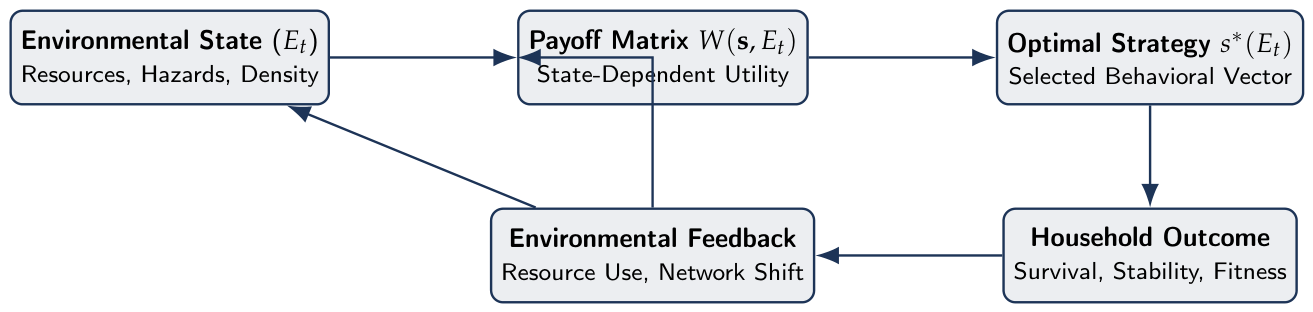
Figure 2.
Stochastic Resource Buffering () Under Environmental Shocks.
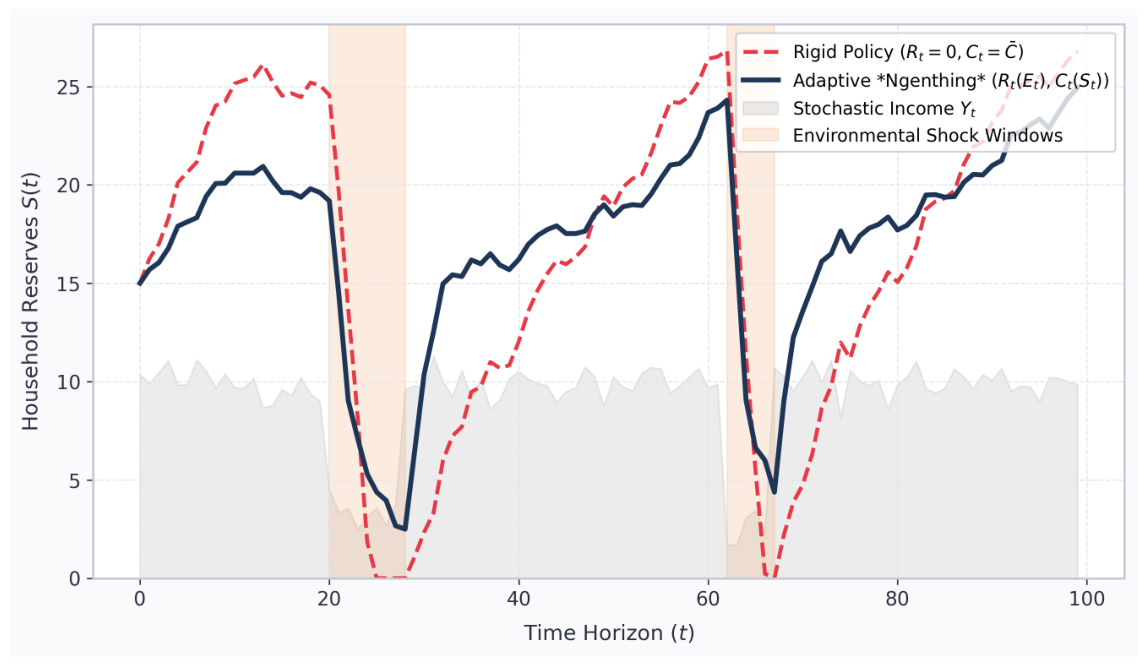
Figure 3.
Shifting Nash Bargaining Frontiers Under Resource Scarcity.
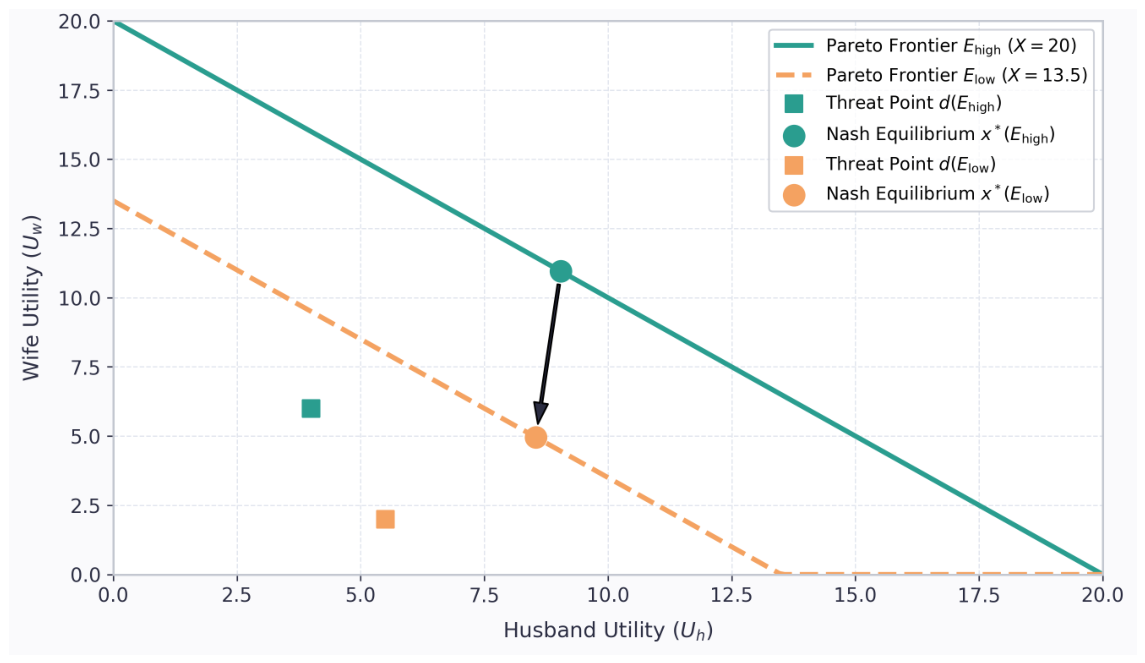
Figure 4.
Domestic Stress () and Homeostatic Recovery Dynamics.
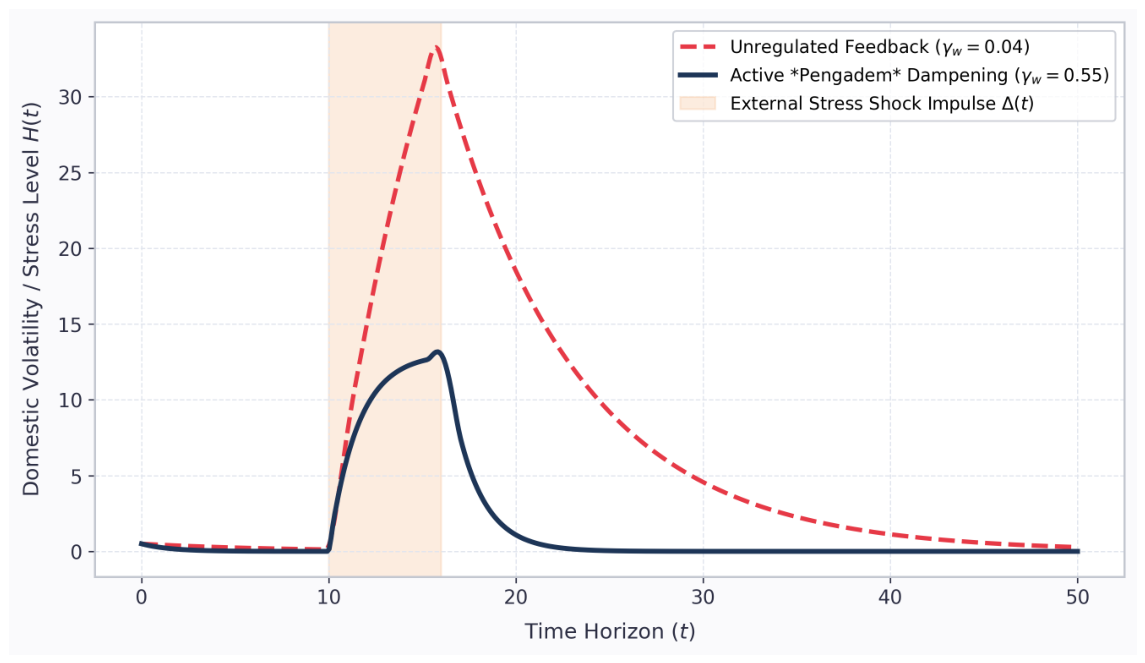
Figure 5.
Switching Boundary for *Gugon Tuhon* vs. Deliberation.
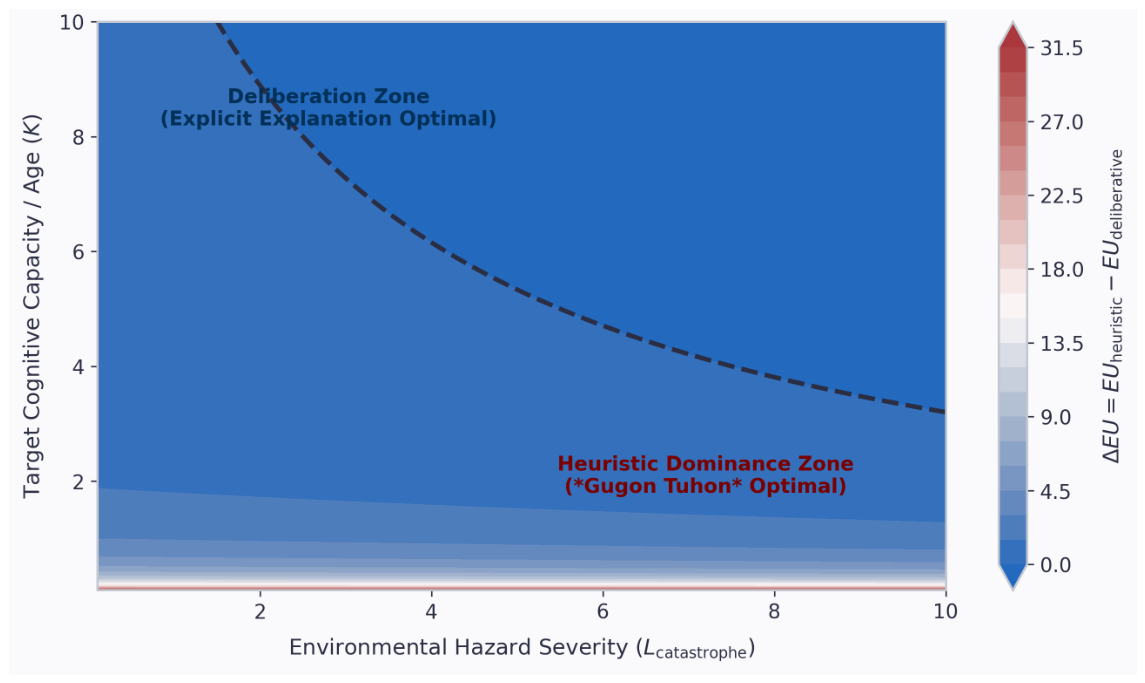
Figure 6.
Replicator Dynamics () of Refined Register (*Krama*) Use.
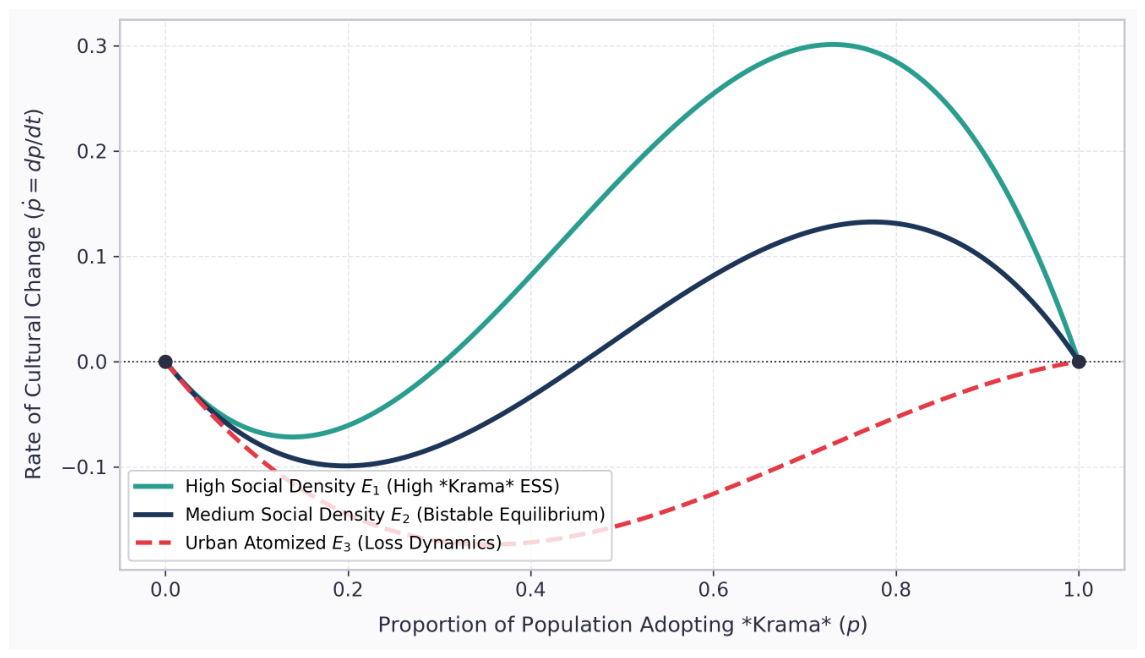
Figure 7.
Costly Signaling Separation Boundary (*Batik Tulis*).
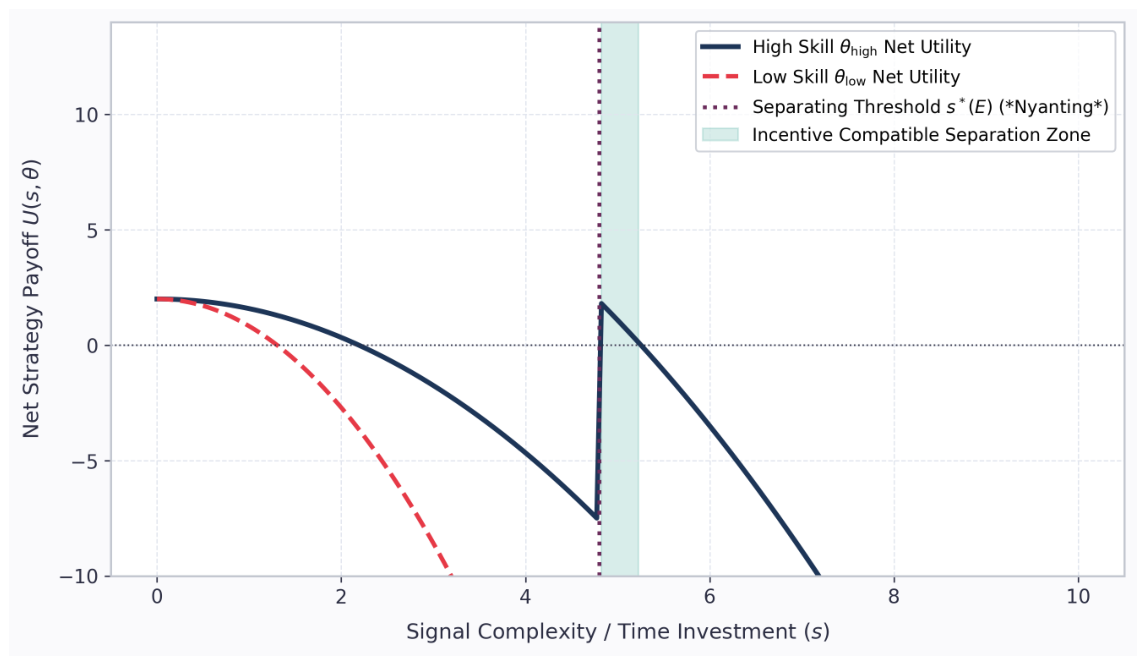

Table 1.
Empirical Validation Matrix: Linking Theoretical Models to Observable Variables and Datasets.
Table 1.
Empirical Validation Matrix: Linking Theoretical Models to Observable Variables and Datasets.
| Model Domain | State Variable (E) | Observable Proxy | Predicted Relationship | Potential Dataset Source |
|---|---|---|---|---|
| Ngenthing Reserve Policy | Income Volatility () | Ratio of Autonomous Female Savings to Total Income | Positive correlation under high volatility (, Equation (4)) | Indonesian Family Life Survey (IFLS) / SUSENAS Logs |
| Pengadem Homeostatic Regulation | External Stress Impulse () | Domestic Volatility Recovery Time | Negative correlation with maternal efficiency (, Equation (8)) | IFLS Mental Health Modules / Qualitative Panel Diaries |
| Garwa Bargaining Equilibrium | Female Market Option () | Female Decision Authority over Capital Allocation | Positive shift in as increases (, Equation (6)) | IFLS Household Decision-Making Modules |
| Gugon Tuhon Risk Heuristic | Environmental Hazard (L) vs. Cognitive Capacity (K) | Adherence to Folk Taboos vs. Analytical Rules | Taboo adherence dominates when L high, K low (Equation (9)) | Vignette Experiments / Primary Field Surveys |
| Unggah-Ungguh Transmission | Community Social Density () | Refined Register (Krama) Usage Frequency | Positive correlation with network density (, Equation (11)) | Sociolinguistic Field Corpora / Observational Surveys |
| Batik Tulis Costly Signaling | Social Status Return () | Time Allocation to High-Complexity Craft (s) | Separating equilibrium when (Equation (16)) | BPS National Time-Use Surveys / Craft Ethnography |
Disclaimer/Publisher’s Note: The statements, opinions and data contained in all publications are solely those of the individual author(s) and contributor(s) and not of MDPI and/or the editor(s). MDPI and/or the editor(s) disclaim responsibility for any injury to people or property resulting from any ideas, methods, instructions or products referred to in the content. |
© 2026 by the authors. Licensee MDPI, Basel, Switzerland. This article is an open access article distributed under the terms and conditions of the Creative Commons Attribution (CC BY) license (http://creativecommons.org/licenses/by/4.0/).
Copyright: This open access article is published under a Creative Commons CC BY 4.0 license, which permit the free download, distribution, and reuse, provided that the author and preprint are cited in any reuse.