

Submitted:
06 October 2026
Posted:
08 October 2026
You are already at the latest version
Abstract
Background: Extremity tourniquets are established lifesaving interventions for severe traumatic hemorrhage, but much of the supporting evidence comes from systems in which evacuation and surgical care occur rapidly. Wilderness, rural, disaster, and contemporary battlefield environments may expose patients to substantially longer tourniquet times. This review examined duration-related outcomes of prolonged emergency tourniquet use and the implications for delayed evacuation. Methods: A rapid review was performed using PubMed/MEDLINE, Google Scholar, backward citation searching, and relevant wilderness and military guidance through Aug 6, 2026. Human trauma studies reporting tourniquet duration and clinical outcomes were eligible. Primary prolonged-use cohorts were included in an exploratory random-effects meta-analysis of amputation proportion. Prolonged use was defined as more than 120 minutes for the primary synthesis; a sensitivity analysis was restricted to cohorts with tourniquet duration greater than 4 hours. Results: Three primary prolonged-use cohorts provided extractable patient-level amputation data (105 patients). The pooled amputation proportion was 35.3% (95% CI, 26.8%-44.9%; I2=0%). Restriction to the two cohorts with tourniquet duration greater than 4 hours produced a similar estimate of 34.9% (95% CI, 25.8%-45.2%). Prolonged cohorts also reported substantial rates of nerve injury, infection, acute kidney injury, rhabdomyolysis, dialysis, and compartment syndrome. In contrast, military and civilian studies dominated by shorter application times reported low tourniquet-attributable morbidity and substantial hemorrhage-control benefit. Conclusions: Emergency tourniquets remain appropriate for life-threatening extremity hemorrhage, but the risk profile changes as evacuation time lengthens. The available evidence supports aggressive reassessment and, when trained personnel and appropriate conditions are present, timely conversion to another effective hemorrhage-control method before ischemic exposure becomes prolonged. Beyond approximately 6 hours, reperfusion and release become higher-risk decisions that should occur with advanced monitoring and resuscitative capability whenever possible. The certainty of evidence is low because prolonged-use studies are small, retrospective, and strongly confounded by injury severity.
Keywords:
tourniquet
; hemorrhage
; wilderness medicine
; prolonged casualty care
; ischemia-reperfusion
; amputation
1. Introduction
Uncontrolled extremity hemorrhage is a preventable cause of traumatic death, and the modern reintroduction of commercial limb tourniquets has changed both military and civilian prehospital care. In a prospective combat cohort, Kragh and colleagues found low tourniquet-related morbidity despite extensive use, with no amputations attributed solely to the tourniquet [1]. Civilian studies subsequently demonstrated similarly favorable short-term safety profiles and an association between prehospital tourniquet use and improved survival in patients with peripheral vascular injury [2,3]. Systematic reviews have generally concluded that commercial tourniquets are effective for life-threatening extremity hemorrhage and that major adverse effects are uncommon when application times are relatively short [4].
The wilderness problem is different. Urban trauma systems often deliver patients to definitive care within minutes to a few hours, whereas wilderness rescue, rural retrieval, disaster operations, maritime incidents, and military prolonged casualty care may extend evacuation for many hours. Joarder and colleagues identified this evidence gap in a 2023 scoping review: most published data supported comparatively safe application for less than 2 hours, while data describing longer application and protracted transport were sparse and heterogeneous [5]. Older Wilderness Medical Society guidance also treated the first 2 hours as a relatively low-risk interval but became more conservative once this threshold was crossed [6]. A wilderness-focused review by Kragh and Dubick emphasized that much of the favorable military experience arose from settings where 91% of tourniquets were in place for 2 hours or less [7].
The emergence of prolonged evacuation in recent conflicts has produced a different clinical phenotype: casualties arriving after 4 to 9 hours of limb ischemia, sometimes with rhabdomyolysis, renal failure, compartment syndrome, infection, and delayed amputation. At the same time, prolonged casualty care doctrine emphasizes repeated reassessment and tourniquet conversion when hemorrhage can be controlled by other means [8,9]. These developments are directly relevant to wilderness medicine, where providers may have to balance immediate hemorrhage control against an uncertain evacuation interval and limited capacity to manage ischemia-reperfusion injury.
The objective of this rapid review and exploratory meta-analysis was to synthesize the available evidence on prolonged emergency extremity tourniquet use, quantify the burden of amputation in cohorts with extended application times, describe other duration-related complications, and translate the findings into a practical framework for wilderness and austere evacuation.
2. Methods
2.1. Design and Reporting
This study was conducted as a rapid evidence review with an exploratory meta-analysis. It was designed as a single-investigator synthesis to address an operational wilderness-medicine question rather than as a registered systematic review. The protocol was not prospectively registered, and duplicate independent screening and extraction were not performed.
2.2. Search Strategy
PubMed/MEDLINE and Google Scholar were searched through August 6, 2026. Backward citation searching was performed from relevant systematic and scoping reviews and wilderness medicine articles. Grey literature was limited to authoritative clinical guidance from the Wilderness Medical Society and the U.S. Department of Defense Joint Trauma System. Search concepts were combined around: “tourniquet,” “extremity tourniquet,” “prehospital tourniquet,” “trauma,” “hemorrhage,” “prolonged,” “duration,” “ischemia,” “reperfusion,” “conversion,” “amputation,” “rhabdomyolysis,” “acute kidney injury,” and “nerve injury.” The principal PubMed concept was: (tourniquet[Title/Abstract]) AND (trauma[Title/Abstract] OR hemorrhage[Title/Abstract] OR haemorrhage[Title/Abstract]) AND (prolonged[Title/Abstract] OR duration[Title/Abstract] OR ischemia[Title/Abstract] OR conversion[Title/Abstract]).
2.3. Eligibility Criteria
Human studies were eligible when they involved emergency extremity tourniquet use for traumatic hemorrhage and reported tourniquet duration, a duration-defined subgroup, or clinically relevant outcomes associated with extended use. Civilian, military, rural, and austere settings were eligible. Elective surgical tourniquet studies, animal studies, venipuncture tourniquets, and reports without clinically interpretable trauma outcomes were excluded from the quantitative synthesis. Reviews and guidelines were retained for contextual synthesis but were not pooled.
2.4. Data Extraction and Outcomes
Data were extracted by a single reviewer into a structured evidence table. Variables included study design, setting, sample size, duration threshold, mean or median tourniquet time, amputation, nerve injury, acute kidney injury, dialysis, rhabdomyolysis, infection, venous thromboembolism, compartment syndrome, and mortality. The primary quantitative outcome was the proportion of patients undergoing amputation in prolonged-use cohorts. Secondary outcomes were synthesized narratively because definitions and reporting varied substantially.
2.5. Risk of Bias
Risk of bias was evaluated qualitatively across selection, exposure ascertainment, outcome ascertainment, confounding, and completeness of reporting. Particular attention was paid to confounding by indication and injury severity, because patients requiring longer tourniquet use often sustain more destructive vascular, blast, crush, or mangling injuries than patients with short application times.
2.6. Statistical Analysis
For cohorts reporting amputation among patients with prolonged tourniquet use, proportions were logit transformed and combined using inverse-variance random-effects methods with the DerSimonian-Laird estimator. Between-study heterogeneity was summarized with I². The primary analysis included cohorts defining prolonged use as more than 120 minutes or longer. A sensitivity analysis restricted the pool to cohorts with tourniquet duration greater than 4 hours. Calculations were performed from published aggregate data. Because only three heterogeneous cohorts contributed to the primary meta-analysis, pooled estimates were considered descriptive rather than causal.
3. Results
The literature consistently separated into two bodies of evidence. The larger historical literature involved relatively short prehospital tourniquet times and primarily addressed survival, bleeding control, and immediate safety. A much smaller contemporary literature specifically described prolonged application during delayed evacuation. Three primary cohorts contained extractable patient-level amputation outcomes for a defined prolonged-use subgroup and were used in the quantitative synthesis [10,11,12]. Additional military and civilian studies, reviews, wilderness medicine articles, and guidelines informed the narrative analysis.
Short-duration evidence. In the prospective combat study by Kragh et al, 232 casualties had 428 tourniquets placed on 309 injured limbs. Four patients (1.7%) developed transient nerve palsy at the tourniquet level, no amputations were attributed solely to tourniquet use, and tourniquet duration was not associated with increased morbidity; only 25 limbs in that cohort had tourniquet time greater than 2 hours [1]. Inaba et al reported favorable outcomes with civilian extremity tourniquet use, while the multicenter study by Teixeira et al found mean tourniquet time of approximately 77 minutes and an independent association between prehospital tourniquet use and survival without an increase in delayed amputation [2,3]. These findings explain why modern trauma systems appropriately prioritize early tourniquet use for life-threatening extremity hemorrhage.
Prolonged civilian use. Hedger et al identified 86 civilian trauma patients with prehospital tourniquet use; a defined prolonged subgroup had total tourniquet time greater than 120 minutes. Among 13 patients in the prolonged subgroup, 11 (85%) experienced at least one recorded complication that could potentially be related to tourniquet use. Five (38%) underwent amputation, 4 (31%) had nerve palsy, 3 (23%) had rhabdomyolysis, 2 (15%) had acute kidney injury, 6 (46%) had wound infection, and 2 (15%) had venous thromboembolism. The authors emphasized that attribution was difficult because the original injury and operative treatment were important competing causes [10].
Prolonged battlefield use. Lukiianchuk et al analyzed 74 casualties with tourniquets in place for at least 4 hours at a forward surgical facility in Ukraine. Mean tourniquet duration was 7.1 hours. Twenty-seven patients required delayed amputation, 58 required hemodialysis, and 5 died; compartment syndrome was reported in all included patients [11]. Katzir et al described 18 patients with 21 high-energy limb injuries and tourniquet times greater than 4 hours. Mean duration was 5.8 hours. Five patients underwent amputation, 7 developed temporary acute kidney injury, 2 required hemodialysis, 8 developed bacterial infections requiring additional surgery, and 16 had persistent nerve injury. Eighty percent of amputations and 75% of infections occurred among patients whose tourniquet time exceeded 6 hours [12].
Meta-analysis. Across the three prolonged-use cohorts, 37 of 105 patients underwent amputation. The random-effects pooled amputation proportion was 35.3% (95% CI, 26.8%-44.9%), with I²=0%. The estimate was essentially unchanged when the civilian cohort using a >120-minute definition was removed: among the two cohorts restricted to >4 hours, the pooled proportion was 34.9% (95% CI, 25.8%-45.2%). The low statistical heterogeneity should not be interpreted as clinical homogeneity; the cohorts differed markedly in injury mechanism, vascular injury burden, selection criteria, setting, and approach to limb salvage.
Tourniquet conversion and reassessment. The Joint Trauma System prolonged casualty care guidance recommends reassessment of all tourniquets and conversion to another effective hemorrhage-control method in less than 2 hours when bleeding can be controlled and the patient can be observed. It cautions against removing a tourniquet that has been in place more than 6 hours without the capability for close monitoring and laboratory-supported resuscitation [8]. Holcomb et al similarly argued that conversion and repositioning should be taught as extensions of tourniquet use rather than treated as advanced afterthoughts, particularly when evacuation is delayed [9]. This represents an evolution from older wilderness guidance, which advised that a tourniquet left in place for more than 2 hours generally remain until definitive medical evaluation [6].

Table 1.
Primary prolonged-tourniquet cohorts included in quantitative synthesis.
| Study | Setting | Prolonged definition | N | Duration | Amputation | Selected complications |
| Hedger et al, 2025 | Civilian retrieval/trauma | >120 min | 13 | Not uniformly reported for subgroup | 5/13 (38%) | Any complication 11/13; nerve palsy 4; AKI 2; rhabdomyolysis 3; infection 6; VTE 2 |
| Katzir et al, 2025 | Battlefield; 2 Level I centers | >4 h | 18 | Mean 5.8 h | 5/18 (27.8%) | AKI 7; dialysis 2; infection 8; persistent nerve injury 16 |
| Lukiianchuk et al, 2025 | Forward surgical facility, Ukraine | ≥4 h | 74 | Mean 7.1 h | 27/74 (36.5%) | Dialysis 58; compartment syndrome reported in all; deaths 5 |
Figure 1.
Exploratory meta-analysis of amputation proportion.
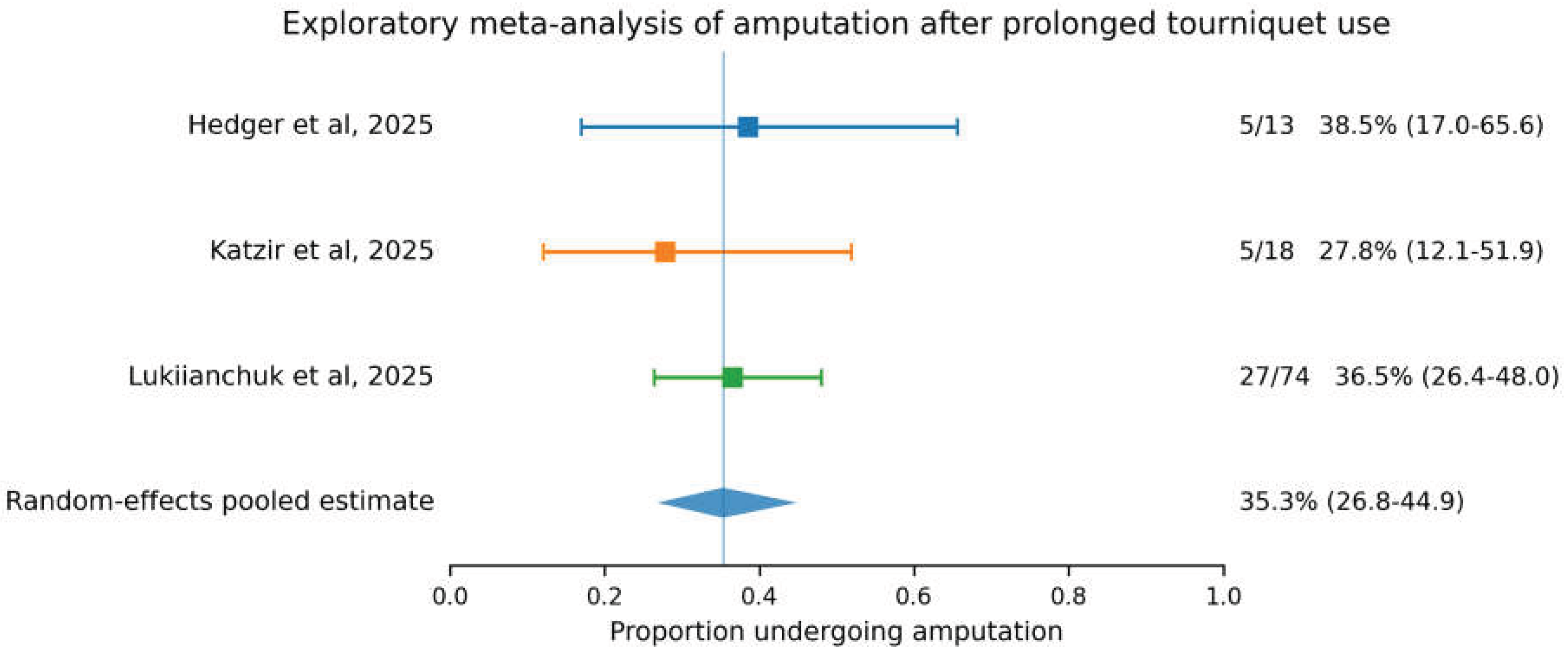
Three prolonged-use cohorts contributed 105 patients. Random-effects pooled amputation proportion: 35.3% (95% CI, 26.8%-44.9%; I²=0%). The estimate is descriptive and should not be interpreted as causal.
4. Discussion
The central finding of this review is not that a particular hour marks a universal transition from “safe” to “unsafe.” Rather, the available data describe a continuum. During the first 1 to 2 hours, modern commercial tourniquets have an extensive record of effective hemorrhage control with relatively low attributable morbidity [1,2,3,4]. As application time extends, local ischemia, muscle injury, nerve dysfunction, thrombosis, compartment syndrome, infection, and systemic consequences of reperfusion become increasingly relevant. The contemporary prolonged-use cohorts demonstrate the magnitude of that problem, although they cannot isolate tourniquet duration from the severity of the underlying injury.
The pooled amputation estimate requires especially careful interpretation. Approximately one-third of patients in the prolonged cohorts underwent amputation, but these were not randomized patients with otherwise comparable injuries. The prolonged groups contained high-energy battlefield wounds, severe tissue destruction, vascular injury, and patients selected for attempts at limb salvage. Katzir et al excluded patients requiring immediate amputation on arrival, while Lukiianchuk et al used a treatment algorithm for patients selected for salvage after at least 4 hours of ischemia [11,12]. The meta-analysis therefore estimates the observed burden of amputation in prolonged-use populations; it does not estimate the causal probability that a tourniquet will produce an amputation.
Why duration matters. Complete arterial occlusion protects the patient from exsanguination at the cost of distal ischemia. With time, skeletal muscle metabolism becomes anaerobic and intracellular potassium, hydrogen ions, lactate, myoglobin, and other metabolites accumulate. Reperfusion can abruptly return this load to the circulation, creating acidosis, hyperkalemia, renal stress, hemodynamic instability, and-in extreme cases-cardiovascular collapse. The high dialysis requirement reported in the Ukrainian cohort illustrates the systemic dimension of prolonged limb ischemia [11]. These mechanisms also explain why simply loosening a very prolonged tourniquet in a resource-poor field environment may be more dangerous than leaving it in place until appropriate resuscitative capability is available.
The wilderness implication is operational rather than purely temporal. A tourniquet should still be applied promptly when extremity bleeding is immediately life threatening; fear of later ischemia should not delay hemorrhage control [6,7,13]. Once bleeding is controlled, however, the evacuation forecast becomes part of treatment. A patient 20 minutes from a road-access ambulance presents a different problem from a climber, hunter, paddler, or disaster casualty facing 6 to 10 hours before surgical care. In the latter setting, the tourniquet needs repeated reassessment, documentation of application time, analgesia when feasible, protection from inadvertent loosening, and early consideration of whether a pressure dressing or hemostatic wound packing can safely maintain control.
Tourniquet conversion should not be equated with periodically loosening the device. The older practice of intermittent release to “perfuse the limb” is not supported and risks recurrent hemorrhage [6]. Modern conversion means establishing another reliable method of hemostasis while the tourniquet is still controlling bleeding, then cautiously releasing it while the wound is directly observed. Current military guidance conditions conversion on the absence of shock, the ability to monitor closely for rebleeding, and the absence of a traumatic amputation requiring ongoing tourniquet control [8,9]. If bleeding recurs, the tourniquet is retightened immediately. This is a trained procedure, not an instruction for an untrained bystander to experiment with a functioning lifesaving device.
The 2-hour and 6-hour thresholds are best regarded as operational decision points rather than biologic absolutes. The 2-hour interval is supported by the large body of short-duration experience and by contemporary guidance encouraging early reassessment and conversion when feasible [5,6,7,8,9]. The 6-hour threshold reflects concern that advanced ischemic injury and reperfusion physiology may make uncontrolled field release hazardous. The newer prolonged battlefield cohorts are consistent with that concern: Katzir et al found that most amputations and infections in their cohort occurred beyond 6 hours, and Lukiianchuk et al demonstrated severe systemic morbidity at a mean duration exceeding 7 hours [11,12]. Nevertheless, limb salvage remained possible even after these long intervals, so duration alone should not be used as an automatic indication for amputation.
Recent literature reinforces these operational principles. A 2026 focused review of prolonged extremity tourniquet use emphasized tourniquet conversion, limb-salvage decision-making, and ischemia-reperfusion management as central challenges when evacuation is delayed [14]. A 2026 proposed Tactical Combat Casualty Care update affirmed reassessment within 2 hours for nonmedical personnel and limited conversion beyond 2 hours to medical personnel [15]. In a separate civilian Level I trauma-center cohort of 647 patients, 543 (83.9%) underwent successful emergency-department conversion; median tourniquet duration was 40 minutes, no complications were attributed to tourniquet use, and each additional 30 minutes of tourniquet time was independently associated with lower odds of successful conversion [16]. Although that cohort was dominated by short application times and therefore does not resolve the prolonged-wilderness question, it supports early reassessment and conversion when clinically appropriate.
A second important finding is that unnecessary or ineffective tourniquet use becomes more consequential when evacuation is long. Hedger et al reported that 77% of prehospital tourniquet applications in their civilian cohort were judged nonindicated, and prolonged use was associated with a high recorded complication burden [10]. In wilderness education, therefore, competency should extend beyond “put on a tourniquet.” Training should include recognition of truly life-threatening hemorrhage, confirmation that the device has stopped bleeding and eliminated the distal pulse when appropriate, documentation of time, reassessment after movement, and an understanding of when trained conversion may be reasonable.
The evidence supports a hierarchy of priorities. First, stop exsanguinating hemorrhage. Second, reassess whether the tourniquet is still required once the situation is controlled. Third, if evacuation will be prolonged and conversion criteria are satisfied, trained providers should consider conversion before ischemic exposure becomes extended. Fourth, if duration has already become very prolonged-particularly beyond approximately 6 hours-release should be treated as a resuscitative event rather than a routine field maneuver. The patient should be moved toward a setting capable of managing recurrent hemorrhage, electrolyte disturbance, renal injury, dysrhythmia, and reperfusion shock.
Table 2.
Evidence-informed operational interpretation for delayed evacuation.
| Elapsed tourniquet time | Evidence signal | Operational implication | Key cautions |
| <2 h | Best-supported safety interval in modern trauma literature | Maintain effective hemorrhage control; reassess indication and prepare conversion if evacuation will be prolonged and criteria are met | Do not loosen solely to provide intermittent perfusion |
| 2-6 h | Evidence becomes progressively sparse; ischemic risk increases with time | Trained provider should reassess need and consider conversion/repositioning when patient is not in shock, wound can be monitored, and no traumatic amputation requires ongoing control | Rebleeding must be immediately treatable; this is not an untrained-bystander maneuver |
| >6 h | Recent prolonged cohorts show high burden of limb and systemic complications | Prioritize evacuation to advanced care; treat release as a potentially high-risk reperfusion event | Avoid unsupervised release when close monitoring, laboratory support, resuscitation, and hemorrhage control are unavailable |
5. Limitations
This review has important limitations. It was conducted as a rapid, single-reviewer synthesis without prospective registration or duplicate screening. The original rapid-review workflow did not preserve the record-level identification and exclusion counts required for a formal PRISMA flow diagram. The prolonged-use meta-analysis included only three cohorts and 105 patients. All were observational, and two came from recent warfare involving high-energy injuries that may not resemble typical recreational wilderness trauma. Definitions of prolonged use differed (>120 minutes versus ≥4 hours), complications were not uniformly defined, and attribution of amputation or organ injury to tourniquet duration was confounded by vascular disruption, crush injury, tissue loss, shock, infection, and surgical decision-making. Statistical heterogeneity for the pooled amputation proportion was low, but clinical heterogeneity was substantial. Publication bias could not be meaningfully assessed with only three studies. The pooled estimate should therefore be interpreted as descriptive epidemiology of selected prolonged-use cohorts, not as a treatment-effect estimate or a duration-specific causal risk.
6. Conclusions
Tourniquets remain a lifesaving first-line intervention for life-threatening extremity hemorrhage. The evidence supporting their safety is strongest when application is brief, particularly within the first 2 hours. When wilderness or austere evacuation becomes prolonged, the clinical task changes: reassessment, documentation, analgesia, hemorrhage-control alternatives, and anticipation of ischemia-reperfusion injury become increasingly important. In three modern prolonged-use cohorts, the pooled amputation proportion was approximately 35%, accompanied by substantial neurologic, infectious, renal, and muscular morbidity. These outcomes reflect both severe injury and extended ischemia and should not be interpreted as proof of tourniquet-caused limb loss. For trained providers, conversion to a reliable pressure or hemostatic dressing should be considered early when the patient is not in shock, the wound can be monitored, and there is no traumatic amputation requiring ongoing tourniquet control. Very prolonged tourniquets-especially beyond about 6 hours-should generally be released only where recurrent bleeding and reperfusion physiology can be actively managed. Further prospective multicenter data are needed to define duration-specific risks applicable to wilderness and rural trauma.
Funding
This research received no specific grant from any funding agency in the public, commercial, or not-for-profit sectors.
Institutional Review Board Statement
Not applicable. This review used only previously published aggregate data and did not involve individual patient-level data or direct contact with human participants.
Informed Consent Statement
Not applicable.
Data Availability Statement
All data used in this review were derived from publicly available published sources. The aggregate data used for the quantitative synthesis are provided in Table 1. No additional patient-level dataset was generated or analyzed.
Conflicts of Interest
The author declares no conflicts of interest.
Appendix 1. Reproducible Search Strategy
Principal PubMed/MEDLINE concept: (tourniquet[Title/Abstract]) AND (trauma[Title/Abstract] OR hemorrhage[Title/Abstract] OR haemorrhage[Title/Abstract]) AND (prolonged[Title/Abstract] OR duration[Title/Abstract] OR ischemia[Title/Abstract] OR conversion[Title/Abstract]).
Additional targeted combinations included: tourniquet AND amputation; tourniquet AND rhabdomyolysis; tourniquet AND acute kidney injury; tourniquet AND reperfusion; tourniquet conversion AND trauma; prolonged tourniquet AND battlefield; prolonged tourniquet AND civilian trauma; tourniquet AND wilderness.
Searches were last updated August 6, 2026. Reference lists of the 2021 civilian systematic review, the 2023 time-and-distance scoping review, relevant Wilderness & Environmental Medicine reviews, and identified prolonged-use studies were manually screened for additional eligible reports. Because record-level identification and exclusion counts were not prospectively retained during the original rapid-review workflow, a formal PRISMA flow diagram was not generated.
References
- Kragh, J.F., Jr.; Walters, T.J.; Baer, D.G.; Fox, C.J.; Wade, C.E.; Salinas, J.; Holcomb, J.B. Practical use of emergency tourniquets to stop bleeding in major limb trauma. J. Trauma. discussion S49-S50. 2008, 64 2 Suppl, S38–S49. [Google Scholar] [CrossRef] [PubMed]
- Inaba, K.; Siboni, S.; Resnick, S.; et al. Tourniquet use for civilian extremity trauma. J. Trauma Acute Care Surg. 2015, 79(2), 232–237. [Google Scholar] [CrossRef] [PubMed]
- Teixeira, P.G.R.; Brown, C.V.R.; Emigh, B. Texas Tourniquet Study Group. Civilian prehospital tourniquet use is associated with improved survival in patients with peripheral vascular injury. J. Am. Coll. Surg. 2018, 226(5), 769–776.e1. [Google Scholar] [CrossRef] [PubMed]
- Eilertsen, K.A.; Winberg, M.; Jeppesen, E.; Hval, G.; Wisborg, T. Prehospital tourniquets in civilians: a systematic review. Prehosp Disaster Med. 2021, 36(1), 86–94. [Google Scholar] [CrossRef] [PubMed]
- Joarder, M.; Noureddine El Moussaoui, H.; Das, A.; Williamson, F.; Wullschleger, M. Impact of time and distance on outcomes following tourniquet use in civilian and military settings: a scoping review. Injury 2023, 54(5), 1236–1245. [Google Scholar] [CrossRef] [PubMed]
- Quinn, R.H.; Wedmore, I.; Johnson, E.L.; et al. Wilderness Medical Society practice guidelines for basic wound management in the austere environment: 2014 update. Wilderness Environ. Med. 2014, 25((4) Suppl, S118–S133. [Google Scholar] [CrossRef] [PubMed]
- Kragh, J.F., Jr.; Dubick, M.A. Bleeding control with limb tourniquet use in the wilderness setting: review of science. Wilderness Environ. Med. 2017, 28((2) Suppl, S25–S32. [Google Scholar] [CrossRef] [PubMed]
- Joint Trauma System. Prolonged Casualty Care Guidelines. Clinical Practice Guideline ID Published December 21, 2021. Available online: https://jts.health.mil/assets/docs/cpgs/Prolonged_Casualty_Care_Guidelines_21_Dec_2021_ID91.pdf (accessed on 6 October 2026).
- Holcomb, J.B.; Dorlac, W.C.; Drew, B.G.; et al. Rethinking limb tourniquet conversion in the prehospital environment. J. Trauma Acute Care Surg. 2023, 95(6), e54–e60. [Google Scholar] [CrossRef] [PubMed]
- Hedger, D.J.; Smith, M.; Weaver, N.; Bendall, J.; Balogh, Z.J. Increasing prehospital tourniquet use attributed to non-indicated use: an 11-year retrospective study. Eur. J. Trauma Emerg. Surg. 2025, 51, 71. [Google Scholar] [CrossRef] [PubMed]
- Lukiianchuk, V.; Linchevskyy, O.; Dorlac, W.C.; et al. Morbidity and mortality associated with ischemia-reperfusion injury after prolonged tourniquet use: a wartime single-center treatment algorithm. J. Trauma Acute Care Surg. 2025, 99((3S) Suppl 1, S79–S85. [Google Scholar] [CrossRef] [PubMed]
- Katzir, A.; Krispel, J.; Acker, A.; et al. Outcomes of prolonged tourniquet application on the battlefield: is a liberal application policy always justifiable? J. Orthop. Trauma. 2025. [Google Scholar] [CrossRef] [PubMed]
- Drew, B.; Bennett, B.L.; Littlejohn, L. Application of current hemorrhage control techniques for backcountry care: part one, tourniquets and hemorrhage control adjuncts. Wilderness Environ. Med. 2015, 26(2), 236–245. [Google Scholar] [CrossRef] [PubMed]
- Lammers, D.; Henry, R.; McClellan, J.; et al. Prolonged tourniquet use in extremity trauma: what you need to know. J Trauma Acute Care Surg 2026. [Google Scholar] [CrossRef] [PubMed]
- Koch, E.J.; Andersen, M.; Barbee, G.A.; et al. Standardizing tourniquet reassessment and conversion across TCCC tiers: TCCC Guidelines Proposed Change 25-2. J. Spec. Oper. Med. 2026, 26(1). [Google Scholar] [CrossRef] [PubMed]
- Fox, A.L.; Stuart, M.; Clemens, M.; Callaway, D.W. CONVERT: civilian outcomes of emergency department tourniquet conversion. J Trauma Acute Care Surg 2026. [Google Scholar] [CrossRef] [PubMed]
Disclaimer/Publisher’s Note: The statements, opinions and data contained in all publications are solely those of the individual author(s) and contributor(s) and not of MDPI and/or the editor(s). MDPI and/or the editor(s) disclaim responsibility for any injury to people or property resulting from any ideas, methods, instructions or products referred to in the content. |
© 2026 by the authors. Licensee MDPI, Basel, Switzerland. This article is an open access article distributed under the terms and conditions of the Creative Commons Attribution (CC BY) license (http://creativecommons.org/licenses/by/4.0/).
Copyright: This open access article is published under a Creative Commons CC BY 4.0 license, which permit the free download, distribution, and reuse, provided that the author and preprint are cited in any reuse.