

Submitted:
05 October 2026
Posted:
08 October 2026
You are already at the latest version
Abstract
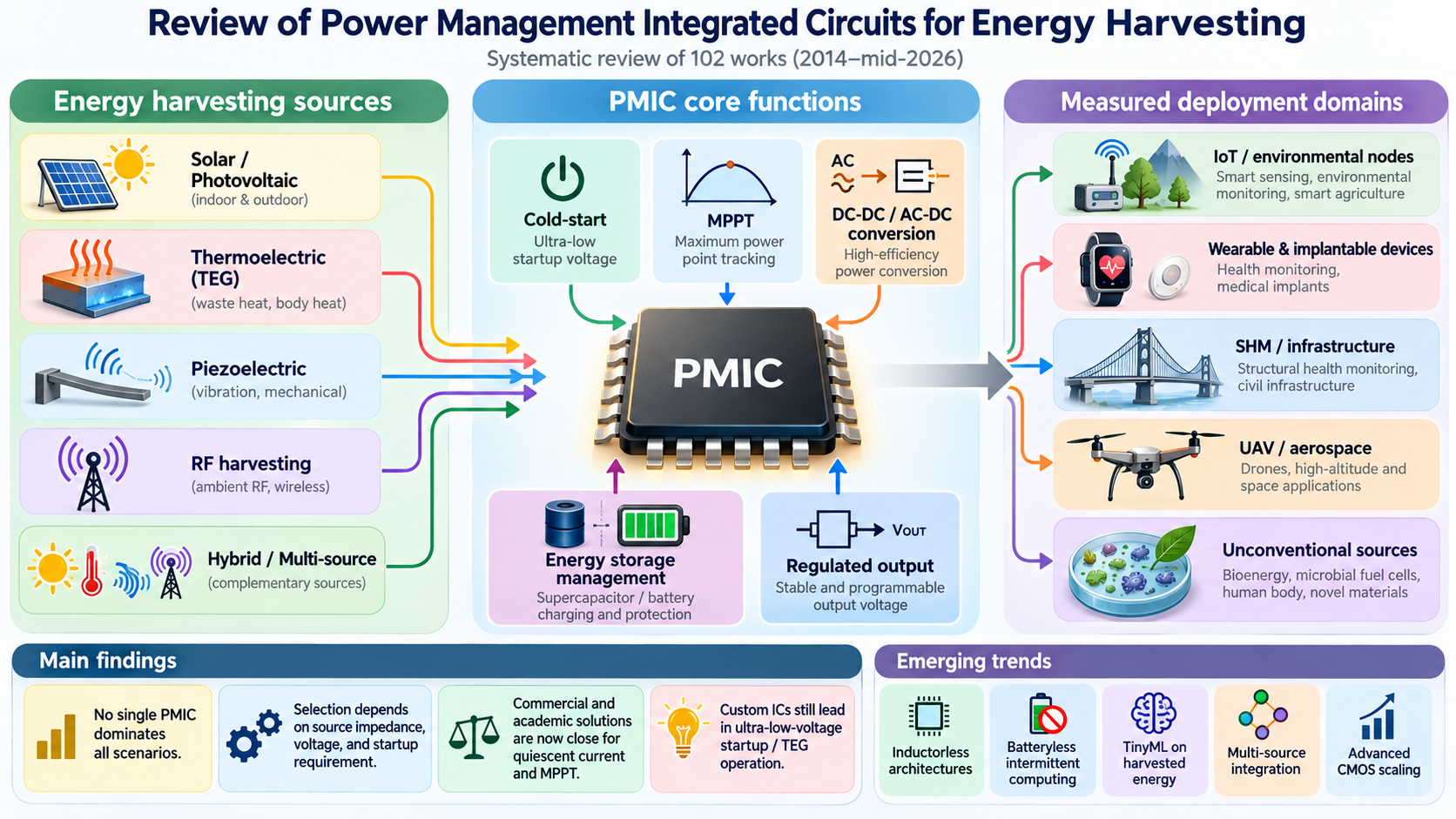
This manuscript presents a review of Power Management Integrated Circuits (PMICs) for energy harvesting applications, covering both commercial off-the-shelf components and academic custom designs reported between 2014 and mid-2026. A two-round search across seven databases processed 1393 sources, of which 102 met the inclusion criteria after deduplication and screening. The review addresses the principal harvesting modalities considered in the literature surveyed, that is, solar/photovoltaic, thermoelectric, piezoelectric, radio-frequency, and hybrid/multisource systems, and examines commercial PMICs alongside state-of-the-art academic prototypes, including designs reported at ISSCC 2025 and ISSCC 2026 conferences. Real-world deployment cases with measured results are analyzed across five application domains: IoT sensor nodes, wearable and implantable devices, structural health monitoring, UAV energy harvesting, and unconventional sources. Key performance metrics are compared, including quiescent current, cold-start voltage, minimum operating voltage, conversion efficiency, and MPPT performance. Academic designs have demonstrated quiescent currents as low as 32 nA, cold-start operation at 57 mV, sustained converter operation from 3.5 mV after startup, and MPPT efficiencies exceeding 99%. Controlled comparisons of commercial PMICs show that their relative performance depends strongly on source impedance, voltage level, excitation conditions, and startup requirements; accordingly, a first-pass selection procedure organized by operating regime is proposed. Five trends shaping next-generation PMICs are identified: inductorless charge-pump architectures, batteryless intermittent-computing integration, TinyML on harvested energy, multi-source chip-level integration, and advanced CMOS integration, represented in the surveyed literature by implementations down to 28 nm FDSOI. The review concludes that the commercial–academic performance gap has narrowed substantially for quiescent current, conversion efficiency, and MPPT performance, whereas custom circuits retain a clear advantage in ultra-low-voltage startup and sustained operation for thermoelectric harvesting.
Keywords:
energy harvesting
; power management integrated circuit (PMIC)
; maximum power point tracking (MPPT)
; DC-DC converter
; cold-start
; Internet of Things (IoT)
; piezoelectric
; thermoelectric generator (TEG)
; photovoltaic
; RF energy harvesting
; wireless sensor network
1. Introduction
Energy harvesting, that is, the capture of ambient energy from light, heat, vibration, or radio waves, has become the enabling technology for self-powered Internet of Things (IoT) sensor nodes, wireless sensor networks (WSNs), wearable health monitors, and implantable medical devices [1,2,3]. The global energy harvesting system market is projected to grow from USD 663.5 million in 2025 to USD 1.61 billion by 2034, driven by increasing adoption of IoT and wireless sensor networks, demand for energy-efficient infrastructure, and policies promoting sustainable energy solutions [4]. Unlike battery-powered systems requiring periodic replacement, which is a prohibitive constraint for the projected trillions of IoT endpoints, energy-harvesting-powered devices can theoretically operate indefinitely, provided the power management electronics can efficiently extract, convert, store, and regulate the harvested energy.
The Power Management Integrated Circuit (PMIC) sits at the heart of every energy harvesting system, bridging the gap between the harvester’s irregular, low-voltage output and the stable supply required by digital loads [5,6], as shown in Figure 1.
A well-designed PMIC must perform several critical functions simultaneously: maximum power point tracking (MPPT) to ensure optimal impedance matching with the source, voltage conversion via DC-DC or AC-DC topologies, energy storage management with charge/discharge protection, regulated output delivery, and cold-start capability from a fully depleted state [7]. The efficiency of these functions directly determines system viability, because a PMIC consuming more power than the harvester produces renders the entire system inoperable.
This manuscript provides a detailed view of the current technological scenario, including commercial parts released through 2026 and academic custom PMIC designs, and a detailed analysis of real-world deployment cases where specific PMICs have been validated with measured experimental results. Its distinguishing contribution is not the enumeration of parts, which is available from vendor documentation, but the confrontation of published measured results with the selection problem faced by system designers: given a source, a voltage range, and a cold-start requirement, which PMIC should be used, and what evidence supports that choice.
The remainder of this paper is organized as follows. Section 2 states the scope and method of the review. Section 3 characterizes each harvesting source and the electrical constraints it imposes. Section 4 reviews the converter topologies and functional blocks, including MPPT and cold-start circuits, that respond to those constraints. Section 5 surveys the commercial and custom PMIC landscape and quantifies the gap between them. Section 6 analyses documented deployments organized by application domain. Section 7 consolidates the evidence into practical selection guidance. Section 8 identifies open challenges and emerging trends, and Section 9 concludes the manuscript.
2. Review Scope and Method
This review covers the period from 2014 to mid-2026, chosen because the foundational commercial energy harvesting PMICs (LTC3108 in 2010, BQ25504 in 2013, BQ25570 in 2013, LTC3588-1 in 2010) were released in the years immediately preceding this window and remain in widest use today, allowing their deployment record to be assessed with measured field data rather than datasheet claims alone. The 2014 lower bound captures the earliest measured deployment studies using these parts, while the 2026 upper bound incorporates significant commercial launches in late 2025 and early 2026, most notably the e-peas AEM15820 (December 2025) and the Asahi Kasei AP4413 (February 2025), as well as academic contributions presented at ISSCC 2025 (Session 31: Energy Harvesting and Wireless Power [8]) and ISSCC 2026 (Session 16: Energy Harvesting, Piezo and Chargers [9]).
Sources and search strategy: The literature search was conducted in two complementary rounds using seven bibliographic databases, search engines, repositories, and publisher platforms: IEEE Xplore, Scopus, ScienceDirect, Google Scholar, PubMed Central, ResearchGate, and the MDPI journal platform. The first round, targeting the broad PMIC landscape, including converter topologies, MPPT algorithms, cold-start circuits, multi-source architectures, and comparative reviews, was initially executed in March 2025 and updated in August 2026. The primary search string combined a PMIC-level term with a harvesting-level term using Boolean operators:
("power management" OR "PMIC" OR "energy harvesting IC" OR "boost converter" OR "cold-start" OR "MPPT") AND ("energy harvesting" OR "ambient energy" OR "piezoelectric" OR "thermoelectric" OR "TEG" OR "photovoltaic" OR "RF harvesting" OR "vibration harvesting" OR "triboelectric")
This round processed 588 sources in its initial execution and 143 additional sources in the August 2026 update, for a total of 731 sources. The 2026 update specifically captured ISSCC 2026 Session 16 [9], which presented ten papers on new circuit topologies, MPPT schemes, and energy-recycling techniques spanning photovoltaic, piezoelectric, thermoelectric, triboelectric, and 5G RF harvesting. This second round specifically targeted real-world deployment cases with measured experimental results, querying each commercial PMIC family by part number (e.g., "BQ25570," "AEM10941," "AEM15820," "LTC3108," "LTC3588-1," "SPV1050," "NEH7100," "MAX20361," "MAX17710," "AP4413") combined with application keywords ("IoT," "sensor node," "wearable," "LoRa," "structural health monitoring," "implantable," "UAV," "bridge monitoring"). This deployment-focused round processed 573 sources initially and 89 additional sources in the update, for a total of 662 sources. The part-number search strategy was essential to capture deployment case studies that do not use generic harvesting terminology in their titles or abstracts. The August 2026 update expanded the part-number query set to include recently released devices such as the AEM15820 and AP4413. Records identified through these additional searches were screened using the same inclusion and exclusion criteria applied to the initial search.
Grey literature was explicitly included under a controlled rationale. Manufacturer datasheets, application notes, evaluation-board documentation, and press releases were admitted as primary sources for component-level specifications (input voltage range, cold-start voltage, quiescent current, MPPT type, package dimensions) because these parameters are defined by the manufacturer and are not independently reproduced in peer-reviewed publications. Each datasheet citation references a specific document revision to ensure reproducibility. Press releases from manufacturers (e.g., e-peas, Nexperia, Asahi Kasei) were admitted only when they documented a named deployment partner, a named end application, and at least one quantitative performance claim; editorial or promotional material without technical content was excluded. All grey-literature sources are clearly identified in the reference list through the "Available online" tag per MDPI formatting guidelines.
Inclusion and exclusion criteria. Works were included when they (i) reported a power management circuit, whether a commercial off-the-shelf IC or a custom CMOS design, for an ambient energy source, and (ii) reported measured electrical results in at least one of the following categories: quiescent current, cold-start voltage, conversion efficiency, MPPT tracking efficiency, harvested power, or demonstrated system autonomy. For deployment case studies, inclusion additionally required identification of the specific PMIC used and at least one quantitative field or laboratory measurement beyond the PMIC datasheet specifications. Simulation-only studies without fabricated or measured hardware, harvester-material studies without an associated power management stage, grid-scale photovoltaic MPPT work (input power > 10 W), and works published before 2014 were excluded, except for seminal earlier references that established foundational techniques still referenced by current designs.
Screening. From the combined 1393 sources processed across both search rounds and their updates (731+662), duplicates appearing in both rounds and across databases were removed, yielding 952 unique records. Title and abstract screening against the inclusion criteria retained 251 records for full-text assessment. Following full-text review, 102 works were included in the final synthesis, distributed as follows: 32 reporting commercial PMIC deployment cases with measured results, 25 presenting academic or custom PMIC designs with fabricated silicon or measured prototypes, 19 comparative studies or review articles, and 22 manufacturer datasheets, application notes, and technical documentation. A post-screening verification step cross-checked every non-datasheet reference against its original publication source to confirm author names, journal, volume, page numbers, and DOI, resulting in corrections to 14 entries where metadata discrepancies were identified. Figure 2 presents the screening process as a PRISMA-style flow diagram.
Counting conventions. A “deployment case” is counted once per published system, not once per PMIC; systems reported across multiple papers by the same group are counted once.
Relation to existing reviews. Recent reviews have addressed energy harvesting techniques for structural health monitoring (SHM) [10], IoT [11], wireless sensor networks (WSNs) [3], wearable harvesting technologies [12], cold-start circuit design [13], and implantable power management [14]. The present review differs in placing commercial parts and custom research ICs on a common set of metrics and in extracting selection guidance from the measured deployment record.
AI assistance. OpenAI ChatGPT (GPT-5.6 Sol) was used during manuscript preparation to assist with consistency checking, language refinement, verification of tabulated information against the cited sources, and preparation of Python scripts for selected figures. All literature-search results, numerical values, classifications, references, and graphical outputs were independently reviewed and validated by the authors against the original sources. Generative AI was not used to create or alter original experimental data or to determine study inclusion or exclusion without author verification.
3. Energy Harvesting Sources and Constraints
Each energy source imposes distinct electrical constraints on PMIC design. This section characterizes the sources; the circuit responses to these constraints are treated in Section 4, the parts that implement them in Section 5, and the systems that use them in Section 6. Table 1 summarizes the typical voltage, current, and power characteristics of each source type.
3.1. Solar/Photovoltaic
Solar energy spans the widest power range among harvesting sources. Outdoor PV cells produce 0.5–5 V at power densities of 10–100 mW/cm², while indoor PV under typical office lighting (200–500 lux) generates only 0.2–0.5 V at 10–100 μW/cm² [1,15]. The strongly nonlinear I-V characteristic demands MPPT, typically implemented as fractional open-circuit voltage (FOCV) at 70–80 % of VOC (see Section 4.5). Organic PV cells and dye-sensitized solar cells (DSSCs) show particular promise for indoor harvesting, with absorption spectra better matched to LED and fluorescent emission. Perovskite solar cells have demonstrated 12-month continuous operation in office environments, yielding 148.8 mWh/cm²/year, a 3× advantage over crystalline silicon indoors [16]. The critical design consequence is that irradiance, not the PMIC, sets the operating regime: below about 250 lux the performance of commercial parts diverges sharply, as quantified in Section 5.3.
3.2. Thermoelectric Generators (TEGs)
TEGs produce DC output at very low voltages, typically 20 – 500 mV for body-worn applications (ΔT = 1 – 5 °C) [11] and up to several volts for industrial waste heat [17]. TEGs therefore present the greatest cold-start challenge for PMICs; the combination of millivolt-level input and the need for 30 – 330× voltage boost has driven the startup circuit innovation reviewed in Section 4.6. A second consequence, less often stated, is that the TEG source impedance is low and nearly constant, so the incremental benefit of sophisticated MPPT is smaller than for PV, which explains why parts with no MPPT at all, such as the LTC3108, remain competitive in this domain.
3.3. Piezoelectric Transducers
Piezoelectric transducers generate high-voltage AC output (5 – 50 V, up to 150 V for PZT ceramics) but at extremely low currents (nA to μA) [18]. PZT transducers generally provide higher electromechanical coupling and can achieve comparatively high power in mechanically favorable configurations, whereas PVDF offers flexibility, lower density, lead-free composition, and mechanical robustness [19]. Reported harvested power depends strongly on transducer geometry, excitation amplitude, frequency, mechanical boundary conditions, and electrical interface. The high source impedance and AC nature require the specialized rectification interfaces described in Section 4.4. Because the output is intrinsically intermittent and tied to a mechanical excitation spectrum, piezoelectric systems are also the most sensitive to the match between the harvester’s resonant frequency and the ambient vibration, a mismatch that dominates the field results reported in Section 6.3 and Section 6.4.
3.4. RF Energy Harvesting
RF harvesting operates at the lowest power levels of all sources considered in this review. Pinuela et al. [21] measured power densities of 36–84 nW/cm² for GSM-900/1800 and WiFi-2.4 GHz bands in central London, while Talla et al. [20] showed that available power at 40 m from a WiFi access point is approximately 1 µW at 2.4 GHz. These figures place ambient RF harvesting one to three orders of magnitude below indoor photovoltaic and thermoelectric sources, and define the regime in which the PMIC's own quiescent current becomes the dominant system constraint. The harvesting front end is a rectenna, which is an antenna coupled to a rectifier, typically a multi-stage Dickson charge pump or voltage multiplier that simultaneously rectifies the AC signal and boosts the resulting DC voltage (Section 4.3). Because RF power drops with the square of distance and is strongly affected by multipath fading, the input to the PMIC is not merely small but non-stationary, with long dead intervals during which the converter must retain its stored state without back-draining the storage element. The e-peas AEM30940, which accepts RF input from −18.5 dBm to +10 dBm [22], is the reference commercial part for this regime.
3.5. Hybrid/Multi-Source Systems
Hybrid systems combine two or more sources to improve reliability and total harvested power. They are not a source class but an architectural response to the intermittency of each individual source, and they impose two requirements that single-source systems do not: independent MPPT per input, because the optimal operating point of a PV cell and a TEG are completely different, and arbitration logic to decide how heterogeneous inputs share a converter and a storage element. Two implementation strategies exist, and both are assessed in Section 5: parallel single-source PMICs and true multi-input ICs.
4. PMIC Architectures and Functional Blocks
This section reviews the circuit responses to the constraints of Section 3, organized by function rather than by whether the implementation is commercial or academic, so that the two can be compared on the same axis.
4.1. Boost Converters
Boost converters dominate for low-voltage DC sources such as TEGs producing 10 – 500 mV and indoor PV cells at 0.2 – 0.5 V, stepping up to the 1.8 – 3.3 V required by microcontrollers [7,23]. The Texas Instruments (TI) BQ25570 employs a PFM (pulse-frequency modulation) boost converter achieving 80 – 93 % efficiency across its operating range [24]. The key design challenge is maintaining high efficiency at sub-milliwatt input power while minimizing quiescent current consumption, since below a few tens of microwatts the converter’s own consumption becomes a first-order term in the energy balance. The BQ25504 achieves <330 nA [25], while the LTC3108 uses a resonant step-up approach with an external transformer to operate from as low as 20 mV [26], trading efficiency and board area for an extreme minimum input voltage.
4.2. Buck-Boost Converters
Buck-boost converters address variable-voltage scenarios such as TEGs with polarity reversal or fluctuating PV inputs. Modern ICs like the e-peas AEM30300 automatically switch between buck and boost modes based on instantaneous input/output voltage conditions [27].
The AEM00300 [28] and AEM00330 [29], also from e-peas, implement a versatile buck-boost topology with source voltage level configuration, allowing operation across a wide range of harvesting conditions without external mode-switching logic. Reconfigurable academic architectures have demonstrated 90.2 % peak efficiency, as in the multi-input single-inductor multi-output interface by Kim et al. [30], which employs a double-conversion rejection technique and buck-based dual-conversion mode in 0.18 µm CMOS.
4.3. Charge Pumps and Inductorless Architectures
Charge pumps have emerged as a compelling inductorless alternative to magnetic converters. Nexperia’s NEH7100 series, launched in Q1 2025, achieves up to 95 % efficiency without an external inductor [31], significantly reducing bill-of-materials cost, PCB area, and electromagnetic interference, and supports configurable 2×/4×/8×/16× boost ratios with adaptive hill-climbing MPPT at 0.5 s intervals. For RF energy harvesting, Dickson charge pumps and voltage multipliers simultaneously rectify and boost the incident RF signal [20,21]. The elimination of the inductor, which is typically the largest, tallest, and most expensive discrete component, represents a paradigm shift for cost-sensitive high-volume IoT markets, and is the first of the trends discussed in Section 8.
4.4. Piezoelectric AC-DC Interfaces
Piezoelectric energy harvesting requires AC-DC conversion with impedance matching optimized for the high-voltage, low-current output of piezoelectric transducers. Standard full-bridge rectifiers extract only a fraction of available energy due to impedance mismatch. Synchronized Switch Harvesting on Inductor (SSHI) and Synchronous Electric Charge Extraction (SECE) interfaces improve power extraction by up to 4 times over standard bridge rectifiers [18,32]. The fully integrated split-electrode SSHC rectifier [33] eliminated the external inductor through on-chip capacitive charge flipping, while multi-input series-SSHI architectures [34] handle multiple PZT elements simultaneously. The LTC3588-1 integrates a full-wave bridge rectifier specifically designed for piezoelectric sources, accepting 2.7 – 20 V AC input with 950 nA quiescent current [35], and remains one of the most established commercially available integrated solutions specifically designed for piezoelectric energy harvesting. Reconfigurable harvester arrays [36] dynamically adapt the PZT array structure to vibration intensity, eliminating the DC-DC converter entirely for direct impedance matching.
4.5. Maximum Power Point Tracking (MPPT)
MPPT implementation remains one of the most actively researched areas. The dominant commercial approach, the fractional open-circuit voltage (FOCV), periodically disconnects the harvester to sample VOC, then operates at a fixed fraction (typically 50–80 %) [5]. It is cheap in silicon and in energy, but it is open-loop and its accuracy degrades when the source characteristic departs from the assumed ratio, which is precisely what happens to PV cells at low illuminance.
Closed-loop alternatives have closed most of the remaining gap. An Incremental Step Sensing (ISS) MPPT algorithm [37] demonstrated >99 % peak MPPT efficiency across a 30 μW – 33 mW range, applicable to any DCM-based converter regardless of topology. At ISSCC 2025, KAIST presented a biased-SECE interface with geometric-mean-computational MPPT achieving 99.9 % MPPT efficiency with 8.75-cycle tracking convergence [38]. Burst-mode MPPT achieved 99 % tracking efficiency versus 96 – 97 % for perturb-and-observe (P&O) in a 2021 IEEE ECCE comparison [39]. AI/ML-based MPPT is an active direction but remains at the algorithm level for macro-scale PV systems; on-chip implementation for micro-scale energy harvesting PMICs has not been demonstrated [40]. Among commercial parts, adaptive and hill-climbing schemes are now available (MAX20361, NEH7100), but FOCV still dominates the installed base.
4.6. Cold-Start Circuits
Cold-start, that is, bootstrapping a converter from zero stored energy, represents one of the most challenging PMIC design problems and is also one of the metrics for which commercial and custom implementations differ most (see Section 5.3). Bose et al. [42] demonstrated a 57 mV one-shot cold start in 135 ms using cross-coupled complementary charge pumps and an ultra-low-voltage ring oscillator implemented in 0.18 μm CMOS. In a subsequent design, Bose et al. [41] demonstrated sustained boost-converter operation from a 3.5 mV input after startup; this value therefore represents minimum post-start operating voltage rather than cold-start voltage. Xue et al. [43] reported a Dickson hybrid boost converter with 110 mV on-chip cold start, 5 mV minimum input operation, and 90.5% peak efficiency by combining fixed-ratio switched-capacitor conversion with switched-inductor operation. A comprehensive review [13] cataloged cold-start strategies and showed that the achievable startup threshold depends strongly on architecture and operating conditions. Collectively, these results demonstrate that custom academic circuits retain an important advantage at millivolt-level thermoelectric inputs, but cold-start voltage and minimum sustained operating voltage must be treated as distinct performance metrics. Where a single IC cannot meet both the startup and the steady-state requirement, cascading two parts is a practical alternative: an ultra-low-voltage front end handles startup and a second stage provides MPPT and regulation.
4.7. Storage and Output Management
The converter is only part of the energy path. Supercapacitors have displaced batteries in most battery-free designs because they tolerate the deep, frequent charge/discharge cycling that intermittent sources impose, at the cost of higher leakage and lower energy density; reported storage elements in the deployments of Section 6 range from 47 mF to 4 F. PMIC-side support for this regime consists of programmable overvoltage and undervoltage thresholds, a power-good comparator to gate the load, and (in newer parts such as the AEM13920) average power monitoring exposed over I²C so that the computational layer can schedule work against measured energy availability.
5. The PMIC Landscape: Commercial and Custom Parts
5.1. Commercial PMICs
The commercial EH PMIC market has matured considerably since 2018, with e-peas, Texas Instruments (TI), Analog Devices (AD, including former Linear Technology and Maxim Integrated), STMicroelectronics (STM), and Nexperia emerging as the leading suppliers. Table 2 summarizes key specifications across representative commercial parts surveyed in this review, while Figure 3 compares specifically the cold-start voltages.
5.1.1.. e-Peas: Broadest Energy Harvesting Portfolio
The company e-peas (Belgium) offers the widest range of dedicated energy harvesting PMICs, with products spanning constant-voltage chargers (AEM00300/AEM00330), boost converters for solar (AEM10941, AEM0090x), TEG-optimized parts (AEM20940), RF/vibration interfaces (AEM30300/AEM30330/ AEM30940), and dual-source managers (AEM13920). All achieve >90 % boost efficiency with sub-μA quiescent current. The AEM13920, released in 2023 – 2024, represents the state of the art in commercial dual-source harvesting: two independent boost inputs with per-source MPPT, a regulated buck output (0.6 – 2.5 V at 100 mA), I²C configurability, and average power monitoring [44].
The AEM10941 has become the benchmark solar PMIC for IoT, adopted in a partnership with Silicon Labs for the xG22E energy harvesting explorer kit [45]; Epishine selected it for organic PV indoor harvesting modules operating below 50 lux [46], and a Sequans Communications partnership proved battery-free LTE-M/NB-IoT connectivity using just 15 cm² of dye-sensitized solar cells at 500 lux [47], a demonstration that harvesting can power cellular IoT rather than only LPWAN.
5.1.2. Texas Instruments: Industry-Standard Benchmarks
TI’s BQ25570 [24] and BQ25504 [25] remain the most widely cited commercial EH PMICs in academic literature. The BQ25570 features an integrated nano-power buck converter for a second regulated rail, operates from 100 mV after warm-start, and cold-starts at 330 mV with programmable FOCV MPPT. The BQ24650 targets higher-power solar panel applications (5 – 28 V input, > 95 % efficiency) [48].
Notably, TI has not released a fundamentally new energy harvesting front-end PMIC since the BQ25570, yet these parts remain the default choice for most of the new academic prototypes due to extensive documentation, such as the reference designs from Würth Elektronik, which pair BQ25570 with optimized inductors for solar, TEG, and piezoelectric applications [49].
5.1.3.. Analog Devices (Linear Technology, Maxim)
The LTC3108/LTC3108-1 pioneered ultra-low-voltage harvesting with a remarkable 20 mV minimum input using an external step-up transformer [26], enabling operation from <1 °C TEG differentials. However, efficiency is moderate (30 – 40 %) and quiescent current is ~6 μA, which is high by modern standards, a trade-off that continues to shape TEG system architecture (Section 6.2). The LTC3588-1 integrates a full-wave bridge rectifier for piezoelectric sources [35]. From the Maxim Integrated acquisition, the MAX20361 stands out as the industry’s smallest solar harvester in a 1.63×1.23 mm WLP, with proprietary adaptive MPPT spanning 15 μW to >300 mW [50]. The MAX17710 achieves an extraordinary 1 nA standby current [51]. The ADP5091/ADP5092 [52] provide an alternative boost charger with FOCV MPPT and 380 mV cold-start, used in comparative studies as a benchmark alongside BQ25570.
5.1.4.. STMicroelectronics, Nexperia, and Emerging Players
STMicroelectronics offers the SPV1050, a versatile buck-boost/boost PMIC with 75 mV – 18 V input range, configurable MPPT via external resistors, and dual LDO outputs supporting any battery chemistry [53]; the STEVAL-IDS003V1 reference design demonstrates TEG harvesting with integrated multi-sensor nodes. Nexperia’s NEH7100BU/NEH7110BU family achieves up to 95 % efficiency without an external inductor using adaptive hill-climbing MPPT [31]. Cypress/Infineon’s S6AE101A targets ultra-low-power solar IoT with 250 nA quiescent current [54].
Atmosic Technologies integrates energy-harvesting functionality from RF, PV, thermal, and motion sources into BLE SoCs [55,56], while Asahi Kasei Microdevices (AKM) introduced new ultra-low-power management devices in 2025, including the AP4413 with a reported 52 nA current consumption [57]. These developments illustrate two complementary directions: greater integration of harvesting functionality into the SoC; and continued reduction of the standby or quiescent consumption of discrete power-management functions. Because these devices do not necessarily provide identical conversion, MPPT, storage-management, and regulation functions, their current figures should not be interpreted as directly equivalent PMIC benchmarks.
5.2. Academic and Custom PMIC Designs
Custom ICs are not simply better versions of commercial parts; they occupy design points that the commercial market has not found economic to serve. Table 3 summarizes representative custom designs reported in the review period.
Three design axes account for most of the distance from commercial silicon. The first is quiescent current: Li et al. [58] demonstrated a MISIMO (Multi-Input Single-Inductor Multi-Output) platform consuming only 32 nA with a dynamic range of 120000×, harvesting simultaneously from PV, TEG, and piezoelectric sources, while latch-based energy management cores in 65 nm CMOS [13] sought to eliminate continuous bias current entirely. The second is source aggregation: the MISIMO architecture in 28 nm FDSOI [59,60] was the landmark contribution, aggregating maximum power from three different sources while simultaneously regulating three output rails and managing battery charge/discharge. The third is application-specific extremes that no catalogue part addresses: a biofuel-cell harvester validated with lactate electrodes for biofuel-cell-powered/wearable biosensing [61], and UC Berkeley’s StimDust, a 1.7 mm³ ultrasonically powered neural stimulator [63]. Custom MPPT and cold-start circuits, historically the fourth axis, were treated in Section 4.5 and Section 4.6.
5.3. Commercial-Custom Gap and Head-to-Head Benchmarks
Several studies have quantified performance differences between commercial PMICs under controlled test conditions. Their results show that relative performance depends strongly on source impedance, available voltage, excitation level, startup conditions, and load profile; consequently, no single efficiency or quiescent-current metric is sufficient to identify an optimal PMIC across all applications. Table 4 summarizes representative commercial and academic results, while Figure 4 and Figure 5 visualize selected operating points. Because current-consumption definitions and test conditions are not fully standardized across datasheets and academic publications, these comparisons should be interpreted as indicative rather than as a normalized cross-device benchmark.
Azlor et al. [64] conducted a controlled comparison, testing BQ25570, ADP5092, SPV1050, and MAX20361 under identical indoor PV conditions from 100 – 1500 lux; all four achieved >98 % FOCV tracking efficiency above 250 lux, but at 100 lux the BQ25570 outperformed all competitors. Brunner et al. [65] benchmarked BQ25570, AEM10941, and MAX20361 for solar harvesting, finding that at low voltages the BQ25570 charges 32 % faster than the AEM10941 and 12 % faster than the MAX20361, while at higher voltages (VOC = 2 V) the MAX20361 outperforms. For concrete structural health monitoring, Sidibe et al. [66] found the AEM30940 outperforming the BQ25570 in cold-start time at 868 MHz with −15 dBm rectifier input.
The clearest remaining advantage of custom ICs occurs at millivolt-level thermoelectric inputs. For the representative values compiled in Table 4, the 57 mV academic cold-start threshold is approximately 4.7 times lower than the 270 mV commercial value, whereas the 3.5 mV post-start operating result is approximately 14 times lower than a 50 mV commercial minimum operating voltage. These are distinct metrics and should not be combined into a single cold-start figure. For solar and other moderate-voltage sources, differences in conversion and MPPT performance are substantially smaller and strongly dependent on operating conditions. Quiescent-current comparisons likewise require caution because commercial datasheets and academic prototypes do not always define or measure current consumption in the same operating state.
6. Real-World Deployment Cases
This section analyses documented cases where commercial PMICs were validated with measured experimental results, organized by application domain. Each system is described once; the by-PMIC view is provided by Table 5, and the distribution of the surveyed cases is shown in Figure 6.
6.1. IoT Sensor Nodes and Environmental Monitoring
IoT sensor nodes represent the largest application domain for energy-harvesting PMICs. Among the documented deployments identified in this review, the BQ25570 appears most frequently, while the AEM10941 and BQ25504 are also recurrent choices, typically paired with LoRa, BLE, or other low-power wireless communication technologies [1,2,3]. Power budgets can range from microwatts during sleep to tens or hundreds of milliwatts during radio-transmission bursts, making aggressive duty cycling and energy-storage management essential. A 2025 systematic review covering 196 papers reported growing interest in battery-free systems using supercapacitors [3]
The BQ25570 appears in more published deployments than any other energy harvesting PMIC. Mabon et al. [68] proved energy neutrality for BQ25570-based LoRa nodes with 7.4×5.5 cm solar panels, demonstrating that panel size in southern France can be halved compared to northern locations for equivalent quality of service. Li et al. [69] operated a BQ25570 node continuously for 15 days at 10-minute transmission intervals with a mean sleep current of just 3.9 μA. A batteryless indoor unit [70] demonstrated operation from polycrystalline PV cells at 582 lux, and a dye-sensitized solar cell deployment [71] validated the part under worst-case diffuse lighting with both flexible and glass modules. The Galápagos pink iguana tracking project [72] deployed BQ25570 nodes with GPS on critically endangered animals in harsh, infrastructure-free volcanic terrain, demonstrating system robustness that laboratory testing cannot establish.
For indoor and low-illuminance conditions the AEM10941 dominates the record: MCCI Corporation deployed AEM10941-based nodes on utility poles across Brooklyn, the Bronx, and Harlem for urban PM2.5 and VOC monitoring via LoRaWAN [45], and Fendji et al. deployed AEM10941-based solar lamps in rural Cameroon [73]. Boitier et al. [74] addressed the SPV1050’s cold-start limitation for battery-free indoor nodes, demonstrating startup using even a mobile phone LED. On the thermal side, Oliveira et al. [75] deployed an LTC3108-1-based LoRaWAN node powered by a TEG with a quasicrystalline solar absorber, and Álvarez-Carulla et al. [76] built a data-center thermal monitoring node using a single TEG and a BQ25504, with the novel feature of using the TEG simultaneously as power source and temperature sensor.
6.2. Wearable and Implantable Devices
Wearable devices face unique constraints of flexible form factors and body-heat TEG differentials of only 1 – 5 °C [12]. Ultra-small packages (MAX20361 at 1.63×1.23 mm, AEM11900 at 2×2 mm) partially address integration challenges.
The measured record shows a clear architectural pattern. Xia et al. [79] developed a cascaded LTC3108+BQ25504 architecture for body heat harvesting, addressing the LTC3108’s lack of MPPT by placing the BQ25504 downstream, achieving improved energy utilization at ΔT as low as 4 K; a wearable TEG system [77] combined the LTC3108 with a BQ25570 to reach 15.8 μW/cm² at rest and 97.6 μW/cm² while walking without requiring MCU-controlled switching. This dual-PMIC arrangement has emerged as the practical response to a gap in the commercial catalogue, at the cost of the front end’s ~6 μA quiescent current. Where custom electronics were used instead, Yang et al. [78] boosted 30.2 mV to 3.4 V for BLE transmission every 1.6 s at ΔT as low as 4 K, outperforming all tested commercial PMICs below 400 mV input. Parallel single-source PMICs are the alternative multi-source strategy: a hybrid PV/TEG healthcare wearable [80] used two BQ25504 ICs for independent MPPT, extending battery life from 9.3 hours to over 18 hours. A flexible thermoelectric architecture [81] achieved wireless continuous physiological monitoring via BLE using body heat alone, and a 2025 study reached a record wearable TEG power density of 312 μW/cm² at 15 °C ambient [82].
For implantable devices the constraints shift from form factor to volume and tissue coupling. The 0.03 mm² 28 nm CMOS boost converter [62] and nanowatt-level PMICs are directly relevant; UC Berkeley’s StimDust [63] demonstrated a 1.7 mm³ ultrasonically powered neural stimulator, while piezoelectric implants have achieved self-powered cardiac pacing with energy per heartbeat exceeding the 0.377 μJ endocardial pacing threshold [98]. Almarri et al. [14] provide comprehensive guidelines for nanowatt-level implantable power management.
6.3. Structural Health Monitoring and Infrastructure
SHM leverages vibration-based piezoelectric harvesting and solar power for bridge, building, and industrial monitoring [19,83]. Sheng et al. [83] achieved a practical self-powered piezoelectric SHM on an operational railway bridge, with wireless sensor activation requiring ~2.6 J every 57-59 min from train-induced vibrations, and Cahill et al. [84] generated 588 μW from bridge vibrations during train passage, results that illustrate the defining characteristic of the domain, namely that the excitation is intense but rare, so storage sizing rather than converter efficiency sets system feasibility.
In industrial settings the excitation is more regular. A tunable cantilever system [85] harvested 2.9 mW from machinery vibrations at 49 Hz with the LTC3588-1, storing 17.5 J in supercapacitors, and pipeline monitoring [86] achieved 2.18 mW at 3.3 V from PPA-1001 transducers. A piezoelectric MEMS array using scandium-doped AlN [87] produced 2.53 μW at 465 Hz, three orders of magnitude below the bulk devices, which delimits the applicability of MEMS-scale harvesting. Thermal and hybrid approaches complete the picture: an LTC3108-based high-voltage substation monitor [88] harvested from two series-connected TEGs on a 120 mm stainless steel busbar with a complete energy balance across all BLE communication phases; a highway weather prototype [89] harvested from asphalt using heat pipes at ΔT of only 4.25 °C; and a hybrid piezoelectric/PV system using the e-peas AEM30330 harvested from 50 Hz power line magnetic field vibrations [90].
6.4. UAV and Aerospace Applications
UAV harvesting is a distinct case because the excitation is generated by the platform itself and the harvested energy supplements, rather than replaces, a main battery that handles propulsion. Perez et al. [92] demonstrated that quadcopter “smart arms” with piezoelectric substitution scavenge up to 5.35 mW during hovering, sufficient for onboard SHM sensors. Our research group at PUC-Rio [91] validated the LTC3588-1 with PVDF transducers directly on UAV arms, generating 17.3 V amplitude at 3975 rpm and charging capacitors to 3.6 V in 162 seconds. The gap between laboratory and flight conditions is nonetheless substantial: lab-fabricated PVDF/ZnO-RGO nanofiber nanogenerators produced only 64 mV during actual 30-second flight [93], three orders of magnitude below the voltage obtained from commercial PVDF film on the same class of platform. Reconciling nanostructured-material performance with flight-condition mechanical coupling remains open.
6.5. Unconventional Sources and Emerging Use Cases
Several deployments extend the PMIC record beyond the four canonical sources. A plant microbial fuel cell array producing 1.8 mW powered a BQ25570-based LoRa soil sensor with a 4 F supercapacitor [67], demonstrating that even microbial sources can sustain IoT operation with appropriate power management. A harmonic-recycling rectenna at 915 MHz [94] used the BQ25570 with a 47 mF supercapacitor to provide stable 3.3 V output from μW-level intermittent RF input. NASA’s LunaSat program integrated the AEM10941 into 5 g miniature lunar science sensors, validating the chip’s minimal BOM of seven external components under extreme constraints [95]. Two results point beyond power delivery itself: an energy-aware task scheduler [96] running on an nRF52840 with an AEM10941 operated with capacitors as small as 10 mF at harvesting currents of only 40 μA while avoiding all power failures, and a 2025 study demonstrated simultaneous visible light communication and energy harvesting with the AEM10941 by exploiting the periodic MPPT sampling phase as a synchronized window for VLC reception at 800 bps [97], with the PMIC’s own timing behavior repurposed as a communication resource.
7. Selection Guidance
No single PMIC dominates all harvesting scenarios. The optimal choice follows from source impedance, available voltage, and the cold-start requirement, in that order, rather than from any single efficiency metric. Table 6 consolidates the evidence of the preceding sections into a first-pass selection matrix.
Two secondary rules follow from the deployment record. First, where no single part satisfies both the startup and the steady-state requirement, cascading a low-voltage front end with an MPPT-capable second stage is an established solution rather than a workaround of last resort, but it adds the front end’s quiescent current permanently to the energy budget. Second, in intermittent-excitation domains such as SHM, storage sizing and load gating dominate system feasibility, and PMIC selection is a secondary decision.
8. Open Challenges and Future Directions
Five trends are reshaping next-generation energy harvesting PMICs.
8.1. Inductorless Architectures
Nexperia’s charge-pump PMICs (NEH7100/NEH7110) [31] and the ISSCC 2025 hybrid piezo+EMG IC demonstrate competitive efficiency without inductors [99], eliminating the largest and most expensive passive component and enabling thinner, cheaper, and more easily integrated solutions. The part is too recent to have an independent academic deployment record, which is itself the near-term research opportunity.
8.2. Batteryless IoT and Intermittent Computing
The convergence of energy harvesting with intermittent computing, where systems operate in bursts powered by supercapacitors rather than batteries, produces new PMIC requirements: task schedulers must be energy-aware, checkpoint/restore mechanisms must be power-efficient, and the PMIC must signal energy availability to the computational layer [96,100].
8.3. TinyML on Harvested Energy
Deploying machine learning inference on batteryless IoT devices represents the frontier of energy-aware computing. Sabovic et al. [101] demonstrated energy-aware TinyML model selection on zero-energy devices, automatically switching between local and cloud inference based on harvested energy availability. Only 6 of 66 studies in a 2025 review of TinyML for smart cities used energy harvesting [102], indicating substantial untapped opportunity.
8.4. Multi-Source Chip-Level Integration
The progression from single-source PMICs (BQ25504) to dual-source (AEM13920) to three-source MISIMO [59] reflects a clear trend toward on-chip conditioning for multiple heterogeneous sources with per-source MPPT, dynamic prioritization, and energy accounting.
8.5. Advanced CMOS Process Scaling
Custom EH PMICs in the surveyed literature span technologies from 180 nm, still common in ultra-low-voltage analog and TEG interfaces, through 65 nm and 40 nm implementations to 28 nm FDSOI MISIMO architectures [59,60]. Advanced process nodes can reduce circuit area, support lower-voltage digital control, and enable denser mixed-signal integration, although their impact on leakage and analog power-conversion efficiency remains strongly dependent on device technology and circuit architecture.
Beyond these, three areas remain virtually unexplored and each represents a distinct research direction: wide-bandgap semiconductors (GaN, SiC) for micro-energy harvesting; digital twin approaches for energy harvesting system optimization; and, most consequentially for this literature, standardized benchmarking protocols for comparing PMICs across source types. The absence of the last is the reason the comparisons of Section 5.3 rest on a handful of independent studies rather than on a reproducible common basis, and it limits what any review of this field can currently conclude.
9. Conclusions
This review surveyed energy-harvesting PMICs reported from 2014 to mid-2026, considering commercial devices, documented deployment cases with measured experimental results, and academic custom designs implemented in technologies ranging from 180 nm to 28 nm FDSOI. Rather than treating PMIC selection as a catalogue-comparison problem, the review related source characteristics, converter architecture, measured device performance, and application-level deployment evidence.
Three main findings emerge. First, no single PMIC is optimal across all harvesting scenarios. Relative performance depends on source impedance, available voltage and power, startup conditions, excitation variability, storage requirements, and load profile; consequently, PMIC selection should be made according to the operating regime rather than a single headline efficiency value. Section 7 consolidates these considerations into a first-pass selection framework.
Second, the gap between academic custom ICs and commercial PMICs is strongly metric-dependent. Differences in conversion efficiency and MPPT performance have become relatively small under favorable operating conditions, and commercial quiescent-current levels have also decreased substantially. The clearest remaining advantage of custom circuits occurs at millivolt-level thermoelectric inputs: the academic designs reviewed here demonstrate lower cold-start thresholds and, especially, substantially lower post-start operating voltages than representative commercial solutions. These two metrics should be distinguished because a circuit capable of sustaining operation from a few millivolts does not necessarily cold-start at the same voltage.
Third, the development of energy-harvesting PMICs is increasingly shaped by system-level integration rather than by converter efficiency alone. Inductorless architectures, multi-source interfaces, batteryless intermittent computing, and energy-aware control are bringing the PMIC into closer interaction with the computational load. At the same time, the comparison performed in this review reveals a persistent methodological limitation: PMICs are reported using different source models, operating points, current-consumption definitions, startup procedures, and load conditions. Standardized cross-source benchmarking protocols would therefore substantially improve the comparability of future devices.
Energy-harvesting PMICs are consequently evolving from isolated power-conversion blocks toward integrated energy-management interfaces that coordinate harvesting, storage, conversion, and load operation in autonomous electronic systems.
Author Contributions
Methodology, R.M.L.P. and C.R.H.B.; software, R.M.L.P. and C.R.H.B.; validation, R.M.L.P. and C.R.H.B.; formal analysis, R.M.L.P. and C.R.H.B.; investigation, R.M.L.P., C.R.G. and C.R.H.B.; resources, C.R.H.B.; data curation, R.M.L.P. and C.R.H.B.; writing—original draft, C.R.H.B.; writing—review & editing, R.M.L.P., C.R.H.B., C.R.G. and A.S.R.; visualization, R.M.L.P. and C.R.H.B.; supervision, C.R.H.B.; project administration, C.R.H.B.; funding acquisition, C.R.H.B. All authors have read and agreed to the published version of the manuscript.
Funding
This study was financed in part by the Coordenação de Aperfeiçoamento de Pessoal de Nível Superior-Brasil (CAPES)-Finance Code 001.
Data Availability Statement
Not applicable.
Acknowledgments
During the preparation of this manuscript, the authors used OpenAI ChatGPT (GPT-5.6 Sol) for assistance with language refinement, manuscript consistency checking, analysis of tabulated information, and generation of Python code used to prepare selected figures. All AI-assisted outputs, numerical data, literature references, and interpretations were reviewed and verified by the authors against the original sources. The authors have reviewed and edited the output and take full responsibility for the content of this publication. The authors thank, for the financial support provided, the Brazilian funding agencies CNPq, CAPES, FINEP, and FAPERJ.
Conflicts of Interest
The authors declare no conflicts of interest. In addition, the funders had no role in the design of the study; in the collection, analyses, or interpretation of data; in the writing of the manuscript; or in the decision to publish the results.:
Abbreviations
The following abbreviations are used in this manuscript:
| AC | Alternating Current |
| AD | Analog Devices |
| AKM | Asahi Kasei Microdevices |
| BLE | Bluetooth Low Energy |
| CMOS | Complementary Metal-Oxide-Semiconductor |
| DC | Direct Current |
| DCM | Discontinuous conduction mode |
| DSSC | Dye-Sensitized Solar Cells |
| EH | Energy Harvesting |
| FDSOI | Fully Depleted Silicon on Insulator |
| FOCV | Fractional Open-Circuit Voltage |
| HV | High voltage |
| I²C | Inter-Integrated Circuit |
| IC | Integrated circuit |
| IoT | Internet of Things |
| LED | Light-emitting diode |
| LoRa | Long Range Radio |
| LoRaWAN | Long Range Wide Area Network |
| LPWAN | Low-power wide-area network |
| MEMS | Micro-electromechanical systems |
| MISIMO | Multi-Input Single-Inductor Multi-Output |
| MPPT | Maximum Power Point Tracking |
| P&O | Perturb-and-observe |
| PFM | Pulse-frequency modulation |
| PMFC | Plant microbial fuel cells |
| PMIC | Power Management Integrated Circuits |
| PRISMA | Preferred Reporting Items for Systematic reviews and Meta-Analyses |
| PV | Photovoltaic |
| PVDF | Polyvinylidene fluoride |
| PZT | Lead zirconate titanate |
| RF | Radiofrequency |
| SECE | Synchronous Electric Charge Extraction |
| SHM | Structural health monitoring |
| SSHC | Synchronized-switch harvesting-on-capacitor |
| SSHI | Synchronized Switch Harvesting on Inductor |
| STM | STMicroelectronics |
| TEG | Thermoelectric generator |
| TI | Texas Instruments |
| UAV | Unmanned Aerial Vehicle |
| WSN | Wireless Sensor Network |
References
- Zeadally, S.; Shaikh, F.K.; Talpur, A.; Sheng, Q. Z. Design architectures for energy harvesting in the Internet of Things. Renew. Sustain. Energy Rev. 2020, 128, 109901. [Google Scholar] [CrossRef]
- Prauzek, M.; Konecny, J.; Borova, M.; Janosova, K.; Hlavica, J.; Musilek, P. Energy Harvesting Sources, Storage Devices and System Topologies for Environmental Wireless Sensor Networks: A Review. Sensors 2018, 18, 2446. [Google Scholar] [CrossRef]
- Ávila, B.Y.L.; Vázquez, C.A.G.; Baluja, O.P.; Cotfas, D.T.; Cotfas, P.A. Energy harvesting techniques for wireless sensor networks: A systematic literature review. Energy Strategy Rev. 2025, 57, 101617. [Google Scholar] [CrossRef]
- IMARC Group. Energy Harvesting System Market Report by Technology (Light Energy Harvesting, Vibration Energy Harvesting, Electromagnetic/Radio Frequency (RF) Energy Harvesting, Thermal Energy Harvesting, and Others), Component (Transducers, Power Management IC (PMIC), Storage Unit), Application (Consumer Electronics, Building and Home Automation, Transportation, Healthcare, and Others), and Region 2026–2034; Report ID SR112026A2501; IMARC Group, 2026. Available online: https://www.imarcgroup.com/energy-harvesting-system-market (accessed on 21 September 2026).
- Kawar, S.; Krishnan, S.; Abugharbieh, K. Power Management for Energy Harvesting in IoT – A Brief Review of Requirements and Innovations. 2021 IEEE International Midwest Symposium on Circuits and Systems (MWSCAS), Lansing, MI, USA, 2021; pp. 360–364. [Google Scholar] [CrossRef]
- Newell, D.; Duffy, M. Review of Power Conversion and Energy Management for Low-Power, Low-Voltage Energy Harvesting Powered Wireless Sensors. IEEE Trans. Power Electron. 2019, 34(10), 9794–9805. [Google Scholar] [CrossRef]
- Szarka, G.D.; Stark, B.H.; Burrow, S.G. Review of power conditioning for kinetic energy harvesting systems. IEEE Trans. Power Electron. 2012, 27(2), 803–815. [Google Scholar] [CrossRef]
- Institute of Electrical and Electronics Engineers. 2025 IEEE International Solid-State Circuits Conference (ISSCC). IEEE, San Francisco, CA, USA, 2025; Available online: https://ieeexplore.ieee.org/xpl/conhome/10904417/proceeding (accessed on 21 September 2026).
- Institute of Electrical and Electronics Engineers. 2026 IEEE International Solid-State Circuits Conference (ISSCC). IEEE, San Francisco, CA, USA, 2026; Available online: https://ieeexplore.ieee.org/xpl/conhome/11408863/proceeding (accessed on 21 September 2026).
- Shaker, M.R.; Eluri, P.R.; Ayele, F.; Chang, B. Practice and Feasibility of Energy Harvesting Technologies in Civil Infrastructure: A Comparative Review. Sustainability 2026, 18, 2055. [Google Scholar] [CrossRef]
- Dai, J.; Deng, H.; Huang, J.; Zhang, X. Recent Progress of Powering IoT Based on Thermoelectric Technology. Micromachines 2025, 16, 1017. [Google Scholar] [CrossRef]
- Kang, M.; Yeo, W.-H. Advances in Energy Harvesting Technologies for Wearable Devices. Micromachines 2024, 15, 884. [Google Scholar] [CrossRef]
- Shi, X.; Cai, M.; Jiang, Y. Key Role of Cold-Start Circuits in Low-Power Energy Harvesting Systems: A Research Review. J. Low. Power Electron. Appl. 2024, 14, 55. [Google Scholar] [CrossRef]
- Almarri, N.; Chang, J.; Song, W.; Jiang, D.; Demosthenous, A. Piezoelectric energy harvesting and ultra-low-power management circuits for medical devices. Nano Energy 2024, 131B, 110196. [Google Scholar] [CrossRef]
- Ali, A.; Shaukat, H.; Elahi, H.; Taimur, S.; Manan, M.Q.; Altabey, W.A.; Kouritem, S.A.; Noori, M. Advancements in energy harvesting techniques for sustainable IoT devices. Results Eng. 2025, 26, 104820. [Google Scholar] [CrossRef]
- Pirc, M.; Ajdič, Z.; Uršič, D.; Jošt, M.; Topič, M. Indoor energy harvesting with perovskite solar cells for IoT applications - A full year monitoring study. ACS Appl. Energy Mater. 2024, 7, 565–575. [Google Scholar] [CrossRef]
- Fleurial, J.-P. Thermoelectric power generation materials: Technology and application opportunities. JOM 2009, 61, 79–85. [Google Scholar] [CrossRef]
- Ramadass, Y.K.; Chandrakasan, A.P. An Efficient Piezoelectric Energy Harvesting Interface Circuit Using a Bias-Flip Rectifier and Shared Inductor. IEEE J. Solid-State Circuits 2010, 45, 189–204. [Google Scholar] [CrossRef]
- Li, T.; Lee, P.S. Piezoelectric Energy Harvesting Technology: From Materials, Structures, to Applications. Small Struct. 2022, 3, 2100128. [Google Scholar] [CrossRef]
- Talla, V.; Kellogg, B.; Ransford, B.; Naderiparizi, S.; Smith, J.R.; Gollakota, S. Powering the next billion devices with Wi-Fi. Commun. ACM 2017, 60, 83–91. [Google Scholar] [CrossRef]
- Pinuela, M.; Mitcheson, P.D.; Lucyszyn, S. Ambient RF energy harvesting in urban and semi-urban environments. IEEE Trans. Microw. Theory Tech. 2013, 61, 2715–2726. [Google Scholar] [CrossRef]
- e-peas Semiconductors. AEM30940 – High-efficiency RF MPPT boost PMIC with two LDO outputs; Datasheet v1.7; e-peas Semiconductors: Mont-Saint-Guibert, Belgium, 2026; Available online: https://e-peas.com/documents/AEM30940/DS-AEM30940.pdf (accessed on 3 August 2026).
- Mitcheson, P.D.; Yeatman, E. M.; Rao, G.K.; Holmes, A.S.; Green, T.C. Energy Harvesting From Human and Machine Motion for Wireless Electronic Devices. Proc. IEEE 2008, 96(9), 1457–1486. [Google Scholar] [CrossRef]
- Texas Instruments. BQ25570—Nano Power Boost Charger and Buck Converter for Energy Harvester Powered Applications; Datasheet SLUSBH2G; Texas Instruments: Dallas, TX, USA, 2023; Available online: https://www.ti.com/lit/ds/symlink/bq25570.pdf (accessed on 25 July 2026).
- Texas Instruments. BQ25504—Ultra Low-Power Boost Converter with Battery Management for Energy Harvester Applications; Datasheet SLUSAH0F; Texas Instruments: Dallas, TX, USA, 2019; Available online: https://www.ti.com/lit/ds/symlink/bq25504.pdf (accessed on 3 August 2026).
- Devices, Analog. LTC3108—Ultralow Voltage Step-Up Converter and Power Manager; Datasheet Rev. D; Analog Devices: Wilmington, MA, USA, 2010; Available online: https://www.analog.com/media/en/technical-documentation/data-sheets/LTC3108.pdf (accessed on 25 July 2026).
- e-peas Semiconductors. AEM30300 – High-efficiency AC MPPT buck-boost battery charger; Datasheet v1.5; e-peas Semiconductors: Mont-Saint-Guibert, Belgium, 2026; Available online: https://e-peas.com/documents/AEM30300/DS-AEM30300.pdf (accessed on 25 July 2026).
- e-peas Semiconductors. AEM00300 – High-efficiency photovoltaic constant voltage buck-boost battery charger; Datasheet v1.5; e-peas Semiconductors: Mont-Saint-Guibert, Belgium, 2026; Available online: https://e-peas.com/documents/AEM00300/DS-AEM00300.pdf (accessed on 26 July 2026).
- e-peas Semiconductors. AEM00330 – High-efficiency photovoltaic constant voltage buck-boost PMIC with DCDC output; Datasheet v1.5; e-peas Semiconductors: Mont-Saint-Guibert, Belgium, 2026; Available online: https://e-peas.com/documents/AEM00330/DS-AEM00330.pdf (accessed on 26 July 2026).
- Kim, H.; Maeng, J.; Park, I.; Jeon, J.; Lim, D.; Kim, C. A 90.2% peak efficiency multi-input single-inductor multi-output energy harvesting interface with double-conversion rejection technique and buck-based dual-conversion mode. IEEE J. Sol. St. Circ. 2021, 56(3), 961–971. [Google Scholar] [CrossRef]
- Nexperia. NEH7100BU – Inductorless Energy Harvesting PMIC with Battery Protection, LDO, USB Charging and I²C; Datasheet Rev. 2; Nexperia: Nijmegen, The Netherlands, 2025; Available online: https://assets.nexperia.com/documents/data-sheet/NEH7100.pdf (accessed on 26 July 2026).
- Yang, Y.; Chen, Z.; Kuai, Q.; Liang, J.; Liu, J.; Zeng, X. Circuit Techniques for High Efficiency Piezoelectric Energy Harvesting. Micromachines 2022, 13, 1044. [Google Scholar] [CrossRef]
- Du, S.; Jia, Y.; Zhao, C.; Amaratunga, G.A.J.; Seshia, A.A. A Fully Integrated Split-Electrode SSHC Rectifier for Piezoelectric Energy Harvesting. IEEE J. Solid-State Circuits 2019, 54(6), 1733–1743. [Google Scholar] [CrossRef]
- Chen, Z.; Xia, Y.; Shi, G.; Wang, X.; Xia, H.; Ye, Y. A Multi-Input Noninterruptive MPPT Technique Based on FCPV Method for Piezoelectric Energy Harvesting. IEEE Trans. Ind. Electron. 2024, 71, 10625–10635. [Google Scholar] [CrossRef]
- Analog Devices. LTC3588-1—Piezoelectric Energy Harvesting Power Supply; Datasheet 35881fc; Analog Devices: Wilmington, MA, USA, 2010; Available online: https://www.analog.com/media/en/technical-documentation/data-sheets/35881fc.pdf (accessed on 26 July 2026).
- Chen, Z.; Hao, X.; Li, Z.; Ma, Y.; Wang, J.; Liu, X.; Du, S.; Han, J.; Zeng, X. An Energy Harvesting Interface Based on Reconfigurable Piezoelectric Harvester Array. IEEE Trans. Power Electron. 2025, 40, 15949–15958. [Google Scholar] [CrossRef]
- Rajendran, M.K.; Venugopal, P.; Chowdary, G. An Incremental Step Sensing MPPT Based SI-SIDO Energy Harvester With. IEEE J. Solid-State Circuits 2024, 59(4), 1271–1282. [Google Scholar] [CrossRef]
- Lee, J.; Kim, H.-S. A Biased-SECE Interface for Piezoelectric Energy Harvesting with Geometric-Mean-Computational MPPT Achieving 99.9% MPPT Efficiency, 8.75 Cycles/ΔVOC Tracking, and 9.3x Energy Extraction. 2025 IEEE International Solid-State Circuits Conference (ISSCC), San Francisco, CA, USA, 2025; pp. 1–3. [Google Scholar] [CrossRef]
- Bagci, F.S.; Kim, K.A. Performance comparison of burst-mode MPPT and perturb and observe MPPT algorithms for photovoltaic energy harvesting applications. Proc. IEEE Energy Conversion Congress and Exposition (ECCE), Vancouver, BC, Canada; 2021; pp. 5878–5883. [Google Scholar] [CrossRef]
- Hussain, M.T.; Sarwar, A.; Tariq, M.; Urooj, S.; BaQais, A.; Hossain, M.A. An Evaluation of ANN Algorithm Performance for MPPT Energy Harvesting in Solar PV Systems. Sustainability 2023, 15, 11144. [Google Scholar] [CrossRef]
- Bose, S.; Anand, T.; Johnston, M.L. A 3.5 mV Input Single-Inductor Self-Starting Boost Converter with Loss-Aware MPPT for Efficient Autonomous Body-Heat Energy Harvesting. IEEE J. Solid-State Circuits 2021, 56, 1837–1848. [Google Scholar] [CrossRef]
- Bose, S.; Anand, T.; Johnston, M.L. Integrated cold-start of a boost converter at 57 mV using cross-coupled complementary charge pumps and ultra-low-voltage ring oscillator. IEEE J. Solid-State Circuits 2019, 54(10), 2867–2878. [Google Scholar] [CrossRef]
- Xue, C.; Xi, R.; Xu, H.; Shao, L.; Yang, X.; Ding, Y.; Li, W.; Qu, W. A compact Dickson hybrid boost converter with 5-mV input 90.5% peak efficiency and on-chip cold-start for thermoelectric energy harvesting. IEEE Trans. Circuits Syst. I Regul. Pap. 2024, 71, 5596–5606. [Google Scholar] [CrossRef]
- e-peas Semiconductors. AEM13920 – High-efficiency dual-source constant voltage and MPPT boost PMIC with DCDC output; Datasheet v2.5; e-peas Semiconductors: Mont-Saint-Guibert, Belgium, 2026; Available online: https://e-peas.com/documents/AEM13920/DS-AEM13920.pdf (accessed on 3 August 2026).
- e-peas Semiconductors. e-peas AEM10941 Is Designed into Air Pollution Monitoring Hardware by MCCI. Available online: https://e-peas.com/press-releases/e-peas-aem10941-is-designed-into-air-pollution-monitoring-hardware-by-mcci/ (accessed on 3 August 2026).
- e-peas Semiconductors. Epishine Chooses e-peas AEM10941 for Indoor Energy Harvesting. Available online: https://e-peas.com/news/eliminate-batteries-with-indoor-light-2/ (accessed on 3 August 2026).
- Sequans Communications; e-peas Semiconductors. Energy Harvesting LTE-M/NB-IoT Connectivity Solution. Available online: https://www.electronicspecifier.com/products/iot/energy-harvesting-lte-m-nb-iot-connectivity-solution/ (accessed on 3 August 2026).
- Texas Instruments. BQ24650 – Standalone 1-6 cell Buck battery charge controller with solar input and integrated MPPT; Datasheet SLUSA75B; Texas Instruments: Dallas, TX, USA, 2020; Available online: https://www.ti.com/lit/gpn/BQ24650 (accessed on 4 August 2026).
- Würth Elektronik. Texas Instruments BQ25570 Reference Design. Available online: https://www.we-online.com/en/components/icref/texas-instruments/BQ25570-Boost (accessed on 3 August 2026).
- Devices, Analog. MAX20361 - Small, Single-/Multi-Cell Solar Harvester with MPPT and Harvest Counter; Datasheet Rev. 5; Analog Devices: Wilmington, MA, USA, 2023; Available online: https://www.analog.com/media/en/technical-documentation/data-sheets/max20361.pdf (accessed on 3 August 2026).
- Devices, Analog. MAX17710—Energy-Harvesting Charger and Protector; Datasheet 19-5872 Rev. 2; Analog Devices: Wilmington, MA, USA, 2012; Available online: https://www.analog.com/media/en/technical-documentation/data-sheets/MAX17710.pdf (accessed on 3 August 2026).
- Devices, Analog. ADP5091/ADP5092 – Ultralow Power Energy Harvester PMUs with MPPT and Charge Management; Datasheet Rev. A; Analog Devices: Wilmington, MA, USA, 2017; Available online: https://www.analog.com/media/en/technical-documentation/data-sheets/ADP5091-5092.pdf (accessed on 4 August 2026).
- STMicroelectronics. SPV1050—Ultralow Power Energy Harvester and Battery Charger; Datasheet; STMicroelectronics: Geneva, Switzerland, 2024; Available online: https://www.st.com/resource/en/datasheet/spv1050.pdf (accessed on 3 August 2026).
- Infineon Technologies. S6AE101A—Energy Harvesting Power Management IC for Wireless Sensor Node; Datasheet; Infineon Technologies: Munich, Germany, 2022; Available online: https://www.infineon.com/row/public/documents/non-assigned/49/infineon-s6ae101a-energy-harvesting-pmic-for-wireless-sensor-node-datasheet-en.pdf (accessed on 4 August 2026).
- Atmosic Technologies. ATM33/ATM33e Series – Extreme Low Power Bluetooth 5.3 SoC; Product Brief ATM33_e-PB-P066; Atmosic Technologies: San Jose, CA, USA, 2024; Available online: https://atmosic.com/download/2211/?tmstv=1785570565 (accessed on 4 August 2026).
- Atmosic Technologies. ATM34/e Series – Extreme Low Power Bluetooth 6.0 with Energy Harvesting; Product Brief 6498-0057-0023; Atmosic Technologies: San Jose, CA, USA, 2025; Available online: https://atmosic.com/download/6498/?tmstv=1785567893 (accessed on 4 August 2026).
- Asahi Kasei Microdevices. Asahi Kasei Microdevices launches new series of power management ICs for energy harvesting. Available online: https://www.asahi-kasei.com/news/2025/e250416.html (accessed on 3 August 2026).
- Li, S.; Liu, X.; Calhoun, B.H. A 32 nA Fully Autonomous Multi-Input Single-Inductor Multi-Output Energy-Harvesting and Power-Management Platform with 1.2 × 10^5 Dynamic Range, Integrated MPPT, and Multi-Modal Cold Start-Up. In Proceedings of the 2022 IEEE International Solid-State Circuits Conference (ISSCC), San Francisco, CA, USA, 2022; pp. 1–3. [Google Scholar] [CrossRef]
- Amin, S. S.; Mercier, P. P. MISIMO: A multi-input single-inductor multi-output energy harvesting platform in 28-nm FDSOI for Powering Net-Zero-Energy Systems. IEEE J. Solid-State Circuits 2018, 53(12), 3407–3419. [Google Scholar] [CrossRef]
- Amin, S. S.; Mercier, P. P. MISIMO: A multi-input single-inductor multi-output energy harvester employing event-driven MPPT control to achieve 89% peak efficiency and a 60,000x dynamic range in 28nm FDSOI. Proc. IEEE ISSCC 2018, 144–146. [Google Scholar] [CrossRef]
- Hashemi Talkhooncheh, A.; Yu, Y.; Agarwal, A.; Kuo, W.W.-T.; Chen, K.-C.; Wang, M.; Hoskuldsdottir, G.; Gao, W.; Emami, A. A Biofuel-Cell-Based Energy Harvester with 86% Peak Efficiency and 0.25-V Minimum Input Voltage Using Source-Adaptive MPPT. IEEE J. Solid-State Circuits 2021, 56, 715–728. [Google Scholar] [CrossRef]
- Ali, M.; Chandrarathna, S.C.; Moon, S.-Y.; Jana, M.S.; Shafique, A.; Qraiqea, H.; Lee, J.-W. A Compact and Efficient Boost Converter in a 28 nm CMOS with 90 mV Self-Startup and Maximum Output Voltage Tracking ZCS for Thermoelectric Energy Harvesting. Sensors 2023, 23, 6243. [Google Scholar] [CrossRef]
- Piech, D.K.; Johnson, B.C.; Shen, K.; Ghanbari, M.M.; Li, K.Y.; Neely, R.M.; Kay, J.E.; Carmena, J.M.; Maharbiz, M.M.; Muller, R. A wireless millimetre-scale implantable neural stimulator with ultrasonically powered bidirectional communication. Nat. BioMed Eng. 2020, 4, 207–222. [Google Scholar] [CrossRef]
- Azlor, M.; Gasulla, M.; Reverter, F. Experimental evaluation and comparison of FOCV-based PMU for indoor low-power PV cells. In Proceedings of the 2024 IEEE International Instrumentation and Measurement Technology Conference (I2MTC), Glasgow, United Kingdom, 2024; pp. 1–6. [Google Scholar] [CrossRef]
- Brunner, H.; Scholl, S.; Boano, C.A.; Römer, K. Modelling and Comparing Converter Architectures and Energy Harvesting ICs for Battery-Free Systems. 2024 IEEE 21st International Conference on Mobile Ad-Hoc and Smart Systems (MASS), Seoul, Korea, Republic of, 2024; pp. 380–386. [Google Scholar] [CrossRef]
- Sidibe, A.; Loubet, G.; Takacs, A.; Dragomirescu, D. A Multifunctional Battery-Free Bluetooth Low Energy Wireless Sensor Node Remotely Powered by Electromagnetic Wireless Power Transfer in Far-Field. Sensors 2022, 22, 4054. [Google Scholar] [CrossRef]
- Estrada-López, J.J.; Vázquez-Castillo, J.; Castillo-Atoche, A.; Osorio-de-la-Rosa, E.; Heredia-Lozano, J.; Castillo-Atoche, A. A sustainable forage-grass-power fuel cell solution for edge-computing wireless sensing processing in Agriculture 4.0 applications. Energies 2023, 16, 2943. [Google Scholar] [CrossRef]
- Mabon, J.; Gautier, M.; Vrigneau, B.; Le Gentil, M.; Berder, O. The smaller the better: Designing Solar Energy Harvesting Sensor Nodes for Long-range Monitoring. Wirel. Commun. Mob. Comput. 2019, 2878545. [Google Scholar] [CrossRef]
- Li, Y.; Hamed, E.A.; Zhang, X.; Luna, D.; Lin, J.-S.; Liang, X.; Lee, I. Feasibility of Harvesting Solar Energy for Self-Powered Environmental Wireless Sensor Nodes. Electronics 2020, 9, 2058. [Google Scholar] [CrossRef]
- Mahdi Elsiddig Haroun, F.; Mohamad Deros, S.N.; Ahmed Alkahtani, A.; Md Din, N. Towards Self-Powered WSN: The Design of Ultra-Low-Power Wireless Sensor Transmission Unit Based on Indoor Solar Energy Harvester. Electronics 2022, 11, 2077. [Google Scholar] [CrossRef]
- Bruzzi, M.; Cappelli, I.; Fort, A.; Pozzebon, A.; Vignoli, V. Development of a Self-Sufficient LoRaWAN Sensor Node with Flexible and Glass Dye-Sensitized Solar Cell Modules Harvesting Energy from Diffuse Low-Intensity Solar Radiation. Energies 2022, 15, 1635. [Google Scholar] [CrossRef]
- Loreti, P.; Catini, A.; De Luca, M.; Bracciale, L.; Gentile, G.; Di Natale, C. The Design of an Energy Harvesting Wireless Sensor Node for Tracking Pink Iguanas. Sensors 2019, 19, 985. [Google Scholar] [CrossRef]
- Fendji, M.D.; Sakwe, G.M.J.; Ekengoue, C.M. Design and implementation of AEM10941 based solar energy system harvester for domestic lighting as a sustainable lighting solution for rural areas. Sci. Rep. 2024, 14, 23264. [Google Scholar] [CrossRef]
- Boitier, V.; Estibals, B.; Huet, F.; Seguier, L. Battery-Free Power Supply for Wireless Sensor Combining Photovoltaic Cells and Supercapacitors. Energy Power Eng. 2023, 15, 151–179. [Google Scholar] [CrossRef]
- Silva Oliveira, V.; Camboim, M.M.; Protasio de Souza, C.; Silva Guedes de Lima, B.A.; Baiocchi, O.; Kim, H.-S. A Thermoelectric Energy Harvester Based on Microstructured Quasicrystalline Solar Absorber. Micromachines 2021, 12, 393. [Google Scholar] [CrossRef]
- Álvarez-Carulla, A.; Saiz-Vela, A.; Puig-Vidal, M.; López-Sánchez, J.; Colomer-Farrarons, J.; Miribel-Català, P.L. High-efficient energy harvesting architecture for self-powered thermal-monitoring wireless sensor node based on a single thermoelectric generator. Sci. Rep. 2023, 13, 1637. [Google Scholar] [CrossRef]
- Thielen, M.; Sigrist, L.; Magno, M.; Hierold, C.; Benini, L. Human body heat for powering wearable devices: From thermal energy to application. Energy Convers. Manag. 2017, 131, 44–54. [Google Scholar] [CrossRef]
- Yang, S.; Li, Y.; Deng, L.; Tian, S.; Yao, Y.; Yang, F.; Feng, C.; Dai, J.; Wang, P.; Gao, M. Flexible thermoelectric generator and energy management electronics powered by body heat. Microsyst. Nanoeng. 2023, 9, 106. [Google Scholar] [CrossRef]
- Xia, C.; Zhang, D.; Pedrycz, W.; Fan, K.; Guo, Y. Human Body Heat Based Thermoelectric Harvester with Ultra-Low Input Power Management System for Wireless Sensors Powering. Energies 2019, 12, 3942. [Google Scholar] [CrossRef]
- Tohidinejad, Z.; Danyali, S.; Valizadeh, M.; Seepold, R.; TaheriNejad, N.; Haghi, M. Designing a Hybrid Energy-Efficient Harvesting System for Head- or Wrist-Worn Healthcare Wearable Devices. Sensors 2024, 24, 5219. [Google Scholar] [CrossRef]
- Sattar, M.; Lee, Y.J.; Kim, H.; Adams, M.; Guess, M.; Kim, J.; Soltis, I.; Kang, T.; Kim, H.; Lee, J.; Kim, H.; Yee, S.; Yeo, W.H. Flexible Thermoelectric Wearable Architecture for Wireless Continuous Physiological Monitoring. ACS Appl. Mater. Interfaces 2024, 16(29), 37401–37417. [Google Scholar] [CrossRef]
- Liang, L.; Sheng, P.; Yao, G.; Huang, Z.; Lin, Y.; Jiang, B. Integration of Flexible Thermoelectric Energy Harvesting System for Self-Powered Sensor Applications. ACS Appl. Mater. Interfaces 2025, 17, 3656–3664. [Google Scholar] [CrossRef]
- Sheng, W.; Xiang, H.; Zhang, Z.; Wang, J. Experimental Study and Application of a Self-Powered Wireless Health Monitoring System for Railway Bridges Based on Piezoelectric Energy Harvesting. Energy 2025, 317, 134583. [Google Scholar] [CrossRef]
- Cahill, P.; Ní Nualláin, N.A.; Jackson, N.; Mathewson, A.; Karoumi, R.; Pakrashi, V. Energy Harvesting from Train-Induced Response in Bridges. J. Bridge Eng. 2014, 19, 04014034. [Google Scholar] [CrossRef]
- Huet, F.; Boitier, V.; Seguier, L. Tunable Piezoelectric Vibration Energy Harvester With Supercapacitors for WSN in an Industrial Environment. IEEE Sens. J. 2022, 22(15), 15373–15384. [Google Scholar] [CrossRef]
- Mahdi, Z.K.; Abbas, R.A.; Al-Taleb, M.K.H.; Ali, A.H.; Mohamed, E.M. Upgrading Sustainable Pipeline Monitoring with Piezoelectric Energy Harvesting. Processes 2024, 12, 2199. [Google Scholar] [CrossRef]
- Muscalu, G.; Firtat, B.; Anghelescu, A.; Moldovan, C.; Dinulescu, S.; Brasoveanu, C.; Ekwinska, M.; Szmigiel, D.; Zaborowski, M.; Zajac, J.; et al. Piezoelectric MEMS Energy Harvester for Low-Power Applications. Electronics 2024, 13, 2087. [Google Scholar] [CrossRef]
- Liu, Y.; Riba, J.-R.; Moreno-Eguilaz, M. Energy Balance of Wireless Sensor Nodes Based on Bluetooth Low Energy and Thermoelectric Energy Harvesting. Sensors 2023, 23, 1480. [Google Scholar] [CrossRef]
- Kürschner, V.N.; Spengler, A.W.; Paiva, K.V. Thermoelectric energy harvesting associated with heat pipes for monitoring highways weather conditions. Discov. Mech. Eng. 2024, 3, 24. [Google Scholar] [CrossRef]
- Clementi, G.; Tinti, L.; Castellini, L.; Costanza, M.; Neri, I.; Cottone, F.; Gammaitoni, L. A Hybrid Piezoelectric and Photovoltaic Energy Harvester for Power Line Monitoring. Actuators 2026, 15, 1. [Google Scholar] [CrossRef]
- Gonçalves, L.d.S.; Pereira, R.M.L.; Tyszler, R.S.; Morais, M.C.A.M.; Barbosa, C.R.H. Application of PVDF Transducers for Piezoelectric Energy Harvesting in Unmanned Aerial Vehicles. Energies 2025, 18, 4759. [Google Scholar] [CrossRef]
- Perez, M.; Billon, K.; Gerges, T.; Capsal, J.F.; Cabrera, M.; Chesné, S.; Jean-Mistral, C. Vibration energy harvesting on a drone quadcopter based on piezoelectric structures. Mech. Ind. 2022, 23, 20. [Google Scholar] [CrossRef]
- Astan, N.; Mohammadzamani, D.; Gholami Parashkoohi, M.; Ebrahimi, E. Energy harvesting and ANFIS modeling of a PVDF/GO-ZNO piezoelectric nanogenerator on a UAV. Open Agric. 2024, 9(1), 20220275. [Google Scholar] [CrossRef]
- Li, R.; Hu, Y.; Li, H.; Jin, H.; Liao, D. Harmonic-recycling passive RF energy harvester with integrated power management. Micromachines 2025, 16, 1053. [Google Scholar] [CrossRef]
- e-peas Semiconductors. e-peas' PMICs Go to the Moon as Part of the University of Colorado/NASA Project. Available online: https://e-peas.com/press-releases/e-peas-pmics-go-to-the-moon-as-part-of-university-of-colorado-nasa-project/ (accessed on 6 August 2026).
- Sabovic, A.; Sultania, A.K.; Delgado, C.; Roeck, L.D.; Famaey, J. An Energy-Aware Task Scheduler for Energy-Harvesting Batteryless IoT Devices. IEEE Internet Things J. 2022, 9(22), 23097–23114. [Google Scholar] [CrossRef]
- Gutiérrez, J.F.; Nguyen, N.; Quintero, J.M.; Gomez, A. Solar Panel-Based Visible Light Communication for Batteryless Systems. In Applications in Electronics Pervading Industry, Environment and Society; Lecture Notes in Electrical Engineering; Springer, 2026; Vol. 1553, pp. 230–235. [Google Scholar] [CrossRef]
- Zheng, Q.; Shi, B.; Li, Z.; Wang, Z.L. Recent progress on piezoelectric and triboelectric energy harvesters in biomedical systems. Adv. Sci. 2017, 4, 1700029. [Google Scholar] [CrossRef]
- Wei, Y.; Yue, X.; Chen, Z.; Du, S. An Inductor-Less Capacitor-Less Synchronous Piezoelectric-Electromagnetic Hybrid Energy Harvesting Platform with Coil-Sharing Scheme. ISSCC 2025. [Google Scholar] [CrossRef]
- Geissdoerfer, K.; Zimmerling, M. Bootstrapping Battery-Free Wireless Networks: Efficient Neighbor Discovery and Synchronization in the Face of Intermittency. In Proceedings of the 18th USENIX Symposium on Networked Systems Design and Implementation (NSDI 21), 2021; pp. 439–455. Available online: https://www.usenix.org/conference/nsdi21/presentation/geissdoerfer (accessed on 9 August 2026).
- Sabovic, A.; Fontaine, J.; De Poorter, E.; Famaey, J. Energy-aware TinyML model selection on zero energy devices. Internet Things 2025, 30, 101488. [Google Scholar] [CrossRef]
- Trigkas, A.; Piromalis, D.; Papageorgas, P. Edge Intelligence in Urban Landscapes: Reviewing TinyML Applications for Connected and Sustainable Smart Cities. Electronics 2025, 14, 2890. [Google Scholar] [CrossRef]
Figure 1.
Block diagram of a generic energy harvesting system architecture.
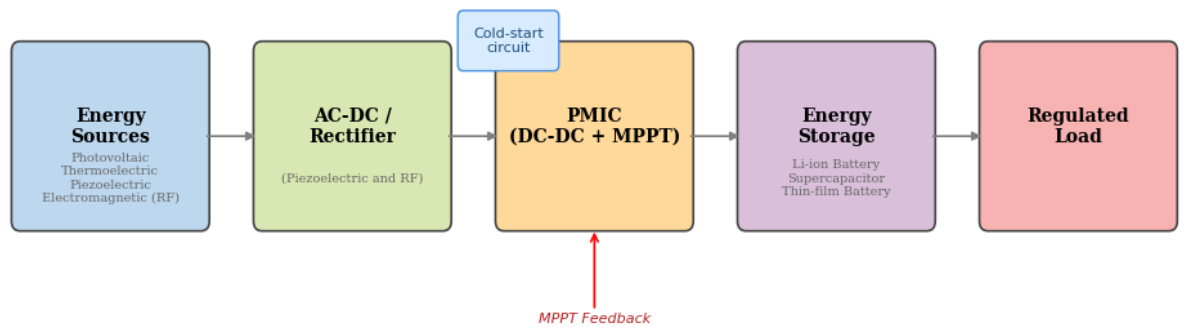
Figure 2.
PRISMA-style flow diagram of the systematic literature review screening process.
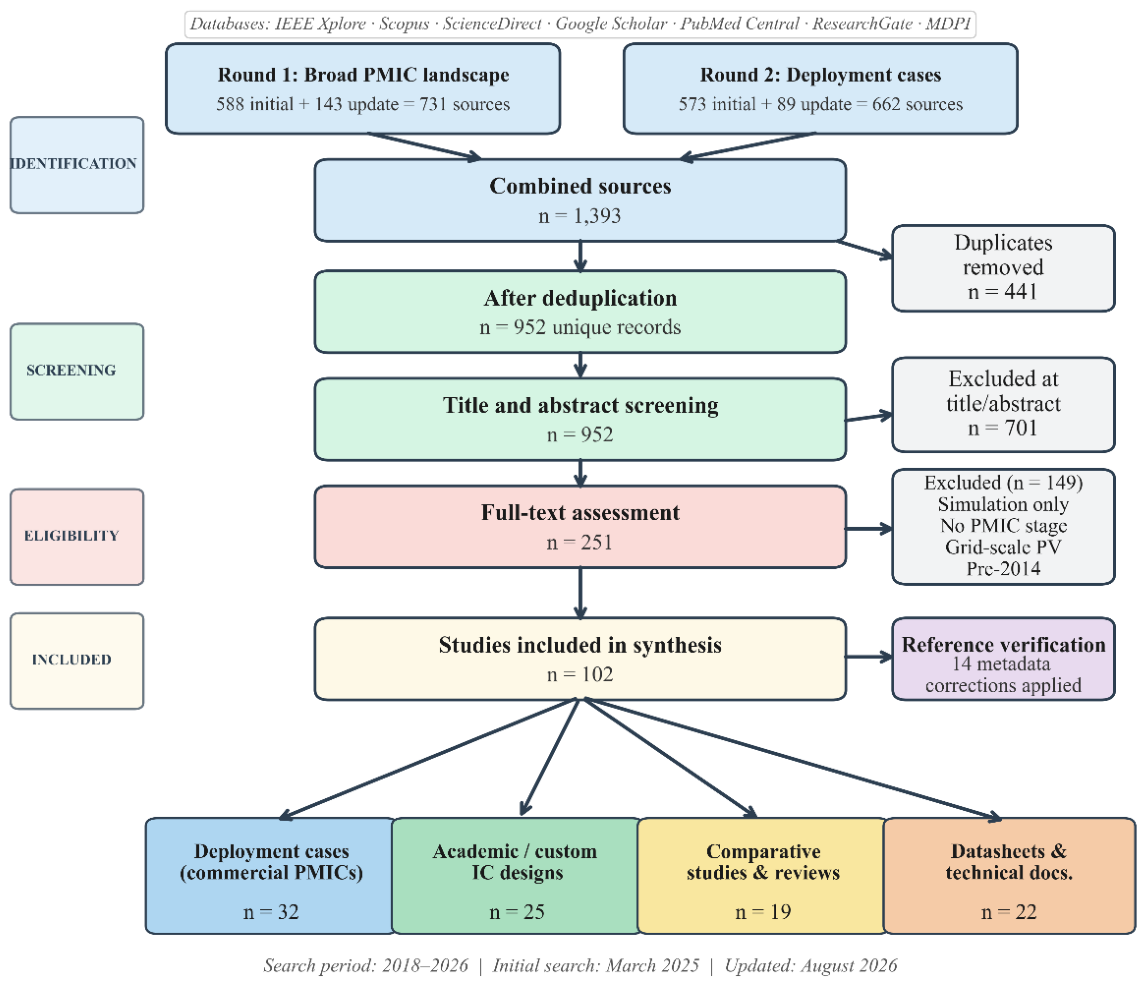
Figure 3.
. Cold-start voltage comparison across commercial energy harvesting PMICs. The horizontal axis was truncated at 820 mV to enhance the visualization.
Figure 3.
. Cold-start voltage comparison across commercial energy harvesting PMICs. The horizontal axis was truncated at 820 mV to enhance the visualization.
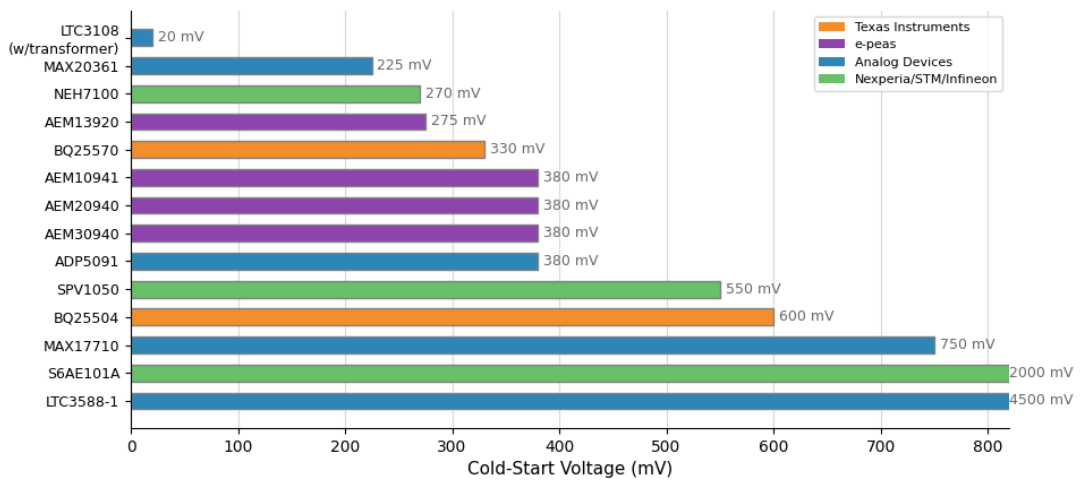
Figure 4.
. Quiescent current comparison across commercial PMICs (log scale). Dashed line: best academic result (32 nA).
Figure 4.
. Quiescent current comparison across commercial PMICs (log scale). Dashed line: best academic result (32 nA).
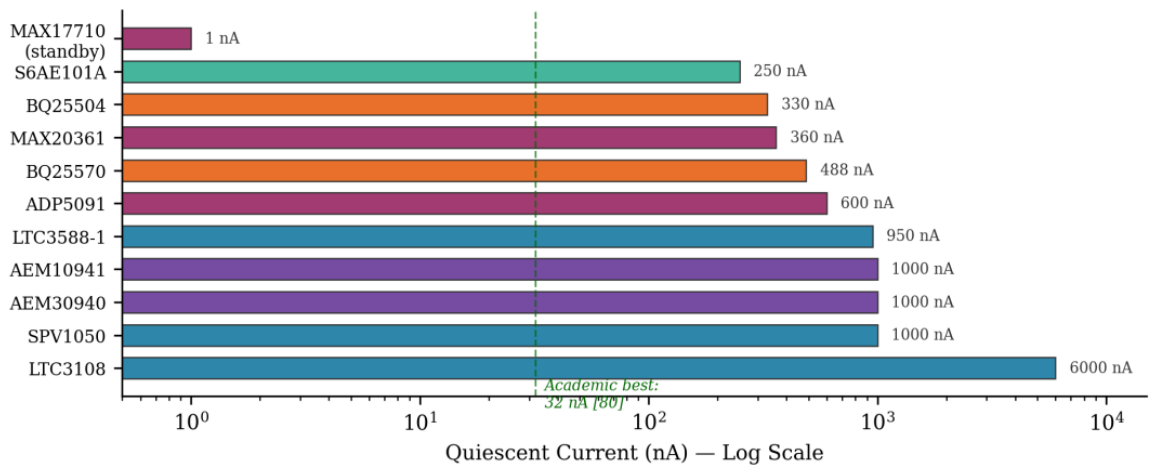
Figure 5.
. Cold-start/self-start voltage and minimum specified or sustained input voltage for representative commercial PMICs and academic custom ICs. For commercial devices, the minimum-input value corresponds to the lower limit of the specified input-voltage range and is not necessarily equivalent to an experimentally demonstrated post-start sustaining threshold. For academic designs, minimum sustained input voltage is shown only when explicitly reported. The LTC3108 20 mV value requires an external step-up transformer; the AEM20940 also supports a 60 mV cold-start option with an external module, which is not represented by the standard-device point.
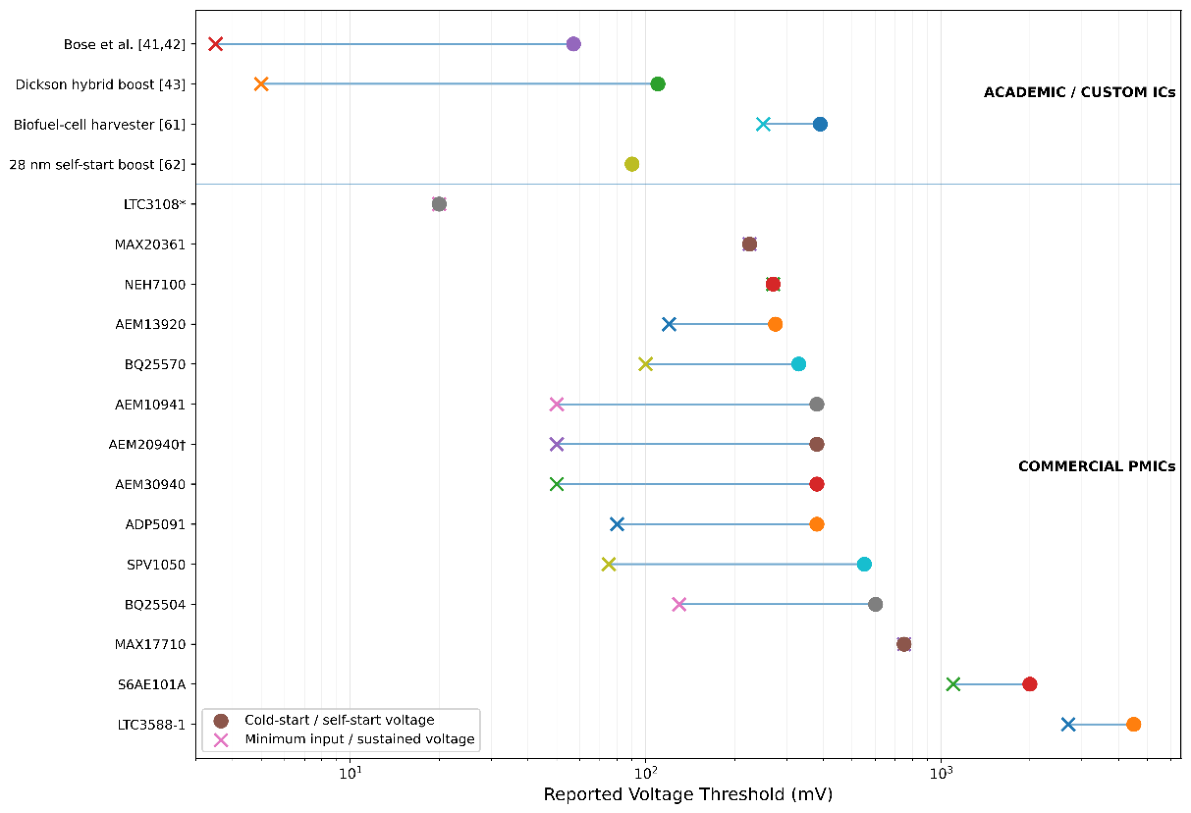
Figure 6.
. Distribution of published deployment cases by PMIC family and application domain.
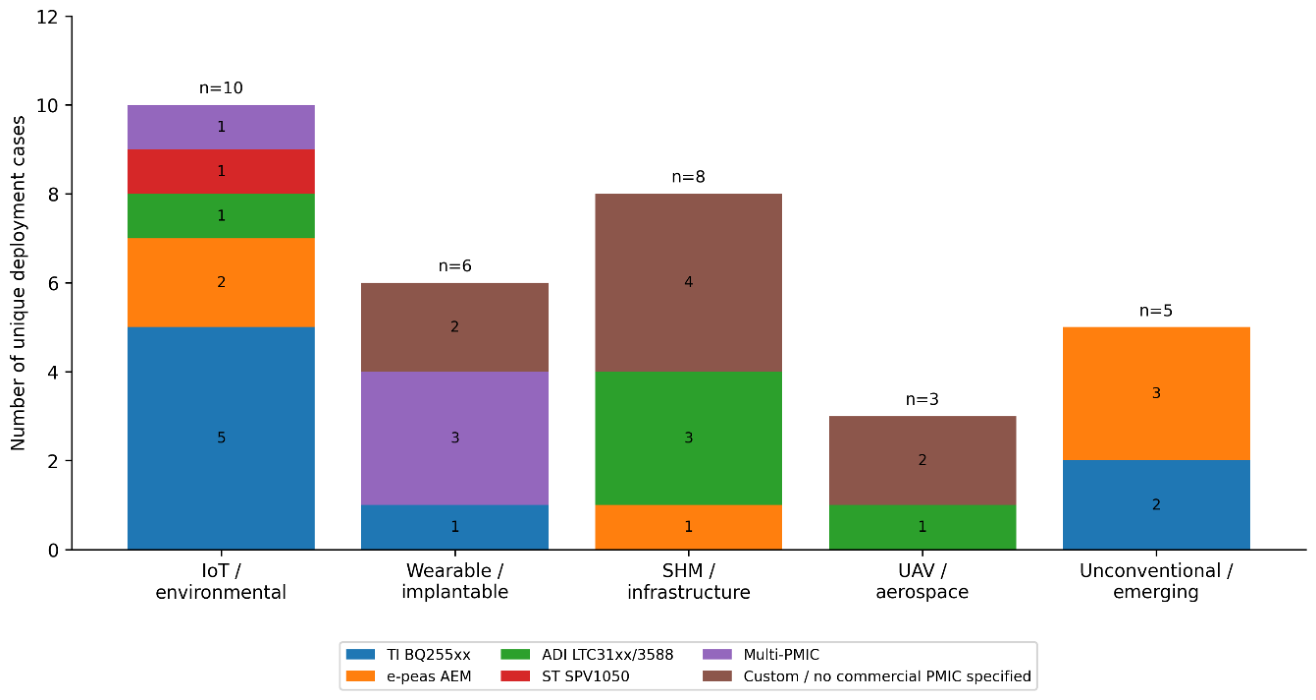

Table 1.
Typical Electrical Characteristics of Energy Harvesting Sources.
| Source | Voltage | Current | Typical Power / Power Density | PMIC Need |
|---|---|---|---|---|
| Outdoor solar PV | 0.5 – 5.0 V DC | mA | 10 – 100 mW/cm² | Boost/MPPT |
| Indoor solar PV | 0.2 – 0.5 V DC | μA | 10 – 100 μW/cm² | Boost/MPPT |
| TEG (body heat) | 20 – 500 mV DC | μA – mA | 10 – 60 μW/cm² | Boost/cold-start |
| TEG (industrial) | 0.5 – 5 V DC | mA | 1 – 10 mW/cm² | Boost/cold-start |
| Piezoelectric (PZT) | 5 – 150 V AC | nA – μA | 10 – 800 μW | Rectifier + Buck |
| Piezoelectric (PVDF) | 1 – 20 V AC | nA – μA | 1 – 20 μW | Rectifier + Buck |
| RF (ambient) | 0.1 – 0.5 V DC | nA – μA | 0.01 – 1 μW/cm² | Rectifier + Boost |
| RF (dedicated) | 0.5 – 3 V DC | μA – mA | 10 μW – 1 mW | Rectifier + Boost |
Table 2.
Comparison of Representative Commercial Energy Harvesting PMICs.
| Part | Mfr. | Topology | VIN (V) | VOUT (V) | Cold Start | IQ (typ.) | MPPT | Source | Pkg (mm) |
|---|---|---|---|---|---|---|---|---|---|
| LTC3108 | AD | Resonant step-up | 0.02 – 0.5 | 20 mV* | 6 μA | None | TEG/Thermopile/Small Solar | 3×4 | |
| MAX20361 | AD | Boost | 0.225 – 2.5 | 225 mV | 360 nA | Adaptive | Solar | 1.63 × 1.23 | |
| NEH7100 | Nexperia | Charge Pump | 0.27 – 5.5 | 270 mV | 1.5 μA | Hill-climb | Multisource | 4×4 | |
| AEM13920 | e-peas | 2×Boost+Buck | 0.12 – 4.5 | 0.6 – 2.5 | 275 mV | <1 μA | Per source | Multisource | 5×5 |
| BQ25570 | TI | Boost+Buck | 0.1 – 5.5 | 330 mV | 488 nA | FOCV | Multisource (PV/TEG) | 3.5×3.5 | |
| AEM10941 | e-peas | Boost+LDO | 0.05 – 5 | 380 mV | <1 μA | FOCV | Solar | 5×5 | |
| AEM20940 | e-peas | Boost+LDO | 0.05 – 5 | 380 mV / 60 mV*** | <1 μA | FOCV | TEG | 5×5 | |
| AEM30940 | e-peas | Boost+Buck+LDO | 0.05 – 5 | 380 mV | ~1 μA | FOCV | RF/Vibration | 5×5 | |
| ADP5091 | AD | Boost | 0.08 – 3.3 | 380 mV | 510 nA | FOCV | Multisource (PV/TEG) | 4×4 | |
| SPV1050 | STM | Boost/Buck-Boost | 0.075 – 18 | 550 mV | <1 μA | Resistor | Solar/TEG | 3×3 | |
| BQ25504 | TI | Boost | 0.13 – 5.5 | 600 mV | <330 nA | FOCV | Solar/TEG | 3×3 | |
| MAX17710 | AD | Boost+LDO | 0.75 – 5.3 | 3.3/2.3/1.8 | 750 mV | 1 nA** | None | Multi | 3×3 |
| S6AE101A | Infineon | Charge to capacitor | 2.0 – 5.5 | 1.1 – 5.2 | 2.0 V | 250 nA | None | Solar/NFC | 3×3 |
| LTC3588-1 | AD | Rectifier+Buck | 2.7 – 20 AC | 1.8/2.5/3.3/3.6 | 4.5 V | 950 nA | None | Piezo | 3×3 |
*Requires external step-up transformer. **Standby current. *** with external module
Table 3.
Representative academic and custom energy harvesting PMICs.
| Design | Process | Architecture | Cold Start / VIN,min | IQ / PQ | Peak Efficiency | Source(s) | Ref |
|---|---|---|---|---|---|---|---|
| MISIMO platform | – | Multi-input single-inductor multi-output | – | 32 nA | – | PV + TEG + Piezo | [58] |
| MISIMO (FDSOI) | 28 nm FDSOI | Single-inductor, 3 sources / 3 rails | – | 262 nW | 89 % (1 μW – 60 mW) | Multi-source | [59,60] |
| Kim et al. interface | 0.18 μm CMOS | MISIMO, double-conversion rejection | – | – | 90.2 % | Multi-source | [30] |
| Bose et al. cold-start | 0.18 μm CMOS | Cross-coupled charge pumps + ring osc. | 57 mV (one-shot, 135 ms); 3.5 mV sustained | – | – | TEG | [41,42] |
| Dickson hybrid boost | – | Switched-capacitor + switched-inductor | 110 mV / 5 mV | – | 90.5 % | TEG | [43] |
| ISS MPPT harvester | – | SI-SIDO, incremental step sensing | – | – | >99 % MPPT (30 μW – 33 mW) | PV/generic | [37] |
| Biased-SECE (KAIST) | – | SECE + geometric-mean MPPT | – | – | 99.9 % MPPT | Piezo | [38] |
| Biofuel-cell harvester | 65 nm CMOS | Source-adaptive MPPT | 0.39 V/ 0.25 V | 220 nW (avg.) | 86 % at 0.39 V | Biofuel cell | [61] |
| Self-startup boost | 28 nm CMOS | ZCS, max. output voltage tracking | 90 mV | – | – | TEG | [62] |
| StimDust | – | Ultrasonic power + bidirectional link | – | – | 82 % (chip) | Ultrasound | [63] |
| Latch-based EM core | 65 nm CMOS | Bias-current-free energy management | – | – | – | Generic | [13] |
Table 4.
Performance gap: commercial vs. academic PMICs. Reported current values are not always measured under identical operating states. Datasheet quiescent or standby currents and current/power consumption reported for custom ICs should therefore be interpreted as representative values rather than as a fully normalized benchmark
| Parameter | Best Commercial | Best Academic | Gap |
|---|---|---|---|
| Quiescent current | 250 nA (S6AE101A) | 32 nA [58] | ~8× |
| Cold-start voltage | 270 mV (NEH7100) | 57 mV [42] | ~4.7× |
| Minimum operating voltage after startup | 50 mV (e-peas) | 3.5 mV [41] | ~14× |
| MPPT efficiency | ~98 % (FOCV) | 99.9 % [38] | ~1.1× |
| Multi-source capability | 2 (AEM13920) | 3+ (MISIMO) [59,60] | 1.5× |
| Peak conversion efficiency | ~95 % (BQ24650) | 90.5 % [43] | ≈ par |
Table 5.
Index of documented deployment cases with measured results.
| System / Deployment | Domain | Source | PMIC | Key measured result | Ref. |
|---|---|---|---|---|---|
| LoRa node, southern vs. northern France | IoT / environmental | Solar PV | BQ25570; SPV1050 | Energy neutrality; panel area halved in the south; ~90 % conversion at MPPT | [68] |
| LoRa node with TPL5111 timer | IoT / environmental | Solar PV | BQ25570 | 15 days continuous, 10-min interval, 3.9 μA mean sleep current | [69] |
| Batteryless indoor LoRa unit | IoT / environmental | Indoor PV (poly-Si) | BQ25570 | Operation at 582 lux; cold-start at 330 mV | [70] |
| DSSC outdoor node | IoT / environmental | DSSC (flexible + glass) | BQ25570 | Positive energy balance over 6–9 days, cloudy forested winter | [71] |
| Galápagos pink iguana tracking | IoT / environmental | Solar PV | BQ25570 | Field robustness in infrastructure-free volcanic terrain | [72] |
| Urban air quality, New York City | IoT / environmental | Solar PV | AEM10941 | PM2.5 and VOC reporting every 6 min from utility poles | [45] |
| Rural solar lamps, Cameroon | IoT / environmental | Solar PV | AEM10941 | Full charge in 3 h; 10 h illumination at 1436 lux | [73] |
| Battery-free indoor node | IoT / environmental | Indoor light | SPV1050 | Cold-start within 15 days from any light source, incl. phone LED | [74] |
| LoRaWAN node, João Pessoa (BR) | IoT / environmental | TEG + quasicrystalline absorber | LTC3108-1 | Continuous transmission | [75] |
| Data centre thermal monitoring | IoT / environmental | TEG | BQ25504 | >92 % system efficiency above ΔT = 13 °C; TEG also used as sensor | [76] |
| Wearable TEG, rest and walking | Wearable / implantable | Body heat | LTC3108 + BQ25570 | 15.8 μW/cm² at rest; 97.6 μW/cm² walking; no MCU switching | [77] |
| Body-heat wearable, low ΔT | Wearable / implantable | Body heat | Custom (cascade context) | 30.2 mV → 3.4 V at ΔT = 4 K; BLE every 1.6 s | [78] |
| Cascaded body-heat harvester | Wearable / implantable | Body heat | LTC3108 + BQ25504 | MPPT added downstream of a non-MPPT front end; ΔT as low as 4 K | [79] |
| Hybrid PV/TEG healthcare wearable | Wearable / implantable | PV + TEG | 2× BQ25504 | Battery life extended from 9.3 h to >18 h | [80] |
| Flexible thermoelectric wearable | Wearable / implantable | Body heat | BQ25504 | Continuous physiological monitoring from body heat alone | [81] |
| High-density wearable TEG (2025) | Wearable / implantable | Body heat | – | 312 μW/cm² at 15 °C ambient; 79.8 μW/cm² on-wrist | [82] |
| Railway bridge SHM | SHM / infrastructure | Piezoelectric | – | ~2.6 J per 57–59 min from train-induced vibration | [83] |
| Bridge vibration harvester | SHM / infrastructure | Piezoelectric | – | 588 μW during train passage | [84] |
| Industrial machinery WSN | SHM / infrastructure | Tunable piezo cantilever | LTC3588-1 | 2.9 mW at 49 Hz; 17.5 J stored | [85] |
| Pipeline monitoring | SHM / infrastructure | Piezoelectric (PPA-1001) | LTC3588-1 | 2.18 mW at 3.3 V | [86] |
| Piezoelectric MEMS array | SHM / infrastructure | Sc-doped AlN MEMS | – | 2.53 μW at 465 Hz | [87] |
| HV substation busbar monitoring | SHM / infrastructure | 2× series TEG | LTC3108 | Full energy balance across all BLE phases | [88] |
| Highway weather monitoring | SHM / infrastructure | Asphalt heat via heat pipes | – | 286.24 J at ΔT = 4.25 °C; 0.625 J per 40-byte message | [89] |
| Power-line magnetic field monitor | SHM / infrastructure | Piezo + PV (50 Hz field) | AEM30330 | Hybrid infrastructure monitoring | [90] |
| UAV arm harvester (PUC-Rio) | UAV / aerospace | PVDF on drone arm | LTC3588-1 | 17.3 V amplitude at 3975 rpm; 3.6 V in 162 s | [91] |
| Quadcopter “smart arms” | UAV / aerospace | Piezoelectric | – | Up to 5.35 mW during hovering | [92] |
| PVDF/ZnO-RGO nanofiber on UAV | UAV / aerospace | Electrospun nanogenerator | – | 64 mV during 30 s flight | [93] |
| Plant microbial fuel cell soil node | Unconventional / emerging | PMFC array | BQ25570 | 1.8 mW from PMFC array | [67] |
| Harmonic-recycling rectenna | Unconventional / emerging | RF, 915 MHz | BQ25570 | Stable 3.3 V from μW-level intermittent RF | [94] |
| LunaSat lunar sensor | Unconventional / emerging | Solar PV | AEM10941 | 5 g sensor, 7 external components | [95] |
| Energy-aware task scheduler | Unconventional / emerging | Solar PV | AEM10941 | No power failures at 40 μA harvesting current | [96] |
| Simultaneous VLC + harvesting | Unconventional / emerging | Indoor light | AEM10941 | 800 bps reception during MPPT sampling window | [97] |
Table 6.
First-pass PMIC selection guidance by operating regime.
| Regime | Governing constraint | Recommended starting point | Evidence |
|---|---|---|---|
| Outdoor solar, >250 lux equivalent | Conversion efficiency at mA-level current | BQ25570 / AEM10941 | [64,65,68] |
| Indoor solar, 100 – 500 lux | Tracking accuracy at low illuminance | BQ25570, best-performing device in the controlled comparison of [64] at 100 lux; AEM10941 supported by reported very-low-illuminance indoor-PV applications [46,70] | [46,64,70] |
| Indoor solar, sub-50 lux with area constraint | Cold-start energy, not efficiency | AEM10941; MAX20361 where footprint dominates | [46,50] |
| TEG, ΔT < 5 °C (body heat) | Minimum input voltage | LTC3108 front end; add BQ25504 downstream for MPPT | [26,77,79] |
| TEG, industrial waste heat (>0.5 V) | Efficiency and storage management | BQ25504 / SPV1050 / AEM20940 | [53,76,88] |
| Piezoelectric, bulk PZT or PVDF film | AC rectification with high-voltage tolerance | LTC3588-1, established integrated rectifier/buck solution specifically designed for piezoelectric harvesting; alternative AC-source PMIC architectures should be evaluated according to transducer voltage and impedance | [35,85,86,91] |
| Piezoelectric, μW-class MEMS | Interface topology, not IC selection | SSHI/SECE/SSHC interface required | [18,32,33,87] |
| RF, ambient or −15 dBm class | Cold-start time under intermittent input | AEM30940 | [22,66] |
| Two heterogeneous sources | Independent MPPT per input | AEM13920 (single IC) or parallel BQ25504 (proven, higher BOM) | [44,80] |
| Three or more sources | Not addressed commercially | Custom multi-input converter | [58,59,60] |
| BOM cost or profile height dominant | Inductor elimination | NEH7100/NEH7110 | [31] |
Disclaimer/Publisher’s Note: The statements, opinions and data contained in all publications are solely those of the individual author(s) and contributor(s) and not of MDPI and/or the editor(s). MDPI and/or the editor(s) disclaim responsibility for any injury to people or property resulting from any ideas, methods, instructions or products referred to in the content. |
© 2026 by the authors. Licensee MDPI, Basel, Switzerland. This article is an open access article distributed under the terms and conditions of the Creative Commons Attribution (CC BY) license (http://creativecommons.org/licenses/by/4.0/).
Copyright: This open access article is published under a Creative Commons CC BY 4.0 license, which permit the free download, distribution, and reuse, provided that the author and preprint are cited in any reuse.