

Submitted:
04 October 2026
Posted:
08 October 2026
You are already at the latest version
Abstract
The requirement of Orientation and Refresher Courses under the University Grants Commission (UGC) Career Advancement Scheme (CAS) has undergone repeated regulatory changes, exemptions and transitional arrangements since the promulgation of the 2018 Regulations. Clause 6.3(VIII) of the UGC Regulations has, at different points, declared the Orientation Course (OC) and Refresher Course (RC) requirement non-mandatory for specified periods. The 3rd Amendment Regulations, 2023 extended the transitional treatment up to 31 December 2023 or as notified by the Commission, while the 4th Amendment Regulations, 2024 subsequently introduced a further hardship with confusion-oriented transition for faculty members who had already qualified or were likely to qualify by 31 December 2024 under the 2010 or 2018 Regulations [3]. This article argues that the continuing reliance upon rigid cut-off dates, without adequately addressing faculty who were similarly situated but completed recognized induction, orientation, refresher or faculty-development programmes during the transition, creates significant concerns of substantive equality, legitimate expectation, proportionality, consistency and administrative fairness. The problem becomes more acute where universities have interpreted transitional provisions differently, granting retrospective CAS benefits in some cases while similarly placed faculty members remain deprived of their original eligibility dates. The article examines the historical UGC approach, including the 2001 exemption for Ph.D. holders, the judicial reasoning in Punam Chauhan & Anr. v. State of H.P. (2023), the 2023 and 2024 amendments, institutional implementation, the emergence of Malaviya Mission Teacher Training Centre (MMTTC) and Faculty Induction Programme (FIP) frameworks, and the consequences of denying CAS progression despite otherwise satisfying substantive academic and service requirements. It proposes a uniform remedial mechanism whereby recognized Orientation/FIP/Refresher and equivalent faculty-development programmes completed during an officially recognized transition period should be assessed on substance rather than nomenclature. The paper concludes with seven specific policy recommendations and a No-Loss Transitional Principle designed to ensure regulatory justice while maintaining academic standards.
Keywords:
UGC
; career advancement scheme
; CAS
; orientation course
; refresher course
; faculty induction programme
; FIP
; MMTTC
; guru-dakshta
; regulatory transition
; equality
; legitimate expectation
; academic promotion
; higher education policy
1. Introduction
Career progression of university teachers is not merely a question of salary or designation. Academic promotion affects professional standing, research opportunities, institutional responsibilities, pension-related benefits, motivation and the ability of faculty members to participate meaningfully in academic governance. In the Indian higher education system, the University Grants Commission (UGC) Career Advancement Scheme (CAS) provides the primary structured mechanism for such progression [1,4].
The UGC CAS design has evolved substantially over time. The system has repeatedly been modified through amendments, transitional provisions, exemptions and administrative clarifications. Among the various requirements for CAS progression, the requirement of Orientation and Refresher Courses provides a particularly striking example of regulatory evolution and the challenges it creates.
The difficulty arises when a condition that was expressly declared non-mandatory for a transitional period subsequently becomes the basis for denying retrospective promotion to individuals who otherwise satisfy the substantive academic and service requirements. The problem is compounded when similarly situated faculty members receive differential treatment based solely on institutional interpretation of ambiguous transitional provisions.
The question is not simply whether an Orientation Course is educationally useful — it undoubtedly is. Rather, the question is whether a faculty member who has already demonstrated academic competence through Ph.D., teaching experience, research, publications, supervision and other recognized faculty-development activities should permanently lose an otherwise accrued CAS eligibility date because of a procedural training requirement, particularly when the regulatory authority itself repeatedly recognizes hardship and provides extensions.
The UGC's own regulatory history demonstrates that the issue has never been static. The 2018 Regulations initially provided that the Orientation/Refresher requirement would not be mandatory up to 31 December 2018 [1]. The 3rd Amendment Regulations of 2023 subsequently prescribed a new transitional mechanism, including a deadline of 31 December 2023 or as notified by the Commission [2]. The 4th Amendment of 2024 then replaced that provision and expressly introduced a further hardship-based transition for faculty who had qualified or were likely to qualify by 31 December 2024 under the 2010 or 2018 Regulations.
This sequence raises an important policy question: If repeated extensions and exemptions have been considered necessary to prevent hardship, why should faculty members who fall within the same transitional circumstances be denied merely because of an administrative cut-off date or institutional interpretation? This paper examines this question through historical, legal, policy and equality-based analysis, ultimately proposing a framework for regulatory justice that maintains standards without sacrificing fairness.
2. Historical Development of the Orientation Requirement
The Orientation Course has historically been conceived as faculty development rather than as an academic qualification in the conventional sense. The UGC's earlier framework described Orientation Programmes as programmes intended to introduce teachers to the social, intellectual and professional environment of higher education. The UGC's Annual Report 2010–11 records an Orientation Programme of four weeks and a Refresher Course of three weeks under the earlier faculty-development framework [9].
Thus, the underlying purpose has always been professional development — to enhance teaching competencies, familiarize faculty with pedagogical innovations, introduce research methodologies, and orient teachers to the evolving landscape of higher education. It is important to distinguish this developmental purpose from the mechanical question of whether a certificate bears a particular title.
Over time, the UGC and various academic institutions have recognized multiple programmes as serving the faculty-development objective. A faculty member may undertake various forms of professional development, including but not limited to:
Orientation Courses
Faculty Induction Programmes (FIP)
Refresher Courses (RC)
Research Methodology programmes
Faculty Development Programmes (FDP)
Teaching-learning and curriculum-development programmes
E-content and MOOC development training
Short-Term Programmes (STP)
NEP Orientation and Sensitisation Programmes
The substantive objective of these programmes can overlap substantially even though the nomenclature differs. All are designed to enhance the professional competence of faculty members in teaching, research, curriculum design, assessment, and the use of educational technology.
The emergence of the Malaviya Mission Teacher Training Programme (MMTTP) and Malaviya Mission Teacher Training Centres (MMTTC) has further altered the terminology and institutional architecture of faculty development. The MMTTC framework represents a shift in how faculty development is conceptualized and delivered, moving toward more structured, comprehensive induction mechanisms.
This evolution in nomenclature and institutional frameworks makes rigid nomenclature-based exclusion increasingly difficult to justify unless the Regulations expressly require such exclusion. The policy question becomes whether the regulatory system should focus on the label attached to a programme or the substantive content and educational purpose it serves.
3. Clause 6.3(VIII): From Non-Mandatory Requirement to Transitional Barrier
The 2018 Regulations contained an important transitional provision stating that the Orientation and Refresher requirement for CAS promotions would not be mandatory up to 31 December 2018. This initial transitional relief acknowledged the practical difficulty of implementing a new training requirement immediately for all serving faculty members.
The 3rd Amendment Regulations, 2023 subsequently amended the position. The UGC's official compendium records the provision that where the Orientation/Refresher requirement remained incomplete, promotion would not be held up, but the requirement was to be fulfilled by 31 December 2023 or as notified by the Commission [2,5].
This wording is important for two reasons. First, the provision itself acknowledged that the requirement was sufficiently important to be completed but not sufficiently fundamental to stop promotion immediately. Second, the phrase 'or as notified by the Commission' preserved regulatory flexibility — indicating that UGC itself retained the discretion to further extend or modify the arrangement.
The 4th Amendment Regulations, 2024 then substantially changed the transitional architecture. The amendment expressly states:
"...to avoid hardship to faculty members who had already qualified or were likely to qualify by 31 December 2024 under the 2010 Regulations, a choice may be given to them to be considered under either the 2010 or 2018 Regulations."
It further states that the date of eligibility shall be retained as the date of promotion, subject to fulfilment of eligibility criteria at the time of application [3].
This is not a minor administrative adjustment. It reflects an explicit policy recognition by the regulator that rigid application of the newer framework could cause hardship. The use of the phrase 'to avoid hardship' is particularly significant: it demonstrates that UGC considers the possibility of hardship to be a legitimate regulatory concern that can justify departure from the strict application of amended requirements.
A critical factual note on institutional records: Pondicherry University's Executive Council records appear to describe the 3rd Amendment as extending the Orientation/Refresher non-mandatory period to 31 December 2024 [8], whereas the official text of the 3rd Amendment provides for 31 December 2023. This discrepancy is itself significant evidence of regulatory confusion and inconsistent institutional interpretation — it is cited here as evidence of the practical difficulty institutions face in implementing transitional provisions, not as evidence that the official regulatory text differs from what was notified.
4. The Central Problem: Unequal Treatment During a Transitional Period
The fundamental problem is not that UGC changed its Regulations. Regulatory change is legitimate. The difficulty arises when similarly situated faculty members receive different outcomes merely because their universities interpreted or implemented the transitional provisions differently.
Institutional records from Pondicherry University demonstrate that its Executive Council considered the 2023 amendment [8] and applied an interpretation under which CAS eligibility dates were revised. Whether every detail of that institutional interpretation is legally correct is a separate question. What matters for policy analysis is that institutional implementation has not necessarily been uniform across different universities.
This creates a troubling situation that can be illustrated through a comparative scenario:
Faculty A: Eligible on an earlier date → institution applies a broad transitional interpretation → retrospective CAS benefit granted.
Faculty B: Same substantive service and academic qualifications → institution applies a stricter interpretation → earlier eligibility date denied.
Such differential treatment requires a rational explanation. If the distinction is based solely on the administrative interpretation adopted by the respective university, rather than on a substantive difference between the faculty members, the policy risks becoming arbitrary — which is precisely the kind of outcome that the constitutional guarantee of equality of treatment is designed to prevent.
Such differential treatment requires a rational explanation. If the distinction is based solely on the administrative interpretation adopted by the respective university, rather than on a substantive difference between the faculty members, the policy risks becoming arbitrary — which is precisely the kind of outcome that the constitutional guarantee of equality of treatment is designed to prevent.
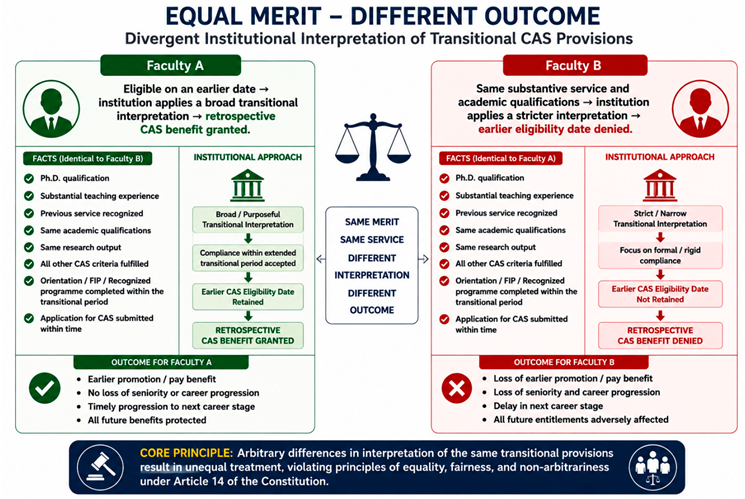
The consequences of such differential treatment are not merely financial. They affect the faculty member's designation, research eligibility, supervisory capacity, administrative standing and professional trajectory. A faculty member denied their original CAS eligibility date may lose years of service benefits, experience delayed designation and encounter difficulties in subsequent CAS stages.
4.1. The Institutional Influence Gap and Influence-Neutral CAS Entitlement
A further dimension of inequality arises from the difference between formal regulatory entitlement and practical institutional access. The UGC establishes the regulatory framework governing CAS, but it is the concerned university and its competent authorities that ordinarily interpret, process and implement individual CAS claims. The UGC, as a regulator, cannot function as an investigating agency for every individual instance of divergent institutional implementation. Consequently, the practical outcome of an ambiguous transitional provision may depend upon the manner in which an individual case is represented, examined and interpreted at the institutional level.
This creates what may be described as the Institutional Influence Gap: a situation in which faculty members subject to substantially the same regulatory framework may possess unequal practical capacity to obtain favourable consideration of their claims because of differences in administrative access, institutional visibility, professional networks, availability of precedents, or ability to pursue repeated representations. The existence of such a gap does not necessarily establish improper influence or misconduct. The concern is more fundamental—that the enjoyment of a regulatory entitlement should not become dependent upon the degree of institutional influence available to the individual faculty member.
The problem becomes particularly significant where different universities, or even different institutional authorities, adopt different approaches to substantially comparable transitional situations. A faculty member with greater institutional visibility may have greater opportunities to obtain clarification, representation, reconsideration or favourable interpretation, whereas another faculty member with comparatively limited institutional access may simply be subjected to the strictest interpretation of the same provision. The resulting disparity is not necessarily attributable to the substantive qualifications of the faculty members; rather, it may arise from differences in their practical ability to navigate the administrative structure.
The distinction between improper influence and institutional access is therefore important. An academically responsible analysis should not presume that every favourable decision obtained by a faculty member resulted from personal influence. Nevertheless, a regulatory system should be designed so that a faculty member does not need personal proximity to institutional decision-makers, repeated representations or exceptional administrative intervention to secure a benefit that is otherwise available under the governing regulations. The relevant question is consequently not whether a particular faculty member was influential, but whether similarly situated faculty members have an equal institutional opportunity to have their regulatory claims considered according to the same legal standard.
This concern is especially relevant in transitional CAS matters because regulatory ambiguity can magnify pre-existing differences in institutional access. Where one institution adopts a broad interpretation that preserves an earlier eligibility date while another adopts a narrow interpretation that denies it, the difference may produce consequences extending beyond a single promotion. It may affect pay fixation, seniority, designation, subsequent CAS eligibility, research opportunities and other elements of academic career progression. The paper has already identified the danger of a "postcode lottery" in which CAS outcomes vary according to institutional interpretation rather than regulatory merit.
The appropriate regulatory principle may therefore be termed Influence-Neutral CAS Entitlement:
A CAS entitlement should be determined by the applicable regulatory provision, substantive eligibility and objectively verifiable facts, and should not depend upon the faculty member's institutional influence, administrative proximity, professional visibility or capacity to secure favourable intervention.
This principle does not require identical outcomes where the underlying facts are genuinely different. It requires that differences in outcome must be traceable to legally relevant differences in facts or regulatory requirements, rather than differences in institutional access. Such an approach is consistent with the paper's broader argument that transitional provisions should operate uniformly and that institutional discretion should remain within clearly identifiable regulatory boundaries. The objective is not to prevent universities from exercising legitimate administrative functions, but to ensure that those functions do not inadvertently transform a common UGC regulatory framework into different systems of entitlement for differently positioned faculty members.
The issue is particularly important for faculty members who lack substantial institutional influence. Academic advancement should not become a privilege available principally to those capable of obtaining exceptional administrative attention. A faculty member who fulfils the applicable academic and service requirements should be able to seek the benefit of a transitional provision through an ordinary, transparent and reasoned process. The absence of institutional influence should not itself become an adverse factor in the practical enjoyment of a regulatory entitlement.
Accordingly, where substantially similar cases have received different treatment, the appropriate institutional response should be a reasoned comparative examination identifying the factual and regulatory basis for the distinction. If no material distinction exists, consistency requires reconsideration of the divergent treatment or, where the ambiguity originates in the UGC framework, authoritative clarification by the UGC. This approach would reduce dependence upon individual influence and strengthen the rule-based character of CAS administration.
5. The 2001 UGC Exemption: Historical Precedent for Flexibility
An especially significant historical precedent is the UGC communication dated 17 May 2001 [6], which addressed repeated queries regarding exemption from Orientation/Refresher Courses for Ph.D. holders under CAS.
The UGC decided that:
A Ph.D. holder may be exempted from attending one course, whether Refresher or Orientation, for eligibility for promotion to Lecturer (Senior Scale).
This communication was expressly considered by the Himachal Pradesh High Court in Punam Chauhan & Anr. v State of H.P. decided on 22 August 2023 [7]. The University of Kerala's Syndicate Minutes dated 18 January 2010 also record the UGC's communication and its implications for CAS eligibility [6].
This historical position is significant for several reasons:
It demonstrates that the UGC has previously accepted that a faculty member's substantive academic qualification can justify exemption from one of the training requirements.
It establishes a historical pattern of regulatory flexibility in the application of Orientation/Refresher requirements.
It shows that the 2001 exemption was treated as a nationally applicable policy, recognized by courts and institutions alike.
It provides a doctrinal basis for arguing that substance-based exemption is consistent with the CAS framework.
Therefore, the proposition that Orientation/Refresher requirements can never be relaxed, exempted or treated flexibly is inconsistent with the historical regulatory record. The 2001 exemption demonstrates that the UGC itself has historically recognized that rigid application of training requirements can be mitigated where a faculty member's academic profile justifies it.
6. Punam Chauhan & Anr. v. State of H.P. (2023): Judicial Recognition of Substance Over Form
The 2023 judgment in Punam Chauhan & Anr. v State of H.P. & Anr., CWP No. 1251/2023 (Himachal Pradesh High Court, decided 22 August 2023), is particularly relevant to the policy discussion [7].
The petitioners had completed Orientation and Refresher Courses during their contractual service. Their services were subsequently regularized, but they were denied CAS benefits because they had not repeated the courses after regularization. The institutional position was that only courses completed after regularization would count for CAS purposes.
The Court's analysis proceeded on five key findings:
The courses had already been successfully completed by the petitioners during their service.
The courses had the same nature, duration and subjects regardless of when or in what employment status they were completed.
The State itself had decided that Orientation undertaken during contractual service could be counted — the denial was therefore inconsistent with the State's own position.
The UGC's 17 May 2001 communication permitted exemption from one Orientation or Refresher Course for Ph.D. holders — providing a national policy basis for flexibility.
There was no justification for requiring the faculty members to repeat courses they had already completed: the educational objective had been achieved.
The Court ultimately directed grant of CAS benefits from the due dates, subject to other requirements being satisfied.
This judgment is significant because it articulates the principle of substance over form in the context of CAS requirements. If a faculty member has already undertaken meaningful professional development, requiring repetition merely because the activity occurred at a different stage of service may have little connection with the educational objective of the requirement.
The judgment also demonstrates that courts can reject an overly formalistic approach where faculty have already completed the substantive training and are denied CAS benefits merely because of the timing or status of their service. The principle articulated in Punam Chauhan has wider implications: it supports a framework where the actual content and completion of training is the relevant inquiry, not merely the procedural context in which the training was undertaken.
Yes. I would make 6.1 a critical but academically neutral subsection, because the point is not to allege that every exemption represents VIP treatment; rather, the historical existence of exemption demonstrates that UGC itself has accepted that Orientation/Refresher requirements are capable of relaxation in appropriate circumstances. The paper already records the 17 May 2001 UGC communication granting a Ph.D. holder exemption from one Orientation or Refresher Course.
6.1. The Historical Exemption and the Question of Equality in Regulatory Relaxation
The UGC's communication dated 17 May 2001, which permitted a Ph.D. holder to be exempted from one Orientation or Refresher Course for purposes of CAS progression, constitutes an important historical precedent for regulatory flexibility. The significance of this exemption extends beyond the individual category to which it originally applied. It demonstrates that the UGC has never treated the Orientation/Refresher requirement as an absolutely inflexible condition incapable of relaxation. The regulatory history therefore raises a fundamental question: if the UGC has historically considered it appropriate to relax or exempt one professional-development requirement for a Ph.D. holder, what principle determines when such relaxation is justified, and why should comparable consideration not be available to similarly situated faculty members where the substantive objective of professional development has otherwise been achieved?
The question becomes particularly important when viewed through the lens of equality. A regulatory system may legitimately create classifications and prescribe different conditions where such distinctions have a rational basis. However, the existence of a historical exemption necessarily requires the regulatory framework to explain the underlying rationale for permitting such flexibility. If the rationale is that a Ph.D. represents a substantial demonstration of academic competence and therefore makes repetition of a particular professional-development requirement unnecessary in an individual case, the same rationale cannot simply disappear when a faculty member occupies a less visible or less institutionally influential position. The concern is not that every faculty member must automatically receive an exemption. Rather, the concern is that regulatory flexibility should be governed by objective criteria and not by the social or institutional position of the person seeking the benefit.
This issue also exposes a potential perception of stratified access to regulatory relief. Where a well-positioned or institutionally visible faculty member is able to secure favourable consideration through representation, institutional intervention or an established precedent, while a comparatively less-connected faculty member is left to bear the full consequences of a strict interpretation, the formal equality of the regulation may coexist with substantive inequality in its implementation. Such a conclusion should not be drawn merely from the fact that one person received a favourable decision and another did not; the relevant inquiry is whether the difference can be explained by legally relevant distinctions rather than differences in institutional access or influence.
The problem becomes even more pronounced where the affected faculty member has already demonstrated substantial academic competence through a Ph.D., prolonged teaching, research publications, doctoral supervision, dissertation guidance, academic administration and other recognised professional activities. The paper has already identified this as a paradox: a faculty member may possess qualifications and experience sufficient for higher academic responsibilities while encountering a CAS barrier arising from a particular training-course condition. If the individual has guided doctoral scholars and dissertations and has continuously participated in teaching, research and academic development, the regulatory inquiry should not proceed on the assumption that the individual has received no meaningful professional development merely because a particular nomenclature or procedural condition remains disputed.
A further question concerns the availability of alternative forms of faculty development. The contemporary faculty-development framework contains Orientation Courses, Faculty Induction Programmes, Refresher Courses, Research Methodology programmes, FDPs, NEP Orientation and Sensitisation Programmes and MMTTC-related programmes, whose substantive objectives may overlap considerably. If multiple recognised avenues exist for continuing professional development, the insistence upon one particular category of programme requires a stronger justification where the faculty member has otherwise continuously engaged in academic development. The regulatory question should therefore move beyond "Was the particular certificate obtained?" and ask "Has the educational and professional-development objective underlying the requirement been substantively fulfilled, and does the applicable regulatory framework provide a mechanism for recognising that fulfilment?"
This concern acquires a distinct dimension for first-generation or institutionally less-connected academics. A teacher may be the first academic professional in the family and may have no familial or professional source from which to learn the complex distinctions among Orientation, Faculty Induction Programme, Guru-Dakshta, MMTTC and Refresher Courses. Such a faculty member may reasonably depend upon the university and the regulator for clear guidance concerning which programme satisfies which regulatory requirement. Where the regulatory architecture itself changes over time and uses overlapping terminology, it would be inequitable to place the entire burden of regulatory interpretation upon an individual faculty member who lacks institutional expertise or access. The paper's existing discussion of information asymmetry supports precisely this concern: the primary custodians of regulatory knowledge are the regulator and implementing institution, rather than the individual employee.
The historical exemption is therefore significant not because every Ph.D. holder must necessarily be exempted from Orientation or Refresher requirements, but because it establishes a regulatory precedent for flexibility. The subsequent framework should explain why flexibility is available in one context but unavailable in another, particularly where the latter faculty member has demonstrably acquired extensive academic competence through teaching, research and doctoral supervision. Otherwise, the regulatory system risks creating a perception that relaxation is readily available to those who possess greater institutional visibility, while hardship is disproportionately experienced by those who lack comparable access.
The appropriate principle should therefore be one of objective, transparent and influence-neutral relaxation. Any exemption, equivalence or transitional benefit should be determined by clearly identifiable criteria—academic qualification, substantive professional development, regulatory transition, completion of recognised programmes, and the purpose of the applicable provision—rather than by the institutional standing or personal influence of the claimant. The objective should not be to create a privileged category of faculty, but to ensure that a regulatory benefit capable of being granted under the UGC framework is equally accessible to every faculty member who satisfies the same substantive conditions.
This approach is also consistent with the reasoning discussed in Punam Chauhan, where the Court rejected an overly formalistic approach to professional-development requirements and recognised the significance of the substantive training already undertaken by the petitioners. The broader lesson is that regulatory standards and regulatory flexibility need not be contradictory. Standards may be maintained while ensuring that the burden of regulatory transition does not fall disproportionately upon faculty members with the least institutional capacity to secure favourable interpretation.
7. The Problem of 'One Hardship After Another'
A particularly serious policy concern arises where a faculty member has already experienced one institutional disadvantage and then encounters a second disadvantage arising from the regulatory transition. This can be characterized as the problem of compounding hardship.
Consider a faculty member who:
Possesses a Ph.D.;
Has substantial teaching experience;
Has guided Ph.D. scholars;
Has research publications in recognized journals;
Has administrative and institutional experience that the University itself recognizes for service purposes;
Satisfies the academic qualifications for higher academic posts; and
May even be eligible for direct recruitment at higher levels under the applicable UGC/institutional recruitment framework;
yet is denied CAS progression because of an Orientation/Refresher technicality.
The contradiction is striking. The same academic experience and qualifications may be sufficient to establish eligibility for direct recruitment to Associate Professor or Professor, while the individual is simultaneously told that they cannot receive CAS progression to Level 11 or Level 12 because of a faculty-development certificate from the date of eligibility.
This raises a fundamental policy question: Should a professional-development requirement operate as a complete barrier to career progression when the same faculty member has already demonstrated substantially higher academic competence?
The answer need not be that Orientation should be abolished. Rather, the answer should be that equivalence, exemption, transition and proportionality must be built into the system. A regulatory framework that prevents a faculty member from receiving CAS promotion while simultaneously recognizing their eligibility for a higher post on direct recruitment basis is internally inconsistent and raises legitimate concerns of disproportionate regulatory burden.
8. Faculty Development or Regulatory Compliance: Reframing the Policy Question
The policy objective of Orientation is faculty development. If the objective is development, the regulatory system should evaluate whether the faculty member has actually undergone meaningful development — not merely whether a particular certificate has been issued.
A faculty member who has completed any combination of the following cannot reasonably be regarded as having undertaken no faculty development whatsoever:
A UGC-HRDC Refresher Course;
A two-week Research Methodology Faculty Development Programme;
Curriculum-development training;
E-content/MOOC development training;
Short-Term Programmes (STPs);
Faculty Induction Programmes (FIPs);
NEP Orientation and Sensitisation Programmes; or
MMTTC-administered faculty-development programmes.
The question should therefore shift from:
'Does the certificate say Orientation?'
to:
'Does the completed programme satisfy the educational and professional-development purpose of the CAS requirement, and does UGC recognize it as an equivalent or alternative?'
The MMTTC framework itself demonstrates the changing nature of faculty-development nomenclature. As the institutional architecture of faculty development evolves, it becomes increasingly important that the regulatory framework evaluates programmes on the basis of content, duration and educational purpose rather than nomenclature alone.
The broader regulatory literature supports this position. Gopal (2012) and Gupta (2018) both note [17,18] that the CAS framework has struggled to keep pace with evolving institutional practices in faculty development. Rathore (2020) identifies [23] the rigidity of nomenclature-based requirements as a systemic challenge in the implementation of CAS.
9. The Faculty Induction Programme, Guru-Dakshta and the Problem of Nomenclature-Based Distinction
The emergence of the Faculty Induction Programme (FIP) and the Guru-Dakshta framework provides an important example of the difficulty created when substantially overlapping faculty-development programmes are distinguished primarily on the basis of nomenclature or procedural categorisation. The contemporary faculty-development framework recognises Orientation Courses, Faculty Induction Programmes, Refresher Courses, Research Methodology programmes, Faculty Development Programmes and other structured academic-development activities. The paper has already noted that the substantive objectives of several of these programmes may substantially overlap.
The Guru-Dakshta framework associated with Faculty Induction prescribes a structured programme of approximately one month and 170–175 hours, covering teaching-learning strategies, curriculum design and assessment, ICT in education, research methodology and ethics, professional conduct, student counselling and mentoring, and higher-education policy and governance [12]. Such a programme represents a substantive professional-development intervention rather than a merely formal or ceremonial requirement. Its content substantially overlaps with the professional-development objectives historically associated with Orientation Courses.
The regulatory difficulty therefore arises when programmes having substantially comparable objectives are treated differently merely because they carry different names. If Orientation, FIP and Guru-Dakshta are recognised as different institutional forms serving substantially similar objectives of faculty induction and professional development, the regulatory framework should explain why the benefit of one programme cannot, where appropriate, be recognised in relation to another solely because of its nomenclature.
The issue becomes even more significant when considered alongside the historical UGC relaxation available to Ph.D. holders. The UGC communication dated 17 May 2001 recognised an exemption from one Orientation or Refresher Course for Ph.D. holders in the relevant CAS context. The underlying regulatory logic appears to recognise that the possession of a Ph.D. constitutes evidence of a substantial level of academic and research competence and that, in an appropriate context, such demonstrated competence can justify relaxation from an additional professional-development requirement.
This raises a further and more difficult question. If possession of a Ph.D. was considered sufficient to justify relaxation from one Orientation or Refresher Course, why should a faculty member who not only possesses a Ph.D. but has subsequently guided Ph.D. scholars and dissertations, undertaken advanced research and acquired extensive academic experience be treated as having no basis whatsoever for comparable regulatory flexibility? The argument is not that doctoral supervision automatically creates a statutory exemption. Rather, it is that the regulatory rationale underlying the earlier Ph.D. exemption should be examined consistently when assessing later forms of demonstrated academic competence.
The distinction becomes particularly difficult for faculty members who entered academia without guidance, as they are first-generation academic may reasonably understand "Orientation", "Faculty Induction Programme", "Guru-Dakshta" and related faculty-development programmes as different expressions of the same broad objective—namely, to equip a teacher with the knowledge and skills necessary to function effectively in higher education. Such a faculty member cannot reasonably be expected, merely by virtue of becoming a university teacher, to possess an expert understanding of the historical evolution of UGC terminology, the precise legal distinction between successive faculty-development schemes, or the consequences that different programme labels may have for CAS eligibility.
This is particularly problematic where the regulatory framework itself has evolved over time. A teacher may encounter Orientation Course, FIP, Guru-Dakshta, MMTTC programmes, Refresher Courses and NEP-related programmes at different stages, while the substantive areas covered by them overlap considerably. The burden of identifying which particular nomenclature carries which precise CAS consequence should therefore not be placed exclusively upon an individual faculty member. The existing analysis of information asymmetry supports the proposition that the regulator and implementing institution bear a greater responsibility for communicating such distinctions clearly.
The resulting regulatory paradox is therefore twofold. First, a faculty member may complete a comprehensive FIP or Guru-Dakshta programme containing substantive components comparable to an Orientation Course, yet encounter a CAS difficulty because the programme bears a different name. Secondly, a Ph.D. holder may historically qualify for relaxation from one Orientation or Refresher Course, while a faculty member who has progressed beyond the stage of merely obtaining a Ph.D. and has demonstrated advanced academic competence through doctoral supervision, dissertation guidance, research and sustained academic contribution may receive no comparable consideration.
The substantive question should consequently not be confined to:
"Does the certificate bear the word Orientation?"
It should also ask:
"What is the educational purpose of the requirement, what professional competence is the requirement intended to establish, what evidence demonstrates that competence, and why should substantially comparable evidence be treated differently merely because it arises through a different recognised route?"
This does not mean that every FIP, Guru-Dakshta programme or doctoral-supervision record must automatically substitute for every Orientation requirement. Rather, it calls for objective criteria for equivalence, exemption and transitional recognition. If the regulatory objective is faculty development, the system should identify the substantive competency that it seeks to achieve and provide a transparent mechanism for determining when that competency has already been demonstrated.
The deeper concern is therefore not the existence of Orientation requirements but the absence of a consistently articulated principle explaining when demonstrated academic competence can justify flexibility. If a Ph.D. was historically capable of supporting relaxation, and if FIP/Guru-Dakshta and Orientation are substantially comparable in their faculty-development objectives, the regulatory framework should explain, through objective and uniformly applicable criteria, why a faculty member who has subsequently demonstrated advanced competence through doctoral supervision and extensive academic work cannot receive comparable consideration.
Such an approach would move the CAS framework from a nomenclature-based model toward a competence-based and purpose-oriented model, while preserving the legitimate regulatory objective of faculty development. It would also reduce the particular disadvantage faced by faculty members who, as first-generation academics, cannot reasonably be expected to possess the same institutional knowledge or administrative guidance as those who have greater access to such resources.
10. The 2024 Amendment and the Principle of Avoiding Hardship
The 4th Amendment Regulations, 2024 [3] are especially important because they expressly use the phrase "to avoid hardship". This is not merely a procedural formulation. It reflects a substantive policy judgment that the rigid application of amended requirements can cause hardship — and that such hardship constitutes a regulatory concern sufficient to warrant a transitional choice mechanism.
The amendment permits faculty who had already qualified or were likely to qualify by 31 December 2024 under the 2010 Regulations to exercise a choice between the 2010 and 2018 frameworks. It also preserves the eligibility date as the promotion date, subject to fulfilment of eligibility criteria at the time of application.
This raises a broader interpretive question: If the UGC expressly recognized hardship sufficient to justify a transitional choice for faculty qualifying under the 2010 framework, should similarly situated faculty members who completed their prescribed FIP/Orientation-related requirement during the same transitional period be automatically excluded merely because their particular university adopted a narrower interpretation of the transitional provisions?
The answer, on principle, should be no. A hardship-removal provision should ordinarily be interpreted to remedy hardship, not create new hardship. Where the express purpose of a provision is to avoid hardship, an interpretation that leaves similarly situated faculty members without relief is inconsistent with the provision's stated purpose.
The principle of purposive construction — well established in Indian statutory interpretation — supports reading the 4th Amendment's transitional mechanism broadly enough to achieve its stated purpose of avoiding hardship. This does not mean every faculty member automatically qualifies for the transitional benefit; it means the question of qualification should be resolved against the background of the provision's purpose, not merely its literal text.
11. Equality and Legitimate Expectation: Constitutional Dimensions
11.1. The Constitutional Guarantee of Equality
Article 14 of the Constitution of India provides that the State shall not deny to any person equality before the law or equal protection of the laws. This guarantee does not require identical treatment in every situation; it requires that persons similarly situated should not be treated differently without a rational basis.
The Supreme Court of India has consistently held that a classification that has no reasonable nexus with the objective of the legislation is arbitrary and violates Article 14. Applied to the CAS context, if two faculty members:
Have comparable service records;
Possess comparable academic qualifications, including Ph.D. and research publications;
Satisfy the same research and API requirements;
Completed substantially comparable professional-development programmes; and
Fall within the same regulatory transition period,
a difference in outcome based solely on the institutional interpretation of transitional provisions — rather than on any substantive difference between the faculty members — lacks a rational basis and is vulnerable to constitutional challenge.
11.2. The Doctrine of Legitimate Expectation
Repeated regulatory extensions can create a reasonable expectation that transitional relief will be administered consistently. This does not create an absolute legal right to a future extension. However, it strengthens the case for transparent criteria, uniform implementation, reasoned decisions, avoidance of retrospective disadvantage and equal treatment of similarly situated faculty.
The doctrine of legitimate expectation, as developed in Indian administrative law (see Jain, 1993 [19]), holds that where a public authority has by its words or conduct created a reasonable expectation that a particular procedure will be followed or a particular benefit will be conferred, the authority cannot resile from that expectation without affording the affected person an opportunity to be heard and providing cogent reasons for the departure.
In the CAS context, the repeated pattern of transitional relief — from 2018 through 2023 to 2024 — creates a legitimate expectation that faculty members who were otherwise eligible and who completed recognized professional-development activities during the transition period would not be permanently penalized for a timing-related deficiency caused by regulatory uncertainty.
This legitimate expectation does not override the regulator's power to amend its framework. It does, however, impose obligations of procedural fairness, transparency and equal treatment in the administration of the transitional provisions.
12. The Cost of Regulatory Uncertainty
The consequences of prolonged CAS uncertainty are not merely financial. Career progression is closely associated with professional identity, financial security, recognition and future academic opportunities. A faculty member who is continually required to defend an already accrued eligibility date is diverted from teaching, research, supervision and institutional responsibilities.
Faculty members affected by prolonged uncertainty may experience:
Professional stagnation and delayed designation;
Delayed salary progression and loss of arrears;
Reduced motivation and diminished research productivity;
Administrative frustration and increased psychological pressure;
Uncertainty regarding subsequent CAS stages; and
Difficulty in maintaining professional standing and competing for institutional responsibilities.
The academic literature on occupational stress in higher education documents the connection between institutional uncertainty, administrative burden and reduced faculty productivity. Singh (2010) and Kumari and Hazarika (2017) demonstrate [36,37] that unresolved career-progression disputes are among the significant stressors affecting university faculty in India.
Thus, the policy question is not simply 'Should the Orientation Course be completed?' It is also: 'Does the manner in which the requirement is enforced advance the quality of higher education?'
If regulatory enforcement causes highly qualified faculty to spend years contesting transitional provisions rather than teaching and researching, the regulatory design deserves reconsideration. A system that perpetually delays the career progression of otherwise qualified teachers while consuming institutional and individual resources in administrative disputes does not advance the quality of higher education that the requirement is designed to serve.
12.1. The Conflict Between Faculty Duties, Programme Attendance and the Practical Burden of Compliance
A further practical difficulty arises from the fact that a university teacher is simultaneously required to discharge teaching, examination, evaluation, student mentoring, doctoral supervision, research and institutional responsibilities. A faculty-development programme extending over approximately one month may therefore create a substantial conflict between the teacher's primary institutional duties and the requirement to attend the programme continuously. The issue becomes particularly acute where the faculty member wishes to undertake the programme through offline mode, because physical attendance requires absence from the parent institution for an extended period and may necessitate leave, workload adjustment, replacement teaching arrangements and institutional permission.
The regulatory framework should therefore confront a basic practical question: how can a teacher who is required to give priority to institutional duties reasonably be expected to remain continuously available for a month-long programme outside the institution without corresponding institutional support? A faculty member cannot ordinarily abandon scheduled classes, examinations, evaluation work, doctoral supervision or other assigned responsibilities merely to satisfy a professional-development requirement. The expectation that the individual must independently reconcile these competing obligations risks converting a faculty-development requirement into an additional professional burden.
The difficulty is further compounded where the faculty member seeks to complete the programme through offline mode because of personal circumstances, health-related difficulties, technological limitations or the need for more effective academic participation. Offline participation may involve travel, accommodation, prolonged absence from the parent institution and greater financial and logistical commitments. Where adequate institutional guidance, leave or workload adjustment is unavailable, the practical ability of the teacher to complete such a programme within a prescribed transitional period becomes substantially constrained.
A related concern arises from the rigidity of attendance and certification requirements. Where an MMTTC or similar programme requires continuous attendance and a faculty member's participation is disrupted by a temporary internet-connectivity problem in an online session, the denial of the entire certificate may appear disproportionate if the individual has otherwise completed the substantive components of the programme. The distinction is important between failure to undertake the programme and failure to satisfy a technical attendance mechanism despite substantially participating in the programme. A regulatory system designed to promote faculty development should ordinarily examine whether the educational objective was substantially achieved before imposing the most severe consequence of complete non-recognition.
The issue is especially significant for faculty members who receive limited guidance regarding programme selection, registration procedures, attendance requirements, mode of participation and certification conditions. A faculty member cannot reasonably be expected to anticipate every technical or procedural condition associated with an evolving MMTTC framework without adequate institutional communication. Where the consequences of a single missed attendance entry, connectivity interruption or procedural error are equivalent to complete non-participation, the regulatory framework risks becoming formally precise but substantively disproportionate.
This does not imply that attendance requirements should be abolished. Regular participation is legitimately relevant to the integrity of faculty-development programmes. The concern is whether the consequences of minor, involuntary or technically caused deviations should be proportionate to the underlying objective. A more balanced framework could provide mechanisms for technical verification, make-up sessions, attendance reconciliation, compensatory academic activities or reasoned consideration of exceptional circumstances, particularly where substantial participation and learning outcomes can be established.
The problem may therefore be conceptualised as the Duty–Development Conflict: a faculty member is simultaneously expected to fulfil institutional responsibilities and undertake professional development, yet the regulatory system may treat these obligations as though they exist independently. A fair system should recognise that faculty development is itself an institutional responsibility and should therefore provide adequate institutional support through timely nomination, academic leave, workload adjustment, clear guidance and reasonable accommodation of genuine technical or exceptional difficulties.
Accordingly, the burden of compliance should not be placed entirely upon the individual teacher. Where the institution requires faculty development as part of professional advancement, the institution and the regulatory system should also bear a corresponding responsibility to make meaningful compliance practically possible. This approach is consistent with the paper's existing analysis that teaching, examination, doctoral supervision and administrative obligations can make participation in externally scheduled programmes difficult without institutional relief.
The central question should therefore not merely be whether every attendance entry was mechanically recorded, but whether the faculty member was provided a fair and practicable opportunity to complete the prescribed professional-development requirement and whether the substantive educational objective was actually achieved. Where a teacher has made genuine efforts to comply but faces difficulties arising from institutional duties, health-related circumstances, inadequate guidance or unavoidable technological disruption, the regulatory framework should provide a proportionate mechanism for resolving the difficulty rather than automatically converting it into a permanent barrier to career advancement.
12.2. Removal of Hardship under the 2024 Transitional Framework
The evolution of the UGC regulatory framework demonstrates that hardship arising from transitional changes was itself recognised as a legitimate regulatory concern. The 2024 framework introduced a further transitional mechanism specifically in the context of avoiding hardship, including protection for faculty members who had already qualified or were likely to qualify within the relevant transitional period. The present paper has already identified that the 4th Amendment expressly uses the language of "to avoid hardship" and provides transitional protection for those who had qualified or were likely to qualify by 31 December 2024 under the earlier framework.
The difficulty, however, lies in the relationship between the successive regulatory frameworks. The 2018 framework introduced transitional arrangements concerning Orientation/Refresher requirements, while subsequent amendments altered the applicable position. The 2024 framework again recognised the need to prevent hardship for persons who had already fulfilled, or were likely to fulfil, the applicable requirements by 31 December 2024. This regulatory history demonstrates that the requirement was not regarded as a static and inflexible condition; rather, the UGC repeatedly adjusted the framework in response to transitional difficulties.
The important question is therefore whether the benefit of hardship-removal is meaningful if a faculty member who falls within the transitional class—particularly one who has completed or was genuinely in the process of completing the applicable requirements before 31 December 2024—can nevertheless lose the benefit of the earlier eligibility position because of a restrictive institutional interpretation. A transitional provision intended to remove hardship should ordinarily operate to protect faculty members from the adverse consequences of regulatory change, rather than merely replace one procedural difficulty with another.
The distinction between a faculty member who has deliberately failed to comply and one who has completed or was demonstrably likely to complete the requirements within the notified transitional period is therefore essential. The latter category presents a fundamentally different case. Where the substantive requirement has been fulfilled within the transition period, denial of the earlier eligibility date may effectively convert a hardship-removal provision into a new source of hardship.
The principle may therefore be stated as follows:
A transitional provision introduced to avoid hardship should not be interpreted in a manner that creates a fresh and disproportionate hardship for faculty members who fall within the class that the transitional provision was designed to protect.
This is particularly important because the paper's proposed No-Loss Transitional Principle proceeds from the same logic: a faculty member who was otherwise eligible should not lose the original eligibility date merely because the regulatory framework subsequently changed, provided the prescribed or recognised requirement was completed within the notified transition period.
12.3. Institutional Growth versus Individual Academic Development
Another structural difficulty arises from the manner in which institutional performance and individual faculty development are sometimes approached as separate objectives, even though the two are intrinsically interconnected. In an academic institution, faculty members are routinely required to demonstrate what they have contributed to institutional development through teaching, research, administration, student activities, committees, publications, projects, extension activities and other institutional responsibilities. Institutional growth is therefore measured, in significant part, through the cumulative contributions of its individual teachers.
The question that follows is whether the same principle of institutional responsibility should operate in the opposite direction. If an institution expects every teacher to demonstrate annually what the teacher has done for institutional development and how many Scopus indexed he has published, should the institution not also demonstrate what it has done to facilitate the teacher's own mandatory professional development?
This question becomes particularly relevant in relation to Orientation and other faculty-development requirements. A teacher may be expected to contribute continuously to institutional objectives while simultaneously being required to complete a prescribed professional-development programme. Yet, where adequate guidance, nomination, academic leave, workload adjustment or institutional facilitation is not extended, the responsibility for resolving the resulting conflict may effectively be transferred entirely to the individual faculty member.
The asymmetry is striking. Institutional growth is treated as a collective responsibility of individual teachers, whereas individual professional growth may be treated as an entirely individual responsibility of the teacher. Such an approach overlooks the fact that improvement in the competence of individual teachers directly contributes to institutional academic quality.
The imbalance becomes even more apparent where teachers are expected to undertake substantial institutional and academic responsibilities, including research projects and associated documentation, while professional-development requirements remain subject to rigid procedural conditions. A faculty member may therefore be expected to undertake a research project, complete institutional obligations and produce evidence of institutional contribution, while simultaneously being required to independently locate, register for and complete a month-long professional-development programme—sometimes without adequate institutional guidance or workload accommodation.
A particularly important illustration is the expectation placed upon faculty members to undertake research projects and related institutional requirements without corresponding preparatory or capacity-building support, while the eventual administrative outcome may not necessarily reflect the substantial effort invested. Where faculty members are required to undertake such responsibilities, the institution's role should extend beyond merely assigning the task. It should include reasonable academic guidance, infrastructure, procedural assistance and recognition of the work undertaken.
This leads to a broader principle of reciprocal institutional responsibility:
If a university relies upon individual faculty members to contribute to institutional growth, the university should correspondingly facilitate the academic and professional development necessary for those faculty members to sustain that contribution.
The issue should not be understood as an argument against institutional accountability. On the contrary, institutional accountability is strengthened when the university recognises that faculty development is itself an institutional investment. A teacher who undertakes professional development becomes better positioned to teach students, supervise research, undertake projects, develop curricula and contribute to institutional objectives.
Concerns deepen when, despite a faculty member receiving no guidance or assistance in executing a research seed-money project, the final institutional documentation reflects zero financial utilization or a 'nil' utilization certificate. This outcome—stemming from a lack of knowledge regarding fund usage or procedural hurdles—raises a critical policy question concerning the relationship between effort, institutional support, actual utilization, and measurable academic output. When faculty members undertake institutional research or development activities, the administrative framework must distinguish between a lack of expenditure and a lack of academic contribution. A 'zero financial utilization' figure implies that no workshops or activities involving the spending of those funds took place.
The broader principle is therefore that institutional growth and individual growth should not be treated as competing objectives. A sustainable university system requires both. Asking a teacher every year what has been done for the institution is legitimate; asking the institution what mechanisms it has provided for the teacher's required professional development is equally legitimate. The relationship should be reciprocal rather than one-directional.
Thus, the CAS framework should be interpreted within a wider institutional ecosystem in which the teacher contributes to the institution and the institution facilitates the teacher's professional advancement. Where the university expects continuous institutional contribution but provides insufficient support for mandatory professional development, the resulting regulatory disadvantage should not automatically be attributed to the individual faculty member. This is particularly relevant to transitional CAS disputes, where the absence of institutional facilitation can interact with rigid deadlines and ultimately produce the very hardship that the transitional provisions were intended to prevent.
12.31 Institutional Precedent: Pondicherry University and Executive Council Consideration
The paper may also draw attention to the institutional approach reflected in Pondicherry University. The materials considered in this study record that Pondicherry University issued a circular dated 13 March 2026 inviting eligible faculty members covered by the UGC Fourth Amendment to submit applications for consideration under the Career Advancement Scheme. The available institutional record further indicates that related CAS eligibility restoration or revision matters were placed before the University's Executive Council, including agenda items concerning CAS eligibility dates.
This is significant from a governance perspective. Where the regulatory framework contains transitional provisions, hardship-oriented amendments and questions concerning restoration or revision of eligibility dates, an institution need not treat each case as an isolated administrative file. It can place the matter before its competent statutory authority, including the Executive Council where appropriate, so that a reasoned institutional determination can be made.
The Pondicherry University example should not be treated as automatically binding on another university. Rather, it demonstrates a possible institutional mechanism for addressing regulatory ambiguity: identify the affected class of faculty, place the issue before the competent authority, examine the applicable UGC provisions, and adopt a reasoned and transparent decision.
12.32 Beneficial Interpretation as a Tool of Faculty Motivation
A beneficial interpretation of a transitional or hardship-remedial provision can have consequences beyond the immediate grant of a promotion benefit. Faculty members are more likely to invest sustained effort in teaching, research, doctoral supervision, curriculum development and institutional service when they perceive that the institution applies career regulations fairly, predictably and in accordance with their remedial purpose.
The purpose of CAS is not merely to classify faculty members into pay levels. Career advancement is also connected with professional recognition, academic confidence and motivation. Where a faculty member has substantially fulfilled the academic and professional conditions and a regulatory amendment was introduced to mitigate hardship, an unnecessarily restrictive interpretation may undermine the motivational purpose of the scheme.
Accordingly, where two legally permissible interpretations are available and one advances the remedial purpose of a transitional provision without compromising academic standards, the interpretation that avoids unnecessary hardship and preserves accrued or protected eligibility may be considered more consistent with the object of the provision, subject always to the actual statutory and regulatory text.
12.33 Effect of Prolonged CAS Uncertainty on Teaching, Research and Pedagogy
The consequences of prolonged career uncertainty may extend into the academic environment. A faculty member who spends substantial time repeatedly seeking clarification, defending eligibility, collecting documents, approaching administrative authorities or pursuing representations is necessarily required to divert time and attention away from teaching, research, student mentoring, doctoral supervision and institutional innovation.
This does not mean that every disputed CAS case necessarily produces poor teaching or ineffective pedagogy. The proposition is more limited: prolonged and unresolved professional uncertainty may reduce motivation, consume academic time and create conditions in which the faculty member's pedagogical engagement and research productivity may be affected.
Pedagogy is not simply the delivery of a syllabus. It involves preparation, updating course material, mentoring students, adopting new teaching methods, research-led teaching, assessment design, academic counselling and engagement with emerging developments. A regulatory system that seeks to improve higher education quality should therefore consider whether its implementation is preserving the conditions necessary for such academic work.
The policy objective should be to ensure that CAS administration motivates faculty to improve academic performance rather than requiring them to devote disproportionate energy to defending procedural entitlements.
12.34 The Organic and Purposive Approach to CAS Interpretation
The paper may frame this issue through an 'organic' or purposive approach to regulatory interpretation. The term should be used carefully: it does not mean that a university may disregard the express text of a UGC Regulation. Rather, where the text reasonably permits more than one interpretation, the provision should be understood in light of its object, regulatory history, transitional purpose and the consequences of competing interpretations.
In the CAS context, the relevant purpose includes maintaining academic standards, promoting faculty development, recognizing professional achievement and facilitating orderly career progression. A transitional amendment expressly designed to address hardship should ordinarily be interpreted in a manner that gives practical effect to that remedial purpose rather than defeating it through an excessively technical construction.
Thus, where a faculty member has completed the substantive requirements within the recognized transitional framework and the regulatory language permits preservation of the original eligibility date, an interpretation that preserves the benefit may better advance the object of the amendment than an interpretation that creates avoidable loss merely because of institutional delay, nomenclature or an overly formal reading.
12.35 Faculty Motivation as an Institutional Quality Indicator
CAS administration should therefore be understood as part of the broader academic quality ecosystem. Fair recognition of faculty progression can strengthen institutional trust and encourage continued investment in research, innovative pedagogy, doctoral supervision, academic administration and community engagement.
Conversely, where similarly situated faculty receive materially different outcomes because of institutional interpretation, prolonged uncertainty may create perceptions of arbitrariness. Such perceptions can adversely affect institutional morale even where the underlying dispute concerns a technical regulatory provision.
A beneficial and transparent CAS system can therefore serve two objectives simultaneously: compliance with UGC standards and preservation of faculty motivation. The two objectives need not be treated as competing values. Indeed, a regulatory framework is more likely to achieve its educational purpose when faculty members have confidence that genuine academic achievement and good-faith compliance will be recognized.
12.36 Hypothetical Case Study: Executive Council Review and Faculty Motivation
Consider a hypothetical university in which a group of faculty members falls within a transitional CAS provision and has completed the relevant professional-development requirements within the prescribed transition period. Instead of rejecting the cases through an isolated departmental interpretation, the competent authority places the issue before the Executive Council or another legally competent statutory body.
The authority examines the UGC amendment, institutional records, the dates of eligibility, completion of requirements, prior service, applicable transitional provisions and the consequences of competing interpretations. It then adopts a reasoned decision preserving the benefit for faculty who satisfy the applicable conditions.
Such a process may have an institutional effect beyond the individual cases. Faculty members may perceive that the university recognizes good-faith compliance and is prepared to use lawful institutional mechanisms to resolve regulatory ambiguity. This can strengthen confidence and motivation to continue research, teaching innovation, supervision and academic service.
The case study does not suggest that every university must reproduce Pondicherry University's precise procedure. It illustrates the broader principle that competent statutory authorities can play an important role in resolving transitional CAS questions through reasoned, transparent and legally permissible decision-making.
12.37 Proposed Recommendation: Benefit-Oriented Implementation Without Lowering Standards
The paper may therefore recommend that universities:
(a) identify transitional CAS cases systematically rather than leaving faculty members to pursue individual representations;
(b) where appropriate, place questions of regulatory interpretation or restoration of eligibility before the competent statutory authority, including the Executive Council or equivalent body;
(c) adopt a beneficial or purposive interpretation where the regulatory language reasonably permits it and where such interpretation furthers the remedial purpose of a hardship-oriented amendment;
(d) ensure that beneficial interpretation does not mean relaxation of mandatory academic standards where the governing Regulations expressly require them;
(e) preserve the original eligibility position where the applicable UGC provision expressly or reasonably permits such preservation;
(f) communicate the decision and its reasoning transparently so that similarly situated faculty members receive consistent treatment; and
(g) recognize that timely and fair CAS administration contributes not only to legal compliance but also to faculty motivation, pedagogical engagement, research productivity and institutional academic quality.
13. The Broader Regulatory Critique: Coherence and Reform
The concern examined in this paper is consistent with the broader debate about India's higher-education regulatory architecture. The Yash Pal Committee (2009) advocated structural reform of higher education regulation and criticized the fragmented and overly regulatory approach that had developed over decades. The Committee's work contributed to a broader national debate about replacing fragmented regulatory structures with a more coherent and outcome-focused higher-education framework.
The Committee's report raised fundamental questions about whether regulatory complexity serves the interests of higher education or primarily serves the interests of the regulatory apparatus itself. These are not merely historical concerns — they remain relevant to the design of CAS transitional provisions.
The broader reform discourse supports the following research question: Can a higher-education regulator maintain academic standards while simultaneously avoiding excessive procedural rigidity that produces inequitable outcomes?
The answer should be yes. The international experience of higher-education regulation demonstrates that it is possible to design systems that are simultaneously rigorous and flexible — that maintain standards through outcome-based assessment and institutional accountability rather than through rigid procedural compliance requirements.
Kumar (2011) and Patel (2019) both note that the UGC's regulatory approach has historically emphasized procedural compliance over substantive outcomes. This tendency toward proceduralism — privileging the label on a certificate over the content of the programme it represents — is a specific manifestation of the broader regulatory critique articulated by the Yash Pal Committee and others.
The National Education Policy 2020 (MoE, 2020) also emphasizes outcome-based approaches and faculty empowerment as central to the transformation of Indian higher education. A CAS framework that creates indefinite procedural barriers for qualified faculty is difficult to reconcile with the NEP's vision of a dynamic, high-quality faculty workforce.
14. Recommendations for Regulatory Reform
The following reforms could address the problem of regulatory hardship and inconsistency in the CAS framework.
14.1. Uniform National Clarification
UGC should issue a single clarification concerning the treatment of Orientation, Refresher, FIP, Guru-Dakshta, MMTTC programmes, NEP Orientation & Sensitisation, qualifying FDPs, Research Methodology programmes, and recognized equivalent programmes. This clarification should be binding upon all HEIs and should eliminate scope for inconsistent institutional interpretation.
14.2. Substance-Over-Nomenclature Approach
Where programme content, duration and institutional recognition substantially correspond to the prescribed requirement, equivalence should be considered. The regulatory focus should be on whether the faculty member has undergone substantive professional development, not merely on whether the certificate bears a specific title.
14.3. Transitional Protection
Faculty who were eligible or likely to become eligible during a notified transition period should receive protection from loss of their original CAS eligibility date. A transitional provision should operate to protect, not to create new barriers.
14.4. Automatic Application of Extensions
When UGC grants a transitional extension, HEIs should not be left to independently reinterpret the scope of the extension. The extension should operate automatically and uniformly across all covered institutions without requiring individual faculty members to separately invoke and demonstrate their entitlement.
14.5. Central Repository of Precedents
UGC/MMTTC should maintain a publicly accessible repository of equivalence decisions, exemptions, transitional orders, institutional CAS clarifications, and recognized programmes. Transparency in the application of the regulatory framework is a prerequisite for equitable outcomes.
14.6. Reasoned Rejection
Where a faculty member's programme or CAS claim is rejected, the University should clearly state whether the faculty member was ever informed of the requirement to complete a 21-day Orientation Course, whether a reasonable opportunity was actually provided to complete it, and what specific institutional assistance or alternative arrangement was made available for such completion. A rejection should not merely identify a deficiency after the event; it should demonstrate that the requirement was clearly communicated in advance and that the faculty member was given a realistic and meaningful opportunity to comply.
14.7. Protection of Subsequent CAS
A disputed Orientation requirement at Level 10 to 11 should not automatically jeopardize the faculty member's Level 11 to 12 progression where the faculty member subsequently completes all applicable requirements. Each CAS stage should be evaluated on its own merits and applicable criteria.
14.8. Placement of the Mandatory Requirement at a Later CAS Stage
The Mandatory requirement should not operate as a barrier at the initial Level 10-to-11 promotion stage. It should instead be made mandatory at a subsequent CAS stage, such as Level 11-to-12 or Level 12-to-13, allowing the faculty member to complete the requirement while ensuring that the first stage of career advancement is not disproportionately obstructed.
15. Interim Synthesis: The Case for Substantive Equivalence
The Orientation and Refresher Course controversy is ultimately a question of regulatory justice.
The UGC itself has demonstrated flexibility through exemptions, transitional provisions and amendments. The historical 17 May 2001 exemption recognized that a Ph.D. holder could be exempted from one Orientation or Refresher Course. The 2018 framework created transitional relief. The 3rd Amendment extended the period of non-mandatory treatment. The 4th Amendment subsequently introduced a further hardship-oriented transition extending the relevant qualification window to 31 December 2024 for faculty falling within its terms.
The Punam Chauhan judgment further demonstrates that courts can reject an overly formalistic approach where faculty have already completed the substantive training and are denied CAS benefits merely because of the timing or status of their service.
The central lesson is therefore not that Orientation Courses should be abolished. Rather, the regulatory system should distinguish between a genuine absence of professional development and a technical deficiency caused by nomenclature, timing or transitional uncertainty.
Where a faculty member has demonstrated sustained teaching, research, doctoral supervision, academic qualifications and professional development, a technical training requirement should not become an indefinite barrier to career progression without a compelling and consistently applied regulatory justification.
A fair CAS system should ensure that standards are maintained without sacrificing equality; professional development is encouraged without creating unnecessary hardship; and regulatory transitions protect rather than penalize faculty members who acted in good faith.
16. Formal Equality, Substantive Equality and the "Entry-Level" Paradox
The debate concerning Orientation and Refresher Courses cannot be separated from the broader question of equal opportunity in higher education employment. Formal equality requires similarly situated employees to be treated alike; however, substantive equality recognizes that individuals entering a profession may not begin from identical social, economic, institutional or professional circumstances.
This distinction becomes particularly important where faculty members from historically disadvantaged communities enter university teaching through constitutional reservations and other affirmative-action mechanisms. Their formal appointment may be equal to that of other faculty members, but equality at the point of appointment does not necessarily mean equality of professional opportunity thereafter.
A regulatory requirement that appears neutral on its face may therefore have a disproportionate practical effect if it fails to account for differences in institutional support, access to mentoring, research infrastructure, workload and professional networks.
The objective should not be to provide preferential treatment to any individual category of faculty. Rather, the objective should be to ensure that a formally neutral CAS rule does not inadvertently reproduce structural inequality.
The distinction between formal equality and substantive equality is well established in constitutional jurisprudence. The Supreme Court of India has recognized, in numerous decisions, that facially neutral rules may have discriminatory practical effects when applied to structurally unequal situations. The CAS framework, read in light of this principle, should be designed to ensure not merely formal access to promotion but meaningful and equal opportunity for career advancement.
17. "Ignorance of Law Is No Excuse" and the Reality of Regulatory Complexity
A recurring institutional response to faculty difficulties is that employees are expected to know the applicable UGC Regulations and cannot claim ignorance of the law.
The maxim ignorantia juris non excusat has an established place in law. However, its application to a complex regulatory employment environment requires caution.
The UGC framework has undergone multiple amendments, including changes in CAS eligibility criteria, Orientation and Refresher requirements, Faculty Induction Programmes, transition dates and cut-off dates, treatment of earlier service, equivalence of programmes, and applicability of the 2010 and 2018 Regulations.
Expecting an individual faculty member to independently navigate every amendment, institutional interpretation, Executive Council resolution and subsequent clarification is unrealistic. More importantly, the primary responsibility for implementing a national regulatory framework consistently lies with the institution and the regulator.
A university should not place an employee in a position where the employee must become an expert in regulatory interpretation merely to protect an accrued promotion entitlement.
The principle of institutional accountability in regulatory implementation is well recognized in administrative law. Where a regulatory authority and an institution are charged with implementing a framework, individual employees should be entitled to rely upon institutional guidance. The principle of estoppel by conduct further suggests that where an institution has acted or communicated in a manner that leads a faculty member to a reasonable understanding of their entitlement, that institution cannot subsequently reverse its position to the detriment of the faculty member without compelling justification.
18. The "You Have Just Joined" Argument
Another institutional difficulty concerns the treatment of newly appointed faculty members.
A faculty member may be told: "You have just joined; why are you already asking about CAS promotion or Orientation?" Such an approach misunderstands the purpose of CAS where previous eligible service is recognized.
If the applicable Regulations permit previous service to be counted, the faculty member's legal eligibility date does not necessarily begin afresh on the date of appointment to the new institution. Consequently, a person who has substantial previous teaching experience, doctoral supervision, research publications and other academic accomplishments cannot reasonably be treated as though they are entering the academic profession for the first time merely because they have joined a new university.
The distinction between "new to this university" and "new to the teaching profession" is therefore important. A faculty member may be institutionally new while professionally experienced.
This distinction has material legal consequences. The CAS framework, as interpreted by the UGC and by various courts, recognizes that service rendered at a prior recognized institution counts toward CAS eligibility. Treating a newly appointed faculty member as professionally inexperienced, when the Regulations themselves recognize the professional standing of their prior service, is inconsistent with the regulatory framework and may constitute a breach of the faculty member's legitimate expectation of institutional recognition of their prior career.
19. Delay in CAS Meetings as an Institutional Problem
The timing of CAS meetings also deserves examination.
If a faculty member becomes eligible on a particular date but the CAS committee is convened substantially later, the delay should ordinarily not become a mechanism for postponing the faculty member's eligibility. Otherwise, an institution could inadvertently create the following sequence: Eligibility arises — CAS meeting is delayed — regulatory requirement changes — new requirement is imposed — original eligibility is lost.
Such an outcome raises fundamental questions of administrative fairness. The employee should not ordinarily bear the consequences of an institutional delay over which the employee has no control.
A transparent system should therefore distinguish between: (1) date of eligibility; (2) date of application; (3) date of CAS committee meeting; and (4) date of actual promotion order. Confusing these four dates can produce substantial inequity.
Courts in India have repeatedly held that where promotion is delayed through no fault of the employee, the benefit of promotion and consequential service benefits should accrue from the original date of eligibility. The principle that an employee should not suffer for administrative delays caused by the institution is well established in service jurisprudence, and there is no principled reason why CAS promotions should be exempt from this principle.
20. The Offline-Online Transition and the Problem of Working Faculty
The Orientation/FIP issue also has a practical dimension that deserves greater attention.
Earlier faculty members may have been permitted to complete programmes through offline residential or classroom-based modes, whereas later faculty may be required to undertake online programmes while simultaneously performing their regular teaching, examination, administrative and research responsibilities.
This raises a legitimate question about whether identical nominal duration produces identical educational conditions. A "one-month" online programme does not necessarily mean that the faculty member is relieved from teaching duties, student supervision, examinations and evaluation, administrative assignments, meetings and institutional reporting, research, and other academic duties.
If a faculty member has no dedicated or independent workspace, inadequate infrastructure, family responsibilities or substantial institutional workload, compulsory full-time online participation may become particularly difficult.
The solution is not necessarily to eliminate the programme. Rather, universities should provide: adequate academic leave for the duration of the programme; workload adjustment; dedicated workspace where required; reliable internet and technological facilities; reasonable scheduling; clear attendance requirements; and equitable treatment between offline and online participants.
A faculty-development programme should develop faculty, not become an additional source of institutional stress. This concern is particularly acute for faculty members who may also manage domestic responsibilities, support family members, or face infrastructure challenges. The assumption that all faculty members participate in online programmes under identical conditions is empirically questionable and deserves regulatory attention.
21. Mental Well-Being and Institutional Responsibility
The consequences of prolonged CAS uncertainty should not be trivialized. Career progression is closely associated with professional identity, financial security, recognition and future academic opportunities. Repeated postponement of CAS meetings, uncertainty concerning eligibility dates, inconsistent interpretation of regulations and the possibility of losing years of service-related benefits can produce considerable psychological pressure.
The appropriate policy response is not to assume that every faculty member will cope identically with such pressure. Universities have a responsibility to maintain an institutional environment in which regulatory disputes are resolved through: timely communication; reasoned decisions; accessible grievance mechanisms; transparent CAS procedures; institutional counselling and support mechanisms where appropriate; and timely review by competent authorities.
A particularly serious concern arises when prolonged regulatory uncertainty is accompanied by social isolation, lack of institutional mentoring and professional insecurity. No academic regulation should be implemented in a manner that makes a faculty member feel that professional survival depends upon navigating an opaque administrative system.
The objective of higher education regulation should ultimately be to strengthen the academic workforce — not to create conditions that diminish faculty well-being and thereby reduce the quality of teaching, research and institutional life. Academic literature on occupational stress in higher education demonstrates the connection between institutional uncertainty, administrative burden and reduced faculty productivity. Regulatory design should therefore consider these consequences as policy-relevant rather than purely personal.
22. The "Lower Stratum" Problem: Entry into Academia Should Not Become a Professional Penalty
Reservation and affirmative-action policies seek to ensure that historically excluded groups obtain access to public employment and higher education. Entry into the profession should be understood as an achievement of constitutional equality, not as a basis for subsequently subjecting those faculty members to lower expectations of professional support or to additional procedural burdens.
A faculty member who enters the teaching profession through an affirmative-action mechanism is entitled to exactly the same institutional opportunities for promotion, mentoring, research support, professional development, CAS progression, academic leadership, and dignified working conditions.
The objective of affirmative action is not merely entry into the system. It is meaningful participation and advancement throughout the career. Thus, the policy question should be: Does the higher-education system provide the same opportunity to progress after appointment as it provides the opportunity to enter?
If the answer is no, formal equality at recruitment may coexist with substantive inequality during career progression. A CAS system that nominally applies to all faculty equally but in practice operates more harshly against those with fewer institutional connections, mentoring access or regulatory awareness reproduces the very inequalities that constitutional provisions seek to eliminate.
23. The Paradox of Academic Qualification versus CAS Recognition
The problem becomes particularly striking where a faculty member has a Ph.D., substantial teaching experience, research publications in recognized journals, supervised doctoral scholars, administrative experience, recognized professional-development activities, and sufficient qualifications for higher academic positions, yet faces denial of CAS progression because of a particular Orientation/Refresher requirement.
The regulatory paradox is obvious. A person may satisfy the academic qualifications required for direct recruitment as Associate Professor or Professor, yet encounter difficulty obtaining CAS progression from Level 10 to Level 11 or Level 11 to Level 12 because of a training-course condition.
This raises a legitimate policy question: Should a professional-development requirement operate as an absolute career barrier where the faculty member has already demonstrated academic competence substantially exceeding the minimum requirements for the higher post?
A proportionate regulatory system should distinguish between a substantive deficiency in academic performance and a remediable procedural or training deficiency. The principle of proportionality — well established in both European administrative law and increasingly recognized in Indian constitutional jurisprudence — requires that the means employed to achieve a regulatory objective should not be disproportionate to that objective. Permanently barring a fully qualified academic from CAS progression because of a nomenclature or timing issue in a faculty-development certificate is difficult to justify under any proportionality framework [15].
24. The Need for a "No-Loss" Transitional Principle
A useful reform would be the introduction of a No-Loss Transitional Principle.
Under such a principle: A faculty member who was otherwise eligible for CAS on a particular date should not lose that eligibility date solely because of a subsequently amended Orientation/Refresher requirement, provided that the faculty member completes the prescribed or recognized equivalent programme within the transition period specified by UGC.
This would be consistent with the logic of the 2024 Amendment's stated objective of avoiding hardship. It would also prevent a particularly unfair situation: Faculty member qualifies — regulatory requirement changes — faculty member completes equivalent training — original eligibility disappears.
The training requirement would remain intact. The faculty member would complete the required development. But the faculty member would not be punished for the regulatory transition.
This principle draws support from established doctrines in service law, including the principle that vested rights in service matters should not ordinarily be extinguished by regulatory changes made after the right has accrued, and the principle that hardship-relief provisions should be construed broadly enough to fulfil their stated purpose. The 4th Amendment's express language of "avoiding hardship" supports construing the transitional framework in a manner consistent with the No-Loss Principle.
25. From "Regulation of Faculty" to "Support of Faculty"
The larger question is what the UGC regulatory system is designed to achieve.
If the purpose of Orientation, Refresher and FIP programmes is to improve teaching and research, then the regulatory system should encourage participation through support and professional development, rather than primarily through the threat of losing promotion benefits.
A faculty member under significant professional pressure is unlikely to derive maximum benefit from a programme if the programme is perceived merely as an administrative hurdle to be cleared. A better model would therefore combine: Regulation + Flexibility + Equivalence + Institutional Support + Transitional Protection.
That model would preserve academic standards while reducing avoidable hardship.
The international experience is instructive. In several higher-education systems, induction and faculty-development programmes are treated primarily as support mechanisms [38] — with institutions bearing the primary responsibility for ensuring that faculty complete them by providing time, resources, workload relief and structured mentoring. The regulatory consequence of incomplete training is addressed through support first, sanction last. India's framework could evolve in this direction without compromising standards, by making institutional support for programme completion a mandatory institutional obligation rather than leaving it entirely to individual faculty initiative.
27. Temporal and Career-Stage Anomaly
The CAS framework as currently implemented produces a temporal anomaly when a faculty member's previous teaching service is recognised for eligibility purposes but the applicable Orientation requirement is assessed as though the faculty member were a new entrant to the profession.
27.1. The Temporal Anomaly: Requiring Later-Stage Faculty to Fulfil Earlier-Stage Training
Where a faculty member's previous teaching service has been recognised for CAS purposes and that service has resulted in an earlier eligibility date, requiring the faculty member, years later, to undertake an Orientation programme designed for newly inducted teachers may create a temporal anomaly. The faculty member is institutionally new but professionally experienced. The regulatory requirement should therefore be examined in light of the faculty member's actual career stage rather than merely the date of joining the present institution.
This argument builds directly upon the distinction drawn in Section 18 between being "new to this university" and being "new to the teaching profession." But it requires one further step: if the University itself counts the earlier service for CAS purposes, why should the same professional history become invisible when assessing faculty-development requirements? A regulatory framework cannot simultaneously treat prior service as professionally significant for promotion eligibility and professionally insignificant for professional-development assessment. That selective recognition is internally inconsistent and analytically indefensible.
27.2. Regulatory Hindsight and the Problem of Retroactive Assessment
A closely related concern is the problem of regulatory hindsight: the application of a later regulatory requirement to an earlier stage of a faculty member's career.
Where a faculty member's CAS eligibility date falls, on the basis of recognised prior service, at a point in time governed by an earlier regulatory regime, it is analytically improper to assess that eligibility solely by reference to requirements introduced or amended after that eligibility date had already accrued. Regulatory hindsight of this kind contradicts the principle that entitlements should ordinarily be assessed by reference to the law in force at the time the entitlement arose.
The principle that vested rights should not be extinguished retroactively is well established in Indian administrative and service law. Where a faculty member has satisfied the eligibility conditions applicable at the time of accrual, the subsequent introduction of additional or amended conditions requires a clear legislative basis and a transitional provision. Absent such a provision, applying the amended requirement to the earlier eligibility date constitutes retroactive regulation.
27.3. Substantive Eligibility Distinct from Procedural Completion
An important doctrinal distinction must be drawn between substantive eligibility and procedural completion.
Substantive eligibility refers to the satisfaction of the academic and professional conditions for CAS progression: teaching experience, research output, API score, doctoral qualification and academic performance. Procedural completion refers to the completion of a specified training programme by a specified date.
These are analytically separate. A faculty member may possess full substantive eligibility while a procedural requirement remains outstanding due to programme unavailability, institutional delay, or transitional regulatory uncertainty. The regulatory system should not treat substantive eligibility as extinguished merely because a procedural requirement remains outstanding for reasons partially or wholly outside the faculty member's control.
Moreover, where a faculty member has already progressed to a subsequent CAS stage, they should not ordinarily be required to recreate the circumstances existing at the earlier eligibility date. The principle that a person who has moved to a later professional stage cannot be made to return to the conditions of an earlier stage is consistent with the general principle of non-regression in service entitlements.
27.4. Career-Stage Mismatch
A further dimension of the temporal anomaly is career-stage mismatch: the possibility that an Orientation programme designed for newly inducted faculty is being applied as a condition upon a faculty member who has, by the time the CAS application is considered, already accumulated several years of teaching, research, supervision and academic administration.
The purpose of an Orientation programme is to introduce newly inducted faculty to the academic environment, teaching methodology, institutional culture and professional expectations. Where a faculty member has taught for several years, supervised doctoral scholars, published research, participated in academic administration and undergone other professional-development activities, the regulatory justification for requiring the same introductory programme as a CAS condition is substantially weakened.
This does not mean that the programme should be dispensed with in all cases. Rather, where there is documented evidence of sustained professional engagement, the regulatory system should offer either an equivalence mechanism or a recognition pathway rather than treating the absence of a specific certificate as an absolute CAS barrier.
27.5. Continuing Professional Development: 2024-2026 and Beyond
A faculty member whose teaching, research, supervision and academic engagement continued through 2024, 2025 and 2026 has accumulated further professional competence during a period when the regulatory interpretation of the Orientation requirement itself remained unsettled.
The regulatory question should distinguish between:
a faculty member who has never undergone meaningful professional development
and
a faculty member who has continued teaching, research, supervision and professional development for several years while the regulatory interpretation remained unsettled.
Treating both categories identically, and applying the same training requirement as though no professional development had occurred in the intervening years, ignores the reality of the faculty member's continuing professional engagement. It also risks imposing a requirement whose original purpose — the introduction of inexperienced faculty to academic culture — has long been superseded by the faculty member's actual academic career.
27.6. Cumulative Professional Development
Faculty development should not necessarily be assessed as a single certificate obtained on a particular date. It may be cumulative, accruing through multiple pathways including:
teaching experience over sustained periods
doctoral supervision and thesis examination
research publications in recognised journals
curriculum development and academic programme design
Faculty Development Programmes (FDPs) and workshops
Refresher Courses and orientation-equivalent programmes
NEP Orientation and Sensitisation programmes
Short-Term Programmes (STPs)
Faculty Induction Programmes (FIPs)
MOOCs and e-learning certifications
e-content development and digital course creation
academic administration and institutional governance
continuing professional engagement with academic communities.
The concept of cumulative professional development recognises that the purposes served by formal Orientation — familiarisation with academic culture, teaching methodology and professional expectations — may have been achieved through multiple channels over the course of a sustained academic career. A regulatory system sensitive to this reality would assess the totality of professional development rather than exclusively the presence or absence of a particular certificate.
28. Accessibility and Availability of Faculty Development Programmes
A regulatory deadline for completing an Orientation or Faculty Induction Programme is only meaningful if the programme is actually accessible to the faculty member required to complete it. Programme availability is a prerequisite for the lawful enforcement of a completion deadline.
28.1. Availability as a Condition of Enforcing a Deadline
A faculty member cannot complete a programme that is not offered, is oversubscribed, is inaccessible due to location or scheduling conflicts, or conflicts with compulsory university duties. Where a programme is not available within the notified extension period — whether due to institutional scheduling, seat limitations or other administrative factors — the non-completion cannot fairly be attributed to the faculty member.
The principle of impossibility provides that no legal obligation can arise where performance is objectively impossible. While this principle applies most clearly in private law, its administrative law analogue — that an authority cannot enforce compliance with a requirement that the regulated party has no practical means of satisfying — is equally applicable. A deadline without a corresponding guarantee of programme availability is therefore administratively deficient.
28.2. Institutional Nomination and Programme Access
Access to MMTTC, HRDC and related UGC-sponsored programmes may depend upon institutional nomination rather than direct individual enrolment. Where the employing university bears the responsibility for nominating faculty to available programme batches, the faculty member's ability to complete the programme is contingent upon institutional action.
In such cases, the responsibility for timely completion is shared between the faculty member and the institution. A faculty member who requests nomination within a reasonable time should not bear the entire consequence of institutional delay in effecting that nomination. The regulatory system should expressly allocate responsibility for timely institutional nomination and provide that administrative failure at the institutional level should not result in loss of CAS eligibility at the faculty level.
28.3. Programme Capacity Constraints
MMTTC and HRDC programmes have finite capacity. Where demand exceeds available seats, not every eligible faculty member can complete the programme within a given period. This structural supply-side constraint is external to individual faculty and should be acknowledged as a factor in assessing non-completion.
A transitional framework that does not account for programme capacity is effectively placing an unlimited demand obligation upon a supply-constrained system. The resulting shortfall is a systemic failure, not an individual failure, and should be addressed through systemic remedies — including increased programme capacity, online alternatives and institutional equivalence recognition — rather than through individual faculty penalty.
28.4. Teaching and Examination Obligations
A university teacher cannot ordinarily discontinue teaching, examination invigilation, evaluation, doctoral supervision or administrative responsibilities to attend an externally scheduled programme without institutional relief. Where the university does not provide adequate workload relief, leave or scheduling accommodation, the practical conditions for programme completion are not met.
The regulatory framework should therefore require institutions to take positive steps — including granting academic leave, adjusting workload and providing logistical support — to enable faculty to complete Orientation and FIP programmes within transitional deadlines. An obligation that rests entirely upon individual initiative, without institutional support, is neither equitable nor conducive to genuine faculty development.
28.5. Programme Scheduling and CAS Eligibility Alignment
The scheduling of available programme batches does not necessarily correspond to individual CAS eligibility dates. A faculty member may become eligible for CAS in one academic term while the next available programme is offered in a subsequent term. Where such a misalignment exists, the faculty member is placed in an impossible position: they cannot complete the programme before their eligibility date, yet their CAS progression is contingent upon prior completion.
A fair regulatory framework should accommodate this scheduling reality by either: (a) permitting CAS progression subject to completion of the programme within a reasonable subsequent period; or (b) recognising that the absence of available programme batches at the relevant time constitutes a sufficient ground for transitional protection.
29. Regulatory Power, Information Asymmetry and Institutional Influence
The relationship between UGC as regulator, universities as implementing institutions, and individual faculty as regulated employees involves a significant asymmetry of information, institutional capacity and interpretive authority. This asymmetry has important implications for the fairness of the CAS framework.
29.1. Regulatory Literacy Cannot Be an Individual Employee's Burden
Faculty members should comply with applicable UGC Regulations. However, where those Regulations have undergone multiple amendments, the regulator and implementing university also bear a responsibility to communicate transitional provisions clearly, promptly and accessibly.
Regulatory literacy — the capacity to identify, interpret and correctly apply a sequence of amendments to one's own employment situation — requires access to official sources, interpretive expertise and institutional support. Expecting an individual faculty member to possess these without institutional assistance misunderstands the nature of a regulated employment relationship. The primary custodian of regulatory knowledge is the regulator and the implementing institution, not the individual employee.
29.2. National Regulations Require National Clarification
Where the same UGC provision produces different university-level interpretations — as documented in the case of Pondicherry University and potentially numerous other institutions — the appropriate remedy is a national authoritative clarification from UGC, not employee-by-employee litigation or representation.
A provision that requires interpretation is a provision that requires clarification. The existence of divergent institutional interpretations is itself evidence that the provision is insufficiently clear. UGC, as the body that issued the provision, is institutionally better placed to resolve that ambiguity than any individual faculty member, university counsel or court.
29.3. The Burden of Regulatory Ambiguity Should Not Fall on Individual Faculty
Where UGC has amended a provision repeatedly, and where successive amendments have created overlapping transitional periods, cut-off dates and eligibility windows, the burden of correctly navigating that complexity falls disproportionately upon individual faculty members who lack the administrative resources of the regulator.
This is a form of information asymmetry: UGC has access to its own regulatory history, amendment rationale and institutional interpretations; individual faculty do not. A regulatory framework that exploits this asymmetry — by permitting multiple interpretations while leaving resolution to individual dispute processes — fails the standard of administrative justice. The existence of such asymmetry strengthens the case for proactive UGC clarification rather than employee-by-employee dispute resolution.
29.4. UGC CAS Transitional Register
Building upon the proposal for a central repository (Section 14.5), this paper specifically proposes the creation of a UGC CAS Transitional Register — a publicly accessible, authoritatively maintained record that would include, for each relevant transition:
the applicable amendment and its effective date
the relevant CAS eligibility date window
the training requirement applicable at each stage
transitional extensions granted and their scope
recognised equivalence determinations and their basis
exemptions issued and their conditions
institutional implementation decisions of national significance
subsequent clarifications and their dates.
Such a register would reduce interpretive uncertainty at every level: for faculty, for university administrators, for CAS committees and for courts. It would convert a fragmented body of amendments, circulars and institutional decisions into a coherent, navigable record — precisely the kind of regulatory infrastructure that a national regulator of higher education should maintain.
29.5. The Direct Recruitment–CAS Asymmetry
The paper has previously identified the paradox that a faculty member may satisfy the academic qualifications required for direct recruitment as Associate Professor or Professor while facing CAS difficulty because of a training-course condition. This paradox deserves a formal regulatory characterisation.
The Direct Recruitment–CAS Asymmetry may be stated as follows: if a set of academic qualifications is considered sufficient to establish competence for direct appointment to a higher academic level, the regulatory system should explain why the same competence is considered insufficient for career advancement through CAS solely because of a training-course timing issue. The asymmetry cannot be justified by reference to the substantive purpose of the training requirement, because direct recruitment bypasses that requirement entirely. It can only be justified by reference to procedural categorisation — which, under the principle of proportionality, is an insufficient basis for a career-limiting consequence.
29.6. Institutional Influence and Rule-Based Entitlement
A recurring concern in the academic employment context is the possibility that access to regulatory benefits may depend, in practice, not only upon formal legal entitlement but also upon the faculty member's proximity to institutional decision-making.
The following propositions are relevant:
Informal influence should not determine formal regulatory entitlement.
Regulatory rights in CAS should be rule-based rather than relationship-based.
A faculty member should not require personal access to institutional decision-makers to secure a regulatory benefit to which they are lawfully entitled.
The same UGC provision should not produce a 'postcode lottery' of CAS benefits, in which outcomes vary not by regulatory merit but by institutional interpretation or administrative proximity.
Institutional discretion in CAS decisions should operate within clearly defined UGC boundaries, not as a general discretion to grant or withhold entitlements.
Transparency of Executive Council decisions affecting CAS eligibility is essential to ensure equal access to regulatory benefits.
Institutional CAS precedents should be publicly accessible and should be treated as evidence of regulatory practice.
A favourable interpretation adopted by one university can serve as evidence of regulatory ambiguity and administrative reasonableness, even if it is not automatically legally binding upon other institutions.
These propositions collectively point to the need for national regulatory uniformity as a safeguard against institutional inequality. The solution is not to question the motivations of any particular institution or administrator. Rather, it is to recognise that without clear national guidance, the practical operation of the CAS framework will inevitably reflect variations in institutional culture, administrative priority and, in some cases, informal access — and that this variation is inconsistent with the principles of equal treatment and regulatory justice.
29.7. Executive Council Decisions and National Regulatory Clarity
Executive Councils of individual universities may exercise interpretive discretion in CAS matters where UGC has not provided explicit guidance. This institutional discretion is not inherently improper. However, it becomes problematic when the same discretion is exercised differently across institutions for identically situated faculty members.
The appropriate response is not to restrict institutional authority, but to narrow the zone of ambiguity through national clarification. Where UGC provides clear guidance, institutional variation is reduced. Where UGC guidance is absent or unclear, institutional variation is inevitable and potentially inequitable. National clarification is therefore both a fairness obligation and an administrative efficiency measure.
29.8. Hypothetical Case Study: Transitional Compliance and Preservation of CAS Eligibility
Consider a hypothetical faculty member who has substantial prior teaching experience and whose earlier service is recognised for purposes of Career Advancement Scheme (CAS) eligibility. On the basis of the applicable service and academic requirements, the faculty member becomes eligible for progression from one academic level to the next under the governing CAS framework.
During the subsequent period, the University Grants Commission (UGC) modifies the regulatory framework governing Orientation and Refresher Courses through successive amendments and transitional arrangements. The faculty member, acting in good faith, undertakes and successfully completes the prescribed Orientation or a formally recognised faculty-development programme within the transitional period identified by the applicable regulatory framework.
The faculty member subsequently applies for CAS promotion. By the time the application is considered, however, the institution adopts a restrictive interpretation under which the earlier eligibility date is not preserved, notwithstanding that the faculty member has otherwise satisfied the substantive academic and service requirements and has completed the relevant professional-development requirement during the recognised transition period.
The hypothetical case raises a precise regulatory question: whether subsequent compliance with a transitional professional-development requirement should extinguish or postpone an eligibility date that had otherwise accrued under the applicable CAS framework.
The issue is not whether Orientation or Refresher Courses are educationally valuable. The issue is whether a faculty member who ultimately complies within the regulatory transition should suffer a permanent loss of the earlier eligibility position merely because the regulatory framework changed between the accrual of eligibility and the administrative consideration of the promotion.
This hypothetical scenario captures the central problem examined in this paper without depending upon the personal circumstances of any particular faculty member. It also demonstrates why transitional provisions must be interpreted in a manner that distinguishes between deliberate non-compliance and good-faith compliance during a period of regulatory uncertainty.
29.9. The Four-Date Problem in CAS Administration
Transitional CAS disputes should distinguish at least four legally and administratively significant dates: (i) the date on which substantive eligibility accrues; (ii) the date on which the prescribed or recognised professional-development requirement is completed; (iii) the date on which the faculty member submits the CAS application; and (iv) the date on which the competent CAS authority actually considers or decides the application.
These dates serve different purposes and should not be collapsed into a single administrative date. The eligibility date concerns the accrual of the substantive right to be considered under the applicable framework. The completion date concerns fulfilment of a professional-development or procedural condition. The application date concerns invocation of the CAS process. The committee date concerns institutional processing.
Confusion among these dates can create an unintended regulatory consequence: a faculty member may become eligible under one framework, complete the relevant requirement during a recognised transition, apply for promotion thereafter, and nevertheless be assessed by reference to a later regulatory position that did not govern the original eligibility date.
A fair transitional system should therefore identify which date determines the applicable regulatory framework and which subsequent events merely constitute procedural completion. Unless the governing Regulation expressly provides otherwise, administrative processing should not transform a procedural completion date into a new substantive eligibility date.
29.10. Good-Faith Compliance and the Distinction Between Non-Compliance and Transitional Compliance
A further distinction should be drawn between a faculty member who deliberately refuses to undertake a prescribed professional-development programme and a faculty member who makes a genuine effort to comply during a period of regulatory transition and completes the programme within the recognised transitional window.
The two situations are materially different. In the first, the regulatory objective has not been pursued. In the second, the faculty member has ultimately fulfilled the professional-development objective, although the timing of completion may differ from the original administrative expectation.
The regulatory consequences should therefore be proportionate to the nature of the conduct. Where the substantive training objective has been achieved within a period expressly recognised by the regulator, the principal question should be whether the applicable transitional provision preserves the earlier eligibility position. A permanent loss of accrued CAS progression should not be presumed merely from the fact that the training requirement was completed after the original eligibility date.
This approach is consistent with the broader principle developed in this paper that transitional provisions should reduce hardship rather than convert regulatory transition into a new source of hardship.
29.11. Programme Availability, Institutional Facilitation and the Practical Meaning of a Deadline
A regulatory deadline is meaningful only where the faculty member has a reasonable and practical opportunity to comply. Orientation, Faculty Induction and related programmes may be subject to limited seats, institutional nomination, fixed schedules, geographical constraints, workload commitments and competing academic responsibilities.
Where a faculty member seeks to comply but the relevant programme is unavailable, oversubscribed, inaccessible, or cannot reasonably be attended because of unavoidable institutional duties, the resulting non-completion should not automatically be treated as individual default. The responsibility for compliance may be shared between the individual faculty member, the employing institution and the regulatory system.
The principle is particularly important during transitional periods. If the regulator extends a completion window but the supply of programmes remains insufficient to accommodate all eligible faculty, the extension cannot achieve its intended purpose unless corresponding programme capacity and institutional facilitation exist.
Accordingly, a fair CAS framework should consider programme availability, institutional nomination, workload adjustment, academic leave, online and offline options, and reasonable scheduling when determining whether a faculty member had a genuine opportunity to comply.
29.12. Comparative Institutional Implementation as Evidence of Regulatory Ambiguity
Where different universities adopt different interpretations of the same UGC transitional provision, the divergence should not immediately be characterised as proof that one institution has acted unlawfully. Institutional autonomy and differences in factual circumstances may legitimately produce some variation.
Nevertheless, substantial differences in the treatment of similarly situated faculty constitute important evidence of regulatory ambiguity. Such differences justify an authoritative clarification by the UGC, particularly where the disputed issue concerns the preservation of eligibility dates, recognition of transitional completion, or the relationship between successive amendments.
Institutional decisions may therefore be examined comparatively for three purposes: first, to identify whether the same regulatory language has generated materially different interpretations; second, to determine whether any distinction between the cases is legally relevant; and third, to identify whether a uniform national clarification is necessary.
The appropriate academic approach is comparative rather than accusatory. The question should be: what factual or regulatory distinction explains the different outcomes? If no material distinction exists, consistency and equal treatment provide a strong policy basis for reconsideration or national clarification.
29.13. Regulatory Clarification, Transparency and the Role of Institutional Records
The complexity of successive UGC amendments creates a strong case for transparent documentary administration. A faculty member affected by a transitional CAS provision should be able to identify the exact Regulation relied upon, the applicable eligibility window, the relevant completion deadline, the reason why a particular programme is or is not recognised, and the basis for preserving or altering the original eligibility date.
Requests for clarification, representations, institutional Executive Council records, CAS committee decisions, circulars and other official communications are therefore not merely procedural documents. Collectively, they form an evidentiary record of how a national regulatory framework is being implemented.
A transparent system should preserve and publish significant institutional interpretations of transitional CAS provisions, while protecting personal information where necessary. Such a record would reduce repetitive disputes and enable universities and faculty members to apply the same principles consistently.
Where ambiguity remains after institutional consideration, the preferred remedy should be an authoritative UGC clarification rather than repeated case-by-case disputes. National clarification would promote administrative efficiency as well as equality of treatment.
29.14. Transitional Compliance–Eligibility Preservation Principle
The analysis developed in this paper supports the formulation of a specific principle:
Where a faculty member was otherwise eligible for CAS progression under the applicable regulatory framework, and subsequently satisfies the prescribed or recognised professional-development requirement within a transition period recognised by the UGC, such subsequent compliance should not, by itself, extinguish or postpone the original date of eligibility unless the governing Regulation expressly requires that consequence.
This may be termed the Transitional Compliance–Eligibility Preservation Principle.
The principle does not abolish the Orientation or Refresher requirement. Nor does it create an automatic exemption from regulatory standards. Instead, it separates two questions that are frequently conflated: whether the professional-development requirement has been fulfilled, and what date governs the faculty member's CAS eligibility.
The principle would protect the integrity of both objectives. Faculty development would remain mandatory where the Regulations so provide, while a faculty member acting in good faith during a recognised transition would not be penalised merely because regulatory requirements changed or institutional processing occurred at a later stage.
The principle is particularly appropriate where the regulatory amendment itself identifies avoidance of hardship as an objective. A transitional rule designed to prevent hardship should ordinarily be interpreted so that faculty members who comply within the protected period do not suffer a fresh and disproportionate career disadvantage as a consequence of the transition itself.
29.15. Documentary Matrix for Transitional CAS Cases
For transparent determination of transitional CAS disputes, the competent authority should consider a standard documentary matrix containing at least the following elements:
(a) the date on which substantive CAS eligibility accrued;
(b) the regulatory framework applicable on that date;
(c) subsequent amendments affecting the relevant requirement;
(d) the date and nature of the professional-development programme completed;
(e) whether the programme was recognised, equivalent, or otherwise covered by a transitional provision;
(f) the date of CAS application;
(g) the date of institutional consideration;
(h) any intervening UGC circular, notification or clarification;
(i) evidence concerning programme availability and institutional facilitation; and
(j) the effect of the decision on subsequent CAS stages.
Such a matrix would reduce arbitrary outcomes by requiring the decision-maker to identify the precise legal and factual basis for altering an earlier eligibility position. It would also make institutional decisions more reviewable and facilitate uniform implementation across higher education institutions.
30. Cumulative and Cascading Career Hardship
The preceding sections have examined discrete aspects of regulatory hardship. This section addresses the cumulative and cascading nature of career disruption when regulatory uncertainty at one CAS stage interacts with subsequent career progression.
30.1. Cumulative Career Uncertainty
It is not merely the pressure caused by one rejected application that affects a faculty member navigating CAS uncertainty. The hardship is cumulative, comprising a sequence of connected uncertainties:
eligibility uncertainty: whether the faculty member qualifies for CAS at the relevant stage
CAS delay: the gap between the eligibility date and the date of the CAS committee meeting
salary uncertainty: whether pay revision will be granted from the eligibility date or only from the meeting date
designation uncertainty: whether the promotion order will be issued in time to affect subsequent institutional records
next CAS uncertainty: whether the delay at the current stage will affect the eligibility date for the subsequent stage
retirement and service-benefit uncertainty: whether unresolved CAS disputes will affect terminal benefits.
This cumulative career uncertainty is qualitatively different from a single administrative dispute. Each unresolved element compounds the uncertainty of subsequent elements, creating a state of prolonged professional insecurity that no individual faculty member should be expected to absorb without institutional and regulatory support.
30.2. Compounding Regulatory Hardship
Regulatory justice should prevent a faculty member from experiencing a sequence in which resolution of one historical disadvantage is immediately followed by creation of a new disadvantage through a transitional regulatory requirement.
This is compounding regulatory hardship, and it is analytically distinct from ordinary regulatory hardship. An isolated procedural requirement, applied uniformly and clearly, may be inconvenient but not unjust. But where a faculty member has already navigated one regulatory transition — for example, the transition between the 2010 and 2018 Regulations — only to encounter a new transitional requirement as the CAS process is convened, the compounding effect may be disproportionate to any legitimate regulatory objective.
The 4th Amendment's stated purpose of avoiding hardship implies recognition by the regulator that the preceding regulatory sequence had caused hardship. Where a relief provision is introduced to address existing hardship, the introduction of a new procedural requirement during the same transitional period compounds the hardship that the relief was intended to reduce. A regulatory framework committed to substantive fairness should be designed to prevent this compounding effect.
30.3. Cascading Effect: Level 10-11 to Level 11-12
A regulatory dispute at the Level 10 to Level 11 CAS stage may have consequences that extend beyond that single promotion. The following cascading effects deserve regulatory attention:
Delay at Level 10-11 may affect the date from which Level 11-12 eligibility is calculated, where the latter depends upon the date of promotion rather than the date of original eligibility.
A disputed Orientation requirement at Level 10-11 may be raised again, in a different form, when Level 11-12 is processed.
The first CAS dispute may become the proximate cause of a second CAS delay, compounding the career disruption.
The financial consequences — difference in pay scales, loss of increments, delay in grade pay revision — accumulate across multiple stages.
Retirement and terminal benefit calculations may be adversely affected if the CAS sequence remains unresolved near the end of service.
A regulatory interpretation of the Orientation requirement should therefore be assessed not only for its immediate effect at the stage in question but also for its downstream effect on subsequent CAS stages. Transitional protection should be designed to prevent cascading loss of future CAS eligibility arising from a single unresolved regulatory dispute.
This is of particular significance where a faculty member's Level 11 to Level 12 eligibility date falls within a measurable future period. A pending dispute at Level 10-11 that is not resolved in a manner that protects the original eligibility date can directly jeopardize Level 11-12 progression — converting a single procedural dispute into a multi-stage career disruption.
30.4. Non-Recognition of Completed Training as a Policy Failure
Faculty members are encouraged, and in some contexts required, to complete professional-development programmes. If programmes completed during a transition period are subsequently ignored for CAS purposes — whether because of nomenclature, institutional interpretation or regulatory ambiguity — faculty may reasonably lose confidence in the regulatory value of professional development.
Such uncertainty can discourage voluntary professional development. A faculty member who has completed a qualifying FDP, participated in a Refresher Course or undertaken a NEP Orientation programme in good faith, and whose CAS application is nonetheless rejected on the ground that the programme does not satisfy the specific Orientation requirement, is placed in an untenable position: they have undertaken professional development, but that development has no recognised regulatory value for CAS purposes.
A recognition framework for completed professional development therefore serves not only the immediate interests of the individual faculty member, but also the broader policy objective of encouraging and sustaining faculty participation in development programmes. If the regulatory system does not recognise what faculty have done, it removes the incentive to do more. The result is contrary to the stated objective of improving the quality of higher education.
30.5. The Interconnection of All Hardship Factors
The temporal anomaly, programme availability constraints, information asymmetry, institutional influence differentials and cumulative career uncertainty identified in Section 27 to 30 do not operate in isolation. They interact and reinforce each other, producing a regulatory environment in which a faculty member who is formally entitled to CAS progression may nonetheless find that entitlement practically inaccessible.
A holistic assessment of the CAS framework must therefore address not only individual procedural requirements but also the systemic conditions under which those requirements operate: the regulatory architecture that makes timely compliance possible or impossible, the institutional support that enables or prevents programme completion, and the regulatory culture that treats career-stage anomaly, information asymmetry and compounding hardship as incidental rather than central to the design of the CAS system.
The argument of this paper, taken as a whole, is that the UGC CAS framework is capable of achieving its stated objectives — improving faculty quality, rewarding sustained academic contribution, and providing a structured career progression path — only if the systemic conditions for equitable implementation are put in place. Those conditions include national regulatory clarity, institutional support obligations, transitional protection mechanisms, and a regulatory philosophy that treats the professional advancement of every faculty member as a shared institutional responsibility rather than an individual obstacle course.
26. Conclusion
The real issue is therefore not whether faculty members should undertake Orientation or Refresher Courses. They should. The issue is whether a regulatory requirement designed to improve academic quality should become a disproportionate barrier to the career progression of otherwise qualified teachers.
A system that repeatedly changes deadlines, creates uncertain transitional provisions, permits different institutional interpretations and places the burden of regulatory complexity upon individual faculty risks converting professional development into professional insecurity.
Higher education cannot be strengthened by making its teachers perpetually uncertain about their careers.
The regulatory objective should be to ensure that faculty members are trained, supported and fairly promoted — not to make them repeatedly prove that they deserve to remain in the system.
The structural-equity argument advanced in this paper is not a critique of any individual institution, administrator or group of faculty members. It is a critique of a regulatory design that has not yet adequately grappled with the institutional, social and professional complexity of higher education employment in India. The solution lies not in abandoning standards but in constructing a regulatory architecture that is simultaneously rigorous and humane — one that treats the improvement of every faculty member as an institutional responsibility, not merely an individual obligation.
Author Note
This paper is intended for academic discussion and policy analysis. It does not constitute legal advice. Faculty members facing CAS-related difficulties should consult their institutional authorities and, where appropriate, seek independent legal counsel.
Acknowledgments
The author acknowledges the contributions of all faculty members, administrators, and researchers whose experiences and insights have informed this analysis. Special thanks to the institutions and courts whose publicly available records and judgments have made this research possible.
Data Availability Statement
All primary sources cited in this paper are publicly available through the URLs provided in the references or through official institutional repositories.
Conflicts of Interest
The author declares no conflict of interest.
References
- University Grants Commission. UGC Regulations on Minimum Qualifications for Appointment of Teachers and Other Academic Staff in Universities and Colleges and Measures for the Maintenance of Standards in Higher Education, 2018. New Delhi: UGC. Clause 6.3 (Career Advancement Scheme) and Appendix III (CAS). Available at: https://www.ugc.gov.in/e-book/UGC_Regulation/files/basic-html/page901.html.
- University Grants Commission. 3rd Amendment to UGC Regulations on Minimum Qualifications for Appointment of Teachers and Other Academic Staff in Universities and Colleges, 2018. Notified 31 July 2023. UGC Compendium of Regulations 1957-2023, pp. 947-948. Available at: https://www.ugc.gov.in/e-book/UGC_Regulation/files/basic-html/page947.html.
- University Grants Commission. 4th Amendment to UGC Regulations on Minimum Qualifications for Appointment of Teachers and Other Academic Staff in Universities and Colleges, 2018. Notified 6 June 2024, published 7 June 2024. Available at: https://www.ctuap.ac.in/wp-content/uploads/2026/05/UGC-Regulations-2018-4th-Amendment.pdf.
- University Grants Commission. UGC Regulations on Minimum Qualifications for Appointment of Teachers and Other Academic Staff in Universities and Colleges, 2010 (and related Career Advancement Scheme provisions). New Delhi: UGC, 2010.
- University Grants Commission. Compendium of UGC Regulations 1957-2023, Page 949 (CAS transitional provisions). Available at: https://www.ugc.gov.in/e-book/UGC_Regulation/files/basic-html/page949.html.
- University Grants Commission. Communication dated 17 May 2001 concerning exemption of Ph.D. holders from one Orientation or Refresher Course for promotion to Lecturer (Senior Scale) under Career Advancement Scheme. Reproduced in: University of Kerala, Syndicate Minutes, 18 January 2010. Available at: https://keralauniversity.ac.in/pdfs/minutes/syndicate_minutes_18_01_10_20201607939889.pdf.
- Punam Chauhan & Anr. v. State of H.P. & Anr., CWP No. 1251/2023. Himachal Pradesh High Court. Decided 22 August 2023. Available at: https://indiankanoon.org/doc/110891362/.
- Pondicherry University. Agenda for the 155th Meeting of the Executive Council. Item 2025.155.29 (revision of CAS eligibility dates; institutional interpretation of UGC 2023-2024 transitional provisions on Orientation/Refresher requirements). Available at: https://www.pondiuni.edu.in/wp-content/uploads/2025/09/155ECAgenda.pdf.
- University Grants Commission. Annual Report 2010-11. New Delhi: UGC. Historical Orientation and Refresher Course framework: four-week Orientation Programme and three-week Refresher Course. Available at: https://www.ugc.gov.in/pdfnews/6965381_Annual-2010-11.pdf.
- Ministry of Human Resource Development / Ministry of Education. Report of the Committee for Review of Existing Institutions Deemed to be Universities (Renovation and Rejuvenation of Higher Education) [Yash Pal Committee Report]. New Delhi: MHRD, 2009. Available at: https://www.education.gov.in/sites/upload_files/mhrd/files/document-reports/RepoRevCom-DmdUniv.pdf.
- Ministry of Education, Government of India. National Education Policy 2020. New Delhi: MoE, 2020. Available at: https://www.education.gov.in/nep/about-nep.
- University Grants Commission / Ministry of Human Resource Development. Guidelines for Faculty Induction Programme (Guru-Dakshta). New Delhi: UGC/HRDC, 2019. (Prescribing FIP structure: approximately 170-175 hours over four weeks, covering teaching-learning, curriculum design, assessment, ICT, research methodology and professional ethics.).
- University Grants Commission. Guidelines for Malaviya Mission Teacher Training Centres (MMTTC). New Delhi: UGC, 2023.
- Baxi, U. The Crisis of the Indian Legal System. New Delhi: Vikas Publishing House, 1982.
- Craig, P. Administrative Law. 8th ed. London: Sweet & Maxwell, 2016. (Principles of legitimate expectation and proportionality.).
- Deshpande, R.S. "Higher Education in India: Status, Concerns and Change." Economic and Political Weekly, vol. 41, no. 18, 2006, pp. 1694-1697.
- Gopal, M. "Higher Education Institutions in India: Issues and Challenges." University News, vol. 50, no. 15, 2012.
- Gupta, S. "Career Advancement Scheme for University Teachers: Issues and Challenges." University News, vol. 56, no. 12, 2018, pp. 10-16.
- Jain, S.N. "Legitimate Expectation and Administrative Law in India." Journal of the Indian Law Institute, vol. 35, no. 1, 1993, pp. 1-28.
- Kumar, K. "The Political Economy of Educational Reform in India." Comparative Education, vol. 47, no. 3, 2011, pp. 337-352.
- Naik, J.P. Policy and Performance in Indian Education. New Delhi: Orient Longman, 1975.
- Patel, V. "Regulatory Challenges in Indian Higher Education: The UGC Experience." Higher Education Review, vol. 3, no. 1, 2019, pp. 45-62.
- Rathore, B.S. "Career Advancement Schemes in Indian Universities: A Critique." Journal of Higher Education, vol. 40, no. 2, 2020.
- Sabharwal, M., and Varma, R. "Faculty Recruitment and Retention in Indian Universities." Asian Education and Development Studies, vol. 4, no. 4, 2015, pp. 420-437.
- Singh, A. "Career Advancement Scheme and Quality in Higher Education: A Policy Review." Indian Journal of Public Administration, vol. 64, no. 4, 2018, pp. 729-745.
- Deshpande, V. "Substantive Equality and Scheduled Castes and Scheduled Tribes in University Employment." Indian Law Review, vol. 2, no. 1, 2018, pp. 1-19.
- Dhanda, A. "Disability, Caste and Access to Higher Education." Economic and Political Weekly, vol. 48, no. 42, 2013.
- Dworkin, R. Taking Rights Seriously. Cambridge: Harvard University Press, 1977. (Formal versus substantive equality principles.).
- Fredman, S. Discrimination Law. 2nd ed. Oxford: Oxford University Press, 2011. (Substantive equality and indirect discrimination.).
- Hepple, B. Equality: The New Legal Framework. Oxford: Hart Publishing, 2011.
- Sharma, R. "Reservation in Higher Education: From Access to Advancement." Social Change, vol. 48, no. 1, 2018.
- Sunstein, C.R. "The Anticaste Principle." Michigan Law Review, vol. 92, no. 8, 1994, pp. 2410-2455. [CrossRef]
- Thorat, S., and Kumar, N., eds. In Search of Inclusive Policy. New Delhi: Rawat Publications, 2008.
- Velaskar, P. "Quality and Inequality in Indian Education." Contemporary Education Dialogue, vol. 7, no. 1, 2010. [CrossRef]
- Vishwanath, J. "Caste Discrimination in Educational Institutions." Economic and Political Weekly, vol. 47, no. 17, 2012.
- Kumari, V., and Hazarika, D. "Academic Stress and Job Satisfaction Among University Teachers." International Journal of Education and Management Studies, vol. 7, no. 2, 2017.
- Singh, A.K. "Occupational Stress Among University Teachers in India." Indian Journal of Industrial Relations, vol. 45, no. 4, 2010.
- Tight, M. The Development of Higher Education in the United Kingdom Since 1945. Maidenhead: Open University Press / McGraw-Hill, 2009. (Comparative higher education governance.).
Disclaimer/Publisher’s Note: The statements, opinions and data contained in all publications are solely those of the individual author(s) and contributor(s) and not of MDPI and/or the editor(s). MDPI and/or the editor(s) disclaim responsibility for any injury to people or property resulting from any ideas, methods, instructions or products referred to in the content. |
© 2026 by the authors. Licensee MDPI, Basel, Switzerland. This article is an open access article distributed under the terms and conditions of the Creative Commons Attribution (CC BY) license (http://creativecommons.org/licenses/by/4.0/).
Copyright: This open access article is published under a Creative Commons CC BY 4.0 license, which permit the free download, distribution, and reuse, provided that the author and preprint are cited in any reuse.