

Submitted:
05 October 2026
Posted:
08 October 2026
You are already at the latest version
Abstract
In the context of China’s dual-carbon goals of carbon peaking and carbon neutrality, urban low-carbon planning has become central to achieving sustainable urban transformation. However, its implementation remains hindered by fragmented legal frameworks, weak regulatory coordination, limited incentive mechanisms, and insufficient public participation. This study examines how institutional safeguard mechanisms can enhance the effectiveness and enforceability of urban low-carbon planning. Using a comparative case analysis of representative Chinese cities, it investigates the current institutional arrangements, identifies key governance deficiencies, and explores feasible pathways for systemic improvement. The findings reveal that legal institutionalization, integrated regulatory frameworks, diversified incentive policies, and participatory co-governance are critical to advancing low-carbon planning and ensuring policy coherence. These insights can improve administrative efficiency, enhance stakeholder engagement, and create a resilient governance structure that supports long-term carbon reduction. The study contributes to the theoretical understanding of urban low-carbon governance and provides actionable policy guidance for cities in developing countries pursuing sustainable and inclusive low-carbon transitions under the global climate governance framework.
Keywords:
carbon peaking and carbon neutrality
; urban low-carbon planning
; safeguard mechanisms
; insti-tutional governance
; participatory co-governance
1. Introduction
Global climate governance is undergoing a profound transformation as nations accelerate their efforts to achieve the temperature control target of 1.5 °C set by the Paris Agreement [1,2,3]. Within this context, China’s Carbon Peaking and Carbon Neutrality (“dual-carbon”) strategies have become the cornerstone of its climate commitment and a crucial pathway toward sustainable development [4,5,6]. Urban areas, responsible for approximately 70% of global carbon emissions and 80% of global GDP, are central to this transition [7,8]. Their low-carbon transformation represents not only a technical challenge but also an institutional imperative for modernizing national climate governance systems.
Carbon peaking refers to the stage at which carbon dioxide (CO₂) emissions reach a maximum before entering a sustained decline, influenced by economic structure, energy mix, technological progress, and policy intervention. Carbon neutrality entails achieving a net-zero balance between anthropogenic emissions and carbon sequestration through emission reduction and carbon sink enhancement measures [9]. Together, these goals signal a paradigm shift from resource-intensive growth to sustainable, innovation-driven development.
Urban low-carbon planning provides the principal spatial and institutional framework for achieving this transformation. It integrates low-carbon principles across energy, transport, construction, and industrial sectors to optimize energy use, promote renewable systems, and enhance efficiency through green standards and technologies [10,11]. Fundamentally, it redefines the balance between developmental and environmental rights, requiring governance frameworks that are spatially adaptive, legally enforceable, and socially inclusive.
International experiences demonstrate the importance of institutional design and policy coherence in advancing low-carbon urban transitions. The European Union has established binding renewable energy targets through the Renewable Energy Directive (RED III) and introduced the Carbon Border Adjustment Mechanism (CBAM) to integrate domestic decarbonization efforts with global trade policy, reinforcing the internal consistency of its carbon governance architecture [12,13]. The United States, under the Inflation Reduction Act (IRA), has developed a vertically coordinated governance model that links federal tax incentives, state-level standards, and municipal certification schemes, effectively reducing carbon intensity in sectors such as urban construction [14,15]. These examples illustrate how legal institutionalization, regulatory alignment, and fiscal incentives can jointly ensure the effectiveness and resilience of low-carbon planning.
In contrast, China’s urban low-carbon planning system, while evolving, remains constrained by fragmented legislation and uneven policy enforcement. The Environmental Protection Law and the Air Pollution Prevention and Control Law form the core of its environmental governance framework, complemented by three rounds of low-carbon pilot city programs that have generated valuable innovation and technical experience [16]. However, systemic weaknesses persist. The fragmentation of legal authority has caused disjunctions between national standards and local implementation; regulatory oversight remains limited in scope and capacity; economic incentives are dispersed and insufficiently targeted; and public participation mechanisms are underdeveloped, resulting in weak social engagement and behavioral inertia. These challenges collectively hinder the translation of policy goals into effective urban actions.
This study addresses these institutional gaps by constructing an integrated safeguard mechanism for urban low-carbon planning within the context of China’s dual-carbon strategy. It synthesizes theoretical and practical perspectives across four dimensions, legal institutionalization, regulatory coordination, policy diversification, and participatory co-governance, to identify how institutional design can reinforce planning effectiveness. By systematically analyzing representative Chinese cities, the study reveals how rigid legal constraints, empowered regulatory systems, incentive-driven policies, and participatory governance can jointly enhance the implementation of low-carbon planning.
2. Literature Review
2.1. Evolution of Urban Low-Carbon Planning Research
Research on urban low-carbon planning has evolved alongside the global discourse on sustainable urban development and climate governance. Early studies primarily focused on technological mitigation approaches, emphasizing carbon accounting, urban energy modeling, and spatial optimization of emissions [17,18,19]. Subsequently, scholars extended the analytical lens to planning governance and institutional design, exploring how multi-level coordination, cross-sectoral collaboration, and spatial planning instruments could advance low-carbon transitions [20,21,22].
In recent years, a governance-oriented paradigm has emerged, shifting the emphasis from “planning for carbon reduction” to “governing for low-carbon cities.” This perspective underscores the necessity of integrating legal, economic, and participatory mechanisms within planning systems to ensure effective policy implementation [23,24]. However, the institutional embedding of such mechanisms remains uneven across countries, particularly in developing contexts where administrative fragmentation and resource constraints persist.
2.2. International Experience and Mechanism Design
In the European Union, urban low-carbon planning is deeply embedded within the legal framework of the European Green Deal and the RED III, which establish binding emission targets and standardized planning procedures. The CBAM further enhances policy coherence by linking domestic emission reductions with external trade regulations, thereby promoting industrial decarbonization at the urban scale [25,26].
The United States offers a multi-level governance model where federal-level incentives under the Inflation Reduction Act (IRA) align with state standards and local actions, forming a vertically integrated system of fiscal, regulatory, and community-driven instruments [27]. This tri-level model demonstrates how robust safeguard mechanisms—legal mandates, financial incentives, and participatory governance—can collectively ensure planning effectiveness and accelerate the low-carbon transition.
2.3. Domestic Research Progress and Existing Gaps
In China, academic attention to low-carbon urban planning emerged in the context of national low-carbon pilot programs initiated since 2010. Existing studies have examined spatial strategies for emission reduction, institutional innovations in pilot cities, and the integration of carbon targets into urban master planning [28,29,30]. Although these studies provide valuable insights into policy experimentation and planning practices, most have focused on technical and spatial dimensions, while overlooking the comprehensive safeguard mechanisms that determine implementation efficacy. Three major gaps can be identified in the current literature. First, the legal and institutional foundation of low-carbon planning remains underdeveloped, with fragmented legal authority across environmental, energy, and planning sectors. Second, regulatory enforcement mechanisms lack coordination and accountability, limiting the traceability of carbon outcomes. Third, incentive and participation mechanisms—particularly those engaging local communities and market actors—remain insufficiently integrated into planning governance.
2.4. Research Contribution
To address these deficiencies, this study integrates institutional theory and urban governance perspectives to construct a multi-dimensional analytical framework for safeguard mechanisms in urban low-carbon planning. Specifically, it investigates how legal rigidity, regulatory empowerment, incentive optimization, and co-governance participation interact to enhance the planning process. By systematically comparing representative Chinese cities, the study contributes to both theory and practice by enriching the conceptual understanding of safeguard mechanisms in low-carbon urban planning, and providing empirically grounded recommendations to strengthen China’s policy framework in pursuit of its “dual-carbon” goals.
3. Theoretical and Quantitative Modeling of Safeguard Mechanisms in Urban Low-Carbon Planning
To enhance the theoretical depth and analytical rigor of this research, a comprehensive modeling framework is developed to quantify and interpret the safeguard mechanisms that underpin urban low-carbon planning under the dual-carbon goals. This section integrates system dynamics, institutional governance theory, and adaptive feedback modeling to provide a quantitative representation of how legal, regulatory, policy, and social mechanisms interact to shape low-carbon urban governance outcomes.
3.1. System Dynamics of Urban Carbon Emissions
From a systems perspective, urban carbon emissions can be conceptualized as the cumulative outcome of energy consumption, emission intensity, and technological progress across multiple sectors. The relationship is expressed as:
where Ct denotes total carbon emissions at time t, Ei,t represents energy consumption of sector, Ii,t indicates carbon emission intensity, and θi,t refers to the rate of technological decarbonization. This formulation captures the structural interdependence between industrial sectors, energy systems, and technological innovation, providing the foundational logic for understanding emission trajectories in urban low-carbon transitions.
3.2. Governance Function Model for Safeguard Mechanisms
Building upon institutional governance theory, safeguard mechanisms are conceptualized as multidimensional instruments that internalize the transaction costs associated with carbon externalities. The theoretical relationship between governance effectiveness and its four safeguard dimensions can be formalized as:
where G represents governance effectiveness, and L, R, P, and S denote Legal Institutionalization, Regulatory Coordination, Policy Diversification, and Social Participation, respectively. The positive partial derivatives indicate that improvements in any safeguard dimension contribute positively to overall governance performance. This model establishes a conceptual linkage between institutional design and governance outcomes, forming the theoretical backbone of this study.
3.3. Decoupling Analysis Between Economic Growth and Carbon Emissions
To assess the empirical implications of safeguard mechanisms, the decoupling relationship between economic growth and carbon emissions is evaluated using the Tapio elasticity model:
where ΔC and ΔGDP represent changes in carbon emissions and gross domestic product over a given period. A decoupling coefficient D<0 indicates strong decoupling, 0<D<0.8 denotes weak decoupling, and D>1 signifies coupling. By quantifying the extent to which urban economies can sustain growth while reducing emissions, this model provides a diagnostic indicator of the practical effectiveness of safeguard mechanisms in promoting sustainable urban transitions.
3.4. Structural Equation Modeling of Safeguard Interactions
The integrated safeguard framework can be operationalized through a structural equation model (SEM), which represents the causal relationship among the four safeguard dimensions and the overall performance of urban low-carbon planning:
where LCP denotes low-carbon planning performance, are contribution coefficients reflecting the relative influence of each safeguard dimension, and ε captures stochastic or unobserved factors. This model provides a basis for empirical verification using city-level data, enabling researchers to measure the marginal effects of legal, regulatory, fiscal, and participatory instruments on planning efficiency and policy implementation outcomes.
3.5. Adaptive Governance Dynamics and Feedback Mechanism
The evolution of safeguard mechanisms in urban low-carbon governance exhibits adaptive and path-dependent dynamics. This process can be expressed as a differential feedback model:
where represents the rate of change in governance performance, are responsiveness coefficients that measure the sensitivity of governance improvement to each safeguard dimension, and δ denotes institutional inertia or policy fatigue. When , the governance system demonstrates resilience and self-reinforcing adaptability—an essential attribute of sustainable low-carbon governance. This adaptive feedback formulation aligns with the theoretical paradigm of dynamic institutional learning, emphasizing iterative adjustment, feedback correction, and long-term equilibrium in policy performance.
3.6. Implications for Empirical Modeling and Future Research
The integrated models presented above provide a theoretical-to-empirical bridge for evaluating urban low-carbon governance. Future studies could employ panel regression, dynamic system simulation, or partial least squares–SEM techniques to estimate parameters ( and validate causal linkages across different city types and policy cycles. By quantifying how institutional design affects urban decarbonization outcomes, this modeling framework contributes to both theoretical innovation and practical guidance for achieving dual-carbon objectives.
4. Current Status and Institutional Challenges
This section may be divided by subheadings. It should provide a concise and precise description of the experimental results, their interpretation, as well as the experimental conclusions that can be drawn.
4.1. Current Status of Urban Low-Carbon Planning
Over the past two decades, China’s total CO₂ emissions have tripled, reflecting the combined effects of rapid industrialization, urbanization, and energy-intensive economic growth. By 2023, China’s CO₂ emissions reached approximately 15.9 billion tonnes, of which 12.4 billion tonnes were energy-related—accounting for around 33% of total global energy-related emissions. Notably, coal consumption remains the dominant source of carbon emissions, contributing nearly 70% of the national total [31].
Spatially, CO₂ emissions are heavily concentrated in northern and eastern China, where energy-intensive industries and dense urban clusters are located. The provinces of Shandong, Hebei, Jiangsu, and Guangdong together account for approximately 31% of national CO₂ emissions (Figure 1). This regional concentration highlights the structural imbalance between industrial production, energy consumption, and ecological carrying capacity.
Given that cities represent the primary loci of both energy use and carbon emissions in China, they play a decisive role in achieving the nation’s dual-carbon goals—peaking carbon emissions before 2030 and achieving carbon neutrality before 2060. Urban low-carbon planning thus serves as a crucial instrument for decoupling economic growth from environmental degradation, promoting a coordinated transition toward green, resilient, and sustainable urban development. By integrating spatial planning, technological innovation, and institutional reform, cities can transform from carbon-intensive growth engines into active agents of climate mitigation.
China’s national legal framework has expanded, encompassing the Environmental Protection Law, Energy Law (2025), Renewable Energy Law, and Circular Economy Promotion Law. Administrative regulations such as the Interim Regulation on Carbon Emissions Trading (2024) further institutionalize market-based emission control. At the local level, by 2023, more than 350 provincial and municipal environmental regulations had been revised or enacted. Cities such as Shenzhen pioneered carbon trading markets, while Shanghai focused on technological innovation and industrial upgrading to reduce emissions. These efforts demonstrate growing policy diversity and regional adaptation.
4.2. Institutional Challenges
4.2.1. Legal Fragmentation
Unlike common law systems grounded in judicial precedent, China’s legal framework operates under a civil law tradition where statutory provisions and judicial interpretations serve as the principal sources of authority. The advancement of urban low-carbon planning therefore relies on a coherent and hierarchical legal foundation. Yet, China’s current framework remains fragmented and lacks the institutional depth required to guide complex low-carbon transitions.

Table 1.
Laws and Policy Documents Related to Urban Low-Carbon Planning.
| Legal Hierarchy | Year | Title | Authority |
|---|---|---|---|
| Law | Implemented in January 2025 | Energy Law of the People’s Republic of China | Standing Committee of the National People’s Congress |
| Revised in 2018 | Air Pollution Prevention and Control Law of the People’s Republic of China | ||
| Revised in 2018 | Energy Conservation Law of the People’s Republic of China | ||
| Revised in 2018 | Environmental Impact Assessment Law of the People’s Republic of China | ||
| Revised in 2014 | Environmental Protection Law of the People’s Republic of China | ||
| Revised in 2012 | Cleaner Production Promotion Law of the People’s Republic of China | ||
| Revised in 2009 | Renewable Energy Law of the People’s Republic of China | ||
| Revised in 2008 | Circular Economy Promotion Law of the People’s Republic of China | ||
| Administrative Regulations | Issued in 2024 | Regulations on Carbon Emissions Trading Management | State Council |
| Issued in 2021 | Pollutant Discharge Permit Management Regulations | ||
| Ministerial Rules | Issued in 2021 | Interim Measures for the Administration of Carbon Emission Rights Trading (Trial) | Ministry of Ecology and Environment |
| Issued in 2014 | Interim Measures for the Administration of Carbon Emission Rights Trading | National Development and Reform Commission | |
| Policy Documents | Opinions on Fully, Accurately, and Comprehensively Implementing the New Development Concept to Achieve Carbon Peaking and Carbon Neutrality (“1+N” Policy Framework); Guidelines on the Establishment of Product Carbon Footprint Accounting and Verification Standards; Notice on Improving the National Carbon Emissions Trading System; Measures for the Voluntary Greenhouse Gas Emission Reduction Trading System, etc. | ||
| International Cooperation | United Nations Framework Convention on Climate Change; Kyoto Protocol; Paris Agreement, etc. | ||
The absence of a basic law dedicated to urban low-carbon planning is a primary deficiency. Existing legislation is dominated by administrative regulations and ministerial directives with limited authority, while carbon-related provisions are dispersed across sectoral laws and normative documents. This dispersion weakens internal coherence and leads to jurisdictional overlap among government departments.
The framework further suffers from insufficient operationalization. The Environmental Protection Law, though central to environmental governance, contains only broad, principle-based clauses on carbon control and urban low-carbon development. Key mechanisms, such as carbon reduction and carbon sink enhancement, have not been institutionalized. The lack of clear legal definitions and property rights for carbon sinks, including forests and wetlands, restricts investment incentives and weakens enforcement capacity.
The low legislative hierarchy of carbon governance compounds these issues. Core areas such as carbon trading, carbon capture and storage (CCS), and carbon sink management remain governed by the Interim Regulations on Carbon Emission Trading Management, a subordinate regulation with limited binding power. The absence of higher-level legislation results in blurred administrative boundaries, inconsistent enforcement, and a lack of statutory authority to support low-carbon urban planning.
4.2.2. Regulatory Inefficiency
Despite significant institutional progress, China’s regulatory system for urban low-carbon planning remains constrained by fragmented governance structures, conflicting regulatory standards, and technological limitations.
At the organizational level, regulation is dispersed across multiple agencies with overlapping mandates. The Ministry of Ecology and Environment, Ministry of Housing and Urban–Rural Development, and National Energy Administration share partial jurisdiction, creating vertical and horizontal misalignment in authority and accountability. This segmentation leads to inconsistent performance metrics, regulatory gaps, and duplicated enforcement, increasing compliance costs and reducing administrative efficiency.
At the regulatory level, variations in regional and ministerial standards aggravate fragmentation. Divergent carbon accounting methods, monitoring boundaries, and reporting parameters hinder data comparability and weaken national oversight, diluting the binding effect of low-carbon policies.
At the technological level, reliance on manual inspections and paper-based reporting constrains regulatory precision. The absence of digital monitoring tools—such as big data analytics, IoT systems, and smart metering—prevents real-time tracking of energy use, resulting in delayed responses, data distortion, and weak enforcement. In energy-intensive sectors, inaccurate data further erode the credibility of regulatory assessments.
4.2.3. Incentive Deficiency
China has expanded its portfolio of low-carbon incentives through subsidies for new energy vehicles, renewable energy projects, and tax deductions for enterprises engaged in energy efficiency and clean technology innovation. Financial institutions have also introduced green credit instruments, including low-interest loans and green bonds, to support low-carbon investment. However, the existing framework remains limited in flexibility, inclusiveness, and effectiveness. Incentives are concentrated in large enterprises and flagship projects, leaving small and medium-sized firms and emerging low-carbon sectors under-supported. Small-scale distributed energy projects often fail to meet eligibility criteria for fiscal or financial incentives due to their limited scale, constraining their development potential.
Fiscal and tax incentives also lack sufficient intensity to offset the high upfront costs and long payback cycles characteristic of low-carbon projects. As a result, private and social capital participation remains weak, and investment momentum in renewable energy and other low-carbon industries is insufficient to drive large-scale transformation.
4.2.4. Public participation barriers
The effective implementation of urban low-carbon planning depends on broad and meaningful public participation. In China, however, awareness and engagement remain uneven across regions, with limited access to participation channels and weak behavioral commitment.
Figure 2.
Awareness Rate of Low-Carbon Knowledge among Respondents in the China Public Awareness and Behavior Survey on Low-Carbon Development.
Figure 2.
Awareness Rate of Low-Carbon Knowledge among Respondents in the China Public Awareness and Behavior Survey on Low-Carbon Development.
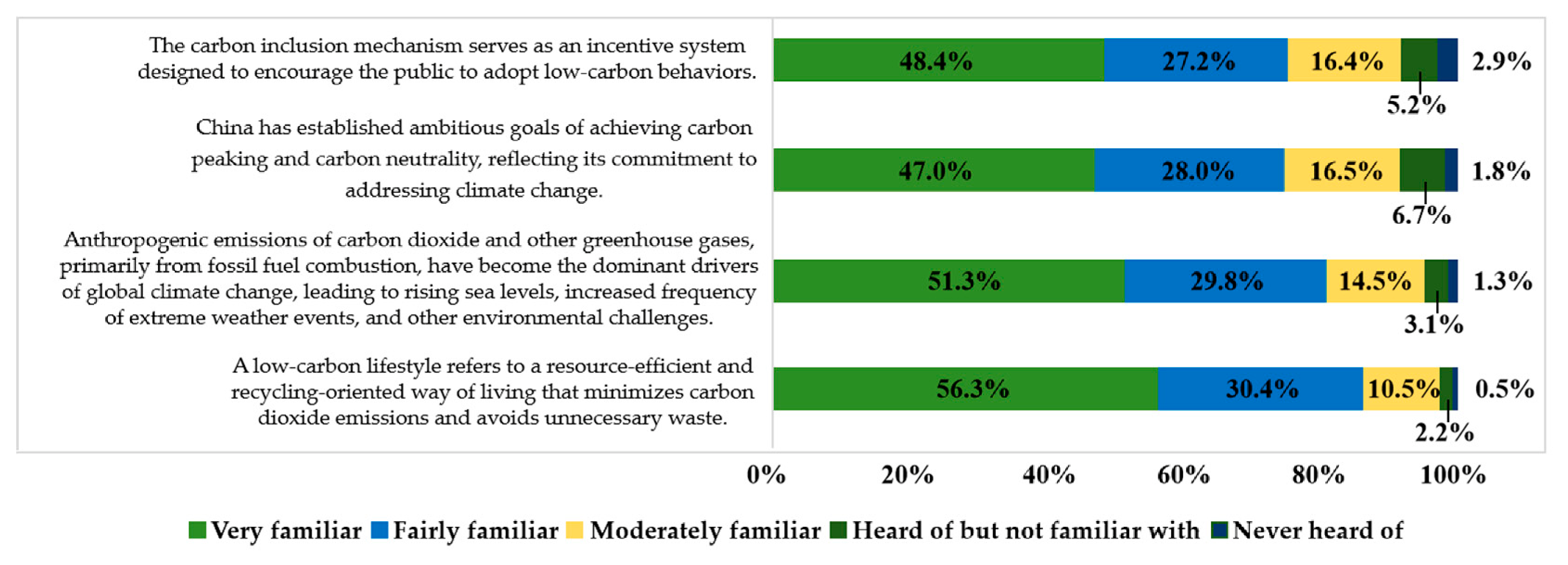
According to the China Public Awareness and Behavior Survey on Low-Carbon Development, released during the 28th Conference of the Parties (COP28) to the United Nations Framework Convention on Climate Change (UNFCCC), a total of 10859 valid responses were collected from 31 provinces, municipalities, and autonomous regions. As shown in Figure 3, 51.3% of respondents were familiar with the concept of climate change and 56.3% understood low-carbon lifestyles. Awareness of newer concepts—such as the national “Dual-Carbon” goals and the “Carbon Inclusion” mechanism—was notably lower, at 47.0% and 48.4%, respectively. Although 84.2% of respondents recognized reusable cups as an effective low-carbon behavior, only 69.3% reported doing so, revealing a persistent disconnect between environmental attitudes and actions[32].
Participation is further constrained by three deficiencies: incomplete information disclosure, limited engagement channels, and weak incentives. Information asymmetry undermines public understanding; complex managed digital participation systems reduce accessibility; and the absence of reward mechanisms, financial or reputational, diminishes motivation for long-term involvement.
5. Framework for Safeguard Mechanism Construction
Establishing a comprehensive, systematic, and effective safeguard mechanism has become an urgent prerequisite for the successful implementation of urban low-carbon planning. As illustrated in Figure 4, such a mechanism should integrate four key dimensions—the refinement of the environmental legal system, the strengthening of regulatory coordination, the diversification of incentive policies, and the expansion of social participation channels.
5.1. Legal Institutionalization
Strengthening the legal foundation is fundamental to advancing urban low-carbon transformation. This requires a systematic and coherent environmental legal framework that provides stability, enforceability, and clear institutional authority. China’s current system remains fragmented, with limited legislative hierarchy and weak coordination between national goals and local implementation.
A Dual-Carbon Basic Law should anchor this framework by defining institutional mechanisms for carbon reduction, carbon sink enhancement, and carbon neutrality. Elevating these principles to statutory obligations would consolidate dispersed regulations, clarify administrative mandates, and embed dual-carbon governance within China’s legal hierarchy. It should codify the legal status of carbon emission rights, standardize trading rules, and delineate the supervisory powers of regulatory agencies. Strengthening these instruments would reduce jurisdictional overlap, enhance market credibility, and improve enforcement capacity.
Existing laws must be updated to reflect the dynamics of urban low-carbon development. Motor vehicle emissions remain a major source of urban air pollution: by 2024, China’s vehicle fleet reached 453 million, with new energy vehicles comprising only 24.72 million. Despite the National Stage VI Vehicle Emission Standards, regulation of volatile organic compounds (VOCs) and nitrogen oxides (NOₓ) remains insufficient, and oversight between traditional and new energy vehicles lacks coordination. Refining the Air Pollution Prevention and Control Law to establish differentiated, lifecycle-based, and dynamically adjustable emission standards—along with amendments to the Environmental Protection Law to strengthen urban carbon control and renewable energy promotion—would enhance legal adaptability and sustain the trajectory toward a low-carbon urban future.
5.2. Regulatory Coordination
Effective regulatory coordination is essential to the implementation of urban low-carbon planning. A unified supervisory body should consolidate fragmented departmental functions and exercise clear authority over planning, monitoring, and enforcement. Centralized oversight would overcome bureaucratic fragmentation and ensure coherence across sectors. Singapore’s Ministry of Sustainability and the Environment illustrates this approach by unifying environmental and water governance, aligning policy goals, and minimizing jurisdictional conflict. A similar institutional model could guide China in establishing a specialized regulatory authority—national or municipal—to enhance coordination, efficiency, and consistency in low-carbon governance.
Table 2 presents a hypothetical but representative dataset demonstrating how the four safeguard mechanisms (L, R, P, S) jointly influence urban low-carbon planning performance (LCP). The Tapio decoupling index (D) provides an auxiliary measure of the effectiveness of these mechanisms in achieving economic–environmental decoupling. A coherent regulatory architecture also depends on standardized and technically robust frameworks encompassing energy use, carbon emissions, building efficiency, and transport decarbonization. Clear monitoring methods, evaluation criteria, and compliance benchmarks are essential. Sector-specific Carbon Accounting Guidelines should define calculation methods, quota allocation principles, and trading procedures, ensuring regulatory transparency and predictability while strengthening institutional credibility.
Digital governance technologies further enhance precision and accountability. Blockchain-based monitoring systems can record real-time energy data across buildings, transport, and industry with high traceability and security. Smart metering and carbon measurement terminals, integrated into centralized data platforms, enable continuous supervision of the entire energy lifecycle—from production to consumption—supporting adaptive, data-driven regulatory governance.
5.3. Policy Diversification
A diversified incentive framework is essential to sustain urban low-carbon transformation. Well-designed incentives enhance policy effectiveness and mobilize the participation of governments, enterprises, and citizens in achieving decarbonization goals.
The incentive mix should integrate fiscal, tax, and financial instruments. Fiscal spending can be expanded through Low-Carbon Development Funds supporting R&D in low-carbon technologies, emission reduction projects, and renewable energy industries. The European Union’s Horizon 2020 Programme demonstrates how targeted funding can accelerate green innovation[33]. Tax policies should extend exemptions and life-cycle deductions for low-carbon enterprises, green buildings, and new energy vehicles, while green finance tools—such as carbon-pledged loans, green bonds, and insurance—can diversify financing and mitigate investment risks.
Incentive precision should increase through differentiated policy design. Large industrial firms may receive direct subsidies to promote technological upgrading and collaborative R&D; small and medium-sized enterprises should access preferential taxes and low-interest loans to modernize production; and consumers should be encouraged through purchase subsidies for energy-efficient appliances and electric vehicles. Such stratified measures enhance inclusiveness and ensure equitable access across sectors.
A dynamic adjustment mechanism is required to maintain policy relevance. Regular evaluations should assess effectiveness, fiscal efficiency, and technological alignment, allowing timely recalibration in response to evolving market and innovation trends. Adaptive policy feedback ensures continuity and prevents stagnation in the transition toward low-carbon urban systems.
5.4. Participatory Co-Governance
Urban low-carbon planning, as a systemic governance process, relies on extensive public engagement and collaborative participation. Effective transformation depends not only on governmental regulation and technological advancement but also on the active involvement of citizens, enterprises, and social organizations throughout planning, implementation, and evaluation.
Information transparency forms the foundation of participation. In the digital era, multi-channel disclosure platforms should integrate data from all planning stages, providing real-time updates, progress reports, and emission metrics. Transparent information enhances public oversight, strengthens trust between government and society, and promotes accountability in urban low-carbon governance.
Diversified participation mechanisms are equally critical. Institutionalized procedures—such as public hearings, stakeholder consultations, and participatory workshops—should be embedded in key decision points, including plan formulation and project site selection. Regular public surveys can systematically capture perceptions and expectations, ensuring that urban planning aligns with social needs and equity principles.
Public oversight and incentive systems are necessary to ensure continuity and legitimacy. A responsive reporting and grievance mechanism should enable citizens to monitor compliance and identify implementation gaps. Verified reports may be rewarded through monetary incentives, carbon credits, or discounts on certified green products, reinforcing civic responsibility and engagement.
6. Comparative and Theoretical Implications
From a comparative perspective, the evolution of China’s urban low-carbon planning exhibits both convergent and divergent characteristics relative to international governance models. The European Union (EU), the United States (U.S.), and China have each developed distinctive institutional pathways that reflect their respective political structures, legal traditions, and socio-economic contexts.
The European Union’s model represents a rule-based governance paradigm, characterized by a highly institutionalized and legally binding framework. Through instruments such as the Renewable Energy Directive (RED III) and the Carbon Border Adjustment Mechanism (CBAM), the EU has embedded low-carbon objectives into its supranational legal architecture, ensuring consistency between environmental, trade, and energy policies. This approach prioritizes regulatory certainty and compliance enforceability, creating a predictable environment for long-term decarbonization investment.
In contrast, the United States’ model follows a multi-level incentive-driven approach. Anchored by the Inflation Reduction Act (IRA), it integrates federal tax credits, state-level standards, and local implementation programs to promote technological innovation and market participation. This flexible and market-oriented mechanism enhances policy adaptability and economic efficiency but relies heavily on fiscal incentives and voluntary compliance, which may generate uneven outcomes across states and sectors.
China’s trajectory reflects a hybrid governance model, integrating the rule-based discipline of the EU with the incentive-oriented flexibility of the U.S., while retaining strong state coordination. This model emphasizes top-level policy design and administrative coherence, supported by expanding market mechanisms (e.g., carbon trading) and emerging participatory governance channels. Such a system enables the country to achieve rapid policy diffusion and large-scale mobilization, yet it also faces institutional challenges—particularly in interdepartmental coordination, local implementation heterogeneity, and long-term public engagement.
From a theoretical standpoint, China’s evolving framework demonstrates the emergence of an “adaptive governance” paradigm within urban low-carbon planning. Adaptive governance recognizes that climate-related challenges are dynamic, uncertain, and cross-sectoral, thus requiring an institutional balance between rigidity and flexibility. In China’s case, the proposed safeguard mechanism—comprising legal institutionalization, regulatory coordination, policy diversification, and social co-governance—embodies this balance. It integrates normative authority (ensuring stability and accountability) with policy adaptability (allowing iterative learning and responsiveness). This hybrid configuration contributes to the theoretical enrichment of governance studies by bridging the dichotomy between hierarchical control and decentralized innovation.
Moreover, the comparative analysis underscores a key insight: effective low-carbon governance is not solely determined by institutional form but by coordination capacity and feedback mechanisms. China’s ongoing institutional reforms illustrate how a centralized system can evolve toward multi-actor collaboration and data-driven governance without losing strategic coherence. By leveraging legal codification, digital monitoring technologies, and participatory mechanisms, the Chinese model contributes a distinctive perspective to global urban sustainability governance—one that emphasizes systemic integration and adaptive resilience.
7. Conclusion
Urban low-carbon planning in China faces persistent institutional and governance barriers, including legal fragmentation, weak regulatory enforcement, limited incentive diversity, and insufficient public participation. These deficiencies undermine the coherence and effectiveness of existing low-carbon initiatives, constraining cities’ capacity to achieve sustained carbon reduction and energy efficiency goals. The present study addresses these challenges by constructing a comprehensive four-dimensional safeguard framework encompassing normative, regulatory, policy, and social mechanisms. Through this framework, the study demonstrates how legal institutionalization, coordinated regulation, diversified incentives, and participatory governance can collectively reinforce the implementation of low-carbon planning, enabling urban systems to transition from fragmented policy structures toward an integrated and resilient governance architecture.
From a theoretical standpoint, this research extends the scope of institutional governance theory by conceptualizing safeguard mechanisms as multi-layered instruments that bridge urban planning, legal authority, and social behavior. The proposed framework elucidates the interdependence between formal institutional arrangements and informal participatory dynamics, emphasizing that the effectiveness of low-carbon planning depends on the systemic interaction of these governance layers. The study thus advances the theoretical understanding of adaptive governance under the dual-carbon strategy, highlighting that sustainable decarbonization requires not only technological innovation and fiscal investment but also the continuous optimization of institutional design, regulatory coherence, and stakeholder coordination.
In terms of policy implications, this study underscores the necessity of establishing a legally binding Dual-Carbon Basic Law to unify dispersed environmental and energy regulations and strengthen the statutory foundation for urban low-carbon planning. It also advocates for the creation of a centralized regulatory supervision system capable of aligning national and local enforcement, supported by digital monitoring technologies and big-data platforms for real-time oversight. Moreover, adaptive fiscal and financial mechanisms—such as dynamic green tax credits, carbon-trading incentives, and multi-level participation frameworks—should be institutionalized to mobilize enterprises, communities, and individuals in the co-production of low-carbon outcomes. Looking ahead, future research should employ comparative, quantitative, and system dynamics methods to evaluate the temporal effectiveness and feedback resilience of safeguard mechanisms across diverse urban contexts, thereby enriching empirical evidence and guiding the iterative evolution of low-carbon governance in China and beyond.
Author Contributions
Conceptualization, M.Y. and J.F.; methodology, M.Y.; software, J.F.; validation, M.Y. and J.F.; formal analysis, M.Y.; investigation, J.F.; resources, M.Y.; data curation, J.F.; writing—original draft preparation, M.Y.; writing—review and editing, M.Y. and J.F.; visualization, M.Y.; supervision, J.F.; project administration, M.Y. and J.F; funding acquisition, J.F. All authors have read and agreed to the published version of the manuscript.
Funding
This research was funded by the Undergraduate Education and Teaching Reform Research Project of the Yunnan Provincial Department of Education (Grant No. JG2025078), the Scientific Research Fund of the Yunnan Provincial Department of Education (Grant No. 2024J1071), the 2024 Young Scientists Fund under the Joint Special Project for Basic Research in Undergraduate Colleges and Universities in Yunnan Province (Grant No. 202401BA070001008), and the Rural CEO Training Program Fund (Grant No. F124240001; Zhaocai Xing [2024] No. 102). The authors also gratefully acknowledge support from the 2025 Zhaotong Xingzhao Talent Support Program (Document No. 2025-56), the Research Startup Fund for High-Level Talents (Grant No. X212250071), and the 2024 Basic Research Project of the Yunnan Provincial Department of Science and Technology (Grant No. X212250036).
Acknowledgments
This study is a research outcome of the Yunnan Provincial Key Laboratory of Philosophy and Social Sciences. The authors would like to thank the administrative staff of Tongji University, Kunming University of Science and Technology, and Zhaotong University for their logistical support throughout the field investigation. The authors also used ChatGPT (OpenAI, GPT-5, August 2025 version) for assistance with language refinement and editorial clarity during the preparation of this manuscript. The authors have reviewed and edited the AI-generated outputs and take full responsibility for the content of this publication.
Conflicts of Interest
The authors declare no conflicts of interest. The funders had no role in the design of the study; in the collection, analyses, or interpretation of data; in the writing of the manuscript; or in the decision to publish the results.
Abbreviations
The following abbreviations are used in this manuscript:
| GDP | Gross Domestic Product |
| CBAM | Carbon Border Adjustment Mechanism |
| RED III | Renewable Energy Directive |
| IRA | Inflation Reduction Act |
References
- Zhou, Y.; Pan, J. Analysis of the process and outcomes of the first Global Stocktake under the Paris Agreement[J]. Chinese Journal Of Population Resources And Environment, 2025, 23(2), 143-152. [CrossRef]
- Tang, Y.; Duan, H.; Yu, S. Mitigating climate change to alleviate economic inequality under the Paris Agreement[J]. iScience, 2023, 26(1), 1-19. [CrossRef]
- Rometius, S.; Wei, X. Blue Horizons for Resilient Islands: Legal–Technological Synergies Advancing SDG 7 and 13 Through the UNCLOS–Paris Agreement Integration in SIDS’ Energy Transitions[J]. Sustainability, 2025, 17(13), 6011. [CrossRef]
- Ju, L. Quantitative Evaluation of China’s Carbon Peaking Policies Based on PMC Index Model: Evidence from the First Batch of National Carbon Peak Pilot Provinces and Regions[J]. Sustainability, 2025, 17. [CrossRef]
- Tian, Y.; Pang, J. Revealing the coupling coordination mechanisms between carbon efficiency and carbon equity: The evidence in china’s interprovincial trade[J]. Environmental Science & Technology, 2025, 59(27), 13705-13718. [CrossRef]
- Jin, Z.; Zhang, C.; Wang, X.; et al. A pathway to China’s energy transition in a carbon neutrality vision[J]. Oil & Gas Geology, 2024, 45(3), 593-599. [CrossRef]
- IPCC. Climate Change 2023: Synthesis Report. Contribution of Working Groups I, II and III to the Sixth Assessment Report of the Intergovernmental Panel on Climate Change [R]. IPCC: Geneva, Switzerland, 2023.
- IEA. Empowering Cities for a Net Zero Future[R]. IEA: Paris, French, 2021.
- Xu, D.; Li, J.; Sheng, C. Carbon Peaking and Carbon Neutrality in China: Theory and Practice, 1st ed.; Springer: Singapore, 2025; pp. 3-11. [CrossRef]
- Yan, Z.; Yuan, Y.; Jianguo, T.; et al. Urban Climate Resilient Development: Analysis of the Potential to Build Low-Carbon-Resilient City in China[J]. Chinese Journal of Urban and Environmental Studies, 2024, 12, 1-19. [CrossRef]
- Shahani, F.; Pineda-Pinto, M.; Frantzeskaki, N. Transformative low-carbon urban innovations: Operationalizing transformative capacity for urban planning[J]. Ambio, 2022, 51(5), 1179-1198. [CrossRef]
- Menkes, M. J. The collision of trade and climate: Aligning the EU carbon border adjustment mechanism with the EU Renewable Energy Directive[J]. The Journal of World Energy Law & Business, 2025, 18(3), . [CrossRef]
- Grácová, K. How Climate Policies Impact Developing Countries: The Case of the European Union Carbon Border Adjustment Mechanism[J]. Carbon & Climate Law Review, 2025, 19(2), 76-87. [CrossRef]
- Woodley, L.; See, C. Y.; Palmer D.; Nunes, A. Equity, Emissions and the Inflation Reduction Act[J]. 2025. [CrossRef]
- Rossetto D. The long-term feasibility of border carbon mechanisms: An analysis of measures proposed in the European Union and the United States and the steel production sector[J]. Sustainable Horizons, 2023. [CrossRef]
- Qu, K,; Zhang, Y.; Liu, Y.; Feng, T. Examining the Impact of China’s New Environmental Protection Law on Enterprise Productivity and Sustainable Development[J]. Journal of the Knowledge Economy, 2024, 15(3), 10722-10747. [CrossRef]
- Feng, K.; Hubacek, K.; Sun, L.; Liu, Z. Consumption-based CO2 accounting of China’s megacities: The case of Beijing, Tianjin, Shanghai and Chongqing[J]. Ecological Indicators, 2014, 47, 26-31. [CrossRef]
- Marland, G. Emissions accounting: China’s uncertain CO2 emissions[J]. Nature Climate Change, 2012, 2, 645-646. [CrossRef]
- Mi, Z.; Zhang, Y.; Guan, D.; Liu, Z.; Cong, R.; Yuan, X. C.; Wei, Y. M. Consumption-based emission accounting for Chinese cities[J]. Applied Energy, 2016, 184. [CrossRef]
- Rasheed T , Shafi S , Anwar M T ,et al.Greener hydrogen production and storage revolution towards a low-carbon future: An overview of current scenarios and future prospects[J]. Fuel, 2026, 405(PartA). [CrossRef]
- Cheng, J.; Zeng, G.; Fang, T. The Origin and Connotation of Low Carbon City: A Conceptual Framework[J]. IEEE, 2012. [CrossRef]
- Wu, F.; Zhang, D. Governance and Low-Carbon Transitions in the Business Sector[J]. Springer,Singapore, 2025. [CrossRef]
- Zhang, J.; Chu, Z.; Sun, Z. Impact of low-carbon city pilot policies on urban green innovation from the perspective of spatial and temporal heterogeneity[J]. Environmental Science & Pollution Research, 2023, 30(53), 114358-11437. [CrossRef]
- Guo. Y.; Li, S. Multi-level governance of low-carbon tourism in rural China: Policy evolution, implementation pathways, and socio-ecological impacts[J]. Frontiers in Environmental Science, 2025. [CrossRef]
- Ren, C.; Yu, C. W.; Cao, S. J. Development of urban air environmental control policies and measures:[J]. Indoor and Built Environment, 2023, 32(2), 299-304. [CrossRef]
- Guzmán, ASR.; Valdeolmillos Villaverde, D.; lvarez López, C.; Alonso, R. S. Smart Contracts fortheEuropean Union’s Carbon Removal Certification Framework: A Path Towards Transparent and Efficient Carbon Markets[C]. International Congress on Blockchain and Applications, Salamanca, Spain, 2025-03-04. [CrossRef]
- Cockerill, R. Recap: The Inflation Reduction Act (IRA)[J].Gasworld: Incorporating CryoGas International, 2023, 61(1).
- Zhou, L.; Wang, Q.; Zhou, H.; Jiang, Y.; Yin, R.; Lu, T. The Development Path and Carbon-Reduction Method of Low-Carbon Pilot Urban Areas in China[J]. Buildings, 2025, 15(7), 1096, 1-17. [CrossRef]
- Sun, H.; Tang, C.; Gao, P.; Zhou, G.Digital economy, energy consumption and urban carbon emission reduction: Empirical evidence from 278 cities in China[J]. Sustainable Futures, 2025, 10(000). [CrossRef]
- Wang, X.; Li, X. Towards a green world: How new urbanization affects green total factor carbon productivity[J]. Frontiers in Environmental Science, 2025, 12, 1-19. [CrossRef]
- Yuan, L. Comprehensive development and utilization of abandoned mines to support the realization of “carbon peaking and carbon neutrality” goals[J]. Science and Technology Review, 39(13), 1. (in Chinese).
- China Youth Daily. China Public Low-Carbon Awareness and Behavior Online Survey Report. Beijing: China Youth Daily. 2023, December 11. (in Chinese).
- Bandelow, N. C.; Hornung, J.; Sager, F. National policymaking between influences of the European Union and the economy[J]. European Policy Analysis, 2022, (1): 6-8. [CrossRef]
Figure 1.
(a) The top ten Provincial Administrative Regions with the highest CO2 emissions in China (Unit: 10,000 tons); (b) The ten Provincial Administrative Regions with the lowest CO2 emissions in China(Unit: 10,000 tons).
Figure 1.
(a) The top ten Provincial Administrative Regions with the highest CO2 emissions in China (Unit: 10,000 tons); (b) The ten Provincial Administrative Regions with the lowest CO2 emissions in China(Unit: 10,000 tons).
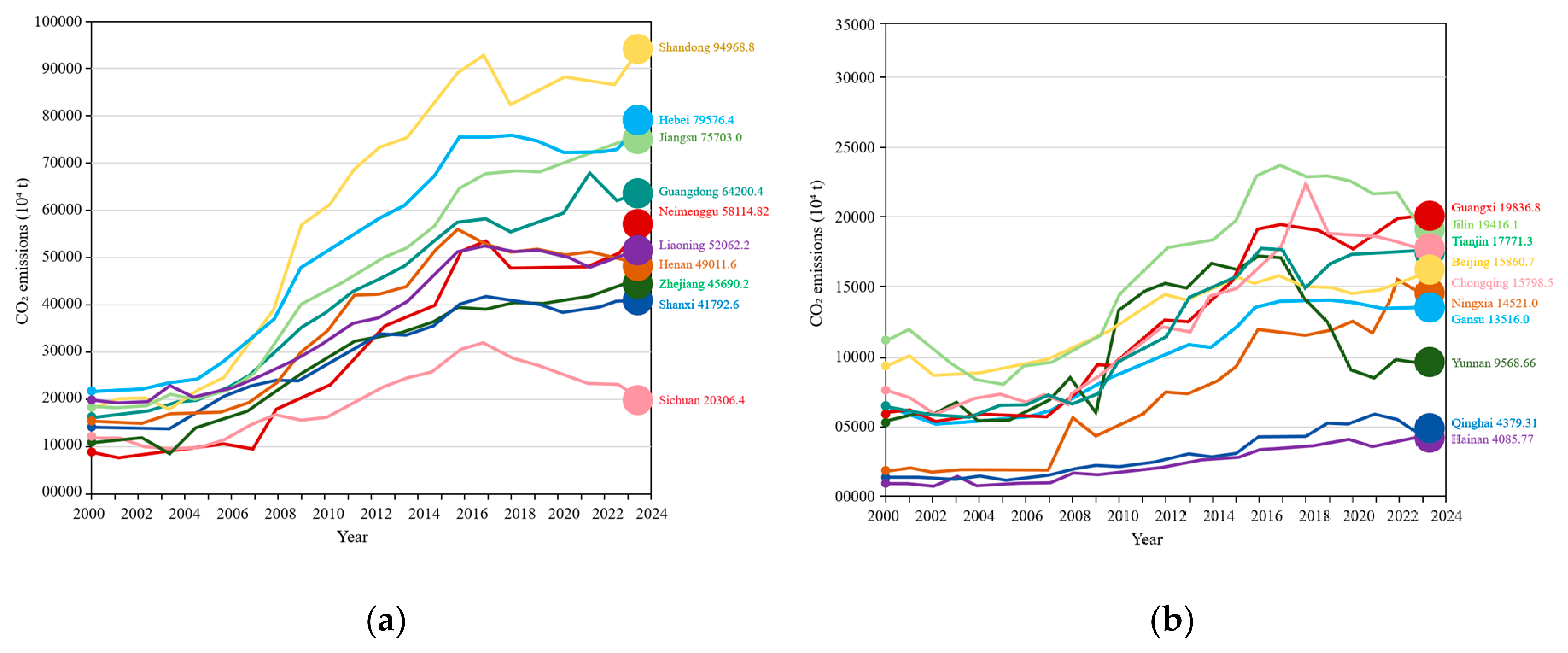
Figure 3.
Pathways for Improving Safeguard Mechanisms in Urban Low-Carbon Planning.
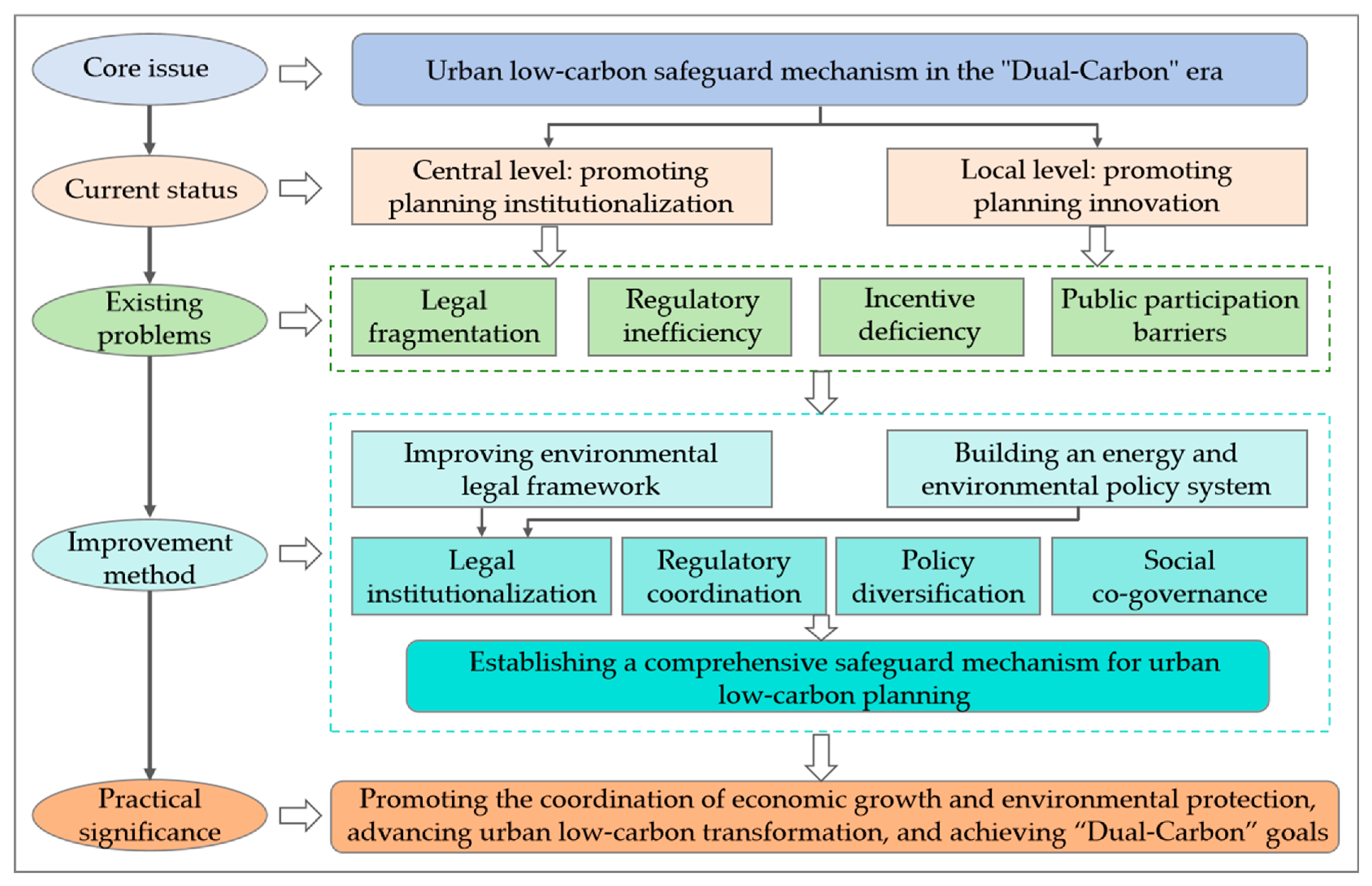
Table 2.
Hypothetical Data Matrix for Safeguard Mechanism Indices and Urban Low-Carbon Planning Performance.
Table 2.
Hypothetical Data Matrix for Safeguard Mechanism Indices and Urban Low-Carbon Planning Performance.
| City | Legal Institutionalization (L) | Regulatory Coordination (R) | Policy Diversification (P) | Social Participation (S) | Low-Carbon Planning Performance (LCP) | Tapio Decoupling Index (D) |
|---|---|---|---|---|---|---|
| Shenzhen | 0.88 | 0.91 | 0.85 | 0.79 | 0.90 | 0.32 |
| Shanghai | 0.86 | 0.89 | 0.83 | 0.77 | 0.88 | 0.41 |
| Hangzhou | 0.82 | 0.84 | 0.80 | 0.72 | 0.83 | 0.38 |
| Chengdu | 0.78 | 0.82 | 0.76 | 0.70 | 0.79 | 0.46 |
| Wuhan | 0.75 | 0.79 | 0.72 | 0.68 | 0.76 | 0.53 |
| Chongqing | 0.74 | 0.77 | 0.70 | 0.65 | 0.73 | 0.49 |
| Kunming | 0.72 | 0.74 | 0.68 | 0.63 | 0.70 | 0.57 |
| Xi’an | 0.70 | 0.72 | 0.65 | 0.61 | 0.67 | 0.61 |
| Zhaotong | 0.66 | 0.68 | 0.62 | 0.58 | 0.63 | 0.68 |
| Lanzhou | 0.63 | 0.65 | 0.60 | 0.55 | 0.61 | 0.71 |
Disclaimer/Publisher’s Note: The statements, opinions and data contained in all publications are solely those of the individual author(s) and contributor(s) and not of MDPI and/or the editor(s). MDPI and/or the editor(s) disclaim responsibility for any injury to people or property resulting from any ideas, methods, instructions or products referred to in the content. |
© 2026 by the authors. Licensee MDPI, Basel, Switzerland. This article is an open access article distributed under the terms and conditions of the Creative Commons Attribution (CC BY) license (http://creativecommons.org/licenses/by/4.0/).
Copyright: This open access article is published under a Creative Commons CC BY 4.0 license, which permit the free download, distribution, and reuse, provided that the author and preprint are cited in any reuse.