

Submitted:
05 October 2026
Posted:
08 October 2026
You are already at the latest version
Abstract
Genetic engineering deliberately alters biological material, but the transmission, spread, and continued function of engineered variation remain subject to evolutionary processes. This structured narrative review compares engineered crops, insect gene drives, and engineered microbes through an origin–transmission–population fate framework, distinguishing control at the sequence, inheritance, and ecological levels. Crop studies document pollen-mediated gene flow, multi-year transgene persistence in a weedy relative, and pest resistance alongside regional pest suppression. Gene-drive studies demonstrate biased inheritance and collapse of particular cage populations, while resistance and ecological heterogeneity constrain extrapolation to other settings. Microbial studies show that construct burden, genetic exchange, and selection can undermine intended functions despite successful initial engineering and host colonization. Together, these findings distinguish molecular precision from control over inheritance, population persistence, and ecological outcomes: initial technical success does not establish lasting practical benefit. The review maps research designs to the claims they can support and identifies difficulties in comparison across systems, interpretation of evidence, and observation over relevant evolutionary time scales. Priorities include multigenerational monitoring, comparable measures of genetic persistence and functional stability, and staged, context-sensitive evaluation. The framework connects molecular intervention with population processes and clarifies the evidence needed for biosafety and governance decisions.
Keywords:
genetic engineering
; evolution
; gene flow
; gene drive
; evolutionary stability
; biosafety
1. Introduction
Genetic engineering supports crop improvement, vector-control research, industrial biotechnology, and the development of living microbial therapeutics. Programmable RNA-guided nucleases have expanded the ability to alter selected sequences [1], while research increasingly asks whether engineered changes are inherited, spread through populations, and retain their intended functions. Molecular success does not answer these later questions. Once an engineered variant enters a reproducing population, natural selection, genetic drift, gene flow, and interactions with other organisms can influence its fate [2].
Recent policy developments make these questions practically relevant. The European Union adopted differentiated rules for plants obtained by certain new genomic techniques in 2026; Regulation (EU) 2026/1388 entered into force on 16 July 2026, although most provisions apply from 17 July 2028 [3]. In the United States, USDA–APHIS restored earlier regulatory procedures after a federal court vacated its 2020 biotechnology rule [4]. China has developed dedicated safety-review criteria for agricultural gene-edited plants while promoting biological breeding more broadly [5,6]. Internationally, the Cartagena Protocol’s Parties welcomed voluntary guidance for case-by-case risk assessment of organisms containing engineered gene drives, and the Convention on Biological Diversity continued its work on synthetic biology [7,8]. These are distinct governance responses, rather than a single international regulatory approach.
The empirical record explains why genetic change, persistence, function, and practical benefit must be distinguished. Western corn rootworm populations evolved field resistance to Bt maize [9], and a herbicide-resistance transgene persisted in a weedy Brassica rapa population over multiple years [10]. Measurements and modeling of standardized BioBrick constructs linked host burden to possible evolutionary loss of engineered function [11]. An engineered microbial therapeutic colonized the human gut, but its predefined clinical analyses did not establish significant benefit over placebo [12]. Greater editing precision alone cannot resolve all of these population-level uncertainties. The central question is therefore how engineered variation originates and is transmitted, what governs its fate across biological systems, and how far its persistence, function, and ecological consequences can be predicted or influenced.
The literature has progressively connected molecular alteration with inheritance and population processes. Work on edited rice and graft-mediated editing separates transmission of an edit from retention of the editing construct [13,14]. Chloroplast engineering explores a different transmission pathway by using maternal plastid inheritance to reduce pollen-mediated transfer where the biology permits [15]. Natural genetic exchange provides a useful comparison: expressed bacterial T-DNA in cultivated sweet potato [16], phylogenetic evidence of host-to-parasite mitochondrial gene transfer in plants [17], and horizontal exchange in microbial communities [18] show that cross-species transfer is not unique to deliberate engineering. Similar transfer routes do not, however, establish equivalent ecological consequences.
At the population level, crop studies connect field gene flow and persistence with pest adaptation and regional suppression [9,10,19,20]. Gene-drive research makes inheritance an intervention target, linking biased transmission and cage suppression to the evolution of resistant variants [21,22,23,24]. This has motivated work on multiplexed, self-limiting, and toxin–antidote designs with different persistence objectives [25,26,27]. Microbial research brings experimental evolution, construct burden, genetic exchange, and engineered containment into the same discussion [11,28,29,30,31]. As work moves toward more complex settings, WHO and National Academies guidance connects evaluation with risk assessment and participation by affected communities [32,33].
Several difficulties emerge when these studies are compared. Organism-specific questions and measures can impede comparison across crops, insects, and microbes. Molecular assays, inheritance experiments, cages, field observations, and simulations address different claims, so treating their results as interchangeable can lead to over-extrapolation. Definitions of success also differ: detecting a genetic change, maintaining a population, preserving a function, and achieving agricultural or health benefit are separate outcomes. Observation periods may be insufficient to characterize later resistance, functional loss, or containment failure. Incomplete reporting of unsuccessful outcomes is an additional concern for synthesis, although this review does not quantify its prevalence.
This review addresses these difficulties through a structured narrative comparison. Its organizing contribution is a common set of questions about the origin, transmission, and population fate of engineered variation, coupled to three levels of control over sequence, inheritance, and ecology (Section 2). It applies those questions to three research areas (Section 3), maps study designs to supported claims, and develops priorities for observation, reporting, and evaluation (Section 4). A source register supports traceability of the selected evidence. The synthesis also considers how uncertainty, participation, and responsibility enter decisions about use (Section 5). The framework is intended to aid comparison and identify missing evidence, rather than to introduce a new evolutionary theory or a validated prediction model.
2. Research Design and Analytical Framework
2.1. Rationale for Case Selection
The three research areas were selected because they expose different relationships between the origin, transmission, and population fate of engineered variation. Crops emphasize movement and persistence in open agricultural systems; gene drives make inheritance itself an engineering target; microbes permit observation of functional stability over many generations. Together, they allow comparison across the sequence, inheritance, and ecological levels of control distinguished in Section 2.4.
Engineered crop traits generally follow ordinary Mendelian inheritance, while movement through pollen or seed, persistence in compatible recipient populations, and pest responses depend on reproductive biology, environmental conditions, and management. Multi-season field observations provide an important basis for examining ecological spread and longer-term effects. They complement the evidence available from controlled systems.
In gene drives, transmission is the engineering target. Biasing inheritance can alter population composition, but continued spread, resistant variants, and reproductive costs remain central uncertainties. Crosses, cage populations, and simulations address different parts of that problem. They make it necessary to distinguish inheritance performance, population effects under tested conditions, and applicability to natural environments.
Microbial generation intervals allow selection on engineered constructs to be observed within a comparatively short study. The central question is whether descendants retain the intended function as burden, genetic exchange, and selection affect their performance. Engineered dependence and biocontainment also make persistence and environmental restriction testable design objectives. Selected host-colonization studies extend the comparison beyond isolated strains into interacting communities.
The cases therefore provide complementary evidence from field monitoring, controlled population experiments, simulation, and host colonization. The review focuses on heritable engineering in nonhuman organisms. Human germline editing, somatic gene therapy, and wholly contained industrial applications are not evaluated as application domains. Engineered bacteria studied in humans are included as a question about microbial populations, rather than modification of the human host. Laboratory and cultivation studies remain relevant when they inform the evolutionary mechanisms considered here.
2.2. Review Scope and Approach
This is a structured narrative review. Literature identification began with an OpenAlex search conducted on 15 September 2026, using combinations of terms for genetic engineering, genome editing, gene drives, gene flow, inheritance, fitness, resistance, and evolutionary stability. That search provided a capped pool of 300 records ranked by citation frequency. Supplementary checks of primary publisher records and public repositories were used to verify bibliographic details and to incorporate directly relevant recent research in each of the three areas. Inclusion depended on a study’s contribution to the comparison rather than on any attempt to estimate the numerical distribution of the field.
Findings were checked against accessible full texts; where only abstracts were available, use was restricted to their stated findings. Each result was interpreted according to whether it came from a laboratory experiment, a cage population, field observation, or numerical simulation, because these four designs answer different questions and license different classes of claim. Foundational conceptual work and authoritative guidance support the framing and the governance discussion. Three limitations of the procedure should be stated. Retrieval was prioritized by citation frequency, supplementation of recent work was selective, and full-text availability was uneven across sources. The review consequently does not constitute an exhaustive systematic review, offers no pooled estimate of effectiveness, and provides no overall ranking of technologies. It emphasizes representative developments and the boundaries within which their evidence applies.
A source register records bibliographic identifiers, access routes, and available version information. SHA-256 hashes are recorded for matched, locally retained source files; a file-integrity check is distinguished from assessment of its scientific findings. Where no local full text was identified, the register states that limitation. Supplementary policy statements are tied to official records published by the literature cutoff, with actual verification dates recorded separately.
2.3. Origin, Transmission, and Population Change
Genetic engineering describes an intentional intervention in genetic material; evolution describes change in inherited variation within populations across generations. An engineered alteration can enter that process through transmission and subsequent population change. A phenotypic difference in one modified organism does not itself demonstrate that a population has evolved, and heritability does not establish eventual spread or usefulness. Origin, transmission, and population fate are therefore connected but analytically distinct. Figure 1 maps questions to follow, not an inevitable sequence of successful outcomes.
In multicellular organisms, an alteration confined to nonreproductive tissue need not be inherited by offspring. In edited rice, tested changes passed to later generations even when the editing transgene was absent [13]. Grafting wild-type shoots onto transgenic rootstocks provides another route to heritable edits in progeny carrying no editing construct [14]. Inheritance of the result and retention of the editing machinery are separate questions; neither experiment alone establishes spread or long-term persistence in natural populations.
Once engineered variation enters a population, selection, genetic drift, and gene flow can shape its fate [2]. Fitness means reproductive success in a specified environment, rather than usefulness to people [34]. A valuable engineered function may impose a burden, while variants that disable it can gain a reproductive advantage. Natural horizontal transfer offers a related distinction: bacterial T-DNA integrated and expressed in cultivated sweet potato shows that cross-species transfer is not exclusively artificial [16]. Neither a change’s origin nor its route of transmission determines its ecological consequences; spread, stability, and effects require context-specific evaluation.
2.4. Intentionality and the Limits of Control
The deliberate character of engineering matters, because people select objectives, organisms, and sites of intervention, whereas natural mutation involves no foresight about future needs. That difference in intention neither predetermines the outcome nor removes the resulting organisms from evolutionary processes. Long-term laboratory evolution offers a complementary perspective: researchers control culture conditions, and lineages nevertheless continue to accumulate changes and adapt across many generations [28]. Human control over conditions and continuing evolutionary change therefore coexist. Two common intuitions fail here, namely that evolution must always be slow, and that an artificial origin cancels evolutionary significance.
Control itself operates at three levels that must be kept apart. Sequence-level control concerns the intended genetic alteration. Inheritance-level control concerns whether and how that alteration passes to descendants. Ecological control concerns performance in populations interacting with other organisms in changing environments. Evidence at one level does not automatically answer questions at another. A precisely targeted modification may still have fitness effects that vary with context, and a stably inherited change may still fail to produce the intended population outcome. The comparison in Section 3 rests throughout on this separation.
3. Evidence from Three Research Areas
3.1. Engineered Crops in Evolving Agricultural Systems
Crop improvement has long depended on inherited variation and selection. Evidence that GmOLEO1 was a target of selection during soybean domestication connects an oil-related trait to that history [35]. Genetic engineering introduces another source of variation, whose movement and persistence still depend on reproductive biology and the receiving environment. Watrud et al. detected pollen-mediated movement from engineered creeping bentgrass beyond the source fields [19], while Warwick et al. documented multi-year persistence of a herbicide-resistance transgene in a weedy Brassica rapa population [10]. These findings establish possibilities in particular crop–environment combinations, rather than a common outcome for all crops. Engineering the chloroplast genome can reduce pollen-mediated transfer where plastids are maternally inherited, but its effectiveness depends on the species and inheritance pattern [15]. Presence outside cultivation, transmission to descendants, and ecological harm remain separate questions.
Agricultural value also depends on responses in organisms that have not themselves been engineered. Gassmann et al. documented field-evolved resistance in western corn rootworm exposed to Bt maize [9]: the crop trait could remain intact while its protective value declined. Conversely, Hutchison et al. found regional suppression of European corn borer associated with Bt maize adoption, including economic benefits for growers of non-Bt maize [20]. The two findings illustrate different outcomes of interactions among crop traits, pest populations, and management. Recent functional studies of the wheat resistance genes Pm13 and Pm57 expand the resources available for disease resistance [36,37], but identifying a resistance function does not establish its durability under future field selection. Evaluation therefore needs to connect trait performance with changes in pest or pathogen populations and the management conditions under which benefits persist.
3.2. Gene Drives and the Engineering of Inheritance
Gene drives make inheritance itself an engineering target. By biasing transmission beyond ordinary Mendelian expectations, they can change population composition or support suppression; success in a cross does not establish either population outcome. Hammond et al. demonstrated a CRISPR-based drive in Anopheles gambiae [21], and Kyrou et al. subsequently reported collapse of tested cage populations using a drive targeting doublesex [22]. Other experiments documented the emergence of resistant variants and showed that resistance depended on the construct and genetic background [23,24]. A transmission advantage must therefore be assessed alongside reproductive costs and the supply of variants that escape the drive. Standing genetic variation in natural mosquito populations [38] and models of resistance and population rebound [39] further limit extrapolation from a successful cage experiment to a new ecological setting.
Alternative architectures pursue different balances between spread, persistence, and control. Anderson et al. demonstrated a split drive in Aedes aegypti cage populations despite fitness costs; the design was potentially confinable, but cage spread did not itself establish confinement after release [40]. Han and Champer compared self-limiting approaches in models, clarifying trade-offs between persistence and repeated intervention [26]. Target-gene choice and multiplexed guide RNAs can affect drive efficiency and the formation of resistant alleles [25]. Recent results also illustrate why experimental conditions matter: Xu et al. eliminated one Drosophila cage population under a high initial carrier frequency, while other tested conditions produced different outcomes [41]. A study in Anopheles stephensi combined laboratory genetic measurements with simulations of suppression and elimination; these were modeled population outcomes, not observed elimination of cage or field populations [42].
Rescue designs and antiparasite constructs extend the range of objectives while exposing further constraints. A rescue drive in Anopheles stephensi addressed the fitness burden associated with disruption of its target gene [43]. Compound antiparasite drives reduced infection in laboratory tests, yet fitness costs and differences between mosquito species prevented further field development of the tested Anopheles gambiae lines [44]. Laboratory antiparasite activity thus remains distinct from community health benefit. WHO guidance accordingly links progression to staged assessment [32]. Large-cage experiments can incorporate age structure and behavior more fully than small cages, as illustrated by Hammond et al. [45], but they still provide an intermediate form of evidence rather than proof of field effectiveness. The relevant question is which uncertainties each stage resolves and which remain for the next setting.
3.3. Engineered Microbes and Evolutionary Stability
Engineered microbes make evolutionary stability especially visible because short generation intervals allow many rounds of selection within a study. Maintaining an introduced function can consume resources, creating an advantage for descendants that reduce or lose that function. Radde et al. measured the burdens associated with 301 standardized BioBrick constructs in Escherichia coli and used population modeling to examine their consequences for evolutionary stability [11]. The study connects initial engineering performance with the possibility of later functional loss; it should not be read as longitudinal observation of failure in every construct. The relationship depends on the host, the function, and culture conditions. A construct that performs well initially may therefore require a separate assessment of whether its descendants continue to perform the intended task.
Biocontainment places a related question at the center of design: under which conditions should an engineered population remain viable? Mandell et al. developed dependence on synthetic amino acids [30], while Rottinghaus et al. tested CRISPR-based kill switches in laboratory conditions and the mouse gut [31]. These studies demonstrate containment strategies under defined conditions; the containment mechanisms themselves also require evaluation of evolutionary stability over the intended period of use [30,31]. Functional stability and containment are different objectives: retaining a therapeutic or production function does not establish restricted survival, and a restriction on survival does not by itself guarantee that the function is retained throughout the intended period of use.
Community and host interactions add further uncertainty. Whitaker et al. observed colonization and genetic exchange by an engineered therapeutic bacterium in the human gut, together with changes relevant to its intended function; the predefined clinical analyses did not establish significant benefit over placebo [12]. Colonization was therefore a biological result with a different evidential status from therapeutic success. Horizontal gene transfer offers a broader route through which microbial populations can acquire or redistribute traits [18]. In a specific experimental context, adaptation to triclosan altered the acquisition of antibiotic-resistance plasmids [29], showing why the history of selection can matter without implying a universal response. Evaluation should specify the intended duration, environment, and function, and follow genetic and functional outcomes in the interacting population. Persistence alone is an incomplete measure of success.
4. Comparative Synthesis, Research Priorities, and Limitations
4.1. What the Comparison Across the Three Areas Establishes
The three areas provide complementary evidence about the fate of engineered variation. Table 1 summarizes the principal evidence represented here and the boundary on its interpretation. The comparison concerns the relationship between a claim and its supporting observations; it does not rank technologies by maturity or safety.
These categories describe the evidence discussed, rather than stages on a universal scale of technological readiness.
Three findings connect the areas. First, transmission and practical utility can diverge: an inherited trait may persist while its value changes. Second, a human objective need not align with the reproductive success of the organism carrying it. Third, selection in interacting populations can affect outcomes even when the engineered sequence remains intact. The examples support attention to these relationships without establishing how often each determines outcomes across the whole field.
Engineering can consequently affect evolution through two broad routes. It can directly introduce inherited variation or alter transmission, including transfer into recipient populations. It can also change selection on other organisms, as a resistant crop changes conditions for pests. These routes may interact, but the evidence supporting them is heterogeneous. The unresolved task is to connect an initial intervention with transmission, population change, functional performance, and consequences over an appropriate period, while stating which links have actually been observed.
4.2. Priority One: Connecting Short-Term Performance to Multigenerational Outcomes
Observations across generations can reveal outcomes that an initial performance assay cannot address. Field resistance to Bt maize [9], multi-year transgene persistence [10], resistance in gene-drive populations [23], burden-related risks to microbial function [11], and genetic changes during gut colonization [12] all make the time dimension relevant. Their designs differ, so they should not be treated as interchangeable demonstrations of a single long-term process.
The appropriate period depends on the organism, environment, and proposed use. Several microbial generations can occur within a short experiment, whereas agricultural and vector-control outcomes may depend on seasons, population turnover, and changes in management. A common reporting framework therefore needs comparable descriptions of elapsed generations and ecological conditions, rather than one observation interval imposed on every system.
Initial conditions also deserve explicit reporting. Drive outcomes can depend on initial carrier frequency [41], genetic background and resistant variants [23,38], while host costs [44] and community interactions [12] can alter performance. Studies should report starting frequencies, relevant background variation, generations or follow-up duration, and environmental conditions alongside the outcome. Where observation is necessarily short, stating which later outcomes remain untested is more informative than implying that early success establishes durable performance.
4.3. Priority Two: Comparable Reporting and Explicit Criteria for Success
The word success can refer to different endpoints: a confirmed sequence alteration, inheritance by descendants, movement into a new population, retained function, suppression, or a practical benefit. These endpoints require different observations. Table 2 maps them to suitable evidence and representative examples; it is intended to improve reporting and expose missing links between a result and a larger claim.
The rows are not a compulsory sequence, a study-quality score, or a claim that every application requires the same endpoint. Nor does this purposive selection permit numerical conclusions about the distribution of evidence across the field. The map instead helps identify when a claim exceeds its design: for example, laboratory measurements combined with simulation can inform expected suppression in Anopheles stephensi, but cannot be reported as observed population elimination [42].
Unsuccessful or conditional outcomes are informative within this framework. Different outcomes across drive cages [41], fitness costs that constrained antiparasite-drive development [44], burden-related instability [11], and the absence of established clinical benefit despite colonization [12] identify limits on broader claims. Reporting such results supports cumulative assessment. These examples do not, by themselves, quantify publication bias or show that negative findings are uniformly neglected.
4.4. Priority Three: Integrating Evaluation with Decisions About Use
Evaluation is more useful when the evidence is matched to a defined decision. WHO guidance and the National Academies report distinguish stages of investigation and emphasize risk assessment, oversight, and engagement with affected communities [32,33]. A promising result at one stage can justify a further question without settling the decision to deploy in a more complex setting.
Four questions organize that assessment. Will the change be inherited and persist for the intended period [10,13,40]? Will the intended function remain stable in the relevant host or community [11,12]? Do benefits and effects on interacting organisms remain acceptable as ecological conditions and selection change [9,20]? Finally, who is responsible for monitoring, how long should it continue, and which findings should trigger reassessment [32,33]? These questions connect biological evidence with the responsibilities involved in use.
Containment strategies illustrate why design intent and demonstrated control must remain distinct. Synthetic dependence, kill switches, and safeguards studied in yeast provide evidence under specified test conditions [30,31,46]. A potentially confinable split drive that spreads in cages requires separate evidence about confinement beyond those conditions [40]. Restricting persistence, detecting escape, and restoring a previous ecological state are also different objectives. Evaluation should state which of them is intended and which has been tested, so that uncertainty can inform monitoring and subsequent decisions.
4.5. Limitations of the Evidence and this Review
Cross-system comparison is constrained by differences in organisms, ecological settings, spatial scales, and outcome measures. A transmission rate, a persistence interval, and a clinical endpoint represent different properties. Comparable reporting can make these differences visible, but cannot remove them or produce a single measure of performance applicable to every intervention.
Longer-term interpretation presents a second difficulty. Selection, drift, gene flow, and changing environments can interact, making their contributions difficult to isolate in open systems. Controlled experiments and models can examine particular mechanisms, while field and host studies provide contextual evidence. Connecting these forms of evidence remains necessary when observation periods or environmental coverage are limited; a short study cannot characterize every later response.
A further gap can separate biological performance from application and governance outcomes. Persistence or suppression does not alone establish durable agricultural or health benefit, acceptable non-target effects, or adequate capacity for monitoring. Longitudinal comparisons, condition-dependent outcomes, and unsuccessful results are therefore valuable for evaluation. The relative size of these evidence gaps is not quantified here.
The review itself is selective. Citation-prioritized retrieval, targeted supplementation of recent work, and uneven access to full texts affect which evidence is represented. It does not provide exhaustive screening, formal study-quality grading, or a pooled effect estimate. Restriction to crops, insect gene drives, and engineered microbes also limits generalization to other applications. The framework is an interpretive aid for comparing claims and identifying missing evidence, not a validated predictor of evolutionary or ecological outcomes.
5. Implications and Conclusions
5.1. Ethical and Governance Implications
Evolutionary interpretation does not determine whether an intervention ought to be used. An artificial origin is not itself evidence of harm, just as a natural process is not a guarantee of acceptability. Decisions also involve the purpose of an intervention, feasible alternatives, the groups affected, the distribution of benefits and burdens, and the authority to decide. These considerations matter alongside evidence about inheritance, persistence, and function. A biologically effective intervention can still raise questions about fairness and responsibility that molecular or population measurements cannot settle.
Potential effects beyond the location of an intervention make participation and accountability particularly relevant. The National Academies report discusses public values and engagement in gene-drive research, where some proposals could affect communities beyond an initial release boundary [33]. Affected groups need meaningful opportunities to understand the evidence, express priorities, and consider the distribution of risk and benefit. The same questions can arise whenever engineered variation or its consequences cross local boundaries; they should be evaluated in relation to the proposed organism, setting, and use.
Governance must also respond to evidence that changes over time. Where later effects remain uncertain, staged evaluation, defined monitoring responsibilities, and explicit criteria for reassessment can connect decisions to emerging observations [32,33]. Regulatory approaches differ across jurisdictions, as documented in comparative work [47] and illustrated by the more recent policy developments discussed in Section 1. Decisions may be necessary before all uncertainty is resolved, but their evidential basis, remaining uncertainties, and mechanisms for review should be clear. Adaptive governance in this sense means revisiting a decision when relevant evidence or conditions change, with responsibility for doing so established in advance.
5.2. Conclusions
Genetic engineering and evolution connect through three steps: the production of heritable variation, its transmission, and the subsequent change of populations. Engineering can deliberately introduce variation, bias transmission, or alter the selection acting on interacting species. The trajectory that follows is determined by reproductive performance, genetic exchange, resistance, and ecological conditions. Two conclusions therefore hold together: an artificial origin does not remove a change from evolution, and technical success in modification does not secure the intended evolutionary outcome.
The crop, gene-drive, and microbial literatures each illuminate a different part of this relationship. Field observation reveals movement and adaptation in agricultural systems, gene-drive experiments clarify the interaction between altered transmission and population effects, and microbial studies expose the instability of engineered function under selection and community interaction. Read through a common set of questions, they support a shift of emphasis from the act of modification to the fate of its consequences across generations. Progress depends on connecting initial performance to durable outcomes in the intended setting, on reporting results at the level of claim the design actually supports, and on stating explicitly the values and responsibilities that use involves.
References
- Jinek, M.; Chylinski, K.; Fonfara, I.; Hauer, M.; Doudna, J. A.; Charpentier, E. A programmable dual-RNA-guided DNA endonuclease in adaptive bacterial immunity. Science 2012, vol. 337(no. 6096), 816–821. [Google Scholar] [CrossRef]
- Futuyma, D. J. Evolutionary biology today and the call for an extended synthesis. Interface Focus 2017, vol. 7(no. 5), Art. no. 20160145. [Google Scholar] [CrossRef]
- European Parliament and Council of the European Union. Regulation (EU) 2026/1388 of 17 June 2026 on plants obtained by certain new genomic techniques and their products, and amending Regulation (EU) 2017/625. Official Journal of the European Union. 26 June 2026. Available online: https://eur-lex.europa.eu/legal-content/EN/ALL/?uri=CELEX%3A32026R1388 (accessed on 19 September 2026).
- USDA Animal and Plant Health Inspection Service. “Court Vacatur of 2020 Biotechnology Regulations,” updated January 13, 2026. Available online: https://www.aphis.usda.gov/vacatur-2020-regulations (accessed on 19 September 2026).
- Ministry of Agriculture and Rural Affairs of the People’s Republic of China. “Detailed Review Rules for Agricultural Gene-Edited Plants (Trial),” 2023 [in Chinese; title translated]. Available online: https://www.moa.gov.cn/ztzl/zjyqwgz/sbzn/202304/P020230428340520546687.pdf (accessed on 19 September 2026).
- Ministry of Agriculture and Rural Affairs of the People’s Republic of China. “Implementation Opinions on Further Deepening Rural Reform and Advancing Comprehensive Rural Revitalization,” March 18, 2025 [in Chinese; title translated]. Available online: https://nkj.moa.gov.cn/zcjd/202503/t20250318_6471872.htm (accessed on 19 September 2026).
- Conference of the Parties serving as the meeting of the Parties to the Cartagena Protocol on Biosafety, “Decision CP-11/7: Risk assessment and risk management,” October 30, 2024. Available online: https://www.cbd.int/doc/decisions/cp-mop-11/cp-mop-11-dec-07-en.pdf (accessed on 19 September 2026).
- Conference of the Parties to the Convention on Biological Diversity, “Decision 16/21: Synthetic biology,” November 1, 2024. Available online: https://www.cbd.int/doc/decisions/cop-16/cop-16-dec-21-en.pdf (accessed on 19 September 2026).
- Gassmann, J.; Petzold-Maxwell, J. L.; Keweshan, R. S.; Dunbar, M. W. Field-evolved resistance to Bt maize by western corn rootworm. PLoS ONE 2011, vol. 6(no. 7), Art. no. e22629. [Google Scholar] [CrossRef]
- Warwick, S. I.; Légère, A.; Simard, M. J.; James, T. Do escaped transgenes persist in nature? The case of an herbicide resistance transgene in a weedy Brassica rapa population. Mol. Ecol. 2008, vol. 17(no. 5), 1387–1395. [Google Scholar] [CrossRef]
- Radde, N.; et al. Measuring the burden of hundreds of BioBricks defines an evolutionary limit on constructability in synthetic biology. Nat. Commun. 2024, vol. 15(no. 1), Art. no. 6242. [Google Scholar] [CrossRef]
- Whitaker, W. R.; et al. Controlled colonization of the human gut with a genetically engineered microbial therapeutic. Science 2025, vol. 389(no. 6757), 303–308. [Google Scholar] [CrossRef]
- Xu, R. F.; et al. Generation of inheritable and transgene clean targeted genome-modified rice in later generations using the CRISPR/Cas9 system. Sci. Rep. 2015, vol. 5(no. 1), Art. no. 11491. [Google Scholar] [CrossRef]
- Yang, L.; Machin, F.; Wang, S.; Saplaoura, E.; Kragler, F. Heritable transgene-free genome editing in plants by grafting of wild-type shoots to transgenic donor rootstocks. Nat. Biotechnol. 2023, vol. 41(no. 7), 958–967. [Google Scholar] [CrossRef]
- Daniell, H.; Lin, C.-S.; Yu, M.; Chang, W.-J. Chloroplast genomes: diversity, evolution, and applications in genetic engineering. Genome Biol. 2016, vol. 17(no. 1, Art. no. 134). [Google Scholar] [CrossRef]
- Kyndt, T.; et al. The genome of cultivated sweet potato contains Agrobacterium T-DNAs with expressed genes: An example of a naturally transgenic food crop. Proc. Natl. Acad. Sci. 2015, vol. 112(no. 18), 5844–5849. [Google Scholar] [CrossRef]
- Davis, C. C.; Wurdack, K. J. Host-to-parasite gene transfer in flowering plants: phylogenetic evidence from Malpighiales. Science 2004, vol. 305(no. 5684), 676–678. [Google Scholar] [CrossRef]
- Aminov, R. I. Horizontal gene exchange in environmental microbiota. Front. Microbiol. 2011, vol. 2, Art.(no. 158). [Google Scholar] [CrossRef]
- Watrud, L. S.; et al. Evidence for landscape-level, pollen-mediated gene flow from genetically modified creeping bentgrass with CP4 EPSPS as a marker. Proc. Natl. Acad. Sci. 2004, vol. 101(no. 40), 14533–14538. [Google Scholar] [CrossRef]
- Hutchison, W. D.; et al. Areawide suppression of European corn borer with Bt maize reaps savings to non-Bt maize growers. Science 2010, vol. 330(no. 6001), 222–225. [Google Scholar] [CrossRef]
- Hammond, et al. A CRISPR-Cas9 gene drive system targeting female reproduction in the malaria mosquito vector Anopheles gambiae. Nat. Biotechnol. 2016, vol. 34(no. 1), 78–83. [Google Scholar] [CrossRef]
- Kyrou, K.; et al. A CRISPR-Cas9 gene drive targeting doublesex causes complete population suppression in caged Anopheles gambiae mosquitoes. Nat. Biotechnol. 2018, vol. 36(no. 11), 1062–1066. [Google Scholar] [CrossRef]
- Hammond, M.; et al. The creation and selection of mutations resistant to a gene drive over multiple generations in the malaria mosquito. PLoS Genet. 2017, vol. 13(no. 10), Art. no. e1007039. [Google Scholar] [CrossRef]
- Champer, J.; et al. Novel CRISPR/Cas9 gene drive constructs reveal insights into mechanisms of resistance allele formation and drive efficiency in genetically diverse populations. PLoS Genet. 2017, vol. 13(no. 7), Art. no. e1006796. [Google Scholar] [CrossRef]
- Oberhofer, G.; Ivy, T.; Hay, B. A. Behavior of homing endonuclease gene drives targeting genes required for viability or female fertility with multiplexed guide RNAs. Proc. Natl. Acad. Sci. 2018, vol. 115(no. 40), E9343–E9352. [Google Scholar] [CrossRef]
- Han, Y.; Champer, J. A comparative assessment of self-limiting genetic control strategies for population suppression. Mol. Biol. Evol. 2025, vol. 42(no. 3), Art. no. msaf048. [Google Scholar] [CrossRef]
- Champer, J.; Lee, E.; Yang, E.; Liu, C.; Clark, A. G.; Messer, P. W. A toxin-antidote CRISPR gene drive system for regional population modification. Nat. Commun. 2020, vol. 11, Art.(no. 1082). [Google Scholar] [CrossRef]
- Barrick, J. E.; et al. Genome evolution and adaptation in a long-term experiment with Escherichia coli. Nature 2009, vol. 461(no. 7268), 1243–1247. [Google Scholar] [CrossRef]
- Yang, Q. E.; et al. Evolution of triclosan resistance modulates bacterial permissiveness to multidrug resistance plasmids and phages. Nat. Commun. 2024, vol. 15(no. 1), Art. no. 3654. [Google Scholar] [CrossRef]
- Mandell, D. J.; et al. Biocontainment of genetically modified organisms by synthetic protein design. Nature 2015, vol. 518(no. 7537), 55–60. [Google Scholar] [CrossRef]
- Rottinghaus, G.; Ferreiro, A.; Fishbein, S. R. S.; Dantas, G.; Moon, T. S. Genetically stable CRISPR-based kill switches for engineered microbes. Nat. Commun. 2022, vol. 13(no. 1, Art. no. 672). [Google Scholar] [CrossRef]
- World Health Organization. Guidance Framework for Testing of Genetically Modified Mosquitoes, 2nd ed.; World Health Organization: Geneva, Switzerland, 2021; ISBN 978-92-4-002523-3. [Google Scholar]
- National Academies of Sciences, Engineering, and Medicine, Gene Drives on the Horizon: Advancing Science, Navigating Uncertainty, and Aligning Research with Public Values; The National Academies Press: Washington, DC, USA, 2016. [CrossRef]
- Orr, H. A. Fitness and its role in evolutionary genetics. Nat. Rev. Genet. 2009, vol. 10(no. 8), 531–539. [Google Scholar] [CrossRef]
- Zhang, D.; et al. Artificial selection on GmOLEO1 contributes to the increase in seed oil during soybean domestication. PLoS Genet. 2019, vol. 15(no. 7), Art. no. e1008267. [Google Scholar] [CrossRef]
- Li, H.; et al. Wheat powdery mildew resistance gene Pm13 encodes a mixed lineage kinase domain-like protein. Nat. Commun. 2024, vol. 15(no. 1), Art. no. 2449. [Google Scholar] [CrossRef]
- Zhao, Y.; et al. Pm57 from Aegilops searsii encodes a tandem kinase protein and confers wheat powdery mildew resistance. Nat. Commun. 2024, vol. 15(no. 1), Art. no. 4796. [Google Scholar] [CrossRef]
- Miles, et al. Genetic diversity of the African malaria vector Anopheles gambiae. Nature 2017, vol. 552(no. 7683), 96–100. [Google Scholar] [CrossRef]
- Marshall, J. M.; Buchman, A.; H. M. Sánchez, C.; Akbari, O. S. Overcoming evolved resistance to population-suppressing homing-based gene drives. Sci. Rep. 2017, vol. 7(no. 1), Art. no. 3776. [Google Scholar] [CrossRef]
- Anderson, M. A. E.; et al. A multiplexed, confinable CRISPR/Cas9 gene drive can propagate in caged Aedes aegypti populations. Nat. Commun. 2024, vol. 15(no. 1, Art. no. 729). [Google Scholar] [CrossRef]
- Xu, X.; et al. Assessing target genes for homing suppression gene drive. EMBO J. 2026, vol. 45(no. 6), 2074–2094. [Google Scholar] [CrossRef]
- Xu, X.; et al. Gene drive-based population suppression in the malaria vector Anopheles stephensi. Nat. Commun. 2025, vol. 16(no. 1, Art. no. 1007). [Google Scholar] [CrossRef]
- Adolfi, et al. Efficient population modification gene-drive rescue system in the malaria mosquito Anopheles stephensi. Nat. Commun. 2020, vol. 11(no. 1), Art. no. 5553. [Google Scholar] [CrossRef]
- Carballar-Lejarazú, R.; et al. “Compound effector genes suppress malaria parasite infections in gene-drive population modification strains of the African malaria mosquitoes, Anopheles gambiae and Anopheles coluzzii,”. G3 Genes Genomes Genet. vol. 16(no. 8, Art. no. jkag014), 2026. [CrossRef]
- Hammond, et al. Gene-drive suppression of mosquito populations in large cages as a bridge between lab and field. Nat. Commun. 2021, vol. 12(no. 1), Art. no. 4589. [Google Scholar] [CrossRef]
- DiCarlo, J. E.; Chavez, A.; Dietz, S. L.; Esvelt, K. M.; Church, G. M. Safeguarding CRISPR-Cas9 gene drives in yeast. Nat. Biotechnol. 2015, vol. 33(no. 12), 1250–1255. [Google Scholar] [CrossRef]
- Turnbull, C.; Lillemo, M.; Hvoslef-Eide, T. A. K. Global regulation of genetically modified crops amid the gene edited crop boom: A review. Front. Plant Sci. 2021, vol. 12, Art.(no. 630396). [Google Scholar] [CrossRef]
Figure 1.
A framework for interpreting engineered change.
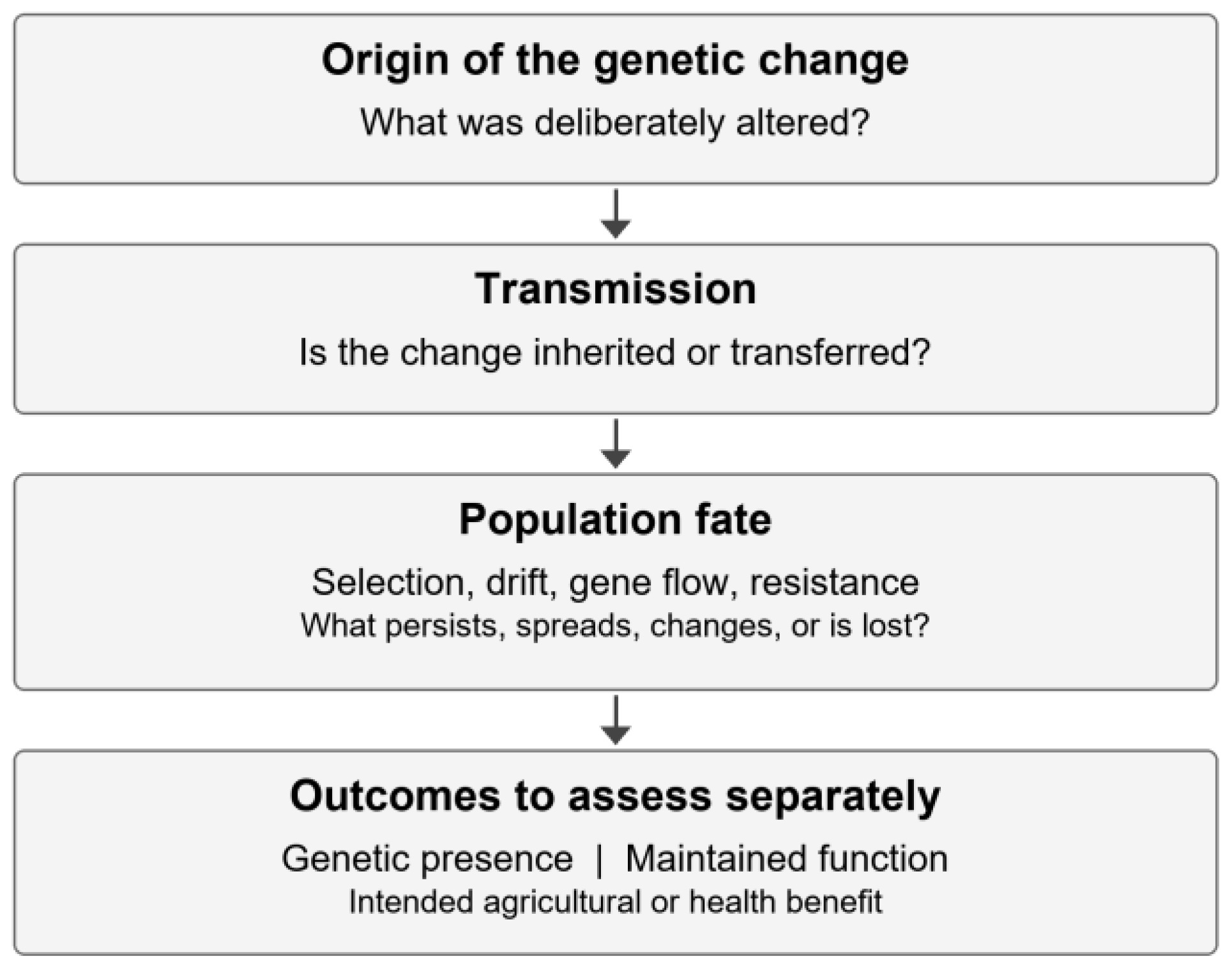

Table 1.
Evidence and interpretation across the three research areas.
| Research area | Evidence represented in this review | Main boundary of interpretation |
|---|---|---|
| Engineered crops | Field gene flow, multi-year transgene persistence, pest resistance, and regional pest suppression [9,10,19,20]. | Outcomes depend on the crop, trait, recipient or pest population, management, and observation period. |
| Gene drives | Biased inheritance, cage-population effects, and modeled population trajectories [22,40,41,42]. | Results in crosses, cages, or simulations do not establish field effectiveness or community health benefit. |
| Engineered microbes | Construct burden, functional stability, containment tests, and genetic change during host colonization [11,12,30,31]. | Persistence does not establish retained function, effective containment, or clinical benefit. |
Table 2.
Claims, supporting observations, and representative evidence.
| Claim | Required observation | Relevant study design | Representative evidence |
|---|---|---|---|
| Sequence alteration | The intended change is detected in the modified organism. | Molecular characterization. | Edited rice: sequence changes were confirmed [13]. |
| Heritable transmission | The change is found in descendants. | Crosses and multigenerational genotyping. | Rice edits and mosquito-drive crosses followed transmission [13,21]. |
| Biased transmission | Transmission deviates from Mendelian expectations. | Controlled crosses; population cages. | Mosquito drives demonstrated inheritance bias [21,40]. |
| Movement beyond the treated population | The change is detected in a recipient population or outside the source area. | Field sampling with source attribution. | Bentgrass pollen-mediated gene flow was detected beyond source fields [19]. |
| Population persistence | Presence or transmission continues over a stated period; the frequency trajectory is reported. | Repeated population sampling. | A transgene persisted in weedy Brassica rapa; a split drive was followed in cages [10,40]. |
| Maintenance or loss of function | The intended function is measured over the relevant interval. | Repeated functional assays; measurements combined with explicit models. | Construct burden informed stability models; kill switches and antiparasite constructs were tested [11,31,44]. |
| Population suppression | Population or reproductive output declines; observed and simulated outcomes are identified separately. | Population experiments; separately labeled simulations. | Cage suppression or collapse was observed [22,41]; other trajectories were modeled [26,42]. |
| Evolutionary response to intervention | Heritable changes in an exposed or target population are detected. | Field bioassays; longitudinal cage and molecular studies. | Pest resistance occurred in the field [9]; drive-resistant variants arose in target mosquitoes [23]. |
| Practical agricultural or health benefit | A relevant outcome improves against an appropriate comparison. | Regional field evaluation; controlled clinical studies. | Regional crop protection yielded benefits [20]; a microbial trial did not establish clinical benefit [12]. |
Disclaimer/Publisher’s Note: The statements, opinions and data contained in all publications are solely those of the individual author(s) and contributor(s) and not of MDPI and/or the editor(s). MDPI and/or the editor(s) disclaim responsibility for any injury to people or property resulting from any ideas, methods, instructions or products referred to in the content. |
© 2026 by the authors. Licensee MDPI, Basel, Switzerland. This article is an open access article distributed under the terms and conditions of the Creative Commons Attribution (CC BY) license (http://creativecommons.org/licenses/by/4.0/).
Copyright: This open access article is published under a Creative Commons CC BY 4.0 license, which permit the free download, distribution, and reuse, provided that the author and preprint are cited in any reuse.