
Submitted:
04 October 2026
Posted:
08 October 2026
You are already at the latest version
Abstract
Project management challenges are mainly sociotechnical. This paper proposes a be-haviorist sociotechnical approach, an integrative framework combining Actor-Network Theory, artificial intelligence, and reflective practice to enhance project management performance. We alert to some current pitfalls in project management and intend to produce actionable value for practitioners and researchers rendering project management more effective. In fact, this paper argues that project management should be understood as the management of a temporary sociotechnical network, where continuous learning, AI-mediated support, and actor-network dynamics are more decisive than traditional planning and control mechanisms.
Keywords:
project management
; actor-network theory
; artificial intelligence
; continuous learning
; reflective practice
1. Introduction
Contextual big opportunities and threats
Edgar Morin long time defined that our XXI century would be a century of complexity [1], our dominant mental model is hierarchical [2], Descartes did his part creating in all of us a sense of division, a mechanist view [3], but, in fact, our dominant thinking should be based in networks and in the integration of different subjects and tendencies [4]. Companies abandoned hierarchical structures to become matrixial, networks, project oriented [5]. Old philosophies search for conciliation, and integration is a facet of conciliation [6,8] see Figure 1 [7]. Nonaka and Ikujiro, in The Knowledge-Creating Company [8] did an historical travel from the beginning of the split (Aristoteles and Socrates) till the end, nowadays, passing through all the significant thinkers of all times, either in one side or the other of the split (rational, and empirical), and they finish this journey concluding we need conciliation. We need to achieve harmonic totality. We have been quite often in wrong directions on how we manage projects, and why we do it. It is maybe time to reshape, to dismantle some of our basic pillars [9], and restart with a new spirit. So, absorbing these few central and critic contextual and cultural influences, we try to align a framework to improve all dimensions of project management. We import knowledge from Actor Network Theory (ANT), Artificial Intelligence (AI), and management. This tries to unveil a new mindset, a new culture of project management.
Projects do not fail because methodologies are inadequate [10,13]. They fail because we still tend to manage sociotechnical systems as if they were technical systems, because traditional management relies on a reductionist, Cartesian-Newtonian paradigm [11].
The following SECI model [7,8], represented in Figure 1, addresses the links between tacit and explicit knowledge and illustrates how knowledge is transformed and enhanced through the process of converting tacit knowledge into explicit and back again, in a circulating way. This simple model changed our perception about knowledge, and how we can create organizational knowledge. This book [8] was a pillar in our scientific Figure 1 - Nonaka, Ikujiro, 2007, The Knowledge-Creating Company, Harvard Business Review, SECI model [7]
Our research question is to understand and make explicit persistent fail in project management, using a sociotechnical framework. We try to prove that the use of the ANT lenses with the integration of AI would ply a very important role in rending things more effective.
2. Materials and Methods
Back to the basics
Project management has always been problematic [9,10]. These days it is more problematic. The rate of success is poor, look at Figure 2, most people involved in this activity is not prepared in project management, also not prepared in managerial skills, they don’t adopt the best attitude facing the projects, they don’t create, develop and internalize effective habits, they are unable to build a new culture of project, they fail in risk assessment [17,18,19] fail in monitoring [17,20,21] processes are not effective, and they are not prepared to integrate [4,20] staff and tools in a systemic way, as a systemic whole, a network of hybrid actors. Finally, they are not yet taking advantage of AI tools [22]. All these causes are sociotechnical and cultural, not technical as reported in many longitudinal studies [2], and top journals [11]. See Figure 2.
Longitudinal studies (from PM international journals, the Standish Group, and Garner) indicate that nearly half of all large-scale projects fail or are "challenged" [10,15]. While methodologies evolve, failure causes remain consistent, deeply rooted in human, organizational, and managerial factors, rather than in technical ones.
Considering the rate of unsuccess, the causes are organizational, not technical, considering the managerial skills there are many improvements to address from the general management body of knowledge, considering the way people is assigned to projects [56], adherence is poor and motivation deficits, and so, there are many wrong choices and sometimes even incompatibilities [16]. Considering and using [14] metrics to measure execution [20,23] there are already methodologies and tools, considering integration of people, equipment, and tools [19] we need to have a perspective (systemic) view of the project and explore the use of the right tools. We explicit and reinforce this later.
Actor-Network Theory (ANT) provides a paradigm where actors are anything that acts in a system, from people, to material, to laws, to policies and AI. Extensively use AI tools, a “a close look” on ANT are good advice. Finally, specifically considering AI, we cannot disregard the use of AI in managing projects. And considering AI [24] we are not referring only to a tool, but to the myriads of new contexts and situations emerging from the use of these tools and how we can learn with them and use them [25,26]. We need to be prepared to take advantage of these factors (actors).
All these contextual backgrounds ask for a new mindset. A cultural change. A culture of management, operation, and communication is necessary, and AI allows the opportunity to do it in a controlled drift [15] in terms of epistemological practice [8]. We try to prove that these elements are crucial to render things in a better way, to achieve better results, and we provide consistent evidence that to envelop them all is necessary. By enveloping as we refer we mean to consider them all in an integrated [19] and systemic way, as a network [12,16], {27]. So, our project is an actor network of hybrid actors that stabilizes when the goal of the project is achieved.
Introducing these new views and approaches we revisit the basics of project management, enhancing the base for reasoning in new ways and with a fresher insight, trying to increase effectiveness.
Enhancing the base for reasoning in new ways
There are some standard approaches to project management, for instance, some well-known practitioners and scholars defined different project management schools of thought. They mean that there are different paradigmatic ways to approach project management. Rodney Turner, Frank Anbari & Christophe Bredillet [28] wrote many papers on the subject, and they finally published a book in Spring. The nine schools of thought in Project Management are Optimization, Modelling, Governance, Behavior, Success, Decision, Process, Contingency, and Marketing. If these reputable authors identified nine schools of thought, they all deserve mention and have a “raison d’être” but, for us, and based on what we previously said, and evoking experience and sound papers in top project management journals, one of them is more eligible than all the others. A behaviorist approach is, in our view, the most adequate for many projects, and it is also a crucial base to all the other paradigmatic approaches. So, our approach is behaviorist, based on human action, looking at the project and the organizational landscape (context), with insights from Actor Network Theory (ANT), and support from powerful AI tools. Traying to achieve a full control of the projects flow can also be limitative, and we should always allow and explore some drift [14]. That means an exploratory and controlled experimental attitude. We are going to explore this statement later and try to explain why. We are also going to explore ANT [16,27,35,42] as a continuous learning network [25,26]. With ANT, knowledge is the product out of alliances between actors, and is constructed within translations, displacements, controversies, detours, in ways such human and non-human elements become woven into objects [16,27]. Further, we explain how an ANT paradigm is important but, for the very beginning, in project management we need to identify stakeholders [29] (it is a basic and initial step) and with ANT they are humans and no humans [16,27,41,42]. All the actors, human and no human, tangible, and not tangible, can positively or negatively affect the project [29], our network (ANT) [27,31].
Some very old wrong assumptions in project management
"The theoretical validity of risk matrices [18] has been questioned because probability-impact multiplication may obscure qualitatively different risk profiles" [32].
Should we define a project as PMBOK [21] do? “a project is a temporary endeavor to create a unique product, service, or result. There are always a beginning and an end”, or should we define a project in this other new way: “a project is a single-purpose network of commitments undertaken by a temporary sociotechnical system?”. Which of the two definitions is more actionable? Both are important and help each other, but with our network approach we prefer the second, that is ours [12,27].
It is always necessary to discover the reason for the Project. To know exactly what the problem is going to solve. But that is not necessary but not sufficient. We need to be able to formulate the problem in a common and clear way for all team members, to be able to generate a common understanding, a common view and a sense of alignment to the objectives [21,33]. To achieve results on this aspect we need to enhance our power and abilities on reflexive practice [36,37].
Tacit knowledge is not transferable, information is. Tacit knowledge needs to be created, developed and internalized within each of us [8,35,36]. Tacit knowledge can only be generated by hands-on "know-how" a lot of reasoning [37], contextual knowledge, deduction, inference and intuition.
The waterfall model is not good enough, it doesn’t provide a good description of stage development in projects? Waterfall models are hierarchical and limited in the way they generate spaghetti developments [38]. They are mechanist that pretends to assume project management is linear “This linear approach suffers from a fatal flaw: It hinders people from incorporating new information into action… Second, a linear view of strategy pushes leaders to escalate commitment to a failing course of action, even as evidence mounts that the original strategy was based on flawed assumptions” [62].
With increasing complexity and rapid variable project contexts it is necessary to adopt more flexible methodologies like Agile, able to adapt and respond to change in better ways [5]. They plan, they do, they plan another step, and they implement again, that’s the way agile works. Other classical methodologies, like PMBOK should create conditions for more flexibility [5,21,40].
We should always delegate to whoever is best placed to do it based on knowledge and effective experience [63].
We should be able to create slacks when things are less predictable [20,23], planning more time, or planning for quick help for other team members when necessary.
Identifying stakeholders is a very important process in the beginning of the project, and all along execution, because stakeholders can vary during the execution [29]. And identifying stakeholders in an ANT way [16,27,41,42] improve effectiveness, because how many times the worst restriction (constrain) comes from software, a computer, a procedure, a policy, a law, an internal or external rule, or a specific procedure, rather than from human [13]. We should always remember that a project has many different boundaries: management, team → organization that owns the project, team → organization to which we are developing the project, project → general laws, standards to witch we need to comply, regulations, that is the full context of the project.
In most part of situations adding more people is not the solution [20,23] as team allocation has good practices and resources [23] shouldn’t be overcharged, neither sub charged. A good leadership should manage resource management with flexibility [23,43].
Project team lieder role is being extended to the other elements of the team [36]. Usually there are always team members that are more prepared to deal with specific parts, or phases, of the project [21,23,63].
People prepared to be part of a project
People need to be prepared, educated and certified [40,44] in the methodology the project is going to be developed. Management is one thing, managing projects is another, but they help each other. That is why a maturity analysis to the team and the organization is so important [21,40]. It lets us know with what we can count. There are dozens of certifications [40,44,54] PMBOK, Prince2, CCPM (Critical Chain Project Management), APM (Association for Project Management), IPMA (International Project Management Association), Certified Scrum Master (CSM), Professional Scrum Master (PSM), PMI-ACP (It covers Scrum, Kanban, and Lean and requires 2 years of Agile experience alongside 21 hours of training), and many others. The best is to have a general-purpose course in project management and be certified in the methodology that is in use in that project, or (and) to be certified in more than one methodology.
There are also certifications to specific aspects [44,54,55] for instance, monitoring and the methodologies and tools used to do it. You can certificate in phases of project management, tools used, different approaches, methodologies.
Strong soft skills are necessary to form a team, to allocate people to tasks, avoiding incompatibilities [20,23] and exploring opportunities, to communicate widely and use communication approved procedures, to motivate everyone when leading the team, as well as being able to develop a team in which leadership can be distributed. This means that there are many forms and topologies of leadership. But continuing our list we also need a sense of community in which everything is clear and transparent to eachoder. We would reinforce that whenever possible, leadership should be distributed including some of the team members as co-leaders [58].
AI could and should be used all along the project and some AI tools [49,61]. Prompting chatbots [51] and interfacing with project. Specific support AI tools and can help in analysis, reporting, decision making, and control [52]. But always supervised by team elements. Human should always have the last word on the decisional process [50,53].
Pitfalls in project management
The common most critical debilities and causes of misalignment in project management include the lack of a clear vision for the project, poorly defined goals, uncontrolled scope (scope creep), inadequate risk planning, and poor communication, see Figure 2. All these critical debilities relate to poor project management skills and education. Even communication, as a core process in project management [43], need education. And AI tools can help also in this department [24]. So, communication [44] and the use of adequate platforms to perform it is essential [43,44]. Communicating by mail, or similar tools that cannot give us a worldwide view of the project, are absolutely to avoid. There are many specific communication tools to help in project management. Apart from CRM systems, you can use Asana and Gira, and others. They are reliable and keep a visual record of all what was done, being done and decided.
Beyond the basics
Project management has always been problematic [10]. These days it is more problematic because complexity increased. And complexity in project management increased mostly because of the environment, or project context. We already said and justified that the most stressful and important factors in project management were human related, not technologic, as we already depicted in Figure 2 and [12,64,65]. And we recall the reason to our choice of a behaviorist approach to project management. Our approach is behaviorist, because we need to be able to read and understand the organizational landscape (organizational and project context), able to take advantage of the network metaphor for projects (ANT) and be prepared to use powerful AI tools. In strong complex environments, there are specific ways to behave, and control should allow and explore some drift [15]. We are going to explore this statement further in this paper and, at that time, we try to explain why.
We are also going to explore Actor Network (Theory) as a project management paradigm. Further, we explain how ANT paradigm is important but, for the very beginning of our explanation, we will say that in project management we should identify [34] stakeholders as humans and no humans [16,27,42] following an ANT [45] approach. This simple fact provides a huge difference.
Both ANT [16,27,42] and AI tools provide means to ensure a continuous learning in the community (the project team, and the organization that assumes the project). In our community (project team) the project manager is an actor like all other resources. In an ANT approach, actors have no hierarchies, they all have the same value.
Monitoring
Monitoring the project is an ongoing practice [21] that we should convert in an effective habit [25]. It is what we call an effective habit. To monitor a project we should use metrics, but metrics can lie to us [11,19]. In fact, if metrics are not well developed and adapted, they can be worse than nothing. As an example, we think about measuring the good work of a doctor by how many patients are seen in an hour. Is this a good metric, that induces value to the system? Of course not, it is a wrong metric that drive us in a wrong way. In a way to practice poor medical care.
All metrics should be directed to enhance value to the project [14]. This stress on value is very important. Not money, not time, but something more enhanced that envelop, integrate, all the others and is useful for the project and for the company where the project is executed, and to the company that owns the project.
The classic monitoring techniques are the Critical Path Method (CPM) [21] and Earned Value Management (EVM) [48], to measure progress against assumed planning. We can also use Critical Change [16]. These techniques can be connected to software tools, like:
- ClickUp: that uses Gantt charts, time tracking, and an all-in-one working hub.
- Trello: facilitates visual, board-based projects, utilizing simple lists and card system.
- Asana: Streamlines task management and cross-team collaboration
Should we monitor the project in specific phases, or should we monitor all the time [21], in a continued practice [48]? When managing a project monitoring is a continual practice.
Unravelling Actor-Network Theory
To assemble project management with ANT. We need to focus on change, transitions, negotiations, discussions, translations, controversies, detours, debates, setbacks [34,48]. Here we focus on things that went wrong and try to understand the reason why, to not repeat the same mistake, or even avoid the problem.
Once again, communication is crucially important [43], it implies transfer of data, definition of processes and tasks, assuming of responsibilities, and stabilizing rules and practices. In our ANT view, this means stabilizing the network [16,42] and if possible, achieve some black boxes crystalizing procedures [16,27]. That means that such procedures became imbedded in the network, and that means they became imbedded in the project team, or in the database of collective “knowledge”. All these aspects should align with project objectives, goals and project value [33]. And, as we already said, “a project is a single-purpose network of commitments undertaken by a temporary sociotechnical system” [12,35]. This sociotechnical system is the assemble of all actors, team, internal rules of the project team, external rules imposed by the organizations, law, culture, all equipment used (computers, …), all the tools, mainly software, and stakeholders. All these actors behave as a network, they and their interaction form the network, and we try they align with sustainability. And finally, this network is our project. And all these things’ commitments, behaviors, and the way they act, react, evolve, and interact, are all temporary. We are not managing a company, we are managing a project, with a start, and an end, hopefully with good results, one or many good results.
The overall use of Artificial Intelligence
In project management, AI is used all over [46,47] as a partner that can help us in all details, from planning, allocating decisions, to other decisions [49]. If you can ask the right questions, you will see that the answers can be very helpful, using chatbots like ChatGPT, Claude, or any other. Your questions should be a sequence of well-placed prompts, aligned with your needs. But, apart from these uses of AI with chatbots, AI can directly connect to software used in the project management, namely workflow tools like GenAI, ONES.com, Asana, Monday.com, ClickUp, Jira, Trello, Smartsheet, Wrike [52].
And with these tools coupled with your managing of the project, you develop an overall complex system (complex network of relations [1,50,60] that either let you more time to pay attention to crucial things in your project or gives you completely different views of what you are doing and what needs to be done [46,52]. They can also suggest alternatives and help on decision making. With this AI incorporation you gain insight on real work done, or to be done, and spare time-consuming efforts and work if not helped by these tools.
Copilot, ChatGPT and other AI tools [46,52] supports the managerial side of projects, where a significant amount of time is spent on planning, documentation, communication, and coordination. Rather than replacing the technical’s expertise, AI tools accelerate routine project management tasks, allowing team members to devote more attention to technical analysis, and contextual insertion. AI also suggests ways of acting, alternatives and priorities. Apart from routine work, AI can also be an intelligent partner [51]. In fact, AI can be as intelligent as you are able to post the right questions and follow adjusting the answers with it (she?).
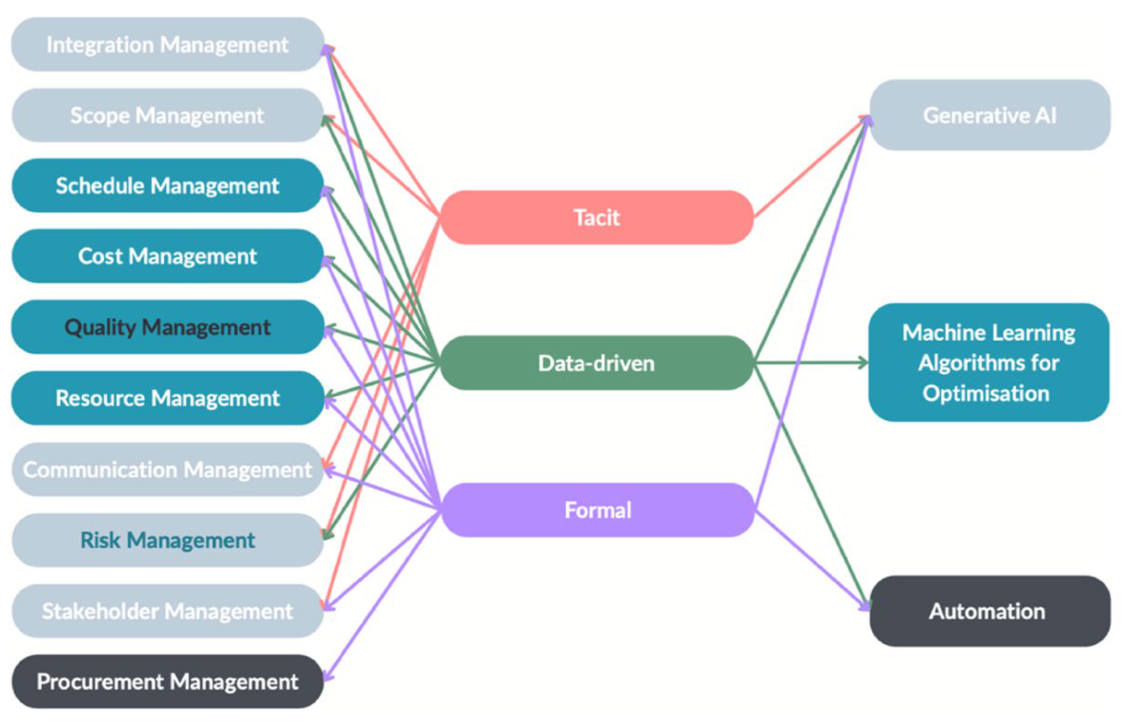
Discovering more specific details AI can help on quality control, on decision-making and in predictive analytics for timeline forecasting, automated resource allocation [23,58], scope management, proactive risk identification [18,32] and assessment, and production of specific and general documentation [46,52]. AI can also be used as a tool of control and overall integration. See Figure 3. But we should say that automation cannot be used without human supervision. Human needs to agree, or not, with proposed AI alternatives and solutions. Every automation needs human supervising [53,64,65].
We stress that we refer to AI with a double point of view, either as a general tool with the different chatbots [51], or as a specialized tool dedicated to specific tasks and procedures in project management [46,47,52]. It can act as a team member, helping to clarify and decide course of action, showing possible alternatives, as it can be used as an addon to the different tools used in the management of the project. There are already many coupling possibilities among AI tools and typical project management tools [24,46,52]. And AI is a field on very rapid development. Almost every day we assist to new tools with new and enhanced possibilities. With the myriads of consequences, we already referred. That is why things get more complex and need more expertise and need a renaissance culture [66].
Using Figure 3 we can see that AI is transversal to all areas of project management. AI is everywhere in the project and that is one more reason to use AI support in project management.
As paradigm shifted from industrial economies to knowledge economies, the importance of the project context changed dramatically [24,31,35,50]. The global economy shifted from materials to knowledge, to mind. You can order and buy materials, but knowledge, is not on the list of what you can purchase (procurement). You need to develop it by yourself. Tacit knowledge [7,8,22,49] is developed by experiencing and reflecting [37], and by being defied to understand and internalize, able to explain yourself to your teammates. It is something you develop (construct). Moving through the network, in translations, controversies, debates with interesting people, exploring the dynamic of groups, and taking advantage of teams in their plain diversity. AI tools help [22,26]. We insist that AI tools can act as a very interesting companion. Anyway, anyhow, things (communication, controversies, translations, and alternatives) must be explained and clear for all with hood communication practices [33,56]. ANT is mainly a network of relations, where there are no nodes, no topology. It is very difficult to represent, because it consists just of relations, controversies and translations [16,27]. This network is a living system that evolves and change, it is a complex system, ant it adjusts to what needs to be done in your project [35,41,42]. That means that, not according to ANT original spirit, we, as engineers, are not only following the actors (as ANT founders and most ANT body of knowledge says), [16,27,30] we try to condition the network as an adaptative system that stabilizes around your purposes and goals, your demand for value in your project. You explore drift [15]. Always with a spirit of debate, detours and controversies, in such a way where the “politically correct attitude” is not welcome. You should defy and create debate, disagreeing with what you think is important. Do not agree, disagree whenever necessary, in effect this attitude pays back to move in the right sense, and it is an essential attitude to be creative and defy status quo [50,51]. To generate chaos before you create is also a well-known procedure.
You learn in practice, managing your projects. And AI becomes an important actor (a network of actors by itself) in our project network, in the sense we explained for ANT. A network of knowledge creation [7,8,49,53] within transactions, communication, inclusive relations, controversies, and above all a network that tries to stabilize in the direct sense of the objectives and goals of the project. Whenever this happens, your project is robust, steady, and full proof for success. We would say that tacit knowledge cannot be generated by AI, but however, AI can convert human tacit knowledge into explicit in executable formats and can generate its own version of hidden machine knowledge, entering the Nonaka and Takeuchi [7] cycle, explained in Figure 1. Anyway, this is debate that is out of our scope in this paper.
3. Conclusion
The field of project management and respective body of knowledge and practice needs more education/certification [25,26,40,44] in methodologies and at different stages of the project development [24,34], and we need to develop (create) theoretical and practical knowledge [8] from other fields, and different approaches [36,37,43,45]. We need to be concerned with managing [1] complexity and integration [4]. Not integration as a management technique, but integration [19,45] as a philosophical and cultural principle.
In fact, there is a crucial need to integrate [1,7,8,19] and conciliate this body of experience and knowledge from different areas and with different paradigms. We described that apart from typical project management methodologies (PMI, Agile, CCPM, …), we need to dig in other fields of inquiry and practice [6]. We named Actor-Network Theory [16,27,30,41,42] and some deep influences from general managerial practice assessment, communication [56,57] monitoring [19,20] the art of reflexive practice [7,8,37] to bet on continuous learning [25,26,35] and learn how to develop, enhance and mobilize communities and how to lead them [49,58,59] to clear objectives, taking the project team as such a community. There are many papers and attitudes to make communities work better, with mobilization and ambition. You should strongly believe it is possible to do better and produce more value [14]. Mobilization [24], ambition, being able to deconstruct, and defy status quo. Finally, a touch of irreverence, control, yes, you need control, but always allow for some flexibility and some drift [15], as drift allows more creative [49,59] and out of the box decisions and solutions. We mean that with drift we can imagine, understand and follow new avenues, in a reflexive practice [37], we even would say a drift we can “control”, but this is not really a good terminology [67,68].
Things need to be understood, as clearly as possible. Things need integration [19], sometimes assembling very different things [6,7,125]. Understanding, clarifying and integrating calls for metaphors and for depictions. Actor networks (ANT) is a depiction of a project. Even being a network without topology, very difficult to draw, a network somehow intangible, it provides a comprehensive way to understand projects as a living thing, as it should be considered. A project is a living system in movement, not a static structure, not something we can understand as linear. It is a complex system [1,50,60,61].
We’d risk saying that we do not manage projects, we deploy a new philosophy of project management, that cultivates conditions for projects to succeed [59,60,61]. which is a very different philosophy. Artificial intelligence has not brought about, nor is it bringing about, a technological revolution, rather, it is bringing about a cultural revolution. Although not on the same scale, what we are proposing in this article is a little cultural revolution, emphasizing the importance of the team, of the prepared individual, with a learning motivation, cultivating effective habits, and of viewing a project as a network of actors.
Final remark - This research adopts a conceptual and integrative methodology. Drawing on project management literature, Actor-Network Theory, knowledge management and artificial intelligence research. It develops a conceptual framework to understand project management as a temporary technical network [4,12,27]. We argued that project failures remain predominantly not technical. ANT provides useful lens to understand projects as temporary sociotechnical networks, while AI offers new mechanisms for coordination, learning and decision support. Future empirical research should test the proposed framework in different project environments.
4. Discussion
The field of project management and respective body of knowledge and practice needs more education/certification [25,26,40,44] in methodologies and at different stages of the project development [24,34], and we need to develop (create) theoretical and practical knowledge [8] from other fields, and different approaches [36,37,43,45]. We need to be concerned with managing [1] complexity and integration [4]. Not integration as a management technique, but integration [19,45] as a philosophical and cultural principle.
In fact, there is a crucial need to integrate [1,7,8,19] and conciliate this body of experience and knowledge from different areas and with different paradigms. We described that apart from typical project management methodologies (PMI, Agile, CCPM, …), we need to dig in other fields of inquiry and practice [6]. We named Actor-Network Theory [16], [27,30,41,42] and some deep influences from general managerial practice assessment, communication [56,57] monitoring [19,20] the art of reflexive practice [7,8,37] to bet on continuous learning [25,26,35] and learn how to develop, enhance and mobilize communities and how to lead them [49,58,59] to clear objectives, taking the project team as such a community. There are many papers and attitudes to make communities work better, with mobilization and ambition. You should strongly believe it is possible to do better and produce more value [14]. Mobilization [24], ambition, being able to deconstruct, and defy status quo. Finally, a touch of irreverence, control, yes, you need control, but always allow for some flexibility and some drift [15], as drift allows more creative [49,59] and out of the box decisions and solutions. We mean that with drift we can imagine, understand and follow new avenues, in a reflexive practice [37], we even would say a drift we can “control”, but this is not really a good terminology [67,68].
Things need to be understood, as clearly as possible. Things need integration [19], sometimes assembling very different things [6,7,125]. Understanding, clarifying and integrating calls for metaphors and for depictions. Actor networks (ANT) is a depiction of a project. Even being a network without topology, very difficult to draw, a network somehow intangible, it provides a comprehensive way to understand projects as a living thing, as it should be considered. A project is a living system in movement, not a static structure, not something we can understand as linear. It is a complex system [1,50,60,61].
We’d risk saying that we do not manage projects, we deploy a new philosophy of project management, that cultivates conditions for projects to succeed [59,60,61]. which is a very different philosophy. Artificial intelligence has not brought about, nor is it bringing about, a technological revolution, rather, it is bringing about a cultural revolution. Although not on the same scale, what we are proposing in this article is a little cultural revolution, emphasizing the importance of the team, of the prepared individual, with a learning motivation, cultivating effective habits, and of viewing a project as a network of actors.
Final remark - This research adopts a conceptual and integrative methodology. Drawing on project management literature, Actor-Network Theory, knowledge management and artificial intelligence research. It develops a conceptual framework to understand project management as a temporary technical network [4,12,27]. We argued that project failures remain predominantly not technical. ANT provides useful lens to understand projects as temporary sociotechnical networks, while AI offers new mechanisms for coordination, learning and decision support. Future empirical research should test the proposed framework in different project environments.
References
- Heath-Carpentier, Amy. The Challenge of Complexity: Essays by Edgar Morin. In The Challenge of Complexity: Essays by Edgar Morin; Liverpool University Press, 2022. [Google Scholar]
- Harris, Alma. Distributed Leadership Matters: Perspectives, Practicalities, and Potential. In Distributed Leadership Matters: Perspectives, Practicalities, and Potential; Sage Academic Books, 2015. [Google Scholar]
- Almeida, P.M.; Santos, Gabriela Fernandes e José. Artificial Intelligence, Tools for Project Management: A Knowledge-Based Perspective. Proj. Leadersh. Soc. 2025, 6, 100196. [Google Scholar] [CrossRef]
- Alotibe, Mohammad. Effective Team Alignment to Meet Project Objectives. Int. J. Manag. Commer. Innov. 2024, Vol. 12(Issue 1), pp: (158–164. [Google Scholar]
- Al-Arafat; Kabir; Morshed; Islam. Artificial Intelligence in Project Management, Balancing automation and Human Judgment. In Frontiers in Applied Engineering and Technology; AIM International Journal Publisher, 2024; Volume 2, 01, pp. 18–29. [Google Scholar]
- Al-Arafat; Kabir; Morshed. Artificial Intelligence in Project Management, Balancing automation and Human Judgment. In Frontiers in Applied Engineering and Technology; AIM International Journal Publisher, 2024; Volume 2, 01, pp. 18–29. [Google Scholar]
- Almeida, P.M.; Santos, Gabriela Fernandes e José. Artificial Intelligence Tools for Project Management: A Knowledge-Based Perspective. Proj. Leadersh. Soc. 2025, 6, 100196. [Google Scholar] [CrossRef]
- Svensson, Anton; Dollerup, Erik. Improving Project Resource Management in Project-Based Organisations (2020). In Production Systems; JÖNKÖPING.
- Arslan, Volkan. The Role of Certification on Project Management: Perspective of PMP Certified Project Managers. Karaelmas Sci. Eng. J. 2024, 14. 36–47. [Google Scholar] [CrossRef]
- Harris, Alma. Distributed Leadership Matters: Perspectives, Practicalities, and Potential. In Distributed Leadership Matters: Perspectives, Practicalities, and Potential; Sage Academic Books, 2015. [Google Scholar]
- Boullier, Dominique. The Drift of Attention Regimes in the Age of Digital Platforms, The Politics of Curiosity. In book chapter of The Politics of Curiosity; Taylor & Francis Group, 2024. [Google Scholar]
- Bottin, Francesco; Malusa, Luciano; Micheli, Giuseppe; Santinello, Giovanni; Tolomio, Ilario. Models of the History of Philosophy: From its Origins in the Renaissance to the ‘Historia Philosophica. In Models of the History of Philosophy: From its Origins in the Renaissance to the ‘Historia Philosophica; Springer, 1993. [Google Scholar]
- Burguillo, Juan Carlos. Complex Networks. In Complex Networks, Self-organizing Coalitions for Managing Complexity; Book chapter, 2018; pp. 35–56. [Google Scholar]
- Callon, Michel. Some Elements of a Sociology of Translation: Domestication of the Scallops and the Fishermen of St Brieuc Bay. Sociol. Rev.>, Sage J. [*] this paper is considered one of the most important ANT papers ever. It is the paper where the concept of translation, Obligatory Passage Point and Immutable Mobile are explained {41} 1984. [Google Scholar] [CrossRef]
- Certification CAPM PMI. [CrossRef]
- Ciborra, Claudio. From Control to Drift: The Dynamics of Corporate Information Infrastructures. In From Control to Drift: The Dynamics of Corporate Information Infrastructures; Oxford University Press, 2000. [Google Scholar]
- Cooper, T. Delegation: The 30% solution. In Paper presented at PMI® Global Congress (2015), EMEA; London, England, Project Management Institute: Newtown Square, PA, 2015. [Google Scholar]
- Christensen, C. M. The Innovator's Dilemma: When New Technologies Cause Great Firms to Fail. In Harvard Business; Harvard Press, 1997. [Google Scholar]
- Schwindt, Christoph. Christoph Schwindt Resource Allocation in Project Management, Resource Allocation in Project Management. In Resource Allocation in Project Management; Springer Nature, 2005. [Google Scholar]
- Damásio, António. Descartes’ Error. In Descartes’ Error; HarpPeren, 1995. [Google Scholar]
- Dempsy, Mary; Brennan, Attracya; Holzberger, Astrid; McAvoy, John. A Review of the Most Significant Challenges Impacting Conventional Project Management Success. IEEE Eng. Manag. Rev. 2022, Vol. 50(N. 3). [Google Scholar] [CrossRef]
- Doherty, Neil; King, Malcolm. From technical to socio-technical change: tackling the human and organizational aspects of systems development projects. In European Journal of Information Systems; Springer, 2005; Vol. 14. [Google Scholar]
- Dowson, j; Unterhitzenberger, C.; Bryde, D. J. Facilitating and improving learning in projects: Evidence from a lean approach. In International Journal of Project Management; Elsevier, 2024; Volume 42, p. 102559. [Google Scholar]
- David, Easley; Kleinberg, Jon. Networks, Crowds, and Markets: Reasoning about a Highly Connected World, Networks, Crowds, and Markets: Reasoning about a Highly Connected World; Cambridge University Press, 2010. [Google Scholar]
- Elmontsri, Mustafa. Review of the strengths and weaknesses of risk matrices. J. Risk Anal. Crisis Response 2014, Vol. 4(No. 1), 49–57. [Google Scholar] [CrossRef]
- Hornstein, Henry A. The integration of project management and organizational change management is now a necessity. Int. J. Proj. Manag. 2015, 33, 291–298. [Google Scholar] [CrossRef]
- Elmousalami, H.; Alotaibi. Automated conceptual earned management. Sci. Rep. 2026. [Google Scholar] [CrossRef]
- Fazaila, Shad; Zahid, Muhammad; Zahid, Muhammad. Leadership and Decision Making In The Project Management Life Cycle: A Knowledge Management Perspective. J. Bus. Tour. 2021, 5(2), 89–97. [Google Scholar]
- Federiakin, Denis; Molerov, Dimitri; Zlatin-Troitschanskaia, Olga; Maur, Adreas. 214). Prompt engineering as a new 21st century skill, Prompt engineering as a new 21st century skill; Frontiers on Education, November 2024. [Google Scholar]
- Flyvbjerg; Budzier. Why Your IT Project May Be Riskier than You Think. Harv. Bus. Rev. 2021, vol. 89(no. 9), 601–603. [Google Scholar]
- Tara, Fenwick; Edwards, Richard. Actor-Network Theory in Education, March. In Nordic Journal of Digital Literacy; Routledge, 2012; Volume 7, 1, pp. 70–72. [Google Scholar]
- Figueiredo, José. Tacit knowledge, action, learning, and spirits of science. In Academy Letters; 2021. [Google Scholar]
- Friston, Karl. Hierarchical Models in the Brain. PLoS Comput Biol. 2008, 4(11). [Google Scholar] [CrossRef]
- Goldrat, Eliyahu. Critical Chain; North River Press, 1997. [Google Scholar]
- Gonçalves, F.A.; Figueiredo, J. How to recognize an Immutable mobile When you find one. Int. J. Actor-Netw. Theory Technol. Innov. 2010. [Google Scholar] [CrossRef]
- Gonçalves, F.; Figueiredo, José. Innovating Practices in Managing Engineering Design Projects. In Management Science, Logistics, and Operations Research; IGI Global, 2012. [Google Scholar]
- Harrison; Barney; Freeman; Phillips (Eds.) The Cambridge Handbook of Stakeholder Theory; Cambridge University Press, 2019. [Google Scholar]
- Hornstein, Henry A. The integration of project management and organizational change management is now a necessity. Int. J. Proj. Manag. 2015, 33, 291–298. [Google Scholar] [CrossRef]
- O’Hara, S.; Levin, G. Using metrics to demonstrate the value of project management. In Paper presented at Project Management Institute Annual Seminars & Symposium; Houston, TX, Project Management Institute: PA, 2000. [Google Scholar]
- Kamila, Jihan; Marzuq, Muhammad. Asana and Trello: A Comparative Assessment of Project Management Capabilities. JOIV Int. J. Inform. Vis. 2024, 8, 207. [Google Scholar] [CrossRef]
- Koning, Rembrand. AI won't make the call: Why human judgment still drives innovation. In Institute for Business in Global Society; Harvard Business School, 2025. [Google Scholar]
- Kleynhans, E.; Spies, P.H. The influence of Newtonian-Cartesian scientific thinking on the interpretation of welfare and development. Dev. South. Afr. 1994. [Google Scholar] [CrossRef]
- Kosmala, Krzysztof; Marszałek, Anna; Rudawska, Edyta. Communication in Project Team Management – Identification of Research Gaps and Direction for Future Research. Eur. Res. Stud. J. 2024, Volume XXVII, S2. [Google Scholar] [CrossRef]
- Laba, Nataliia. AI is not a Tool; AI&Society, 2026; Vol. 41. [Google Scholar]
- Latour, Bruno. We have Never Been Modern; Harvard University Press: Cambridge, Massachusetts, 1993. [Google Scholar]
- Lauesen, Soren. IT Project Failures, Causes and Cures. IEEE Access 2020, PP. 1–1. [Google Scholar] [CrossRef]
- Latour, B.; Jensen, P.; Venturini, T.; Grauwin, S.; Boullier, D. 2012: ‘The Whole Is Always Smaller Than Its Parts’: A Digital Test of Gabriel Tarde’s Monads. Br. J. Sociol. 63(4), 590–615. [CrossRef]
- Lockyer, Keith; Gordon, James. Project Management and Project Network Techniques, Sixth edition of Critical Path Analysis and Other Project Network Techniques, Keith Lockyer and James Gordon; 1996. [Google Scholar]
- Mariani, Contanza; Manchini, Mauro. Harnessing AI for value: examining the impact of AI capabilities and the mediating role of organizational agility on project value proposition. Int. J. Manag. Proj. Bus. 2025, 18(8), 112–143. [Google Scholar] [CrossRef]
- Mariani, Costanza; Mancini, Mauro. Beyond replacement: How project managers perceive the transformative role of AI in project work. J. Eng. Technol. Manag. 2025. [Google Scholar] [CrossRef]
- AI (Artificial Intelligence) Culture in Context of the Culture of Working Society; Kharkiv State Academy of Culture: Kharkiv, Ukraine.
- McConnell, Steve. The Nine Deadly Sins of Project Planning, September / October; IEEE Software, 2001. [Google Scholar]
- Mitchell, Melanie. Complex Systems: Network Thinking; Elsevier Science, 2006. [Google Scholar]
- Nonaka; Ikujiro. The Knowledge-Creating Company; Harvard Business Review, 2007. [Google Scholar]
- Nonaka, I.; Takeuchi, H. The knowledge creating company: how Japanese companies create the dynamics of innovation; Oxford University Press: New York, 1995. [Google Scholar]
- PMBOK Guide. In Project Management Institute (PMI; 2025.
- PMI® Certification Handbook. PMI, 2026.
- Polanyi, Karl. The Great Transformation, The Political and Economic Origins of Our Time; Beacon Paperback edition, 2001. [Google Scholar]
- Saravanos, Antonios. A Brief History of the Waterfall Model: Past, Present, and Future. 2025. [Google Scholar] [CrossRef]
- Schön, Donald A. The Reflexive Practitioner; Basic Books, 1983. [Google Scholar]
- Shah, Satya; Matsimbe, Enock. Impact of Distributed Leadership on Project Outcomes within Organisations. In WSEAS TRANSACTIONS on BUSINESS and ECONOMICS; 2025; volume 22. [Google Scholar]
- Soroka-Potrzebna, Hanna. The importance of certification in project management in the labor. In Procedia, Computer Science, Procedia Computer Science; Elsevier, 2021; Volume 192, pp. 1934–1943. [Google Scholar]
- Sull, Donald. MIT Sloan, Closing the Gap Between Strategy and Execution, first page. 2007. [Google Scholar]
- Wasi, Toushik; Azmine; Tasnim, Sadia. AI Collaboration and the Decentering of Human Creativity re Collaboration and the Decentering of Human Creativity AI Collaboration and the Decentering of Human Creativity AI Collaboration and the Decentering of Human Creativity. ACM AI Lett. 2026, Volume 1(Issue 2 Article No.), 13. [Google Scholar] [CrossRef]
- Turner, J. Rodney; Anbari, Frank; Bredillet, Christophe; Turner; Rodney, J.; Anbari, Frank; Bredillet, Christophe. Perspectives on research in project management: the nine schools, in Glob al Business Perspectives; Springer: three Issues, 2013. [Google Scholar]
- Volberda, H. W. "Toward the Flexible Form: How to Remain Vital in Hypercompetitive Environments. Organ. Sci. 1996, 7(4), 359–374. [Google Scholar] [CrossRef]
- Yim, I.H.Y.; Su, J. Artificial intelligence (AI) learning tools in K-12 education: A scoping review. J. Comput. Educ. 2025, 12, 93–131. [Google Scholar] [CrossRef]
- Zulch, B.G. Communication: The foundation of project management; Science Direct, Elsevier, 2016. [Google Scholar]
- Wei, Wenjin. Using actor–network theory to revisit the digitalized tool in social design; Taylor and Francis, 2023; pp. Pages 49–67. [Google Scholar]
- Title of the cited article. Journal Title, Volume (Issue), Firstpage–Lastpage/Article Number.
- Azikiwe, H.; Bello, A. Book title; Publisher Name, 2020b. [Google Scholar]
- Davison, T. E. Title of the book chapter. In Title of the book: Subtitle; (Original work published 1623) (Optional); Editor, A. A., Ed.; (pp. Firstpage–Lastpage). Publisher Name., 2019. [Google Scholar]
- Fistek, A.; Jester, E.; Sonnenberg, K. Title of contribution [Type of contribution]. Conference Name, Conference City, Conference Country, 2017, Month Day. [Google Scholar]
- Harwood, J. Title of the cited article. Available online: URL (accessed on. 2008. (accessed on Day Month Year).
- Hutcheson, V. H. Title of the thesis. XX Thesis, Name of Institution Awarding the Degree, 2012. [Google Scholar]
- Lippincott, T.; Poindexter, E. K. Title of the unpublished manuscript [Unpublished manuscript/Manuscript in preparation/Manuscript submitted for publication]. In Department Name, Institution Name; 2019. [Google Scholar]
Figure 1.
Nonaka, Ikujiro, 2007, The Knowledge-Creating Company, Harvard Business Review, SECI model [7].
Figure 1.
Nonaka, Ikujiro, 2007, The Knowledge-Creating Company, Harvard Business Review, SECI model [7].
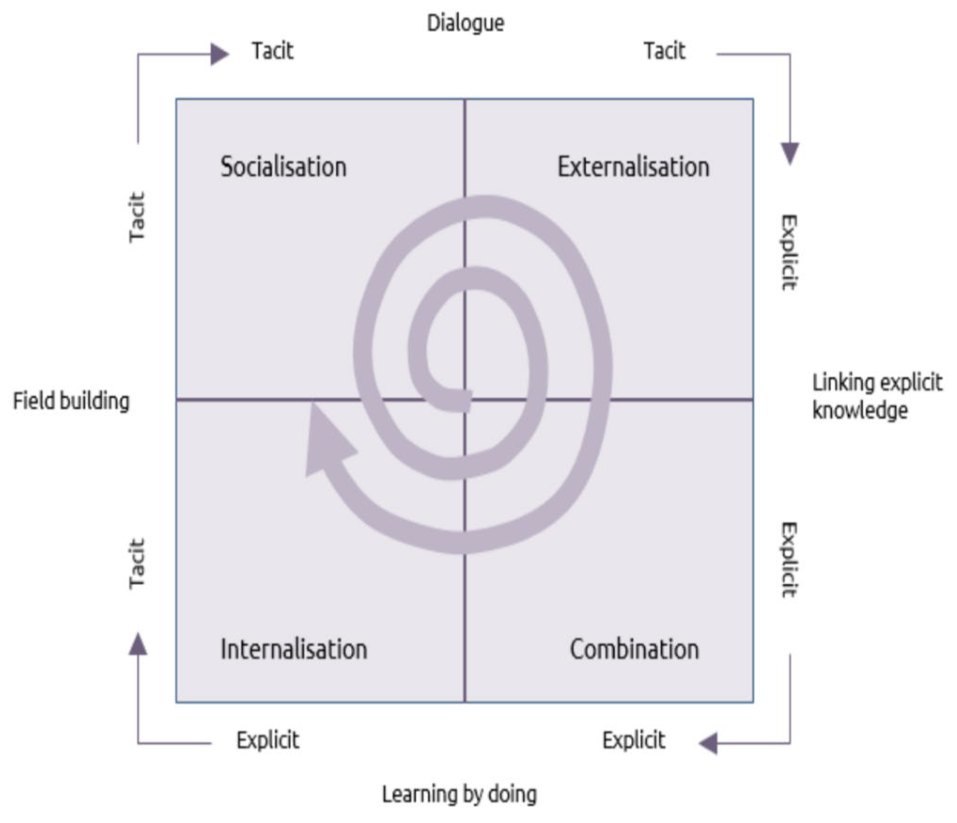
Figure 2.
This is a figure. Schemes follow another format. If there are multiple panels, they should be listed as follows: (a) Description of what is contained in the first panel. (b) Description of what is contained in the second panel. Figures should be placed in the main text near the first time they are cited.
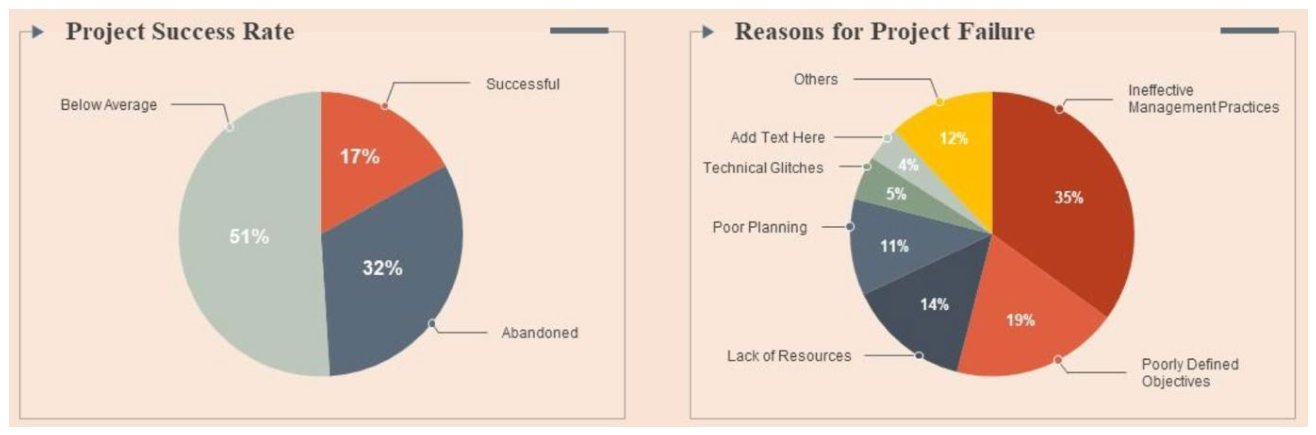
Figure 3.
Conceptual framework for integrating AI tools into PM [24].
Figure 3.
Conceptual framework for integrating AI tools into PM [24].
Disclaimer/Publisher’s Note: The statements, opinions and data contained in all publications are solely those of the individual author(s) and contributor(s) and not of MDPI and/or the editor(s). MDPI and/or the editor(s) disclaim responsibility for any injury to people or property resulting from any ideas, methods, instructions or products referred to in the content. |
© 2026 by the authors. Licensee MDPI, Basel, Switzerland. This article is an open access article distributed under the terms and conditions of the Creative Commons Attribution (CC BY) license (http://creativecommons.org/licenses/by/4.0/).
Copyright: This open access article is published under a Creative Commons CC BY 4.0 license, which permit the free download, distribution, and reuse, provided that the author and preprint are cited in any reuse.