

Submitted:
11 October 2026
Posted:
13 October 2026
You are already at the latest version
Abstract
Photography occupies a prominent and contested place in contemporary participatory urban planning. This research develops a critical-interpretative framework that rejects celebratory narratives of visual participation, whilst recognising the genuine possibilities that participatory photography can offer under appropriate political and institutional conditions. Drawing on recent literature, we examine four interrelated issues: i. access to participation and the exclusions it reproduces; ii. control over the production, selection, interpretation and circulation of images; iii. divergent spatial experiences and conflicts of use; iv. and the gap between representation and material change. The evidence gathered and analysed reveals tensions that methodological refinement alone cannot resolve, namely: researchers limit participants’ autonomy even in ostensibly co-produced projects; visual literacy and technological access remain unevenly distributed; images are selectively appropriated to legitimise predetermined institutional agendas; and emerging AI technologies risk intensifying these dynamics through algorithmic bias and a growing loss of trust in evidence. Participatory photography is understood here as a contested terrain, whose emancipatory potential depends on power relations, institutional conditions and the community’s control over the production and use of the images themselves.
Keywords:
photovoice
; urban planning
; co-creation
; spatial justice
; visual methods
1. Introduction
Photography has emerged as a key medium in participatory urban planning and co-creation processes. ‘Photovoice’ projects, mobile photomapping applications and geospatial visual methods promise to democratise spatial governance, amplifying marginalised voices and translating lived experience into applicable planning knowledge (Wang & Burris, 1997; Carpenter, 2022; Burgos-Thorsen et al., 2024). This ‘visual turn’ in participatory urbanism signals broader shifts towards community-based participatory research, frameworks of justice in design, and epistemic pluralism in the way cities are represented and transformed (Costanza-Chock, 2020). Participatory photography methods have proliferated in the fields of public health, urban planning, community development and environmental justice, amongst others, as tools that ostensibly redistribute authority from experts to residents, enabling communities to bring their spatial experiences to the fore, articulate priorities and influence policy (Gullón et al., 2019; Meenar & Mandarano, 2021; Erfani, 2021).
However, the proliferation of cameras in participatory planning calls for critical analysis. Photography is not a neutral technology of representation, but rather a historically situated practice, rooted in colonial legacies, capitalist logics and asymmetrical power relations (Sontag, 1977; Tagg, 1993; Azoulay, 2008). The camera has long served as an instrument of surveillance, classification and control, documenting the poor for the purposes of social reform, the colonised for anthropological knowledge, and those deemed deviant for legal punishment (Sekula, 1986). These histories do not disappear when cameras are distributed to community members, as they shape what can be photographed, who takes the photographs, how the images circulate and what institutional use is made of them.
This study develops a critical-interpretative framework for understanding the role of photography in urban co-creation. We argue that participatory photography functions simultaneously as a technology of visibility and invisibility, bringing certain urban realities into view whilst obscuring others. Four interrelated concerns guide the analysis: access to participation and its exclusions; control over the production, interpretation and circulation of images; divergent spatial experiences and conflicts of use; and the gap between representation and material change. Following the methodological account in Section 2, Section 3 examines the origins, claims and conditions of participatory visual methods. Section 4 addresses power asymmetries, selective participation and the limits of recognition, whilst Section 5 explores urban narratives, conflicting spatial experiences and selective invisibility. Section 6 discusses methodological approaches oriented towards justice, and Section 7 considers the emerging implications of artificial intelligence. Section 8 brings these strands together to examine how community control and institutional conditions shape the outcomes of visual participation. Section 9 concludes by identifying conditions for a more equitable practice.
2. Methodology
This article draws on a critical-interpretative framework to reflect on recent research into photography, power and participatory urban planning. The corpus mainly covers the period from 2016 to 2026, whilst not neglecting seminal works from previous decades, and includes empirical studies of ‘photovoice’ projects in urban contexts, theoretical contributions from critical urban studies, feminist epistemology, postcolonial criticism and science and technology studies, alongside methodological innovations and accounts from practitioners. Given the breadth of the sources drawn upon and the unavailability of complete procedural documentation, we describe this work as a critical interpretative review, rather than a systematic review in the technical sense.
In this context, priority was given to works that: (a) document participatory photography in urban or peri-urban contexts; (b) critically examine power dynamics and ethical dimensions; (c) report outcomes at various levels, ranging from individual recognition to material change; and (d) explore methodological alternatives. The corpus includes empirical studies, narrative and systematic reviews of the ‘photovoice’ practice, institutional project reports and theoretical contributions. Where these sources are based on participants’ testimonies, we treat these voices as mediated by their publication context, as secondary sources in relation to this article, and not, of course, as direct fieldwork. Empirical studies, reviews, institutional reports and theoretical texts are distinguished throughout the analysis.
The analytical approach is deliberately reflexive, clearly recognising that the researchers’ position, including that of the sources analysed, shapes the way in which the evidence is framed. The synthesis highlights tensions and contradictions, rather than reducing them to a single evaluative verdict.
3. Visual Methods in Urban Planning: Origins, Claims and Conditions
Photovoice emerged in the mid-1990s as a participatory action research method designed to enable marginalised communities to document their lived experiences and influence policy through photography and collective dialogue (Wang & Burris, 1997). Rooted in Paulo Freire’s critical pedagogy, feminist theory and the traditions of documentary photography, it was initially developed for public health research, before spreading to the fields of urban planning, community development and environmental justice (Seitz & Orsini, 2022). This trajectory reflects broader trends towards participatory governance and the recognition of experiential knowledge as legitimate planning evidence (Burgos-Thorsen et al., 2024; Madsen et al., 2023).
Its advocates argue that visual methods offer distinct advantages over conventional participatory techniques, as: photographs provide concrete evidence of spatial conditions and can be more persuasive than verbal testimony in institutional contexts; the act of taking photographs encourages critical reflection on environments that are taken for granted; and the collective analysis of images develops the analytical capacity of the community as a whole (Wang & Burris, 1997; Carpenter, 2022). Several empirical studies document significant impacts. A ‘photovoice’ study on physical activity and urban design in socio-economically diverse neighbourhoods in Madrid led to policy recommendations that were incorporated into municipal planning strategies (San-Juan-Escudero et al., 2025). A citizen science and ‘photovoice’ approach to mapping food resources produced evidence that informed food system planning at the municipal level (Soma et al., 2022).
Whilst these successes are real, they are unevenly distributed. The review by Sanon et al. (2014) of 30 ‘photovoice’ studies carried out between 2008 and 2013 revealed that, whilst all 30 generated some form of awareness-raising regarding social justice, only 11 reported beneficial outcomes, such as concrete improvements in conditions, and only 3 achieved what the authors classify as transformative impacts – namely changes at the level of systems, governance or policies. These categories are not mutually exclusive stages, nor do they constitute a universal measure of ‘photovoice’ effectiveness, as the projects analysed varied considerably in their objectives and institutional contexts. What this finding highlights is the persistence of a gap between the awareness raised through visual participation and the redistribution of resources or decision-making power. The fundamental question is not whether participatory photography works in abstract terms, but rather under what conditions concrete results are likely to occur.
Certain conditions consistently prove to be significant: i. the extent to which the production and interpretation of images are controlled by the participants, rather than by the researchers; ii. the presence of institutional relationships capable of translating visual evidence into binding commitments; iii. and the integration of ‘photovoice’ into broader organisational strategies, rather than its implementation as an isolated data-collection exercise.
4. Power Asymmetries and Exclusions in Participatory Photography
4.1. Access and Selective Participation
The assumption that photography is universally accessible is often contradicted in practice. Visual literacy, that is, the ability to produce images that convey intended meanings within dominant photographic conventions, is unevenly distributed across populations and is shaped by cultural capital and prior exposure to image-making (Bandauko & Arku, 2023; Carpenter, 2022). When projects distribute cameras without addressing these inequalities, they risk reproducing hierarchies of cultural capital rather than dismantling them.
The MOSAIC project, conducted by the Environmental Social Sciences Research Group (ESSRG) in a rural Hungarian community to explore land-use change and adaptation to climate change, illustrates these dynamics with methodological transparency. Although it was explicitly stated that no prior experience was required, many community members refused to take part, viewing photography as a task requiring professional skills. Participation was initially limited to one amateur photographer and two professional photographers. The team responded adaptively: after the initial collection yielded over 100 photographs, the ESSRG researchers carried out a pre-selection process to construct a coherent visual narrative. They then returned with printed photographs displayed in a small exhibition, which sparked wider curiosity within the community and attracted a further five participants to the discussions at the second workshop. The team also presented a printed map of the village, proposed by Fanni Sall, which enabled participants to geographically locate their images and anchor the narratives to the site, transforming the method into a combined visual-cartographic dialogue (Czegőédi et al., 2025).
This case defies a simplistic interpretation as a methodological failure. The initially low level of engagement was not eliminated, but rather redirected in a productive way. This adaptation generated rich collective narratives about memory, attachment to the land and environmental changes. The selection pressures at work in the design (who participates, whose photographs are pre-selected, how the map shapes interpretation) do, however, warrant explicit documentation, rather than being treated as given conditions. It is also worth noting that MOSAIC operated in a rural context, that is, with substantial differences compared to the dynamics of participation in urban projects, where anonymity, population density and institutional interests may differ significantly.
Technological and logistical barriers exacerbate selective access. Traditional ‘photovoice’ protocols assume that participants have secure housing, stable routines that allow for involvement over several weeks, and freedom of movement (Bandauko & Arku, 2023). These assumptions exclude populations experiencing homelessness, housing instability or mobility restrictions (Henry & Gabel, 2019). For many potential participants, time, safety and transport are more important than access to equipment.
4.2. Control over the Images: A Chain of Editorial Decisions
A second structural problem concerns the complex issue of control over images. A participant may have complete control over the photograph they take, choosing the subject, the angle and the moment, without having any control over what happens afterwards. Which images are shortlisted for group discussion? How are they captioned? Which ones are chosen for exhibition? How are they subsequently used in institutional reports? Each stage in this chain is a formally justified editorial decision which may, progressively, distance the photographer from authorship of their own image.
The researcher’s control is most evident in the facilitation process. The suggestions, questions and thematic priorities that researchers bring to group discussions determine which photographs receive analytical attention and which remain marginal (Call-Cummings & Martinez, 2016; Carpenter, 2022). Funding structures and institutional deadlines further restrict the community’s autonomy, defining what counts as a relevant research question even before the participants arrive. Ethical review processes add another layer of mediation, as institutional review boards often require faces to be blurred or participants to be anonymized, a safeguard to which many participants explicitly object, having sought public recognition as the authors of their own stories (Creighton et al., 2018). The tension between institutional risk management and participants’ desire for visibility is, in itself, a power asymmetry that ‘photovoice’ protocols have failed to resolve.
4.3. Security, Surveillance and the Social Significance of the Camera
These tensions become even more acute in contexts of social conflict. Esther Prins’s (2010) fieldwork in El Salvador documents an incident in which a photograph of a sugar-cane field taken by a participant led the landowner to accuse the researcher of having sent the participant to plan an arson attack. The camera, regardless of the actual intention, was interpreted by the landowner as an instrument of surveillance and a threat. This episode does not demonstrate that participatory photography is inherently dangerous, but it does at least reveal that the meaning of the camera is not controlled by the person holding it, but is also shaped by observers and by the political contexts in which the images are produced and received. Attention to context-specific risks is part of a responsible participatory approach and is not a reason to abandon the method.
4.4. The Gap Between Recognition and Concrete Change
Institutional actors often engage with ‘Photovoice’ in ways that draw legitimacy without redistributing power. Planning authorities may attend exhibitions, express genuine appreciation for the community’s perspectives and incorporate selected images into reports, whilst ultimately pushing ahead with predetermined agendas (Carpenter, 2022; Erfani, 2021). This dynamic requires careful interpretation. Recognition, which is the experience of being seen and heard, is no trivial outcome for communities that have been systematically rendered invisible. For some participants, having photographs displayed to a public audience represents a significant form of recognition (Seitz & Orsini, 2022). However, recognition, influence over institutional procedures and the redistribution of material resources are distinct outcomes that should not be reduced to a single verdict on whether a project ‘was successful’. Assessing ‘Photovoice’ fairly requires that the evaluation corresponds to the project’s stated objectives and the available evidence, distinguishing between the absence of documented effects and the absence of effects, and between the absence of follow-up and the absence of change.
5. Photography, Urban Narratives and Spatial Conflict
5.1. Constructing and Challenging Urban Narratives
Photography has long been fundamental to the construction of narratives about urban space, stories of progress or decline, renewal or decay, which shape public opinion and legitimise institutional interventions (Aelbrecht, 2026; Nastasi & Ponzini, 2018). Advertising billboards for property developments present inspiring depictions of gleaming towers and diverse residents, whilst concealing the displacement and erasure of existing communities (O’Mahony & Lawton, 2019). Historical analyses show how photographs of ‘run-down’ neighbourhoods were used to garner public support for demolition and regeneration projects that destroyed thriving working-class communities (Grantmyre, 2016). Contemporary urban communication continues to employ visual strategies that normalise displacement as an improvement, rendering the ‘previous’ conditions unrecognisable once the transformation is complete.
Contrary to dominant narratives, participatory photography has served as a tool for counter-representation. Strasser’s (2024) work on gentrification-induced displacement in Vienna demonstrates how community photography can bring to light the human costs of urban transformation that official narratives overlook. Community photo albums in Detroit have brought together alternative visual histories that highlight the agency of Black residents, challenging the ‘ruin’ aesthetic that drew artists and the media to the city’s physical decay (Aelbrecht, 2026). The ability to produce and disseminate such counter-narratives, however, remains limited by unequal access to platforms, galleries and institutional audiences. Counter-narratives typically reach smaller, already sympathetic audiences, in comparison with development marketing or state communications.
5.2. Divergent Experiences and the Limits of Consensus
One of the most instructive contributions of ‘photovoice’ linked to specific territories is its ability to document contradictory experiences of the same urban spaces. The ‘Urban Belonging’ project, carried out with participants from seven marginalised communities in Copenhagen, generated 1,459 geolocated photographs, which were co-interpreted in group sessions (Burgos-Thorsen et al., 2024). The dataset revealed community-specific patterns in terms of belonging and exclusion, alongside, crucially, divergent interpretations of identical spaces.
The project’s documentation of cycling infrastructure illustrates this point well. For participants without mobility restrictions, the accumulation of bicycles on pavements symbolised Copenhagen’s sustainable urban identity, but for participants in wheelchairs, this same accumulation blocked pedestrian access and forced them to use the carriageway; furthermore, for participants with mental health vulnerabilities, the visual density caused anxiety. The same physical layout produces incompatible experiences of belonging and exclusion, depending on each individual’s position and vulnerability. Participatory photography does not resolve this conflict. What georeferenced methods, which preserve spatial location and enable cross-group interpretation, can do is make these divergent experiences analytically manageable and, in so doing, challenge the assumption that planning decisions must be optimised for a single imaginary user. Consensus as the aim of participation may be a structural problem rather than an aspiration.
5.3. Aestheticisation and Selective Invisibility
Urban beautification projects (murals, façade improvements, landscape redesigns) are often used as compensatory gestures that create the appearance of investment, whilst facilitating displacement (Pritchard, 2020; Balliger, 2021). Visual interventions create narratives of neighbourhood improvement that attract capital, increase property values and pave the way for gentrification, whilst rendering the displaced communities aesthetically invisible.
The findings of the ‘Urban Belonging’ project regarding Ørstedsparken in Copenhagen illustrate how a landscape intervention produces effects of exclusion that are only visible from certain social positions. According to the project’s documentation and analysis, the clearing of dense vegetation in the park, as reported by participants, removed spatial resources on which homeless people who frequented a nearby food bank relied for shelter and privacy (Burgos-Thorsen et al., 2024; Burgos-Thorsen, 2023). From the perspective of official planning, an open and visible park may appear safer and more attractive; from the perspective of someone without a home, dense vegetation provides shelter. This does not determine the official intention behind the intervention, nor does the available documentation demonstrate a causal link with the exclusion of any specific population. What the ‘photovoice’ evidence does is make visible both the change in the landscape and the effects as experienced, thereby challenging the claim that urban improvements are uniformly experienced as improvements. The case illustrates the capacity of ‘photovoice’ not only to document exclusion, but also to reveal it where official accounts would not record it.
6. Methodological Innovations Geared Towards Justice
6.1. Geospatial and Intersectional Approaches
Geospatial ‘photovoice’ represents a significant methodological innovation, integrating GPS-tagged photography with mobile applications and geographic information systems to enable spatial analysis at scales not available in conventional qualitative research (Burgos-Thorsen et al., 2024; Madsen et al., 2023). The ‘Urban Belonging’ project demonstrates the ability to move between individual experience and collective spatial patterns, and between demographic and post-demographic modes of analysis. Following initial sessions specific to each community, participants were regrouped around shared spatial experiences rather than identity categories, which facilitated dialogue between communities and revealed intersectional dimensions that demographic groupings can obscure. The project’s implementation also utilised automated face-blurring algorithms, whilst retaining spatial and contextual information, thereby addressing ethical concerns regarding surveillance without sacrificing the granularity essential for planning applications.
Intersectional approaches are essential to any serious claim to spatial justice. Gilchrist’s (2025) feminist ‘photovoice’ study with women from East and South-East Asia in the UK draws on intersectional analysis to reveal how racism, sexism and xenophobia combine to produce specific forms of urban exclusion. Hassen’s (2025) ‘photovoice’ study on urban green spaces documents how Black residents experience surveillance, racialised violence and restricted access in spaces formally designated as public. These studies demonstrate that the ‘voice of the community’ is not homogeneous and that revealing differences within communities requires deliberate design, rather than the assumption that a shared geography produces shared priorities.
6.2. Counter-Mapping, Feminist Methodologies and Reflective Co-Interpretation
Counter-mapping positions participatory visual documentation in explicit opposition to dominant spatial regimes, documenting contested spaces, informal land uses and alternative spatial imaginaries (Soma et al., 2022; Black et al., 2025). This approach is most effective when combined with organising strategies and rights-based advocacy, rather than being used as isolated research exercises. Feminist and decolonial methodologies emphasise long-term accountability to communities, rejecting extractivist models that benefit academic careers at the expense of the communities whose experiences are mobilised as research data (Hayhurst, 2025; D’Ignazio & Klein, 2020). This means paying attention to the ownership of images, data sharing and what happens to the collected materials once the project has ended, issues that standard ‘photovoice’ protocols rarely address.
Reflective co-interpretation challenges the conventional division between data collection by participants and analysis by researchers. Rather than treating photographs as raw data, reflective approaches position interpretation as a continuous and collaborative process, in which participants retain authority over the meanings of their images throughout the entire process (Lu et al., 2023). This requires researchers to share draft analyses, invite critique and revise their conclusions in response to that critique, a form of accountability that substantially alters the epistemic contract of ‘Photovoice’.
Innovations in dissemination are equally necessary. Traditional ‘photovoice’ exhibitions often fail to reach policy-makers with the authority to bring about concrete change (Carpenter, 2022; Erfani, 2021). Some projects have integrated participatory photography into formal planning processes to ensure that visual evidence is directly incorporated into decision-making procedures. Others have experimented with policy-oriented formats, regulatory proposals and planning challenges that translate community documentation into institutional language without delegating the construction of meaning to institutional actors. None of these innovations guarantees concrete results; however, they do bridge the gap between community expression and institutional consideration.
7. Artificial Intelligence and the Visual Construction of Urban Futures
Generative AI tools, capable of producing photorealistic urban images from text prompts, have emerged as potential instruments for participatory design, enabling non-specialists to visualise alternative urban futures without the need for architectural expertise (Guridi et al., 2025; Mushkani et al., 2025). Empirical studies on AI in participatory design contexts reveal that the images generated can facilitate a productive dialogue amongst various stakeholders, providing concrete visual references for critique and refinement (Guridi et al., 2025). This potential is conditional: trust, community oversight and mechanisms that allow participants to reject or modify AI-generated proposals are prerequisites for any empowering application.
The concerns are primarily structural in nature. Training datasets for image-generation models disproportionately represent affluent, Western and predominantly white urban environments, meaning that AI outputs reproduce these aesthetic preferences even when instructed otherwise (Cavagliagà, 2024; Collective Recourse Working Group, 2025). Linguistic bias disadvantages speakers of languages other than English and communities whose spatial knowledge is rooted in other languages (Pasquini, 2025). The ability of generative AI to produce photorealistic yet entirely fabricated images raises fundamental epistemological questions: if visualisations can be produced without being based on real locations or feasibility constraints, the distinction between evidence-based planning and speculative imagery becomes difficult to uphold (Griffin & Muehlenhaus, 2023; Ramirez, 2022).
These dynamics do more than simply exacerbate the existing risks of participatory photography; they have the potential to undermine its claim to serve as evidence. If institutional audiences are unable to distinguish between community photographs documenting living conditions and AI-generated images serving the interests of property developers, the epistemic authority of participatory visual documentation is compromised. Regulating AI in urban visualisation is therefore not a secondary technical consideration; it is a question of whose knowledge counts and who controls the visual terms of the planning discourse.
8. Discussion
Four structural problems emerge from the evidence analysed. Firstly, access to participation is limited not only by obvious barriers (digital exclusion, mobility), but also by more subtle forces: the perception of photography as a specialised practice, selection pressures arising from research questions defined by researchers, and the time demands of projects lasting several weeks on people with precarious livelihoods. The experience of the MOSAIC project demonstrates that low initial participation can elicit adaptive responses that ultimately broaden engagement; yet the conditions that enable such adaptation—a flexible design, genuine community control over the research question, and adequate time—are rarely present in commissioned institutional programmes.
Secondly, the chain leading from the production of images to institutional decision-making is longer and more mediated than most methodological accounts acknowledge. A photographer controls the subject they frame; they do not, therefore, control the pre-selection, captions, curation of the exhibition or subsequent institutional use. At each stage, editorial decisions may or may not preserve the intended meanings. Researchers and professionals who claim to have ‘given a voice’ to communities without monitoring what happens to the images throughout this chain are making a rather flimsy claim.
Thirdly, the documentation of contradictory spatial experiences (bicycles as an icon or a barrier; the park’s vegetation as an amenity or a shelter) challenges the model of consensus implicit in much of participatory planning practice. The analytical value of participatory photography may lie not in the production of consensus, but in making experiential divergences manageable, thereby enabling planning to take account of heterogeneous users rather than an imaginary ‘average resident’.
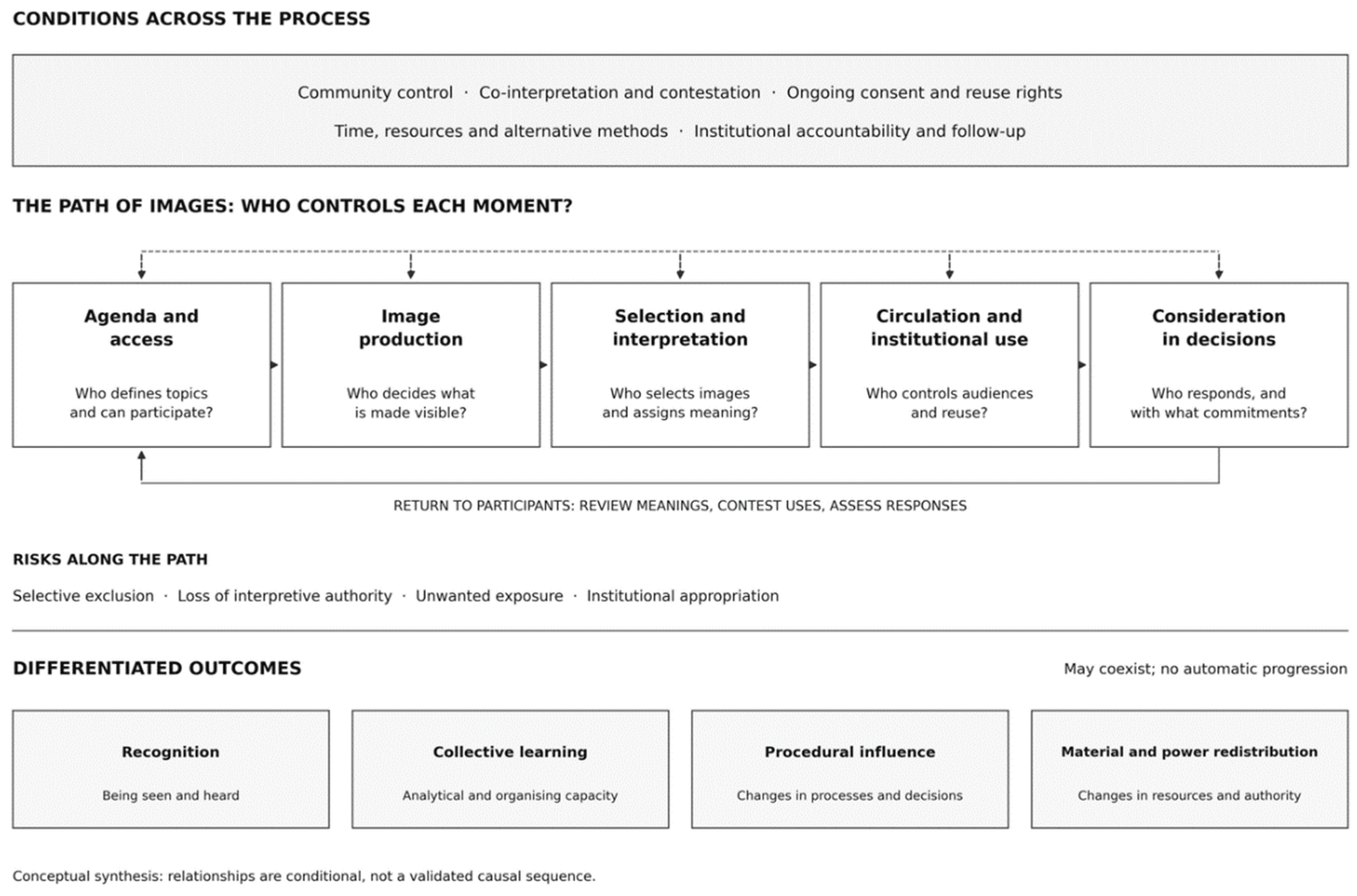
Fourthly, the gap between representation and material change depends on factors that ‘photovoice’ cannot provide on its own, in particular, the institutional willingness to make binding commitments, the political conditions that make redistribution possible, and the presence of organised communities capable of holding institutions to account over time. These conditions can be supported by a thoughtful design of ‘photovoice’, in particular through the integration of visual methods within broader organising strategies, but they cannot be replaced by methodological refinement (see Figure 1).
The framework identifies moments at which participants’ authority over images and their meanings may be preserved, shared or weakened. Cross-cutting conditions shape the process, while feedback enables participants to contest interpretations and uses. Outcomes may coexist and do not constitute an automatic progression from recognition to redistribution.
These structural observations do not support a deterministic acceptation or rejection of the method. The evidence analysed includes projects that have generated significant recognition, expanded the community’s analytical capacity and contributed to documented policy changes. These outcomes are valuable and should not be dismissed as mere consolation prizes for a method that has failed to bring about structural transformation. Distinguishing between recognition, learning, procedural influence and material redistribution is both analytically necessary and ethically important for an honest representation of what participatory photography can and cannot achieve.
9. Conclusion
Participatory photography is not, in itself, empowering or inevitably appropriative. It is a contested terrain where struggles over representation, knowledge and power are waged, and where the outcomes depend on conditions that go far beyond the methodology itself.
The evidence analysed here points to several conditions for a more equitable form of visual participation, presented not as guarantees of transformation, but as foundations for a practice that takes power seriously. Participants must be able to define the themes of their photography and challenge interpretations of their images throughout the entire process, not just at the time of collection. Control over the identification and reuse of images must remain with the participants, including the right to withdraw images from institutional circulation. Alternatives to photography, such as mapping, storytelling and drawing, must be available to those for whom the camera is a barrier rather than a tool. The institutional response to the community’s visual evidence must be identifiable and traceable, and not merely appreciative. Monitoring must be integrated into the project design, tracking the fate of images, conclusions and recommendations after the formal conclusion of the project.
These conditions require institutional arrangements, time, resources, genuine decision-making authority and long-term relationships, which are rarely made available in commissioned participatory processes. Demanding this is not a utopian requirement; several projects analysed here come close to meeting these conditions. But achieving this requires a deliberate political and institutional commitment, and not merely methodological innovation.
This analysis has some limitations that are worth noting. The corpus reflects what is published and accessible in English, which over-represents projects from the Global North and contexts with a strong academic publishing infrastructure. Projects without documented outcomes are systematically under-represented in the published literature. Project reports and institutional accounts of ‘photovoice’ do not constitute independent evaluations. Participants’ testimonies, where available, are mediated by the contexts of publication and should not be treated as unfiltered evidence of experience. These limitations call for caution when generalising and require that any isolated case be treated as illustrative rather than representative.
Photography will continue to proliferate in urban planning and co-creation. The fundamental task is not to reject it, but rather to hold it to account, by asking who controls the framing, who interprets the image, who benefits from its circulation, and who bears the costs of its misuse.
References
- Aelbrecht, W. (2026). Mind the information gap! Constructing counter-narratives for urban planning in Detroit’s photobooks. Social & Cultural Geography, 27(1), 41–65. [CrossRef]
- Avendaño, X. (2024). Ciudad y fotografía: Discursos visuales de poder en la ciudad de Guatemala, 1890–1930. OpenEdition Books. [CrossRef]
- Azoulay, A. (2008). The civil contract of photography. Zone Books.
- Balliger, R. (2021). Painting over precarity: Community public art and the optics of dispossession, gentrification and governance in West Oakland, CA. Journal of Urban Cultural Studies, 8(1), 35–58. [CrossRef]
- Bandauko, E., Arku, G. (2023). The power of a camera: Fieldwork experiences from using participatory photovoice. International Journal of Qualitative Methods, 22, 1–14. [CrossRef]
- Black, G. F., Petersen, L., Mpofu-Mketwa, T. J., Dick, L., Wilson, A., Ncube, S., Abrams, A., Carden, K., Dickie, J., Hamilton-Smith, N., Piper, L., & Lamb, G. (2025). Participatory Visual Methods and the Mobilization of Community Knowledge: Working Towards Community-Derived Disaster Risk Management in the Context of Advancing Climate Change. Journal of Participatory Research Methods, 6(2), 136–167. [CrossRef]
- Burgos-Thorsen, S. (2023). Expanding Data Imaginaries in Urban Planning: Foregrounding lived experience and community voices in studies of cities with participatory and digital visual methods. [Doctoral dissertation]. Aalborg University. [CrossRef]
- Burgos-Thorsen, S., Niederer, S., & Madsen, A. K. (2024). What is an inclusive city? Reconfiguring participation in planning with geospatial photovoice to unpack experiences of urban belonging among marginalised communities. Visual Studies, 39(1–2), 144–163. [CrossRef]
- Call-Cummings, M., & Martinez, S. (2016). Consciousness-raising or unintentionally oppressive?. The Qualitative Report, 21(5), 798. [CrossRef]
- Carpenter, J. (2022). Picture this: Exploring photovoice as a method to understand lived experiences in marginal neighbourhoods. Urban Planning, 7(3), 351-362. [CrossRef]
- Cavagliagà, M. (2024). AI-driven visual preference biases: Exploring future challenges in urban planning and building design. International Conference on Geometry and Graphics (pp. 69-80). Cham: Springer Nature Switzerland. [CrossRef]
- Collective Recourse Working Group. (2025). Collective recourse for generative urban visualizations. arXiv preprint arXiv:2509.11487. [CrossRef]
- Costanza-Chock, S. (2020). Design justice: Community-led practices to build the worlds we need. MIT Press.
- Creighton, G., Oliffe, J., Ferlatte, O., Bottorff, J., Broom, A., & Jenkins, E. (2018). Photovoice ethics: Critical reflections from men’s mental health research. Qualitative Health Research, 28(3), 446–455. [CrossRef]
- Czegőédi, A., Sall, F., & Berta, G. (2025, May 8). Photovoice for land-use change: A visual tool for participatory research. MOSAIC Project / ESSRG. https://mosaic-europe.eu/mosaic/article/photovoice-for-land-use-change:-a-visual-tool-for-participatory-research.
- D’Ignazio, C., & Klein, L. F. (2020). Data feminism. MIT Press.
- Erfani, G. (2021). Visualising urban redevelopment: Photovoice as a narrative research method for investigating redevelopment processes and outcomes. Geoforum, 126, 80-90. [CrossRef]
- Gilchrist, L. (2025). Framing the unseen: Feminist photovoice and intersectionality in shaping urban exclusion and agency for ESEA women. Families, Relationships and Societies, 14(1), 1–18. [CrossRef]
- Grantmyre, N. (2016). Conflicting visions of renewal in Pittsburgh’s Hill District, 1950–1968. Urban History, 43(4), 639-639. [CrossRef]
- Griffin, L., & Muehlenhaus, I. (2023). The ethics of AI-generated maps: A study of DALL-E 2 and implications for cartography. arXiv preprint arXiv:2304.10743. [CrossRef]
- Gullón, P., Díez, J., Conde, P., Ramos, C., Márquez, V., Badland, H., Escobar, F., & Franco, M. (2019). Using Photovoice to Examine Physical Activity in the Urban Context and Generate Policy Recommendations: The Heart Healthy Hoods Study. International Journal of Environmental Research and Public Health, 16(5), 749. [CrossRef]
- Guridi, J. A., Hwang, A. H. C., Santo, D., Goula, M., Cheyre, C., Humphreys, L., & Rangel, M. (2025). From fake perfects to conversational imperfects: Exploring image-generative AI as a boundary object for participatory design of public spaces. Proceedings of the ACM on Human-Computer Interaction, 9(2), 1-33. [CrossRef]
- Hassen, N. (2025). Narratives of exclusion: A photovoice study towards racial equity and justice in public urban greenspaces. Landscape and Urban Planning, 254, 105233. [CrossRef]
- Hayhurst, L. M. C. (2025). (En)tangled ethics and relational mobilities: Reflections on decolonial feminist digital participatory action research. Action Research, 24(3), 277-297. [CrossRef]
- Henry, R., & Gabel, C. (2019). “It’s not just a picture when lives are at stake”: Ethical considerations and photovoice methods with Indigenous peoples. Journal of Educational Thought, 52(3), 229-252.
- Lu, A. J., Sannon, S., Moy, C., Brewer, S., Green, J., Jackson, K. N., Reeder, D., Wafer, C., Ackerman, M. S., & Dillahunt, T. R. (2023). Participatory noticing through photovoice. In Proceedings of the 2023 ACM Designing Interactive Systems Conference (pp. 2489-2508). [CrossRef]
- Madsen, A. K., Burgos-Thorsen, S., De Gaetano, C., Ehn, D., Groen, M., Niederer, S., Norsk, K., & Simonsen, T. (2023). The urban belonging photo app: A toolkit for studying place attachments with digital and participatory methods. Methodological Innovations, 16(3), 292-314. [CrossRef]
- Meenar, M. R., & Mandarano, L. A. (2021). Using photovoice and emotional maps to understand transitional urban neighborhoods. Cities, 118, 103353. [CrossRef]
- Mushkani, Rashid, Hugo Berard, and Shin Koseki. "WeDesign: Generative AI-Facilitated Community Consultations for Urban Public Space Design." arXiv preprint arXiv:2508.19256 (2025). [CrossRef]
- Nastasi, M., & Ponsine, D. (2018). Toward a photographic urbanism? Images iconizing cities and swaying urban transformation. In The Routledge companion to urban imaginaries (pp. 245–260). Routledge. [CrossRef]
- O’Mahony, M., Lawton, P. (2019). Image circulation, development hoardings and new strategies of urban change. Geografiska Annaler: Series B, 101(3), 202-218. [CrossRef]
- Pasquini, C. (2025). Examining linguistic dynamics and inclusion in text-to-image generative AI for participatory architecture [Master’s thesis]. Malmö University.
- Prins, E. (2010). Participatory photography: A tool for empowerment or surveillance? Action Research, 8(4), 426–443. [CrossRef]
- Pritchard, S. (2020). The artwashing of gentrification and social cleansing. The Handbook of Displacement (pp. 179-198). Cham: Springer International Publishing. [CrossRef]
- Ramirez, A. (2022). Qiddiya’s journey: A case study in urban imagineering and image laundering. Journal of Urban Cultural Studies, 9(2), 223-243. [CrossRef]
- San-Juan-Escudero, A., Ballesteros-Peña, S., Fernández-Aedo, I., Sánchez, S. C., Fernandez-Alonso, J., Gullón, P., Franco, M. & Gravina, L. (2025). Exploring urban design’s impact on physical activity: A participatory photovoice study across socioeconomically diverse neighborhoods. Landscape and urban planning, 259, 105334. [CrossRef]
- Sanon, M. A., Evans-Agnew, R. A., & Boutain, D. M. (2014). An exploration of social justice intent in photovoice research studies from 2008 to 2013. Nursing Inquiry, 21(3), 212–226. [CrossRef]
- Seitz, C. M., & Orsini, M. M. (2022). Thirty years of implementing the photovoice method: Insights from a review of reviews. Health Promotion Practice, 23(2), 281-288. [CrossRef]
- Sekula, A. (1986). The body and the archive. October, 39, 3–64.
- Soma, T., Li, B., & Shulman, T. (2024). A citizen science and photovoice approach to food asset mapping and food system planning. Journal of planning education and research, 44(3), 1503-1515. planning. Journal of Planning Education and Research, 42(3), 345–359. [CrossRef]
- Sontag, S. (1977). On photography. Farrar, Straus and Giroux.
- Strasser, A. (2024). Visibilising gentrification-induced displacement: a visual essay on the role of a socially and politically engaged photographic practice in housing activism. Visual Studies, 39(1–2), 118–126. [CrossRef]
- Tagg, J. (1993). The burden of representation: Essays on photographies and histories. University of Minnesota Press.
- Wang, C., & Burris, M. A. (1997). Photovoice: Concept, methodology, and use for participatory needs assessment. Health Education & Behavior, 24(3), 369–387. [CrossRef]
Figure 1.
From visual participation to spatial justice: mediation, control and differentiated outcomes. Source: author’s synthesis.
Figure 1.
From visual participation to spatial justice: mediation, control and differentiated outcomes. Source: author’s synthesis.
Disclaimer/Publisher’s Note: The statements, opinions and data contained in all publications are solely those of the individual author(s) and contributor(s) and not of MDPI and/or the editor(s). MDPI and/or the editor(s) disclaim responsibility for any injury to people or property resulting from any ideas, methods, instructions or products referred to in the content. |
© 2026 by the authors. Licensee MDPI, Basel, Switzerland. This article is an open access article distributed under the terms and conditions of the Creative Commons Attribution (CC BY) license (http://creativecommons.org/licenses/by/4.0/).
Copyright: This open access article is published under a Creative Commons CC BY 4.0 license, which permit the free download, distribution, and reuse, provided that the author and preprint are cited in any reuse.