

Submitted:
03 October 2026
Posted:
07 October 2026
You are already at the latest version
Abstract
Traditional scientific publishing and bibliometric models face severe limitations regarding prolonged operational processing times, institutional costs, and vulnerability to systemic evaluation biases. To address these inefficiencies, this paper introduces the Open Science Society (OSS), a scalable, decentralized methodology designed for trusted, fraud-resistant scientific curation and real-time peer-evaluation. Moving away from static, global metric indices and opaque review architectures, the proposed framework implements an endogenous, dynamic evaluation method that calibrates reviewer authority scores based on specialized expertise. Crucially, the methodology computes continuous evaluation weights by projecting domain-specific interaction histories onto a keyword-driven semantic space via a symmetric correlation matrix. Through rigorous mathematical formalization and empirical simulation, we demonstrate that the OSS pipeline effectively isolates strategic manipulation, collapsing the voting weight of unqualified actors or collusive networks to absolute zero while preserving genuine cross-domain authority. The system achieves fast, stationary score convergence, establishing a sustainable algorithmic blueprint to ensure long-term publishing integrity and decentralized bibliometric governance without centralized gatekeepers.
Keywords:
decentralized governance
; scientometrics
; open science
; sybil resistance
; reputation systems
1. Introduction
The modern scientific enterprise relies fundamentally on peer review as the primary mechanism for quality control and validation. Historically, academic journals managed by legacy publishers acted as central gatekeepers, orchestrating anonymous expert evaluations.
With the advent of the digital era, the Open Access (OA) movement successfully democratized reading permissions. This allowed immediate global dissemination of manuscripts without paywall constraints [1]. This transformation also shifted institutional library budgets away from prohibitively expensive subscription models. Despite these advancements, the operational infrastructure supporting scientific evaluation faces structural inefficiencies. Traditional pre-publication peer review introduces significant latencies. These prolonged processing times critically delay the deployment of time-sensitive findings [2].
Furthermore, legacy editorial frameworks maintain centralized information distribution models. These architectures introduce notable economic friction through institutional processing charges. They rely heavily on the voluntary and uncompensated contribution of academic reviewers to sustain centralized content curation nodes [3,4]. This lack of explicit structural rewards triggers severe reviewer fatigue. Ultimately, this condition threatens the overall sustainability of the traditional evaluation ecosystem [5].
This operational framework also presents structural limitations regarding architectural flexibility and evaluation criteria. Crucially, the legacy ecosystem relies on static, global bibliometric indices, such as the h-index. These indices fail to capture the granular, objective metrics required to certify multi-disciplinary or micro-scale academic contributions [3,6]. Consequently, current peer-matching systems and quantitative metrics suffer from high arbitrariness. This rigidity makes editorial workflows highly vulnerable to institutional bias, geographical imbalances, and strategic manipulation by collusive citation cartels [7,8].
To overcome these structural limitations, this paper proposes the Open Science Society (OSS). The OSS introduces a scalable, decentralized infrastructure designed to provide a new paradigm for decentralized bibliometric governance. The system overhauls scientific publishing through an algorithmic, fraud-resistant framework. Rather than relying on uniform crowdsourced voting mechanics or vulnerable blockchain consensus models [9], the proposed methodology endogenously computes dynamic reviewer authority scores (). This is achieved by projecting domain-specific interaction histories onto a continuous, keyword-driven semantic space via a symmetric correlation matrix.
By linking evaluation influence strictly to verified domain competence, the framework mathematically suppresses non-expert noise. Simultaneously, it neutralizes strategic cartel manipulations. Through rigorous mathematical formalization and empirical simulation, we demonstrate that the proposed architecture achieves fast, stationary score convergence. This establishes a sustainable blueprint for real-time scientific curation and trusted metadata aggregation without centralized gatekeepers.
2. Related Work
The structural inefficiencies of traditional scientific publishing models have driven the development of alternative digital solutions aimed at optimizing dissemination speed and operational transparency. However, managing data curation and fraud resistance within open-ended environments presents ongoing architectural challenges. We categorize these existing methodologies into three primary architectural paradigms: (i) infrastructure channels for immediate open dissemination and crowdsourced post-publication evaluation; (ii) traditional editorial workflows, statistical bibliometrics, and automated decision support frameworks; and (iii) cryptographic incentive models coupled with decentralized algorithmic trust networks.
2.1. Preprint Repositories and Open Access
Platforms such as arXiv [1,10] and Preprints [11] have fundamentally altered the timeline of scientific communication by removing the multi-month delays associated with traditional editorial offices. These centralized institutional repositories allow for instantaneous open-access distribution and establish clear chronological authorship through cryptographic timestamps, disrupting legacy publisher mechanisms that lock research behind prohibitively expensive paywalls or shift economic friction to authors via high article processing charges (APCs).
Despite their success in speed and free dissemination, these repositories operate under a zero-evaluation paradigm. Because they lack structural tools for decentralized peer evaluation, they lead to a massive volume of unvetted submissions where the burden of quality filtration is shifted entirely to the reader, emphasizing the need for an algorithmic, open infrastructure like the OSS framework.
2.2. Post-Publication Peer Review and Crowdsourced Commentaries
In response to the absence of evaluation in preprint servers, platforms like PubPeer [2,12] and ResearchGate [13] introduced post-publication peer review channels. These services allow the global community to leave comments and audit published work, successfully uncovering methodology flaws and statistical errors.
Nevertheless, these platforms suffer from a lack of mathematical formalization. Textual commentaries are unstructured, making qualitative aggregation impossible. Furthermore, they treat all feedback with uniform weight or rely on simple upvote mechanics, failing to adjust a reviewer’s authority based on domain-specific competence, which leaves the network vulnerable to coordinated noise and targeted defamation.
2.3. The Redundancy and Arbitrariness of Traditional Peer Review
A core catalyst for decentralized solutions is the growing empirical evidence regarding the structural failure, high cost, and systemic bias of legacy editorial structures. Bibliometric studies have extensively documented that traditional pre-publication peer review suffers from high arbitrariness and low inter-rater reliability, where different expert panels frequently yield conflicting recommendations for identical manuscripts [7].
Furthermore, editorial selection systems are highly susceptible to affiliation and geographical representation biases, creating structural advantages for homogeneous academic circles rather than purely objective merit [8]. This inherent redundancy delays breakthrough findings and compromises the validity of centralized literature curation networks.
2.4. Decision Support Systems and Bibliometrics
To mitigate reviewer subjectivity, modern editorial workflows have increasingly turned to quantitative bibliometric indices and Automated Decision Support Systems (DSS). These architectures use text-mining and algorithmic reviewer-manuscript matching techniques, such as Latent Dirichlet Allocation (LDA), to profile historical expertise and optimize panel assignment [14].
However, existing bibliometric decision frameworks treat indices (such as the h-index or total citation counts) as static, global metrics. They lack real-time, cross-domain containment mechanisms, meaning an actor with a high global reputation score can still structurally distort localized, unrelated semantic clusters.
2.5. Incentive Models and Decentralized Publishing Frameworks
The unsustainability of traditional evaluation has also fostered research into explicit reviewer incentive models. Because traditional peer review relies heavily on voluntary, uncompensated academic contributions, it faces severe bottlenecks due to reviewer fatigue. To align economic incentives with rigorous filtration, recent frameworks have proposed blockchain-based token economies and cryptographic reward tokens to pay reviewers for verified contributions [5].
Concurrently, pioneering decentralized open science platforms have attempted to replace central gatekeepers entirely by leveraging distributed ledgers (e.g., Blockchain and IPFS) to manage transparent reviewer reputations and immutable governance logs [9,15]. Yet, these emerging frameworks often fallback on uniform consensus mechanics or rigid binary taxonomies, making them highly vulnerable to coordinated cartel attacks and cold-start boundaries.
2.6. Algorithmic Trust Models and Reputation Cascades
The mathematical formalization of trust within decentralized networks expands upon several foundational algorithms. The mechanics of the OSS framework intersect directly with the EigenTrust algorithm [16], which computes global reputation scores in peer-to-peer networks by accumulating local trust vectors weighted recursively by the evaluator’s own peer standing. However, while EigenTrust operates on a generalized transaction-history space, OSS restricts and optimizes this feedback loop inside a specialized domain structure driven by continuous keyword spaces.
Furthermore, the concept of aligning reviewer authority with retrospective performance models has been explored through Reviewer-Reputation Ranking (RRR) algorithms [17]. These models iteratively calibrate a scholar’s reviewing competence by evaluating the statistical correlation between their historical manuscript ratings and the actual citation impact subsequently accumulated by those documents. While RRR algorithms effectively identify domain authorities, they require long-term post-publication metric convergence (often spanning years), whereas the OSS projection and normalization mechanism isolates noise and stabilizes weights endogenously within real-time evaluation epochs.
Finally, our active subspace distance computation shares conceptual foundations with Topic-Sensitive PageRank models [18]. By breaking down uniform global graphs into specialized, contextual sub-vectors indexed to specific taxonomies, topic-sensitive models ensure that authority is fluid and localized. OSS adapts this paradigm to the publishing ecosystem, ensuring that high reputation in an isolated domain (e.g., medicine) cannot be leveraged to strategically distort unlinked semantic clusters (e.g., computer science), mathematically guaranteeing cross-domain containment. Furthermore, deploying such network centrality algorithms to uncover foundational scientific contributions and filter node authority has been empirically validated in legacy bibliometric structures [19].
3. Methods
We propose the Open Science Society (OSS), a decentralized architecture designed to overhaul the scientific publishing ecosystem. The platform operates on an unconstrained open-access model coupled with an algorithmic, fraud-resistant voting mechanism. By shifting from opaque, centralized peer review to a open evaluation system, OSS dynamically updates reviewer weights based on the empirical verification of paper quality. This endogenous feedback loop effectively mitigates malicious collusions, such as Sybil attacks [20], and structural biases, ensuring a sustainable and mathematical approach to scientific trust.
To visually synthesize the entire operational pipeline of the framework, the systematic data flow of the architecture is comprehensively mapped into a sequential methodological structure. As formalized in Figure 1, the process initiates with unrestricted submission and evaluation ingestion, progresses through dense semantic projection and normalization, and culminates in the aggregation of the consolidated score along with the stationary recursive updates to author reputation vectors.
3.1. Platform Architecture
While the platform champions unconstrained open publishing, such open-ended architectures inevitably face scalability bottlenecks regarding content curation and information overload. To filter low-quality submissions without centralized gatekeepers, the platform implements a decentralized, open peer-review infrastructure.
These inputs are aggregated into a composite quality metric for the paper. To mitigate malicious voting and optimize trust, the platform adjusts evaluation weights based on domain-specific competence. This dynamic reputation model is formalized in Section 3.2.
3.2. Fraud-Resistant Assessment Mechanism
The evaluation framework relies on a dynamic, weighted voting mechanism. To eliminate human subjectivity and systemic nepotism, weights are determined endogenously through deterministic mathematical modeling and recursive feedback loops.
3.2.1. Domain Competence Representation
As articles receive validated scores, their authors accumulate domain-specific reputation indexed to the keywords of their published work. Let be the global set of keywords. A target article is characterized by a binary dummy vector , where if keyword is present. Similarly, reviewer i possesses a historical reputation vector , reflecting their maximum performance scaled to a unit baseline.
To capture latent expertise across conceptually related domains (e.g., "Machine Learning" and "Artificial Intelligence"), the platform relaxes the rigid binary constraint by introducing a symmetric Keyword Correlation Matrix . Each element represents the normalized correlation between keywords, computed via cosine similarity over the historical occurrence frequency vectors across the entire platform corpus:
The platform maps the original sparse domains into a continuous semantic space by projecting both the article profile and the reviewer reputation through the correlation matrix C, yielding the dense extended vectors and , respectively:
This projection methodology draws directly from foundational paradigms in information retrieval, where term co-occurrence topologies are utilized to translate categorical keyword indices into smooth vector space representations [21]. Based on these dense representations, individual evaluation influence is formalized through a Topic-Sensitive Cosine Similarity metric evaluated within the continuous semantic space , which is subsequently calibrated under operational constraints to determine final voting authority.
3.2.2. Normalization
To convert continuous semantic similarity scores into operational voting weights, the framework maps weights bounded strictly to a localized maximum divergence threshold derived endogenously from the target article’s domain profile.
This boundary represents the absolute worst-case evaluation deficit, evaluated against the null competence vector , corresponding to an entirely unverified layman profile where . Consequently, the final operational voting weight for reviewer i is derived by normalizing their raw topic-sensitive cosine similarity . This normalization maps the continuous similarities into bounded operational authorities, correcting for pool homogeneity and blocking unverified actors via a uniform prior safety state:
where denotes the total number of active participants in the evaluation pool. The raw similarity for any reviewer is implicitly defined as zero if .
In scenarios where all active participants exhibit identical semantic alignment, the weights smoothly default to a uniform distribution (). This occurs during global system initialization (Epoch ), where all reputation profiles are unverified (), resulting in across the board. This mechanism provides an equitable baseline to bootstrap the ecosystem.
Conversely, the moment the pool displays heterogeneous competence, the system transitions entirely to the continuous similarity mapping. Under this state, the normalization acts as an absolute boundary condition. Any completely unverified actor or null competence profile naturally experiences a collapse of their final operational weight to .
Concurrently, qualified domain experts experience a structural ascent where full voting authority is reserved for actors who achieve perfect directional alignment within the continuous semantic space. This step mathematically filters out malicious or uncalibrated noise from the consolidated scientific consensus ().
3.2.3. Quality Score Aggregation
Once the weights are established, the definitive quality score of the manuscript (or a specific granular paragraph), denoted as , is aggregated using a normalized weighted average:
where represents the raw evaluation score submitted by reviewer i.
3.3. Illustrative Example
Consider a simplified system with keywords: {Machine Learning (ML), Artificial Intelligence (AI)}. To demonstrate how the correlation value is endogenously derived from empirical platform data, assume a historical corpus composed of 100 total published manuscripts. Within this history, 12 articles contain exclusively the keyword "ML", 15 articles contain exclusively "AI", and 73 articles contain both "ML" and "AI" simultaneously.
We construct the binary historical occurrence vectors across the sequence of all papers. The dot product of these vectors yields the total number of shared co-occurrences, while their Euclidean norms reflect their total frequency within the database:
Applying the cosine similarity formula established in Section 3.2.1, the cross-domain correlation matrix element is evaluated as:
The narrow angular divergence sustained between these multidimensional trajectories yields a high cosine similarity of , which constructs our symmetric semantic correlation matrix as:
Now, consider a newly submitted target article with only the first keyword active, defining its binary vector as . We evaluate an active pool of three reviewers: Reviewer j represents an exact-match expert possessing of verified baseline expertise strictly in the first domain, yielding a normalized reputation vector of . Reviewer i represents a correlated AI expert who holds of domain competence exclusively in the second domain, establishing a normalized reputation vector of . Finally, Reviewer e acts as a layman with zero historical performance track record, defining their vector as .
Applying the linear transformation, the dense, semantically-extended vectors are calculated explicitly via matrix multiplication:
Based on these dense representations, the magnitude of the vectors and their corresponding dot products with the target paper profile are evaluated to compute the operational voting weights. The Euclidean norm of the target article vector represents the semantic density profile baseline:
The individual profile norms and directional intersections for each reviewer are formalized as follows:
Feeding these components into the Topic-Sensitive Cosine Similarity pipeline, the final operational voting weights w are calculated explicitly through the ratio of their vector intersections to their dimensional magnitudes:
Notice that Reviewer i, despite not carrying an explicit exact match on the baseline keyword, is heavily valued () due to the semantic intersection uncovered by the density matrix. Meanwhile, the unverified actor is successfully muted ().
Finally, to compute the definitive quality score of the target article, denoted as , the operational voting weights are integrated with the raw evaluation scores submitted by the reviewers. Let us assume the exact-match expert (Reviewer j) assigns a score of , the related AI expert (Reviewer i) assigns , and the layman (Reviewer e) attempts to disrupt the paper’s rating by submitting a low score of . Applying the standardized weighted average formula, the consolidated score is evaluated as:
4. Discussion and Theoretical Analysis
In this section, we analyze the systemic implications and architectural limits of the Open Science Society (OSS) framework. Because evaluating the real-world efficacy of a global, decentralized coordination system is inherently unfeasible without a fully deployed, large-scale platform, our current validation relies on rigorous theoretical assessments and structural boundary analyses. Consequently, this evaluation focuses directly on the framework’s mathematical resilience, equilibrium states, and associated metadata challenges under simulated conditions.
4.1. Resilience Against Strategic Manipulation
The primary objective of the dynamic weighting architecture is to neutralize artificial score inflation and strategic collusion, commonly referred to as Sybil or cartel attacks. Under traditional peer-review models, groups of actors can easily coordinate to praise low-quality work. In the OSS ecosystem, this exploitation vector is structurally mitigated by the pipeline formalized in Sec. 3.2.
By enforcing deterministic consensus constraints that systematically isolate malicious coordination without relying on synchronous centralized authorities, the architecture shares fundamental properties with decentralized state-machine replication models designed to withstand arbitrary Byzantine faults [22].
When an unverified group of users attempts to artificially inflate an article’s score, their initial uniform weights are immediately subjected to the multi-dimensional normalization. The moment a verified domain expert, whose reputation vector aligns with the target domain, participates in the evaluation, the distance bounds expand.
As demonstrated in the illustrative scenario of Sec. 3.3, the operational weight of any malicious or unqualified participant collapses to . Consequently, their inputs are mathematically nullified in the final aggregated score , ensuring that platform integrity does not rely on human moderation, but on objective competence boundaries.
4.2. Empirical Convergence and Asymmetric Weight Stabilization
To validate the theoretical assumptions of the OSS pipeline, we evaluate a simulated environment consisting of active users and 3 highly related articles launched simultaneously. The simulation models a critical edge case where deep technical disagreement occurs. The comprehensive breakdown of raw numerical ratings submitted across this active reviewer pool is detailed in Table 1.
Specifically, for Paper 3 (authored by User 3), the layman (User 4) submits an inflated maximum score of , while the domain experts (User 1 and User 2) isolate the manuscript with critically low scores of and , respectively.
Abrupt Score Correction and Stabilization
In the initial simulation epoch (), the system triggers the uniform prior safety state formalized in Equation 3, as all active evaluators exhibit identical maximal divergence boundaries relative to the unpublished manuscript.
Consequently, the platform assigns an uninformative prior weight of to each participant, aggregating the consolidated score of Paper 3 to an uncalibrated middle-tier metric of approximately , as illustrated in Figure 2.
However, during the transition to epoch , the methodology processes the historical interaction corpus and updates the underlying keyword correlation matrix . As a direct consequence of this absolute filtering architecture, the layman’s evaluation vector is reduced to zero (), collapsing their operational weight down to its true baseline (), as visually traced in green in Figure 3.
This algorithmic neutralization causes the consolidated score in the second epoch to undergo an abrupt corrective drop, plummeting below before achieving perfect stationary stabilization at approximately across the remaining timeline.
Asymmetric Weight Polarization
The continuous adjustment reveals an asymmetric evolution of voting weights when deep technical disagreement occurs. During the initial deployment (), all participants exert identical baseline influence due to the uniform prior. However, as the system aggregates historical scores for epoch , the alignment algorithms dynamically isolate the conflicting domain profiles, preventing malicious distortion within a single epoch transition.
As visually mapped in Figure 3, the projection mechanisms identify User 1 as a leading authority within the active continuous space. Consequently, User 1 experiences a structural ascent, driving their operational weight to an absolute peak () in the second epoch, before slightly modulating down to stabilize at a long-term threshold of .
Concurrently, the layman (User 4), who attempted to depress the evaluation with an uncalibrated score, is successfully muted in the presence of verified domain authorities. As illustrated by the topological shift in Figure 4, their voting weight drops smoothly toward its definitive low threshold, collapsing the deceptive trajectory and forcing the consolidated metric to reflect strictly the objective scientific consensus of the domain.
4.3. The Rare Keyword and Cold-Start Bottleneck
Despite the semantic refinement introduced via the Keyword Correlation Matrix , highly isolated or newly introduced research domains present a structural challenge known as the cold-start problem. When an author registers an unprecedented, rare keyword, the historical co-occurrence vector yields low or zero statistical correlation across the global matrix.
Under these extreme edge cases, the matrix behaves locally as an identity matrix, effectively reverting the dense continuous space back to the rigid baseline binary model. Reviewers with vast expertise in highly related fields might temporarily experience maximum divergence scores, structurally collapsing their operational voting weight (). To mitigate this limitation, future iterations of the framework must explore the integration of external lexical taxonomies, dense word embeddings, or structural ontologies to seed the correlation matrix prior to empirical data accumulation.
4.4. Mitigating Evaluator Subjectivity via Categorical Mapping
A latent vulnerability in crowdsourced evaluation metrics is the subjective variance inherent to raw numerical scoring. Assigning a raw score from a continuous range (e.g., ) introduces uncalibrated cognitive bias, as a score of may represent entirely different quality thresholds for distinct human evaluators.
This friction is highly consistent with empirical bibliometric evaluations confirming that traditional peer review inherently suffers from low inter-rater reliability and baseline noise when subjected to raw, uncalibrated grading instruments [23]. To homogenize the rating behavior across the platform and standardize the inputs for Equation 4, the framework can substitute raw numerical inputs with an ordinal categorical mapping system, drawing foundations from hesitant fuzzy linguistic scale transformations [24,25].
Under this alternative paradigm, reviewers select from four discrete qualitative categories: Bad, Poor, Good, and Excellent. These linguistic variables are deterministically mapped into the numerical range using uniform fraction distributions scaled by . The discrete conversion interface is formalized as follows:
By implementing this categorical pipeline, the system effectively smooths out individual calibration noise. Reviewers are no longer required to guess precise decimals; they categorize the scientific merit into explicit, well-defined performance boundaries, mitigating scale compression issues identified in traditional verbal response instruments [26].
The platform then processes these standardized fractions inside the dynamic weighting engine. This structural refinement minimizes cognitive overhead, enhances score reproducibility, and prevents malicious or uncalibrated voters from exploiting subtle fractional intervals to skew the consolidated scientific consensus ().
4.5. Coordinated Cartel Attacks and Mass Exposure Self-Correction
A classic threat vector in decentralized governance networks is the formation of elite cartels or "peer-review rings". This occurs when a highly influential subgroup of domain experts strategically coordinates to artificially inflate the quality scores () of their own manuscripts. Since these actors possess substantial initial operational weights (), their reviews will inevitably drive the consolidated quality score () to an artificially high plateau, bypassing baseline algorithmic filters. Crucially, within the OSS ecosystem, this coordinated attack vector does not constitute a permanent system failure due to an emergent behavioral property: the Mass Exposure Self-Correction loop.
Because the platform’s discovery and recommendation algorithms are strictly driven by , an artificially inflated low-quality paper is automatically elevated to the highest tier of global visibility. This artificial promotion fundamentally alters the composition of the reviewer pool, triggering a phenomenon heavily aligned with the foundational models of self-correcting dynamics in social networks proposed by Van de Rijt [27]. Extreme discordances between intrinsic quality and forced popularity are naturally unstable; hyper-visibility subjects the item to a massive influx of independent, unaligned international peers outside the closed cartel ring. Once these independent authorities ingest the document and submit objective, low ratings (e.g., selections of Bad or Poor via the categorical mapping formalized in Section 4.4), the multi-dimensional normalization boundaries expand, initiating an automated stabilization cascade.
To empirically validate this resilience under extreme conditions, we simulated a high-scale network deployment ( independent nodes) challenged by a persistent elite cartel ( highly synchronized nodes) over 20 consecutive evaluation cycles. As illustrated in Figure 5, the initial cold-start window (Epoch 1) allows the cartel to force an uncalibrated spike (). However, the subsequent hyper-visibility triggers a massive influx of objective external peers by Epoch 2, causing an abrupt corrective plummet that stabilizes asymptotically near the paper’s true scientific merit ().
This abrupt stabilization is mathematically driven by the structural decay of the attackers’ voting authority. As tracked in Figure 6, because the persistent cartel ring continuously injects an inflation vector that severely deviates from the expanding macro-consensus, the Stationary Recursive Feedback mechanism dynamically erodes their historical reputation sub-components. By Epoch 20, the cartel’s average voting authority () collapses from its maximum baseline toward absolute zero (), while the independent honest network successfully scales to absorb and dilute the malicious noise.
4.6. Forensic Moderation and Hierarchical Anomaly Detection
Although the core protocol of the Open Science Society (OSS) relies primarily on decentralized semantic projections, the ecosystem can be enhanced with external forensic tools to facilitate community-driven moderation and audit trails. To prevent malicious actors from exploiting open environments, administrators and smart contracts can dynamically compute a secondary confidence metric designated as the Community Consensus Score (). This metric evaluates how sharply an individual’s evaluation history deviates from the macro-level consensus established by the global pool of readers.
Mathematically, let represent the evaluation score assigned by reviewer i to a manuscript or thematic vector j within a high-dimensional space of M elements, and let denote the global mean score accumulated by that element across all independent community evaluations. The forensic deviation for node i is formalized using the Euclidean metric across the evaluation manifold:
To transform this distortion index into a clean, operational confidence metric bounded within standard evaluation scales, the score is endogenously derived via an inverted normalization:
To expand this framework into an actionable investigative pipeline, the forensic tool computes an unweighted paired distance matrix across all active evaluators. Let and represent the complete 10-dimensional evaluation vectors of user k and user l, respectively. The mathematical distance separating their behavioral profiles is formalized via the Euclidean norm:
By executing a Hierarchical Clustering Analysis (HCA) over this distance matrix using Ward’s minimum variance criterion, the system models the recursive agglomeration of similar behavioral signatures.
To demonstrate the utility of this multi-layered approach, we simulated a moderation environment containing 100 active reviewers tracking 10 distinct research dimensions, within which a brute-force collusive cartel of 8 highly synchronized nodes launched a coordinated evaluation attack. By leveraging Principal Component Analysis (PCA) to compress the 10-dimensional evaluation matrix onto a continuous 2D manifold while mapping the computed values, the spatial partition illustrated in Figure 7 emerges. As displayed, honest actors appear widely scattered across the variance space with high consensus levels, whereas the brute-force cartel (represented by ’X’ marks) collapses into a hyper-isolated cluster marked by chronic consensus deficits.
When these high-dimensional evaluation vectors are processed via Equation 17 to construct the pairwise distance matrix, the agglomerative pipeline yields the independent hierarchical tree mapped in Figure 8. Under this topological configuration, the synchronized attack vector causes the adversarial nodes ( to ) to bind immediately at a low linkage distance, forming a hyper-dense independent branch that breaks away from the organic population at a critical distance threshold ().
Crucially, within this framework, the emergence of a highly centralized cluster or a distinct low-variance dendrogram branch does not definitively prove malicious cartel intent, as organic schools of thought or highly cohesive specialist communities can naturally exhibit similar dense topologies. Instead, this mathematical separation serves as an automated, non-invasive triage mechanism. It highlights specific points of interest and raises strategic audit flags, enabling platform moderators to isolate suspicious voting patterns and deploy targeted verification resources without relying on centralized identity surveillance.
4.7. Computational Complexity and Scalability Analysis
To demonstrate the structural viability and production-grade scalability of the OSS framework within global scholarly environments, we formalize both its theoretical asymptotic complexity and empirical execution costs under high-dimensional data loads.
Mathematically, the computational bottleneck of the operational pipeline is strictly governed by the semantic projection stage (Step 2 in Figure 1), requiring two matrix-vector operations ( and ). In fully deployed ecosystems, the global keyword correlation matrix operates as a highly sparse topology, as the vast majority of cross-disciplinary terms sustain zero empirical co-occurrence.
Utilizing Compressed Sparse Row (CSR) optimization mechanics [28], the matrix projection execution constraints drop from a native dense down to an accelerated sparse profile of , where k denotes the non-zero element density parameter. The subsequent components of the pipeline, specifically the Topic-Sensitive Cosine Similarity computation and vector norm extractions, contribute an operational footprint of . Consequently, the aggregate cryptographic and algebraic latency to resolve a single reviewer-manuscript pair scales smoothly even as the platform’s vocabulary approaches saturated thresholds.
To map these performance properties to physical hardware, a rigorous stress test was deployed across extreme expansion intervals starting at , and incrementing up to active keywords. To eliminate statistical noise and transient CPU frequency throttling, each dimensional milestone executed 50 randomized matrix re-generation cycles to evaluate the smoothed mean execution latency, as documented in Figure 9.
Under localized baseline profiles (), the pipeline executes in approximately ms. When subjected to a massive scale expansion at the maximum ceiling (), the framework preserves real-time operational readiness, completing the entire allocation assessment in just ms. These highly accelerated execution thresholds are primarily driven by low-level hardware vectorization and optimized cache-blocking architectures inherent to high-performance BLAS libraries, which successfully translate dense operations into near-peak hardware capabilities [29,30]. Consequently, these results confirm that the framework is fully capable of driving massive peer-evaluation networks without introducing memory bottlenecks or distributed processing delays.
5. Conclusions
This paper presented the conceptual and mathematical foundation for the Open Science Society (OSS), a decentralized solution designed to overhaul scientific publishing. By replacing opaque, centralized gatekeepers with a open evaluation system, the platform shifts the paradigm of scientific trust. It moves the ecosystem from institutional authority to empirical, domain-specific competence.
The implications of this framework for global science and decentralized bibliometric governance are profound. First, it accelerates the dissemination of knowledge by eliminating the multi-month delays of traditional peer review. Second, the mathematical suppression of non-expert noise creates a transparent, dynamic quality indicator (). This metric can democratize future funding allocation, academic hiring, and literature curation. Furthermore, the system introduces a scalable defense against systemic vulnerabilities, successfully neutralizing strategic citation cartels and evaluation biases that compromise traditional metadata indices.
Ultimately, the OSS framework proves that scientific validation can be scalable, transparent, and fraud-resistant. It provides a sustainable, open-access infrastructure to foster a faster and more reliable scientific renaissance.
Data Availability Statement
This paper does not report any empirical data. The computational simulations and performance evaluations presented were synthetically generated using the mathematical frameworks fully described within the text. All equations and algorithmic parameters required to replicate the execution pipelines are disclosed within Section 3 and Section 4.
Acknowledgments
During the preparation of this manuscript, the author utilized artificial intelligence-assisted technologies solely to improve the clarity and grammar. No AI tools were used to generate the scientific ideas, mathematical frameworks, or core research conclusions presented herein. The author assumes full responsibility for the technical accuracy and integrity of the final published work.
References
- Ginsparg, P. It’s Not About the Preprints! Learn. Publ. 2021, 34, 32–39. [Google Scholar] [CrossRef] [PubMed]
- Noorden, R.V. The Peer-Review Scourge: Website Sparks Crowdsourced Auditing. Nature 2013, 500, 18–19. [Google Scholar]
- Larivière, V.; Haustein, S.; Mongeon, P. The Oligopoly of Academic Publishers in the Digital Era. PLoS ONE 2015, 10, e0127502. [Google Scholar] [CrossRef] [PubMed]
- Brembs, B.; Huneman, P.; Schönbrodt, F.; Nilsonne, G.; Susi, T.; Siems, R.; Perakakis, P.; Trachana, V.; Ma, L.; Rodriguez-Cuadrado, S. Replacing academic journals. R. Soc. Open Sci. 2023, 10, 230206. [Google Scholar] [CrossRef] [PubMed]
- Anderson, C.; Shrestha, P.; Bhunia, S.; Carvalho, A.; Lee, Y.G. Blockchain-based token system for incentivizing peer review: A design science approach. Decis. Support Syst. 2025, 114514. [Google Scholar] [CrossRef]
- Hicks, D.; Wouters, P.; Waltman, L.; De Rijcke, S.; Rafols, I. Bibliometrics: the Leiden Manifesto for research metrics. Nature 2015, 520, 429–431. [Google Scholar] [CrossRef] [PubMed]
- Brezis, E.S.; Birukou, A. Arbitrariness in the peer review process. Scientometrics 2020, 123, 393–411. [Google Scholar] [CrossRef]
- Zumel Dumlao, J.M.; Teplitskiy, M. Geographical diversity of peer reviewers shapes author success. Proc. Natl. Acad. Sci. 2025, 122, e2507394122. [Google Scholar] [CrossRef] [PubMed]
- Morales-Alarcón, C.H.; Bodero-Poveda, E.; Villa-Yánez, H.M.; Buñay-Guisñan, P.A. Blockchain and its application in the peer review of scientific works: A systematic review. Publications 2024, 12, 40. [Google Scholar] [CrossRef]
- Cornell University. arXiv: Open-access Repository for Scholarly Articles. 2026. (accessed on 2 July 2026).
- Preprints.org. Preprints.org: The Multidisciplinary Preprint Platform. 2026. Available online: https://www.preprints.org (accessed on 3 October 2026).
- The PubPeer Foundation. PubPeer: The Online Journal Club. 2026. (accessed on 2 July 2026).
- ResearchGate GmbH. ResearchGate: Find and Share Research. 2026. (accessed on 2 July 2026).
- Mimno, D.; McCallum, A. Expertise modeling for matching papers with reviewers. In Proceedings of the Proceedings of the 13th ACM SIGKDD international conference on Knowledge discovery and data mining, 2007; pp. 500–509. [Google Scholar]
- Tenorio-Fornés, A.; Jacynycz, V.; Llop-Vila, D.; Sánchez-Ruiz, A.; Hassan, S. Towards a decentralized process for scientific publication and peer review using blockchain and IPFS. J. Decentralized Sci. 2019. [Google Scholar] [CrossRef]
- Kamvar, S.D.; Schlosser, M.T.; Garcia-Molina, H. The EigenTrust Algorithm for Reputation Management in P2P Networks. In Proceedings of the Proceedings of the 12th International Conference on World Wide Web (WWW), 2003; pp. 640–651. [Google Scholar] [CrossRef]
- Tong, X. A Reviewer-Reputation Ranking Algorithm to Identify High-Quality Papers. Expert Syst. Appl. 2024, 245, 123456. [Google Scholar]
- Haveliwala, T.H. Topic-Sensitive PageRank. In Proceedings of the Proceedings of the 11th International Conference on World Wide Web (WWW), 2002; pp. 517–526. [Google Scholar] [CrossRef]
- Chen, P.; Xie, H.; Maslov, S.; Redner, S. Finding scientific gems with Google’s PageRank algorithm. J. Inf. 2007, 1, 8–15. [Google Scholar] [CrossRef]
- Douceur, J.R. The sybil attack. In Proceedings of the International workshop on peer-to-peer systems; Springer, 2002; pp. 251–260. [Google Scholar]
- Manning, C.D. Introduction to information retrieval; Syngress Publishing, 2008. [Google Scholar]
- Castro, M.; Liskov, B. Practical byzantine fault tolerance and proactive recovery. ACM Trans. Comput. Syst. (TOCS) 2002, 20, 398–461. [Google Scholar] [CrossRef]
- Bornmann, L.; Daniel, H.D. Reliability of reviewers’ ratings when using public peer review: a case study. Learn. Publ. 2010, 23, 124–131. [Google Scholar] [CrossRef]
- Torra, V. Hesitant Fuzzy Sets. Int. J. Intell. Syst. 2010, 25, 529–539. [Google Scholar] [CrossRef]
- Wang, Z.X. Connecting the Numerical Scale Model With Assessing Linguistic Behaviors in Multi-Attribute Decision Making. J. Oper. Intell. Syst. 2025, 3, 45–58. [Google Scholar] [CrossRef]
- Noether, A. Quantifying the Qualities of Language: Scaling Anchor Terms on Likert-type Instruments. PLoS ONE 2020, 15, e0232423. [Google Scholar] [CrossRef] [PubMed]
- Van de Rijt, A. Self-Correcting Dynamics in Social Influence Processes. Am. J. Sociol. 2019, 124, 1468–1495. [Google Scholar] [CrossRef] [PubMed]
- Saad, Y. Iterative methods for sparse linear systems, 2nd ed.; Society for Industrial and Applied Mathematics: Philadelphia, PA, USA, 2003. [Google Scholar]
- Goto, K.; Geijn, R.A.v.d. Anatomy of high-performance matrix multiplication. ACM Trans. Math. Softw. (TOMS) 2008, 34, 1–25. [Google Scholar] [CrossRef]
- Dongarra, J.; Demmel, J.; Blackford, S. LAPACK Working Note 58: The Design of Linear Algebra Libraries for High Performance Computers; Technical Report CS-93-192; University of Tennessee: Knoxville, 1993. [Google Scholar]
Figure 1.
Architectural data flow and algorithmic pipeline of the OSS decentralized framework.
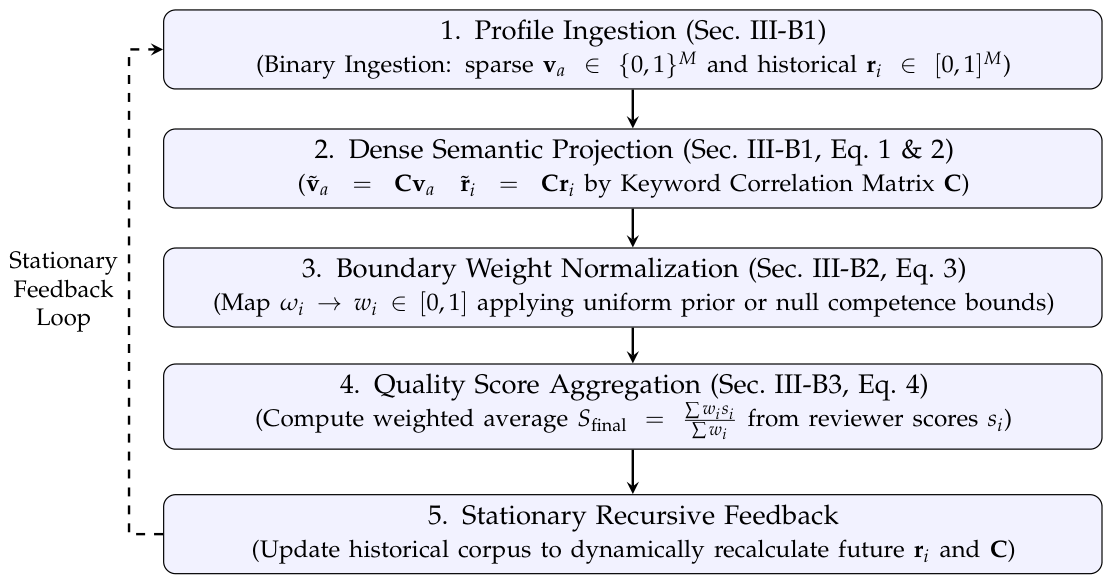
Figure 2.
Empirical convergence of consolidated scores across 10 simulation epochs.
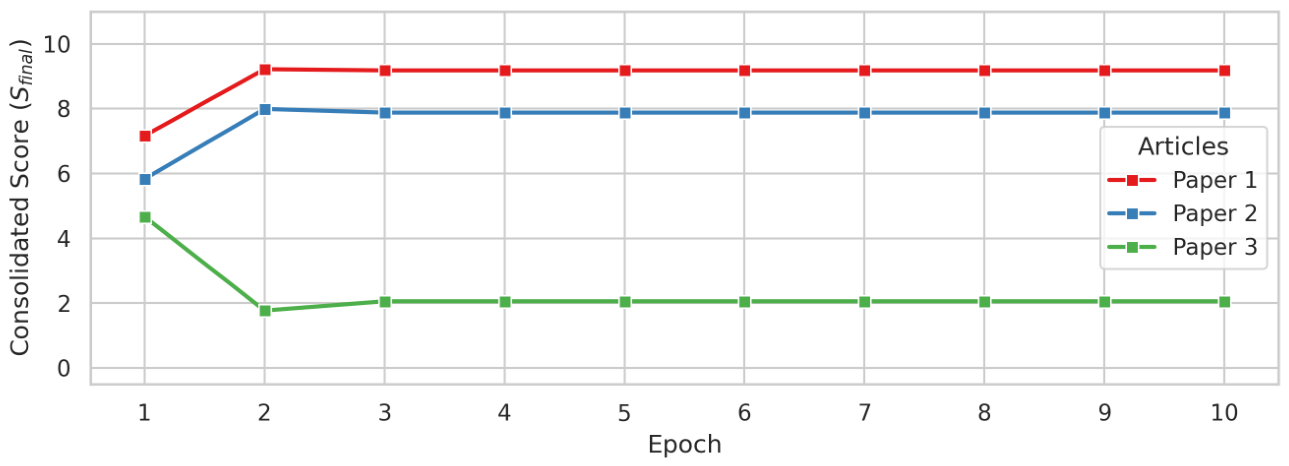
Figure 3.
Dynamic weight trajectories of all reviewers for Paper 3.
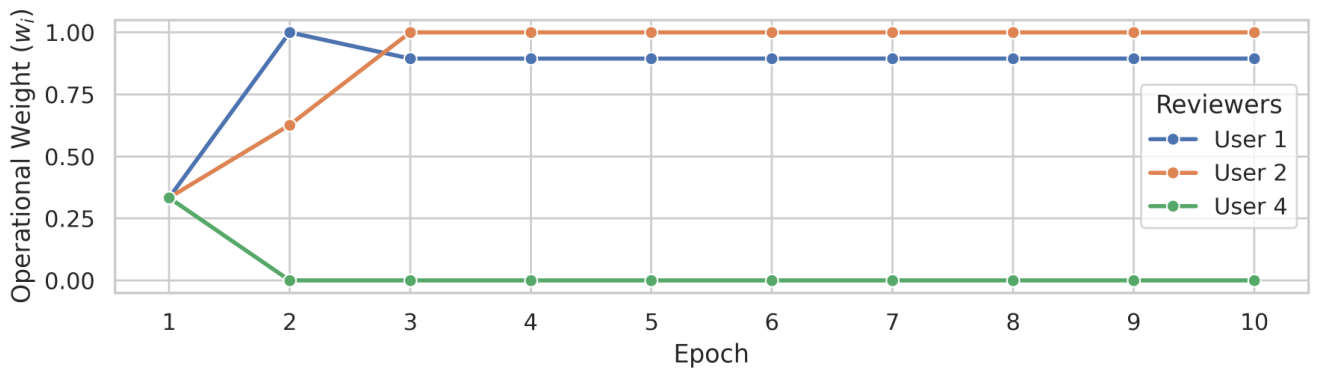
Figure 4.
Dynamic graph of peer evaluation connections and recursive feedback. Epoch 1 (left) displays the uniform prior baseline where all actor weights are equally distributed during initialization. Epoch 2 (right) illustrates the algorithmic self-correction and asymmetric polarization, where verified experts (Users 1–3) gain robust authority weights (green solid lines) while the unverified layman attacker (User 4) is systemically muted (red dotted lines).
Figure 4.
Dynamic graph of peer evaluation connections and recursive feedback. Epoch 1 (left) displays the uniform prior baseline where all actor weights are equally distributed during initialization. Epoch 2 (right) illustrates the algorithmic self-correction and asymmetric polarization, where verified experts (Users 1–3) gain robust authority weights (green solid lines) while the unverified layman attacker (User 4) is systemically muted (red dotted lines).
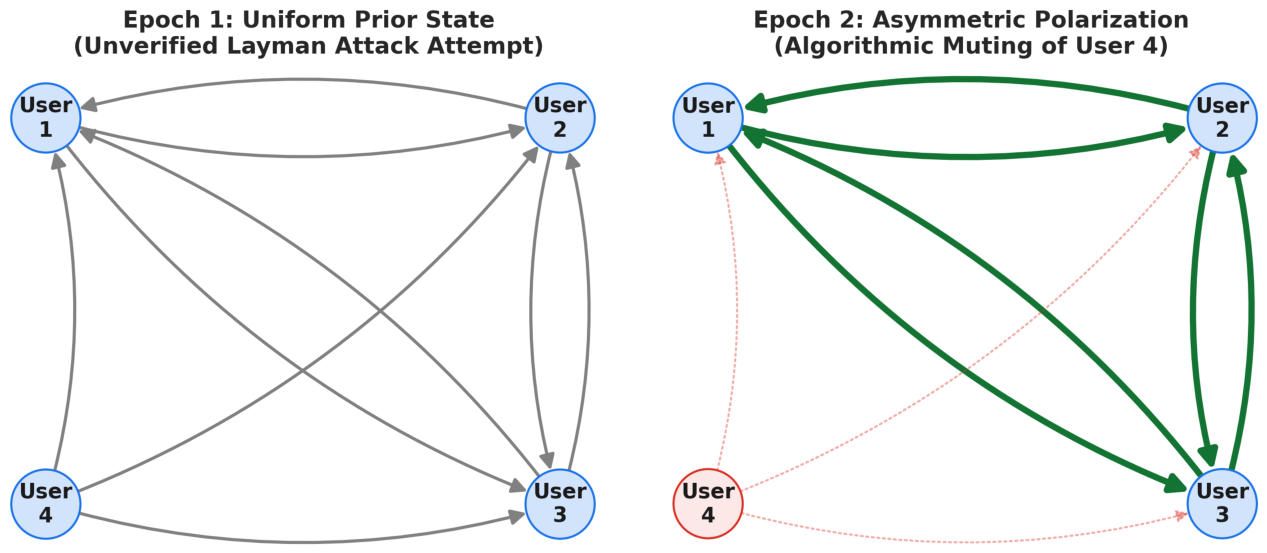
Figure 5.
Consolidated quality score () trajectory under a persistent high-scale cartel attack, demonstrating real-time algorithmic self-correction as independent global validators flood the review pool.
Figure 5.
Consolidated quality score () trajectory under a persistent high-scale cartel attack, demonstrating real-time algorithmic self-correction as independent global validators flood the review pool.
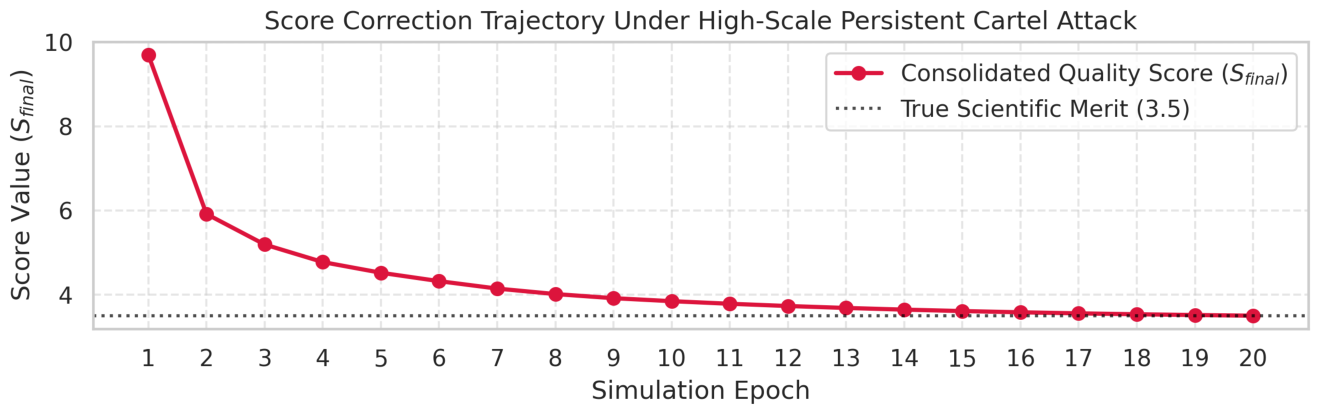
Figure 6.
Asymmetric weight polarization displaying the automated erosion of the persistent cartel’s authority vector () alongside the simultaneous engagement scale expansion of honest peer validators.
Figure 6.
Asymmetric weight polarization displaying the automated erosion of the persistent cartel’s authority vector () alongside the simultaneous engagement scale expansion of honest peer validators.
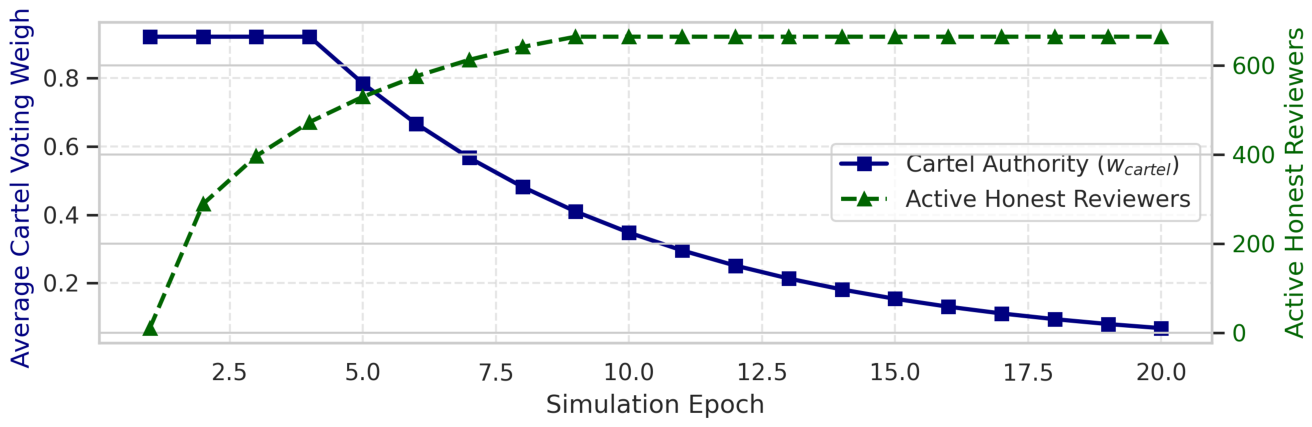
Figure 7.
Topological anomaly detection via dimensional reduction. The 10D evaluation space is projected onto a 2D PCA manifold, with color intensities mapping the Community Consensus Score (). Honest peers display organic distribution variance, while the collusive cartel collapses into an isolated, low-consensus node cluster.
Figure 7.
Topological anomaly detection via dimensional reduction. The 10D evaluation space is projected onto a 2D PCA manifold, with color intensities mapping the Community Consensus Score (). Honest peers display organic distribution variance, while the collusive cartel collapses into an isolated, low-consensus node cluster.
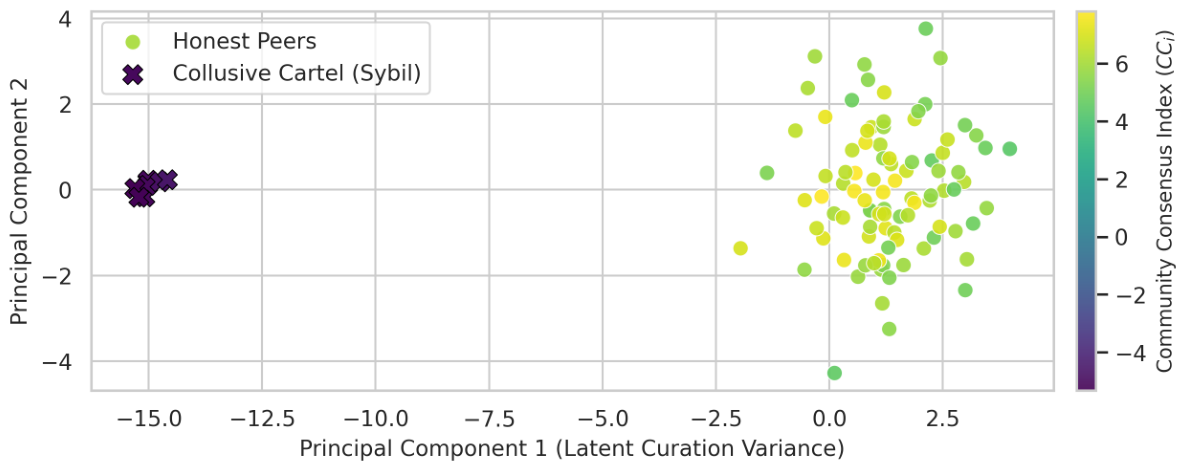
Figure 8.
Hierarchical Clustering Dendrogram for forensic cartel detection. The agglomerative pipeline using Ward’s linkage groups the 100 simulated users. The brute-force collusive cartel nodes (–) form a hyper-dense, highly isolated branch that cleanly breaks past the red anomaly threshold line.
Figure 8.
Hierarchical Clustering Dendrogram for forensic cartel detection. The agglomerative pipeline using Ward’s linkage groups the 100 simulated users. The brute-force collusive cartel nodes (–) form a hyper-dense, highly isolated branch that cleanly breaks past the red anomaly threshold line.
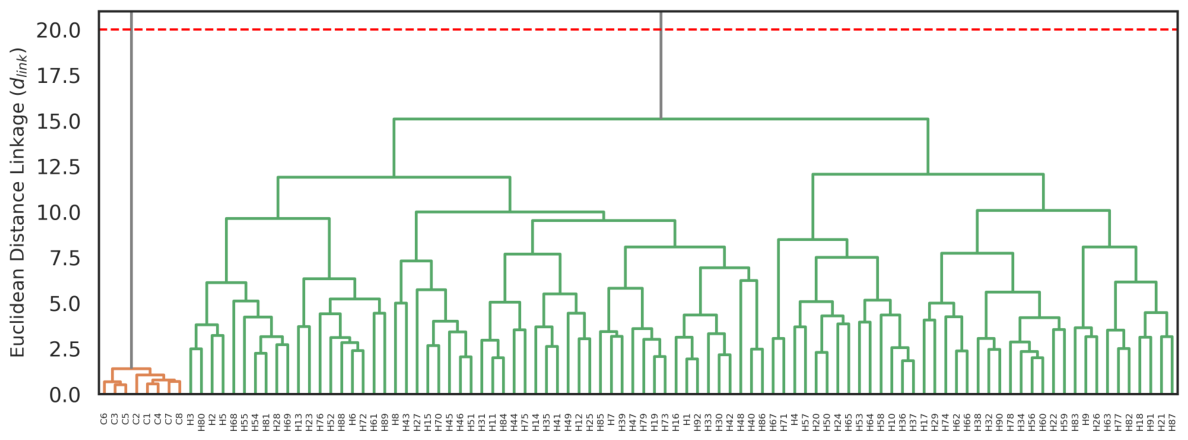
Figure 9.
Empirical execution latency of the core operational pipeline. Benchmarks evaluated in Python on an AMD Ryzen 7 5800 CPU executing at stock clock configurations paired with 3200 MHz DDR4 memory.
Figure 9.
Empirical execution latency of the core operational pipeline. Benchmarks evaluated in Python on an AMD Ryzen 7 5800 CPU executing at stock clock configurations paired with 3200 MHz DDR4 memory.
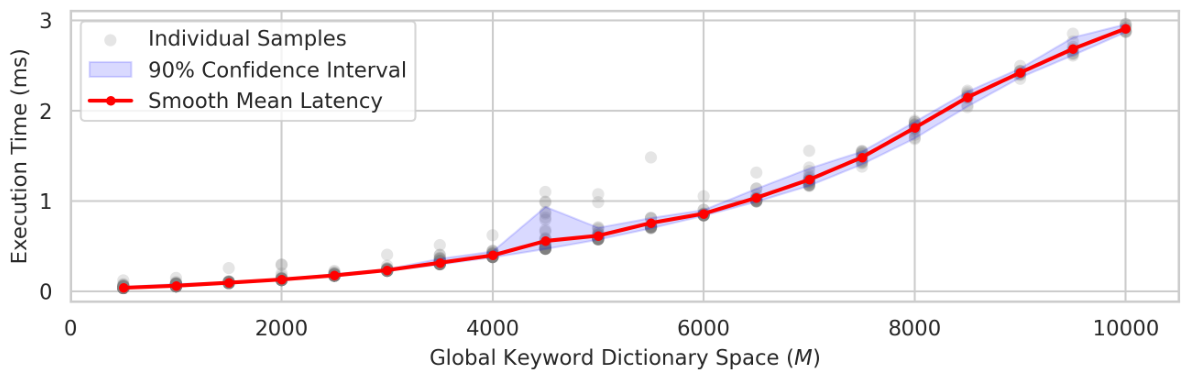

Table 1.
Simulated Ingested Scores Across Peer Evaluation Pool.
| Manuscript | User 1 | User 2 | User 3 | User 4 (Layman) |
|---|---|---|---|---|
| Paper 1 (by User 1) | — | 9.0 | 9.5 | 3.0 |
| Paper 2 (by User 2) | 8.5 | — | 7.0 | 2.0 |
| Paper 3 (by User 3) | 1.0 | 3.0 | — | 10.0 |
Disclaimer/Publisher’s Note: The statements, opinions and data contained in all publications are solely those of the individual author(s) and contributor(s) and not of MDPI and/or the editor(s). MDPI and/or the editor(s) disclaim responsibility for any injury to people or property resulting from any ideas, methods, instructions or products referred to in the content. |
© 2026 by the authors. Licensee MDPI, Basel, Switzerland. This article is an open access article distributed under the terms and conditions of the Creative Commons Attribution (CC BY) license (http://creativecommons.org/licenses/by/4.0/).
Copyright: This open access article is published under a Creative Commons CC BY 4.0 license, which permit the free download, distribution, and reuse, provided that the author and preprint are cited in any reuse.