
Submitted:
01 October 2026
Posted:
06 October 2026
You are already at the latest version
Abstract
Newton’s constant G fixes the universal strength of the low-energy metric response, but the Einstein field equations do not determine its magnitude. At the interface of quantum theory and gravitation, the more appropriate structural target is the dimensionless coupling αG(M)=GM2/(ℏc), which compares the gravitational response of a mass anchor M with the quantum unit of action. We ask a deliberately limited question: can the normalization of this coupling be represented by a finite premetric selector while continuous Einstein and quantum-field dynamics remain downstream? Within a neutral-parent reconstruction framework, representative independence, cut independence, universality, and compositional consistency lead conditionally to a finite defect–platform module. An explicit boundary map gives dim Md=2d−d−1; for d=4, it splits intrinsically as 43=18+25. The eighteen-dimensional part matches an independently published light-baryon route count under a stated grade–role rule, while the twenty-five-dimensional part is an explicit ordered return module. Stated local cut transports generate M43(R), so a cut-independent scalar cannot assign unrelated weights to the two parts; the neutral projection is therefore 25/43. Basis invariance and multiplicative composition uniquely select the determinant, giving C*18, and finite symmetry projectors followed by a one-stratum return recurrence give the remaining correction. The finite theorems are exact inside the declared objects. Their use as a gravitational matching condition remains conditional on explicitly listed bridge premises. The construction is not a quantization of the metric, a graviton model, or an ultraviolet completion of gravity. Under the stated premises, αG(e)≃1.75180939905×10−45, corresponding to Gstr≃6.6743000×10⁻¹¹m3kg−1s−2. The agreement with CODATA 2022 is retrospective; no measured value of G enters the displayed structural formula.
Keywords:
quantum gravity
; Newton’s constant
; dimensionless gravitational coupling
; premetric reconstruction
; neutral parent
; defect–platform co-selection
; indefinite reconstruction stability
; invariant projection
; fundamental constants
1. Introduction
Newton’s constant is unusual among familiar low-energy constants. It is experimentally difficult to determine, its numerical value depends on the unit system, and neither the Standard Model nor the classical Einstein field equations fixes its magnitude. The CODATA 2022 recommendation is
with a relative standard uncertainty of approximately [1,2]. Independent torsion-balance determinations have historically exhibited differences much larger than their individual uncertainties, illustrating the continuing experimental challenge [3]. A proposed structural value must therefore be compared with experiment without converting numerical proximity into an unjustified claim of precision.
The dimensionless quantity associated with a nonzero mass reference M is
The primary question of this paper is whether , rather than a bare SI number, can be selected by a finite structure fixed before the gravitational comparison. The measured electron mass will eventually provide the SI mass anchor, but the structural theorem itself concerns a dimensionless coupling.
1.1. Quantum–Gravity Scope and Relation to Quantum Read-Out
The appearance of ℏ in is not merely a change of units. It converts the classical response coefficient G into a dimensionless comparison between metric response and the quantum scale of action for a specified mass anchor. The origin of that comparison lies at a restricted but genuine quantum–gravity interface: one asks how a universal coefficient inherited by quantum matter is matched to the effective geometry that responds to its stress–energy. The present paper addresses this matching coefficient. It does not propose a microscopic graviton dynamics, quantize the metric, or construct a high-energy completion of general relativity.
A recently published reconstructional quantum theory of the present treats a physical present as an outcome-conditioned quantum read-out of a stable relational boundary, and formulates its successor structure by quantum instruments, stable record sectors, and a conditional Born representation [4]. That construction begins after a quantum observable algebra and a readable causal platform are available. The present paper asks a complementary upstream question: whether the same premetric selection layer can fix the scalar normalization of the metric response that all later quantum read-outs inherit. The quantum-present construction is therefore not a premise in the numerical derivation of G; it clarifies the downstream meaning of “read-out” and the division of labor between reconstruction, quantum theory, and effective gravitational dynamics.
The logical order is thus straightforward. Premetric reconstruction supplies candidate invariant boundary data; sector-specific read-out supplies quantum states, records, particles, and an effective metric; and established quantum field theory and general relativity govern the resulting observables. The finite selector developed below is proposed only for the first task. Its physical interpretation is acceptable only if it descends consistently to the same quantum and metric platform used by the later theories.
1.2. Motivation and Change of Viewpoint
Earlier papers developed the particle and platform problems largely as separate tasks. One line asked how reconstruction and the Indefinite Reconstruction Stability Principle (IRSP) could organize persistent particle identities, neutral-parent resolution, and mass or magnetic read-outs. The other asked how the same stability requirement could select a readable spacetime platform and its effective laws. This separation produced useful partial results, but it also left unexplained normalizations, relative weights, and compatibility conditions to be supplied from outside each local problem.
The organizing proposal of the present paper is that these open conditions should be tested jointly. The starting point is a premetric substrate capable of supporting relations and comparisons, without presupposing a metric, particle list, or dynamical law. The working hypothesis is that a consistent readable model requires both identities that persist under admissible continuation and a complementary platform that can detect, transport, and compare them. The persistent defect and its detecting complement are thus treated as reciprocal requirements rather than independently chosen ingredients.
Within the declared reconstruction grammar, IRSP requires the identity to survive every admissible continuation and descend consistently to the observable quotient; saturation requires every inequivalent admissible route with nonzero read-out to be retained. Applied jointly rather than locally, these requirements motivate a codimension-two persistent defect together with a -dimensional Lorentzian detecting platform. Structural capacities, coupling strengths, ratios, and effective law classes are then different read-outs of the jointly selected defect–platform architecture, not independent decorations attached afterward. The central methodological lesson of the programme is consequently that IRSP, quotient-first saturation, and joint selection must be imposed throughout a derivation.
This shift makes it possible to revisit several persistent problems in the derivation of G: why the eighteen particle routes and the platform return sector belong to one selector, how their relative normalization can be fixed, why the completed capacity is inherited before sectoral differentiation, and why the residual return structure admits a controlled closure. The result is not yet an unconditional theory of Newton’s constant. It does, however, replace several previously disconnected choices by one testable chain of finite requirements and moves the programme substantially closer to a structural account of one of nature’s most important unexplained constants.
The neutral-parent reconstruction programme therefore reverses the usual order of explanation. Instead of beginning with a spacetime, fields, particles, laws, and free constants, it first asks which relations and identities remain well defined under indefinite admissible reconstruction. Persistent codimension-two defects and their carrier platform are required to close together. Sector-specific read-outs map the resulting invariant structure to effective spacetime, particles, mass ratios, phases, and coupling normalizations. Conventional dynamics takes over after that read-out. Reconstruction is proposed as a selection layer beneath effective dynamics, not as a replacement for general relativity, quantum field theory, or QCD.
This architecture has been developed in a sequence of published results. Two topological papers classify admissible reconstruction operations and the local-to-global transport of a primary meridian [5,6]. Subsequent applications construct a neutral-parent particle archetype, obtain a quantitative nucleon magnetic-moment ratio, organize the charged-lepton hierarchy, derive a completed carrier capacity associated with the fine-structure constant, and select a four-dimensional Lorentzian platform with Maxwell–Einstein dynamics under declared premises [7,8,9,10]. Most recently, a published light-baryon analysis derives eighteen primitive route classes, a canonical organization, structural nucleon ratios, and a unified light-baryon spectrum [11]. These results do not prove the gravitational correspondence. They do, however, freeze the principal inputs before the present calculation and provide nontrivial cross-sector evidence that the same architecture supports quantitative read-outs.
In a complementary quantum-foundational direction, the published reconstructional theory of the present formulates entangled read-out, outcome-conditioned actualization, and emergent temporal succession on an already readable platform [4]. It neither supplies nor assumes the gravitational number calculated here. Its relevance is to show where the present selector is meant to terminate: in a common platform on which quantum observables and effective metric response can coexist.
A published laws-side analysis leaves open the normalization of the gravitational coupling [10]. The present paper addresses that complementary constants-side problem. The two tasks meet only after read-out:
Accordingly, the eighteen-channel kernel used below is not a census of gravitational sources. It participates in selecting one universal coupling that is subsequently inherited by every completed system with nonzero total stress–energy.
1.3. Why a Finite Structure Can Represent a Gravitational Coupling
The proposal is not that spacetime contains forty-three points, that gravity has only finitely many dynamical states, or that the elements counted below are gravitons. The finite construction is assigned a narrower task. The Einstein equations describe how a given gravitational coupling governs the metric response, but they do not determine the numerical normalization of that coupling. A prior selection layer may therefore fix a dimensionless boundary datum without replacing the continuum dynamics that uses it.
Why should such a selector be finite? The present framework first quotients away alternative descriptions of the same completed relation and then keeps each inequivalent primitive route once. At this level the relevant question is not how many spacetime events occur, but how many distinguishable ways a persistent defect and its readable platform can close together. That classification can be finite even though the post-read-out spacetime and its dynamical state space are continuous. Finite symmetry data routinely select representation dimensions or invariant coefficients without implying a finite continuum; the same limited role is proposed here for the dimensionless gravitational normalization.
A viable universal coupling selector should satisfy four reader-checkable requirements.
- 1.
- Representative independence: equivalent drawings, labelings, and boundary representatives must give the same scalar.
- 2.
- Cut independence: moving the arbitrary cut used to describe one closed departure–return relation must not change the answer or leave an unobservable relative weight between its defect-facing and platform-facing descriptions.
- 3.
- Universality: before mass, charge, and flavor read-outs differentiate the primitive routes, the metric normalization must not depend on those later labels.
- 4.
- Compositional consistency: independently completed primitive channels must combine by one basis-independent rule, rather than by an order-dependent or fitted prescription.
The quotient, cut-transport commutant, common completed inheritance, and determinant character developed below implement these four requirements in finite form. The resulting logical chain is
Only the last arrow converts the dimensionless output into a dimensional constant by choosing a mass anchor. The same G must result from every anchor after the exact covariance relation proved in Section 4.
This motivation does not prove that the selected scalar is gravitational. That identification is the main physical bridge of the paper. It becomes a scientifically assessable proposal because the finite objects are explicit, the scalar is fixed without inserting measured G, the result is required to be universal after read-out, and every premise that connects the finite selector to gravity is separately identified. A failure of any one of those premises breaks the proposed derivation rather than being absorbed into a new adjustable coefficient.
The central new structural observation is a two-sided closure identity. An explicit observable boundary map gives a forty-three-dimensional platform selector and, within the same quotient, separates eighteen oriented derangement directions from a twenty-five-dimensional fixed-axis return sector. Independently, quotient-first saturation gives eighteen light-baryon routes, while the codimension-two departure–return interface has twenty-five ordered incidences. Primitive defect–platform co-selection identifies these two presentations:
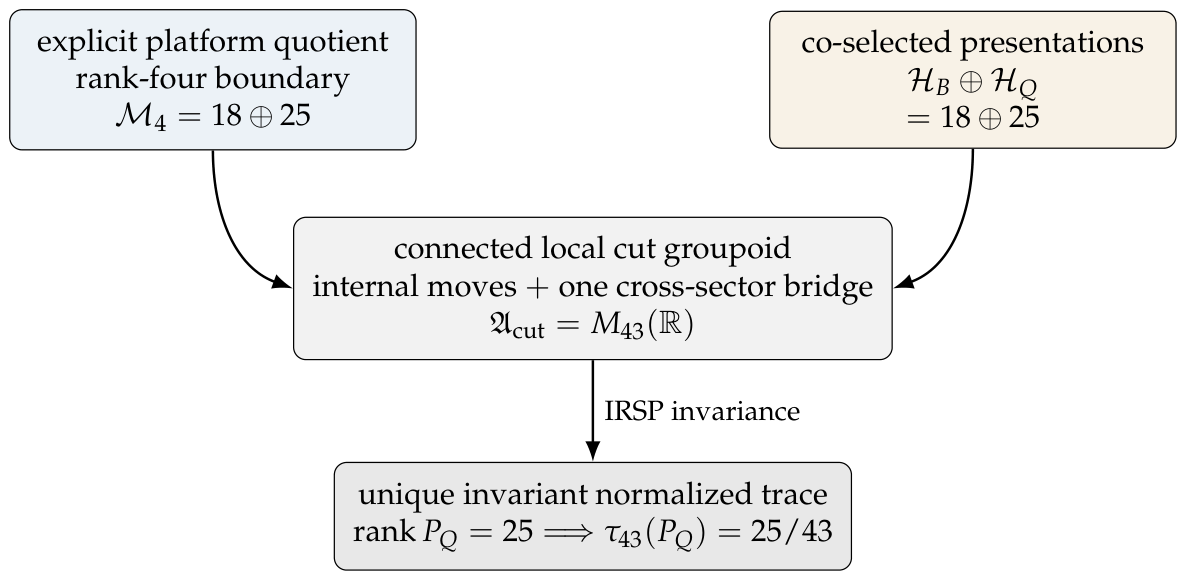
The local cut operations are specified below rather than replaced by an irreducibility assumption. Their saturated source–target algebra is , so IRSP removes a possible relative weight between the two presentations. The unique invariant normalized trace of the neutral-return projector is .
At a glance, the proposed gravitational capacity has the factorization
Every factor is defined or derived before the numerical comparison with Equation 1; the imported carrier capacity is frozen independently of that comparison. In particular, , , and the return factor is derived from finite symmetry projectors followed by an all-order paired-return filtration.
1.4. Result at a Glance
The detailed construction leads to the neutron-anchored capacity
and hence to the electron-anchored dimensionless result
Only after this dimensionless theorem is complete is the measured electron mass introduced to express the result in SI units:
The displayed excess digits document the arithmetic and are not claimed as experimental precision. The value reported in the abstract and conclusion is rounded more conservatively.
The neutron is used because the closed-neutral projection is simplest in that representation. It is not a preferred physical unit. For any other nonzero anchor, an exact conversion of returns the same G.
For orientation, Table 1 states the physical reason for each bridge premise before the detailed constructions are introduced. The middle column gives motivation, not proof; the last column distinguishes the finite conclusion from the remaining physical obligation.
1.5. What Is Derived, What Is Assumed, and What Remains
The word derivation is used at four explicitly separated levels.
- 1.
- Derived in the present paper. Within the displayed finite objects and axioms, the explicit platform boundary map, the intrinsic platform decomposition, the unique dimensional match, the local cut-transport algebra, the determinant character, the normalized projector weight, the finite symmetry coefficients, the return-tower resummation, and the stated remainder bounds are proved. In particular, the eighteen channels are primitive route classes rather than spin projections or a count read from the observed spectrum; the determinant and rational coefficients follow from uniqueness or projector theorems rather than from their numerical usefulness.
- 2.
- Previously derived and imported conditionally. The codimension-two parent, the Lorentzian platform, the completed capacity , the eighteen-channel baryon theorem, and the structural nucleon ratios come from the cited publications. Their numerical values are frozen before the present G evaluation, but their physical correspondence premises are not re-proved here.
- 3.
- Postulated or conditionally identified. The saturated platform grammar, the dimension-general grade–role rule, the carrier-facing identification of the eighteen baryon routes with the eighteen defect-facing platform directions, admissibility of the stated local cut moves, common completed-capacity inheritance, the one-stratum return rule, and identification of the resulting scalar as the gravitational selector remain declared bridge principles. The main theorem states them as hypotheses rather than hiding them inside the calculation.
- 4.
- Reserved for future work. A microscopic construction of the primitive exact-one-fixed boundary rule and the listed local cut generators from a more microscopic carrier complex, derivation of the selector and source read-out functors, and prospective tests with no structural retuning remain open.
The numerical agreement is retrospective because the experimental value of G was known during development. The frozen formula, the explicit bridge principles, and the unresolved proof obligations—not a claim of blind discovery—are what future mathematics and measurements can test.
The remainder of the paper separates the exact finite mathematics from the physical correspondence assumptions. For readers new to the reconstruction program, Section 2 gives a self-contained terminology guide and explains the carrier, persistent defect, , neutral parent, premetric equal weighting, sector-specific read-out, and the division of labor with effective physics. Section 3 maps the relevant published results; Section 4 and Section 5 define the dimensionless target and imported inputs. Section 6 reviews the published route theorem, and Section 7 develops the new platform closure and its dimension test. Section 8 and Section 9 establish the determinant, invariant trace, finite projectors, and return completion. Section 10 reports the numerical and discrete sensitivity audits, while Section 11 and Section 12 delimit the effective interpretation and falsification conditions.
2. Framework and Terminology: From Reconstruction to Effective Physics
This section is intended to make the calculation readable without prior knowledge of the reconstruction program. The central picture is simple even though the terminology is unfamiliar. The framework first asks which structural relations can persist and close before distance, time, fields, and couplings have been assigned. A sector-specific read-out then represents the surviving invariant as a particle, a mass ratio, an electromagnetic response, or a metric coupling. General relativity and quantum field theory subsequently govern the motion and interaction of those read-out objects. The proposal is therefore a candidate selection layer beneath effective dynamics, not a rival dynamical theory.
2.1. A Concise Terminology Guide
Table 2 collects the terms used repeatedly below. The third column is important because familiar words such as “carrier”, “defect”, and “parent” otherwise invite an unintended mechanical picture.
2.2. Carrier and the Meaning of “Premetric”
The word carrier abstracts a familiar fact: physical structures are not defined relative to literal nothingness. In general relativity, the metric is dynamical rather than an inert container; in quantum field theory, particles and phases are excitations of fields relative to a nontrivial vacuum. The carrier is the proposed prior support whose effective, carrier-facing description contains spacetime propagation, field coherence, and observable particle behavior. It is not a nineteenth-century ether and does not select a preferred inertial frame [7,10,12,13].
The primitive carrier description is called premetric because it uses only data that do not require a distance function: incidence, adjacency, orientation reversal, composition, closure, automorphism, and quotient. The word “prior” is logical, not chronological. There is no claim that a pregeometric object waits for some external clock and later turns into spacetime. Clock time is itself part of the effective description obtained after metric read-out.
One can therefore distinguish three layers:
The downward arrows in Equation 10 express explanatory dependence, not evolution in an already available time coordinate.
2.3. Reconstruction, IRSP, and Saturation
Definition 1
(Reconstruction). A reconstruction is an admissibility-governed extension procedure. A local relation is retained only if it remains compatible under repeated composition and defines the same protected identity independently of the chosen representative.
Let denote a class of finite reconstruction configurations, the admitted extension operations, and ∼ the equivalence generated by structural automorphisms and identical observable descent. For , an admissible route r is a finite composable sequence of operations from . The route is persistent if it can be continued to arbitrary finite depth whenever an admissible continuation exists and if its protected class is unchanged by replacing P or r with an equivalent representative.
Principle 1
(Indefinite Reconstruction Stability Principle). A candidate physical identity is retained only if it remains well defined under indefinite admissible continuation and descends consistently to the observable quotient.
The word indefinite means “with no prescribed final reconstruction depth”, not “infinitely large at one stage”. The principle excludes a locally attractive pattern that fails when its allowed relations are composed further. It also excludes representative-dependent decoration: observable identity belongs to the invariant class, not to an arbitrary drawing of it. The underlying reconstruction classification motivates codimension-two support for persistent loop-readable obstruction [5,6,10].
Saturation is the constructive companion to . If is the read-out for sector s, define schematically
Thus every admissible inequivalent route that survives in the selected read-out is retained once.
A useful physical analogy is a route map. Saturation draws all admitted routes to the target. Printing the map a thousand times, or realizing one route in a thousand equivalent ways, does not create a thousand new routes; all are representatives of the same invariant map. Conversely, deleting a genuinely different admitted route would leave the map incomplete. This is why the present framework uses saturation but no longer invokes a “minimality” principle.
2.4. Persistent Defects and Why Codimension Two Is Selected
A defect in this paper is a failure of the carrier to be globally trivial around a localized support. The physically readable information resides in the complement of that support. In a three-dimensional readable spatial slice, the transverse complement of a codimension-two core satisfies
A small linking loop can therefore carry winding and holonomy that cannot be removed without crossing the core. Codimension one naturally gives a separating interface, whereas the small link of a codimension-three point is , whose fundamental group is trivial. Codimension two is consequently the natural local support when persistent identity is required to be loop-detectable [14,15,16].
The first topology analysis classifies the admissible local reconstruction operations, while the subsequent primary-meridian analysis supplies the local-to-global complement framework used to transport a loop-readable obstruction through compatible reconstruction [5,6]. In particular, local closure should not be confused with triviality of the completed object. For a closure chain C,
A persistent particle or bound state may therefore be closed while defining a nonzero completed class.
The core should not be pictured as a tiny material string inside a particle. Before metric read-out, “codimension two” specifies an incidence and complement role. The familiar linking-loop picture is its later geometric representation. Likewise, the availability of one-dimensional unitary holonomy explains why a phase read-out can occur before particle-specific labels are resolved, but it does not by itself derive the electromagnetic Lagrangian.
2.5. The Neutral-Parent Particle Archetype
The codimension-two defect is not yet an electron, a neutrino, or a hadron. The neutral-parent hypothesis states that its first locally completed particle-level polarization is neutral before charged and sectoral branches become separately readable. In the notation of the published particle theory, the organizing resolution is
Here is the lepton-supporting twofold Lorentz-readable branch and is the hadron-supporting branch with nested confined three-sector closure. The hat emphasizes complementary closure roles of one parent rather than two independent primitive substances. The arrow denotes structural resolution, not decay [7].
Different particles are thus modeled as different carrier-readable manifestations of a common codimension-two archetype: the parent embeds or closes differently relative to the effective carrier. This is the organizing spine of the program. It does not claim that observed particles contain an unseen constituent. After read-out, the Standard Model names and describes the resulting lepton, hadron, gauge, and flavor sectors in its ordinary field variables. The current paper uses the completed hadronic manifestation and then asks for its metric-capacity read-out.
2.6. Defect–Platform Co-Selection and the Movable Cut
A persistent defect and a readable carrier cannot be selected independently. A return without a platform has no observable carrier-facing representation; a platform without an identity-preserving return contains no selected defect. The neutral parent is therefore represented by a completed relation
where R denotes the persistent return data, P the platform data, and their compatibility pairing. The two directed descriptions and are reciprocal presentations of one completed relation, not two physical copies.
Codimension two makes this reciprocity concrete. A small meridian is a closed loop, and any drawing of it requires an arbitrary cut or basepoint. Moving that cut changes which part of the same completed cycle is described as a defect-side route and which part is described as a platform-facing return. The protected identity cannot depend on that choice. This motivates the following form of the co-selection requirement.
Principle 2
(Cut-independent defect–platform co-selection). At the primitive metric-selector level, admissible meridian transport acts on the combined defect-route and transverse-return presentations. The local transport system contains the continuation moves internal to each presentation and at least one movable-cut operation that crosses between them. A scalar selector must commute with all such continuation and cut-transport operations.
The crossing operation does not mean that a baryon and the platform are the same object. It means that moving the descriptive cut on one completed neutral-parent cycle can change which local data are written in the defect-route presentation and which are written in the platform-return presentation. Without any crossing move, the two families would define independently reconstructible parents, contrary to primitive co-selection.
Physical intuition.
One may mark a point on a closed ring in order to describe a departure and a return, but the ring has no physical memory of where the mark was placed. A coupling that changed when that mark was moved would be a property of the drawing rather than of the completed ring.
Logical status.
Cut independence follows from IRSP once the admissible transport groupoid is specified. The finite generators and their source–target action are written explicitly in Section 7. Their connectedness then proves the scalar-commutant statement; what remains conditional is the physical admissibility of those generators, not an additional abstract irreducibility assumption.
2.7. Equal Weighting Before Sector Differentiation
“Equal weighting” is easily misunderstood because, at the premetric level, it is neither a probability postulate nor an assertion that physically different particles have equal masses. It is a statement about a scalar read-out before a structure that distinguishes the alternatives is available. The precise finite statement is elementary.
Proposition 1
(Invariant weighting on a finite orbit). Let a group H act transitively on a finite set X, and let be normalized and invariant:
Then for every .
Proof.
Transitivity and invariance make all values of w equal. Normalization fixes their common value to . □
Premetricity alone does not force equal weights between inequivalent orbits. What forces equality within an orbit is the absence of an invariant distinction available to the read-out. In this paper the analogous capacity statement is that, before electromagnetic, flavor, or mass operators differentiate the primitive baryon routes, the completed carrier-capacity read-out is blind to their route labels. They therefore inherit the same eigenvalue , even though later sectoral read-outs distinguish their masses and charges. This declared pre-sector premise is what leads to the operator in Equation 67; the determinant theorem then fixes how the eighteen equal channel capacities compose. No measured value of G is used to assign those equal eigenvalues.
The logical qualification is important. The eighteen-channel theorem proves the route count; it does not by itself prove that the coupling-capacity functor coequalizes every route label. That is a physical correspondence premise, stated separately so that it can be challenged without disputing the finite counting theorem.
2.8. Read-Out and the Division of Explanatory Labor
Definition 2
(Sector-specific read-out). A read-out is a map
from persistent invariant closure data to the observable objects of a selected effective sector s. The sectors may include metric, mass, electromagnetic, weak, flavor, or spin read-outs.
The same invariant architecture can have different images under , , and . A protected component can be essential to closure while lying in the kernel of one particular additive read-out, or while mapping to the neutral element of a multiplicative read-out. Absence from that observable image does not imply absence from the full reconstruction. Conversely, equal capacity before sector differentiation does not imply equal mass or charge after the relevant operators act. Faithful read-out represents protected content in sector-appropriate language; it does not create a new protected distinction that had no premetric antecedent [10].
For gravity, two maps must be distinguished. The present paper studies the coupling-capacity selector
where multiplication composes independent primitive selector channels. The separate source read-out acts on completed persistent systems,
where denotes the effective total energy–momentum data. A class can be neutral under the first map, in the sense of adding no new multiplicative selector factor, while remaining nonzero under the second.
This distinction fixes the division of labor. The reconstruction layer is proposed to select persistent identities, structural constants and ratios, and boundary data that constrain the form of the effective law. Once spacetime and fields are readable, general relativity, quantum field theory, the Standard Model, and QCD take over for propagation, cross sections, decays, renormalization, bound-state dynamics, and experimental response. They are correct and indispensable at that level.
Successive compatible read-outs may possess a smooth continuum limit. If P is a reconstruction state, an admissible step, and its effective representation, a regular limit can satisfy
where E is the effective evolution law. Time-dependent partial differential equations are then the efficient continuum description of small changes among successive read-outs. They need not reproduce the prior finite selection problem in their own variables.
This is also why the lack of a premetric Lagrangian is not a missing microscopic derivation. A spacetime Lagrangian presupposes the metric, fields, representations, couplings, and admissible state variables whose selection is being investigated. The appropriate rigor at the prior layer is instead a fully specified finite incidence complex, its automorphisms and quotients, and a proved read-out factorization. After metric read-out, the present calculation supplies a proposed matching value for the Einstein–Hilbert coupling. The independent laws-side reconstruction addresses why the Einstein form is selected [10]; the Einstein field equations then govern the dynamical use of the coupling proposed here.
Figure 1 summarizes the complete explanatory chain.
2.9. How the Present Paper Should Be Read
The framework has already been applied to the nucleon magnetic-moment ratio and the charged-lepton hierarchy, while the all- completed-capacity tower, the eighteen-channel light-baryon construction, the structural nucleon ratios, and the four-dimensional law-selection result provide the principal imported inputs for the present calculation [7,8,9,11]. The published laws-side analysis supplies the complementary reconstruction account of law selection [10]. The quantum-present analysis supplies a complementary downstream account of quantum read-out and actualized records [4]; it contributes no fitted constant or numerical factor to the present calculation. These earlier results motivate a cross-sector test and clarify its intended physical location; they do not prove that the metric-coupling read-out proposed here is correct.
Throughout this paper, “complete light-baryon kernel” means saturated relative to the declared primitive route space . It does not mean that light baryons exhaust the matter content or the systems that source gravity after read-out.
Three claim levels are kept separate throughout:
- 1.
- exact finite mathematics inside declared incidence objects, including the eighteen-channel quotient, platform-dimension and dimensional-closure theorems, determinant and normalized-trace uniqueness, projector ranks, tower resummation, and remainder bounds;
- 2.
- conditional physical correspondence premises, including neutral-parent particle organization, the platform and grade–role grammars, primitive co-selection, admissibility of the stated local cut moves, common pre-sector capacity, and identification of the resulting module as the metric-coupling selector;
- 3.
- retrospective numerical comparison with the measured value of G.
The adjective conditional in the title refers to the second level. It does not weaken the exactness of the first, and the numerical agreement at the third is not used as a substitute for either.
A reader may therefore audit the paper in two passes. The first pass checks only the finite implications: the quotient counts, boundary rank, decomposition, transport algebra, character uniqueness, projector ranks, and series resummation. None of those checks requires accepting the proposed gravitational interpretation. The second pass asks whether the seven bridge premises summarized in Table 1 are appropriate descriptions of the underlying carrier. The numerical agreement is evidence to be weighed only after those two logically distinct tasks have been kept separate.
3. Published Foundations and Programme-Level Evidence
Because the reconstruction framework is unfamiliar to many readers, it is important to distinguish an isolated numerical proposal from a programme whose principal ingredients have already been used elsewhere. A recent Quantum Reports article developed the downstream quantum-present read-out, but the present calculation uses a different part of the framework and must be assessed independently [4]. Table 3 records the published chain relevant to the present calculation. The table is a provenance map, not an argument that publication or repeated agreement proves the gravitational correspondence.
The quantitative sequence matters in two limited but useful senses. First, the completed capacity, the three-grade particle structure, the eighteen baryon routes, the nucleon ratios, and the four-dimensional platform were not introduced solely inside the present G calculation. Second, the same ordering—completion, quotient, saturation, and sector-specific read-out— has survived applications to topology, laws, constants, and mass ratios. This raises the evidential value of a new cross-sector test while leaving every new gravitational premise open to independent challenge.
The quantum-present result occupies a different logical position from the inputs that determine the displayed number. It describes a downstream quantum read-out once an observable platform exists. Including it in the provenance table prevents two possible misunderstandings: the finite selector is neither a hidden-variable replacement for quantum theory nor an attempt to derive G from measurement actualization. The required compatibility is instead that one representative-independent metric normalization be inherited by every admissible quantum read-out of the common platform.
The logical dependencies are summarized in Figure 2. The arrows express requirement, inheritance, or convergence; they do not imply a temporal sequence, nor does later agreement retroactively prove an earlier premise.
For clarity, the phrase conditional structural derivation has a precise meaning in this paper: once the displayed finite objects and read-out conditions are assumed, the dimensionless result follows uniquely. It does not mean that Newton’s constant has been derived from general relativity, the Standard Model, or topology alone.
4. Dimensionless Coupling and Exact Anchor Covariance
The primary object is the family of dimensionless capacities
No member of this family is physically privileged merely by the choice of mass unit. This distinction between a dimensionless physical relation and the numerical value assigned to a dimensional constant is essential when claims about deriving fundamental constants are assessed [17].
Proposition 2
(Mass-anchor covariance). For any two nonzero reference masses and representing the same universal G,
Consequently,
Proof.
Substitution of gives both statements immediately. □
Anchor covariance is an exact change-of-reference identity, not an independent empirical success. The neutron representation is convenient because the neutral departure–return complex in Section 9 is closed. The proton, electron, or any other nonzero reference is equally valid after applying Equation 21. A related conventional form is
so the proposed result may be read as a dimensionless Planck-to-matter mass ratio before it is converted to SI units.
5. Published Structural Inputs and Provenance
The calculation imports four outputs obtained without using the measured value of G. Their logical roles are listed in Table 4.
5.1. Published Completed Carrier Capacity
The independently published fine-structure analysis begins with the bare valuation
and obtains the completed response
The electromagnetic read-out of this completed invariant is the predicted inverse low-energy fine-structure constant. The present paper makes the additional cross-sector premise that completion occurs before electromagnetic and metric read-outs differentiate. It does not propose that photons or ordinary electromagnetic forces dynamically generate gravity [9].
5.2. Nucleon Mass Representations
The complete baryon analysis gives the alpha-free ratios
The measured electron mass supplies the external SI unit; the fine-structure constant is not inserted into either ratio. The neutron ratio will be used for the convenient closed-neutral representation, while Proposition 2 converts exactly to the proton representation. The finite formulas from which these numbers arise are recorded in Appendix B.
5.3. Programmatic Independence
The common neutral-parent architecture was introduced before the present gravitational calculation. Published applications include the nucleon magnetic-moment ratio and the charged-lepton hierarchy [7,8]. The published light-baryon analysis then derives the primitive channel count and organizes the nucleon and wider baryon mass read-outs [11]. These results do not prove the gravitational correspondence. The alpha tower is imported from its final published form, and the eighteen-channel theorem is imported from the frozen published analysis without alteration. They therefore cannot be introduced in the present paper solely to reproduce G.
6. The Eighteen-Channel Light-Baryon Kernel
The exponent in Equation 7 must be established before the gravitational comparison. Let
be the three projective grades of the primitive codimension-two carrier. A rooted bilateral baryon route has two complementary confined-side roles and one distinguished continuation role. Before quotienting, a route is therefore
The two confined sides form an unordered bilateral pair, whereas the continuation role remains distinguished. “Grade-local completion” means that the leading grade substitutions commute with transverse closure and that no additional cross-grade constraint is imposed at this primitive stage. Let .
Theorem 1
(Premetric eighteen-channel theorem). For the rooted bilateral incidence complex with grade-local completion, quotient-first saturation gives
Proof.
The continuation role has three grades. The two side roles contribute an unordered multiset of size two drawn from three grades, giving possibilities. Hence the quotient contains classes. Equivalently, Burnside’s lemma gives
because the identity fixes all 27 routes and side exchange fixes the nine routes with . □
The physical intuition is three cards: the continuation card remains distinguished, while exchanging the two confined-side cards does not create a new pocket. Saturation draws every admissible inequivalent route once; it does not prefer a smaller map and does not multiply the count when the same route is realized repeatedly. Figure 3 gives an alternative route-ledger visualization designed for the present paper. Its rows hold the distinguished continuation grade fixed, while its columns enumerate the six unordered confined-side pairs. This presentation makes the quotient and the factor visible without assigning a spatial geometry to the route classes used in the published light-baryon analysis [11].
The theorem also gives the familiar dimensions without inserting the observed multiplets. Let , so . Linearization of the side-exchange quotient gives
The two summands have dimensions ten and eight, respectively [18]. Only afterward does the light-flavor read-out identify them with the decuplet and octet. The observed spectrum is thus a comparison with the route theorem, not its input.
The theorem counts primitive species channels. Spin projections and radial or orbital excitations lie in fibers over a selected channel:
These spin and excitation fibers do not reselect the metric normalization. The route count selects a coupling kernel; it is not a census of all post-read-out sources of gravity. Once the universal coupling has been fixed, every completed system with nonzero total stress–energy is governed by the same effective gravitational response.
7. Explicit Platform Boundary and Defect–Return Closure
The eighteen-channel theorem fixes the defect-route module. It does not yet fix the carrier-facing space in which a neutral projection is to be taken. This section constructs the platform space, its boundary map, its decomposition, and its local cut-transport algebra explicitly. The physical correspondence with the published baryon routes is then isolated as a separate co-selection statement.
7.1. Explicit Saturated Platform Quotient
Let be the dimension of a candidate readable platform and let the symmetric group act by ordering its d distinguishable axis roles. The identity ordering is a reference presentation and therefore does not constitute a nontrivial exposure. A codimension-two meridian has two orientations, while IRSP identifies the protected identity across those orientations as one common spine.
The prequotient active platform module is
For , write , and for each axis define
The role of “exactly one” is easiest to see by separating the possible fixed-axis patterns. A chamber with no fixed axis moves the complete readable frame and is retained as defect-facing data. The identity moves nothing and is already represented by the protected spine. A chamber with exactly one fixed axis singles out one platform label while the complementary labels execute a nontrivial closed rearrangement. It is therefore the minimal one-axis diagonal self-presentation: the same anchored axis is being exposed through several oriented representatives. Chambers with additional fixed axes retain relative departure–return information between the moved and unmoved roles and are not removed by this boundary. Summing every exact-one-fixed representative for the same axis in both meridian orientations avoids choosing a preferred complementary motion or orientation.
This reasoning motivates the following primitive boundary rule; it does not derive the rule from a deeper carrier complex. Once the rule is stated, the map, its rank, and the quotient dimension are ordinary finite mathematics.
Principle 3
(Primitive diagonal boundary). An active chamber that fixes exactly one axis is a primitive diagonal self-exposure of that axis. Observable quotienting removes the saturated orientation-independent sum of all such representatives with the same fixed axis.
Accordingly, define
The active platform module is the observable quotient
Proposition 3
(Explicit boundary map). For every , the map in Equation 35 is injective and equivariant under axis relabeling, where acts on itself by conjugation and on by permuting the standard basis.
Proof.
The set is nonempty: a -cycle on the complement of a fixes exactly a. The sets are pairwise disjoint, because a permutation cannot have two different singleton fixed sets. Hence the nonzero vectors have disjoint supports and are linearly independent. Finally, , so , which proves equivariance. □
For example, at ,
with one analogous boundary vector for each of the other three axes. Thus the previously abstract rank-four quotient is represented by four displayed, independent vectors.
Theorem 2
(Dimension of the saturated platform selector). Under Principle 3,
In particular,
Proof.
The two oriented copies of the nonidentity chambers contribute basis elements. The common protected spine contributes one. Injectivity of makes its image d-dimensional, so rank–nullity applied to Equation 36 gives . Setting gives . □
Physical intuition.
Saturation keeps every nontrivial way of ordering the readable axes in both meridian orientations. IRSP prevents the reference identity from being duplicated when the orientation changes. The exact-one-fixed sum records a diagonal self-exposure whose anchor is already carried by ; quotienting it removes redundant presentation data rather than a physical direction after comparison with G.
7.2. Intrinsic Derangement–Return Decomposition
Let
and write for the subfactorial, the number of derangements of d labels. The first set moves every platform axis; the second contains every nonidentity ordering that leaves at least one axis fixed. Because the image of is supported entirely on , the prequotient direct sum descends without mixing the two parts.
Theorem 3
(Intrinsic platform split). Under Principle 3,
where
In four dimensions,
Proof.
The basis of Equation 33 is the disjoint union of the derangement basis, the fixed-axis basis, and . Proposition 3 places every boundary vector in the fixed-axis summand, proving Equation 41. The dimensions follow by counting. For , , so the first summand has dimension , while the second has dimension . □
This split is obtained inside the platform quotient itself. It does not arise by noticing afterward that . Derangements have no diagonal self-exposure and are therefore the natural defect-facing directions. Permutations with a fixed axis retain a platform anchor and form the return-facing quotient. This interpretation motivates the later co-selection map but is not needed for the dimension statement.
7.3. Explicit Five-Role Basis of the Return Quotient
At , every element of is either a transposition or a three-cycle. Put , where p denotes the protected spine. For each axis a, let and be the two three-cycles on the complementary three axes, and set
The boundary vector for axis a is the all-even sum . The quotient retains the other three Walsh combinations
Proposition 4
(Five-role return basis). There is an explicit vector-space isomorphism
defined on a quotient basis by
Consequently, the return quotient is a genuine twenty-five-dimensional ordered-incidence module.
Proof.
The twelve oriented transposition states give the ordered pairs with distinct nonparent entries. For each a, the four states in Equation 45 have one boundary relation and the three independent modes in Equation 46; these give twelve further basis vectors. Together with , the count is , and the images in Equation 48 are exactly the twenty-five ordered pairs in . □
After a fixed relabeling of the four nonparent entries as , the target in Equation 47 is the five-role module used below. The relabeling is a choice of notation; the quotient basis and its dimension do not depend on that choice.
7.4. Four-Dimensional Co-Selection
It is informative to compare the defect-facing platform count with the particle-route count before setting . The dimension-general grade–role correspondence used here is as follows. A route description is rooted: one platform role is distinguished as the continuation reference, and grades record relative departures from that reference. A simultaneous change of every role is a relabeling of the root frame, not a new relative grade. Thus a candidate with d distinguishable platform roles has independent rooted relative directions. The rule is the finite grade version of this root-versus-relative distinction. It recovers the three grades used in the published baryon construction when , but in the present dimension test it is applied uniformly before the solution is known.
The root-counting argument makes the rule natural; it is not yet an upstream derivation from the full carrier incidence complex. The unique-dimension theorem below is therefore conditional on it.
Principle 4
(Grade–role correspondence). A d-dimensional candidate platform has primitive projective grades. The rooted bilateral route count is therefore
Theorem 4
(Unique defect-facing match). Under Principles 3 and 4, require the primitive particle routes to match the defect-facing platform directions:
Among integers , the unique solution is
The complementary platform quotient then has dimension , equal to the five-role incidence count.
Proof.
At , the two counts are 4 and 6; at , both are 18; and at , they are 88 and 40. For , the derangement recurrence implies . If , then because . Induction from therefore excludes every later equality. □
7.5. The Complete Co-Selected Module
Let
Codimension two distinguishes defect-route and transverse-return changes at leading order. Assigning them bidegrees and , respectively, gives
Mixed changes have higher total degree and appear later as return corrections.
There is a structural reason to compare with the derangement sector rather than with an arbitrary eighteen-dimensional subspace. A derangement leaves no platform axis unchanged: it records a presentation in which the whole readable frame participates in the departure. This is the platform-side signature expected of a primitive defect-facing route. By contrast, a fixed axis supplies a return anchor and belongs to . The independently constructed baryon routes are likewise primitive defect routes after side exchange and saturation. The two modules therefore describe the same proposed carrier-facing role from opposite sides.
Equal dimension is necessary but not sufficient for that identification. A physical map must also respect orientation reversal, adjacency of grade-local continuations, and relabeling of equivalent representatives. The present paper assumes that such a carrier-facing natural map exists; it does not infer it from alone.
Principle 5
(Primitive co-selection exhaustion). The carrier-facing representation supplies an isomorphism between the saturated baryon routes and the defect-facing platform directions. Together with the explicit return map of Proposition 4, the two images have trivial intersection and exhaust the active platform module:
The platform maps are now deliberately asymmetric in logical status. is the explicit basis isomorphism proved above. The map is the physical co-selection correspondence: equality of the two dimensions and the unique match in Theorem 4 support it but do not, by themselves, construct it. This distinction prevents a dimension match from being presented as a naturality theorem.
7.6. Local Cut Transports and Their Commutant
It remains to determine whether the two summands can carry independent scalar weights. For this purpose a reconstruction operation is represented by its local source and target, rather than only by a global permutation of all states. Put
The motivation for the allowed moves is the absence of a preferred mark on a closed meridian. Moving the mark within the route presentation changes one grade locally; moving it within the return presentation changes one endpoint of the ordered incidence; moving it through the defect–platform interface changes which side of the same completed relation carries the local description. These are reversible changes of presentation, not particle transmutations or time evolution. If the first two move families were present but the cross-sector move were absent, the route and return blocks could carry unrelated invariant weights. The universal scalar would then contain a free ratio and would not have been selected.
The following realization states the smallest move content needed to test cut independence. Its algebraic consequence is proved below; its microscopic admissibility remains a physical premise.
Principle 6
(Local cut-transport realization). The admissible primitive transports contain the following reversible local moves.
- 1.
- On , one may change the distinguished continuation grade by one step in , or change one member of the unordered side-grade pair by one step and reorder the pair.
- 2.
- On , axis relabeling and a protected cut slide connect the five roles in ; either the departure or return endpoint may be moved while the other endpoint is held fixed.
- 3.
- Primitive co-selection supplies at least one movable-cut bridge with and .
Each move acts faithfully on the intermediate selector before the final scalar read-out.
The first family is the grade-local continuation already used in the route quotient. For the second, permutations connect the four nonparent roles and one protected cut slide connects p to a nonparent role; saturation under axis relabeling removes any dependence on which nonparent role was chosen. The third item is the minimal cross-sector content of defect–platform co-selection. Its basepoints are immaterial once the two internal graphs are connected.
For every object , let . For every directed elementary move , let
Let be the unital real ∗-algebra generated by these object projectors and partial transports.
Theorem 5
(Explicit cut-transport commutant). Under Principle 6,
Proof.
The route graph is connected: successive grade moves take every continuation grade and every unordered side pair to a fixed reference route. The role graph on is connected, and moving one endpoint at a time therefore connects the Cartesian product . The movable-cut bridge joins these two connected components, so the graph on all forty-three objects is connected.
If is a path, then
Thus contains every matrix unit and equals . The commutant of the full matrix algebra consists only of scalar multiples of the identity. □
The use of partial source–target arrows is essential. A transitive group of global permutations can have a larger commutant; connected local reconstruction arrows generate the matrix units needed in Equation 57. Consequently, irreducibility is no longer an additional assumption once the local moves in Principle 6 are accepted.
Figure 4.
Finite closure and transport. The explicit platform quotient has an intrinsic split. Primitive co-selection identifies its two summands with the route and return presentations. Connected local source–target transport then generates the full matrix algebra, removing an independent relative block weight.
8. Completion and the Unique Multiplicative Capacity Character
The light-baryon theorem supplies the dimension of the kernel but does not by itself choose how capacities combine. This section makes that step explicit.
The completed value is proposed as a property of the common neutral-parent carrier response, not as a property assigned separately to each observed baryon. In the reconstruction order used here, carrier completion occurs before electromagnetic, flavor, and mass operators resolve the primitive routes into different effective particles. Route labels can therefore change later masses and charges without changing the completed pre-sector eigenvalue. If completion occurred only after those labels were introduced, eighteen unrelated channel values would be allowed and the claimed universal normalization would be lost. This is the motivation for common inheritance; the ordering itself remains a physical premise.
Principle 7
(Completion before sectoral factorization). A primitive channel enters the metric kernel as a completed carrier-readable state. Independent-channel composition therefore acts on , not on the unfinished valuation .
Let denote carrier completion and ⊠ independent composition. The structural premise is that completion respects composition:
This is a physical reconstruction premise. Once it is declared, the form of the scalar product read-out is not arbitrary.
The proposed metric read-out is multiplicative because it measures the joint capacity of independently completed selector channels: direct-sum composition should factor without referring to an ordering of the channels. This is different from adding post-read-out energies or stress–energy sources. Those belong to , whereas the present character belongs to the prior coupling selector . A universal scalar must also be unchanged by a basis rotation among equivalent channel descriptions and must return for one channel of capacity . These three operational requirements—factorization, basis independence, and one-channel normalization—are the axioms in the next theorem. The theorem proves that they leave no freedom beyond the determinant. What remains conditional is that gravitational coupling capacity is the read-out satisfying these requirements.
Theorem 6
(Unique positive multiplicative capacity character). For every , let be defined on real symmetric positive-definite operators and satisfy:
Then
Proof.
By the spectral theorem, A is orthogonally similar to with all . Repeated use of direct-sum multiplicativity, followed by the one-dimensional normalization, gives
□
Thus the determinant is not inserted because it produces a large number. It is forced by basis invariance, independent-channel composition, and one-channel normalization. The physical premise is that the metric-capacity read-out belongs to this class of characters.
The finite projection uses the additive counterpart of this result.
Theorem 7
(Unique invariant weight of a finite projector). Let be linear, positive on positive semidefinite operators, invariant under orthogonal conjugation, and normalized by . For every idempotent orthogonal projector P of rank r,
Proof.
All rank-one orthogonal projectors are related by orthogonal conjugation and therefore receive a common value. An orthonormal resolution of the identity contains d such projectors, so normalization fixes that value to . Every rank-r projector is conjugate to a sum of r mutually orthogonal rank-one projectors. Linearity gives . □
This theorem alone does not prevent separately weighted invariant blocks. In the present construction that possibility is excluded by Theorem 5. Let W be a positive selector density. IRSP representative independence requires
The explicit commutant theorem makes W scalar, so after normalization. Thus the invariant weight is taken on the complete platform module, not assigned separately to its 18- and 25-dimensional presentations.
Let be the idempotent whose image is the neutral-return summand in Equation 54. Since , Theorem 7 gives the promised exact projection
Why no hidden relative parameter remains.
Without the cross-sector cut transport, one could write , leading to . Such a free relative scale would defeat the derivation. The portal in Principle 6 joins the two otherwise invariant components, and Equations 57, 64 and 65 show exactly how the free scale is excluded and how that step can be challenged.
Common inheritance of is likewise formulated before numerical evaluation. Let denote the central completed carrier response and let the sector read-outs preserve identities and finite direct sums. Naturality then gives
Thus the equality of the eighteen eigenvalues is a consequence of the completion-before-differentiation premise, not a statement that the eighteen later baryons have equal masses or charges.
On the complete baryon route space, let
Every primitive class inherits the same completed pre-sector eigenvalue. Theorem 6 then gives
This is an exact theorem inside the declared read-out axioms. What remains conditional is the physical assertion that the gravitational capacity is the character of this particular completed kernel.
The same result can be written in bare variables without changing the theory:
Omitting the bracketed factor would remove universal carrier completion, not merely change conventions. Figure 5 displays the ordering.
9. Finite Neutron Projection and Neutral Corrections
The determinant character provides the leading complete-kernel capacity. A closed-neutral representation also requires a finite projection and its first neutral interface corrections. This section states the finite sets explicitly so that the exact counting can be separated from the physical selection premises.
9.1. The Five-Role Neutral-Return Projector
Let
denote the two transverse-side roles, the distinguished continuation role, the return role, and the protected-parent role. This is the physical relabeling of used in Proposition 4; the roles are selected by the codimension-two cut grammar rather than by five observed particle species. Let and be the departure and return copies on a cut meridian. Their incidence space is
The platform denominator is not defined from . It is obtained from the explicit boundary quotient in Theorem 2. Moreover, Theorem 3 and Proposition 4 construct the rank-25 summand inside that quotient before the physical co-selection map is used.
Theorem 8
(Finite closed-neutral projection). Under Principles 3, 5 and 6 and Theorems 5 and 7, the cut-independent closed-neutral projection is
Proof.
Proposition 4 gives , while Equation 39 gives . Theorem 5 places the normalized invariant trace on the full module. Therefore Theorem 7 gives . □
The remaining physical content is localized in three declared statements: the primitive exact-one-fixed boundary rule, the baryon-to-defect-facing co-selection map, and the admissibility of the local moves in Principle 6. The rank, the full transport algebra, and the rational number then follow by finite proofs rather than independent read-out premises.
9.2. Finite Correction Theorem
Write the neutral response as
The first three coefficients arise from successive invariant subspaces of the same five-role interface. Write
The two-element set carries the side-exchange , while the protected three-role closure carries the confined cycle. Departure–return reversal exchanges the two coordinates.
Principle 8
(Neutral interface symmetry). The finite neutral selector is the invariant projection generated by the side-exchange, core-cycle, and departure–return reversal actions:
- 1.
- orientation reversal acts freely and with opposite sign on first-order boundary exposures;
- 2.
- at second order, the selector is the Reynolds projector on the ordered off-diagonal incidence module
- 3.
- at third order, the selector projects onto the uniform protected diagonal.
Theorem 9
(First finite neutral correction coefficients). Under Principle 8,
Proof.
At first order, every exposure x is paired with its reversed presentation , and the oriented response satisfies . Invariance of the trace gives , hence .
At second order, . Let H be the finite group generated by side exchange, the core cycle, and pair reversal. Its orbits on are classified by
side–side, side–core, and core–core. Thus there are exactly three orbits. Their cardinalities and representative incidences are recorded in Table A2. The Reynolds operator
projects onto the functions constant on each orbit, so . By Theorem 7, . Equation (77) supplies the explicit correspondence previously described as one survivor for each projective grade.
At third order, the core departure–return module has dimension nine. Its diagonal is spanned by the three vectors . The core acts transitively on these vectors, so their invariant subspace is the single line generated by
The corresponding projector has rank one in a nine-dimensional ambient module. Hence . □
The rational coefficients are therefore ranks of canonical invariant projectors, not separately inserted fractions. The remaining conditional content is the physical assertion that the metric selector uses precisely the neutral symmetry action in Principle 8. That action is specified without reference to the measured residual.
9.3. All-Order Metric Self-Return Completion
The third-order core return is the first member of an indefinitely continued paired-return sequence. Let
where is obtained from by adjoining the next admissible interface-depth role. At depth n, the departure–return square has dimension , while the persistent protected core retains dimension nine.
The extension is taken one stratum at a time because reconstruction depth is defined by elementary admissible continuation. A jump that introduced two new roles at once would either factor into two such continuations or would be a new primitive operation requiring its own rule. Closed-neutral return also requires the new departure role and its return partner to be introduced together; adding only one leg would leave the interface unclosed. The protected three-role core persists because it carries the identity being continued rather than the newly attached depth label. Finally, the depth valuation assigns to each new leg, so a paired extension contributes .
These observations explain the form of the next principle and why it produces a recurrence rather than a collection of independently chosen corrections. They do not derive the elementary attachment rule from the microscopic carrier. If continuation changes the core, attaches more than one primitive stratum, or uses a different depth valuation, the resulting tower and the prediction for G change.
Principle 9
(One-stratum return extension). Each indefinite reconstruction step adjoins exactly one new interface-depth role in both the departure and return presentations. The protected core is unchanged, the selector at that step is its invariant projector, and the depth valuation assigns one factor to each of the two new incidence legs.
Theorem 10
(Paired-return recurrence). Under Principle 9 and Theorem 7, the j-th additional paired return has normalized weight , where
Proof.
At the j-th extension, the ambient return square is , of dimension , and the protected core projector has rank nine. Its normalized invariant weight is therefore . The two new legs contribute . Multiplying this step weight by gives Equation 81. □
The recurrence is therefore not separately fitted at every order. Its conditional content has been reduced to the one-stratum attachment rule and the additive depth valuation, both of which are stated before numerical evaluation.
Theorem 11
(Exact resummation and remainder of the metric tower). Under Principle 9,
The series is absolutely convergent for every finite z. For the physical value , truncation at obeys
Proof.
When multiplied by the prefactor , the omitted response after setting is bounded by
Combining Theorems 4 and 6, 7, 8, 9, 10, 11 gives the central conditional result.
Theorem 12
(Conditional structural gravitational capacity). Assume:
- 1.
- the published three-grade baryon quotient and completed capacity are imported without gravitational retuning;
- 2.
- the platform and grade–role grammars are those of Principles 3 and 4;
- 3.
- the primitive co-selected module is exhausted as in Principles 2 and 5, and the local moves of Principle 6 are admissible;
- 4.
- every baryon route inherits the same completed capacity by completion-before-differentiation;
- 5.
- the metric-coupling read-out obeys the character axioms Equations 59, 60 and 61;
- 6.
- the neutral projection and interface symmetry are those of Theorem 8 and Principle 8; and
- 7.
- indefinite continuation obeys the one-stratum return rule in Principle 9.
Then
In plain language, the formula combines four independently auditable steps. The eighteen primitive defect routes receive one common completed capacity and therefore contribute ; the neutral return sector occupies twenty-five of the forty-three cut-connected selector directions and therefore contributes ; finite interface symmetries give the first nonvanishing corrections; and successive paired returns add the convergent all-order factor. The theorem proves the combination once its assumptions are granted. It does not promote those assumptions into consequences of the numerical agreement.
For readers who prefer to see the reconstruction levels directly, the same result gives Newton’s constant as the elementary positive tower
Indeed, the series inside the third term begins
Thus every displayed term has a direct depth interpretation: the index j counts the number of additional paired returns beyond the protected core. Equations (89) and (90) are exactly equivalent to the hypergeometric and modified-Bessel forms, not an additional approximation.
Proposition 5
(Electron-anchored dimensionless coupling). Under the hypotheses of Theorem 12 and the published structural nucleon ratio,
This statement is dimensionless and does not require the numerical value of any SI mass.
Table 5 gives a compact audit trail from structural object to numerical factor. Its purpose is to let a reader inspect any link without reconstructing the entire programme at once.
The transparent three-term truncation is recovered by setting :
It is not a separate fitting formula; it is the leading truncation of Equation 88 with the explicit remainder Equation 87.
Figure 6 provides a compact visual summary of the finite projection and correction ledgers.
10. Numerical Result, Sensitivity, and Historical Status
The numerical evaluation uses
where h and c are exact in SI and the electron mass is taken from CODATA 2022 [1,19]. The structural neutron mass is
Table 6 shows that the leading finite structures are numerically separable and that the all-order self-return completion is a controlled final step rather than an additional fit.
The all-order formula therefore gives
or, at a precision more commensurate with the present structural control,
The corresponding dimensionless quantities are
and
The residual relative to the CODATA central value is smaller than the propagated electron-mass uncertainty. Table 7 is therefore a sensitivity audit, not a probabilistic theoretical uncertainty budget.
Discrete alternatives provide a more informative structural audit than differentiating the final expression with respect to integers that are not continuous parameters. Table 8 changes one leading count at a time while retaining the remaining construction. The neighboring values are diagnostics, not members of the admissible model once the route and closure theorems are imposed.
No nominal pull is assigned because the structural premises do not yet carry a probability distribution. The value of G was known while the construction was developed, so Equation 99 is a retrospective conditional reconstruction. The nontrivial prospective content is the frozen finite architecture: eighteen primitive channels, the determinant character, the quotient, the absence of a linear term, and the and normalized fixed sets, together with the higher-return recurrence. Retuning any of these after future measurements would count as failure rather than refinement.
For the proton representation, exact anchor covariance gives
Substitution into returns exactly the same G, up to rounding. This demonstrates consistency of representations, not a second independent prediction.
11. Effective-Theory Matching and Universality
After spacetime read-out, the low-energy gravitational dynamics are described by the Einstein–Hilbert effective action,
General relativity determines classical propagation and response, while the higher operators organize low-energy quantum and curvature corrections [12,13,20]. At that level, G is an empirically matched Wilson coefficient. The present proposal supplies a candidate premetric matching condition,
with fixed structurally and then transformed between anchors by Equation 21. It neither replaces Equation 104 nor, by itself, derives Einstein dynamics from the finite incidence complex. The complementary laws-side reconstruction conditionally addresses the emergence of the Lorentzian platform and selection of the Maxwell–Einstein law form [10]; the present paper addresses the logically distinct normalization of its gravitational coefficient.
The quantum side of the matching is equally limited. The factor ℏ in Equation 105 makes the coupling dimensionless and locates it relative to the quantum unit of action; it does not by itself quantize spacetime. The reconstructional quantum theory of the present begins with an observable algebra, quantum states, and admissible successor instruments on a readable platform [4]. In the combined picture, the metric normalization selected here must descend as one scalar on that same platform, independent of which quantum record sector is actualized. The present construction therefore proposes a matching condition at the boundary between premetric selection and quantum–gravitational effective physics, without modifying unitary evolution, the Born rule, or the Einstein–Hilbert action.
The selector/source distinction remains essential after read-out. The eighteen light-baryon channels are proposed to select one value of the coupling; they are not an enumeration of the states allowed to occur in . Every completed physical state with nonzero total stress–energy then sources the same metric response. Schematically,
The same separation applies to particle physics. QCD remains the tested dynamical account of confinement, hadron propagation, scattering, decay, and hadron mass. The route theorem proposes a prior finite organization of the primitive light-baryon identities; it does not replace quarks, gluons, chiral dynamics, or lattice QCD [21,22].
Universality is expressed by selecting the metric-coupling normalization once and inheriting it in later read-outs:
This provides a structural motivation for universal coupling but is not by itself a proof of every experimental formulation of the equivalence principle. High-precision tests such as the final MICROSCOPE result constrain observable composition dependence after read-out and therefore provide an external consistency requirement on any proposed selector architecture [23].
The weakness of gravity at a nucleon scale becomes transparent in the dimensionless result. In the proton representation,
Within the proposal, the small number is the reciprocal of a capacity accumulated multiplicatively over eighteen primitive channels. It is not inserted as a tiny continuous coefficient. Macroscopically, gravitational mass–energy adds while positive and negative electric charges largely cancel. Color singletness and particle–antiparticle quantum-number cancellation do not cancel a bound state’s total stress–energy. This weak microscopic coupling can therefore dominate on large scales. Figure 7 summarizes the inheritance claim.
The proposal is related in spirit to induced gravity in asking whether a gravitational coefficient can arise from deeper structure [24]. It differs by locating the proposed normalization in a finite premetric reconstruction calculus. The high power also recalls large-number relations [25], but here the exponent is fixed by the independently constructed baryon route space rather than by a logarithmic fit to G.
12. Claim Status, Limitations, and Falsifiability
Table 9 and Table 10 separate exact statements inside finite declared complexes from imported results and physical correspondence premises.
The coupling derivation would fail if any of the following occurs:
- 1.
- the primitive exact-one-fixed boundary identification is wrong, or the explicit map does not represent the physical observable quotient;
- 2.
- the grade–role correspondence or primitive co-selection map fails, so that the eighteen baryon routes do not match the defect-facing platform sector;
- 3.
- any stated local cut generator is inadmissible or fails to act faithfully, or no cross-sector movable-cut bridge exists; the resulting relative weight would then remain free;
- 4.
- completed capacity is not inherited equally across the eighteen routes, or the metric-capacity read-out violates basis invariance, direct-sum multiplicativity, or one-channel normalization;
- 5.
- the neutral interface action differs from Principle 8, changing any of the ranks ;
- 6.
- indefinite return does not obey the one-stratum filtration in Principle 9;
- 7.
- a further primitive metric-selector sector is required beyond the co-selected module;
- 8.
- improved experiments converge to a value incompatible with the frozen formula after input and derived remainder uncertainties are controlled; or
- 9.
- any displayed count or coefficient must be retuned as measurements improve.
Once the declared primitive boundary rule and local moves are granted, the formerly abstract boundary and irreducibility steps reduce to explicit finite constructions. The remaining upstream task is sharper: the primitive exact-one-fixed rule, the baryon-to-platform map , and the listed local cut generators must be obtained from the complete microscopic carrier incidence complex. A spacetime Lagrangian cannot supply that prior selection, but the absence of such a Lagrangian does not relax the demand for specified incidence objects, equivalences, kernels, and read-out functors. Once read-out has occurred, the resulting value must match the coefficient in Equation 104, after which general relativity and effective field theory take over.
No claim is made here to provide a complete quantum theory of gravity, a graviton spectrum, a renormalized ultraviolet dynamics, cosmology, a dark sector, or the gravitational response of arbitrary off-shell states. Nor is the previously published quantum-present construction rederived. These are separate problems. The present claim is confined to a conditional structural normalization of the low-energy dimensionless coupling and to its proposed representative-independent descent to the common metric and quantum read-out platform.
13. Conclusions
This paper has recast the problem of Newton’s constant as a problem of dimensionless capacity and exact anchor transformation. The neutron is a convenient closed-neutral representation, not a privileged physical anchor. The primary result is ; the measured electron mass is introduced only to express the result as an SI value of G. Any nonzero anchor gives the same G after the covariance relation Equation 21. This places the proposal at a specific quantum–gravity interface: it concerns the normalization relating quantum matter scales to effective metric response, not the quantization of the metric itself.
The reason a finite structure can enter this problem is correspondingly restricted. It is not used as a finite model of gravitational dynamics. It is used as a candidate selector for one dimensionless scalar that the later continuum dynamics treats as universal. Quotienting removes representative-dependent multiplicity, cut transport removes a hidden relative normalization, common inheritance removes route-dependent couplings, and the determinant character removes freedom in composing the completed channels. In that precise sense the finite architecture can select a coupling normalization without replacing the Einstein equations that use it. Whether nature realizes this selector is the conditional physical claim, not a consequence of the finite proofs alone.
The central new result is an explicit defect–platform closure. The boundary map sums the two orientations of every chamber that fixes exactly one axis; its four-dimensional image has rank four. The resulting platform quotient has an intrinsic decomposition into eighteen oriented derangement directions and a twenty-five-dimensional fixed-axis return quotient. The latter has an explicit basis indexed by the ordered pairs of five cut roles. Under primitive co-selection these platform summands are identified with the published baryon-route and transverse-return presentations:
Matching the oriented derangement count to the dimension-general baryon-route count has the unique integer solution , providing a cross-sector recovery of the platform dimension obtained independently in the laws-side reconstruction.
Under the stated local-move realization, the source–target transports are explicit. Grade moves connect the eighteen route states, role moves connect the twenty-five return states, and a single movable-cut bridge joins the sectors. Their saturated algebra is , whose commutant is scalar. Within this realization, IRSP eliminates a hidden relative weight, and the unique normalized trace of the rank-25 projector is . Meanwhile, quotient-first saturation of the three-grade rooted bilateral route complex gives exactly eighteen classes and a canonical decomposition. Common completed inheritance and determinant uniqueness then make the complete kernel contribute .
The calculation is all-order at two distinct levels. The inherited is the completed alpha-incidence tower, with exact Lerch, hypergeometric, and logarithmic forms. The closed-neutral interface then supplies the rank-three off-diagonal projector, the rank-one core projector, and the indefinitely continued self-return filtration; the first-order orientation-odd term vanishes. The one-stratum rule generates the recurrence, which resums exactly to , equivalently to a modified-Bessel remainder and to the explicit positive tower in Equation 89. The complete conditional capacity is
which gives
and, after SI conversion,
The match to the CODATA central digits is retrospective; experimental uncertainty does not make the excess arithmetic digits evidential. Its future value depends on the complete finite architecture remaining frozen and on the primitive boundary rule, co-selection map, local cut realization, and return attachment rule surviving independent scrutiny.
The result is proposed as a premetric matching condition, not as a replacement for a Lagrangian theory. The published laws-side reconstruction addresses the conditional selection of the Maxwell–Einstein form, whereas the present paper addresses its coefficient normalization. General relativity and gravitational effective field theory govern dynamics and sourcing after that coupling is selected; QCD governs hadronic dynamics after particle identities are read out. The published reconstructional quantum theory of the present addresses a further downstream task: quantum states, outcome-conditioned records, and temporal succession on the readable platform [4]. These three contributions have distinct jobs—law form, coupling normalization, and quantum read-out—and none substitutes for the others.
The next decisive mathematical tasks are to derive the exact-one-fixed boundary rule, the baryon-to-platform naturality map, the listed local cut generators, and the one-stratum return attachment from the complete carrier incidence complex. Those obligations are stated as falsification conditions, not hidden inside the numerical comparison. Until they are discharged, the result should be read as a precise conditional reconstruction with an exact finite core and an explicitly exposed physical bridge.
Author Contributions
Bin Li is the only author.
Funding
No external funding was received.
Data Availability Statement
No new experimental data were generated. All numerical inputs and formulas required to reproduce the retained calculation are given in the text and in Appendix D.
Conflicts of Interest
The author is employed by Silicon Minds Inc. The views expressed are those of the author. The author declares no other conflict of interest.
Abbreviations
| IRSP | Indefinite Reconstruction Stability Principle |
| GR | General relativity |
| QFT | Quantum field theory |
| QCD | Quantum chromodynamics |
| SI | International System of Units |
| CODATA | Committee on Data of the International Science Council |
Appendix A. Finite Closure and Projector Audit
This appendix records the elementary finite checks behind the new closure theorem. They are separated from the main exposition so that the physical meaning of the construction is not obscured by bookkeeping.
For candidate dimension d, define
The neighboring values are listed in Table A1; the unique equality at makes the co-selection test transparent before the inductive uniqueness argument is applied.

Table A1.
Integer audit of the defect-facing match. Here is the oriented derangement count and is the complementary platform quotient.
Table A1.
Integer audit of the defect-facing match. Here is the oriented derangement count and is the complementary platform quotient.
| d | |||||
|---|---|---|---|---|---|
| 3 | 8 | 4 | 6 | 4 | |
| 4 | 43 | 18 | 18 | 0 | 25 |
| 5 | 234 | 88 | 40 | 48 | 146 |
| 6 | 1433 | 530 | 75 | 455 | 903 |
The recurrence argument in the proof of Theorem 4 proves that no later integer solution occurs.
The four-dimensional rank audit can be read directly from the cycle types of . The prequotient has
basis states. The four boundary vectors have disjoint supports, one on the four oriented three-cycle states fixing each axis. Hence their rank is four, the complete quotient has dimension , and the fixed-axis quotient has dimension . The basis in Equation 48 accounts for these twenty-five dimensions as .
The transport connectivity audit is equally finite. Every route state is joined to a reference route by grade-local moves; every ordered role pair is joined to by moving one endpoint at a time; and the single co-selection bridge joins the two reference components. Thus the object graph has one connected component on vertices, as required in Theorem 5.
For the second-order projector, the twenty ordered off-diagonal incidences split into the three invariant orbit types listed in Table A2.
Table A2.
Orbit types of the five-role off-diagonal module under side exchange, the core cycle, and departure–return reversal.
Table A2.
Orbit types of the five-role off-diagonal module under side exchange, the core cycle, and departure–return reversal.
| Type | Core endpoints | Oriented cells | Representative |
|---|---|---|---|
| Side–side | 0 | 2 | |
| Side–core | 1 | 12 | |
| Core–core | 2 | 6 | |
| Total | 20 | Three invariant orbit sums |
The invariant function space therefore has dimension three even though the three orbits have unequal cardinalities. The normalized trace weights the rank of the invariant projector, not the number of cells in an arbitrarily chosen representative orbit. For the third-order projector, the core square has nine cells and its uniform diagonal is one-dimensional, giving rank ratio .
Appendix B. Imported Alpha-Free Nucleon Representations
The complete light-baryon analysis uses the shared neutral-parent scale
The closed-neutral factor is
which gives
The charged-boundary factor is
which gives
These formulas are imported from the baryon analysis; they are not refitted in the present G calculation.
Appendix C. Completed Carrier Response
Let . The completed carrier response in Equation 25 contains the tail
Since ,
where is the Lerch transcendent. Equivalently,
For the integer shift five, the same function is elementary:
Moreover, if
then monotonicity of gives the certified bound
At , the right-hand side is . Thus the alpha tower is not an unspecified ellipsis: it is convergent, exactly resumable, and equipped with a uniform remainder estimate.
This appendix records the independently derived analytic input. It does not identify the logarithmic or hypergeometric representation with ordinary QED running.
Appendix D. Numerical Reproducibility
Starting from
one obtains
References
- Tiesinga, E.; Mohr, P.J.; Newell, D.B.; Taylor, B.N. CODATA Recommended Values of the Fundamental Physical Constants: 2022. Rev. Mod. Phys. 2025, 97, 025002. [Google Scholar] [CrossRef]
- National Institute of Standards and Technology. CODATA Value: Newtonian Constant of Gravitation. Available online: https://physics.nist.gov/cgi-bin/cuu/Value?bg= (accessed on 31 August 2026).
- Li, Q.; Xue, C.; Liu, J.-P.; Wu, J.-F.; Yang, S.-Q.; Shao, C.-G.; Quan, L.-D.; Tan, W.-H.; Tu, L.-C.; Wu, Q.; et al. Measurements of the Gravitational Constant Using Two Independent Methods. Nature 2018, 560, 582–588. [Google Scholar] [CrossRef] [PubMed]
- Li, B. A Reconstructional Quantum Theory of the Present: Entangled Read-Out, Probabilistic Actualization, and Emergent Time. Quantum Rep. 2026, 8, 86. [Google Scholar] [CrossRef]
- Li, B. Topological Classification of Admissible Reconstruction Operations. Int. J. Topol. 2026, 3, 8. [Google Scholar] [CrossRef]
- Li, B. Primary Meridian Obstructions under Admissible Reconstruction: A Local-to-Global Topological Framework for Codimension, Holonomy, and Persistence. Int. J. Topol. 2026, 3, 19. [Google Scholar] [CrossRef]
- Li, B. Particle Structure from Codimension-Two Carrier Closure. Symmetry 2026, 18, 1154. [Google Scholar] [CrossRef]
- Li, B. A Structural Origin of the Charged-Lepton Hierarchy. Symmetry 2026, 18, 1232. [Google Scholar] [CrossRef]
- Li, B. A Conditional Structural Derivation of the Fine-Structure Constant from Neutral Codimension-Two Holonomy Capacity. Symmetry 2026, 18, 1418. [Google Scholar] [CrossRef]
- Li, B. Reconstruction Before Dynamics: A Premetric Framework for Selecting Physical Laws. Symmetry 2026, 18, 1420. [Google Scholar] [CrossRef]
- Li, B. A Conditional Structural Organization of the Light-Baryon Spectrum: Eighteen Channels and Nucleon Mass Ratios. Entropy 2026, 28, 1021. [Google Scholar] [CrossRef] [PubMed]
- Wald, R.M. General Relativity; University of Chicago Press: Chicago, IL, USA, 1984. [Google Scholar]
- Donoghue, J.F. General Relativity as an Effective Field Theory: The Leading Quantum Corrections. Phys. Rev. D 1994, 50, 3874–3888. [Google Scholar] [CrossRef] [PubMed]
- Hatcher, A. Algebraic Topology; Cambridge University Press: Cambridge, UK, 2002. [Google Scholar]
- Mermin, N.D. The Topological Theory of Defects in Ordered Media. Rev. Mod. Phys. 1979, 51, 591–648. [Google Scholar] [CrossRef]
- Kibble, T.W.B. Topology of Cosmic Domains and Strings. J. Phys. A 1976, 9, 1387–1398. [Google Scholar] [CrossRef]
- Duff, M.J.; Okun, L.B.; Veneziano, G. Trialogue on the Number of Fundamental Constants. J. High Energy Phys. 2002, 03, 023. [Google Scholar] [CrossRef]
- Fulton, W.; Harris, J. Representation Theory: A First Course; Springer: New York, NY, USA, 1991. [Google Scholar]
- Bureau International des Poids et Mesures. The International System of Units (SI), 9th ed.; BIPM: Sèvres, France, 2019. [Google Scholar]
- Einstein, A. The Field Equations of Gravitation. In The Collected Papers of Albert Einstein, Volume 6: The Berlin Years: Writings, 1914–1917, English Translation Supplement; Kox, A.J., Klein, M.J., Schulmann, R., Eds.; Princeton University Press: Princeton, NJ, USA, 1997; pp. 117–120. [Google Scholar]
- Particle Data Group. Review of Particle Physics. Phys. Rev. D 2024, 110, 030001. [Google Scholar] [CrossRef]
- Ji, X. Breakup of Hadron Masses and Energy–Momentum Tensor of QCD. Phys. Rev. D 1995, 52, 271–281. [Google Scholar] [CrossRef] [PubMed]
- Touboul, P.; Métris, G.; Rodrigues, M.; André, Y.; Baghi, Q.; Bergé, J.; Boulanger, D.; Bremer, S.; Chhun, R.; Christophe, B.; et al. MICROSCOPE Mission: Final Results of the Test of the Equivalence Principle. Phys. Rev. Lett. 2022, 129, 121102. [Google Scholar] [CrossRef] [PubMed]
- Sakharov, A.D. Vacuum Quantum Fluctuations in Curved Space and the Theory of Gravitation. Sov. Phys. Dokl. 1968, 12, 1040–1041. [Google Scholar]
- Dirac, P.A.M. The Cosmological Constants. Nature 1937, 139, 323. [Google Scholar] [CrossRef]
Figure 1.
Division of explanatory labor. Reconstruction selects the proposed persistent identity, saturated finite kernel, and dimensionless boundary data. General relativity, quantum field theory, the Standard Model, and QCD remain the post-read-out dynamical theories. The arrows show logical dependence, not a temporal decay chain.
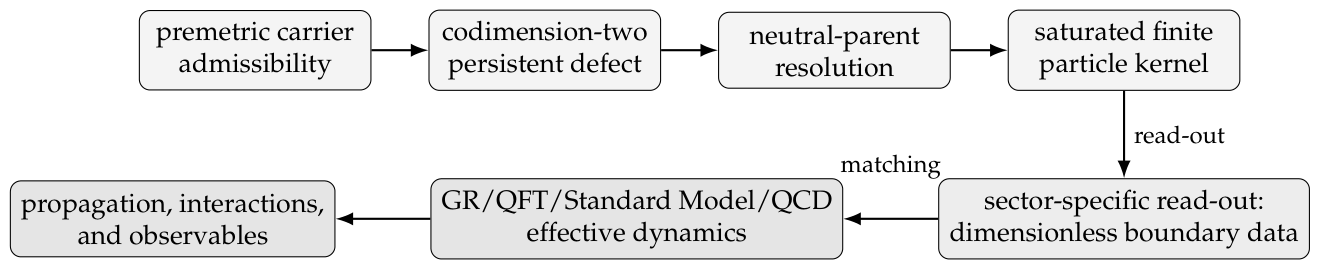
Figure 2.
Programme-level dependency map. The present gravitational result is a convergence test of an organic requirement chain. Existence and persistence jointly require an identity and a detecting complement; IRSP and saturation then constrain the platform, capacity, and particle strands before their defect–platform closure. The arrows show logical dependence rather than temporal evolution or empirical proof.
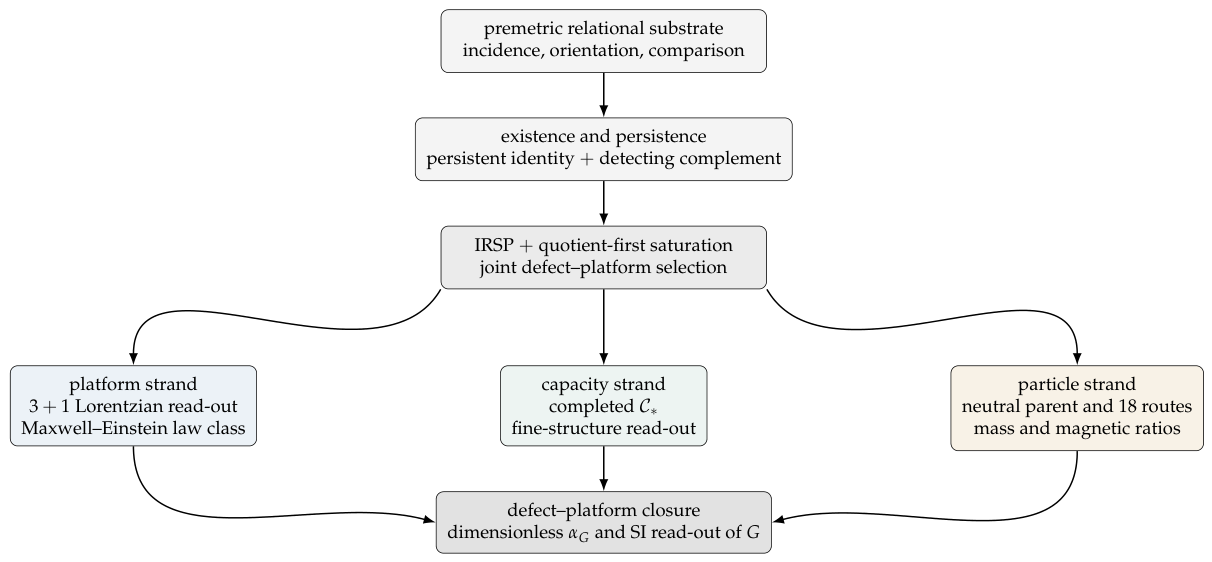
Figure 3.
Route-ledger representation of the primitive light-baryon quotient. Each row fixes the distinguished continuation grade , and each column is one unordered confined-side grade pair. The eighteen cells are therefore the quotient classes themselves, not spatial constituents, spin states, or repeated realizations. The right-hand ledger separates three logically different steps: quotient-first counting, the decomposition after complex linearization, and the conditional inheritance of one completed capacity by every primitive route. The non-geometric ledger makes no claim that the route classes occupy a physical lattice.
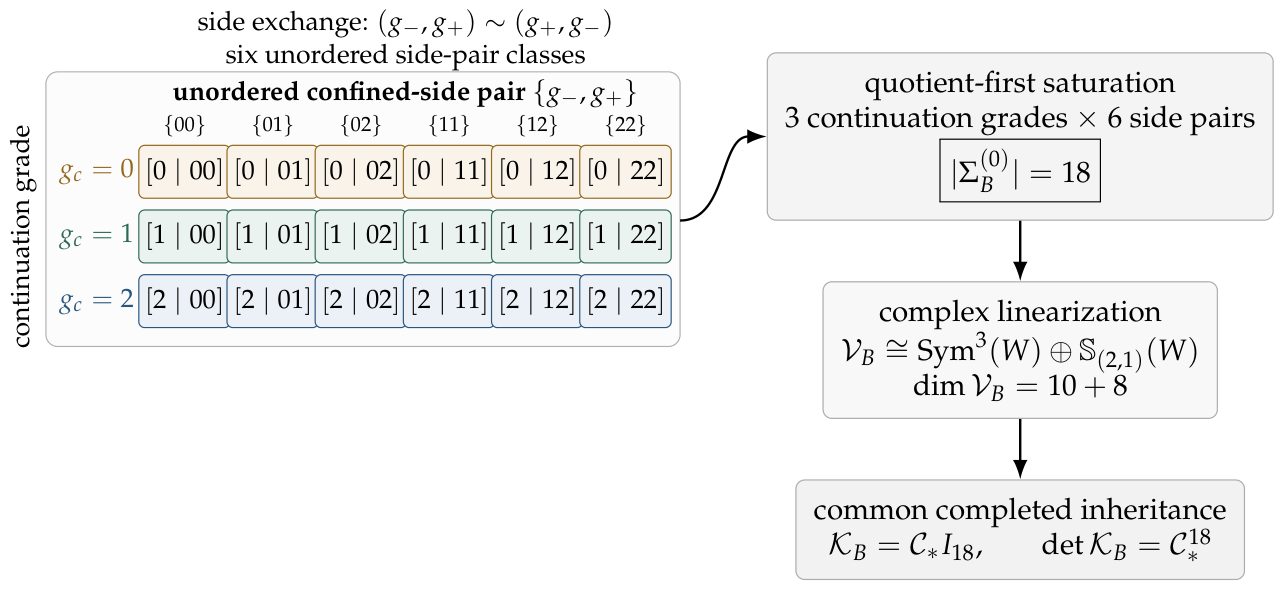
Figure 5.
Completion precedes factorization and sector differentiation. Electromagnetic phase and gravitational capacity are proposed as inequivalent read-outs of one completed pre-sector invariant; ordinary electromagnetism is not claimed to generate gravity dynamically.
Figure 5.
Completion precedes factorization and sector differentiation. Electromagnetic phase and gravitational capacity are proposed as inequivalent read-outs of one completed pre-sector invariant; ordinary electromagnetism is not claimed to generate gravity dynamically.
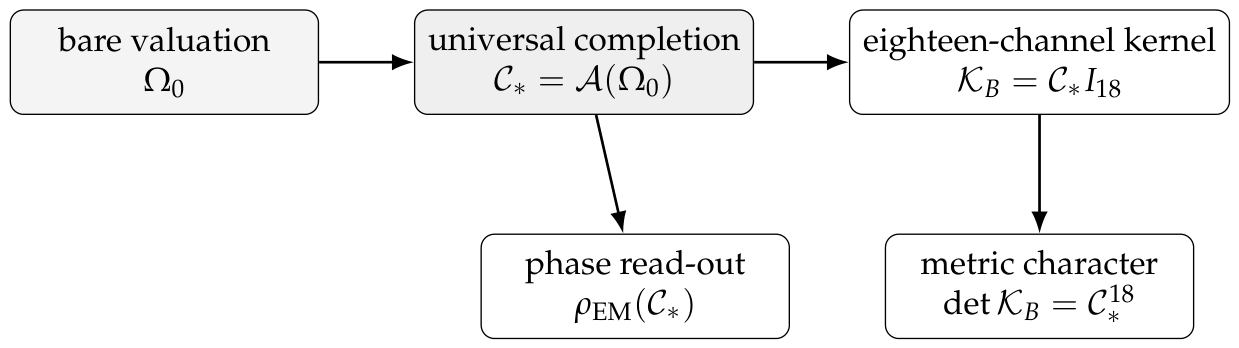
Figure 6.
Projection, finite coefficients, and indefinite continuation in the closed-neutral representation. Platform closure, projector ranks, and resummation are exact under the displayed finite grammars; the applicability of those grammars to the physical metric selector is the conditional premise.
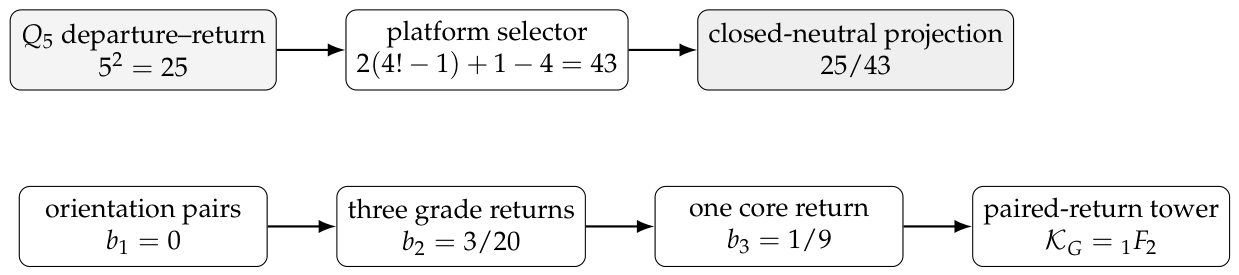
Figure 7.
Anchor-independent universality in the proposed reconstruction. Different mass read-outs and composites inherit the same metric normalization rather than selecting separate gravitational constants, and every completed state with nonzero total stress–energy sources the resulting common response.
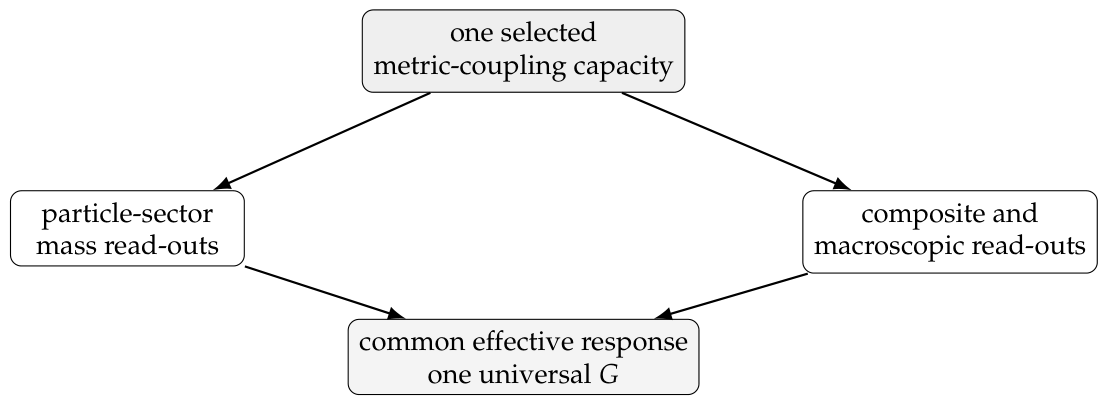
Table 1.
Roadmap of the seven principal bridge premises.
| Bridge premise | Why it is introduced | What follows, and what remains |
|---|---|---|
| Exact-one-fixed boundary | One fixed axis represents the minimal diagonal self-exposure of a rooted platform; summing all complementary motions in both orientations removes the presentation without choosing one representative. | The boundary map, rank, and quotient dimension are exact. Its identification with the microscopic carrier boundary remains conditional. |
| grade–role rule | Choosing one of d platform roles as the root leaves relative departure grades; common relabeling is not a new grade. | The route count and unique integer match are exact under this rule. Deriving the rule from the full carrier complex remains open. |
| correspondence | A derangement leaves no platform axis fixed and is therefore the natural defect-facing platform presentation; saturated baryon routes are the independently constructed primitive defect routes. | The two spaces both have dimension eighteen, but equality of dimension does not construct the physical map. Equivariance and naturality of remain bridge requirements. |
| Local cut moves and bridge | A closed meridian has no preferred cut. Moving the cut changes a local route description without changing the completed object, and may move the description across the defect–platform interface. | Once the stated reversible moves are admitted, connectedness, the full matrix algebra, and the scalar commutant are exact. Microscopic admissibility of the moves remains to be derived. |
| Common inheritance | Carrier completion is proposed to occur before charge, flavor, and mass read-outs distinguish the primitive routes. | The kernel is then . The ordering of completion before sector differentiation is a physical premise, not a consequence of the route count. |
| Determinant capacity | A universal positive scalar should be independent of basis and should multiply when independently completed channels are composed. | Those axioms uniquely give the determinant and hence . The claim that the metric-coupling read-out obeys these axioms remains conditional. |
| One-stratum return | Indefinite continuation is resolved into elementary steps, each adding one departure role and its paired return role while preserving the protected core. | The recurrence, series, Bessel form, and remainder bound are exact. The elementary attachment rule remains an upstream carrier premise. |
Table 2.
Reader’s guide to the reconstruction terminology used in this paper.
| Term | Meaning in this paper | It does not mean |
|---|---|---|
| Premetric | A logical layer at which incidence, return, orientation, admissibility, and equivalence are defined, but distance, clock time, and local field energy are not yet assigned. | A hidden metric spacetime or a short-distance material lattice. |
| Carrier | The underlying support through which persistent structure can eventually become externally readable as spacetime, phase, field, and particle behavior. | A mechanical ether, an extra substance inside spacetime, or a new particle species. |
| Reconstruction | Repeated admissible extension subject to compatibility under composition. | A time-stepping simulation, decay chain, or scattering history. |
| Persistent defect | A localized obstruction that remains distinguishable from the carrier by invariant complement data. | A classical hard core or a singularity inserted into a pre-existing spatial medium. |
| Closure and completion | The requirement that a route, branch, or monodromy return consistently as a whole, and the satisfaction of that requirement. | Spatial containment of smaller ordinary particles. |
| Reconstruction complement | The remaining branch or branches required to complete a specified neutral-parent relation. | Necessarily a one-particle antiparticle or the Standard Model charge-conjugation operation. |
| Stability of identity under arbitrarily long admissible continuation and under descent to the observable quotient. | A least-size or fewest-realizations principle. | |
| Saturation | Inclusion of every inequivalent admissible route with nonzero read-out after equivalence and cancellation are imposed. | Counting repeated representatives, or preferring the map with the fewest routes. |
| Neutral parent | The locally closed, unresolved polarization archetype before charged and sectoral manifestations separate. | An unstable neutral particle that decays into the observed species. |
| Read-out | A sector-specific map from invariant closure data to effective observable data. | A measurement collapse, a transition amplitude, or ordinary temporal evolution. |
| Coupling selector | The multiplicative read-out proposed to fix the universal dimensionless normalization . | A list of the objects that later appear as sources in the Einstein field equations. |
| Gravitational source read-out | The representation of a completed persistent system by its total effective energy–momentum tensor after metric read-out. | A second selection of G for each particle species or composite. |
| Completed capacity | A scalar response assigned after all admitted same-structure returns have been included. | A probability or a new force acting between the primitive routes. |
Table 3.
Published foundations of the neutral-parent reconstruction programme and their use in the present work. Numerical values are shown only where they clarify that the imported structures had quantitative applications before the present calculation. Here uses only the quoted experimental uncertainty. These values are descriptive normalized residuals, not theory significances, because no uncertainty has yet been assigned to the structural correspondence premises.
| Layer | Publication | Principal result | Role here |
|---|---|---|---|
| Topology | Topological classification, Int. J. Topol. 3, 8 [5] | Classification of admissible local reconstruction operations and the codimension of loop-readable persistence | Supplies the topology-first grammar and codimension-two motivation |
| Primary meridian | Local-to-global obstruction theory, Int. J. Topol. 3, 19 [6] | Transport of a protected primary meridian through compatible reconstruction | Supports cut transport, holonomy, and global persistence |
| Particle structure | Codimension-two carrier closure, Symmetry 18, 1154 [7] | Neutral-parent particle organization and the quantitative ratio , differing from the reference ratio by ppm, or | Supplies the common parent and the lepton–hadron resolution |
| Lepton ratios | Charged-lepton hierarchy, Symmetry 18, 1232 [8] | Structural ratios , , and , with reported residuals | Demonstrates a quantitative mass read-out from the same parent architecture |
| Carrier constant | Fine-structure capacity, Symmetry 18, 1418 [9] | Completed response , with exact all-order resummation and relative to CODATA 2022 | Provides the completed pre-sector capacity imported without gravitational retuning |
| Law selection | Reconstruction before dynamics, Symmetry 18, 1420 [10] | Conditional selection of a Lorentzian conformal platform, four-dimensional descent, Maxwell–Einstein dynamics, and the global Standard Model quotient | Provides the independently constructed metric platform and effective-law side |
| Quantum read-out | Reconstructional quantum theory of the present, Quantum Rep. 8, 86 [4] | Outcome-conditioned entangled read-out, quantum instruments, a conditional Born representation, and relativistic confluence | Locates the present metric-coupling selector upstream of quantum states and actualized records; it supplies no numerical input to G |
| Hadron ratios and spectrum | Light-baryon organization, Entropy 28, 1021 [11] | Eighteen primitive routes, canonical organization, structural nucleon ratios and , and seven refined centroids spanning to | Provides the frozen defect-route kernel and neutron mass anchor |
| Present work | Defect–platform gravitational co-selection | Platform closure , invariant projection, return completion, and ; the central-value residual corresponds nominally to using the CODATA uncertainty alone | New conditional derivation tested retrospectively against G |
Table 4.
Inputs fixed outside the present gravitational calculation.
| Input | Structural role | Use in this paper |
|---|---|---|
| Completed carrier capacity | Common completed eigenvalue of the neutral-parent carrier response | Base of the capacity character |
| Premetric baryon route theorem | Eighteen inequivalent primitive channels with a canonical split | Dimension of the complete kernel |
| Structural nucleon ratios | Closed-neutral and charged-boundary mass read-outs derived in the baryon analysis | Conversion between dimensionless capacity and SI G |
| Four-dimensional Lorentzian platform | Laws-side consequence of reciprocal reconstruction stability and read-out | Independent input to the platform closure count and a cross-check of Theorem 4 |
Table 5.
Derivation ledger for the gravitational capacity. “Exact” means exact under the structural object or principle named in the same row.
Table 5.
Derivation ledger for the gravitational capacity. “Exact” means exact under the structural object or principle named in the same row.
| Factor | Structural object | Operation | Logical source |
|---|---|---|---|
| 18 | Three-grade rooted bilateral route space | Side-exchange quotient and saturation | Published baryon theorem |
| Completed scalar on the 18-route module | Unique positive multiplicative character, | Common-inheritance principle plus exact theorem | |
| 43 | Four-dimensional platform chamber module | Two orientations, protected spine, and the explicit rank-four boundary quotient | Primitive boundary principle plus exact injectivity theorem |
| 25 | Fixed-axis return quotient | Explicit basis isomorphism with | Exact platform decomposition |
| Neutral summand of the complete platform selector | Unique normalized trace of a rank-25 projector | Connected local cut algebra and scalar commutant | |
| 0 | Orientation-odd first-order response | Reversal cancellation | Exact symmetry consequence |
| Three invariant types in twenty off-diagonal incidences | Reynolds projector and normalized trace | Exact under neutral interface symmetry | |
| Uniform protected diagonal in the core | Rank-one projector and normalized trace | Exact under core symmetry | |
| Protected core inside expanding return squares | One-stratum recurrence and exact resummation | Return-filtration principle |
Table 6.
Staged evaluation in the neutron representation. Relative differences use the CODATA 2022 central value in Equation 1.
Table 6.
Staged evaluation in the neutron representation. Relative differences use the CODATA 2022 central value in Equation 1.
| Retained structure | Relative difference | ||
|---|---|---|---|
| Full self-return tower |
Table 7.
Relative scales relevant to interpreting the numerical agreement. The tower-completion row is fixed by the recurrence and its exact resummation.
Table 7.
Relative scales relevant to interpreting the numerical agreement. The tower-completion row is fixed by the recurrence and its exact resummation.
| Source | Relative scale | Interpretation |
|---|---|---|
| Full-tower central-value residual | Numerical comparison only | |
| All-order change relative to the three-term truncation | Derived and bounded tower remainder | |
| Electron-mass standard uncertainty propagated through | Experimental input sensitivity | |
| CODATA 2022 relative standard uncertainty of G | Present experimental comparison scale |
Table 8.
Discrete ablation of the exponent and neutral-projector rank. The large changes show that the exact agreement is not insensitive to neighboring integer choices.
Table 8.
Discrete ablation of the exponent and neutral-projector rank. The large changes show that the exact agreement is not insensitive to neighboring integer choices.
| Diagnostic replacement | Resulting | Structural meaning |
|---|---|---|
| instead of | One primitive defect route removed | |
| Retained | Published eighteen-route kernel | |
| instead of | One additional primitive route inserted | |
| instead of | One neutral-return direction removed | |
| Retained | Rank-25 projector in the 43-module | |
| instead of | One neutral-return direction inserted |
Table 9.
Audit of the logical status of the main ingredients.
| Ingredient | Status | Remaining obligation |
|---|---|---|
| and | Published finite theorem under grade-local completion | Independent scrutiny of the baryon correspondence and saturation domain |
| Explicit and | Exact injectivity and rank theorem under the primitive exact-one-fixed boundary principle | Derive that primitive boundary identification from the microscopic carrier complex |
| , with dimensions | Exact decomposition theorem; the return summand has an explicit five-role basis | Independent verification of the declared platform chamber grammar |
| Exact integer theorem under the grade–role correspondence | Establish upstream rather than only in the selected case | |
| Primitive defect–platform co-selection; the return map is explicit but the baryon-to-defect-facing map remains physical | Construct the carrier-facing naturality map upstream | |
| and | Exact matrix-unit and normalized-trace theorems under the stated local moves | Derive the local generators and cross-sector portal from the full incidence complex |
| Exact uniqueness theorem under the three character axioms | Establish that the metric-coupling read-out obeys those axioms | |
| Exact consequence of the character theorem for | Establish common completed inheritance from the neutral-parent naturality map |
Table 10.
Audit of the logical status of the main ingredients (continued).
| Ingredient | Status | Remaining obligation |
|---|---|---|
| Selector/source separation | Declared read-out distinction consistent with the post-read-out effective theory | Derive both read-out maps and their compatibility with universal effective sourcing |
| Exact ranks of invariant projectors under the declared , , and reversal actions | Derive the complete symmetry action from the carrier incidence complex | |
| Bessel form | Exact recurrence, resummation, and remainder bound under one-stratum extension | Derive the one-stratum attachment and depth valuation upstream |
| Completed alpha tower and | Published structural output with exact all-order resummation | Independent scrutiny of the published carrier-incidence derivation |
| Nucleon ratios | Imported output of the complete baryon analysis | Independent scrutiny of the baryon read-out correspondence |
| Numerical agreement with G | Retrospective central-value comparison | Prospective measurement and prohibition of structural retuning |
Disclaimer/Publisher’s Note: The statements, opinions and data contained in all publications are solely those of the individual author(s) and contributor(s) and not of MDPI and/or the editor(s). MDPI and/or the editor(s) disclaim responsibility for any injury to people or property resulting from any ideas, methods, instructions or products referred to in the content. |
© 2026 by the authors. Licensee MDPI, Basel, Switzerland. This article is an open access article distributed under the terms and conditions of the Creative Commons Attribution (CC BY) license (http://creativecommons.org/licenses/by/4.0/).
Copyright: This open access article is published under a Creative Commons CC BY 4.0 license, which permit the free download, distribution, and reuse, provided that the author and preprint are cited in any reuse.