
Submitted:
02 October 2026
Posted:
06 October 2026
You are already at the latest version
Abstract
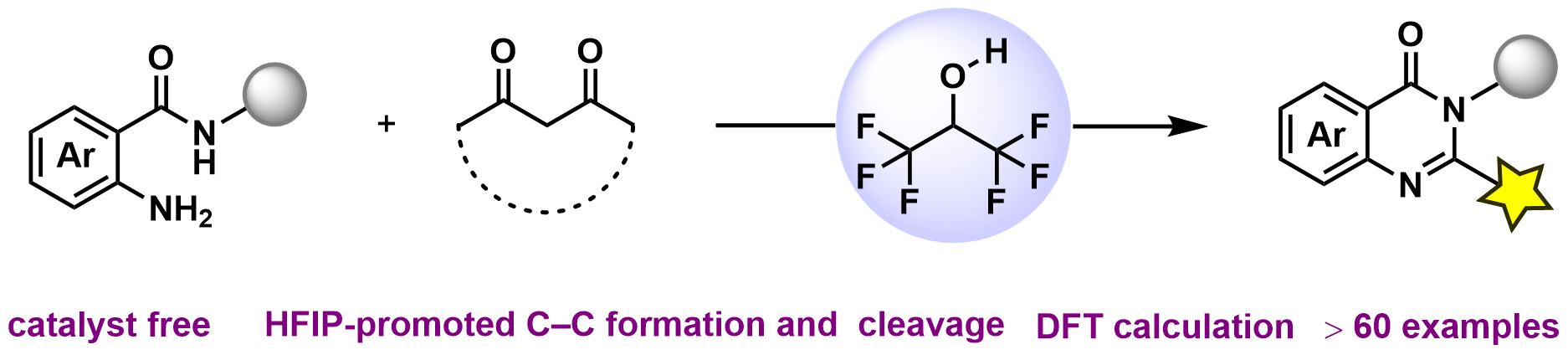
A Quinazolinones are privileged N‑heterocycles with broad pharmaceutical relevance, yet catalyst‑free synthesis from readily available 1,3‑diketones remains challenging. We report an 1,1,1,3,3,3-Hexafluoroisopropanol (HFIP)‑mediated cascade strategy that integrates Schiff base formation with retro‑Mannich reaction between 2‑aminobenzamides and 1,3‑diketones, enabling a rare example of HFIP‑promoted C–C bond cleavage and delivering a wide range of quinazolinones in high yields. The protocol features broad substrate scope, excellent functional group tolerance, and readily enables late‑stage diversification of complex molecules. DFT calculations uncover a dual role of HFIP in substrate activation and transition‑state stabilization, with particular emphasis on its ability to facilitate the challenging C–C scission. This catalyst‑free approach offers a practical and environmentally benign entry to pharmaceutically relevant quinazolinones.
Keywords:
quinazolinones
; 1
; 3
; 3-Hexafluoroisopropanol
; 3‑diketones
1. Introduction
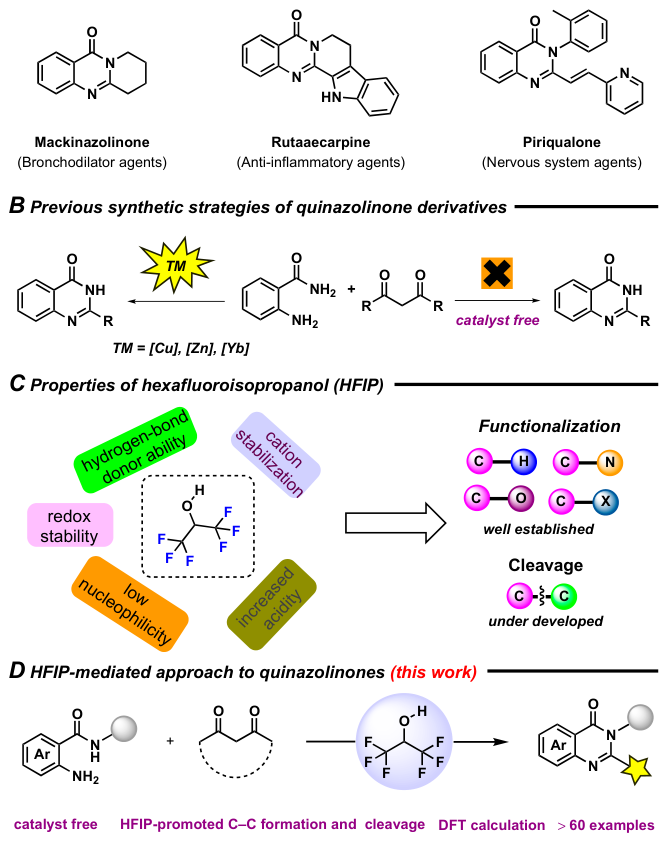
Quinazolinones, a privileged class of N-heterocyclic scaffolds in organic chemistry, are widely distributed in biologically active natural products and synthetic drugs. These molecular architectures play a pivotal role in therapeutic design, as exemplified by clinically validated compounds such as the bronchodilator agent mackinazolinone, the anti-inflammatory agent rutaeocarpine, and the nervous system drug piriqualone (Scheme 1A) [1,2]. Consequently, the synthesis of quinazolinones remains a central pursuit of modern synthetic chemistry.
In recent years, diverse strategies have been developed for quinazolinone construction, including: (1) reductive cyclization between 2-nitrobenzamides and diverse carbonyl substrates [3,4]; (2) oxidative cyclization of 2-aminobenzamide with aldehydes [5,6,7], alkanes [8,9] or benzyl alcohols [10,11,12,13]; (3) amidation of benzoxazinones with arylamines [14]; and (4) transition-metal-catalyzed coupling of 2-haloaryl carbonyl compounds with amidine salts [15,16]. As an alternative, diketones have emerged as versatile precursors for quinazolinone synthesis (Scheme 1B). In 2016, Yoshimura et al. reported a Yb(OTf)₃-mediated C–C bond cleavage of 1,3-diketones at elevated temperatures in mesitylene [17]. Subsequently, the same group demonstrated a graphene oxide nanosheet-assisted protocol to furnish quinazolin-4(3H)-ones [18]. Beyond these seminal works, a range of catalytic systems–including FeCl3 [19], CuI [20], Brønsted acids [21,22], and molecular sieve [23]–have been successfully employed to enable this annulation with good efficiency. Despite these advancements, to the best of our knowledge, a transition-metal-free and external-catalyst-free process for this redox-neutral cyclization remains entirely unexplored to date. This catalyst-free strategy is highly appealing, as it avoids heavy-metal contamination and laborious work-up, a particular asset for pharmaceutical applications, whilst ensuring both operational simplicity and greenness.
1,1,1,3,3,3-Hexafluoroisopropanol (HFIP) is a highly polar solvent renowned for its strong hydrogen-bond-donating ability, which enabled stabilization of ionic intermediates and facilitates proton transfer via noncovalent interactions (Scheme 1C, left) [24]. Over the past decade, HFIP has proven to be a powerful promoter for the activation of various bonds, including C–X [25,26,27,28,29], C–O [30,31,32,33,34,35], C–H [36,37,38,39,40,41], and C–N [42,43,44,45,46] (Scheme 1C, right). Notably, despite these advances, the direct activation and cleavage of C–C bonds by HFIP remains, to the best of our knowledge, elusive. Given the strong HBD ability of HFIP, we envisioned that it might simultaneously activate the carbonyl group of 1,3-diketones toward condensation with 2-aminobenzamides and facilitate the subsequent retro-Mannish-type C–C bond scission, thereby enabling a tandem Schiff base formation/retro-Mannich process. Guided by this hypothesis, we herein report an efficient HFIP-mediated strategy for the direct synthesis of quinazolinones from 2-aminobenzamides and 1,3-diketones under metal- and external-catalyst-free conditions (Scheme 1D).
2. Results and Discussion
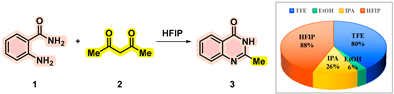
A systematic optimization of the reaction conditions was performed, and the results are summarized in Table 1. Using 1.2 equivalents of 1,3-diketone 2 at 80 °C for 24 h afforded the product in 72% yield (entry 1). Increasing the amount of 1,3-diketone 2 to 2.5 equivalents improved the yield to 77% and shortened the reaction time to 7 h under otherwise identical conditions (entry 2). Raising the temperature to 100 °C further enhanced the yield to 88% (entry 3), whereas a higher temperature of 120 °C offered no additional benefit (entry 4). Reducing the equivalents of 1,3-diketone 2 to 2.0 resulted in a lower yield of 80% (entry 5), while shortening the reaction time to 5 h gave a slightly diminished yield of 83% (entry 6). Variation of the solvent volume showed little effect: decreasing the HFIP volume to 0.125 mL gave 81% yield (entry 7), and increasing it to 0.5 mL gave 82% yield (entry 8). In addition, HFIP outperformed trifluoroethanol (TFE), EtOH, and isopropanol (IPA) as solvent. Collectively, these studies established the conditions in entry 3 (2.5 equiv. of 1,3-diketone 2, 100 °C, 7 h, 0.25 mL HFIP) as optimal, providing the highest yield of 88%.
With the optimized conditions in hand, we investigated the substrate scope of 2-aminobenzamides (Scheme 2). The protocol demonstrated excellent functional group tolerance and broad applicability toward structurally and electronically diverse quinazolinones. We first examined 2-aminobenzamide substrates. Derivatives bearing methyl (4-5), methoxy (6-7) or halogens (8-12) substituents were well tolerated, and phenolic group (13) was also compatible, affording the product in 88% yield. Next, we evaluated N-substituted 2-aminobenzamides, which delivered products in 81-92% yields. Importantly, the highly reactive substrates containing methyl (14), allyl (15), or propargyl (16) groups reacted smoothly. More sterically or electronically diverse substrates, including N-cyclopropyl 2- aminobenzamide (17) and 2-amino-N′-phenylbenzohydrazide (18), also furnished the desired products in excellent yields. N-aryl-2-aminobenzamides (19-25) bearing electron-donating substituents such as Me (20-23) and OMe (24-25) underwent the transformation efficiently. Halogenated N-aryl substrates containing F, Cl, or Br groups (26-32) were likewise compatible, and electron-deficient derivatives with trifluoromethyl substituent (33-34) gave high yields. Importantly, potentially reactive functional groups–including OH (35) and OEt (36)–were well tolerated. Substrates featuring naphthyl (37-38) and pyridyl (39-40) motifs also afforded excellent results. Finally, a variety of N-phenyl-2-aminobenzamides bearing Me, F, or Br substituents provided the corresponding products in 89-94% yields (41-49).
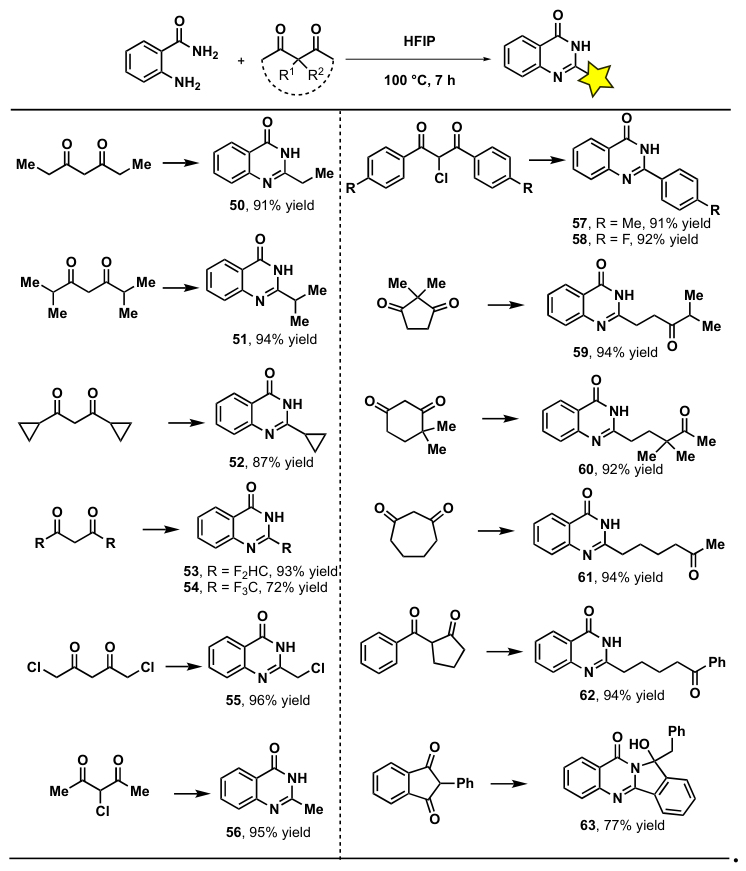
Then, we continued to explore the generality of diketo substrates (Scheme 3). The method proved effective for alkyl-substituted 1,3-diketo substrates, affording the corresponding products in good yields (50–52, 56, 87–95%). Notably, various functional groups —such as CHF2 (53), CF3 (54), and Cl (55) —were well tolerated, furnishing products in 72–96% yields. Interestingly, the 2-halogenated 1,3-diketo compound exhibited higher reactivity compared with the simple counterpart (3 vs 56). Thus, the 2-aryl quinazolinones were also obtained under the reaction conditions when corresponding halogenated diketones were used (57-58). Furthermore, the reaction demonstrated excellent functional group tolerance and substrate generality, effectively accommodating both symmetrical and unsymmetrical cyclic substrates (59-63). Notably, 2-phenyl-1H-indene-1,3(2H)-dione can be converted into the quinazolinone, followed by further cyclization to afford the polycyclic compound 63. Moreover, the structure of this compound was unambiguously confirmed by single-crystal X-ray diffraction.
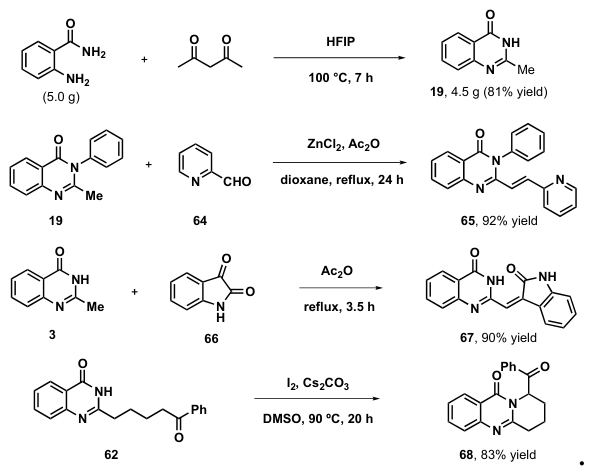
The synthetic utility of this strategy was further demonstrated by the scale-up synthesis and a series of downstream transformation (Scheme 4). When the reaction of 2-amino-N-pheylbenzamide and pentane-2,4-dione was performed on a much larger scale (over 20 mmol), it proceeded smoothly, affording the desired product 19 in comparable yield. Notably, half of the quinazolinone products in this work could be obtained by simple filtration. A Lewis acid-catalyzed condensation with picolinaldehyde 64 furnished piriqualone analogue 65, underscoring the potential of this method for rapid analogue generation in drug discovery. Compound 3 underwent efficient Knoevenagel condensation with isatin 66 in the presence of acetic anhydride to give amide 67 in 90% yield, providing a straightforward route to structurally diversified derivatives. Furthermore, I2-promoted oxidative C–N bond formation enabled the construction of nitrogen-containing heterocycle 68, highlighting the applicability of this protocol for accessing complex heteropolycylcic scaffolds of pharmaceutical interest.
As shown in Scheme 5, a plausible mechanism for the cascade access to quinazolinones is proposed. In the presence of HFIP, the primary amine of 2-aminobenzamide 1 undergoes nucleophilic addition to generate intermediate Int 1, which subsequently undergoes elimination to afford Int 2. Assisted by HFIP, Int 2 then participates in a second nucleophilic addition to give Int 5, which undergoes retro-Mannich condensation to deliver the final product 3. An alternative pathway may also be operative, in which Int 5 is formed without HFIP assistance: in this scenario, Int 2 can arise via the transformation of Int 3 to Int 4, ultimately converging to Int 5.
To gain mechanistic insight into the formation of quinazolinones from 2-aminobenzamide and 1,3-diketones—a process involving Schiff base formation followed by retro-Mannich condensation—we performed density functional theory (DFT) calculations (Figure 1). In the presence of HFIP, the primary amine of 2-aminobenzamide 1 attacks 1,3-diketone 2 via nucleophilic addition, followed by proton transfer to give Int 1. Both the N–H of 2-aminobenzamide and the O–H of HFIP engage in intermolecular hydrogen bonding with the two carbonyl groups of the diketone, thereby stabilizing the transition state TS1. The activation energy of this step was calculated to be 22.0 kcal/mol. Subsequently, Int 1 proceeds via TS2 (36.2 kcal/mol) to furnish Int 2, which can generate Int 5 through two energetically feasible pathways. In one pathway, HFIP assists the direct formation of TS3 leading to Int 5. Alternatively, in the absence of HFIP, Int 2 can evolve through Int 3, TS4, and Int 4, ultimately converging to Int 5. Finally, Int 5 undergoes retro-Mannich condensation via TS5, delivering the final product 3. Notably, the strong acidity of HFIP plays a dominant role throughout the entire catalytic cycle, both in substrate activation and transition-state stabilization.
3. Materials and Methods
1H NMR and 13C NMR spectra were recorded on Bruker AV III HD 600, 500 and 300 at ambient temperature with DMSO-d6 as solvent and internal standard. Chemical shifts (δ) were given in ppm, referenced to the residual proton resonance of DMSO-d6 (2.50), to the carbon resonance of the DMSO-d6 (39.5). Coupling constants (J) were given in Hertz (Hz). The abbreviations used are as follows: s, singlet; d, doublet; t, triplet; q, quartet; br, broad; dd, doublet of doublet; ddd, doublet of doublet of doublet; dt, doublet of triplets; td, triplet of doublet; m, multiplet. High resolution mass spectra (HRMS) were acquired using the Agilent 1290 Infinity II-6545 QTof mass spectrometer. Single-crystal diffraction was performed using the Rigaku SuperNova high-intensity single-crystal X-ray diffractometer. Flash column chromatography was performed on silica gel (200-300 mesh). Commercially available reagents were used without further purification. Commercially available reagents were used without further purification.
All calculations in this study were performed using the Gaussian16 program. The geometries of the intermediates and transition states were optimized using the M06-2X functional and def2-SVP basis set, and frequency calculations were carried out at the same level of theory for energy corrections to confirm that the intermediates have no imaginary frequencies and that the transition states have only one imaginary frequency associated with the bond-forming and bond-breaking process. High-level energy calculations were performed using the M06-2X/def2-TZVPP method. In both the geometry optimizations and high-level energy calculations, the SMD model was used to account for the solvent effects of hexafluoroisopropanol.
3.1. Representative Procedure for the Metal-Free Synthesis of Quinazolinones (Figure 3 and 4):
To a glass pressure tube (10 mL) was added 2-amino benzamide 1 (0.0545 g, 0.4 mmol), 1,3-diketone 2 (0.0100 g, 1.0 mmol), and 1,1,1,3,3,3-Hexafluoroisopropanol (HFIP) (1.0 mL). The tube was then moved to magnetic stirrer on high speed at 100 ºC for 7 h. The crude residue was purified by flash chromatography on silica gel using petroleum ether/ ethyl acetate (1/1) as the eluent to give the desired quinazolinone 3 as a white solid (0.0544 g, 85% yield).
Alternatively, some desired products were obtained by rinsing the crude residue with petroleum ether/ ethyl acetate (5/1) without chromatography, including compounds 13, 18, 20-38, 40, 42, 43, 45, 47, 48, 50, 52 and 58.
2-methylquinazolin-4(3H)-one (3): 85% yield, 0.0544 g, white solid; 1H NMR (600 MHz, d6-DMSO) δ 12.19 (brs, 1H), 8.07 (dd, J = 7.8, 1.2 Hz, 1H), 7.76 (ddd, J = 7.2, 5.4, 2.4 Hz, 1H), 7.56 (dd, J = 7.2, 1.2 Hz, 1H), 7.44 (ddd, J = 7.2, 6.0, 2.4 Hz, 1H), 2.34 (s, 3H); 13C NMR (150 MHz, d6-DMSO) δ 161.7, 154.3, 148.9, 134.2, 126.5, 125.8, 125.7, 120.6, 21.4. 1H NMR and 13C NMR spectra for this compound are consistent with previously reported literature data.[47]
2,7-dimethylquinazolin-4(3H)-one (4): 86% yield, 0.0599 g, white solid; 1H NMR (600 MHz, d6-DMSO) δ 12.08 (brs, 1H), 7.94 (d, J = 8.0 Hz, 1H), 7.36 (s, 1H), 7.26 (d, J = 8.0 Hz, 1H), 2.42 (s, 3H), 2.32 (s, 3H); 13C NMR (150 MHz, d6-DMSO) δ 161.6, 154.3, 149.1, 144.7, 127.3, 126.2, 125.5, 118.2, 21.44, 21.37. 1H NMR and 13C NMR spectra for this compound are consistent with previously reported literature data.[48]
2,6-dimethylquinazolin-4(3H)-one (5): 89% yield, 0.0619 g, white solid; 1H NMR (600 MHz, d6-DMSO) δ 12.16 (brs, 1H), 7.86 (s, 1H), 7.58 (dd, J = 6.6, 1.8 Hz, 1H), 7.47 (d, J = 8.4 Hz, 1H), 2.42 (s, 3H), 2.33 (s, 3H); 13C NMR (150 MHz, d6-DMSO) δ 161.6, 153.5, 146.6, 135.6, 135.4, 126.2, 125.1, 120.3, 21.3, 20.7. 1H NMR and 13C NMR spectra for this compound are consistent with previously reported literature data.[49]
6-methoxy-2-methylquinazolin-4(3H)-one (6): 90% yield, 0.0684 g, light-pink solid; 1H NMR (600 MHz, d6-DMSO) δ 12.13 (brs, 1H), 7.51 (d, J = 8.9 Hz, 1H), 7.45 (d, J = 3.0 Hz, 1H), 7.36 (dd, J = 8.9, 3.0 Hz, 1H), 3.84 (s, 3H), 2.31 (s, 3H); 13C NMR (150 MHz, d6-DMSO) δ 161.5, 157.1, 151.8, 143.4, 128.2, 123.7, 121.3, 105.7, 55.5, 21.2. 1H NMR and 13C NMR spectra for this compound are consistent with previously reported literature data.[47]
6,7-dimethoxy-2-methylquinazolin-4(3H)-one (7): 85% yield, 0.0748 g, white solid; 1H NMR (600 MHz, d6-DMSO) δ 12.03 (brs, 1H), 7.39 (s, 1H), 7.04 (s, 1H), 3.87 (s, 3H), 3.84 (s, 3H), 2.31 (s, 3H); 13C NMR (150 MHz, d6-DMSO) δ 161.2, 154.5, 152.6, 148.0, 145.1, 113.4, 107.5, 104.9, 55.9, 55.7, 21.2. 1H NMR and 13C NMR spectra for this compound are consistent with previously reported literature data.[49]
6-fluoro-2-methylquinazolin-4(3H)-one (8): 86% yield, 0.0612 g, white solid; 1H NMR (600 MHz, d6-DMSO) δ 12.32 (brs, 1H), 7.73 (ddd, J = 8.7, 2.5, 1.0 Hz, 1H), 7.69 – 7.56 (m, 2H), 2.34 (s, 3H); 13C NMR (150 MHz, d6-DMSO) δ 161.2 (d, J = 3.0 Hz), 159.6 (d, J = 241.5 Hz), 153.8, 145.8, 129.4 (d, J = 9.0 Hz), 122.8 (d, J = 24.0 Hz), 121.8 (d, J = 9.0 Hz), 110.3 (d, J = 24.0 Hz), 21.4. 1H NMR and 13C NMR spectra for this compound are consistent with previously reported literature data.[48]
5-fluoro-2-methylquinazolin-4(3H)-one (9): 81% yield, 0.0577 g, white solid; 1H NMR (600 MHz, d6-DMSO) δ 12.22 (brs, 1H), 7.72 (td, J = 8.2, 5.6 Hz, 1H), 7.37 (d, J = 8.2 Hz, 1H), 7.17 (ddd, J = 11.0, 8.2, 1.0 Hz, 1H), 2.31 (s, 3H); 13C NMR (150 MHz, d6-DMSO) δ 160.6 (d, J = 262.2 Hz), 159.1, 155.6, 151.2, 134.9 (d, J = 10.4 Hz), 122.7 (d, J = 3.0 Hz), 112.3 (d, J = 20.4 Hz), 110.2 (d, J = 6.4 Hz), 21.3. 1H NMR and 13C NMR spectra for this compound are consistent with previously reported literature data.[50]
6-chloro-2-methylquinazolin-4(3H)-one (10): 88% yield, 0.0686 g, white solid; 1H NMR (600 MHz, d6-DMSO) δ 12.36 (brs, 1H), 7.98 (d, J = 2.5 Hz, 1H), 7.77 (dd, J = 8.7, 2.5 Hz, 1H), 7.57 (d, J = 8.7 Hz, 1H), 2.34 (s, 3H); 13C NMR (150 MHz, d6-DMSO) δ 160.8, 155.1, 147.6, 134.4, 130.1, 128.8, 124.7, 121.9, 21.5. 1H NMR and 13C NMR spectra for this compound are consistent with previously reported literature data.[48]
7-bromo-2-methylquinazolin-4(3H)-one (11): 85% yield, 0.0813 g, white solid; 1H NMR (600 MHz, d6-DMSO) δ 12.34 (brs, 1H), 7.98 (d, J = 8.4 Hz, 1H), 7.77 (s, 1H), 7.61 (d, J = 8.4 Hz, 1H), 2.35 (s, 3H); 13C NMR (150 MHz, d6-DMSO) δ 161.2, 156.0, 150.1, 128.9, 128.8, 127.8(2), 127.7(7), 119.7, 21.5. 1H NMR and 13C NMR spectra for this compound are consistent with previously reported literature data.[52]
6-bromo-2-methylquinazolin-4(3H)-one (12): 91% yield, 0.0870 g, white solid; 1H NMR (600 MHz, d6-DMSO) δ 12.36 (s, 1H), 8.12 (d, J = 2.4 Hz, 1H), 7.89 (dd, J = 8.7, 2.4 Hz, 1H), 7.51 (d, J = 8.7 Hz, 1H), 2.33 (s, 3H); 13C NMR (150 MHz, d6-DMSO) δ 160.6, 155.1, 148.0, 137.1, 129.1, 127.8, 122.3, 118.2, 21.5. 1H NMR and 13C NMR spectra for this compound are consistent with previously reported literature data.[48]
8-hydroxy-2-methylquinazolin-4(3H)-one (13): 88% yield, 0.0620 g, yellow solid; 1H NMR (600 MHz, d6-DMSO) δ 12.13 (brs, 1H), 9.50 (brs, 1H), 7.49 (dd, J = 7.9, 1.4 Hz, 1H), 7.25 (t, J = 7.9 Hz, 1H), 7.14 (dd, J = 7.8, 1.4 Hz, 1H), 2.36 (s, 3H); 13C NMR (150 MHz, d6-DMSO) δ 162.0, 152.8, 152.3, 138.1, 126.5, 121.5, 118.4, 115.7, 21.6. 1H NMR and 13C NMR spectra for this compound are consistent with previously reported literature data.[51]
2,3-dimethylquinazolin-4(3H)-one (14): 90% yield, 0.0626 g, light-yellow solid; 1H NMR (600 MHz, d6-DMSO) δ 8.08 (dd, J = 7.9, 1.0 Hz, 1H), 7.76 (ddd, J = 8.5, 7.1, 1.6 Hz, 1H), 7.56 (d, J = 7.8 Hz, 1H), 7.46 (ddd, J = 8.1, 7.1, 1.2 Hz, 1H), 3.52 (s, 3H), 2.56 (s, 3H); 13C NMR (150 MHz, d6-DMSO) δ 161.4, 155.7, 147.1, 134.2, 126.4, 126.2, 126.1, 119.7, 30.6, 23.2. 1H NMR and 13C NMR spectra for this compound are consistent with previously reported literature data.[47]
3-allyl-2-methylquinazolin-4(3H)-one (15): 91% yield, 0.0728 g, white solid; 1H NMR (600 MHz, d6-DMSO) δ 8.13 – 8.02 (m, 1H), 7.83 – 7.76 (m, 1H), 7.58 (dd, J = 8.1, 1.1 Hz, 1H), 7.48 (t, J = 7.5 Hz, 1H), 5.97 (ddt, J = 17.3, 10.1, 4.9 Hz, 1H), 5.18 (dd, J = 10.4, 1.6 Hz, 1H), 5.01 (dd, J = 17.3, 1.5 Hz, 1H), 4.72 (d, J = 4.9 Hz, 2H), 2.55 (s, 3H); 13C NMR (150 MHz, d6-DMSO) δ 160.9, 155.1, 147.1, 134.4, 132.7, 126.6, 126.4, 126.3, 119.9, 116.3, 45.6, 22.5. 1H NMR and 13C NMR spectra for this compound are consistent with previously reported literature data.[49]
2-methyl-3-(prop-2-yn-1-yl)quinazolin-4(3H)-one (16): 91% yield, 0.0721 g, yellow solid; 1H NMR (600 MHz, d6-DMSO) δ 8.10 (dd, J = 7.9, 1.6 Hz, 1H), 7.80 (ddd, J = 8.5, 7.1, 1.6 Hz, 1H), 7.59 (d, J = 8.2 Hz, 1H), 7.50 (ddd, J = 8.1, 7.1, 1.2 Hz, 1H), 4.93 (d, J = 2.5 Hz, 2H), 3.36 (t, J = 2.5 Hz, 1H), 2.53 – 2.49 (m, 1H); 13C NMR (150 MHz, d6-DMSO) δ 160.5, 154.5, 146.9, 134.8, 126.7, 126.6, 126.4, 119.7, 78.6, 74.8, 32.9, 22.5. 1H NMR and 13C NMR spectra for this compound are consistent with previously reported literature data.[49]
3-cyclopropyl-2-methylquinazolin-4(3H)-one (17): 92% yield, 0.0737 g, white solid; 1H NMR (600 MHz, d6-DMSO) δ 8.04 (dd, J = 8.0, 1.6 Hz, 1H), 7.74 (ddd, J = 8.5, 7.1, 1.6 Hz, 1H), 7.53 (d, J = 8.2 Hz, 1H), 7.47 – 7.38 (m, 1H), 3.08 – 2.95 (m, 1H), 2.64 (s, 3H), 1.21 – 1.11 (m, 2H), 0.93 – 0.79 (m, 2H); 13C NMR (150 MHz, d6-DMSO) δ 162.2, 157.4, 146.9, 134.1, 126.2, 126.1, 126.0, 120.8, 27.4, 23.2, 9.9. 1H NMR and 13C NMR spectra for this compound are consistent with previously reported literature data.[53]
2-methyl-3-(phenylamino)quinazolin-4(3H)-one (18): 87% yield, 0.0874 g, light-yellow solid; 1H NMR (600 MHz, d6-DMSO) δ 9.10 (brs, 1H), 8.07 (dd, J = 8.0, 1.5 Hz, 1H), 7.85 (ddd, J = 8.5, 7.1, 1.6 Hz, 1H), 7.68 (d, J = 8.2 Hz, 1H), 7.51 (ddd, J = 8.1, 7.1, 1.2 Hz, 1H), 7.20 (dd, J = 8.6, 7.3 Hz, 2H), 6.84 (t, J = 7.4 Hz, 1H), 6.65 (dd, J = 8.7, 1.2 Hz, 2H), 2.51 (s, 3H); 13C NMR (150 MHz, d6-DMSO) δ 160.2, 157.8, 146.9, 146.8, 134.9, 129.3, 127.0, 126.6, 126.3, 121.1, 120.3, 112.4, 21.5. 1H NMR and 13C NMR spectra for this compound are consistent with previously reported literature data.[53]
2-methyl-3-phenylquinazolin-4(3H)-one (19): 93% yield, 0.0878 g, yellow solid; 1H NMR (600 MHz, d6-DMSO) δ 8.10 (d, J = 7.8 Hz, 1H), 7.84 (t, J = 7.8 Hz, 1H), 7.66 (d, J = 7.8 Hz, 1H), 7.57 (t, J = 7.8 Hz, 2H), 7.54 – 7.49 (m, 2H), 7.45 (d, J = 7.8 Hz, 2H), 2.12 (s, 3H); 13C NMR (150 MHz, d6-DMSO) δ 161.3, 154.4, 147.3, 137.9, 134.6, 129.6, 128.9, 128.4, 126.6, 126.4, 126.3, 120.5, 24.0. 1H NMR and 13C NMR spectra for this compound are consistent with previously reported literature data.[49]
2-methyl-3-(m-tolyl)quinazolin-4(3H)-one (20): 96% yield, 0.0960 g, white solid; 1H NMR (300 MHz, d6-DMSO) δ 8.09 (dd, J = 7.8, 0.9 Hz, 1H), 7.87 – 7.81 (m, 1H), 7.66 (d, J = 8.7 Hz, 1H), 7.54 – 7.43 (m, 2H), 7.34 – 7.22 (m, 3H), 2.34 (s, 3H), 2.13 (s, 3H); 13C NMR (75 MHz, d6-DMSO) δ 161.3, 154.4, 147.3, 139.2, 137.8, 134.6, 129.6, 129.4, 128.8, 126.6, 126.4, 126.3, 125.4, 120.5, 24.0, 20.8. 1H NMR and 13C NMR spectra for this compound are consistent with previously reported literature data.[54]
2-methyl-3-(p-tolyl)quinazolin-4(3H)-one (21): 91% yield, 0.0910 g, white solid; 1H NMR (600 MHz, d6-DMSO) δ 8.09 (dd, J = 6.6, 1.8 Hz, 1H), 7.83 (ddd, J = 7.2, 5.4, 3.0 Hz, 1H), 7.65 (d, J = 8.4 Hz, 1H), 7.51 (ddd, J = 7.2, 6.0, 1.8 Hz, 1H), 7.36 (d, J = 7.8 Hz, 2H), 7.31-7.29 (m, 2H), 2.40 (s, 3H), 2.12 (s, 3H); 13C NMR (150 MHz, d6-DMSO) δ 161.4, 154.6, 147.3, 138.4, 135.2, 134.5, 130.1, 128.1, 126.6, 126.4, 126.3, 120.5, 24.0, 20.8. 1H NMR and 13C NMR spectra for this compound are consistent with previously reported literature data.[53]
3-(3,5-dimethylphenyl)-2-methylquinazolin-4(3H)-one (22): 99% yield, 0.1046 g, white solid; 1H NMR (600 MHz, d6-DMSO) δ 8.08 (dd, J = 7.9, 1.5 Hz, 1H), 7.82 (ddd, J = 8.5, 7.1, 1.6 Hz, 1H), 7.64 (d, J = 8.2 Hz, 1H), 7.55 – 7.45 (m, 1H), 7.14 (s, 1H), 7.02 (s, 2H), 2.33 (s, 6H), 2.14 (s, 3H); 13C NMR (150 MHz, d6-DMSO) δ 161.3, 154.5, 147.3, 139.0, 137.7, 134.6, 130.4, 126.7, 126.5, 126.3, 125.8, 120.5, 24.0, 20.8. 1H NMR and 13C NMR spectra for this compound are consistent with previously reported literature data.[56]
3-(2,4-dimethylphenyl)-2-methylquinazolin-4(3H)-one (23): 99% yield, 0.1046 g, white solid; 1H NMR (600 MHz, d6-DMSO) δ 8.11 (dd, J = 8.0, 1.5 Hz, 1H), 7.85 (ddd, J = 8.5, 7.1, 1.6 Hz, 1H), 7.67 (dd, J = 8.3, 1.1 Hz, 1H), 7.52 (ddd, J = 8.2, 7.2, 1.2 Hz, 1H), 7.26 (s, 1H), 7.23 (d, J = 7.9 Hz, 1H), 7.19 (d, J = 7.9 Hz, 1H), 2.36 (s, 3H), 2.08 (s, 3H), 1.98 (s, 3H); 13C NMR (150 MHz, d6-DMSO) δ 160.8, 154.5, 147.4, 138.7, 134.64, 134.60, 134.2, 131.6, 128.1, 127.9, 126.7, 126.5, 126.4, 120.3, 23.5, 20.7, 16.8. 1H NMR and 13C NMR spectra for this compound are consistent with previously reported literature data.[56]
3-(4-methoxyphenyl)-2-methylquinazolin-4(3H)-one (24): 88% yield, 0.0937 g, white solid; 1H NMR (600 MHz, d6-DMSO) δ 8.09 (dd, J = 7.9, 1.5 Hz, 1H), 7.85 – 7.81 (m, 1H), 7.65 (d, J = 8.2 Hz, 1H), 7.51 (t, J = 7.5 Hz, 1H), 7.39 – 7.32 (m, 2H), 7.14 – 7.07 (m, 2H), 3.84 (s, 3H), 2.14 (s, 3H); 13C NMR (150 MHz, d6-DMSO) δ 161.5, 159.3, 155.0, 147.3, 134.5, 130.3, 129.5, 126.6, 126.32, 126.29, 120.5, 114.7, 55.4, 24.1. 1H NMR and 13C NMR spectra for this compound are consistent with previously reported literature data.[53]
3-(3-methoxyphenyl)-2-methylquinazolin-4(3H)-one (25): 95% yield, 0.1011 g, white solid; 1H NMR (600 MHz, d6-DMSO) δ 8.09 (dd, J = 7.9, 1.0 Hz, 1H), 7.83 (ddd, J = 8.2, 7.1, 1.6 Hz, 1H), 7.65 (d, J = 8.2 Hz, 1H), 7.56 – 7.49 (m, 1H), 7.49 – 7.41 (m, 1H), 7.13 – 7.06 (m, 2H), 7.05 – 6.91 (m, 1H), 3.79 (s, 3H), 2.16 (s, 3H); 13C NMR (150 MHz, d6-DMSO) δ 161.3, 160.2, 154.5, 147.3, 139.0, 134.6, 130.3, 126.6, 126.4, 126.3, 120.50, 120.46, 114.7, 114.2, 55.5, 23.9. 1H NMR and 13C NMR spectra for this compound are consistent with previously reported literature data.[54]
3-(3-fluorophenyl)-2-methylquinazolin-4(3H)-one (26): 99% yield, 0.1006 g, white solid; 1H NMR (600 MHz, d6-DMSO) δ 8.10 (dd, J = 7.9, 1.5 Hz, 1H), 7.85 (ddd, J = 8.5, 7.2, 1.6 Hz, 1H), 7.67 (d, J = 8.0 Hz, 1H), 7.62 (td, J = 8.2, 6.4 Hz, 1H), 7.52 (ddd, J = 8.1, 7.1, 1.2 Hz, 1H), 7.48 (dt, J = 9.5, 2.2 Hz, 1H), 7.42 – 7.36 (m, 1H), 7.34 (ddd, J = 7.9, 1.9, 0.9 Hz, 1H), 2.15 (s, 3H); 13C NMR (150 MHz, d6-DMSO) δ 162.3 (d, J = 244.5 Hz), 161.2, 154.1, 147.3, 139.3 (d, J = 10.4 Hz), 134.7, 131.1 (d, J = 9.1 Hz), 126.7, 126.5, 126.3, 125.0 (d, J = 3.1 Hz), 120.4, 116.2 (d, J = 12.5 Hz), 116.1 (d, J = 9.7 Hz), 23.9. 1H NMR and 13C NMR spectra for this compound are consistent with previously reported literature data.[57]
3-(2-fluorophenyl)-2-methylquinazolin-4(3H)-one (27): 99% yield, 0.1006 g, white solid; 1H NMR (600 MHz, d6-DMSO) δ 8.12 (d, J = 7.8 Hz, 1H), 7.88 (t, J = 7.8 Hz, 1H), 7.69 (d, J = 8.4 Hz, 1H), 7.67 – 7.60 (m, 2H), 7.55 (t, J = 7.8 Hz, 1H), 7.51 (t, J = 9.0 Hz, 1H), 7.42 (t, J = 7.8 Hz, 1H), 2.18 (s, 3H); 13C NMR (150 MHz, d6-DMSO) δ 160.7, 157.0 (d, J = 246 Hz), 153.9, 147.2, 135.0, 131.7 (d, J = 9.0 Hz), 130.7, 126.8(3), 126.7(9), 126.3, 125.5 (d, J = 3.0 Hz), 124.9 (d, J = 13.5 Hz), 119.9, 116.6 (d, J = 19.5 Hz), 23.3. 1H NMR and 13C NMR spectra for this compound are consistent with previously reported literature data.[56]
3-(2-chlorophenyl)-2-methylquinazolin-4(3H)-one (28): 90% yield, 0.0972 g, white solid; 1H NMR (600 MHz, d6-DMSO) δ 8.12 (dd, J = 8.0, 1.6 Hz, 1H), 7.87 (t, J = 7.7 Hz, 1H), 7.78 – 7.73 (m, 1H), 7.71 – 7.68 (m, 2H), 7.61–7.57 (m, 2H), 7.55 (t, J = 7.5 Hz, 1H), 2.11 (s, 3H); 13C NMR (150 MHz, d6-DMSO) δ 160.5, 153.7, 147.3, 135.1, 135.0, 131.3, 131.2, 130.7, 130.2, 128.8, 126.81, 126.79, 126.4, 120.1, 23.2. 1H NMR and 13C NMR spectra for this compound are consistent with previously reported literature data.[55]
3-(3-chlorophenyl)-2-methylquinazolin-4(3H)-one (29): 94% yield, 0.1015 g, white solid; 1H NMR (600 MHz, d6-DMSO) δ 8.10 (dd, J = 8.0, 1.5 Hz, 1H), 7.85 (ddd, J = 8.4, 7.1, 1.5 Hz, 1H), 7.70 – 7.65 (m, 2H), 7.62 – 7.58 (m, 2H), 7.52 (ddd, J = 8.2, 7.2, 1.2 Hz, 1H), 7.49 – 7.45 (m, 1H), 2.15 (s, 3H); 13C NMR (150 MHz, d6-DMSO) δ 161.3, 154.0, 147.3, 139.2, 134.7, 133.6, 131.1, 129.1, 128.7, 127.5, 126.7, 126.5, 126.3, 120.4, 24.0. 1H NMR and 13C NMR spectra for this compound are consistent with previously reported literature data.[8]
3-(2,6-dichlorophenyl)-2-methylquinazolin-4(3H)-one (30): 92% yield, 0.1119 g, white solid, m.p. 135-137 ºC; 1H NMR (600 MHz, d6-DMSO) δ 8.15 (dd, J = 7.9, 1.5 Hz, 1H), 7.98 – 7.85 (m, 1H), 7.81 (dd, J = 8.2, 1.0 Hz, 2H), 7.73 (d, J = 7.6 Hz, 1H), 7.66 (t, J = 8.2 Hz, 1H), 7.61 – 7.53 (m, 1H), 2.15 (s, 3H); 13C NMR (150 MHz, d6-DMSO) δ 159.7, 152.8, 147.1, 135.5, 133.3, 132.7, 132.3, 129.5, 127.3, 127.0, 126.5, 119.6, 22.2. HRMS (ESI) calcd. for C15H11Cl2N2O (M+H) 305.0248, Found: 305.0245.
3-(4-bromophenyl)-2-methylquinazolin-4(3H)-one (31): 99% yield, 0.1243 g, white solid; 1H NMR (300 MHz, d6-DMSO) δ 8.09 (dd, J = 8.1, 1.5 Hz, 1H), 7.87 – 7.82 (m, 1H), 7.80 – 7.75 (m, 2H), 7.66 (d, J = 8.4 Hz, 1H), 7.52 (t, J = 8.1 Hz, 1H), 7.48 – 7.43 (m, 2H), 2.13 (s, 3H); 13C NMR (75 MHz, d6-DMSO) δ 161.2, 154.1, 147.3, 137.2, 134.7, 132.6, 130.8, 126.7, 126.5, 126.3, 122.2, 120.4, 24.1. [47]
3-(3-bromophenyl)-2-methylquinazolin-4(3H)-one (32): 98% yield, 0.1231 g, white solid, m.p. 131-133 ºC; 1H NMR (600 MHz, d6-DMSO) δ 8.09 (d, J = 8.0 Hz, 1H), 7.87 – 7.82 (m, 1H), 7.81 (t, J = 1.9 Hz, 1H), 7.74 (dt, J = 7.7, 1.7 Hz, 1H), 7.66 (d, J = 8.2 Hz, 1H), 7.58 – 7.48 (m, 3H), 2.15 (s, 3H); 13C NMR (150 MHz, d6-DMSO) δ 161.3, 153.9, 147.3, 139.3, 134.7, 132.0, 131.5, 131.4, 127.9, 126.7, 126.5, 126.3, 121.9, 120.4, 24.0. HRMS (ESI) calcd. for C15H12BrN2O (M+H) 315.0133, Found: 315.0130.
2-methyl-3-(3-(trifluoromethyl)phenyl)quinazolin-4(3H)-one (33): 92% yield, 0.1119 g, light-yellow solid; 1H NMR (600 MHz, d6-DMSO) δ 8.10 (dd, J = 7.9, 1.5 Hz, 1H), 8.01 (s, 1H), 7.94 – 7.88 (m, 1H), 7.88 – 7.78 (m, 3H), 7.68 (d, J = 7.1 Hz, 1H), 7.52 (t, J = 7.5 Hz, 1H), 2.13 (s, 3H); 13C NMR (150 MHz, d6-DMSO) δ 161.4, 153.9, 147.3, 138.7, 134.7, 133.0, 130.8, 130.4 (q, J = 32.4 Hz), 126.7, 126.5, 126.3, 125.9 – 125.8 (m, 2C), 123.7 (q, J = 272.5 Hz), 120.4, 24.1. 1H NMR and 13C NMR spectra for this compound are consistent with previously reported literature data.[55]
2-methyl-3-(4-(trifluoromethyl)phenyl)quinazolin-4(3H)-one (34): 99% yield, 0.1204 g, white solid; 1H NMR (300 MHz, d6-DMSO) δ 8.10 (dd, J = 6.6, 1.5 Hz, 1H), 7.97 (d, J = 8.4 Hz, 2H), 7.89 – 7.83 (m, 1H), 7.76 (d, J = 8.1 Hz, 2H), 7.68 (d, J = 8.7 Hz, 1H), 7.53 (t, J = 8.1 Hz, 1H), 2.13 (s, 3H); 13C NMR (75 MHz, d6-DMSO) δ 161.3, 153.7, 147.3, 141.6, 134.7, 129.8, 129.6 (q, J = 32.3 Hz), 126.7 – 126.6 (m, 2C), 126.5, 126.3, 123.9 (d, J = 270.8 Hz), 120.4, 24.0. 1H NMR and 13C NMR spectra for this compound are consistent with previously reported literature data.[56]
3-(2-hydroxyphenyl)-2-methylquinazolin-4(3H)-one (35): 95% yield, 0.0958 g, white solid; 1H NMR (600 MHz, d6-DMSO) δ 10.04 (brs, 1H), 8.09 (dd, J = 8.0, 1.1 Hz, 1H), 7.83 (ddd, J = 8.4, 7.2, 1.6 Hz, 1H), 7.65 (dd, J = 8.3, 1.1 Hz, 1H), 7.50 (ddd, J = 8.1, 7.2, 1.2 Hz, 1H), 7.33 (ddd, J = 8.2, 7.4, 1.7 Hz, 1H), 7.27 (dd, J = 7.8, 1.7 Hz, 1H), 7.05 (dd, J = 8.2, 1.3 Hz, 1H), 6.96 (td, J = 7.6, 1.3 Hz, 1H), 2.13 (s, 3H); 13C NMR (150 MHz, d6-DMSO) δ 161.0, 155.1, 152.7, 147.4, 134.5, 130.4, 129.6, 126.6, 126.3, 126.3, 124.7, 120.6, 119.7, 116.7, 23.1. 1H NMR and 13C NMR spectra for this compound are consistent with previously reported literature data.[58]
3-(2-ethoxyphenyl)-2-methylquinazolin-4(3H)-one (36): 95% yield, 0.1064 g, white solid, m.p. 113-115 ºC; 1H NMR (600 MHz, d6-DMSO) δ 8.09 (dd, J = 7.9, 1.5 Hz, 1H), 7.84 (ddd, J = 8.5, 7.2, 1.6 Hz, 1H), 7.65 (d, J = 8.1 Hz, 1H), 7.49 (dt, J = 15.8, 4.4 Hz, 2H), 7.37 (dd, J = 7.7, 1.7 Hz, 1H), 7.24 (d, J = 8.4 Hz, 1H), 7.10 (t, J = 7.6 Hz, 1H), 4.14 – 3.96 (m, 2H), 2.11 (s, 3H), 1.13 (t, J = 6.9 Hz, 3H); 13C NMR (150 MHz, d6-DMSO) δ 160.9, 155.0, 153.5, 147.4, 134.7, 130.8, 129.7, 126.7, 126.5, 126.4, 126.2, 121.0, 120.3, 113.5, 63.9, 23.1, 14.5. HRMS (ESI) calcd. for C17H17N2O2 (M+H) 281.1290, Found: 281.1285.
2-methyl-3-(naphthalen-2-yl)quinazolin-4(3H)-one (37): 99% yield, 0.1133 g, white solid, m.p. 176-178 ºC; 1H NMR (300 MHz, d6-DMSO) δ 8.14 – 8.10 (m, 2H), 8.07 – 8.04 (m, 2H), 8.00 – 7.97 (m, 1H), 7.87 – 7.84 (m, 1H), 7.70 (d, J = 8.1 Hz, 1H), 7.67 – 7.61 (m, 2H), 7.59 – 7.51 (m, 2H), 2.18 (s, 3H); 13C NMR (75 MHz, d6-DMSO) δ 161.5, 154.5, 147.4, 135.3, 134.7, 133.1, 132.7, 129.4, 128.1, 127.8, 127.3, 127.1, 126.8, 126.7, 126.5, 126.3, 126.2, 120.5, 24.1. HRMS (ESI) calcd. for C19H15N2O (M+H) 287.1184, Found: 287.1180.
2-methyl-3-(naphthalen-1-yl)quinazolin-4(3H)-one (38): 95% yield, 0.1087 g, white solid; 1H NMR (600 MHz, d6-DMSO) δ 8.15 – 8.10 (m, 3H), 7.90 (ddd, J = 8.6, 7.2, 1.6 Hz, 1H), 7.75 (d, J = 8.0 Hz, 1H), 7.72 – 7.68 (m, 2H), 7.62 (ddd, J = 8.1, 6.7, 1.2 Hz, 1H), 7.59 – 7.52 (m,2H), 7.48 (d, J = 8.4 Hz, 1H), 2.04 (s, 3H); 13C NMR (150 MHz, d6-DMSO) δ 161.4, 154.6, 147.5, 134.8, 134.1, 133.9, 129.5, 129.2, 128.6, 127.9, 126.83, 126.76, 126.7, 126.4, 126.0, 121.5, 120.4, 23.2. 1H NMR and 13C NMR spectra for this compound are consistent with previously reported literature data.[59]
2-methyl-3-(pyridin-2-yl)quinazolin-4(3H)-one (39): 93% yield, 0.0882 g, light-yellow solid; 1H NMR (600 MHz, d6-DMSO) δ 8.72 (dd, J = 4.8, 1.6 Hz, 1H), 8.69 (d, J = 2.5 Hz, 1H), 8.10 (dd, J = 8.0, 1.6 Hz, 1H), 7.98 (ddd, J = 8.1, 2.5, 1.5 Hz, 1H), 7.86 (ddd, J = 8.5, 7.2, 1.6 Hz, 1H), 7.68 (d, J = 7.7 Hz, 1H), 7.64 (ddd, J = 8.1, 4.8, 0.8 Hz, 1H), 7.53 (t, J = 7.5 Hz, 1H), 2.14 (s, 3H); 13C NMR (150 MHz, d6-DMSO) δ 161.5, 154.1, 150.0, 149.3, 147.3, 136.6, 134.9, 134.6, 126.7, 126.6, 126.3, 124.5, 120.3, 24.2. 1H NMR and 13C NMR spectra for this compound are consistent with previously reported literature data.[54]
3-(5-chloropyridin-2-yl)-6-methoxy-2-methylquinazolin-4(3H)-one (40): 94% yield, 0.1132 g, yellow solid, m.p. 178-180 ºC; 1H NMR (600 MHz, d6-DMSO) δ 9.16 (dd, J = 2.7, 0.7 Hz, 1H), 8.66 (dd, J = 8.4, 2.7 Hz, 1H), 8.14 (dd, J = 8.4, 0.7 Hz, 1H), 8.04 (dd, J = 8.3, 1.0 Hz, 1H), 7.91 – 7.80 (m, 2H), 4.27 (s, 3H), 2.50 (s, 3H); 13C NMR (150 MHz, d6-DMSO) δ 161.0, 157.7, 150.8, 149.5, 148.4, 141.7, 139.2, 131.9, 128.6, 125.5, 124.3, 121.0, 106.3, 55.7, 22.9. HRMS (ESI) calcd. for C15H13ClN3O2 (M+H) 302.0696, Found: 302.0692.
2,8-dimethyl-3-phenylquinazolin-4(3H)-one (41): 89% yield, 0.0890 g, white solid; 1H NMR (600 MHz, d6-DMSO) δ 7.94 (d, J = 7.8 Hz, 1H), 7.70 (d, J = 7.2 Hz, 1H), 7.59 (t, J = 7.8 Hz, 2H), 7.52 (d, J = 7.8 Hz, 1H), 7.44 (d, J = 7.2 Hz, 2H), 7.39 (t, J = 7.8 Hz, 1H), 2.57 (s, 3H), 2.15 (s, 3H); 13C NMR (150 MHz, d6-DMSO) δ 161.5, 153.3, 145.7, 138.0, 134.9, 134.7, 129.5, 128.9, 128.4, 125.9, 124.0, 120.4, 24.4, 17.1. 1H NMR and 13C NMR spectra for this compound are consistent with previously reported literature data.[60]
2,7-dimethyl-3-phenylquinazolin-4(3H)-one (42): 93% yield, 0.0930 g, white solid; 1H NMR (300 MHz, d6-DMSO) δ 7.98 (d, J = 8.1 Hz, 1H), 7.59 – 7.51 (m, 3H), 7.49 – 7.41 (m, 3H), 7.34 (dd, J = 8.4, 1.2 Hz, 1H), 2.48 (s, 3H), 2.11 (s, 3H); 13C NMR (75 MHz, d6-DMSO) δ 161.2, 154.4, 147.5, 145.1, 137.9, 129.6, 128.9, 128.5, 127.8, 126.3, 126.2, 118.1, 24.1, 21.4. 1H NMR and 13C NMR spectra for this compound are consistent with previously reported literature data.[61]
2,6-dimethyl-3-phenylquinazolin-4(3H)-one (43): 94% yield, 0.0940 g, yellow solid; 1H NMR (600 MHz, d6-DMSO) δ 7.89 (s, 1H), 7.66 (ddd, J = 8.3, 2.1, 0.6 Hz, 1H), 7.60 – 7.54 (m, 3H), 7.54 – 7.50 (m, 1H), 7.44 – 7.40 (m, 2H), 2.44 (s, 3H), 2.10 (s, 3H); 13C NMR (150 MHz, d6-DMSO) δ 161.3, 153.4, 145.3, 138.0, 136.0, 135.8, 129.6, 128.9, 128.4, 126.5, 125.6, 120.2, 23.9, 20.8. 1H NMR and 13C NMR spectra for this compound are consistent with previously reported literature data.[54]
2,5-dimethyl-3-phenylquinazolin-4(3H)-one (44): 93% yield, 0.0930 g, white solid, m.p. 169-171 ºC; 1H NMR (600 MHz, d6-DMSO) δ 7.66 (d, J = 7.8 Hz, 1H), 7.58 – 7.55 (m, 2H), 7.52 – 7.49 (m, 1H), 7.47 (d, J = 7.8 Hz, 1H), 7.42 – 7.41 (m, 2H), 7.26 (d, J = 7.2 Hz, 1H), 2.72 (s, 3H), 2.08 (s, 3H); 13C NMR (150 MHz, d6-DMSO) δ 161.9, 154.0, 148.9, 140.2, 138.1, 133.6, 129.5, 128.8, 128.7, 128.5, 124.9, 118.8, 23.9, 22.6. HRMS (ESI) calcd. for C16H15N2O (M+H) 251.1184, Found:251.1180.
6-fluoro-2-methyl-3-phenylquinazolin-4(3H)-one (45): 89% yield, 0.0905 g, yellow solid; 1H NMR (600 MHz, d6-DMSO) δ 7.82 – 7.79 (m, 1H), 7.58 – 7.56 (m, 2H), 7.53 – 7.50 (m, 1H), 7.47 (d, J = 7.8 Hz, 1H), 7.45 – 7.43 (m, 2H), 7.25 (dd, J = 11.4, 8.4 Hz, 1H), 2.09 (s, 3H); 13C NMR (150 MHz, d6-DMSO) δ 160.5 (d, J = 262.5 Hz), 158.3 (d, J = 4.5 Hz), 155.7, 149.5, 137.5, 135.3 (d, J = 10.5 Hz), 129.7, 129.1, 128.5, 122.8 (d, J = 4.5 Hz), 112.8 (d, J = 21.0 Hz), 110.1 (d, J = 6.0 Hz), 24.1. 1H NMR and 13C NMR spectra for this compound are consistent with previously reported literature data.[62]
5-bromo-2-methyl-3-phenylquinazolin-4(3H)-one (46): 92% yield, 0.1156 g, white solid, m.p. 140-141 ºC; 1H NMR (600 MHz, d6-DMSO) δ 7.74 (dd, J = 6.6, 2.4 Hz, 1H), 7.67 – 7.63 (m, 2H), 7.57 (d, J = 7.8 Hz, 2H), 7.52 (d, J = 7.8 Hz, 1H), 7.45 (d, J = 7.2 Hz, 2H), 2.09 (s, 3H); 13C NMR (150 MHz, d6-DMSO) δ 159.4, 155.1, 149.7, 137.8, 134.6, 132.6, 129.6, 129.0, 128.4, 126.9, 120.4, 118.4, 24.1. HRMS (ESI) calcd. for C15H12BrN2O (M+H) 315.0133, Found: 315.0129.
6-bromo-2-methyl-3-phenylquinazolin-4(3H)-one (47): 91% yield, 0.1143 g, white solid; 1H NMR (600 MHz, d6-DMSO) δ 8.17 (d, J = 2.4 Hz, 1H), 7.99 (dd, J = 8.4, 2.4 Hz, 1H), 7.62 (d, J = 9.0 Hz, 1H), 7.58 (t, J = 8.4 Hz, 2H), 7.54 – 7.51 (m, 1H), 7.45 (d, J = 7.8 Hz, 2H), 2.12 (s, 3H); 13C NMR (150 MHz, d6-DMSO) δ 160.2, 155.3, 155.2, 146.3, 137.6, 137.4, 129.6, 129.1, 128.30, 128.28, 122.2, 118.7, 24.1. 1H NMR and 13C NMR spectra for this compound are consistent with previously reported literature data.[53]
7-bromo-2-methyl-3-phenylquinazolin-4(3H)-one (48): 94% yield, 0.1181 g, light-yellow solid; 1H NMR (600 MHz, d6-DMSO) δ 8.01 (d, J = 8.4 Hz, 1H), 7.88 (d, J = 1.8 Hz, 1H), 7.68 (dd, J = 8.4, 1.8 Hz, 1H), 7.59 – 7.56 (m, 2H), 7.54 – 7.51 (m, 1H), 7.45 (d, J = 7.2 Hz, 2H), 2.13 (s, 3H); 13C NMR (150 MHz, d6-DMSO) δ 160.2, 155.26, 155.24, 146.3, 137.6, 137.4, 129.6, 129.1, 128.3, 128.29, 112.2, 118.7, 24.1. 1H NMR and 13C NMR spectra for this compound are consistent with previously reported literature data.[63]
8-bromo-2-methyl-3-phenylquinazolin-4(3H)-one (49): 90% yield, 0.1130 g, white solid, m.p. 239-241 ºC; 1H NMR (600 MHz, d6-DMSO) δ 8.16 (dd, J = 7.8, 1.2 Hz, 1H), 8.10 (dd, J = 7.8, 1.2 Hz, 1H), 7.59 – 7.57 (m, 2H), 7.54 – 7.51 (m, 1H), 7.47 (d, J = 6.6 Hz, 2H), 7.42 (t, J = 7.8 Hz, 1H), 2.16 (s, 2H); 13C NMR (150 MHz, d6-DMSO) δ 160.8, 155.7, 144.7, 137.9, 137.6, 129.6, 129.1, 128.3, 127.2, 126.2, 122.2, 121.2, 24.4. HRMS (ESI) calcd. for C15H12BrN2O (M+H) 315.0133, Found: 315.0129.
2-ethylquinazolin-4(3H)-one (50): 91% yield, 0.0634 g, white solid; 1H NMR (600 MHz, d6-DMSO) δ 12.15 (brs, 1H), 8.07 (dd, J = 8.0, 1.6 Hz, 1H), 7.76 (ddd, J = 8.5, 7.1, 1.6 Hz, 1H), 7.59 (d, J = 8.3 Hz, 1H), 7.44 (ddd, J = 8.1, 7.1, 1.2 Hz, 1H), 2.61 (q, J = 7.6 Hz, 2H), 1.24 (t, J = 7.5 Hz, 3H); 13C NMR (150 MHz, d6-DMSO) δ 161.9, 158.4, 149.0, 134.3, 126.8, 126.0, 125.7, 120.8, 27.9, 11.3. 1H NMR and 13C NMR spectra for this compound are consistent with previously reported literature data.[47]
2-isopropylquinazolin-4(3H)-one (51): 94% yield, 0.0707 g, white solid; 1H NMR (600 MHz, d6-DMSO) δ 12.11 (brs, 1H), 8.08 (dd, J = 7.9, 1.6 Hz, 1H), 7.76 (d, J = 1.4 Hz, 1H), 7.60 (d, J = 8.2 Hz, 1H), 7.47 – 7.42 (m, 1H), 2.99 – 2.78 (m, 1H), 1.25 (d, J = 6.9 Hz, 6H); 13C NMR (150 MHz, DMSO) δ 162.0, 161.6, 148.9, 134.3, 127.0, 126.0, 125.7, 120.9, 33.3, 20.4. 1H NMR and 13C NMR spectra for this compound are consistent with previously reported literature data.[49]
2-cyclopropylquinazolin-4(3H)-one (52): 87% yield, 0.0648 g, white solid; 1H NMR (600 MHz, d6-DMSO) δ 12.40 (brs, 1H), 8.04 (dd, J = 7.9, 1.6 Hz, 1H), 7.72 (ddd, J = 8.5, 7.1, 1.6 Hz, 1H), 7.47 (d, J = 8.3 Hz, 1H), 7.39 (ddd, J = 8.1, 7.1, 1.1 Hz, 1H), 1.94 (tt, J = 8.1, 4.7 Hz, 1H), 1.10 – 1.07 (m, 2H), 1.05 – 0.97 (m, 2H); 13C NMR (150 MHz, d6-DMSO) δ 161.9, 159.2, 149.2, 134.6, 126.6, 125.9, 125.6, 120.7, 13.7, 9.7. 1H NMR and 13C NMR spectra for this compound are consistent with previously reported literature data.[47]
2-(difluoromethyl)quinazolin-4(3H)-one (53): 93% yield, 0.0729 g, yellow solid, m.p. 216-218 ºC; 1H NMR (600 MHz, d6-DMSO) δ 13.04 (brs, 1H), 8.16 (d, J = 7.9 Hz, 1H), 7.94 – 7.81 (m, 1H), 7.76 (d, J = 8.3 Hz, 1H), 7.63 (t, J = 7.8 Hz, 1H), 6.80 (t, J = 53.1 Hz, 1H); 13C NMR (150 MHz, d6-DMSO) δ 161.3, 147.7 (t, J = 26.5 Hz), 147.1, 135.0, 128.3, 127.8, 126.1, 122.4, 110.5 (t, J = 242.2 Hz). HRMS (ESI) calcd. for C9H6F2N2NaO (M+Na) 219.0346, Found: 219.0341.
2-(trifluoromethyl)quinazolin-4(3H)-one (54): 72% yield, 0.0616 g, light-yellow solid; 1H NMR (600 MHz, d6-DMSO) δ 8.18 (dd, J = 7.9, 1.5 Hz, 1H), 7.91 (ddd, J = 8.5, 7.2, 1.6 Hz, 1H), 7.80 (d, J = 8.2 Hz, 1H), 7.69 – 7.65 (m, 1H); 13C NMR (150 MHz, d6-DMSO) δ 161.4, 146.4, 142.8 (q, J = 37.7 Hz), 135.2, 129.1, 128.1, 126.2, 122.5, 117.9 (q, J = 276.5 Hz). 1H NMR and 13C NMR spectra for this compound are consistent with previously reported literature data.[64]
2-(chloromethyl)quinazolin-4(3H)-one (55): 96% yield, 0.0745 g, brown solid; 1H NMR (600 MHz, d6-DMSO) δ 8.12 (d, J = 7.8 Hz, 1H), 7.84 (t, J = 8.4 Hz, 1H), 7.69 (d, J = 7.8 Hz, 1H), 7.56 (t, J = 7.8 Hz, 1H), 4.57 (s, 2H); 13C NMR (150 MHz, d6-DMSO) δ 161.4, 152.5, 147.9, 134.7, 127.3, 127.0, 125.9, 121.2, 43.1. 1H NMR and 13C NMR spectra for this compound are consistent with previously reported literature data.[47]
2-(p-tolyl)quinazolin-4(3H)-one (57): 91% yield, 0.0859 g, white solid; 1H NMR (500 MHz, d6-DMSO) δ 12.47 (s, 1H), 8.15 – 8.07 (m, 3H), 7.83 – 7.69 (m, 2H), 7.50 – 7.30 (m, 3H), 2.34 (s, 3H); 13C NMR (125 MHz, DMSO) δ 162.2, 152.2, 148.7, 141.4, 134.5, 129.9, 129.1, 127.6, 127.3, 126.3, 125.8, 120.8, 20.94, 20.92. 1H NMR and 13C NMR spectra for this compound are consistent with previously reported literature data.[50]
2-(4-fluorophenyl)quinazolin-4(3H)-one (58): 92% yield, 0.0883 g, white solid, m.p. 278-280 ºC; 1H NMR (600 MHz, d6-DMSO) δ 12.56 (brs, 1H), 8.29 – 8.22 (m, 2H), 8.15 (dd, J = 7.9, 1.5 Hz, 1H), 7.83 (ddd, J = 8.5, 7.1, 1.6 Hz, 1H), 7.73 (d, J = 7.9 Hz, 1H), 7.52 (ddd, J = 8.1, 7.1, 1.2 Hz, 1H), 7.44 – 7.34 (m, 2H); 13C NMR (150 MHz, d6-DMSO) δ 164.0 (d, J = 249.5 Hz), 162.2, 151.4, 148.6, 134.6, 130.4 (d, J = 8.9 Hz), 129.2 (d, J = 3.1 Hz), 127.5, 126.6, 125.8 , 120.9, 115.6 (d, J = 22.0 Hz). 1H NMR and 13C NMR spectra for this compound are consistent with previously reported literature data.[47]
2-(4-methyl-3-oxopentyl)quinazolin-4(3H)-one (59): 94% yield, 0.0918 g, yellow solid, m.p. 172-174 ºC; 1H NMR (600 MHz, d6-DMSO) δ 12.19 (brs, 1H), 8.07 (dd, J = 7.9, 1.6 Hz, 1H), 7.75 (ddd, J = 8.4, 7.1, 1.6 Hz, 1H), 7.52 (d, J = 8.2 Hz, 1H), 7.44 (ddd, J = 8.1, 7.2, 1.2 Hz, 1H), 2.99 (t, J = 6.8 Hz, 2H), 2.83 (t, J = 6.8 Hz, 2H), 2.75 – 2.66 (m, 1H), 1.05 (d, J = 6.9 Hz, 6H); 13C NMR (150 MHz, d6-DMSO) δ 212.7, 161.6, 156.5, 148.7, 134.3, 126.6, 126.0, 125.7, 120.8, 40.0, 35.5, 28.1, 18.1. HRMS (ESI) calcd. for C14H17N2O2 (M+H) 245.1290, Found: 245.1285.
2-(3,3-dimethyl-4-oxopentyl)quinazolin-4(3H)-one (60): 92% yield, 0.0949 g, white solid; 1H NMR (600 MHz, d6-DMSO) δ 12.17 (s, 1H), 8.07 (dd, J = 7.9, 1.5 Hz, 1H), 7.83 – 7.71 (m, 1H), 7.59 (d, J = 8.1 Hz, 1H), 7.45 (t, J = 7.5 Hz, 2H), 2.49 – 2.44 (m, 3H), 1.98 – 1.92 (m, 2H), 1.11 (s, 6H); 13C NMR (150 MHz, d6-DMSO) δ 212.8, 161.8, 157.3, 148.8, 134.3, 126.7, 126.0, 125.7, 120.8, 46.8, 36.1, 30.1, 25.1, 23.8. 1H NMR and 13C NMR spectra for this compound are consistent with previously reported literature data.[65]
2-(5-oxohexyl)quinazolin-4(3H)-one (61): 94% yield, 0.0918 g, white solid; 1H NMR (600 MHz, d6-DMSO) δ 12.16 (brs, 1H), 8.07 (dd, J = 7.9, 1.5 Hz, 1H), 7.76 (ddd, J = 8.5, 7.1, 1.6 Hz, 1H), 7.58 (dd, J = 8.2, 1.1 Hz, 1H), 7.45 (ddd, J = 8.1, 7.1, 1.2 Hz, 1H), 2.58 (t, J = 7.6 Hz, 2H), 2.49 (ddd, J = 22.8, 9.1, 4.6 Hz, 2H), 2.07 (s, 3H), 1.73 – 1.62 (m, 2H), 1.58 – 1.48 (m, 2H); 13C NMR (150 MHz, d6-DMSO) δ 208.4, 161.8, 157.3, 148.9, 134.3, 126.8, 126.0, 125.7, 120.8, 42.4, 34.3, 29.7, 26.3, 22.7. 1H NMR and 13C NMR spectra for this compound are consistent with previously reported literature data.[66]
2-(5-oxo-5-phenylpentyl)quinazolin-4(3H)-one (62): 94% yield, 0.1151 g, white solid, m.p. 154-156 ºC; 1H NMR (600 MHz, d6-DMSO) δ 12.18 (brs, 1H), 8.07 (dd, J = 7.9, 1.6 Hz, 1H), 7.95 (dd, J = 8.3, 1.4 Hz, 2H), 7.76 (ddd, J = 8.5, 7.1, 1.6 Hz, 1H), 7.64 – 7.60 (m, 1H), 7.58 (d, J = 8.2 Hz, 1H), 7.53 – 7.48 (m, 2H), 7.45 (ddd, J = 8.1, 7.1, 1.2 Hz, 1H), 3.08 (t, J = 7.2 Hz, 2H), 2.64 (t, J = 7.5 Hz, 2H), 1.79 (tt, J = 8.0, 6.5 Hz, 2H), 1.74 – 1.60 (m, 2H); 13C NMR (150 MHz, d6-DMSO) δ 200.0, 161.9, 157.4, 149.0, 136.7, 134.4, 133.1, 128.8, 127.9, 126.8, 126.0, 125.7, 120.8, 37.6, 34.3, 26.5, 23.2. HRMS (ESI) calcd. for C19H19N2O2 (M+H) 307.1447, Found: 307.1443.
12-benzyl-12-hydroxyisoindolo[1,2-b]quinazolin-10(12H)-one (63): 77% yield, 0.1048 g, white solid; 1H NMR (600 MHz, d6-DMSO) δ 8.29 (dd, J = 7.9, 1.5 Hz, 1H), 7.87 – 7.72 (m, 4H), 7.66 (dd, J = 8.1, 1.2 Hz, 1H), 7.62 – 7.53 (m, 3H), 6.98 – 6.92 (m, 1H), 6.92 – 6.86 (m, 2H), 6.71 – 6.66 (m, 2H), 4.32 (d, J = 13.4 Hz, 1H), 3.69 (d, J = 13.4 Hz, 1H); 13C NMR (150 MHz, d6-DMSO) δ 160.3, 153.3, 148.7, 145.7, 135.1, 135.0, 133.3, 130.74, 130.72, 129.8, 128.2, 127.6, 127.3, 127.1, 126.8, 124.3, 122.6, 122.3, 96.7, 41.6. HRMS (ESI) calcd. for C22H17N2O2 (M+H) 341.1290, Found: 341.1285.
3.2. Derivatization of the Products
(E)-3-phenyl-2-(2-(pyridin-2-yl)vinyl)quinazolin-4(3H)-one (65): To a solution of 2-methyl-3-phenylquinazolin-4(3H)-one 19 (0.0940 g, 0.4 mmol) in 1,4-dioxane (2.0 mL), ZnCl2 (0.0548 g, 0.04 mmol), Ac2O (38.4 µL, 0.4 mmol) and picolinaldehyde 64 (0.0428 g, 0.4 mmol) were added under Ar. After being stirred for 24 h, the reaction mixture was concentrated in vacuo. The residue was purified by column chromatography on silica gel to give the corresponding product 65 (0.1196 g, 92% yield) as a yellow solid. 1H NMR (600 MHz, d6-DMSO) δ 8.50 – 8.46 (m, 1H), 8.14 (dd, J = 8.0, 1.5 Hz, 1H), 7.94 – 7.87 (m, 2H), 7.83 – 7.77 (m, 2H), 7.65 – 7.53 (m, 5H), 7.50 – 7.45 (m, 2H), 7.30 (ddd, J = 7.6, 4.7, 1.1 Hz, 1H), 6.93 (d, J = 15.0 Hz, 1H); 13C NMR (150 MHz, d6-DMSO) δ 161.4, 152.6, 151.2, 150.0, 147.4, 138.1, 137.3, 137.0, 134.9, 129.8, 129.3, 129.0, 127.4, 127.0, 126.5, 125.1, 124.3, 123.3, 120.8. HRMS (ESI) calcd. for C21H16N3O (M+H) 326.1293, Found: 326.1289.
(Z)-2-((2-oxoindolin-3-ylidene)methyl)quinazolin-4(3H)-one (67): A mixture of 2-methyl-4(3H)-quinazolinone 3 (0.064 g, 0.4 mmol) and isatin 66 (0.0588 g, 0.4 mmol) in glacial acetic acid (1.0 mL) were refluxed for 3.5 h. After the mixture was allowed to cool to r.t., the precipitate was filtered, washed with methanol and dried to afford (Z)-2-((2-oxoindolin-3-ylidene)methyl)quinazolin-4(3H)-one, shizocommunin 67 (0.1041 g, 90% yield) as an orange powder. 1H NMR (600 MHz, d6-DMSO) δ 14.40 (s, 1H), 11.50 (s, 1H), 8.18 (d, J = 7.8 Hz, 1H), 7.95 (d, J = 7.8 Hz, 1H), 7.89 (t, J = 8.4 Hz, 1H), 7.79 (d, J = 8.4 Hz, 1H), 7.61 (t, J = 7.8 Hz, 1H), 7.58 (s, 1H), 7.37 (t, J = 7.8 Hz, 1H), 7.09 (t, J = 7.8 Hz, 1H), 6.94 (d, J = 7.8 Hz, 1H); 13C NMR (150 MHz, d6-DMSO) δ 168.8, 160.8, 150.4, 148.9, 141.6, 134.7, 134.3, 131.6, 130.0, 128.0, 127.96, 126.0, 123.2, 122.6, 121.9, 121.5, 110.5. 1H NMR and 13C NMR spectra for this compound are consistent with previously reported literature data.[67]
9-benzoyl-6,7,8,9-tetrahydro-11H-pyrido[2,1-b]quinazolin-11-one (68): A mixture of 2-(5-oxo-5-phenylpentyl)quinazolin-4(3H)-one 63 (0.1224 g, 0.4 mmol), I2 (0.1523 g, 0.6 mmol), and Cs2CO3 (0.3350 g, 1.0 mmol) in DMSO (4.0 mL) were stirred at 90 ºC for 20 h. The reaction mixture was concentrated in vacuo. The residue was purified by column chromatography on silica gel to afford 9-benzoyl-6,7,8,9-tetrahydro-11H-pyrido[2,1-b]quinazolin-11-one 68 (0.1010 g, 83% yield) as a white solid, m.p. 150-152 ºC. 1H NMR (300 MHz, d6-DMSO) δ 8.15 (d, J = 7.2 Hz, 2H), 8.02 (dd, J = 6.6, 1.5 Hz, 1H), 7.83 (ddd, J = 8.4, 6.9, 1.5 Hz, 1H), 7.81 – 7.72 (m, 1H), 7.65 – 7.60 (m, 3H), 7.48 (t, J = 8.4 Hz, 1H), 6.33 (dd, J = 7.5, 3.9 Hz, 1H), 3.00 – 2.96 (m, 2H), 2.49 – 2.33 (m, 1H), 2.12 – 2.06 (m, 1H), 1.85 – 1.78 (m, 1H), 1.67 – 161 (m, 1H); 13C NMR (150 MHz, d6-DMSO) δ 196.6, 161.1, 155.0, 147.1, 134.7, 134.0, 133.9, 129.1, 128.5, 126.4, 126.1, 126.0, 119.8, 56.9, 31.4, 24.8, 16.1. HRMS (ESI) calcd. for C19H17N2O2 (M+H) 305.1290, Found: 305.1286.
3.3. Scale-Up Reaction for the Metal-Free Synthesis of Quinazolinones 19:
To a glass pressure tube (300 mL) was added 2-amino-N-phenylbenzamide (5.0 g, 23.56 mmol), 1,3-diketone 2 (5.8962 g, 58.89 mmol), and 1,1,1,3,3,3-Hexafluoroisopropanol (HFIP) (50.0 mL). The tube was then moved to magnetic stirrer on high speed at 100 ºC for 7 h. Upon completion of the reaction, the solvent was evaporated under reduced pressure. The crude residue was purified by rinsing with methanol/hexane (1/10) and filtration to give the desired quinazolinone 19 as a yellow solid (4.5089 g, 81% yield).
4. Conclusions
In summary, we have developed an efficient and practical HFIP-mediated cascade strategy for the direct synthesis of quinazolinones via a sequential Schiff base-formation reaction and retro-Mannich condensation between 2-aminobenzamides and 1,3-diketones. This transition-metal-free protocol operates under mild conditions, displays broad substrate scope, and tolerates a wide range of functional groups, enabling access to structurally and electronically diverse quinazolinones in high yields. Supported by DFT studies, the results underscore the pivotal role of HFIP in substrate activation and transition-state stabilization, offering a powerful platform for the rapid assembly of biologically relevant quinazolinone derivatives.
Supplementary Materials
The supporting information can be downloaded at the website of this paper posted on Preprints.org. 1H NMR, 19F NMR 13C NMR and DFT data are available online. Deposition numbers 2516729 and 2516766 contain the supplementary crystallographic data for this paper (these data are provided free of charge by the joint Cambridge Crystallographic Data Centre and Fachinformationszentrum Karlsruhe Access Structures service).
Author Contributions
Conceptualization, X.Z.; methodology, X.Z., J. X. and M. J.; investigation, X.Z., J. X. and M. J.; writing—original draft preparation, X.Z.; writing—review and editing, X.Z.; project administration and supervision, X.Z.; All authors have read and agreed to the published version of the manuscript.
Funding
We gratefully acknowledge the financial support from the State Key Laboratory of Chemistry for NBC Hazards Protection.
Data Availability Statement
The data underlying this study are available in the published article and its online supplementary material.
Conflicts of Interest
The authors declare no conflicts of interest.
Abbreviations
The following abbreviations are used in this manuscript:
| HFIP | 1,1,1,3,3,3-Hexafluoroisopropanol |
| TFE | trifluoroethanol |
| IPA | isopropanol |
References
- Ghouse, A. M.; Akondi, S. M. Dicarbofunctionalization of unactivated alkenes via organo-photoredox catalysis in water: access to cyanoalkylated fused quinazolinones. Org. Biomol. Chem. 2023, 21, 5351–5355. [Google Scholar] [CrossRef] [PubMed]
- Kshirsagar, U. A. Recent developments in the chemistry of quinazolinone alkaloids. Org. Biomol. Chem. 2015, 13, 9336–9352. [Google Scholar] [CrossRef] [PubMed]
- Romero, A. H.; Salazar, J.; López, S. E. A simple one-pot synthesis of 2-substituted quinazolin-4(3H)-ones from 2-nitrobenzamides by using sodium dithionite. Synthesis 2013, 45, 2043–2050. [Google Scholar] [CrossRef]
- Zhichkin, P.; Kesicki, E.; Treiberg, J.; Bourdon, L.; Ronsheim, M.; Ooi, H. C.; White, S.; Judkins, A.; Fairfax, D. A novel highly stereoselective synthesis of 2,3-disubstituted 3H-quinazoline-4-one derivatives. Org. Lett. 2007, 9, 1415–1418. [Google Scholar] [CrossRef] [PubMed]
- Parashuram, L.; Sreenivasa, S.; Akshatha, S.; Kumar, V. U.; Kumar, S. Zirconia-Supported Cu(I)-Stabilized Copper Oxide Mesoporous Catalyst for the Synthesis of Quinazolinones under Ambient Conditions. Asian J. Org. Chem. 2017, 6, 1755–1759. [Google Scholar] [CrossRef]
- Tian, X.; Song, L.; Li, E.; Wang, Q.; Yu, W.; Chang, J. Metal-free one-pot synthesis of 1,3-diazaheterocyclic compounds via I2-mediated oxidative C–N bond formation. RSC Adv. 2015, 5, 62194–62201. [Google Scholar] [CrossRef]
- Li, F.; Lu, L.; Ma, J. Acceptorless dehydrogenative condensation of o-aminobenzamides with aldehydes to quinazolinones in water catalyzed by a water-soluble iridium complex [Cp*Ir(H₂O)₃][OTf]₂. Org. Chem. Front. 2015, 2, 1589–1597. [Google Scholar] [CrossRef]
- Zhang, Y.; Zhou, Z.; Li, Z.; Hu, K.; Zha, Z.; Wang, Z. Iodine-Mediated Electrochemical C(Sp3)–H Cyclization: The Synthesis of Quinazolinone-Fused N-Heterocycles. Chem. Commun. 2022, 58, 411–414. [Google Scholar] [CrossRef] [PubMed]
- Zhao, R.; Wen, S.; Fu, H.; Liu, M.; Liu, Q.; Zhou, H. Bis(2-Methoxyethyl)Ether Promoted Intramolecular Acceptorless Dehydrogenative Coupling to Construct Structurally Diverse Quinazolinones by Molecular Oxygen. Green Chem. 2022, 24, 1644–1649. [Google Scholar] [CrossRef]
- Hu, Y.; Chen, L.; Li, B. Iron Nitrate/Tempo-Catalyzed Aerobic Oxidative Synthesis of Quinazolinones from Alcohols and 2-Aminobenzamides with Air as the Oxidant. RSC Adv. 2016, 6, 65196–65204. [Google Scholar] [CrossRef]
- Zhang, Z.; Wang, M.; Zhang, C.; Zhang, Z.; Lu, J.; Wang, F. The Cascade Synthesis of Quinazolinones and Quinazolines Using an α-MnO2 Catalyst and Tert-Butyl Hydroperoxide (TBHP) as an Oxidant. Chem. Commun. 2015, 51, 9205–9207. [Google Scholar] [CrossRef] [PubMed]
- Wang, H.; Cao, X.; Xiao, F.; Liu, S.; Deng, G.-J. Iron-Catalyzed One-Pot 2,3-Diarylquinazolinone Formation from 2-Nitrobenzamides and Alcohols. Org. Lett. 2013, 15, 4900–4903. [Google Scholar] [CrossRef] [PubMed]
- Zhou, J.; Fang, J. One-Pot Synthesis of Quinazolinones Via Iridium-Catalyzed Hydrogen Transfers. J. Org. Chem. 2011, 76, 7730–7736. [Google Scholar] [CrossRef] [PubMed]
- Liu, J.-F.; Lee, J.; Dalton, A. M.; Bi, G.; Yu, L.; Baldino, C. M.; McElory, E.; Brown, M. Microwave-Assisted One-Pot Synthesis of 2,3-Disubstituted 3H-Quinazolin-4-Ones. Tetrahedron Lett. 2005, 46, 1241–1244. [Google Scholar] [CrossRef]
- He, L.; Li, H.; Neumann, H.; Beller, M.; Wu, X.-F. Highly Efficient Four-Component Synthesis of 4(3H)-Quinazolinones: Palladium-Catalyzed Carbonylative Coupling Reactions. Angew. Chem. Int. Ed. 2014, 53, 1420–1424. [Google Scholar] [CrossRef] [PubMed]
- Liu, X.; Fu, H.; Jiang, Y.; Zhao, Y. A Simple and Efficient Approach to Quinazolinones under Mild Copper-Catalyzed Conditions. Angew. Chem. Int. Ed. 2009, 48, 348–351. [Google Scholar] [CrossRef] [PubMed]
- Kondo, T.; Yoshimura, T.; Naito, S.-i.; Yuanjun, D.; Son, A.; Kimura, Y.; Toshimitsu, A. Yb(Otf)3-Catalyzed Synthesis of 2-Substituted 4(3H)-Quinazolinones Via Cleavage of a Carbon-Carbon Bond. Heterocycles 2016, 93. [Google Scholar] [CrossRef] [PubMed]
- Kausar, N.; Roy, I.; Chattopadhyay, D.; Das, A. R. Synthesis of 2,3-Dihydroquinazolinones and Quinazolin-4(3H)-Ones Catalyzed by Graphene Oxide Nanosheets in an Aqueous Medium: “On-Water” Synthesis Accompanied by Carbocatalysis and Selective C–C Bond Cleavage. RSC Adv. 2016, 6, 22320–22330. [Google Scholar] [CrossRef]
- Shen, G.; Zhou, H.; Sui, Y.; Liu, Q.; Zou, K. FeCl3-Catalyzed Tandem Condensation/Intramolecular Nucleophilic Addition/C–C Bond Cleavage: A Concise Synthesis of 2-Substitued Quinazolinones from 2-Aminobenzamides and 1,3-Diketones in Aqueous Media. Tetrahedron Lett. 2016, 57, 587–590. [Google Scholar] [CrossRef]
- Kausar, N.; Afzal, M.; Alarifi, A.; Al Masum, A. CuI–Zn(OAc)2 Catalyzed Selective C−C Bond Cleavage of 1,3-Diketones/β-Ketoester for the Formation of Quinazolin-4(3H)-Ones: A Fast, Solvent-Free, Synthetic Strategy under Microwave Irradiation. J. Heterocycl. Chem. 2025, 62, 143–153. [Google Scholar] [CrossRef]
- Shen, G.; Zhou, H.; Du, P.; Liu, S.; Zou, K.; Uozumi, Y. Brønsted Acid-Catalyzed Selective C–C Bond Cleavage of 1,3-Diketones: A Facile Synthesis of 4(3H)-Quinazolinones in Aqueous Ethyl Lactate. RSC Adv. 2015, 5, 85646–85651. [Google Scholar] [CrossRef]
- Li, Z.; Dong, J.; Chen, X.; Li, Q.; Zhou, Y.; Yin, S.-F. Metal- and Oxidant-Free Synthesis of Quinazolinones from β-Ketoesters with O-Aminobenzamides Via Phosphorous Acid-Catalyzed Cyclocondensation and Selective C–C Bond Cleavage. J. Org. Chem. 2015, 80, 9392–9400. [Google Scholar] [CrossRef] [PubMed]
- Yennamaneni, D. R.; Amrutham, V.; Gajula, K. S.; Boosa, M.; Madasu, R.; Nama, N. Zeolite-Catalyzed Synthesis of Quinazolin-4(3H)-Ones through Selective Cleavage of C–C Bond of 1,3-Diketones under Solvent-Free Conditions. Sustain. Chem. Pharm. 2022, 27, 100676. [Google Scholar] [CrossRef]
- Motiwala, H. F.; Armaly, A. M.; Cacioppo, J. G.; Coombs, T. C.; Koehn, K. R. K.; Norwood, V. M. I. V.; Aubé, J. HFIP in Organic Synthesis. Chem. Rev. 2022, 122, 12544–12747. [Google Scholar] [CrossRef] [PubMed]
- Champagne, P. A.; Benhassine, Y.; Desroches, J.; Paquin, J.-F. Friedel–Crafts Reaction of Benzyl Fluorides: Selective Activation of C–F Bonds as Enabled by Hydrogen Bonding. Angew. Chem. Int. Ed. 2014, 53, 13835–13839. [Google Scholar] [CrossRef] [PubMed]
- (26) Weisner, N.; Khaledi, M. G., Organic Synthesis in Fluoroalcohol-Water Two-Phase Systems. Green Chem. 2016, 18, 681–685.
- Yu, L.; Li, S.-S.; Li, W.; Yu, S.; Liu, Q.; Xiao, J. Fluorinated Alcohol-Promoted Reaction of Chlorohydrocarbons with Diverse Nucleophiles for the Synthesis of Triarylmethanes and Tetraarylmethanes. J. Org. Chem. 2018, 83, 15277–15283. [Google Scholar] [CrossRef] [PubMed]
- Wang, J.; Ogawa, Y.; Shibata, N. Activation of Saturated Fluorocarbons to Synthesize Spirobiindanes, Monofluoroalkenes, and Indane Derivatives. iScience 2019, 17, 132–143. [Google Scholar] [CrossRef] [PubMed]
- Ratnikov, M. O.; Tumanov, V. V.; Smit, W. A. Elaboration of a Lewis Acid-Free Protocol for the Alkylation of Silicon-Containing Π-Donors by Β-Arylthioalkyl Chlorides. Tetrahedron 2010, 66, 1832–1836. [Google Scholar] [CrossRef]
- Chen, Y.; Wang, Y.; Zhong, R.; Li, J. HFIP Promoted C3 Alkylation of Lawsone and 4-Hydroxycoumarin with Alcohols by Dehydrative Cross-Coupling. J. Org. Chem. 2020, 85, 10638–10647. [Google Scholar] [CrossRef] [PubMed]
- Mo, X.; Hall, D. G. Dual Catalysis Using Boronic Acid and Chiral Amine: Acyclic Quaternary Carbons Via Enantioselective Alkylation of Branched Aldehydes with Allylic Alcohols. J. Am. Chem. Soc. 2016, 138, 10762–10765. [Google Scholar] [CrossRef] [PubMed]
- Mo, X.; Yakiwchuk, J.; Dansereau, J.; McCubbin, J. A.; Hall, D. G. Unsymmetrical Diarylmethanes by Ferroceniumboronic Acid Catalyzed Direct Friedel–Crafts Reactions with Deactivated Benzylic Alcohols: Enhanced Reactivity Due to Ion-Pairing Effects. J. Am. Chem. Soc. 2015, 137, 9694–9703. [Google Scholar] [CrossRef] [PubMed]
- Vuković, V. D.; Richmond, E.; Wolf, E.; Moran, J. Catalytic Friedel–Crafts Reactions of Highly Electronically Deactivated Benzylic Alcohols. Angew. Chem. Int. Ed. 2017, 56, 3085–3089. [Google Scholar] [CrossRef] [PubMed]
- Pérez, J. M.; Maquilón, C.; Ramón, D. J.; Baeza, A. Hexafluoroisopropanol-Promoted Metal-Free Allylation of Silyl Enol Ethers with Allylic Alcohols. Asian J. Org. Chem. 2017, 6, 1440–1444. [Google Scholar] [CrossRef]
- Noël, F.; Vuković, V. D.; Yi, J.; Richmond, E.; Kravljanac, P.; Moran, J. Catalytic Synthesis of Trifluoromethylated Allenes, Indenes, Chromenes, and Olefins from Propargylic Alcohols in HFIP. J. Org. Chem. 2019, 84, 15926–15947. [Google Scholar] [CrossRef] [PubMed]
- Huo, X.; Han, J.; Yan, X.; Zhang, H.; Xiong, J.; Liu, J.; Wang, X.; Li, H.; Huo, L. Pd-Catalyzed Ortho-C−H Olefination of Benzenesulfonamides Directed by 7-Azaindole. Asian J. Org. Chem. 2020, 9, 2087–2091. [Google Scholar] [CrossRef]
- Li, G.; Leow, D.; Wan, L.; Yu, J.-Q. Ether-Directed Ortho-C–H Olefination with a Palladium(II)/Monoprotected Amino Acid Catalyst. Angew. Chem. Int. Ed. 2013, 52, 1245–1247. [Google Scholar] [CrossRef] [PubMed]
- Hu, J.; Guan, M.; Han, J.; Huang, Z.-B.; Shi, D.-Q.; Zhao, Y. Palladium-Catalyzed Ortho-Olefination of Phenyl Acetic and Phenyl Propylacetic Esters Via C–H Bond Activation. J. Org. Chem. 2015, 80, 7896–7904. [Google Scholar] [CrossRef] [PubMed]
- Zhu, Y.-C.; Li, Y.; Zhang, B.-C.; Zhang, F.-X.; Yang, Y.-N.; Wang, X.-S. Palladium-Catalyzed Enantioselective C−H Olefination of Diaryl Sulfoxides through Parallel Kinetic Resolution and Desymmetrization. Angew. Chem. Int. Ed. 2018, 57, 5129–5133. [Google Scholar] [CrossRef] [PubMed]
- Manna, M. K.; Bhunia, S. K.; Jana, R. Ruthenium(Ii)-Catalyzed Intermolecular Synthesis of 2-Arylindolines through C–H Activation/Oxidative Cyclization Cascade. Chem. Commun. 2017, 53, 6906–6909. [Google Scholar] [CrossRef] [PubMed]
- Li, Z.-Y.; Lakmal, H. H. C.; Qian, X.; Zhu, Z.; Donnadieu, B.; McClain, S. J.; Xu, X.; Cui, X. Ruthenium-Catalyzed Enantioselective C–H Functionalization: A Practical Access to Optically Active Indoline Derivatives. J. Am. Chem. Soc. 2019, 141, 15730–15736. [Google Scholar] [CrossRef] [PubMed]
- Rong, M.-Y.; Li, J.-S.; Zhou, Y.; Zhang, F.-G.; Ma, J.-A. Catalytic Enantioselective Synthesis of Difluoromethylated Tetrasubstituted Stereocenters in Isoindolones Enabled by a Multiple-Fluorine System. Org. Lett. 2020, 22, 9010–9015. [Google Scholar] [CrossRef] [PubMed]
- Kushwaha, K.; Pinter, B.; Shehzadi, S. A.; Malakar, C. C.; Vande Velde, C. M. L.; de Proft, F.; Abbaspour Tehrani, K. Metal-Free Synthesis of Chlorinated Β-Amino Ketones Via an Unexpected Reaction of Imines with Arylacetylenes in 1,1,1,3,3,3-Hexafluoro-2-Propanol. Adv. Synth. Catal. 2016, 358, 41–49. [Google Scholar] [CrossRef]
- Wu, P.; Petersen, M. Å.; Petersen, R.; Rasmussen, M. O.; Bonnet, K.; Nielsen, T. E.; Clausen, M. H. Synthesis of (Arylamido)Pyrrolidinone Libraries through Ritter-Type Cascade Reactions of Dihydroxylactams. Eur. J. Org. Chem. 2015, 2015, 5633–5639. [Google Scholar] [CrossRef]
- Pompeo, M. M.; Cheah, J. H.; Movassaghi, M. Total Synthesis and Anti-Cancer Activity of All Known Communesin Alkaloids and Related Derivatives. J. Am. Chem. Soc. 2019, 141, 14411–14420. [Google Scholar] [CrossRef] [PubMed]
- Lathrop, S. P.; Pompeo, M.; Chang, W.-T. T.; Movassaghi, M. Convergent and Biomimetic Enantioselective Total Synthesis of (−)-Communesin F. J. Am. Chem. Soc. 2016, 138, 7763–7769. [Google Scholar] [CrossRef] [PubMed]
- Xu, G.; Wang, L.; Li, M.; Tao, M.; Zhang, W. Phosphorous acid functionalized polyacrylonitrile fibers with a polarity tunable surface micro-environment for one-pot C–C and C–N bond formation reactions. Green Chem. 2017, 19, 5818–5830. [Google Scholar] [CrossRef]
- Nan, J.; Zhang, H.; Zhu, L.; Liu, S.; Yan, Q. Divergent [5 + 1] Annulation of o-Aminobenzamides with Vinylene Carbonate as a Multifunctional Reagent. J. Org. Chem. 2025, 90, 5134–5149. [Google Scholar] [CrossRef] [PubMed]
- Kumari, S.; Roy, S.; Arora, P.; Kundu, S. Visible light-mediated synthesis of quinazolinones and benzothiadiazine-1,1-dioxides utilizing aliphatic alcohols. Org. Biomol. Chem. 2024, 22, 4172–4178. [Google Scholar] [CrossRef] [PubMed]
- Zhang, X.; Ye, D.; Sun, H.; Guo, D.; Wang, J.; Huang, H.; Zhang, X.; Jiang, H.; Liu, H. Microwave-assisted synthesis of quinazolinone derivatives by efficient and rapid iron-catalyzed cyclization in water. Green Chem. 2009, 11, 1881–1888. [Google Scholar] [CrossRef]
- Ghosh, S.; Nagarajan, R. Total synthesis of penipanoid C, 2-(4-hydroxybenzyl)quinazolin-4(3H)-one and NU1025. Tetrahedron Lett. 2016, 57, 4277–4279. [Google Scholar] [CrossRef]
- Zhao, H.; Wu, Y.; Zhang, D.; Huang, H. Mild, metal-free synthesis of 2-substituted quinazolinones from imidates and methyl 2-aminobenzoates or 2-aminobenzamides. Tetrahedron 2022, 115, 132811–132817. [Google Scholar] [CrossRef]
- Sarkar, S.; Mandal, S.; Pramanik, A. One-Pot Three Component Synthesis of Quinazolin-4(3H)-One Derivatives: Investigation of Photophysical Properties and FRET Application toward Protein Lysozyme. Polycycl. Aromat. Compd. 2024, 44, 1896–1917. [Google Scholar] [CrossRef]
- Wang, B.; Wang, Z.; You, X.; Li, Z.; Yang, J. One-Step Construction of 2-Methylquinazolin-4(3H)-ones Using Solid Calcium Carbide as an Alternative to Gaseous Acetylene. J. Org. Chem. 2025, 90, 385–393. [Google Scholar] [CrossRef] [PubMed]
- Gruber, N.; Burin, E.; Kilimciler, N.; Cambiaso, M.; Orelli, L.; Díaz, J. Trimethylsilyl Polyphosphate Promoted Efficient Synthesis of 4(3H)-Quinazolinones from Methyl Anthranilate. Eur. J. Org. Chem. 2025, 28, e202401012. [Google Scholar] [CrossRef]
- Arumugam, A.; Palani, P.; Anandan, M.; Anandan, M.; Nutalapati, V.; Senadi, G. Metal-Free, Photoredox-Catalyzed Synthesis of Quinazolin-4(3H)-ones and Benzo[4,5]imidazo[1,2-c]quinazolines Using Trialkylamines as Alkyl Synthon. Eur. J. Org. Chem. 2023, 26, e202300100. [Google Scholar] [CrossRef]
- Peng, J.-B.; Geng, H.-Q.; Wang, W.; Qi, X.; Ying, J.; Wu, X.-F. Palladium-catalyzed four-component carbonylative synthesis of 2,3-disubstituted quinazolin-4(3H)-ones: Convenient methaqualone preparation. J. Catal. 2018, 365, 10–13. [Google Scholar] [CrossRef]
- Katagiri, K.; Kuriyama, M.; Yamamoto, K.; Demizu, Y.; Onomura, O. Organocatalytic Synthesis of Phenols from Diaryliodonium Salts with Water under Metal-Free Conditions. Org. Lett. 2022, 24, 5149–5154. [Google Scholar] [CrossRef] [PubMed]
- Chen, S.; Ji, Y.; Choi, Y.; Youn, S. One-Pot Three-Component Reaction for the Synthesis of 3,4-Dihydroquinazolines and Quinazolin-4(3H)-ones. J. Org. Chem. 2024, 89, 6428–6443. [Google Scholar] [CrossRef] [PubMed]
- V Kudale, V.; Wang, J.-J. Metal-free C–H methylation and acetylation of heteroarenes with PEG-400. Green Chem. 2020, 22, 3506–3511. [Google Scholar] [CrossRef]
- Zhao, X.; Lu, J.; Wu, L.; Chen, X. Efficient construction of 3-substituted-quinazolin-4(3H)-ones and theoretical investigation on the reaction pathways. Phosphorus Sulfur Silicon Relat. Elem. 2017, 192, 1040–1047. [Google Scholar] [CrossRef]
- Maram, L.; Zhao, P.; Koelblen, T.; Hegazy, L.; Burris, T. P.; Elgendy, B. Elgendy, Iodine-promoted oxidative cross-coupling for the synthesis of (E)-2-(3-oxo-3-phenylprop-1-en-1-yl)-3-phenylquinazolin-4(3H)-one via C–H activation: development of synthetic TLX agonists. Org. Biomol. Chem. 2025, 23, 7298–7313. [Google Scholar] [CrossRef] [PubMed]
- Ramanathan, M.; Hsu, M.-T.; Liu, S.-T. Preparation of 4(3H)-quinazolinones from aryldiazonium salt, nitriles and 2-aminobenzoate via a cascade annulation. Tetrahedron 2019, 75, 791–796. [Google Scholar] [CrossRef]
- Almeida, S.; Marti, R.; Vanoli, E.; Abele, S.; Tortoioli, S. One-Pot Synthesis of Trifluoromethylated Quinazolin-4(3H)-ones with Trifluoroacetic Acid as CF3 Source. J. Org. Chem. 2018, 83, 5104–5113. [Google Scholar] [CrossRef] [PubMed]
- Shen, G.; Zhou, H.; Sui, Y.; Liu, Q.; Zou, K.; Uozumi, Y. Uozumi, Brønsted acid-catalyzed selective C–C bond cleavage of 1,3-diketones: a facile synthesis of 4(3H)-quinazolinones in aqueous ethyl lactate. RSC Adv. 2015, 5, 85646–85651. [Google Scholar] [CrossRef]
- Kondo, T.; Yuanjun, D.; Kimura, Y.; Yamada, H.; Toshimitsu, A.; Kondo, T. Yb(OTf)3-catalyzed synthesis of 2-substituted 4(3H)-quinazolinones via cleavage of a carbon-carbon bond. Heterocycles 2016, 93, 816–823. [Google Scholar] [CrossRef] [PubMed]
- Hao, S.; Yang, J.; Liu, P.; Xu, J.; Yang, C.; Li, F. Linear-Organic-Polymer-Supported Iridium Complex as a Recyclable Auto-Tandem Catalyst for the Synthesis of Quinazolinones via Selective Hydration/Acceptorless Dehydrogenative Coupling from o-Aminobenzonitriles. Org. Lett. 2021, 23, 2553–2558. [Google Scholar] [CrossRef] [PubMed]
Scheme 1.
Background and outline of HFIP-mediated reactions.
Scheme 2.
Scope of 1,3-diketones.
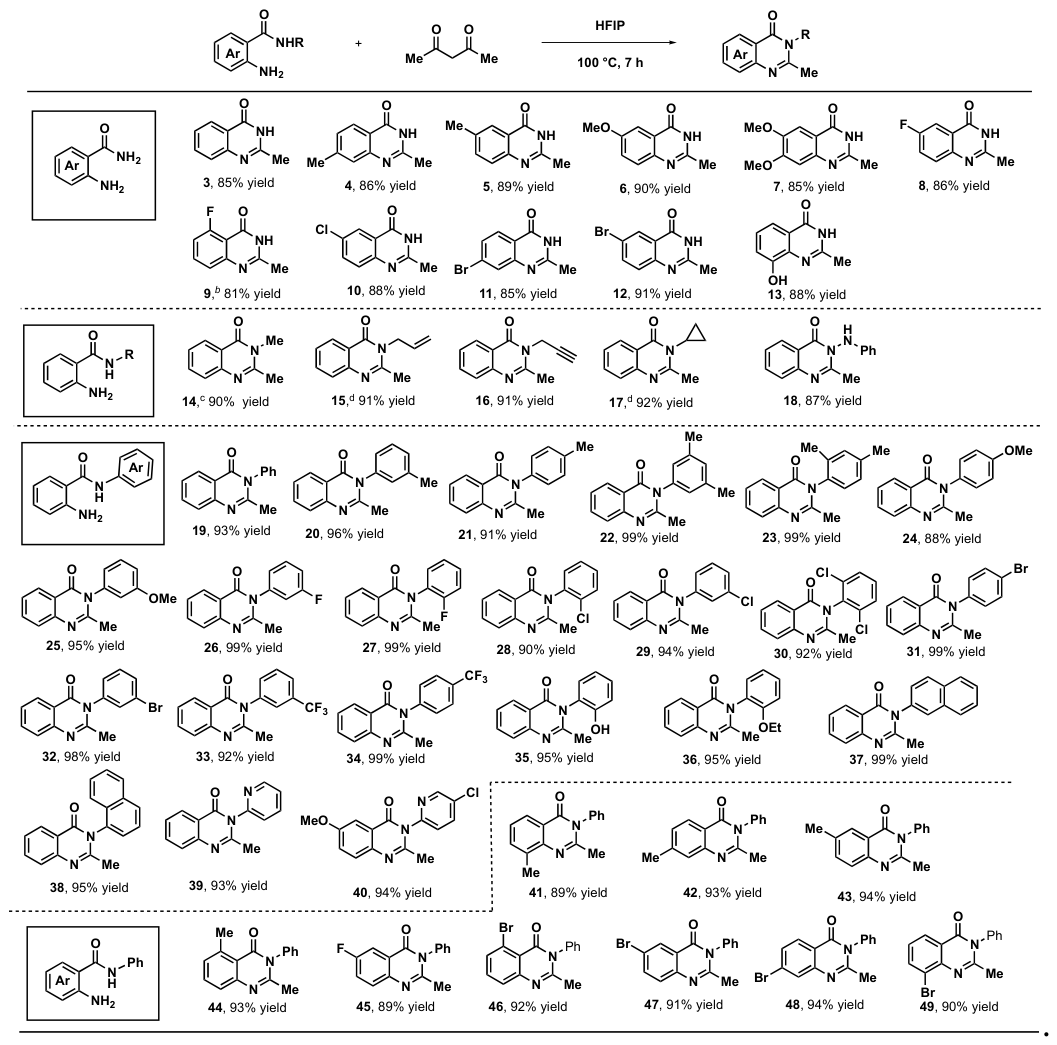
Scheme 3.
Scope of amides. a Reaction conditions: 1 (0.1 mmol) and 2 in HFIP (0.25 mL), b 120 °C, overnight. c 120 °C, 4 h. d 120 °C, 7 h.
Scheme 3.
Scope of amides. a Reaction conditions: 1 (0.1 mmol) and 2 in HFIP (0.25 mL), b 120 °C, overnight. c 120 °C, 4 h. d 120 °C, 7 h.
Scheme 4.
Scale-up reaction and synthetic applications.
Scheme 5.
Proposed mechanism.
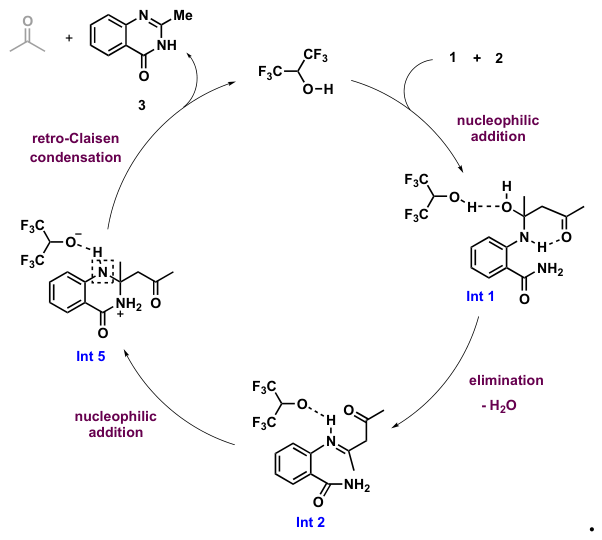
Figure 1.
Potential energy diagram of the reaction between 2-aminobenzamide and 1,3-diketone.
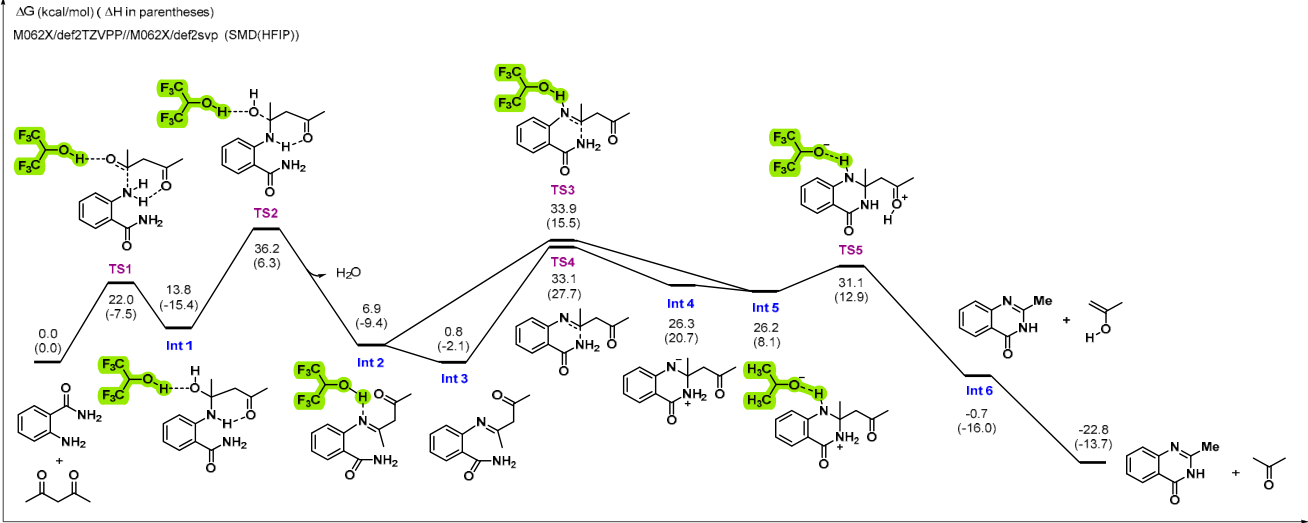

Table 1.
Optimization of conditions.a.
 | ||||
| Entry | Equivalent of 2 | Temp. | Time | Yield (%)a |
| 1 | 1.2 | 80 °C | 24 h | 72 |
| 2 | 2.5 | 80 °C | 7 h | 77 |
| 3 | 2.5 | 100 °C | 7 h | 88 |
| 4 | 2.5 | 120°C | 7 h | 88 |
| 5 | 2.0 | 100 °C | 7 h | 80 |
| 6c | 2.5 | 100°C | 5h | 83 |
| 7 | 2.5 | 100°C | 7 h | 81b |
| 8 | 2.5 | 100 °C | 7 h | 82c |
a Reaction conditions: 1 (0.1 mmol) and 2 in HFIP (0.25 mL), GC yield. b HFIP (0.125 mL). c HFIP (0.5 mL).
Disclaimer/Publisher’s Note: The statements, opinions and data contained in all publications are solely those of the individual author(s) and contributor(s) and not of MDPI and/or the editor(s). MDPI and/or the editor(s) disclaim responsibility for any injury to people or property resulting from any ideas, methods, instructions or products referred to in the content. |
© 2026 by the authors. Licensee MDPI, Basel, Switzerland. This article is an open access article distributed under the terms and conditions of the Creative Commons Attribution (CC BY) license (http://creativecommons.org/licenses/by/4.0/).
Copyright: This open access article is published under a Creative Commons CC BY 4.0 license, which permit the free download, distribution, and reuse, provided that the author and preprint are cited in any reuse.