
Preprint
Article

This version is not peer-reviewed.

Rifampicin Coexposure Increases the Acute Toxicity of Chlorantraniliprole to Zebrafish (Danio rerio)

Submitted:

02 October 2026

Posted:

05 October 2026

You are already at the latest version

Abstract

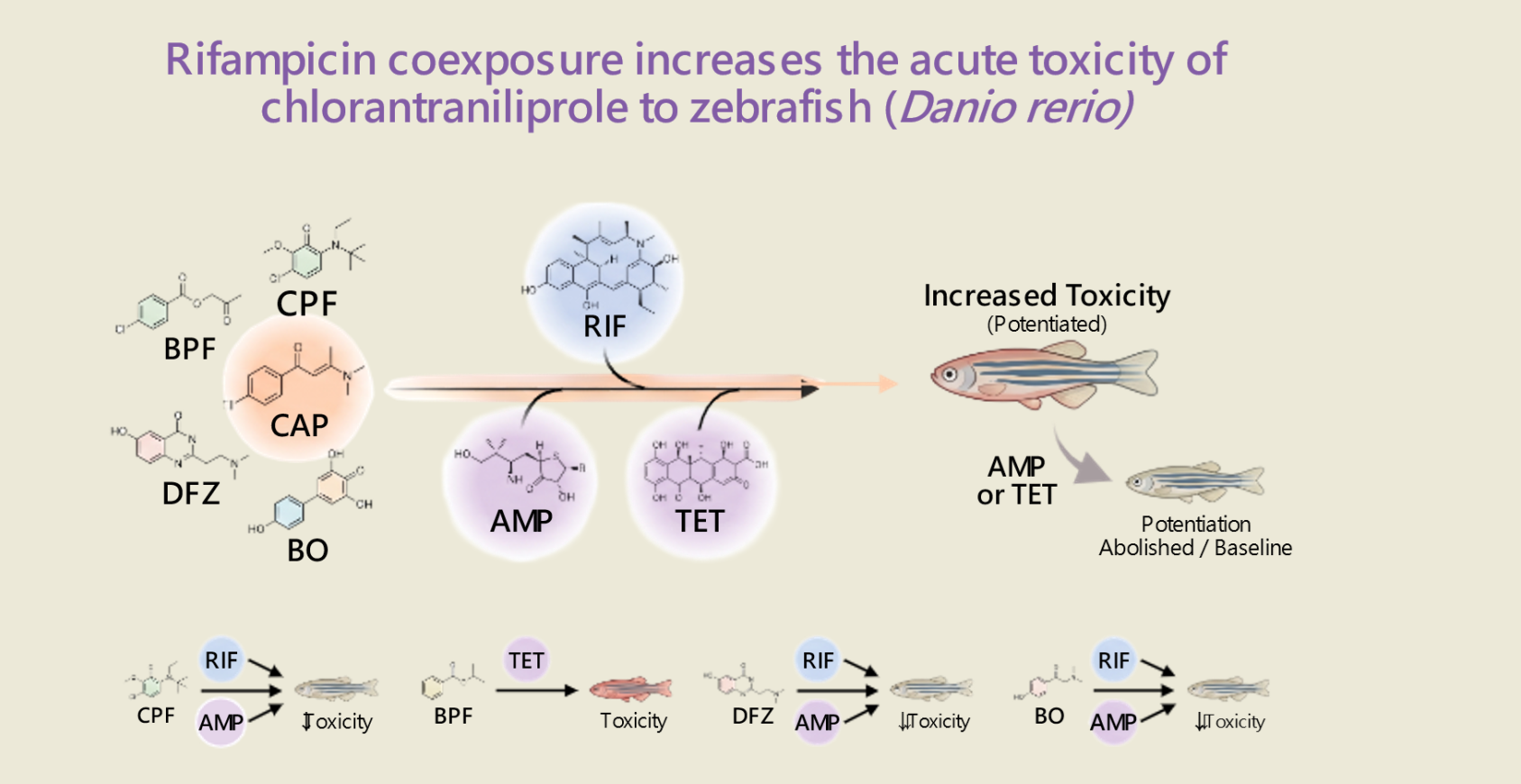
Pesticides and antibiotics frequently co-occur in aquatic environments, yet their combined effects on aquatic life remain poorly understood. To address this gap, we evaluated whether antibiotic co-exposure alters pesticide toxicity in juvenile zebrafish (Danio rerio). We tested five pesticides, including chlorantraniliprole (CAP), chlorpyrifos (CPF), buprofezin (BPF), difenoconazole (DFZ), and boscalid (BO), both alone and in mixtures with three common antibiotics: rifampicin (RIF), ampicillin (AMP), and tetracycline (TET). Adding RIF significantly potentiated CAP toxicity, lowering its 96-hour LC50 from 61.85 to 40.72 mg/L, yielding an LC50 ratio (LCR) of 1.52. Notably, this potentiation was fully abolished by the co-addition of a second antibiotic (AMP or TET). For CPF, only the ternary mixture with RIF and AMP produced a slight but significant reduction in toxicity (LCR = 0.95). For BPF, only co-exposure with TET significantly potentiated toxicity (LCR = 1.18). In contrast, both DFZ and BO showed significantly reduced toxicity when combined with RIF or AMP, with LCRs ranging from 0.80 to 0.91. These varied responses reveal that antibiotic-pesticide interactions are highly chemical-specific rather than a generalized consequence of mixture exposure. Collectively, these findings underscore that single-compound toxicity data alone are insufficient for assessing pesticide hazards in multi-contaminant environments.
Keywords: 
;  ;  ;  ;  ;  

1. Introduction

Pesticides are among the most widely used agrochemicals worldwide, and their continuous application in agricultural systems has led to their frequent detection in surface waters and sediments [1]. A global assessment of agricultural insecticide contamination found that more than half of measured surface-water concentrations exceeded regulatory threshold levels, with aquatic macroinvertebrate biodiversity declining even at these threshold concentrations [2]. Synthetic organic pollutants, including pesticides, rarely occur in isolation in the aquatic environment; instead, they enter waterways as complex chemical mixtures together with numerous other anthropogenic contaminants [3]. Their ecological significance extends beyond their intended agricultural targets: insecticides, fungicides, and insect growth regulators used across rice and other cropping systems have been reported to disturb hepatic metabolism and gut microbiota in fish; impair neurotransmitter content and embryonic development; and disrupt photosynthesis and energy metabolism in freshwater algae, indicating that pesticide toxicity extends across taxa and trophic levels [4,5,6,7]. Even pesticides prized for their selective, target-specific mode of action are not necessarily benign to non-target aquatic organisms: chlorantraniliprole (CAP), an anthranilic diamide insecticide that acts on insect ryanodine receptors triggering uncontrolled calcium release and fatal muscle paralysis in target pests [8,9], has also been shown to disrupt hepatic function and metabolic profiles in zebrafish even at low internal doses [10,11]. Collectively, these findings underscore the need to evaluate pesticide toxicity not as an isolated, single-compound exposure, but within the context of the complex chemical mixtures that organisms actually encounter in the environment.
Antibiotics have similarly become ubiquitous contaminants of aquatic ecosystems, entering surface waters via wastewater discharge, aquaculture operations, livestock production, hospital effluents, and everyday human pharmaceutical use [12,13,14,15]. Their ecological significance extends beyond direct toxicity to aquatic organisms: antibiotics can also reshape microbial community composition and activity, thereby altering the biodegradation and transformation of co-occurring pollutants [16,17,18,19]. As microbial activity is a key driver of pesticide degradation in aquatic systems, antibiotic contamination has the potential to indirectly influence how persistent and bioavailable co-occurring pesticides become, with further consequences for host detoxification capacity and gut microbiome function [20,21].
The toxicological consequences of chemical mixtures become particularly important when one contaminant alters the persistence, bioavailability, or biotransformation of another. Environmental risk assessment frameworks have long cautioned that evaluating chemicals individually may substantially underestimate the risks posed when organisms are exposed to complex mixtures or when synergistic interactions occur [22,23,24]. Direct evidence that antibiotics can modify pesticide toxicity has begun to emerge, primarily from insect models: ampicillin altered aphid responses to imidacloprid and cyantraniliprole, while rifampicin increased insecticide susceptibility in the green peach aphid (Myzus persicae) [25,26]. Gut microbiota have similarly been shown to shape insecticide susceptibility more broadly across insect taxa [27]. Joint exposure to pesticides and antimicrobial compounds has also been examined in other aquatic invertebrates: in the brine shrimp, Artemia salina, co-exposure to the organophosphate insecticide chlorpyrifos and the antibacterial agent triclosan altered acute LC50 values and cholinesterase activity relative to single-compound exposure, indicating that pesticide–antimicrobial interactions are not restricted to vertebrate models [28]. Because both antibiotics and pesticides are substrates, inducers, or inhibitors of cytochrome P450-dependent biotransformation pathways in fish, co-exposure has the potential to alter detoxification capacity and oxidative stress responses regardless of the specific compounds involved [29]. Direct evidence of such interactions in aquatic vertebrates has begun to emerge for a small number of pesticide-antibiotic pairs. In zebrafish, co-exposure to the pyrethroid insecticide deltamethrin with the antibiotic sulfamethoxazole altered the 96-h LC50 relative to deltamethrin alone [30], and co-exposure to chlorantraniliprole with the antibiotics ciprofloxacin or erythromycin has been reported to affect reproductive endpoints in adult zebrafish even where acute lethality was largely unaffected [11]. However, whether antibiotic co-exposure broadly alters the acute toxicity of widely used insecticides and fungicides in fish remains largely unexplored, representing an important gap in current mixture-toxicity assessment for aquatic ecosystems.
Given this gap, the present study was designed to determine whether co-exposure with commonly occurring antibiotics alters the acute toxicity of pesticides to juvenile zebrafish (Danio rerio). In this study, we selected five pesticides that are widely used and well recognized in agricultural pest control, particularly in rice cultivation: chlorantraniliprole (CAP), chlorpyrifos (CPF), buprofezin (BPF), difenoconazole (DFZ), and boscalid (BO). We further selected three antibiotics among the most extensively used in human and veterinary health and other applied fields: rifampicin (RIF), ampicillin, and tetracycline (TET). By comparing 96-h median lethal concentration (LC50) values and LC50 ratios of each pesticide alone and in binary and ternary combinations with these antibiotics, this study aimed to establish whether, and to what extent, antibiotic co-exposure modifies pesticide acute toxicity in a vertebrate aquatic model.

2. Materials and Methods

2.1. Zebrafish

The zebrafish (Danio rerio) AB strain was provided by the Institute of Hydrobiology, Chinese Academy of Sciences (Wuhan, China). Fish were acclimated to laboratory conditions for at least two weeks before exposure. During acclimation, they were maintained at 26 ± 1 °C, pH 7.2–7.5, and dissolved oxygen above 80% saturation under a 14-hour light/10-hour dark photoperiod. Fish were fed a commercial zebrafish diet and live Artemia nauplii daily during acclimation. Juvenile fish of approximately 2 months old (1.5–2.0 cm body length) were used for bioassays. They were not fed during the 96-hour acute exposure period to avoid interfering with the test solutions.

2.2. Chemicals

Chlorantraniliprole (CAP, technical grade, 95% active ingredient (A.I.)) and chlorpyrifos (CPF, 98% A.I.) were obtained from Hubei Kangbaotai Fine Chemical Co., Ltd. Buprofezin (BPF, 98% A.I.) was obtained from Jiangsu Changlong Agrochemical Co., Ltd. Difenoconazole (DFZ, 98% A.I.) was obtained from Nanjing Essence Fine Chemical Co., Ltd. Boscalid (BO, 97% A.I.) was obtained from Shandong Jingbo Agrochemicals Technology Co., Ltd. The antibiotics rifampicin (RIF, 95% purity), ampicillin (AMP, 98% purity), and tetracycline (TET, 98% purity) were obtained from Wuhan Servicebio Technology Co., Ltd.

2.3. Acute Toxicity Bioassays

We assessed the acute toxicity of pesticides to juvenile zebrafish using a semi-static method adapted from OECD Guideline 203 [31]. The main modification was the use of 2-month-old zebrafish as test organisms. Pesticide stock solutions were prepared in acetone at 100,000 mg/L (10% w/v). We prepared test solutions by adding the required volume of each stock solution to dechlorinated water. For each concentration, three replicate 2-L glass tanks were used, each containing 1 L of test solution and 10 juvenile zebrafish. Test solutions were renewed every 24 h to maintain consistent exposure over the 96-h period. Mortality was recorded every 24 h. Fish were considered dead when opercular movement had ceased, and they no longer responded to gentle tactile stimulation. Preliminary range-finding experiments were conducted for each pesticide to establish appropriate concentration series that would produce partial mortality. Based on these results, we selected 5~6 nominal concentrations for each pesticide and used them to determine the 96-h LC50 for each pesticide alone. To control for solvent effects, each treatment group was paired with its own solvent control. The acetone concentration in each solvent control was the same as that in the corresponding pesticide treatment at its highest tested concentration. The highest tested concentrations of CAP, CPF, BPF, DFZ, and BO were set to 78, 3.38, 4.25, 1.65 and 1.45 mg/L, respectively, as well as the corresponding acetone concentrations in the solvent controls of 0.0178%, 0.00338%, 0.00425%, 0.00165% and 0.00145%, respectively. Mortality in all solvent controls remained below 10%.
For the co-exposure tests, preliminary experiments were also performed to determine the non-lethal concentration of each antibiotic (RIF, AMP, and TET), which was found to be 50 mg/L for all three. Antibiotic stock solutions were also prepared in acetone at 100,000 mg/L (10%, w/v), and appropriate volumes were added to dechlorinated water to achieve the target concentration of 50 mg/L. In binary mixture treatments, the selected pesticide concentrations were combined with 50 mg/L of each antibiotic. In ternary mixtures (one pesticide + two antibiotics), each antibiotic was also maintained at 50 mg/L. For both binary and ternary mixtures, the pesticide and antibiotic(s) were added simultaneously to the test water and mixed thoroughly before fish were introduced. Throughout the co-exposure experiments, both the pesticide-only treatments and the solvent controls were run concurrently with the mixture groups in each test session. For each mixture treatment, the acetone concentration in the corresponding solvent control was also the same as the total acetone concentration in that mixture treatment at its highest tested concentration. Mortality in all solvent controls also remained below 10%. Each treatment was conducted in triplicate, with 10 fish per replicate.

2.4. Data Analysis

PoloPlus (LeOra Software) was used to analyze the toxicity data of zebrafish to pesticides and their mixtures to obtain the LC50 values, 95% confidence limits (CLs), and the LC50 ratios (LCRs) and their 95% CLs between different toxicity regression lines. The criteria for determining whether the toxicity was significantly different were based on whether the 95% confidence limits of LCR overlapped [32].

3. Results

3.1. Acute Toxicity of Chlorantraniliprole (CAP) Alone and in Combination with Antibiotics

Toxicity data were analyzed using the probit model in PoloPlus software, and all concentration-response curves exhibited a good fit (χ2 values with degrees of freedom are presented in Table 1, Table 2, Table 3, Table 4 and Table 5). The 96-h LC50 of CAP alone was 61.85 mg/L. Co-exposure with RIF significantly increased the toxicity of CAP, as evidenced by a reduced LC50 of 40.72 mg/L and an LCR of 1.52 (95% CL: 1.45–4.59), whose confidence interval did not include 1. In contrast, the addition of AMP or TET significantly decreased CAP toxicity, with LC50 values of 66.84 mg/L and 66.42 mg/L, respectively, and corresponding LCRs of 0.92 (0.90–0.95) and 0.93 (0.90–0.96), both with 95% CLs excluding 1. For ternary mixtures, the presence of two antibiotics did not significantly alter the toxicity of CAP relative to the single exposure, as the LCRs for CAP+RIF+AMP, CAP+RIF+TET, and CAP+AMP+TET were 1.02 (0.98–1.06), 1.04 (1.00–1.08), and 1.00 (0.97–1.04), respectively, with all 95% CLs overlapping with 1. These results indicate that the RIF-induced increase in CAP toxicity observed in the binary mixture was not maintained when a second antibiotic (AMP or TET) was co-administered.

3.2. Acute Toxicity of Chlorpyrifos (CPF) Alone and in Combination with Antibiotics

For CPF, the 96-h LC50 was 2.13 mg/L alone and 2.03, 2.10, and 2.08 mg/L in combination with RIF, AMP, and TET, respectively, corresponding to LCR values of 1.05, 1.01, and 1.03. In the ternary mixtures, CPF + RIF + AMP produced an LC50 of 2.25 mg/L (LCR = 0.95, 95% CL 0.91–0.99), while CPF + RIF + TET and CPF + AMP + TET produced LCR values of 0.98 and 1.00, respectively (Table 2). Overall, LC50 values for CPF changed only modestly across all antibiotic combinations, with LCR values remaining close to 1.0.

3.3. Acute Toxicity of Buprofezin (BPF) Alone and in Combination with Antibiotics

The LC50 of BPF alone was 2.50 mg/L (95% CL: 2.21–2.77 mg/L). Co-exposure with RIF, AMP, and TET reduced the LC50 to 2.19, 2.26, and 2.10 mg/L, respectively, corresponding to LCR values of 1.14, 1.10, and 1.18. The BPF + TET combination produced the clearest increase in toxicity among the binary treatments (LCR = 1.18, 95% FL: 1.05–1.33). In the ternary mixtures, LCR values ranged from 0.93 to 1.04, indicating that the toxicity increases observed in the binary combinations were not consistently maintained when a second antibiotic was added (Table 3). The chi-square value for the BPF + RIF + AMP combination was somewhat elevated, suggesting model fit should be interpreted with some caution; however, the LCR was not significant, and the overall trend was consistent with the other ternary mixtures.

3.4. Acute Toxicity of Difenoconazole (DFZ) Alone and in Combination with Antibiotics

The LC50 of DFZ alone was 1.28 mg/L (95% CL: 1.25–1.31 mg/L). In contrast to CAP and BPF, co-exposure with RIF and AMP increased the LC50 to 1.41 and 1.52 mg/L, respectively, corresponding to LCR values below 1.0 (0.91 and 0.85, both statistically significant), indicating reduced acute toxicity of DFZ in the presence of these two antibiotics (Table 4). TET was not tested in combination with DFZ in the present study.

3.5. Acute Toxicity of Boscalid (BO) Alone and in Combination with Antibiotics

The LC50 of BO alone was 1.05 mg/L (95% CL: 0.94–1.15 mg/L). As with DFZ, co-exposure with RIF and AMP increased the LC50 of BO to 1.30 and 1.16 mg/L, respectively, giving significant LCR values of 0.80 and 0.90 (Table 5), indicating that BO acute toxicity was reduced rather than increased in the presence of these antibiotics. Taken together, the results across the five pesticides show that antibiotic co-exposure produced increases, decreases, or negligible changes in pesticide acute toxicity depending on the specific pesticide-antibiotic combination tested (Table 1, Table 2, Table 3, Table 4 and Table 5).

4. Discussion

The primary objective of this study was to determine whether antibiotic co-exposure alters the acute toxicity of pesticides in zebrafish. The most notable finding was the pronounced potentiation of CAP toxicity by RIF. The addition of RIF lowered the 96 h LC50 of CAP from 61.85 to 40.72 mg/L, representing a nearly 1.5-fold increase in toxicity. Interestingly, this effect was specific to RIF; AMP and TET alone did not enhance CAP toxicity but instead slightly reduced it, and the RIF-induced potentiation was completely abolished when a second antibiotic (AMP or TET) was co-administered. This specificity is consistent with previous findings. A study reported that sulfamethazine slightly increased the acute toxicity of chlorpyrifos to zebrafish and significantly aggravated oxidative stress after prolonged exposure [33]. Shi et al. [11] found that ciprofloxacin and erythromycin exacerbated the developmental and reproductive toxicity of chlorantraniliprole, although acute lethality was largely unaffected. In the green peach aphid (Myzus persicae), RIF similarly enhanced the toxicity of several insecticides, while AMP reduced the efficacy of imidacloprid and cyantraniliprole [25,26]. Collectively, these findings, together with the present results, support the view that antibiotic–pesticide interactions are chemical-specific rather than a generalized antibiotic effect and that the nature and magnitude of the interaction depend on the specific compounds and toxicity endpoints examined.
The mechanistic basis for the RIF-specific potentiation of CAP toxicity remains unclear from the present data, as biochemical, toxicokinetic, and microbiological endpoints were not assessed. Nevertheless, two plausible hypotheses merit future investigation. The first concerns cytochrome P450 (CYP)-mediated metabolism. CYPs are known to be major enzymes involved in pesticide metabolism. RIF is also reported as a well-known modulator of CYP enzymes, although its effects are highly species- and isoform-specific: it acts as a potent inducer of human CYP3A4 [34], but its impact in fish is considerably less consistent. For instance, Smith and Wilson [35] reported that RIF treatment did not induce broad CYP activity in rainbow trout (Oncorhynchus mykiss) and killifish (Fundulus heteroclitus), although it did induce CYP1A-related activity specifically in rainbow trout. [36] found that RIF had no effect on CYP2-related activity in zebrafish embryos but did upregulate CYP3A65 expression. [37] observed that RIF induced CYP2K and CYP3A expression in primary hepatocytes of carp (Cyprinus carpio). In the aphid M. persicae, RIF reduced multifunction oxidase activity and downregulated the CYP gene CYP6CY3, and this suppression of CYP activity was associated with increased susceptibility of the aphids to insecticides [25,26]. Given that CAP itself is metabolized by CYPs in zebrafish [10], and given the variable and context-dependent effects of RIF on fish CYP enzymes documented above, it is conceivable that RIF exposure in zebrafish could disrupt the metabolic balance of CAP, either by enhancing its CYP-mediated bioactivation to a more toxic intermediate or by inhibiting the CYP isoforms responsible for its clearance. Nevertheless, these possibilities remain to be tested experimentally.
The second potential mechanism involves the gut microbiome. RIF is a broad-spectrum antibiotic that can substantially alter the microbial communities living in fish. This was demonstrated in mosquitofish (Gambusia affinis), where RIF exposure reduced gut microbial diversity and eliminated certain taxa [38]. Given that the gut microbiome contributes to the metabolism of xenobiotics [20], such microbial disruption could impair the host’s capacity to detoxify CAP, thereby potentiating its toxicity. This possibility is further supported by findings in bed bugs (Cimex hemipterus), where RIF altered the bacterial community and increased susceptibility to the insecticides fenitrothion and imidacloprid [39]. Moreover, [40] demonstrated that combined exposure to the herbicide glyphosate and the antibiotic oxytetracycline perturbed the gut microbiota of zebrafish and produced synergistic toxicity on the gut-liver axis. However, as gut bacterial communities, CYP activity, and CAP metabolite profiles were not measured in the present study, these mechanisms remain speculative and warrant further investigation.
The effects of antibiotics on pesticide toxicity were not uniform across the five compounds tested. For CPF, the LC50 values remained largely unchanged across all antibiotic combinations (LCRs: 0.95–1.05), suggesting that its acute toxicity is largely insensitive to co-administered antibiotics. BPF exhibited a modest increase in toxicity, but only in combination with TET (LCR = 1.18). In contrast, DFZ and BO displayed the opposite trend: co-exposure with RIF or AMP significantly reduced their toxicity, with LCRs ranging from 0.80 to 0.91. Thus, antibiotic co-exposure does not invariably enhance pesticide toxicity; under certain combinations, it may even confer a protective effect. This variability is consistent with previous zebrafish studies. Liu et al. [30] reported that co-exposure to deltamethrin and sulfamethoxazole altered acute toxicity in a concentration-dependent manner, with either potentiation or antagonism observed depending on the exposure levels. Similarly, Shi et al. [11] found that co-exposure to CAP with ciprofloxacin or erythromycin did not affect acute lethality but did exacerbate developmental and reproductive toxicity. Collectively, these findings support the view that mixture effects cannot be reliably predicted from single-compound toxicity data alone [22,23].
From a risk assessment perspective, our findings underscore that single-compound LC50 values may not adequately capture the complexity of real-world exposures. Given that antibiotics and pesticides frequently co-occur in aquatic environments [1,12], reliance on individual toxicity tests alone could lead to either underestimation or overestimation of the actual hazards posed by these chemical mixtures.
Several limitations of the present study warrant acknowledgment. The antibiotic concentration used here (50 mg/L) is higher than typical environmental levels. We chose this concentration deliberately to maximize the probability of detecting interactions, so interpret the results as evidence that antibiotic-pesticide interactions are possible rather than as a direct estimate of environmental risk. Future investigations should measure actual exposure concentrations, examine a broader range of antibiotic levels, and quantify biochemical and toxicokinetic endpoints to elucidate the underlying mechanisms. Such efforts would provide a more comprehensive understanding of how antibiotic-pesticide mixtures behave under environmentally realistic conditions.

5. Conclusions

This study demonstrates that co-exposure to antibiotics can significantly alter the acute toxicity of pesticides in juvenile zebrafish and that the direction and magnitude of this effect are highly dependent on the specific chemical combination. The most pronounced response was observed with rifampicin, which potentiated chlorantraniliprole toxicity nearly 1.5-fold. This potentiation was not reproduced by ampicillin or tetracycline and was completely abolished when a second antibiotic was added. Comparisons across chlorpyrifos, buprofezin, difenoconazole, and boscalid further revealed that antibiotic co-exposure could increase, decrease, or negligibly affect pesticide toxicity depending on the pesticide–antibiotic pair. Collectively, these findings support the inclusion of mixture-based approaches in aquatic pesticide hazard assessment and underscore the urgent need for mechanistic studies on antibiotic–pesticide interactions under environmentally relevant conditions.

Author Contributions

Conceptualization, S.W. and Y.H.; methodology, Z.L. and Y.G.; software, T.T.; validation, L.L.; formal analysis, Y.H.; investigation, Z.L.; resources, S.W., X.A., L.L., and T.T.; data curation, Y.H.; writing—original draft preparation, F.L.G.; writing—review and editing, S.W., F.L.G., F.W., Y.H., and X.L.; visualization, F.L.G., X.A., Y.H., and X.L.; supervision, S.W., Y.H., and X.L.; project administration, X.L. All authors have read and agreed to the published version of the manuscript.

Funding

This research received no external funding.

Institutional Review Board Statement

The animal study was approved by the Animal Ethics Committee of the Zhejiang Academy of Agricultural Sciences (protocol code 2022ZAASLA43, 2 April 2022).

Data Availability Statement

The raw data supporting the conclusions of this article will be made available by the authors on request.

Conflicts of Interest

The authors declare no conflicts of interest.

References

  1. Gu, W.; Xing, W.; Liang, M.; Wang, Z.; Zhang, B.; Sun, S.; Fan, D.; Wang, L. Occurrence, distribution, and risk assessment of pesticides in surface water and sediment in Jiangsu Province, China. Environmental Science and Pollution Research 2023, 30, 118418-118429. [CrossRef]
  2. Stehle, S.; Schulz, R. Agricultural insecticides threaten surface waters at the global scale. Proceedings of the National Academy of Sciences 2015, 112, 5750-5755. [CrossRef]
  3. Schwarzenbach, R.P.; Egli, T.; Hofstetter, T.B.; Von Gunten, U.; Wehrli, B. Global Water Pollution and Human Health. Annual Review of Environment and Resources 2010, 35, 109-136. [CrossRef]
  4. Marimuthu, K.; Muthu, N.; Xavier, R.; Arockiaraj, J.; Rahman, M.A.; Subramaniam, S. Toxicity of Buprofezin on the Survival of Embryo and Larvae of African Catfish, Clarias gariepinus (Bloch). PLoS ONE 2013, 8, e75545. [CrossRef]
  5. Qian, L.; Qi, S.; Cao, F.; Zhang, J.; Zhao, F.; Li, C.; Wang, C. Toxic effects of boscalid on the growth, photosynthesis, antioxidant system and metabolism of Chlorella vulgaris. Environmental Pollution 2018, 242, 171-181. [CrossRef]
  6. Xu, N.; Zhou, Z.; Chen, B.; Zhang, Z.; Zhang, J.; Li, Y.; Lu, T.; Sun, L.; Peijnenburg, W.J.G.M.; Qian, H. Effect of chlorpyrifos on freshwater microbial community and metabolic capacity of zebrafish. Ecotoxicology and Environmental Safety 2023, 262, 115230. [CrossRef]
  7. Yang, Q.; Deng, P.; Xing, D.; Liu, H.; Shi, F.; Hu, L.; Zou, X.; Nie, H.; Zuo, J.; Zhuang, Z.; et al. Developmental Neurotoxicity of Difenoconazole in Zebrafish Embryos. Toxics 2023, 11, 353. [CrossRef]
  8. Du, S.; Hu, X. Comprehensive Overview of Diamide Derivatives Acting as Ryanodine Receptor Activators. Journal of Agricultural and Food Chemistry 2023, 71, 3620-3638. [CrossRef]
  9. Lahm, G.P.; Cordova, D.; Barry, J.D. New and selective ryanodine receptor activators for insect control. Bioorganic & Medicinal Chemistry 2009, 17, 4127-4133. [CrossRef]
  10. Meng, Z.; Cui, J.; Liu, L.; Yang, C.; Bao, X.; Wang, J.; Chen, X. Toxicity effects of chlorantraniliprole in zebrafish (Danio rerio) involving in liver function and metabolic phenotype. Pesticide Biochemistry and Physiology 2022, 187, 105194. [CrossRef]
  11. Shi, X.; Wei, Y.; Cui, J.; Liu, X.; Zhao, F.; Zheng, L.; Wang, P.; Liu, D. Toxic effects of chlorantraniliprole on zebrafish (Danio rerio) at different developmental stages under antibiotic pressure. Environmental Pollution 2025, 367, 125590. [CrossRef]
  12. Carvalho, I.T.; Santos, L. Antibiotics in the aquatic environments: A review of the European scenario. Environment International 2016, 94, 736-757. [CrossRef]
  13. Fent, K.; Weston, A.A.; Caminada, D. Ecotoxicology of human pharmaceuticals. Aquatic Toxicology 2006, 76, 122-159. [CrossRef]
  14. Harrower, J.; McNaughtan, M.; Hunter, C.; Hough, R.; Zhang, Z.; Helwig, K. Chemical Fate and Partitioning Behavior of Antibiotics in the Aquatic Environment—A Review. Environmental Toxicology and Chemistry 2021, 40, 3275-3298. [CrossRef]
  15. Zhang, Q.-Q.; Ying, G.-G.; Pan, C.-G.; Liu, Y.-S.; Zhao, J.-L. Comprehensive Evaluation of Antibiotics Emission and Fate in the River Basins of China: Source Analysis, Multimedia Modeling, and Linkage to Bacterial Resistance. Environmental Science & Technology 2015, 49, 6772-6782. [CrossRef]
  16. Boxall, A.B.A.; Rudd, M.A.; Brooks, B.W.; Caldwell, D.J.; Choi, K.; Hickmann, S.; Innes, E.; Ostapyk, K.; Staveley, J.P.; Verslycke, T.; et al. Pharmaceuticals and Personal Care Products in the Environment: What Are the Big Questions? Environmental Health Perspectives 2012, 120, 1221-1229. [CrossRef]
  17. Costanzo, S.D.; Murby, J.; Bates, J. Ecosystem response to antibiotics entering the aquatic environment. Marine Pollution Bulletin 2005, 51, 218-223. [CrossRef]
  18. Grenni, P.; Ancona, V.; Barra Caracciolo, A. Ecological effects of antibiotics on natural ecosystems: A review. Microchemical Journal 2018, 136, 25-39. [CrossRef]
  19. Välitalo, P.; Kruglova, A.; Mikola, A.; Vahala, R. Toxicological impacts of antibiotics on aquatic micro-organisms: A mini-review. International Journal of Hygiene and Environmental Health 2017, 220, 558-569. [CrossRef]
  20. Chen, L. Gut Microbiota Manipulation to Mitigate the Detrimental Effects of Environmental Pollutants. Toxics 2021, 9, 127. [CrossRef]
  21. Yang, Y.; Guo, X.; Xu, T.; Yin, D. Effects of carbamazepine on gut microbiota, ARGs and intestinal health in zebrafish. Ecotoxicology and Environmental Safety 2023, 249, 114473. [CrossRef]
  22. Backhaus, T.; Faust, M. Predictive Environmental Risk Assessment of Chemical Mixtures: A Conceptual Framework. Environmental Science & Technology 2012, 46, 2564-2573. [CrossRef]
  23. Escher, B.; Braun, G.; Zarfl, C. Exploring the Concepts of Concentration Addition and Independent Action Using a Linear Low-Effect Mixture Model. Environmental Toxicology and Chemistry 2020, 39, 2552-2559. [CrossRef]
  24. Laetz, C.A.; Baldwin, D.H.; Collier, T.K.; Hebert, V.; Stark, J.D.; Scholz, N.L. The Synergistic Toxicity of Pesticide Mixtures: Implications for Risk Assessment and the Conservation of Endangered Pacific Salmon. Environmental Health Perspectives 2009, 117, 348-353. [CrossRef]
  25. Li, Z.; Li, W.; Mu, Q.; Zhu, Y.; Qin, W.; Shi, X.; He, Y. Rifampicin synergizes the toxicity of insecticides against the green peach aphid, Myzus persicae. Ecotoxicology and Environmental Safety 2024, 276, 116291. [CrossRef]
  26. Li, Z.; Li, W.; Qin, W.; Liu, J.; He, Y. Ampicillin enhanced the resistance of Myzus persicae to imidacloprid and cyantraniliprole. Pest Management Science 2023, 79, 1388-1398. [CrossRef]
  27. Jaffar, S.; Ahmad, S.; Lu, Y. Contribution of insect gut microbiota and their associated enzymes in insect physiology and biodegradation of pesticides. Frontiers in Microbiology 2022, 13. [CrossRef]
  28. Albendín, M.G.; Aranda, V.; Coello, M.D.; González-Gómez, C.; Rodríguez-Barroso, R.; Quiroga, J.M.; Arellano, J.M. Pharmaceutical Products and Pesticides Toxicity Associated with Microplastics (Polyvinyl Chloride) in Artemia salina. International Journal of Environmental Research and Public Health 2021, 18, 10773. [CrossRef]
  29. Nambiar, S.P.; Pillai, D.; Nair, S.N.; Krishnan, R. Ecotoxicological significance of cytochrome P450 in fish encompassing xenobiotic detoxification and physiological regulation. Discover Biotechnology 2025, 2. [CrossRef]
  30. Liu, Y.; Liu, F.; Wang, C. Acute Toxicity, Neurotoxic, Immunotoxic, and Behavioral Effects of Deltamethrin and Sulfamethoxazole in Adult Zebrafish: Insights into Chemical Interactions and Environmental Implications. Toxics 2025, 13, 128. [CrossRef]
  31. OECD. OECD Guidelines for the Testing of Chemicals, Section 2 Test No. 203: Fish, Acute Toxicity Test; OECD Publishing: 2025.
  32. Robertson, J.; Preisler, H.; Russell, R. PoloPlus: Probit and logit analysis user’s guide. LeOra Software, Petaluna, CA, USA 2007.
  33. Jiang, J.; He, B.; Liu, X.; Liu, D.; Zhou, Z.; Wang, P. Influence of co-exposure to sulfamethazine on the toxicity and bioaccumulation kinetics of chlorpyrifos in zebrafish (Danio rerio). Chemosphere 2022, 308, 136317. [CrossRef]
  34. Niemi, M.; Backman, J.T.; Fromm, M.F.; Neuvonen, P.J.; Kivist, K.T. Pharmacokinetic Interactions with Rifampicin. Clinical Pharmacokinetics 2003, 42, 819-850. [CrossRef]
  35. Smith, E.M.; Wilson, J.Y. Assessment of cytochrome P450 fluorometric substrates with rainbow trout and killifish exposed to dexamethasone, pregnenolone-16α-carbonitrile, rifampicin, and β-naphthoflavone. Aquatic Toxicology 2010, 97, 324-333. [CrossRef]
  36. Loerracher, A.-K.; Braunbeck, T. Inducibility of cytochrome P450-mediated 7-methoxycoumarin-O-demethylase activity in zebrafish (Danio rerio) embryos. Aquatic Toxicology 2020, 225, 105540. [CrossRef]
  37. Corcoran, J.; Lange, A.; Winter, M.J.; Tyler, C.R. Effects of Pharmaceuticals on the Expression of Genes Involved in Detoxification in a Carp Primary Hepatocyte Model. Environmental Science & Technology 2012, 46, 6306-6314. [CrossRef]
  38. Carlson, J.; Leonard, A.; Hyde, E.; Petrosino, J.; Primm, T. Microbiome disruption and recovery in the fish <em>Gambusia affinis</em> following exposure to broad-spectrum antibiotic. Infection and Drug Resistance 2017, Volume 10, 143-154. [CrossRef]
  39. Soh, L.-S.; Veera Singham, G. Bacterial symbionts influence host susceptibility to fenitrothion and imidacloprid in the obligate hematophagous bed bug, Cimex hemipterus. Scientific Reports 2022, 12. [CrossRef]
  40. Zheng, J.; Wang, C.; Teng, M.; Li, T.; Jiang, J.; Chen, X.; Wu, F. Hepatic toxicity induced by exposure to glyphosate/aminomethylphosphonic acid and oxytetracycline alone or in combination in zebrafish: A novel mechanism of the gut-liver axis. Aquatic Toxicology 2026, 291, 107713. [CrossRef]

Table 1. Acute toxicity of chlorantraniliprole (CAP) alone and in combination with antibiotics in juvenile zebrafish after 96 h.
Treatment n Slope ± SE LC50 (95% CL) mg/L χ2 (df)1 LCR (95% CL)2
CAP 200 39.36 ± 7.07 61.85 (60.40–62.95) 0.29 (3) 1.00
CAP + RIF 240 12.76 ± 1.94 40.72 (36.81–43.36) 3.11 (3) 1.52 (1.45–4.59) *
CAP + AMP 210 28.82 ± 5.95 66.84 (65.29–68.91) 0.39 (4) 0.92 (0.90–0.95) *
CAP + TET 230 25.96 ± 3.79 66.42 (64.93–67.86) 2.25 (4) 0.93 (0.90–0.96)
CAP + RIF + AMP 240 16.45 ± 3.01 60.55 (58.10–62.50) 2.19 (4) 1.02 (0.98–1.06)
CAP + RIF + TET 210 19.80 ± 4.32 59.61 (57.39–61.52) 1.15 (3) 1.04 (1.00–1.08)
CAP + AMP + TET 230 16.93 ± 2.95 61.70 (59.54–63.64) 0.12 (2) 1.00 (0.97–1.04)
Note: n, total number of fish tested. SE, standard error. LC50, median lethal concentration. CL, confidence limit. χ2, chi-square; df, degrees of freedom. LCR, LC50 ratio. 1All of the toxicity data fitted the probit model (chi-square test P > 0.05). 2LCR and its 95% CL were calculated using PoloPlus. *indicates that their toxicities are significantly different between the mixture treatment and the pesticide treatment alone if the 95% CL of LCR does not include 1.00. The pesticide treatment alone was used as the base treatment.
Table 2. Acute toxicity of chlorpyrifos (CPF) alone and in combination with antibiotics in juvenile zebrafish after 96 h.
Treatment n Slope ± SE LC50 (95% CL) mg/L χ2 (df)1 LCR (95% CL)2
CPF 210 32.92 ± 5.41 2.13 (2.07–2.18) 0.92 (3) 1.00
CPF + RIF 180 21.18 ± 5.47 2.03 (1.97–2.12) 0.70 (2) 1.05 (1.00–1.09)
CPF + AMP 180 27.44 ± 6.41 2.10 (2.05–2.20) 1.84 (2) 1.01 (0.98–1.05)
CPF + TET 180 18.34 ± 5.30 2.08 (2.01–2.22) 0.47 (2) 1.03 (0.98–1.07)
CPF + RIF + AMP 180 25.81 ± 5.17 2.25 (2.19–2.34) 0.93 (2) 0.95 (0.91–0.99) *
CPF + RIF + TET 180 22.48 ± 4.18 2.18 (2.12–2.26) 0.51 (2) 0.98 (0.94–1.01)
CPF + AMP + TET 180 33.26 ± 5.41 2.12 (2.07–2.16) 1.10 (2) 1.00 (0.97–1.04)
Note: n, total number of fish tested. SE, standard error. LC50, median lethal concentration. CL, confidence limit. χ2, chi-square; df, degrees of freedom. LCR, LC50 ratio. 1All of the toxicity data fitted the probit model (chi-square test P > 0.05). 2LCR and its 95% CL were calculated using PoloPlus. *indicates that their toxicities are significantly different between the mixture treatment and the pesticide treatment alone if the 95% CL of LCR does not include 1.00. The pesticide treatment alone was used as the base treatment.
Table 3. Acute toxicity of buprofezin (BPF) alone and in combination with antibiotics in juvenile zebrafish after 96 h.
Treatment n Slope ± SE LC50 (95% CL) mg/L χ2 (df)1 LCR (95% CL)2
BPF 210 5.69 ± 0.92 2.50 (2.21–2.77) 0.47 (4) 1.00
BPF + RIF 240 12.27 ± 1.78 2.19 (2.10–2.30) 2.44 (4) 1.14 (1.00–1.28)
BPF + AMP 240 10.33 ± 1.52 2.26 (2.05–2.52) 6.56 (4) 1.10 (0.98–1.24)
BPF + TET 180 20.93 ± 3.35 2.10 (2.02–2.17) 0.014 (2) 1.18 (1.05–1.33) *
BPF + RIF + AMP 300 7.76 ± 1.97 2.39 (2.04–2.77) 16.47 (5) 1.04 (0.92–1.18)
BPF + RIF + TET 180 9.39 ± 1.28 2.67 (2.49–2.87) 2.50 (3) 0.93 (0.82–1.06)
BPF + AMP + TET 180 6.58 ± 0.91 2.48 (2.05–3.03) 4.39 (3) 1.00 (0.87–1.15)
Note: n, total number of fish tested. SE, standard error. LC50, median lethal concentration. CL, confidence limit. χ2, chi-square; df, degrees of freedom. LCR, LC50 ratio. 1All of the toxicity data fitted the probit model (chi-square test P > 0.05). 2LCR and its 95% CL were calculated using PoloPlus. *indicates that their toxicities are significantly different between the mixture treatment and the pesticide treatment alone if the 95% CL of LCR does not include 1.00. The pesticide treatment alone was used as the base treatment.
Table 4. Acute toxicity of difenoconazole (DFZ) alone and in combination with antibiotics in juvenile zebrafish after 96 h.
Treatment n Slope ± SE LC50 (95% CL) mg/L χ2 (df)1 LCR (95% CL) 2
DFZ 180 32.93 ± 5.35 1.28 (1.25–1.31) 0.84 (3) 1.00
DFZ + RIF 180 33.82 ± 5.41 1.41 (1.38–1.45) 1.33 (3) 0.91 (0.88–0.94) *
DFZ + AMP 180 18.97 ± 3.17 1.52 (1.47–1.57) 1.68 (3) 0.85 (0.81–0.88) *
Note: n, total number of fish tested. SE, standard error. LC50, median lethal concentration. CL, confidence limit. χ2, chi-square; df, degrees of freedom. LCR, LC50 ratio. 1All of the toxicity data fitted the probit model (chi-square test P > 0.05). 2LCR and its 95% CL were calculated using PoloPlus. *indicates that their toxicities are significantly different between the mixture treatment and the pesticide treatment alone if the 95% CL of LCR does not include 1.00. The pesticide treatment alone was used as the base treatment.
Table 5. Acute toxicity of boscalid (BO) alone and in combination with antibiotics in juvenile zebrafish after 96 h.
Treatment n Slope ± SE LC50 (95% CL) mg/L χ2 (df)1 LCR (95% CL) 2
BO 150 19.91 ± 2.91 1.05 (0.94–1.15) 2.16 (2) 1.00
BO + RIF 180 15.00 ± 2.42 1.30 (1.25–1.37) 0.85 (3) 0.80 (0.76–0.85) *
BO + AMP 150 26.47 ± 4.36 1.16 (1.13–1.20) 1.08 (2) 0.90 (0.86–0.95) *
Note: n, total number of fish tested. SE, standard error. LC50, median lethal concentration. CL, confidence limit. χ2, chi-square; df, degrees of freedom. LCR, LC50 ratio. 1All of the toxicity data fitted the probit model (chi-square test P > 0.05). 2LCR and its 95% CL were calculated using PoloPlus. *indicates that their toxicities are significantly different between the mixture treatment and the pesticide treatment alone if the 95% CL of LCR does not include 1.00. The pesticide treatment alone was used as the base treatment.
Disclaimer/Publisher’s Note: The statements, opinions and data contained in all publications are solely those of the individual author(s) and contributor(s) and not of MDPI and/or the editor(s). MDPI and/or the editor(s) disclaim responsibility for any injury to people or property resulting from any ideas, methods, instructions or products referred to in the content.
Copyright: This open access article is published under a Creative Commons CC BY 4.0 license, which permit the free download, distribution, and reuse, provided that the author and preprint are cited in any reuse.