

Submitted:
02 October 2026
Posted:
05 October 2026
You are already at the latest version
Abstract
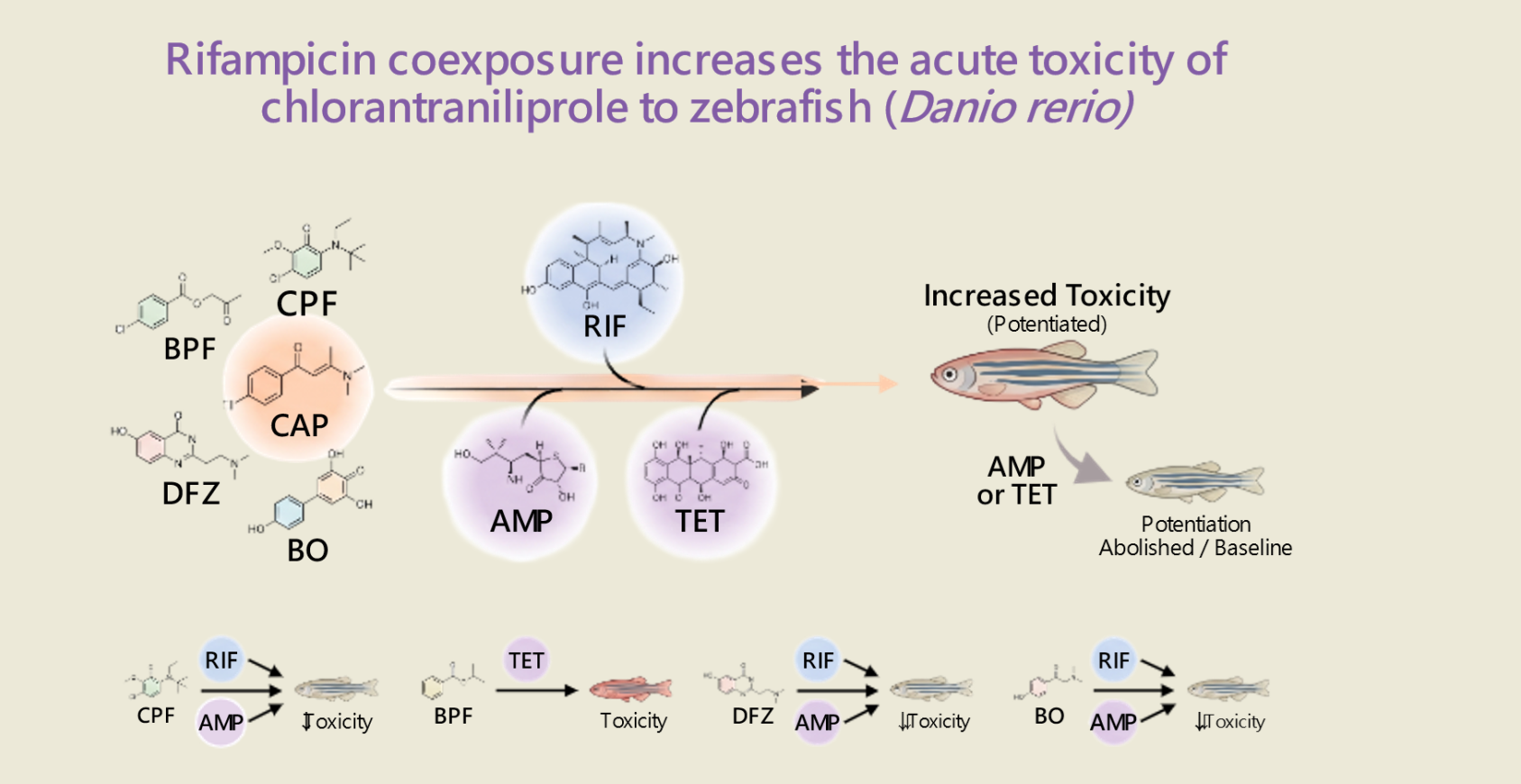
Pesticides and antibiotics frequently co-occur in aquatic environments, yet their combined effects on aquatic life remain poorly understood. To address this gap, we evaluated whether antibiotic co-exposure alters pesticide toxicity in juvenile zebrafish (Danio rerio). We tested five pesticides, including chlorantraniliprole (CAP), chlorpyrifos (CPF), buprofezin (BPF), difenoconazole (DFZ), and boscalid (BO), both alone and in mixtures with three common antibiotics: rifampicin (RIF), ampicillin (AMP), and tetracycline (TET). Adding RIF significantly potentiated CAP toxicity, lowering its 96-hour LC50 from 61.85 to 40.72 mg/L, yielding an LC50 ratio (LCR) of 1.52. Notably, this potentiation was fully abolished by the co-addition of a second antibiotic (AMP or TET). For CPF, only the ternary mixture with RIF and AMP produced a slight but significant reduction in toxicity (LCR = 0.95). For BPF, only co-exposure with TET significantly potentiated toxicity (LCR = 1.18). In contrast, both DFZ and BO showed significantly reduced toxicity when combined with RIF or AMP, with LCRs ranging from 0.80 to 0.91. These varied responses reveal that antibiotic-pesticide interactions are highly chemical-specific rather than a generalized consequence of mixture exposure. Collectively, these findings underscore that single-compound toxicity data alone are insufficient for assessing pesticide hazards in multi-contaminant environments.
Keywords:
1. Introduction
2. Materials and Methods
2.1. Zebrafish
2.2. Chemicals
2.3. Acute Toxicity Bioassays
2.4. Data Analysis
3. Results
3.1. Acute Toxicity of Chlorantraniliprole (CAP) Alone and in Combination with Antibiotics
3.2. Acute Toxicity of Chlorpyrifos (CPF) Alone and in Combination with Antibiotics
3.3. Acute Toxicity of Buprofezin (BPF) Alone and in Combination with Antibiotics
3.4. Acute Toxicity of Difenoconazole (DFZ) Alone and in Combination with Antibiotics
3.5. Acute Toxicity of Boscalid (BO) Alone and in Combination with Antibiotics
4. Discussion
5. Conclusions
Author Contributions
Funding
Institutional Review Board Statement
Informed Consent Statement
Data Availability Statement
Conflicts of Interest
References
- Gu, W.; Xing, W.; Liang, M.; Wang, Z.; Zhang, B.; Sun, S.; Fan, D.; Wang, L. Occurrence, distribution, and risk assessment of pesticides in surface water and sediment in Jiangsu Province, China. Environmental Science and Pollution Research 2023, 30, 118418-118429. [CrossRef]
- Stehle, S.; Schulz, R. Agricultural insecticides threaten surface waters at the global scale. Proceedings of the National Academy of Sciences 2015, 112, 5750-5755. [CrossRef]
- Schwarzenbach, R.P.; Egli, T.; Hofstetter, T.B.; Von Gunten, U.; Wehrli, B. Global Water Pollution and Human Health. Annual Review of Environment and Resources 2010, 35, 109-136. [CrossRef]
- Marimuthu, K.; Muthu, N.; Xavier, R.; Arockiaraj, J.; Rahman, M.A.; Subramaniam, S. Toxicity of Buprofezin on the Survival of Embryo and Larvae of African Catfish, Clarias gariepinus (Bloch). PLoS ONE 2013, 8, e75545. [CrossRef]
- Qian, L.; Qi, S.; Cao, F.; Zhang, J.; Zhao, F.; Li, C.; Wang, C. Toxic effects of boscalid on the growth, photosynthesis, antioxidant system and metabolism of Chlorella vulgaris. Environmental Pollution 2018, 242, 171-181. [CrossRef]
- Xu, N.; Zhou, Z.; Chen, B.; Zhang, Z.; Zhang, J.; Li, Y.; Lu, T.; Sun, L.; Peijnenburg, W.J.G.M.; Qian, H. Effect of chlorpyrifos on freshwater microbial community and metabolic capacity of zebrafish. Ecotoxicology and Environmental Safety 2023, 262, 115230. [CrossRef]
- Yang, Q.; Deng, P.; Xing, D.; Liu, H.; Shi, F.; Hu, L.; Zou, X.; Nie, H.; Zuo, J.; Zhuang, Z.; et al. Developmental Neurotoxicity of Difenoconazole in Zebrafish Embryos. Toxics 2023, 11, 353. [CrossRef]
- Du, S.; Hu, X. Comprehensive Overview of Diamide Derivatives Acting as Ryanodine Receptor Activators. Journal of Agricultural and Food Chemistry 2023, 71, 3620-3638. [CrossRef]
- Lahm, G.P.; Cordova, D.; Barry, J.D. New and selective ryanodine receptor activators for insect control. Bioorganic & Medicinal Chemistry 2009, 17, 4127-4133. [CrossRef]
- Meng, Z.; Cui, J.; Liu, L.; Yang, C.; Bao, X.; Wang, J.; Chen, X. Toxicity effects of chlorantraniliprole in zebrafish (Danio rerio) involving in liver function and metabolic phenotype. Pesticide Biochemistry and Physiology 2022, 187, 105194. [CrossRef]
- Shi, X.; Wei, Y.; Cui, J.; Liu, X.; Zhao, F.; Zheng, L.; Wang, P.; Liu, D. Toxic effects of chlorantraniliprole on zebrafish (Danio rerio) at different developmental stages under antibiotic pressure. Environmental Pollution 2025, 367, 125590. [CrossRef]
- Carvalho, I.T.; Santos, L. Antibiotics in the aquatic environments: A review of the European scenario. Environment International 2016, 94, 736-757. [CrossRef]
- Fent, K.; Weston, A.A.; Caminada, D. Ecotoxicology of human pharmaceuticals. Aquatic Toxicology 2006, 76, 122-159. [CrossRef]
- Harrower, J.; McNaughtan, M.; Hunter, C.; Hough, R.; Zhang, Z.; Helwig, K. Chemical Fate and Partitioning Behavior of Antibiotics in the Aquatic Environment—A Review. Environmental Toxicology and Chemistry 2021, 40, 3275-3298. [CrossRef]
- Zhang, Q.-Q.; Ying, G.-G.; Pan, C.-G.; Liu, Y.-S.; Zhao, J.-L. Comprehensive Evaluation of Antibiotics Emission and Fate in the River Basins of China: Source Analysis, Multimedia Modeling, and Linkage to Bacterial Resistance. Environmental Science & Technology 2015, 49, 6772-6782. [CrossRef]
- Boxall, A.B.A.; Rudd, M.A.; Brooks, B.W.; Caldwell, D.J.; Choi, K.; Hickmann, S.; Innes, E.; Ostapyk, K.; Staveley, J.P.; Verslycke, T.; et al. Pharmaceuticals and Personal Care Products in the Environment: What Are the Big Questions? Environmental Health Perspectives 2012, 120, 1221-1229. [CrossRef]
- Costanzo, S.D.; Murby, J.; Bates, J. Ecosystem response to antibiotics entering the aquatic environment. Marine Pollution Bulletin 2005, 51, 218-223. [CrossRef]
- Grenni, P.; Ancona, V.; Barra Caracciolo, A. Ecological effects of antibiotics on natural ecosystems: A review. Microchemical Journal 2018, 136, 25-39. [CrossRef]
- Välitalo, P.; Kruglova, A.; Mikola, A.; Vahala, R. Toxicological impacts of antibiotics on aquatic micro-organisms: A mini-review. International Journal of Hygiene and Environmental Health 2017, 220, 558-569. [CrossRef]
- Chen, L. Gut Microbiota Manipulation to Mitigate the Detrimental Effects of Environmental Pollutants. Toxics 2021, 9, 127. [CrossRef]
- Yang, Y.; Guo, X.; Xu, T.; Yin, D. Effects of carbamazepine on gut microbiota, ARGs and intestinal health in zebrafish. Ecotoxicology and Environmental Safety 2023, 249, 114473. [CrossRef]
- Backhaus, T.; Faust, M. Predictive Environmental Risk Assessment of Chemical Mixtures: A Conceptual Framework. Environmental Science & Technology 2012, 46, 2564-2573. [CrossRef]
- Escher, B.; Braun, G.; Zarfl, C. Exploring the Concepts of Concentration Addition and Independent Action Using a Linear Low-Effect Mixture Model. Environmental Toxicology and Chemistry 2020, 39, 2552-2559. [CrossRef]
- Laetz, C.A.; Baldwin, D.H.; Collier, T.K.; Hebert, V.; Stark, J.D.; Scholz, N.L. The Synergistic Toxicity of Pesticide Mixtures: Implications for Risk Assessment and the Conservation of Endangered Pacific Salmon. Environmental Health Perspectives 2009, 117, 348-353. [CrossRef]
- Li, Z.; Li, W.; Mu, Q.; Zhu, Y.; Qin, W.; Shi, X.; He, Y. Rifampicin synergizes the toxicity of insecticides against the green peach aphid, Myzus persicae. Ecotoxicology and Environmental Safety 2024, 276, 116291. [CrossRef]
- Li, Z.; Li, W.; Qin, W.; Liu, J.; He, Y. Ampicillin enhanced the resistance of Myzus persicae to imidacloprid and cyantraniliprole. Pest Management Science 2023, 79, 1388-1398. [CrossRef]
- Jaffar, S.; Ahmad, S.; Lu, Y. Contribution of insect gut microbiota and their associated enzymes in insect physiology and biodegradation of pesticides. Frontiers in Microbiology 2022, 13. [CrossRef]
- Albendín, M.G.; Aranda, V.; Coello, M.D.; González-Gómez, C.; Rodríguez-Barroso, R.; Quiroga, J.M.; Arellano, J.M. Pharmaceutical Products and Pesticides Toxicity Associated with Microplastics (Polyvinyl Chloride) in Artemia salina. International Journal of Environmental Research and Public Health 2021, 18, 10773. [CrossRef]
- Nambiar, S.P.; Pillai, D.; Nair, S.N.; Krishnan, R. Ecotoxicological significance of cytochrome P450 in fish encompassing xenobiotic detoxification and physiological regulation. Discover Biotechnology 2025, 2. [CrossRef]
- Liu, Y.; Liu, F.; Wang, C. Acute Toxicity, Neurotoxic, Immunotoxic, and Behavioral Effects of Deltamethrin and Sulfamethoxazole in Adult Zebrafish: Insights into Chemical Interactions and Environmental Implications. Toxics 2025, 13, 128. [CrossRef]
- OECD. OECD Guidelines for the Testing of Chemicals, Section 2 Test No. 203: Fish, Acute Toxicity Test; OECD Publishing: 2025.
- Robertson, J.; Preisler, H.; Russell, R. PoloPlus: Probit and logit analysis user’s guide. LeOra Software, Petaluna, CA, USA 2007.
- Jiang, J.; He, B.; Liu, X.; Liu, D.; Zhou, Z.; Wang, P. Influence of co-exposure to sulfamethazine on the toxicity and bioaccumulation kinetics of chlorpyrifos in zebrafish (Danio rerio). Chemosphere 2022, 308, 136317. [CrossRef]
- Niemi, M.; Backman, J.T.; Fromm, M.F.; Neuvonen, P.J.; Kivist, K.T. Pharmacokinetic Interactions with Rifampicin. Clinical Pharmacokinetics 2003, 42, 819-850. [CrossRef]
- Smith, E.M.; Wilson, J.Y. Assessment of cytochrome P450 fluorometric substrates with rainbow trout and killifish exposed to dexamethasone, pregnenolone-16α-carbonitrile, rifampicin, and β-naphthoflavone. Aquatic Toxicology 2010, 97, 324-333. [CrossRef]
- Loerracher, A.-K.; Braunbeck, T. Inducibility of cytochrome P450-mediated 7-methoxycoumarin-O-demethylase activity in zebrafish (Danio rerio) embryos. Aquatic Toxicology 2020, 225, 105540. [CrossRef]
- Corcoran, J.; Lange, A.; Winter, M.J.; Tyler, C.R. Effects of Pharmaceuticals on the Expression of Genes Involved in Detoxification in a Carp Primary Hepatocyte Model. Environmental Science & Technology 2012, 46, 6306-6314. [CrossRef]
- Carlson, J.; Leonard, A.; Hyde, E.; Petrosino, J.; Primm, T. Microbiome disruption and recovery in the fish <em>Gambusia affinis</em> following exposure to broad-spectrum antibiotic. Infection and Drug Resistance 2017, Volume 10, 143-154. [CrossRef]
- Soh, L.-S.; Veera Singham, G. Bacterial symbionts influence host susceptibility to fenitrothion and imidacloprid in the obligate hematophagous bed bug, Cimex hemipterus. Scientific Reports 2022, 12. [CrossRef]
- Zheng, J.; Wang, C.; Teng, M.; Li, T.; Jiang, J.; Chen, X.; Wu, F. Hepatic toxicity induced by exposure to glyphosate/aminomethylphosphonic acid and oxytetracycline alone or in combination in zebrafish: A novel mechanism of the gut-liver axis. Aquatic Toxicology 2026, 291, 107713. [CrossRef]

| Treatment | n | Slope ± SE | LC50 (95% CL) mg/L | χ2 (df)1 | LCR (95% CL)2 |
| CAP | 200 | 39.36 ± 7.07 | 61.85 (60.40–62.95) | 0.29 (3) | 1.00 |
| CAP + RIF | 240 | 12.76 ± 1.94 | 40.72 (36.81–43.36) | 3.11 (3) | 1.52 (1.45–4.59) * |
| CAP + AMP | 210 | 28.82 ± 5.95 | 66.84 (65.29–68.91) | 0.39 (4) | 0.92 (0.90–0.95) * |
| CAP + TET | 230 | 25.96 ± 3.79 | 66.42 (64.93–67.86) | 2.25 (4) | 0.93 (0.90–0.96) |
| CAP + RIF + AMP | 240 | 16.45 ± 3.01 | 60.55 (58.10–62.50) | 2.19 (4) | 1.02 (0.98–1.06) |
| CAP + RIF + TET | 210 | 19.80 ± 4.32 | 59.61 (57.39–61.52) | 1.15 (3) | 1.04 (1.00–1.08) |
| CAP + AMP + TET | 230 | 16.93 ± 2.95 | 61.70 (59.54–63.64) | 0.12 (2) | 1.00 (0.97–1.04) |
| Treatment | n | Slope ± SE | LC50 (95% CL) mg/L | χ2 (df)1 | LCR (95% CL)2 |
| CPF | 210 | 32.92 ± 5.41 | 2.13 (2.07–2.18) | 0.92 (3) | 1.00 |
| CPF + RIF | 180 | 21.18 ± 5.47 | 2.03 (1.97–2.12) | 0.70 (2) | 1.05 (1.00–1.09) |
| CPF + AMP | 180 | 27.44 ± 6.41 | 2.10 (2.05–2.20) | 1.84 (2) | 1.01 (0.98–1.05) |
| CPF + TET | 180 | 18.34 ± 5.30 | 2.08 (2.01–2.22) | 0.47 (2) | 1.03 (0.98–1.07) |
| CPF + RIF + AMP | 180 | 25.81 ± 5.17 | 2.25 (2.19–2.34) | 0.93 (2) | 0.95 (0.91–0.99) * |
| CPF + RIF + TET | 180 | 22.48 ± 4.18 | 2.18 (2.12–2.26) | 0.51 (2) | 0.98 (0.94–1.01) |
| CPF + AMP + TET | 180 | 33.26 ± 5.41 | 2.12 (2.07–2.16) | 1.10 (2) | 1.00 (0.97–1.04) |
| Treatment | n | Slope ± SE | LC50 (95% CL) mg/L | χ2 (df)1 | LCR (95% CL)2 |
| BPF | 210 | 5.69 ± 0.92 | 2.50 (2.21–2.77) | 0.47 (4) | 1.00 |
| BPF + RIF | 240 | 12.27 ± 1.78 | 2.19 (2.10–2.30) | 2.44 (4) | 1.14 (1.00–1.28) |
| BPF + AMP | 240 | 10.33 ± 1.52 | 2.26 (2.05–2.52) | 6.56 (4) | 1.10 (0.98–1.24) |
| BPF + TET | 180 | 20.93 ± 3.35 | 2.10 (2.02–2.17) | 0.014 (2) | 1.18 (1.05–1.33) * |
| BPF + RIF + AMP | 300 | 7.76 ± 1.97 | 2.39 (2.04–2.77) | 16.47 (5) | 1.04 (0.92–1.18) |
| BPF + RIF + TET | 180 | 9.39 ± 1.28 | 2.67 (2.49–2.87) | 2.50 (3) | 0.93 (0.82–1.06) |
| BPF + AMP + TET | 180 | 6.58 ± 0.91 | 2.48 (2.05–3.03) | 4.39 (3) | 1.00 (0.87–1.15) |
| Treatment | n | Slope ± SE | LC50 (95% CL) mg/L | χ2 (df)1 | LCR (95% CL) 2 |
| DFZ | 180 | 32.93 ± 5.35 | 1.28 (1.25–1.31) | 0.84 (3) | 1.00 |
| DFZ + RIF | 180 | 33.82 ± 5.41 | 1.41 (1.38–1.45) | 1.33 (3) | 0.91 (0.88–0.94) * |
| DFZ + AMP | 180 | 18.97 ± 3.17 | 1.52 (1.47–1.57) | 1.68 (3) | 0.85 (0.81–0.88) * |
| Treatment | n | Slope ± SE | LC50 (95% CL) mg/L | χ2 (df)1 | LCR (95% CL) 2 |
| BO | 150 | 19.91 ± 2.91 | 1.05 (0.94–1.15) | 2.16 (2) | 1.00 |
| BO + RIF | 180 | 15.00 ± 2.42 | 1.30 (1.25–1.37) | 0.85 (3) | 0.80 (0.76–0.85) * |
| BO + AMP | 150 | 26.47 ± 4.36 | 1.16 (1.13–1.20) | 1.08 (2) | 0.90 (0.86–0.95) * |
Disclaimer/Publisher’s Note: The statements, opinions and data contained in all publications are solely those of the individual author(s) and contributor(s) and not of MDPI and/or the editor(s). MDPI and/or the editor(s) disclaim responsibility for any injury to people or property resulting from any ideas, methods, instructions or products referred to in the content. |
© 2026 by the authors. Licensee MDPI, Basel, Switzerland. This article is an open access article distributed under the terms and conditions of the Creative Commons Attribution (CC BY) license (http://creativecommons.org/licenses/by/4.0/).