
Submitted:
30 September 2026
Posted:
05 October 2026
You are already at the latest version
Abstract
Pentozali is one of the most characteristic traditional folk dances of Crete, Greece. Traditionally conceived as a vigorous “war dance,” it is distinguished by a lively and energetic musical and choreographic character. This study analyzes tempo curves in live and studio recordings of Pentozali and investigates differences in tempo behavior across performance contexts. A corpus of live and studio Pentozali recordings was established (Ν=100), and tempo was analyzed computationally using MIRtoolbox. Different tempo-estimation approaches were evaluated, and the Metre-based approach was selected based on trajectory stability and agreement with manually verified tempo estimates, using autocorrelation to track multiple periodicities across hierarchical metrical levels. Live performances exhibited a significantly higher mean tempo than studio recordings (152.52 vs. 143.54 BPM, p < 0.001, Cohen’s d = 0.84). Within-performance tempo range did not differ significantly between groups (p = 0.61), whereas studio performances showed significantly greater absolute and relative tempo change (p = 0.019 and p = 0.005, respectively). In live recordings, publication year was associated with within-performance tempo range (p = 0.034), with more recent recordings tending to show smaller tempo variation. These findings illustrate how computational tempo analysis can quantitatively characterize performance practices in traditional Cretan folk dance music.
Keywords:
ethnomusicology
; computational ethnomusicology
; music information retrieval
; computational music analysis
; beat tracking
; musicscape
; automatic tempo estimation
; Cretan folk dance music
; Cretan traditional music
; music tempo variation
1. Introduction
Pentozali is a traditional dance of Crete, the largest island of Greece [1], and forms part of a rich musical culture in which music and dance are closely connected to social and communal life [2]. Pentozali is traditionally regarded as a vigorous “war dance,” an identity closely associated with the historical traditions and cultural memory of Crete [3],[4]. Its present form is associated with the 1770–1771 uprising against Ottoman rule led by Ioannis Vlachos, known as Daskalogiannis, who is said to have invited the musician Stefanos Triantafyllakis, known as Kioros, to Sfakia in southwestern Crete, the main center of the uprising, and commissioned a new dance to encourage the men preparing for the revolt [3],[5],[4]. The name Pentozali derives from the Greek words pento (five) and zalo (step), with the “fifth step” symbolically representing the fifth attempt of the Cretans to liberate the island [4]. Pentozali has also been interpreted as belonging to the broader tradition of pyrrhichios dance associated with ancient Greece, although direct historical continuity between the ancient and modern forms cannot be established with certainty [3],[4]. Historically, the dance was particularly prominent in western Crete, where it occupied a central place in communal celebrations and was regarded as the characteristic leaping dance of the region; during the twentieth century, it subsequently became established as one of the major dances associated with Crete as a whole [6],[7].
Musically, Pentozali is described as a characteristic Cretan dance with a springy and energetic character, associated with rapid movement and leaping steps [8],[4]. It is traditionally performed in a 2/4 meter, with its musical structure closely related to the characteristic steps and movements of the dancers [8],[3]. The melodic line is traditionally performed on the Cretan lyra [9], although the violin is also used in Cretan performance practice, while the laouto provides rhythmic and harmonic support and reinforces the underlying pulse [7],[10]. Other instruments have also been employed in different regional and historical contexts, including the mandolin, mandoura, and askomandoura [10]. The musical performance is further characterized by an interaction between musicians and dancers, with the lead musician able to vary and ornament the melodic material in response to the movements of the leading dancer, who may in turn elaborate on the established choreographic patterns [8],[7]. Such flexibility is consistent with the broader characteristics of Cretan music, in which melodic structures may be varied, ornamented, and adapted in performance while retaining recognizable musical forms [7].
The performance of Cretan music and dance is closely embedded in a variety of social and communal contexts in Crete, including weddings, baptisms, village saint festivals (panigyria), and other glentia (festive gatherings) [4],[11],[12], where dancing constitutes an integral component of musical participation and expression [13],[14]. Pentozali forms part of a repertoire that includes the five widely recognized dances of Syrtos, Siganos, Pentozali, Maleviziotis, and Sousta, while the Cretan dance repertoire as a whole comprises more than twenty additional local dances [4],[7]. Such occasions traditionally provide important settings for collective music-making, singing, and dancing, with participants actively contributing to the unfolding performance [4],[11]. In particular, weddings and village festivities have long constituted important contexts for Cretan dance, in which dancing functions not only as entertainment but also as a form of social interaction and communal participation [4],[11]. Historically, these events were frequently held in village squares, courtyards, or other communal spaces, while during the twentieth century many larger celebrations increasingly moved to dedicated entertainment venues (kentra) [11],[6]. These traditions have also received considerable attention in ethnomusicological research, reflecting their continuing cultural significance within Crete and the broader study of Greek traditional music [15].
Tempo, is a fundamental temporal dimension of music and an important component of musical expression. Performers, commonly introduce local and global variations in tempo, including accelerations, decelerations, and more subtle fluctuations in the timing of successive beats or musical phrases [16],[17]. Such variations constitute an important component of expressive performance and may arise from the interaction between musical structure, performer intention, and the communicative requirements of the performance [18],[19]. Research on expressive timing has shown that tempo changes may be systematically related to musical structure, with characteristic patterns of acceleration and deceleration occurring at different structural levels, including phrases and larger sections [17],[20],[21]. Tempo variation can also influence the perception and communication of musical expression: changes in tempo are associated with perceived emotional arousal and other aspects of affective response, while expressive timing contributes to listeners’ recognition of the intended character of a performance [18],[19],[22].
Computational musicology enables the representation and analysis of tempo as a time-varying property of musical performance. These representations, commonly described as tempo curves [23], characterize the evolution of tempo across a performance and allow systematic patterns of acceleration and deceleration to be examined. The analysis of tempo curves has been used to compare interpretations and to identify recurring patterns in expressive timing, including gradual accelerations, decelerations, and other forms of systematic tempo shaping. Most automated approaches assume that beats are periodically spaced and are associated with note onsets or other salient musical events. Automated tempo estimation typically involves detecting musical onsets in the audio signal and analyzing their periodicity to estimate the underlying beat rate. Established approaches include Fourier- and autocorrelation-based methods, with onset detection based on energy, spectral, phase, or complex-domain information [24]. Time-varying tempo estimates can subsequently be represented as tempo curves, in which changes in the duration of successive beats or other metrically defined units are represented over the course of a performance. Additionally, machine learning methods can also be employed [25],[26]. Such an approach is particularly relevant to dance traditions, in which temporal organization is closely connected to bodily movement and interaction between performers.
Although progressive acceleration is repeatedly described as a characteristic feature of Pentozali performance [4],[6], its extent and temporal organization have not, to the authors’ knowledge, been quantitatively characterized. It therefore remains unclear how consistently tempo increases across individual performances, how tempo changes develop over the course of a performance, and whether temporal characteristics differ between live and studio contexts. The present study addresses these questions through computational analysis of Pentozali audio recordings, deriving continuous tempo trajectories to characterize overall tempo, within-performance tempo variation, and initial-to-final tempo change. A further objective is to evaluate tempo-estimation approaches for their ability to provide stable and musically meaningful trajectories in this repertoire. The study then compares live and studio performances to examine differences in their temporal profiles and explores whether tempo characteristics are associated with publication year, performer category, and performance setting within the live corpus. By providing a quantitative account of tempo trajectories in Pentozali, the study contributes empirical evidence on the temporal organization of this traditional Cretan dance and on the ways in which performance context may shape its realization.
2. Methods
2.1. Corpus Selection
The screening and selection procedure was conducted collaboratively by the authors and two individuals with experience in Cretan traditional music. The evaluators independently assessed the recordings and subsequently discussed their assessments to reach a consensus regarding inclusion in the final corpus. This procedure was adopted to mitigate individual evaluator bias and to strengthen the musical validity of the selection process.
Selection criteria were established to ensure that the recordings clearly corresponded to Pentozali and exhibited recognizable characteristics of the dance's established rhythmic, melodic, and performance practice. Individual recordings were selected through a literature-informed screening process designed to ensure that the resulting corpus broadly reflected Pentozali performance practice while maintaining adequate technical quality for computational analysis [27],[28]. Recordings were considered eligible for inclusion when the Pentozali identity of the performance could be clearly established, the musical material was sufficiently complete and clearly audible, and the recording provided adequate audio quality for subsequent computational tempo analysis. Particular attention was given to recording quality and potential signal degradation, as audio encoding and other technical characteristics may affect the representation and analysis of musical recordings [29]. The selection also sought to preserve variation within the repertoire. Recordings were therefore excluded when substantial technical deficiencies, such as excessive background noise, severe distortion, or other recording artifacts, were judged likely to interfere with reliable tempo estimation. Performances containing substantial departures from the established musical characteristics of Pentozali, including pronounced cross-genre influences or highly contemporary arrangements that could affect its characteristic rhythmic organization, were likewise excluded.
Following the initial collection of publicly accessible recordings, a pool of 150 Pentozali recordings was assembled for screening. This approach is consistent with previous efforts to systematically collect and organize Greek musical audio for computational research [30],[31]. The recordings were subsequently subjected to the qualitative screening procedure described above, resulting in a final corpus of 100 recordings for the computational analysis of tempo trajectories. The final corpus comprised 50 studio recordings, labeled ps1–ps50, and 50 live performances, labeled pl1–pl50.This balanced composition was intended to facilitate comparison of tempo behavior across the two performance contexts while minimizing differences in sample size between the groups. Detailed information concerning the recordings included in the corpus is provided in the Supplementary Material.
2.2. Computational Estimation and Analysis of Tempo Curves
For the computational estimation and analysis of tempo curves, MIRtoolbox version 1.8.2 was used [32]. MIRtoolbox is a modular MATLAB-based toolbox for Music Information Retrieval (MIR) that provides computational methods for extracting a range of musical features directly from audio signals, including rhythmic and temporal characteristics. In the present study, its tempo-analysis functions were used to derive time-varying tempo estimates from the audio recordings. All analyses were conducted in MATLAB R2021a (The MathWorks Inc., Natick, MA, USA).
Initial analyses were conducted using the classical mirtempo [33] procedure with frame-based tempo estimation. In this approach, an event-detection curve is derived from the audio signal and periodicities are identified using autocorrelation. The most prominent periodicity within each analysis frame is then selected and expressed as a tempo value in beats per minute (BPM). Although this approach provides a direct representation of local tempo, preliminary testing of representative Pentozali recordings revealed occasional abrupt transitions between alternative metrical levels. Such transitions reflect the inherent ambiguity that may arise when several related periodicities are present in the rhythmic structure of a musical signal.
To address this issue, the metrical version of mirtempo was employed for the final analysis (mirtempo(...,'Metre')). The metrical version (Metre-based approach) developed by Lartillot and Grandjean [34] extends conventional periodicity-based tempo estimation by tracking multiple metrical levels and organizing them into a hierarchical metrical structure. The method first derives an accentuation curve from the audio signal and computes autocorrelation across successive analysis frames. Peaks in the resulting autocorrelation representation correspond to candidate periodicities, which are evaluated as potential levels within the metrical hierarchy. The temporal continuity of these levels is then tracked across successive frames, allowing the method to produce a more coherent tempo trajectory and to reduce abrupt switching between alternative metrical levels [34]. The method therefore provides a particularly suitable basis for the present study, where the objective is to examine gradual changes in tempo over the course of a performance rather than isolated tempo estimates.
Finally, because the recordings differed in duration, the temporal axis of each tempo curve was normalized from 0 to 100% of performance duration. This normalization allowed the temporal development of tempo to be compared across performances independently of their absolute recording durations. The resulting curves were subsequently used to examine the direction and magnitude of tempo change and to compare live and studio performances.
3. Results
3.1. Comparison of different tempo estimation methods
As a first step, the different tempo estimation approaches were compared. In addition to the computational methods, manual verification of the estimated tempo trajectories was performed. For this purpose, a MATLAB script was developed that allowed a researcher to tap the perceived beat by pressing the space bar while listening to the recording. The timing of successive taps was recorded and converted into local tempo estimates according to:
where ti and ti+1 represent the times of two successive beat taps in seconds. The resulting estimates were interpolated onto a continuous normalized time axis and lightly smoothed using a moving-average procedure to reduce small local fluctuations resulting from variations in individual beat taps.
Figure 1 presents a comparison of the three tempo trajectories for the Pentozali performance ps16. The classical MIRtempo trajectory exhibits an abrupt transition to a lower metrical level during the performance, whereas the Metre-based approach provides a more temporally continuous trajectory. The manually derived trajectory, obtained from beat-by-beat tapping, follows the overall temporal development of the Metre-based estimate. Similar abrupt transitions to a lower metrical level were observed in several other recordings when using the classical MIRtempo approach, although this behavior was not present in all performances. The ps16 recording was selected as a representative example in which the difference between the two computational approaches was clearly observable. The close agreement between the Metre-based and manually derived trajectories provided additional support for the selection of the Metre-based approach. Accordingly, the Metre-based MIRtempo method was used for the subsequent analysis of the corpus.
To further illustrate the periodicity structure underlying the tempo estimation, an additional onset-based analysis was performed for the same performance using the Metre-based approach. Detected onset events were represented as an impulse sequence, and local autocorrelation was calculated to identify candidate periodicities corresponding to different possible tempo levels. Figure 2 visualizes these candidate periodicities across the complete performance as a time-varying candidate-BPM map. This representation illustrates that multiple periodicities may coexist within the rhythmic structure of the recording, providing a possible basis for the metrical ambiguity observed with conventional frame-based tempo estimation. The tempo trajectory obtained using the Metre-based approach is superimposed on the map to show its temporal evolution relative to the underlying candidate periodicities.
3.2. Studio Recordings
The tempo curves of the 50 studio Pentozali performances are presented in Figure 3. Individual performances are shown as gray trajectories, together with the mean tempo curve (blue) and the corresponding ±1 standard deviation (SD) region. The individual curves demonstrate considerable variation in absolute tempo across recordings, as well as variation in the magnitude and direction of tempo change within individual performances. Despite this between-performance variability, the mean trajectory shows an overall tendency toward increasing tempo across normalized performance time. The increase appears as a gradual change rather than as a pronounced discontinuity, indicating a general tendency toward acceleration across the studio recordings.
The descriptive tempo characteristics of the 50 studio performances are summarized in Table 1. The mean performance tempo was 143.54 ± 13.82 BPM, with individual performance means ranging from 103.46 to 163.51 BPM. The mean within-performance tempo range was 30.66 ± 13.29 BPM, with values ranging from 0.85 to 60.10 BPM. This indicates substantial variation between recordings in the extent of tempo variation occurring within individual performances. The mean absolute tempo change, calculated as the difference between final and initial tempo, was 25.15 ± 15.58 BPM, with values ranging from −13.61 to 57.46 BPM. The positive mean indicates an overall tendency toward acceleration. The corresponding mean relative tempo change was 21.80 ± 16.20%, with a range from −8.20% to 57.99%. Thus, while acceleration was a general tendency across the studio corpus, its magnitude varied considerably among individual performances.
To examine whether the overall tempo of the studio recordings was systematically related to publication year, a linear regression analysis was conducted using publication year as the predictor and mean performance tempo as the dependent variable. The relationship is shown in Figure 4. A small negative association was observed, corresponding to a decrease in mean tempo of approximately 0.06 BPM per year (slope = −0.0635 BPM/year). However, the relationship was not statistically significant (R² = 0.0070, p = 0.5639). Publication year therefore accounted for less than 1% of the variance in mean performance tempo, providing no evidence of a systematic relationship between publication year and overall tempo in the studio recordings.
A second linear regression analysis examined whether publication year was associated with the degree of tempo variation occurring within individual performances. Figure 5 presents the relationship between publication year and within-performance tempo range. A small negative association was observed, with within-performance tempo range decreasing by approximately 0.15 BPM per year (slope = −0.1467 BPM/year). However, this relationship was also not statistically significant (R² = 0.0328, p = 0.2081). Publication year accounted for approximately 3.3% of the variance in within-performance tempo range, providing no statistically significant evidence of a systematic change in within-performance tempo variability across the publication years represented in the studio corpus.
3.3. Live Recordings
The tempo trajectories of the 50 live Pentozali performances are presented in Figure 6. Individual performances are shown as gray trajectories, together with the mean tempo trajectory (red) and the corresponding ±1 SD region. The individual curves demonstrate considerable variation in absolute tempo and in the magnitude and temporal development of tempo change across performances. Despite this between-performance variability, the mean trajectory shows a clear tendency toward increasing tempo over the course of the performance. The increase is generally gradual rather than characterized by a single abrupt transition, indicating that progressive acceleration represents a broad tendency across the live recordings. The relatively wide dispersion of the individual trajectories further indicates that the extent of acceleration varies substantially between performances.
The descriptive tempo characteristics of the live recordings are summarized in Table 2. Across the 50 performances, the mean estimated performance tempo was 152.52 ± 6.24 BPM, with values ranging from 140.63 to 169.03 BPM. The mean within-performance tempo range was 29.23 ± 14.55 BPM, ranging from 3.98 to 66.69 BPM, indicating substantial variation in the degree of tempo fluctuation among individual performances. The mean absolute tempo change from the beginning to the end of the performances was 18.30 ± 12.90 BPM, with individual values ranging from −11.77 to 45.77 BPM. Thus, the mean value was positive, indicating a general tendency toward acceleration. Expressed relative to the initial tempo, the mean tempo change was 13.91 ± 10.46%, with values ranging from −7.20% to 36.01%. These results indicate that progressive acceleration was not uniform across all performances, but was nevertheless a prominent overall characteristic of the live corpus.
The relationship between publication year and mean performance tempo was examined using linear regression (Figure 7). A very small positive association was observed, with mean performance tempo increasing by approximately 0.05 BPM per year (slope = 0.0496 BPM/year). However, the relationship was not statistically significant (R² = 0.0018, p = 0.7671). Publication year therefore explained less than 1% of the variance in mean performance tempo, indicating no meaningful systematic relationship between the publication year of a recording and its overall tempo. Thus, the differences in mean tempo observed across the live recordings do not appear to reflect a systematic temporal trend in the corpus.
A different pattern was observed when publication year was related to within-performance tempo range (Figure 8). The regression revealed a negative association, with within-performance tempo range decreasing by approximately 0.89 BPM per year (slope = −0.8922 BPM/year). This relationship was statistically significant (R² = 0.0903, Pearson’s r = −0.3004, p = 0.0340), although the magnitude of the association was modest. Publication year accounted for approximately 9% of the variance in within-performance tempo range. The result suggests that more recently published live recordings tended, on average, to exhibit smaller within-performance tempo variation than earlier recordings. Importantly, this finding concerns the magnitude of tempo variation rather than overall tempo level, as publication year was not significantly associated with mean performance tempo.
To further examine potential sources of variation within the live corpus, tempo characteristics were compared according to performer category (professional dancers vs. civilians; Table 3). The 50 live performances comprised 39 performances involving professional dancers and 11 involving civilians. Mean performance tempo was very similar between the two groups, at 156.00 ± 4.90 BPM for performances involving professional dancers and 155.53 ± 8.17 BPM for those involving civilians, with no statistically significant difference between groups (Welch’s t = 0.24, p = 0.82, Cohen’s d = 0.08). The within-performance tempo range was greater for performances involving professional dancers (31.19 ± 14.40 BPM) than for those involving civilians (23.31 ± 14.31 BPM), although this difference did not reach statistical significance (Welch’s t = 1.60, p = 0.13, Cohen’s d = 0.55). Similarly, mean absolute tempo change was 18.71 ± 13.39 BPM for professional-dancer performances and 16.88 ± 14.18 BPM for civilian performances, with no significant difference between groups (Welch’s t = 0.40, p = 0.70, Cohen’s d = 0.14). The corresponding relative tempo changes were 14.28 ± 10.41% and 12.60 ± 11.03%, respectively, also showing no statistically significant difference (Welch’s t = 0.47, p = 0.65, Cohen’s d = 0.16). Overall, the results provide no statistically significant evidence that performer category was associated with mean tempo or the magnitude of tempo change in the live recordings, although the moderate effect size for within-performance tempo range suggests a potentially greater degree of tempo variation in performances involving professional dancers.
Tempo characteristics were also examined according to performance setting, distinguishing indoor and outdoor live recordings (Table 4). The corpus comprised 27 indoor and 23 outdoor performances. Mean performance tempo was 154.99 ± 5.52 BPM for indoor performances and 156.96 ± 5.81 BPM for outdoor performances, with no statistically significant difference between settings (Welch’s t = −1.22, p = 0.23, Cohen’s d = −0.35). The mean within-performance tempo range was 29.68 ± 11.38 BPM indoors and 29.20 ± 17.96 BPM outdoors, with no significant difference between settings (Welch’s t = 0.11, p = 0.91, Cohen’s d = 0.03). Similarly, mean absolute tempo change was 18.67 ± 13.62 BPM for indoor performances and 17.88 ± 13.51 BPM for outdoor performances, with no statistically significant difference (Welch’s t = 0.21, p = 0.84, Cohen’s d = 0.06). The corresponding relative tempo changes were 14.25 ± 10.59% and 13.52 ± 10.52%, respectively, also showing no significant difference between settings (Welch’s t = 0.24, p = 0.81, Cohen’s d = 0.07). Overall, the results provide no statistically significant evidence of differences in mean tempo, within-performance tempo range, or absolute or relative tempo change between indoor and outdoor live performances.
3.4. Comparison of Studio and Live Recordings
Tempo characteristics were compared between the 50 live and 50 studio Pentozali recordings. Because the two groups comprised different performances rather than repeated recordings of the same performances, the comparison was conducted at the group level rather than by calculating recording-by-recording differences. The results of the statistical comparison are summarized in Table 5, while the corresponding mean tempo trajectories are shown in Figure 9.
The mean performance tempo was significantly higher in the live recordings than in the studio recordings. Live performances had a mean tempo of 152.52 ± 6.24 BPM, compared with 143.54 ± 13.82 BPM for studio performances, corresponding to a mean difference of 8.98 BPM (95% CI: 4.67–13.29 BPM, p < 0.001, Cohen's d = 0.84). The effect size indicates a substantial difference in overall tempo between the two recording contexts. In addition to their lower mean tempo, the studio recordings exhibited greater between-performance variability, as reflected by their larger standard deviation (13.82 BPM vs. 6.24 BPM).
In contrast, no statistically significant difference was observed in within-performance tempo range. The mean range was 30.66 ± 13.29 BPM for studio recordings and 29.23 ± 14.55 BPM for live recordings, corresponding to a difference of −1.43 BPM (95% CI: −7.01 to 4.15 BPM, p = 0.61, Cohen's d = −0.10). Thus, despite the difference in overall tempo level, the two recording contexts showed comparable magnitudes of tempo variation within individual performances.
A statistically significant difference was observed for absolute tempo change. Studio recordings showed a mean change of 25.15 ± 15.58 BPM, whereas live recordings showed a mean change of 18.30 ± 12.90 BPM. The mean difference between groups was −6.85 BPM (95% CI: −12.61 to −1.09 BPM, p = 0.019, Cohen's d = −0.48), indicating that the studio performances exhibited a greater overall change between their initial and final tempo estimates. The corresponding ranges also indicate substantial variability within both groups, with absolute tempo changes extending from deceleration to pronounced acceleration.
The same pattern was observed when tempo change was expressed relative to the initial tempo. Studio recordings exhibited a mean relative tempo change of 21.80 ± 16.20%, compared with 13.91 ± 10.46% for live recordings. The difference between groups was −7.89 percentage points (95% CI: −13.38 to −2.40, p = 0.005, Cohen's d = −0.58). Thus, studio performances demonstrated a significantly greater relative change in tempo over the course of the performance than live performances.
The mean tempo trajectories shown in Figure 9 provide a complementary representation of these group-level differences. The live trajectory remains at a higher overall tempo level across the normalized performance, whereas the studio trajectory begins at a lower level and exhibits a greater overall increase. The shaded ±1 SD regions further illustrate the greater between-performance dispersion in the studio recordings, particularly in relation to absolute tempo level and the later portion of the trajectory.
Taken together, the comparison indicates that the two performance contexts differed primarily in overall tempo level and the magnitude of overall tempo change, rather than in the general amount of within-performance tempo variability. Live performances were characterized by a significantly higher mean tempo, whereas studio performances exhibited significantly greater absolute and relative changes in tempo across the performance. At the same time, the non-significant difference in within-performance tempo range suggests that the overall extent of local tempo variation was broadly comparable between the two groups. These findings therefore point to differences in the temporal profiles of live and studio Pentozali performances rather than a simple distinction between greater and lesser tempo variability.
4. Discussion
The present study aimed to quantitatively characterize tempo curves in Pentozali and to examine whether tempo behavior differs between live and studio performance contexts. The findings provide quantitative support for the frequently reported characterization of Pentozali as a dance associated with increasing speed [4],[6]. Across both recording contexts, the mean tempo trajectories showed an overall tendency toward acceleration, indicating that progressive tempo increase is a recurring feature of Pentozali performance. Importantly, however, the magnitude and temporal profile of this acceleration differed between live and studio recordings. The present analysis therefore provides a quantitative representation of a phenomenon that has previously been described primarily in qualitative terms.
The most prominent difference between the two performance contexts concerned overall tempo level and initial-to-final tempo change. Live performances had a significantly higher mean performance tempo than studio recordings (152.52 vs. 143.54 BPM), with a substantial effect size (Cohen's d = 0.84). At the same time, studio performances exhibited significantly greater absolute and relative tempo change from the beginning to the end of the performance. Thus, the two contexts cannot be characterized simply as differing in the amount of tempo variability. Indeed, within-performance tempo range did not differ significantly between live and studio recordings. Rather, the results indicate different temporal profiles: live performances were maintained at a higher overall tempo level, whereas studio performances began from a lower level and showed a greater overall initial-to-final increase. This distinction suggests that performance context may influence both the overall tempo level adopted by performers and the way tempo develops across the course of a performance.
The observed differences can be considered in relation to the broader performance practices of Cretan dance music. Live Cretan music and dance traditionally take place within social and participatory contexts in which musicians and dancers interact throughout the performance [4],[11]. Such conditions may permit tempo to develop dynamically as the performance progresses, potentially contributing to changes in musical and physical intensity. The higher overall tempo observed in the live recordings may be consistent with the energetic and participatory character of live dance performance. However, the greater initial-to-final tempo change observed in the studio recordings indicates that the relationship between performance context and tempo development is more complex than a simple distinction between greater and lesser acceleration. Because the present study does not directly measure dancer movement, musician–dancer interaction, or audience participation, these factors should be regarded as possible interpretations rather than established causal explanations.
The findings are also consistent with previous research showing that progressive tempo increase is not unique to Pentozali. Holzapfel [35] identified accelerating tempo trajectories in other Cretan dances, including Anogianos, Maleviziotis, Sousta, and Sitiakos. He further reported that recent Maleviziotis performances, particularly live performances, may reach exceptionally high tempi, and that increasing speed has been associated partly with the desire of some lyra players to demonstrate their technical abilities [35]. The present findings extend these observations by demonstrating a systematic acceleration tendency in Pentozali and by showing that the temporal profile differs between live and studio contexts. Progressive acceleration may therefore represent a broader feature of Cretan dance performance, while its magnitude and temporal organization may vary according to the circumstances in which a performance takes place.
Tempo variation is widely recognized as an important component of musical performance and expression across different musical traditions. Studies of recorded popular music have demonstrated that tempo variation may follow systematic patterns and may relate to musical structure, rather than simply representing random fluctuations in beat rate [36]. Similarly, research on jazz and rock recordings has identified temporal fluctuations operating at different timescales, distinguishing short-term microtiming variability from slower changes in overall tempo [37]. Research on expressive instrumental performance has likewise shown that performers systematically manipulate tempo alongside other acoustic features to communicate different expressive intentions [38]. Against this broader background, the progressive acceleration observed in the present Pentozali recordings can be understood as a form of systematic temporal organization rather than simply variability around a nominal beat. The distinction between within-performance tempo range and initial-to-final tempo change further illustrates the importance of considering multiple measures when characterizing temporal behavior: a performance may exhibit substantial local variation without necessarily showing a large overall acceleration, and conversely, a relatively smooth trajectory may produce a substantial initial-to-final change.
The additional analyses within the live corpus provide further context for interpreting the observed variability. The descriptive comparison according to performer category indicated broadly similar mean tempos for performances involving professional dancers and civilians, although performances involving professional dancers showed somewhat greater within-performance tempo range and slightly greater absolute and relative tempo change. These differences should be interpreted cautiously because the analysis was descriptive; nevertheless, they raise the possibility that characteristics of the dancers involved may contribute to variation in the temporal development of live performances. Similarly, the comparison between indoor and outdoor live recordings revealed broadly comparable tempo characteristics, suggesting that the physical setting alone may not account for the major differences observed within the live corpus. The regression analyses further showed no significant relationship between publication year and mean performance tempo in either studio or live recordings. A significant but modest negative association was observed between publication year and within-performance tempo range among live recordings, whereas no significant relationship was found for the corresponding studio recordings. This result suggests that some aspects of temporal variability in the live corpus may have changed across the period represented by the recordings, although the relatively small proportion of explained variance indicates that publication year is unlikely to be a major determinant of tempo behavior.
An additional contribution of the study concerns the computational estimation of tempo itself. The comparison of alternative MIRtempo approaches showed that the classical frame-based method could produce abrupt transitions between alternative metrical levels, whereas the Metre-based approach yielded more temporally continuous trajectories and showed closer agreement with manually derived tempo estimates. This issue is particularly relevant for Pentozali because its rhythmic structure may support multiple related periodicities. The use of a metrical approach that tracks multiple periodicities within a hierarchical structure therefore provided a more suitable basis for examining gradual tempo development across the performances. The resulting analysis demonstrates that methodological choices in computational tempo estimation can materially affect the representation of temporal behavior and should be considered carefully when analyzing rhythmically complex traditional music.
In conclusion, the findings indicate that tempo in Pentozali is not adequately described by a single nominal BPM value. Rather, performances exhibit temporally structured trajectories whose overall level and degree of change vary according to performance context. Live performances were characterized by a higher overall tempo, while studio performances exhibited greater initial-to-final tempo change, despite comparable within-performance tempo ranges. These results provide quantitative evidence that performance context is associated with distinct temporal profiles in Pentozali and demonstrate the potential of computational tempo-curve analysis for investigating performance practices in traditional Cretan dance music.
4.1. Limitations and Future Work
Several limitations should nevertheless be acknowledged. The corpus comprises 100 recordings selected from an initial pool of 150, and although the live and studio groups were balanced, the recordings may differ in performer, instrumentation, recording period, duration, and other contextual characteristics. The distinction between live and studio recordings should therefore be interpreted as a difference between the sampled performance contexts rather than as evidence of a single causal effect of recording environment. In addition, the performer-category and indoor/outdoor analyses were based on characteristics of the available live recordings and should be interpreted cautiously, particularly where only descriptive comparisons were conducted. The significant association between publication year and within-performance tempo range in the live corpus was also modest and accounted for only a limited proportion of the observed variance.
Automated tempo estimation may be affected by rhythmic accents, instrumental ornamentation, and competing periodicities. Although the Metre-based approach produced more stable trajectories and showed greater agreement with manually verified estimates, individual estimates may still contain tracking errors. The normalization of the temporal axis to performance duration also facilitates comparison of tempo curves but removes information about absolute performance duration and the timing of specific musical or choreographic events.
Future research should extend the corpus and incorporate additional contextual variables. A particularly promising direction would be multimodal analysis combining audio-derived tempo curves with video-based or motion-capture measures of dance movement. Such an approach could directly examine whether progressive musical acceleration corresponds to increasing choreographic intensity, changes in movement characteristics, or specific patterns of dancer–musician interaction. Additional information concerning musicians, instruments, dancers, audience participation, and social setting could also help disentangle the multiple factors that may contribute to temporal development in live performance. Comparative analysis of Pentozali and other Cretan leaping dances could further determine whether the observed acceleration profile represents a distinctive feature of Pentozali or part of a broader temporal practice within Cretan dance music.
5. Conclusions
This study provides quantitative evidence that progressive acceleration is a prominent feature of live Pentozali performance and, importantly, that its expression differs according to performance context. Live recordings showed substantially greater tempo development than studio recordings, where tempo trajectories were generally more restrained and many performances exhibited minimal or no overall acceleration. These findings suggest that progressive acceleration should not be regarded simply as an invariant property of the Pentozali musical form. Rather, its pronounced expression in live performance points to tempo development as a context-dependent aspect of the performance practice of the dance.
This finding adds a quantitative dimension to longstanding descriptions of Pentozali as a progressively accelerating dance and provides evidence that the temporal character of the dance cannot be fully understood independently of the circumstances in which it is performed. The stronger acceleration observed in live performances is consistent with the participatory and interactive nature of Cretan dance performance, while the present data do not permit the specific mechanisms underlying this difference to be determined.
The results provide a basis for further investigation of the relationship between musical tempo and the physical and social dimensions of dance performance. Future studies combining tempo trajectories with measures of dancer movement, musician–dancer interaction, and other performance characteristics could clarify how and why acceleration develops during live Pentozali performances. Comparative research across other Cretan dances may further establish whether the pattern observed here is distinctive to Pentozali or forms part of a broader temporal practice within Cretan dance music. Overall, the study shows that progressive acceleration is not merely a descriptive impression of Pentozali performance but a measurable feature whose expression is strongly associated with the live performance context.
Supplementary Materials
The following supporting information can be downloaded at the website of this paper posted on Preprints.org.
Author Contributions
Conceptualization, N.P.; methodology, N.P.; software, N.P.; validation, N.P., I.A. ; formal analysis, N.P.; investigation, N.P.; resources, N.P., I.A. ; data curation, N.P., I.A. ; writing—original draft preparation, N.P.; writing—review and editing, N.P., I.A.; visualization, N.P.; supervision, N.P., I.A. ; project administration, N.P., I.A. ; funding acquisition, N.P. All authors have read and agreed to the published version of the manuscript.
Funding
This research received no external funding.
Data Availability Statement
Data are available from the corresponding author upon reasonable request.
Acknowledgments
The authors sincerely thank the two evaluators for their valuable assistance in the screening and selection of the recordings and for their contribution to the musical evaluation of the corpus.
Conflicts of Interest
The authors declare no conflicts of interest.
Abbreviations
The following abbreviations are used in this manuscript:
| MIR | Music Information Retrieval |
| BPM | Beats per Minute |
| SD | Standard Deviation |
References
- Vogiatzakis, I.; Rackham, O. Crete. In Mediterranean island landscapes: Natural and cultural approaches; Springer, 2008; pp. 245–270. [Google Scholar]
- Martin, A.R.; Mihalka, M. Music around the World: A Global Encyclopedia [3 volumes]: A Global Encyclopedia; ABC-CLIO, 2020. [Google Scholar]
- Magrini, T. Manhood and music in Western crete: Contemplating death. Ethnomusicology 2000, 44, 429–459. [Google Scholar] [CrossRef]
- Hnaraki, M. Cretan Identity through its dancing history. Pap. Ethnol. Anthropol. 2012, 19, 65–86. [Google Scholar]
- Papadakis, C. Kritiki” lyra: Enas mythos. In Hania: Pelekanakis; 1989. [Google Scholar]
- Holzapfel, A. From dusk till dawn: An analysis of Cretan music festivities. In Trends in World Music Analysis: New Directions in World Music Analysis; Routledge, 2022. [Google Scholar]
- Hagleitner, M. Modality and Diversity in Cretan Music. Ser. Musicol. Balc. 2020, 1, 86–107. [Google Scholar] [CrossRef]
- Holzapfel, A. Melodic key phrases in traditional cretan dance tunes. In Proceedings of the 5th International Workshop on Folk Music Analysis June 10-11-12, 2015 University Pierre and Marie Curie Paris, France, 2015; pp. 79–82. [Google Scholar]
- Papadakis, N.M.; Nikolidakis, N.; Stavroulakis, G.E. FEM Investigation of the Air Resonance in a Cretan Lyra. Vibration 2023, 6, 945–959. [Google Scholar] [CrossRef]
- Giorgos Amargianakis Archive, University of Crete. Available online: https://amargianakis-archive.lib.uoc.gr/en/ (accessed on 10-8-2026).
- Sykäri, V. Dialogues in Rhyme: The Performative Contexts of Cretan Mantinádes. Oral Tradit. 2009, 24. [Google Scholar] [CrossRef]
- Hnaraki, M. Cretan Music: Unraveling Ariadne's Thread; Kerkyra publications, 2007. [Google Scholar]
- Pavlopoulou, A. Musical tradition and change on the island of Crete. In Goldsmiths, University of London; 2012. [Google Scholar]
- Papadakis, N.M.; Aroni, I. From Soundscape to Musicscape: Applying Soundscape Attributes to Cretan Folk Dances; 2026. [Google Scholar]
- Dawe, K. Music and musicians in Crete: Performance and ethnography in a Mediterranean island society; Scarecrow Press, 2007. [Google Scholar]
- Repp, B.H. On determining the basic tempo of an expressive music performance. Psychol. Music 1994, 22, 157–167. [Google Scholar] [CrossRef]
- Todd, N. A model of expressive timing in tonal music. Music Percept. 1985, 3, 33–57. [Google Scholar] [CrossRef]
- Gabrielsson, A.; Juslin, P.N. Emotional expression in music performance: Between the performer's intention and the listener's experience. Psychol. Music 1996, 24, 68–91. [Google Scholar] [CrossRef]
- Juslin, P.N.; Madison, G. The role of timing patterns in recognition of emotional expression from musical performance. Music Percept. 1999, 17, 197–221. [Google Scholar] [CrossRef]
- Repp, B.H. Relational invariance of expressive microstructure across global tempo changes in music performance: An exploratory study. Psychol. Res. 1994, 56, 269–284. [Google Scholar] [CrossRef] [PubMed]
- Demos, A.P.; Lisboa, T.; Begosh, K.T.; Logan, T.; Chaffin, R. A longitudinal study of the development of expressive timing. Psychol. Music 2020, 48, 50–66. [Google Scholar] [CrossRef]
- Juslin, P.N.; Sloboda, J.A. Handbook of music and emotion: Theory, research, applications; Oxford University Press, 2010. [Google Scholar]
- Desain, P.; Honing, H. Tempo curves considered harmful. Contemp. Music Rev. 1993, 7, 123–138. [Google Scholar] [CrossRef]
- Müller, M. Fundam. Music Process. Audio Anal. Algorithms Appl. 2015. [CrossRef] [PubMed]
- Foscarin, F.; Schlüter, J.; Widmer, G. Beat this! accurate beat tracking without dbn postprocessing. arXiv 2024, arXiv:2407.21658. [Google Scholar] [CrossRef]
- MatthewDavies, E.; Böck, S. Temporal convolutional networks for musical audio beat tracking. In Proceedings of the 2019 27th European Signal Processing Conference (EUSIPCO), 2019; pp. 1–5. [Google Scholar]
- Tsouchlarakis, I. The dances of Crete, legend, history, tradition; Kentro Spoudis Kritikou Politismou: Athens, 2000. [Google Scholar]
- Kaloyanides, M.G. The Music of Cretan Dances, a study of the Musical Structures of Cretan Dance Forms as Performed in the Irakleion Province of Crete; Wesleyan University, 1975. [Google Scholar]
- Papadakis, N.M.; Aroni, I.; Stavroulakis, G.E. Effectiveness of MP3 Coding Depends on the Music Genre: Evaluation Using Semantic Differential Scales. Acoustics 2022, 4, 704–719. [Google Scholar] [CrossRef]
- Christodoulou, A.-M.; Lartillot, O. A multimodal dataset of Greek folk music. In Proceedings of the Proceedings of the 12th International Conference on Digital Libraries for Musicology, 2025; pp. 19–27. [Google Scholar]
- Makris, D.; Karydis, I.; Sioutas, S. The greek music dataset. In Proceedings of the Proceedings of the 16th International Conference on Engineering Applications of Neural Networks (INNS), 2015; pp. 1–7. [Google Scholar]
- Lartillot, O.; Toiviainen, P.; Eerola, T. A matlab toolbox for music information retrieval. In Proceedings of the Data Analysis, Machine Learning and Applications: Proceedings of the 31st Annual Conference of the Gesellschaft für Klassifikation eV, Albert-Ludwigs-Universität Freiburg, March 7–9, 2007; 2008, pp. 261–268. [Google Scholar]
- Lartillot, O. Mirtempo: tempo estimation through advanced frame-by-frame peaks tracking. Proc. Music Inf. Retr. Eval. Exch. (MIREX) 2010, 1–2. [Google Scholar]
- Lartillot, O.; Grandjean, D. Tempo and metrical analysis by tracking multiple metrical levels using autocorrelation. Appl. Sci. 2019, 9, 5121. [Google Scholar] [CrossRef]
- Holzepfel, A. Structure and interaction in Cretan leaping dances: Connecting ethnography and computational analysis. 2018. [Google Scholar]
- Carter, D.S.; Von Appen, R. Measuring the Myth. Theory Pract. 2024, 49, 91–158. [Google Scholar]
- Sogorski, M.; Geisel, T.; Priesemann, V. Correlated microtiming deviations in jazz and rock music. PLoS ONE 2018, 13, e0186361. [Google Scholar] [CrossRef] [PubMed]
- Almeida, A.; Wolfe, J.; Schubert, E.; Li, W.; Smith, J. How clarinettists vary amplitude, frequency, spectral features and microtiming to play music expressively. J. New Music Res. 2024, 53, 369–382. [Google Scholar] [CrossRef]
Figure 1.
Comparison of tempo curves obtained using classical frame-based MIRtempo, Metre-based MIRtempo, and manual beat tapping for the Pentozali performance ps16. The horizontal axis represents normalized performance time (0–100%), while the vertical axis represents estimated tempo in beats per minute (BPM).
Figure 1.
Comparison of tempo curves obtained using classical frame-based MIRtempo, Metre-based MIRtempo, and manual beat tapping for the Pentozali performance ps16. The horizontal axis represents normalized performance time (0–100%), while the vertical axis represents estimated tempo in beats per minute (BPM).
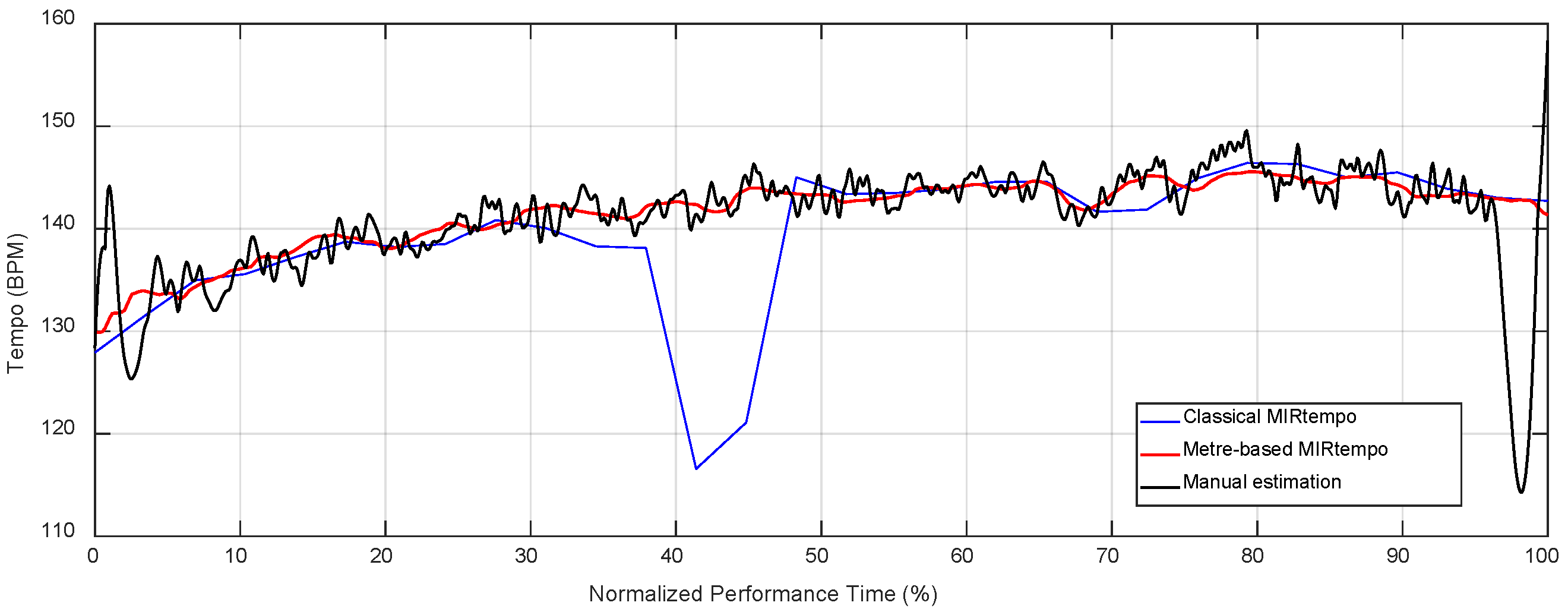
Figure 2.
Onset-Based Autocorrelation and Metrical Tempo Tracking for the Pentozali performance ps16. The figure illustrates the methodological approach used to examine tempo and periodicity across the complete recording. Upper panel: audio waveform with detected onset events (blue circles) obtained using MIRtoolbox onset detection. Lower panel: time-varying candidate-BPM periodicity map derived from local autocorrelation of the detected onset sequence. The horizontal axis represents time (s), the vertical axis represents candidate tempo levels (BPM), and color intensity indicates the relative strength of each candidate periodicity at each analysis position. The blue curve represents the tempo trajectory obtained using the MIRtoolbox Metre approach.
Figure 2.
Onset-Based Autocorrelation and Metrical Tempo Tracking for the Pentozali performance ps16. The figure illustrates the methodological approach used to examine tempo and periodicity across the complete recording. Upper panel: audio waveform with detected onset events (blue circles) obtained using MIRtoolbox onset detection. Lower panel: time-varying candidate-BPM periodicity map derived from local autocorrelation of the detected onset sequence. The horizontal axis represents time (s), the vertical axis represents candidate tempo levels (BPM), and color intensity indicates the relative strength of each candidate periodicity at each analysis position. The blue curve represents the tempo trajectory obtained using the MIRtoolbox Metre approach.
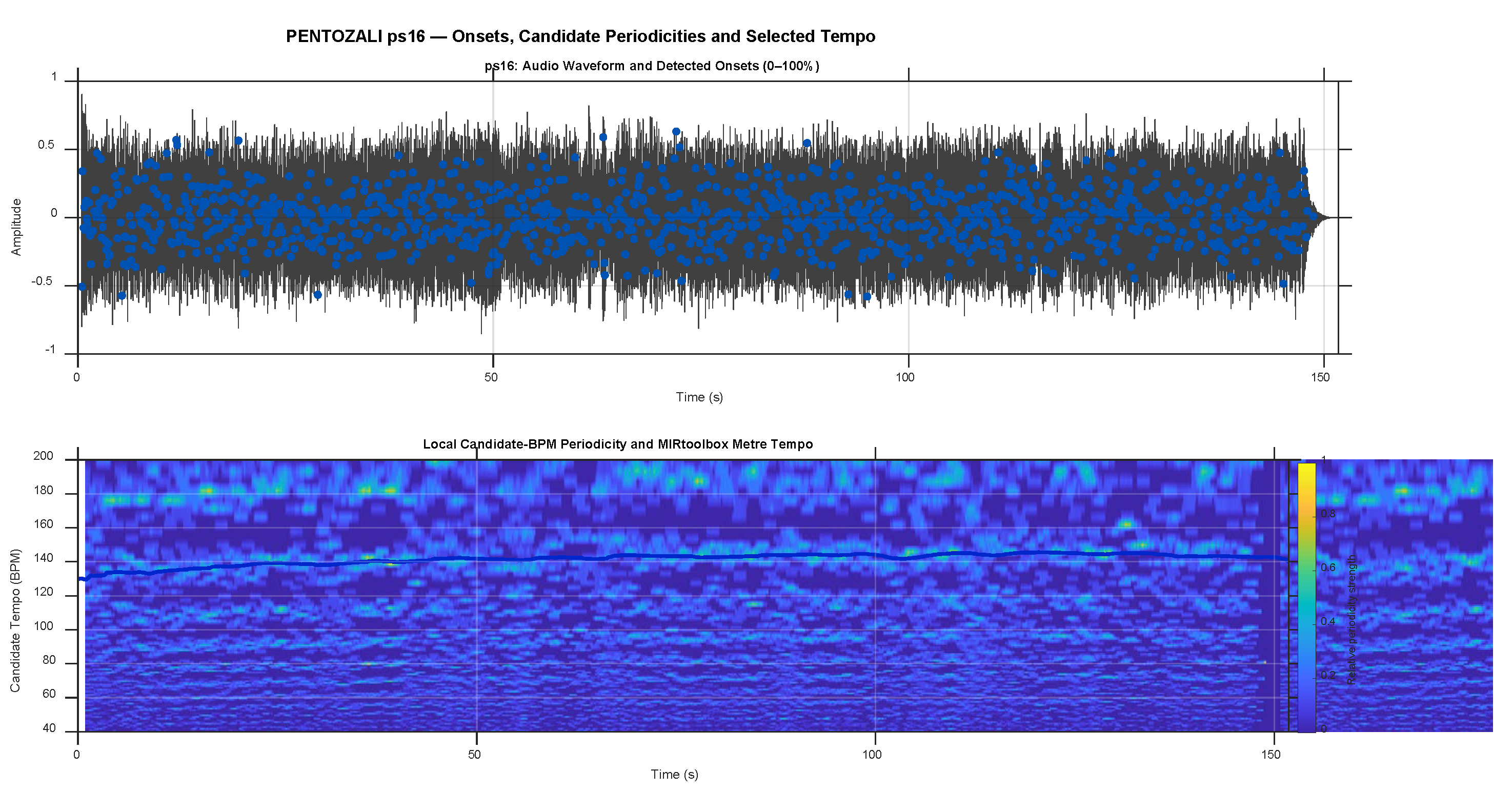
Figure 3.
Tempo curves of the studio Pentozali performances. Individual recordings are shown in gray, while the blue line represents the mean tempo curve across the analyzed performances. The shaded region indicates ±1 standard deviation around the mean. The horizontal axis represents normalized performance time (0–100%), and the vertical axis represents tempo in beats per minute (BPM).
Figure 3.
Tempo curves of the studio Pentozali performances. Individual recordings are shown in gray, while the blue line represents the mean tempo curve across the analyzed performances. The shaded region indicates ±1 standard deviation around the mean. The horizontal axis represents normalized performance time (0–100%), and the vertical axis represents tempo in beats per minute (BPM).
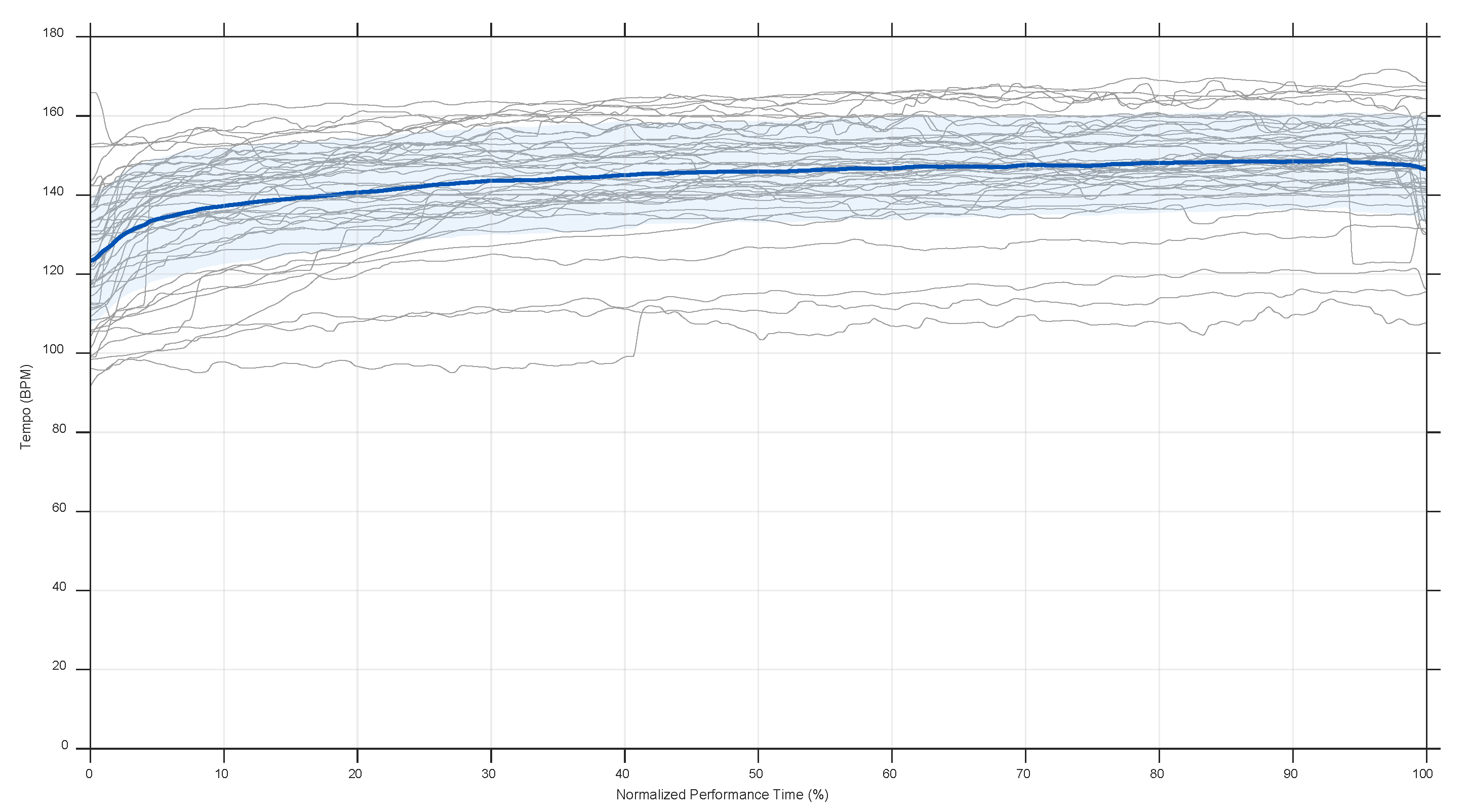
Figure 4.
Relationship between publication year and mean performance tempo. Each point represents one studio recording, with the x-axis indicating the year of publication of the corresponding song and the y-axis indicating its mean performance tempo (BPM). The fitted line represents the linear regression between publication year and mean performance tempo.
Figure 4.
Relationship between publication year and mean performance tempo. Each point represents one studio recording, with the x-axis indicating the year of publication of the corresponding song and the y-axis indicating its mean performance tempo (BPM). The fitted line represents the linear regression between publication year and mean performance tempo.
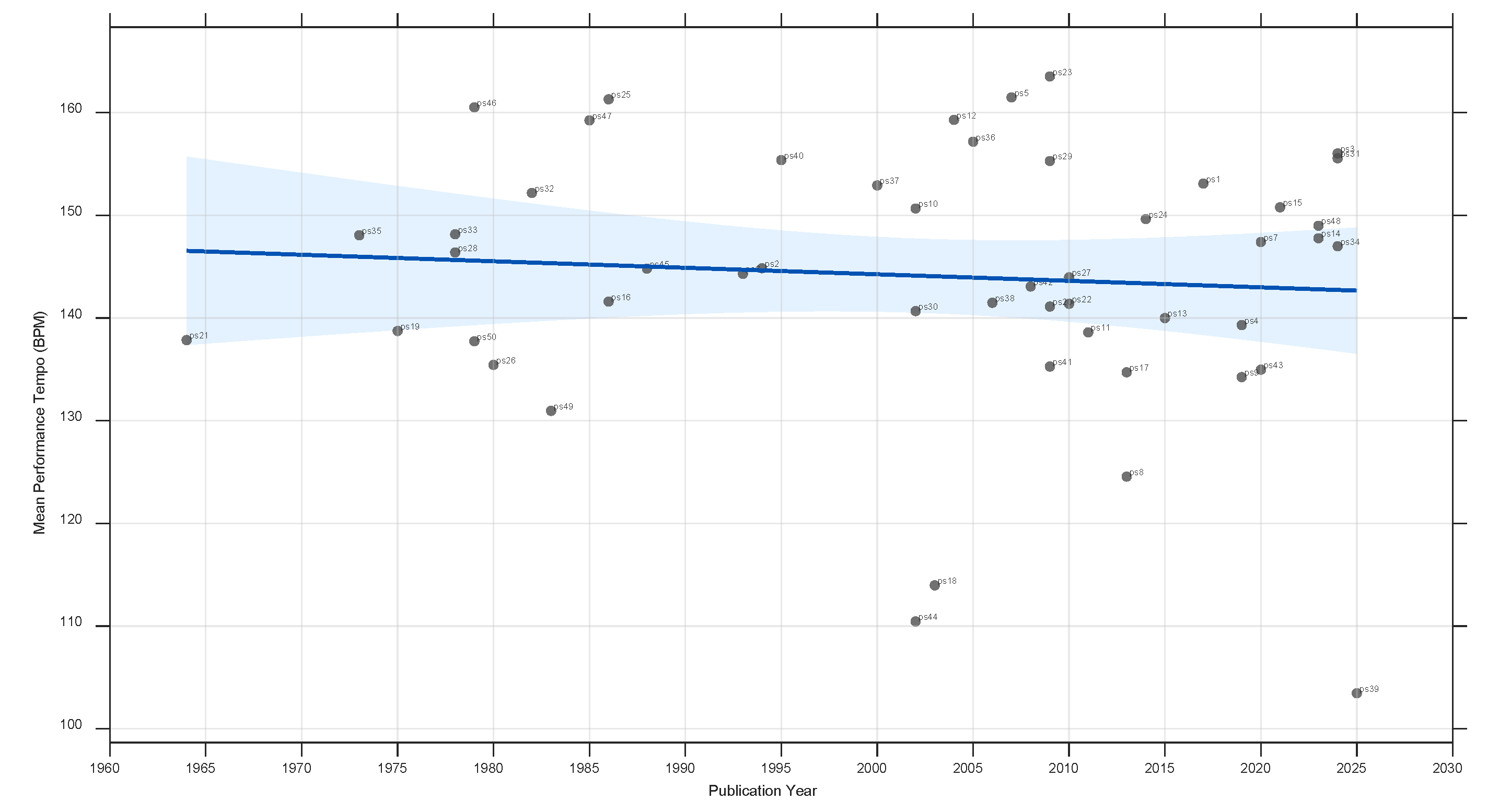
Figure 5.
Within-performance tempo range in relation to publication year. Each gray circle represents one individual recording. The y-axis shows the within-performance tempo range, calculated as the difference between the maximum and minimum tempo (BPM) observed within each performance. The blue line represents the linear regression between publication year and within-performance tempo range.
Figure 5.
Within-performance tempo range in relation to publication year. Each gray circle represents one individual recording. The y-axis shows the within-performance tempo range, calculated as the difference between the maximum and minimum tempo (BPM) observed within each performance. The blue line represents the linear regression between publication year and within-performance tempo range.
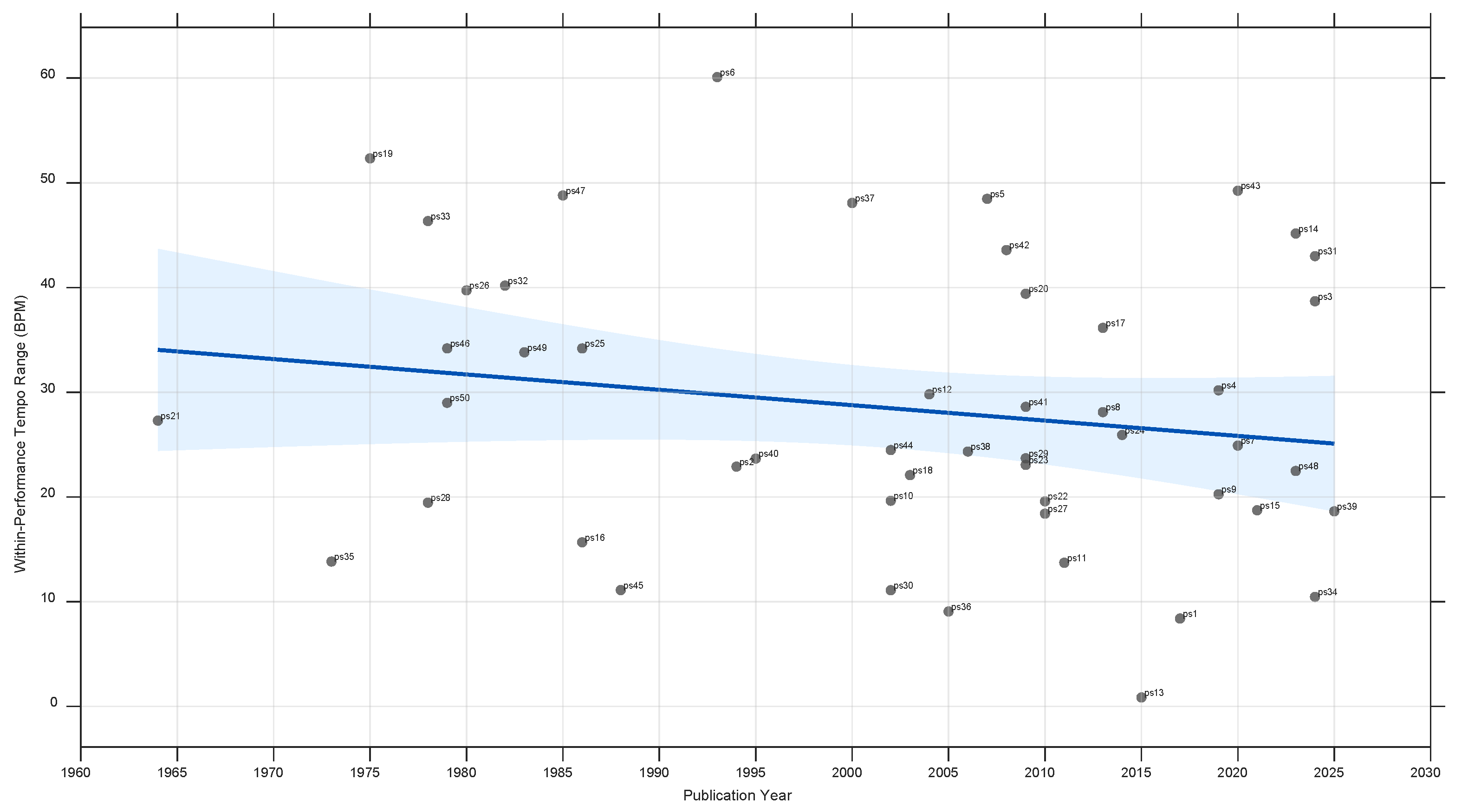
Figure 6.
Tempo trajectories of the live Pentozali performances. Individual recordings are shown in gray, while the red line represents the mean tempo trajectory across the analyzed performances. The shaded region indicates ±1 standard deviation around the mean. The horizontal axis represents normalized performance time (0–100%), and the vertical axis represents tempo in beats per minute (BPM).
Figure 6.
Tempo trajectories of the live Pentozali performances. Individual recordings are shown in gray, while the red line represents the mean tempo trajectory across the analyzed performances. The shaded region indicates ±1 standard deviation around the mean. The horizontal axis represents normalized performance time (0–100%), and the vertical axis represents tempo in beats per minute (BPM).
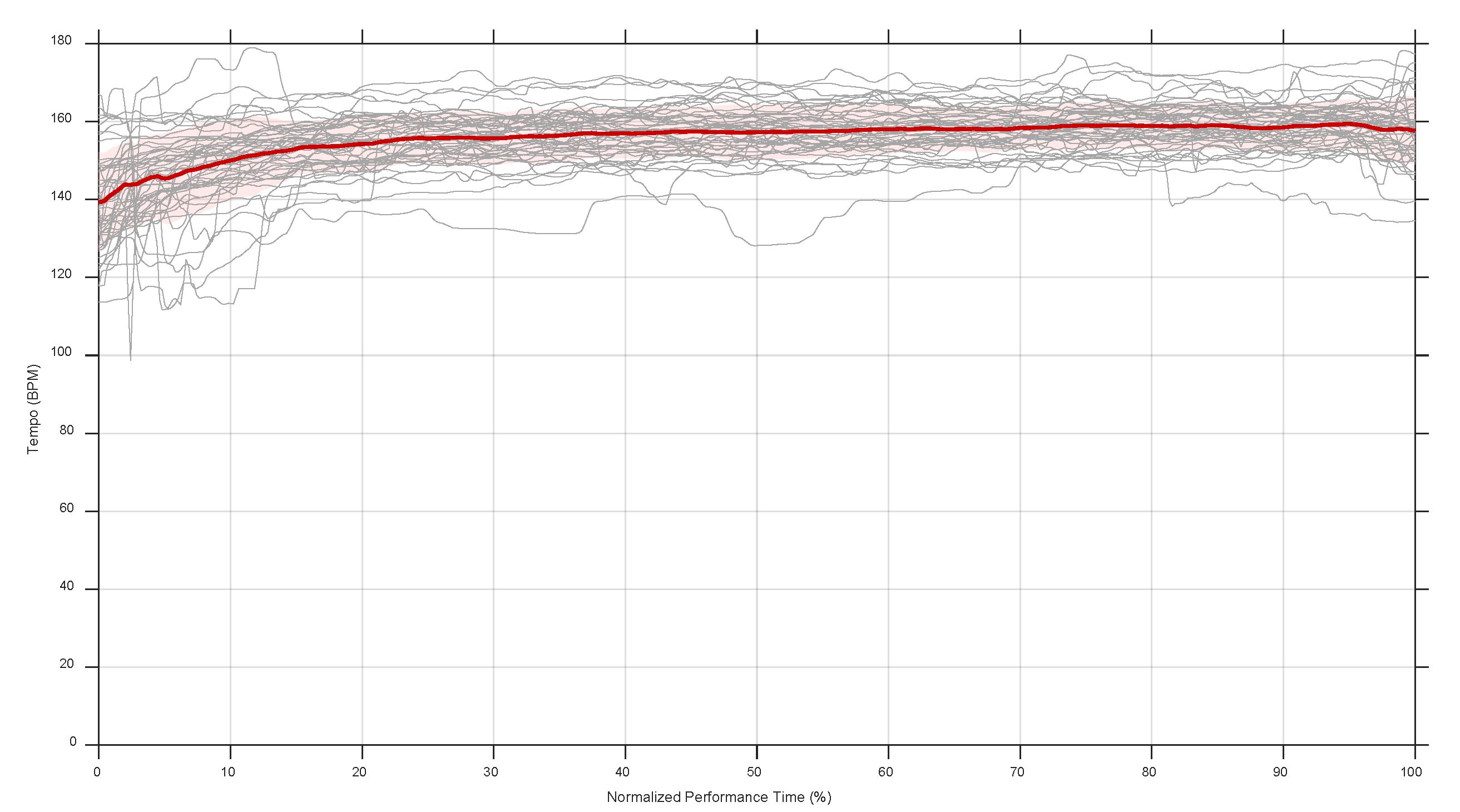
Figure 7.
Relationship between publication year and mean performance tempo in the 50 live Pentozali recordings. Each point represents one live recording, identified by its recording code (pl1–pl50), with the x-axis indicating the year of publication of the corresponding song and the y-axis indicating its mean performance tempo (BPM). The red line represents the fitted linear regression between publication year and mean performance tempo, while the shaded area indicates the 95% confidence interval of the regression estimate.
Figure 7.
Relationship between publication year and mean performance tempo in the 50 live Pentozali recordings. Each point represents one live recording, identified by its recording code (pl1–pl50), with the x-axis indicating the year of publication of the corresponding song and the y-axis indicating its mean performance tempo (BPM). The red line represents the fitted linear regression between publication year and mean performance tempo, while the shaded area indicates the 95% confidence interval of the regression estimate.
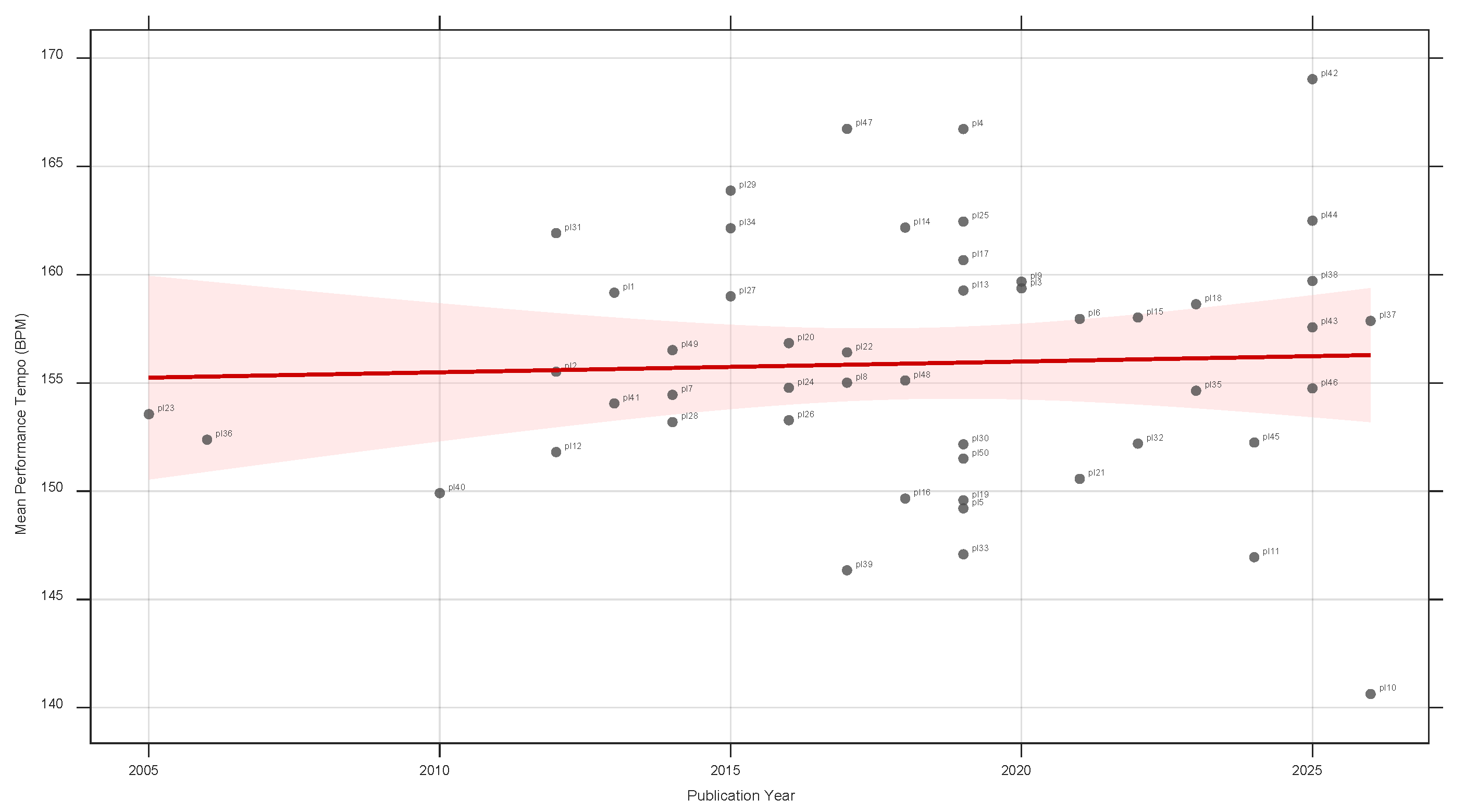
Figure 8.
Within-performance tempo range in relation to publication year. Each gray circle represents one individual live Pentozali recording (n = 50). The y-axis shows the within-performance tempo range, calculated as the difference between the maximum and minimum estimated tempo (BPM) observed within each performance. The red line represents the linear regression between publication year and within-performance tempo range, while the shaded region indicates the 95% confidence interval of the regression estimate.
Figure 8.
Within-performance tempo range in relation to publication year. Each gray circle represents one individual live Pentozali recording (n = 50). The y-axis shows the within-performance tempo range, calculated as the difference between the maximum and minimum estimated tempo (BPM) observed within each performance. The red line represents the linear regression between publication year and within-performance tempo range, while the shaded region indicates the 95% confidence interval of the regression estimate.
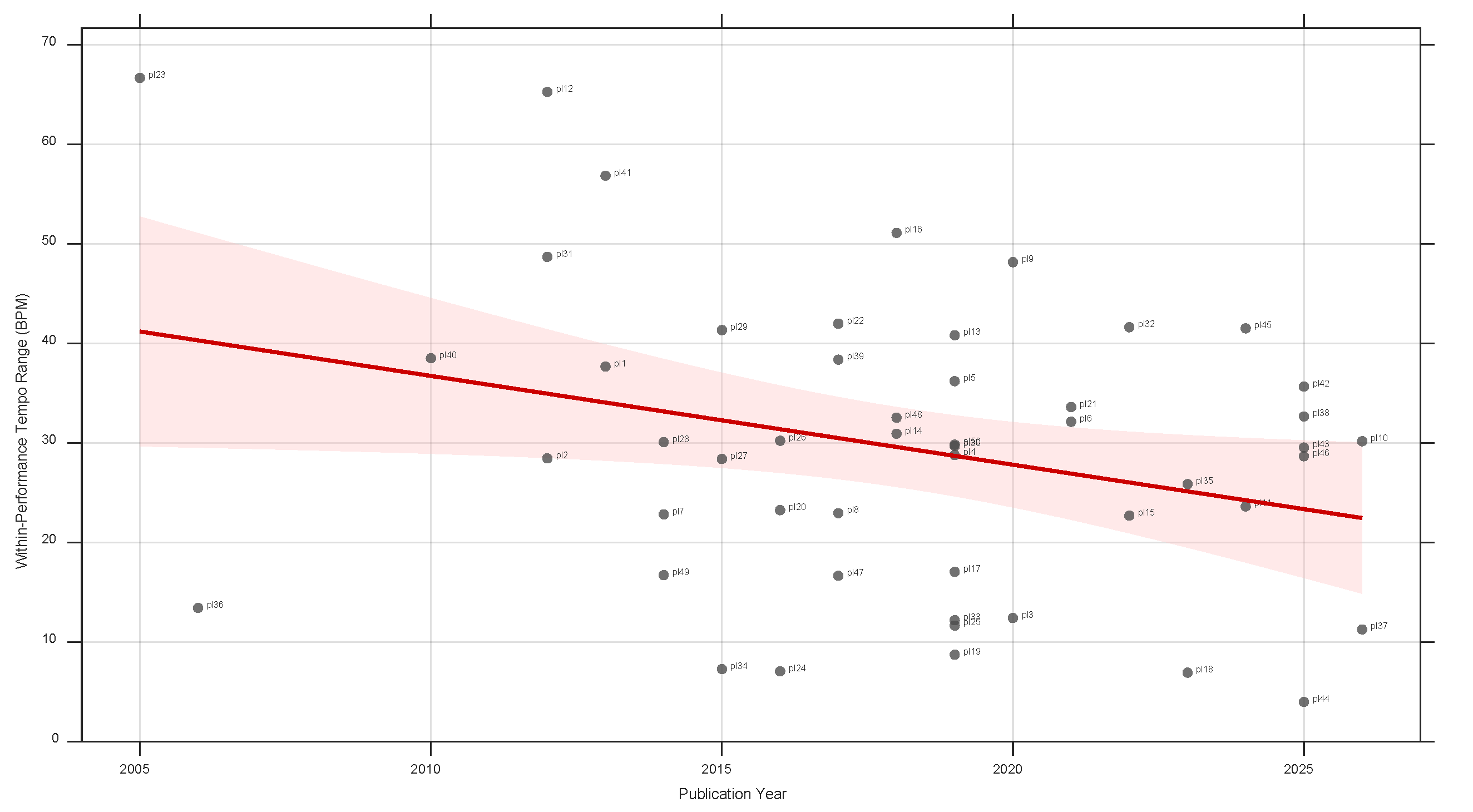
Figure 9.
Mean tempo curves for studio and live Pentozali performances. Mean tempo trajectories across normalized performance time (0–100%) for 50 studio recordings (blue) and 50 live recordings (red). Solid lines represent the mean tempo curve, while shaded areas indicate ±1 standard deviation across performances.
Figure 9.
Mean tempo curves for studio and live Pentozali performances. Mean tempo trajectories across normalized performance time (0–100%) for 50 studio recordings (blue) and 50 live recordings (red). Solid lines represent the mean tempo curve, while shaded areas indicate ±1 standard deviation across performances.
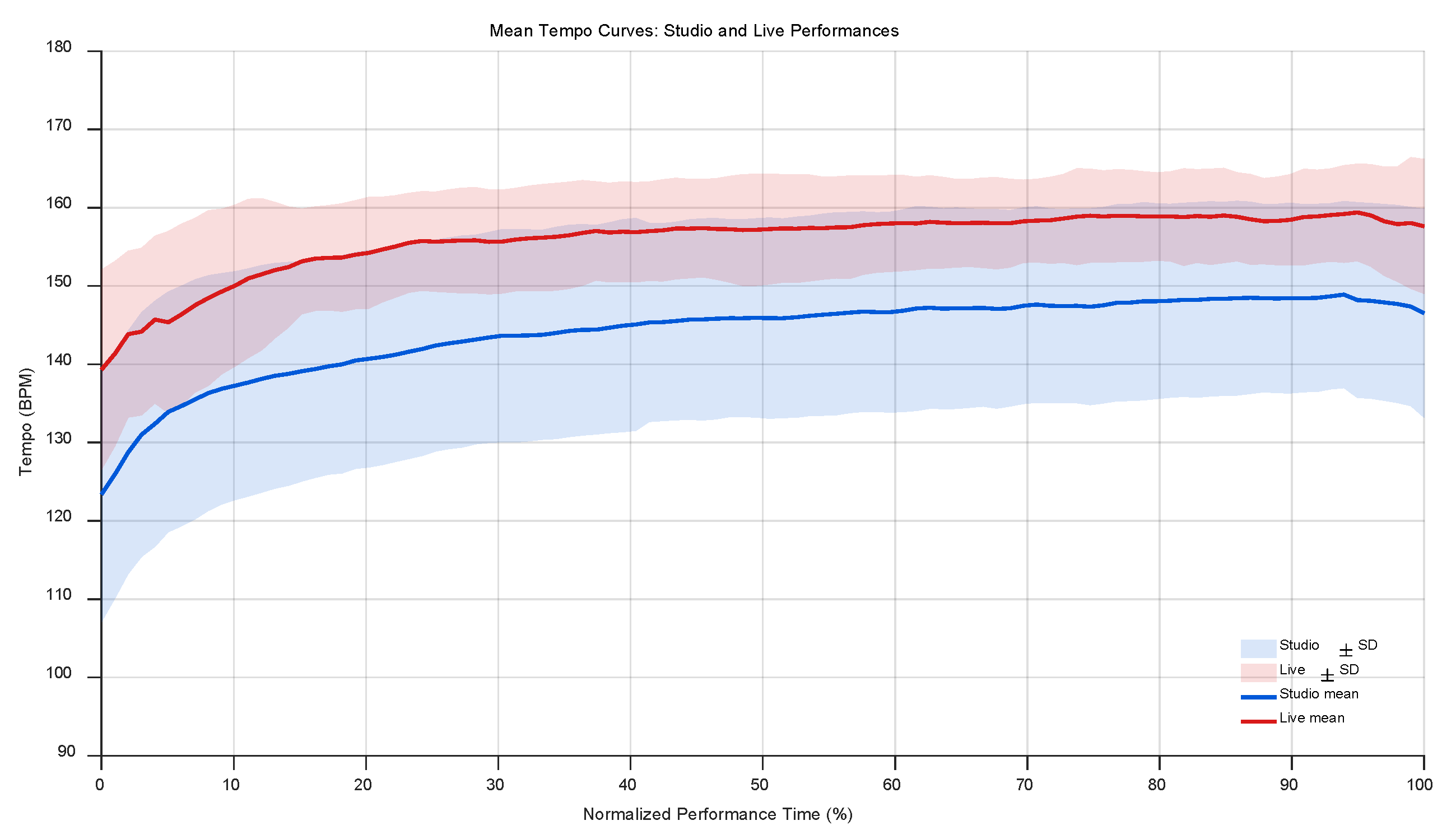

Table 1.
Tempo characteristics and tempo change across the 50 Pentozali studio performances. Values are presented as mean ± standard deviation (SD), with the observed range shown in the final column. Mean performance tempo represents the mean estimated tempo across each performance. Within-performance tempo range represents the difference between the maximum and minimum estimated tempo within each performance. Absolute tempo change represents the difference between final and initial tempo (final − initial). Relative tempo change represents the absolute tempo change expressed as a percentage of the initial tempo.
Table 1.
Tempo characteristics and tempo change across the 50 Pentozali studio performances. Values are presented as mean ± standard deviation (SD), with the observed range shown in the final column. Mean performance tempo represents the mean estimated tempo across each performance. Within-performance tempo range represents the difference between the maximum and minimum estimated tempo within each performance. Absolute tempo change represents the difference between final and initial tempo (final − initial). Relative tempo change represents the absolute tempo change expressed as a percentage of the initial tempo.
| Variable | Mean ± SD | Range |
| Mean performance tempo (BPM) | 143.54 ± 13.82 | 103.46–163.51 |
| Within-performance tempo range (BPM) | 30.66 ± 13.29 | 0.85–60.10 |
| Absolute tempo change (BPM) | 25.15 ± 15.58 | −13.61–57.46 |
| Relative tempo change (%) | 21.80 ± 16.20 | −8.20–57.99 |
Table 2.
Tempo characteristics and tempo change across the 50 Pentozali live performances. .
| Variable | Mean ± SD | Range |
| Mean performance tempo (BPM) | 152.52 ± 6.24 | 140.63–169.03 |
| Within-performance tempo range (BPM) | 29.23 ± 14.55 | 3.98–66.69 |
| Absolute tempo change (BPM) | 18.30 ± 12.90 | −11.77–45.77 |
| Relative tempo change (%) | 13.91 ± 10.46 | −7.20–36.01 |
Table 3.
Tempo characteristics of the 50 live Pentozali performances according to performer category. Performances are classified according to whether the dancers were professional dancers or civilians.
Table 3.
Tempo characteristics of the 50 live Pentozali performances according to performer category. Performances are classified according to whether the dancers were professional dancers or civilians.
| Variable | Professional Mean SD | Civilian Mean SD | Difference in Mean | 95% CI of Difference | p | Cohen's d |
| Mean performance tempo (BPM) | 156.00 ± 4.90 | 155.53 ± 8.17 | 0.47 | −3.37 to 4.31 | 0.82 | 0.08 |
| Within-performance tempo range (BPM) | 31.19 ± 14.40 | 23.31 ± 14.31 | 7.88 | −2.42 to 18.18 | 0.13 | 0.55 |
| Absolute tempo change (BPM) | 18.71 ± 13.39 | 16.88 ± 14.18 | 1.83 | −7.50 to 11.16 | 0.70 | 0.14 |
| Relative tempo change (%) | 14.28 ± 10.41 | 12.60 ± 11.03 | 1.68 | −5.51 to 8.87 | 0.65 | 0.16 |
Table 4.
Tempo characteristics of live Pentozali performances according to performance setting (indoor vs. outdoor). Indoor and outdoor categories refer to the physical setting in which the corresponding live performance was recorded.
Table 4.
Tempo characteristics of live Pentozali performances according to performance setting (indoor vs. outdoor). Indoor and outdoor categories refer to the physical setting in which the corresponding live performance was recorded.
| Variable | Indoor- Mean SD | Outdoor Mean SD | Difference in Mean (Indoor − Outdoor) | 95% CI of Difference | p | Cohen's d |
| Mean performance tempo (BPM) | 154.99 ± 5.52 | 156.96 ± 5.81 | −1.97 | −5.21 to 1.27 | 0.23 | −0.35 |
| Within-performance tempo range (BPM) | 29.68 ±11.38 | 29.20 ± 17.96 | +0.48 | −8.38 to 9.34 | 0.91 | 0.03 |
| Absolute tempo change (BPM) | 18.67 ± 13.62 | 17.88 ± 13.51 | +0.79 | −6.96 to 8.54 | 0.84 | 0.06 |
| Relative tempo change (%) | 14.25 ± 10.59 | 13.52 ± 10.52 | +0.73 | −5.30 to 6.76 | 0.81 | 0.07 |
Table 5.
Comparison of tempo characteristics between live and studio performances. Values are presented as mean ± standard deviation (SD), with the observed range shown in parentheses.
Table 5.
Comparison of tempo characteristics between live and studio performances. Values are presented as mean ± standard deviation (SD), with the observed range shown in parentheses.
| Variable | Studio Mean ± SD | Live Mean ± SD | Difference in Mean (Live − Studio) | 95% CI of Difference | p | Cohen's d |
| Mean performance tempo (BPM) | 143.54 ± 13.82 | 152.52 ± 6.24 | +8.98 | 4.67 to 13.29 | <0.001 | 0.84 |
| Within-performance tempo range (BPM) | 30.66 ± 13.29 | 29.23 ± 14.55 | -1.43 | −7.01 to 4.15 | 0.61 | −0.10 |
| Absolute tempo change (BPM) | 25.15 ± 15.58 | 18.30 ± 12.90 | -6.85 | −12.61 to −1.09 | 0.019 | −0.48 |
| Relative tempo change (%) | 21.80 ± 16.20 | 13.91 ± 10.46 | -7.89 | −13.38 to −2.40 | 0.005 | −0.58 |
Disclaimer/Publisher’s Note: The statements, opinions and data contained in all publications are solely those of the individual author(s) and contributor(s) and not of MDPI and/or the editor(s). MDPI and/or the editor(s) disclaim responsibility for any injury to people or property resulting from any ideas, methods, instructions or products referred to in the content. |
© 2026 by the authors. Licensee MDPI, Basel, Switzerland. This article is an open access article distributed under the terms and conditions of the Creative Commons Attribution (CC BY) license (http://creativecommons.org/licenses/by/4.0/).
Copyright: This open access article is published under a Creative Commons CC BY 4.0 license, which permit the free download, distribution, and reuse, provided that the author and preprint are cited in any reuse.