

Submitted:
30 September 2026
Posted:
05 October 2026
You are already at the latest version
Abstract
Homoleptic mercaptides of n-dodecanethiol (i.e., organosulfur compounds with formula: Me(SC12H25)X, where X is the oxidation state of the metal, Me) are soluble, at low concentrations, in paraffin wax, and these solid solutions can be used as fuel for fabricating paraffin candles with colored flames (or UV/NIR-light emitting flames). Depending on the nature of the required metal, the preparation of n-dodecanethiol salts can be done by adopting different synthetic strategies. Here, the main methods for synthesizing n-dodecanethiol mercaptides are described; these methods are based on: (1) neutralization of the thiol with metal hydroxide in an alcoholic medium, (2) double-displacement reaction in acidic or basic environments, (3) synthesis based on the mercaptide solubility product (KSP) in water, and (4) direct reaction of the thiol with the elemental metal in an active form. The most important issues related to the preparation of the mercaptide through these chemical reactions (e.g., mercaptide purification, variation of the metal's oxidation number, mercaptide XRD characterization, etc.) are also analyzed in some detail.
Keywords:
paraffinic wax
; colored flame
; UV/Vis/NIR sources
; atomic emission
; mercaptides
; n-dodecanethiol
; antiseptic light
1. Introduction
A flame can be variously colored by dispersing adequate metallic cations into it. For such a purpose a metallic salt (metal cation source) needs to be placed in the candle/lamp cotton witch (or an additional witch) or dissolved in the candle/lamp fuel [1-3], the last can be a liquid substance, in the case of alcohol/petrol lamps [1], or a solid (e.g., paraffin, sorbitol-ethane-diol-glycerol) for candles [2,3]). Atomic emission [4] is the physical phenomenon involved in such technological process of flame coloration. In particular, in the atomic emission, metal cations become atoms in the flame by catching plasma’s free-electrons, and valence shell electrons are thermally excited between sub-levels belonging to the same atomic level (e.g., 2s→2p, 3s→3p); consequently, visible (or UV, NIR) photons are emitted as a result of the radiative relaxation of these excited electrons.
Unlike in the past, the current applications of the flame are almost exclusively as a source of heat and not of light; however, there are some application areas (e.g., fireworks, fuel-fired emergency torches/lamps, kerosene lanterns) in which the flame is still used as a light source, and atomic emission allows to have an emission spectrum with a primary component of monochromatic visible, ultraviolet, or infrared radiation. There are hydrocarbon combustions that generate not clearly visible flames, so their coloration can help define exactly the contours, which could be a characteristics useful in engineering contexts. Furthermore, a monochromatic flame is useful not only in decorative applications (e.g., artistic installations, votive lamps, special choreographies, fireworks, etc.) and visually impactful educational experiments, but can also be used to include some remote information in the flame, such as its combustion temperature or a color-based warning message (e.g., accident warnings such as landslides, falling rocks, etc.). Flames are also used as a sterilization tool (e.g., for inoculation loops and needles in microbiology) and to purify the air from carbon particles (e.g., anti-smoke candles). In both cases, the presence of metal atoms in the flame’s plasma (e.g., catalytically active metals) can be beneficial for the antiseptic radiation produced (UV light) and catalytic effect, respectively. Ultimately, isotropic (i.e., omnidiretional) light sources based on candle flames with various functionalities can be obtained by introducing specific metallic ions into them (e.g., iron, zinc, nickel).
Metal ions (cations) are contained in inorganic/organic compounds known as salts (other compounds like hydrides, metal carbonyls, π-complexes, metal acetylides, etc. also contain metallic atoms; however, they are unstable or toxic chemical compounds). Usually, these ionic compounds are fully insoluble in the liquid or solid hydrocarbons used as fuel to generate flames. In a salt, the ionic nature of the salt chemical bond depends not only on the nature of the metal (i.e., the metal's electropositivity), but also on the electronegativity of the nonmetallic atom to which this metal atom is bonded. In the case of halides (MenXm) and oxyacid salts (e.g. nitrates, sulphates, phosphates, chlorates, acetyl acetonates, etc.), the bond can be considered as purely ionic (i.e. 100% ionic) due to the high electronegativity of the halogen and oxygen atoms to which the metal is bonded, but with sulphides, selenides and tellurides the bond is partly covalent (specifically, it is a heteropolar covalent bond). The percentage of ionic character of the sulfide bond (i.e. sulfur-metal chemical bond) can be estimated by the empirical Pauling equation [5], given the electronegativity difference between metal and sulfur (i.e., ionicity % ={1-exp[-(ΔX/2)2]}·100, where ΔX is the metal-sulfur electronegativity difference) and this quantity is always lower than 50%, even with alkali and alkaline-earth metals. As visible in Figure 1, the analysis of the ionic character of sulfur-metal bonds by the Pauling equation shows that sulfides of noble-metals and semimetals are practically nonpolar, while those of earth metals, transition metals, etc. always have negligible ionic character. This limited percentage of salt bond ionicity calculated for sulfides suggests a good solubility of linear hydrocarbon molecules containing the mercaptide group (i.e., -SMe), i.e., n-alkyl thiol salts, in a fully nonpolar environment such as a hydrocarbon environment (both liquid hydrocarbons such as methane, propane, and butane, and solids like paraffin waxes). Flame dying requires very small quantities of metals in addition the presence of thiols in hydrocarbons is quite common since they are typical gas-tracers for natural gasses, LPG (propane, butane), etc.
Normal-alkyl-thiols (i.e., organic compounds with general formula CnH2n+1-SH) with long hydrocarbon chains (n>10) are paraffin-like hydrocarbon molecules containing a terminal sulfhydryl group (-SH). Due to its acidity (pKa~9), this group can be easily salified to form a mercaptide group (-SMe), i.e., a saline group similar to inorganic sulfides [6]. Due to the low ionic character of the mercaptide bond (S-Me is a heteropolar covalent bond) and the covalent nature of the S-C bond (the total dipolar moment of mercaptide corresponds to the Me-S bond dipole moment), thiol salts can be dissolved in molten paraffin (a mixture of hydrocarbons with the formula: CnH2n+2 with 20≤n≤40), and the dissolved molecules do not spontaneously organize into micellar structures.
Using these solid solution of mercaptides in paraffin as fuel for candles, combustion can generate visible and intensely colored flames, the color of which depends on the type of metal contained in the mercaptide. However, also antiseptic flames that emit intense ultraviolet light or NIR-emitting flames based on cesium (useful for some types of catering) can be similarly obtained. To the best of our knowledge, mercaptides have never been used for paraffin doping and candle flame coloration. This brief review discusses synthesis strategies, mercaptide purification and characterization methods, mercaptide colorations, and other issues related to the preparation of these precious organosulfur compounds, which can potentially be used as functional additives in the manufacturing of paraffin candles with flames having properties like color, antiseptics, thermal radiation emission, etc.
2. Experimental Part
The selection of the thiol precursor for the preparation of different types of metal mercaptides for flame coloration is a quite critical issue due to the intense and unpleasant odor characterizing these sulfur-containing compounds (humans can detect thiols in air at concentrations as low as 2·10-9 mg, equivalent to 1 part in 50 billions). Since the vapor pressure of any liquid decreases as its molecular weight increases, and the compound odor is related to the quantity of molecules released into the air by evaporation, it is preferable to use long-chain hydrocarbon thiols (e.g., n-dodecanethiol, octadecane-thiol) rather than low-molecular weight thiols. n-Dodecanethiol (C12H25-SH) is a type of liquid thiol, low in odor and widely used in the study of self-assembled monolayers (SAM) [7]. The liquid nature of this thiol at room temperature makes it easy to dissolve in the alcoholic solvents required for its salification. In this study, n-dodecane thiol was the only mercaptane type used for mercaptide preparation. n-Dodecanethiol and the purified paraffin wax used for preparing the mercaptide solid solutions were provided by Aldrich. The main physical properties of n-dodecanethiol are shown in Table I.

Table 1.
– Main physical properties of n-dodecanethiol.
| d(g/cm3) | MW | Tm(°C) | Tb (1atm)(°C) | P25°C |
|---|---|---|---|---|
| 0.841-0.85 | 202.4 | -7 | 266-283 | 0.0086-0.009 |
The thiol is stored at temperatures of a few degrees Celsius (ca. 4°C), in brown glass bottles, to minimize its photocatalyzed oxidation to disulfide (i.e., 4 R-SH + O2 → 2 R-S-S-R + 2 H2O), a reaction that occurs slowly over time when the thiol is exposed to air. Besides slowing down the kinetics of this oxidation reaction, refrigeration further minimizes problems related to the unpleasant odor of this substance and thus facilitates its handling.
Some mercaptides require to be stored in an anhydrous environment (glass vacuum desiccator) for preventing the hydrolysis reactions that may occur with some of them (those with a high ionic S-Me bond), when they are exposed to air humidity.
After synthesis the mercaptides successful formation has been easily verified by using X-ray powder diffraction (X’Expert PRO, PANalytical, Oxford, UK); indeed, the intense and regularly spaced signals visible at low theta values in the XRD diffractograms of these chemical compounds is a finger print of these special organosulfur substances in a crystalline form.
3. Results and Discussion
3.1. Synthesis by Neutralization Reaction
The chemical synthesis of homoleptic mercaptides (i.e., Me(SR)X) can be carried out through different schemes, depending on the nature of the metal involved and the length of the normal alkanethiol used. Since some alkali metal and alkaline-earth metal mercaptides (e.g., lithium, sodium, potassium, calcium, barium, and strontium mercaptides) have great potentialities for flame coloration (indeed, a paraffin candle flame is a relatively cool flame and easily excitable metals, especially alkali and alkaline-earth metals, are the most suitable, as they remain visible even in low temperature flames), one way to prepare them is by using the simple neutralization (acid-base reaction) of the thiol with the hydroxide of the desired metal. In particular, since the sulfhydryl group (-SH) has a characteristics slightly acidic behavior (pKa~9), it can be salified by treatment with a strong base (e.g., metal hydroxide, an inorganic compound with the formula Me(OH)X), and the reaction leads to the formation of water as by-product. According to such acid-base reaction scheme, homoleptic mercaptides can be considered as thiol salts more than metal complexes. For example, sodium/potassium mercaptide can be obtained by neutralization of the sulfhydryl group with sodium/potassium hydroxide (NaOH and KOH respectively). The general scheme of this chemical reaction is as follows:
Thiol + Metal hydroxide → Mercaptide + Water
It is convenient to carry out this neutralization reaction in solution, that is, by combining the alcoholic solution (e.g., ethanol as solvent) of thiol with the alcoholic solution of metal hydroxide (thiols and hydroxides are often soluble in alcohol, and furthermore, this organic solvent is inert both towards the ions contained in the metal hydroxide and the thiol). These two chemical reagents are reacted at room temperature, and to avoid incorporating thiol into the mercaptide, which separates by precipitation, the reaction is carried out by using precise stoichiometric amounts of reagents (for the same reason, the required volume of thiol solution is typically added gradually, i.e., dropwise, using a burette or a loading funnel, to the salt solution, which is stirred with a magnetic stir bar as shown in Figure 2). The produced mercaptide separates more or less completely by precipitation because it is a quite nonpolar compound mostly insoluble in the reaction medium (due to the neutralization reaction, which generates water, the mercaptide precipitates from a water-alcohol mixture). The obtained mercaptide, after a brief recrystallization period, is typically isolated by evaporating the water-alcohol mixture in a rotavapor and finally dissolved in the molten paraffinic wax.
3.2. Synthesis by Double-Displacement Reaction
In an alcoholic solvent medium, a thiol and a salt establish an equilibrium reaction among the thiol, the corresponding mercaptide, and the acid conjugate to the salt anion (eventually in a dissociated form). This equilibrium is usually shifted to the right since the mercaptide is poorly soluble in alcohol and therefore precipitates. When the mercaptide is instead partially soluble in alcohol, the equilibrium reaction can still be driven to the right by using a salt of a weak acid: the reaction then generates a weak acid that, remaining undissociated, usually precipitates from the alcoholic medium, thus shifting the equilibrium toward the products. Thus the most nonpolar mercaptides, which are highly insoluble in alcoholic media, can be synthesized through a chemical precipitation reaction in the resulting acidic environment. If an alcoholic solution of thiol and an alcoholic salt solution are slowly combined together under stirring by using a burette or a loading funnel, the separation of a solid phase corresponding to the metal mercaptide is observed. The solvent type can be also adequately adapted, for example, in the preparation of silver mercaptide [8], a solution of n-dodecanethiol (C12H25SH) in acetone (ethanol cannot be used because it reduces the silver ions to Ag(0)) is added dropwise to a solution of silver nitrate (AgNO3) in acetonitrile (CH3CN), maintained under magnetic stirring. The mercaptide precipitates as a microcrystalline white powder and, after an appropriate recrystallization time period (at room temperature), it can be separated by pump filtration through rapid filtration on a paper filter (Whatman n.42, filter paper), then washed with acetone and/or ethanol and left to dry in air. In this case, mercaptide precipitation is also favored by the presence of electrolytes dissolved in the alcohol (dissociated nitric acid, a strong monoprotic acid). The yield is generally 100% due to the insolubility of the mercaptide produced in the reaction medium. Mercaptide precipitation can take place instantaneously when the metal does not change its oxidation state during exposure to the thiol, or it occurs with some delay if the oxidation state of the metal changes due to the chemical reduction by the thiol.
However, since the reaction of mercaptide formation by precipitation is an equilibrium reaction, in the case the mercaptide precipitation does not occur completely after mixing the reactants (modest mercaptide insolubility in alcohol), a pH correction (for example, by adding ammonium hydroxide or triethylamine) is necessary. In this case, the mercaptide precipitation takes place according to the following reaction scheme, where the added base (ammonium hydroxide) eliminates the acid product from equilibrium, thus allowing the thiol to completely convert to mercaptide:
Thiol + Salt ↔ Mercaptide + Acid
Acid + Base → Salt’ + Water
A variety of mercaptides have been prepared according to this system scheme [9].
3.3. Synthesis Based on the Solubility Product
For some metal ions (e.g., Ni2+), it is convenient to react the salt not with the thiol, but with its thiolate (e.g., sodium thiolate using water as reaction product). In this case, the precipitation is based on the solubility product (Ksp) of the mercaptide in distilled water [9], which usually corresponds to an extremely small number. This process is similar to the previous one, but in this case, the thiolate concentration in the system is much higher. The dissolution-precipitation medium is distilled water, kept under vigorous stirring (also the salt was dissolved in water). During this reaction, the mercaptideis is generally only partially dissolved in the reaction medium; indeed, it is mostly dispersed. Precipitation is favored by the presence of electrolytes and possibly water in the precipitation medium.
Mercaptide1 + Salt1 → Mercaptide2 + Salt2
3.4. Direct Thiol Reaction With Active Metals
Since thiols are quite weak monoprotic acid, some mercaptides can be prepared also by the direct action of thiol on the elemental metal; it is a Red-Ox reaction in which the elemental metal is oxidized to cation and the thiol’s proton is reduced to gaseous hydrogen [10]). The reaction takes place in heterogeneous phase, and therefore, to ensure high metal surface reactivity, it is better to react the metal in a finely-sized form (micro/nano-powder), free from surface oxide layers (i.e., as active metal). As an example, cobalt(II) n-dodecylthiolate has been obtained by reacting n-dodecanethiol directly with cobalt microspheres obtained through the polyol process [10,11]. The resulting cobalt(II) mercaptide is an amorphous solid with a purple coloration. In particular, after drying, this mercaptide appears as a soft plastic material similar to a rubber gum, widely soluble in nonpolar solvents like chloroform (CHCl3). In general, mercaptides can have a waxy, rubbery, or microcrystalline consistency, depending on whether they are amorphous (the first two cases) or microcrystalline (the third case). This Red-Ox reaction can be schematized as follows:
Thiol + Elemental metal → Mercaptide + Hydrogen
Similar reactions are observed with alkali (Li, Na, K) and alkaline-earth (Mg, Ca, Ba, Sr) metals, in this case a fast reaction kinetics is usually observed because of the very reactive behavior of these metals.
3.5. Variation of the Oxidation Number During Synthesis
The sulfur atom present in the thiol molecule has an oxidation number of -2, therefore the thiol can be oxidized to disulfide, where sulfur assumes an oxidation number of -1 due to the presence of sulfur-sulfur bond (i.e., 2R-SH → R-S-S-R + 2H+ +2e-), reducing the oxidation state of the metallic cation. Noble-metal ions, such as gold(III), are reduced to their lower oxidation states, before to precipitate as mercaptide. For example, gold chloride (AuCl3) is reduced to Au(I), which then precipitates as mercaptide (RS-Au, a substantially covalent compound), without further reduction by the thiol [12-14]. Both tetrachloroauric acid (i.e., HAuCl4) and Au(III) chloride (AuCl3.3H2O) lead to the formation of the Au(I) mercaptide (AuSC12H25).
When the metal has multiple valences (i.e., polyvalent metal ions), partial substitution products can also be generated; for example, for the antimony salt with the formula SbX3, the mercaptide-forming reaction can lead to the following compounds: SbRX2, SbR2X, and SbR3 [15].
3.6. Mercaptide Coloration and Fluorescence
Alkali and alkaline-earth metal mercaptides are white microcrystalline solids that can be therefore incorporated into paraffin wax without altering its characteristic white coloration. In contrast, as visible in Figure 3, other transition metal mercaptides are often colored (e.g., bismuth(III) dodecyl-mercaptide is yellow, cobalt(II) dodecyl-mercaptide is purple), and their presence in the wax—even at low concentrations—can produce shades of color. The mercaptide coloration is different from the color effect provided to the flame by the phenomenon of metal fluorescence (i.e., atomic emission).
Owing to the presence of metal-metal bonds (e.g., aurophilic interactions) in the mercaptide crystals, these organosulfur substances show frequently intensive fluorescence characteristics (see Figure 4).
3.7. Purification of Freshly Synthesized Mercaptides by Dissolution/Reprecipitation
Mercaptides need to be carefully purified by recrystallization because during synthesis, they easily incorporate thiol upon precipitation [16], and this compound must be present as little as possible in the mercaptide crystalline powder given its unsuitable organoleptic properties (odor). This co-precipitation occurs because the thiol's hydrocarbon chain (normal-dodecyl) can co-crystallize with the identical chain of its mercaptide. This is the reason mercaptides are prepared by combining the two reagents in stoichiometric amounts (and therefore never in excess of thiol), and the thiol solution is added dropwise to the vigorously stirred salt solution to avoid precipitation of the mercaptide in a thiol-rich environment. This mercaptide purification process by recrystallization can be performed very effectively by dissolving the mercaptide to be purified in hot chloroform (50°C) or tetrahydro furan (THF) (see Figure 5) and then adding ethanol to the resulting nonpolar solution, which mixes with the chloroform and, being polar, modifies the solvent polarity and causes the nonpolar mercaptide to reprecipitate. The thiol incorporated into the mercaptide microcrystals (along with other polar impurities) remains dissolved in the chloroform-ethanol solvent system.
3.8. Identification of the Reaction Product
For crystalline mercaptides, X-ray diffraction (XRD) provides a straightforward means of confirming mercaptide formation via any of the synthesis routes described above. Many mercaptides adopt a lamellar microstructure (bilayered polymeric structures) due to preferential interactions between the normal alkyl chains (Van der Waals interactions) and the metal atoms (see, for example, Figure 6 for the silver mercaptide case).
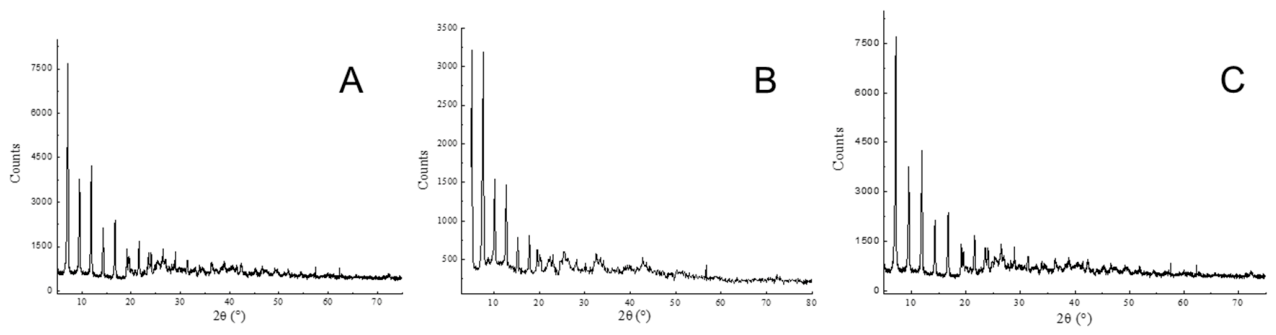
This particular crystalline arrangement yields a characteristic low-angle diffraction pattern with relatively intense, easily identifiable peaks that are perfectly equally spaced (see Figure 7), reflecting the periodicity of alternating organic and inorganic layers. The interlayer spacing is related to both the hydrocarbon chain length and the metal type.
The development of flames with functional properties is depending on the availability of adequate materials formulations, since flames are plasma generated by the combustion of a solid/liquid and therefore have properties depending on the type of solid/liquid combustible fueling it. Appropriate doping of the fuel allows introduction of specific species into the flame, capable to confer the desired functional properties. Flame coloring or emission of ultraviolet/NIR radiation based on the fluorescence of thermally excited atoms, is probably the simplest of possible functionalizations and results technologically useful for several reasons (e.g., perfect visualization of the flame's contours, long-distance transmission of information, optimization of aesthetics and/or visual impact, antiseptic effect on the surrounding environment due to intense UV emission, NIR fotobiomodulation, production of radiopaque or slightly magnetic flames, etc.). In particular, the flame can emit high-energy ultraviolet radiation (up to 200nm) as well as visible and infrared radiation and can therefore have effective antiseptic, antimicrobial and antifungal properties on the entire illuminated surrounding environment (in fact, it emits across the entire solid angle, like puntiform sources). The use of a paraffin candle is the simplest way to generate a flame and doping the solid paraffin with metal ions can confer numerous functional properties to the flame generated by its combustion on the basis of the choice of the introduced metal atom type (high-Z metal, catalytic metal, etc.). However, innovation of paraffin candles is quite challenging since this hydrocarbon is a highly nonpolar solid. Here, it has been found that paraffin doping by long-chain normal-alkyl mercaptide molecules, such as dodecyl mercaptide, is frequently possible because of the heteropolar covalent nature of the sulfur-metal (S-Me) bond. Metal atoms with very different characteristics can be introduced into the flame, such as catalytic, radiopaque, fluorescently colored (atomic emission), even slightly magnetic, UV/NIR emitting, etc. The development of functional flames is a new area of research encompassing materials science and offering significant potential applications given the flame's widespread use as a source of ionizing radiation across the entire solid angle, antiseptic/antimicrobial/antifungal, heat source, light source, incendiary weapon, etc.
4. Conclusion
Paraffin candle flame coloration requires to use metal mercaptides of various types. Depending on the nature of the metal atom needed to produce a given color (or UV/NIR radiation emission), these metal mercaptides of n-dodecanethiol can be prepared by using four different synthetic strategies: the first is based on the neutralization of the acidic thiol with metal hydroxide in an alcoholic environment; the second exploits the double-displacement equilibrium reaction favored by the mercaptide poor solubility in alcohol (due to its nonpolar nature) or the elimination of equilibrium acid by neutralization; the third is based on the very low solubility product of some mercaptides in water; and finally, the fourth synthesis scheme involves the direct red-ox reaction of the elemental metal with the thiol, with production of the mercaptide and hydrogen gas.
References
- Fei, L.; Guan, L.; He, F. PCT WO 98/00480; “Liquid fuel generating coloured flame for candle”. 08 01 1998.
- Garnys, V. US 6,921,260 B2; “Candles with colored flames”. 26 Jul 2005.
- Suzuki, K.; Okada, T. JPS63258987; “Illumination liquid fuel generating colored flame”. 15 04 1987.
- Cairns, W.R.L.; Braysher, E.C.; Butler, O.T.; Cavoura, O.; Davidson, C.M.; Torro, J.L.T.; von der Au, M. Atomic spectrometry update: review of advances in environmental analysis. J. Anal. At. Spectrom. 2025, 41, 16–70. [Google Scholar] [CrossRef]
- Pauling, L. The nature of the chemical bond, 3rd ed.; Cornell University Press: Ithaca, NY, 1960; p. 98. [Google Scholar]
- Bishop, P.T. The use of gold mercaptides for decorative precious metal applications. Gold. Bull. 2002, 35, 89–98. [Google Scholar] [CrossRef]
- Love, J.C.; Estroff, L.A.; Kriebel, J.K.; Nuzzo, R.G.; Whitesides, G.M. “Self-assembled monolayers of thio-lates on metals as a form of nanotechnology”. Chem. Rev. 2006, 105, 1103–1169. [Google Scholar]
- Carotenuto, G.; Martorana, B.; LaPeruta, G.; Longo, A.; Perlo, P.; Nicolais, L. Preparation of micrometric silver filaments for polymeric pressure sensors. Sens. Actuators A Phys. 2006, 132, 541–546. [Google Scholar] [CrossRef]
- Carotenuto, G.; Martorana, B.; Perlo, P.; Nicolais, L. A universal method for the synthesis of metal and metal sulfide clusters embedded in polymer matrices. J. Mater. Chem. 2003, 13, 2927–2930. [Google Scholar] [CrossRef]
- Carotenuto, G.; Pasquini, L.; Milella, E.; Pentimalli, M.; Lamanna, R.; Nicolais, L. Preparation and characterization of cobalt-based nanostructured materials. 2003, 31, 545–551. [Google Scholar] [CrossRef]
- Takahashi, K.; Yokoyama, S.; Matsumoto, T.; Huaman, J.L.C.; Kaneko, H.; Piquemal, J.-Y.; Miyamura, H.; Balachandran, J. Towards a designed synthesis of metallic nanoparticles in polyols – elucidation of the redox scheme in a cobalt–ethylene glycol system. New J. Chem. 2016, 40, 8632–8642. [Google Scholar] [CrossRef]
- Susha, A.S.; Ringler, M.; Ohlinger, A.; Paderi, M.; LiPira, N.; Carotenuto, G.; Rogach, A.L.; Feldmann, J. Strongly Luminescent Films Fabricated by Thermolysis of Gold−Thiolate Complexes in a Polymer Matrix. Chem. Mater. 2008, 20, 6169–6175. [Google Scholar] [CrossRef]
- Carotenuto, G.; Nicolais, L.; Perlo, P. Synthesis of polymer-embedded noble metal clusters by thermolysis of mercaptides dissolved in polymers. Polym. Eng. Sci. 2006, 46, 1016–1021. [Google Scholar] [CrossRef]
- Carotenuto, G.; Nadal, M.; Repetto, P.; Perlo, P.; Ambrosio, L.; Nicolais, L. New Polymeric Additives for Allowing Photoelectric Sensing of Plastics during Manufacturing. Adv. Compos. Lett. 2007, 16. [Google Scholar] [CrossRef]
- Capezzuto, F.; Carotenuto, G.; Antolini, F.; Burresi, E.; Palomba, M.; Perlo, P. New fluorescent polymeric nanocomposites synthesized by antimony dodecyl-mercaptide thermolysis in polymer. Express Polym. Lett. 2009, 3, 219–225. [Google Scholar] [CrossRef]
- Nicolais, L.; Carot-enuto, G. (Eds.) Nanocomposites – In situ synthesis of Polymer-Embedded Nanostructures”; Wiley, 2014. [Google Scholar]
Figure 1.
– Ionicity values of different Me-S bonds.
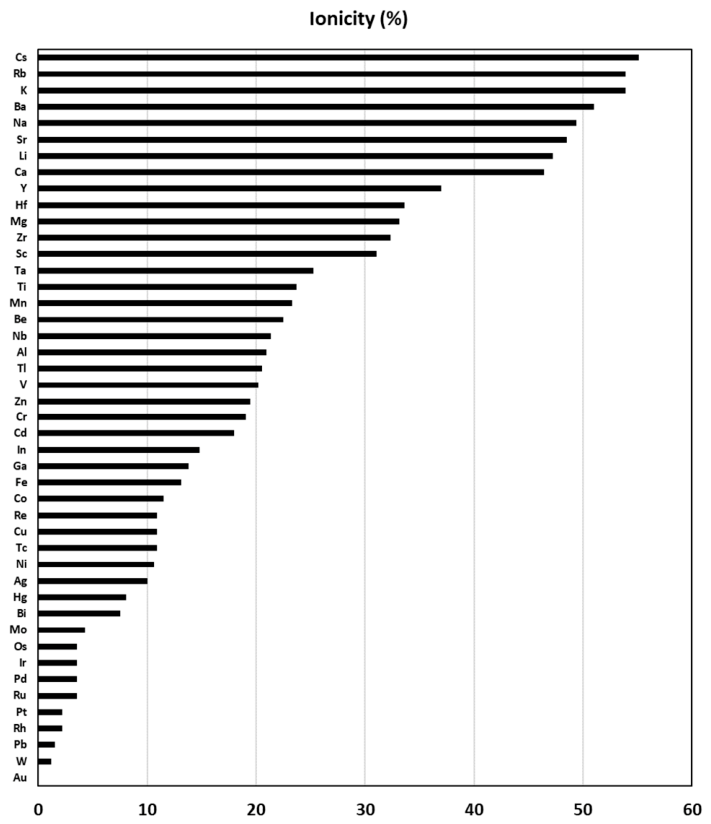
Figure 2.
– Experimental setup required for mercaptide synthesis under thiol-deficient conditions.
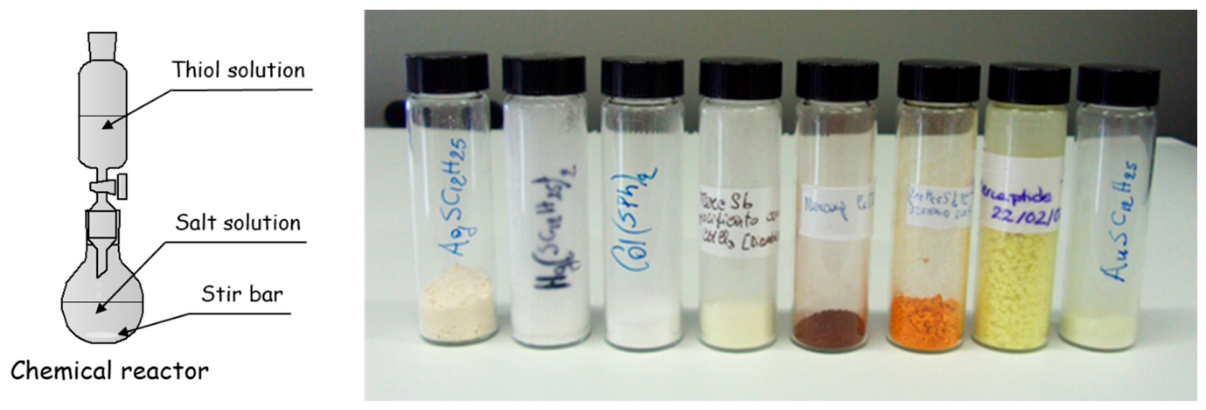
Figure 3.
– Antimony (A), platinum (B), and bismuth (C) mercaptides.
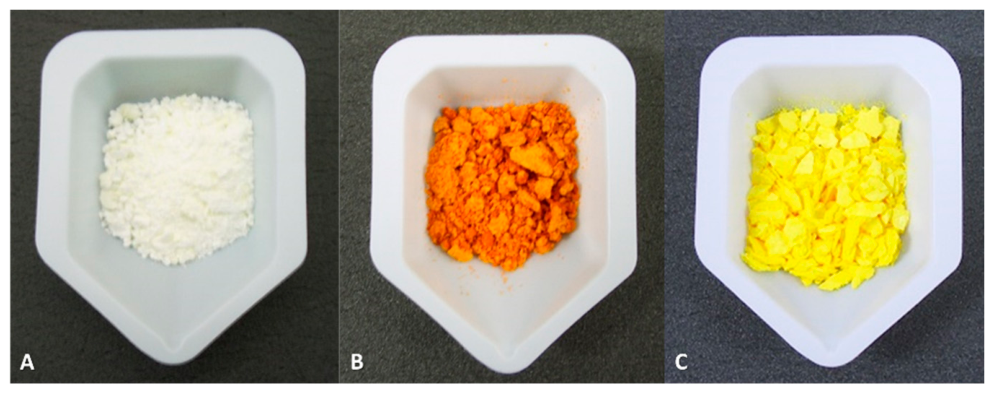
Figure 4.
– Fluorescence properties of mercaptides.
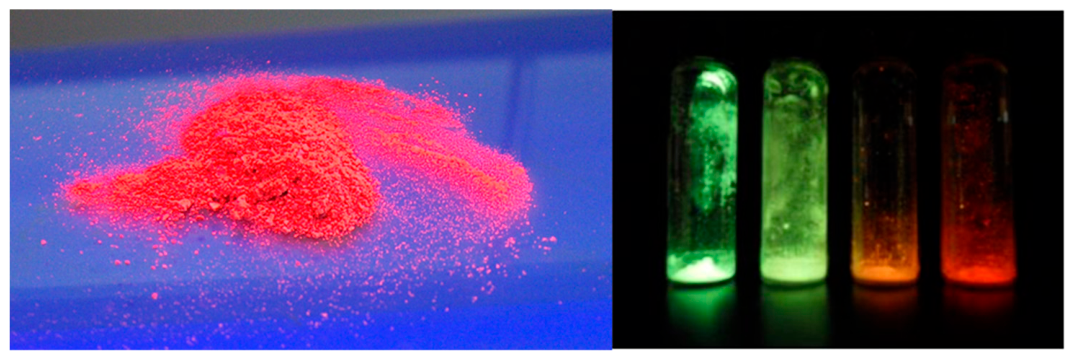
Figure 5.
- Bismuth mercaptide dissolved in chloroform (A) and reprecipitated by ethanol addition (B).
Figure 5.
- Bismuth mercaptide dissolved in chloroform (A) and reprecipitated by ethanol addition (B).
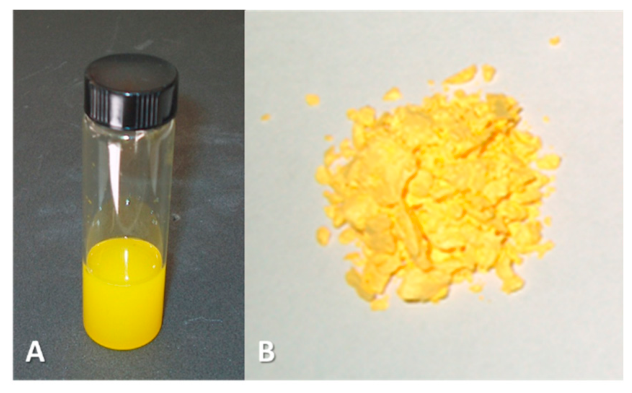
Figure 6.
Lamellar microstructure of silver dodecyl-mercaptide.
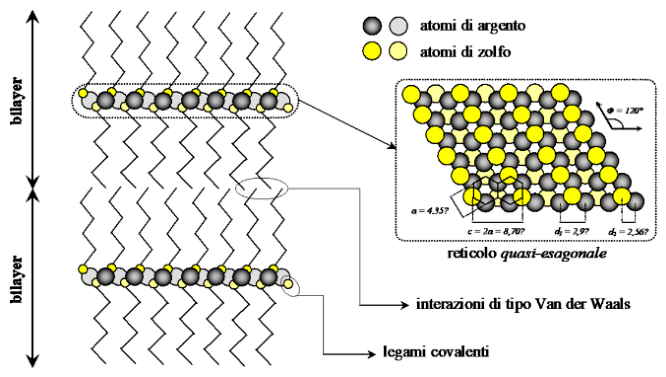
Figure 7.
–XRD diffractograms of dodecyl-mercaptides of lead (A), silver (B) and platinum (C).
Disclaimer/Publisher’s Note: The statements, opinions and data contained in all publications are solely those of the individual author(s) and contributor(s) and not of MDPI and/or the editor(s). MDPI and/or the editor(s) disclaim responsibility for any injury to people or property resulting from any ideas, methods, instructions or products referred to in the content. |
© 2026 by the authors. Licensee MDPI, Basel, Switzerland. This article is an open access article distributed under the terms and conditions of the Creative Commons Attribution (CC BY) license (http://creativecommons.org/licenses/by/4.0/).
Copyright: This open access article is published under a Creative Commons CC BY 4.0 license, which permit the free download, distribution, and reuse, provided that the author and preprint are cited in any reuse.