

Submitted:
01 October 2026
Posted:
05 October 2026
You are already at the latest version
Abstract
Although the EightFold Way theorem on quarks has led to a successful Stan- dard Model of the theory of particle physics, its Unfolding reveals unrecognized relationships and offers solutions to problems that have remained unsolved. In addition to eight documented ones, another is presented here, providing further evidence that the canonical postulates concerning the quark as electron-type Dirac particle and the nature of the top quark need to be revised.
Keywords:
top quark
; non-angular dipole moment
; Structural Model of particle physics
; CKM matrix
; neutral mesons
; CP violation
1. Introduction
The quark in the Structural Model [1] is a Dirac particle. In that respect it is not different from the quark in the Standard Model [2]. The fundamental difference, though, is the concept that the intrinsic non-angular dipole moment that Dirac derived in his theory of the electron next to the intrinsic angular dipole moment does not have an imaginary value like in the case of electrons but areal value instead. In the Standard Model the properties of the quark have been inherited from the electron-type Dirac particle thereby ignoring the theoretical possibility that the non-angular dipole moment could be real.
The adoption of a real value for the non-angular dipole moment is not without problems, because it can be proven that such quark in isolation would violate the Lorentz invariance. This objection, though, can be refuted by showing that a quark in confinement with other quarks gains back the Lorentz invariance because of mutual cancelation of the violating mathematical terms. The non-angular dipole moment of the quark has probabilistic properties similar to those of the angular dipole moment. The latter is usually denoted as spin, a reason why the former can be denoted as isospin. And indeed, the theory as developed in the Structural Model has demonstrated that the properties that in the Standard Model have been related with the Standard Model’s isospin postulatecan be traced back to the physical isospin model in the Structural Model.
This marks a first difference between the quark model in Structural Model with the one in the Standard Model. The second one has to do with the quark hierarchy. In particular with the interpretation of the heaviest quark: the top quark. In the Standard Model the quarks are considered as elementary particles. Their mass attributes, beingconstituent or bare (or running), are considered as unrelated and determined by their empiricalvalues, usually derived from composite quarks as mesons and baryons. In the Structural Model, though, these mass attributes are calculated from the pion, as the archetype meson that is built as a structure of a quark and an antiquark that can be modeled as a two-body quantum mechanical anharmonic oscillator. The quark and the antiquark compose a stable configuration under equilibrium of the attraction force from the monopole property of the quarks and the repulsive force from the two non-angular dipole moments in proper orientation. Under influence of the potential energy of the two quarks the center-of-mass gets a ground state energy that gives the pion a baryonic mass. This baryonic mass divided over the two quarks gives the quarks their constituent mass.
This awareness allows to conceive all mesons as quantum states of the two-body quantum mechanical oscillator archetype (pion) and all baryons as quantum states of the three-body quantum mechanical oscillator archetype (nucleon). In the Structural Model, the excited quantum states of the anharmonic mechanical oscillators archetype are equivalent with the ground states of non-excited quantum mechanical oscillators that are built by quarks with a flavour different from the basic quark with its two isospin states u or d. This model enables the derivation of the constituent masses of the quark family from first principles. It shows that quarks should not be considered as independent elementary particles, but are deterministically related instead. This a second important difference between the Standard Model and the Structural Model.
While the isospin state (= polarity of the non-angular dipole moment) of the archetype quark can be in two different states, up or down, this is no longer true for the flavours. In fact, the quark family splits up into two parts: the down-isospin sequence and the up-spin sequence . It is a consequence from the weak interactionmechanism, mediated by the weak interaction boson W, which reverses the polarity of the non-angular dipole moments. While this mechanism has no effect on the symmetricarchetype meson, it has an isospin effect on asymmetric mesons, such as the kaon , in which the constituting quarks have different energetic strengths. In that case the charge conservation constraint imposes an isospin reversal under weak interaction. While in the Standard Model the intimate relationship between electric charge and isospin is adopted as an undeniable empirical fact and formulated as a postulate, this relation is easily understood physically in the Structural Model by recognizing that the non-angular dipole moment of the quark coincides with the angular dipole moment of a pointlike electric charge. The Maxwellian modeling of the quark in the Structural Model shows that the archetype meson is not only the cradle of baryonic mass, but of electric charge as well. The theory predicts that beyond the b quark no heavier quarks can exist, because the quantum levels of the archetype meson cannot be excited further because of the loss of binding energy in the anharmonic quantum mechanical oscillator structure. Hence, the isospin sister of the b quarks is missing in the Structural Model, while the identification in 1995 by Fermilab the signature of a 176 GeV/c2 top quark, incapable of hadronization because of its short life, has been hailed as the missing son in the quark family [3].
2. The Top Quark
The proper understanding of this top quark in the Structural Model requires a closer inspection of the bosonic interactions between the quarks. These interactions are determined not only by the weak interaction force from the non-angular dipole moments of the quarks, but to a great extent by the bosonic force embodied by the regular angular dipole moments as well. The intrinsic angular motions evoke a spin-spin interaction mechanism between the quarks. This has a major influence on the baryonic mass of mesons and the constituent masses of the quarks. These constituent masses get equivalent magnetic moments that give a bosonic interaction. The spin-spin interaction creates a mass gap between a mesons in pseudoscalar state (with the angular spins of the quarks antiparallel) and the same meson in vector state (with the angular spins parallel). For the archetype meson as an example, we have for its rest mass energy
in pion state:
in rho state:
in which is the energy equivalent of the quark’s constituent mass and in which is the mass gap due to spin-spin interaction between the angular dipole moments of the quarks. The quantization step equates the mass of the Z boson in virtual state. To understand why, it has to be recognized that the 80.4 GeV massive energy of the free W boson represents the 140 MeV rest mass energy of the pion in relativistic state. Therefore, the massive 91 GeV massive energy of a free W boson has in virtual state an energy equal to the amount of
which correspondence nicely with the empirical mass gap indeed. Moreover it sets the constituent mass of the quark at 308 MeV. It is therefore fair to say that, whereas the charged weak interaction boson boson is responsible for an isospin flip, the neutral weak interaction boson is responsible for a regular spin flip. The recognition of this in the Standard Model unrecognized mechanism is essential to give the top quark a proper physical interpretation.
Supposing that the 176 GeV/c2 signature represents a quark indeed and that this quark cannot hadronize, it must be subject to confinement anyway. That means that while the quark cannot make junctions with other quarks, it can still makes a junction with its antiquark. Therefore the pion model must apply, including a role for the weak interaction boson. The confinement model makes an equivalent for (1), such that the top quark under confinement builds a junction with mass under weak interaction such that,
in which is the rest mass energy of the top quark and in which represents the energy of the boson, now in free state instead of in virtual state.
Taking into account the empirical values of the top quark (176 GeV/c2) and the boson (91 GeV/c2), it is very likely that the confined junction built by the top quarks is identical with the boson. That would mean that the boson (80.4 GeV/c2) is a top quark meson. To make it true, the top quark mass should equate 176.7 GeV/c2, which nicely fits with the 176 GeV/c2 signature of the Fermilab experiment in 1995.
Note: Since then this signature has got the slightly different value. The present PDG value is 173 GeV/c2. The difference is within the tolerance bandwidth of electromagnetic interaction.
Anyhow, this view reveals another important difference with the Standard Model view. In the Standard Model the top quark is considered as the up-isospin sister of the down-isospin bottom quark , while in the Structural Model the top quark is considered as the relativistic state of the quark that can be either in up-isospin state or in down-isospin state. As to be shown later, this difference allows an explanation for an unresolved problem in the Standard Model.
It is instructive to point to another unrecognized relationship between the high-energetic bosons. That is the relationship between the massive energy of the W boson and the massive energy of the Higgs boson. In the Structural Model the mass of the muon is calculated by first principles from the rest mass of the pion. The relationship between the two has been calculated as,
It has to be emphasized here that this relationship is more than an accidental numerical coincidence, but that it has been proven from the first principles of the Structural Model. Such intimate relationships between the high energetic bosons and the top quark have remained hidden in the Standard Model. Note: In the Structural Model the energetic monopole field of the quark is a screened Coulomb-type field. Its boson is a massive equivalent of a photon. The boson has a massive energy that is equal to half the energy of the Standard Model’s Higgs particle.
The different view on quarks as summarized so far in this article enables one to reveal relationships and solutions of problems that have remained unsolved or unrecognized in the Standard Model. A short list contains:
- Unification with gravity by showing that the Gravitational Constant can be expressed in quantum mechanical parameters
- Calculation of the mass of the electron from first principles
- Prediction and the verification of the neutrino rest masses
- Calculation of the mass of the nucleons from first principles
- Calculation of the muon mass from first principles
- Calculation of the mass spectrum of the hadron masses
- Calculation of the hadronization limit
- Calculation of the quark masses
(Note: these results have been documented, some of them in journal articles, most of them in preprints at preprints.org, all of them compiled in [1])
There is more. The identification of the real valued non-angular dipole moment of quarks does not only affect the interpretation of weak interaction, but it does affect the interpretation strong interaction as well. In the Standard Model, eight gluing bosons, dubbed as gluons, are held responsible for strong interaction. These bosons are the result from the assignment of the color attribute to quarks in order to meet the probabilistic unitary constraint over three interrelated quarks in the baryon structure. In the Structural Model there is no need to introduce an additional bosonic force next to the weak interaction embodied by the non-angular dipole of the quark and the strong interaction embodied by its monopole. These two interaction forces build a three-body anharmonic quantum mechanical oscillator structure that reveals the existence of a third spin phenomenon, dubbed astop spin, next to (angular) spin and (non-angular) isospin, thereby solving the spin conflict that shows up in a naive bond of three quarks. Its identification is the result of the description of the three-body quantum mechanical oscillator in terms of pseudo-spherical coordinates. Its quantum wave equation has the format,
Despite of its planar origin, the format is almost, but not quite, the same as that of a centric mass in a six-dimensional sphere subject to a centric potential . The square of the variable is the sum of the squared distances between the quarks. The feature of interest is the grand angular quantum number. Its interpretation is a circular planar motion of the center-of-mass. Note that this is different from an orbital motion of the whole frame around a static position of the mass center. It is this motion, either clockwise or anti-clockwise, that gives the quarks in the structure an additional spin freedom next to angular spin and "non-angular spin". It obsoletes the need for gluons. Instead, the strong interaction boson is the carrier of the quark’s monopole force. This force is screened by an unknown ambient energetic field. It is matter of convention to interpret the observed 125 GeV signature in particle collisions either as a boson of an ambient energetic Higgs field or to interpret half its value as a boson of the quark’s monopole field.
Note: It is instructive to emphasize that the polarity of the non-angular dipole moment of a quark in a meson imposes a constraint on the polarity of the non-angular dipole moment of its antiquark. Otherwise the bond between the two cannot be maintained. Because of the relationship between this dipole moment and the weak interaction, the weqak interaction operation is constrained as well. In the Standard Model the constraint has an equivalent in the exclusive weak interaction coupling on the left-chiral components of the Dirac field. That preference is given to one of the chiral components is a consequence of the constraint. That nature prefers the left-chiral field as an empirical fact.
So far, a review of the Structural Model, details and elaborations of which can be found in [1]. Let us terminate this review by showing the solution of yet another unsolved problem in the Standard Model.
It has to do with the oscillation phenomenon of neutral mesons that in 1955 for kaons has been predicted by Abraham Pais and Oreste Piccioni [4]. That prediction was experimentally confirmed in 1959 by groups at Berkeley and elsewhere, establishing the existence of two distinct neutral-kaon lifetimes [5]. The phenomenon of neutral-meson oscillation, which also occurs in the neutral D- and B-meson systems, contributed to the development in 1973 of the 3×3 CKM matrix by Makoto Kobayashi and Toshihide Maskawa [6]. The CKM matrix extended the 2×2 mixing matrix introduced by Nicola Cabibbo in 1963 [7]. In the Cabibbo framework, the down-type and quarks are mixed quantum states of d and s, providing a mathematical description of the observed behaviour of the neutral kaon. Within the Standard Model of particle physics, the CKM matrix is incorporated into the theoretical framework of Feynman box diagrams. These diagrams account for the possible interaction paths connecting the relevant quark states, including contributions from off-shell virtual particles [8]. This framework, however, has a notable shortcoming: while the neutral kaon and the two neutral B-meson systems fit naturally into it, the neutral D-meson system does not [9].
As a further proof for the viability of the Structural Model it will be shown that the neutral D meson can be given a natural place in the CKM matrix.
3. The Structural Neutral Meson System
The neutral meson is considered here as a two-body oscillator system. The two bodies are the quark and antiquark that constitute a bound state, maintained in equilibrium between the attractive force associated with the monopole property of the quark and the repulsive force associated with its non-angular dipole moment. In the Structural Model of physics, the bosonic force associated with this non-angular dipole moment is identified as the weak interaction [1].
A symmetrical configuration, such as a pion, has a single mode: interchanging the particle and antiparticle states returns an identical system. This is different for an asymmetrical configuration, such as a kaon. Interchanging the particle and antiparticle states produces a two-body oscillator that can operate in two different modes. Each of these modes can be regarded as a resonator. The system can therefore be described as an assembly of two resonators. An operational mechanism that induces the interchange of particle and antiparticle states can then be interpreted as a coupling mechanism between the two resonators.
Such a system has useful analogies with electrical oscillators or mechanical mass-spring oscillators, as shown in Figure 1.
If , and the system resonates in two different modes, with an offset around the central angular frequency . This offset is observable as a beat frequency .
Let us now return to the neutral meson. The process that drives the interchange is the weak interaction, mediated by the weak-interaction boson W in a virtual state. According to the principles of the Structural Model, a weak-interaction boson is capable of reversing the polarity of the non-angular dipole moment of a quark [10]. In other words, the weak interaction may change an up-isospin quark into a down-isospin quark, and vice versa. This is evident in the transformation of u or d quarks into d or u quarks, as occurs in beta decay. However, a transformation of a u quark into an s quark may also occur. Such a transformation is shown, for example, in the creation of the s quark through pion excitation.
Within this framework, the interaction between and can occur along different routes, each with a different probability. This is illustrated in the first row of Figure 2. Tentatively, it is assumed here that the quark hierarchy contains, beyond the bottom quark sector, another up-quark. Such a quark is taken for granted in the Standard Model because of the existence of the top quark. In the Structural Model, however, the natural candidate would have a mass of only approximately three times that of b and is incapable of hadronization, making it non-existent [10,].In the Structural Model, the top quark appears instead as the relativistic state of the quark and as the quark that, together with the antitop quark, allows the W boson to be conceived as a meson. As illustrated in the figure, if such a quark—whether identified with the top quark or regarded as a hypothetical quark—is accepted, the probabilities associated with the three routes sum to unity, with decreasing amplitudes along the row.
The lower row of the figure gives the format of the transient probabilities that enable the transformation of the kaon state into the antikaon state . This format is given by the squared product of transient amplitudes. In terms of the mass-spring analogy, the kaon mass can be regarded as occurring in two different modes around a central value , with an offset . One may expect this mass offset to be proportional to the mass of the s quark and to the sum of the transient probabilities involved, weighted according to their mass contributions. In general, this can be expressed as
In this expression, the proportionality factor A is dimensionless, and the constituent masses , etc., are normalized to the known rest mass of the weak-interaction boson W. In principle, of course, the various contributions compete with one another in relative strength. The approximation shown here will be explained later in the text. The formula is heuristic, but it is based on a physical line of reasoning. Its validity must ultimately be demonstrated by comparison with experimental evidence.
Applying the same approach to the neutral bottom B mesons, we can construct Figure 3.
Let us now consider the transformation of a quark into an antiquark more closely. Within the neutral kaon meson, the s quark transforms into d through the up-quarks u,c and t, respectively, via the transient amplitudes , and . The squared amplitudes represent the corresponding probabilities. Consequently, the sum of the squared amplitudes must equal unity. On the other hand, the antiquark transforms into through , and , respectively. Hence,
A similar relationship applies to the neutral mesons in the bottom sector. The resulting relationships can be represented by a single 3 × 3 probability matrix in which the sum of the elements in each row and each column is equal to 1. Thus,
The amplitude matrix derived from this probability matrix resembles the (Cabibbo-Kobayashi-Maskawa) matrix, which will be discussed later in this text. Generalizing Equation (2), we now obtain
By relating the upper two equations of this set, we obtain
Similarly, relating the lower two equations gives
Let us next attempt to determine the values of the probability matrix. The underlying amplitude matrix M is built by three rotation angles, such that
This implies that threeindependent relationships are required to find the three angles that determine the six elements of the probability matrix. Eqs. (12) and (13) are two of those. They are useful if the numerical values of the constituent quarks and the beat frequencies of the neutral mesons were known. In the Structural Model the values of the constituent masses of the quarks have been calculated from first principles. The numerical values of the beat frequencies are empirical, established from experimental observation. They are shown in Figure 4.
In addition to (12) and (13) a third numerical relationship is required to find the numerical values for the elements of the probability matrix.
In principle, the missing equation can be obtained from the neutral D meson. This meson belongs to a different class. The class is complementary in the sense that the roles of the up-quarks and down-quarks are reversed. Figure 5 illustrates the proposed transformation of the neutral D meson into its antiparticle. Note that the probability amplitudes and their relationships can be conveniently extracted from the probability matrix in (10). Thus, for the neutral D meson, we obtain
Unfortunately, this will reveal a problem. The matrix as established in the Standard Model after intensive search over many decades has resulted in [11],
This allows us to simplify (15), to
Calculating the ratio would give
The empirical value observed as shown in Figure 4 is approximately 1.89. How to explain this discrepancy?
Because of its excessive massive energy the influence of the top quark in the probability paths is quite high. Because in the Standard Model the top quark is considered as isospin-up quark, its role is missing in the probability path of the neutral D meson. In the Structural Model of particle physics, however, the top quark is regarded as the relativistic state of the quark. Evidence for this interpretation is presented in [1]. It therefore has the same isospin properties, possessing both the up-quark and down-quark properties. It is instructive to note here that the document explicitly mentions that the isospin state of the top quark cannot be determined [12]. Due to its property of down-quark, the top quark must be included in the transient path , with a weighting factor determined by the top quark contribution. See Figure 6. Equation (17) must therefore be modified to
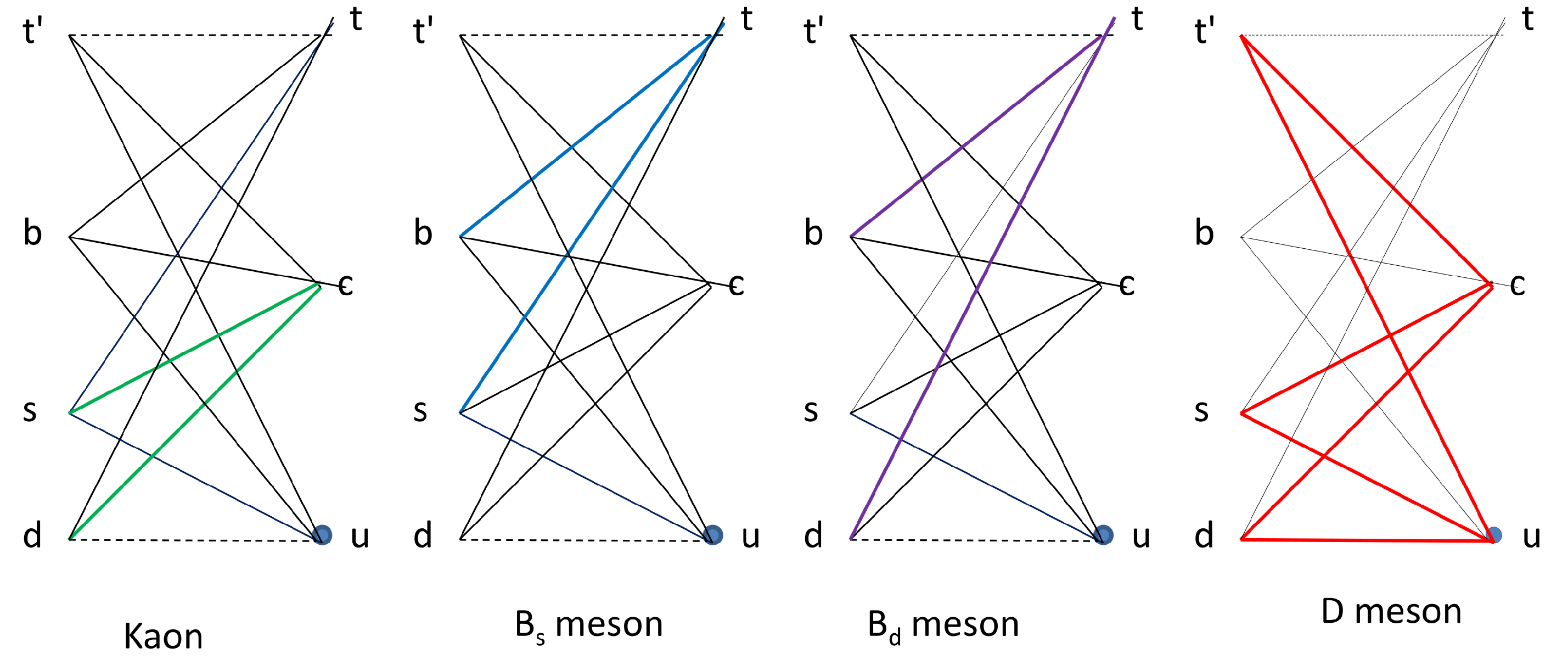
This is illustrated in Figure 7. In the Structural Model, the top quark behaves as the d quark. This allows to equate . Taking this into account and relating (20) with the upper equation in (11), we have
The use of (20) as the missing third equation enables the calculation of the probability matrix. The way to do so is trying to solve the set of equations composed by (12), (13), (20) and the six equations from (9-10), thereby taking the numerical values in Figure 4 as input. The result of the calculation with a suitable computer program shows the result
It shows a close fit with the matrix (16) shown in the Standard Model. It gives the value.
This value is close to the value 1.89 obtained from Figure 4.
Note: Although the fit is close, the difference between the small elements and in relative terms is significant. This is of interest, because in spite of their small values, their impact is significant because these values show up in products with the high mass of the top quark. It leaves the question why the tiny elements are different in (16) and (21). This issue will be addressed in the next paragraph.
4. CP Violation
An amplitude matrix with real coefficients is compatible with conservation of , because complex conjugation leaves the real coefficients unchanged. Unitarity can nevertheless be preserved if, in addition to the rotation matrices, one or more phase angles are introduced. For example, this can be achieved by connecting to one or more of the rotation matrices a phase shift matrix with the format,
The introduction of such phase angles makes the coefficients in the first and third row of the amplitude matrix complex, thereby changing their amplitudes. The freedom to introduce a phase parameter into the unitary neutral-meson system makes it possible to account for the unexpected phenomenon of charge-parity violation in neutral-meson systems. violation was first observed in 1964 by Christenson, Cronin, Fitch, and Turlay through the decay behaviour of neutral kaons [11].
To understand this phenomenon, it is instructive to regard the meson as a two-body oscillator, as described before. The two constituents of this oscillator may move in or out of phase with respect to each other. The resulting states are symmetric and antisymmetric superpositions of the two constituent configurations:
or, equivalently,
(Note that superposition as such is different from mixing due to coupling discussed so far. Mixing may occur, though, under superposition)
The properties of these two superpositions are different. Whereas has even symmetry, has odd symmetry. Under decay, the character of the initial state is expected to be preserved. Consequently, the hadronic decay of should result in a two-pion state, or , whereas the hadronic decay of should result in a three-pion state, or . This is what is normally observed.
The fact that the decay associated with takes considerably longer than that associated with is also understandable within this picture, because the available phase space and the corresponding mass gaps of the two decay paths are different. Against this background, the observation in 1964 of decay events was particularly remarkable and was interpreted as evidence for a violation of symmetry.
Although the observation of CP violation came as a surprise, there is no fundamental reason why interactions between quarks should be restricted to real transition amplitudes. Within the Structural Model of particle physics, complex transition amplitudes can even be anticipated. The reason is that reversal of the polarity of the non-angular dipole moment of the quarks, which in the Structural Model is identified with the origin of the weak interaction, represents only one component of the quark interaction. A second component arises from the interaction associated with the regular angular dipole moment.
As analyzed in the Structural Model, this angular dipole moment gives rise to a bosonic spin-spin interaction between quarks. This is a quantum-mechanical process governed by coefficients constructed from Pauli matrices, and these coefficients naturally introduce complex quantities into the transition amplitudes. A complete first-principles treatment of these effects would be rather cumbersome. A practical approach is therefore to introduce an additional phase-offset matrix into the product of the three rotation matrices derived from measurements of the beat frequencies of the four neutral-meson configurations.
The remaining problem is to determine a numerical value for the phase parameter. Whereas the numerical values of the transition amplitudes can be obtained from appropriate measurements of the beat frequencies, determining the phase parameter is less straightforward. A detailed discussion of this issue is beyond the scope of this article. It can be found in the literature that describes the underlying theory of the matrix [13]. The present phase factor as shown in the document is, . The easiest way to investigate the consistency between (16) and (21) is an adaptation of (16) for and compare it with (21). To do so, it is required to retrieve the rotation angles from (16) and obtain a full expression for M with the inclusion of (23) and without.
The rotation angles from (16) can be obtained from an appropriate numerical analysis. These values (in degrees) are reported in the data book as [12],
Recalculation of the matrix for gives,
The latter result is now impressively close to the matrix (21) as derived by the simple theory exposed in this article.
5. Discussion
The probability matrix (21) derived in this article is correct by construction. When applied to the four neutral-meson systems, it reproduces the observed numerical relationships between their beat frequencies. However, the match is obtained by assigning empirical data to the parameters of a heuristic model constructed on physical grounds. This construction is meaningful only if the resulting model has predictive power for physical phenomena other than those used to determine its parameters.
In this respect, the Structural Model approach is not fundamentally different from the canonical matrix shown in (16). The striking difference lies in the way the two matrices are derived. The Structural Model approach is based on a direct and comparatively simple structural interpretation by taking the differences between the numerical values of the beat frequencies as input (the factor A in (8), etc. is irrelevant for the derivation of the matrix). By contrast, the canonical matrix has been derived from the analysis and measurements of the actual numerical values to obtain a meaningful value for A as well. It has undergone continuous refinement over the years in order to improve its predictive accuracy. This refinement has required the introduction of a number of corrective factors and phenomenological parameters, including bag parameters, decay constants, loop functions, correction factors, and related quantities [14].
However, the canonical framework encounters the difficulty that the neutral D meson does not fit naturally into the theoretical framework underlying the conventional description. As argued in this article, this discrepancy can be traced to the different interpretations of the top quark in the Structural Model of particle physics and in the Standard Model of particle physics. It is quite probable that inclusion of the true isospin property of the top quark in present neutral Standard Model based neutral meson studies will give the neutral D meson its proper place.
6. Conclusions
The recognition that Dirac’s theory of the electron allows a quantum physical quark concept with two real anomalous dipole moments instead of a real magnetic one next to an imaginary electric one shown by electrons. This has a major impact on the first principles of a particle physics theory. It reveals a fundamental physical layer below the Standard Model that enables the Unfolding of the phenomenological Eightfold Way concept such that the family of six elementary quarks is reduced to a single elementary archetype. This view enables finding already documented solutions for quite some problems that in the canonical theory have remained unsolved. In this article further evidence has been provided by solving yet another one that has remained unsolved so far, because of the incorrect interpretation of the top quark in the Standard Model. It has been shown that correct interpretation allows the removal of a weakness in the matrix model of the quark family. While so far the neutral D meson could not be fitted in, a revision of the nature of the top quark and the recognition of the quark as a non-electron type Dirac particle allows its incorporation.
Acknowledgments
The author is indebted to Dr. Wouter Hulsbergen of the University of Amsterdam for drawing his attention to the neutral meson issue.
References
- Roza, E. Introduction to the Structural Model of particle physics; Kindle Books, 2025; ISBN 978-9090401461. [Google Scholar]
- Griffiths, D. Introduction to elementary particles; John Wiley an Sons, 2008. [Google Scholar]
- Abachi, S.; Abbott, B.; Abolins, M.; et al. Observation of the top quark. Phys. Rev. Lett. 1995, 74(14), 2632. [Google Scholar] [CrossRef]
- Pais, A.; O. Piccioni, O. Note on the Decay and Absorption of the Θ0. Phys. Rev. 1955, 100, 1487. [Google Scholar] [CrossRef]
- Crawford, Jr. F.S; et al. Evidence for the Transition of a K0 into a K¯0 Meson. Phys. Rev. 1959, 113, 1601. [Google Scholar]
- Kobayashi, M.; Maskawa, T. CP-violation in the renormalizable theory of weak interaction. Prog. Theor. Phys. 1973, 49(2), 652. [Google Scholar] [CrossRef]
- Cabibbo, N. Unitary Symmetry and Leptonic Decays. Phys. Rev. Lett. 1963, 10(12), 531. [Google Scholar] [CrossRef]
- Inami, T.; Lim, C.S. Effects of Superheavy Quarks and Leptons in Low-Energy Weak Processes KL→μμ- and K0→K¯0 Mixing. Prog. Theor. Phys. 1981, 65, 297. [Google Scholar]
- E. Golowich, E.; A. A. Petrov, A.A. Short Distance Analysis of D0→D¯0 Mixing. Phys. Lett. B 2005, 625, 53. [Google Scholar] [CrossRef]
- Roza, E. The spin-spin interaction mechanism between quarks and its impact on the mass spectrum of mesons. 2021. Available online: www.preprintsd.org. [CrossRef]
- Ceccuci; Ligeti, Z.; Sakai, Y. Particle Data Group): CKM Quark Mixing Matrix, Rev. of Particle Physics (2024). Phys. Rev. D. 110(030001), Sec. 12.2–12.3.
- Takahashi, F.; et al. (Particle Data Group) (2026): Top Quark. Rev. Part. Phys. Int. J. Mod. Phys. A 41, 2630011, Sec. 61.254.4.
- Christenson, J. H.; Cronin, J. W.; Fitch, V. L.; Turlay, R. Evidence for the 2π Decay of the KL Meson. Phys. Rev. Lett. 1964, 13, 138. [Google Scholar]
- S. Navas, S.; et al. (Particle Data Group) (2025): CKM Quark-Mixing Matrix, Review of Particle Physics. Phys. Rev. D. 110, 030001.
Figure 1.
Mechanical equivalent of the neutral meson configuration
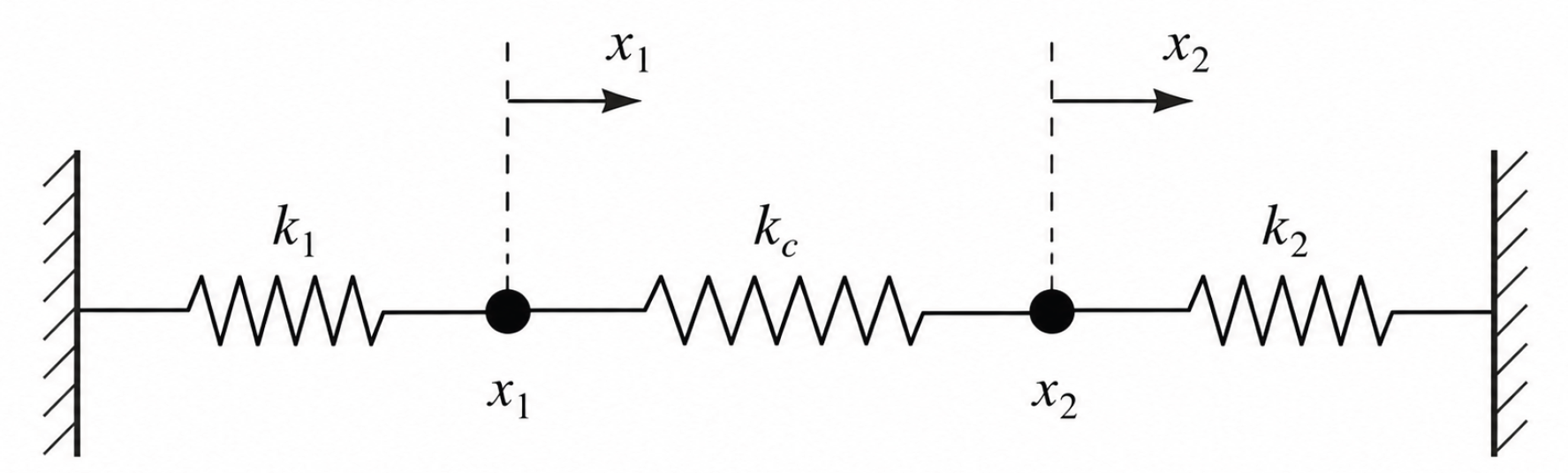
Figure 2.
transient probabilities in the neutral kaon system
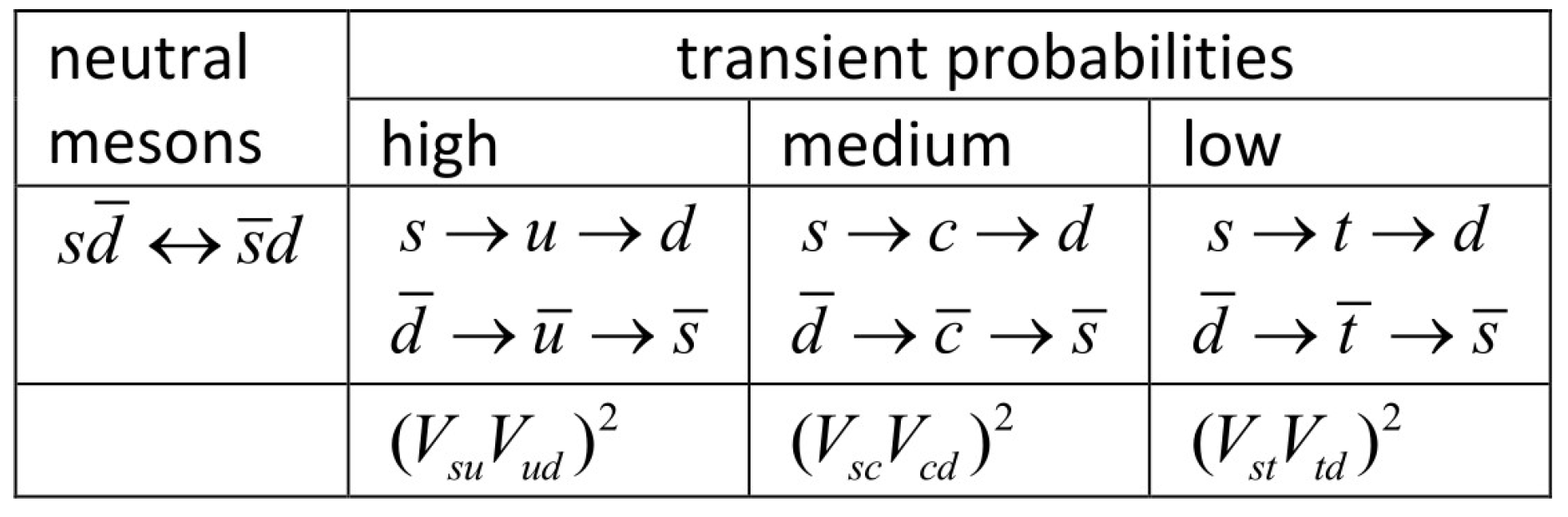
Figure 3.
transient probabilities of the neutral bottom mesons added.
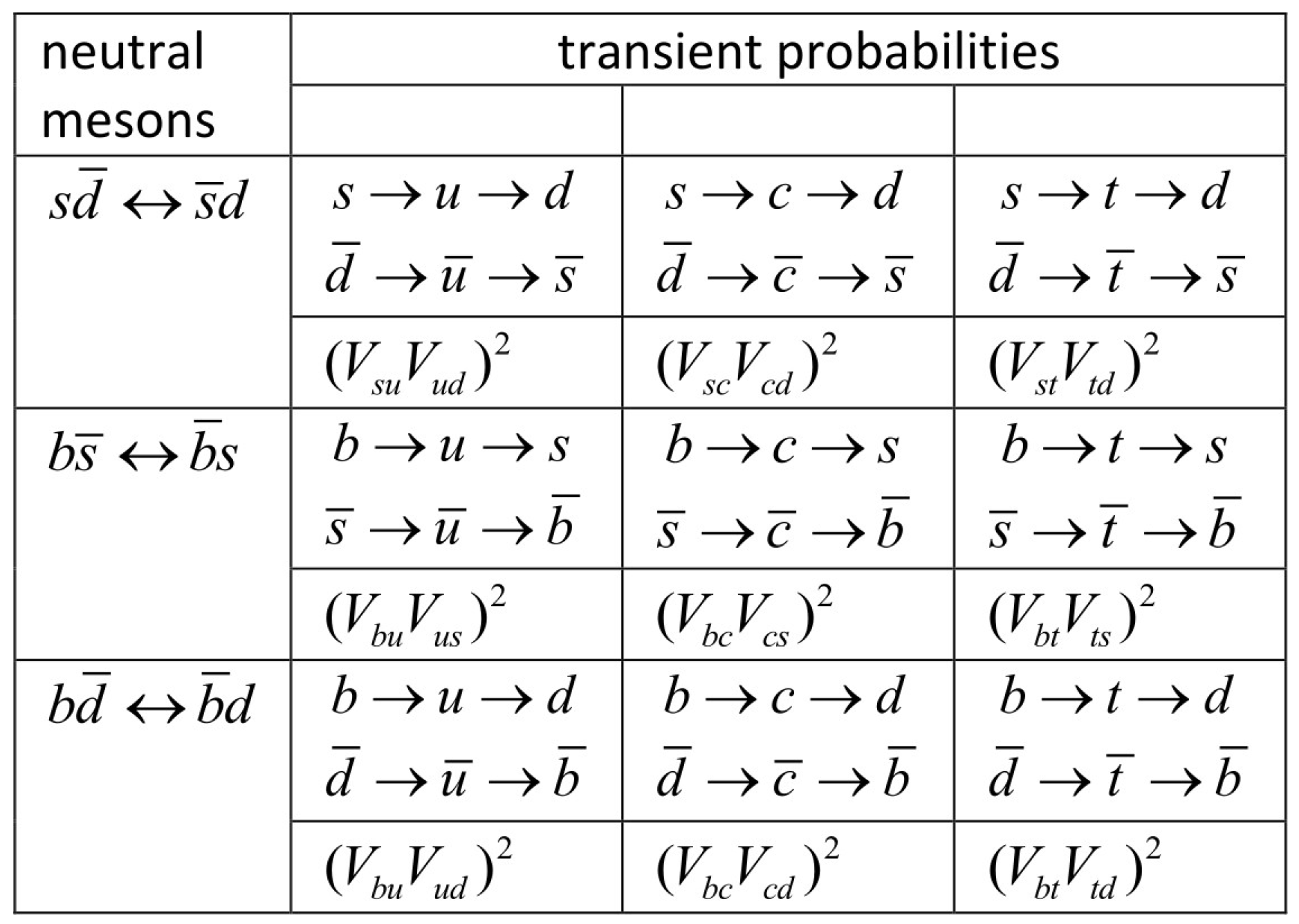
Figure 4.
empirical values of the beat frequencies of the neutral mesons. Note: the constituent quark masses are not empirical, but have been derived from first principles
Figure 4.
empirical values of the beat frequencies of the neutral mesons. Note: the constituent quark masses are not empirical, but have been derived from first principles
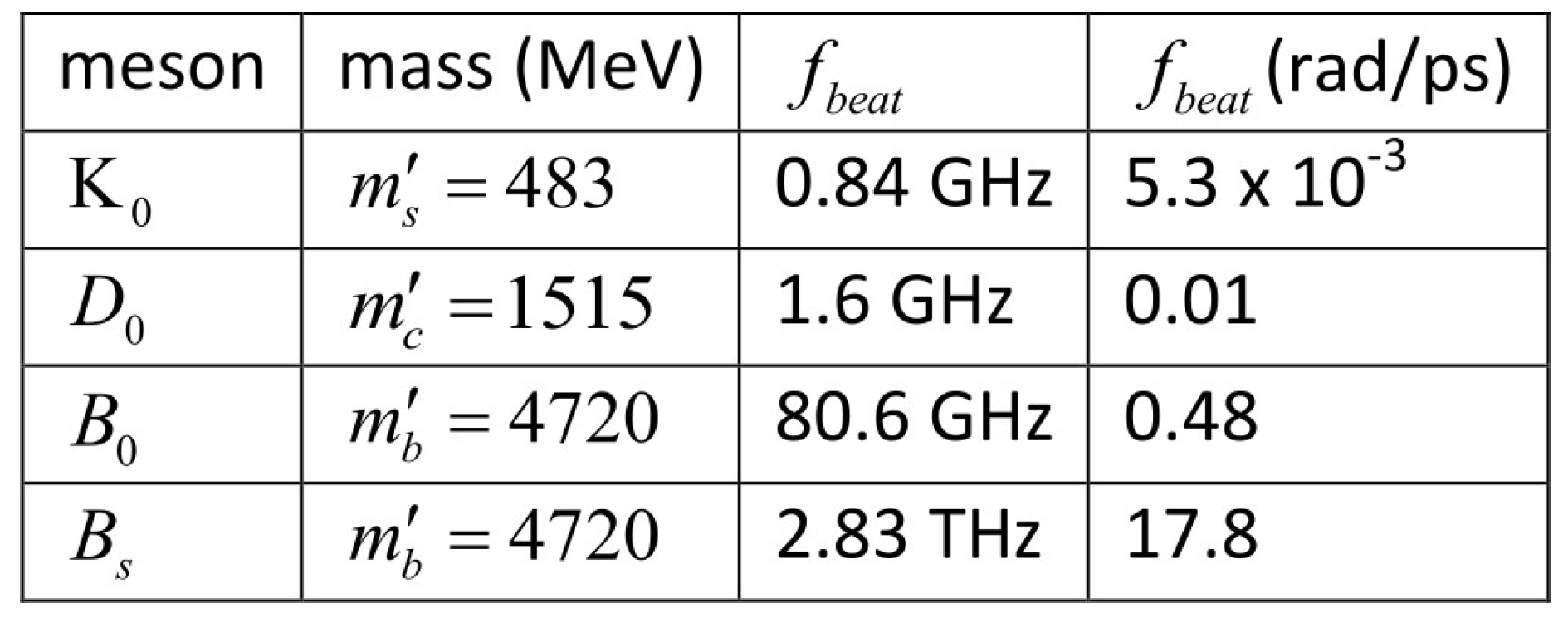
Figure 5.
the transient probabilities of the neutral D meson (Standard Model)
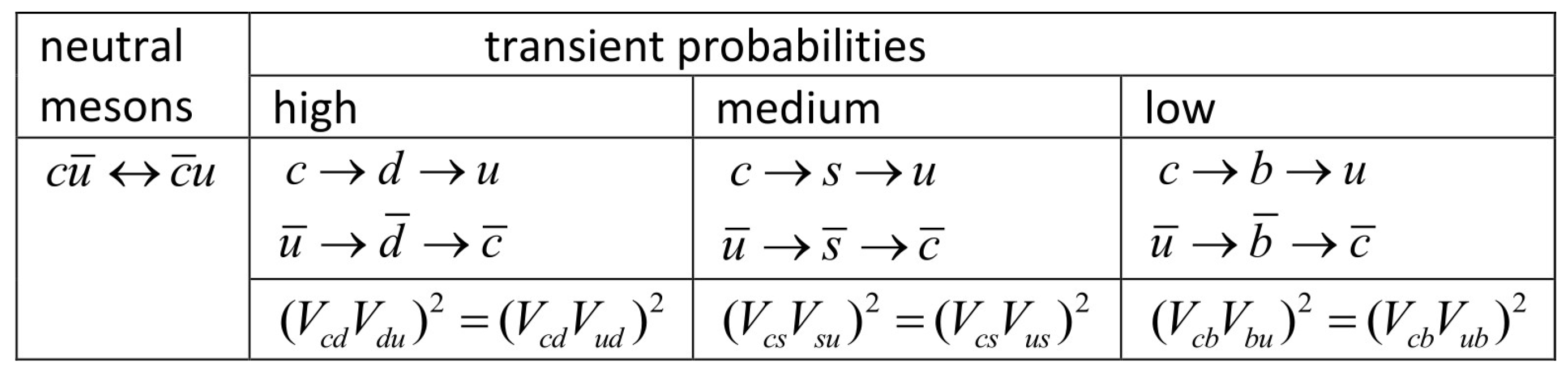
Figure 6.
the transient probabilities of the neutral D meson (Structural Model)
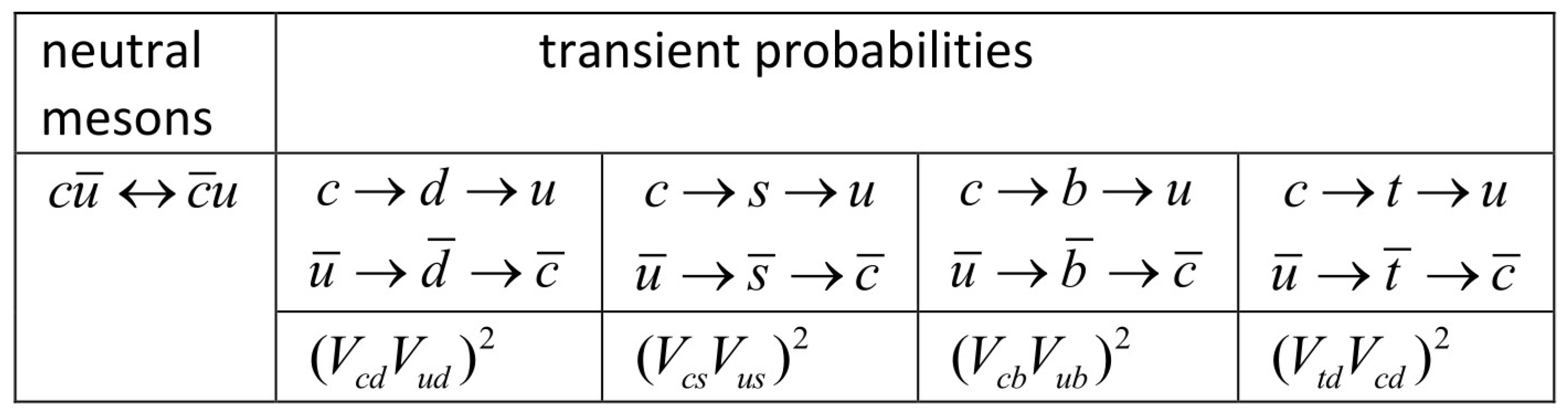
Figure 7.
the transient probabilities of the neutral D meson (Structural Model)
Disclaimer/Publisher’s Note: The statements, opinions and data contained in all publications are solely those of the individual author(s) and contributor(s) and not of MDPI and/or the editor(s). MDPI and/or the editor(s) disclaim responsibility for any injury to people or property resulting from any ideas, methods, instructions or products referred to in the content. |
© 2026 by the authors. Licensee MDPI, Basel, Switzerland. This article is an open access article distributed under the terms and conditions of the Creative Commons Attribution (CC BY) license (http://creativecommons.org/licenses/by/4.0/).
Copyright: This open access article is published under a Creative Commons CC BY 4.0 license, which permit the free download, distribution, and reuse, provided that the author and preprint are cited in any reuse.