
Submitted:
02 October 2026
Posted:
05 October 2026
You are already at the latest version
Abstract
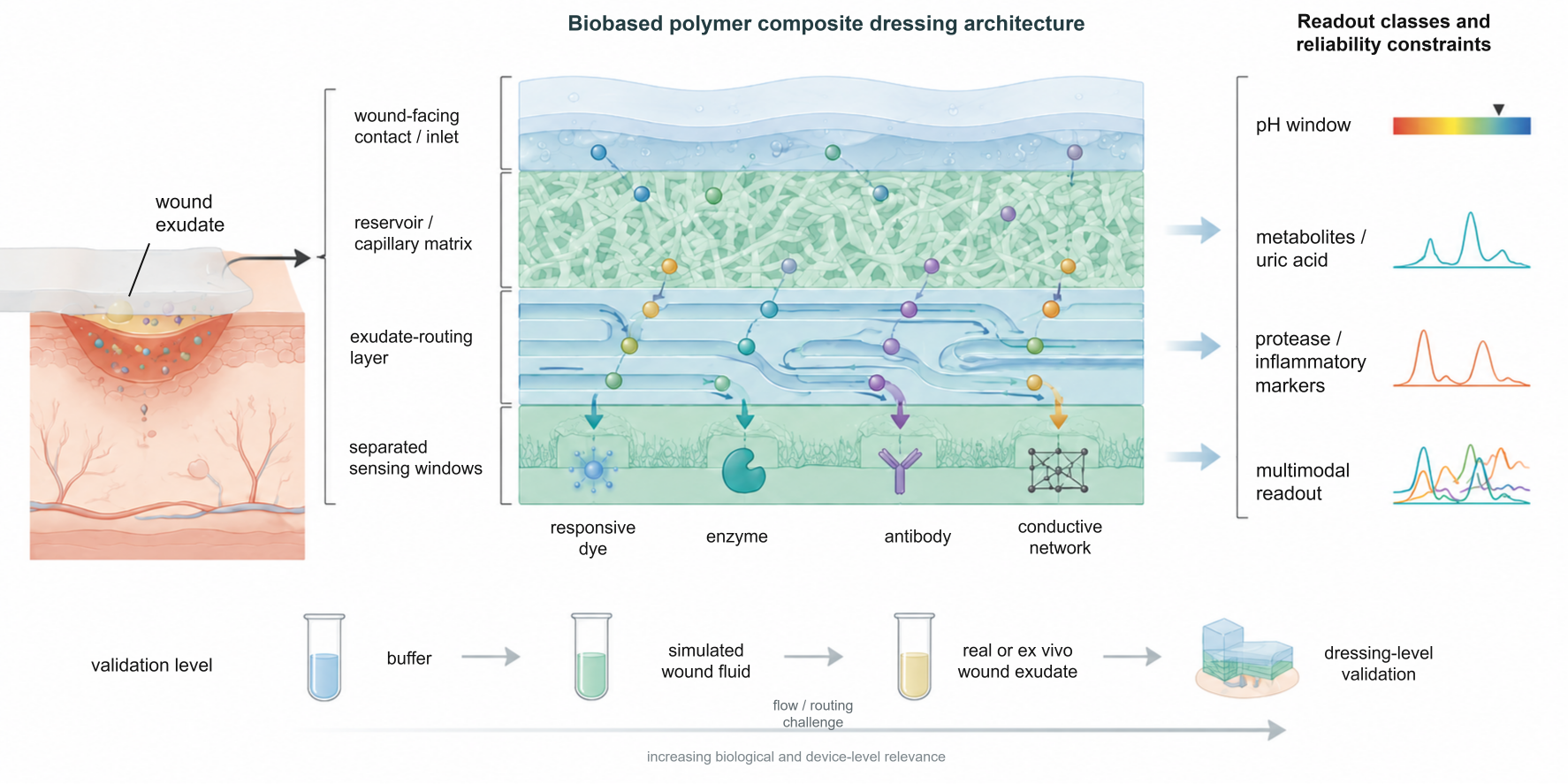
Sensor-integrated wound dressings place optical, electrochemical, biochemical, or wireless sensing modules within materials that are simultaneously responsible for wound contact and fluid management. In this setting, biobased polymers influence hydration, swelling, capillary transport, wet-state mechanics, retention of functional phases, and the local environment presented to the sensor. This review examines how chitosan, alginate, hyaluronic acid, cellulose, nanocellulose, bacterial cellulose, gelatin, collagen, and silk fibroin function as wound-contact layers, absorbent reservoirs, capillary supports, transition domains, and hosts for sensing components. Auxiliary phases, including PVA, PEDOT:PSS, carbon nanomaterials, MXenes, metal nanoparticles, responsive dyes, enzymes, and antibody-based recognition elements, are considered according to the conductivity, optical response, catalytic activity, antimicrobial function, or molecular selectivity they introduce into these matrices. Across the reviewed studies, signal reliability varied with exudate handling, sensing-zone exposure, fouling, wet-state stability, and the spatial organization of functional modules. We use these relationships to examine how material architecture stabilizes the sensing interface and to interpret validation in the wound-monitoring conditions under which each readout was tested.
Keywords:
biobased polymer composites
; sensor-integrated wound dressings
; smart wound dressings
; wound exudate monitoring
; hydrogel dressings
; conductive biomaterials
; colorimetric sensing
; electrochemical biosensors
; interface stability
; validation
Copyright: This open access article is published under a Creative Commons CC BY 4.0 license, which permit the free download, distribution, and reuse, provided that the author and preprint are cited in any reuse.