

Submitted:
01 October 2026
Posted:
05 October 2026
You are already at the latest version
Abstract
Moral beauty, the perception of profound virtue in others, has long been theorized to evokemoral elevation, yet its emotional profile relative to other positive experiences remainsunderexamined. In a randomized writing study, 296 U.S. adults reflected on either (a) a morallybeautiful person or act, (b) an awe-inspiring natural place, or (c) an amusing person, and thenreported moral elevation and a range of discrete emotions. Moral beauty elicited significantlygreater elevation than amusement, and this effect remained robust after controlling for baselineaffect. Nature awe did not differ from amusement in elevation but selectively elicited greaterawe, whereas amusement selectively elicited amusement and higher-arousal positive affect.Moral beauty did not significantly increase a gratitude-and-love composite relative toamusement, although the observed pattern was consistent with a warmer, more affiliative profile.These findings suggest that moral beauty is not reducible to generic positive affect ornature-based awe. Instead, encounters with virtue appear to preferentially elicit moral elevation,helping distinguish the emotional consequences of moral excellence from those of perceptualvastness and playful positivity. The findings contribute to research on positive emotions, moralelevation, and the psychological significance of witnessing virtue.
Keywords:
moral beauty
; moral elevation
; awe
; amusement
; positive emotion
The Emotional Signature of Moral Beauty: Elevation Beyond Awe and Amusement
Human beings have long been captivated by acts of extraordinary moral goodness. Philosophers such as Hutcheson and Hume wrote that virtue possesses its own kind of beauty, a force that moves observers toward admiration, compassion, and prosocial concern. Contemporary affective science echoes this insight: witnessing moral excellence reliably elicits moral elevation, a warm, uplifting emotional state characterized by tenderness, inspiration, and a desire to connect with others (Haidt, 2000; Haidt et al., 2004). Despite extensive research on elevation, its emotional boundaries remain underdeveloped. Very little work has directly compared moral beauty to other uplifting emotional experiences such as nature-based awe or amusement. This comparison is theoretically important because both moral beauty and nature are recognized within Keltner’s framework as two of the eight wonders of awe: distinct classes of elicitors that evoke awe through different pathways (Keltner, 2024). Moral beauty evokes awe through virtue, courage, and moral excellence; nature evokes awe through perceptual vastness, scale, and beauty. Although both can inspire awe, they may produce sharply different emotional signatures. Awe more broadly arises when individuals encounter perceptual or conceptual vastness that challenges their mental frameworks (Keltner & Haidt, 2003). Nature-based awe often elicits wonder, small-self, and cognitive accommodation. Amusement, in contrast, provides an ideal positive-affect control condition. This overlap in positivity but divergence in elicitors raises a central question: Does moral beauty produce a distinct emotional signature, or can its effects be explained by general awe or positive arousal?
Moral Beauty as a Distinct Emotional Category
Philosophers and psychologists have argued that moral beauty is uniquely rooted in virtue and social connection. Empirical research supports this view: elevation reliably fosters warmth, affiliation, and prosocial motivation (Haidt, 2000; Algoe & Haidt, 2009). Moral beauty therefore may evoke a warm, relational form of awe distinct from nature-based awe, which can be perceptual, expansive, or even fear-tinged (Gordon et al., 2017). Indeed, nature awe has great effects (Anderson et al., 2018) but is not inherently interpersonal. Amusement, meanwhile, is positive but playful rather than meaningful. If moral beauty is a distinctive emotional elicitor, it should produce an emotional profile diverging from both awe and amusement:
- Greater elevation than either comparison condition
- Greater warmth and low-arousal prosocial emotion (e.g., gratitude, love)
- Little high-arousal positivity, characteristic of amusement
- Emotion-family specificity, such that awe predicts awe and amusement predicts amusement
The Present Study
We tested these predictions using short autobiographical writing prompts, a validated method for eliciting discrete emotional states (Mills & D’Mello, 2014). Participants were randomly assigned to reflect on:
- A morally beautiful person or act
- An awe-inspiring natural space
- A personally amusing individual
This design compares two awe “wonders,” moral beauty and nature,” to a positive control that matches valence but not meaning, transcendence, or warmth.
Hypotheses
- Confirmatory Hypothesis 1: Moral beauty will elicit greater elevation than amusement.
- Confirmatory Hypothesis 2: Moral beauty will lead to significant differences in other-oriented, low-arousal positive emotions (gratitude, love) relative to amusement.
- Exploratory Hypothesis 1: Moral beauty will elicit greater elevation than nature-based awe.
- Exploratory Hypothesis 2: Moral beauty will lead to significant differences in warm, low-arousal positive emotions (gratitude, love) relative to nature-based awe.
Together, these contrasts allow us to determine whether moral beauty constitutes a uniquely uplifting emotional experience.
Method
Participants
A total of 296 U.S. adults were recruited through Prolific for $2.50 USD. Ages ranged from 19 to 80 (M = 42.49, SD = 13.90). Gender identity was reported as Woman (56.76%), Man (41.55%), Non-binary (0.34%), Genderqueer (1.01%), or Questioning/Unsure (0.34%). Ethnoracial identity was diverse: White/European American (64.19%), Asian/Asian American (10.47%), Black/African American (11.49%), Latinx/Latin American (9.12%), American Indian/Alaska Native (0.68%), Middle Eastern/North African (0.34%), Other background (0.68%), and Multiracial (3.04%). Educational attainment varied widely; 33.78% held a bachelor's degree and 19.26% held a graduate or professional degree.
Design and Procedure
After providing informed consent, participants completed baseline measures of their current emotional state. Participants were then randomly assigned to one of three reflection conditions:
- Moral Beauty: Describe a person who exhibited profound moral goodness, courage, compassion, or selflessness.
- Nature Awe: Describe a place in nature that left you feeling awestruck.
- Amusement: Describe a person who reliably amuses you.
Participants wrote for 4 minutes and then completed emotion measures.
Measures
- Moral Elevation
Nine elevation items (e.g., uplifted, warm, inspired to be a better person) were rated on 5-point Likert scales. Internal consistency was excellent (α = .90).
- 2.
- Discrete Emotional Facets
Participants rated 17 discrete emotional facets (categorized along dimensions of arousal and valence below) on 1–7 scales:
- Positive high-arousal: excited, happy
- Negative high-arousal: shame, anxious, irritated, angry
- Positive low-arousal: grateful, loved, calm, satisfied
- Negative low-arousal: sad, disappointed, lonely, hopeless
- Target emotions: inspired, awestruck, amused
After the experimental task, participants viewed a standardized and valence-neutral video (to bring emotions back to baseline) and then filled out a battery of personality-related survey questions as well as socio-demographics (see supplemental for details).
Analytic Strategy
Condition effects on moral elevation and discrete emotions contrasted by amusement. Multiple linear regressions were conducted to assess the effects of moral beauty reflection on a) moral elevation and b) other-oriented, low arousal positive emotions relative to that by amusement. In these models, the amusement condition was coded as the reference condition (denoted by intercept estimates). Baseline affect was included as a covariate to rule out the possibility of pre-stimulus effects as a source of observed differences.
Condition effects on moral elevation and discrete emotions contrasted by awe. Multiple linear regressions were then conducted to assess the effects of moral beauty reflection on moral elevation relative to that by nature-based awe. In this model, the awe-reflection condition was coded as the reference condition (denoted by intercept estimates). Baseline affect was included as a covariate to rule out the possibility of pre-stimulus effects as a source of observed differences.
We interpreted standardized betas from the regression models as the measure of effect sizes from our conditions and computed 95% confidence intervals to make statistical significance inferences, with an alpha set to .05.
Results
Elevation
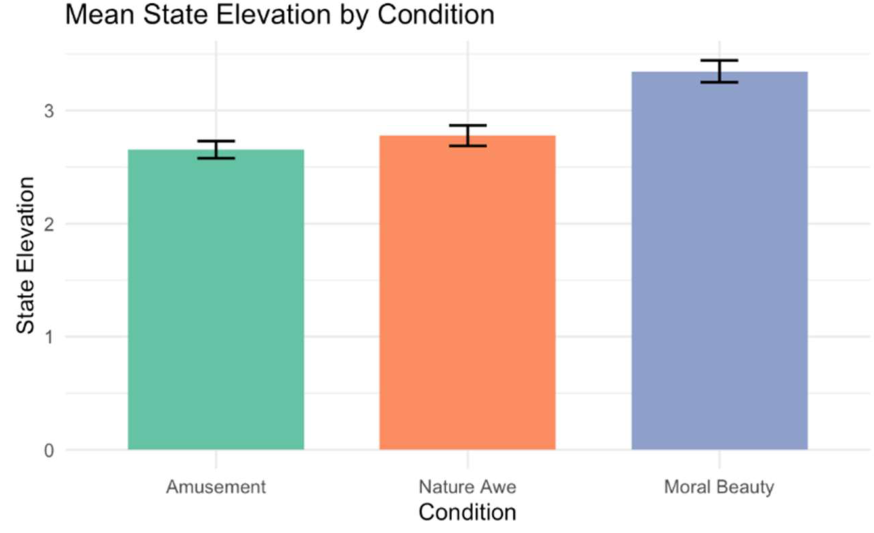
Condition significantly predicted elevation, F(2, 283) = 17.55, p < .001, R² = .10. Participants in the moral beauty condition reported significantly higher elevation than those in the amusement condition (b = 0.693, p < .001). Nature awe did not differ from amusement (b = 0.124, p = .32). Controlling for baseline emotion improved model fit, F(3, 282) = 17.01, p < .001, R² = .14, and moral beauty remained a significant predictor (b = 0.653, p < .001).
Figure 1 depicts elevation across conditions.
Manipulation Checks
- Amusement
Amusement ratings confirmed successful induction: both nature awe and moral beauty produced significantly less amusement than the amusement condition (bs = –1.23 to –1.38, ps < .001).
- 2.
- Awe
Nature awe elicited significantly higher awe than amusement (b = 0.962, p < .001). Moral beauty produced marginally increased awe (b = 0.449, p = .063).
Additional Emotion Profiles
- Low-Arousal Positive Emotions
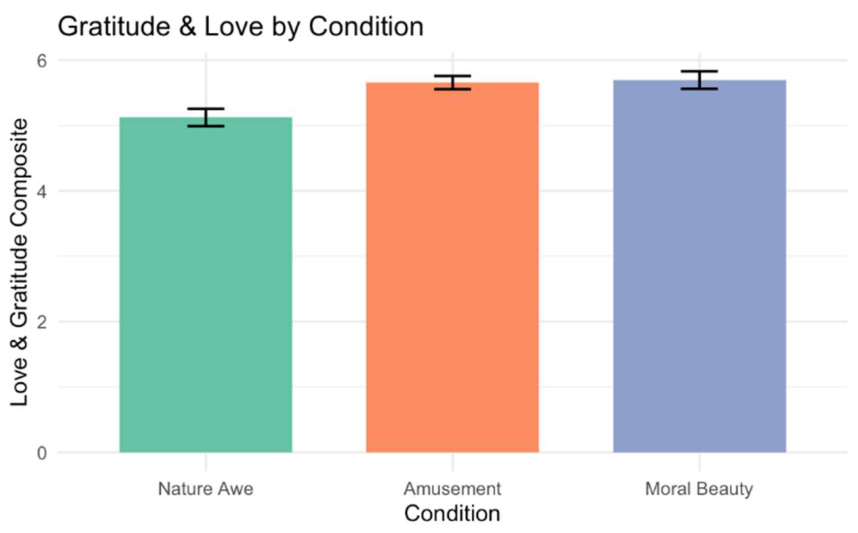
Gratitude and love correlated significantly (r = .62, p < .001) and were therefore added up into a single composite score for other-oriented emotions. This emotional state was significantly predicted by condition, with nature awe producing lower warmth than amusement ( b = –0.54, p < .001). Moral beauty did not differ significantly from amusement but trended upward. These patterns support exploratory hypothesis 2, indicating that moral beauty produces an affiliative, warm emotional profile.
Figure 2 depicts love and gratitude across conditions.
- 2.
- High-Arousal Positive Emotions
Excitement and happiness were strongly predicted by baseline emotion, but the amusement condition elicited the highest responses. Neither awe nor moral beauty increased these emotions, consistent with the expectation that moral beauty is more calming and reflective than energetic.
- 3.
- Low and High Arousal Negative Emotions
Sadness, shame, anxiety, and related states were unaffected by condition and were predicted solely by baseline emotion.
Discussion
The present study examined whether moral beauty evokes an emotional profile that can be distinguished from nature-based awe and amusement. The clearest finding was that reflecting on moral beauty elicited significantly greater moral elevation than reflecting on an amusing person, and this effect remained significant after controlling for baseline affect. Nature-based awe, in contrast, did not significantly increase elevation relative to amusement. These findings suggest that moral beauty is especially effective at eliciting elevation rather than simply producing a generalized positive emotional response.
Moral Beauty as a Distinct Emotional Elicitor
The present findings are consistent with theories that link the perception of virtue with moral elevation. Participants who reflected on moral beauty reported greater elevation than those in the amusement condition, indicating that the emotional consequences of witnessing or recalling moral excellence cannot be explained solely by positive valence. The persistence of this effect after accounting for baseline emotion further suggests that the difference was associated with the content of the reflection rather than pre-existing mood. The results also help clarify the relationship between moral beauty and awe. Although moral beauty and nature are both capable of eliciting awe-like experiences, their emotional consequences were not identical. Nature-based reflection selectively increased reported awe, whereas moral beauty was more strongly associated with elevation. This pattern supports the possibility that different elicitors within the broader domain of wonder produce distinguishable emotional responses.
Differentiating Moral Beauty from Nature-Based Awe
Nature awe and moral beauty may overlap in their capacity to direct attention beyond the self, yet the present findings suggest that they do so through different emotional pathways. Nature awe significantly increased reports of awe relative to amusement, whereas moral beauty showed its clearest effect on elevation. This distinction may reflect differences in what participants were attending to in each condition. The nature condition focused on an awe-inspiring natural environment, whereas the moral beauty condition focused on another person’s goodness, courage, compassion, or selflessness. Accordingly, nature-based awe may be more closely tied to experiences of perceptual vastness and wonder, while moral beauty may be more closely tied to the appraisal of virtue and moral excellence. The present study therefore contributes to efforts to distinguish related positive emotions according to their eliciting conditions rather than treating them as interchangeable forms of positive affect.
Distinguishing Moral Beauty from Amusement
Amusement provided an important comparison because it is positively valenced but differs substantially from moral beauty in meaning and social significance. The manipulation checks indicated that the amusement condition successfully elicited amusement, while both moral beauty and nature awe produced significantly lower amusement ratings. The emotional profiles of the conditions also differed in arousal. Amusement was associated with the highest levels of excitement and happiness, whereas moral beauty did not increase these high-arousal positive emotions. This pattern further suggests that the elevation associated with moral beauty is not simply a consequence of feeling more intensely positive. Instead, moral beauty appears to elicit a qualitatively different form of positive experience, characterized more clearly by uplift and moral inspiration than by energetic pleasure.
Warmth and Affiliate Emotions as Part of Moral Beauty’s Signature
Although gratitude and love did not show statistically significant increases above amusement in isolated models, the pattern of results combined with the strong elevation effect supports the hypothesis that moral beauty evokes a warm, affiliative emotional tone. These emotions represent low-arousal forms of positivity linked to closeness, bonding, and moral concern. Unlike amusement, which is lively and energetic, moral beauty appears to engender a quieter, relational warmth.
Taken together, the findings demonstrate that the emotional signature of moral beauty includes:
- Strong elevation, independent of baseline mood
- Warm, affiliative positivity (e.g., gratitude, love)
- Little high-arousal positive emotion
- Selective and theoretically coherent emotion patterns
Implications for Emotion Science
These results have conceptual implications for understanding moral cognition, empathy, and social bonding. If moral beauty reliably elicits elevation and affiliative warmth, then exposure to virtuous exemplars, whether interpersonal, narrative, or media-based, may play a crucial role in fostering moral development, prosociality, and community cohesion. Elevation has been shown to increase generosity, trust, and moral motivation; thus, understanding its elicitors can inform interventions in education, organizational culture, and social policy.
The differentiation between nature awe and moral beauty also enriches the science of awe by clarifying that awe is not a monolithic emotion but a family of related states whose psychological consequences depend on their elicitors. Moral beauty’s interpersonal warmth contrasts with nature awe’s perceptual vastness, suggesting distinct neural, physiological, and behavioral outcomes.
Limitations and Future Directions
Several limitations warrant consideration. First, emotional responses were measured via self-report. Incorporating physiological indicators (e.g., vagal tone, goosebumps, warmth, tears) would capture the embodied aspects of elevation. Second, although autobiographical recall is ecologically valid, real-time exposure to moral beauty (e.g., video stimuli, narrative vignettes) may produce stronger or more nuanced effects. Third, cultural factors likely shape what is perceived as morally beautiful. Cross-cultural replications are essential for determining universality. Finally, future work should compare moral beauty to related constructs such as admiration, compassion, and gratitude to more precisely map the emotional boundaries within the moral domain.
Conclusion
The present findings affirm that moral beauty evokes a unique emotional landscape characterized by elevation and affiliative warmth, distinguishing it from nature awe and amusement. Moral beauty emerges as a powerful emotional elicitor, one that inspires moral aspiration, strengthens social bonds, and affirms the human capacity for goodness. By illuminating its distinct affective signature, this study contributes to a deeper understanding of how encounters with virtue can shape emotional life and motivate prosocial engagement.
References
- Anderson, C. L.; Monroy, M.; Keltner, D. Awe in nature heals: Evidence from military veterans, at-risk youth, and college students. Emotion 2018, 18(8), 1195–1202. [Google Scholar] [CrossRef]
- Gordon, A. M.; Stellar, J. E.; Anderson, C. L.; McNeil, G. D.; Loew, D.; Keltner, D. The dark side of the sublime: Distinguishing a threat-based variant of awe. J. Personal. Soc. Psychol. 2017, 113(2), 310–328. [Google Scholar] [CrossRef]
- Haidt, J. The positive emotion of elevation. Prev. Treat. 2000, 3(1), 3. [Google Scholar] [CrossRef]
- Haidt, J.; Keltner, D.; Peterson, C.; Seligman, M. E. P. Appreciation of beauty and excellence. In Character strengths and virtues: A handbook and classification; Peterson, C., Seligman, M. E. P., Eds.; Oxford University Press, 2004; pp. 537–551. [Google Scholar]
- Keltner, D. Awe: The new science of everyday wonder and how it can transform your life; Penguin Press, 2024. [Google Scholar]
- Keltner, D.; Haidt, J. Approaching awe, a moral, spiritual, and aesthetic emotion. Cogn. Emot. 2003, 17(2), 297–314. [Google Scholar] [CrossRef]
Disclaimer/Publisher’s Note: The statements, opinions and data contained in all publications are solely those of the individual author(s) and contributor(s) and not of MDPI and/or the editor(s). MDPI and/or the editor(s) disclaim responsibility for any injury to people or property resulting from any ideas, methods, instructions or products referred to in the content. |
© 2026 by the authors. Licensee MDPI, Basel, Switzerland. This article is an open access article distributed under the terms and conditions of the Creative Commons Attribution (CC BY) license.
Copyright: This open access article is published under a Creative Commons CC BY 4.0 license, which permit the free download, distribution, and reuse, provided that the author and preprint are cited in any reuse.