

Submitted:
30 September 2026
Posted:
04 October 2026
You are already at the latest version
Abstract
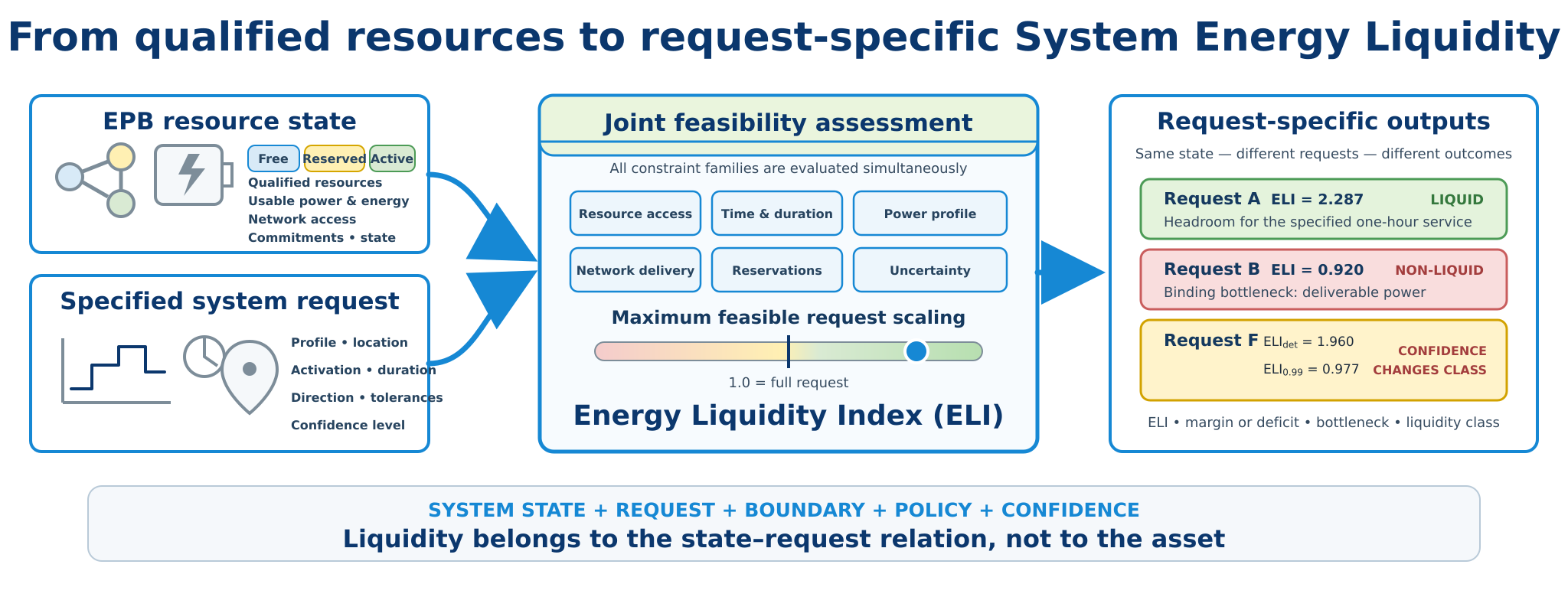
Power systems increasingly contain diverse, distributed, and energy-limited resources, yet installed capacity, stored energy, and aggregate flexibility do not establish whether a specified service can be fulfilled. This study defines System Energy Liquidity as the state-dependent and request-specific capability to mobilize and deliver usable energy and power under resource, temporal, network, operational, uncertainty, and reservation constraints. A technical request specifies direction, power profile, duration, location, activation deadline, delivery tolerances, quality, and priority class; the probabilistic assessment applies a declared confidence level separately. Deterministic and probabilistic Energy Liquidity Indices measure the maximum proportional scaling of the requested trajectory that remains feasible. The scalar index is complemented by margins, bottleneck diagnostics, and a multidimensional liquidity domain. A stylized three-node system with storage, dispatchable generation, demand response, flexible load, and constrained interfaces demonstrates seven power, energy, spatial, temporal, probabilistic, and absorption cases. The same state is liquid for one request and non-liquid for another. Scenario F is deterministically liquid, with ELI_{det}=1.960, but fails the 0.99 confidence requirement, with ELI_{0.99}=0.977. Energy and Power Banking is represented as a coordination architecture that can change access, pooling, reservation, routing, and future resource state. The sequential example illustrates how explicit reservation can preserve future liquidity; it does not assume that this function is exclusive to EPB.
Keywords:
system energy liquidity
; energy and power banking
; resource accessibility
; network-constrained flexibility
; request-specific assessment
Copyright: This open access article is published under a Creative Commons CC BY 4.0 license, which permit the free download, distribution, and reuse, provided that the author and preprint are cited in any reuse.