
Submitted:
01 October 2026
Posted:
04 October 2026
You are already at the latest version
Abstract
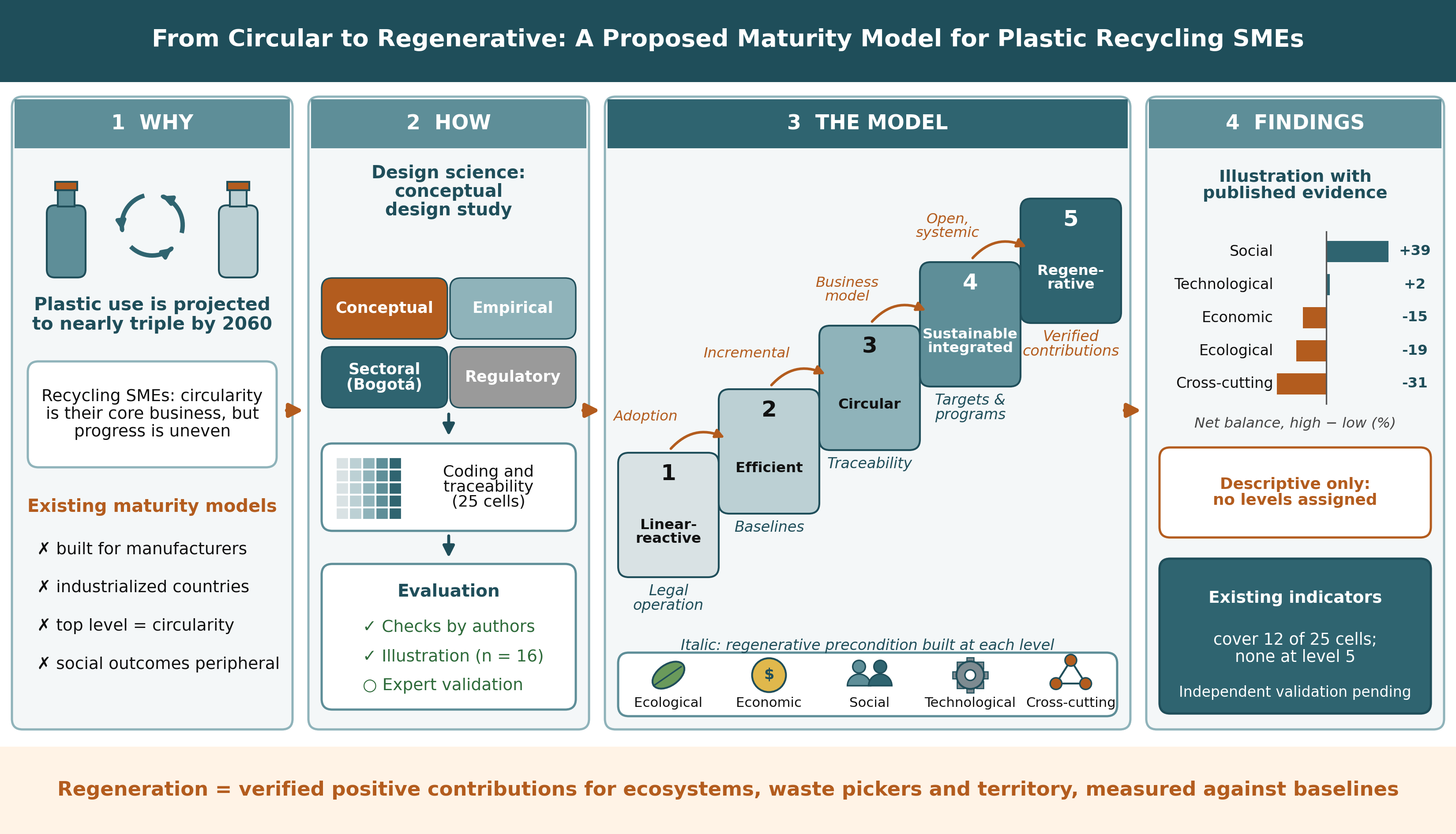
Maturity models help small and medium-sized enterprises (SMEs) plan their transition toward a circular economy, but existing models were developed mainly for manufacturing firms in industrialized countries and culminate in circularity rather than regeneration. This conceptual design study proposes a circular-regenerative maturity model for plastic recycling SMEs. Following a design science approach, the model was built through a criterion-based synthesis of literature, regulation and sectoral evidence and was evaluated ex ante by the authors only. It comprises five cumulative levels (linear-reactive, efficient, circular, sustainable integrated and regenerative) across five dimensions (ecological, economic, social, technological and cross-cutting), yielding 25 descriptors paired with verifiable evidence. The regenerative level requires verified positive contributions for third parties beyond the break-even point, measured against a baseline and safeguarded by additionality and non-displacement criteria, and each level builds a precondition for it. A brief illustration with previously published results from 16 formalized SMEs in Bogotá, Colombia, shows that existing indicators cover 12 of the 25 cells and none at the regenerative level. The model has not yet been validated by independent experts or applied to firms; its propositions are offered for empirical testing.
Keywords:
circular economy
; maturity model
; regenerative economy
; plastic recycling
; SMEs
; emerging economies
; waste pickers
; Colombia
Copyright: This open access article is published under a Creative Commons CC BY 4.0 license, which permit the free download, distribution, and reuse, provided that the author and preprint are cited in any reuse.