
Submitted:
01 October 2026
Posted:
04 October 2026
You are already at the latest version
Abstract
Hydraulic transmission and control technology is a core supporting technology for agricultural machinery. Its technical performance directly determines the operation quality, production efficiency, and overall reliability of agricultural machinery. This paper focuses on hydraulic transmission and control technology for agricultural machinery. It systematically reviews the field from three dimensions: key technology analysis, research status review, and development trend outlook. First, it elaborates the three core technical systems in agricultural machinery hydraulics. In terms of hydraulic components, it analyzes the working principles and application scenarios of power elements, actuating elements, and control elements. In terms of hydraulic systems, it analyzes the technical characteristics and evolution paths of five typical systems used in agricultural machinery. In terms of control technology, it summarizes a multi-level technical framework. This framework includes classical PID and its improved algorithms, advanced control methods, and intelligent control methods. Second, based on the latest domestic and international research literature, it comprehensively reviews the research progress in hydraulic components, hydraulic systems, and control methods. Finally, in response to the transformation and upgrading of smart agriculture and the “dual carbon” strategy, it identifies three major future directions for hydraulic transmission and control technology in agricultural machinery. The findings of this review are expected to offer theoretical references and technical guidance for the R&D and industrial upgrading of high-end hydraulic systems for agricultural machinery.
Keywords:
agricultural machinery
; hydraulic transmission
; hydraulic system
; intelligent control
1. Introduction
Agricultural mechanization is an important hallmark of agricultural modernization and an important support for safeguarding national food security [1]. As the technological foundation of modern agriculture, the technological level of agricultural machinery directly affects production efficiency, food supply, and the capacity for sustainable development [2]. As China's agricultural production accelerates its transition toward large-scale, intensive, and intelligent development, traditional agricultural machinery can no longer meet the demands of precision agriculture and smart agriculture. Therefore, it has become an important task to develop high-end agricultural machinery that is efficient, reliable, energy-saving, environmentally friendly, intelligent, and precise [3]. Across the entire grain production chain—including tillage, seeding, crop management, and harvesting—as well as specialized sectors like cash crops, livestock farming, and aquaculture, the performance of agricultural machinery, together with the level of core components and control technologies, directly affects agricultural production efficiency and overall output capacity. Together, these factors form an important foundation for promoting the upgrading of the agricultural industry [4].
Hydraulic transmission and control technology occupies an important position in the core technology system of agricultural machinery [5]. Compared with mechanical and electrical transmissions, hydraulic transmission features outstanding advantages including higher power density, larger output torque, seamless stepless speed regulation, robust overload protection, and flexible spatial layout. It can adapt to field conditions with large load fluctuations, complex motions, and strong impacts [6]. The hitch, steering, and travel drive of high-horsepower tractors, the header lifting, speed regulation, and cleaning of combine harvesters, and the boom profiling and variable-rate spraying of plant protection machinery all rely heavily on hydraulic systems [7]. The response speed, control accuracy, and reliability of hydraulic systems directly affect the operation quality, efficiency, and service life of agricultural machinery. They are foundational technologies supporting the development of agricultural machinery toward larger scale, integration, and intelligence [8].
Hydraulic transmission and control technology for agricultural machinery is an interdisciplinary research field that integrates agricultural engineering with fluid power transmission and control. It involves the design and optimization of hydraulic components, system integration and matching, electro-hydraulic control, and energy efficiency improvement [9]. This technology has evolved from traditional on-off hydraulic transmission and electro-hydraulic proportional and servo control to intelligent hydraulic control that integrates multi-sensor technologies and artificial intelligence. Agricultural machinery often operates for long periods in unstructured environments with dust, muddy water, temperature variations, and vibration shock. Therefore, hydraulic technology must also take into account reliability, environmental adaptability, cost, and ease of maintenance. It must strike a balance between performance and engineering practicality [10].
Major agricultural economies in Europe and North America have a long-standing foundation in the field of agricultural machinery hydraulics. Electro-hydraulic proportional control had already been widely deployed in production by the mid-to-late 20th century. Leading enterprises including John Deere, CNH Industrial and AGCO have continuously promoted energy efficiency optimization, precision control and fieldbus communication, and developed mature technical solutions such as load-sensing, hydrostatic continuously variable transmission (HCVT) and electro-hydraulic servo steering [11]. In recent years, with the advancement of smart agriculture, cutting-edge technologies including digital hydraulics, hydraulic control for autonomous operation and electro-hydraulic integrated drive have been further integrated into agricultural machinery [12]. Since the onset of the 21st century, Chinese universities, research institutes and enterprises have conducted research focusing on hydraulic systems of high-horsepower tractors, electro-hydraulic control systems for combine harvesters and hydraulic energy efficiency, and have achieved phased achievements in proportional control algorithms, load-sensing system matching and component adaptation [13].
A systematic analysis of the research status and development trends of hydraulic transmission and control technologies for agricultural machinery can help refine the theories and methods of electro-hydraulic control in unstructured environments, and promote the interdisciplinary integration of hydraulic power transmission and agricultural engineering [14]. From the perspective of engineering application, it can provide a technical reference for the independent research and development of hydraulic systems for high-end agricultural machinery, and is of great significance for overcoming core technical bottlenecks, enhancing the competitiveness of agricultural machinery, advancing the intelligent upgrading of agricultural mechanization, and safeguarding food security and rural revitalization [15].
This paper presents a systematic overview of hydraulic transmission and control technologies for agricultural machinery, and is structured as follows. Section 2 analyzes hydraulic components, hydraulic systems, and hydraulic control technologies in terms of key technologies, and elucidates their fundamental role in the agricultural machinery hydraulic technology system. Section 3 systematically summarizes the research status in this field from the above three dimensions. Section 4 analyzes development trends and key challenges, and outlines future research directions.
2. Key Technologies of Hydraulic Transmission and Control in Agricultural Machinery
The key hydraulic transmission and control technologies in agricultural machinery are core technologies that ensure the operational efficiency of agricultural machinery and its adaptability to field operating conditions. They can be divided into three levels: the hydraulic component layer, the hydraulic system layer, and the control technology layer. The three layers function in synergy to enable the reliable and efficient operation of hydraulic systems under complex field operating conditions. This chapter begins with an overall schematic diagram of these key technologies, as shown in Figure 1.
2.1. Key Technologies of Hydraulic Components
Hydraulic components are the functional foundation of hydraulic systems in agricultural machinery [16]. They mainly include power elements, actuating elements, and control elements. These components are responsible for energy conversion, motion execution, and system regulation, respectively. In harsh environments such as dust, muddy water, vibration, and alternating loads, these components must balance environmental adaptability and control accuracy. They are also developing toward high efficiency, integration, and intelligentization[17].
Hydraulic pumps are the power source of the system. They supply pressurized oil to each actuating unit of the entire machine. Their performance directly affects operational efficiency, energy consumption, and adaptability to operating conditions [18]. At present, agricultural machinery mainly uses gear pumps, piston pumps, and vane pumps [19]. Gear pumps are widely used low-to-medium pressure power elements. External gear pumps have a simple structure, low cost, and strong contamination resistance. They are commonly used for steering and hitch lifting in small and medium-power tractors, with a rated pressure typically of 16–25 MPa. Internal gear pumps have small flow pulsation, low noise, and relatively high volumetric efficiency. They are mainly used in auxiliary hydraulic systems of mid-to-high-end tractors and combine harvesters, and are gradually being used to improve the NVH performance of the entire machine. Axial piston pumps are suitable for high-power hydraulic systems. They have high volumetric efficiency, and their rated pressure can reach 35–42 MPa. They can easily achieve continuous displacement adjustment. Variable control can improve engine power matching and reduce overflow losses and fuel consumption. They are widely used in high-horsepower tractors, large combine harvesters, and other equipment [20]. Vane pumps run smoothly and have low noise, but their contamination resistance is relatively weak. They are mainly used in cleaner scenarios such as facility agriculture equipment and indoor agricultural product processing machinery [21].
Hydraulic cylinders and hydraulic motors are energy output terminals. They respectively realize linear motion and rotary motion, and directly drive working mechanisms and travel systems [22]. Hydraulic cylinders are divided into single-acting and double-acting types. The former has a simple structure, low cost, and convenient maintenance. It is often used for one-way operations such as hitch lifting and header lifting, but its return stroke controllability is relatively poor. The latter can actively output force and speed in both directions. It is widely used in steering, working mechanism adjustment, and precision agriculture scenarios such as seeding depth control, variable-rate fertilization, and profiling control. It has become a common actuating component for mid-to-high-end adjustable working mechanisms [23]. Hydraulic motors are mainly used for hydrostatic travel and rotary working mechanisms. Together with hydraulic pumps, they form open or closed volumetric speed control circuits to achieve stepless speed regulation and flexible transmission [24].
Hydraulic control valves are the control hub of the system. They regulate pressure, flow, and direction to achieve precise control of actuator motion and output [25]. Hydraulic systems in agricultural machinery have many actuators and frequent load fluctuations. This creates differentiated requirements for the integration level and control accuracy of control valves [26]. Multi-way directional valves integrate multiple directional units. They can control multiple actuators and provide graded overload protection. Load-sensing multi-way valves work with variable pumps to supply oil on demand. This reduces throttling losses and heat generation. Electronically controlled multi-way valves replace mechanical operation with electromagnetic or electro-hydraulic drive. They provide a foundation for remote, automatic, and unmanned operations. Electro-hydraulic proportional valves can continuously adjust pressure, flow, and spool opening according to electrical signals. They can be used for stepless speed regulation and variable-rate fertilization and spraying. They can also be combined with force and position sensors to achieve constant-force or constant-depth control of electro-hydraulic hitches. Servo valves are mainly used in scenarios requiring high precision and fast response [27].
2.2. Key Technologies of Hydraulic Systems
Hydraulic systems connect hydraulic components with the functions of the entire machine [28]. They directly affect the operation quality, control performance, and energy efficiency of agricultural machinery. According to their functional characteristics, they are mainly divided into five categories: hitch systems, steering systems, travel drive systems, leveling and attitude control systems, and load-sensing and power matching systems. They are developing toward electro-hydraulic, intelligent, and energy-saving directions [29].
The hydraulic hitch system is the core device that connects wheeled tractors to implements. The three-point hitch is the mainstream configuration [30]. Tillage depth control is divided into three modes: draft control, position control, and mixed draft-position control. Draft control uses tillage resistance as feedback to maintain a constant resistance. It is suitable for heavy-duty plowing in uneven soil, but its tillage depth consistency is relatively poor. Position control uses the relative height of the implement as feedback to ensure uniform tillage depth. It is suitable for flat fields, but it is insensitive to resistance variations. Mixed draft-position control adopts a draft-dominant with position-limiting mode. It is currently the mainstream solution for medium and high-power tractors [31]. Electro-hydraulic hitches use proportional valves and force and displacement sensors to achieve closed-loop control. Their control strategies are gradually evolving from PID to adaptive PID, fuzzy control, and neural networks. Combined with navigation, they enable precision agriculture functions such as automatic headland lifting and lowering, slope tillage depth compensation, and prescription map-based tillage [32].
The hydraulic steering system is a key component of the chassis of self-propelled agricultural machinery. It is developing from fully hydraulic steering toward electro-hydraulic coupling and steer-by-wire. Fully hydraulic steering is reliable and flexible in layout, but it is difficult to meet the requirements of active steering. Electro-hydraulic coupling retains the load capacity of the hydraulic system. It also uses electronic control and proportional control to achieve assist adjustment and active steering. It has become a common solution for high-horsepower tractors and large combine harvesters. Steer-by-wire eliminates the mechanical connection between the steering wheel and the actuating mechanism. It uses electrical signal commands to control the hydraulic actuation unit. It can adapt to four-wheel independent steering. It is an important supporting technology for unmanned agricultural machinery. It is currently in the stage of R&D verification and demonstration application. Key research focuses on fault redundancy design and optimization of the environmental adaptability of electronic control elements [33].
The hydraulic travel drive system achieves stepless speed regulation through volumetric speed control. It offers advantages such as low-speed high torque, overload protection, and flexible layout. It has become the mainstream travel solution for small and medium-power self-propelled agricultural machinery. The closed single circuit consists of a variable pump and a motor. It has a compact structure and relatively low cost, making it suitable for light, low-speed equipment such as micro tillers and rice transplanters. The closed dual-circuit differential drive can independently drive the left and right wheels or tracks. It provides stronger steering maneuverability and traction distribution capability, and is widely used in tracked combine harvesters and tractors. Multi-wheel independent drive uses distributed proportional control to independently adjust the speed, torque, and traction of each wheel. It can achieve anti-slip and coordinated steering. However, it has a complex structure and high cost, so it is mainly used in high-end equipment such as unmanned platforms [34].
The hydraulic leveling and attitude control system integrates actuating elements, attitude sensing, and electronic control technology. It actively suppresses terrain disturbances. Automatic chassis leveling takes the vehicle body inclination angle as its target. It forms a closed-loop regulation system composed of lifting cylinders, proportional valves, inclination sensors, and an electronic control unit. The wheel-side suspension type is suitable for dynamic leveling during travel. The outrigger type has strong load-bearing capacity and high precision, making it suitable for orchard platforms and stationary equipment. The attitude control system can adjust roll, pitch, and penetration angle through hydraulic cylinders. It also combines profiling signals to maintain operation quality [35].
Load-sensing and power matching technologies are important paths for improving energy efficiency in hydraulic systems. A load-sensing system adjusts pump output based on load pressure feedback. This reduces relief losses and ensures parallel operation of multiple actuators. Compared with traditional fixed-displacement pump systems, it can reduce energy consumption by 20%–35%. It has been widely adopted in tractors, combine harvesters, and large plant protection machinery. Engine-hydraulic power matching is optimized at the whole-machine level. The mechanical constant-power regulation mechanism at the pump end has a reliable structure but lacks dynamic adjustment. It is mostly used in economical agricultural machinery. Electronic global power matching obtains operating status through the CAN bus. It adjusts the displacement of electro-proportional pumps in a closed loop. This achieves power distribution and priority scheduling for multiple pumps and multiple actuators. This technology saves an average of 10%–15% fuel and has become a core energy-saving solution for high-end equipment [36].
2.3. Key Technologies of Hydraulic System Control
Hydraulic system control technology is the core for achieving precision operation, efficient drive, and intelligent decision-making. It has evolved from classical control to advanced control, and then to intelligent control [37].
Classical control methods are represented by PID control and its variants. They have a simple structure and are easy to implement. They are currently the most widely used basic control methods in hydraulic systems of agricultural machinery [38]. Traditional fixed-parameter PID is suitable for systems with relatively stable operating conditions. However, its control performance tends to degrade under complex conditions such as variations in soil resistance, load impacts, and time-varying hydraulic parameters. Therefore, methods such as variable-parameter PID, fuzzy PID, and feedforward-feedback composite PID improve dynamic response and steady-state accuracy through parameter switching or disturbance feedforward compensation. They have good engineering applicability in tillage depth control, travel speed control, and hydraulic actuator control [39].
To address the nonlinearity, uncertainty, and strong disturbances in agricultural machinery hydraulic systems, advanced methods such as fuzzy control, sliding mode control (SMC), adaptive control, active disturbance rejection control (ADRC), and model predictive control (MPC) have been widely studied [40]. Fuzzy control is based on fuzzy inference and does not require an accurate model. It can use empirical rules to improve system adaptability to parameter variations and external disturbances. It is suitable for field scenarios such as time-varying soil resistance and sudden load changes. SMC forces the system states to converge to and remain near a sliding mode surface by designing switching control laws. It provides strong robustness and invariance to parameter variations and external impacts. Chattering during control can be effectively suppressed through strategies such as terminal sliding mode, higher-order sliding mode, and adaptive sliding mode. It is suitable for heavy-load and strong-disturbance operating condition [41]. Adaptive control adjusts the controller by identifying system parameters online. It effectively compensates for slow time-varying drifts such as oil temperature changes and component aging, and maintains long-term consistency. However, its ability to suppress sudden strong disturbances is limited. It is suitable for scenarios such as tillage depth control, speed ratio regulation, and multi-cylinder synchronization. ADRC enhances system disturbance rejection through disturbance observation and compensation. It has good adaptability to sudden load changes [42]. MPC replaces accurate mechanistic models with T-S fuzzy models. It handles multivariable coupling, time delays, and constraints through rolling horizon optimization. It is suitable for speed ratio control of hydro-mechanical continuously variable transmissions (HMCVT), cooperative control, and look-ahead operation control. However, it has high requirements for computing resources[43].
With the development of artificial intelligence, reinforcement learning and deep learning are gradually being applied to hydraulic control of agricultural machinery[44]. Reinforcement learning autonomously optimizes control strategies through interaction with the environment. It shows great potential in gear shifting optimization, tillage depth self-tuning, and multi-actuator cooperative decision-making. Deep learning uses multi-source sensor information to learn the nonlinear characteristics of the system. It can be combined with PID, adaptive control, or sliding mode control for tillage depth regulation, HMCVT speed ratio control, and multi-actuator cooperative control. However, it relies heavily on data and has weak interpretability [45]. Current intelligent control methods still face problems such as difficulty in data acquisition, lack of model interpretability, and difficulty in experimental validation. Therefore, hybrid control based on classical or advanced control and integrating reinforcement learning, fuzzy inference, and neural networks is becoming an important direction for the integrated development of perception, decision-making, and control in agricultural machinery hydraulic systems [46].
3. Research Status of Hydraulic Transmission and Control Technology for Agricultural Machinery
3.1. Research Status of Hydraulic Components for Agricultural Machinery
3.1.1. Power Elements
Power elements are the core power source of hydraulic systems. Their performance directly affects the working capacity and reliability of hydraulic systems in agricultural machinery. In recent years, as agricultural machinery has developed toward high power, high efficiency, and intelligentization, researchers at home and abroad have carried out extensive research on hydraulic pump reliability evaluation, hydrostatic transmission system design and optimization, dynamic characteristics of hydraulic systems, and power detection of power elements. These efforts have produced abundant achievements.
In terms of tractor hydraulic power elements, researchers have carried out in-depth studies on key issues such as reliability evaluation of hydraulic pumps, control of hydrostatic transmission systems, and load matching of power elements. Siddique et al. [47] took a 78 kW tractor as the research object. To address the lack of effective reliability evaluation methods for tractor hydraulic pumps under field operation conditions, they conducted reliability experimental research on four typical farmland operations. Xi et al. [48] focused on a tractor equipped with HMCVT. To address insufficient speed stability during field operations, they proposed an integrated HMCVT speed control strategy that coordinates engine speed and hydraulic displacement ratio. This strategy can reduce speed fluctuations and impacts, shorten adjustment time, and effectively improve operation speed stability. Baek et al. [49] studied the hydraulic and power transmission system of a 55 kW agricultural tractor. To address the lack of measured load support for the design of its hydraulic power elements, they conducted field experiments in paddy fields. They studied the characteristics of operation power demand and the distribution of load duration. The physical configuration and installation layout of the 55 kW agricultural tractor are shown in Figure 2.
In terms of hydraulic drive systems for agricultural machinery chassis, researchers have studied power matching and operation stability in hilly and mountainous areas and under special terrain conditions. Zhao et al. [50] took an agricultural machinery chassis for hilly and mountainous areas as the research object. To address the poor operation stability and high rollover risk of traditional agricultural machinery in mountainous areas, they designed a four-wheel adaptive chassis leveling system. Automatic leveling was achieved through parameter matching of hydraulic components and a four-point leveling strategy. KODRIČ et al. [51] focused on agricultural machinery operating on extremely steep slopes. To address the difficulty of agricultural machinery operation on steep slopes, they proposed and designed a hydraulic transmission system for agricultural machinery. It uses an internal combustion engine to drive a hydraulic pump for energy supply. It can utilize potential energy and automatically distribute power on demand. Lu et al. [52] studied the hydraulic drive system of a small multifunctional agricultural hydraulic chassis. To address the insufficient power and performance of agricultural machinery in field operations in hilly and mountainous areas, they completed the selection and matching of key power elements in the hydraulic drive system to meet the operation requirements in hilly and mountainous areas.
In terms of hydraulic drive systems for harvesting machinery, researchers have explored parameter matching of travel drive systems and power detection technology for key components. Qu et al. [53] took the hydraulic travel drive system of a tracked tiger nut harvester as the research object. To address the low mechanization level of tiger nut harvesting in China, as well as the weak driving capability and poor operation stability of existing pull-type harvesters, they completed the parameter matching design of power elements in the hydraulic system. Niu et al. [54] focused on a self-propelled forage harvester. To address the lack of power detection technology for key power elements in agricultural machinery, they analyzed power parameters such as the rotational speed and torque of working components, as well as the output flow rate and pressure of the travel drive hydraulic pump. This provides a reference for forage harvesting and optimal design.
3.1.2. Actuating Elements
Actuating elements are key components in hydraulic systems that convert hydraulic energy into mechanical energy. They directly drive various working devices of agricultural machinery. With the development of precision agriculture and smart agriculture, higher requirements have been placed on the control accuracy, energy efficiency, and dynamic characteristics of actuating elements. In recent years, researchers at home and abroad have conducted in-depth studies on energy efficiency optimization and dynamic modeling of hydraulic cylinders, vibration reduction of hydraulic hitch systems, development of hydraulic drive test platforms, and application of actuating elements in precision operations. These efforts have promoted the development of hydraulic actuating component technology for agricultural machinery.
In terms of dynamic modeling and energy efficiency optimization of hydraulic cylinders, researchers have studied accurate modeling methods for hydraulic cylinders and new high-efficiency drive schemes. Radio et al. [55] took a digital hydraulic cylinder as the research object. To address the high energy consumption of throttling and directional control in traditional agricultural machinery hydraulic systems, they proposed an energy-efficient drive system scheme for digital hydraulic cylinders. This scheme uses multiple sets of effective acting areas and a constant pressure source to achieve stepwise variation of driving force, thereby avoiding valve-controlled energy consumption. Arai et al. [56] focused on the hydraulic cylinder of an agricultural-grade excavator. To address the dynamic modeling and control of hydraulic cylinders, they adopted an updated physical parameter identification method to build a numerical simulation model of an agricultural excavator. They conducted an integrated theoretical, experimental, and numerical study on the dynamic energy behavior of the hydraulic cylinder.
In terms of hydraulic actuating mechanisms for hitch and lifting, researchers have studied accurate traction force measurement and operation accuracy improvement. Kim et al. [57] took the three-point hitch mechanism of a tractor as the research object, as shown in Figure 3. To address the difficulty of accurately measuring traction force during hitch operations, they analyzed the motion characteristics of the hitch mechanism based on kinematic equations. They used hydraulic actuators to complete static calibration of a dynamometer, achieving accurate measurement of force and torque. Bockhop et al. [58] focused on the hydraulic lifting arm system of a self-propelled boom sprayer. To address its insufficient operation accuracy, they analyzed the hydraulic actuating system containing hydraulic cylinders and accumulators. They built a simulation model by combining parameter adjustment with field tests under multiple operating conditions.
In terms of actuating mechanisms for working devices and steering control, researchers have studied application scenarios such as boom balance, soil sampling, and steering navigation. Pashaee et al. [59] took the active balance system of a boom sprayer as the research object. To address uneven spraying caused by boom vibration on uneven ground, they proposed an active boom balance system based on the variable pivot method. A servo motor was used as the actuating component to adjust the boom pivot position and achieve active leveling. Spliethoff et al. [60] focused on a tractor-mounted hydraulic soil sampler. To address the low efficiency of undisturbed soil sample collection, they compared it with traditional samplers under multiple soil management modes. This provided a reliable hydraulic sampling tool for soil sampling. Guan et al. [61] studied the hydraulic steering actuator of a tracked rice combine harvester. To address large navigation tracking errors caused by track sinking and slipping in paddy field operations, they designed a hydraulic steering actuator controller based on a particle swarm optimization (PSO)-based fuzzy control method. This effectively improved the navigation tracking accuracy of the harvester.
3.1.3. Control Elements
Control elements are the core regulating components of hydraulic systems. They regulate oil pressure, flow rate, and direction to achieve precise control of actuators. As agricultural machinery develops toward automation and intelligentization, electro-hydraulic proportional valves, servo valves, and integrated control valve groups are widely used in scenarios such as automatic steering, hitch control, transmission shifting, and header height adjustment. In recent years, researchers at home and abroad have conducted extensive studies on the modeling and simulation of electro-hydraulic proportional valves, electro-hydraulic steering control, and optimization of servo valve-controlled cylinder systems. Significant progress has been made.
In terms of modeling and simulation of electro-hydraulic proportional valves, researchers have studied hydraulic characteristic prediction and precise control of proportional valves. Min et al. [62] took the electro-hydraulic proportional valve of an autonomous tractor as the research object. Its test system is shown in Figure 4. To address the difficulty of accurately predicting the actual hydraulic characteristics of the valve under real operating conditions during precise steering control, they built a simulation model based on AMESim that integrates operating conditions and valve control signals. They analyzed the hydraulic characteristics, flow characteristics, and response characteristics of the valve under different operating conditions. Yang et al. [63] focused on the hydraulic height adaptive system of a combine harvester header. To address the insufficient control accuracy of the original electronically controlled directional valve, they used an integrated solenoid proportional valve to replace the original valve. They conducted research on control elements and algorithms for agricultural machinery hydraulic systems.
In terms of optimization of servo valve and multi-way valve control systems, researchers have conducted in-depth exploration of the nonlinearity and parameter uncertainty in electro-hydraulic servo systems. Siddique et al. [64] took the clutch pack of a power-shift transmission in an agricultural tractor as the research object. To address the optimal design of the clutch pack, they constructed a multi-parameter mathematical and simulation model. They used a sensor fusion method to accurately measure the proportional valve pressure and incorporated it into the simulation. They studied the factors influencing the core design of the clutch pack. Wang et al. [65] focused on the electro-hydraulic servo valve-controlled cylinder system of a tractor hydraulic hitch system. To address the strong nonlinearity, uncertainty, and time-varying parameters of the system, they studied a composite control strategy in which a linear active disturbance rejection controller was optimized by a genetic algorithm.
3.2. Research Status of Hydraulic Systems for Agricultural Machinery
3.2.1. Hydraulic Hitch System
The hydraulic hitch system is the core hydraulic system for tractors to achieve implement hitching, tillage depth adjustment, and traction control. Its performance directly affects the quality and efficiency of field operations. With the development of precision agriculture and intelligent agricultural machinery, electro-hydraulic hitch systems integrate electronic control and sensing technologies. They are gradually shifting from position control to mixed draft-position control, from mechanical feedback to electro-hydraulic control, and from fixed parameters to adaptive control. Current research mainly focuses on tillage depth adjustment, mixed draft-position control, and system integration optimization.
In terms of the design of electro-hydraulic hitch control systems and sensing detection, researchers have studied the electro-hydraulic control architecture and traction force measurement methods of hitch systems. Singha et al. [66] focused on three-point hitch system of a tractor. To address the insufficient performance of traditional mechanical hydraulic hitches, they developed an electro-hydraulic hitch control system based on lower link traction force sensing, achieving precise tillage depth adjustment. Chukewad et al. [67] focused on a tractor three-point hitch system driven by two independent hydraulic cylinders. To address the difficulty of synchronous motion of the two independent arms and the tendency of implements to roll during floating operations, they proposed a coordinated motion controller for single and dual arms, along with a software algorithm that can simulate a physical rocker shaft.
In terms of mixed draft-position control algorithms, researchers have proposed various advanced control strategies to address nonlinearity, time-varying parameters, and uncertainty. Liu et al. [68] focused on the hydraulic hitch system of a tractor, as shown in Figure 5. To address its strong nonlinearity, time-varying parameters, and uncertainty, they designed a differential-integral sliding mode adaptive controller (DI-SMAC) for mixed draft-position control. This provided an effective control scheme for fine tillage operations of tractors. Luo et al. [69] focused on the electro-hydraulic hitch system of a tractor. To address the difficulty of traditional control methods in simultaneously achieving constant tillage depth, high traction, and high efficiency, they proposed a hydraulic cylinder pressure control method for the electro-hydraulic hitch system and established a system dynamics model. Sun et al. [70] studied the electro-hydraulic hitch system of a tractor. To improve traction efficiency and reduce fuel consumption, they proposed a tillage depth-speed coordinated control method, established a system dynamics model, and designed a corresponding sliding mode controller. This can significantly improve operation quality.
In terms of control algorithms and reviews for hitch systems, researchers have introduced methods such as fuzzy control into electro-hydraulic hitch systems to improve adaptability to operating conditions. Gao et al. [71] took an electro-hydraulic hitch system as the research object. To address the complex and variable agricultural environment, they proposed a variable universe fuzzy PID control algorithm. They established a transfer function model and completed simulation and field validation. Xu et al. [72] focused on the electro-hydraulic hitch operation system of an agricultural tractor. To address slow response and low accuracy in target value control, they studied a variable universe fuzzy control algorithm based on mixed draft-position adjustment. This effectively improved the tillage quality and operation efficiency of the system. Anche et al. [73] focused on the electro-hydraulic hitch system of a tractor. To address the impact of disturbance forces on the hitch system when traveling on uneven terrain, they proposed a sliding mode control method. This method integrates recursive least squares parameter adaptation, position limiting, and dual-valve triggering logic. In addition, Sun et al. [74] systematically reviewed the research advances in tractor electro-hydraulic hitch systems across three key domains: tillage depth adjustment approaches, tillage depth control algorithms, and core components. They highlighted that multi-parameter tillage depth adjustment are capable of ensuring operation quality while achieving a balance between load stability and traction efficiency.
3.2.2. Hydraulic Steering System
Hydraulic steering systems are key actuation systems for automatic navigation and unmanned driving of agricultural machinery. Their control accuracy and response speed directly affect path tracking and operation quality. With the development of automatic navigation technology for agricultural machinery, electro-hydraulic steering is gradually evolving from traditional hydraulic steering to steer-by-wire, multi-mode, and adaptive steering. Current research mainly focuses on the design of steer-by-wire systems, multi-mode steering, and analysis of steering characteristics under complex operating conditions.
In terms of steering control algorithm optimization, researchers have conducted extensive studies on the application of fuzzy PID and its improved algorithms in hydraulic steering systems. An et al. [75] took agricultural wheeled vehicles equipped with hydraulic steering systems as the research object. To address the poor adaptability of automatic steering systems for agricultural machinery, they studied an automatic steering system based on fuzzy self-tuning PID. Li et al. [76] focused on the navigation hydraulic steering system of a large high-clearance self-propelled sprayer. To address its insufficient navigation accuracy, they designed a navigation hydraulic steering system and established a corresponding mathematical model. They integrated a pure pursuit path tracking algorithm with fuzzy adaptive PID control to study the control strategy. Delavarpuor et al. [77] took the automatic steering system of a tractor as the research object. To address the reduction in operation efficiency caused by uncontrolled implement motion during traction operations, they designed a fuzzy logic steering controller. This improved tracking accuracy for low-speed simple trajectories. Dong et al. [78] focused on the automatic row-following system of a corn harvester. To address the difficulty of adapting to corn harvesting operations with different row spacings, they designed an automatic row-following system with a deviation detection sensor. They achieved automatic attitude adjustment based on the fuzzy control.
In terms of the design of steer-by-wire and multi-mode steering systems, researchers have explored new steering system configurations and electro-hydraulic drive schemes. Ren et al. [79] took an unmanned orchard plant protection vehicle as the research object. To address the insufficient hardware performance and environmental adaptability of domestic orchard plant protection equipment, they designed a new-generation unmanned vehicle. It integrates hydrostatic transmission, four-wheel drive, and synchronous steering. It is also equipped with electro-hydraulic steering and a dual-core control architecture, as shown in Figure 6. Hu et al. [80] focused on a multi-mode hydraulic steering system for agricultural machinery in hilly and mountainous areas. To address the insufficient steering flexibility of agricultural machinery in these areas, they studied a hydraulic steering system based on the load-sensing principle and PID algorithm. This provides a reference for the development of similar steering systems. Yang et al. [81] took a tractor steering system as the research object. To address the low headland turning efficiency of traditional steering methods, they designed an electro-hydraulic drive device with 360° steering auxiliary wheels and a corresponding control scheme. This significantly improved the headland turning efficiency of autonomous tractors. Xu et al. [82] studied the electro-hydraulic coupling steering system of a tractor. To address poor steering performance under multiple influencing factors, they studied the influence patterns of oil temperature, oil supply pressure, and travel speed on steering performance. This can provide a reference for the design and parameter optimization of tractor steering systems.
3.2.3. Hydraulic Travel Drive System
Hydraulic travel drive systems are the core of self-propelled agricultural machinery for achieving stepless speed regulation, flexible transmission, and power splitting. They mainly include hydrostatic transmission (HST), HMCVT, and multi-pump multi-motor drive configurations. With the growing demand for mechanization in hilly and mountainous areas and for efficient operations, related research is mainly developing toward mechanical-electrical-hydraulic integration, intelligent control, and high efficiency and energy saving.
In terms of HMCVT, researchers have conducted systematic studies on transmission characteristics, optimization of speed ratio control laws, and system identification methods. Wang et al. [83] took a new type of HMCVT for tractors as the research object and studied the transmission characteristics, efficiency, and parameter influence patterns of the transmission. Xia et al. [84] focused on a new type of HMCVT for tractors. To address low operation efficiency caused by fluctuations in operation resistance and the influence of oil pressure fluctuations on control accuracy, they proposed an efficient speed ratio control law and designed a feedforward compensation sliding mode control algorithm. This effectively improved operation efficiency. Cheng et al. [85] studied the HMCVT of a tractor. To address insufficient response accuracy of the system, they proposed a system identification method based on a prior model-heuristic intelligent optimization algorithm. This effectively improved control accuracy. Zhao et al. [86]took the hydro-mechanical transmission (HMT) of a tractor as the research object. To address the relatively high cost of traditional HMT, they proposed an HMT transmission scheme using a single planetary gear set for power confluence. They studied its parasitic power and efficiency characteristics.
In terms of HST, researchers have studied parameter matching of key components, drive performance optimization, and travel stability control. Liu et al. [87]took the hydrostatic drive system of a mountain tracked tractor as the research object. To address the narrow operating speed adjustment range, complex operation, and low safety on slopes of medium-sized tracked tractors, they completed parameter matching of key components and performance verification of the drive system. Zhu et al. [88]focused on the dual-pump dual-motor hydraulic travel system of a tracked tobacco harvester. To address insufficient travel stability, they proposed a coordinated control strategy with straight-line and steering dual modes. This improved system control performance and can provide a reference for the development of high-performance tracked agricultural vehicles. Ma et al. [89]took the drive system of an agricultural operation platform as the research object. To address insufficient stability under multiple steering conditions when the platform travels transversely and longitudinally, they designed an X-type dual-pump four-motor hydrostatic drive system. They completed mechanical analysis, component selection, modeling and simulation, and multi-condition tests. Cai et al. [90]focused on the transmission system of the power chassis of a high-clearance plant protection machine, as shown in Figure 7. To address insufficient passability and overall traction of existing plant protection machines during mid-to-late field operations, they designed a transmission system based on hydrostatic transmission and a part-time four-wheel-drive transfer case. This can provide a reference for the design of the power chassis of high-clearance plant protection machines.
In terms of other new hydraulic transmission systems, researchers have explored technologies such as mechanical-electrical-hydraulic hybrid transmission and intelligent shift control. Meng et al. [91]took the power-shift system of a cotton picker as the research object. To address the problem of large shifting impacts in cotton pickers, they studied an intelligent displacement control method for a variable pump and dual variable motors based on a fuzzy algorithm. This effectively reduced vehicle speed fluctuations and impacts during shifting and ensured stable operation of the cotton picker. Zhu et al. [92]took the mechanical-electrical-hydraulic powertrain system of a tractor as the research object. They proposed a mechanical-electrical-hydraulic hybrid transmission system and studied its speed regulation characteristics, torque characteristics, and efficiency characteristics under multiple operating conditions.
3.2.4. Hydraulic Travel Drive System
Hydraulic leveling and attitude control system is a key technology for agricultural machinery. It helps the machinery adapt to complex terrain in hilly and mountainous areas and ensures operation quality and safety. To address vehicle body tilt caused by slopes and rough terrain, current research mainly focuses on the design of chassis attitude leveling mechanisms, adaptive leveling control, hydraulic suspension linkage, adaptive header height adjustment, and multi-body dynamics simulation analysis.
In terms of leveling of harvesting machinery chassis, researchers have conducted in-depth studies on adaptive adjustment of vehicle body attitude for tracked combine harvesters and sugarcane harvesters. Hu et al. [93]took a combine harvester as the research object. To address the influence of vehicle body tilt on operation performance under complex terrain and the fact that few existing leveling methods are suitable for tracked vehicles, they combined attitude detection with hydraulic cylinder extension adjustment through a mathematical model. They designed a four-point adjustable lifting tracked chassis and an adaptive leveling system. Liu et al. [94]focused on a sugarcane harvester. To address excessive vehicle body tilt and safety hazards during slope operations, they developed an automatic leveling chassis based on the principle of hydraulic lifting leveling. Real-time attitude adjustment was achieved through coordinated control of multiple hydraulic cylinders. Tan et al. [95]took a self-propelled corn harvester as the research object. To address its susceptibility to overturning on slopes and the problems of a single existing chassis leveling mechanism and small adjustable angle, they designed a chassis attitude adjustment device composed of dual leveling mechanisms and a leveling control system. Chai et al. [96]studied the attitude adjustment mechanism of a tracked combine harvester, as shown in Figure 8. To address poor reliability of the attitude adjustment mechanism, they established a dynamic model of the attitude-adjustable chassis of the tracked combine harvester and studied the dynamic stress response under different operating conditions. Sun et al. [97]took a tracked combine harvester as the research object. To address the fact that few existing leveling methods are suitable for tracked vehicles, they developed a hydraulic four-point adjustable lifting chassis leveling mechanism. Based on ADAMS, they studied the dynamic performance under different attitude adjustment conditions.
In terms of tractor and chassis leveling systems, researchers have explored leveling control models, new leveling mechanisms, and omnidirectional leveling technology. Wang et al. [98] took the vehicle body leveling system of a hilly and mountainous tractor as the research object. To address the influence of the control model on vehicle leveling accuracy, they proposed a leveling control model based on tire stiffness and mass displacement. This model can accurately output the vehicle body attitude. Pan et al. [99] focused on a wheel-legged unmanned agricultural machinery chassis. To address the insufficient maneuverability of traditional agricultural machinery chassis, they designed a pneumatic-hydraulic linkage wheel-leg structure inspired by the hind legs of locusts. They also built an omnidirectional leveling control system. Its leveling accuracy, response speed, and ground clearance adjustment can meet actual operation requirements. Liu et al. [100] took a tracked orchard operation platform as the research object. To address large chassis inclination fluctuations and low efficiency during operations on complex terrain, they proposed a five-point support hydraulically driven omnidirectional leveling scheme. They conducted research through kinematic analysis, multi-objective parameter optimization, and mechanical-hydraulic co-simulation.
In terms of attitude adjustment of working implements, researchers have conducted applied research on adaptive header height control and automatic leveling of mounted implements. Yu et al. [101] took the automatic leveling system of paddy field preparation machinery as the research object. To address its low operation efficiency and insufficient leveling accuracy, they developed an automatic leveling hydraulic system that integrates hydraulic and sensing technologies. They used an M4/3 solenoid directional valve to achieve automatic leveling. Yao et al. [102] focused on the automatic leveling system of tractor-mounted implements. To address asymmetric tillage depth on both sides of the implement caused by vehicle body roll, they developed an automatic implement leveling system based on a double closed-loop fuzzy PID algorithm. Ni et al. [103] took the header height adjustment system of a soybean harvester as the research object. To address poor harvesting quality caused by low soybean plants, they designed a header profiling mechanism and a hydraulic drive system. They constructed an adaptive header height adjustment system.
3.2.5. Load-Sensing and Power Matching System
Load-sensing technology represents one of the most effective approaches to enhancing the energy efficiency of hydraulic systems in agricultural machinery. It adjusts pump flow and pressure by sensing load demand in real time. This achieves on-demand oil supply and reduces throttling losses and power waste in the system. Current research mainly focuses on energy-saving optimization of load-sensing systems, new high-efficiency hydraulic system architectures, intelligent power matching, and the application of load-sensing technology in multi-circuit hydraulic systems.
In terms of energy-saving optimization of load-sensing systems, researchers have conducted innovative studies on new energy-saving architectures such as pump margin adjustment, multi-pressure rail design, and dual-variable coordinated control. Tian et al. [104] took the pre-compensated load-sensing system of an agricultural tractor as the research object. To address the energy losses that still occur when each actuator passes through throttling control valves, they proposed two energy efficiency improvement schemes: variable pump margin (VPM) and hybrid variable margin (HVM). These schemes were verified through simulation and experiments. Wu et al. [105] focused on the multi-way valve system of a hilly and mountainous tractor. To address its large pressure loss and insufficient flow supply and demand, they designed a dual-variable load-sensing system that combines an electro-hydraulic load-sensing pump with an independent metering flow distribution mechanism, and its performance was verified through AMESim modeling and simulation. Guo et al. [106] took the hydraulic control system of agricultural tractors and implements as the research object. To address the problem of high throttling losses in agricultural hydraulic systems under traditional flow control logic, which leads to low overall energy efficiency, they proposed a variable pressure multi-pressure rail system based on pressure control logic.
In terms of applications of load-sensing technology and power matching, researchers have combined the load-sensing principle with intelligent control algorithms. This has enabled system-level energy-saving optimization for specific operation scenarios. Liang et al. [107] took the power system of a sugarcane combine harvester as the research object. To address poor harvesting performance and unstable results under complex operating conditions, they designed a hydraulic system based on load-sensing technology. They also proposed an intelligent power matching strategy that integrates fuzzy control and accumulator energy storage. This effectively improved operation performance and fuel economy. Li et al. [108] focused on the steering system of a high-clearance sprayer. To address insufficient steering flexibility and operation efficiency, they designed a load-sensing-based crab steering hydraulic system. They established mathematical models of the steering transmission mechanism and the hydraulic system. They also conducted simulation and field tests.
3.3. Research Status of Control Methods for Agricultural Machinery Hydraulic Systems
3.3.1. Classical Control Methods
PID and its derived algorithms have become widely used classical control methods in agricultural machinery hydraulic systems due to their simple structure, and high reliability. They achieve real-time closed-loop control of key parameters such as seeding depth, header height, tillage depth, and chassis attitude through sensor feedback and hydraulic actuators. This section mainly reviews typical application studies of PID and its derived methods in agricultural machinery hydraulic systems.
In terms of tillage depth control and seeding depth adjustment, PID-type control methods achieve real-time closed-loop regulation of key operation parameters by integrating sensor feedback and hydraulic actuators. Zhou et al. [109] took a no-till planter as the research object. To address the complex structure and insufficient adaptability of the electro-hydraulic seeding depth control system, they innovatively designed an integrated pressure-reducing hydraulic cylinder. They proposed a feedforward compensation PID control algorithm to achieve dynamic adjustment of downforce. Li et al. [110] focused on a peanut planter. To address the difficulty of maintaining consistent seeding depth, they proposed an improved dual-loop feedback fuzzy PID control strategy. Through MATLAB/AMESim co-simulation, they verified that the control performance of this method was significantly improved compared with traditional methods. Liu et al. [111] focused on the electro-hydraulic hitch system of a tractor. To address inaccurate pressure control during field operations, they proposed an adaptive fuzzy PID controller with compensation correction. This achieved online real-time tuning of PID parameters.
In terms of header height adjustment and profiling control, PID control methods achieve adaptive adjustment to different crops and terrain conditions by integrating profiling mechanisms and multi-sensor fusion. Zhao et al. [112] took the header of a forage harvester in hilly and mountainous areas as the research object. To address the insufficient capability of traditional two-degree-of-freedom headers, they designed a three-degree-of-freedom profiling header. They overcame the adjustment coupling problem through kinematic decoupling. They also built a profiling control system that integrates a hydraulic system and a fuzzy PID controller. He et al. [113] focused on a soybean harvester for saline-alkali land. To address inconsistent stubble height and low harvesting quality in saline-alkali land, they designed an adaptive header height control system. It consists of a mechanical profiling device, a PLC control unit, and a double-acting hydraulic cylinder. They established a fuzzy PID-based height control model. Tan et al. [114] took a corn harvester as the research object. To address poor manual control accuracy of header height, they designed an adaptive adjustment system composed of a pressure wheel profiling device, an STM32 control unit, and a hydraulic adjustment mechanism, as shown in Figure 9. They achieved automatic header height adjustment using PID.
In chassis travel, steering control, and other operation processes, PID and its derived algorithms also play a fundamental control role. Li et al. [115] took a wide boom sprayer as the research object. To address the difficulty of keeping the boom parallel to the ground, they established mathematical models of a valve-controlled hydraulic cylinder and an active suspension. They proposed a feedforward PID control algorithm to improve tracking performance. Zhang et al. [116] focused on an unmanned tracked harvester for paddy fields. To address insufficient path tracking accuracy and performance in fully automatic operations, they proposed an adaptive path tracking control system that combines a multi-parameter optimization feedback algorithm with nonlinear PID steering control. Du et al. [117] took a lateral row-following system for agricultural operations as the research object. To address the difficulty of precisely aligning working implements with the centerline of seedling rows, they proposed a PID row-following control method based on seedling row deviation. Through AMESim-MATLAB co-simulation verification, this system can significantly improve row-following accuracy. Tan et al. [118] focused on the wheel spacing adjustment system of a sprayer. To address insufficient adjustment accuracy under different row spacings, they designed an electro-hydraulic driven wheel spacing adjustment system for the sprayer. By comparing four PID control schemes, they showed that integral-separated fuzzy PID control had the fastest response and the highest steady-state accuracy. Liu et al. [119] took the hydraulic variable-diameter threshing drum of a combine harvester as the research object. To address the inability to adaptively adjust drum diameter, they proposed a variable universe fuzzy PID controller based on an adaptive scaling factor. MATLAB simulation verified that its control characteristics were superior to conventional fuzzy PID.
3.3.2. Advanced Control Methods
As agricultural machinery develops toward large scale and intelligentization, the nonlinearity, parameter uncertainty, and external disturbances of hydraulic systems have become increasingly prominent. Classical PID can hardly meet the requirements of high precision and strong robustness under complex operating conditions. To address these problems, advanced methods such as sliding mode control, active disturbance rejection control, and model predictive control have been widely studied. This section reviews representative studies on these advanced control methods in hydraulic systems of agricultural machinery.
In terms of sliding mode control, researchers have addressed the strong nonlinearity and heavy-load strong-disturbance characteristics of agricultural machinery hydraulic systems. They have effectively suppressed chattering through improved strategies such as terminal sliding mode, higher-order sliding mode, and sliding mode synchronization control. Sun et al. [120] focused on the tillage depth control system of a tractor. To address the difficulty of traditional tillage depth control methods in adapting to drastic changes in soil conditions, they proposed a tillage depth control method with a variable comprehensive coefficient based on draft resistance interval division. They also designed a sliding mode control algorithm based on a differential observer. Ma et al. [121] focused on the hydraulic cylinder-driven rotary control system of a forestry harvester. To address the difficulty of accurately modeling nonlinear hydraulic systems, they proposed an FTSM-ADRC strategy that integrates finite-time sliding mode control and active disturbance rejection control. It uses a state observer to compensate for disturbances in real time and combines higher-order sliding mode to ensure finite-time convergence. Hu et al. [122] took the chassis leveling system of a hilly tracked harvester as the research object. To address problems such as track tension fluctuations, poor hydraulic cylinder synchronization, and unsatisfactory chassis leveling performance, they proposed a sliding mode synchronization leveling strategy that integrates theoretical track perimeter constraints and hydraulic cylinder synchronization control.
In terms of model predictive control (MPC), researchers have leveraged its rolling horizon optimization and multivariable coordination capabilities. Significant progress has been made in scenarios such as speed ratio optimization, header profiling, and path tracking. Wang et al. [123] took the header height control system of a grain combine harvester as the research object. To address the difficulty of precisely controlling header height under complex terrain, they proposed a header profiling control algorithm based on multi-sensor data fusion and model predictive control (MSD-MPC). It achieves high control accuracy and stability under different operating conditions. Liu et al. [124] focused on the hydro-mechanical continuously variable transmission (HMCVT) of a tractor. To address large shifting impacts and poor stability caused by shifting disturbances during speed changes, they proposed a dual rolling coordinated control strategy that integrates Kalman filtering and model predictive control. Zhang et al. [125] took an autonomous tractor as the research object. To address the difficulty of balancing path tracking and fuel economy, they proposed a dual-variable economic control strategy that combines model predictive control path tracking with LSTM-based resistance prediction.
In terms of robust control and other advanced hybrid control methods, researchers have proposed various solutions from the perspectives of parameter uncertainty and external disturbance suppression. Xu et al. [126] focused on the path tracking control system of a tractor. To address the susceptibility of the electro-hydraulic coupling steering system to uncertainty and external disturbances, they proposed a hierarchical multi-loop robust control architecture (LMLRC). It includes a path tracking layer, an angle tracking layer, and a current tracking layer, as shown in Figure 10. Miao et al. [127] focused on the steering system of an autonomous tractor. To address the influence of external disturbances on steering system stability during tractor operations, they proposed an SMPC strategy that combines model predictive control and sliding mode control. This can effectively improve the working accuracy and anti-disturbance capability of autonomous tractor steering operations. Cui et al. [128] focused on a sprayer. To address the susceptibility of the electro-hydraulic active suspension to uncertainty and external disturbances, they proposed a nonlinear robust feedback control method with disturbance compensation (NRCDC). This method integrates a robust controller with a disturbance observer through backstepping. Its performance is superior to three conventional controllers. Delavarpour et al. [129] took a tractor-trailer system as the research object. To address crop damage caused by the inability of automatic navigation to ensure precise trailer following, they proposed an adaptive steering control algorithm based on fuzzy logic. They also designed a matching hydraulic drive scheme.
3.3.3. Intelligent Control Methods
With the development of artificial intelligence technology, methods such as neural networks, reinforcement learning, and swarm intelligence optimization have shown considerable application potential in hydraulic systems of agricultural machinery. Compared with traditional control, intelligent control methods learn complex nonlinear relationships through data-driven approaches. This enables the optimization of control strategies. This section reviews typical applications of representative intelligent control methods in hydraulic systems of agricultural machinery.
In terms of neural network control, researchers have combined methods such as BP neural networks and single-neuron adaptive control with PID. They use the self-learning capability of neural networks to optimize controller parameters online. This significantly improves the control performance of hydraulic systems under complex nonlinear operating conditions. Cai et al. [130] took a high-clearance self-propelled sprayer as the research object. To address its high center of gravity and susceptibility to tipping under terrain influence, they developed a four-point independently adjustable hydraulic suspension system. They proposed a hybrid control strategy based on model-assisted estimation and BP neural network parameter optimization PID (BP-PID), as shown in Figure 11. Ding et al. [131] focused on a master-slave cooperative harvesting system composed of a harvester and a transport vehicle. To address the need for precise control of the longitudinal relative position of the two vehicles, they studied a method for calculating the longitudinal deviation between the two vehicles and a single-neuron adaptive PID speed control strategy. This achieved precise control of the longitudinal relative position. Zhou et al. [132] focused on the tillage depth control system of a tractor rotary tiller as the research object. To address unstable tillage depth and uneven tillage quality, they proposed a variable-gain single-neuron PID control algorithm. It uses an electronically controlled proportional hydraulic system to adjust the rotary tiller height in real time to follow field undulations. Ji et al. [133] focused on the header height adjustment system of a combine harvester. To address the difficulty of adapting header height to the harvesting requirements of multiple crops, they used a BP neural network to collect header height. They analyzed the header hydraulic system through AMEsim simulation and used fuzzy PID control to adjust the header lifting hydraulic cylinder to stabilize header height.
In terms of swarm intelligence optimization algorithms and reinforcement learning, researchers have used methods such as particle swarm optimization, genetic algorithms, and deep reinforcement learning to achieve automatic tuning of controller parameters and strategy optimization. Li et al. [134] took the electro-hydraulic proportional flow system of a multi-loop hydraulic output power test bench for tractors as the research object. To address insufficient dynamic response, linearity, and control accuracy, they proposed a flow control strategy using particle swarm optimization (PSO)-tuned fuzzy PID. Shi et al. [135] focused on the hydraulic steering control system of an unmanned tractor. To address the difficulty of real-time PID parameter tuning under variable field conditions, they proposed an online PID parameter optimization steering control algorithm based on improved DDPG (IDDPG-PID). It can meet the accuracy and robustness requirements of automatic steering control for unmanned tractors. He et al. [136] took the steer-by-wire hydraulic steering system of a tractor as the research object. To address the difficulty of PID parameter tuning, they proposed a PID parameter optimization control strategy based on an improved sparrow search algorithm. This effectively improved the dynamic response speed and steering tracking accuracy of the system. Jiang et al. [137] focused on the omnidirectional leveling system of hilly tracked working machinery. To address large vehicle body tilt and poor operation quality during agricultural operations on hilly terrain, they used the NSGA-II multi-objective genetic algorithm to optimize key structural parameters. They proposed a QBP-PID composite control algorithm that integrates Q-learning, a BP neural network, and PID to achieve real-time online parameter adjustment.
4. The Development Trends of Hydraulic Transmission and Control Technology for Agricultural Machinery
The previous sections systematically overviewed the research status of hydraulic transmission and control technology for agricultural machinery. In response to the development needs of smart agriculture, the “dual carbon” goals, and unmanned operations, traditional hydraulic technology still has shortcomings in operating condition adaptability, control accuracy, energy efficiency, and autonomous decision-making. In the future, hydraulic technology for agricultural machinery will focus on digitalization and intelligentization, unmanned operation, and green development [138].
4.1. Deep Integration of Digital-Intelligent Hydraulics and Artificial Intelligence
Digital and intelligent hydraulics is an important direction for improving the perception, diagnosis, and control capabilities of hydraulic systems in agricultural machinery [139]. Existing studies have applied neural networks, reinforcement learning, and optimization algorithms to tillage depth control, automatic steering, chassis leveling, and HMCVT control. They have gradually formed control modes that integrate intelligent algorithms with PID, sliding mode control, and MPC. However, the application of artificial intelligence in hydraulic systems is still mainly focused on parameter tuning and local control. The operating status and performance degradation of key components such as hydraulic pumps, valves, and cylinders are still underutilized. In addition, the operating environment and load of agricultural machinery vary significantly. As a result, the adaptability of models to different operating conditions is limited.
Future research efforts are expected to advance the development of digital and intelligent hydraulics and artificial intelligence from “algorithm-assisted control” to “system-level deep integration” [140]. By combining operating information such as vibration, pressure, and flow rate, methods should be established for state sensing and performance degradation characterization of hydraulic components and systems. Hydraulic physics-based models should be integrated with artificial intelligence methods to improve state prediction and control capability under complex operating conditions. On this basis, intelligent diagnosis, parameter adjustment, and control decision-making should be integrated into the hydraulic control system. This will enable online identification of key operating states and adaptive adjustment of control strategies. It will also improve the stability and practical application capability of intelligent hydraulic systems [141].
4.2. Integration and Control of Hydraulic Systems for Unmanned Operations
Unmanned operations require hydraulic systems to shift from single-function execution to multi-system cooperative control. Existing studies have carried out research on hydraulic automatic steering, steer-by-wire, hydrostatic drive, multi-wheel independent drive, and chassis leveling. These studies provide a hydraulic actuation foundation for unmanned agricultural machinery. However, different hydraulic functional systems are still relatively independent. Coordination among steering, travel, suspension, and working implements remains insufficient. At the same time, the safety assurance capability of steer-by-wire hydraulic systems still needs improvement when sensors, control valves, or oil supply systems operate abnormally [142].
Future research should address the needs of unmanned operations. It should strengthen the integrated design of hydraulic power sources, control valves, actuators, and the whole-machine control system. A unified architecture should be established for the coordinated control of steering, travel, suspension, and working implements. In response to complex field loads and terrain variations, real-time coordinated control methods should be studied that consider pressure, flow, and actuator constraints. This will improve control stability during the simultaneous operation of multiple actuators. At the same time, fault diagnosis, redundancy, and fault-tolerant control of steer-by-wire hydraulic systems should be improved. This will enable the hydraulic system to maintain basic steering, travel, and attitude control capabilities under local fault conditions. It will provide support for the long-term reliable operation of unmanned agricultural machinery [143].
4.3. Green and Sustainable Development of Hydraulic Technology
The green development of hydraulic systems in agricultural machinery has gradually evolved from reducing traditional throttling losses to improving system-level energy utilization efficiency [144]. Existing studies have conducted extensive research on technologies such as load-sensing, variable pump margin, independent metering flow distribution, and accumulators. They have also begun to optimize energy distribution between the engine and the hydraulic system through intelligent power matching. However, most existing studies focus on energy-saving optimization for a single circuit or specific operating conditions. They give insufficient consideration to the dynamic energy coupling among the engine, hydraulic pump, control valve, actuator, and load. As a result, it is difficult to balance operation performance, energy consumption, and system service life.
Future research should shift from energy saving of a single hydraulic circuit to comprehensive energy efficiency optimization of the whole-machine hydraulic system. Further study should be conducted on the dynamic power matching among the engine, hydraulic pump, control valve, and actuator. The pressure and flow distribution should be optimized during parallel operation of multiple pumps and multiple actuators. Energy storage units such as accumulators should be integrated to enhance energy recovery and reuse during braking, lowering, and load fluctuations [145]. At the same time, energy consumption, heat loss, leakage, and component service life should be included in the comprehensive evaluation of hydraulic systems. Low-leakage, high-efficiency, and long-life hydraulic components and systems should be developed. This will promote the development of agricultural machinery hydraulic technology toward high efficiency, low consumption, and sustainability [146].
Author Contributions
Methodology, writing—original draft preparation, F.L.; conceptualization, investigation, funding acquisition, Y.Z.; formal analysis, writing—review and editing, T.Z.; data curation, validation, S.Z. All authors have read and agreed to the published version of the manuscript.
Funding
This research was funded by the Open Fund of State Key Laboratory of Mechanical Transmission for Advanced Equipment (SKLMT-MSKFKT-202527), and the Qing Lan Project of Jiangsu Higher Education Institutions (RC20251111).
Data Availability Statement
The original contributions presented in this study are included in the article. Further inquiries can be directed to the corresponding author.
Conflicts of Interest
The authors declare no conflicts of interest.
References
- Jiang, Y.; Wang, R.; Ding, R.; Sun, Z.; Jiang, Y.; Liu, W. Research review of agricultural machinery power chassis in hilly and mountainous areas. Agriculture 2025, 15, 1158. [Google Scholar] [CrossRef]
- Li, K.; Shi, J.; Hu, C.; Xue, W. The intelligentization process of agricultural greenhouse: A review of control strategies and modeling techniques. Agriculture 2025, 15, 2135. [Google Scholar] [CrossRef]
- Shen, Y.; Yang, F.; Wu, J.; Luo, S.; Khan, Z.; Zhang, L.; Liu, H. Advances and Future Trends in Electrified Agricultural Machinery for Sustainable Agriculture. Agriculture 2025, 15, 2367. [Google Scholar] [CrossRef]
- Zhu, X.; Zhao, Y.; Yuan, S.; Liu, J.; Tang, L. Current situation and development considerations of mechanized irrigation in hilly and mountainous areas. J. Drain. Irrig. Mach. Eng. 2024, 42, 294–303. [Google Scholar] [CrossRef]
- Wang, X.; Yuan, S.; Jia, W. Current situation and development of agricultural mechanization in hilly and mountainous areas. J. Drain. Irrig. Mach. Eng. 2022, 40, 535–540. [Google Scholar] [CrossRef]
- Cui, L.; Xue, X.; Le, F.; Mao, H.; Ding, S. Design and experiment of electro hydraulic active suspension for controlling the rolling motion of spray boom. Int. J. Agric. Biol. Eng. 2019, 12, 72–81. [Google Scholar] [CrossRef]
- Zhao, J.; Fan, S.; Zhang, B.; Wang, A.; Zhang, L.; Zhu, Q. Research status and development trends of deep reinforcement learning in the intelligent transformation of agricultural machinery. Agriculture 2025, 15, 1223. [Google Scholar] [CrossRef]
- Wu, H.; Wang, X.; Chen, X.; Zhang, Y.; Zhang, Y. Review on key technologies for autonomous navigation in field agricultural machinery. Agriculture 2025, 15, 1297. [Google Scholar] [CrossRef]
- Ding, R.; Qi, X.; Chen, X.; Mei, Y.; Li, A.; Wang, R.; Guo, Z. Research on the Design of an Omnidirectional Leveling System and Adaptive Sliding Mode Control for Tracked Agricultural Chassis in Hilly and Mountainous Terrain. Agriculture 2025, 15, 1920. [Google Scholar] [CrossRef]
- Zhang, Y.; Liu, H.; Shen, Y.; He, S.; Wang, H.; Shen, Y. A systematic review of modeling and control approaches for path tracking in unmanned agricultural ground vehicles. Agronomy 2025, 15, 2274. [Google Scholar] [CrossRef]
- Sun, C.; Sun, J.; Ding, S.; Li, Q.; Ma, L. Path Tracking Control in Autonomous Agricultural Vehicles: A Systematic Survey of Models, Methods, and Challenges. Agriculture 2025, 15, 2522. [Google Scholar] [CrossRef]
- Chen, Y.; Chen, L.; Wang, R.; Xu, X.; Shen, Y.; Liu, Y. Modeling and test on height adjustment system of electrically-controlled air suspension for agricultural vehicles. Int. J. Agric. Biol. Eng. 2016, 9, 40–47. [Google Scholar] [CrossRef]
- Liu, J.; Xia, C.; Jiang, D.; Li, C.; Wang, X. Development and testing of the power transmission system of a crawler electric tractor for greenhouses. Appl. Eng. Agric. 2020, 36, 797–805. [Google Scholar] [CrossRef]
- Awais, M.; Li, W.; Hussain, S.; Cheema, M.J.M.; Li, W.; Song, R.; Liu, C. Comparative evaluation of land surface temperature images from unmanned aerial vehicle and satellite observation for agricultural areas using in situ data. Agriculture 2022, 12, 184. [Google Scholar] [CrossRef]
- Zhu, Z.; Yang, Y.; Wang, D.; Cai, Y.; Lai, L. Energy saving performance of agricultural tractor equipped with mechanic-electronic-hydraulic powertrain system. Agriculture 2022, 12, 436. [Google Scholar] [CrossRef]
- Li, H.; Chen, L.; Zhang, Z. A study on the utilization rate and influencing factors of small agricultural machinery: Evidence from 10 hilly and mountainous Provinces in China. Agriculture 2022, 13, 51. [Google Scholar] [CrossRef]
- Deng, Y.; Liu, F.; Wang, S.; Xu, Y.; Ni, T.; Zhao, D. Event-triggered adaptive neural network asymptotic tracking control of intelligent vehicles with composite learning. Adv. Equip. 2025, 1, 1–26. [Google Scholar] [CrossRef]
- Sun, L.; Liu, M.; Wang, Z.; Wang, C.; Luo, F. Research on load spectrum reconstruction method of exhaust system mounting bracket of a hybrid tractor based on MOPSO-wavelet decomposition technique. Agriculture 2023, 13, 1919. [Google Scholar] [CrossRef]
- Zhu, Z.; Zeng, L.; Chen, L.; Zou, R.; Cai, Y. Fuzzy adaptive energy management strategy for a hybrid agricultural tractor equipped with HMCVT. Agriculture 2022, 12, 1986. [Google Scholar] [CrossRef]
- Zhu, Y.; Ding, C.; Lan, B.; Gao, Q. Coupling Characteristics of Rotary Punch Drilling Systems Under Impact Loads. Int. J. Hydromechatron. 2026, 9, 1–27. [Google Scholar] [CrossRef]
- Huang, X.; Wang, W.; Li, Z.; Wang, Q.; Zhu, C.; Chen, L. Design method and experiment of machinery for combined application of seed, fertilizer and herbicide. Int. J. Agric. Biol. Eng. 2019, 12, 63–71. [Google Scholar] [CrossRef]
- Zhu, Z.; Chai, X.; Xu, L.; Quan, L.; Yuan, C.; Tian, S. Design and performance of a distributed electric drive system for a series hybrid electric combine harvester. Biosyst. Eng. 2023, 236, 160–174. [Google Scholar] [CrossRef]
- Dwomoh, F.; Zhu, X.; Fordjour, A.; Liu, J.; Yuan, S.; Li, H. Structural design and performance characteristics of the fluidic sprinkler application technology for saving irrigation water: a review. J. Agric. Eng. 2023, 54, 1452. [Google Scholar] [CrossRef]
- Chen, C.; Cao, G.; Zhang, J.; Hu, J. Dynamic monitoring of harvester working progress based on traveling trajectory and header status. Eng. Agríc. 2023, 43, e20220196. [Google Scholar] [CrossRef]
- Cui, B.; Cui, X.; Wei, X.; Zhu, Y.; Ma, Z.; Zhao, Y.; Liu, Y. Design and testing of a tractor automatic navigation system based on dynamic path search and a fuzzy stanley model. Agriculture 2024, 14, 2136. [Google Scholar] [CrossRef]
- Jia, W.; Tai, K.; Dong, X.; Ou, M.; Gao, R.; Wang, Y.; Yang, Q.; Wang, X. Design of and experimentation on an intelligent intra-row obstacle avoidance and weeding machine for orchards. Agriculture 2025, 15, 947. [Google Scholar] [CrossRef]
- Tang, Z.; Wang, H.; Liu, S.; Zhang, J.; Wang, Y.; Li, Z. Development of structure and control system of self-propelled small green vegetables combine harvester. J. Agric. Sci. Technol. 2025, 25, 1045–1058. [Google Scholar] [CrossRef]
- Wang, W.; Yang, S.; Zhang, X.; Xia, X. Research on the smart broad bean harvesting system and the self-adaptive control method based on CPS technologies. Agronomy 2024, 14, 1405. [Google Scholar] [CrossRef]
- Deng, Y.; Liu, F.; Xu, Y.; Li, F.; Ni, T.; Zhao, D. Double-channel event-triggered adaptive tracking control of nonstrict-feedback nonlinear systems with separate state transmission. Adv. Equip. 2025, 1, 0003. [Google Scholar] [CrossRef]
- Mohamed, T.; Gao, J.; Tunio, M. Development and experiment of the intelligent control system for rhizosphere temperature of aeroponic lettuce via the Internet of Things. Int. J. Agric. Biol. Eng. 2022, 15, 225–233. [Google Scholar] [CrossRef]
- Tang, S.; Jiang, Y.; Su, H.; Lim, K.M.; Zheng, Z.; Zhu, Y. Wear Defect Detection of Hydraulic Pump Using a Hybrid Method of VGG and LSTM. Int. J. Hydromechatron. 2025, 8, 412–443. [Google Scholar] [CrossRef]
- Guan, X.; Ge, H.; Nie, S.; Ding, Y. Research on agricultural autonomous positioning and navigation system based on LIO-SAM and Apriltag fusion. Agronomy 2025, 15, 2731. [Google Scholar] [CrossRef]
- Wang, A.; Ji, X.; Song, Q.; Wei, X.; Chen, W.; Wang, K. Path tracking controller and system design for agricultural tractors based on improved stanley and sliding mode algorithms considering sideslip compensation. Agronomy 2025, 15, 2329. [Google Scholar] [CrossRef]
- Han, J.; Yan, X.; Tang, H. Method of controlling tillage depth for agricultural tractors considering engine load characteristics. Biosyst. Eng. 2023, 227, 95–106. [Google Scholar] [CrossRef]
- Wang, R.; Zhang, K.; Ding, R.; Jiang, Y.; Jiang, Y. A novel hydraulic interconnection design and sliding mode synchronization control of leveling system for crawler work machine. Agriculture 2025, 15, 137. [Google Scholar] [CrossRef]
- Zhang, S.; Liu, Q.; Xu, H.; Yang, Z.; Hu, X.; Song, Q.; Wei, X. Path tracking control of a large rear-wheel–steered combine harvester using feedforward PID and look-ahead Ackermann algorithms. Agriculture 2025, 15, 676. [Google Scholar] [CrossRef]
- Jiang, L.; Xu, B.; Husnain, N.; Wang, Q. Overview of agricultural machinery automation technology for sustainable agriculture. Agronomy 2025, 15, 1471. [Google Scholar] [CrossRef]
- Zhu, L.; Sun, W.; Zhang, Q.; Lu, E.; Xue, J.; Sha, G. Tractor path tracking control method based on prescribed performance and sliding mode control. Agriculture 2025, 15, 1663. [Google Scholar] [CrossRef]
- Zhu, Y.; Zhang, S.; Tang, S.; Gao, Q. Research progress and applications of artificial intelligence in agricultural equipment. Agriculture 2025, 15, 1703. [Google Scholar] [CrossRef]
- Shen, Y.; Shen, Y.; Zhang, Y.; Huo, C.; Shen, Z.; Su, W.; Liu, H. Research progress on path planning and tracking control methods for orchard mobile robots in complex scenarios. Agriculture 2025, 15, 1917. [Google Scholar] [CrossRef]
- Wang, B.; Du, X.; Wang, Y.; Mao, H. Multi-machine collaboration realization conditions and precise and efficient production mode of intelligent agricultural machinery. Int. J. Agric. Biol. Eng. 2024, 17, 27–36. [Google Scholar] [CrossRef]
- Liu, W.; Zhou, J.; Zhang, T.; Zhang, P.; Yao, M. Key technologies in intelligent seeding machinery for cereals: recent advances and future perspectives. Agriculture 2024, 15, 8. [Google Scholar] [CrossRef]
- Jia, W.; Zhang, Z.; Dong, X.; Ou, M.; Gao, R.; Wang, Y.; Yang, Q.; Wang, X. Quantification and optimization of straight-line attitude control for orchard weeding robots using adaptive pure pursuit. Agriculture 2025, 15, 2085. [Google Scholar] [CrossRef]
- Song, Q.; Shi, J.; Li, X.; Du, D.; Wang, A.; Cui, X.; Wei, X. Path tracking control of rice transplanter based on fuzzy sliding mode and extended line-of-sight guidance method. Agronomy 2026, 16, 215. [Google Scholar] [CrossRef]
- Ding, R.; Sun, G.; Zhang, J.; Peng, L.; Wang, R.; Jiang, Y.; Guo, Z. A review of independent metering control system for mobile machinery. Int. J. Hydromechatron. 2025, 8, 1–39. [Google Scholar] [CrossRef]
- Liu, H.; Yan, S.; Shen, Y.; Li, C.; Zhang, Y.; Hussain, F. Model predictive control system based on direct yaw moment control for 4WID self-steering agriculture vehicle. Int. J. Agric. Biol. Eng. 2021, 14, 175–181. [Google Scholar] [CrossRef]
- Siddique, M.A.A.; Kim, Y.-J.; Baek, S.-M.; Baek, S.-Y.; Han, T.-H.; Kim, W.-S.; Kim, Y.-S.; Lim, R.-G.; Choi, Y. Development of the Reliability Assessment Process of the Hydraulic Pump for a 78 kW Tractor during Major Agricultural Operations. Agriculture 2022, 12, 1609. [Google Scholar] [CrossRef]
- Xi, Z.; Luo, Z.; Cao, F.; Niu, L.; Xu, L. Output speed control for hydro-mechanical continuously variable transmission of tractor. PLoS ONE 2024, 19, e0308493. [Google Scholar] [CrossRef]
- Baek, S.-M.; Jeon, H.-H.; Kim, W.-S.; Kim, Y.-S.; Kim, Y.-J. Design load analysis for electrification of a 55-kW agricultural tractor based on workload. Sci. Rep. 2026, 16, 17508. [Google Scholar] [CrossRef]
- Zhao, Y.; Liu, W.; Song, S.; Liu, P.; Wang, Y.; Zhang, G. Design of a wheeled adaptive chassis leveling system for hilly and mountainous areas. INMATEH-Agric. Eng. 2025, 75, 253–268. [Google Scholar] [CrossRef]
- Kodrič, M.; Pehan, S. Hydraulic transmission of agricultural machine appropriate for treating extreme steep farmland terrains. Tech. Gaz. 2020, 27, 718–724. [Google Scholar] [CrossRef]
- Lu, X.; Chen, X.; Zhang, H.; Lü, X. Design and test of hydraulic driven system for small multifunctional agricultural chassis. INMATEH-Agric. Eng. 2022, 68, 559–568. [Google Scholar] [CrossRef]
- Qu, Z.; Zhang, J.; Le, J.; Wang, H.; Liu, Y. Design and testing of hydraulic drive system for crawler-type tiger-nut harvester. INMATEH-Agric. Eng. 2025, 76, 187–198. [Google Scholar] [CrossRef]
- Niu, K.; Cui, X.; Qin, R.; Wang, Y.; Ma, H. Research and development of power detection technology and device for key parts of green fodder harvester. INMATEH-Agric. Eng. 2024, 74, 57–68. [Google Scholar] [CrossRef]
- Radoi, R.; Pavel, I.; Chirita, P.; Popescu, M.; Dumitru, A. Energy efficient drive system with digital hydraulic cylinder for construction and agricultural machinery. INMATEH-Agric. Eng. 2022, 68, 12–20. [Google Scholar] [CrossRef]
- Arai, R.; Sakai, S.; Tatsuoka, A.; Zhang, Q. Analytical, experimental, and numerical investigation of energy in hydraulic cylinder dynamics of agriculture scale excavators. Energies 2021, 14, 6210. [Google Scholar] [CrossRef]
- Kim, H.-G.; Lee, J.-W.; Kim, S.-C.; Oh, J.; Shim, S.-B. Development of a Modified Method for Measuring the Actual Draft Force Using a Tractor-Attached Dynamometer. Agriculture 2024, 14, 544. [Google Scholar] [CrossRef]
- Bockhop, T.; Adams, B.; McNaull, R.; Blaylock, K. Characterization and analysis of an off-road vehicle hydraulic lift arm suspension. J. ASABE 2025, 68, 591–606. [Google Scholar] [CrossRef]
- Pashaee, P.; Ghasemzadeh, H.; Behfar, H. Designing and constructing an active boom balancing system using a new technique variable fulcrum method and comparing it with a conventional sprayer. J. Agric. Mach. 2021, 11, 145–159. [Google Scholar] [CrossRef]
- Spliethoff, J.; Rampim, L.; Pott, C.; Mello, L.; Schneiders, J. Development and validation of a hydraulic sampler for collection of undisturbed soil samples. Arch. Agron. Soil Sci. 2022, 68, 431–446. [Google Scholar] [CrossRef]
- Guan, Z.; Li, Y.; Mu, S.; Zhang, M.; Chen, X.; Wang, Y.; Liu, J.; Sun, Q. Tracing algorithm and control strategy for crawler rice combine harvester auxiliary navigation system. Biosyst. Eng. 2021, 211, 50–62. [Google Scholar] [CrossRef]
- Min, Y.-S.; Kim, Y.-J.; Baek, S.-Y.; Baek, S.-M.; Kim, W.-S. Development of electrohydraulic proportional valve model for precise steering control in autonomous tractors. Machines 2025, 13, 138. [Google Scholar] [CrossRef]
- Yang, R.; Wang, Z.; Shang, S.; Zhang, J.; Qing, Y.; Zha, X. The design and experimentation of EVPIVS-PID harvesters’ header height control system based on sensor ground profiling monitoring. Agriculture 2022, 12, 282. [Google Scholar] [CrossRef]
- Siddique, M.A.A.; Kim, W.-S.; Kim, Y.-S.; Baek, S.-Y.; Baek, S.-M.; Kim, Y.-J.; Park, S.-U.; Choi, C.-H. Simulation of design factors of a clutch pack for power-shift transmission for an agricultural tractor. Sensors 2020, 20, 7293. [Google Scholar] [CrossRef]
- Wang, Y.; Wang, Q.; Wang, X.; Lu, L.; Sun, Z. Optimized linear active disturbance rejection control of servo valve-controlled cylinder system in Eectro-Hydraulic hitch. INMATEH-Agric. Eng. 2026, 78, 486. [Google Scholar] [CrossRef]
- Singha, P.S.; Kumar, A.; Sarkar, S.; Baishya, S.; Kumar, P. Development of electro-hydraulic hitch control system through lower link draft sensing of a tractor. J. Sci. Ind. Res. 2022, 81, 384–392. [Google Scholar] [CrossRef]
- Chukewad, Y.M.; Chadha, S.; Jagdale, K.S.; Elkunchwar, N.; Rosa, U.A.; Omohundro, Z. Tractor three-point hitch control for an independent lower arms system. AgriEngineering 2024, 6, 1725–1746. [Google Scholar] [CrossRef]
- Liu, C.; Gu, J.; Du, X.; Liu, C.; Du, Y.; Mao, E. Differential and integral sliding mode adaptive control algorithm for draft and position integrated control of electro-hydraulic hitch in agricultural tractor. INMATEH-Agric. Eng. 2023, 70, 369–378. [Google Scholar] [CrossRef]
- Luo, Z.; Wang, J.; Wu, J.; Zhang, S.; Chen, Z.; Xie, B. Research on a hydraulic cylinder pressure control method for efficient traction operation in electro-hydraulic hitch system of electric tractors. Agriculture 2023, 13, 1555. [Google Scholar] [CrossRef]
- Sun, X.; Song, Y.; Lu, Z.; Deng, X. Research on a Coordinated Control Method of Tractor Electro-Hydraulic Hitch Tillage Depth and Travel Speed Based on Optimal Overall Efficiency and Economic Performance. Agriculture 2025, 15, 2232. [Google Scholar] [CrossRef]
- Gao, Q.; Lu, Z.; Xue, J.; Gao, H.; Sar, D. Fuzzy-PID controller with variable universe for tillage depth control on tractor-implement. J. Comput. Methods Sci. Eng. 2021, 21, 19–29. [Google Scholar] [CrossRef]
- Xu, J.K.; Li, R.C.; Li, Y.C.; Zhang, Y.S.; Sun, H.L.; Ding, X.K.; Ma, Y. Research on variable-universe fuzzy control technology of an electro-hydraulic hitch system. Processes 2021, 9, 1920. [Google Scholar] [CrossRef]
- Anche, G.; Devika, K.; Subramanian, S. Robust pitching disturbance force attenuation for tractor considering functional constraints. IEEE Access 2020, 8, 86419–86432. [Google Scholar] [CrossRef]
- Sun, X.; Lu, Z.; Song, Y.; Deng, X.; Xue, J.; Zhang, Y. Development status and research progress of a tractor electro-hydraulic hitch system. Agriculture 2022, 12, 1547. [Google Scholar] [CrossRef]
- An, G.; Zhong, Z.; Yang, S.; Yang, L.; Jin, C.; Du, J.; Yin, X. EASS: An automatic steering system for agricultural wheeled vehicles using fuzzy control. Comput. Electron. Agric. 2024, 217, 108544. [Google Scholar] [CrossRef]
- Li, W.; Shao, M.; Du, Y.; Li, Z.; Sun, Z.; Yang, F. Design and verification of automatic navigation control system for large high clearance self-propelled sprayer. Proc. Inst. Mech. Eng. Part D. J. Automob. Eng. 2025, 239, 5927–5947. [Google Scholar] [CrossRef]
- Delavarpour, N. Design and Development of an Automatic Steering System for Agricultural Towed Implements. Master's Thesis, North Dakota State University, 2022. [Google Scholar]
- Dong, N.; Zhang, Z.; Li, C.; Chi, R.; Du, Y.; Zhu, X. Design of a deviation detection sensor and an auto-follow row system for corn harvesters. Proc. Inst. Mech. Eng. Part D. J. Automob. Eng. 2023, 237, 2132–2142. [Google Scholar] [CrossRef]
- Ren, Z.; Chen, J.; Sun, M.; Fu, R. A new generation of embodied intelligent plant protection unmanned vehicle integrated with hydrostatic transmission and four-wheel drive technology: design, development and application. Comput. Electron. Agric. 2026, 244, 111525. [Google Scholar] [CrossRef]
- Hu, K.; Zhang, W. Design and experiment of multi-mode steering system of agricultural machinery for hilly and mountainous area. Adv. Mech. Eng. 2021, 13, 16878140211034827. [Google Scholar] [CrossRef]
- Yang, Y.; Zhang, G.; Chen, Z.; Wen, X.; Cheng, S.; Ma, Q.; Qi, J.; Zhou, Y.; Chen, L. An independent steering driving system to realize headland turning of unmanned tractors. Comput. Electron. Agric. 2022, 201, 107278. [Google Scholar] [CrossRef]
- Xu, G.; Sun, Q.; Chen, M.; Wang, H.; Zhang, Y. Research on the Steering Characteristics of Electro-Hydraulic Coupled Steering System of Self-Driving Tractor. INMATEH-Agric. Eng. 2024, 73, 603–612. [Google Scholar] [CrossRef]
- Wang, J.; Xia, C.; Fan, X.; Cai, J. Research on transmission characteristics of hydromechanical continuously variable transmission of tractor. Math. Probl. Eng. 2020, 2020, 6978329. [Google Scholar] [CrossRef]
- Xia, G.; Xia, Y.; Tang, X.; Zhao, L.; Sun, B. Speed regulation control of tractors’ new dual-flow transmission system based on slip rate resistance classification. Proc. Inst. Mech. Eng. Part D. J. Automob. Eng. 2021, 235, 3571–3593. [Google Scholar] [CrossRef]
- Cheng, Z.; Lu, Z. System response modeling of HMCVT for tractors and the comparative research on system identification methods. Comput. Electron. Agric. 2022, 202, 107386. [Google Scholar] [CrossRef]
- Zhao, Y.; Chen, X.; Song, Y.; Wang, G.; Zhai, Z. Energy and fuel consumption of a new concept of hydro-mechanical tractor transmission. Sustainability 2023, 15, 10809. [Google Scholar] [CrossRef]
- Liu, Z.; Zhang, G.; Chu, G.; Shi, Y.; Li, Y. Design matching and dynamic performance test for an HST-based drive system of a hillside crawler tractor. Agriculture 2021, 11, 466. [Google Scholar] [CrossRef]
- Zhu, C.; Chen, B.; Luo, B.; Li, Y.; Wang, J. Design and Experiment of a Hydraulic Drive System for a Tracked Tobacco Harvester Based on Dual-Variable Pump-Motor Coordinated Control. INMATEH-Agric. Eng. 2026, 77, 514–530. [Google Scholar] [CrossRef]
- Ma, J.; Yan, H.; Li, R.; Li, F.; Fang, X. Design, simulation, and experimental study of hydrostatic drive system for wide-span farming platform. PLoS ONE 2025, 20, e0334856. [Google Scholar] [CrossRef]
- Cai, Z.; Xie, D.; Liu, T.; Zhang, H.; Chen, X.; Wang, J. Design of a High-Gap Plant Protection Machine (HGPM) with stepless variable speed and power adjustable function. Machines 2023, 11, 265. [Google Scholar] [CrossRef]
- Meng, X.; Ni, X.; Chen, H.; Pan, W.; Zhao, Y.; Zhai, B.; Cai, W. Research on the Control Strategy of the Power Shift System of a Cotton Picker Based on a Fuzzy Algorithm. Agriculture 2024, 14, 874. [Google Scholar] [CrossRef]
- Zhu, Z.; Lai, L.; Sun, X.; Chen, L.; Cai, Y. Design and analysis of a novel mechanic-electronic-hydraulic powertrain system for agriculture tractors. IEEE Access 2021, 9, 153811–153823. [Google Scholar] [CrossRef]
- Hu, J.; Pan, J.; Dai, B.; Chai, X.; Sun, Y.; Xu, L. Development of an attitude adjustment crawler chassis for combine harvester and experiment of adaptive leveling system. Agronomy 2022, 12, 717. [Google Scholar] [CrossRef]
- Liu, G.; Wu, T.; Liu, Q.; Zhang, Y.; Wang, X. An Adaptive Self-Leveling Chassis System for Improving the Adaptability of Sugarcane Harvesters on Hilly Terrains. Smart Agric. Technol. 2025, 13, 101706. [Google Scholar] [CrossRef]
- Tan, H.; Wang, G.; Zhou, S.; Jia, H.; Zou, Z.; Qu, M. Development of a crawler chassis attitude adjustment device for a self-propelled maize harvester and experiment of fuselage leveling. Int. J. Agric. Biol. Eng. 2024, 17, 166–175. [Google Scholar] [CrossRef]
- Chai, X.; Hu, J.; Ma, T.; Liu, P.; Shi, M.; Zhu, L.; Zhang, M.; Xu, L. Construction and characteristic analysis of dynamic stress coupling simulation models for the attitude-adjustable chassis of a combine harvester. Agronomy 2024, 14, 1874. [Google Scholar] [CrossRef]
- Sun, Y.; Xu, L.; Jing, B.; Chai, X.; Li, Y. Development of a four-point adjustable lifting crawler chassis and experiments in a combine harvester. Comput. Electron. Agric. 2020, 173, 105416. [Google Scholar] [CrossRef]
- Wang, Z.; Ma, W.; Wang, T.; Liu, C. Body leveling control model establishment and experiment analysis. Appl. Eng. Agric. 2022, 38, 243–251. [Google Scholar] [CrossRef]
- Pan, K.; Zhang, Q.; Wang, Z.; Wang, S.; Zhou, A.; You, Y.; Wang, D. Method for the posture control of bionic mechanical wheel-legged vehicles in hilly and mountainous areas. Int. J. Agric. Biol. Eng. 2024, 17, 151–162. [Google Scholar] [CrossRef]
- Liu, Y.; Li, J.; Zhang, Z.; Jiang, Y.; Sun, Z. Design and Experimental Evaluation of an Omnidirectional Leveling System for Crawler Orchard Working Platforms. Smart Agric. Technol. 2026, 14, 102013. [Google Scholar] [CrossRef]
- Yu, Z.; Wang, X.; Zhang, W.; Fan, M.; Zhang, B.; Yi, S.; Yuan, C. Simulation analysis and experimental study of the hydraulic system for an automatic leveling paddy field land preparation machine using AMESim. INMATEH-Agric. Eng. 2025, 77, 541–549. [Google Scholar] [CrossRef]
- Yao, H.; Zhang, E.; Liu, Y.; Du, J.; Yin, X. Design and Experiment of an Automatic Leveling System for Tractor-Mounted Implements. Sensors 2025, 25, 3707. [Google Scholar] [CrossRef]
- Ni, Y.; Jin, C.; Chen, M.; Yuan, W.; Qian, Z.; Yang, T.; Cai, Z. Computational model and adjustment system of header height of soybean harvesters based on soil-machine system. Comput. Electron. Agric. 2021, 183, 105907. [Google Scholar] [CrossRef]
- Tian, X.; Stump, P.; Vacca, A.; Wang, G. Power-saving solutions for pre-compensated load-sensing systems on mobile machines. Trans. ASABE 2021, 64, 1435–1448. [Google Scholar] [CrossRef]
- Wu, Y.; Ruan, Y.; Zhang, J.; Wang, S.; Wang, L.; Du, X.; Yan, X. Dual-variable control load-sensing system for multi-way valves in hilly and mountainous tractors. PLoS ONE 2025, 20, e0321940. [Google Scholar] [CrossRef]
- Guo, X.; Lengacher, J.; Vacca, A. A variable pressure multi-pressure rail system design for agricultural applications. Energies 2022, 15, 6173. [Google Scholar] [CrossRef]
- Liang, K.; Feng, Y.; Yao, B.; Chen, Z.; Sun, Z.; Yang, F. A power matching control strategy for sugarcane combine harvesters. Appl. Eng. Agric. 2023, 39, 439–448. [Google Scholar] [CrossRef]
- Li, W.; Yang, F.; Mao, E.; Shao, M.; Sui, H.; Du, Y. Design and verification of crab steering system for high clearance self-propelled sprayer. Agriculture 2022, 12, 1893. [Google Scholar] [CrossRef]
- Zhou, L.; Ma, Y.; Zhou, H.; Niu, K.; Zhao, B.; Wei, L.; Bai, S.; Zheng, Y.; Zhang, W. Design and test of sowing depth measurement and control system for no-till corn seeder based on integrated electro-hydraulic drive. Appl. Sci. 2023, 13, 5823. [Google Scholar] [CrossRef]
- Li, M.; Chang, X.; Gu, Y.; Wang, P.; Shang, S. Design of dynamic deep sowing system for peanut planter with double-loop feedback fuzzy PID control. Agriculture 2025, 15, 808. [Google Scholar] [CrossRef]
- Liu, C.; Zhao, J.; Gu, J.; Du, Y.; Li, Z.; Zhu, Z.; Mao, E. Pressure control algorithm based on adaptive fuzzy PID with compensation correction for the tractor electronic hydraulic hitch. Appl. Sci. 2020, 10, 3179. [Google Scholar] [CrossRef]
- Zhao, Z.; Xu, Y.; Zou, W.; Chen, J.; Wang, R. Design and Simulation of a Three-DOF Profiling Header for Forage Harvesters in Hilly Terrain. AgriEngineering 2026, 8, 145. [Google Scholar] [CrossRef]
- He, X.; Yang, Z.; Shang, S.; Zhang, H.; Liu, Y. Design and experiment of an adaptive height adjustment system for soybean harvester header. Rev. Bras. Eng. Agríc. Ambient. 2025, 29, e292755. [Google Scholar] [CrossRef]
- Tan, H.; Wang, G.; Zhou, S.; Jia, H.; Zou, Z. Design and experiment of header height adaptive adjustment system for maize (Zea mays L.) harvester. Sustainability 2023, 15, 14137. [Google Scholar] [CrossRef]
- Li, J.; Nie, Z.; Chen, Y.; Wang, X.; Liu, Q. Development of boom posture adjustment and control system for wide spray boom. Agriculture 2023, 13, 2162. [Google Scholar] [CrossRef]
- Zhang, S.; Wei, X.; Liu, C.; Yang, Z.; Hu, X.; Song, Q. Adaptive path tracking and control system for unmanned crawler harvesters in paddy fields. Comput. Electron. Agric. 2025, 230, 109878. [Google Scholar] [CrossRef]
- Du, X.; Hong, F.; Lai, H.; Wang, Y.; Li, J.; Zhang, Z. Design and experiment of a transverse row-follow system for agricultural implements based on seedling strip deviation. Biosyst. Eng. 2025, 257, 104219. [Google Scholar] [CrossRef]
- Tan, L.; Jia, M.; He, J.; Wang, X. Design and Preliminary Experiment of Track Width Adjustment System for Sprayer Based on Integral Separated Fuzzy Proportional Integral Derivative Control Strategy. Agriculture 2024, 14, 1247. [Google Scholar] [CrossRef]
- Liu, Y.; Li, Y.; Ji, K.; Zhang, T.; Wang, X. Development of a hydraulic variable-diameter threshing drum control system for combine harvester part I: Adaptive monitoring method. Biosyst. Eng. 2025, 250, 174–182. [Google Scholar] [CrossRef]
- Sun, X.; Song, Y.; Wang, L.; Lu, Z.; Deng, X.; Xue, J. Variable comprehensive coefficient draft-position integrated tillage depth control method of tractor based on traction resistance interval division. Int. J. Agric. Biol. Eng. 2025, 18, 66–74. [Google Scholar] [CrossRef]
- Ma, Y.; Han, D.; Liu, J.; Wang, X. Finite time sliding mode ADRC for precise angle control of feed rollers in forestry harvesters. Int. J. For. Eng. 2025, 36, 346–359. [Google Scholar] [CrossRef]
- Hu, J.; Shi, M.; Ma, T.; Liu, P.; Zhang, M. Adaptive synchronous sliding mode levelling system for combine harvester considering track circumference: Co-simulation and experimental verification. Biosyst. Eng. 2026, 264, 104396. [Google Scholar] [CrossRef]
- Wang, Q.; Meng, Z.; Wen, C.; Li, H.; Zhang, Y.; Xu, L. Grain combine harvester header profiling control system development and testing. Comput. Electron. Agric. 2024, 223, 109082. [Google Scholar] [CrossRef]
- Liu, M.; Li, W.; Xu, L.; Chen, X.; Zhang, Y.; Lu, Z. Coordinated dual-rolling control of shifting in HMCVT based on KF-MPC algorithm with anti-disturbance capabilities. Comput. Electron. Agric. 2024, 227, 109561. [Google Scholar] [CrossRef]
- Zhang, J.; Hou, J.; Liu, M.; Wang, A.; Song, Q. Energy-Efficient path tracking control for autonomous tractors equipped with Hydro-Mechanical continuously variable transmission based on coordinated control methods. Comput. Electron. Agric. 2026, 252, 112115. [Google Scholar] [CrossRef]
- Xu, G.; Chen, M.; He, X.; Wang, H.; Zhang, Y.; Liu, J. Path following control of tractor with an electro-hydraulic coupling steering system: Layered multi-loop robust control architecture. Biosyst. Eng. 2021, 209, 282–299. [Google Scholar] [CrossRef]
- Miao, H.; Diao, P.; Yao, W.; Zhang, J.; He, X. Stability study of time lag disturbance in an automatic tractor steering system based on sliding mode predictive control. Agriculture 2022, 12, 2091. [Google Scholar] [CrossRef]
- Cui, L.; Xue, X.; Kong, W.; Mao, H.; Ding, S. Design and implementation of a nonlinear robust controller based on the disturbance observer for the active spray boom suspension. Int. J. Agric. Biol. Eng. 2023, 16, 153–161. [Google Scholar] [CrossRef]
- Delavarpour, N.; Eshkabilov, S.; Bon, T.; Wang, Y.; Sun, Z. The tractor-cart system controller with fuzzy logic rules. Appl. Sci. 2020, 10, 5223. [Google Scholar] [CrossRef]
- Cai, Z.; An, X.; Xie, D.; Wang, H.; Zhang, Y. An attitude control method with model-aided estimation and parameter-adaptive optimization for high clearance sprayers. Comput. Electron. Agric. 2025, 237, 110572. [Google Scholar] [CrossRef]
- Ding, F.; Zhang, W.; Luo, X.; Li, Y.; Chen, Q. Gain self-adjusting single neuron PID control method and experiments for longitudinal relative position of harvester and transport vehicle. Comput. Electron. Agric. 2023, 213, 108215. [Google Scholar] [CrossRef]
- Zhou, M.; Xia, J.; Zhang, S.; Wang, Q. Development of a depth control system based on variable-gain single-neuron PID for rotary burying of stubbles. Agriculture 2021, 12, 30. [Google Scholar] [CrossRef]
- Ji, K.; Li, Y.; Zhang, T.; Liu, Y. Technology of adjusting the header height of the harvester by multi-sensor data fusion based on BP neural network. INMATEH-Agric. Eng. 2022, 68, 91. [Google Scholar] [CrossRef]
- Li, Q.; Bai, X.; Lu, Y.; Wang, R. Flow control of tractor multi-channel hydraulic tester based on AMESim and PSO-optimized fuzzy-PID. Agriculture 2025, 15, 1190. [Google Scholar] [CrossRef]
- Shi, Y.; Chen, C.; Gao, W.; Wang, A.; Zhang, Y. Research on an automatic steering control strategy for unmanned tractors based on IDDPG-PID algorithm. Comput. Electron. Agric. 2026, 251, 111994. [Google Scholar] [CrossRef]
- He, T.; Pan, S.; Lu, Z.; Wang, Y. Control Research on Tractor Steer-by-Wire Hydraulic System Based on Improved Sparrow Search Algorithm-PID. Agriculture 2026, 16, 795. [Google Scholar] [CrossRef]
- Jiang, Y.; Sun, Z.; Wang, R.; Zhang, K.; Ding, R. Design and control of a new omnidirectional levelling system for hilly crawler work machines. Comput. Electron. Agric. 2024, 218, 108661. [Google Scholar] [CrossRef]
- Ge, G.; Zhang, G.; Wang, Y.; Liu, H.; Chen, L. Research status and development trends of artificial intelligence in smart agriculture. Agriculture 2025, 15, 2247. [Google Scholar] [CrossRef]
- Zhang, R.; Zhu, H.; Chang, Q.; Wang, X.; Liu, Y. A comprehensive review of digital twins technology in agriculture. Agriculture 2025, 15, 903. [Google Scholar] [CrossRef]
- Zhu, F.; Chen, J.; Guan, Z.; Zhang, Y. Development of a combined harvester navigation control system based on visual simultaneous localization and mapping-inertial guidance fusion. J. Agric. Eng. 2024, 55, 1583. [Google Scholar] [CrossRef]
- Jing, T.; Tang, Z.; Ding, Z.; Hu, J.; Chai, X. Paddy soil compaction effect undergoing multi-dimensional dynamic load of combine harvester crawler. Agriculture 2024, 14, 202. [Google Scholar] [CrossRef]
- Elsherbiny, O.; Gao, J.; Ma, M.; Chen, L.; Wang, Y. Advancing lettuce physiological state recognition in IoT aeroponic systems: A meta-learning-driven data fusion approach. Eur. J. Agron. 2024, 161, 127387. [Google Scholar] [CrossRef]
- Gao, X.; Gao, J.; Qureshi, W.A. Applications, trends, and challenges of precision weed control technologies based on deep learning and machine vision. Agronomy 2025, 15, 1954. [Google Scholar] [CrossRef]
- Ding, R.; Qi, X.; Meng, X.; Sun, G.; Wang, R.; Jiang, Y.; Guo, Z. A review on the chassis configurations and key technologies of agricultural robots. Agriculture 2025, 15, 2379. [Google Scholar] [CrossRef]
- Chen, Z.; Yin, J.; Farhan, S.M.; Wang, H.; Liu, Y. A comprehensive review of obstacle avoidance for autonomous agricultural machinery in multi-operational environment. Artif. Intell. Agric. 2025, 16, 139–163. [Google Scholar] [CrossRef]
- Chen, S.; Qi, J.; Gao, J.; Wang, X.; Zhang, Y. Research on the control system for the conveying and separation experimental platform of tiger nut harvester based on sensing technology and control algorithms. Agriculture 2025, 15, 115. [Google Scholar] [CrossRef]
Figure 1.
Overall schematic diagram of key technologies.
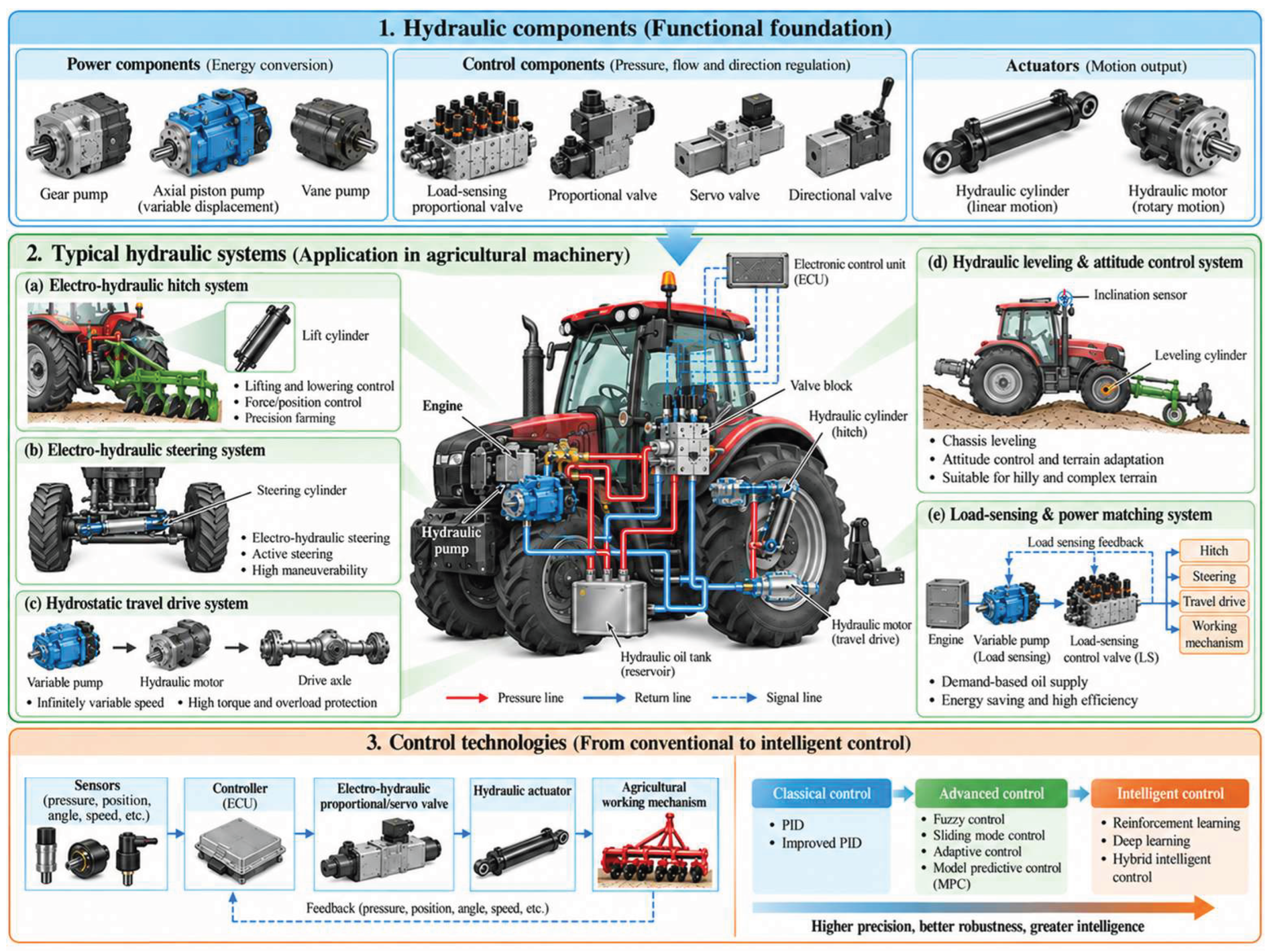
Figure 2.
Physical configuration and installation layout of the 55-kW agricultural tractor [49].
Figure 2.
Physical configuration and installation layout of the 55-kW agricultural tractor [49].
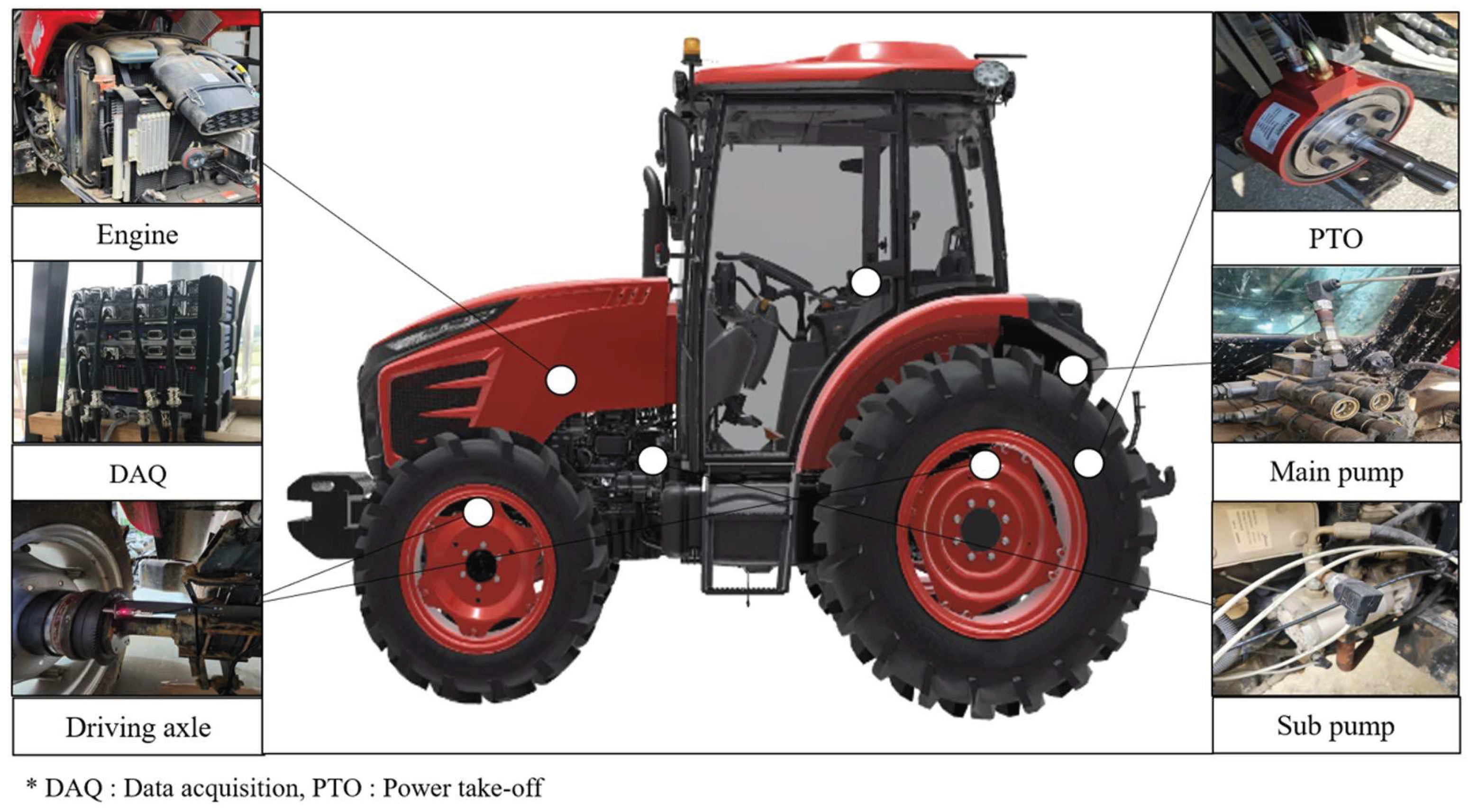
Figure 3.
Element of three-point hitch [57].
Figure 3.
Element of three-point hitch [57].
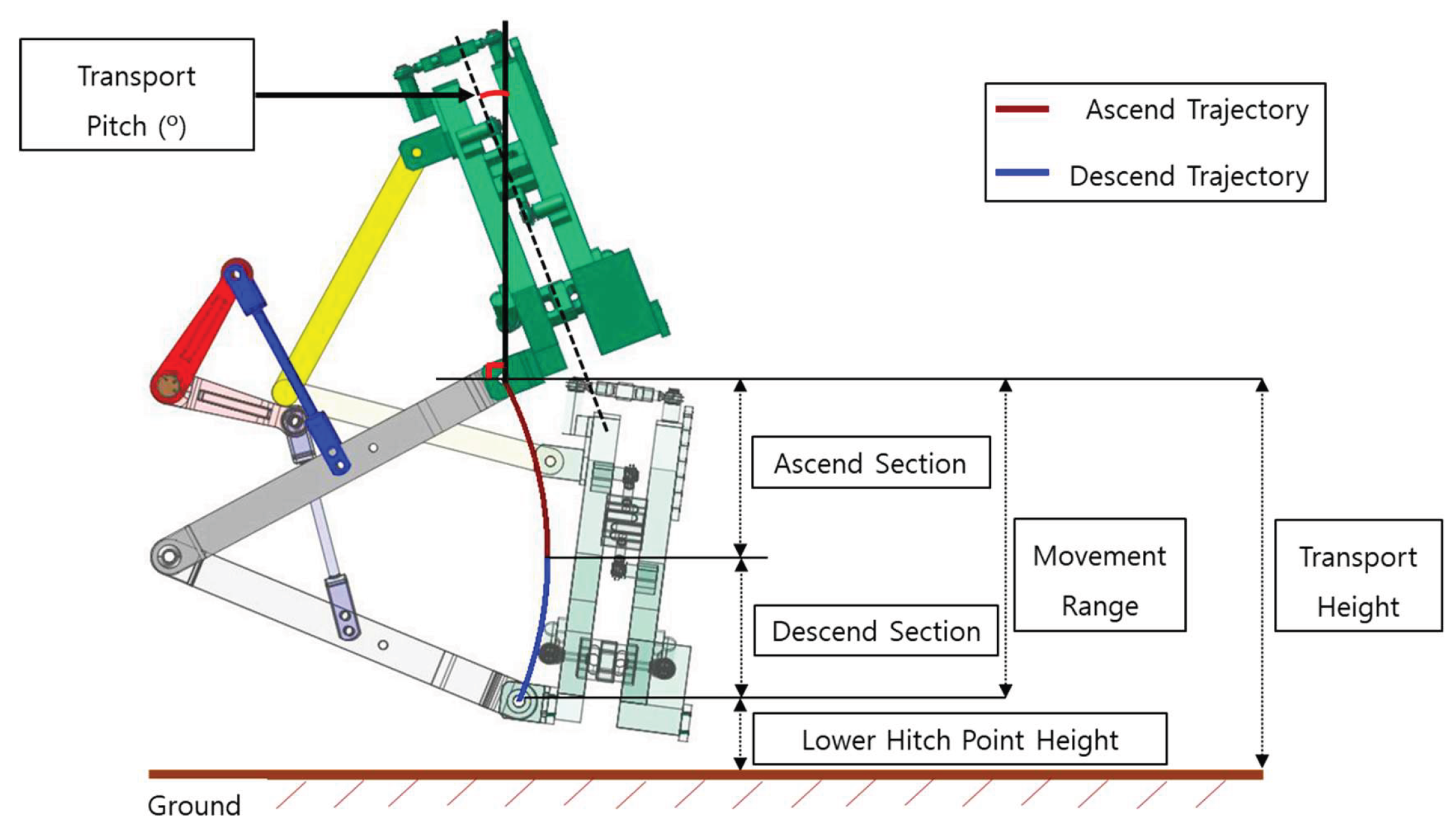
Figure 4.
Measurement system for EHPV [62].
Figure 4.
Measurement system for EHPV [62].
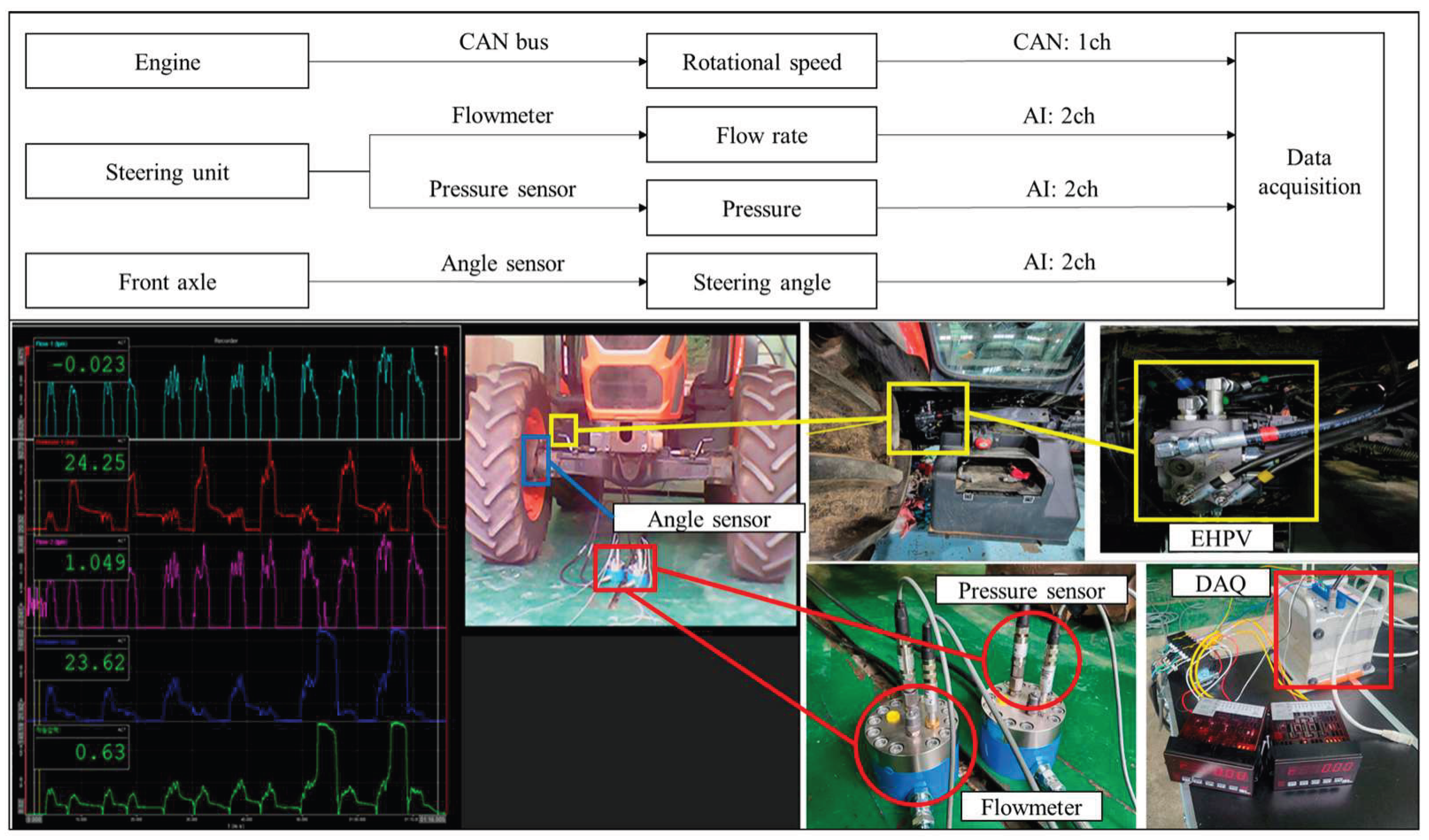
Figure 5.
Schematic diagram of electro-hydraulic hitch [68].
Figure 5.
Schematic diagram of electro-hydraulic hitch [68].
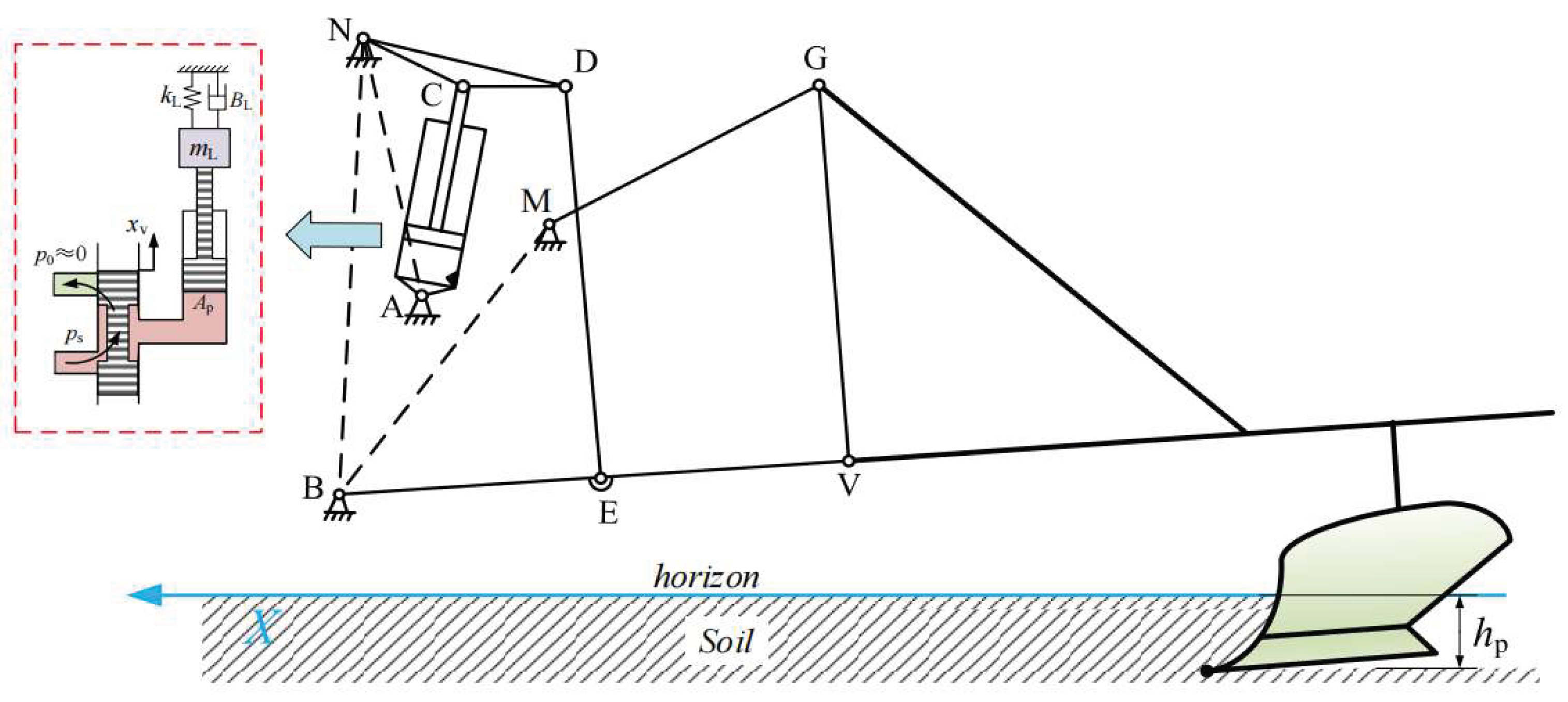
Figure 6.
Physical construction of electro-hydraulic steering system [79].
Figure 6.
Physical construction of electro-hydraulic steering system [79].
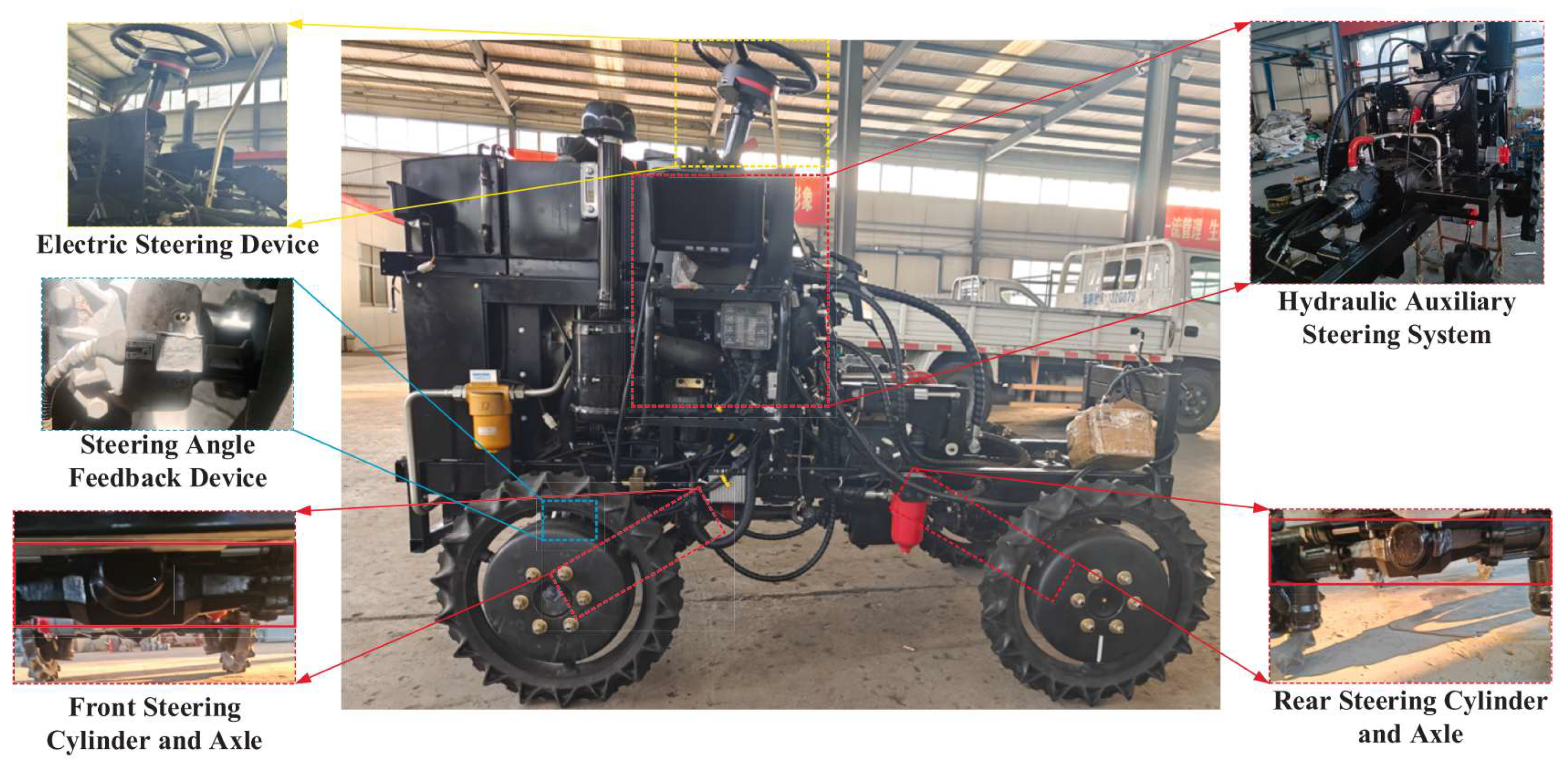
Figure 7.
Chassis drive train diagram [90].
Figure 7.
Chassis drive train diagram [90].
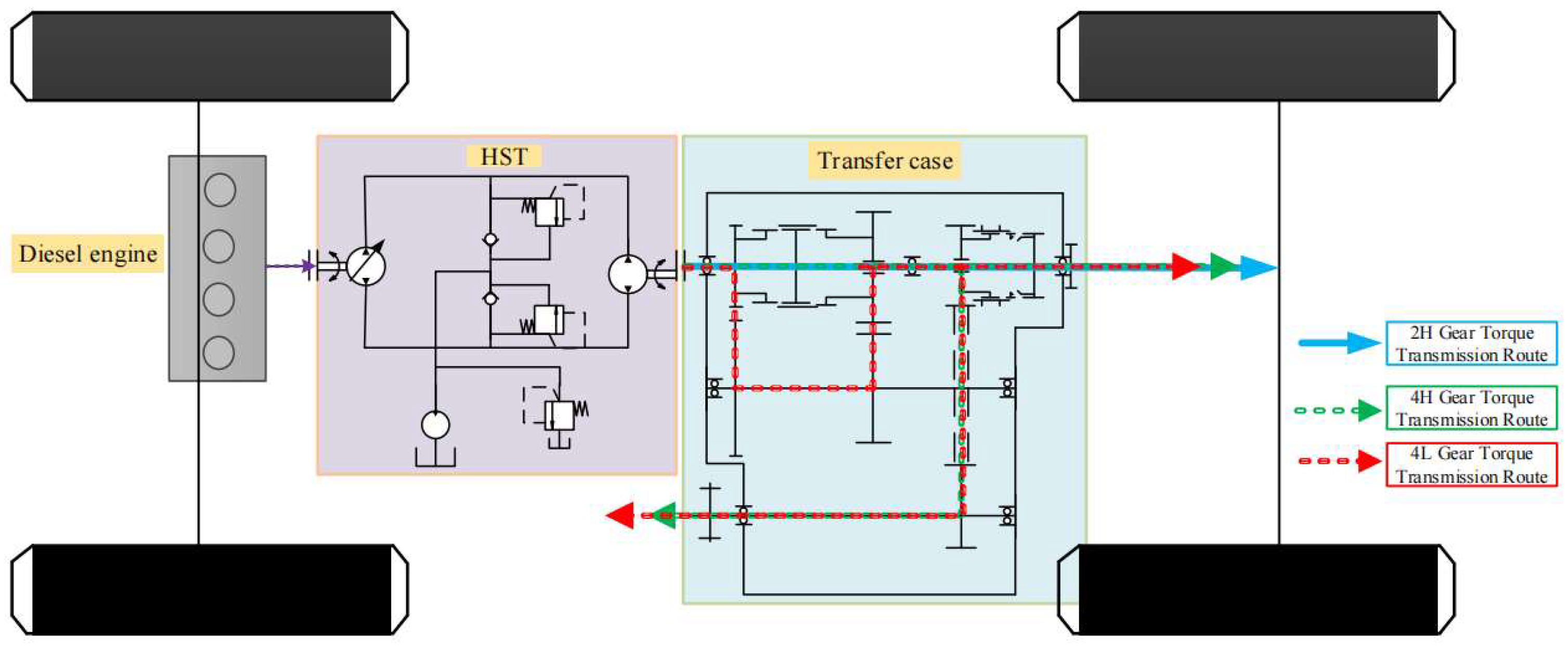
Figure 8.
4LZ-4.0 tracked combine harvester attitude-adjustment system [96].
Figure 8.
4LZ-4.0 tracked combine harvester attitude-adjustment system [96].
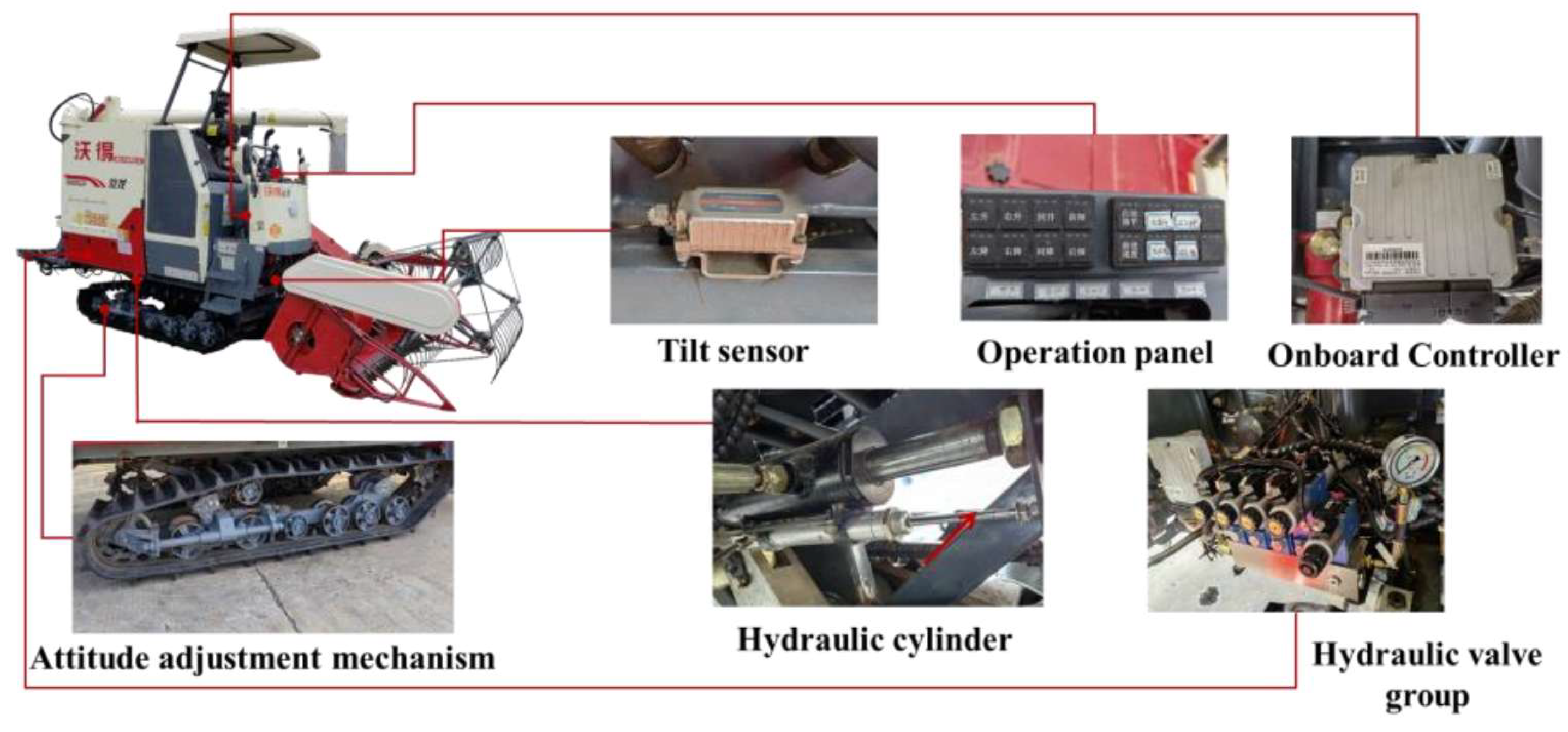
Figure 9.
Schematic diagram of electro-hydraulic hitch [114].
Figure 9.
Schematic diagram of electro-hydraulic hitch [114].
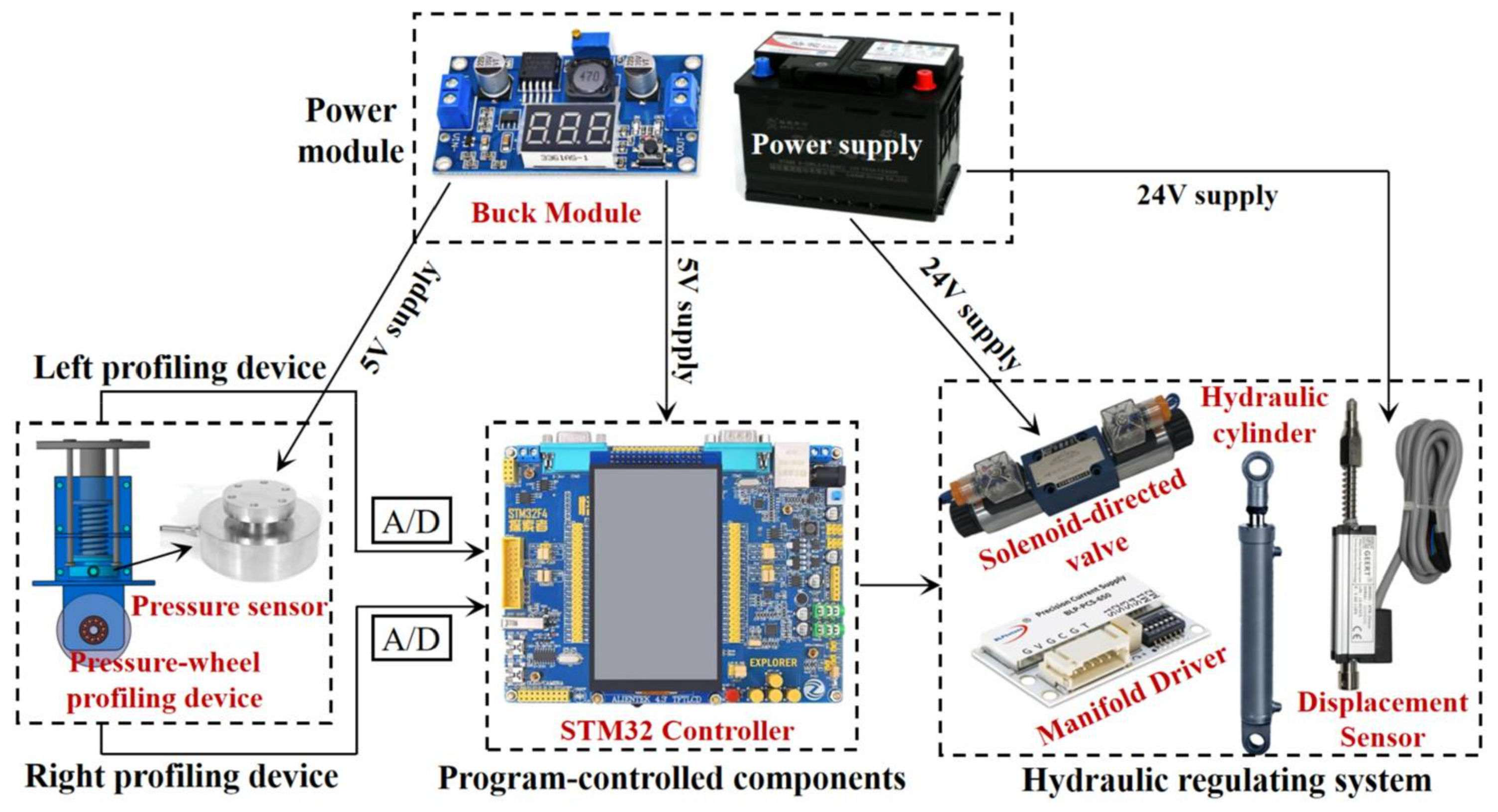
Figure 10.
Control scheme of proposed LMLRC for path following [126].
Figure 10.
Control scheme of proposed LMLRC for path following [126].
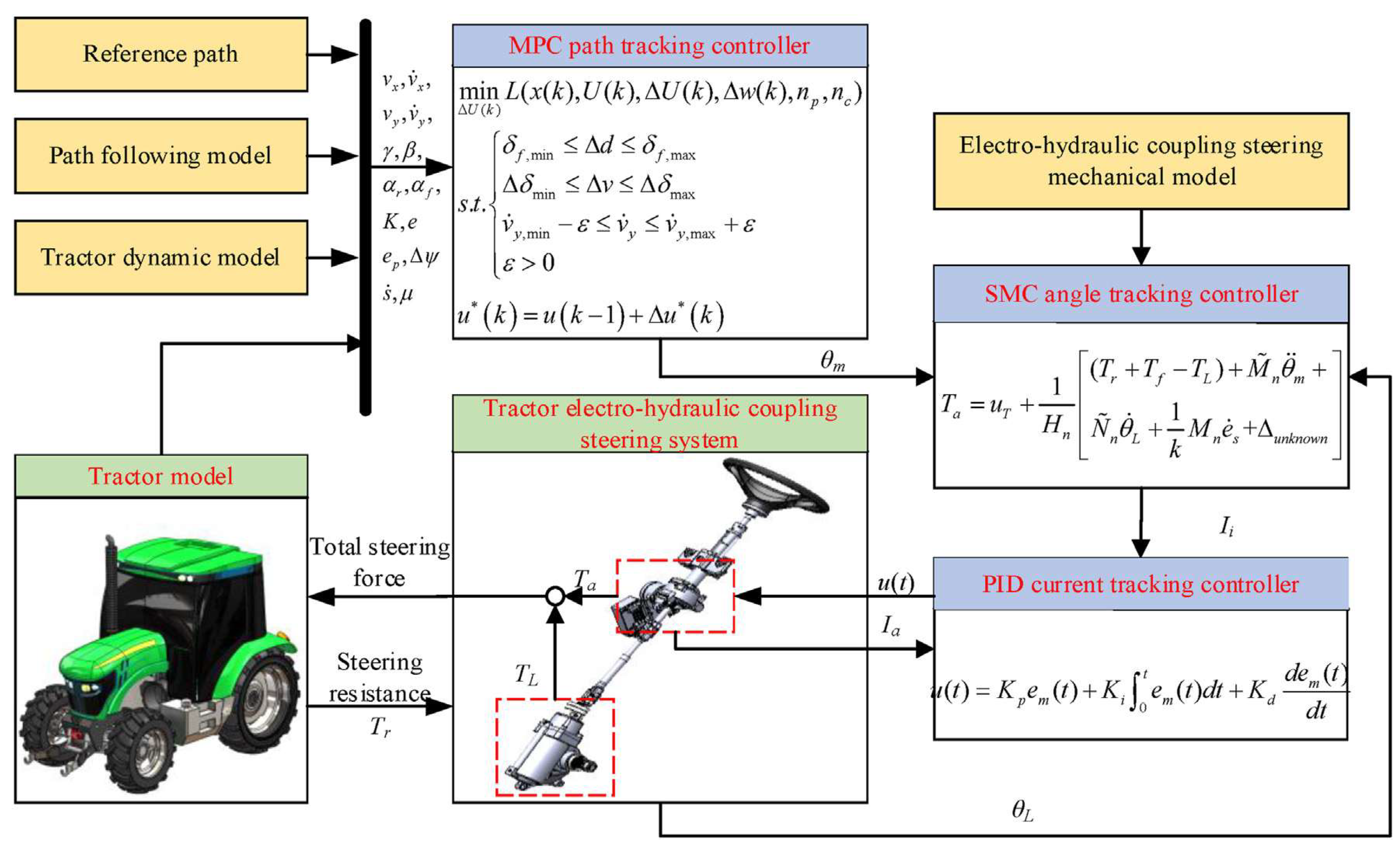
Figure 11.
The cooperative compound control strategy [130].
Figure 11.
The cooperative compound control strategy [130].
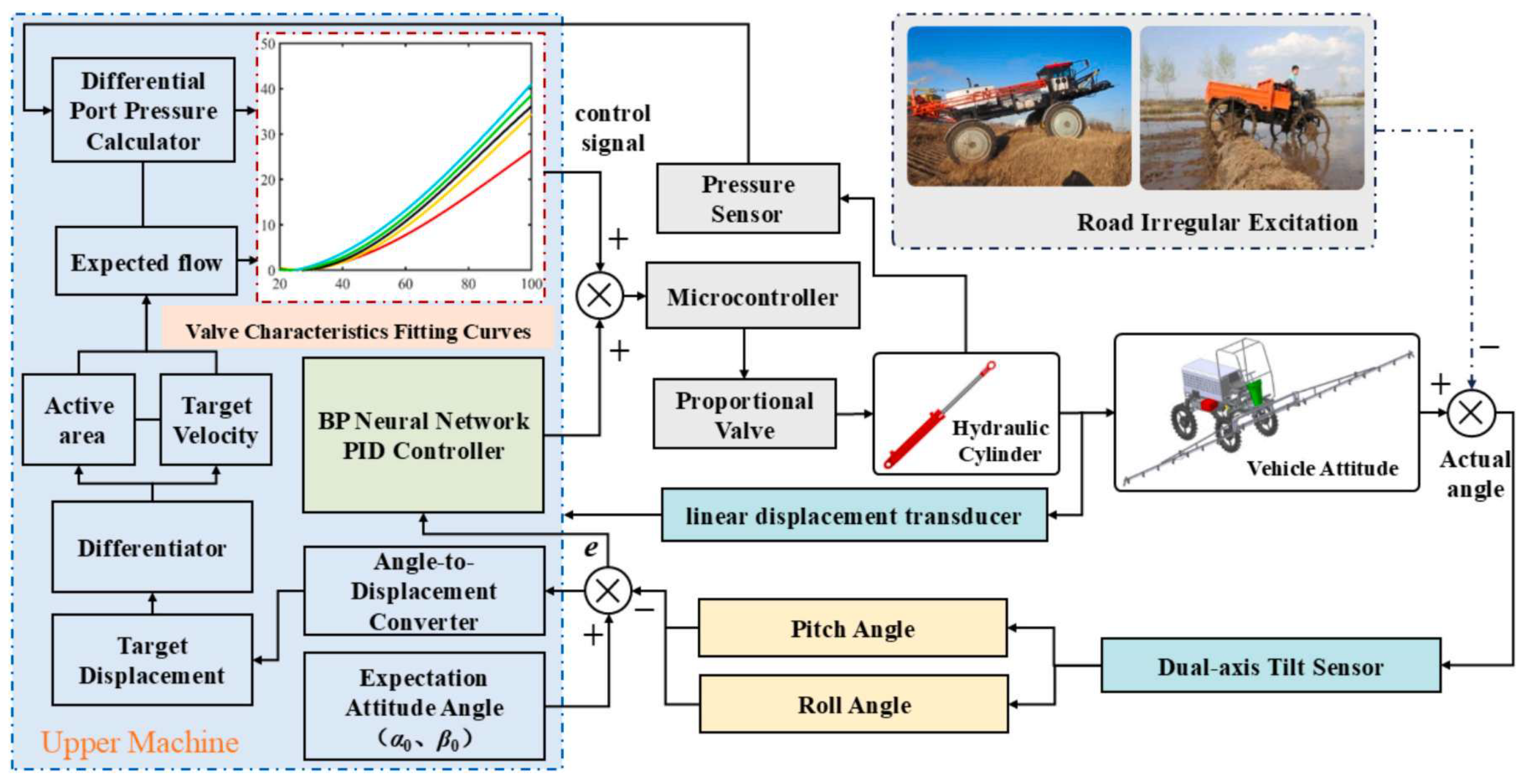
Disclaimer/Publisher’s Note: The statements, opinions and data contained in all publications are solely those of the individual author(s) and contributor(s) and not of MDPI and/or the editor(s). MDPI and/or the editor(s) disclaim responsibility for any injury to people or property resulting from any ideas, methods, instructions or products referred to in the content. |
© 2026 by the authors. Licensee MDPI, Basel, Switzerland. This article is an open access article distributed under the terms and conditions of the Creative Commons Attribution (CC BY) license (http://creativecommons.org/licenses/by/4.0/).
Copyright: This open access article is published under a Creative Commons CC BY 4.0 license, which permit the free download, distribution, and reuse, provided that the author and preprint are cited in any reuse.