

Submitted:
01 October 2026
Posted:
04 October 2026
You are already at the latest version
Abstract
Metal-halide perovskite solar cells combine high photovoltaic efficiency with low-temperature solution processing, but their performance and durability remain sensitive to precursor coordination, nucleation, drying, grain-boundary formation, and interfacial degradation. This critical narrative review evaluates plant-derived secondary metabolites as process-active additives rather than assuming that biological origin alone confers sustainability or passivation. Evidence is organized for alkaloids and xanthines, polyphenols and phenolic acids, and terpenoids and carotenoids, with explicit separation of experimentally demonstrated mechanisms, computational support, molecular analogy, and design hypotheses. Carbonyl-mediated coordination provides the clearest mechanistic basis for caffeine and related xanthines, whereas selected phenolic compounds have been associated, in separate studies, with coordination, crystallization control, and suppression of Sn²⁺ oxidation. Direct photovoltaic evidence now includes selected monoterpenoids, the sesquiterpene lactone artemisinin, and carotenoids, although the results remain molecule- and process-specific and do not justify class-wide generalization. The review maps molecular descriptors onto precursor chemistry, coating and crystallization variables, film structure, recombination, ion migration, device performance, and stability. Translation beyond laboratory spin coating will require specification-controlled additives, standardized stability protocols, process-compatible formulations, and iterative computational–experimental screening. This evidence-based framework identifies secondary-metabolite scaffolds as a promising but molecule-specific platform for perovskite process engineering, whose sustainability benefit remains to be established through life-cycle assessment.
Keywords:
perovskite solar cells
; secondary metabolites
; molecular additives
; crystallization
; defect passivation
; process–structure relationships
; stability
; scalable processing
; computational design
1. Introduction
Since their first report as visible-light sensitizers in 2009 [1], metal-halide perovskite photovoltaics have reached certified research-cell efficiencies of 28.0% for single-junction devices, 30.1% for all-perovskite tandems, and 35.2% for monolithic perovskite/silicon tandems [2], while progress in p–i–n architectures, tandems, and operational durability has accelerated industrial interest [3,4,5]. The remaining translation gap is increasingly governed by reproducible film formation, interface control, manufacturing yield, stability under combined stressors, and environmental management rather than by absorber efficiency alone [4,6,7].
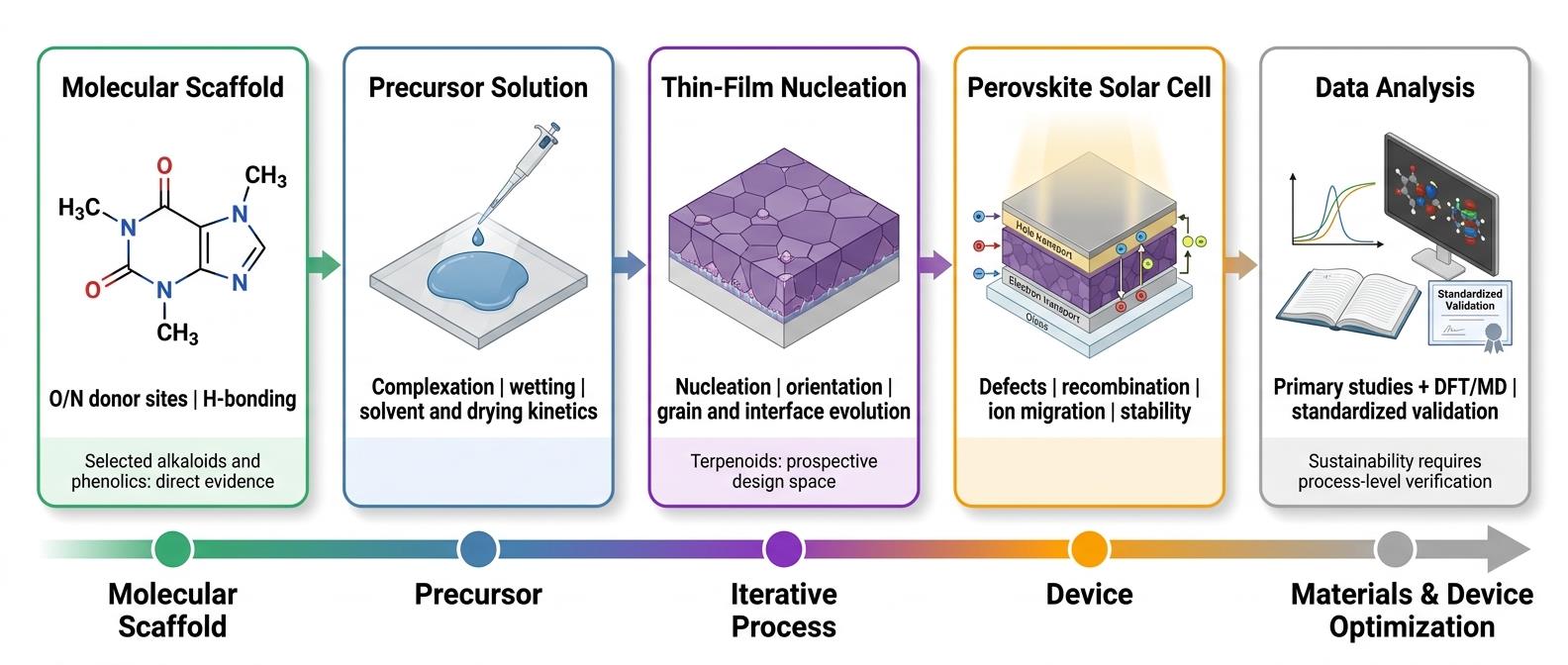
Because solution-processed perovskites form through coupled precursor complexation, solvent coordination, nucleation, intermediate-phase conversion, drying, and thermal treatment, molecular additives can influence both the wet-film process and the final solid-state defect landscape [8,9,10]. A useful review must therefore connect molecular chemistry to process variables rather than classify additives only by biological origin.
1.1. Process Engineering and Commercialization Gap
Perovskite stability is a device-level property that depends on absorber composition, interfaces, transport layers, electrodes, encapsulation, electrical bias, illumination, temperature, humidity, and oxygen exposure [4,5,7,11,12,13]. Surface and grain-boundary defects can promote non-radiative recombination, ion redistribution, and reactions with environmental species; nevertheless, a spectroscopic shift or improved morphology alone does not establish a unique passivation mechanism [11,12].
Scalable coating further introduces rheology, wet-film lifetime, solvent evaporation, coating speed, substrate temperature, and ambient control as coupled variables [6,14]. Additives that perform well in antisolvent-assisted spin coating may fail in blade or slot-die processes if they alter viscosity, drying fronts, phase segregation, or residual-solvent removal.
This review focuses on alkaloids and xanthines, terpenoids, and polyphenols or phenolic acids used or proposed in perovskite photovoltaics. Primary metabolites, proteins, biopolymers, and synthetic analogues are included only when they provide a clearly labeled mechanistic comparator. Capsaicinoids are treated according to structure and reported function rather than assumed to represent all alkaloids.
1.2. Why Secondary Metabolites?
Secondary metabolites provide chemically diverse scaffolds containing carbonyl, phenolic, carboxyl, heterocyclic nitrogen, and hydrophobic motifs. These groups may alter precursor association, coordinate undercoordinated metal sites, form molecule-specific hydrogen-bond networks, regulate crystallization, or affect oxidation and moisture transport [15,16,17,18,19,20,21]. Their value must be evaluated molecule by molecule because natural origin does not guarantee low toxicity, biodegradability, scalable purification, or lower life-cycle impact [7,14,15,16,17].
This article is a structured critical narrative review, not a statistical meta-analysis. Literature was identified through two complementary sources, Scite-indexed scholarly records and CAS SciFinder-n (CAplus/MEDLINE), both searched up to 28 September 2026. SciFinder-n reference searches combined “perovskite solar cell” with family-specific terms for (i) alkaloids and xanthines (alkaloid, caffeine, theophylline, theobromine, capsaicin, berberine, quinine, nicotine; 36 records), (ii) terpenoids and carotenoids (terpene, terpenoid, terpineol, camphor, camphorquinone, lycopene, carotenoid, menthol, limonene, betulin, artemisinin; 141 records), and (iii) polyphenols and phenolic acids (polyphenol, flavonoid, tannic, gallic and caffeic acids, curcumin, catechin, quercetin, myricetin, ferulic acid, resveratrol; 66 records); Scite searches used equivalent terms together with “additive”, “crystallization”, “passivation”, and “stability”. Records were screened by title and abstract. Studies in which the natural compound acted only as a paste or dispersion solvent (e.g., α-terpineol in carbon or TiO₂ pastes), as a reducing agent in nanoparticle synthesis, or in non-perovskite devices were excluded. Recent reviews were used for citation chaining, but mechanistic and quantitative statements were checked against primary studies whenever available. Quantitative entries in Table 4 were extracted from the main text and tables of the primary studies; values available only in Supporting Information are identified as such.
Evidence is classified as: (i) experimentally demonstrated in a perovskite film or device; (ii) supported by perovskite-specific computation; (iii) inferred from a molecular analogue; or (iv) proposed as a testable design hypothesis. Studies were retained when the molecular identity, incorporation route, perovskite composition, and relevant film or device outcome could be resolved. Reports based only on crude extracts or unrelated biological activity were not used to establish perovskite mechanisms.
1.3. Novelty Relative to Previous Reviews
Recent reviews have surveyed biologically derived components, phytochemical additives, natural plant extracts, natural and nature-inspired biomaterial additives, and bio-inspired multiscale strategies for perovskite optoelectronics [15,16,17,22,23]. Han et al. [23], in particular, provide a broad account of natural and nature-inspired biomaterial additives across metal-halide perovskite optoelectronics.
In contrast, the present review deliberately narrows the chemical scope to structurally defined secondary metabolites and selected bio-inspired derivatives relevant to perovskite solar-cell processing. Its novelty is methodological rather than merely taxonomic: it (i) separates experimentally demonstrated, perovskite-specific computational, analogue-inferred, and prospective evidence; (ii) maps donor availability, hydrogen-bonding capacity, redox activity, hydrophobicity, volatility, solubility, and molecular geometry onto the incorporation route; (iii) connects those descriptors to precursor coordination, nucleation, drying, film and interface structure, optoelectronic response, device stability, and performance; and (iv) evaluates translation to scalable coating and sustainability constraints. Primary metabolites, crude extracts, and biopolymers are used only as explicitly labeled mechanistic comparators rather than merged into the secondary-metabolite evidence base.
2. Classification of Secondary Metabolites
2.1. Alkaloids, Xanthines, and Capsaicinoids
Alkaloids are nitrogen-containing secondary metabolites with diverse electronic structures. For perovskite processing, the relevant descriptors are not simply the number of nitrogen atoms but their lone-pair availability, protonation state, steric accessibility, adjacent carbonyl groups, hydrogen-bond functionality, and solubility [24,25]. Xanthines such as caffeine and theophylline require separate treatment because carbonyl oxygen atoms are generally more defensible Pb²⁺-binding sites than blanket assignment of every ring nitrogen as a donor [18,19].
Primary studies report molecule-specific outcomes. Caffeine was reported to coordinate Pb²⁺ through its carbonyl groups, increase the crystallization activation barrier, promote preferred orientation, and improve thermal stability; a subsequent UMC–DFT study examined adsorption configurations on MAPbI₃ surfaces [18,26]. Theophylline–BF₄⁻ derivatives combine carbonyl-containing xanthine scaffolds with ionic functionality, while an independent first-principles study evaluated theophylline passivation at MAPbI₃ surface defects [19,27]. Capsaicin is a capsaicinoid with amide, phenolic, and aromatic functionality: it has been introduced through the antisolvent in MAPbI₃ p–i–n devices [20] and blended into SnO₂ quantum-dot electron-transport layers of n–i–p devices, where XPS indicated carbonyl coordination to Sn and Pb whereas the amine interaction was weak [28]; it should therefore not be treated as a generic nitrogen donor. Capsaicin added at 0.1 wt% to the MAPbI₃ precursor was further shown to convert the near-surface region from p- to n-type, forming a homojunction about 100 nm below the surface and reaching 21.88% efficiency in p–i–n devices [29]. Quinoline, the parent aromatic N-heterocycle of the quinoline alkaloids, is included only as a non-metabolite comparator; it has been added directly to precursor solutions [30]. Beyond xanthines and capsaicinoids, the tricyclic alkaloid colchicine catalyzed the direct formation of α-FAPbI₃ in an antisolvent-free one-step process [31], and aminophylline, a theophylline–ethylenediamine salt, has been used as a precursor additive in triple-cation devices [32]. Nucleobases such as adenine and cytosine, occasionally described as alkaloid-based passivators [33], are primary metabolites and are treated here only as comparators. Representative molecular structures of the alkaloid-derived additives, xanthines, and capsaicinoids discussed in this review are shown in Figure 1.
2.2. Terpenoids and Carotenoids: Demonstrated and Prospective Cases
Terpenoids derive from isoprene units and span nonpolar hydrocarbons, oxygenated mono- and diterpenoids, multifunctional triterpenoids, and carotenoid tetraterpenes [34,35,36]. Hydrophobicity, vapor pressure, melting point, surface activity, conjugation, redox behavior, and accessibility of alcohol or carbonyl groups can affect solvent coordination, volatilization, crystallization, interfacial protection, and moisture or oxygen transport.
Direct photovoltaic evidence is available for selected structures. The monoterpene alcohol α-terpineol was used as a precursor-solvent additive and associated with delayed crystallization and improved film quality [37]. Camphor and camphorquinone, described as naturally sourced volatile solid additives, were added to the PbI₂ precursor of a two-step process, with stepwise volatilization linked to crystallization control [38]. Lycopene has been investigated as a carotenoid/tetraterpene-derived additive or protective membrane for oxygen-, ultraviolet-, and environmental-stability control [39,40]. The oxygenated sesquiterpene lactone artemisinin coordinates undercoordinated Pb²⁺ and has been used both as a bulk passivator in flexible devices and as an electron-transport-layer/perovskite interlayer in two-step films [41,42]. Among carotenoids, β-carotene has been applied as a bulk additive [43] and, in a 1.74 eV MAPb(Br0.2I0.8)3 p–i–n cell, both through the antisolvent and as a buried interlayer between the hole-selective monolayer and the perovskite [44], and the xanthophyll astaxanthin as a buried-interface modifier [45]. The lupane triterpenoid betulin, added at 0.001 wt% to a MAPbI₃ precursor, was associated with Pb²⁺ coordination and hydrogen bonding supported by NMR, XPS, and DFT, increasing p–i–n efficiency from 19.14% to 21.15% [46]. By contrast, phytol, limonene, and ursolic or oleanolic acid remain prospective scaffolds; their coordination, segregation, self-assembly, or nucleation effects require perovskite-specific validation.
2.3. Polyphenols and Phenolic Acids
Polyphenols and phenolic acids combine molecule-dependent metal coordination, hydrogen bonding, redox activity, strain regulation, and interfacial packing. Tannic acid has been used as a post-treatment that modifies surface chemistry and has been associated with reduced ion diffusion [21]. Gallic acid acts as a coadditive with SnCl₂ in tin perovskites and has also been developed as a dispersible multidentate chelator [47,48], whereas caffeic acid was reported to regulate mixed Pb–Sn crystallization and limit Sn²⁺ oxidation [49]. Catechin, tea polyphenols, and myricetin (the latter combined with a BF₄⁻ pseudohalide) have similarly been used to suppress Sn²⁺ oxidation in Sn-containing absorbers [50,51,52], resveratrol combines Pb²⁺ coordination with superoxide scavenging [53], and the phenylpropanoid plant sunscreen sinapoyl malate has been applied to the electron-transport material to improve ultraviolet stability [54]. Curcumin has been applied at the buried SnO₂/perovskite interface [55], polyphenol encapsulation has been used for combined moisture stability and Pb containment [56], and redox-active flavonoid interlayers have been reported for strain-relieved Sn–Pb devices [57]. These outcomes remain molecule- and architecture-specific. Outside these three families, a crude aqueous garlic extract attributed mainly to the organosulfur metabolite allicin raised n–i–p efficiency from 22.89% to 24.50%; because the active species in the annealed film was not identified, it is retained only as a comparator [58].
Flavonoids and other phenolic scaffolds remain promising candidates, but antioxidant activity measured in solution is not equivalent to stabilization in a solid perovskite film. Mechanistic validation should include oxidation-state measurements, chemical-location analysis, concentration controls, and device aging under defined atmosphere and illumination.
3. Evidence Framework and Process-Oriented Classification
Bio-derived additives can influence precursor coordination, intermediate-phase stability, wetting, nucleation, grain growth, interface chemistry, ion redistribution, and degradation. These functions depend on molecular identity, purity, concentration, solvent system, incorporation route, and perovskite composition [8,9,10,15,16,17]. Renewable origin is therefore treated as a sourcing attribute rather than evidence of low toxicity, biodegradability, or device compatibility.
3.1. Process-Oriented Classification and Evidence Level
3.2. Molecular Interactions Governing Bio-Derived Additive Engineering
Bio-derived additives can affect perovskite processing through several non-exclusive mechanisms. Electron-rich donor atoms may coordinate undercoordinated Pb²⁺ or Sn²⁺ sites or alter precursor complexes; hydrogen-bond donors and acceptors may interact with halides, A-site cations, or solvent molecules; hydrophobic scaffolds may modify wetting and water transport; and redox-active groups may influence photo-oxidative pathways. Each assignment depends on molecular structure, concentration, protonation, solvent, surface termination, and incorporation route [9,59,60,61].
Coordination and hydrogen bonding can alter nucleation, intermediate-phase stability, grain growth, surface energetics, and defect-associated electronic states. Aromaticity alone does not demonstrate beneficial electronic coupling, and π–π stacking requires an aromatic organic partner rather than the inorganic [MX₆] framework. Likewise, chelation in solution does not prove defect passivation or lead sequestration in a solid device. Table 2 therefore summarizes potential process effects using conditional language and evidence requirements [59,61,62,63].
4. Molecular Interaction Mechanisms of Secondary Metabolite Additives with Halide Perovskites
4.1. Chemical Interactions between Perovskites and Alkaloid-Type Scaffolds
Alkaloids and related molecular scaffolds form a chemically diverse group of nitrogen-containing compounds. Those discussed here include purine alkaloids such as caffeine and theophylline with N-heterocycles and the capsaicinoid capsaicin (Figure 1). Their structures may incorporate heteroaromatic or partially saturated rings, π-conjugated systems, and polar functional groups such as –OH, –NH, C=O, and –OCH₃; sulfur-containing moieties are also considered in some computational candidates (Section 6.1.2) [64]. These features provide potential hydrogen-bond donors and acceptors, electronically available Lewis-base sites, and polarizable aromatic surfaces that could interact with perovskite precursors, surfaces, grain boundaries, and adjacent transport layers. However, the dominant interaction pathway must be established for each molecule and processing environment, rather than inferred from its classification as an alkaloid or from the number of heteroatoms it contains. [24,59,60]
Halide-perovskite surfaces and grain boundaries may contain undercoordinated Pb²⁺ or Sn²⁺ centers, halide vacancies, antisite defects, interstitial species, and other defect-associated configurations. These sites can contribute to carrier trapping, non-radiative recombination, ion migration, and environmentally induced degradation. [59,60,61,65] The targeted defect is not always the same: first-principles calculations on a PbI₂-terminated (100) surface of a formamidinium-based perovskite identified the Pb-on-I antisite as a readily formed defect and found the interaction of xanthines with iodide vacancies to be energetically unfavorable. [66] Alkaloids and related bio-inspired additives may interact with such regions through molecule-specific combinations of hydrogen bonding, Lewis acid–base coordination involving accessible O-, N-, or S-donor atoms, electrostatic interactions, dispersion forces, and interactions associated with π-conjugated frameworks. [59,60,61,65]
The relative contribution of these mechanisms depends on lone-pair availability, protonation state, hydrogen-bond donor or acceptor character, steric accessibility, molecular orientation, solvent environment, incorporation route, perovskite composition, and the specific interface under consideration. Accordingly, the following subsections distinguish hydrogen bonding (Section 4.1.1) from direct Lewis-base coordination (Section 4.1.2) and weaker noncovalent interactions (Section 4.1.3), and state for each the level of experimental or computational evidence available. Because xanthines are the best-resolved cases, they organize the discussion; capsaicin and quinoline are compared in Section 4.4, and terpenoids and polyphenols are treated in Section 4.5 and Section 4.6.
4.1.1. Molecule-Specific Hydrogen Bonding with Halides and Interfaces
Hydrogen-bond donors (–NH, –OH, or protonated N⁺–H) can interact with surface halides. The assignment is molecule-specific: caffeine carries no N–H or O–H donor, theophylline retains one N7–H donor, and protonation of the free imidazole nitrogen N9 in theophyllinium salts converts a lone-pair donor into an N⁺–H donor [19]. The clearest case comes from a study of theophylline, caffeine, and theobromine on a formamidinium-based perovskite. An N–H···I hydrogen bond was reported to assist the primary C=O binding to a Pb-on-I antisite in theophylline, with a calculated interaction energy of about −1.7 eV; methylating the N–H (caffeine) weakened it to about −1.3 eV, and the isomer theobromine, whose N–H lies next to the C=O, gave a weaker interaction (about −1.1 eV) and lower device efficiency than the untreated control [66]. These results were obtained by surface post-treatment and cannot be transferred directly to precursor-incorporated caffeine [18].
First-principles calculations on MAPbI₃ indicate that xanthine cations obtained by quaternizing the free imidazole nitrogen bind the surface more strongly than the neutral molecules, with Pb–O and I–H contacts dominating [67]. In [19], salts of the same theophylline cation with BF₄⁻ and Cl⁻ gave different film and device behavior; the calculations reported there address the anion–surface interaction, so the contribution of the cation’s carbonyl and N–H groups was inferred rather than computed. Hydrogen bonding has also been proposed to influence iodide migration at grain boundaries [61], and multifunctional passivants such as trichloromelamine [68] illustrate how coordination and N–H···I interactions may operate together; both are analogies, not demonstrations for the alkaloids discussed here.
4.1.2. Lewis-Base Coordination through O- and N-Donor sites
Alkaloids and related molecular scaffolds do not exhibit uniform affinity for undercoordinated metal sites in halide perovskites. Their coordination behavior depends on lone-pair availability, protonation state, steric accessibility, molecular orientation, competing donor atoms, and the surrounding solvent, surface, or lattice environment. Consequently, coordination should be assigned to a specific functional group and adsorption configuration rather than inferred from the presence of nitrogen alone.
At perovskite surfaces and grain boundaries, coordinatively unsaturated environments may expose Lewis-acidic Pb²⁺ or Sn²⁺ centers and generate electronic states that contribute to carrier trapping and non-radiative recombination. Molecular additives containing electronically available O- or N-donor atoms may coordinate these sites through Lewis acid–base interactions [18,24,25]. When the adsorption geometry is favorable, donation of electron density toward an undercoordinated metal center may decrease the density or electronic activity of defect-associated states. The general donor–acceptor concept is summarized schematically in Figure 2.
The availability of a nitrogen lone pair depends strongly on its molecular environment. Pyridinic nitrogen retains an in-plane lone pair that may participate in coordination, whereas the lone pair of pyrrolic nitrogen contributes to the aromatic π-system and is therefore substantially less available. Protonation can further suppress the Lewis basicity of a nitrogen donor. Accordingly, any proposed N→Pb²⁺ or N→Sn²⁺ interaction must be evaluated with respect to the molecular structure, protonation state, steric environment, surface termination, and adsorption geometry [25,59,62].
Oxygen-containing groups may provide more defensible coordination sites in molecules possessing carbonyl, hydroxyl, or related functionalities. In xanthines such as caffeine and theophylline, carbonyl oxygen atoms are generally the most plausible Pb²⁺-binding sites unless coordination through a ring nitrogen is demonstrated explicitly. These compounds should therefore not be classified generically as nitrogen-donor additives merely because they contain several nitrogen atoms [18,19,24,25].
4.1.3. Dispersion, Metal–π, and Organic π–π Interactions
Alkaloids and related molecular scaffolds containing extended conjugated systems may adsorb at perovskite surfaces and interfaces through dispersion forces, electrostatic contributions, and, under suitable geometrical and electronic conditions, metal–π interactions. These mechanisms depend on molecular orientation, surface termination, intermolecular distance, polarizability, and the surrounding chemical environment. Therefore, the presence of an aromatic ring alone does not establish a specific metal–π interaction.
Metal–π interactions may be considered when an electronically accessible Pb²⁺ or Sn²⁺ center is positioned near the π-electron density of an aromatic system. However, direct experimental evidence for well-defined metal–π contacts in specific alkaloid/perovskite systems remains limited. Such interactions should consequently be described as possible adsorption contributions unless supported by structural, spectroscopic, or computational evidence identifying the corresponding geometry. [60,62]
Conventional π–π stacking requires two aromatic or conjugated organic components arranged at an appropriate distance and relative orientation. The inorganic corner-sharing [MX₆] octahedral framework does not constitute a π-stacking partner. Organic π–π association may nevertheless occur between neighboring additive molecules or between an aromatic additive and an organic interfacial material. Collectively, dispersion, possible metal–π contacts, and organic π–π interactions may influence molecular adsorption, interfacial packing, and local energetics, but they should not be interpreted automatically as Lewis-base coordination or electronic defect passivation. These distinct interaction modes and their principal structural requirements are summarized schematically in Figure 3.
4.2. Defect Passivation and Lead-Containment Claims
4.2.1. Passivation of Metal-Related and Halide-Related Defects
Lewis-basic and multifunctional molecules may interact with coordinatively unsaturated Pb²⁺ or Sn²⁺ centers and with halide-related surface or grain-boundary environments. Metal coordination, hydrogen bonding, electrostatic interactions, and local structural reorganization may contribute to these effects. However, the presence of an interaction with the perovskite surface does not, by itself, demonstrate electronic defect passivation. Each mechanism should be assigned to a specific functional group, defect configuration, and adsorption geometry. [59,61,69]
Defects should preferably be described according to their chemical and structural identity, for example, undercoordinated metal sites, halide vacancies, interstitial species, or antisite defects, rather than classified only as generic “cationic” or “anionic” defects. Formal charge states should be specified only when supported by an explicit defect model or appropriate experimental evidence. [11]
Electronic passivation is more convincingly established when molecular interaction evidence is accompanied by complementary optoelectronic measurements. Relevant observations may include enhanced steady-state photoluminescence, longer time-resolved photoluminescence lifetimes, lower trap densities obtained from appropriate electrical measurements, reduced non-radiative recombination losses, increased quasi-Fermi-level splitting, or improved open-circuit voltage.[11,12] Because each individual measurement can also be affected by changes in morphology, crystallinity, energetic alignment, or carrier extraction, a combination of structural, spectroscopic, computational, and device-level evidence is preferable.
4.2.2. Evidence Required for Lead Containment
The presence of Pb²⁺ in high-performance perovskites creates a potential environmental risk when damaged devices release soluble lead species. Because complete Pb substitution often compromises photovoltaic performance, internal sequestration and external containment are being investigated as complementary risk-mitigation strategies [13,63,70].
Multidentate molecules may complex released Pb²⁺ and reduce its mobility, but solution-phase chelation capacity does not by itself demonstrate effective lead sequestration in a damaged photovoltaic device. For alkaloid-derived additives, claims of lead immobilization require direct leaching tests under defined damage, water exposure, and aging conditions. Established device-level containment systems provide the appropriate experimental benchmark [63,70].
Lead immobilization is therefore a promising but insufficiently demonstrated function of alkaloid additives. The supramolecular complex of hydroxypropyl-β-cyclodextrin and 1,2,3,4-butanetetracarboxylic acid (HPβCD/BTCA), a non-metabolite comparator, provides direct device-level evidence for reduced lead leakage [63], whereas comparable leaching data have not been reported for alkaloid additives. Within the secondary-metabolite literature, device-level lead-containment evidence is currently limited to polyphenol-based systems [48,56]. Combining internal coordination with an external containment layer remains a testable design hypothesis [63].
4.3. Protection against Moisture and Photo-Oxidation
Coordination of an additive to an undercoordinated surface metal site can reduce both defect-associated electronic states and local reactivity toward polar molecules. Hydrogen-bond networks may additionally influence water uptake and ionic motion. These effects are supported for several classes of passivants, but the balance between coordination, hydrogen bonding, and hydrophobicity must be demonstrated for each alkaloid. [61,62]
Light and molecular oxygen provide a separate degradation pathway. Bryant et al. [71] demonstrated that photo-generated electrons can reduce O₂ to superoxide, initiating degradation of MAPbI₃ through reactions involving the organic cation. Alkaloid-mediated suppression of this pathway remains plausible where defect passivation or antioxidant activity is demonstrated, but cannot be inferred from metal coordination alone.
4.4. Structure–Interaction Relationships for Alkaloid-Type Scaffolds
Alkaloids constitute a heterogeneous class of nitrogen-containing secondary metabolites. For interaction with halide perovskites, the decisive feature is the electronic availability and accessibility of a lone pair rather than nitrogen hybridization alone. Pyridinic nitrogen is sp² hybridized and retains an in-plane lone pair; pyrrolic nitrogen is likewise sp², but its lone pair participates in aromaticity. Protonation, substitution, steric environment, solvent, and competing O-donor groups must also be considered [24,25]. Table 3 groups representative alkaloid-type scaffolds by their available functional groups, supporting techniques, and the level of evidence reported for each interaction; these assignments must remain molecule- and study-specific rather than generalized across a scaffold class. Quinolines and isoquinolines may combine available N donors with O-containing substituents. In xanthines such as caffeine and theophylline, carbonyl oxygen atoms are the best-supported Pb²⁺-binding sites; N-donor coordination has not been demonstrated for either molecule, and neither N-donor coordination nor hydrogen bonding should be generalized across differently substituted derivatives [18,19,24,25,66]. Protonation of the free imidazole nitrogen, as in theophylline–BF₄⁻ salts, removes that lone pair and creates a hydrogen-bond donor instead; the reported Pb 4f shift for this derivative reflects anion adsorption modeled computationally, so the specific contribution of carbonyl coordination remains inferred rather than calculated [19]. Capsaicin likewise exhibits route-dependent behavior at the absorber and SnO₂/perovskite interfaces [20,28]. For quinoline, included as a non-metabolite comparator, pyridinic N-donation to Pb²⁺ is structurally plausible; however, the reported gains in efficiency and humidity stability [30] have not been assigned to a spectroscopically resolved binding geometry.
Dispersion, electrostatic, and possible metal–π contributions at perovskite interfaces, and the conditions under which organic π–π stacking may occur, are discussed in Section 4.1.3 and are not established for the scaffolds compared here. Their energetic and electronic contribution has not yet been assessed systematically for indoles, isoquinolines, β-carbolines, and xanthines on relevant perovskite facets, which remains a computational and spectroscopic research need rather than a class-wide demonstrated mechanism [60,62].
4.5. Interaction Mechanisms of Terpenoids and Carotenoids
The available evidence identifies at least four distinct process mechanisms rather than a universal terpenoid effect. In α-terpineol-containing precursor inks, the alcohol functionality and high boiling point were associated with solvent/cation interactions, delayed nucleation, and improved crystallinity [37]. Camphor and camphorquinone act as volatile solid additives; their removal during processing can regulate crystal formation without requiring permanent interfacial coverage [38]. Lycopene instead provides a conjugated hydrophobic carotenoid scaffold associated with oxygen/ultraviolet resistance and interfacial protection [39,40]. A fourth route is direct Lewis-base coordination by oxygenated terpenoids: artemisinin interacts with uncoordinated Pb²⁺ and suppresses the formation of metallic Pb clusters during light soaking [41]. Carotenoids combine hydrophobicity and radical scavenging with, in the case of astaxanthin, carbonyl coordination to Pb²⁺ and Sn⁴⁺ at the SnO₂/perovskite interface [43,44,45], and first-principles work attributes lycopene passivation to a cover-type interaction of its conjugated C=C backbone with the surface [72].
For long-chain alcohols such as phytol or geranylgeraniol, simultaneous surface coordination and hydrophobic grain-boundary anchoring is chemically plausible but has not been demonstrated systematically in perovskite films. Adsorption energies from unrelated O-donor molecules cannot be assigned to these compounds without explicit surface models and comparable computational settings.
These cases demonstrate why incorporation route must be explicit: α-terpineol modifies the wet precursor and annealing history, camphor-derived solids exploit controlled volatilization, and lycopene functions as an additive or protective interfacial layer [37,38,39,40]. Contact angle, surface tension, volatilization profile, in situ crystallization, residual-additive mapping, and electronic characterization are needed to separate solvent, morphological, passivation, and barrier effects.
Polycyclic triterpenoids such as betulin, ursolic acid, and oleanolic acid exhibit self-assembly in several non-perovskite solvent systems [36]. This behavior motivates investigation as an interfacial design concept, and betulin has also been used as a dilute precursor passivator in MAPbI₃ [46]; however, neither observation demonstrates quasi-two-dimensional passivation layers on a perovskite. Terms such as ‘coordinatively adsorbed’ should be reserved for systems with direct structural or computational evidence.
Scale-up assessment requires solubility limits, ink aging, filtration behavior, rheology, surface tension, coating uniformity, volatilization or residual-solvent analysis, and thermal stability. The volatile-additive concept is especially relevant to scalable drying, but evaporation rate, exhaust handling, process window, and residual composition must be established under blade or slot-die coating rather than inferred from spin coating [37,38].
The principal research opportunity is therefore a controlled validation workflow that compares demonstrated α-terpineol, camphor/camphorquinone, artemisinin, betulin, and carotenoid systems with underexplored structures using molecular screening, precursor-compatibility testing, in situ crystallization analysis, film-distribution mapping, optoelectronic characterization, and standardized device aging. Evidence should be assigned to individual compounds, not transferred to the terpenoid class as a whole.
4.6. Interaction Mechanisms of Polyphenols and Phenolic Acids
Polyphenols and phenolic acids offer combinations of phenolic OH, carbonyl, and carboxyl groups. Depending on molecular geometry and protonation, these groups may coordinate undercoordinated Pb²⁺ or Sn²⁺, form hydrogen bonds with halides or organic cations, alter precursor complexation, regulate strain, or participate in redox reactions [21,47,48,49,55,57].
Catechol or galloyl motifs can form multidentate interactions with metal ions, but the binding mode in a perovskite precursor or surface must be established directly. Recent dispersible gallic-acid chelators provide a perovskite-specific multidentate design example [48]. Reported shifts in XPS, FT-IR, Raman, or NMR can support coordination when interpreted with suitable controls; solution-phase metal chelation alone is insufficient.
Hydrogen-bond networks may influence halide motion, local strain, and interfacial chemistry. The magnitude of this effect depends on site density, molecular orientation, and competition with solvent and A-site cations. Computational claims should report the surface, defect state, functional, dispersion treatment, solvation model, and adsorption geometry [61].
In Sn-containing perovskites, antioxidant additives may suppress Sn²⁺ oxidation or related defect formation. Gallic and caffeic acid and redox-active flavonoid interlayers provide perovskite-specific examples, but oxidation-state or redox effects must be distinguished from morphology and strain regulation using XPS, complementary chemical analysis, structural probes, and appropriate molecular controls [47,48,49,57].
Polyphenols can also influence film formation through precursor coordination, solubility, and drying. Concentration-dependent aggregation is a potential limitation because strongly associating molecules may introduce insulating domains, parasitic absorption, or interfacial recombination. Optimal concentrations and solvent compatibility are therefore formulation-specific.
Radical-scavenging activity is a plausible complementary stabilization mechanism, particularly under illumination and oxygen exposure. Lycopene and redox-active flavonoid studies strengthen this design hypothesis, but antioxidant capacity measured by solution assays does not quantify protection inside a perovskite film [39,40,57]. Direct validation requires controlled-atmosphere aging, reactive-oxygen-species probes, oxidation-state measurements, and comparison with non-antioxidant structural analogues [71,73].
4.6.1. Evidence Requirements for Interfacial Electronic Effects
Conjugated polyphenol scaffolds may modify interfacial dipoles, strain, or packing when located at a perovskite/transport-layer interface. Curcumin at the buried SnO₂/perovskite interface and redox-active flavonoid interlayers provide direct device examples [55,57]. Claims of improved charge transfer or π–π stacking still require energy-level measurements, chemical-location evidence, and an identifiable aromatic organic partner; electronic coupling with the inorganic framework should not be described as π–π stacking.
4.6.2. Process Engineering Considerations
For translation beyond spin coating, polyphenol studies should report solubility, viscosity, surface tension, contact angle, drying window, additive retention, and batch purity. Purified standards, concentration series, and scalable coating trials are needed to distinguish genuine molecular effects from uncontrolled changes in ink formulation.
5. Process–Structure–Optoelectronic Property Relationships
5.1. Incorporation Route and Precursor Chemistry
The incorporation route determines which process stage an additive can influence. Precursor additives can change metal–solvent coordination, complex lifetime, supersaturation, and intermediate phases; antisolvent additives act during rapid solvent extraction and nucleation; post-treatments primarily modify the exposed surface and near-surface interface [9,18,20,21,30]. These routes should not be compared as mechanistically equivalent. Figure 4 maps the additives reviewed here onto the process stage at which they are introduced and the variables they can influence: most demonstrations enter through the precursor ink, whereas the coating, annealing, and encapsulation stages remain comparatively unexplored.
Concentration is equally important. Insufficient loading may not measurably change precursor or surface chemistry, whereas excessive loading can retard conversion, induce insulating residues, alter stoichiometry, or create unfavorable energy-level offsets. Solubility limits and chemical identity should be reported in molar units where possible, together with solvent composition, solution aging, filtration, and deposition conditions.
5.2. Crystallization and Film Structure
Caffeine, capsaicin, quinoline, caffeic acid, α-terpineol, and camphor-derived additives illustrate distinct pathways for crystallization control [18,20,30,37,38,49]. Caffeine and α-terpineol act from the precursor solution and retard aspects of nucleation or crystal growth; capsaicin is introduced through the antisolvent and becomes enriched near grain boundaries and the top interface; quinoline alters precursor-mediated growth and orientation; caffeic acid modulates nucleation in mixed Pb–Sn absorbers while limiting Sn²⁺ oxidation; and camphor/camphorquinone use controlled volatilization to modify the crystallization trajectory. Colchicine is particularly relevant to scalable deposition because it steers direct α-FAPbI₃ formation without an antisolvent quench, with devices retaining 83.6% of their initial efficiency after more than 1500 h at 85 °C [31].
Grain size, roughness, and diffraction intensity are useful descriptors but cannot independently establish electronic quality. A defensible process assignment requires time-resolved or in situ measurements of wet-film evolution, statistically defined morphology, crystallographic orientation, chemical mapping, and matched control films processed under identical conditions.
5.3. Defects, Recombination, and Interfacial Energetics
Evidence for passivation should converge across chemical and optoelectronic measurements. XPS or vibrational shifts can indicate a changed local environment but do not uniquely establish coordination geometry. Increased photoluminescence may reflect reduced non-radiative recombination, altered extraction, morphology, or dielectric screening. Strong assignments should combine spectroscopy with time-resolved photoluminescence, quasi-Fermi-level splitting or electroluminescence, trap-sensitive measurements, and device-level voltage losses [11,12,61,62].
Tannic acid provides a surface-treatment example in which multiple hydroxyl and carbonyl functions, interfacial-energy changes, and a cross-linked network were associated with reduced recombination and ion diffusion [21]. Curcumin-modified SnO₂/perovskite interfaces, capsaicin-modified SnO₂, and flavonoid interlayers broaden the evidence for interface-selective defect, charge-transfer, strain, and redox regulation [28,55,57]. Such multifunctionality is advantageous, but individual contributions should be separated through molecular controls, concentration series, and location-sensitive characterization.
5.4. Charge Transport, Ion Migration, and Impedance
Electrical interpretation requires restraint. EIS-derived resistances and capacitances depend on bias, illumination, frequency window, perturbation amplitude, temperature, and equivalent-circuit choice. SCLC-derived trap densities depend explicitly on thickness, dielectric constant, contact selectivity, and assumed trap-filled-limit voltage. Reviews should therefore compare control and treated samples only when measurement conditions and analysis assumptions are matched [62,65,68,69].
Ion-migration claims should be supported by complementary evidence such as bias-dependent transients, temperature-dependent measurements, operational hysteresis, compositional mapping, or validated modeling. A longer photoluminescence lifetime alone is not proof of suppressed ion migration.
5.5. Device Performance and Stability
Table 4 compares representative primary studies using control-to-treated performance and explicit aging conditions wherever they were available. The values are not a meta-analysis because device architecture, active area, perovskite composition, encapsulation, scan direction, and aging protocol differ. Stabilized output and champion scan efficiency are distinguished when the source reports both.
The expanded evidence matrix distinguishes precursor or bulk modifiers [37,38,39,48], interface-selective treatments [28,40,55,57], and external encapsulation [56]. These routes address different rate-limiting processes and should not be pooled into a single additive-performance distribution. Among the newer studies, camphorquinone provides operational MPPT evidence under ISOS-L-1 [38], whereas catechin-Q is evaluated under ISOS-D-1I dark storage [57]; the protocols answer different stability questions.
5.6. Process Compatibility and Scale-Up
Translation beyond spin coating requires formulation and coating data: additive purity, solubility, viscosity, surface tension, contact angle, coating speed, substrate temperature, drying window, residual composition, and batch-to-batch reproducibility [6,14]. Standardized stability assessment should follow the ISOS consensus framework and report encapsulation, atmosphere, humidity, temperature, spectrum, electrical condition, active area, sample count, and retention criterion [75].
The most credible scale-up workflow is iterative: molecular screening; precursor-compatibility testing; in situ film-formation analysis; film and interface characterization; statistically powered device validation; standardized aging; and life-cycle or techno-economic assessment. This sequence links molecular design to manufacturable process windows rather than extrapolating directly from adsorption energy to PCE.
6. Theoretical Modeling and Rational Design of Secondary Metabolite Additives
Computational methods can connect molecular structure with precursor association, surface adsorption, defect states, charge redistribution, ion migration, and environmental interactions. Their principal value is comparative candidate ranking and mechanistic testing, not direct prediction of device efficiency. The integrated computational–experimental workflow is summarized in Figure 5.
For additive engineering, useful molecular descriptors include donor-atom accessibility, adsorption energy, charge transfer, dipole moment, hydrogen-bond capacity, polarizability, logP, and solubility. Descriptor values are meaningful only when calculated with consistent models and validated experimentally.
6.1. Electronic-Level Modeling of Additive–Perovskite Interactions
6.1.1. Defect Physics as the Basis for Additive Design
First-principles studies explain why many intrinsic bulk defects in lead-halide perovskites are relatively shallow, whereas surfaces, interfaces, and grain boundaries can introduce chemically reactive or electronically active sites. Additive design should therefore specify the modeled termination, defect, charge state, and chemical environment rather than refer generically to ‘the perovskite surface’ [11,59,65].
Undercoordinated metal sites and halide-related defects provide possible targets for coordination or hydrogen bonding. The relevant state depends on composition, surface reconstruction, and operating environment; simplified neutral-slab models may not represent charged defects or realistic precursor-covered surfaces.
6.1.2. Adsorption Energies and Donor–Metal Coordination
Adsorption energy is a useful comparative descriptor when the same surface, coverage, functional, dispersion correction, basis, and solvation treatment are used. It should not be compared quantitatively across incompatible computational protocols.
For xanthine-derived additives, modeling should test all plausible donor sites and conformations. Experimental and computational work on caffeine and theophylline derivatives supports carbonyl-dominated interaction with Pb²⁺ and illustrates how functionalization, surface termination, and defect identity can change adsorption and interfacial electronic structure (Figure 6) [18,19,26,27,64,67].
Theophylline–BF₄⁻ derivatives provide a relevant theoretical–experimental example: calculated interaction and charge redistribution were evaluated alongside device response. Such correlations are informative but do not prove that adsorption energy alone controls PCE [19].
Candidate derivatives containing sulfur or other polarizable donors may strengthen adsorption [64], but stronger binding is not automatically beneficial. Screening must also exclude deep gap states, unfavorable band offsets, poor solubility, and irreversible precursor complexation.
The preferred candidate is therefore the molecule that balances binding, electronic benignity, process compatibility, and stability—not necessarily the molecule with the most negative adsorption energy.
Charge-density difference, projected density of states, electrostatic potential, and Bader or related charge analyses can clarify whether adsorption creates an interfacial dipole, redistributes charge, or introduces shallow or deep states. These descriptors require consistent sign conventions and clearly defined reference densities. Figure 7 illustrates the interpretation of charge-density redistribution within a defined additive–perovskite model.
From a materials engineering perspective, such modeling can help prioritize functional groups before synthesis, although reductions in development time or cost have not yet been quantified.
6.1.3. Charge Transfer and Interfacial Energy Alignment
Strong adsorption is useful only when the resulting surface electronic structure remains compatible with charge transport. Computational predictions should therefore be validated against spectroscopy, photoluminescence, mobility, and device measurements rather than interpreted as direct performance forecasts [11,18,19].
At the process level, molecular coordination can alter precursor speciation and crystallization as well as the final surface. Explicit-solvent or cluster models are needed when the proposed mechanism occurs in the wet film; a vacuum surface calculation alone cannot establish solution-phase behavior.
Within the selected model, projected density of states (PDOS) and Bader charge analyses can indicate interfacial dipole formation, band-edge shifts, and the emergence of shallow versus deep states.
A robust workflow combines adsorption geometry, energetic comparison, electronic-state analysis, and experimental validation. Uncertainty should include alternative adsorption sites, surface terminations, molecular conformers, and computational method. Representative adsorption configurations and their corresponding comparative adsorption energies are shown in Figure 6.
6.2. Modeling Environmental Stability and Degradation Mechanisms
6.2.1. Water Diffusion and Grain Boundary Effects
Water, oxygen, heat, light, and ionic redistribution interact during perovskite degradation. Atomistic modeling can compare adsorption, reaction pathways, and diffusion barriers, but isolated-water calculations cannot reproduce a humid, illuminated, electrically biased device [4,71].
Modeling enables estimation of water adsorption energies, diffusion barriers at grain boundaries, and ionic-migration activation energies.
Such parameters can inform, but not by themselves predict, long-term device stability.
Environmental simulations should distinguish bulk diffusion, surface diffusion, grain-boundary transport, adsorption, and chemical reaction. Calculated barriers are model-specific and should not be presented as universal material constants. First-principles calculations on a Σ5-(210) grain boundary in MAPbI₃ illustrate this distinction: water migrates along the boundary with a barrier of only about 0.07 eV and from the boundary into the bulk with about 0.24 eV, whereas diffusion through bulk MAPbI₃ requires about 0.70 eV [76] (Figure 8). These values support grain-boundary passivation and improved crystallinity as moisture-mitigation strategies, but they refer to a single idealized boundary and should not be generalized to all microstructures.
6.2.2. Linking Modeling to Stability Reporting
Theophylline–BF₄⁻ studies illustrate how molecular modeling and device experiments can be combined, but stability duration must be reported with humidity, illumination, encapsulation, temperature, and electrical condition. A duration alone is not a transferable stability metric [19].
Modeling can guide the selection of functional groups and possible degradation barriers, but it cannot replace formulation screening or standardized aging. Predictions should be tested using controlled compositions and matched reference devices.
6.3. Multiscale Modeling and Device-Level Correlations
Device behavior emerges from coupled electronic, ionic, chemical, and morphological processes. Multiscale modeling can connect atomistic descriptors with drift–diffusion or kinetic models, but quantitative device prediction requires experimentally constrained parameters and uncertainty analysis.
A practical hierarchy is: molecular or precursor interaction; surface and defect electronic structure; ion or molecular transport; film morphology; and device-scale recombination and transport. Each scale should pass validated information to the next rather than infer PCE directly from adsorption energy.
A multiscale modeling framework integrates electronic-structure calculations for bonding and defect states; atomistic simulations for solvent, ion, and water transport; mesoscale descriptions of nucleation and morphology; and device models constrained by experimentally measured transport and recombination parameters.
The main output of a multiscale workflow should be a ranked, testable set of candidates and process conditions, together with predicted failure modes and discriminating experiments.
6.4. Computational Libraries of Natural Metabolites
Computational libraries of secondary metabolites can support high-throughput screening when structures, protonation states, tautomers, conformers, and calculation settings are standardized. Candidate ranking should combine interaction, electronic, environmental, and process-compatibility descriptors.
Screening parameters may include adsorption energy, donor accessibility, dipole moment, frontier-orbital alignment, charge transfer, protonation state, hydrogen-bond capacity, polarizability, hydrophobicity, solubility, and predicted chemical stability. Rankings should retain the model definition and uncertainty for every descriptor.
Machine-learning models may accelerate screening only when trained on curated, comparable data. Small heterogeneous datasets of champion devices are unsuitable targets without architecture, process, and stability metadata.
6.5. Limitations of Current Modeling Approaches
The major limitations are idealized surfaces, uncertain defect charge states, incomplete solvent representation, restricted time and length scales, and weak connection to manufacturing variables. Iterative theory–experiment validation is therefore essential.
Future modeling efforts should incorporate explicit-solvent simulations, ab initio molecular dynamics at elevated temperatures, coupling between electronic-structure and transport models, and integration with high-throughput experimental screening.
6.6. Implications for Scalable and Sustainable Additive Engineering
For scalable additive engineering, computation should prioritize experimentally measurable decisions: solubility window, precursor compatibility, likely adsorption motif, risk of deep states, hydrophobicity, and degradation susceptibility.
7. Conclusions and Perspectives
This review has examined alkaloids, terpenoids, and polyphenols as multifunctional, process-active additives for halide perovskite solar cells. The central framework connects molecular descriptors and precursor or surface interactions with nucleation, crystallization, film morphology, defect and interface chemistry, charge transport, device performance, and stability. Bio-inspired synthetic derivatives and non-metabolite molecules were included only as explicitly identified mechanistic comparators.
The evidence supports a molecule-specific rather than class-universal interpretation. Xanthines provide the clearest alkaloid-derived examples, with carbonyl coordination playing a central role. Selected polyphenols and phenolic acids have demonstrated coordination, crystallization, strain, interfacial, or oxidation-control effects. Direct photovoltaic evidence for α-terpineol, camphor/camphorquinone, artemisinin, betulin, and the carotenoids lycopene, β-carotene, and astaxanthin establishes terpenoids and carotenoids as more than a purely prospective design space [37,38,39,40,41,43,45,46]; however, the distinct mechanisms and incorporation routes still preclude class-wide generalization.
Reported device improvements cannot yet be combined into universal performance or lifetime ranges because architectures, controls, concentrations, aging conditions, and reporting practices differ. Future quantitative synthesis requires a predefined extraction protocol and study-level table containing composition, architecture, route, control and treated metrics, uncertainty, stability protocol, and reference.
Most demonstrations remain at an early laboratory proof-of-concept stage, broadly consistent with TRL 3–4 rather than a formal technology-wide assignment. The most advanced case, camphorquinone, combines an independently certified efficiency, a 1.0 cm² device, and 1000 h of MPPT operation under ISOS-L-1 [38]. Progress toward TRL 5–6 requires compatibility with blade, slot-die, or inkjet coating; control of ink rheology and drying kinetics; purified or specification-controlled additives; and reproducible processing windows. Long-term stability should be tested under clearly reported ISOS-D, ISOS-L, and ISOS-T conditions, including combined stress where possible.
Priority research should focus on structure-controlled bio-inspired derivatives, chemically defined additive standards, perovskite-specific screening of underexplored terpenoids, explicit-solvent and finite-temperature modeling, in situ crystallization measurements, and validation under scalable coating and ISOS-aligned aging. Machine-learning models should be trained only on curated study-level data that preserve composition, architecture, concentration, processing, uncertainty, and stability metadata.
A life-cycle perspective is essential for establishing whether a bio-derived additive provides a genuine sustainability benefit. Extraction yield, solvent consumption, purification energy, land or biomass demand, formulation concentration, reproducibility, and end-of-life fate must be evaluated alongside photovoltaic performance. Secondary metabolites should therefore be regarded as chemically diverse design scaffolds—not intrinsically green solutions—and advanced through the same evidence standards applied to efficiency, reliability, and manufacturing.
Author Contributions
Conceptualization, A.E.-R.; methodology, A.E.-R., A.V.-C. and É.G.-J.; investigation, A.V.-C., M.Á.A.-B., M.A.G.-M., J.E.G.-L., D.A.-L. and B.K.G.-P.; formal analysis, A.V.-C., É.G.-J., L.D.S., E.S.-C. and A.M.G.-T.; writing—original draft preparation, A.V.-C. and A.E.-R.; writing—review and editing, all authors; visualization, A.V.-C. and A.E.-R.; supervision, A.E.-R., É.G.-J. and E.S.-C.; project administration, A.E.-R. All authors have read and agreed to the published version of the manuscript.
Funding
This research received no external funding.
Institutional Review Board Statement
Not applicable.
Informed Consent Statement
Not applicable.
Data Availability Statement
No new experimental datasets were generated in this review. All quantitative values discussed are traceable to the cited primary literature.
Acknowledgments
During revision, OpenAI ChatGPT was used to support language editing, structural organization, and consistency checking, and Scite was used to assist literature verification. The authors reviewed all scientific statements, citations, interpretations, and final wording and take full responsibility for the manuscript.
Conflicts of Interest
Arián Espinosa-Roa serves as a Guest Editor of the Special Issue to which this manuscript may be submitted and will not participate in its editorial handling, reviewer selection, or decision process. The authors declare no other conflict of interest.
References
- Kojima, A.; Teshima, K.; Shirai, Y.; Miyasaka, T. Organometal halide perovskites as visible-light sensitizers for photovoltaic cells. J. Am. Chem. Soc. 2009, 131, 6050–6051. [Google Scholar] [CrossRef]
- National Laboratory of the Rockies (NLR). Best Research-Cell Efficiency Chart, rev. 17 July 2026. Available online: https://www.nlr.gov/pv/cell-efficiency (accessed on 28 September 2026).
- Park, N.-G.; Snaith, H.J.; Miyasaka, T. Key advances in perovskite solar cells in 2025. Nat. Rev. Clean Technol. 2026, 2, 6–7. [Google Scholar] [CrossRef]
- Zhu, H.; Teale, S.; Lintangpradipto, M.N.; et al. Long-term operating stability in perovskite photovoltaics. Nat. Rev. Mater. 2023, 8, 569–586. [Google Scholar] [CrossRef]
- Thiesbrummel, J.; Milić, J.V.; Deibel, C.; et al. Ion migration in perovskite solar cells. Nat. Rev. Chem. 2026, 10, 179–195. [Google Scholar] [CrossRef]
- Li, Z.; Klein, T.R.; Kim, D.H.; et al. Scalable fabrication of perovskite solar cells. Nat. Rev. Mater. 2018, 3, 18017. [Google Scholar] [CrossRef]
- Ding, G.; Zheng, Y.; Xiao, X.; Cheng, H.; Zhang, G.; Shi, Y.; Shao, Y. Sustainable development of perovskite solar cells: Keeping a balance between toxicity and efficiency. J. Mater. Chem. A 2022, 10, 8159–8171. [Google Scholar] [CrossRef]
- Kalantari, N.; Delibaş, N.; Niaei, A. Unveiling the potential of additives in optimizing halide perovskite solar cells performance and reliability. Mater. Today Sustain. 2024, 28, 101011. [Google Scholar] [CrossRef]
- Zhang, F.; Zhu, K. Additive engineering for efficient and stable perovskite solar cells. Adv. Energy Mater. 2020, 10, 1902579. [Google Scholar] [CrossRef]
- Isikgor, F.H.; Zhumagali, S.; Merino, L.V.T.; et al. Molecular engineering of contact interfaces for high-performance perovskite solar cells. Nat. Rev. Mater. 2023, 8, 89–108. [Google Scholar] [CrossRef]
- Luo, D.; Su, R.; Zhang, W.; et al. Minimizing non-radiative recombination losses in perovskite solar cells. Nat. Rev. Mater. 2020, 5, 44–60. [Google Scholar] [CrossRef]
- Jiang, Q.; Zhao, Y.; Zhang, X.; et al. Surface passivation of perovskite film for efficient solar cells. Nat. Photonics 2019, 13, 460–466. [Google Scholar] [CrossRef]
- Li, X.; Zhang, F.; He, H.; et al. On-device lead sequestration for perovskite solar cells. Nature 2020, 578, 555–558. [Google Scholar] [CrossRef]
- Podapangi, S.K.; Jafarzadeh, F.; Mattiello, S.; Korukonda, T.B.; Singh, A.; Beverina, L.; Brown, T.M. Green solvents, materials, and lead-free semiconductors for sustainable fabrication of perovskite solar cells. RSC Adv. 2023, 13, 18165–18206. [Google Scholar] [CrossRef]
- Mombeshora, E.T.; Muchuweni, E.; Doolin, A.J.; Davies, M.L.; Martincigh, B.S.; Nyamori, V.O. The prospects of biologically derived materials in perovskite solar cells. Appl. Mater. Today 2024, 40, 102406. [Google Scholar] [CrossRef]
- Chepngetich, N.; Mumbi, G.M.; Meheretu, G.M.; et al. Recent trends on the application of phytochemical-based compounds as additives in the fabrication of perovskite solar cells. Energy Adv. 2024, 3, 741–764. [Google Scholar] [CrossRef]
- He, Y.; Li, Y.; Gao, A.; et al. Making cells ‘greener’: Research progress of natural green plant extracts in perovskite solar cells. Adv. Funct. Mater. 2025, 35, 2502262. [Google Scholar] [CrossRef]
- Wang, R.; Xue, J.; Meng, L.; et al. Caffeine improves the performance and thermal stability of perovskite solar cells. Joule 2019, 3, 1464–1477. [Google Scholar] [CrossRef]
- González-Juárez, E.; Espinosa-Roa, A.; Cadillo-Martínez, A.T.; et al. Enhancing the stability and efficiency of MAPbI3 perovskite solar cells by theophylline–BF4− alkaloid derivatives: A theoretical–experimental approach. RSC Adv. 2023, 13, 5070–5080. [Google Scholar] [CrossRef]
- Zhang, H.-W.; Bi, Y.-G.; Shan, D.-M.; et al. Improving efficiency and stability of p–i–n perovskite solar cells by capsaicin-based antisolvent additive engineering. Sol. RRL 2023, 7, 2300511. [Google Scholar] [CrossRef]
- Gao, X.; Rong, L.; Wu, F.; et al. Interfacial modification using cross-linkable tannic acid for highly efficient perovskite solar cells with excellent stability. J. Energy Chem. 2024, 91, 236–244. [Google Scholar] [CrossRef]
- Duan, T.; Guo, P.; Feldmann, S.; Sutter-Fella, C.M.; et al. Bio-inspired multiscale design for perovskite solar cells. Nat. Rev. Clean Technol. 2025, 1, 638–655. [Google Scholar] [CrossRef]
- Han, J.; Tian, Y.; Jeon, I.; et al. Natural and nature-inspired biomaterial additives for metal halide perovskite optoelectronics. Adv. Mater. 2025, 37, 2410327. [Google Scholar] [CrossRef]
- Aniszewski, T. Alkaloids: Chemistry, Biology, Ecology, and Applications, 2nd ed.; Elsevier: Amsterdam, The Netherlands, 2015; ISBN 978-0-444-59433-4. [Google Scholar]
- Pearson, R.G. Hard and soft acids and bases. J. Am. Chem. Soc. 1963, 85, 3533–3539. [Google Scholar] [CrossRef]
- Ribeiro Junior, L.A.; Tromer, R.M.; dos Santos, R.M.; et al. On the adsorption mechanism of caffeine on MAPbI₃ perovskite surfaces: A combined UMC–DFT study. Phys. Chem. Chem. Phys. 2021, 23, 10807–10813. [Google Scholar] [CrossRef]
- Zhao, Y.; Cheng, L.; Xu, B.; et al. Passivation effect of theophylline on the surface defects of MAPbI₃ perovskite. Comput. Mater. Sci. 2023, 219, 112028. [Google Scholar] [CrossRef]
- Lin, S.; Xia, P.; Wu, S.; et al. Passivating the interface between halide perovskite and SnO₂ by capsaicin to accelerate charge transfer and retard recombination. Appl. Phys. Lett. 2022, 120, 103503. [Google Scholar] [CrossRef]
- Xiong, S.; Hou, Z.; Zou, S.; et al. Direct observation on p- to n-type transformation of perovskite surface region during defect passivation driving high photovoltaic efficiency. Joule 2021, 5, 467–480. [Google Scholar] [CrossRef]
- Li, G.; Wu, J.; Song, J.; et al. Excellent quinoline additive in perovskite toward to efficient and stable perovskite solar cells. J. Power Sources 2021, 481, 228857. [Google Scholar] [CrossRef]
- Wu, Z.; Cai, H.; Wu, T.; et al. The tricyclic alkaloid catalyzed crystallization of α-FAPbI3 for high performance antisolvent-free perovskite solar cells. Energy Environ. Sci. 2024, 17, 4670–4680. [Google Scholar] [CrossRef]
- Zhang, Z.; Liu, H.; Tang, Y.; et al. Organic compound passivation for perovskite solar cells with improving stability and photoelectric performance. Sol. Energy 2022, 231, 414–419. [Google Scholar] [CrossRef]
- Wu, W.; Dong, X.; Liu, G.; et al. Regulating coordination by multi-configurational alkaloid-based passivation molecules for high-performance perovskite photovoltaics. Chem. Eng. J. 2023, 452, 139535. [Google Scholar] [CrossRef]
- Holopainen, J.K.; Himanen, S.J.; Yuan, J.S.; Chen, F.; Stewart, C.N., Jr. Ecological functions of terpenoids in changing climates. In Natural Products: Phytochemistry, Botany and Metabolism of Alkaloids, Phenolics and Terpenes; Ramawat, K.G., Mérillon, J.-M., Eds.; Springer: Berlin/Heidelberg, Germany, 2013; pp. 2913–2940. [Google Scholar] [CrossRef]
- El Menyiy, N.; El Omari, N.; Balahbib, A.; Benali, T.; Guaouguaou, F.E.; Charfi, S.; Bouyahya, A. Herbal terpenoids in healthcare. In Herbal Biomolecules in Healthcare Applications; Academic Press: Cambridge, MA, USA, 2022; pp. 313–361. [Google Scholar] [CrossRef]
- Zhong, J.; Mareque-Rivas, J.C.; Lan, X.; Su, Y.X. Supramolecular assembly of triterpenoids: Current state and biomedical perspectives. Aggregate 2025, 6, e70081. [Google Scholar] [CrossRef]
- Giuliano, G.; Bonasera, A.; Scopelliti, M.; et al. Boosting the performance of one-step solution-processed perovskite solar cells using a natural monoterpene alcohol as a green solvent additive. ACS Appl. Electron. Mater. 2021, 3, 1813–1825. [Google Scholar] [CrossRef]
- Park, J.; Kim, S.; Kim, W.; et al. Stepwise volatilization induced by nature-sourced volatile solid additives improving the efficiency and stability of perovskite solar cells. Energy Environ. Sci. 2025, 18, 6260–6272. [Google Scholar] [CrossRef]
- Zhuang, X.; Zhou, D.; Liu, S.; et al. Learning from plants: Lycopene additive passivation toward efficient and “fresh” perovskite solar cells with oxygen and ultraviolet resistance. Adv. Energy Mater. 2022, 12, 2200614. [Google Scholar] [CrossRef]
- Dong, C.; Li, X.; Ma, C.; et al. Lycopene-based bionic membrane for stable perovskite photovoltaics. Adv. Funct. Mater. 2021, 31, 2011242. [Google Scholar] [CrossRef]
- Yang, L.; Xiong, Q.; Li, Y.; et al. Artemisinin-passivated mixed-cation perovskite films for durable flexible perovskite solar cells with over 21% efficiency. J. Mater. Chem. A 2021, 9, 1574–1582. [Google Scholar] [CrossRef]
- Huang, Y.; Yu, G.; Khan, D.; et al. A functional biological molecule restores the PbI2 residue-induced defects in two-step fabricated perovskites. Molecules 2023, 28, 7120. [Google Scholar] [CrossRef]
- Meng, H.; Li, X.; Mai, Y.; et al. Hydrophobic β-carotene passivation toward efficient and stable perovskite solar cells. Eng. Sci. 2025, 35, 1578. [Google Scholar] [CrossRef]
- Bisconti, F.; Leoncini, M.; Gambino, S.; et al. Mimicking natural antioxidant systems for improved photostability in wide-band-gap perovskite solar cells. ACS Nano 2024, 18, 1573–1581. [Google Scholar] [CrossRef]
- Jiang, J.; Liu, B.; Wang, L.; et al. Synergistic interfacial modification with amphiphilic astaxanthin for efficient and stable perovskite solar cells. Mater. Sci. Semicond. Process. (corrigendum: 204, 110295). 2026, 204, 110278. [Google Scholar] [CrossRef]
- Xiong, S.; Hao, T.; Sun, Y.; et al. Defect passivation by nontoxic biomaterial yields 21% efficiency perovskite solar cells. J. Energy Chem. 2021, 55, 265–271. [Google Scholar] [CrossRef]
- Wang, T.; Tai, Q.; Guo, X.; Cao, J.; Liu, C.-K.; Wang, N.; et al. Highly air-stable tin-based perovskite solar cells through grain-surface protection by gallic acid. ACS Energy Lett. 2020, 5, 1741–1749. [Google Scholar] [CrossRef]
- Li, C.; Sui, H.; Wang, X.; et al. Dispersible multidentate gallic acid chelators for sustainable perovskite solar cells. Electrochim. Acta 2026, 549, 148042. [Google Scholar] [CrossRef]
- Liu, H.; Wang, L.; Li, R.; et al. Modulated crystallization and reduced VOC deficit of mixed lead–tin perovskite solar cells with antioxidant caffeic acid. ACS Energy Lett. 2021, 6, 2907–2916. [Google Scholar] [CrossRef]
- Yang, W.; Cao, J.; Dong, C.; et al. Suppressed oxidation of tin perovskite by catechin for eco-friendly indoor photovoltaics. Appl. Phys. Lett. 2021, 118, 023501. [Google Scholar] [CrossRef]
- Ban, H.; Sun, Q.; Zhang, T.; et al. Stabilization of inorganic CsPb0.5Sn0.5I2Br perovskite compounds by antioxidant tea polyphenol. Sol. RRL 2020, 4, 1900457. [Google Scholar] [CrossRef]
- Zhang, Y.; Zhao, B.; Liu, L.; et al. Interfacial molecular lock enables highly efficient tin perovskite solar cells. ACS Appl. Mater. Interfaces 2023, 15, 53362–53370. [Google Scholar] [CrossRef]
- Wu, X.; Bi, J.; Cui, G.; et al. An eco-friendly passivation strategy of resveratrol for highly efficient and antioxidative perovskite solar cells. Small 2025, 21, 2406127. [Google Scholar] [CrossRef]
- Cao, J.; Lv, X.; Zhang, P.; et al. Plant sunscreen and Co(II)/(III) porphyrins for UV-resistant and thermally stable perovskite solar cells: From natural to artificial. Adv. Mater. 2018, 30, 1800568. [Google Scholar] [CrossRef]
- Wu, X.; Bi, J.; Cui, G.; et al. Highly efficient and stable perovskite solar cells via a multifunctional curcumin-modified buried interface. ACS Photonics 2025, 12, 997–1004. [Google Scholar] [CrossRef]
- Dipta, S.S.; Christofferson, A.J.; Kumar, P.V.; et al. Stable and lead-safe polyphenol-encapsulated perovskite solar cells. Adv. Sci. 2024, 11, 2403057. [Google Scholar] [CrossRef]
- Wang, S.; Yeom, K.-W.; Fu, G.; et al. Redox-active flavonoid interlayers enable strain-relieved and efficient Sn–Pb perovskite solar cells. ACS Energy Lett. 2026, 11, 4554–4563. [Google Scholar] [CrossRef]
- Lee, S.; Kim, K.; Son, H.D.; et al. Suppressing degradation via natural antioxidant encapsulation toward highly efficient and stable perovskite solar cells. Chem. Eng. J. 2024, 500, 157118. [Google Scholar] [CrossRef]
- Yan, W.; Yang, W.; Zhang, K.; et al. Enhancing performance and stability of perovskite solar cells through surface defect passivation with organic bidentate Lewis bases. ACS Omega 2022, 7, 32383–32392. [Google Scholar] [CrossRef]
- Pan, H.; Shao, H.; Zhang, X.L.; Shen, Y.; Wang, M. Interface engineering for high-efficiency perovskite solar cells. J. Appl. Phys. 2021, 129, 130904. [Google Scholar] [CrossRef]
- Lin, L.; Jones, T.W.; Yang, T.C.-J.; et al. Hydrogen bonding in perovskite solar cells. Matter 2024, 7, 38–58. [Google Scholar] [CrossRef]
- Zhao, B.; Zhang, T.; Liu, W.; et al. Recent progress of surface passivation molecules for perovskite solar cell applications. J. Renew. Mater. 2023, 11, 1533–1554. [Google Scholar] [CrossRef]
- Yang, M.; Tian, T.; Fang, Y.; et al. Reducing lead toxicity of perovskite solar cells with a built-in supramolecular complex. Nat. Sustain. 2023, 6, 1455–1464. [Google Scholar] [CrossRef]
- Cadillo-Martínez, A.T.; Vargas-Calderon, A.; Barrero-Moreno, M.C.; et al. Novel caffeine-based additives for perovskite solar cells: A computational study. J. Phys. Chem. Solids 2025, 199, 112509. [Google Scholar] [CrossRef]
- Shao, Y.; Fang, Y.; Li, T.; et al. Grain-boundary-dominated ion migration in polycrystalline organic–inorganic halide perovskite films. Energy Environ. Sci. 2016, 9, 1752–1759. [Google Scholar] [CrossRef]
- Wang, R.; Xue, J.; Wang, K.-L.; Wang, Z.-K.; Luo, Y.; Fenning, D.; et al. Constructive molecular configurations for surface-defect passivation of perovskite photovoltaics. Science 2019, 366, 1509–1513. [Google Scholar] [CrossRef]
- Cadillo-Martínez, A.T.; Vargas-Calderon, A.; Espinosa-Roa, A.; et al. The role of organic cations as additives in photovoltaic perovskites. Phys. Chem. Chem. Phys. 2023, 25, 19706–19712. [Google Scholar] [CrossRef]
- Niu, Q.; Zhang, L.; Xu, Y.; et al. Defect passivation using trichloromelamine for highly efficient and stable perovskite solar cells. Polymers 2022, 14, 398. [Google Scholar] [CrossRef]
- Kim, G.W.; Min, J.; Park, T.; Petrozza, A. Defect passivation through (α-methylguanido)acetic acid in perovskite solar cells for high operational stability. ACS Appl. Mater. Interfaces 2022, 14, 20848–20855. [Google Scholar] [CrossRef]
- Li, W.; Mi, T.; Tian, T.; Yang, M.; Pang, H. Mitigating lead toxicity in halide perovskite solar cells: Strategies for sustainable development. Inorganics 2025, 13, 123. [Google Scholar] [CrossRef]
- Bryant, D.; Aristidou, N.; Pont, S.; et al. Light- and oxygen-induced degradation limits the operational stability of methylammonium lead triiodide perovskite solar cells. Energy Environ. Sci. 2016, 9, 1655–1660. [Google Scholar] [CrossRef]
- Chen, N.; Li, Q.-S. Glue-like passivation by the natural alkene lycopene for efficient and stable perovskite solar cells: Insights from a theoretical perspective. J. Mater. Chem. C 2024, 12, 1412–1420. [Google Scholar] [CrossRef]
- Mohammadian-Sarcheshmeh, H.; Mazloum-Ardakani, M.; Rameez, M.; Shahbazi, S.; Diau, E.W.-G. Application of a natural antioxidant as an efficient strategy to decrease oxidation in Sn-based perovskites. J. Alloys Compd. 2020, 846, 156351. [Google Scholar] [CrossRef]
- Dhanabal, R.; Kasinathan, D.; Mahalingam, A.; et al. Caffeine additive based nanoarchitectonics of methylammonium lead iodide (MAPbI3) perovskite solar cell device: Investigations on charge carrier properties using AC impedance spectroscopy. J. Mater. Sci. Mater. Electron. 2023, 34, 2205. [Google Scholar] [CrossRef]
- Khenkin, M.V.; Katz, E.A.; Abate, A.; et al. Consensus statement for stability assessment and reporting for perovskite photovoltaics based on ISOS procedures. Nat. Energy 2020, 5, 35–49. [Google Scholar] [CrossRef]
- Tian, F.; Feng, W.; Xing, B.; He, X.; Saidi, W.A.; Zhang, L. Grain boundaries in methylammonium lead halide perovskites facilitate water diffusion. Adv. Energy Sustain. Res. 2021, 2, 2100087. [Google Scholar] [CrossRef]
Figure 1.
Representative molecular structures of alkaloid-derived additives, xanthines, and capsaicinoids investigated in halide-perovskite processing. Caffeine and theophylline represent carbonyl-containing xanthine scaffolds, and capsaicin contains amide, phenolic, methoxy, and aromatic functionalities. The central ABX₃ representation is included only as a general structural context for the perovskite.
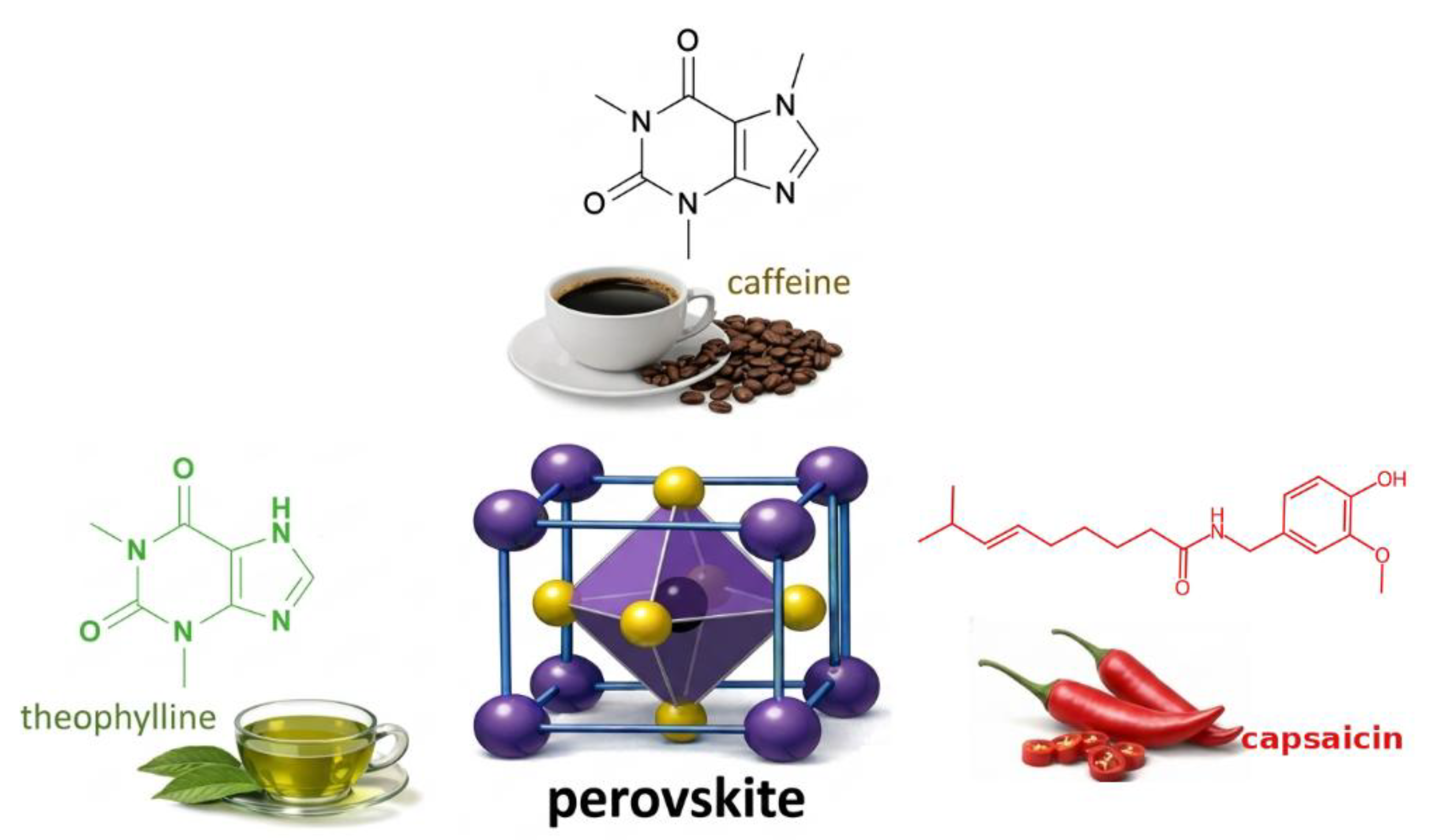
Figure 2.
Simplified representation of Lewis acid–base coordination at a halide-perovskite surface. Electronically available donor atoms, such as a carbonyl oxygen or a pyridine-like nitrogen, may coordinate an accessible undercoordinated Pb²⁺ or Sn²⁺ center when the molecular orientation and adsorption geometry are favorable. The illustrated donor groups represent alternative molecule-specific examples and should not be interpreted as simultaneous binding sites within the same additive. Coordination alone does not demonstrate electronic defect passivation.
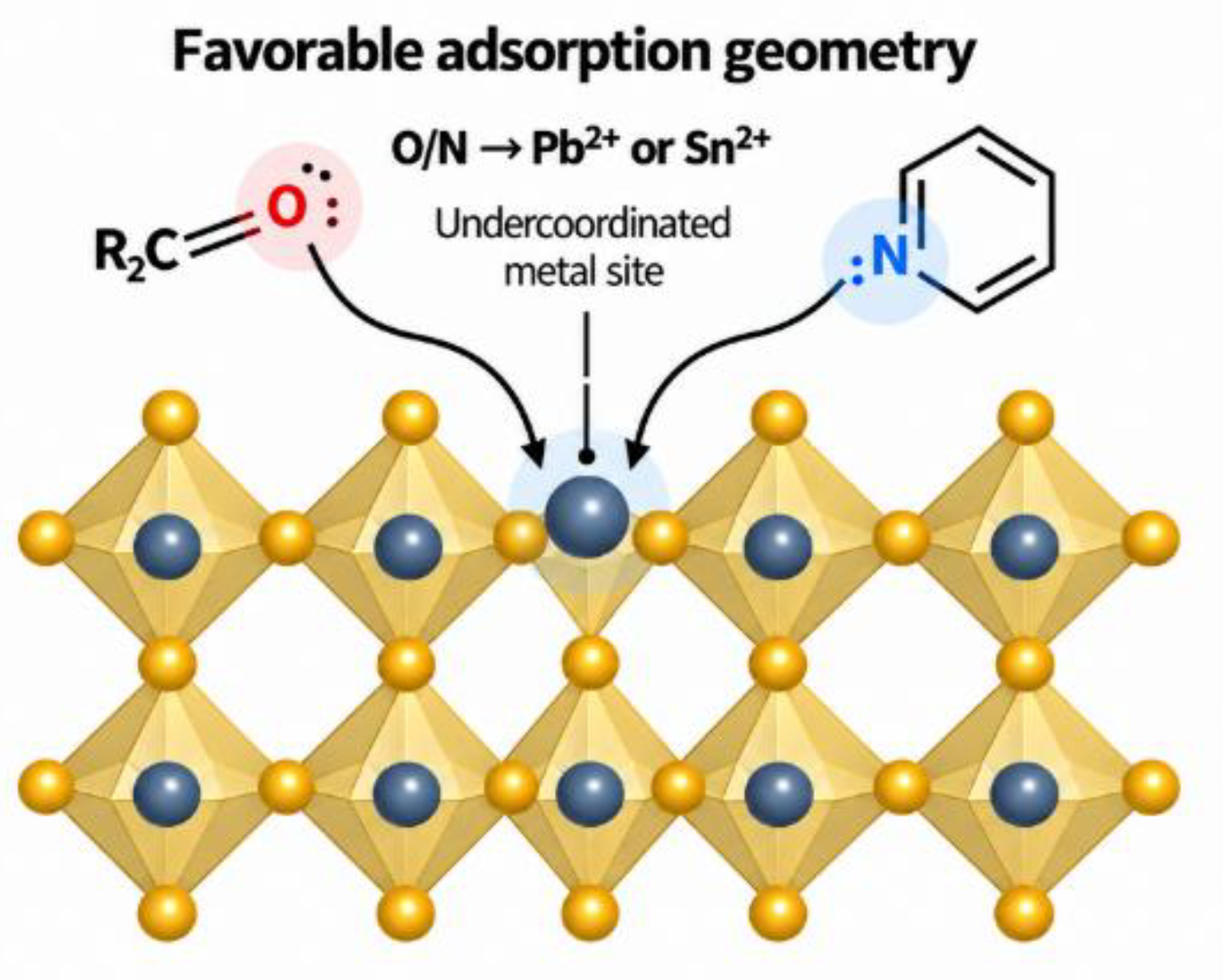
Figure 3.
Schematic representation of noncovalent interactions involving conjugated molecular additives at halide-perovskite interfaces. (a) Dispersion-driven adsorption of a conjugated molecule on the halide-rich inorganic surface, governed by molecular orientation, distance, polarizability, and the local environment. (b) Possible metal–π interaction between an accessible Pb²⁺ or Sn²⁺ center and the π-electron density of an aromatic system; direct evidence for this interaction in specific alkaloid/perovskite systems remains limited. (c) Conventional π–π association between two aromatic organic components. The inorganic corner-sharing [MX₆] framework is not a π-stacking partner. These noncovalent interactions may influence adsorption, interfacial packing, and local energetics but do not, by themselves, demonstrate Lewis-base coordination or electronic defect passivation.
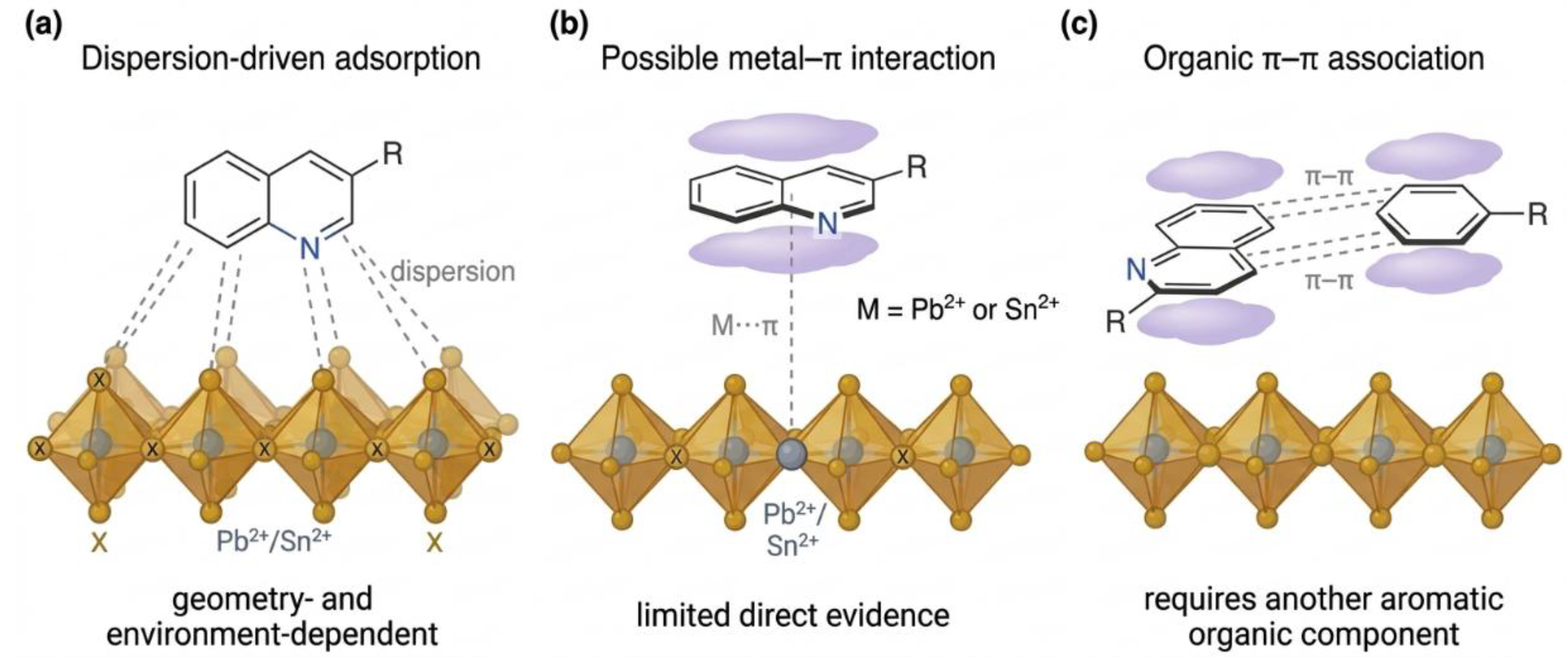
Figure 4.
Process-stage map of secondary-metabolite additives in perovskite solar-cell fabrication. Columns correspond to the stage at which each additive enters the process, with the principal process variables it can influence; rows group additives by chemical family. Each entry reports film- or device-level evidence from the cited primary study; “DFT” denotes the availability of perovskite-specific first-principles calculations. Dashed arrows indicate additives whose action extends beyond the entry stage (high-boiling α-terpineol retained until annealing; camphor/camphorquinone removed by stepwise volatilization). β-Carotene appears at two entry points because the same study compared a buried interlayer with antisolvent delivery [44]. Theophylline–BF₄⁻ and aminophylline (theophylline salts) and quinoline (a non-metabolite comparator) are shown separately. CQ, camphorquinone; GA, gallic acid; TA, tannic acid.
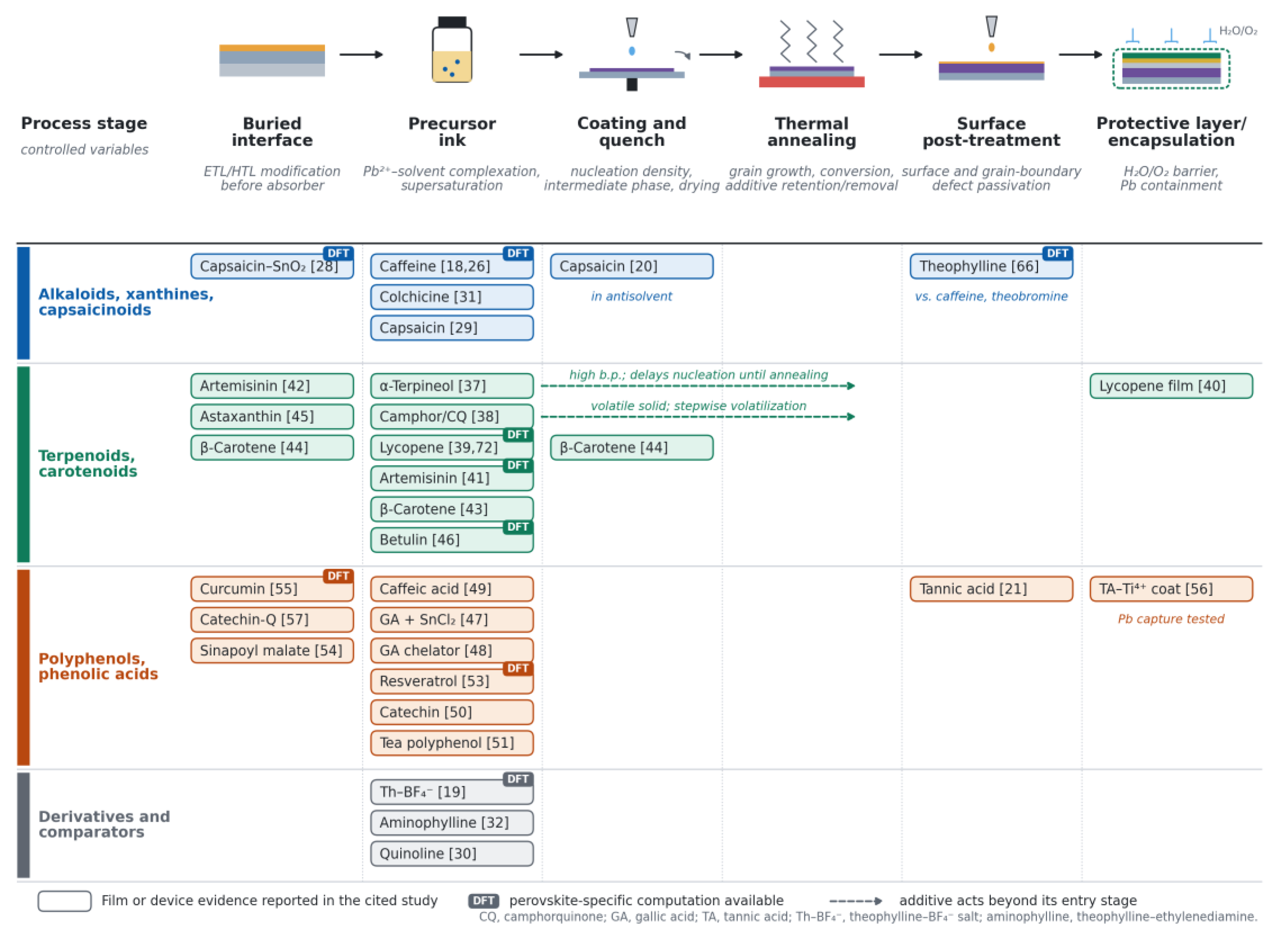
Figure 5.
Multiscale computational–experimental framework for the rational design of secondary-metabolite additives. Molecular calculations generate interaction and electronic descriptors; surface and grain-boundary models evaluate defect-related and environmental mechanisms; and experiments validate precursor compatibility, crystallization, film quality, device response, and operational stability. The workflow supports comparative candidate ranking rather than direct prediction of photovoltaic efficiency.
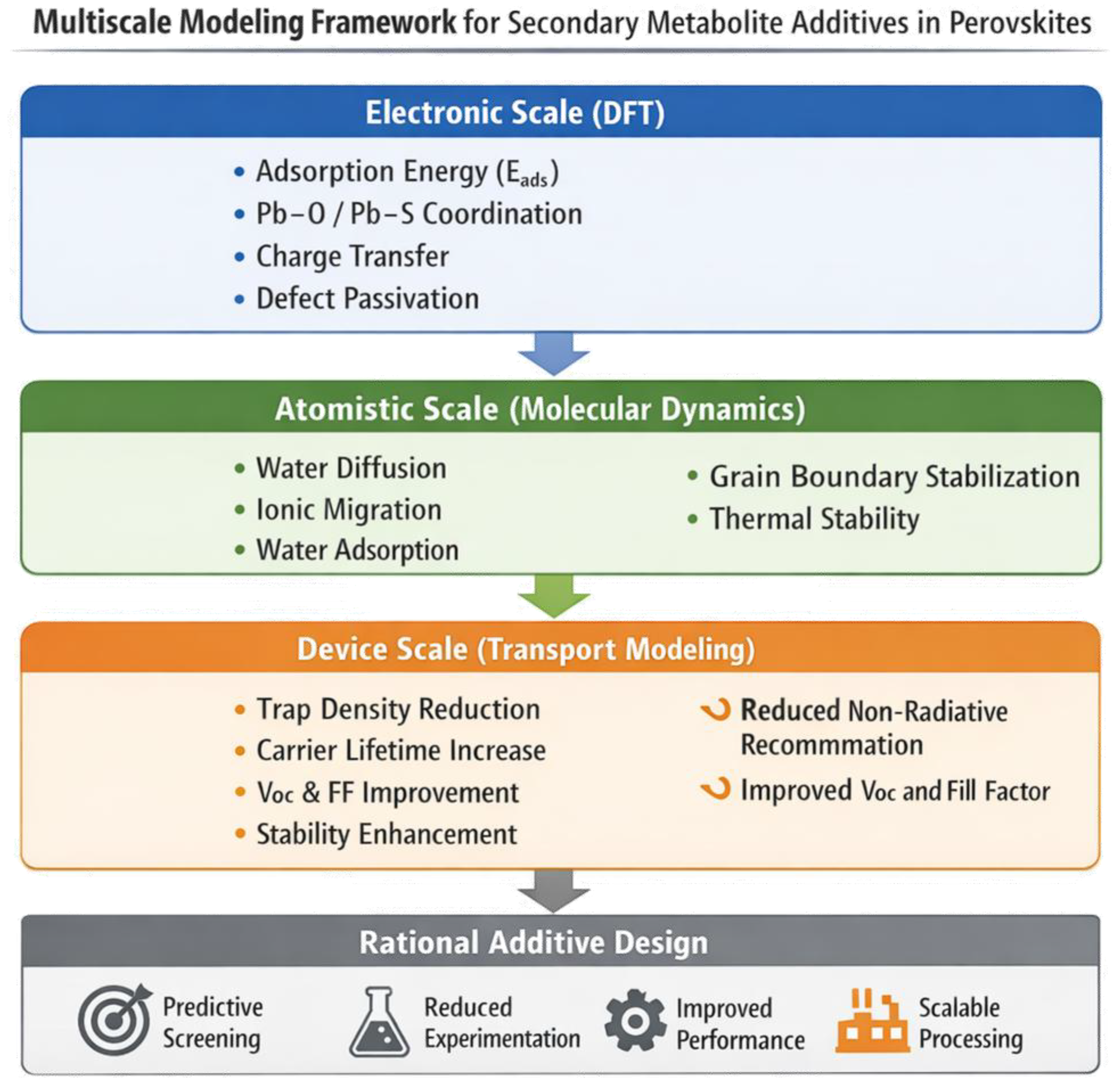
Figure 6.
Adsorption sites and calculated adsorption energies of caffeine and its thio-substituted derivatives on a MAPbI₃ model surface. (a) Adsorption sites (above Pb and hollow MA) on the MAPbI₃ slab and molecular structures of caffeine, T-caffeine (one C=O replaced by C=S), and D-caffeine (both C=O replaced by C=S), with the imidazole (α) and pyrimidine (β) rings labeled. (b) Adsorption energies for the H₁–H₄ adsorption configurations and their average. More negative values indicate stronger adsorption within the selected computational convention; the energies are model-dependent and should be compared only within the same computational protocol. Adapted from Ref. [64].
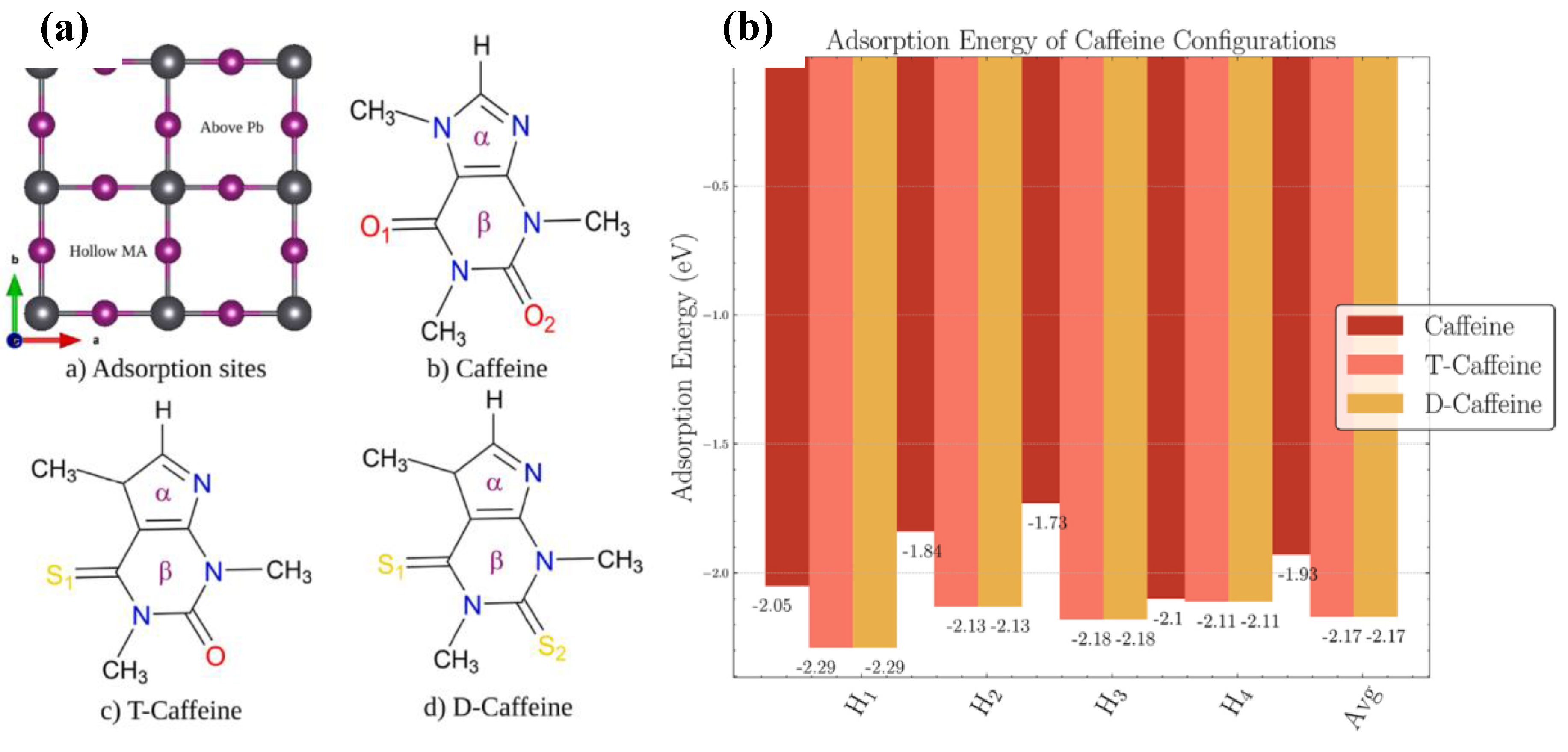
Figure 7.
Charge-density-difference analysis for thio-substituted caffeine derivatives on MAPbI₃: (a,b) Δρ isosurfaces for T-caffeine and D-caffeine; (c) plane-averaged charge-density difference Δq and (d) cumulative charge transfer ΔQ along z for caffeine (H₄), T-caffeine (H₂), and D-caffeine (H₁), with the interfacial region shaded. Accumulation and depletion regions illustrate redistribution within the selected model; they do not by themselves establish carrier transfer under device operating conditions. Adapted from Ref. [64].
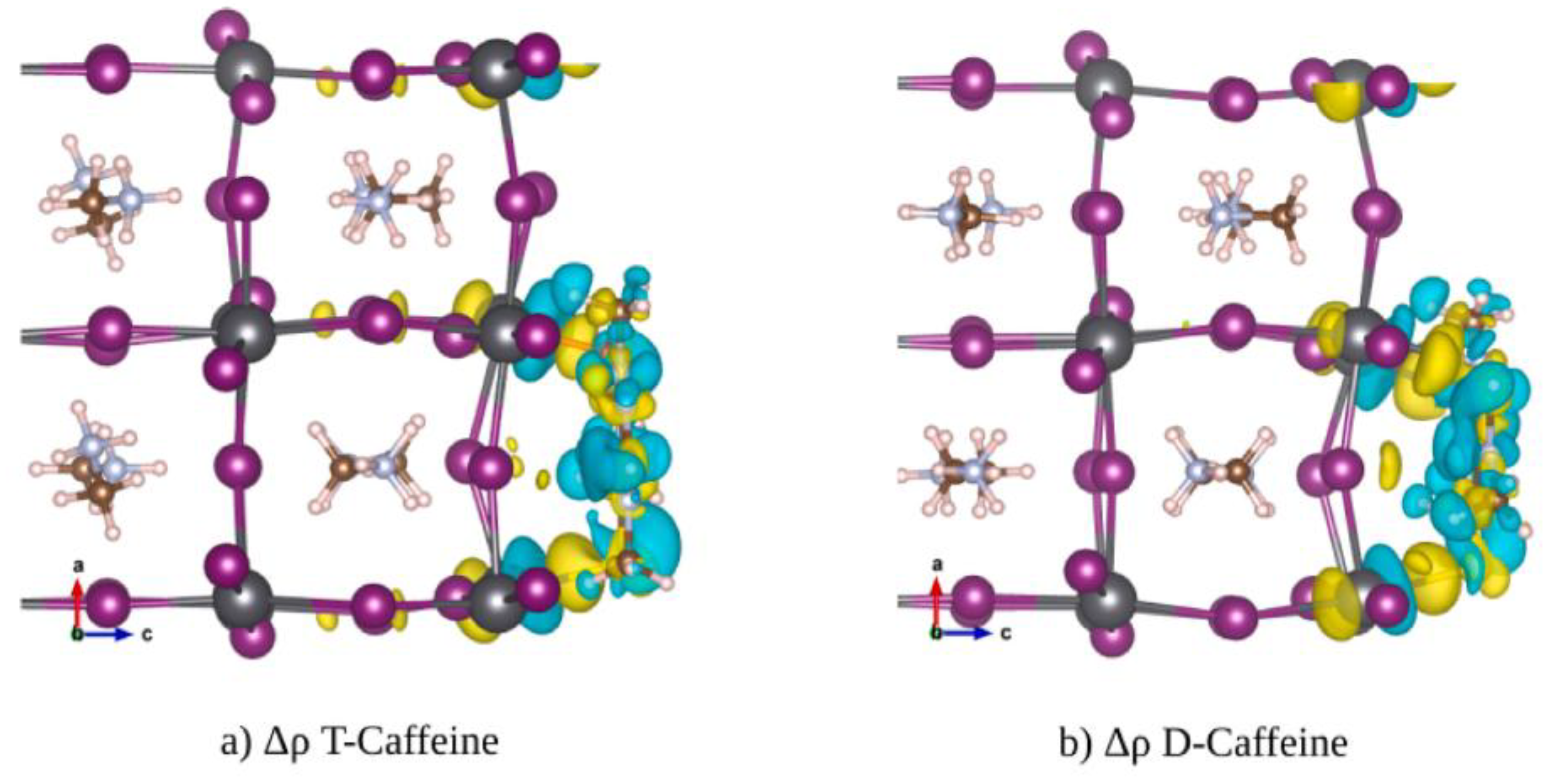
Figure 8.
Water-diffusion pathways in MAPbI₃ calculated with the climbing-image nudged elastic band method: (a) along a Σ5-(210) grain boundary (paths 1–3), (b) from the grain boundary into the bulk (paths 4–6), and (c) within bulk MAPbI₃ (paths 7–9); (d–f) corresponding energy profiles. The lowest barriers are 0.07 eV along the boundary, 0.24 eV from boundary to bulk, and 0.70 eV in the bulk. Barriers are specific to the modeled boundary and computational protocol. Reproduced from Ref. [76] under a Creative Commons Attribution (CC BY) license; © 2021 The Authors, published by Wiley-VCH GmbH.
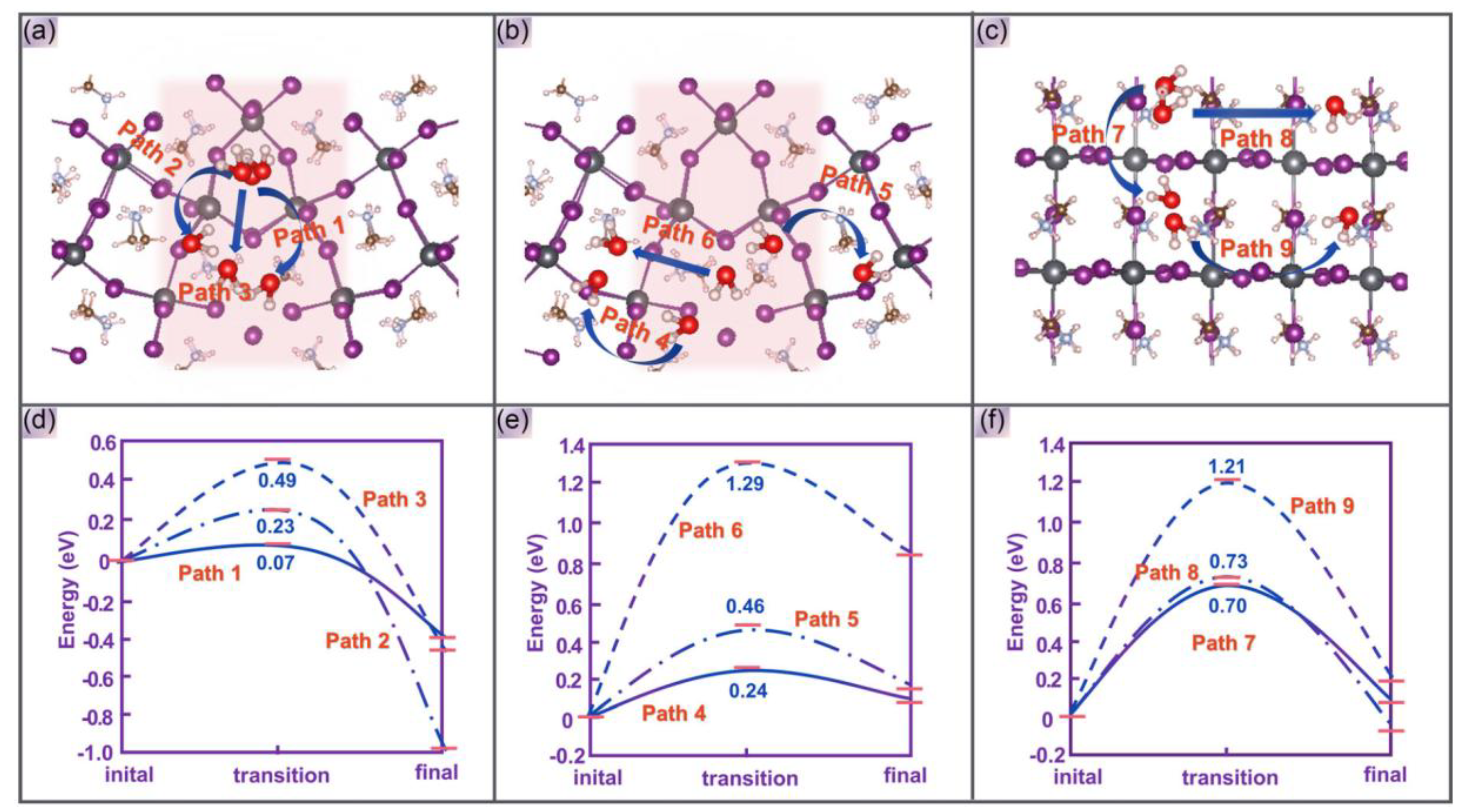

Table 1.
Process-oriented classification, relevant molecular descriptors, proposed or demonstrated interactions, and evidence levels for secondary-metabolite additives and candidates in perovskite photovoltaics.
Table 1.
Process-oriented classification, relevant molecular descriptors, proposed or demonstrated interactions, and evidence levels for secondary-metabolite additives and candidates in perovskite photovoltaics.
| Family | Representative compounds | Relevant descriptors | Supported/proposed interaction | Consequence of the process | Level of evidence |
|---|---|---|---|---|---|
| Alkaloids, xanthines and capsaicinoids | Caffeine; theophylline derivatives; capsaicin; quinoline (non-metabolite comparator) | Donor availability; carbonyls; N–H/O–H; substitution | Carbonyl-dominated Pb²⁺ interaction in the case of xanthines; molecule-specific hydrogen bonding or N-donation | Precursor coordination, antisolvent response, crystallization, or interface modification | Direct evidence for selected molecules [18,19,20,30] |
| Polyphenols and phenolic acids | Tannic, gallic and caffeic acids; curcumin; flavonoids | Phenolic OH; carbonyl/carboxyl; redox activity; aggregation; conjugation | Molecule-dependent coordination, hydrogen bonding, strain regulation, and redox activity | Treatment of surfaces or buried interfaces, precursor chemistry, crystallization, encapsulation, or stability | Direct evidence for selected molecules [21,47,48,49,55,56,57] |
| Terpenoids and carotenoids | α-terpineol; camphor/camphorquinone; artemisinin; carotenoids; betulin; phytol and other potential triterpenoids | LogP; volatility; boiling point; surface activity; conjugation; oxygen donor accessibility | Solvent-mediated crystallization effects, or the protective interface; other modes of coordination remain hypothetical | Precursor control and drying, processing with volatile additives, oxygen/UV protection, or interfacial protection | Direct evidence for selected compounds [37,38,39,40,41,42,43,44,45,46]; prospective cases [34,35,36] |
Table 2.
Mechanistic assignments, molecular requirements, minimum supporting evidence, and defensible process-level consequences for bio-derived additives in halide perovskites.
Table 2.
Mechanistic assignments, molecular requirements, minimum supporting evidence, and defensible process-level consequences for bio-derived additives in halide perovskites.
| Mechanism | Molecular requirement | Target/process stage | Minimum evidence | Defensible consequence |
|---|---|---|---|---|
| Lewis-base coordination | Accessible O/N/S lone pair | Precursor complex or undercoordinated metal site | Spectroscopy plus molecular controls and/or validated computation | Changed precursor association or reduced metal-site defect activity |
| Hydrogen bonding | Defined donor/acceptor pair | Halide, A-site cation, solvent, or interface | Structure-specific spectroscopy/computation and controls | Changed ion motion, strain, intermediate phase, or interface chemistry |
| Chelation | Multidentate geometry | Metal ion in solution or surface | Binding geometry and concentration dependence | Controlled precursor association or nucleation |
| Interfacial aromatic effects | Conjugated scaffold plus compatible organic partner | Transport layer or organic interlayer | Chemical location and energy-level evidence | Modified packing or interfacial dipole |
| Hydrophobic modification | Nonpolar scaffold at the relevant location | Wet film, surface, or grain boundary | Contact angle plus chemical-location and aging analysis | Changed wetting or water uptake |
| Redox/antioxidant activity | Accessible redox-active motif | ROS or oxidized Sn species | Controlled atmosphere and oxidation-state measurements | Reduced photo-oxidation or Sn²⁺ loss |
| Crystal-growth modulation | Precursor interaction or facet-selective adsorption | Wet-film complex or growing crystal | In situ crystallization and morphology controls | Changed nucleation, orientation, or grain distribution |
| Grain-boundary modification | Demonstrated segregation and electronic compatibility | Grain-boundary region | Chemical mapping plus recombination/transport data | Changed recombination, ion redistribution, or moisture transport |
Table 3.
Molecule-specific structure–interaction assignments and process relevance of representative alkaloid-type scaffolds investigated in halide perovskites.
Table 3.
Molecule-specific structure–interaction assignments and process relevance of representative alkaloid-type scaffolds investigated in halide perovskites.
| Scaffold | Representative | Evidence | Defensible interaction | Process relevance | Ref. |
|---|---|---|---|---|---|
| Purine alkaloid (xanthine) | Caffeine | Experimental (FT-IR, XPS); computational (DFT) | Carbonyl-O coordination with Pb²⁺; no N–H/O–H donor; N9 coordination not demonstrated | Precursor-mediated crystallization and thermal stability | [18,26,66] |
| Purine alkaloid (xanthine) | Theophylline | Experimental (FT-IR) and computational (DFT) | Carbonyl-O coordination assisted by an N7–H···I hydrogen bond | Surface post-treatment; defect passivation at a Pb-on-I antisite | [66] |
| Synthetic derivative (xanthinium salt) | Theophylline–BF₄⁻ | Experimental (XPS) and computational (anion adsorption); computational (cation) | Pb 4f shift attributed to anion adsorption; carbonyl coordination inferred, not calculated; N9 lone pair consumed by protonation | Passivation and device response; ionic contribution derivative-dependent | [19] |
| Capsaicinoid | Capsaicin | Experimental (XPS, UPS, KPFM, NMR); computational (DFT) | Amide C=O coordination to Sn⁴⁺/Pb²⁺ at SnO₂ (XPS, DFT); weak N–H interaction; not a generic N-donor mechanism | Antisolvent, precursor, and SnO₂-interface routes | [20,28,29] |
| Aromatic N-heterocycle (comparator) | Quinoline | Experimental (XRD, SCLC, TRPL); no binding spectroscopy | Pyridinic N-donation proposed; binding geometry not resolved spectroscopically | Precursor additive | [30] |
Table 4.
Evidence matrix of representative primary studies, with incorporation route, author-reported performance, stability conditions, and limits on cross-study interpretation.
Table 4.
Evidence matrix of representative primary studies, with incorporation route, author-reported performance, stability conditions, and limits on cross-study interpretation.
| Additive / system | Incorporation route | Control → treated performance | Reported stability condition | Evidence boundary | Ref. |
|---|---|---|---|---|---|
| Caffeine; MAPbI₃ / CsFAMAPbI₃ | Precursor; 1 wt% optimized for MAPbI₃ | Champion MAPbI₃: 17.59% → 20.25%; stabilized treated output 19.8% | 86% retained after 1300 h at 85 °C in N₂ | Thermal test is not equivalent to illuminated MPP operation | [18] |
| Theophylline–BF₄⁻; MAPbI₃ n–i–p | Precursor additive | 13.6% → 15.04% | Films stable >600 h at 30% RH; control <240 h | Film stability should not be reported as device T80 | [19] |
| Theophylline; (FAPbI3)0.92(MAPbBr3)0.08 | Surface post-treatment | Stabilized output: 20.36% → 22.64% | >90% of initial PCE (21.32%) retained after 500 h; encapsulated, 30–40% RH, 40 °C; control (19.34%) lost >80% | Surface post-treatment; not transferable to precursor-incorporated xanthines | [66] |
| Capsaicin; MAPbI₃ p–i–n | Capsaicin-containing antisolvent | Treated champion 20.85%; stabilized control → treated: 18.11% → 20.25% | 70.7% retained after >400 h; ambient 25–35% RH; unencapsulated | Active area 0.07 cm²; shelf-type ambient exposure | [20] |
| Capsaicin; FA/MA mixed-halide n–i–p, SnO₂ quantum-dot ETL | Blended into SnO₂ electron-transport layer (2 wt%) | Mean 19.90 ± 0.47% → 21.87 ± 0.28%; champion 20.34% → 22.24% | ≈90% retained after 1000 h storage vs. 76% for control (storage conditions given only in SI) | Interfacial treatment; not equivalent to antisolvent incorporation | [28] |
| Quinoline; Cs0.05FA0.81MA0.14PbI2.55Br0.45 n–i–p | Precursor additive; 0.4 M optimized | Champion 18.65% → 20.87%; mean 17.99% → 20.59% | 85% retained after 32 days at 20 ± 5% RH vs. 70% for control; unencapsulated | Crystallization and trap-density evidence (XRD, SCLC, TRPL); no direct binding spectroscopy | [30] |
| Caffeine; MAPbI₃ n–i–p (CuSCN hole-transport layer) | Precursor; 5 wt% optimized | 10.31% → 16.39% | 86% retained after 30 days, ambient, 30–40% RH (control 62% after 6 days); encapsulation not stated | Commercial caffeine (the abstract refers to coffee powder); low FF (61.8%) and JSC–EQE mismatch (24.22 vs. 21.91 mA cm−2) | [74] |
| Capsaicin; MAPbI₃ p–i–n | Precursor additive (0.1 wt%) | 19.16% → 21.88%; FF 83.81% | >90% retained after 800 h storage in air, 45% RH, RT, vs. 40% for control; unencapsulated | p- to n-type surface-region transformation; homojunction ~100 nm below the surface | [29] |
| Colchicine; α-FAPbI3 | Precursor additive; antisolvent-free one-step | Treated 25.06% | 83.6% after >1500 h at 85 °C (unencapsulated); 87.6% after 450 h MPPT | Catalyzed crystallization bypassing δ-phase intermediates; relevant to scalable coating | [31] |
| Aminophylline; triple-cation n–i–p | Precursor additive | 19.62% → 22.11% | 60% after 100 days in air (25–30% RH, unencapsulated); control <14% | Theophylline–ethylenediamine salt, not a single purified metabolite | [32] |
| α-Terpineol; MAPbI3−xClx n–i–p, one-step | Precursor additive (5 mg mL−1) | Au-electrode devices: 16.1% → 17.5% (Ag: 13.9% → 15.4%) | Unencapsulated Au devices, ambient dark storage: 84% retained after 1000 h vs. 65% for control; RH not reported | Hydrogen bonding with MA⁺/I⁻ and high boiling point delay nucleation; additive not detected in the annealed film | [37] |
| Camphorquinone; FA-based n–i–p PSC | Volatile solid additive (3 mM) in the PbI₂ precursor; two-step deposition | Champion (Cs0.05FA0.95PbI3): 23.20% → 25.00%, certified 24.89%; FA0.92MA0.08PbI3: 22.60% → 24.19%; 1.0 cm² device 22.50% | 90.1% after 1000 h MPPT, 1 sun, 25 °C, encapsulated (ISOS-L-1; control 80.8% after 500 h); 91.8% vs. 81.3% after 250 h (ISOS-L-3) | Stepwise volatilization; laboratory active area 0.042 cm² | [38] |
| Lycopene; perovskite additive | Additive distributed within the perovskite film | 20.57% → 23.62% | 91.2% average PCE after 960 h in O₂; 92.4% after 3500 h in long-term test | O₂, UV, and long-term tests are distinct protocols and should remain separate | [39] |
| Lycopene bionic membrane; PSC | Protective layer on the perovskite absorber | >21% under AM 1.5G; 40.24% indoor efficiency at 1000 lux | Almost 90% retained after 1000 h in wet O₂ ambience | External protective layer; indoor and outdoor efficiencies are not directly comparable | [40] |
| Artemisinin; flexible RbCsFAMA n–i–p PSC | Bulk additive (0.22 mol%) | 19.53% → 21.10%; VOC 1.077 → 1.126 V; rigid 21.44% → 22.85% | 93.3% vs. 75.6% after 600 h in air (RH <15%); 89.3% vs. 73.5% at 85 °C in N₂; unencapsulated | C=O–Pb²⁺ interaction (DFT); lower Pb⁰ fraction after light soaking | [41] |
| Betulin; MAPbI₃ p–i–n | Precursor additive; 0.001 wt% optimized | 19.14% → 21.15%; VOC 1.078 → 1.106 V; FF 78.62% → 81.57% | 90% after 30 days in air, 60 ± 5% RH, RT (control 57%); 75% after 300 h at 85 °C in N₂ (control 47%); 55% after 250 h light soaking at 50 °C (control 20%); unencapsulated | OH–Pb²⁺ coordination and hydrogen bonding (NMR, XPS, DFT); same device platform as the capsaicin study | [46] |
| β-Carotene; (CsFAMA)Pb(I/Br)3 | Bulk additive | 20.49% → 23.38% | >89% after 500 h under ambient humidity | Long-chain hydrophobic passivator | [43] |
| β-Carotene; 1.74 eV MAPb(Br0.2I0.8)3 p–i–n | 1 mM in toluene: buried interlayer beneath the perovskite or antisolvent additive | 18.36% → 20.26% (interlayer) or 19.91% (antisolvent; hysteresis-free) | Films: suppressed halide segregation under 2 h pulsed-laser exposure; only antisolvent-treated films resisted UV/ozone; device MPPT ~6 h | Antioxidant photoprotection; buried interlayer cannot protect the top surface; passivation not tested | [44] |
| Astaxanthin; SnO₂/perovskite interface | Buried-interface modifier | 22.61% → 24.32% (Table 1; 24.23% in abstract) | 93% after 1600 h dark storage in air, 25 °C, 35% RH; unencapsulated (control 70%) | C=O coordination to Pb²⁺ and Sn⁴⁺; corrigendum exchanges figures only | [45] |
| Tannic acid; lead-halide PSC | Surface post-treatment | 21.31% → 23.11% | 92% after 1200 h at 30% RH; >80% after 650 h at 85 °C in N₂; MPPT tested 1000 h | Different stress tests must remain separate | [21] |
| Gallic acid + SnCl₂; FASnI₃ p–i–n | Precursor coadditive (1 mol% GA with 7 mol% SnCl₂) | 3.38% → 9.03% (SnCl₂-only control) | ~80% after 1000 h in air at 20% RH; unencapsulated (control degraded within 200 h) | Gallic acid acts within a SnCl₂–GA coadditive system | [47] |
| Caffeic acid; FA0.7MA0.3Pb0.5Sn0.5I3 p–i–n | Precursor additive (2.5 mol%) | 17.88% → 19.85%; VOC 0.798 → 0.855 V | 90% retained after 500 h dark storage in N₂, 25 ± 5 °C; unencapsulated (control lost >40%) | Crystallization and Sn²⁺-oxidation control | [49] |
| Curcumin; SnO₂/perovskite buried interface | Buried-interface modification | 22.03% → 24.46% | 90.42% retained after 1000 h at 25 °C and 50 ± 5% RH | Interface-selective treatment supported by DFT and device characterization | [55] |
| Natural polyphenol encapsulant; Pb-halide PSC | External nanoencapsulation coating | Encapsulated-device PCE 20.7% | T90 >650 h; T80 >2050 h; T70 >7000 h at 22 °C, 65% RH, indoor light | Encapsulation and Pb sequestration; not an internal additive effect | [56] |
| Gallic-acid multidentate chelator; carbon PSC | Precursor (bulk) additive, 0.2 mg mL−1; HTM-free carbon device | 15.55% → 18.83% | 90% after 1000 h at 20 °C, 40% RH, unencapsulated (control 59%); 85% after 720 h continuous 1-sun illumination in N₂ | Coupled crystallization, defect passivation, energy alignment, and Pb immobilization | [48] |
| Catechin-Q; mixed Sn–Pb PSC | Plasma-oxidized flavonoid interlayer at PEDOT:PSS/perovskite interface | 21.87% → 23.48%; VOC 0.842 → 0.873 V; mean 21.10% → 23.05% | 95% retained after 4800 h under ISOS-D-1I (N₂, unencapsulated) vs. 78% for control | Buried-interface redox/strain regulation; ISOS-D-1I is a dark-storage protocol | [57] |
| Resveratrol; lead-halide PSC | Bulk additive | 21.62% → 23.44% | 88% after >1000 h in O₂; 91% after >1000 h at 25 °C and 50 ± 5% RH | Pb²⁺ coordination plus superoxide scavenging; DFT-supported | [53] |
| Myricetin + BF₄⁻; Sn PSC | Surface and grain-boundary anchoring with pseudohalide co-additive | Treated 14.08% | Negligible loss after 1000 h dark storage; 89.9% after 200 h continuous illumination | Myricetin effect not separable from the BF₄⁻ co-additive | [52] |
| Catechin; FA0.75MA0.25SnI2Br | Precursor additive (1.0%) | Mean 4.29% → 5.45%; champion 4.96% → 6.02%; 10.45% → 12.81% under 1000 lx | Unencapsulated, air, 72% RH: ~73% retained after ~400 min; control failed within ~320 min | Pb-free absorber; minute-scale stability test; indoor-light application | [50] |
| Garlic aqueous extract (allicin-attributed; organosulfur comparator); FAPbI₃ n–i–p | Precursor additive, 0.001 wt%; no physical encapsulant despite “in situ encapsulation” wording | Champion 22.89% → 24.50%; mean 22.07% → 23.42% | ~92% after 190 days, 25 °C, 15 ± 5% RH, indoor light (control tracked 37 days); ~80% after 140 h at 90 ± 10% RH; unencapsulated | Crude extract; allicin not quantified in extract or film; comparator only | [58] |
Disclaimer/Publisher’s Note: The statements, opinions and data contained in all publications are solely those of the individual author(s) and contributor(s) and not of MDPI and/or the editor(s). MDPI and/or the editor(s) disclaim responsibility for any injury to people or property resulting from any ideas, methods, instructions or products referred to in the content. |
© 2026 by the authors. Licensee MDPI, Basel, Switzerland. This article is an open access article distributed under the terms and conditions of the Creative Commons Attribution (CC BY) license (http://creativecommons.org/licenses/by/4.0/).
Copyright: This open access article is published under a Creative Commons CC BY 4.0 license, which permit the free download, distribution, and reuse, provided that the author and preprint are cited in any reuse.