

Submitted:
30 September 2026
Posted:
02 October 2026
You are already at the latest version
Abstract
Solar thermal energy for drying applications offers a sustainable pathway to help reduce post-harvest losses and decarbonize low-temperature heat processes. However, the design of solar drying systems has advanced faster than the development of robust control and monitoring strategies. Nevertheless, these advances have generated extensive reviews on dryer configurations, thermal storage, modeling tools, and product-quality outcomes, dedicated syntheses of monitoring and control remain limited. This review synthesizes recent developments in control and monitoring for solar drying systems, covering distribution, integration, and mixed configurations operating in passive and active modes. A structured search of the recent literature in major scientific databases was used to identify studies that report explicit control or monitoring strategies, including rule-based and PID controllers, fuzzy and networked control schemes, automatic monitoring systems based on low-cost microcontrollers and IoT platforms, and smart sensing approaches for estimating moisture content and drying rate. The review analyses the process variables most frequently measured and controlled (air temperature, relative humidity, airflow rate, and product moisture) and how these choices affect drying time, product quality, and energy performance. Most practical solar drying applications still use basic rule-based or PID control and data logging, while advanced control and data-driven methods are largely limited to experimental systems. The sensor limitations and the standardized metrics and measurements remain key challenges. This paper concludes with recommendations and research opportunities for developing robust, scalable, and economically viable control architectures for solar drying.
Keywords:
solar drying
; process control
; monitoring
; sensors
; IoT
; smart sensors
; PID
1. Introduction
Solar drying offers a viable solution for preserving agricultural products and addressing global challenges [1]. Also, contributes to food security by reducing post-harvest losses, promotes sustainability by depending on renewable energy, and stimulates economic development in rural areas by adding value to agricultural products [2,3]. However, the operation of solar drying systems is strongly influenced by how the process is monitored and controlled. The lack of control in operating conditions can lead to prolonged drying times, poor-quality product, and inefficient energy use [4,5]. Despite these challenges, few studies have integrated both control and monitoring aspects in a single synthesis, resulting in a gap in the literature that this paper aims to fill.
The use of solar energy for food drying dates back centuries, with traditional open-sun drying [6]. This inexpensive method is the simplest and most commonly used for drying, and involves placing the food and exposing it to air and sunlight. However, this method is slow, weather-dependent, and exposes the product to pests, dust, and other contaminants [6].
On the other hand, the commercialization of dehydrated products is affected by variability in quality, often due to the lack of systematic monitoring and control of drying conditions and consequently, a wide variety of solar drying systems (SDS) have been developed, ranging from simple direct dryers (where products are enclosed and directly exposed to sunlight) to more complex indirect or mixed-mode setups that use solar collectors to heat the air, then circulated through the drying chamber [7,8].
Hybrid dryers that integrate solar energy with conventional sources, such as electricity, have been proposed to enhance reliability during variations in solar irradiance [9]. The dryer’s design depends on the type of product, climate, and economic constraints [7,8,9], and its efficiency is influenced by how well key process variables are measured and, when feasible, actively controlled. Therefore, the control techniques are employed to maintain these optimal drying conditions, specifically air temperature, humidity, and airflow rate, which directly influence product temperature and moisture content [10,11]. This control implementation range from simple rule-based or on-off strategies (such as manual or automatic vent opening and fan switching) to closed-loop control using PID algorithms or fuzzy logic, and, more recently, intelligent, data-driven approaches [10,11]. On the other side, monitoring techniques enhance these controllers by providing real-time information about the process state, typically through measurements of air temperature and humidity, product moisture content, and, in some cases, product weight loss over time [12]. Also, the sensor’s quality, placement, data resolution, information storage, and analysis directly affect system efficiency and performance assessment.
As a result, recent studies highlight that integrating control and monitoring techniques into industrial-scale drying systems is a significant challenge [13,14], due the variability in climatic conditions, the distributed nature of solar collectors and drying chambers, and constraints on cost and maintenance in rural settings complicate the design of robust control architectures [13,14]. However, advances in digital sensors, low-cost microcontrollers, and Internet of Things (IoT) platforms have opened new possibilities for real-time data acquisition, remote supervision, and automated decision-making in solar dryers [15,16]. The economic viability of these solutions is essential, particularly in areas that have limited access to conventional energy sources. Therefore, it is necessary to adopt integrated approaches that lower the costs of sensors and controls, optimize energy usage, and clearly demonstrate a favorable cost-benefit ratio [17,18].
Although control and monitoring play an important role in solar drying applications, many existing reviews focus primarily on dryer configurations, thermal storage integration, or product quality outcomes. In contrast, topics such as instrumentation, automation, and closed-loop control are often viewed as secondary or relegated to future work [26], resulting in a lack of comprehensive, technically detailed syntheses dedicated to monitoring and control—especially regarding recent advancements in smart sensing, connected devices, and data-driven methods.
This paper addresses this gap by providing a comprehensive review of control and monitoring techniques for solar drying applications, with an emphasis on recent advancements. Through a structured examination of the latest research, the review explores various control strategies—including traditional rule-based and PID controllers, and more advanced methods such as fuzzy logic and networked control systems—as well as automatic monitoring systems and IoT-enabled solutions.
The review centers on the process variables usually measured and controlled, examining how these choices affect drying time, product quality, and energy efficiency. Finally, the paper identifies limitations, emerging research opportunities, and practical recommendations to guide the development of robust and economically viable control architectures for solar drying systems.
Solar Drying Review View
In the last decade, solar drying has been extensively reviewed regarding dryer types and configurations [19,20,21], system-level performance and scale-up [8,20,22], and modeling and product quality considerations [23,24,25]. Monitoring and control are frequently regarded only as supporting elements or as tasks for future consideration (e.g., Saini et al. [26] and C. K. Saha et al. [27]), rather than as the main design layer required for consistent performance under varying solar input.
Table 1 outlines the key review themes and illustrates how this review enhances them by concentrating on the measurement, actuation, and digital control architectures for solar dryers. Table 1 is intended as an illustrative thematic map rather than a systematic classification: the review papers were identified through a parallel search filtered to document type = review, and each review was assigned to the theme matching its primary focus (with secondary themes noted where applicable). A supplementary list of the review papers and their assigned themes is provided. Within the “monitoring, control, and digitalization” row, some cited works are drawn from adjacent industrial solar-heat and process-control literature rather than from solar-drying reviews specifically; these are included deliberately to triangulate the identified gap across both the solar-dryer and the broader drying-control literatures.
2. Review Methodology
2.1. Search Strategy
The review was conducted following a structured search strategy in major scientific databases, primarily Scopus and Web of Science, complemented by targeted searches in Google Scholar to capture additional relevant references. The search focused on the period 2000–2025, when most of the reported work on modern solar drying systems and digital control and monitoring solutions has been published. Combinations of the following keywords were used in titles, abstracts and author keywords: “solar drying”, “solar dryer”, “solar drying system”, “solar dehydrator”, “solar thermal”, together with “control”, “automatic control”, “process control”, “monitoring”, “data acquisition”, “PID”, “fuzzy”, “networked control”, “IoT”, “wireless”, and “smart sensor”. Only documents written in English and published as journal articles or peer–reviewed conference papers were considered. This method follows established guidance for conducting structured literature reviews in interdisciplinary engineering and energy research [37,38,39]. Anthropic Claude AI assisted with initial article screening, study classification, language editing, and figure scripting; all outputs were verified by the authors, who take full responsibility for the content of this publication.
2.2. Inclusion and Exclusion Criteria
The initial search returned a broad set of publications related to solar energy use in drying, as well as general work on solar thermal systems. To focus the review on control and monitoring aspects, the following inclusion criteria were applied:
- (1)
- the study deals with solar thermal drying systems or with solar thermal plants that supply low–temperature heat to drying or similar processes;
- (2)
- the paper reports an explicit control or monitoring strategy, or presents an experimental or numerical study where control-relevant variables (e.g., air temperature, relative humidity, air flow rate, product moisture) are measured and used to assess system performance;
- (3)
- sufficient technical details are provided on the control or monitoring hardware (sensors, actuators, controllers, communication modules) and/or on the control algorithms implemented.
Studies were excluded if they: (1) focused exclusively on dryer design, modelling or drying kinetics without any discussion of control or monitoring; (2) dealt with non-solar drying technologies (e.g., purely electric or fossil-fuel dryers) without a clear link to solar-assisted configurations; (3) were purely economic, social or policy analyses without technical description of control or monitoring systems; or (4) consisted of patents, theses or non peer–reviewed reports.
2.3. Data Extraction and Classification
For each selected paper, the following information was extracted: type of solar drying system (distributed, integral or mixed; passive, active or hybrid), type of product and operating scale (laboratory, pilot or field), process variables measured and/or controlled (e.g., air temperature, relative humidity, air flow rate, product temperature or moisture), control and monitoring approach (rule-based control, on–off switching, PID control, fuzzy or other advanced controllers, automatic monitoring systems, IoT–based solutions, smart sensors), hardware platform (microcontrollers, PLCs, data loggers, communication modules) and performance indicators (drying time, final moisture content, quality attributes, energy indicators such as solar fraction, thermal efficiency or specific moisture extraction rate).
The study identification and selection process followed a structured protocol in line with PRISMA guidelines [40]. Figure 1 illustrates the flow of information through the review’s phases. A total of 492 records were initially retrieved from Scopus, Web of Science, and Google Scholar. After removing duplicates and screening titles and abstracts, 130 full-text articles were reviewed; 78 met the inclusion criteria and were included in the final analysis.
Duplicate records were identified and removed. Of the 130 full-text articles assessed for eligibility, 52 were excluded; the reasons for exclusion (no explicit control or monitoring strategy; non-solar drying technology without a solar-assisted link; purely economic, social, or policy scope; insufficient technical detail; or non-peer-reviewed source) are summarized with counts in the Supplementary Material, together with a completed PRISMA 2020 checklist.
The studies were categorized into broad groups based on the following criteria: (a) the configuration of the solar drying system (distributed, integral, or mixed), (b) the primary control and monitoring strategies used, and (c) the complexity and intended application (small-scale rural dryers, pilot-scale demonstrators, industrial applications, or solar heating for industry (SHIP)). This classification will be used in subsequent sections to organize the discussion of control and monitoring techniques and to highlight current trends, gaps, and research opportunities.
3. Background
This section offers an overview of the current state of solar drying technologies. It includes a discussion of the various types of solar drying systems, the control and monitoring techniques currently employed, and the existing limitations and challenges in this field. This background will lay the groundwork for a more detailed exploration of control and monitoring techniques for solar drying applications in the following sections. In the broader solar drying literature, control and monitoring are frequently identified as enabling technologies for performance, quality, and reliability. Nevertheless, they are rarely discussed with the same level of technical depth as thermal design and performance evaluation, which motivates the focused coverage that follows.
3.1. Classification of Solar Drying Systems
Solar drying can be performed either through traditional open-sun drying or through more technical Solar Drying Systems (SDS). In open sun drying, the product is directly exposed to ambient air and solar radiation, which makes the process simple and low-cost but strongly dependent on weather conditions and vulnerable to contamination by dust, insects, and animals [6,41]. In contrast, SDS provides an enclosed environment in which solar energy is captured and transferred to the drying air in a more controlled way, improving hygiene, product quality, and process reproducibility [7,21,42,43].
SDS are commonly classified according to the airflow driving mode as passive (natural convection) or active (forced convection), and according to the relative arrangement of the collector and drying chamber as distributed, integral, or mixed systems [7,42,44]. In passive dryers, buoyancy forces driven by temperature gradients generate airflow, simplifying construction and operation but limiting control of airflow velocity and temperature. Active dryers use fans or blowers, typically powered by electricity or photovoltaics, to impose a prescribed airflow rate, offering greater flexibility for process control and sensor and actuator integration.
In distributed solar dryers, the solar collector and the drying chamber are separate units. Incident solar radiation is converted to heat in the collector and transferred to a working fluid (usually air or water) that subsequently delivers heat to the product inside the drying chamber [7,42,43]. When air is used, these systems are generally referred to as direct air-heating solar drying systems; when a liquid is used as intermediate fluid, they constitute indirect air-heating systems, often coupled with storage to attenuate solar intermittency [42,45,46]. In both cases, the solar air heater or solar thermal collector is a key component whose design and performance directly influence the controllability of the drying temperature and airflow.
Integral solar dryers combine the functions of solar energy capture and product containment in a single unit, so that the product is located inside a chamber that also acts as a solar collector, typically with one or more transparent covers [7,42]. In these systems, solar radiation penetrates the transparent surface and is absorbed by the internal surfaces and the product itself, while the cover reduces convective losses due to air. This configuration increases the drying chamber temperature compared to open sun drying, but at the cost of reduced flexibility to independently adjust collector and chamber conditions.
Mixed solar dryers combine features of distributed and integral configurations. A portion of the solar energy is absorbed by a dedicated collector and transferred to the airflow, while the product continues to receive direct or diffuse solar radiation through transparent surfaces [47,48,49]. Mixed designs aim to exploit the advantages of both concepts: improved energy capture and higher controllability of air temperature and flow, while maintaining relatively simple construction and the possibility of integrating thermal storage or auxiliary heaters. The choice of configuration (distributed, integral, or mixed; passive or active) has direct implications for what can be effectively monitored and controlled: in distributed and active systems, separate access to collector and chamber variables facilitates advanced control of temperature, humidity, and airflow, whereas integral and passive systems tend to rely on simpler monitoring strategies focused on chamber temperature and relative humidity, often with limited actuation options [50,51,52].
To relate this taxonomy to the reviewed corpus and to support the claims about controllability, the distribution of the 78 included studies across configuration classes is summarized in the Supplementary Material. For readers more familiar with the conventional direct/indirect/mixed-mode typology, the present framing maps approximately as follows: integral (greenhouse) dryers correspond to direct mode, in which solar radiation reaches the product directly; distributed dryers correspond to indirect mode, in which a separate collector heats the working fluid that is then delivered to the chamber; and mixed designs combine both. The terms “direct” and “indirect” air heating are used here to distinguish air heated directly in a solar air heater from air heated through a liquid-mediated loop, which is a separate distinction from whether radiation reaches the product. Finally, because the contribution of this review is control- and monitoring-oriented, the configuration framework should be read together with the secondary, control-relevant degrees of freedom that determine the available actuators and measurable indicators—namely recirculation versus once-through ventilation, the presence of thermal storage, auxiliary heaters, PV-powered fans, and dehumidification—which are summarized alongside Figure 2.
3.1.1. Principles of Thermal Drying
The drying of biological materials is a complex process governed by simultaneous heat and mass transfer mechanisms. Heat is transferred from the surrounding air to the product’s surface, while moisture migrates from the interior to the surface, where it evaporates into the airflow. These coupled phenomena are influenced by both internal resistance (within the solid matrix) and external resistance (at the product–air interface) [53]. Two transport mechanisms simultaneously occur during drying: (i) heat transfer from the medium to the wet material, inducing changes from water to the vapor phase, and (ii) water transport, liquid or vapor, from the inside to the surface, where moisture is removed by gas. Therefore, there are two resistances to moisture removal (internal and external). Heat and mass transfer phenomena occur simultaneously both externally and internally within the solid matrix and are generally influenced by differences in temperature and water concentration, the air velocity field, and the material’s properties. A conceptual representation of the thermal drying process is shown in Figure 3.
In hygroscopic materials, such as agricultural products, the drying process follows two principal regimes: the constant-rate period and the falling-rate period [44,54]. During the constant-rate period, surface moisture is removed rapidly, and the drying rate is governed primarily by external conditions, including air temperature, humidity, and airflow velocity. Moisture migrates easily to the surface, resulting in minimal internal resistance [44].
As drying progresses, the critical moisture content is reached (the point at which the rate of internal moisture migration no longer keeps pace with surface evaporation). This marks the onset of the falling-rate period, during which internal resistance dominates, and moisture transport slows as migration through the dry outer layers becomes increasingly complex [55]. The falling-rate stage is crucial for control applications, as improper regulation of temperature or airflow during this phase can result in over-drying, quality loss, or increased energy consumption [54]. Effective drying strategies must account for material properties, temperature, moisture gradients, and dynamic air properties, all of which influence the simultaneous internal and external transfer processes.
These principles apply universally to solar drying systems and underpin the design of adaptive control methods. Figure 3 illustrates a conceptual representation of these coupled mechanisms in thermal drying [44,54].
Because the smart-sensing and moisture-estimation methods discussed later in this review rely on psychrometric relationships, it is useful to introduce the relevant quantities here. The state of moist air is more completely described by the humidity ratio (or absolute humidity) W, defined as the mass of water vapor per unit mass of dry air, than by relative humidity alone: at a fixed humidity ratio, relative humidity falls as air temperature rises, so relative humidity by itself is not a sufficient control variable across varying temperatures. The moist-air enthalpy, which combines the sensible heat of the air and the latent heat carried by the water vapor, governs the energy available for evaporation. For a dryer operating at steady airflow, a simple mass balance on the air stream links the water removal rate to the difference between the outlet and inlet humidity ratios: the rate of water removed equals the dry-air mass flow rate multiplied by the increase in humidity ratio across the chamber. This relationship provides the physical basis for estimating drying rate and product moisture from paired temperature and relative-humidity measurements at the inlet and outlet, and it motivates the use of humidity-ratio trends—rather than relative humidity alone—as monitoring and control indicators.
3.1.2. Drying Air Characteristics
The quality characteristics (color, flavor, texture, nutraceutical components, etc.) of the dehydrated product determine the guidelines for selecting drying operating parameters: temperature, relative humidity, and air velocity. Therefore, it is important to identify operating parameters that ensure the desired product quality while also optimizing energy use and drying time, which are closely linked to the economic feasibility of the drying process.
The relative humidity of the drying air is crucial for the drying process. The air’s moisture-retention capacity can be increased by dehumidifying or heating the air before it enters the drying chamber, thereby increasing its evaporation capacity [56]. Furthermore, in certain products, relative air humidity at a certain level (25%) prevents surface hardening and crusting on the surface of the solid [57]; in such a way that it prevents the drying speed from decreasing.
Due to solar intermittency, solar-powered technologies typically operate in batch mode for a few hours a day or more than a day, especially for whole (non-sliced) vegetables. In batch drying, the drying chamber is loaded with a fixed amount of wet material at the beginning of the process, and the “dry” material with the desired humidity is discharged at the end. In the drying of hygroscopic products, such as crops and foods, the rate of moisture loss is most significant at the beginning of the drying process, when the moisture content is high, and decreases dramatically as the moisture content approaches zero at the end of the drying process. Therefore, in a batch process, the relative humidity of the air inside the drying chamber at the beginning is much higher than at the end. Consequently, at the beginning of the drying process, it is important to remove the humid air by extracting it from the drying chamber, allowing the entry of new air with lower relative humidity and greater capacity to absorb water from the drying chamber’s wet products. As a practical guideline reported for conventional hot-air dryers operating with a constant inlet airflow, the relative humidity at the drying-chamber outlet is generally kept below approximately 60% to preserve the moisture-carrying capacity of the exhaust air. This value should be treated as context-dependent (product class, air temperature, and drying stage) rather than as a fixed threshold.
3.1.3. Airflow Rate and Air Velocity
Airflow rate is another important parameter that influences the drying process. Insufficient airflow can lead to slow moisture removal and high drying temperatures. Air velocity significantly affects the drying rate. Higher air velocity reduces the thickness of the stagnant air film on the product surface, thereby decreasing the resistance to both moisture diffusion and heat transfer from the hot air to the product.
The internal resistance to moisture movement in agricultural products is much greater than the resistance to surface mass transfer, as airflow rates above certain levels do not significantly affect the drying rate. Therefore, a higher flow can be used at the beginning of drying, and a lower flow can be used during the falling-rate period [56,58].
In batch operation, the temperature or velocity of the drying air can be varied over time to match the requirements of instantaneous drying kinetics [59]. At the beginning of drying, maximum airflow at a low temperature is used because the product surface is saturated with water and moisture removal is directly related to the mass flow of air. Later, during the falling-rate period, lower airflow is used while the temperature is increased—up to a limit determined by the product’s thermal sensitivity—to enhance the diffusion rate of internal moisture at the end of the drying process. This operational strategy has already been reported for batch drying of black ginger [60] and rubber sheets [61]. Through this intermittent batch drying approach, drying time and energy consumption were reduced, thereby increasing the overall efficiency of the drying system [60], at the expense of decreasing the efficiency of the SAH system [61].
3.1.4. Drying Air Temperature
In thermal drying with hot air, a key control parameter is the product temperature, as it affects quality characteristics. Although higher drying temperatures speed up the drying process, they could also damage the product (loss of color, flavor, aroma, and vitamins) [56].
Increasing the temperature of the drying air will increase the drying rate in two ways. Firstly, this increases the drying air’s ability to retain moisture. Second, the heated air will raise the product’s vapor pressure. This phenomenon will drive moisture to the surface faster. However, there is a limit to how high the air temperature in a dryer can be raised. The thermal sensitivity of most fruits and vegetables often limits the operation of high-temperature dryers. If the temperature is too high at first, a hard layer (dry layer) can develop on the outside (known as surface hardening) that traps moisture within the layer. High temperatures at the end of the drying period can cause food to burn.
The product’s temperature will always be lower at the beginning of drying than at the end. At the beginning of the process, the energy supplied primarily goes into evaporating the water removed from the product (latent heat of vaporization). In contrast, at the end of the process, the energy supplied is practically invested in increasing the solid product’s sensible energy. There is a maximum permissible temperature for the product that maintains the quality characteristics desired by consumers. However, it must also be kept in mind that there is a minimum drying time under certain conditions (temperature and relative humidity) to guarantee quality characteristics. Drying in minimum time can be achieved by continuous drying.
Effective control and monitoring of solar drying systems are critical for optimizing and improving the quality of dried products. These systems involve interactions between solar collectors, the drying chambers, and control components. Consequently, implementing effective control and monitoring techniques is necessary to manage these interactions and obtain the required results. One critical aspect of managing solar drying systems is regulating airflow. Forced convection, often driven by fans or blowers, is commonly used to increase drying rates and ensure uniformity. The regulation of airflow, temperature, and humidity inside the dryer is typically achieved through feedback control systems that adjust fan or blower operation based on conditions within the drying chamber [62]. Monitoring techniques, alongside control techniques, are essential for the effective operation of solar drying systems. These techniques use sensors to measure key parameters, as temperature, humidity or solar radiation. The data gathered by these sensors is then utilized to guide control decisions and evaluate the system’s performance. Recent advancements in sensor technology and data analytics have allowed the development of more advanced monitoring techniques, for example, the real-time monitoring and predictive modeling [53,63,64]. Despite significant advancements in solar drying technologies, several limitations and challenges remain. These include difficulties in controlling the drying process, the impact of external and internal factors on the drying rate, and the need for robust, low-cost, intelligent sensors for effective monitoring and control. Traditional open-sun-drying methods rely heavily on external factors, such as solar radiation, ambient temperature, air speed, and relative humidity. They are also influenced by internal factors, as the initial moisture content, the product type, and the exposed mass. This dependency makes a difficult to control of the drying process, resulting in inconsistent product quality, specially in food products.
While solar dryers can reduce drying time, they too have limitations. For example, the air temperature at the outlet of a solar collector in a solar dryer can fluctuate significantly, affecting both the drying duration and the quality of the final dried product. [65]. Moreover, traditional drying methods, such as open-sun drying and conventional fuel dryers, are often unsuitable due to issues like contamination, rodent and insect infestations, fungal growth, and rising drying costs [66].
4. Control and Monitoring Techniques for Solar Drying
The efficiency, accuracy, and reliability of solar drying systems are influenced not only by the thermal design of collectors and chambers but also by the monitoring and control of key process variables. Solar radiation is naturally intermittent, and both ambient conditions and product characteristics can change throughout the drying cycle. As a result, recent advancements in solar drying technologies have increasingly focused on integrating sensors, microcontrollers, and communication technologies. These tools are used to measure important state variables and implement control strategies that maintain appropriate temperature, humidity, and airflow profiles for specific products and dryer configurations [42,57,66,67].
This section summarizes recent advancements in control and monitoring techniques, highlighting the measured variables, actuators used, and reported performance indicators.
4.1. Rule-Based and Pid Control in Solar Dryers
The efficiency, accuracy, and reliability of solar drying systems are heavily influenced by effective control and monitoring. This section summarizes recent advancements in these techniques.
Many practical solar dryers still use simple rule-based strategies, such as on-off control of fans, dampers, or auxiliary heaters, based on threshold values for chamber temperature or relative humidity. These strategies are appealing for small-scale applications because they are easy to implement, require minimal computational resources, and can be executed with inexpensive microcontrollers [53,67]. However, using simple on-off control often results in temperature and humidity oscillations and may struggle to adjust to rapid changes in solar irradiance.
More advanced systems utilize PID (Proportional–Integral–Derivative) algorithms to effectively regulate the air temperature within the drying chamber, as demonstrated in the research by Herrera-Morales et al. [32], a solar dryer for potato drying incorporates an electronic PID controller that adjusts the operation of fans and an electric resistance heater to maintain the chamber temperature close to a specified setpoint. The control system measures the air temperature and relative humidity inside the dryer and modulates the actuation to reduce overshoot and shorten settling time, resulting in a more uniform temperature profile and a more predictable drying time. This kind of feedback control is particularly relevant in hybrid solar–electric dryers, where auxiliary energy can be used efficiently only if the control system responds adequately to variations in solar input.
Tchaya et al. [63] addressed a related problem in an indirect multitray solar dryer with energy storage and different airflow modes. Using negative temperature coefficient (NTC) sensors to measure temperatures at the inlet, outlet, and on several trays, they designed a proportional temperature controller that actuates fans to maintain the tray temperatures near a target value under fluctuating irradiance [63,68]. Their results show that temperature uniformity across trays depends strongly on the airflow configuration and sensor placement, and that humidity, rather than drying time, is a more robust indicator for determining the end of drying when solar input is unstable. This work illustrates the need to jointly design sensor locations, control laws, and airflow patterns.
4.2. Automatic Monitoring Systems and IoT-Based Solutions
Automatic data acquisition systems have been developed to monitor the most relevant drying parameters (typically product mass, air temperature, and relative humidity) with minimal operator intervention. Paes en [67] implemented an automated monitoring system for a hybrid solar-electric dryer (HSED) that uses load cells, DHT22 sensors, and a low-cost Arduino-based unit to collect and log drying air temperature, relative humidity, and product mass in real time. Communication via Bluetooth and an Android mobile application allows the operator to visualize drying curves and follow the process remotely. The authors validated the system against conventional instruments and noted that the primary limitation was the DHT22 sensor’s reduced accuracy at high relative humidity, particularly for humidity measurements.
Going a step further, IoT-enabled banana dryer implementations report remote monitoring of chamber temperature, relative humidity, and airflow via cloud-based dashboards, with basic on-off actuation for fans/heaters [68,69]. Patil et al. [70] provide an overview of previous developments in solar banana dryers, helping contextualize current IoT approaches. While these IoT implementations are still relatively straightforward, primarily relying on threshold-based control algorithms, they incorporate essential elements for future smart dryers. These include standardized communication protocols, remote access, and integrated data logging. A relevant open challenge is to move from ad hoc dashboards to the systematic use of recorded data for model identification, the optimization of operating policies, and integration with farm- or plant-level decision support systems [36,68,69].
4.3. Smart Sensors and Moisture Estimation
A critical variable in drying is the product’s moisture content, which is challenging to measure continuously without invasive or expensive equipment. Two complementary lines of work have emerged: (i) indirect estimation of moisture from air temperature and relative humidity inside the chamber and (ii) model-based “smart sensors” that use psychrometric relationships and drying kinetics to infer moisture removal.
In a study on Oolong tea drying [71], the authors proposed using combined temperature and humidity sensors to estimate product moisture content during the process. By correlating the measured psychrometric conditions with gravimetric moisture data, they developed regression relationships that allow the moisture content to be inferred from T–RH measurements with acceptable accuracy. This concept is directly transferable to solar dryers for agricultural products, where temperature and humidity sensors are already commonly installed.
Correa-Hernando et al. [72] developed smart sensors for supervising a solar dryer, using multiple low-cost Sensirion sensors distributed within the drying chamber. Their model-based sensors exploit the psychrometric properties of the drying air and the spatial distribution of temperature and humidity to estimate the amount of water removed and to detect non-uniformities in drying conditions within the chamber [72]. These smart sensors provide higher-level information, such as accumulated water removal, local drying rates, and efficiency indicators, which can be used for both online supervision and data-driven modeling. More recently, data-driven models have been used as soft sensors to predict product state during solar-assisted drying. In a solar hybrid collector with dryer (SHCD) for coriander seeds, Saranya et al. [73] compared open sun drying with solar hybrid drying and trained three machine learning models, Gaussian Process Regression, Multilayer Perceptron (MLP), and Radial Basis Function (RBF) networks, to predict “heat-induced dryness” and “mass-based dryness” from measured drying parameters. The tracked variables included air outlet temperature, moisture loss, and solar radiation for 3 kg batches of coriander seeds. Among the models, the RBF network achieved the best performance, with coefficients of determination of about 0.98 for temperature and 0.99 for mass-based dryness, outperforming MLP and GPR. These results show that appropriately selected ML models can act as accurate virtual sensors of dryness for solar hybrid drying systems, potentially reducing the need for direct moisture measurements.
Data-driven smart sensing has also been applied to quality attributes. Rodríguez-Ortiz et al. [74] developed an optimised Multilayer Perceptron neural network to predict visual colour (CIE L*a*b* coordinates) in solar-dried fruits. The model uses nine input variables that capture key solar-drying parameters (e.g., drying air temperature, relative humidity, and solar radiation) and outputs the three CIELAB coordinates for solar-dried oranges. The MLP architecture was tuned using a genetic algorithm, and Bayesian regularization was employed to mitigate overfitting, resulting in excellent predictive performance (R2 ≈ 1.0 for training and 0.99 for test data) with low error metrics. The authors emphasize that this model can serve as a practical tool for forecasting color changes during the solar drying of fruits. It can support real-time quality control and process optimization, as well as aid in the offline design and operation of dryers.
Analyzing these contributions makes it possible to find a way toward integrated measurement strategies in which direct measurements—such as air temperature, relative humidity, air velocity, and, when available, product mass—are combined with models to estimate moisture content.
Networked Control Systems and Hybrid Dehydrators
Another line of development focuses on networked control systems (NCS), in which sensors, controllers, and actuators are connected via communication networks, enabling remote supervision and control of hybrid dehydrators. Quiñones-Reyes et al. [75] presented a networked control system for a hybrid dehydrator in which temperature and relative humidity within the drying chamber are measured by distributed sensors, and actuation of heaters and fans is commanded via a supervisory computer connected via an industrial communication protocol [75]. The authors combined experimental design with the NCS architecture to investigate how different operating conditions affect drying performance and to identify suitable control settings. Their work highlights problems as communication delays, the robustness of control under variable network conditions or the importance of a structured experimental methodology for tuning controllers in hybrid solar dryers.
Although very few studies explicitly frame solar dryers within the NCS paradigm, related contributions implement remote monitoring and intelligent control architectures for hybrid solar–electric dryers using communication networks. For example, Hidra in [64] designed and implemented an intelligent remote monitoring and control system for a hybrid solar–electric dryer (HSED) to enhance its performance. Their system integrates sensors and actuators with a remote supervision interface, demonstrating how networked architectures can coordinate the operation of electrical heaters and fans under fluctuating operating conditions [64]. These works show that networked control and remote supervision are technically feasible for hybrid dehydrators. However, they also highlight open challenges in communication reliability, delay compensation, and integrating NCS concepts with IoT-based platforms and advanced control algorithms.
Table 2 summarizes representative monitoring and control techniques reported for solar dryers, ranging from low-cost Arduino-based monitoring with on–off actuation [67] to IoT-enabled remote supervision [64,68,69] and networked control architectures [75]. Related Arduino-based implementations for solar tunnel dryers using low-cost temperature sensors (e.g., LM35) and basic on–off regulation have also reported improvements in temperature control and product quality [76,77].
As summarised in Table 2, most reported implementations still rely on relatively simple rule-based PID controllers, often acting on a single variable such as drying air temperature. These approaches are attractive because of their low cost and ease of implementation, but they offer limited ability to handle strong nonlinearity, varying operating conditions, and product-dependent quality constraints. More advanced strategies, such as fuzzy logic and networked control systems, have been explored in only a few hybrid dehydrators and typically at pilot scale, reflecting a clear trade-off between potential performance gains and design/implementation complexity.
The table also shows that many systems monitor only a subset of the relevant variables, usually chamber temperature and relative humidity, and only occasionally product-mass or air velocity. Low-cost humidity sensors often exhibit accuracy and stability issues at high temperatures and humidity, which directly affect moisture estimation and, consequently, control performance. Recent developments in smart sensors and data-driven estimation techniques demonstrate that higher-level indicators, such as drying rate, accumulated water removal, or quality attributes (e.g., color), can be inferred from basic measurements. However, these tools are still rarely embedded in closed-loop control schemes.
Finally, IoT-based monitoring and control architectures are beginning to appear in solar drying applications, particularly for specific products such as bananas, enabling remote supervision and continuous data logging. However, these control actions remain mostly threshold-based, and few studies report comprehensive efficiency indicators that link sensing and control choices with energy use and product quality. Table 2 shows the necessity for more integrated methods that combine advanced sensing technologies, such as smart data-driven sensors with sophisticated control strategies and standardized performance metrics. This integration is crucial for fully realizing the potential of solar drying systems.
To avoid conflating connectivity with control maturity, Table 2 distinguishes three orthogonal dimensions for each reported system: (i) connectivity and architecture (standalone, IoT-cloud, or networked/SCADA), (ii) control law (on–off, PID, fuzzy, or supervisory), and (iii) sensing and estimation approach (direct sensors, load-cell mass, psychrometric soft sensors, or machine-learning models), together with an explicit indicator of whether the implementation is closed-loop. This separation makes clear that several reported prototypes are monitoring-only systems rather than closed-loop controllers, and that a system can be highly connected yet still rely on simple threshold actuation. The Complexity rating reported in Table 2 follows a simple rubric, scoring hardware parts count and cost, algorithm and tuning effort, networking requirements, and maintenance and calibration burden on a 1–3 scale and mapping the aggregate to Low, Medium, or High. Regarding sensing hardware, the low-cost relative-humidity sensors most commonly reported (e.g., DHT22-class devices) typically offer accuracies of the order of ±2–5% RH and ±0.5–1 °C, with reduced accuracy and slower response near saturation, susceptibility to hysteresis and long-term drift, and sensitivity to condensation—limitations that are particularly relevant at the high humidities seen at dryer outlets. Higher-grade capacitive sensors (e.g., SHT- or BME-class) and industrial probes provide tighter accuracy and better stability but at higher cost, and calibration practice and sensor placement or shielding are rarely reported in the reviewed studies.
To increase understanding of variations in solar dryer performance, Table 3 compares selected studies that used different control and monitoring strategies. It presents experimental outcomes, including final moisture content, energy consumption, and types of sensors used, which are not always apparent from conceptual classifications alone. This synthesis aims to offer practical insights for researchers and designers when assessing the trade-offs between control complexity, data requirements, and field performance.
The studies shown in Table 3 were selected to span the range of control types and dryer classes identified above, prioritizing implementations that report at least one quantitative energy or moisture outcome. Because the reported outcomes mix moisture bases (wet basis, dry basis, or percent extracted) and heterogeneous energy metrics with different system boundaries, Table 3 now distinguishes the moisture endpoint type and basis and labels the boundary of each energy metric (per kg of water removed versus per kg of product; electric-only versus electric plus auxiliary; whether incident solar energy is included), so that apparent cross-study differences are not over-interpreted as physical when they are in fact definitional. To substantiate the standardization argument at the corpus level rather than only through the selected cases, an audit of reporting completeness across all 78 included studies is provided in the Supplementary Material—namely the percentage of studies reporting specific energy consumption or specific moisture extraction rate, the percentage reporting final moisture content with an explicit basis, the percentage reporting air velocity, and the percentage reporting any sensor calibration or measurement uncertainty. Finally, several of the machine-learning and soft-sensing studies report very high coefficients of determination; these results are encouraging but are in most cases internally validated, and their generalization across seasons, loads, and products has not been established. Table 3 therefore reports, where available, the dataset size and the validation type (random split, time split, or external validation) so that the strength of evidence can be interpreted appropriately.
The studies presented in Table 3 differ in scope and technical complexity, but some clear trends can be observed. The following discussion section will examine these trends, highlighting the limitations of current implementations, the challenges in sensing and actuation, and the research opportunities in hybrid, predictive, and data-driven control systems.
5. Discussion and Recommendations
The integration of control and monitoring techniques in solar drying systems has seen notable developments over the last decade, particularly in embedded electronics, sensing, and wireless communication. Traditional controllers, such as proportional-integral-derivative (PID) controllers and basic rule-based systems, continue to be widely used because of their simplicity and minimal hardware requirements, making them suitable for low-resource environments (e.g., [67,70]). As shown in Table 3, their performance is generally acceptable but often lacks the adaptability needed for fluctuating environmental conditions.
From a research-to-application perspective, monitoring and control should be considered an important component of the design process rather than mere add-ons. They play a crucial role in determining whether improvements achieved at the laboratory scale can be successfully applied in the field, especially under varying solar conditions. This approach aligns with the long-standing concern that drying research can become too theoretical and self-referential if operational validation and transfer issues are not directly addressed [39].
A significant limitation in the current literature is the limited use of multivariable or adaptive control strategies. Most systems still rely on single-loop temperature or humidity regulation and rarely incorporate feedback from the actual moisture content of the products. Intelligent control methods, such as fuzzy logic, neural networks, and hybrid strategies, have been proposed (e.g., Saranya et al., Correa-Hernando et al. [72,73]), but these methods remain underutilized in both experimental and commercial settings. Additionally, few studies have validated these systems across different crop types or climatic conditions.
The choice of sensors is a significant limitation in many systems. Low-cost solutions often rely on basic temperature and relative humidity sensors, such as the DHT22, which suffer from low accuracy and drift over time. Only a limited number of studies, such as those by Hidra et al. [64], showcase integrated multi-sensor systems that offer real-time feedback and adaptive actuation. Furthermore, the lack of standardized sensor calibration and redundancy hinders the development of robust control in most of the systems reviewed.
Energy efficiency and final moisture content also vary significantly across designs. For example, the dual-stage airflow system of Ekka et al. [60] demonstrated low specific energy consumption (0.56 kWh per kg of water removed in its two-stage case, compared with 1.07 kWh per kg of water removed in the single-stage case) while maintaining acceptable drying quality, whereas more advanced systems often incur increased computational or energy overhead due to continuous sensing and control tasks. Despite these differences, very few studies include a complete techno-economic assessment or address long-term energy savings.
From a design standpoint, there is an emerging trend toward modular, remotely monitored systems that often incorporate IoT interfaces. However, many remain tailored to specific crops or conditions and lack the generalizability needed for broader adoption. The interoperability of control systems with renewable energy inputs or grid-tied infrastructure also remains an underexplored opportunity.
The literature reflects some increasing sophistication in proposed solutions alongside fragmentation. Future work should prioritize integrated control architectures, sensor reliability, and performance validation under realistic operating conditions, with a stronger emphasis on economic feasibility, field durability, and multi-crop adaptability.
6. Conclusions
This review has examined a broad range of control and monitoring techniques used in solar drying systems, categorizing them into three main types: conventional approaches (e.g., PID, proportional logic), logical (rule-based) methods, and advanced techniques (e.g., fuzzy logic, neural networks, IoT integration). The inclusion of performance comparisons (see Table 3) has provided a clearer understanding of how different strategies influence energy consumption, product quality, and system complexity.
In contrast, intelligent approaches, such as the RBF-based model discussed in Saranya et al. and the smart-sensing/model-based estimation framework from Correa-Hernando et al. [72] can achieve superior predictive performance. However, their application beyond laboratory or pilot scales remains limited due to factors such as hardware and integration costs, data scarcity, and the lack of standardization and interoperability [8].
An important finding is the lack of integrated frameworks that scale sensing, actuation and adaptive control. Moreover, the absence of standardized testing protocols and techno-economic analyses impedes comparison and broader adoption.
To advance future innovation, we recommend the following directions: develop modular hybrid control strategies that leverage PID robustness and AI adaptability; standardize sensor selection, placement, and calibration to enhance data reliability and system stability; implement predictive models with real-time feedback, ideally trained on field-collected data under various drying conditions; conduct comprehensive techno-economic analyses for both commercial and decentralized implementations; and promote interoperability with off-grid renewable energy sources to improve sustainability and deployment flexibility.
These directions will require technical improvements and a system-level design mindset that accounts for usability, cost, and scalability across diverse agricultural contexts.
Author Contributions
Conceptualization, J.A.-L. and N.O.-R.; methodology, J.A.-L. and N.O.-R.; software, J.A.-L. and N.O.-R; validation, J.A.-L. and B.C.-T; formal analysis, J.A.-L. and O.G-V.; investigation, J.A.-L. and N.O.-R; resources, J.A.-L. and N.O.-R; data curation, J.A.-L. and C.V.-S.; writing - original draft, J.A.-L. and N.O.-R; writing - review and editing, C.C.-P. and C.V.-S; visualization, C.C.-P.; supervision, J.A.-L; project administration, N.O.-R. and O.G.-V; funding acquisition, N.O.-R. and O.G.-V. All authors have read and agreed to the published version of the manuscript.
Funding
This research was partially funded by the National Council of Humanities, Sciences, and Technologies of Mexico.
Data Availability Statement
No new data were created or analyzed in this study. Data sharing is not applicable to this article.
Acknowledgments
The present publication was derived from the project “Design, Implementation, and Strengthening of Solar Energy Systems to Mitigate Agricultural Product Losses and Enhance Horticultural Chains in Zacatecas,” with reference number 319195. Additionally, we extend our sincere gratitude to the University of Guadalajara for their generous financial support, which facilitated the publication of these findings at the conference, through the PROSNI funding program designed to assist researchers, members of the National System of Researchers (Sistema Nacional de Investigadoras e Investigadores - SNII) in Mexico. During the preparation of this manuscript, the authors used Anthropic Claude Opus 4.8 for the purposes of improving readability and assisting with editing and formatting of the manuscript and references. The authors have reviewed and edited the output and take full responsibility for the content of this publication.
Conflicts of Interest
The authors declare no conflicts of interest.
Abbreviations
The following abbreviations are used in this manuscript:
| AI | Artificial Intelligence |
| EMC | Equilibrium Moisture Content |
| ERH | Equilibrium Relative Humidity |
| HSED | Hybrid Solar-Electric Dryer |
| IoT | Internet of Things |
| MDPI | Multidisciplinary Digital Publishing Institute |
| NTC | Negative Temperature Coefficient |
| PID | Proportional, Integral, Derivative |
| DOAJ | Directory of open access journals |
| TLA | Three letter acronym |
| LD | Linear dichroism |
| SHIP | Solar Heat for Industrial Processes |
| SDS | Solar Drying Systems |
| SNII | Sistema Nacional de Investigadoras e Investigadores |
References
- M. Castillo-Téllez et al., “Solar drying of oregano leaves (Plectranthus amboinicus, Lour): Analysis of experimental performance under a tropical climate,” Energy Explor. Exploit., vol. 42, no. 5, pp. 1895--1921, Mar. 2024. [CrossRef]
- A. Chel and G. Kaushik, “Renewable energy for sustainable agriculture,” Agron. Sustain. Dev., vol. 31, no. 1, pp. 91--118, 2011. [CrossRef]
- P. Udomkun Sebastian Romuli, Steffen Schock, Busarakorn Mahayothee, Murat Sartas, Tesfamicheal Wossen, Emmanuel Njukwe, Bernard Vanlauwe, y Joachim Müller et al., “Review of solar dryers for agricultural products in Asia and Africa: An innovation landscape approach,” J. Environ. Manage., vol. 268, p. 110730, 2020. [CrossRef]
- A. Chauhan, S. Singh, A. Dhar, and S. Powar, “Optimization of pineapple drying based on energy consumption, nutrient retention, and drying time through multi-criteria decision-making,” J. Clean. Prod., vol. 292, p. 125913, 2021. [CrossRef]
- R. P. F. Guiné, “The Drying of Foods and Its Effect on the Physical-Chemical, Sensorial and Nutritional Properties,” ETP Int. J. Food Eng., vol. 4, no. 2, pp. 93--100, 2018. [CrossRef]
- H. Qu, M. H. Masud, M. Islam, M. I. H. Khan, A. A. Ananno, and A. Karim, “Sustainable food drying technologies based on renewable energy sources,” Crit. Rev. Food Sci. Nutr., vol. 62, no. 25, pp. 6872--6886, Sep. 2022. [CrossRef]
- N. Ortiz Rodríguez, J. Aguila Leon, O. García Valladares, B. Castillo Téllez, and F. Martinez Sarabia, “Tecnologías de Secado Solar: una Revisión conenfoque a para Aplicaciones Agroindustriales a mediay gran escala,” ResearchGate, vol. 2, no. 3, pp. 18--28, 2021, [Online]. Available: https://www.researchgate.net/profile/Francisco-Martinez-Sarabia/publication/369881327_Tecnologias_de_Secado_Solar_una_Revision_con_enfoque_a_para_Aplicaciones_Agroindustriales_a_media_y_gran_escala/links/64307315ad9b6d17dc414080/Tecnologias-de-Secado-Sola.
- N. M. Ortiz-Rodríguez, M. Condorí, G. Durán, O. García-Valladares, and N. M. Ortiz-Rodríguez M. Condorí, G. Durán, y O. García-Valladares, “Solar drying Technologies: A review and future research directions with a focus on agroindustrial applications in medium and large scale,” Appl. Therm. Eng., vol. 215, p. 118993, 2022. [CrossRef]
- N. M. Ortiz-Rodríguez, O. García-Valladares, I. Pilatowsky-Figueroa, and A. C. Menchaca-Valdez, “Solar-LP gas hybrid plant for dehydration of food,” Appl. Therm. Eng., vol. 177, p. 115496, Aug. 2020. [CrossRef]
- Y. Su, M. Zhang, and A. S. Mujumdar, “Recent Developments in Smart Drying Technology,” Dry. Technol., vol. 33, no. 3, pp. 260--276, 2015. [CrossRef]
- S. S. N. Chakravartula et al., “Computer vision-based smart monitoring and control system for food drying: A study on carrot slices,” Comput. Electron. Agric., vol. 206, no. December 2022, p. 107654, 2023. [CrossRef]
- J. Li et al., “Novel Sensing Technologies During the Food Drying Process,” Food Eng. Rev., vol. 12, no. 2, pp. 121--148, 2020. [CrossRef]
- G. López-Morales, Y. M. Espinosa Sánchez, A. Flores-Rosas, and H. Vilchis, “Moisture Content Detection in Mango (Mangifera indica L., cv. Ataulfo) and Papaya (Carica papaya) Slices During Drying Using an MMI-Based Sensor,” Sensors, vol. 25, no. 22, 2025. [CrossRef]
- J. Guo et al., “Intelligent monitoring, predicting, and control technology of food drying: Recent advances, challenges, and future prospects,” Food Control, vol. 180, 2026. [CrossRef]
- Y. Fu, Z. Zhang, and D.-W. Sun, “Intelligent monitoring, predicting, and control technology of food drying: Recent advances, challenges, and future prospectsHz-TDS combined with transformer-based neural network,” J. Food Eng., vol. 406, 2026. [CrossRef]
- Y. Zhong, M. Zhang, M. Feng, G. V. Semenov, and D. Yu, “Artificial intelligence-based multi-objective optimization in fruit and vegetable drying systems: A comprehensive review,” Food Res. Int., vol. 218, 2025. [CrossRef]
- S. S. Panigrahi et al., “Next-Generation Food Drying: Specialized and Smart Approaches to Boost Efficiency and Quality,” Compr. Rev. Food Sci. Food Saf., vol. 24, no. 5, 2025. [CrossRef]
- B. Madhu, “Advances in Renewable Energy-Based Drying Systems for Food Materials: A Comprehensive Review of Innovations, Smart Integration, and Sustainability,” J. Food Process Eng., vol. 48, no. 9, 2025. [CrossRef]
- G. There y Rohit Sharma, “A Comprehensive Review of Design and Technological Advancements across Various Types of Solar Dryers,” 2024. [CrossRef]
- V. Goel Ankur Dwivedi, Kuber Singh Mehra, Sudhir Kumar Pathak, V. V. Tyagi, Suvanjan Bhattacharyya, y A. K. Pandey et al., “Solar drying systems for Domestic/Industrial Purposes: A State-of-Art review on topical progress and feasibility assessments,” Sol. Energy, vol. 267, p. 112210, 2024. [CrossRef]
- A. Kamarulzaman, M. Hasanuzzaman, N. A. Rahim, and A. Kamarulzaman M. Hasanuzzaman, y N. A. Rahim, “Global Advancement of Solar Drying Technologies and Its Future Prospects: A Review,” Sol. Energy, vol. 221, pp. 559--582, 2021. [CrossRef]
- M. K. Shimpy y Anil Kumar, “Designs, Performance and Economic Feasibility of Domestic Solar Dryers,” 2023. [CrossRef]
- E. Getahun Mulugeta A. Delele, Nigus Gabbiye, Solomon W. Fanta, Petros Demissie, y Maarten Vanierschot, “Importance of Integrated CFD and Product Quality Modeling of Solar Dryers for Fruits and Vegetables: A Review,” 2021. [CrossRef]
- Z. Deng Ming Li, Tianyu Xing, Junyi Zhang, Yunfeng Wang, y Ying Zhang et al., “A Literature Research on the Drying Quality of Agricultural Products with Using Solar Drying Technologies,” Sol. Energy, vol. 229, pp. 69--83, 2021. [CrossRef]
- H. S. EL-Mesery, A. I. EL-Seesy, Z. Hu, Y. Li, and H. S. EL-Mesery Ahmed I. EL-Seesy, Zicheng Hu, y Yang Li, “Recent developments in solar drying technology of food and agricultural products: A review,” Renew. Sustain. Energy Rev., vol. 157, p. 112070, 2022. [CrossRef]
- R. K. Saini Devender Kumar Saini, Rajeev Gupta, Piush Verma, Robin Thakur, Sushil Kumar, y Ali wassouf, “Technological development in solar dryers from 2016 to 2021-A review,” 2023. [CrossRef]
- C. K. Saha Nibir Kanti Roy, Jakia Khatun, Nishat Tasnim, y Md. Shahinur Alam, “Solar hybrid dryers for fruits, vegetables, and fish: A comprehensive review on constructional features and techno-economic-environmental analysis,” 2024. [CrossRef]
- G. Srinivasan D. K. Rabha, y P. Muthukumar, “A Review on Solar Dryers Integrated with Thermal Energy Storage Units for Drying Agricultural and Food Products,” 2021. [CrossRef]
- M. S. Barghi Jahromi Vali Kalantar, Hadi Samimi Akhijahani, y Hadi Kargarsharifabad, “Recent progress on solar cabinet dryers for agricultural products equipped with energy storage using phase change materials,” 2022. [CrossRef]
- A. Atia Mohamed Teggar, y Abdelghani Laouer, “Performance of various solar dryer types integrating latent heat storage for drying agricultural products: An up-to-date review,” 2024. [CrossRef]
- G. D. Shekata Getachew Shunki Tibba, y Aklilu Tesfamichael Baheta, “Recent advancements in indirect solar dryer performance and the associated thermal energy storage,” 2024. [CrossRef]
- S. K. Natarajan Elavarasan Elangovan, Rajvikram Madurai Elavarasan, Anand Balaraman, y Senthilarasu Sundaram, “Review on Solar Dryers for Drying Fish, Fruits, and Vegetables,” 2022. [CrossRef]
- A. Menon Valentina Stojceska, y Savvas A. Tassou, A. Menon, V. Stojceska, and S. A. Tassou, “A systematic review on the recent advances of the energy efficiency improvements in non-conventional food drying technologies,” Trends Food Sci. Technol., vol. 100, no. June 2019, pp. 67--76, Jun. 2020. [CrossRef]
- D. Kimaro Anthony Nyangarika, y Thomas Kivevele, “Uncovering socioeconomic insights of solar dryers for sustainable agricultural product preservation: A systematic review,” 2024. [CrossRef]
- M. C. Ndukwu Matthew Ibeh, Bassey B. Okon, Godwin Akpan, C. A. Kalu, Inemesit Ekop, Chris Chibuike Nwachukwu, et al, “Progressive review of solar drying studies of agricultural products with exergoeconomics and econo-market participation aspect,” 2023. [CrossRef]
- J. D. Gil et al., “A review from design to control of solar systems for supplying heat in industrial process applications,” Renew. Sustain. Energy Rev., vol. 163, no. October 2021, p. 112461, 2022. [CrossRef]
- M. Borrego Margaret J. Foster, y Jeffrey E. Froyd, “Systematic Literature Reviews in Engineering Education and Other Developing Interdisciplinary Fields,” 2014. [CrossRef]
- H. Snyder, “Literature review as a research methodology: An overview and guidelines,” 2019. [CrossRef]
- S. Kraus Matthias Breier, Weng Marc Lim, Marina Dabić, Satish Kumar, Dominik Kanbach, Debmalya Mukherjee, et al, “Literature Reviews as Independent Studies: Guidelines for Academic Practice,” 2022. [CrossRef]
- M. J. Page et al., “The PRISMA 2020 Statement: An Updated Guideline for Reporting Systematic Reviews,” BMJ, vol. 372, 2021. [CrossRef]
- Y. Yao, Y. X. Pang, S. Manickam, E. Lester, T. Wu, and C. H. Pang, “A review study on recent advances in solar drying: Mechanisms, challenges and perspectives,” Sol. Energy Mater. Sol. Cells, vol. 248, p. 111979, 2022. [CrossRef]
- A. G. M. B. Mustayen, S. Mekhilef, and R. Saidur, “Performance study of different solar dryers: A review,” Renew. Sustain. Energy Rev., vol. 34, pp. 463--470, 2014. [CrossRef]
- A. L. César-Munguía, O. García-Valladares, R. Pérez-Espinosa, and A. Domínguez-Niño, “Hybrid thermosolar-LPG dehydrating plant installed in Xochitepec, México. Case study: Pineapple,” Appl. Therm. Eng., vol. 225, p. 120171, 2023. [CrossRef]
- O. V. Ekechukwu, “Review of solar-energy drying systems I: An overview of drying principles and theory,” Energy Convers. Manag., vol. 40, no. 6, pp. 593--613, 1999. [CrossRef]
- P. K. Jangde, A. Singh, and T. V. Arjunan, “Efficient solar drying techniques: a review.,” Environ. Sci. Pollut. Res. Int., vol. 29, no. 34, pp. 50970--50983, Jul. 2022. [CrossRef]
- M. C. Téllez, B. C. Téllez, J. A. Navarro, J. C. O. Sierra, and R. Marzoug, “Drying of medicinal plants through hybridization of solar technologies, as a proposal to support food security in Mexico,” Proc. ISES Sol. World Congr. 2019 IEA SHC Int. Conf. Sol. Heat. Cool. Build. Ind. 2019, pp. 290--299, 2020. [CrossRef]
- E. C. López- et al., “Indirect and mixed- mode solar drying and its effect on physicochemical properties of raw and cooked chicken breast meat,” no. June, pp. 1--11, 2022. [CrossRef]
- S. Suherman et al., “Performance of a mixed-mode air recirculation solar dryer integrated with thermal energy storage and evacuated tube solar collector for drying sweet corn kernels,” J. Food Sci. Technol., pp. 1--12, 2024.
- B. Castillo-t, M. Castillo, M. F. Mart, G. A. Mej, and A. Dom, “Energía, eficiencia y calidad en el secado de alimentos: el caso de la verdolaga,” in Energías renovables: generación, distribución, almacenamiento y su impacto en los países en desarrollo, First., Francisco Ernesto Navarrete Báez; Belkis Coromoto Sulbaran Rangel, Ed. Astra, 2025, pp. 39--73.
- Y. Bhaisare, T. Choudhary, and T. Sheorey, “Simulating Forced Convection to Examine the Effectiveness of Solar Tunnel Dryers for Drying Agricultural Food Products,” Lect. Notes Mech. Eng., pp. 49--59, 2026. [CrossRef]
- K. Khasiya, S. H. Jasani, B. K. Markam, V. Veeragurunathan, K. Prasad, and S. Maiti, “Feasibility of the Mixed-Mode Solar Dryer for Sustainable Seaweed Drying,” ACS Sustain. Resour. Manag., vol. 2, no. 11, pp. 2314--2326, 2025. [CrossRef]
- C. N. Deepak and A. K. Behura, “Thermal and environmental analysis of Cucumis sativus drying in a mixed mode solar dryer with combined sensible and latent heat energy storage,” Sci. Rep., vol. 15, no. 1, 2025. [CrossRef]
- J. A. Herrera-Morales, H. Carbajal-Morán, and Á. Almidón-Elescano, “Solar Dryer with Electronic PID Controller for Dry Potato Production,” Ecol. Eng. Environ. Technol., vol. 23, no. 1, pp. 223--229, 2022. [CrossRef]
- H. Sabarez, “3.04 - Advanced Drying Technologies of Relevance in the Food Industry,” in Innovative Food Processing Technologies, K. Knoerzer and K. Muthukumarappan, Eds. Oxford: Elsevier, 2021, pp. 64--81.
- K. Allaf, S. M. N. Bouyahy, and M. Romdhane, “Drying diffusing model.”.
- M. A. Leon, S. Kumar, and S. C. Bhattacharya, “A comprehensive procedure for performance evaluation of solar food dryers,” Renew. Sustain. Energy Rev., vol. 6, no. 4, pp. 367--393, 2002. [CrossRef]
- S. P. Ong et al., Drying of Foods, Vegetables and Fruits, vol. null. 2010.
- B. Castillo-Téllez, M. C. Téllez, E. C. López-Vidaña, A. Domínguez Niño, G. A. Mejía-Pérez, and C. J. Vega-Gómez, “Temperature--air velocity association, experimental and modeling study of stevia leaves solar drying,” Energy Explor. Exploit., vol. 41, no. 5, pp. 1802--1818, 2023. [CrossRef]
- A. S. Mujumdar, “Research and Development in Drying: Recent Trends and Future Prospects,” Dry. Technol., vol. 22, no. 1--2, pp. 1--26, 2004. [CrossRef]
- J. P. Ekka, K. Bala, P. Muthukumar, and D. K. Kanaujiya, “Performance analysis of a forced convection mixed mode horizontal solar cabinet dryer for drying of black ginger (Kaempferia parviflora) using two successive air mass flow rates,” Renew. Energy, vol. 152, pp. 55--66, 2020. [CrossRef]
- N. M. Ortiz-Rodríguez, J. F. Marín-Camacho, A. L.- González, and O. García-Valladares, “Drying kinetics of natural rubber sheets under two solar thermal drying systems,” Renew. Energy, vol. 165, pp. 438--454, 2021. [CrossRef]
- S. Shamekhi-Amiri, T. B. Gorji, M. Gorji-Bandpy, and M. Jahanshahi, “Drying behaviour of lemon balm leaves in an indirect double-pass packed bed forced convection solar dryer system,” Case Stud. Therm. Eng., vol. 12, no. August, pp. 677--686, 2018. [CrossRef]
- G. B. Tchaya, E. Tchoffo Houdji, J. H. Tchami, C. Kapseu, and M. Kamta, “Regulation of Temperature on Multitrays in an Indirect Solar Dryer (ISD) with Energy Storage and Three Airflow Modes,” J. Eng. (United Kingdom), vol. 2021, 2021. [CrossRef]
- N. Hidra, M. Lehmad, S. Doubabi, and N. Abdenouri, “Design and implementation of an intelligent remote monitoring and control system for enhancing hybrid solar-electric dryer (HSED) performance,” Dry. Technol., vol. 43, no. 11--12, pp. 1855--1878, 2025. [CrossRef]
- M. R. Nukulwar and V. B. Tungikar, “A review on performance evaluation of solar dryer and its material for drying agricultural products,” Mater. Today Proc., vol. 46, pp. 345--349, 2021. [CrossRef]
- B. K. Sovacool, M. Bazilian, S. Griffiths, J. Kim, A. Foley, and D. Rooney, “Decarbonizing the food and beverages industry: A critical and systematic review of developments, sociotechnical systems and policy options,” Renew. Sustain. Energy Rev., vol. 143, no. February, p. 110856, 2021. [CrossRef]
- J. L. Paes, V. A. Ramos, M. V. M. de Oliveira, M. F. Pinto, T. A. P. Lovisi, and W. D. de Souza, “Automation of monitoring of drying parameters in hybrid solar-electric dryer for agricultural products \| Automação do monitoramento dos parâmetros de secagem em secador híbrido solar-elétrico para produtos agrícolas,” Rev. Bras. Eng. Agric. e Ambient., vol. 26, no. 4, pp. 283--291, 2022, [Online]. Available: https://unaledu-my.sharepoint.com/:b:/g/personal/clccaroru_unal_edu_co/EWXmRjMvUrZIgukEwzP8LKcBDn5RdzV14o7KGftTgHCQmQ?e=c5e0GW.
- D. R. Pangavhane, S. P. Shekhawat, A. Khurd, and V. Principal, “Development of An IoT-Based Solar Banana Dryer Monitoring,” vol. 7, no. 1, pp. 4745--4752, 2022.
- P. S. Patil, D. R. Pangavhane, S. P. Shekhawat, D. S. Deshmukh, and A. Professor, “DEVELOPMENT OF AN IOT-BASED SOLAR BANANA DRYER MONITORING AND CONTROL SYSTEM,” [Online]. Available: https://api.semanticscholar.org/CorpusID:270207476.
- P. S. Patil, D. R. Pangavane, and D. S. Deshmukh, “Review on Research and Development in Solar Banana Dryer Application,” Int. J. Eng. Trends Technol., no. July, pp. 649--658, 2016.
- A. Chen, H. Y. Chen, and C. Chen, “Use of temperature and humidity sensors to determine moisture content of Oolong tea,” Sensors (Switzerland), vol. 14, no. 8, pp. 15593--15609, 2014. [CrossRef]
- E. C. C. Hernando et al., “Development of smart sensors for the supervision of a solar dryer: agro-products dehydration application,” Proc. Int. Conf. Agric. Eng. (AgEng 2010), vol. 2005, 2010, [Online]. Available: http://oa.upm.es/8714/.
- A. Saranya, B. Poorani, M. Rajendiran, N. Poyyamozhi, and P. Prabhakar, “Machine learning models and experimental evaluation on mass and temperature of dried coriander seeds in solar hybrid collector with dryer (SHCD),” Renew. Energy, vol. 256, 2026. [CrossRef]
- D. Rodríguez-Ortíz, D. P. García-Moreira, E. C. López-Vidaña, A. Y. Alanis, and I. Moreno, “Predicting color change in solar-dried fruits using neural networks: A multilayer perception approach,” J. Stored Prod. Res., vol. 115, 2026. [CrossRef]
- P. Quiñones-Reyes et al., “Networked Control System for a Hybrid Dehydrator from the Design of Experiments,” in 2019 IEEE International Fall Meeting on Communications and Computing (ROC&C), 2019, pp. 34--39. [CrossRef]
- S. B. Mali and M. C. Butale, “Automation of Solar Tunnel Dryer using Arduino For Sapota of Department of Electrical Engineering professor of Department of Electrical Engineering,” no. May, pp. 1643--1649, 2019.
- D. R. Patil, S. S. Kore, V. N. Patil, A. S. Mane-Deshmukh, S. B. Mali, and D. P. Durgade, “Automatically Controlled Solar Tunnel Dryer using Arduino for Coriander,” Int. Res. J. Eng. Technol., no. June, p. 760, 2008, [Online]. Available: www.irjet.net.
- B. Lopez-Velasco, A. Ruiz-Garcia, J. G. Cebada-Reyes, and C. A. Villasenor-Perea, “IoT-based Environmental Monitoring and Prediction of Banana Moisture Content in a Solar Greenhouse Dryer,” IEEE Lat. Am. Trans., vol. 22, no. 10, pp. 881--890, 2024. [CrossRef]
Figure 1.
PRISMA Flow Diagram of the Study Selection Process.
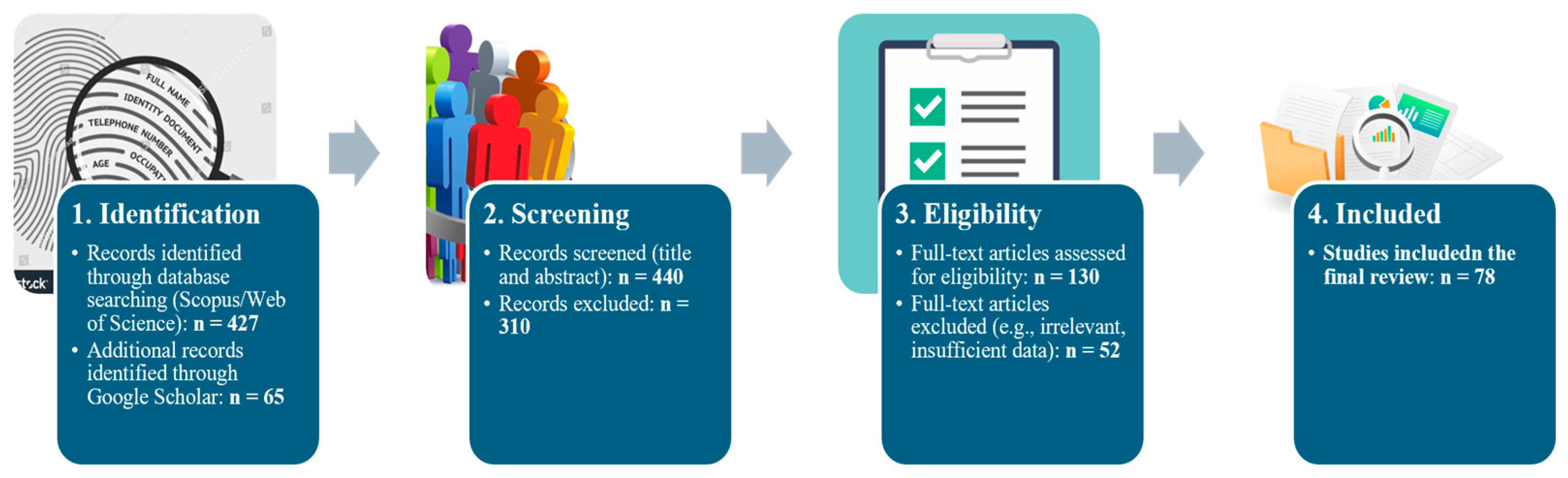
Figure 2.
a) Classification of solar dryers. Solar drying systems: b) distributed with direct and indirect air heating, c) integral greenhouse type, and d) mixed.
Figure 2.
a) Classification of solar dryers. Solar drying systems: b) distributed with direct and indirect air heating, c) integral greenhouse type, and d) mixed.
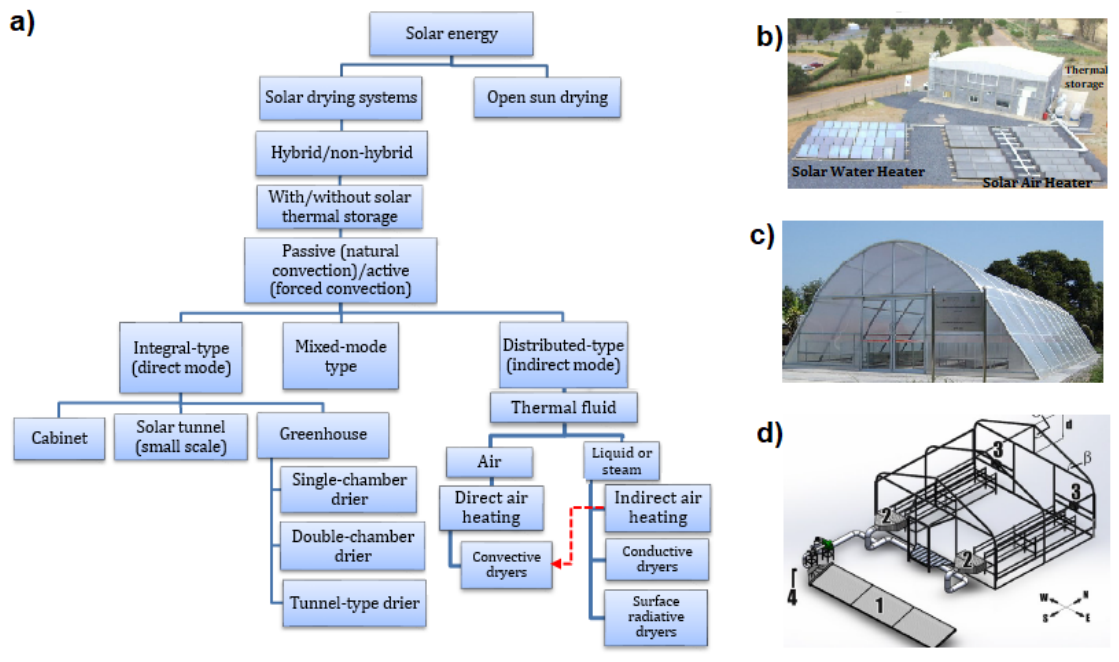
Figure 3.
A conceptual representation of the thermal drying process of wet material. Adapted from [54].
Figure 3.
A conceptual representation of the thermal drying process of wet material. Adapted from [54].
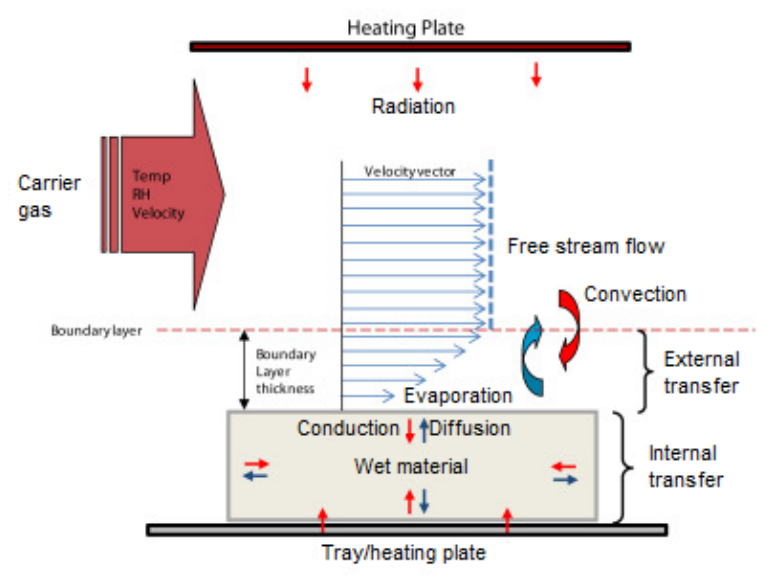

Table 1.
Dominant themes in solar drying reviews and their connection to monitoring and control.
| Review theme | Typical focus in the literature | Implications for monitoring and control (this review) |
|---|---|---|
| Dryer typologies and design configurations [19,20,21] | Classification of direct, indirect, mixed, greenhouse, and hybrid dryers; collector and chamber design. | Defines sensor/actuator placement and control objectives across configurations. |
| Thermal storage and hybridization [28,29,30] | PCM/sensible storage, auxiliary heaters, and PV/PVT integration to extend drying beyond sun hours. | Introduces supervisory control (charging/discharging logic), state estimation, and energy management. |
| Modeling and performance assessment [23,25,31] | CFD and lumped models, drying kinetics, energy/exergy, and performance metrics. | Enables model-based control and soft sensing; clarifies data requirements for calibration/validation. |
| Product quality and food safety [24,32,33] | Color, texture, nutrient retention, and microbial safety outcomes are evaluation criteria. | Translates quality targets into control variables (temperature, humidity, airflow) and constraints. |
| Technoeconomic and adoption context [22,34,35] | Cost, scalability, user operation, and maintainability considerations. | Motivates low-cost sensing, robust/simple controllers, and fail-safe operation. |
| Monitoring, control, and digitalization [26,27,36] | Often brief subsections; limited comparative synthesis across sensors, controllers, and architectures. | This review provides a structured synthesis of sensors, control strategies, and IoT/digital architectures, and outlines research gaps and recommendations. |
Table 2.
Comparative analysis of control and monitoring techniques for solar drying systems.
| Control and Monitoring Technique | Study | Advantages | Limitations | Possible Improvements | Complexity |
|---|---|---|---|---|---|
| Low-cost Arduino-based monitoring with on–off actuation (Bluetooth/app) | [67] | Continuous real-time acquisition of key drying variables (product mass, air temperature, and RH) using low-cost hardware; simple on–off actuation (e.g., exhaust fan/heater relay) improves operational repeatability; user-friendly Bluetooth mobile interface enables local visualization and basic supervision. | Typically threshold-based and single-loop; limited robustness under variable irradiance and disturbances; low-cost RH sensing (e.g., DHT22) can be inaccurate at high temperature/humidity; wiring/breadboard noise and non-standard data handling may affect reliability and reproducibility. | Implement hysteresis and time-delay logic; upgrade RH sensing and sensor protection/calibration routines; migrate to PCB-based integration and standardized data formats; add local logging plus optional remote connectivity; incorporate soft-sensor moisture/quality estimation and supervisory control to move beyond simple on–off schemes. | Medium |
| PID-Based Controllers | [53] | Industry standard; eliminates errors, improves tracking, maintains temperature/humidity, and ensures uniform drying. | Tuning affects performance; poor tuning causes overshoot/oscillations, mainly with variable sun; often, a single-loop for air temperature only. | Use auto-tuning, gain-scheduling, or adaptive control; consider multi-loop feedback if needed. | Medium |
| Networked/supervisory control systems (NCS) | [75] | Multitask control, expert knowledge, nonlinear, networked for supervision/tuning/coordination | Complex design; needs robust networks & resources; rule design is complex; pilot validation only. | Develop design/tuning tools (optimisation- or data-driven); address network delays/losses; integrate with IoT for energy/quality optimisation. | High |
| IoT-based monitoring and control | [64,68,69] | Enables remote monitoring, data logging, dashboards/alerts, and traceability of drying batches; facilitates supervisory control and quicker response to disturbances. | Dependence on connectivity and sensor calibration; many implementations remain rule-based (limited closed-loop control); interoperability and cybersecurity are rarely addressed | Edge computing with local fallback control; standardized protocols (e.g., MQTT/REST), calibration/diagnostics routines, and integration of moisture/quality indicators into supervisory control. | Medium |
| Smart sensing and model-based/ML estimation (soft sensors) | [71,72,73,74] | Capable of dealing with nonlinearities and uncertainties; can encode empirical expertise in linguistic rules; has demonstrated improved temperature regulation and overall performance compared with simple on–off schemes in some hybrid dryers. | Controller design is relatively complex; it requires careful definition and calibration of membership functions and rule bases; it is sensitive to sensor errors; implementation and maintenance may be challenging for non-specialist operators. | Simplify design procedures and provide user-friendly tools for rule-based tuning; combine fuzzy logic with PID or other conventional controllers (hybrid schemes); integrate additional sensors (e.g., humidity, product mass) to refine control actions and reduce the rule-set size. | High |
| Temperature Control Systems for Indirect Solar Dryers | [63] | Enable active regulation of tray temperatures in indirect multitray dryers under fluctuating solar irradiance; stabilise temperatures across different airflow modes; provide a practical way to compare and optimise airflow configurations for better temperature uniformity. | Temperature distribution across trays can remain non-uniform, particularly in specific airflow modes; humidity is often monitored but not tightly controlled; links between control performance and final product quality are rarely quantified. | Add additional fans or ventilation paths and sensors at critical locations to improve spatial uniformity; extend control to coupled temperature–humidity strategies; incorporate product-state or moisture criteria when defining setpoints and stopping conditions. | Medium |
Table 3.
Comparative analysis of control and monitoring techniques for solar drying systems.
| Ref | Dryer Type | Control / Monitoring | Sensors Used | Moisture reported/Notes | Energy metric reported |
|---|---|---|---|---|---|
| [53] | Hybrid indirect solar dryer (potato) | PID control of temperature and relative humidity (setpoints) | DHT22 (T, RH); Arduino-based controller; fans/heater | Reports ~73.16% moisture extracted over 8 h; maintains setpoints ~36.5 °C and ~33% RH; focuses on T/RH control (not product-endpoint control). | NR |
| [63] | Indirect solar dryer (multitray) with energy storage | Proportional tray-temperature regulation (setpoint control) | NTC temperature sensor(s) (tray-level) | Temperature regulation on multitrays under variable sun; humidity/product endpoints are not central in reported results. | NR |
| [67] | Hybrid solar-electric dryer (HSED) | Arduino-based monitoring; on/off exhaust during measurement; Bluetooth mobile app | DHT22 (T. RH); load cells and HX711; Arduino Mega 2560; BLE module | Validates automated vs conventional instruments: good correlation for mass & air temperature; low correlation for RH with DHT22. | NR |
| [64] | Hybrid solar-electric dryer (HSED) | Remote monitoring and PID temperature control (heater & fan) via PLC/LabVIEW and web (MQTT) | KIMO TM-110 PNB (3×temp), KIMO HM110-POD (2×RH), Kipp & Zonen pyranometer, YZC-131 load cell; WeatherLink Vantage Pro2; (actuators: 2 kW heater, OD1238 fan) | 0.10–0.14 kg water/kg dry matter (9–12% w.b.), depending on Tset. Fig slices (4 kg) dried at 40–70 °C; remote web dashboard and alerts; local fallback if internet drops; PID parameters adjustable remotely; camera-assisted monitoring. | SEC: 0.70 kWh/kg (at 70 °C); drying efficiency: 89% (70 °C); SEF 42.3%, EEF 57.7% (70 °C) |
| [69] | Solar banana dryer (IoT-enabled monitoring/control prototype) | IoT monitoring and remote supervisory control via ESP8266 NodeMCU (Blynk app); no explicit closed-loop control algorithm reported | ESP8266 NodeMCU; 3× DHT22 (T/RH). Airflow/velocity monitoring/control is claimed, but the specific sensor is not described; a manual thermometer and humidity meter are used for comparison | Uses ESP8266 NodeMCU; cloud dashboard via Blynk; compares IoT sensor readings vs manual instruments; reports % differences for T and RH errors larger. | NR |
| [78] | Solar greenhouse dryer (banana) | IoT monitoring (LoRa and WiFi to ThingSpeak) plus online ARX moisture prediction; logs fan on/off time (supervisory) | BME680 (Ta, RH); SCT-013 current sensor (fan on/off); Arduino Mega and UNO; LilyGo LoRa32 | 19.84% w.b. (4 days); 20.03% w.b. (5 days, with rainfall). Provides remote dashboard plus moisture prediction (ARX). Stronger “IoT plus soft-sensing” case study than the IJME prototype. | Power module: 4.2 Wh for IoT system (drying energy NR) |
| [72] | Instrumented solar dryer (smart-sensing supervision) | Smart sensing / psychrometric monitoring; model-based estimation of drying variables | Sensirion SHT (T and RH) network (8 nodes) | Focus is on sensor networks and computed psychrometric variables (absolute humidity, etc.). | NR |
| [73] | Solar hybrid collector with dryer (SHCD) | Data-driven/ML evaluation (RBF NN, etc.) and monitored airflow/thermal variables (not a closed-loop controller focus) | Thermocouples (collector/dryer), solar irradiance sensor (handheld). digital anemometer (air velocity) | Coriander seeds; ML models for mass/temperature; reports R² up to >0.98; compares solar dryer vs open-sun drying. | SEC avg 3.98 kWh/kg (range 1.60–15.00 kWh/kg); SMER avg 0.36 kg/kWh |
| [71] | Tea drying (moisture determination method) | Moisture estimation from T/RH sensors (psychrometric/ERH approach) | T/RH sensors (calibrated) | Useful as a ‘soft sensor’ reference; not a solar-dryer control/energy performance case. | NR |
| [60] | Forced convection mixed-mode horizontal solar cabinet dryer (black ginger) | Operational strategy: two successive airflow rates (manual 2-stage) | Thermocouples; hygrometer; anemometer; solar radiation measurement; weighing scale | Two-stage airflow reduced SEC. | SEC: 1.07 kWh/kg water (Case 1); 0.56 kWh/kg water (Case 2) |
Disclaimer/Publisher’s Note: The statements, opinions and data contained in all publications are solely those of the individual author(s) and contributor(s) and not of MDPI and/or the editor(s). MDPI and/or the editor(s) disclaim responsibility for any injury to people or property resulting from any ideas, methods, instructions or products referred to in the content. |
© 2026 by the authors. Licensee MDPI, Basel, Switzerland. This article is an open access article distributed under the terms and conditions of the Creative Commons Attribution (CC BY) license (http://creativecommons.org/licenses/by/4.0/).
Copyright: This open access article is published under a Creative Commons CC BY 4.0 license, which permit the free download, distribution, and reuse, provided that the author and preprint are cited in any reuse.