

Submitted:
30 September 2026
Posted:
02 October 2026
You are already at the latest version
Abstract
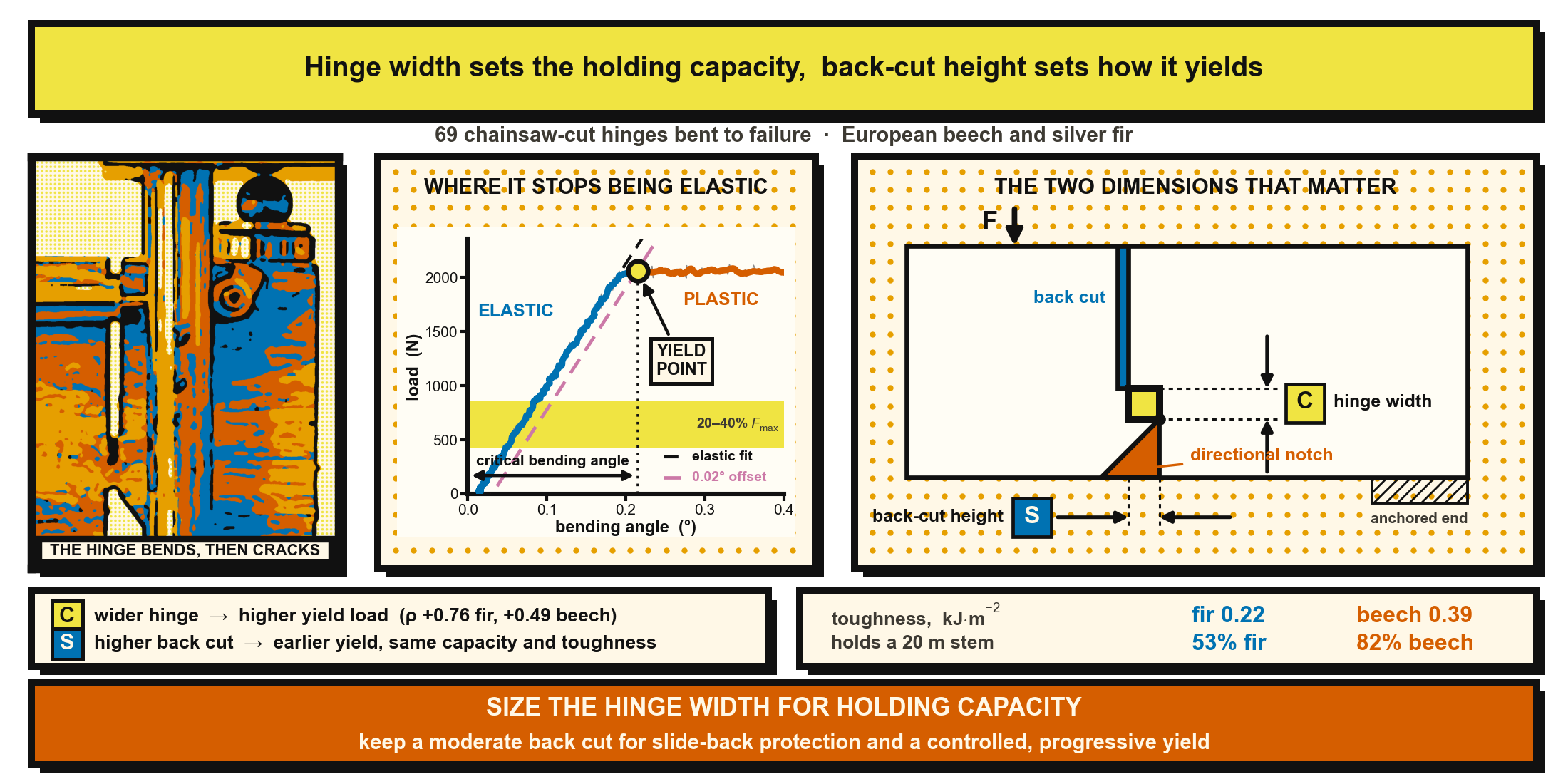
Motor-manual tree felling by chainsaws remains a widespread but hazardous forestry practice. This operation consists of executing a directional notch followed by a felling cut that releases a hinge. The hinge geometry (defined by its height, width, and alignment relative to the directional notch) is a critical determinant of safe felling, controlling the direction and stability of the falling tree. How the hinge's geometry might affect these aspects has not yet been studied. This study evaluates variations in hinge flexibility and bending stiffness using wooden square beams of European beech (Fagus sylvatica) and silver fir (Abies alba) in a rig reproducing the classical felling cuts, varying hinge geometry combinations. Two geometric parameters, back-cut height (S) and hinge width (C) were examined. Mechanical testing was performed using a universal testing machine, and load–deformation curves were smoothed with a Savitzky–Golay filter; the Critical Bending Angle and Yield Point were determined by using the 0.02° offset method and absorbed energy by Simpson integration. Results reveal different mechanical behavior between the two dimensions: hinge width primarily determines yield force, whereas back-cut height governs flexibility, showing a strong negative correlation with the critical bending angle. Significant species-specific differences were observed for both response variables. Hinge toughness, expressed as absorbed energy per unit hinge cross-section, was found to be independent of back-cut height and about 1.8 times higher in beech (0.39 kJ·m⁻²) than in fir (0.22 kJ·m⁻²).
Keywords:
tree felling
; chainsaw
; felling hinge
; hinge geometry
; back-cut
; hinge bending stiffness
; hinge toughness
Copyright: This open access article is published under a Creative Commons CC BY 4.0 license, which permit the free download, distribution, and reuse, provided that the author and preprint are cited in any reuse.