

Submitted:
30 September 2026
Posted:
02 October 2026
You are already at the latest version
Abstract
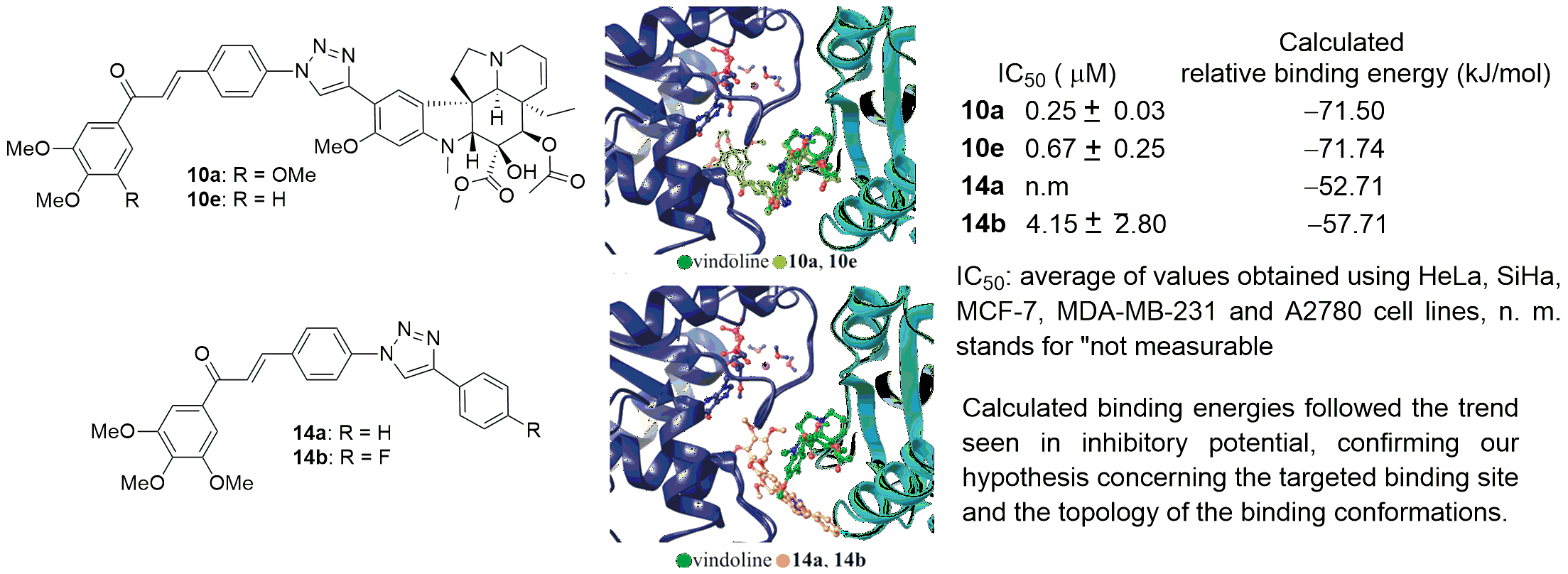
In the frame of our ongoing research on multitarget alkaloid-derived anticancer agents, relying on a modular synthetic strategy terminated by well-established sequential Sonogashira and CuAAC protocols, we synthesized a systematic selection of chalcone-vindoline hybrids incorporating 1,4-disubstituted 1,2,3-triazole as a linker. The use of the same synthetic approach led to the construction of a zidovudine-derived vindoline hybrid, which served as a negative control highlighting the essential contribution of the chalcone moiety to the antiproliferative activity. Two analogous aryl-substituted chalcone hybrids 14a,b were also prepared to assess the contribution of the vindoline fragment to the desired effect. The targeted hybrids and the references were evaluated for their antiproliferative activity against a panel of human adherent gynecological cancer cell lines (HeLa, SiHa, MCF-7, MDA-MB-231 and A2780) as well as on non-malignant fibroblasts (NIH/3T3). Vindoline hybrids 10a and 10i comprising 3,4,5- and 1,4,6-trimethoxyphenyl-substituted chalcone fragments, respectively, displayed substantial activity, featuring IC50 values lower than 0.4 µM on all the investigated cancer cell lines. On the other hand, hybrids 10c–e containing monomethoxy-substituted chalcones, also featuring submicromolar IC50 values on malignant cells, showed moderately lower activities against non-malignant fibroblasts (NIH/3T3), indicating a certain degree of cancer selectivity. The related ferrocene-derived hybrid (10i) and vindoline-free chalcones 14a,b were identified as antiproliferative agents with significantly decreased efficiency, while the ferrocene hybrid comprising an alternative enone sequence in the chalcone residue (11) as well as the zidovudine-derived vindoline hybrid 12 were inactive. Modeling results indicate that the vindoline hybrids bind to the inter-dimer vinca crevice of tubulin oligomers and confirm that the two segments exert a mutually stabilizing effect on the binding of the other, providing a framework for future structure optimization.
Keywords:
vindoline
; chalcone
; hybrid molecules
; Sonogashira reaction
; CuAAC
; antiproliferative effect
; tubuline inhibitor
; docking studies
Copyright: This open access article is published under a Creative Commons CC BY 4.0 license, which permit the free download, distribution, and reuse, provided that the author and preprint are cited in any reuse.