

Submitted:
30 September 2026
Posted:
02 October 2026
You are already at the latest version
Abstract
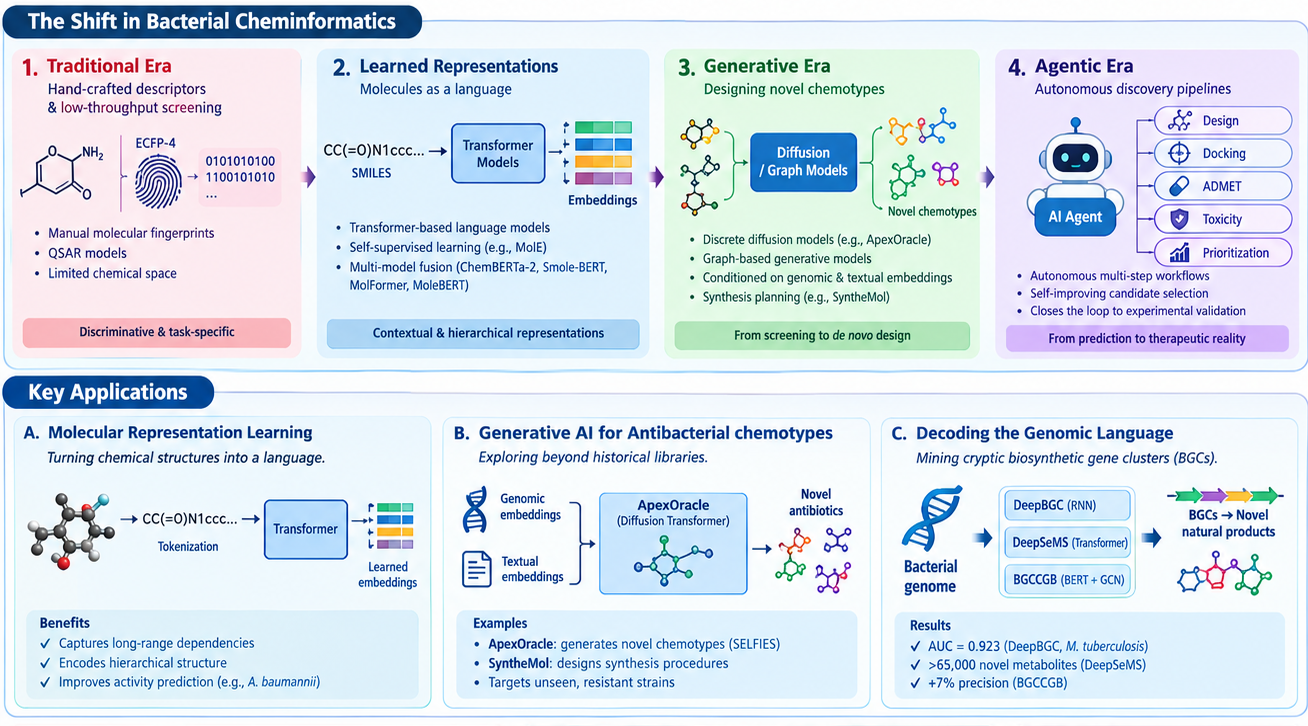
The escalating global crisis of antimicrobial resistance (AMR), often characterized as a "silent pandemic," necessitates a paradigm shift in antibiotic discovery. Traditional cheminformatics pipelines, reliant on hand-crafted molecular descriptors and low-throughput screening, are increasingly insufficient to address the evolving threats of multidrug-resistant pathogens. This Opinion article explores the transformative integration of Large Language Models (LLMs) and foundational Transformer architectures into bacterial cheminformatics. We argue that the field is transitioning from simple discriminative modeling toward a generative and agentic era. By leveraging advanced molecular representations that treat chemical structures as a linguistic medium, LLMs enable the exploration of vast, structurally novel chemotypes previously inaccessible. Furthermore, LLMs are revolutionizing microbial genome mining and the identification of cryptic biosynthetic gene clusters through the decoding of "genomic language." We highlight recent breakthroughs, including foundational discrete diffusion models and autonomous discovery agents, while addressing the critical needs for data quality and rigorous biological validation. The future of antimicrobial research lies in multi-modal, foundational systems capable of bridging the gap between genomic potential and therapeutic reality.
Keywords:
bacterial cheminformatics
; Large Language Models
; antimicrobial resistance
; antibiotic discovery
; biosynthetic gene clusters
; generative AI
; molecular representation learning
Copyright: This open access article is published under a Creative Commons CC BY 4.0 license, which permit the free download, distribution, and reuse, provided that the author and preprint are cited in any reuse.