

Submitted:
01 October 2026
Posted:
02 October 2026
You are already at the latest version
Abstract
An older athlete can retain exceptional performance in a practiced task without demonstrating preservation of a young-adult neuromuscular system. Building on the previously proposed Dual-Barrier Model of motor specificity and biological aging, this review provides a mechanistic expansion of Barrier 2, Biological Aging (Ruggia, 2026). It examines central motor organization, predictive control, sensory integration, descending input, spinal neuromodulation, motor-unit organization, neuromuscular transmission, muscle composition, and contractile function. Human evidence supports age-associated differences at multiple levels, but does not establish a universal sequence of failure or a single dominant lesion. Lower indirect estimates of persistent inward currents, altered rapid motor-unit discharge, and impaired muscle contractile properties provide complementary explanations for reduced force-time performance. Important counterevidence includes preserved implicit motor adaptation, retained modulation of spinal excitability, training-associated improvements, and successful functional reinnervation. Regeneration of a downstream component therefore cannot be presumed either sufficient for integrated rejuvenation or incapable of useful recovery. The expanded model proposes that the expression of age-associated limitations depends on interactions among biological capacity, compensation, task-specific expertise, and movement demands. Its principal prediction is that constrained preparation time and multidirectional reactive demands will reveal differences that successful performance alone may obscure. This prediction remains untested as an integrated mechanistic model in Masters sprinters. A research agenda combines matched movement tasks with sensory, electrophysiological, force-time, and tissue measurements, while specifying outcomes that would weaken the model. The contribution is a testable systems framework, not evidence that training is ineffective, regeneration must fail, or an immutable biological ceiling has been established.
Keywords:
neuromuscular aging
; Dual-Barrier Model
; persistent inward currents
; motor units
; muscle quality
; reactive movement
; functional integration
1. Introduction and Relationship to the Dual-Barrier Model
The original Dual-Barrier Model distinguishes two reasons why excellence in a practiced movement cannot establish youthful movement capacity across tasks. Barrier 1, Motor Specificity, concerns transfer between tasks. Barrier 2, Biological Aging, concerns the biological system producing the performance. The parent paper introduced whole-body reactive force-time capacity as a proposed construct describing the organization, generation, absorption, redirection, and stabilization of force when the required response is incompletely known in advance. It did not establish a validated composite score or demonstrate the predicted age-by-demand interaction in Masters athletes (Ruggia, 2026).
The specificity distinction has an experimental foundation. Straight-sprint training in Young et al.'s study did not broadly transfer as predetermined change-of-direction demands became more complex; change-of-direction training did not improve straight sprinting. This was a training-transfer experiment, not a study of aging or genuinely reactive agility (Young et al., 2001). The present manuscript retains that distinction but asks a different question: what interacting biological mechanisms constitute Barrier 2, and how should their contribution to movement be tested?
Preserved muscle size, successful movement, and retained expertise are informative but incomplete endpoints. Competitive older athletes can retain substantial muscle while showing marked differences in power relative to muscle volume, and longitudinal human observations show that strength and muscle mass need not change in parallel (Goodpaster et al., 2006; Zange et al., 2026). Such dissociations justify investigating neural and muscular mechanisms together. They do not identify the residual difference as exclusively neural, and they do not imply that all older individuals share the same limiting component.
The central proposition of this extension is that youthful movement depends on functional coordination across a distributed architecture. Repair, preservation, or adaptation at one level must be evaluated in relation to the remaining system and the demands placed upon it. This is a hypothesis about integration and measurement, not a claim that every component must be restored before any meaningful functional improvement can occur. The paper develops the evidence for that proposition, confronts preservation and repair evidence, and specifies experiments capable of constraining or falsifying its stronger predictions.
2. Review Approach and Interpretive Boundaries
This is a critical narrative review and hypothesis paper, not a systematic review, meta-analysis, clinical trial, or original experimental study. The supplied parent preprint and preliminary mechanistic framework defined the questions, but the preliminary framework was not treated as evidence for its own claims. Literature retrieval targeted the named mechanisms, their measurement limitations, and counterexamples involving preservation, plasticity, and functional repair. Publisher records, PubMed/Europe PMC records, and accessible original articles were used to check publication identity and reported findings. Searches and verification were completed in September 2026. No exhaustive database screening or formal risk-of-bias scoring was performed.
Primary human studies receive priority for age-related functional claims. Mechanistic animal work is identified explicitly, and narrative reviews supply context where direct human experiments are limited. Statements distinguish observations, supported interpretations, the present hypothesis, and proposed tests. Cross-sectional differences are not treated as within-person rates of decline. Electrophysiological estimates are not equated with anatomical cell counts, and a training-associated change in one variable is not equated with restoration of the entire system. The parent preprint is cited as the origin of the framework, not as independent peer-reviewed confirmation (Ruggia, 2026).
For this paper, restoration of a measured component means reaching a prespecified reference range using an appropriate measurement and comparator. Integrated restoration would require convergent evidence across relevant biological and functional domains, rather than a single favorable endpoint. Neither definition requires identical microscopic anatomy in every person. They require explicit targets and adequate measurement. These are proposed operational definitions, intended to prevent improvement, compensation, preservation, and restoration from being used interchangeably.
3. Barrier 2 as a Distributed Biological Constraint
Movement depends on interacting neural, sensory, and musculoskeletal processes. Reviews of aging describe changes across central and peripheral neuromuscular levels, while human studies separately document altered rapid activation and intrinsic muscle contractile properties (Borzuola et al., 2020; Klass et al., 2008; Lamboley et al., 2015; Manini et al., 2013). The useful systems question is therefore not simply whether the brain, motor neuron, or muscle is responsible. It is which processes constrain a particular task, how other processes compensate, and whether the constraint changes when task demands change.
Figure 1 presents the expanded architecture. Its arrows indicate functional relationships rather than a proven chronological cascade of degeneration. Sensory information returns to spinal and supraspinal circuits; neuromodulatory signals alter the response to synaptic input; and muscle mechanics determine the movement that generates subsequent feedback. Figure 2 provides a simplified teaching view of this same architecture. Neither diagram implies that aging affects every node equally or that each illustrated difference has been established in every muscle, age group, or athletic population.
A useful conceptual formulation is that observed performance depends jointly on biological capacities, their coordination, prior experience, and task demands. It would be premature to assign a numerical coefficient to each level or multiply study-specific percentage deficits into a single predicted loss. These variables are measured with different methods, often in different populations, and can interact nonlinearly. The framework instead proposes conditional constraints: a preserved component can support excellent performance in one task while another component becomes limiting under a different time, load, or uncertainty requirement.
Table 1 summarizes the component evidence and its limits. Its evidence-strength descriptions concern the stated finding, not proof of the complete model. Direct evidence of a local physiological difference can coexist with weak evidence that this difference causes an age-related loss of reactive whole-body movement. Keeping those inferential steps separate is essential to the proposed expansion.
4. Central Motor Architecture and Predictive Control
4.1. Motor Representations and Retained Learning
Motor memory should not be represented as a fixed software file that inevitably becomes corrupted with age. Hamano et al. examined cortical network changes during early finger-sequence learning in healthy volunteers using functional magnetic resonance imaging. Their findings concern the changing organization of a practiced sequence, not destruction of motor engrams during normal aging (Hamano et al., 2020). Network-level representations can be dynamic without being either intact in every respect or globally lost.
Evidence from adaptation directly limits a global predictive-failure claim. Vandevoorde and Orban de Xivry found that age differences in overall motor adaptation coexisted with preserved implicit internal-model recalibration and retention. The age-sensitive component was more closely related to cognitive aspects of adaptation (Vandevoorde & Orban de Xivry, 2019). Thus, an older adult may retain an important predictive-learning process even when performance in the complete task differs. This distinction argues against treating all feedforward control, learning, and executive contribution as a single aging variable.
Within the expanded model, central limitations are therefore task-dependent hypotheses to be measured, not assumed universal failures. Relevant experiments would separate advance planning, implicit recalibration, explicit strategy, attention, and execution. Preserved performance in one domain would constrain claims about that domain without proving preservation of all others. Conversely, slower task completion cannot by itself localize the cause to cortical representations.
4.2. Feedforward and Feedback Control Are Complementary
Fast movement places substantial demands on advance preparation, but speed does not make the entire movement feedback-free. An integrative review emphasizes central planning while also describing the heterogeneous methods and definitions used to study fast limb movements (Correia et al., 2022). In a human perturbation experiment, rapid responses within the long-latency interval included independently modulated stabilization and release of prepared actions, followed by additional interactions. This demonstrates that rapid control can combine preparation with feedback rather than conforming to a universal open-loop cutoff (Lee & Perreault, 2019).
Accordingly, the model does not assert that every correction requires more than 100 ms or that all movement completed quickly must be exclusively preprogrammed. The available correction time depends on the sensory pathway, task, perturbation, and response being measured. A study of fast voluntary force generation, a stretch response, and a visual target correction interrogate different timing processes. Combining them into a single cortical delay would obscure the mechanism under investigation.
5. Sensory Integration and Proprioceptive Aging
Proprioception supplies information about body configuration and movement. A human histological study found age-related differences in intrafusal fiber content and myosin composition in biceps muscle spindles (Liu et al., 2005). This establishes a peripheral sensory alteration in sampled tissue; it does not demonstrate universal gamma-motor-neuron loss. A broader review describes age-related changes in proprioceptive sensitivity and integration relevant to upright standing (Henry & Baudry, 2019). Alpha motor neurons drive extrafusal muscle fibers, whereas the gamma system regulates intrafusal activity and spindle sensitivity. Age-related dysfunction of their coordination remains a more specific question than a general observation of worse balance.
Central processing also matters. During muscle-spindle stimulation, Goble et al. identified age-related differences in right putamen activation associated with joint-position sense and local white-matter measures (Goble et al., 2012). Van Impe et al. related white-matter fractional anisotropy to balance performance under challenging sensory conditions in older adults (Van Impe et al., 2012). These are associations. Fractional anisotropy is not a direct count of surviving axons, and neither study establishes that a fixed percentage of motor-control capacity has been lost.
The movement implication is more concrete than a claim of generalized sensory collapse. When Zhang et al. displaced visual targets or backgrounds during fast pointing, older participants achieved comparable accuracy but responded later and less vigorously to perturbations (Zhang et al., 2018). Successful task completion therefore did not imply identical control dynamics. The proposed extension predicts that reduced preparation and changing sensory information may expose such differences across additional tasks, but a pointing experiment cannot establish an age effect in Masters sprint-to-cut transitions.
6. Descending Drive and Spinal Amplification
6.1. Motor Neurons Are Active Integrators
A motor neuron does not simply relay an unchanged command from the cortex. Its output reflects converging excitatory and inhibitory input, intrinsic membrane properties, and neuromodulatory state. Persistent inward currents, carried through voltage-sensitive conductances, can amplify synaptic input and help sustain firing. Much of the direct intracellular evidence comes from animal preparations; interpretation of human firing patterns depends on indirect measurements (Heckman et al., 2008). A multiplier measured in a particular preparation must not be converted into a universal percentage of available human force.
Brainstem monoaminergic influences are important to this physiology, but an age-related difference in human firing does not directly measure serotonin or noradrenaline availability. Reduced synaptic input, changed channel properties, altered inhibition, and neuromodulatory differences are candidate explanations that require discrimination. The relevant review treats these mechanisms as research questions rather than an established complete causal chain in aging humans (Orssatto, Blazevich, & Trajano, 2023).
6.2. What Human Persistent Inward Current Estimates Show
Paired motor-unit analysis commonly estimates discharge hysteresis through delta frequency, ΔF. A lower-threshold control unit serves as an indirect indicator of shared input while a test unit is recruited and derecruited. The resulting measure is informative about intrinsic excitability under specified assumptions; it is not an intracellular current recording or a direct biochemical assay (Heckman et al., 2008; Orssatto, Blazevich, & Trajano, 2023).
Orssatto et al. studied 25 older and 17 young adults during low-force plantar- and dorsiflexion ramps. Older participants showed lower ΔF estimates and lower peak discharge rates in soleus and tibialis anterior (Orssatto et al., 2021). Hassan et al. reported corresponding age differences in upper-limb motor-unit estimates (Hassan et al., 2021). Convergence across these experiments supports altered motor-neuron excitability in the tested conditions. It does not establish an identical deficit in every motor pool or predict the first instant of an explosive movement without additional evidence.
In particular, slow submaximal ramps and rapid high-force contractions sample different operating conditions and often different observable units. The proposed bridge from reduced PIC contribution to reduced rapid movement therefore remains a mechanistic inference. It should be tested using convergent recordings and interventions rather than assuming that a low-force ΔF value is a direct measure of high-threshold recruitment during reactive braking.
6.3. Preserved Modulation Is Substantive Counterevidence
In a related experiment, remote handgrip increased ΔF in both age groups, while tendon vibration reduced it, with some muscle-specific age differences. The analyzable cohort comprised 17 young and 25 older adults, with smaller samples for individual conditions because motor units had to be identified and matched (Orssatto et al., 2022). Lower baseline estimates therefore coexisted with retained capacity for facilitation. This finding limits the proposition that the older spinal system has simply lost neuromodulatory responsiveness.
Training evidence provides another constraint. In 17 older adults, a two-week control period followed by six weeks of resistance training was associated with increased soleus ΔF estimates, discharge rates, and improved physical outcomes. Changes in several measures were correlated (Orssatto, Rodrigues, et al., 2023). The design was not a randomized parallel-group trial, and it did not establish complete restoration to a young reference system. Nevertheless, it directly opposes describing the measured spinal contribution as permanently fixed or unresponsive to training.
7. Motor Neurons and Motor-Unit Organization
Age-related motor-unit remodeling can involve loss of functional units, collateral reinnervation, and enlargement of surviving units. In cross-sectional human comparisons, lifelong endurance and power athletes showed patterns consistent with greater compensatory motor-unit expansion (Piasecki et al., 2019). Such evidence supports remodeling and compensation; it does not show that training generates new spinal motor neurons. Likewise, motor-unit number estimates depend on electrical and sampling assumptions and must not be read as whole-body anatomical inventories.
Octogenarian world-class athletes had more estimated functioning motor units and greater transmission stability in a sampled lower-leg muscle than age-matched controls (Power et al., 2016). This is meaningful preservation evidence. Selection, training history, and other group differences prevent attributing the entire contrast to training, and comparison with age-matched controls does not demonstrate young-adult restoration. The finding nevertheless constrains any claim that biological aging proceeds identically regardless of lifelong activity.
Direct anatomy raises a further challenge to a simple neuron-death account. Castro et al. reported preserved motor-neuron density in their sampled material alongside reduced excitatory synaptic input. Their human cervical-cord comparison involved three young and three older donors, with more extensive mechanistic characterization in mice and supporting primate observations (Castro et al., 2023). These findings do not settle motor-neuron survival across the whole human spinal cord. They show why reduced output, altered connectivity, peripheral disconnection, and neuronal death must be distinguished rather than treated as interchangeable explanations.
The expanded framework consequently does not require all weakness to originate in motor-neuron loss. It includes altered input to surviving neurons, altered intrinsic gain, changed recruitment and firing, and peripheral remodeling as distinguishable candidate mechanisms. A decisive study would combine structural and functional measures in the same motor pool. Differences between histology and electrophysiological estimates should motivate such work, rather than be resolved by declaring all missing units either dead or merely dormant.
8. Peripheral Axons and Neuromuscular Junctions
The peripheral pathway must conduct activity and transmit it to muscle, but age-related change is not uniform across species or measurement domains. Jones et al. found substantial preservation of adult human neuromuscular-junction architecture in the sampled material, in contrast to commonly described mouse changes (Jones et al., 2017). Preserved morphology does not demonstrate identical transmission under every condition; conversely, a mouse fragmentation pattern should not be imposed automatically on human junctions.
Disuse is an additional exposure, not a synonym for chronological aging. After 21 days of bed rest in nine young men, Sarto et al. observed altered motor-unit properties, impaired transmission measures, and initial evidence of junctional remodeling/denervation (Sarto et al., 2025). The study supports sensitivity to medium-term inactivity. It does not establish irreversible neuron death, the same response in all older adults, or a lifelong exponential loss law.
For movement, the relevant hypothesis is that impaired transmission or axonal reliability can interact with firing demands and the available muscular reserve. Testing requires defining the muscle, contraction, and transmission measure. Surface EMG amplitude alone is insufficient to locate a deficit among descending drive, motor-unit discharge, conduction, junctional transmission, and muscle-fiber properties. Interpretation should use measurements capable of separating those alternatives rather than assign all low activation to a single upstream lesion (Borzuola et al., 2020; Manini et al., 2013).
9. Muscle Quality and the Downstream Environment
9.1. Muscle Quantity Does Not Exhaust Muscle Function
The Health ABC longitudinal study followed changes in strength and body composition in 1,880 older adults over three years. Strength declined more rapidly than lean mass, and gaining lean mass did not ensure maintained strength (Goodpaster et al., 2006). This establishes a dissociation, not a numerical estimate of the fraction caused by the nervous system. Muscle quality is an operational description whose biological explanation requires additional measurements.
Intrinsic muscle findings provide part of that explanation. In skinned human fibers, Lamboley et al. identified age-related differences in type II specific force, calcium sensitivity, and sarcoplasmic-reticulum calcium content (Lamboley et al., 2015). Because the preparation directly interrogates muscle properties, these findings cannot be reduced to inadequate voluntary cortical effort. They support retaining excitation-contraction coupling and contractile machinery within Barrier 2 alongside neural mechanisms.
Myosteatosis requires precise compartment and measurement definitions. Intermuscular or intramuscular adipose tissue denotes adipocytes outside muscle fibers; the abbreviation IMAT is used differently across studies. Intramyocellular lipid denotes lipid within fibers and is not interchangeable with these adipose depots or necessarily evidence of impaired function. Whole-body fat percentage, regional adipose tissue, computed-tomography attenuation and lean tissue quantity therefore should not be treated as equivalent measurements (Dondero et al., 2024). In older Health ABC participants, lower muscle attenuation was associated with lower strength after adjustment for muscle size (Goodpaster et al., 2001). This association does not establish that removing a given amount of lipid will cause a specified improvement.
Human evidence connects muscle fat with activation and movement, but does not establish the direction of causation. In 15 older adults (29 legs), greater intramuscular adipose tissue was associated with a lower knee-extensor central activation ratio measured by superimposed stimulation (r = −0.51). This small observational study cannot identify the anatomical site of an activation deficit or demonstrate that fat physically blocks electrical nerve conduction (Yoshida et al., 2012). In 40 community-dwelling older adults, participants using a cross-step after lateral balance perturbation had less hip-abductor intramuscular adipose tissue, greater abductor torque and longer first steps than those using a medial step, despite no significant difference in lean tissue area. These cross-sectional comparisons link composition to protective stepping; they do not show that changing fat content changes stepping strategy or reactive agility (Addison et al., 2017).
Human tissue experiments support treating IMAT as biologically active rather than exclusively passive noncontractile material. Kahn and colleagues compared conditioned media from IMAT explants from six adults with obesity with subcutaneous and visceral adipose explants from six different adults with obesity. IMAT secreted higher levels of selected inflammatory cytokines, chemokines and bioactive lipid mediators, but also higher levels of selected anti-inflammatory cytokines. The study establishes secretory activity and supports a plausible influence on the local muscle environment. Its small, separate donor groups differed in adiposity, and it did not measure contraction, neural activation or rapid force development. Consequently, it does not establish an inflammatory mechanism of impaired movement in aging Masters athletes (Kahn et al., 2022).
More direct evidence of impaired contraction comes from an animal experiment. In glycerol-treated mouse muscle, greater intramuscular adipose tissue was associated with lower isolated-muscle contractile tension beyond that explained by loss of contractile material. Glycerol treatment did not reduce contractile force in a lipodystrophic mouse model unable to generate adipocytes. Together, these experiments support an adipose-dependent contribution to contractile impairment in that model, rather than a purely passive association (Biltz et al., 2020). They do not establish the corresponding effect in normal human aging, identify a specific secreted mediator, or demonstrate nerve-conduction blockade: the contraction deficit was measured in isolated muscle, without the intact neuromuscular and circulatory systems.
Myosteatosis should not be presented as universally irreversible. A systematic review and meta-analysis of exercise interventions in adults reported reduced lipid infiltration and increased muscle attenuation, although the studies differed in populations, interventions and imaging methods (Ramírez-Vélez et al., 2021). These findings support modification of measured muscle composition. They do not establish that fat reduction itself mediates functional improvement, that all lipid compartments respond identically, or that improved composition restores young-adult integrated neuromuscular function.
Within Barrier 2, the supported interpretation is that muscle fat can mark impaired function and may also participate in a biologically active local environment; evidence for activation and protective stepping in older humans remains associative, whereas direct contractile evidence is experimental and animal-based (Addison et al., 2017; Biltz et al., 2020; Kahn et al., 2022; Yoshida et al., 2012). The model therefore treats myosteatosis as one potential contributor alongside neural activation, contractile properties and other aspects of muscle quality. Whether regional muscle fat independently contributes to early RFD, braking or unpredictable multidirectional movement in Masters athletes remains a testable hypothesis, not a demonstrated result of these studies.
9.2. Highly Active Athletes Remain Informative
Zange et al. compared 43 men across young athletes, Masters athletes, and age-matched controls, using muscle imaging and jumping measurements. Athletes retained larger muscle volumes than controls, and older athletes had less muscle fat than older controls. Nevertheless, power relative to muscle volume differed substantially with age (Zange et al., 2026). This dissociation is central to the framework: substantial tissue preservation does not itself establish youthful force-time performance. The volume-independent deficit described as sarcosthenia is not a direct assay of neural degeneration or a unique molecular diagnosis.
Alvero-Cruz et al. likewise found age-associated body-composition changes in competitive Masters track-and-field athletes. Their cross-sectional analysis reported approximately 2.0 percentage points higher body fat per decade, with a standard error of 0.4 percentage points. Age remained a predictor of jumping power after adjustment for specialization, percent fat-free mass, and phase angle (Alvero-Cruz et al., 2021). The age coefficient is not a within-person trajectory or proof that unmeasured neural changes explain the remainder.
Mechanically, at a given required change in velocity, moving additional mass requires additional net impulse. This physical relationship motivates including body composition and total mass in reactive-movement analyses; it does not establish that fat alone causes age-related movement differences. At an identical whole-body fat percentage, tissue distribution and muscle properties can still differ. Regional imaging and functional measures are therefore needed alongside whole-body composition. Braking control, force attenuation, and subsequent propulsion should be measured directly rather than inferred from appearance (Goodpaster et al., 2001; Harper et al., 2022).
10. Rapid Force Production and Time-Critical Movement
Rate of force development describes the rise in force after a defined force onset. It is not the entire time from stimulus presentation to movement. The first approximately 50–75 ms is strongly influenced by rapid activation and discharge behavior, but contractile and mechanical properties also contribute; methods, onset detection, and filtering influence the estimate (Maffiuletti et al., 2016). The present model does not label this interval pure cortical drive or declare a universal 50-ms threshold separating youthful and aged movement.
Klass et al. found lower rapid voluntary torque development and lower early motor-unit discharge frequency in older than young adults during fast dorsiflexor contractions. Comparison with electrically evoked responses supported contributions from both neural activation and contractile slowing (Klass et al., 2008). The experiment provides a mechanistic reason to measure force-time behavior separately from maximal force. It does not prove that every muscle or every reactive movement has the same percentage deficit.
A complete experiment should separately timestamp the stimulus, detectable EMG onset, force onset, and the subsequent force trajectory. The stimulus-to-EMG interval, electromechanical delay, and force development address different processes. For multijoint movement, force absorption and redirection also matter: a participant may generate a high maximum force yet organize it too late or in a less effective direction for a particular perturbation. This last proposition is a task-level hypothesis informed by force-development physiology and braking mechanics, not a result established by an isolated isometric test (Harper et al., 2022; Maffiuletti et al., 2016).
11. From Laboratory Components to Reactive Whole-Body Movement
The parent construct of whole-body reactive force-time capacity remains a proposed multidimensional framework (Ruggia, 2026). It should not become a single unvalidated score that conceals dissociations between perception, force, balance, and execution. A useful assessment would retain interpretable outcomes: response latency, early force production, braking impulse, directional force control, stabilization time, and completion accuracy. Measures should be chosen for reliability and relevance to the task rather than because each can be described as neural.
Existing human studies give partial support without performing the complete test. MacKenzie et al. associated hopping measures with age, strength, and a corticospinal measure in 32 non-athletes. The task was a particular hopping assessment, not a full test of unpredictable agility, and corticospinal assessment used a hand-muscle response rather than directly identifying the lower-limb cause (MacKenzie et al., 2025). A cross-sectional study of 231 community-dwelling older adults found that a reactive direction-change task distinguished fall-history groups, but it did not prospectively predict falls or compare Masters sprinters with young athletes (Giesche et al., 2026).
The central prediction remains an interaction: after appropriate familiarization and accounting for baseline mechanical capability, age-associated differences should become more evident as preparation time is restricted and directional or reactive demands increase. It is not enough to show that older people are slower on all tasks. Nor should any outcome be interpreted as confirming the model simply because its label includes complexity. Mechanical load and uncertainty must be manipulated separately, and successful completion must be distinguished from the kinetics and coordination used to achieve it.
12. Regeneration and Functional Integration
12.1. The Question Is Sufficiency Rather than Impossibility
Replacing a motor neuron, repairing an axon, restoring neuromuscular contact, or increasing muscle tissue addresses a defined component. Whether that intervention restores youthful movement depends on what it repairs and what the remaining system can support. Figure 3 separates local repair, demonstrated integration, and integrated performance. It is a proposed evaluation framework, not a prediction that regenerated components necessarily remain inert.
For a replacement motor neuron, relevant questions include effective input, appropriate target innervation, recruitment and discharge control, sensory coordination, and compatibility with the contractile tissue it drives. For axonal repair, existing central circuitry may remain available and be reorganized through rehabilitation. For muscle repair, functional innervation and loading may be more immediately limiting than cortical reconstruction. The integration problem therefore differs across interventions; it cannot be reduced to a requirement to recreate every past motor memory.
12.2. Successful Repair Challenges a Categorical Failure Claim
Bryson et al. transplanted stem-cell-derived motor neurons in mice and obtained muscle activation through optogenetic control after reinnervation (Bryson et al., 2014). This is successful functional peripheral incorporation. It does not demonstrate natural voluntary control through the complete original descending architecture, but it refutes the proposition that transplanted motor neurons must be functionally inert.
Human reconstruction also demonstrates usable plasticity. In a prospective case series involving 16 people with tetraplegia, nerve transfers, sometimes combined with tendon transfers, were followed by improvements in upper-limb function (van Zyl et al., 2019). This was injury reconstruction rather than rejuvenation of normally aging motor systems. The case-series design and combined procedures limit causal attribution to any single element. Nonetheless, surviving circuitry, redirected peripheral connections, and rehabilitation can support meaningful function; perfect restoration of the original anatomy is not a prerequisite for benefit.
Axolotl work offers a complementary boundary. Following brain injury, regenerated neurons displayed cellular diversity and mature physiological properties, while original tissue organization and long-range connections were not completely restored (Amamoto et al., 2016). This animal model illustrates why neuronal regeneration and circuit reconstruction are distinct endpoints. Its unusual regenerative biology cannot be projected directly onto aging humans, and incomplete reconstruction in that model does not prove an absolute human integration barrier.
12.3. A Repair Hierarchy for Experimental Testing
The proposed sequence of evidence is local survival or repair, functional transmission, appropriately controlled recruitment, integration with sensory and motor circuits, useful task performance, and transfer to demanding movements. These are evaluation domains, not mandatory stages with a predetermined order. Some interventions may bypass a damaged pathway; others may make existing pathways useful again. A treatment can produce a valuable clinical gain without meeting a claim of rejuvenation.
The strongest challenge to the present hypothesis would be selective downstream repair that restores demanding reactive performance despite independently verified persistence of proposed upstream abnormalities. Such a result would show that those abnormalities were not limiting for the tested function. Conversely, persistent deficits after repair would be informative only if repair was adequate, measurement sensitive, rehabilitation sufficient, and competing explanations addressed. An unsuccessful intervention cannot automatically validate a systems-level integration barrier.
13. Training and Retained Biological Plasticity
Figure 4 summarizes an evidence pattern that is more informative than the binary choice between no aging and no adaptation. Training can change measured components, while other differences persist or remain untested. For example, older women in a strength-training study increased sarcoplasmic-reticulum calcium uptake and ATPase activity without a corresponding change in evoked relaxation speed (Hunter et al., 1999). This is component-specific plasticity with an incomplete downstream correspondence, not evidence of either total rejuvenation or useless adaptation.
The resistance-training changes in motor-neuron excitability estimates and the preserved acute facilitation discussed above reinforce this distinction (Orssatto et al., 2022; Orssatto, Rodrigues, et al., 2023). These findings should be integrated into the framework rather than relegated to exceptions. They make irreversibility an empirical question for each mechanism, timescale, and intervention. Preserved adaptation also provides a plausible route through which rehabilitation or regeneration could be exploited by an older system.
The evidence reviewed here does not demonstrate restoration of the complete integrated neuromuscular system to a young-adult biological state. That conclusion is bounded by the endpoints and studies reviewed; it is not proof that every possible intervention must fail. Training trials should therefore report baseline status, the component altered, the size and persistence of change, the comparator, and the degree of transfer. A meaningful improvement can occur without equivalence to young adults, and equivalence on one task can occur without equivalence throughout the architecture.
14. Evidence That Constrains the Expanded Model
Several findings prevent a universal degeneration narrative. Implicit recalibration can remain preserved; older motor neurons retain measurable modulation; trained older adults can improve intrinsic excitability estimates; human junctional architecture can remain stable; and peripheral reconstruction can support useful function (Jones et al., 2017; Orssatto et al., 2022; Orssatto, Rodrigues, et al., 2023; van Zyl et al., 2019; Vandevoorde & Orban de Xivry, 2019). The model must accommodate this heterogeneity. A node in Figure 1 is a candidate contributor whose state requires measurement, not a declaration that the node is irreparably damaged.
Alternative explanations for age-associated performance differences include task exposure, selected athletic backgrounds, disuse, injury history, medication, sensory limitations, movement strategy, and measurement bias. Some are biological contributors and others are confounders or modifiers. Their presence means an age coefficient cannot stand in for a known mechanism. Likewise, expertise can improve anticipation and efficiency without making every biological measure youthful; this possibility should be tested rather than invoked to explain away contrary results.
The framework would become uninformative if every possible result could be called compensation. Compensation must have a measurable proposed mechanism and a comparison that could contradict it. If an older group matches younger participants across a broad, reliable battery without evidence of greater cost or altered control, that is a substantive constraint on claims of hidden functional impairment. Structural differences alone would not justify insisting on an unmeasured performance deficit.
15. Testable Predictions and Discriminating Experiments
The proposed tests distinguish the general systems framework from specific mechanisms. Table 2 presents predictions, measurements, and outcomes that would weaken each claim. No prediction is considered confirmed merely because an older group performs worse than a young group.
15.1. The Core Movement Experiment
Recruit young trained sprinters and Masters sprinters, characterize sex, training exposure, injury, medication, sensory status, body composition, and performance level, and test the same participants across straight sprinting, predetermined direction changes, and matched reactive conditions. Training and performance matching should be reported transparently: matching solely on performance can select unusually capable older participants or atypical younger comparators. Familiarization should reduce unequal novelty, with residual learning recorded rather than assumed absent.
Manipulate directional demand and advance information as separable factors where practical. Match approach speed, path geometry, and required displacement for planned and reactive comparisons, or model their differences explicitly. Randomize task order, standardize recovery, and report failure and exclusion rates. A task so difficult that one group cannot complete it may create a selection problem rather than a clean estimate of hidden control differences.
Primary analysis should specify the age-by-uncertainty interaction for a prespecified outcome or limited outcome family. Secondary analyses can examine force-time behavior, intersegment coordination, and stabilization. Force plates, synchronized EMG and kinematics, and validated reaction-time events should resolve stimulus, activation, and mechanical timing. Normalization must be justified: dividing by muscle mass can remove part of the mechanism of interest or introduce ratio artifacts. Report absolute outcomes and appropriately adjusted models as well as any normalized values.
15.2. Linking Components Without Overclaiming Mediation
A nested laboratory battery could measure motor-unit discharge during defined contractions, ΔF during standardized ramps, joint-position sense, maximal strength, rapid force production, and regional muscle composition. These measurements would test whether proposed components add explanatory information beyond age and training. Motor units are nested within people; large unit counts must not be treated as large independent participant samples.
Cross-sectional mediation would remain exploratory. Stronger causal evidence would come from longitudinal change and interventions with plausible component specificity, including evidence that the intended physiological target changed. If a training intervention improves reactive performance without changing the nominated mechanism, that result may identify an alternative route or challenge the measure's relevance. Mechanistic interpretation should be revised accordingly rather than rescue the original explanation through an unspecified compensatory process.
15.3. Research Sequence and Decision Criteria
First establish repeatability and tolerability of the task progression. Then test the interaction in a sufficiently powered sample, with sample size based on the interaction and measurement variability rather than an invented expected effect. Follow with longitudinal and intervention studies that track component and task changes together. An independent replication should precede claims that the proposed construct generalizes across sports, muscles, or clinical groups.
Equivalence claims require prespecified margins and sufficient precision; a nonsignificant difference is not evidence of restoration. Conversely, a small statistically detectable difference need not be functionally important. Report uncertainty, clinically or mechanically relevant effect sizes, and adverse or limiting task responses. The aim is to identify when a measured component actually constrains movement and when the system successfully accommodates it.
16. Limitations and Scope
The synthesis is selective and not an exhaustive systematic review. Much of the evidence comes from cross-sectional comparisons, isolated muscles, indirect electrophysiological measurements, and samples that do not represent highly trained older athletes. Sex, training history, tissue, and task differ across studies. The diagrams organize this heterogeneous evidence but cannot establish the causal ordering or quantitative contribution of their nodes.
Direct measurement of human spinal neuromodulatory mechanisms during real-world reactive movement is particularly limited. Cellular animal experiments inform plausible mechanisms without proving their dominance in humans. Regenerative evidence largely concerns injury or experimental lesions, not integrated rejuvenation in normally aging adults. The proposed model therefore exceeds existing direct tests and must remain explicitly hypothetical at the systems-interaction level.
This manuscript addresses movement capacity. It does not establish a maximal human lifespan, a universal first-failing organ, a terminal motor-unit number, or a fixed age at which restoration becomes impossible. It also does not justify prescribing an experimental neuromodulatory or regenerative treatment. Those questions require different evidence and are outside the present analysis.
17. Conclusions
Barrier 2 can be expanded into an interacting architecture linking central organization, sensory processing, spinal integration, peripheral transmission, and muscle function. Human evidence supports age-associated differences within several components, while preservation, training responses, and functional repair demonstrate that deterioration is neither uniform nor equivalent to complete loss of plasticity.
The central hypothesis is that preserved performance in a specialized task does not establish youthful integration across that architecture. Conversely, an abnormal component measure does not prove that the component limits every movement. The decisive next step is a preregistered comparison of the same young and Masters athletes across matched planned and reactive tasks, with synchronized biological and force-time measurements. Demonstration, absence, or reversal of the predicted age-by-demand interaction must be allowed to change the model. Regeneration studies should similarly measure functional integration and transfer, permitting selective repair to succeed without presuming that it must restore every aspect of biological youth.
Conflict of Interest Statement
The author declares no conflict of interest.
Funding Statement
No external funding was received for this review and hypothesis manuscript.
Author Contributions
Tony Ruggia conceived the proposed extension of the Dual-Barrier Model and defined its scientific questions and scope. This manuscript synthesizes published literature and proposes hypotheses and experiments; no new laboratory experiments or participant data collection were undertaken.
Data Availability Statement
No new experimental datasets were generated or analyzed. The manuscript draws on the cited publications. The conceptual figures do not represent experimental observations or simulated numerical data.
Ethics Statement
Institutional review board approval and participant consent were not applicable because this work involved no newly conducted human or animal experiments.
AI Assistance Disclosure
ChatGPT assisted with literature retrieval, bibliographic checking, drafting, figure and table preparation, and document formatting. AI assistance does not constitute authorship. Tony Ruggia is responsible for reviewing and approving the scientific claims, interpretations, references, and final manuscript before submission.
References
- Addison, O.; Inacio, M.; Bair, W.-N.; Beamer, B. A.; Ryan, A. S.; Rogers, M. W. Role of hip abductor muscle composition and torque in protective stepping for lateral balance recovery in older adults. Archives of Physical Medicine and Rehabilitation 2017, 98(6), 1223–1228. [Google Scholar] [CrossRef] [PubMed]
- Alvero-Cruz, J. R.; Brikis, M.; Chilibeck, P.; Frings-Meuthen, P.; Vico Guzmán, J. F.; Mittag, U.; Michely, S.; Mulder, E.; Tanaka, H.; Tank, J.; Rittweger, J. Age-related decline in vertical jumping performance in Masters track and field athletes: Concomitant influence of body composition. Frontiers in Physiology 2021, 12, 643649. [Google Scholar] [CrossRef] [PubMed]
- Amamoto, R.; Lopez Huerta, V. G.; Takahashi, E.; Dai, G.; Grant, A. K.; Fu, Z.; Arlotta, P. Adult axolotls can regenerate original neuronal diversity in response to brain injury. eLife 2016, 5, e13998. [Google Scholar] [CrossRef] [PubMed]
- Biltz, N. K.; Collins, K. H.; Shen, K. C.; Schwartz, K.; Harris, C. A.; Meyer, G. A. Infiltration of intramuscular adipose tissue impairs skeletal muscle contraction. The Journal of Physiology 2020, 598(13), 2669–2683. [Google Scholar] [CrossRef] [PubMed]
- Borzuola, R.; Giombini, A.; Torre, G.; Campi, S.; Albo, E.; Bravi, M.; Borrione, P.; Fossati, C.; Macaluso, A. Central and peripheral neuromuscular adaptations to ageing. Journal of Clinical Medicine 2020, 9(3), 741. [Google Scholar] [CrossRef] [PubMed]
- Bryson, J. B.; Machado, C. B.; Crossley, M.; Stevenson, D.; Bros-Facer, V.; Burrone, J.; Greensmith, L.; Lieberam, I. Optical control of muscle function by transplantation of stem cell–derived motor neurons in mice. Science 2014, 344(6179), 94–97. [Google Scholar] [CrossRef] [PubMed]
- Castro, R. W.; Lopes, M. C.; Settlage, R. E.; Valdez, G. Aging alters mechanisms underlying voluntary movements in spinal motor neurons of mice, primates, and humans. JCI Insight 2023, 8(9), e168448. [Google Scholar] [CrossRef] [PubMed]
- Correia, J. P.; Vaz, J. R.; Domingos, C.; Freitas, S. R. From thinking fast to moving fast: motor control of fast limb movements in healthy individuals. Reviews in the Neurosciences 2022, 33(8), 919–950. [Google Scholar] [CrossRef] [PubMed]
- Dondero, K.; Friedman, B.; Rekant, J.; Landers-Ramos, R.; Addison, O. The effects of myosteatosis on skeletal muscle function in older adults. Physiological Reports 2024, 12(9), e16042. [Google Scholar] [CrossRef] [PubMed]
- Giesche, F.; Abobakr, A. H.; Banzer, W.; Groneberg, D. A.; Vogt, L.; Hoffmann, M.; Albert, I.; Hülsdünker, T. Reactive agility and motor-cognitive assessments for distinguishing community-dwelling older adults with and without a history of falls: a dual-centre cross-sectional study. GeroScience Advance online publication. 2026. [Google Scholar] [CrossRef] [PubMed]
- Goble, D. J.; Coxon, J. P.; Van Impe, A.; Geurts, M.; Van Hecke, W.; Sunaert, S.; Wenderoth, N.; Swinnen, S. P. The neural basis of central proprioceptive processing in older versus younger adults: An important sensory role for right putamen. Human Brain Mapping 2012, 33(4), 895–908. [Google Scholar] [CrossRef] [PubMed]
- Goodpaster, B. H.; Carlson, C. L.; Visser, M.; Kelley, D. E.; Scherzinger, A.; Harris, T. B.; Stamm, E.; Newman, A. B. Attenuation of skeletal muscle and strength in the elderly: The Health ABC Study. Journal of Applied Physiology 2001, 90(6), 2157–2165. [Google Scholar] [CrossRef] [PubMed]
- Goodpaster, B. H.; Park, S. W.; Harris, T. B.; Kritchevsky, S. B.; Nevitt, M.; Schwartz, A. V.; Simonsick, E. M.; Tylavsky, F. A.; Visser, M.; Newman, A. B.; for the Health ABC Study. The loss of skeletal muscle strength, mass, and quality in older adults: The health, aging and body composition study. The Journals of Gerontology: Series A 2006, 61(10), 1059–1064. [Google Scholar] [CrossRef] [PubMed]
- Hamano, Y. H.; Sugawara, S. K.; Yoshimoto, T.; Sadato, N. The motor engram as a dynamic change of the cortical network during early sequence learning: An fMRI study. Neuroscience Research 2020, 153, 27–39. [Google Scholar] [CrossRef] [PubMed]
- Harper, D. J.; McBurnie, A. J.; Dos’ Santos, T.; Eriksrud, O.; Evans, M.; Cohen, D. D.; Rhodes, D.; Carling, C.; Kiely, J. Biomechanical and neuromuscular performance requirements of horizontal deceleration: A review with implications for random intermittent multi-directional sports. Sports Medicine 2022, 52(10), 2321–2354. [Google Scholar] [CrossRef] [PubMed]
- Hassan, A. S.; Fajardo, M. E.; Cummings, M.; McPherson, L. M.; Negro, F.; Dewald, J. P. A.; Heckman, C. J.; Pearcey, G. E. P. Estimates of persistent inward currents are reduced in upper limb motor units of older adults. The Journal of Physiology 2021, 599(21), 4865–4882. [Google Scholar] [CrossRef] [PubMed]
- Heckman, C. J.; Johnson, M.; Mottram, C.; Schuster, J. Persistent inward currents in spinal motoneurons and their influence on human motoneuron firing patterns. The Neuroscientist 2008, 14(3), 264–275. [Google Scholar] [CrossRef] [PubMed]
- Henry, M.; Baudry, S. Age-related changes in leg proprioception: implications for postural control. Journal of Neurophysiology 2019, 122(2), 525–538. [Google Scholar] [CrossRef] [PubMed]
- Hunter, S. K.; Thompson, M. W.; Ruell, P. A.; Harmer, A. R.; Thom, J. M.; Gwinn, T. H.; Adams, R. D. Human skeletal sarcoplasmic reticulum Ca2+ uptake and muscle function with aging and strength training. Journal of Applied Physiology 1999, 86(6), 1858–1865. [Google Scholar] [CrossRef] [PubMed]
- Jones, R. A.; Harrison, C.; Eaton, S. L.; Llavero Hurtado, M.; Graham, L. C.; Alkhammash, L.; Oladiran, O. A.; Gale, A.; Lamont, D. J.; Simpson, H.; Simmen, M. W.; Soeller, C.; Wishart, T. M.; Gillingwater, T. H. Cellular and molecular anatomy of the human neuromuscular junction. Cell Reports 2017, 21(9), 2348–2356. [Google Scholar] [CrossRef] [PubMed]
- Kahn, D.; Macias, E.; Zarini, S.; Garfield, A.; Zemski Berry, K.; Gerszten, R.; Schoen, J.; Cree-Green, M.; Bergman, B. C. Quantifying the inflammatory secretome of human intermuscular adipose tissue. Physiological Reports 2022, 10(16), e15424. [Google Scholar] [CrossRef] [PubMed]
- Klass, M.; Baudry, S.; Duchateau, J. Age-related decline in rate of torque development is accompanied by lower maximal motor unit discharge frequency during fast contractions. Journal of Applied Physiology 2008, 104(3), 739–746. [Google Scholar] [CrossRef] [PubMed]
- Lamboley, C. R.; Wyckelsma, V. L.; Dutka, T. L.; McKenna, M. J.; Murphy, R. M.; Lamb, G. D. Contractile properties and sarcoplasmic reticulum calcium content in type I and type II skeletal muscle fibres in active aged humans. The Journal of Physiology 2015, 593(11), 2499–2514. [Google Scholar] [CrossRef] [PubMed]
- Lee, H.; Perreault, E. J. Stabilizing stretch reflexes are modulated independently from the rapid release of perturbation-triggered motor plans. Scientific Reports 2019, 9(1), 13926. [Google Scholar] [CrossRef] [PubMed]
- Liu, J.-X.; Eriksson, P.-O.; Thornell, L.-E.; Pedrosa-Domellöf, F. Fiber content and myosin heavy chain composition of muscle spindles in aged human biceps brachii. Journal of Histochemistry & Cytochemistry 2005, 53(4), 445–454. [Google Scholar] [CrossRef] [PubMed]
- MacKenzie, E. G.; Bray, N. W.; Raza, S. Z.; Newell, C. J.; Murphy, H. M.; Ploughman, M. Age-related differences in agility are related to both muscle strength and corticospinal tract function. Physiological Reports 2025, 13(4), e70223. [Google Scholar] [CrossRef] [PubMed]
- Maffiuletti, N. A.; Aagaard, P.; Blazevich, A. J.; Folland, J.; Tillin, N.; Duchateau, J. Rate of force development: physiological and methodological considerations. European Journal of Applied Physiology 2016, 116(6), 1091–1116. [Google Scholar] [CrossRef] [PubMed]
- Manini, T. M.; Hong, S. L.; Clark, B. C. Aging and muscle: A neuron's perspective. Current Opinion in Clinical Nutrition and Metabolic Care 2013, 16(1), 21–26. [Google Scholar] [CrossRef] [PubMed]
- Orssatto, L. B. R.; Blazevich, A. J.; Trajano, G. S. Ageing reduces persistent inward current contribution to motor neurone firing: Potential mechanisms and the role of exercise. The Journal of Physiology 2023, 601(17), 3705–3716. [Google Scholar] [CrossRef] [PubMed]
- Orssatto, L. B. R.; Borg, D. N.; Blazevich, A. J.; Sakugawa, R. L.; Shield, A. J.; Trajano, G. S. Intrinsic motoneuron excitability is reduced in soleus and tibialis anterior of older adults. GeroScience 2021, 43(6), 2719–2735. [Google Scholar] [CrossRef] [PubMed]
- Orssatto, L. B. R.; Fernandes, G. L.; Blazevich, A. J.; Trajano, G. S. Facilitation–inhibition control of motor neuronal persistent inward currents in young and older adults. The Journal of Physiology 2022, 600(23), 5101–5117. [Google Scholar] [CrossRef] [PubMed]
- Orssatto, L. B. R.; Rodrigues, P.; Mackay, K.; Blazevich, A. J.; Borg, D. N.; de Souza, T. R.; Sakugawa, R. L.; Shield, A. J.; Trajano, G. S. Intrinsic motor neuron excitability is increased after resistance training in older adults. Journal of Neurophysiology 2023, 129(3), 635–650. [Google Scholar] [CrossRef] [PubMed]
- Piasecki, M.; Ireland, A.; Piasecki, J.; Degens, H.; Stashuk, D. W.; Swiecicka, A.; Rutter, M. K.; Jones, D. A.; McPhee, J. S. Long-term endurance and power training may facilitate motor unit size expansion to compensate for declining motor unit numbers in older age. Frontiers in Physiology 2019, 10, 449. [Google Scholar] [CrossRef] [PubMed]
- Power, G. A.; Allen, M. D.; Gilmore, K. J.; Stashuk, D. W.; Doherty, T. J.; Hepple, R. T.; Taivassalo, T.; Rice, C. L. Motor unit number and transmission stability in octogenarian world class athletes: Can age-related deficits be outrun? Journal of Applied Physiology 2016, 121(4), 1013–1020. [Google Scholar] [CrossRef] [PubMed]
- Ramírez-Vélez, R.; Ezzatvar, Y.; Izquierdo, M.; García-Hermoso, A. Effect of exercise on myosteatosis in adults: A systematic review and meta-analysis. Journal of Applied Physiology 2021, 130(1), 245–255. [Google Scholar] [CrossRef] [PubMed]
- Ruggia, T. Beyond Sprint Speed: A Dual-Barrier Model of Agility, Motor Specificity, and Neuromuscular Aging Across the Lifespan; Preprints, 2026. [Google Scholar] [CrossRef]
- Sarto, F.; Kalc, M.; Motanova, E. S.; Franchi, M. V.; Stashuk, D.; Murks, N.; Valli, G.; Negro, S.; Prašnikar, T.; Gasparini, M.; Martino, G.; De Vito, G.; Holobar, A.; Simunič, B.; Pišot, R.; Narici, M. V. Twenty-one days of bed rest alter motor unit properties and neuromuscular junction transmission in young adults. Journal of Applied Physiology 2025, 138(6), 1411–1424. [Google Scholar] [CrossRef] [PubMed]
- Van Impe, A.; Coxon, J. P.; Goble, D. J.; Doumas, M.; Swinnen, S. P. White matter fractional anisotropy predicts balance performance in older adults. Neurobiology of Aging 2012, 33(9), 1900–1912. [Google Scholar] [CrossRef] [PubMed]
- van Zyl, N.; Hill, B.; Cooper, C.; Hahn, J.; Galea, M. P. Expanding traditional tendon-based techniques with nerve transfers for the restoration of upper limb function in tetraplegia: a prospective case series. The Lancet 2019, 394(10198), 565–575. [Google Scholar] [CrossRef] [PubMed]
- Vandevoorde, K.; Orban de Xivry, J.-J. Internal model recalibration does not deteriorate with age while motor adaptation does. Neurobiology of Aging 2019, 80, 138–153. [Google Scholar] [CrossRef] [PubMed]
- Yoshida, Y.; Marcus, R. L.; LaStayo, P. C. Intramuscular adipose tissue and central activation in older adults. Muscle & Nerve 2012, 46(5), 813–816. [Google Scholar] [CrossRef] [PubMed]
- Young, W. B.; McDowell, M. H.; Scarlett, B. J. Specificity of sprint and agility training methods. Journal of Strength and Conditioning Research 2001, 15(3), 315–319. [Google Scholar] [CrossRef]
- Zange, J.; Endres, J.; Clemen, C. S.; Rittweger, J. Leg and hip muscles show muscle-specific effects of ageing and sport on muscle volume and fat fraction in male Masters athletes. The Journal of Physiology 2026, 604(2), 917–935. [Google Scholar] [CrossRef] [PubMed]
- Zhang, Y.; Brenner, E.; Duysens, J.; Verschueren, S.; Smeets, J. B. J. Effects of aging on postural responses to visual perturbations during fast pointing. Frontiers in Aging Neuroscience 2018, 10, 401. [Google Scholar] [CrossRef] [PubMed]
Figure 1.
Expanded Barrier 2 Systems Model. Proposed conceptual model of interacting control levels. Human component evidence concerns adaptation (Vandevoorde & Orban de Xivry, 2019), sensory and white-matter associations (Goble et al., 2012; Van Impe et al., 2012), spinal synaptic anatomy (Castro et al., 2023), motor-neuron excitability estimates (Orssatto et al., 2021; Orssatto, Rodrigues, et al., 2023), motor-unit remodeling (Piasecki et al., 2019), junctional morphology (Jones et al., 2017), and muscle contractile properties (Lamboley et al., 2015). Brainstem mechanisms remain candidates in the human aging pathway (Orssatto, Blazevich, & Trajano, 2023). The overall age-by-demand interaction is a hypothesis, not a result assembled from these separate studies. PIC, persistent inward current; ΔF, delta-frequency estimate; NMJ, neuromuscular junction.
Figure 1.
Expanded Barrier 2 Systems Model. Proposed conceptual model of interacting control levels. Human component evidence concerns adaptation (Vandevoorde & Orban de Xivry, 2019), sensory and white-matter associations (Goble et al., 2012; Van Impe et al., 2012), spinal synaptic anatomy (Castro et al., 2023), motor-neuron excitability estimates (Orssatto et al., 2021; Orssatto, Rodrigues, et al., 2023), motor-unit remodeling (Piasecki et al., 2019), junctional morphology (Jones et al., 2017), and muscle contractile properties (Lamboley et al., 2015). Brainstem mechanisms remain candidates in the human aging pathway (Orssatto, Blazevich, & Trajano, 2023). The overall age-by-demand interaction is a hypothesis, not a result assembled from these separate studies. PIC, persistent inward current; ΔF, delta-frequency estimate; NMJ, neuromuscular junction.
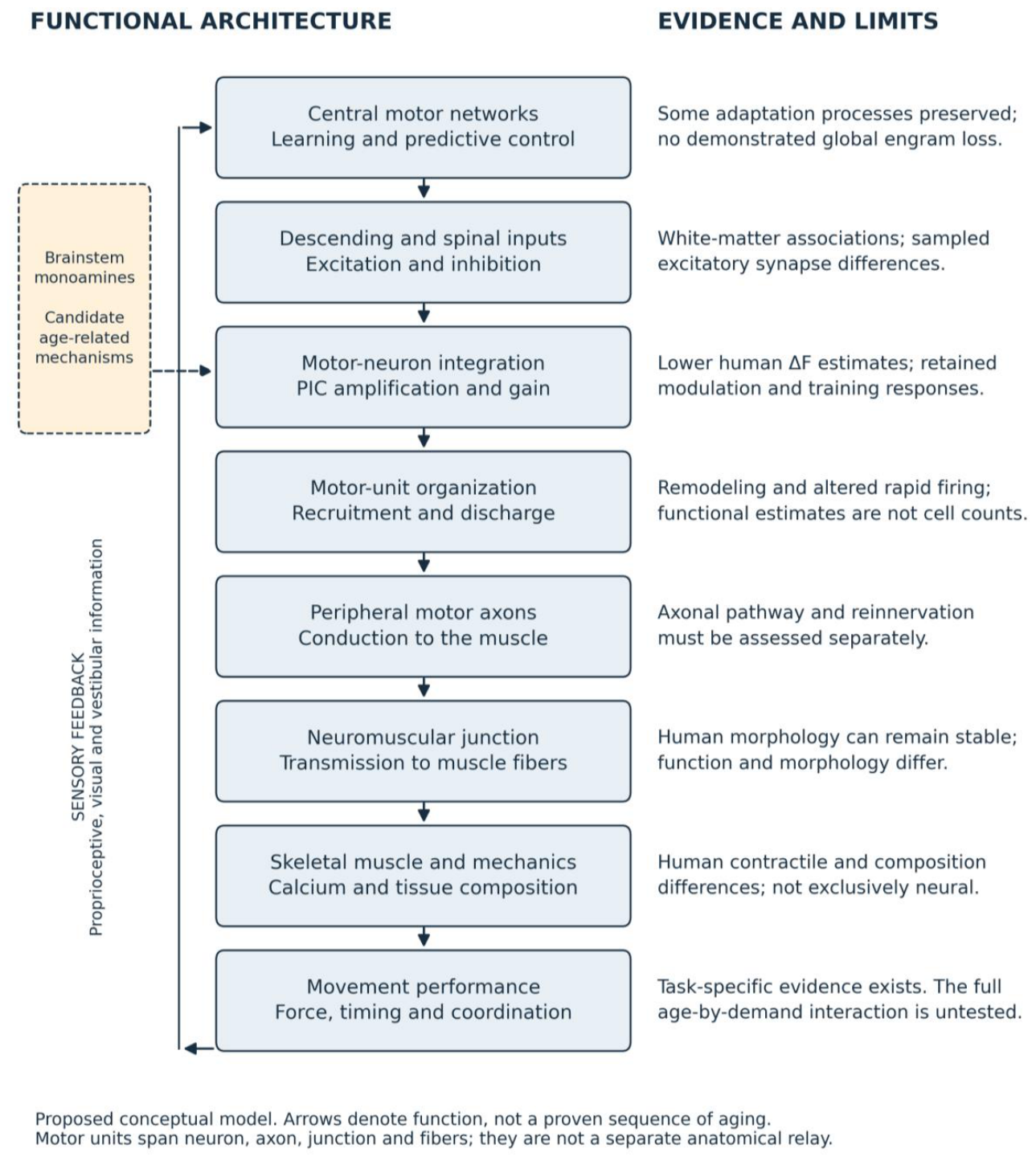
Figure 2.
From Motor Command to Movement. Proposed conceptual teaching model of the integrated pathway. The simplification omits parallel descending pathways and local circuit detail; it does not imply that motor neurons are passive relays or that feedback reaches only the brain. Physiological context: (Borzuola et al., 2020; Heckman et al., 2008; Henry & Baudry, 2019).
Figure 2.
From Motor Command to Movement. Proposed conceptual teaching model of the integrated pathway. The simplification omits parallel descending pathways and local circuit detail; it does not imply that motor neurons are passive relays or that feedback reaches only the brain. Physiological context: (Borzuola et al., 2020; Heckman et al., 2008; Henry & Baudry, 2019).
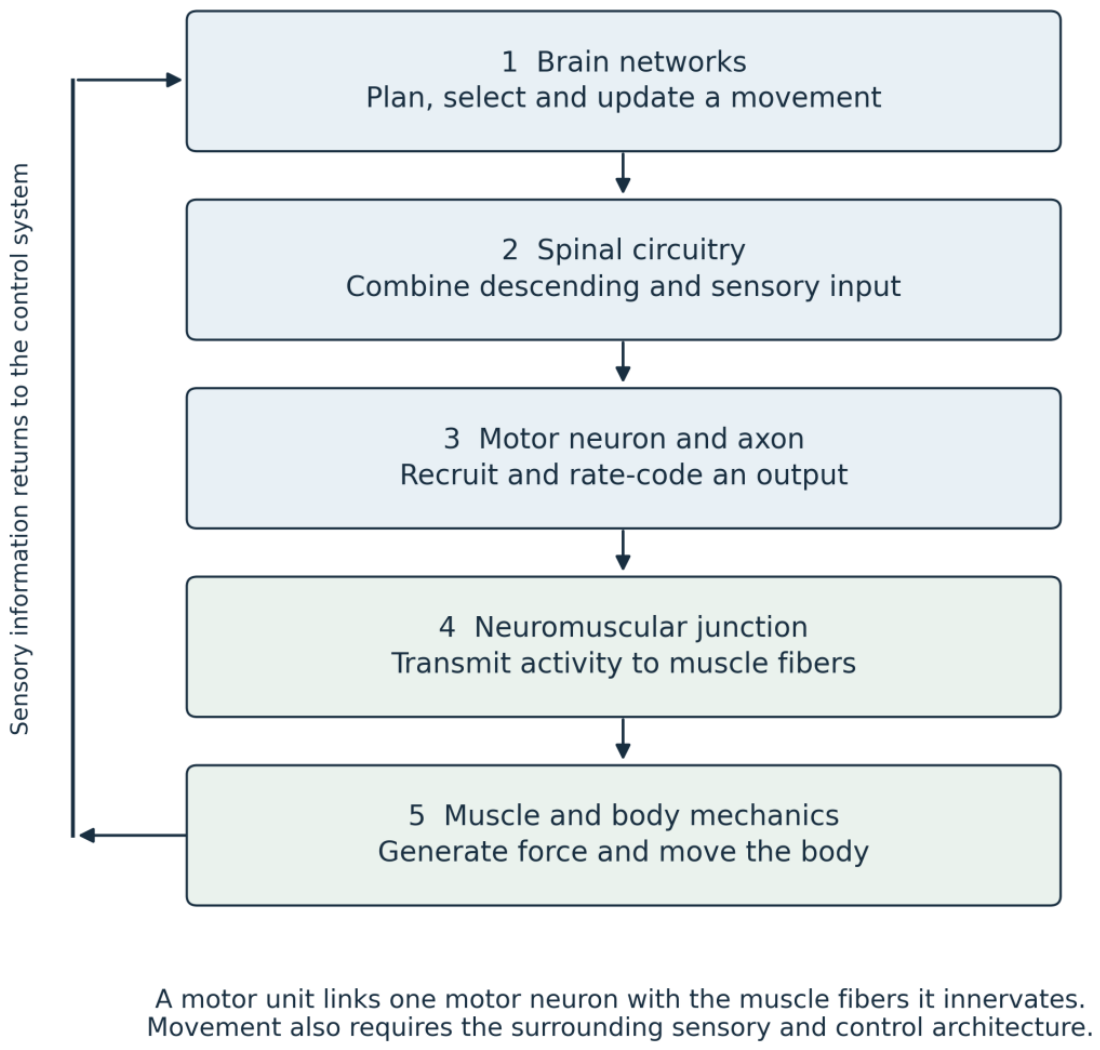
Figure 3.
Regeneration versus Functional Integration. Proposed conceptual model distinguishing local repair from tested integration and movement transfer. Counterexamples demonstrate optically controlled muscle activation after mouse motor-neuron transplantation (Bryson et al., 2014), functional recovery after human nerve-transfer reconstruction (van Zyl et al., 2019), and neuronal regeneration with incomplete architectural reconstruction after axolotl brain injury (Amamoto et al., 2016). These are different species, interventions, and outcomes; none is presented as a trial of integrated rejuvenation in normally aging humans.
Figure 3.
Regeneration versus Functional Integration. Proposed conceptual model distinguishing local repair from tested integration and movement transfer. Counterexamples demonstrate optically controlled muscle activation after mouse motor-neuron transplantation (Bryson et al., 2014), functional recovery after human nerve-transfer reconstruction (van Zyl et al., 2019), and neuronal regeneration with incomplete architectural reconstruction after axolotl brain injury (Amamoto et al., 2016). These are different species, interventions, and outcomes; none is presented as a trial of integrated rejuvenation in normally aging humans.
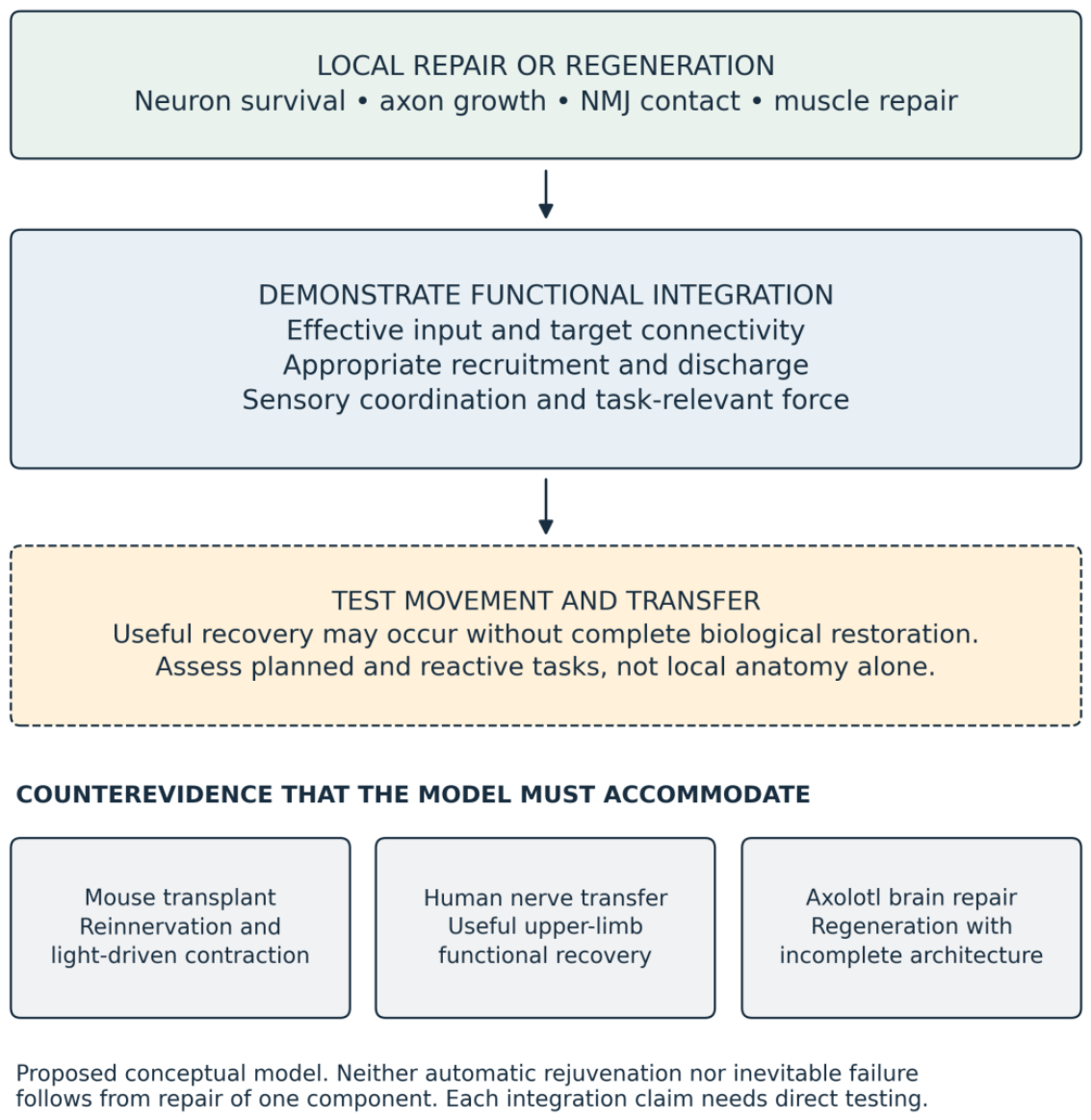
Figure 4.
Training and Biological Aging. Proposed conceptual synthesis of retained plasticity and unestablished restoration. Implicit adaptation: (Vandevoorde & Orban de Xivry, 2019). Spinal estimates, facilitation and training: (Orssatto et al., 2021; Orssatto et al., 2022; Orssatto, Rodrigues, et al., 2023). Athlete motor-unit observations: (Piasecki et al., 2019; Power et al., 2016). Muscle calcium handling: (Hunter et al., 1999; Lamboley et al., 2015). Muscle volume and power: (Zange et al., 2026). Columns do not imply that every finding was measured in the same participants or that training caused cross-sectional athlete differences. No numerical effect sizes are pooled.
Figure 4.
Training and Biological Aging. Proposed conceptual synthesis of retained plasticity and unestablished restoration. Implicit adaptation: (Vandevoorde & Orban de Xivry, 2019). Spinal estimates, facilitation and training: (Orssatto et al., 2021; Orssatto et al., 2022; Orssatto, Rodrigues, et al., 2023). Athlete motor-unit observations: (Piasecki et al., 2019; Power et al., 2016). Muscle calcium handling: (Hunter et al., 1999; Lamboley et al., 2015). Muscle volume and power: (Zange et al., 2026). Columns do not imply that every finding was measured in the same participants or that training caused cross-sectional athlete differences. No numerical effect sizes are pooled.
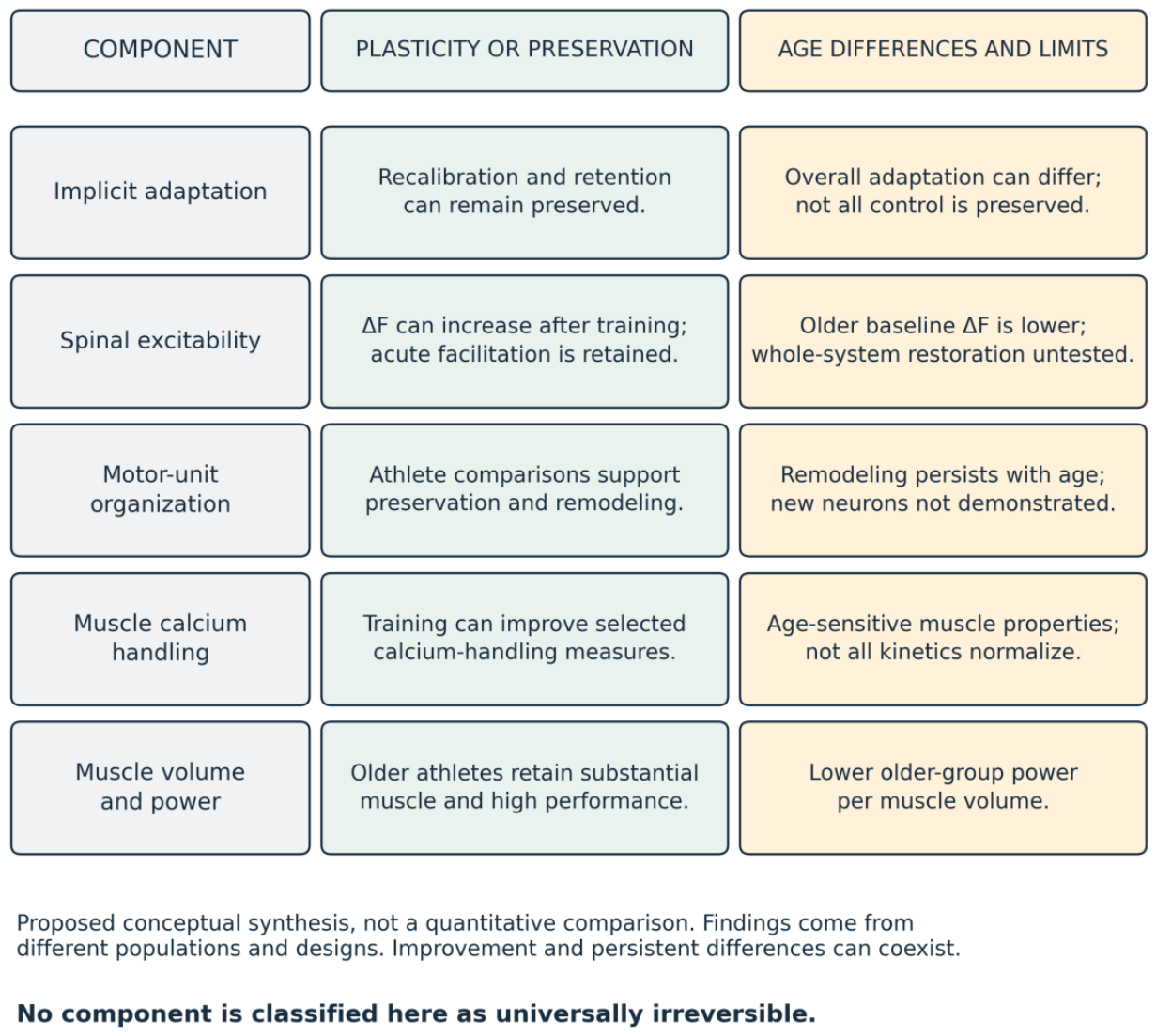

Table 1.
Evidence map for the expanded Barrier 2 framework.
| Component | Age-related finding | Evidence and population | Primary sources or review context | Strength and limitations | Modification demonstrated | ||
|---|---|---|---|---|---|---|---|
| Central networks and motor memory | Task-dependent differences; global engram destruction is not established. | Human sequence-learning fMRI; young/older adaptation comparisons. | (Hamano et al., 2020; Vandevoorde & Orban de Xivry, 2019) | Direct task evidence. The sequence-learning experiment is not an aging test. | Implicit recalibration and retention can be preserved; not proof that every central process is youthful. | ||
| Predictive and feedback control | Older visual corrections can be later and less vigorous despite similar accuracy. | Human fast pointing with visual perturbations; robotic perturbation study for timing context. | (Lee & Perreault, 2019; Zhang et al., 2018) | Direct behavioral evidence; feedback timing is pathway-specific. No universal open-loop cutoff. | Prepared responses and rapid feedback coexist. Reversal of aging effects was not tested. | ||
| White matter and descending pathways | Diffusion measures are associated with balance under sensory challenge. | Human MRI and balance study in older adults. | (Van Impe et al., 2012) | Associational; fractional anisotropy is not a cell count or a unique measure of myelin. | Causal restoration by training not established in the cited study. | ||
| Proprioception and gamma-related function | Spindle fiber composition and central proprioceptive processing differ with age. | Human biceps histology and spindle-stimulation imaging. | (Goble et al., 2012; Liu et al., 2005) | Direct tissue and imaging observations; gamma-neuron loss itself was not measured. | Review supports adaptable postural strategies; whole sensory-loop restoration remains untested (Henry & Baudry, 2019). | ||
| Brainstem neuromodulation | Reduced monoaminergic influence is one candidate explanation for lower excitability. | Mechanistic animal literature and indirect human estimates; review synthesis. | (Heckman et al., 2008; Orssatto, Blazevich, & Trajano, 2023) | Strong physiological rationale; limited direct human aging localization. | Preserved remote facilitation challenges complete loss of responsiveness (Orssatto et al., 2022). | ||
| Spinal excitatory connectivity | Fewer excitatory contacts in sampled aging tissue without lower neuron density. | Human cervical samples, three donors per age group; supporting primate and mouse work. | (Castro et al., 2023) | Direct sampled anatomy; small human sample, no causal human movement intervention. | Synaptic-restoration efficacy in aging humans was not established. | ||
| PIC contribution and intrinsic gain | Lower ΔF estimates in older lower- and upper-limb motor units. | Human low-force ramps; lower-limb study: 25 older and 17 young adults. | (Hassan et al., 2021; Orssatto et al., 2021) | Convergent indirect evidence; task and unit-sampling limits. | ΔF increased after older-adult resistance training; whole-system restoration not tested (Orssatto, Rodrigues, et al., 2023). | ||
| Recruitment and rapid discharge | Lower early discharge frequency accompanies lower rapid torque development. | Human young/older dorsiflexor experiments with voluntary and evoked responses. | (Klass et al., 2008) | Direct task physiology; neural and contractile contributions coexist. | Training can improve rapid activation in reviewed populations; not universal normalization (Maffiuletti et al., 2016). | ||
| Motor-unit remodeling | Older units can be enlarged; lifelong athletes show preservation or compensation. | Cross-sectional human athlete/control EMG and motor-unit estimates. | (Piasecki et al., 2019; Power et al., 2016) | Functional estimates and selected athletic cohorts; not anatomical proof of new neurons. | Preservation associated with training status; causal lifelong-training effect not isolated. | ||
| Peripheral axons and target reinnervation | Conduction and target connectivity are separable from cell-body survival. | Human aging review; clinical reconstruction after spinal injury. | (Manini et al., 2013; van Zyl et al., 2019) | Aging mechanisms reviewed; injury repair is not an aging-reversal trial. | Useful function after nerve transfer is demonstrated in a case series. | ||
| NMJ structure and transmission | Adult human morphology can remain stable; disuse can impair transmission. | Human junctional tissue; 21-day bed rest in nine young men. | (Jones et al., 2017; Sarto et al., 2025) | Morphology differs from function; young disuse is not normal aging. | Neither study establishes integrated rejuvenation; structural stability is preservation evidence. | ||
| Muscle quantity and sarcosthenia | Strength can decline faster than lean mass; older athletes retain power deficits. | Three-year cohort of 1,880 older adults; imaging/jump study of 43 men. | (Goodpaster et al., 2006; Zange et al., 2026) | Longitudinal dissociation and cross-sectional athlete evidence; residual is not uniquely neural. | Athletes preserve substantial volume; youthful power per volume is not established. | ||
| Fat distribution and myosteatosis | Muscle fat relates to strength, activation and protective stepping. Human explants secrete signaling factors; mouse experiments support impaired contraction. | Older-adult observational studies; human obesity explants; glycerol-treated and adipocyte-deficient mice. Distinct evidence types. | (Addison et al., 2017; Biltz et al., 2020; Goodpaster et al., 2001; Kahn et al., 2022; Yoshida et al., 2012) | Human functional findings are associative. Secretory activity does not establish impaired human contraction. Animal causality is model-specific; no nerve-blockade evidence. | Exercise studies support improved composition (Ramírez-Vélez et al., 2021). Causal mediation of movement gains and restoration of youthful function remain unestablished. | ||
| Type II fibers and calcium handling | Older fibers show altered specific force and calcium-related properties. | Skinned human fibers; strength-training study in young and older women. | (Hunter et al., 1999; Lamboley et al., 2015) | Direct muscle physiology; isolated preparations do not reproduce whole movement. | Selected calcium-handling measures improved after training; evoked relaxation did not. | ||
| Force-time and mechanical control | Rapid torque and braking involve demands not captured by maximum strength alone. | Human aging contractions; sports braking literature for task mechanics. | (Harper et al., 2022; Klass et al., 2008) | Strong task rationale; no common percentage deficit across incompatible tasks. | RFD is responsive to training in reviewed studies; transfer requires testing (Maffiuletti et al., 2016). | ||
| Integrated reactive movement | Timing, variability, and reactive performance show task-specific age-related associations. | Fast pointing; 32 non-athletes in hopping; 231 older adults classified by fall history. | (Giesche et al., 2026; MacKenzie et al., 2025; Zhang et al., 2018) | Partial task evidence. The full Masters age-by-demand prediction remains untested. | Component improvement does not yet establish integrated restoration; direct comparative trial needed. | ||
Note. Evidence strength applies to the component finding, not proof of the integrated model. “Not established” does not mean impossible. PIC, persistent inward current; ΔF, delta-frequency estimate; NMJ, neuromuscular junction; RFD, rate of force development.
Table 2.
Predictions and potential falsifiers of the expanded framework.
| Testable prediction | Discriminating measurement | Finding that would weaken it |
|---|---|---|
| Age differences become larger with restricted preparation and directional demand. | Within-person planned/reactive tasks with matched approach speed and geometry; prespecified age-by-demand interaction. | Reliable equivalence of the interaction within meaningful bounds, or an effect fully explained by baseline mechanics or familiarity. |
| Multiple biological levels add information beyond muscle quantity. | Joint models of composition, rapid force, sensory measures and motor-unit physiology; independent validation. | One measured component consistently explains the relevant outcomes, with other nominated levels adding no reproducible information. |
| Improving a component need not normalize integrated movement. | Intervention with verified target engagement and concurrent task-transfer measurements. | Selective improvement repeatedly restores demanding movement despite persistent differences in the proposed remaining constraints. |
| Local regeneration requires an empirical integration test. | Repair verification plus controlled activation, sensory coordination and movement outcomes. | Selective downstream repair produces broad youthful-range performance without restoration of nominated upstream measures. |
| Successful completion can coexist with altered control dynamics. | Matched-success trials with force-time, latency and stabilization measures. | No meaningful difference across reliable control measures at matched success and demand. |
Note. These are proposed tests, not published experimental results. Equivalence requires prespecified margins and adequate precision.
Disclaimer/Publisher’s Note: The statements, opinions and data contained in all publications are solely those of the individual author(s) and contributor(s) and not of MDPI and/or the editor(s). MDPI and/or the editor(s) disclaim responsibility for any injury to people or property resulting from any ideas, methods, instructions or products referred to in the content. |
© 2026 by the author. Licensee MDPI, Basel, Switzerland. This article is an open access article distributed under the terms and conditions of the Creative Commons Attribution (CC BY) license.
Copyright: This open access article is published under a Creative Commons CC BY 4.0 license, which permit the free download, distribution, and reuse, provided that the author and preprint are cited in any reuse.