
Submitted:
01 October 2026
Posted:
02 October 2026
You are already at the latest version
Abstract
Traditional gels are generally constructed using colloidal nanoparticles as fundamental building blocks, which confines gel skeletons within nanoscale architectures and imposes intrinsic constraints on the atomic-level regulation of network structures. Recent advances in the synthesis of ultralong metallic single-atom chains, exemplified by the carbon-sheathed Cu single-atom chains reported in recent literature, offer an intriguing possibility to expand the boundary of gel assembly. With the assistance of protective carbon sheath, such sub-nanometer one-dimensional atomic chains may be dispersed as unconventional colloidal units in liquid media, and potentially intertwine to form continuous three-dimensional gel networks upon concentration adjustment or mild crosslinking treatment. In this review, we tentatively put forward the new concept of atomic chain gels (ACGs), not as a fully established material system, but as a conceptual hypothesis for discussion within the community. We first revisit the classical definitions of colloids and gels, clarify the structural boundary from isolated single atoms, sub-nanometer clusters to stabilized metallic single-atom chains. We further discuss the plausible assembly pathways, unique thermodynamic features including orientational entropy of one-dimensional atomic chains, and prospective application scenarios in energy storage and electrocatalysis. We sincerely hope this preliminary conceptual attempt can inspire peer researchers and stimulate open discussions on atomic-scale gel materials.
Keywords:
colloidal assembly
; atomic chain gels
; metallic single‐atom chains
; sub‐nanometer colloid
1. Introduction
Gels represent an important class of soft matter materials, defined as systems containing a continuous three-dimensional network that immobilizes liquid solvents. Over the past century, the vast majority of reported colloidal gels rely on zero-dimensional nanoparticles as core building units [1,2,3]. The classical textbook description of colloidal dispersions sets a size range of 1~100 nm for dispersed particles, which has long guided the design of gel materials. Along with the development of low-dimensional nanomaterials, one-dimensional nanowires, carbon nanotubes and nanofibers have also been applied to fabricate gel networks [4,5,6]. Nevertheless, these building blocks are still nanoscale objects, whose skeletons are assembled from numerous atoms or small crystallites rather than continuous atom-by-atom connected chains.
In recent years, sub-nanometer materials have attracted rapidly growing research interest. Isolated single atoms [7,8,9], atomic clusters [10,11,12] and atomically thin one-dimensional chains [13,14,15] have expanded our understanding of the boundary between true solution and colloidal dispersion. Among these emerging materials, the newly reported ultralong metallic single-atom chains [15], stabilized by in-situ formed carbon sheath, provide a new candidate for the assembly of atomic-level gels. The metallic atoms are sequentially connected via direct metal-metal bonds to form continuous one-dimensional chains with sub-nanometer cross-section and micrometer-scale length. After mild exfoliation, these carbon-sheathed atomic chains can be dispersed into liquid phase. This observation inspires us to raise a tentative question: can these stabilized metallic single-atom chains serve as new colloidal building blocks, and further assemble into mesoscopic or even macroscopic atomic-level gel networks (supporting atomic-level defect regulation, see Figure 1 for details)?
We would like to emphasize at the very beginning that this work is merely a conceptual exploration rather than a summary of mature experimental achievements. We do not intend to challenge the classical colloid and gel theories. Instead, we aim to extend the existing framework by introducing a potential new assembly route. In this review, we will first sort out the fundamental limits of traditional gel building blocks. Then we will discuss the feasibility of stabilized metallic single-atom chains as sub-nanometer colloidal units. We will propose the plausible assembly route of atomic chain gels, analyze their distinctive thermodynamic characteristics, and discuss potential application prospects and unavoidable challenges. We sincerely invite peer researchers to comment, discuss and refine this preliminary idea.
2. The Boundary of Building Blocks in Conventional Gel Systems
2.1. Colloidal Gels Assembled from 0D Nanoparticles
Classical colloidal gels are formed when dispersed nanoparticles interconnect through non-covalent interactions such as van der Waals force, electrostatic attraction, hydrogen bonding or external coating layer, forming a percolated network to trap solvent [16]. The building blocks are discrete nanoparticles, which possess clear phase interfaces between particle and solvent. However, the minimal structural unit remains at the nanometer scale. The internal atomic arrangement of nanoparticles often contains grain boundaries, defects and disordered regions, which limits the precise atomic-level modulation of gel skeletons. This intrinsic structural ambiguity of nanoparticles not only hinders the in-depth understanding of the fundamental structure-property relationship of colloidal gels, but also brings great challenges to their rational design for targeted functional applications in catalysis, energy conversion and biomedical science.
Among various nanoparticles, nanospheres are connected end-to-end in a single direction, resembling a pearl necklace. They tend to form one-dimensional long chains rather than random aggregation. For uncoated short nanochains, fine “connecting necks” exist between nanospheres, keeping the spheres in contact and connected in a straight line (see Figure 2 A and B) [17]; for longer, continuous one-dimensional beaded chains, monodisperse spheres are arranged in an ordered linear pattern (see Figure 2 C and D) [18]; when a large number of nanochains entangle with each other, they are more likely to form a three-dimensional network, such as the three-dimensional beaded network structure of a hollow porous shell (see Figure 2 E and F) [19]. If the nanospheres are magnetic colloids (core-shell structure: magnetic cores such as Fe3O4@ silica/polymer shell): when an external magnetic field is applied, each magnetic nanosphere is magnetically polarized to generate magnetic dipole-dipole interaction; dipoles tend to align end-to-end and arrange into one-dimensional chains along the direction of the magnetic field, which is the “pearl chain”; after the magnetic field is removed, the structure can be cured through shell crosslinking, retaining the three-dimensional colloidal structure of the core-shell nanochain (see Figure 2 C and D) [18]. There are interfaces (or coating layers) between these nanospheres in the above-mentioned nanochains, which can realize interfacial electron and mass transfer, and are widely used in catalysis, magnetically responsive materials, colloidal robots, and biological separation.
All of the nanosphere bead-like colloidal chains depicted in the aforementioned figures [17,18,19], along with the recently reported carbon-sheathed single-atom copper chains [15] (For detailed structure, please refer to the text below and the Figure 6), represent two distinct classes of one-dimensional chain systems at different scales: colloidal nanoparticles (nanospheres) [17,18,19] assembled into one-dimensional bead-like chains (nanoscale assembly), versus atomic-scale single-metal atoms linearly connected to form atomic chains, encapsulated by an outer carbon sheath [15], constituting true single-atom linear (or atomic chain) structures. The physicochemical properties of these two architectures will also differ fundamentally. The former arises from inter-nanosphere interactions with unique anisotropic properties, whereas the latter is stabilized by strong covalent bonds within the encapsulated atomic wire.
2.2. 1D Nanowire and Nanotube-Based Gels
One-dimensional nanomaterials including carbon nanotubes, metal or metal oxide nanowires have been widely used to construct gels [4,5,6]. Their high aspect ratio favors entanglement and network formation. Even so, these metal-based nanowires are singlecrystalline (see Figure 3 A-C) [20] or polycrystalline (see Figure 3 D-I) [21] nanostructures, where the wire is composed of stacked atomic layers rather than a single continuous atomic chain. Their diameter is usually several nanometers or larger, which is still far beyond the atomic scale. A large-field view shows that a large number of ultra-long one-dimensional nanowires are randomly staggered and intertwined with each other (Figure 3 A) . It can be intuitively observed that these nanowires have an extremely high aspect ratio and overlap with one another, and they are the basic building blocks for gel formation (Figure 3 B). After the hydrogel is formed, the nanochains entangle and connect with each other to construct a continuous, porous and interconnected three-dimensional network framework (Figure 3 C), which finally confirms that the nanochain dispersion can form a macroscopic free-standing colloidal gel. Discrete polyhedral nanoparticles can also build one-dimensional chain-like nanowires via end-to-end connection. In the large-field view, a large number of chain-like nanowires are interwoven and distributed (Figure 3 D-F), and it can be clearly seen in local areas that polyhedral single-crystal particles are connected into a continuous one-dimensional long chain through local necking fusion. These particles are intrinsically PtNi alloy, and the connecting neck region is Pt-rich and Ni-poor (Figure 3 G-I), which is the key for nanochains to maintain the one-dimensional connected structure.
One-dimensional carbon nanotubes gels usually have controllable three-dimensional network structures. However, due to the lack of metal active sites, their application in the catalysis field is limited, and additional introduction of single-atom catalysts is often required. The surface of metal-based single-crystalline nanowires is relatively smooth with insufficient active site density, which also leads to limitations of the constructed three-dimensional gel network in practical applications. Polycrystalline nanowires can significantly improve catalytic efficiency through crystal face design and step regulation, making them a promising direction for the future development of metal nanowire gels. However, in any case, what these one-dimensional nanoscale gels lack most is single-atom-level regulation. If we can further introduce single atoms into such structures [22], or design sub-1-nanometer atomic-level crystalline nanowires [23], new breakthroughs and future development in this field are expected to be achieved.
2.3. Supramolecular Metallogels
Supramolecular metallogels are constructed through coordination bonds between metal nodes and organic ligand linkers [24,25]. Metal atoms act as crosslinking nodes connected by organic ligands. This kind of gel realizes atomic-level connection at coordination sites, but there is no continuous metal-metal bonded atomic chain in the skeleton. The metal centers are separated by organic ligand bridges, which is structurally different from the metallic single-atom chains we discuss herein. Figure 4 A illustrates the coordination between organic small-molecule foldamers and metal ions (Pd2+), which constructs stimuli-responsive organogels through orthogonal self-assembly [26]. The main driving force is the metal coordination bond between Pd²⁺ and the nitrogen-containing sites of the foldamer, and intramolecular hydrogen bonds assist in stabilizing the conformation of the foldamer (photographs in Figure 4 B show the organogel, acid-induced gel disassembly, and recovery of foldamer molecules [26]). Orthogonal self-assembly (crosslinking) of organic molecular ligands with Eu3+ can forms a luminescent supramolecular three-dimensional network gel with multi-stimuli responsive properties, which can respond to triggers including pH, ions and mechanical force (crown ether unit acts both as an assembly skeleton and sensitize the luminescence of Eu3+) (Figure 4 C) [27].
In these supramolecular metallogels, metal ions are not simply doped, but act as building nodes to participate in the assembly of the network. They are uniformly distributed in the gel skeleton, endowing the material with the unique optical, magnetic and electrochemical properties of metals. With atomically dispersed metal sites, the atomic utilization rate is close to 100%. The interconnected pores in the colloid allow substrate molecules to diffuse to the metal active sites, making this material suitable for homogeneous/quasi-homogeneous catalysis (the soft gel network also facilitates catalyst recovery). Meanwhile, mechano-responsive fluorescent switches can also be designed based on this material: tiny vibration or extrusion can change its rheological state, and the luminescence signal can be collected for applications such as flexible mechanical sensing and micro-vibration monitoring.
Overall, despite the extensive exploration of advanced functional gel materials in recent years, all the above-mentioned gel systems, which have been applied in fields including catalysis, energy storage, sensing and biomedicine, have their own distinctive merits suited for different application scenarios. Most reported gel architectures currently take common structural units such as organic-metal ions assembly, inorganic nanoparticles, and inorganic nanowires as their primary building blocks, yet none of them adopt continuous metal-metal bonded atomic chains as primary building blocks. In fact, continuous metal-metal bonded atomic chains [15] have unique intrinsic properties including ultrahigh aspect ratio, continuous conductive pathways and special quantum size effects, which make them ideal candidate building blocks for constructing high-performance novel gel materials. Nevertheless, this type of system has not been reported or explored in existing research, which inspires our tentative thinking about the possibility of atomic chain-based gel systems.
3. From Single Atoms, Sub-Nanometer Clusters to Stabilized Metallic Single-Atom Chains: Exploring the Lower Limit of Colloidal Units
Before the potential of atomic chain building blocks can be properly discussed and evaluated, it is necessary to clarify, at a fundamental level, the differences among three distinct forms: isolated metal atoms, atomic clusters, and carbon-sheathed metallic single-atom chains. A clear understanding of these fundamental differences is a prerequisite for any meaningful assessment of the role that atomic chain building blocks may play.
3.1. Isolated Single Metal Atoms: Not Qualified as Colloidal Units
An isolated metal atom dissolved in a solvent exists in the form of solvated species, in which the metal center is intimately associated with surrounding solvent molecules rather than existing as an independent particulate entity [28]. Under such conditions, no distinct phase boundary (solid liquid interface) can be identified between the solvated atom and the continuous liquid medium; the system remains homogeneous at the molecular scale and lacks the interfacial discontinuity that is essential for colloidal classification. According to the classical definition of colloids, which requires a dispersed phase separated from a continuous phase by a well-defined interface, these solvated species belong to a true solution rather than to a colloidal dispersion. Consequently, isolated single atoms cannot form discrete colloidal particles, nor can they independently assemble into gel networks. This point is well accepted in colloid and surface chemistry, and we fully agree with this classical conclusion.
3.2. Sub-Nanometer Atomic Clusters: The Transitional Boundary of Colloids
Sub-nanometer clusters are composed of a relatively small number of atoms, typically ranging from several to dozens of atoms, and their characteristic size places them in a transitional region between individual molecules and conventional colloidal nanoparticles [29]. In this intermediate size regime, the distinction between molecular species and colloidal particles becomes less sharp, as the clusters exhibit features that overlap with both categories while not fully corresponding to either one. When such clusters remain stable in a solvent and retain their discrete, independent existence without undergoing rapid dissociation, they can reasonably be regarded as sub-nanometer colloidal units. That is, the key requirement is that the clusters persist as separable entities in the liquid medium and do not lose their individual identity over the relevant timescale. However, clusters are inherently zero-dimensional objects. Their assembly into gel networks is therefore still based on the packing of individual 0D particles, meaning that the structural framework of the gel is constructed through particle-particle contacts rather than through continuous atomic chains. Accordingly, such assemblies lack continuous one-dimensional atomic connectivity, and the resulting gel skeleton does not provide an uninterrupted atomic-scale pathway along any single dimension.
3.3. Carbon-Sheathed Metallic Single-Atom Chains: A Candidate for Sub-Nanometer Colloidal Building Blocks
Recently, targeting the key bottleneck that traditional single-metal atomic chains generally only consist of several to dozens of atoms and are difficult to fabricate at scale, Li’s team has successfully prepared milligram-scale carbon-sheathed copper single atomic chains, which are over 1 μm in length and contain more than 4,000 consecutive Cu atoms. This material boasts excellent acid resistance stability, remarkable conductive anisotropy and one-dimensional antiferromagnetic coupling, and has established a new material platform for the universal preparation of ultra-long single atomic chains and their applications in nanoelectronics and spintronics. This research developed a high-pressure polymerization strategy and fabricated sp3 carbon sheath-confined single-metal atomic chains (sSMAC) with micron-scale length and carbon layer encapsulation (see Figure 5) [15]. Figure 5 (A) shows the schematic illustration of the synthesis of sSMAC via high-pressure polymerization. Using stacked metallomacrocyclic ligand-coordinated precursor β-copper phthalocyanine (β-CuPc) as the starting material, topochemical polymerization is triggered under high pressure and heat treatment to obtain single-metal Cu atomic chains protected by sp3-hybridized carbon sheaths. Figure 5 (B) shows the optical photograph of the bulk Cu-sSMAC single crystal obtained from the high-pressure reaction. Figure 5 (C) shows transmission electron microscope (TEM) image of the exfoliated Cu-sSMAC atomic wires obtained via liquid-phase ultrasonic exfoliation. Figure 5 (D-F) show energy dispersive X-ray spectroscopy (EDS) elemental mapping of Cu-sSMAC atomic wires, corresponding to N element (E) and Cu element (F) respectively. The signals of N and Cu overlap highly, proving that Cu is uniformly distributed within the carbon framework. Figure 5 (G) shows the atomic-resolution high-angle annular dark-field scanning transmission electron microscopy (HAADF-STEM) image of Cu-sSMAC. The inset shows an amplified view of the Cu atomic chain, and the measured Cu–Cu interatomic distance is approximately 2.54 Å. Figure 5 (H) shows the structural model of the polymerized carbon sheath optimized by density functional theory (DFT), with interlayer distances labeled. Figure 5 (I) shows the crystal structure model of Cu-sSMAC. The upper panel shows the polymerized phthalocyanine structural unit, and the lower panel presents the one-dimensional Cu atomic chain embedded in the carbon framework, with an equilibrium Cu–Cu spacing of 2.57 Å. The full set of results confirms at multiple scales that the high-pressure polymerization strategy can successfully prepare continuous one-dimensional Cu single atomic chains confined in carbon sheaths.
The carbon-sheathed metallic single-atom chains possess a unique core-shell structure [15]. The inner core is a continuous one-dimensional chain where metal atoms are linked sequentially via metal-metal bonds. The outer carbon sheath acts as a protective layer to prevent the fracture and aggregation of the bare atomic chain. After exfoliation from bulk precursor crystals, these core-shell one-dimensional objects can be dispersed in liquid medium. The carbon sheath provides surface functional groups, which may offer electrostatic repulsion and steric stabilization to avoid rapid aggregation. We tentatively consider that such carbon-sheathed atomic chains could be treated as a new type of sub-nanometer colloidal unit. It should be stressed that the carbon sheath serves only as a stabilizer. The core structural feature of the building block originates from the inner continuous metallic atomic chain. We do not claim that bare atomic chains can be dispersed in liquid (as shown in Figure 1), and the carbon protection is an indispensable auxiliary condition for this assembly concept.
4. Tentative Definition and Plausible Assembly Pathway of Atomic Chain Gels
4.1. Conceptual Definition of Atomic Chain Gels
On the basis of above discussion, we tentatively define atomic chain gels (ACGs) as follows: Atomic chain gels are a hypothetical gel system, which uses carbon-sheathed metallic single-atom chains as primary building units. The one-dimensional atomic chains can be dispersed to form sub-nanometer colloidal suspension. Upon concentration elevation or mild crosslinking, these chains intertwine and construct a percolated three-dimensional network, which immobilizes solvent to form hydrogels. After solvent removal via supercritical drying or freeze drying, the corresponding atomic chain aerogels can be obtained. We reiterate that this definition is only a conceptual hypothesis at present. Corresponding systematic experimental verification is still absent. We put forward this definition merely for academic discussion.
4.2. Stepwise Assembly Route
We outline a plausible assembly sequence as follows (see Figure 6 for the key gelation processes): (1) Synthesis of bulk precursor crystal containing embedded metallic single-atom chains, such as the high-pressure synthesized copper phthalocyanine derived bulk crystal reported previously. (2) Mild acid treatment and low-power ultrasonic exfoliation to separate the carbon-sheathed atomic chains from bulk matrix, forming colloidal dispersion. The exfoliation parameters must be carefully controlled to avoid destroying the protective carbon sheath and breaking inner atomic chains. (3) Induce gelation: with the increase of concentration, high-aspect-ratio atomic chains spontaneously entangle with each other to form percolated three-dimensional network (physical crosslinking). Alternatively, chemical crosslinking can be introduced via surface functional groups on carbon sheath to reinforce the network. It should be noted that crosslinking occurs between outer carbon sheath, and the inner metal atomic chain does not participate in inter-chain bonding. (4) Drying process: adopt freeze drying or supercritical drying to eliminate solvent while preserving the interconnected network, yielding atomic chain aerogel. Capillary force during drying is a major risk that may lead to network collapse, which requires careful process optimization.
4.3. Comparison Between Atomic Chain Gels and Traditional Gel Systems
Table 1 compares the key characteristics of several traditional gel systems and the hypothetical atomic chain gel, with the comparison covering four dimensions: system type, structural unit, main bonding characteristic, and network formation method. The specific properties of each system are listed as follows:
(1) Nanoparticle colloidal gels: The structural units are zero-dimensional nanoparticles. The interior of the particles is connected by covalent bonds/metallic bonds, while the interactions between particles are non-covalent interactions, and the network is formed by the packing and aggregation of particles.
(2) 1D nanowire gels or carbon nanotube gels: The structural units are one-dimensional nanowires or carbon nanotubes. The interior of the wires or tube is connected by covalent bonds, and the interaction between wires or tubes is van der Waals force, with the network formed by the entanglement of nanowires or nanotubes.
(3) Metallogels: It is composed of metal coordination nodes and organic ligands, takes metal-ligand coordination bonds as the main bonding mode, and forms the network through coordination crosslinking.
(4) Atomic chain gels: The structural units are carbon-coated metal single-atom chains. The chain is connected by metal-metal bonds, and the inter-chain connection is realized through entanglement or crosslinking on the carbon surface. The whole network is formed relying on the entanglement of one-dimensional atomic chains.
From the above comparison, it can be clearly seen that the newly proposed atomic chain gel has completely different structural and bonding characteristics from all the listed traditional gel systems. The unique one-dimensional single-atom chain structural unit and the intrinsic metal-metal bonding within the chain give this emerging gel system great potential to exhibit novel physical and chemical properties that cannot be achieved by traditional gels. This comparison also clarifies the structural positioning of the new atomic chain gel, and provides a clear structural basis for the subsequent in-depth analysis of its functional properties and application exploration.
5. Pphysicochemical Features and Application Prospects of Atomic Chain Gels
If atomic chain gels can be experimentally realized, they may exhibit several unique properties compared with conventional gel materials. The inner continuous metal-metal bonded atomic chain provides unbroken electron transport pathway. The sub-nanometer diameter and open entangled network may facilitate ion diffusion, which is promising for electrochemical systems. Nevertheless, this inference remains speculative before experimental validation. The atomic chain skeleton exposes continuous metal atomic sites, which may offer potential advantages in electrocatalysis. However, the carbon sheath partially covers metal atoms, so the accessibility of active sites needs to be carefully evaluated.
The continuous conductive atomic chain network and unique behavior during ion adsorption may provide new opportunities for supercapacitor electrode materials. The entangled porous network is expected to accelerate ion transport. It may offer a new platform to investigate the correlation between atomic-scale structure and capacitive performance. The atomically continuous metal chain may provide uniform active sites for electrocatalytic reactions. The gel network structure can provide fast mass transfer channel for reactants and products. Atomic chain aerogels may be explored for metal ion adsorption, gas sensing and electromagnetic attenuation. These applications are merely preliminary conjectures.
7. Current Challenges and Outlook
We would like to honestly list the major challenges facing this conceptual system, which we believe deserve careful attention from the community.
First, the stability of carbon-sheathed atomic chain colloidal dispersion remains a primary concern. High-aspect-ratio one-dimensional chains tend to entangle and precipitate spontaneously. Maintaining stable dispersion while reaching the critical gelation concentration is technically difficult. Moreover, during exfoliation and gelation, any damage to carbon sheath would cause the inner metallic atomic chain to fracture and metal atoms to agglomerate into nanoparticles, losing the original atomic-chain structure.
Second, structural fidelity is hard to preserve throughout the whole fabrication workflow. The gelation, solvent exchange and drying steps all carry risks of atomic chain reconstruction and metal atom diffusion. Advanced characterization including HAADF-STEM, XAFS must be applied to verify whether the metal atomic chain survives after assembling into aerogel.
Third, scalable synthesis is still a great obstacle. Current metallic single-atom chains are obtained from high-pressure solid-state synthesis, which is difficult for large-scale production.
Looking forward, if this conceptual route can be validated experimentally, several directions can be further explored. It is attractive to seek protective strategies beyond carbon sheath to obtain atomic chain gels. Designing multi-metallic alloy atomic chains as gel building blocks may bring richer chemical properties. Attempting to introduce metallic atomic defects [30] to modulate the pore structure and reactivity of atomic gels (as shown in Figure 1). Furthermore, the entropy engineering [31] can be adopted to regulate atomic chain gel assembly and electrochemical performances. Recently, it has also been reported in literature that metallic support-supported single atomic chains [32,33,34] and carbon nanotube-encapsulated ultra-long single atomic chains [35] are promising for design into colloidal structures. We emphasize again that all these prospects are only tentative ideas. We sincerely hope that this conceptual discussion can inspire more researchers to think about the atomic limit of gel assembly.
8. Conclusions
In this tentative review, we briefly revisit the development and building block limits of conventional gel materials. Drawing on the recent breakthrough of carbon-sheathed ultralong metallic single-atom chains, we propose the hypothetical concept of atomic chain gels. We analyzed the feasibility of carbon-sheathed single-atom chains as sub-nanometer colloidal building blocks, and outlined the plausible assembly pathway from colloidal dispersion to hydrogel and aerogel. We do not intend to establish a mature theory or claim completed experimental discoveries. This is just our preliminary attempt to expand the boundary of gel assembly to continuous atomic chain scale. We sincerely welcome comments, criticism and discussions from peer researchers. We hope this humble conceptual proposal can provide a minor reference for the design of next-generation atomic-level gel materials.
Acknowledgments
This study was supported by National Natural Science Foundation of China (52574352), Natural Science Foundation of Guangdong Province (2024A1515011103).
References
- Gaponik, N.; Herrmann, A. K.; Eychmuller, A. Colloidal nanocrystal-based gels and aerogels: material aspects and application perspectives. J. Phys. Chem. Lett. 2012, 3(1), 8–17. [Google Scholar] [CrossRef]
- Campea, M. A.; Majcher, M. J.; Lofts, A.; Hoare, T. A review of design and fabrication methods for nanoparticle network hydrogels for biomedical, environmental, and industrial applications. Adv. Funct. Mater. 2021, 31(33), 2102355. [Google Scholar] [CrossRef]
- Chelazzi, D.; Baglioni, P. From nanoparticles to gels: A breakthrough in art conservation science. Langmuir 2023, 39(31), 10744. [Google Scholar] [CrossRef]
- Kim, Y.; Parale, V.G.; Kim, T.; Kim, S.H.; Choi, H.; Patil, U.M.; Park, H.H. Synthesis of Zn-Co-S nanowire bundle type aerogel electrodes for asymmetric supercapacitors. Chem. Eng. J. 2023, 474, 145875. [Google Scholar] [CrossRef]
- Lu, Y.; Yue, Y.; Ding, Q.; Mei, C.; Xu, X.; Wu, Q.; Han, J. Self-recovery, fatigue-resistant, and multifunctional sensor assembled by a nanocellulose/carbon nanotube nanocomplex-mediated hydrogel. ACS Appl. Mater. Interfaces 2021, 13(42), 50281–50297. [Google Scholar] [CrossRef]
- Pirzada, T.; Ashrafi, Z.; Xie, W.; Khan, S. A. Cellulose silica hybrid nanofiber aerogels: from sol–gel electrospun nanofibers to multifunctional aerogels. Adv. Funct. Mater. 2020, 30(5), 1907359. [Google Scholar] [CrossRef]
- Guo, Y.; Liang, J.; Huang, Y.; Yang, J.; Zhang, Q.; Wang, A.; Zhang, T. Covalent and strong metal–support interactions for robust single-atom catalysts. Acc. Chem. Res. 2025, 58(15), 2440–2453. [Google Scholar] [CrossRef]
- Li, R.; Yu, G.; Lin, Z.; Wu, Y. Stabilizing few-atom platinum clusters by zinc single-atom-glue for efficient anti-Markovnikov alkene hydrosilylation. Angew. Chem. Int. Ed. 2024, 63, e202404568. [Google Scholar] [CrossRef]
- Ju, X.; Javorková, E.; Michalička, J.; Pumera, M. Single-atom colloidal nanorobotics enhanced stem cell therapy for corneal injury repair. ACS Nano 2025, 19, 19095–19115. [Google Scholar] [CrossRef]
- Zhang, F.; Shi, W.; Liu, Q.; Wang, X. Modular assembly of polyoxometalate clusters at the sub-1 nm scale. Nat. Protoc. 2026, 21, 347–372. [Google Scholar] [CrossRef]
- Zhang, C.; Wang, Z.; Liu, C.; Bai, Y.; Liang, C.; Low, J.; Xiong, Y. Rapid synthesis of subnanoscale high-entropy alloys with ultrahigh durability. Nat. Mater. 2026, 25(1), 26–34. [Google Scholar] [CrossRef]
- Rival, J. V.; Mymoona, P.; Lakshmi, K. M.; Nonappa; Pradeep, T.; Shibu, E. S. Self-assembly of precision noble metal nanoclusters: hierarchical structural complexity, colloidal superstructures, and applications. Small 2021, 17(27), 2005718. [Google Scholar] [CrossRef]
- Zhang, S.; Shi, W.; Wang, X. Locking volatile organic molecules by subnanometer inorganic nanowire-based organogels. Science 2022, 377(6601), 100–104. [Google Scholar] [CrossRef]
- Cheng, Y.; Liu, X.; Guo, Y.; Dong, G.; Hu, X.; Zhang, H.; Mai, L. Monodispersed sub-1 nm inorganic cluster chains in polymers for solid electrolytes with enhanced Li-ion transport. Adv. Mater. 2023, 35(47), 2303226. [Google Scholar] [CrossRef]
- Zhang, J.; Dong, X.; Qiu, S.; Yang, X.; Li, C.; Ma, H.; Li, K. Ultralong sheathed single-metal-atom chains synthesized under high pressure. Science 2026, 393(6813), 826–830. [Google Scholar] [CrossRef]
- Trappe, V.; Sandkühler, P. Colloidal gels—low-density disordered solid-like states. Curr. Opin. Colloid Interface Sci. 2004, 8(6), 494–500. [Google Scholar] [CrossRef]
- Li, M.; Song, X.; Tu, H.; Sun, J.; Deng, Y.; Wang, B.; Guo, X. A functionally tunable magnetic nanochains platform for N-glycoproteomic analysis of extracellular vesicles from ultratrace biofluids. Nat. Commun. 2025, 16(1), 7646. [Google Scholar] [CrossRef]
- Liu, D.; Li, S.; Zhang, T.; Jiang, H.; Lu, Y. 3D magnetic field-controlled synthesis, collective motion, and bioreaction enhancement of multifunctional peasecod-like nanochains. ACS Appl. Mater. Interfaces 2021, 13(30), 36157–36170. [Google Scholar] [CrossRef]
- Jiao, W.; Chen, C.; You, W.; Zhao, X.; Zhang, J.; Feng, Y.; Che, R. Hollow palladium-gold nanochains with periodic concave structures as superior ORR electrocatalysts and highly efficient SERS substrates. Adv. Energy Mater. 2020, 10(18), 1904072. [Google Scholar] [CrossRef]
- Tao, N.; Sai, B.; Wei, R.; Wang, J.; Mahdinloo, S.; Lan, T.; Ouyang, J. A Readily Synthesized All-In-One Nanowire Hydrogel: Toward Inhibiting Tumor Recurrence and Postoperative Infection. Adv. Mater. 2026, 38(1), e08137. [Google Scholar] [CrossRef]
- Xia, T.; Zhao, K.; Zhu, Y.; Bai, X.; Gao, H.; Wang, Z.; Guo, H. Mixed-dimensional Pt–Ni alloy polyhedral nanochains as bifunctional electrocatalysts for direct methanol fuel cells. Adv. Mater. 2023, 35(2), 2206508. [Google Scholar] [CrossRef]
- Zhu, Y.; Zhu, X.; Bu, L.; Shao, Q.; Li, Y.; Hu, Z.; Huang, X. Single-atom in-doped subnanometer Pt nanowires for simultaneous hydrogen generation and biomass upgrading. Adv. Funct. Mater. 2020, 30(49), 2004310. [Google Scholar] [CrossRef]
- Liu, G.; Luo, R.; Ma, J.; Guo, T.; Kang, J.; Shi, W.; Guo, L. Sub-Nanometer Pt Nanowires With Disordered Shells for Highly Active Electrocatalytic Oxidation of Formic Acid. Angew. Chem. Int. Ed. 2025, 64(12), e202422199. [Google Scholar] [CrossRef]
- Wu, H.; Zheng, J.; Kjøniksen, A. L.; Wang, W.; Zhang, Y.; Ma, J. Metallogels: availability, applicability, and advanceability. Adv. Mater. 2019, 31(12), 1806204. [Google Scholar] [CrossRef]
- Tam, A. Y. Y.; Yam, V. W. W. Recent advances in metallogels. Chem. Soc. Rev. 2013, 42(4), 1540–1567. [Google Scholar] [CrossRef]
- Wasim, M.; Gallant, B. M.; Yadav, N.; Fraser, C.; Öztürk, S.; Male, L.; Pike, S. J. Dual Photo-and pH-Responsive Foldamer Metallogels. J. Am. Chem. Soc. 2026, 148(32), 34373–34381. [Google Scholar] [CrossRef]
- Chen, Y.; Li, H.; Zhang, Y.; Li, Z.; Yang, D. Eu3+-Directed Supramolecular Metallogels with Reversible Quadruple-Stimuli Response Behaviors. Small 2024, 20(25), 2309542. [Google Scholar] [CrossRef]
- Sullivan-Allsop, S.; Clark, N.; Wang, W.; Cai, R.; Thornley, W.; Hopkinson, D. G.; Haigh, S. J. Atomic-resolution imaging of gold species at organic liquid-solid interfaces. Science 2026, 392(6793), 77–82. [Google Scholar] [CrossRef]
- Xue, B.; Lai, Y.; Cai, L.; Liu, Y.; Yin, J. F.; Yin, P. Emergent research trends on the structural relaxation dynamics of molecular clusters: from structure–property relationship to new function prediction. Acc. Chem. Res. 2024, 57(20), 3057–3067. [Google Scholar] [CrossRef]
- He, Y.; Liu, L.; Zhu, C.; Guo, S.; Golani, P.; Koo, B.; Liu, Z. Amorphizing noble metal chalcogenide catalysts at the single-layer limit towards hydrogen production. Nat. Catal. 2022, 5(3), 212–221. [Google Scholar] [CrossRef]
- Zhang, X.; Dai, X.; Gao, L.; Xu, D.; Wan, H.; Wang, Y.; Yan, L. T. The entropy-controlled strategy in self-assembling systems. Chem. Soc. Rev. 2023, 52(19), 6806–6837. [Google Scholar] [CrossRef]
- Xu, Z.; Zhou, L.; Zhou, G.; Wu, S.; Wang, P.; Li, H.; Liu, L. Light-driven orderly assembly of Ir-atomic chains to integrate a dynamic reaction pathway for acidic oxygen evolution. Angew. Chem. Int. Ed. 2023, 62(21), e202301128. [Google Scholar] [CrossRef]
- Sang, X.; Zhang, P.; Shi, W.; An, X.; Shi, Z.; Chen, L.; He, Y. Chain-ordered Pt atoms with delocalized electronic structure for improved hydrogen production. Nat. Commun. 2025, 17(1), 33. [Google Scholar] [CrossRef]
- Wang, C.; Li, X.; Ni, E.; Yang, W.; Zeng, Z.; Liu, H.; Fu, L. Single-Atom Suture. ACS Nano 2025, 19(2), 2468–2474. [Google Scholar] [CrossRef]
- Yu, B.; Yao, Z.; Cheng, Z.; Jiang, Y.; Yang, H.; Wang, Z.; Yang, F. Confined assembly of well-defined single-unit chain with charge delocalization for boosting catalysis. J. Am. Chem. Soc. 2025, 147(38), 34647–34658. [Google Scholar] [CrossRef]
Figure 1.
Hypothetical structural evolution of single-atom chain and atomic-level gel network (the rods between atoms represent metal-metal bonds, and the dashed circles represent metal atomic defects; the introduction of atomic defects enables the control of sub-1nm-scale atomic gel pore structures; the stabilization of atomic chains can be achieved by exogenous protection or regulation).
Figure 1.
Hypothetical structural evolution of single-atom chain and atomic-level gel network (the rods between atoms represent metal-metal bonds, and the dashed circles represent metal atomic defects; the introduction of atomic defects enables the control of sub-1nm-scale atomic gel pore structures; the stabilization of atomic chains can be achieved by exogenous protection or regulation).
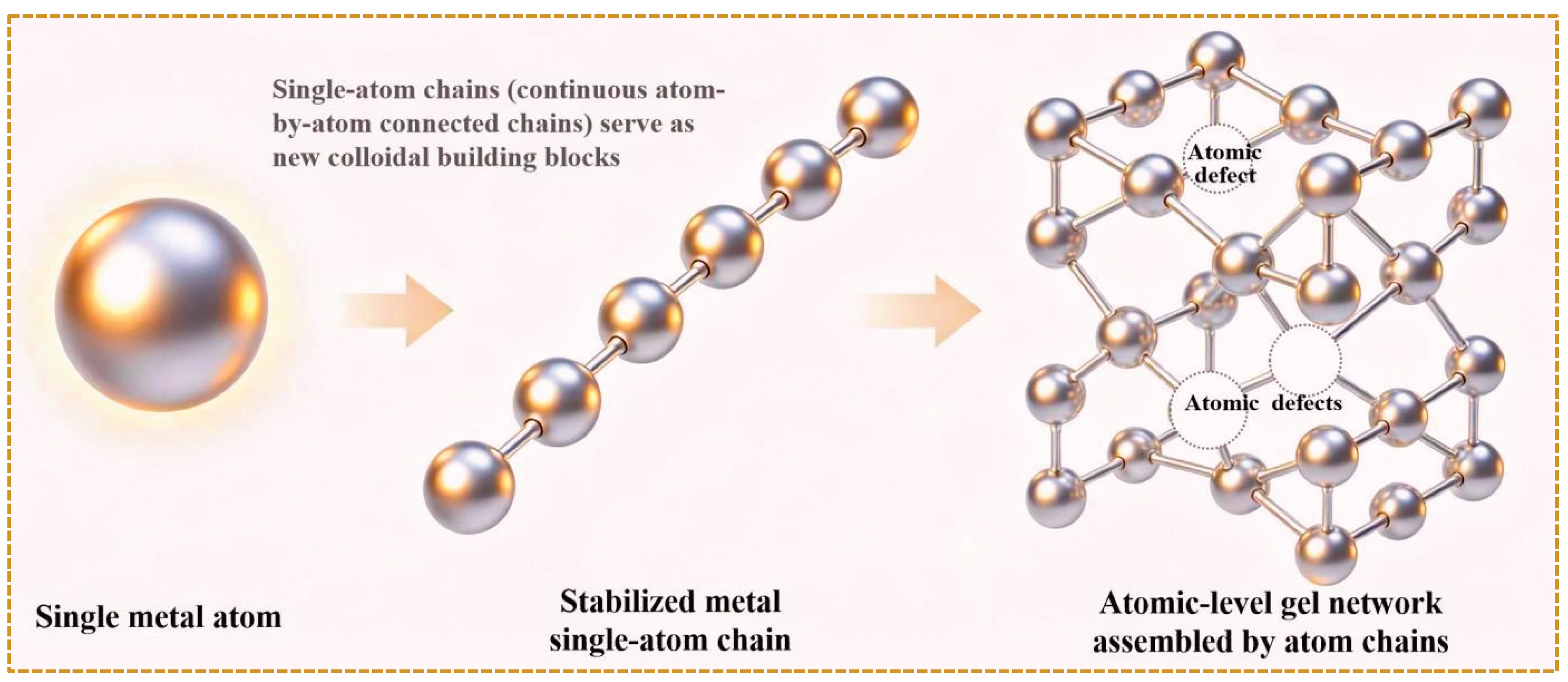
Figure 2.
Colloidal gels assembled from 0D nanospheres: (A and B) Organic molecule-modified Fe3O4 Nanochains [17]; (C and D) Pea-shaped Fe3O4@SiO2 Nanochains [18]; (E and F) three-dimensional network made of hollow PdAu Nanochains [19].
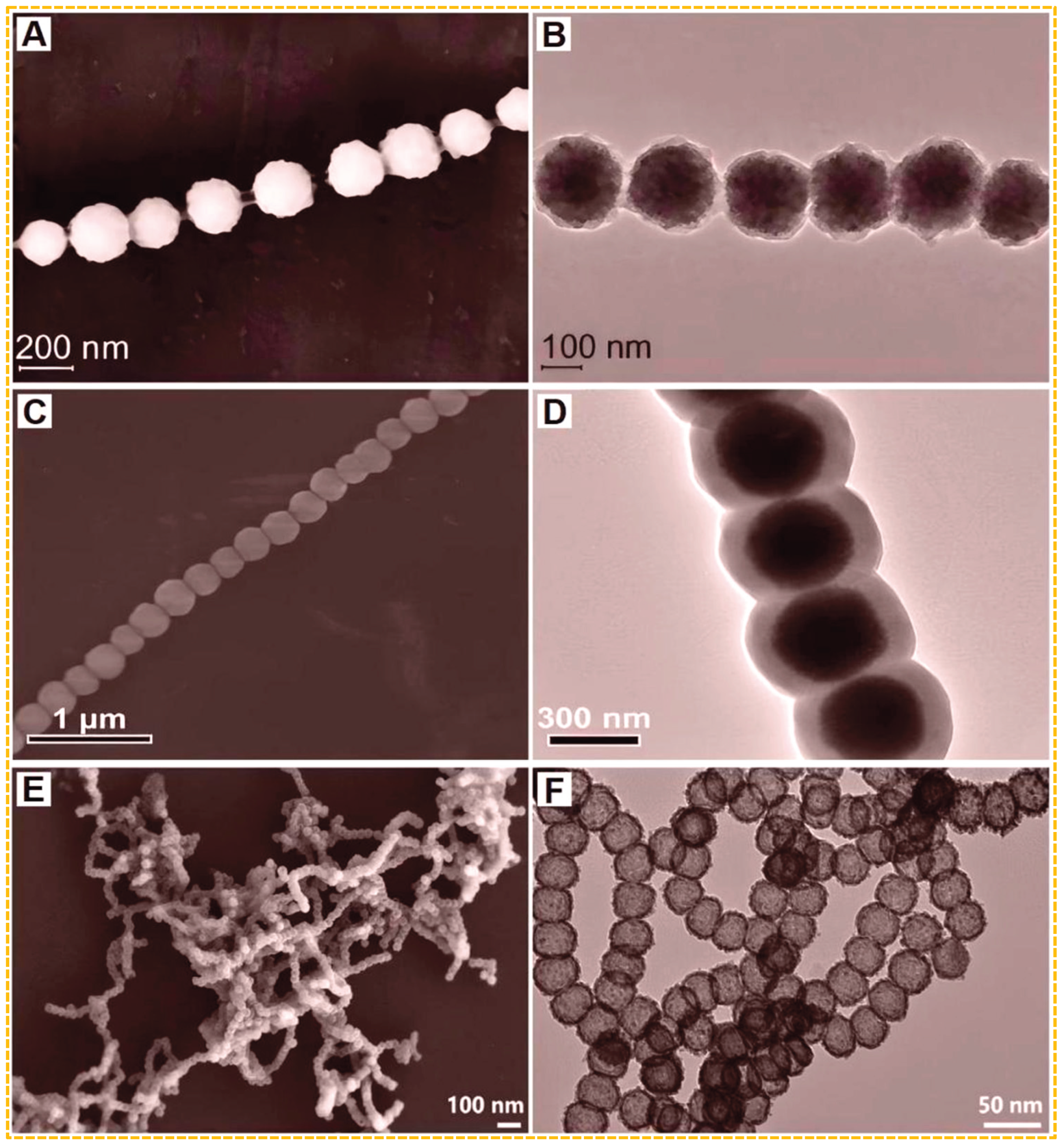
Figure 3.
Metal-based 1D nanowire gels: (A-C) ultra-long V2O5 nanowire gels [20]; (D-I) PtNi alloy chain-like nanowire gels [21].
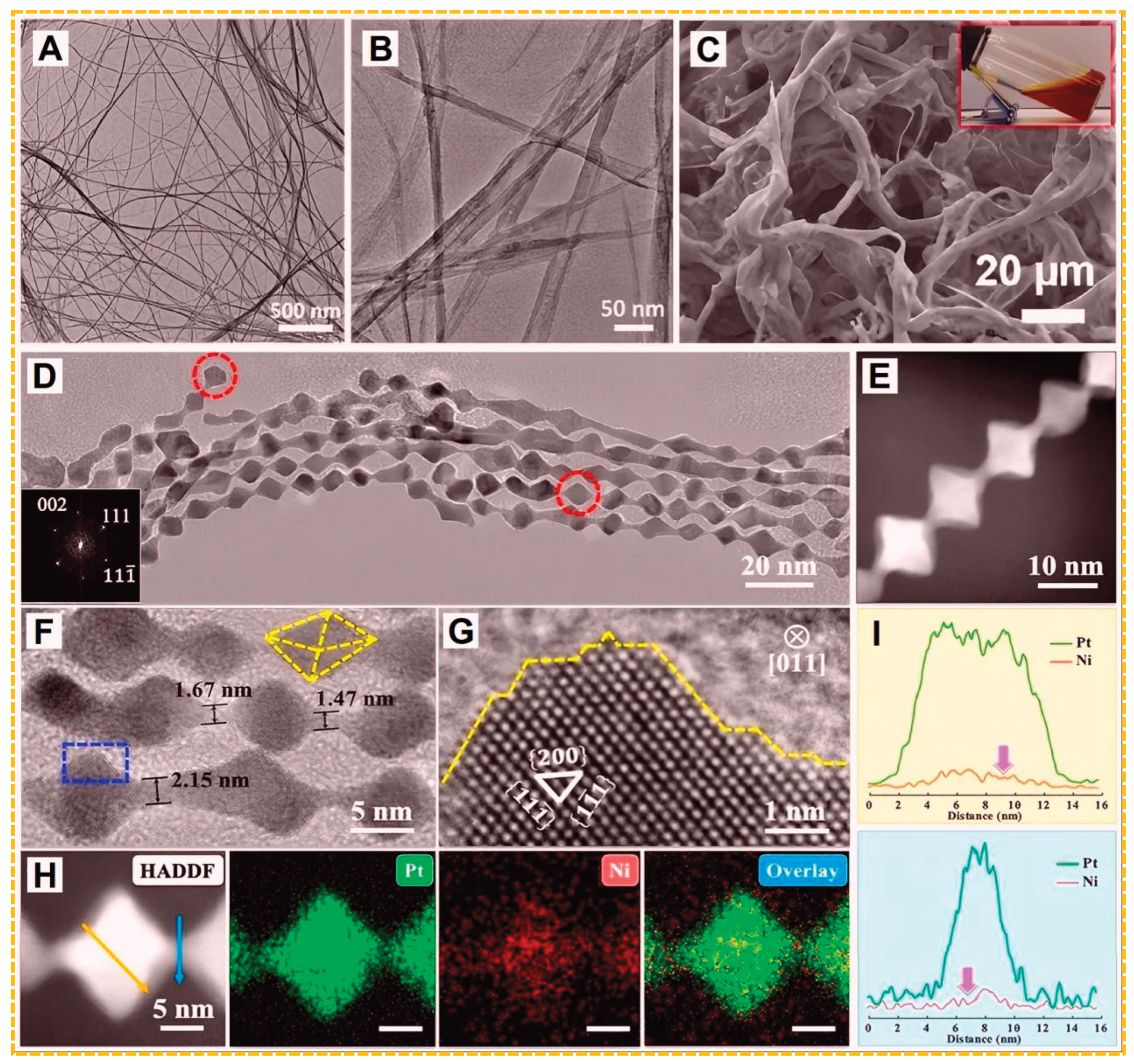
Figure 4.
Supramolecular metallogels: (A and B) Pd2+-based metallogels [26]; (C) Pd3+-based metallogels [27].
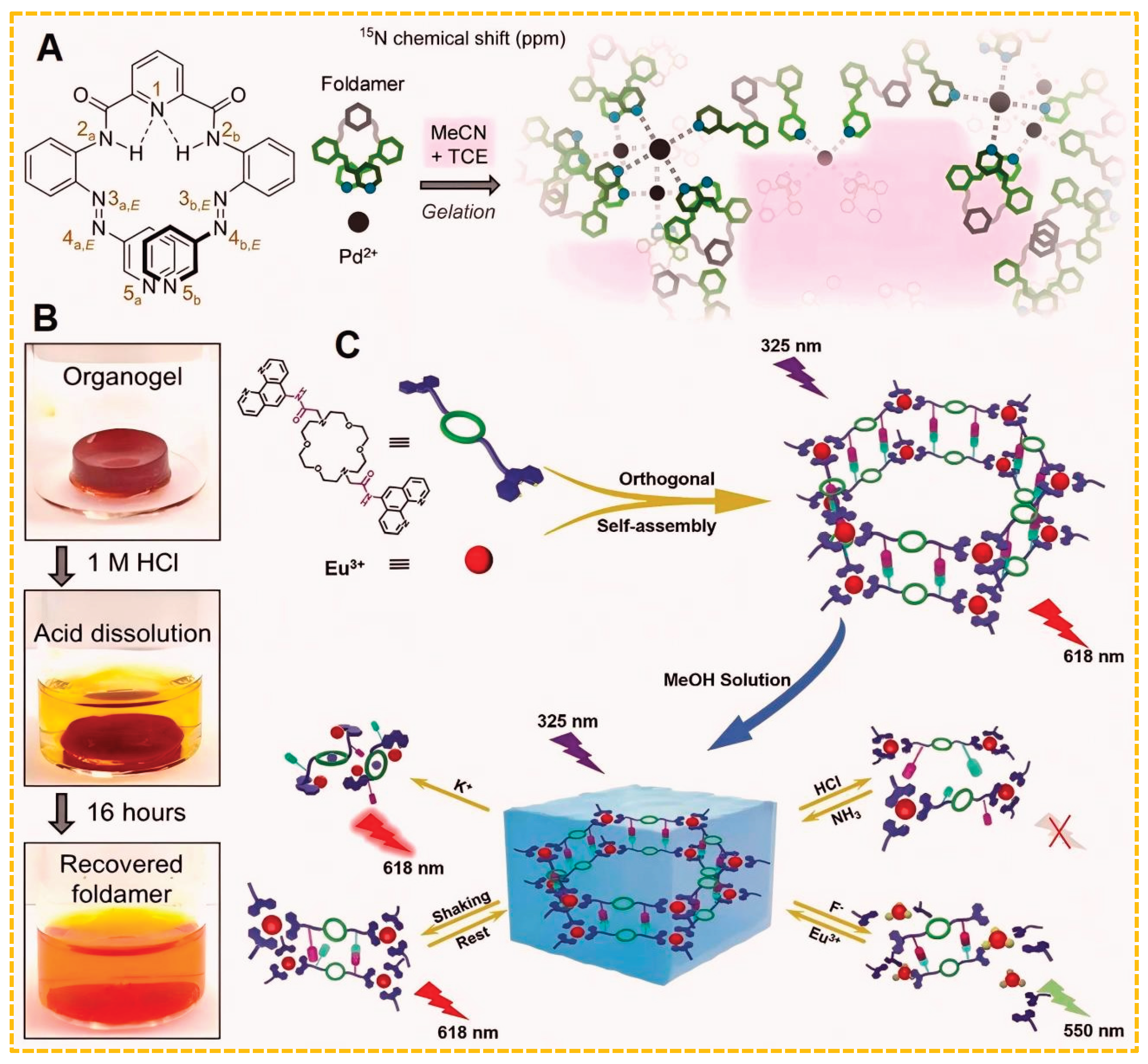
Figure 5.
Synthesis and structural characterization of sp3-carbon-sheathed single metal atomic chains (sSMACs) [15]. (A) Schematic of high-pressure polymerization to produce sSMACs from stacked β-CuPc precursors. Inset: molecular structure of CuPc. (B) Optical image of bulk Cu-sSMAC single crystal. (C, D) TEM images of exfoliated Cu-sSMAC wires. (E, F) EDS elemental mapping. (G) Atomic-resolution HAADF-STEM image of Cu-sSMAC. Inset: measured Cu–Cu distance of ~2.54 Å. (H) DFT-optimized carbon sheath structure with marked interlayer distances. (I) Crystal model of Cu-sSMAC showing the 1D Cu atomic chain with a Cu–Cu spacing of 2.57 Å.
Figure 5.
Synthesis and structural characterization of sp3-carbon-sheathed single metal atomic chains (sSMACs) [15]. (A) Schematic of high-pressure polymerization to produce sSMACs from stacked β-CuPc precursors. Inset: molecular structure of CuPc. (B) Optical image of bulk Cu-sSMAC single crystal. (C, D) TEM images of exfoliated Cu-sSMAC wires. (E, F) EDS elemental mapping. (G) Atomic-resolution HAADF-STEM image of Cu-sSMAC. Inset: measured Cu–Cu distance of ~2.54 Å. (H) DFT-optimized carbon sheath structure with marked interlayer distances. (I) Crystal model of Cu-sSMAC showing the 1D Cu atomic chain with a Cu–Cu spacing of 2.57 Å.
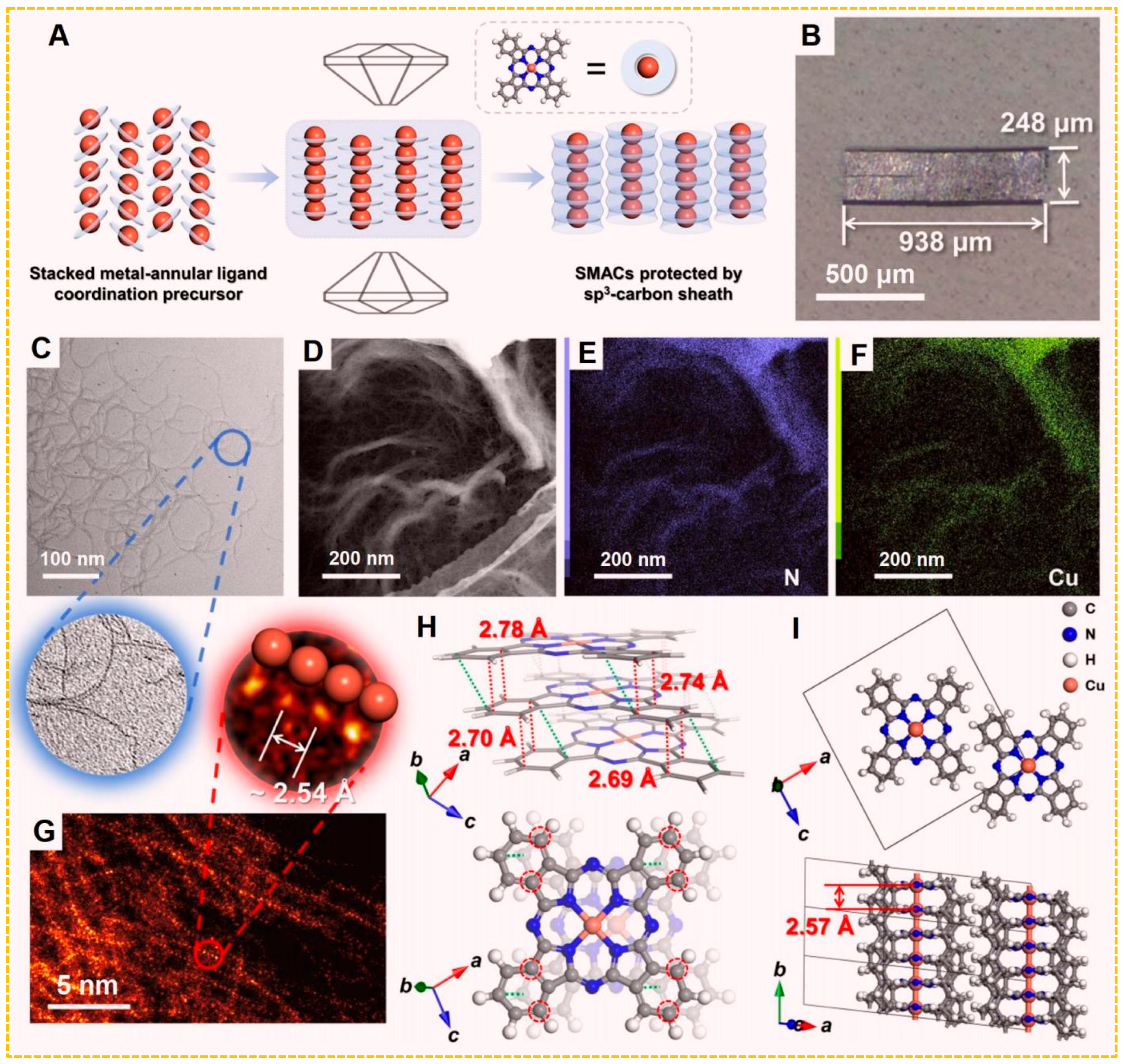
Figure 6.
The key gelation of carbon-sheathed atomic chain (physical or chemical crosslinking to reinforce the 3D network of gels and avoid destroying the carbon sheath and breaking atomic chains).
Figure 6.
The key gelation of carbon-sheathed atomic chain (physical or chemical crosslinking to reinforce the 3D network of gels and avoid destroying the carbon sheath and breaking atomic chains).
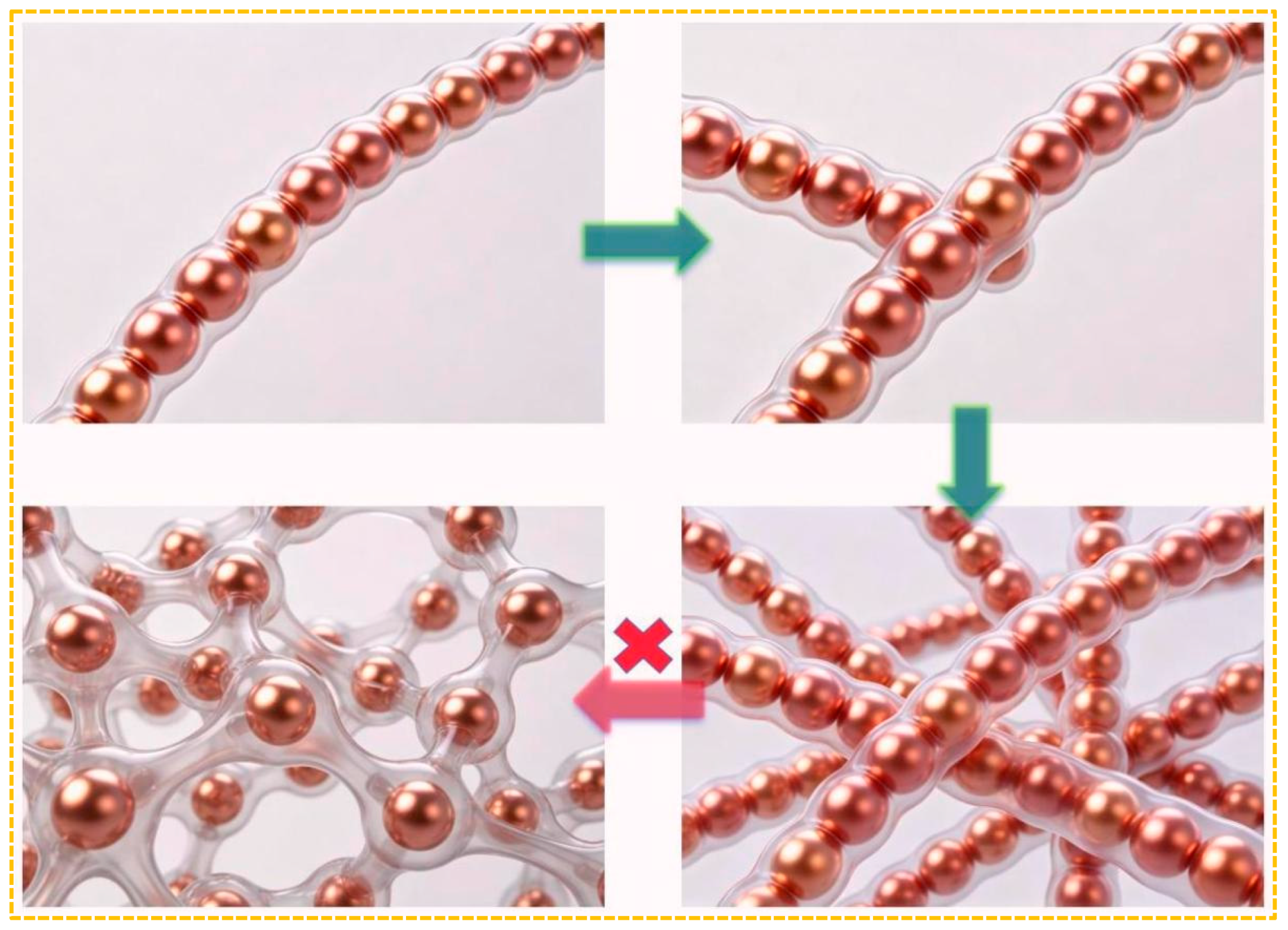

Table 1.
Comparison of key features between atomic chain gels and conventional gel systems.
| System | Building block | Main bonding feature | Network formation |
|---|---|---|---|
| Nanoparticle colloidal gels | 0D nanoparticles | Intra-particle covalent/metallic bond; inter-particle non-covalent interaction | Particle packing and aggregation |
| 1D nanowire gels or carbon nanotube gels | 1D nanowire or carbon nanotube | Covalent bond inside wire or tube; inter- wire or tube van der Waals force | Nanowire or Nanotube entanglement |
| Metallogels | Metal coordination nodes + organic ligands | Metal-ligands coordination bond | Coordination crosslinking |
| Atomic chain gels | Carbon-sheathed metallic single-atom chain | Intra-chain metal-metal bond; inter-chain entanglement / carbon-surface crosslinking | Entanglement of 1D atomic chains |
Disclaimer/Publisher’s Note: The statements, opinions and data contained in all publications are solely those of the individual author(s) and contributor(s) and not of MDPI and/or the editor(s). MDPI and/or the editor(s) disclaim responsibility for any injury to people or property resulting from any ideas, methods, instructions or products referred to in the content. |
© 2026 by the authors. Licensee MDPI, Basel, Switzerland. This article is an open access article distributed under the terms and conditions of the Creative Commons Attribution (CC BY) license (http://creativecommons.org/licenses/by/4.0/).
Copyright: This open access article is published under a Creative Commons CC BY 4.0 license, which permit the free download, distribution, and reuse, provided that the author and preprint are cited in any reuse.