
Submitted:
01 October 2026
Posted:
02 October 2026
You are already at the latest version
Abstract
As a new catalytic material with excellent performance, nitrogen (N)-doped carbon nanocages with high surface reactivity has extremely broad application prospects in electrocatalysis. In this study, N-doped graphene-like carbon nanocages (NGCNs) modified by trace nickel (Ni) species (possible components are: single atoms and clusters) were prepared from nickel acetate, carbon source and nitrogen source by thermal decomposition acid etching methods. The excess Ni was removed by acid etching, and finally a three-dimensional (3D) NGCNs-supported atomic nickel catalyst was obtained. Then the catalyst was characterized by scanning electron microscope (SEM), transmission electron microscopy (TEM) and X-ray photoelectron spectroscopy (XPS). At the same time, the 3D NGCNs-supported atomic nickel catalyst was assembled into oxygen reduction reaction (ORR) and oxygen evolution reaction (OER) electrodes for electrochemical evaluation, and the possible synergistic effect betwen Ni single atom and Ni cluster or N-doped carbon and Ni in NGCNs was also suggested.
Keywords:
graphene-like carbon
; carbon nanocages
; three-dimensional structure
; small cluster catalyst
; oxygen electrode reaction
1. Introduction
Hollow carbon nanocages have the advantages of hollow structure, porous structure and spherical structure, which demonstrate excellent physical and chemical properties, including high conductivity, strong corrosion resistance, regular structure and large specific surface area [1,2,3]. Based on the unique structure and excellent performance, the hollow carbon nanocage has shown great application prospect in many fields, such as energy conversion/storage and catalysis carriers [4,5,6]. Especially for catalytic applications, hollow carbon nanocages with high specific surface area and a variety of space equivalent sites, is a class of excellent catalysts and catalytic supports for multifarious complex catalytic reactions [7,8,9]. Some unique characteristics and advantages of hollow carbon nanocages make them particularly attractive for catalytic materials compared to other nanostructures: (i) Superiority of shell structure: shell structure is the main matrix material of hollow materials, and it can be used as catalyst and support itself. Especially, the introduction of catalytic active sites (such as non-metallic atom and metal single atom doping structure) at the defect points of shell can greatly enhance the catalytic activity. (ii) Superiority of porous structure: to utilize the inner cavity and inner surface sites, the shell is usually a porous open structure. Mass transfer can be controlled by controlling the size of the porous structure, such as electrolyte ions diffusion in electrocatalytic systems. (iii) Superiority of hollow structure: the hollow interior can act as a reservoir for ion storage, providing additional space and sufficient electrolyte ions for fast electrochemical processes and preventing the aggregation of encapsulated electroactive materials, thereby facilitating the electrochemical activity and stability of the material. Obviously, the structure, morphology and surface chemical composition of hollow carbon nanocages have great influence on their performances in various technology applications [10,11]. Therefore, the development of novel synthesis methods and techniques for engineering functionalized hollow nanomaterials are of great significance for the study of model catalytic reactions and the promotion of application-oriented catalytic performances.
Electrocatalytic oxygen reduction reaction (ORR) and oxygen evolution reaction (OER) are the key links of multifarious electrochemical energy conversion devices (such as fuel cells, metal-air batteries and water electrolysis) [12,13]. The multi-step electron transfer processes and slow kinetics of OER and ORR will produce large overpotential, which seriously reduces the reaction efficiency [14]. Nowadays, noble metal Ru/Ir and Pt catalysts are highly efficient OER and ORR electrocatalysts, but their scarcity, high price and unsatisfactory stability badly hinder their large-scale application [15]. Therefore, on the premise of guaranteeing high performance, it is of great importance to develop inexpensive and efficient non-noble metal or metal-free electrocatalysts [16]. Heterogeneous element nitrogen (N) doping of carbon materials is an extensive and efficient strategy for the engineering of non-noble metal (Me/N/C or single-atom catalyst) and metal-free electrocatalysts [17]. Based on the structural advantages of carbon nanocages and active mechanism of N-doped carbon electrocatalysts, N-doped carbon nanocages is indeed one of promising candidate materials for high efficiency electrocatalysis. At present, there have been several studies on the design and synthesis of N-doped carbon nanocages as metal-free or non-noble metal electrocatalysts for ORR or/and OER [18,19,20]. For example, Chen and co-workers recently reported N-doped carbon nanocages with a porous architecture by a multi-step procedure including of interfacial assembly, sol-gel synthesis, hydrothermal treatment, carbonization and removing of SiO2 templates [18]. Although satisfactory catalytic activity was proved for this metal-free ORR/OER bifunctional electrocatalyst, its complex and tedious synthesis method will be a great potential obstacle for practical application. Recent research by Sheng et al. found that the graphitic carbon nanocages with N-doped structures showed highly efficient ORR performances, prepared by pyrolyzing pentacarbonyl and acetonitrile precursors and removing metallic cores of Fe@C nanoparticles [19]. However, the high price and toxicity of these precursors also are non-negligible obstacles for practical application. More recently, Chen and co-workers further demonstrated that the atomic dispersion of Fe-Nx species in N-doped porous carbon nanocages by a multi-step procedure can result in a single-atom non-noble metal ORR electrocatalyst with greatly enhanced performances [20]. Taken together, the development N-doped graphitic carbon nanocages with atomic dispersion of Me-Nx (Me=Fe, Co, Ni, Cu etc) [21,22] would be the priority for high-performance ORR/OER bifunctional electrocatalysts. At the same time, a low-cost, green and efficient preparation method with controllable capability is absolutely essential to the future large-scale application of these non-noble metal electrocatalysts.
Herein, we report the fabrication of a class of novel N-doped graphene-like carbon nanocages (NGCNs) modified by trace nickel species (possible components of Ni atom clusters and single atom structures) for efficient ORR and OER bifunctional electrocatalyst. A high-efficiency quasi-CVD (or called Q-CVD) growth technique (with nickel acetate, bagasse, and urea as precursors) and subsequent acid treatment was developed for construction of high-N-content NGCNs with trace atomic-structured nickel species. By making full use of the unique structure of the NGCNs, we have realized the excellent catalytic activity and stability for both ORR and OER applications in alkaline solution.
2. Experimental Section
2.1. Synthesis of the NGCNs
N-doped graphene-like carbon nanocages (NGCNs) are prepared using a simple and efficient quasi-chemical vapor deposition (Q-CVD) technique using nickel acetate as a catalyst precursor (actually a metallic nickel as catalyst), bagasse as a carbon precursor (decomposition to release carbon-containing others), and urea as a nitrogen precursor (decomposition to ammonia). The specific preparation process is described as follows: First, 200 g of bagasse and 50 g of urea are placed at the bottom of the graphite crucible, and then 50 g of nickel acetate is placed above the bagasse to form an upper and lower structure. Subsequently, the protected crucible was placed in the Muffle furnace, heated to 750 oC at a heating rate of 20 oC per minute, and kept warm for 30 minutes. Finally, the excess nickel component is removed by a hydrochloric acid etching process at room temperature to obtain NGCNs material. The mixture for nickel etching is a mixture of concentrated hydrochloric acid and water by volume ratio 1:1, ultrasonic treatment for 30 minutes, and standing for 5 hours. In the preparation process, too low temperature will lead to insufficient carbonization degree, which is not conducive to electrical conductivity; However, too high temperature can easily lead to too thick graphite carbon layer, which is not conducive to the diffusion of electrolyte. Therefore, in this paper, we use a moderate temperature of 750 oC to prepare hollow carbon materials with reasonable structure. At the same time, control sample carbon (C) was obtained by carbonizing bagasse directly, and nitrogen doped carbon (NC) was obtained by carbonizing bagasse and urea mixture at 750 oC.
2.2. Physical Characterization
The nanostructure of the as-prepared materials were observed by scanning electron microscope SEM (JSM-6700F), and transmission electron microscopy TEM (JEM-2010HR). Their surface chemical states were investigated by X-ray photoelectron spectroscopy XPS (ESCALAB 250).
2.3. Electrochemical Characterization
Electrochemical measurements were performed on a double potentiostatic electrochemical workstation. In the experiment, a rotating ring electrode was used, and its working electrode was composed of platinum ring and glass carbon disk. The oxygen reduction reaction (ORR) was studied in a standard three-electrode system. The reference electrode is a reversible hydrogen electrode (RHE), and the counter electrode is a graphite electrode. During the preparation of the working electrode, 5mg of each catalyst was mixed with 0.9 mL ethanol and 0.1 mL of 0.5 wt.% Nafion. After ultrasonic treatment, the resulting grout was coated on a glass carbon disk (with a catalyst loading of 0.51 mg cm⁻²) and dried under infrared light. The electrolyte is a 1M KOH solution saturated with oxygen (O2) and nitrogen (N2), respectively. The oxygen evolution reaction (OER) was studied in the same three-electrode cell. Linear sweep voltammetry (LSV) and chronopotentiometry (CP) were used to evaluate the performance. The ORR test conditions were 1600 rpm and sweep rate was 5 mV s-1. OER test conditions are 1600 rpm and scan rate is 10 mV s-1.
3. Results and Discussion
3.1. Synthesis Process and Mechanism of the NGCNs
The schematic device of Q-CVD for preparation of NGCNs is shown in Figure 1 (left), where the carbon and nitrogen precursors (bagasse and urea) are placed in the lower layer of container, and catalyst precursor (nickel acetate) is placed in the upper layer. During the heat treatment process, abundant gaseous hydrocarbons (CH4, C2H2, C2H4, etc.) are released by fast pyrolysis of bagasse [23], and high-concentration ammonia gas (NH3) are also released by thermal decomposition of urea [24]. Synchronously, nickel acetate will be decomposed into metal nickel, which can be used as an effective catalyst for the growth of graphene-like carbon [25].
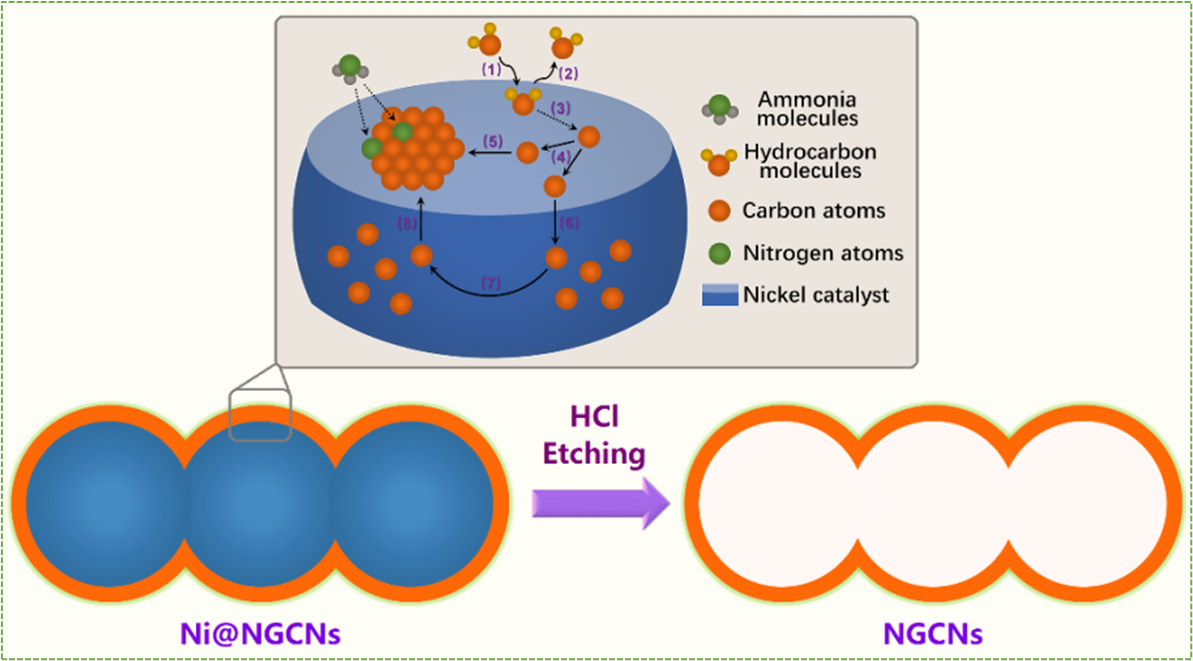
The synthesis process of nitrogen-doped graphene nanosheets (NGCNs) encompasses two primary stages: the in-situ growth mechanism of graphene and the removal of the nickel template, as depicted on the right side of Figure 1. The in-situ growth of graphene on the surface of a nickel catalyst may entail the following mechanistic steps: (1) Adsorption of hydrocarbon molecules onto the nickel surface; (2) Desorption of certain hydrocarbon molecules; (3) Decomposition of hydrocarbon molecules to generate carbon atoms; (4) Migration of carbon atoms on the nickel surface; (5) Direct deposition of carbon atoms on the nickel surface to form graphene; (6) Dissolution of carbon atoms within the nickel matrix; (7) Diffusion of carbon atoms in the nickel matrix; and (8) Precipitation of surface carbon, which ultimately results in the formation of graphene on the nickel surface [26]. It is noteworthy that nitrogen-doped graphene can be produced through the in-situ substitution of nitrogen atoms under the influence of ammonia molecules. The Q-CVD synthesis process demonstrates a distinctive “solid (bagasse and urea)-gas (hydrocarbons and ammonia)-solid (nitrogen-doped graphene)” pattern. Finally, NGCNs products featuring excellent hollow nanostructures can be readily obtained from Ni@NGCNs semi-finished products by implementing the etching step (removal of the nickel template) with hydrochloric acid.
3.2. Structure and Composition of the NGCNs
In order to analyze the morphology and structure of NGCNs product, the observation of scanning electron microscope (SEM) and transmission electron microscope (TEM) are first performed, with the results shown in Figure 2. From SEM images in Figure 2 (A-C), it can be seen that the NGCNs sample has a large number of nanosphere structures and some nanoparticle structures. The average diameter of these nanospheres is about 300 nm and that of nanoparticle is about 30 nm. It is worth noting that the matching of large nanospheres and small nanoparticles results in high packing density and high contact conductivity, when used as electrode materials for electrochemical applications [27]. From TEM images in Figure 2 (D-F), it can be observed that the NGCNs sample possesses obvious hollow nanocage structures with an average diameter of 300 nm that is consistent with result of SEM images. TEM image of an independent hollow nanocage (Figure 2 E) reveals that a hollow small nanoparticle is adhered on the surface of hollow nanocage (as shown by the arrow). All these features indicate that these large nanospheres and small nanoparticles all are of hollow nanocage structures. A high-resolution (HR) TEM image (Figure 2 F) manifests that the wall thickness of NGCNs is less than 10 nm, where the ultrathin nanostructure can endow with catalytic material higher active area per unit of weight [28]. Most importantly, the HR-TEM image clearly indicates that lots of ultrafine nanodots (0.2~1.0 nm) are dispersed on the inner surface of NGCNs, which is very similar to the M-N4 (M=Fe, Co and Ni) single-atom or atom clusters catalysts [21,22]. In this case, these ultrafine nanodots on NGCNs mainly come from the nickel residue with mono-disperse Ni atom or cluster structure, which can be fixed within carbon matrix by coordination with nitrogen.
To show further insight into the detailed nanostructure and growth process of the NGCNs, the contrastive TEM images of NGCNs and Ni@NGCNs are displayed in Figure 3. Interestingly, a string of perfect hollow nanochain made up of multiple hollow nanospheres is found in sample of NGCNs (Figure 3 A). It was recently reported that the nanochains, formed by the linear self-assembly of nanospheres, nanoparticles, nanorods or nanorings, are a class of novel 1-D oriented architectures, which can give rise to extraordinary collective properties [29]. Importantly, some of these hollow nanospheres are grown together to form seamless connections (see the rectangle in Figure 3 B), which can offer excellent electrical conductivity, interconnected mass transfer path and high structural stability [30]. On the other hand, the sample of Ni@NGCNs shows a distinct core-shell nanostructure, where the Ni core is tightly wrapped by thin carbon shell of NGCNs (Figure 3 C). This result further confirm that the carbon shell was grown by Q-CVD route under the catalysis of nickel (see Figure 1 for details). Form HR-TEM image in Figure 3 D, we can clearly see the crystal lattice fringes with a spacing of about 0.34 nm, corresponding to the G (002) crystal plane graphene (G). Meanwhile, the Ni (111) crystal plane with a spacing of about 0.20 nm can be also observed in the sample of Ni@NGCNs. Notably, there are a number of crystal defects existed in this graphene carbon shell (see the arrows in Figure 3 D), which are often the birthplaces of active sites (coordination nitrogen and metal single atoms) for the application of electrocatalysis [21,22]. The specific surface area of of Ni@NGCNs is 56 m2 g-1, and that of that of NGCNs is as high as 470 m2 g-1. Since hollow carbon samples exhibit a graphite-like carbon structure, they possess no additional microporous structures beyond their inherent hollow architecture. The large increase in specific surface area indicates that most of the Ni is clear, exposing abundant voids and available nanopores.
The XPS spectrum (measurement scan) of NGCNs sample with the characteristic spectrum of Ni2p, O1s, N1s and C1s is showed in Figure 4. According to the scanning measurement of XPS spectrum (Figure 4 A), it can be seen that the sample has the C1s peak at 292.3 eV, N1s peak at 410.2 eV, O1s peak at 530.4 eV and Ni2p peak at 783.4 eV respectively. The contents of Ni, O, N and C are 0.37 at%, 3.12 at%, 7.05 at% and 89.46 at% respectively (Figure 4B), which confirms the successful preparation of NGCNs with nitrogen doping and nickel residue. The mass content of metal Ni is about 2.17 wt. % by the ICP-MS analysis. Extremely weak peaks and low levels of Ni indicate that the Ni nano-particles were successfully removed after acid etching. The high-resolution spectrum of C1s (Figure 4C) can be decomposed into six peaks at 290.2, 287.1, 286.2, 285.3, 284.8 and 284.3 eV, corresponding to COOH, C-N, C=O/C = N, C-OH, C-C, and C=C, respectively [31]. The high-resolution spectrum of O1s (Figure 4D) can be decomposed into four peaks at 535.4, 533.5, 532.2 and 530.8 eV, corresponding to four different types of oxygen: N-O, COOH, C-OH and C=O, respectively [32]. The high-resolution spectrum of N1s (Figure 4E) can be decomposed into four different peaks at 403.4, 401.0, 399.4 and 398.2 ev, namely pyridine oxide N, graphite phase N, pyrrole N and pyridine N [33]. Pyridine N is beneficial to improve the current density and conductivity in the electro-catalytic process. In the structural diagram of doped N and possible Ni cluster/Ni-N4 positions in graphene (Figure 4F), we can see that the carbon network on graphene is incomplete: some carbon atoms are replaced by Ni atoms, O atoms and four different N atoms, while Ni atoms are mainly connected with four N atoms. Therefore, Ni atoms need to replace C atoms first and then connect with four pyridine N atoms. Among them, one N connecting three six-membered rings is graphite phase N, the one replacing one carbon in the five-membered ring is pyrrole N, and the one replacing one carbon in the six-membered ring is pyridine N, while the carbon in the six-membered ring is first replaced by Ni atom, and then connected with O atom is oxidized pyridine N (see Figure 4F for details) [34]. It can be concluded that the highest content of the sample is carbon, followed by four different N elements, and less O and Ni elements. In the process of acid etching, there is still a small amount of Ni residue, which infiltrates into graphene. This analysis is consistent with the results of Figure 2 F and Figure 4 B, where the Ni residue is most likely single atoms of nickel and a few clusters of nickel [35]. Among carbon-based single atomic catalysts, M-Nx is the most extensive coordination structure at present, and also a classical structure in the traditional M-N-C catalyst. In this article we only provide a preliminary structural reference for NGCNs.
3.3. Electrocatalytic Performances of the NGCNs
3.3.1. ORR Performances of the NGCNs
Under the conditions of oxygen (O2)-saturated solution and rotating speed of 1600 rpm and 5 mv s-1, we obtained the performance diagrams of electrocatalytic oxygen reduction reaction (ORR) for different samples (C, NC, and NGCNs). The products of ORR include H2O and H2O2. As shown in Figure 5 A, the linear voltammetric polarization curve (LSV) of the above three materials for ORR is shown. The initial potential and half wave potential of NGCNs catalyst reach 0.89 V and 0.82 V respectively, which are higher than those of NC catalyst (0.84 V, 0.76 V) and pure carbon catalyst (0.76 V, 0.61 V), while the limited diffusion current densities of NGCNs, NC and pure C are 3.72, 2.37 and 1.49 mA cm-2, respectively. It can be seen that the half wave potential and current density of NGCNs are higher than those of NC and pure C, and the electrocatalytic performance is directly proportional to the current density, which also shows that the catalytic performance of NGCNs is better, that is, the yield of main product H2O generated by NGCNs is the highest. The high catalytic activity can be attributed to the special hollow structure and nickel atomic structure of NGCNs catalyst. In addition, through literature review, we found that most commercial Pt/C catalysts (average particle size 3 nm) showed mediocre oxygen reduction performance in alkaline aqueous solutions [36] (for example, the initial potential and half wave potential of Pt/C catalyst is 0.94 V and 0.86 V in 1M KOH [37]). Overall, the present non-precious metal NGCNs (containing a small amount of nickel) promise to be useful and successful alkaline ORR electrocatalysts (relatively expensive Pt/C catalysts).
The ring electrode measurement (Figure 5B) shows that the peroxide oxidation current of NGCNs, NC and pure C is 12.2 μA, 45.5 μA, and 107.3 μA, respectively. The current is directly proportional to the H2O2 yield, which means that pure C produces the most H2O2 by-products, NC takes the second place, and NGCNs is the least. The electron transfer number (n) of NGCNs, NC and pure C at 0.5 V are 3.822, 3.156 and 1.769, respectively. According to the analysis in Figure 5 A and B, NGCNs produces the most main products of H2O and the least by-products of H2O2 (closest to a four-electron ORR process), which further confirms the superiority of the electrocatalytic performance of NGCNs.
Figure 5 C is the constant potential I-t curve (stability test) for NGCNs, which was subjected to potentio-static test for 5000 s under the conditions of 0.85, 0.80 and 0.70 V respectively. After 5000 s, under the conditions of 0.75 mA cm-2 and 0.85 V, the steady state current density of NGCNs tends to decrease slightly, but the change is very weak, indicating that the stability of NGCNs is good. Then continue to test its stability under the conditions of 2.6 mA cm-2 and 0.80 V. It can be seen that the reduction trend of the steady state current density under this condition is slightly larger than that under the conditions of 0.75 mA cm-2 and 0.85 V, but the overall change is small. Similarly, the stability variation under the conditions of 3.2 mA cm-2 and 0.70 V, is not large. Figure 5 D shows the ORR stability test of NGCNs before damage and after 5000 s at potentials of 0.70 V, 0.80 V and 0.85 V respectively. Before 0.8V, these SLV curves with potential of 0.70 V, 0.80 V and 0.85 V show current attenuation trend, and the decreasing value is 0.24 mA cm-2 at 0.70 V. After 0.8V, the four curves tend to be consistent, and the change in value of half wave potential is basically zero. Finally, it can be confirmed that the ORR stability of NGCNs is very excellent under the test conditions.
Combined with the analysis of Figure 5 A, B, C and D, we know that compared with NC and pure C, NGCNs reveals excellent ORR catalytic performance due to its suitable nickel atomic residue, abundant defects by N doping into graphene matrix, and favorable hollow structure with high atomic utilization. In addition, the doping of Ni not only makes the interaction between Ni single atom and Ni cluster in the carbon matrix, but also between carbon matrix and nickel atoms, so as to effectively regulate the electronic structure and catalytic activity of NGCNs and improve their catalytic stability [38,39,40]. Therefore, the as-prepared NGCNs catalyst with residual atomic nickel species has become the preferred and promising catalyst for ORR among the three catalyst materials.
3.3.2. OER Performances of the NGCNs
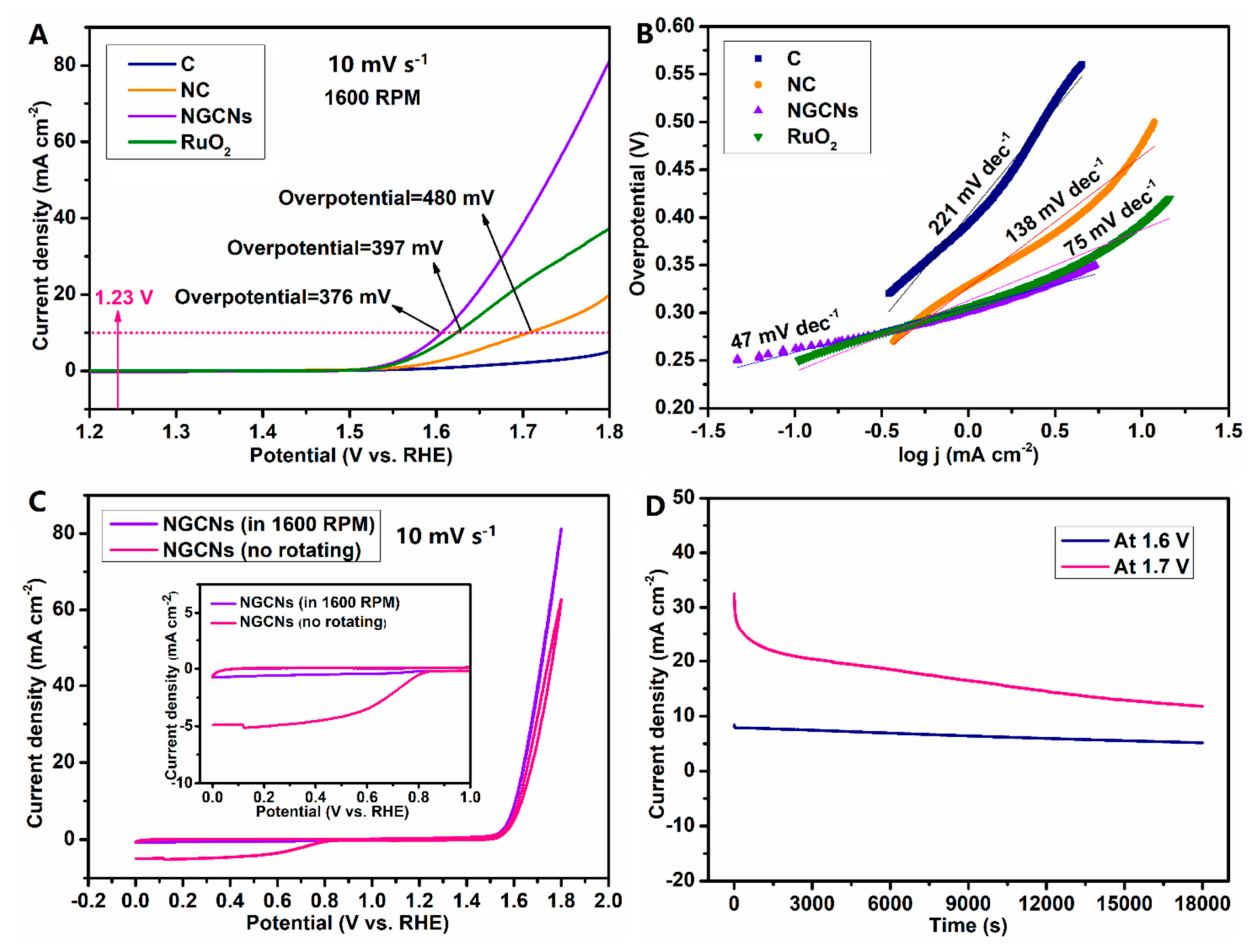
Under the conditions of nitrogen (N2)-saturated solution and rotating speed of 1600 rpm and 10 mV s-1, we further obtained the performance diagrams of electrocatalytic oxygen evolution reaction (OER) for different samples (C, NC, NGCNs, and RuO2). The OER measurement result varies from 1.2 V to 1.8 V of four samples by linear sweep voltammetry (LSV) are shown in Figure 6 A. Compared with RuO2 (overpotential=480 mV), NC (overpotential=397 mV) and C (overpotential>600 mV), the NGCNs has the lowest overpotential (376 mV) at the accepted standard current density (10 mA cm-2) and the highest current density in all effective potential ranges (1.52 V to 1.8 V), indicating that the electrocatalytic activity of the NGCNs material is greatly improved by nitrogen doping and nickel atomization. The four samples (C, NC, NGCNs, and RuO2) also show different onset potentials of 1.62, 1.55, 1.53, 1.52 V, respectively. According to the Tafel equation (η = blogj + a, where j is the current density and b is the Tafel slope), the linear region of the Tafel plot on LSV curve is further fitted, and the results are shown in Figure 6 B. Obviously, NGCNs has a Tafel slope of a very small 47 mV dec-1, much lower than C (221 mV dec-1), NC (138 mV dec-1), and RuO2 (75 mV dec-1), demonstrating the ultrafast catalytic kinetics of the NGCNs-supported atomized nickel catalyst. Oxygen evolution reaction (OER) involves multiple electron transfer process and the kinetic reaction is slow. The OER mechanism based on adsorption-desorption of intermediates, namely OHads→Oads→OOHads→O2ads process (adsorption product evolution mechanism, AEM) are widely recognized. It is considered that solving the energy relationship between OHads and OOHads is the key to obtain the ideal conditions of low overpotential. In general, during the OER process catalyzed by metal (M) catalysts (including precious metals and transition metals), M-O bond interactions have a significant effect on the stability of intermediates on the catalyst surface and on the overall electrocatalytic efficiency (See the recent review paper for details) [41].
To verify synchronous oxygen evolution and in-situ oxygen reduction, we further compared the CV performance of successive OER and ORR tests under rotational (1600 rpm) and non-rotational (0 rpm) conditions at the same 10 mv s-1 (see Figure 6 C). Under rotational (1600 rpm) condition, the synchronous evolved O2 in OER is quickly shaken off and removed from the electrode surface, so no oxygen reduction catalytic performance was shown in subsequent ORR. Under rotational (0 rpm) condition, the synchronous evolved O2 in OER can be retained on the surface of the electrode, so it shows a certain degree of oxygen reduction catalytic performance in subsequent ORR. The ORR performance is poor (0.81 V onset potential) because the O2 content generated in situ is effective and the electrode surface solution does not reach saturation O2 condition. Nevertheless, these results can basically demonstrate that the NGCNs-supported atomized nickel catalyst has good bi-functional characteristics in OER and ORR synchronous application.
Figure 6 C further shows the constant potential I-t curve (stability test) for NGCNs within 18000 s under the conditions of 1.6 and 1.7 V. After 18000 s, under the condition 1.6 V, the steady state current density of NGCNs tends to decrease slightly, and the change is very weak, indicating that the OER stability of NGCNs is excellent. The electrochemical stability at 1.7V is relatively poor, mainly because of the strong oxidation at high potential. In general, the catalyst has both high OER catalytic activity and desirable electrochemical stability, showing a good application prospect.
The samples showed excellent OER electrocatalytic activity and stability. First, it benefits from the synergistic effect between pyridine N graphite N and nickel species in the catalyst: previous theoretical calculations show that the electrons are transferred from metal species to N-doped carbon layer, which has a positive impact on the OER catalytic process of N-doped carbon catalyst [42]. In addition, there is also evidence of the synergistic effect between metal atoms and clusters: the coexistence of single atoms and clusters can significantly improve the catalytic activity for OER [43,44,45,46,47]. At the same time, the defect-rich carbon shell and hollow structure help to improve the diffusion and transmission of ions and alleviate the strain pressure, so as to improve the electrocatalytic activity and stability.
3.3.3. Performance Optimization and Outlook of the NGCNs
At present, the biggest problem for the bi-functional carbon-based ORR and OER catalysts without precious metals is their stability. Application of a high positive potential (> 1.2V vs RHE) to stability tests results in a rapid loss of ORR activity (high positive potential > 1.8V can result in a rapid loss of OER activity). This is due to oxidation of the active site of the metal and detachment from the carbon carrier, especially for iron-based catalysts, which is likely to destroy the proton exchange membrane (due to Fe Fenton action). Therefore, this paper pays special attention to the study of nickel-based non-noble metal catalysts (NGCNs with a small number of nickel), although the performance of nickel-based catalysts is inferior than that of iron-based catalysts. The performance and stability of nickel-based non-precious metal catalysts can further be improved by the optimization design of single atom or atomic cluster nickel. It is expected that the further performance optimization of nickel-based catalysts in device applications can be achieved. The performance evaluation of high potential stability is expected to be implemented in the future. In addition, we are preparing additional metals into NGCNs to improve the ORR and OER performances. A series of NGCNs-based metal single atoms (Ni, Fe, Co, Pt or Ru) will be designed for optimized bi-functional performances.
Single-atom catalysts have attracted much attention due to their unique electronic properties and catalytic activities. An atomic cluster is a kind of aggregate composed of a few to dozens of atoms, showing the characteristics between monatomic and polyatomic systems. Synergistic effect refers to the interaction of single atoms and clusters of atoms in the catalytic process to produce an effect superior to that of individual components. The single atomic sites and atomic cluster sites show synergistic effects in the electrocatalysis process, which can improve the catalytic efficiency and selectivity [48,49,50]. By adjusting the interaction between single atoms and atomic clusters, the electronic structure and catalytic performance can be optimized, thus improving the activity and stability of the electrocatalytic ORR for NGCNs with a small number of nickel atoms/clusters.
During acid treatment, trace metal elements may be present in the form of approximately single atoms, which treat the surface of the material for specific catalytic functions. Moreover, hollow carbon materials also have the following advantages: hollow carbon materials have lower density and higher specific strength; Hollow structure provides a larger specific surface area; Hollow carbon materials are more stable in extreme chemical environments [51]. Therefore, hollow carbon materials supporting single atom catalysts have a high application prospect, and its advantages mainly include the following aspects [52]: hollow carbon materials can provide a large number of internal space and surface sites due to its unique structural characteristics, which is conducive to the uniform dispersion and stable existence of single atom catalysts. This structure not only increases the contact area between catalyst and reactants, but also promotes the adsorption and activation of reactants on the catalyst surface, thus significantly improving the catalytic efficiency. Hollow carbon material as a carrier can effectively prevent the aggregation and deactivation of single atom catalyst in the reaction process. Its stable chemical properties and mechanical strength ensure that the catalyst can maintain high catalytic performance under long-term use, extending the service life of the catalyst.
4. Conclusions
The three-dimensional NGCNs with atomic nickel species (with high content of N (7.05%) and low content of Ni (only 0.37%)) was successfully prepared by thermal decomposition acid etching methods from cheap precursors. The NGCNs showed good hollow (200~300 nm) nano-cage structure and ultra-thin (about 10 nm) microporous carbon layer structure. At the same time, there are abundant Ni single atoms and atom clusters on the N-doped defective carbon matrix of NGCNs. The synergistic effect between Ni single atoms and Ni clusters, or carbon matrix and Ni atom can promote the catalytic activity of the NGCNs-supported atomized nickel catalyst by adjusting the electronic structures. The formation of unique electron configuration may optimize the adsorption/desorption process of the reaction intermediates and accelerate the reaction kinetics. The atomic utilization rate of NGCNs-Ni atomic catalyst and the catalytic activity of ORR and OER are higher than those of NC and pure C due to various factors. In addition, the ORR and OER stability tests of NGCNs were carried out at different potentials, and the results show that the stability is good.
Acknowledgments
This research was supported by National Natural Science Foundation of China (22078071), Natural Science Foundation of Guangdong Province (2024A1515011103), Projects of Talents Recruitment of GDUPT (XJ2022000101), Guangdong Province ordinary University youth Innovative talents Project(2024KTSCX183), and National Undergraduate Innovation and Entrepreneurship Training Program (202611656031).
References
- Wang, X. X., Tan, Z. H., Zeng, M., & Wang, J. N. (2014). Carbon nanocages: A new support material for Pt catalyst with remarkably high durability. Scientific reports, 4(1), 1-11.
- Wu, Q., Yang, L., Wang, X., & Hu, Z. (2017). From carbon-based nanotubes to nanocages for advanced energy conversion and storage. Accounts of chemical research, 50(2), 435-444.
- Wu, Q., Yang, L., Wang, X., & Hu, Z. (2020). Mesostructured carbon-based nanocages: an advanced platform for energy chemistry. Science China Chemistry, 63(5), 665-681.
- Wu, Q., Yang, L., Wang, X., & Hu, Z. (2020). Carbon-Based Nanocages: A New Platform for Advanced Energy Storage and Conversion. Advanced Materials, 32(27), 1904177.
- Yan Z, Gao Z, Zhang Z, et al. Graphene nanosphere as advanced electrode material to promote high performance symmetrical supercapacitor[J]. Small, 2021, 17(18): 2007915.
- Yan, Z., Gao, Z., Zhang, Z., Dai, C., Wei, W., & Shen, P. K. (2021). Graphene nanosphere as advanced electrode material to promote high performance symmetrical supercapacitor. Small, 17(18), 2007915.
- Chen, S., Bi, J., Zhao, Y., Yang, L., Zhang, C., Ma, Y., ... & Hu, Z. (2012). Nitrogen-doped carbon nanocages as efficient metal-free electrocatalysts for oxygen reduction reaction. Advanced materials, 24(41), 5593-5597.
- Chen, Y., Yao, Y., Xia, Y., Mao, K., Tang, G., Wu, Q., ... & Hu, Z. (2020). Advanced Ni-Nx-C single-site catalysts for CO2 electroreduction to CO based on hierarchical carbon nanocages and S-doping. Nano Research, 13(10), 2777-2783.
- Li, Z., Zhang, L., Yang, C., Chen, J., Wang, Z., Bao, L., ... & Shen, P. (2019). Graphitized carbon nanocages/palladium nanoparticles: Sustainable preparation and electrocatalytic performances towards ethanol oxidation reaction. International Journal of Hydrogen Energy, 44(12), 6172-6181.
- Li, Z., Jiao, X., Li, C., & Chen, D. (2018). Synthesis and application of nanocages in supercapacitors. Chemical Engineering Journal, 351, 135-156.
- Liu, P., Gao, S., Wang, Y., Huang, Y., He, W., Huang, W., & Luo, J. (2020). Carbon nanocages with N-doped carbon inner shell and Co/N-doped carbon outer shell as electromagnetic wave absorption materials. Chemical Engineering Journal, 381, 122653.
- Xia, B. Y., Yan, Y., Li, N., Wu, H. B., Lou, X. W. D., & Wang, X. (2016). A metal–organic framework-derived bifunctional oxygen electrocatalyst. Nature energy, 1(1), 1-8.
- Zhang, J., Zhao, Z., Xia, Z., & Dai, L. (2015). A metal-free bifunctional electrocatalyst for oxygen reduction and oxygen evolution reactions. Nature nanotechnology, 10(5), 444-452.
- Hu, C., & Dai, L. (2017). Multifunctional carbon-based metal-free electrocatalysts for simultaneous oxygen reduction, oxygen evolution, and hydrogen evolution. Advanced Materials, 29(9), 1604942.
- Wu, G., Santandreu, A., Kellogg, W., Gupta, S., Ogoke, O., Zhang, H., ... & Dai, L. (2016). Carbon nanocomposite catalysts for oxygen reduction and evolution reactions: From nitrogen doping to transition-metal addition. Nano Energy, 29, 83-110.
- Chen, Z., Wang, Q., Zhang, X., Lei, Y., Hu, W., Luo, Y., & Wang, Y. (2018). N-doped defective carbon with trace Co for efficient rechargeable liquid electrolyte-/all-solid-state Zn-air batteries. Science Bulletin, 63(9), 548-555.
- Asefa, T. (2016). Metal-free and noble metal-free heteroatom-doped nanostructured carbons as prospective sustainable electrocatalysts. Accounts of chemical research, 49(9), 1873-1883.
- Jia, N., Weng, Q., Shi, Y., Shi, X., Chen, X., Chen, P., ... & Chen, Y. (2018). N-doped carbon nanocages: Bifunctional electrocatalysts for the oxygen reduction and evolution reactions. Nano Research, 11(4), 1905-1916.
- Sheng, Z. M., Hong, C. Y., Li, N. N., Chen, Q. Z., Jia, R. P., Zhang, D. Y., & Han, S. (2018). Graphitic nanocages prepared with optimized nitrogen-doped structures by pyrolyzing selective precursors towards highly efficient oxygen reduction. Electrochimica Acta, 259, 1104-1109.
- Jia, N., Xu, Q., Zhao, F., Gao, H. X., Song, J., Chen, P., ... & Chen, Y. (2018). Fe/N codoped carbon nanocages with single-atom feature as efficient oxygen reduction reaction electrocatalyst. ACS Applied Energy Materials, 1(9), 4982-4990.
- Li, Z., Li, B., Hu, Y., Liao, X., Yu, H., & Yu, C. (2022). Emerging Ultrahigh-Density Single-Atom Catalysts for Versatile Heterogeneous Catalysis Applications: Redefinition, Recent Progress, and Challenges. Small Structures, 2200041.
- Li, Z., Li, B., Hu, Y., Wang, S., & Yu, C. (2022). Highly-dispersed and high-metal-density electrocatalysts on carbon supports for the oxygen reduction reaction: from nanoparticles to atomic-level architectures. Materials Advances, 3(2), 779-809.
- Al Arni, S. (2018). Comparison of slow and fast pyrolysis for converting biomass into fuel. Renewable Energy, 124, 197-201.
- Wang, D., Hui, S., & Liu, C. (2017). Mass loss and evolved gas analysis in thermal decomposition of solid urea. Fuel, 207, 268-273.
- Li, Y., Li, Z., & Shen, P. K. (2013). Simultaneous formation of ultrahigh surface area and three-dimensional hierarchical porous graphene-like networks for fast and highly stable supercapacitors. Advanced Materials, 25(17), 2474-2480.
- ZOU, Z., DAI, B., & LIU, Z. (2013). CVD process engineering for designed growth of graphene. Scientia Sinica Chimica, 43(1), 1-17.
- Li, Z., Li, Q., Fang, Y., Wang, H., Li, Y., & Wang, X. (2011). Unique mesoporous carbon microsphere/1-D MnO 2-built composite architecture and their enhanced electrochemical capacitance performance. Journal of Materials Chemistry, 21(43), 17185-17192.
- Li, Z., Xiao, K., Yu, C., Wang, H., & Li, Q. (2021). Three-dimensional graphene-like carbon nanosheets coupled with MnCo-layered double hydroxides nanoflowers as efficient bifunctional oxygen electrocatalyst. International Journal of Hydrogen Energy, 46(69), 34239-34251.
- Zhang, B., Yu, X., Ge, C., Dong, X., Fang, Y., Li, Z., & Wang, H. (2010). Novel 3-D superstructures made up of SnO2@ C core-shell nanochains for energy storage applications. Chemical Communications, 46(48), 9188-9190.
- Yu, X., Yang, S., Zhang, B., Shao, D., Dong, X., Fang, Y., ... & Wang, H. (2011). Controlled synthesis of SnO2@ carbon core-shell nanochains as high-performance anodes for lithium-ion batteries. Journal of Materials Chemistry, 21(33), 12295-12302.
- Li, Z., Zhang, L., Chen, X., Li, B., Wang, H., & Li, Q. (2019). Three-dimensional graphene-like porous carbon nanosheets derived from molecular precursor for high-performance supercapacitor application. Electrochimica Acta, 296, 8-17.
- Li, B., Li, Z., Pang, Q., Zhuang, Q., Zhu, J., Tsiakaras, P., & Shen, P. K. (2019). Synthesis and characterization of activated 3D graphene via catalytic growth and chemical activation for electrochemical energy storage in supercapacitors. Electrochimica Acta, 324, 134878.
- Li, B., Li, Z., Pang, Q., & Zhang, J. Z. (2020). Core/shell cable-like Ni3S2 nanowires/N-doped graphene-like carbon layers as composite electrocatalyst for overall electrocatalytic water splitting. Chemical Engineering Journal, 401, 126045.
- Li, Z., Lin, J., Li, B., Yu, C., Wang, H., & Li, Q. (2021). Construction of heteroatom-doped and three-dimensional graphene materials for the applications in supercapacitors: A review. Journal of Energy Storage, 44, 103437.
- Hu, Y., Li, H., Li, Z. S., Li, B., Wang, S., & Yao, Y. (2021). Progress in batch preparation of single-atom catalysts and application in sustainable synthesis of fine chemicals. Green Chemistry, 23, 8754-8794.
- Zhang, Y., Li, J., Peng, Q., Yang, P., Fu, Q., Zhu, X., & Liao, Q. (2022). Toward an objective performance evaluation of commercial Pt/C electrocatalysts for oxygen reduction: Effect of catalyst loading. Electrochimica Acta, 429, 140953.
- Chen, S., Li, M., Gao, M., Jin, J., van Spronsen, M. A., Salmeron, M. B., & Yang, P. (2020). High-performance Pt–Co nanoframes for fuel-cell electrocatalysis. Nano letters, 20(3), 1974-1979.
- Ao, X., Zhang, W., Li, Z., Li, J. G., Soule, L., Huang, X., ... & Zeng, X. C. (2019). Markedly enhanced oxygen reduction activity of single-atom Fe catalysts via integration with Fe nanoclusters. ACS nano, 13(10), 11853-11862.
- Yang, Z., Jiang, K., Tong, G., Ke, C., Wu, H., Liu, P., ... & Zhuang, X. (2022). Copper-involved highly efficient oxygen reduction reaction in both alkaline and acidic media. Chemical Engineering Journal, 437, 135377.
- Wei, X., Luo, X., Wu, N., Gu, W., Lin, Y., & Zhu, C. (2021). Recent advances in synergistically enhanced single-atomic site catalysts for boosted oxygen reduction reaction. Nano Energy, 84, 105817.
- Li, Z., Li, B., Yu, M., Yu, C., & Shen, P. (2022). Amorphous metallic ultrathin nanostructures: A latent ultra-high-density atomic-level catalyst for electrochemical energy conversion. International Journal of Hydrogen Energy, 47, 26956-26977.
- Du, J., Li, F., & Sun, L. (2021). Metal–organic frameworks and their derivatives as electrocatalysts for the oxygen evolution reaction. Chemical Society Reviews, 50(4), 2663-2695.
- Liu, M., Li, J., Chi, B., Zheng, L., Zhang, Y., Zhang, Q., ... & Liao, S. (2021). Integration of single Co atoms and Ru nanoclusters boosts the cathodic performance of nitrogen-doped 3D graphene in lithium–oxygen batteries. Journal of Materials Chemistry A, 9(17), 10747-10757.
- Peng, L., Shang, L., Zhang, T., & Waterhouse, G. I. (2020). Recent Advances in the Development of Single-Atom Catalysts for Oxygen Electrocatalysis and Zinc–Air Batteries. Advanced Energy Materials, 10(48), 2003018.
- Li, S., Chen, B., Wang, Y., Ye, M. Y., van Aken, P. A., Cheng, C., & Thomas, A. (2021). Oxygen-evolving catalytic atoms on metal carbides. Nature Materials, 20(9), 1240-1247.
- Lian, K., Gao, S., Liu, W., Liu, Q., Feng, Y., Luo, J., Hu, G., Chu, K., Wang, D., & Liu, X. (2025). Coupling Value-Added Methanol Oxidation with Low-Coordinated Atomic Ni Sites for Efficient CO2 Electrolysis. ACS Nano, 19(21), 20001–20011.
- Chen, M., Ma, J., Chen, X., Liu, Q., Feng, Y., & Liu, X. (2025). Support engineering of single-atom electrocatalysis: Mechanism analysis and application expansion. Chinese Chemical Letters, 36, 111637.
- Zhang, M., Li, H., Chen, J., Ma, F. X., Zhen, L., Wen, Z., & Xu, C. Y. (2023). High-loading Co single atoms and clusters active sites toward enhanced electrocatalysis of oxygen reduction reaction for high-performance Zn–air battery. Advanced Functional Materials, 33(4), 2209726.
- Liu, H., Jiang, L., Khan, J., Wang, X., **ao, J., Zhang, H., ... & Han, L. (2023). Decorating Single-Atomic Mn Sites with FeMn Clusters to Boost Oxygen Reduction Reaction. Angewandte Chemie, 135(3), e202214988.
- Li, P., Qiang, F., Tan, X., Li, Z., Shi, J., Liu, S., ... & Wang, H. (2024). Electronic modulation induced by decorating single-atomic Fe-Co pairs with Fe-Co alloy clusters toward enhanced ORR/OER activity. Applied Catalysis B: Environmental, 340, 123231.
- Li, Z., Li, B., Yu, C., Wang, H., & Li, Q. (2023). Recent progress of hollow carbon nanocages: general design fundamentals and diversified electrochemical applications. Advanced Science, 10(7), 2206605.
- Yang, L., Zhu, Y., Yao, X., Du, C., Han, Z., Tian, J., ... & Cao, C. (2023). Surface-optimized carbon nanocages with tailorable atomic Fe-N4 sites to boost oxygen reduction in long stable zinc-air battery. Energy Storage Materials, 63, 102972.
Figure 1.
Schematic device (left) and synthetic process (right) of NGCNs.
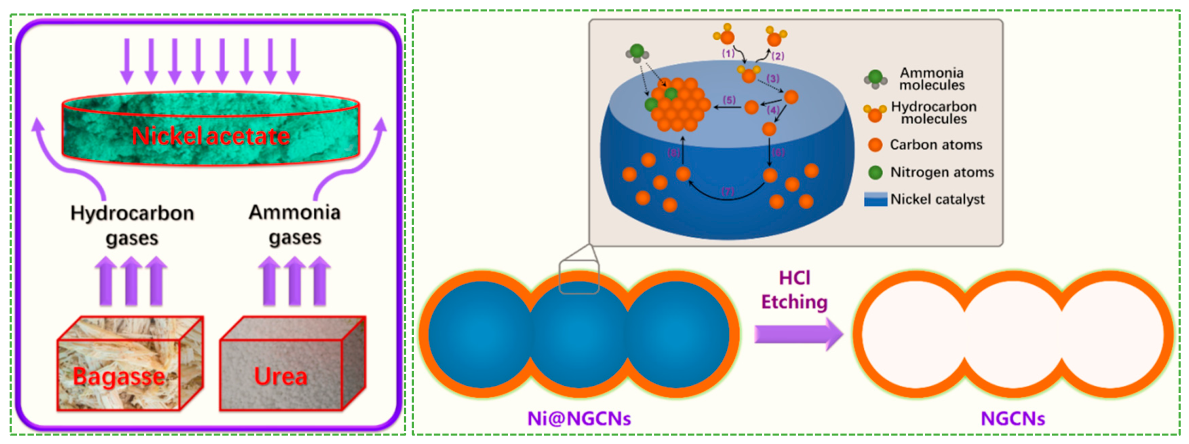
Figure 2.
Typical SEM (A-C) and TEM (D-F) images of NGCNs.
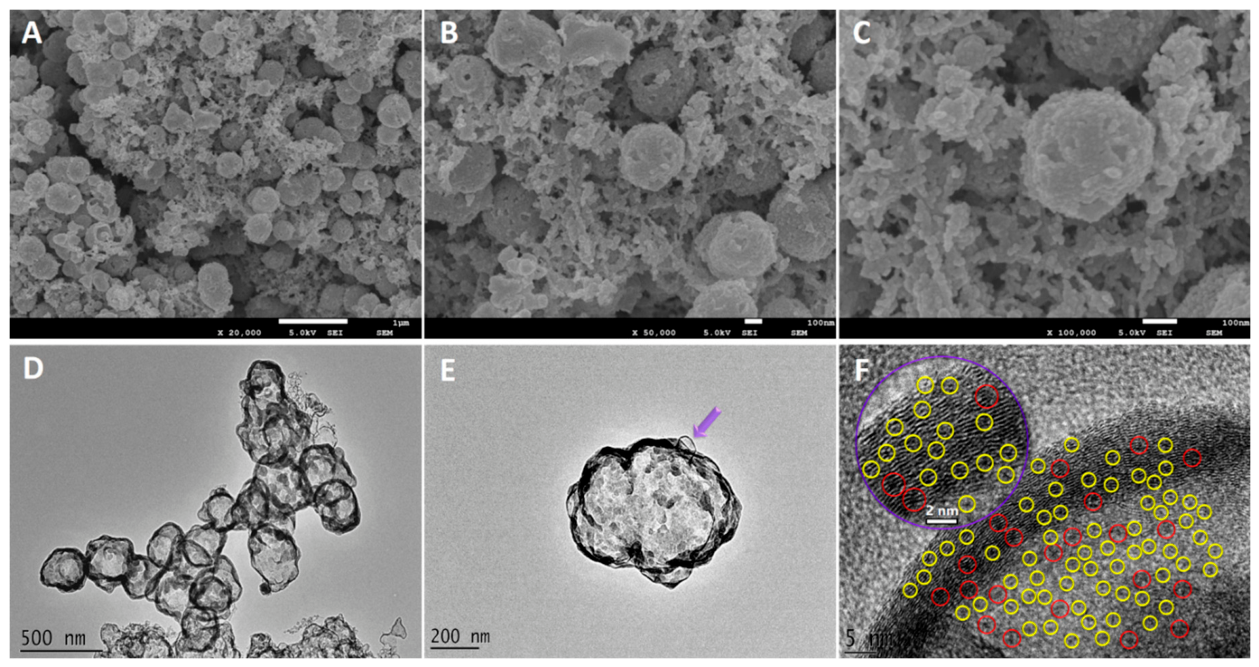
Figure 3.
Contrastive TEM images of NGCNs (A, B) and Ni@NGCNs (C, D).
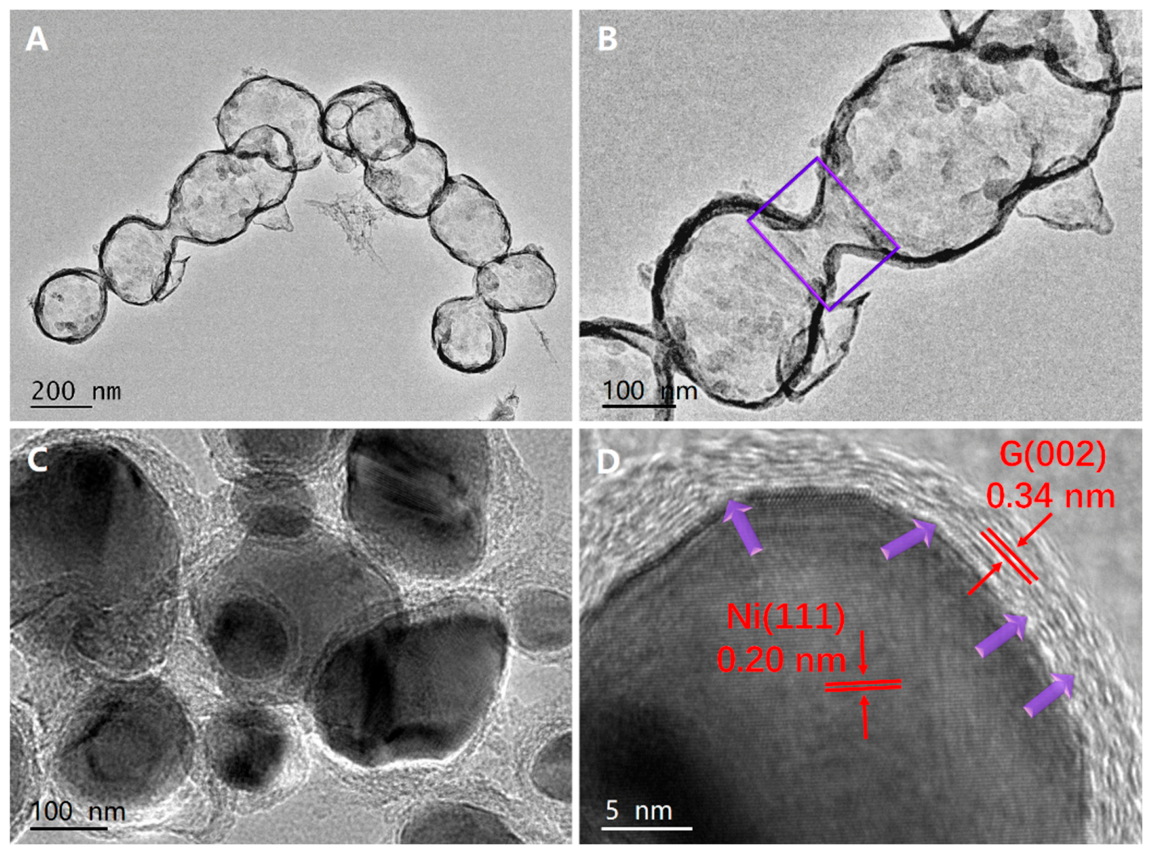
Figure 4.
XPS spectrum of NGCNs: (A) survey scan, (B) atomic percentage, (C) C 1s, (D) O 1s, (E) N 1s and (F) schematic structures of doping N in graphene and possible Ni-N4 sites.
Figure 4.
XPS spectrum of NGCNs: (A) survey scan, (B) atomic percentage, (C) C 1s, (D) O 1s, (E) N 1s and (F) schematic structures of doping N in graphene and possible Ni-N4 sites.
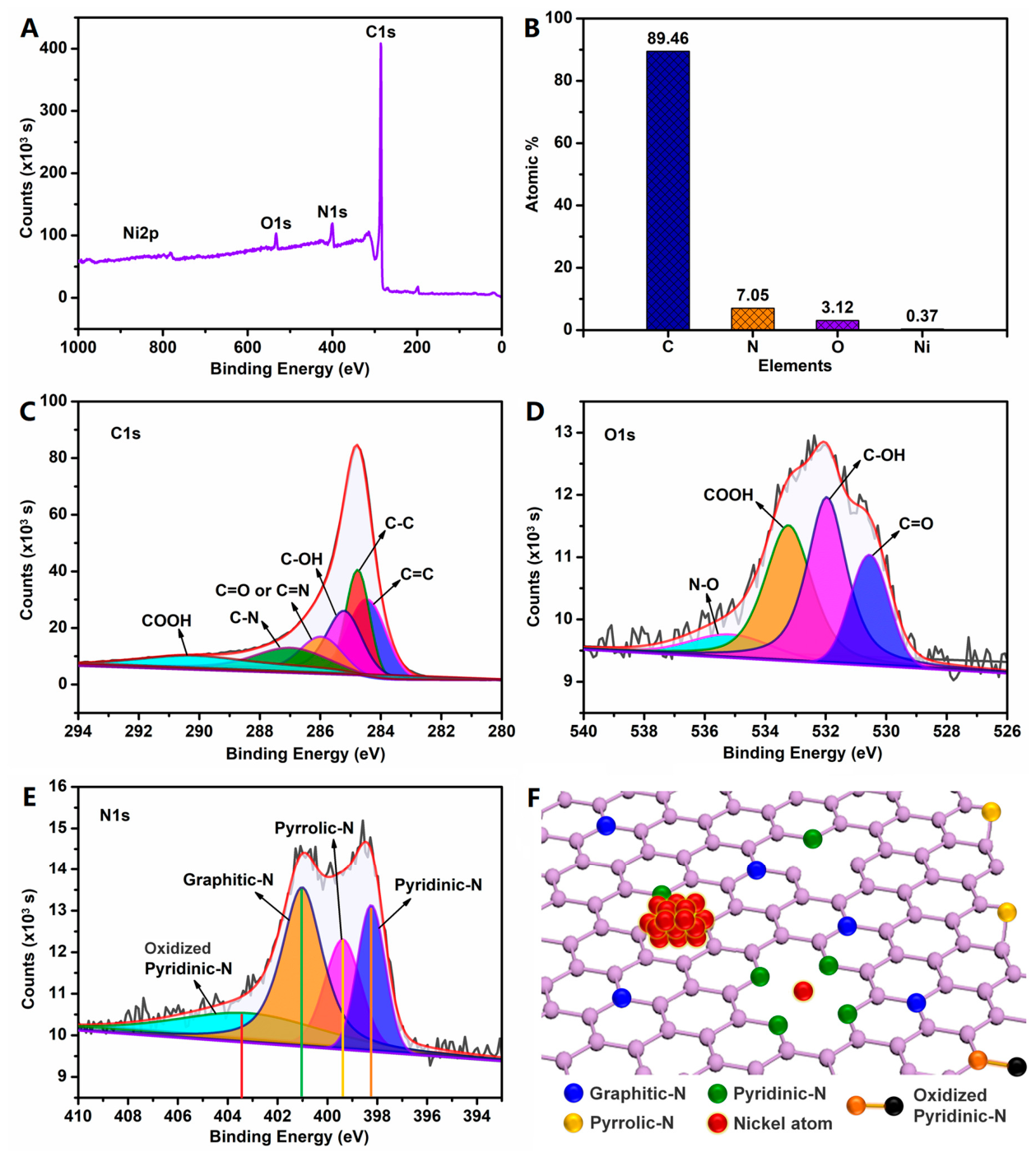
Figure 5.
Electrocatalytic ORR performances: (A) linear voltammetric polarization curve, (B) ring current and number of electrons, (C) constant potential I-t curve, and (D) ORR stability.
Figure 5.
Electrocatalytic ORR performances: (A) linear voltammetric polarization curve, (B) ring current and number of electrons, (C) constant potential I-t curve, and (D) ORR stability.
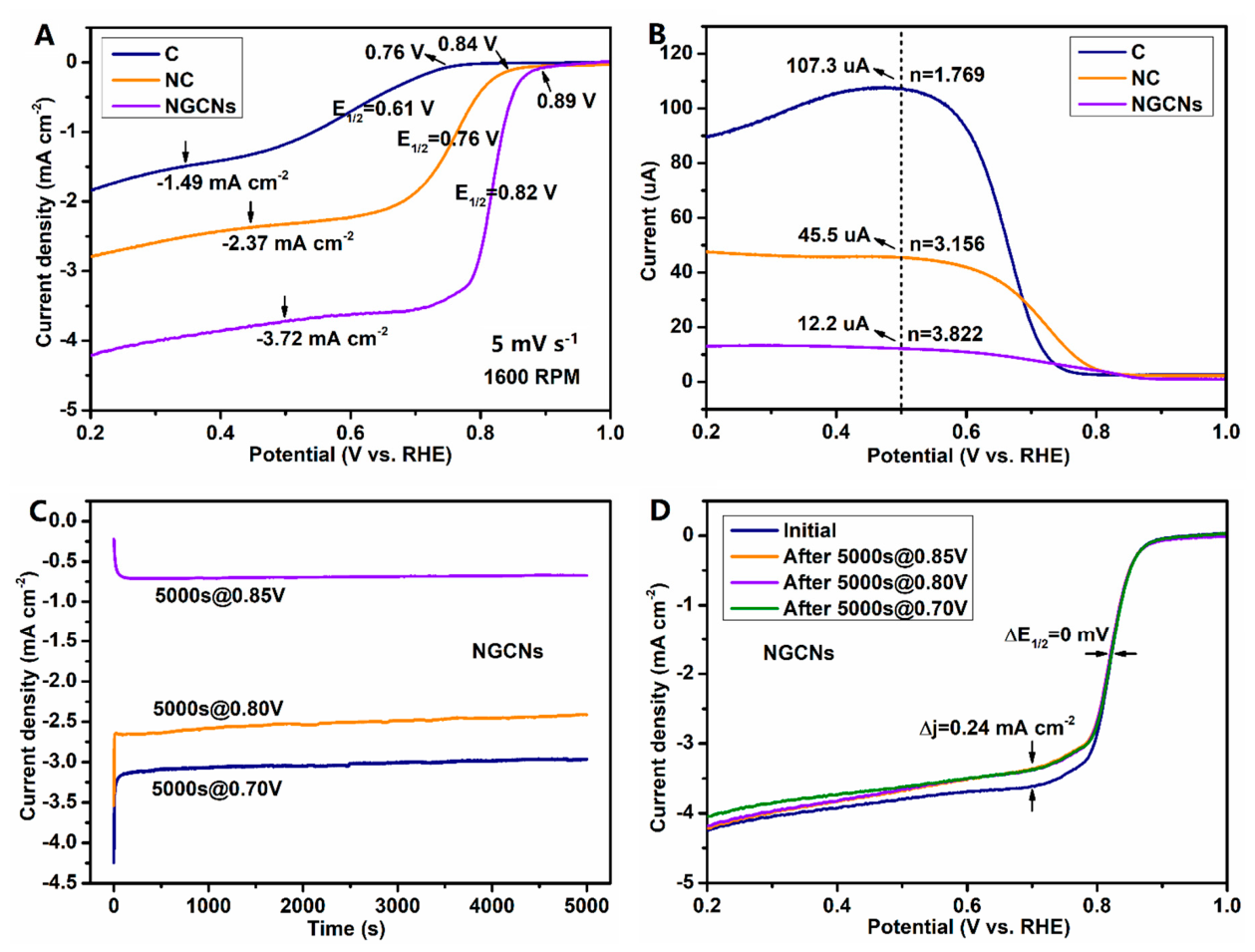
Figure 6.
Electrocatalytic OER performances: (A) linear voltammetric polarization curve, (B) Tafel plot, (C) successive OER and ORR tests, and (D) OER constant potential I-t curve.
Figure 6.
Electrocatalytic OER performances: (A) linear voltammetric polarization curve, (B) Tafel plot, (C) successive OER and ORR tests, and (D) OER constant potential I-t curve.
Disclaimer/Publisher’s Note: The statements, opinions and data contained in all publications are solely those of the individual author(s) and contributor(s) and not of MDPI and/or the editor(s). MDPI and/or the editor(s) disclaim responsibility for any injury to people or property resulting from any ideas, methods, instructions or products referred to in the content. |
© 2026 by the authors. Licensee MDPI, Basel, Switzerland. This article is an open access article distributed under the terms and conditions of the Creative Commons Attribution (CC BY) license (http://creativecommons.org/licenses/by/4.0/).
Copyright: This open access article is published under a Creative Commons CC BY 4.0 license, which permit the free download, distribution, and reuse, provided that the author and preprint are cited in any reuse.