

Submitted:
30 September 2026
Posted:
02 October 2026
You are already at the latest version
Abstract
This study examines how community conflict, restorative principles, and community planning can be integrated into a framework for conflict-sensitive and resilient urban governance. It connects two Hungarian urban cases situated in different temporal contexts: the completed community planning process in Cseri Park, Kaposvár (2017–2019), and an ongoing developer–resident conflict in Balokány-liget, Pécs, that emerged in 2026. Using qualitative document analysis of municipal minutes and resolutions, development documents, a planning-team project description, and press sources, the study applies an asymmetric lesson-transfer approach rather than a symmetrical comparison. The findings identify six transferable process mechanisms from Cseri Park: institutional authorization combined with early engagement, multi-stage participation, dedicated mediation or facilitation support, integration of local and professional knowledge, community-building across stakeholder groups, and feedback-based refinement and priority-setting. The study develops a three-level analytical framework linking community conflict, the restorative city, and community planning, with local identity treated as part of conflict diagnosis and socio-cultural urban resilience as a potential longer-term outcome. The results suggest that adapted participatory mechanisms can support more transparent, collaborative, and resilient responses to urban conflicts.
Keywords:
community conflict
; restorative city
; community planning
; local identity
; urban resilience
; participatory urban development
; conflict management
; social trust
1. Introduction
Urban development projects are often met with distrust by local residents, despite their anticipated benefits. Such initiatives may develop into community conflicts when the needs and interests of the stakeholders involved diverge. While some stakeholders support the proposed changes, others reject them or approach them with reservations [1]. These differing views may be rooted in differences in land-use interests, access to information, and decision-making authority. Therefore, urban development requires the simultaneous consideration of the needs of both developers and users [2]. Consequently, spatial development is both a planning and social process: it concerns not only what is built or what functions are introduced in a given area, but also the extent to which stakeholders’ needs and expressed views are considered in the decision-making process [3,4].
Urban development processes are typically preceded by assessments addressing functional and environmental considerations, as well as the preparation of local reports. Research highlighting the significance of place attachment and local identity suggests that understanding community responses requires consideration not only of the everyday use of a place but also of collective memory, a sense of control over the place, and the values that stakeholders consider important to preserve as part of its character [5,6,7]. This does not imply that local identity and collective memory are uniform or immutable. From the perspective of community planning, the relevant question is precisely how these differing perspectives are incorporated into the planning process and to what extent they are taken into account when decisions concerning new functions are made [8].
The literature on participatory planning has long distinguished between information provision, consultation, and genuine influence over decision-making. Arnstein’s classic model drew attention to the distribution of power underlying formal participation [9], while Fung argued that the quality of participatory processes depends on three factors: who is able to participate in the process, how participants can express and deliberate on their views, and the extent to which the outcomes of collective deliberation influence actual decision-making [10]. Quick and Feldman emphasize the importance of inclusion: stakeholder involvement becomes meaningful when participants are not merely given an opportunity to comment on an already developed solution, but can also influence how the problem is defined and how the rules of the process are established [11]. In the context of community conflict, the quality of participation is particularly sensitive. According to Innes and Booher, one-off large public hearings may increase participants’ frustration even when they are formally open to everyone. This may occur particularly when participants cannot see how their contributions can influence the decision [12]. By contrast, collaborative planning and governance are based on regular dialogue among participants, jointly accessible information, clearly defined roles and responsibilities, and continued cooperation throughout implementation [13,14,15]. Forester’s work suggests that where substantial differences in interests and values exist, achieving full agreement is not necessarily a realistic objective. It may be more important to establish frameworks for deliberation in which the parties can move beyond fixed positions and focus instead on specific needs, risks, and potential commitments [16].
Community planning can be understood as a more intensive form of participatory planning in which the affected community does not merely comment on proposals developed by professional actors or developers but also participates in defining problems, developing alternatives, and, where possible, shaping decisions [17]. This process is supported by planners and facilitators who seek to balance professional requirements with the needs of local residents.
At this point, the concept of the restorative city becomes relevant to the issue of community conflict. The restorative city represents an urban approach that extends beyond the institutional framework of restorative justice and seeks to address conflicts through dialogue and relationship-building [18,19,20]. Studies of restorative cities in Europe suggest that this approach becomes effective at the urban level when it is not confined to a single project but develops into a culture of cooperation among institutions, services, and communities [21,22]. The restorative city concept does not regard conflict as a disruption that needs to be eliminated, but rather as a situation that calls for an exploration of damaged relationships, underlying needs, and questions of responsibility, as well as the identification of conditions for future cooperation [23,24,25].
Community planning can provide a practical set of tools for this purpose. Early engagement, multi-stage workshops, the integration of local and professional knowledge, mediation or facilitation support, the joint exploration of alternatives, and feedback on the outcomes of proposals are all procedural elements that treat those involved in the conflict not merely as residents waiting to be informed, but as participants in understanding and shaping the problem [12,13,14,15,16,26,27,28]. The theory of procedural fairness further suggests that the legitimacy of decisions is shaped not only by their outcomes but also by whether stakeholders have been given a meaningful opportunity to express their views, whether they have been treated with respect, whether they have had access to relevant information, and whether the considerations underlying the decision are transparent [29]. Urban models of community mediation similarly emphasize the interrelationship between identity, power asymmetries, institutional trust, and local responsibility [30,31].
The three-part framework is also linked to the socio-cultural dimension of urban resilience. In this interpretation, resilience does not imply the absence of conflict; rather, it refers to the community and institutional capacity of a city to address disagreements through transparent procedures, maintain channels of communication, and continue to respond collectively to emerging problems even after a decision has been made. The present study proceeds from the premise that community conflict constitutes the diagnostic level, the restorative city the normative and relational level, and community planning the operational level. Within this three-part framework, community conflict reveals the needs, local values, and relational tensions that require attention. The restorative approach defines the safeguards and protocols that should guide the process, while community planning translates these principles into concrete procedural forms. Local identity therefore does not constitute a separate fourth pillar but rather a dimension of conflict diagnosis, whereas socio-cultural resilience represents one potential long-term outcome of successfully integrating the three levels. Figure 1 summarizes the three-level analytical framework and its relationship with local identity and socio-cultural resilience.
The empirical analysis is based on two Hungarian urban cases situated in different contexts. The documented community planning process conducted in Cseri Park, Kaposvár, between 2017 and 2019 serves as a completed case from which lessons can be drawn. In contrast, an ongoing conflict can currently be identified in Balokány-liget, Pécs, surrounding a development proposal that became public in 2026. According to the conflict map, tensions have emerged between the developer’s objectives concerning the reuse, cultural activation, and economic viability of the site and the needs of local residents relating to tranquillity, transport, parking, environmental impacts, access to information, and influence over decision-making [32,33,34,35]. Rather than comparing the two cases, the analysis examines which experiences and process mechanisms derived from the completed planning process may be transferable to the management of the ongoing conflict in Balokány-liget.
This study addresses three research questions: (RQ1) What developer and resident needs, local values, and tensions related to participation and trust emerge in the conflict surrounding Balokány-liget? (RQ2) Which mechanisms from the completed community planning process in Cseri Park can be transferred to the Balokány-liget case, and which require adaptation due to the different conflict context? (RQ3) How can adapted community planning connect restorative conflict management with the strengthening of socio-cultural urban resilience?
The contribution of this study lies in bringing the three interconnected elements of community conflict, the restorative city, and community planning into a unified theoretical framework and demonstrating how local identity and socio-cultural resilience can be incorporated into this framework. The empirical analysis explores the potential for applying lessons from a completed participatory process to an ongoing conflict. Within this framework, the study proposes a process for Balokány-liget that begins by identifying the needs of the developer and local residents, as well as the values associated with the place. This is followed by the collection of jointly verifiable information, the collaborative development of multiple development alternatives, and the institutionalization of collaborative mechanisms for addressing problems that may arise at a later stage. This approach connects restorative conflict management with the socio-cultural dimensions of sustainable and inclusive urban planning.
2. Materials and Methods
2.1. Research Design: Asymmetric Lesson Transfer
This study adopts a qualitative, exploratory case-study approach. The two cases are not examined as a symmetrical comparison. Instead, selected principles of structured, focused case analysis are used to assess the mechanisms identified in the completed source case against predefined criteria in relation to the ongoing target case [36,37]. The aim is neither to determine which of the two development processes was more successful nor to directly examine causal relationships. Cseri Park serves as the source case: a completed and documented community planning process from which specific participatory and conflict-management mechanisms can be identified. Balokány-liget serves as the target case: an ongoing and publicly contested situation in which the analysis examines the conditions under which lessons from the source case may be applied.
Asymmetry is methodologically significant. In Cseri Park, community planning did not take the form of a single event but rather developed as a gradually institutionalized process. In June 2017, the need to involve local residents and experts was publicly articulated; this was followed by a formal mandate from the General Assembly and, in December 2017, by the approval of the professional programme, while the documented participatory planning process took place in 2018–2019 [38,39,40,41,42,43]. In Balokány-liget, by contrast, the broader community conflict is associated with a relatively advanced development proposal that had already been made public [33,34,35]. Given the substantial differences between the source case and the target case in terms of the timing of the conflict, as well as the differences in their conflict maps indicated by the documented sources, no element of the Cseri Park community planning process can be transferred mechanically. The central question of asymmetric lesson transfer is therefore which process mechanisms identified in the source case may respond to a documented need or relational problem in Balokány-liget, and which restorative principle provides the rationale for their adaptation.
2.2. Data Sources and Documents Examined
Document analysis is an independent method of qualitative research. The documents used in this study are treated not merely as sources of background information, but as institutional and social records of the processes under examination [44]. The empirical core of the study consists of publicly available documentary and media sources directly related to the two cases. In the case of Balokány-liget, the analysis examined one municipal development document and three press reports published in July 2026 [32,33,34,35]. For Cseri Park, the source base comprises the minutes of the General Assembly meeting of 8 June 2017, documenting the institutional antecedents of the community planning process [41]; Municipal Resolution No. 123/2017 (VI. 12.) [42]; Resolution No. 226/2017 (XII. 7., approving the professional programme [38]; a local press report on the participatory events held in 2018 [40]; the project description prepared by the planning team [39]; and a 2019 press source retrospectively reporting on the duration of the process and its first implemented elements [43]. This chain of sources makes it possible to reconstruct not only the participatory events in the Cseri Park case, but also the institutional preparation and formal authorization of the community planning process. Figure 2 presents the institutional preparation and participatory process of community planning in Cseri Park.
Media reports are not treated as objective or comprehensive accounts of the events under examination. Their primary role is to show which arguments, concerns, and interpretations of the conflict appeared in the public sphere, as well as how the development of the participatory events in Cseri Park was reported in the media. Municipal minutes and resolutions allow the process of institutional decision-making and authorization to be traced, while the project description prepared by the planning team presents the planning and mediation methods applied. The differing perspectives offered by these source types are not assessed according to their evidentiary weight; rather, they are examined in relation to one another. This study does not assume that individuals quoted in the media represent the views of the entire local community, nor does it treat the project description prepared by the planning team as an independent evaluation of the outcomes of the process. Taken together, these different sources constitute the empirical core of the lesson-transfer analysis. Table 1 summarizes the empirical document base and the analytical role of each source.
2.3. Analytical Framework: Community Conflict – Restorative City – Community Planning
The analysis applies three interconnected and sequential levels. It proceeds from the premise that conflict management should not be approached solely in terms of addressing its symptoms; rather, the identification of the underlying problem provides the basis for determining appropriate case-specific responses. The first level involves the diagnosis of community conflict: identifying the needs, interests, fears, and perceived risks of the actors involved, the cultural and community values associated with the place, and tensions related to participation, as well as determining which of these can be treated as issues open to joint examination. The second level involves a restorative urban interpretation: examining what forms of relational harm, problems of trust, lack of recognition, or uncertainties regarding responsibility are revealed by the conflict and what safeguards are required to restore damaged relationships and trust [18,19,21,22,23,24,25]. The third level is the operational level of community planning: it identifies the specific participatory mechanisms through which the needs, local values, and restorative principles identified in the preceding stages can be incorporated into the planning process [9,10,11,12,13,14,15,16,26,27,28].
Together, the three levels form an analytical chain, as illustrated in Table 2. A mechanism identified in Cseri Park is considered a transferable lesson only if (a) it responds to a conflict-related problem or need that can be documented in Balokány-liget, (b) it is consistent with the relationship- and responsibility-oriented principles of the restorative approach, and (c) it can be translated into a concrete form of community planning.
2.4. Analytical and Lesson-Transfer Procedure
The analysis was conducted in three consecutive steps. First, we reconstructed the institutional and participatory process of community planning in Cseri Park in chronological order and identified six interrelated mechanisms from the documents: (1) institutional authorization of the process and early stakeholder engagement, (2) multi-stage participation, (3) dedicated mediation or facilitation support, (4) the integration of local and professional knowledge, (5) community-building approaches involving multiple stakeholder groups, and (6) feedback-based planning and the gradual establishment of priorities. Second, we analysed the sources documenting the objectives of the developer and the municipality in relation to Balokány-liget, the concerns expressed by residents and civil society actors, uncertainties regarding information, criticism concerning the manner and timing of residents’ involvement in the decision-making process, potential future risks associated with the operation of the site, and elements relating to its cultural function, community use, or place-based values considered important to preserve. Third, we conducted a comparative analysis to examine which problems or needs documented in Balokány-liget could be addressed operationally by each of the mechanisms identified in the Cseri Park case, and how these mechanisms might contribute to subsequent processes of community cohesion.
In this study, the term ‘need’ is not used as a psychological diagnosis, but rather as an interest or expectation identifiable behind a publicly expressed position and relevant to the decision-making process. In this context, the term ‘restorative’ does not refer to the adoption of a specific restorative justice procedure. Rather, it denotes an urban and community-oriented approach that regards dialogue, the mutual recognition of different interests and perspectives, fair participation, taking responsibility, the restoration of damaged or weakened relationships, and the creation of conditions for long-term cooperation as essential elements of the process.
2.5. Validity Considerations and Limitations
The validity of the analysis was strengthened in three ways. First, different types of sources were combined so that the municipal, planning, and media perspectives complemented, rather than substituted, one another. Second, the analysis applied consistent, predefined transferability criteria for determining whether the lessons from Cseri Park could be considered transferable to Balokány-liget; these criteria were established independently of the results. Third, media sources were used exclusively to identify documented claims, public statements, arguments, and interpretations of the conflict; the narrative framing employed by the media was not treated as an empirical fact in its own right. The analysis considered only documented claims, expressed needs, and the observable characteristics of the process.
The limitations of the research must also be taken into account. At the time of writing, the conflict surrounding Balokány-liget is ongoing; consequently, neither the outcome of the development decision nor the effects of its subsequent operation can yet be assessed. Cseri Park and Balokány-liget also differ in terms of function, timing, and the nature of the social pressures associated with the two sites. The sources do not include original interviews, survey data, or participant observation. The municipal documents relating to Cseri Park primarily foreground institutional considerations and therefore provide a more reliable record of the decision-making process than of participants’ lived experiences. A further limitation is the absence of a long-term impact assessment, which cannot be substituted by the planning-team or media sources. Publicly available documents were examined to identify local cultural and community values. Structured interviews with stakeholders would have allowed for the collection of more in-depth analytical data. Accordingly, a limitation of the study is that the methodology employed was not suitable for the representative measurement of local identity.
3. Results
3.1. Cseri Park as a Community Planning Case
Based on the publicly available documents, the community planning process in Cseri Park can be traced back to June 2017. During the General Assembly debate on 8 June, the mayor proposed that the Park’s future functions should be determined with the involvement of residents from the surrounding area and with the participation of professionals. The mayor explicitly emphasized the role of community planning in strengthening and building the local community [41]. Four days later, Point 7 of Municipal Resolution No. 123/2017 (VI. 12.) formally stipulated that the rehabilitation of the Donner and Cseri neighbourhoods should be implemented through community planning and required a report to be submitted by the end of the year [42]. General Assembly Resolution No. 226/2017 (XII. 7.) further advanced this institutional preparation: the assembly approved the report on the implementation of the previous decision, adopted the professional programme for the community planning of the revitalization of Cseri Park, and authorized the mayor to initiate the process [38].
The documented participatory phase began in late September 2018 with the ‘Cseri Picnic’, where proposals from Park users were collected [40]. The process subsequently continued through a series of forums to which local residents, civil society organizations, and neighbouring institutions were invited. At the second forum, participants were divided into four groups and asked to rank the ideas collected up to that point according to their importance. A draft based on the consolidated proposals was planned to be presented at the subsequent meeting [40]. According to the project description prepared by the planning team, the concept for the Park’s renewal was based on community needs identified with the assistance of professionals during the community planning process. As an outcome of the process, a concept plan was developed in 2019 [39]. A retrospective statement published in July 2019 described the process as approximately six months of community planning and identified a dog park, playground, forest school, nature trail, and running track as the most prominently expressed needs of local residents [43].
Based on the source material, six interrelated process mechanisms can be distinguished. The first is the combination of formal authorization to conduct the process with early engagement. Its purpose was to ensure that community needs and development requirements were taken into account already at the stage when the functions of the site were being defined, while also providing institutional legitimacy for the participatory process. This was subsequently reinforced by a General Assembly decision and a professional programme [38,41,42]. The second mechanism is multi-stage participation, which ensured continuity in stakeholder engagement: the picnic, successive forums, group work, prioritization, and feedback were organized as interconnected stages of the process [40]. The third is dedicated mediation support, aimed at facilitating dialogue and cooperation among the actors involved and complementing professional planning expertise with community-oriented and communication skills [39]. The fourth is the integration of local and professional knowledge, which enabled the preferences and experiences of Park users to be incorporated into the professional planning process. The fifth is a community-building approach involving multiple stakeholder groups, which sought to broaden participation and strengthen relationships among the actors involved. In addition to public forums, the process included picnics, small-group work, and the involvement of civil society organizations and neighbouring institutions [39,40]. The sixth mechanism is the repeated feedback and prioritization of proposals, which enabled community proposals to be evaluated, weighted, and translated into planning considerations. Rather than merely collecting ideas, the process involved ranking them and subsequently presenting the consolidated draft to the community for further feedback [40].
However, these mechanisms do not demonstrate that the Cseri Park process produced a conflict-free or optimal outcome for all stakeholders. The available sources do not contain independent long-term impact assessments; therefore, no conclusions regarding developer or user satisfaction were drawn from them. For the purposes of the Balokány-liget case, what is relevant is the structure and functioning of the documented participatory and planning process in Cseri Park, together with its formal institutional authorization. Participatory planning was first grounded in political and institutional authorization and was subsequently supported by a sequence of interconnected community events, mediation support, priority-setting, and professional planning work. Therefore, the comparison of different sources does not substantiate the ‘success’ of Cseri Park. Rather, it draws attention to how the procedural mechanisms examined in this case may be transferred to a community conflict in another location while being adapted to the specific characteristics of that conflict.
3.2. The Current Community Conflict in Balokány-Liget: From Positions to Needs
According to the development proposal made public in 2026, investors planned to create a multifunctional open-air cultural and event venue on the site of the former swimming complex in Balokány-liget. Alongside arguments concerning the reuse of the site, the expansion of the city’s cultural offer, and the attraction of new audiences, public sources also prominently reflected concerns among nearby residents regarding noise, traffic, parking, impacts on green space and quality of life, as well as the timing and transparency of the decision-making process [32,33,34,35]. Given the site’s former function as a swimming complex and its current park-like character, the planning issue also concerns the type of future use to be assigned to an urban place that carries both historical and community significance. Community sentiments are therefore associated both with memories of the past and with fears related to the use of the site.
Reducing the conflict to a division between pro-development and anti-development camps does not provide a comprehensive understanding of its actual nature. On the developer and municipal side, identifiable needs include the activation of an unused or underused site, the development of cultural infrastructure, the operational viability of the project, and greater predictability for the investment. The developer’s publicly expressed arguments also included safety considerations associated with a more orderly use of the site. A broader theoretical framework for this consideration can be provided by crime prevention through environmental design. According to Andrea Tünde Barabás, the deliberate design of the built environment—including measures that improve the visibility of the area and facilitate natural surveillance—may reduce opportunities for crime and strengthen informal community control [45]. On the residents’ side, similarly identifiable needs include tranquillity, safety, and predictability; the manageable impact of traffic and parking; the protection of environmental values; transparency in the decision-making process; and assurance that effective mechanisms will remain available to address problems that may arise at a later stage. Community planning may provide an appropriate procedural framework for exploring these considerations, as stakeholder involvement can bring local needs, interests, and experiential knowledge to the surface, contribute to the social acceptability of the decision-making process, and, through continuous feedback, enable the planning process to respond to problems that emerge at later stages [26,46].
The needs of the two sides are partly competing but also overlap. Shared interests may include the orderly and sustainable use of the site, crime prevention, safe mobility, clear operational rules, the verifiability of expert claims, and the avoidance of prolonged escalation of the conflict. The process becomes meaningful when the underlying needs that can be addressed through different planning solutions are identified.
The analysis of needs also encompasses the dimension of local identity. The literature on place attachment indicates that community responses to site transformation cannot be understood solely in terms of the direct benefits and burdens associated with the proposed function. Previous uses of the site, memories associated with the place, and the extent to which stakeholders feel that they can influence its future are also important [5,6,7]. Based on the documentary sources used to examine the conflict, it cannot be concluded that Balokány-liget is associated with a single, uniform local identity. The available documents do not allow the reasons for this diversity to be reliably determined. Several media statements expressed a strong attachment to the site’s former function as a public swimming complex, as well as a desire for its restoration. However, these statements do not provide a basis for determining the extent to which this preference characterizes the local community as a whole or particular age groups. Therefore, an important task of community planning is to identify which physical, historical, cultural, and everyday-use values different stakeholder groups consider important to preserve when planning the future functions of the site and how these values can be reconciled with new functions. According to the developer’s publicly stated position, reopening the former swimming complex in its original function is not technically or economically feasible. However, the available sources do not contain an independent technical impact assessment that would allow this study to treat this claim as an independently established technical finding [33,35]. Table 3 presents the needs documented in the Balokány-liget case and the areas of common concern.
3.3. Transferable Lessons from Cseri Park for Balokány-Liget
The lesson-transfer analysis indicates that the added value of the Cseri Park case lies not in a specific park design or participatory technique, but in a process principle supported by documentary evidence that can also be applied at a different stage of the conflict in Balokány-liget. In this sense, lesson transfer means that the process principle can be applied to a situation that differs from the conflict context of the source case, provided that local considerations are taken into account. Based on the chronology of the public sources examined, the broader conflict involving local residents had already been publicly articulated before a structured participatory process was established to address it [33,34,35]. In Cseri Park, by contrast, the involvement of residents and professionals began on the basis of institutional authorization and at a stage preceding the emergence of public conflict [38,41,42]. Consequently, in Balokány-liget, community planning must first address the tensions relating to trust and information that have already emerged.
The first lesson is the combination of institutional authorization and early engagement. In the Cseri Park case, the need to involve local residents was publicly articulated before the functions of the site had been determined, after which a General Assembly resolution and an approved professional programme established the institutional framework for community planning [38,41,42]. In Balokány-liget, it is no longer possible to apply the model case at an early stage—that is, before the emergence of the conflict—but the underlying principle remains transferable: before the next substantive phase of decision-making, it should be publicly clarified which issues have already been decided, which remain open, who is responsible for the participatory process, and how its outcomes will inform the decision-making process. Therefore, the credibility of participation depends on clearly defining the current scope of decision-making and formally committing to it at the institutional level.
The second lesson is multi-stage participation. In Cseri Park, the opening picnic was followed by a series of forums, small-group prioritization of interests and needs, and a feedback stage explaining how these were incorporated into the planning process [40]. The public forum held in Balokány-liget in July 2026 provided an important space for articulating concerns and identifying the conflict, but a single forum alone cannot enable the joint examination of complex technical, operational, and trust-related issues [33]. Therefore, the lesson from Cseri Park is not to replicate a particular type of event but to organize participation as a process: a large public forum should be complemented by smaller working groups, thematic workshops, site visits, and repeated feedback.
The third lesson is the provision of dedicated mediation or facilitation support for the planning process. The project description prepared by the Cseri Park planning team explicitly reports the involvement of a mediator in public forums and community events [39]. This does not imply that the roles of the planner and the mediator were institutionally separated in every respect; however, the presence of distinct mediation expertise within the participatory process can be documented. In Balokány-liget, where the developer, planner, or municipality may be perceived as stakeholders with an interest in the outcome, it would be appropriate to entrust the facilitation of conflict-related communication to an independent facilitator or, depending on the nature of the conflict and the consent of the parties, to a mediator. The added value of the restorative approach lies in the fact that a mediator acting as an impartial process facilitator does not merely moderate the discussion but also supports the exploration of the needs and grievances underlying the parties’ positions, as well as the responsibilities they are willing to assume [18,19,21,22,23,24,25,30,31].
The fourth lesson is the integration of local and professional knowledge within a collaborative process. In Balokány-liget, most of the tensions and fears identified relate to issues that can be measured and assessed in advance, including the number and timing of events, audience capacity, sound propagation, traffic and parking impacts, pedestrian routes, impacts on green space, cleaning, public safety, and complaint handling. However, local knowledge may encompass not only practical experience of how the site is used, but also narratives that provide insight into the cultural and community-related past and present associated with the place [5,6,7]. A shared evidence base becomes a tool for conflict management when stakeholders do not merely receive completed expert assessments, but also participate in defining the questions to be examined, the measurement points, and the evaluation criteria, as well as in identifying the place-based values that should be preserved.
The fifth lesson is a community-building approach involving multiple stakeholder groups. In the Cseri Park process, the forums were complemented by opening and closing picnics, small-group work, and the involvement of civil society organizations and neighbouring institutions, in addition to local residents [39,40]. In a highly conflictual case, not every encounter needs to take the form of a formal debate. All of the identified elements of the Cseri Park process may be relevant, while the involvement of developers and residents can also be supported through less formalized formats, such as joint site visits, thematic small-group sessions, and facilitated meetings in which participants can share their own experiences of using the site. These formats may help reduce rigid stakeholder positions, strengthen mutual understanding, and enhance the social acceptability of the process.
The sixth lesson is that the planning process should be shaped through continuous feedback, which should also be used to identify the most important tasks. In the Cseri Park case, participants ranked the collected ideas in groups, and the resulting list of priorities was subsequently presented [40]. This indicates that participation did not end with a one-off collection of opinions; rather, participants were able to articulate their views through successive rounds of review and refinement. A documented feedback system would also be important in the Balokány-liget case: each round of planning should conclude with a publicly accessible decision log or feedback matrix showing which proposals were incorporated, which were not, the reasons for these decisions, what further assessment is required, and who is responsible for the next step.
The six lessons outlined above are presented in Table 4.
3.4. Proposed Restorative Community Planning Process for Balokány-Liget
Based on the findings of the lesson-transfer analysis, what is warranted in Balokány-liget is not another single public forum but a structured participatory process consisting of successive and interconnected stages. The proposed eight steps are summarized in Table 5; they do not predetermine the substantive outcome of the development project. Rather, they are intended to ensure that the needs of the developer and local residents are articulated in an identifiable and comparable form, allowing some of them to become the subject of collaborative planning, while the ultimate decision-making responsibility remains with the actors holding the relevant authority.
Four elements of the process are particularly important. In Balokány-liget, the credibility of community planning begins with clarifying the current scope of decision-making. Establishing a shared evidence base involves not only making expert documents publicly available but also jointly determining what should be measured and according to which criteria the results should be evaluated. A shared map of place-based values enables cultural and community meanings to be incorporated as inputs into the development of alternatives, rather than being considered only retrospectively during communication. Finally, it should be emphasized that post-decision monitoring and review are integral to both restorative logic and urban resilience: responsibility and learning do not end once a decision has been made.
The proposed approach does not require a full consensus. Community planning does not replace municipal responsibility, property rights, regulatory procedures, or expert decision-making. The criterion for meaningful participation is whether issues that remain open to influence can genuinely be influenced, whether the reasons behind decisions on issues that have already been settled can be clearly traced, whether participants’ needs and concerns receive documented responses, and whether an institutional framework for jointly addressing problems remains in place after the decision has been made. Figure 3 illustrates the integrated logic of community conflict, restorative cities, and community planning.
4. Discussion
4.1. The Three-Part Framework: Diagnosis, Normative Framework, and Practical Mechanism
The most important theoretical finding of this study is that community conflict, restorative cities, and community planning can be understood not as three parallel themes but as interconnected and sequential levels of analysis. Community conflict serves a diagnostic function: it brings to the surface divergent needs, asymmetries of information and power, and tensions related to participation and trust. The restorative city adds qualitative requirements to this diagnostic level: being heard, mutual recognition, problem-specific methodologies, responsibility, and the maintenance of relationships are not merely communicative values but form part of effective urban conflict management [18,19,21,22,23,24,25]. Community planning, when applied in accordance with restorative principles, can translate these requirements into concrete procedures. Within this model, local identity and cultural and community values associated with the place form part of conflict diagnosis: they indicate that planning must take into account not only functions but also community needs [5,6,7].
This distinction is important because community planning is not necessarily restorative in itself. A participatory process may involve numerous meetings but still fail to provide genuine influence, address power asymmetries, or ensure feedback. The reverse is also true: without community planning mechanisms, restorative urban principles can easily remain general statements of values. The three-part framework therefore enables mutual checks across its components. Conflict identifies what needs to be addressed. The restorative approach seeks to restore damaged relationships and trust. Community planning, in turn, provides the procedural design through which this process can be carried out.
4.2. Limitations of the Lessons from Cseri Park and the Need for Adaptation
The differences between Cseri Park and Balokány-liget do not constitute a methodological obstacle; rather, they are central to the question of how lessons can be transferred. The documents examined collectively reflect this asymmetry: in Cseri Park, the principle of community planning had already emerged in June 2017, at an early stage in defining the functions of the site, on the basis of authorization provided by a General Assembly resolution. The documented participatory process subsequently began following the approval of the professional programme [38,39,40,41,42]. Thus, one of the main functions of participation could indeed be to shape preferences and the future functions of the site. In Balokány-liget, by contrast, the conflict had already been publicly articulated; consequently, the first task of community planning is not simply to collect ideas. The existing scope for decision-making, previous information and communication gaps, issues of trust, and the safeguards considered important by the parties must first be clarified.
Consequently, the lesson of ‘early engagement’ derived from Cseri Park cannot be directly applied to the community conflict in Balokány-liget. However, the institutional logic underlying early engagement can be transferred: defining the scope for decision-making in advance, establishing the framework for participation through a formal decision, designating responsibility for managing the process, and organizing multiple interconnected participatory events. Therefore, appropriate adaptation requires that each subsequent substantive decision point be accompanied by participation at the earliest possible stage, with a clearly defined opportunity to exert genuine influence. The same applies to community-building formats: in an already polarized situation, informal encounters can be credible only if they do not obscure genuine differences in interests, but instead complement a structured and documented decision-making process.
Therefore, lesson transfer does not involve adopting the Cseri Park ‘model’ as such, but rather adapting its source-based mechanisms to local specificities. The Cseri Park case demonstrates in particular that the quality of community planning does not derive from a single forum, but from the combined effect of municipal authorization, a sequence of participatory events over time, the professional credibility of the facilitator, the processing of community priorities, and feedback from the planning team. This is consistent with the restorative city approach, which does not proceed from uniformly applicable models, but instead emphasizes processes adapted to local needs and specificities and based on dialogue and cooperation among different actors [18,23].
4.3. The Restorative Added Value: From Needs to the Allocation of Responsibilities
In the Balokány-liget case, the restorative urban approach adds value to conventional participatory planning in three respects. First, it treats conflict not merely as an obstacle, but as a source of information. Behind residents’ opposition, pressure from the developer to move the project forward, or municipal involvement, needs can be identified that may inform the planning process. This does not mean that every need must be met, but it allows the parties to understand more precisely which values or fears underlie the other party’s position.
Second, the restorative approach also regards the state of relationships as an outcome in its own right. A decision may be legally valid and technically feasible, while the process through which it was reached results in a lasting loss of trust. Restorative literature therefore attaches importance not only to the substance of the resulting agreement but also to whether the process provides opportunities for participants to be heard, for their dignity and perspectives to be recognized, for dialogue, for the assumption of responsibility, and for the development of mutual understanding. These factors may also contribute to relationship-building and more enduring relational change [47,48]. The restorative city approach extends this relational dimension to the management of community conflicts and is based on dialogue, recognition of the dignity of the other party, and cooperative and constructive processes [18].
Third, the restorative approach links participation to the clarification of responsibilities and commitments. The purpose of dialogue is therefore not merely to develop a mutual understanding of the parties’ positions but also to clarify what commitments the individual actors undertake, how fulfilment of those commitments can be monitored, and what procedure will ensure the joint management of problems that may arise at a later stage [18,19,21,22,23,24,25,47,48]. In the Balokány-liget case, this highlights the importance of defining in advance the operational conditions, complaint-handling procedures, monitoring arrangements, and review mechanisms.
4.4. Community Planning as Local Infrastructure for Restorative and Resilient Urban Governance
The literature on restorative cities emphasizes that urban-level change does not result from a single programme, but rather from a network of institutions and community practices [18,19,21,22,23,24,25]. From this perspective, Balokány-liget is not merely the subject of a specific development dispute but also a test of whether the city is capable of addressing conflict through a process that generates patterns of cooperation that can be applied in future cases. From the perspective of sustainable and inclusive urban planning, therefore, what matters is not only the substance of the decision reached, but also its effects on institutions and community cohesion, the recognition of local knowledge and values, and the value of the planning process as a form of community learning [49].
In this sense, community planning can serve as a local mechanism for restorative and resilient urban governance. Not every urban conflict needs to be addressed using the same method, and not every development project requires a fully participatory process. However, in situations where a decision has a lasting impact on the everyday environment, the actors are mutually interdependent, and the conflict has also become an issue of trust or legitimacy, multi-stage community planning may provide a means through which the city’s restorative principles can be experienced in the form of a concrete procedure.
The broader resilience literature emphasizes adaptive capacity, learning, and institutional responses to changing circumstances. Urban governance can be considered more resilient when it is capable of addressing contested situations while maintaining opportunities for dialogue among the actors involved, allowing previous decisions and assumptions to be revisited, and transforming local experiences and cultural and community values into knowledge that can inform subsequent decisions [50,51,52]. Lesson transfer is therefore not only a response to a specific conflict, but also a socio-cultural mechanism for strengthening long-term urban adaptive capacity.
4.5. Research Limitations and Future Directions
This study is document-based and exploratory in nature; consequently, the empirical effects of the proposed process have not yet been tested in the target settings. A subsequent stage of research could involve a longitudinal examination of the process in Balokány-liget. Semi-structured interviews with developers, municipal representatives, residents, civil society actors, and experts, together with observation of participatory events and tracking of how proposals are addressed over time, would make it possible to examine whether the restorative community planning framework strengthens trust, the acceptability of the decision-making process, and community cohesion. Interviews and participant observations could also explore which local cultural and community values stakeholders identify and how the process affects the socio-cultural dimensions of urban adaptive capacity.
The inclusion of additional comparative cases could also help determine which mechanisms work particularly well when community planning is introduced into an already established conflict and which are more effective when it becomes institutionalized before the conflict escalates.
5. Conclusions
The debate surrounding Balokány-liget demonstrates that urban development conflicts cannot be understood solely in terms of the substantive aspects of a development project. The positions of developers and residents reflect different but partly reconcilable needs, while decisions concerning the future of the site also require consideration of its cultural and community significance. Therefore, the long-term manageability of the conflict also depends on when and with what degree of influence the actors can become involved, how much they trust the information provided, whether they perceive the decision-making process as transparent and traceable, which place-based values they consider important to preserve, and whether enforceable safeguards are in place for future operations.
Six mechanisms can be identified from the completed community planning process in Cseri Park that, with appropriate adaptation, may also be applied in Balokány-liget: combining the establishment of an institutional framework with early engagement; multi-stage participation; dedicated mediation or facilitation support; integration of local and professional knowledge; community-building approaches involving multiple stakeholder groups; and feedback-based planning and priority-setting. These mechanisms do not guarantee consensus but may reduce the risk of positions becoming entrenched and create a clearer relationship between participation, professional planning work, and decision-making responsibility.
The main theoretical conclusion of the study is a three-part framework of community conflict, restorative city, and community planning. Community conflict reveals the needs, local values, and relational problems that require attention. The restorative city defines the qualitative criteria of the process: mutual recognition, dialogue, responsibility, and the maintenance of relationships. Community planning, in turn, translates these criteria into concrete and verifiable procedural steps. Integrating these three levels may also strengthen socio-cultural urban resilience by transforming the experience of conflict into shared knowledge and a capacity for cooperation that can inform subsequent decisions.
Therefore, the proposed eight-step process for Balokány-liget is not intended to secure acceptance of a predetermined development decision. Its purpose is to bring the needs of developers and residents, together with the cultural and community values associated with the place, into a shared framework for problem-solving; to make contested claims subject to joint verification; to develop multiple genuine alternatives; and to establish channels of responsibility and review that remain operational after the decision has been made. In this sense, community planning is not merely a communicative accompaniment to conflict, but a practical form of restorative, sustainable, and inclusive urban governance.
The lessons also indicate that the socio-cultural sustainability and resilience of urban planning cannot be separated from the quality of local residents’ participation. Local attachment, collaborative identification of cultural and community values, transparency in decision-making, and the establishment of continuous arrangements for feedback and review can together enable urban governance to accommodate new functions while preserving the distinctive character of the place.
Author Contributions
Conceptualization, Cs.H., B.K.H.-F. and V.F.; methodology, Cs.H., B.K.H.-F. and V.F.; investigation, Cs.H., B.K.H.-F. and V.F.; formal analysis, Cs.H., B.K.H.-F. and V.F.; writing—original draft preparation, Cs.H., B.K.H.-F. and V.F.; writing—review and editing, Cs.H., B.K.H.-F. and V.F.; visualization, Cs.H., B.K.H.-F. and V.F. All authors have read and agreed to the published version of the manuscript.;
Funding
This research was funded by the University of Pécs, grant number 001_2026_PTE_RK/1.
Institutional Review Board Statement
Not applicable. This study was based exclusively on the analysis of publicly available documents and literature and did not involve human participants or the collection of personal data.
Informed Consent Statement
Not applicable.
Data Availability Statement
The empirical sources analysed in this study are publicly available and cited in the References. No new datasets were generated in this study. During the preparation of this manuscript, the authors used ChatGPT (OpenAI, GPT-5.6) to assist with the preparation and graphical presentation of the figures. The authors reviewed and edited all AI-assisted outputs and took full responsibility for the content of this publication.
Conflicts of Interest
The authors declare no conflict of interest. The funder had no role in the design of the study, collection, analysis, or interpretation of data, writing of the manuscript, or decision to publish the results.
References
- Földi, Z. A társadalmi részvétel szerepe a városfejlesztés gyakorlatában—európai és hazai tapasztalatok. Tér Társad. 2009, 23, 27–43. [CrossRef]
- Long, Z.; Wang, H.; Zheng, G. Uncovering the intricacies among power, interest, and knowledge in public participation: Evidence from urban renewal in Shenzhen, China. Cities 2026, 172, 106818. [CrossRef]
- Csanádi, G.; Csizmady, A.; Kőszeghy, L. Nyilvánosság és részvétel a településtervezési folyamatban. Tér Társad. 2010, 24, 15–36. [CrossRef]
- Bródy, L.S. Társadalmi részvétel a városfejlesztésben: változó szerepek Budapest tereinek alakításában. Tér Társad. 2022, 36, 82–99. [CrossRef]
- Devine-Wright, P. Rethinking NIMBYism: The role of place attachment and place identity in explaining place-protective action. J. Community Appl. Soc. Psychol. 2009, 19, 426–441. [CrossRef]
- Lewicka, M. Place attachment: How far have we come in the last 40 years? J. Environ. Psychol. 2011, 31, 207–230. [CrossRef]
- Manzo, L.C.; Perkins, D.D. Finding common ground: The importance of place attachment to community participation and planning. J. Plan. Lit. 2006, 20, 335–350. [CrossRef]
- Bradley, Q. Neighbourhood planning and the impact of place identity on housing development in England. Plan. Theory Pract. 2017, 18, 233–248. [CrossRef]
- Arnstein, S.R. A ladder of citizen participation. J. Am. Inst. Plann. 1969, 35, 216–224. [CrossRef]
- Fung, A. Varieties of participation in complex governance. Public Adm. Rev. 2006, 66, 66–75. [CrossRef]
- Quick, K.S.; Feldman, M.S. Distinguishing participation and inclusion. J. Plan. Educ. Res. 2011, 31, 272–290. [CrossRef]
- Innes, J.E.; Booher, D.E. Reframing public participation: Strategies for the 21st century. Plan. Theory Pract. 2004, 5, 419–436. [CrossRef]
- Healey, P. Collaborative Planning: Shaping Places in Fragmented Societies; Macmillan: London, UK, 1997.
- Ansell, C.; Gash, A. Collaborative governance in theory and practice. J. Public Adm. Res. Theory 2008, 18, 543–571. [CrossRef]
- Emerson, K.; Nabatchi, T.; Balogh, S. An integrative framework for collaborative governance. J. Public Adm. Res. Theory 2012, 22, 1–29. [CrossRef]
- Forester, J. Dealing with Differences: Dramas of Mediating Public Disputes; Oxford University Press: New York, NY, USA, 2009. [CrossRef]
- Sanoff, H. Community Participation Methods in Design and Planning; John Wiley & Sons: New York, NY, USA, 2000.
- Mannozzi, G. The emergence of the idea of a ‘restorative city’ and its link to restorative justice. Int. J. Restor. Justice 2019, 2, 288–292. [CrossRef]
- Matczak, A. What is a restorative city? Arch. Criminol. 2021, 43, 399–427. [CrossRef]
- Herke, Cs.; Herke-Fábos, B.K.; Bushrat, J. Designing restorative city models for child safety and crime prevention: Insights from the Global South. Urban Plan. Constr. 2025, 3, 28–50. [CrossRef]
- Liebmann, M. Bristol: Working together to resolve conflict and repair harm. Int. J. Restor. Justice 2019, 2, 298–305. [CrossRef]
- Maggio, F.; Perrella, L.; Lepri, G.L.; Lodi, E.; Scarpa, M.L.; Patrizi, P. Oltre un decennio di costruzione di una restorative city. Pandemos 2025, 3, 1–20. [CrossRef]
- Hanley, C. The restorative city. Contexts 2025, 24, 42–47. [CrossRef]
- European Forum for Restorative Justice. Thematic Brief on Restorative Justice Cities; European Forum for Restorative Justice: Leuven, Belgium, 2020.
- European Forum for Restorative Justice. Working Group on Restorative Cities. Available online: https://www.euforumrj.org/working-group-restorative-cities (accessed on 31 August 2026).
- Sain, M.; Czene, Z.; Péti, M.; Varga, Z. Segédlet a közösségi tervezéshez; Nemzeti Fejlesztési és Gazdasági Minisztérium–VÁTI Nonprofit Kft.: Budapest, Hungary, 2010.
- Tóth, T. Közösségépítés települési dimenziói. Studia Mundi—Economica 2018, 5, 58–73. [CrossRef]
- Málovics, G.; Mihók, B.; Pataki, G.; Szentistványi, I.; Roboz, Á.; Balázs, B.; Nyakas, S. Részvételi akciókutatással a társadalmi kirekesztés ellen: egy szegedi példa tanulságai. Tér Társad. 2014, 28, 66–84. [CrossRef]
- Tyler, T.R. Why People Obey the Law; Princeton University Press: Princeton, NJ, USA, 2006.
- Wong, M.M.K.K. Community mediation in plural cities: A contextual theory of identity, power, trust, and grassroots ownership. Conflict Resolut. Q. 2026, 44, 111–126. [CrossRef]
- Carrera-Fossas, E.; Brugué, Q. Neighbourhood organization as a way of addressing vulnerability: A case study of a community mediation programme in Olot, Spain. Space Polity 2025, 29, 112–133. [CrossRef]
- Pécs Megyei Jogú Város Önkormányzata. Célterületi cselekvési terv—Kelet-Pécs. Available online: https://pecs.hu/app/uploads/2026/02/KELET-PECS.pdf (accessed on 31 August 2026).
- Nimmerfroh, F. Megtelt a Pepita, élénk vita kísérte a Balokányba tervezett koncerthelyszín bemutatását. PécsMa, 18 July 2026. Available online: https://www.pecsma.hu/megtelt-a-pepita-elenk-vita-kiserte-a-balokanyba-tervezett-koncerthelyszin-bemutatasat/ (accessed on 31 August 2026).
- Szabó-Gödri, R. A tévéből tudták meg, hogy 9000 fős koncerthelyszín épülhet a lakásuk mellett. Átlátszó, 13 July 2026. Available online: https://atlatszo.hu/orszagszerte/2026/07/13/a-tevebol-tudtak-meg-hogy-9000-fos-koncerthelyszin-epulhet-a-lakasuk-mellett/ (accessed on 31 August 2026).
- Gűth, E. Szabadtéri koncerthelyszínként éledhet újjá Pécs egyik lepusztult strandja, ha a környékbeliek hagyják. Telex, 19 July 2026. Available online: https://telex.hu/belfold/2026/07/19/balokany-pecs-fejlesztes-udud-aquaprofit-gellai (accessed on 31 August 2026).
- Yin, R.K. Case Study Research and Applications: Design and Methods, 6th ed.; SAGE: Thousand Oaks, CA, USA, 2018.
- George, A.L.; Bennett, A. Case Studies and Theory Development in the Social Sciences; MIT Press: Cambridge, MA, USA, 2005.
- Kaposvár Megyei Jogú Város Közgyűlése. 226/2017. (XII. 7.) önkormányzati határozat. Available online: https://kph.kaposvar.hu/authorized/kozlony/kozlony201703/download/20171207.pdf (accessed on 31 August 2026).
- Lépték-Terv. Cseri Park. 2019. Available online: https://leptek.hu/project/17 (accessed on 31 August 2026).
- Marosi, G. Közösségi tervezésben újul meg a Cseri Park. Sonline, 19 October 2018. Available online: https://www.sonline.hu/helyi-kozelet/2018/10/kozossegi-tervezesben-ujul-meg-a-cseri-park (accessed on 31 August 2026).
- Kaposvár Megyei Jogú Város Közgyűlése. Jegyzőkönyv, 2017. június 8. Available online: https://kph.kaposvar.hu/data/onkorm/kozgyulesijegyzokonyvek/download/20170608.pdf (accessed on 9 September 2026).
- Kaposvár Megyei Jogú Város Közgyűlése. 123/2017. (VI. 12.) önkormányzati határozat, 7. pont. In Közgyűlési jegyzőkönyv, 2017. június 12. Available online: https://kph.kaposvar.hu/data/onkorm/kozgyulesijegyzokonyvek/download/20170612.pdf (accessed on 9 September 2026).
- Koszorus, R. A Kutyatár négylábúi is tesztelték az épülő futtatót. Sonline, 5 July 2019. Available online: https://www.sonline.hu/helyi-kozelet/2019/07/a-kutyatar-negylabui-is-teszteltek-az-epulo-futtatot (accessed on 9 September 2026).
- Bowen, G.A. Document analysis as a qualitative research method. Qual. Res. J. 2009, 9, 27–40. [CrossRef]
- Barabás, A.T. Bűnmegelőzés a környezet alakításával. In Határkövek: Ünnepi tanulmányok a 65 éves Sallai János rendőr ezredes tiszteletére; Kovács, T., Ed.; Ludovika Egyetemi Kiadó: Budapest, Hungary, 2025; pp. 41–48. [CrossRef]
- Windt, S. Közösségi tervezéssel a biztonságos terekért. Belügyi Szemle 2019, 67, 83–96. [CrossRef]
- Kirkwood, S. A practice framework for restorative justice. Aggress. Violent Behav. 2022, 63, 101688. [CrossRef]
- Kuo, S.-Y.; Longmire, D.; Cuvelier, S.J. An empirical assessment of the process of restorative justice. J. Crim. Justice 2010, 38, 318–328. [CrossRef]
- Alasmari, F. Stakeholder participation in urban land readjustment: A meta-synthesis of global approaches and institutional challenges. Front. Sustain. Cities 2026, 8, 1788572. [CrossRef]
- Tyler, S.; Moench, M. A framework for urban climate resilience. Clim. Dev. 2012, 4, 311–326. [CrossRef]
- Mehmood, A. Of resilient places: Planning for urban resilience. Eur. Plan. Stud. 2016, 24, 407–419. [CrossRef]
- O’Donnell, E.C.; Lamond, J.E.; Thorne, C.R. Learning and Action Alliance framework to facilitate stakeholder collaboration and social learning in urban flood risk management. Environ. Sci. Policy 2018, 80, 1–8. [CrossRef]
Figure 1.
Three-level framework of community conflict, restorative city, community planning, and its relationship with local identity and socio-cultural urban resilience.
Figure 1.
Three-level framework of community conflict, restorative city, community planning, and its relationship with local identity and socio-cultural urban resilience.
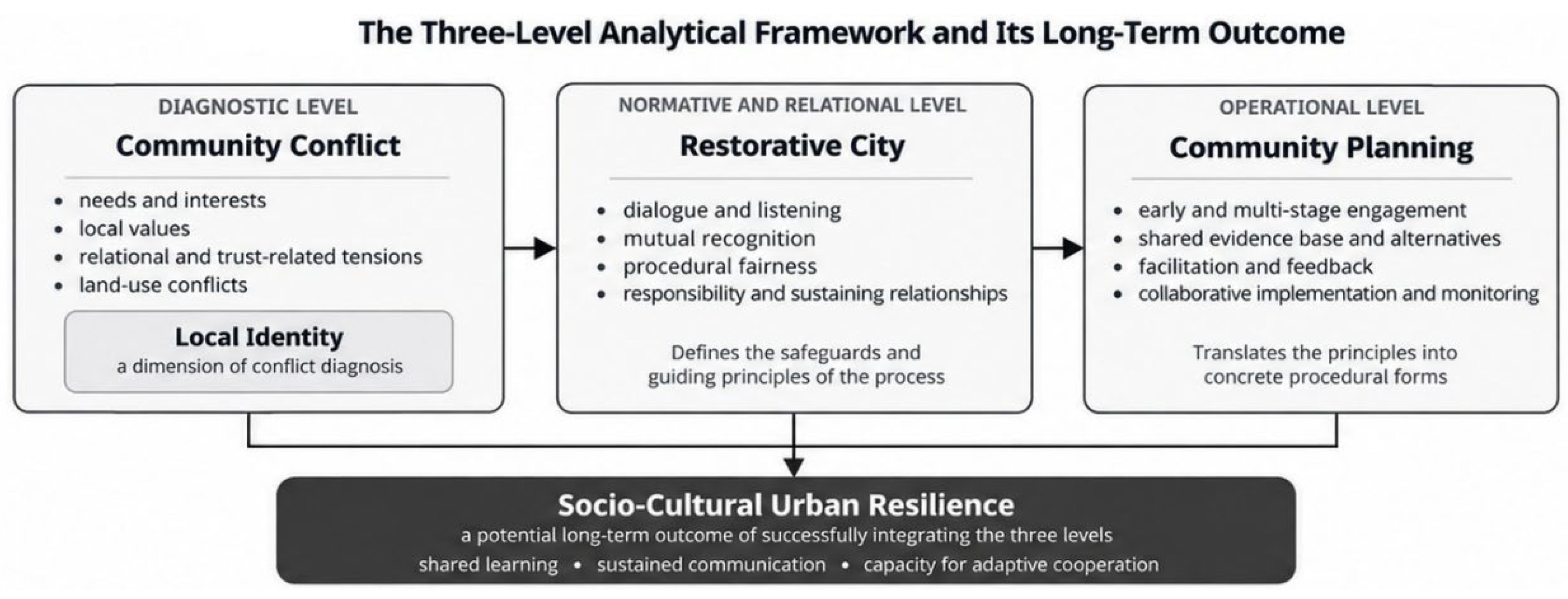
Figure 2.
Institutional preparation and participatory process of community planning in Cseri Park (2017–2019).
Figure 2.
Institutional preparation and participatory process of community planning in Cseri Park (2017–2019).
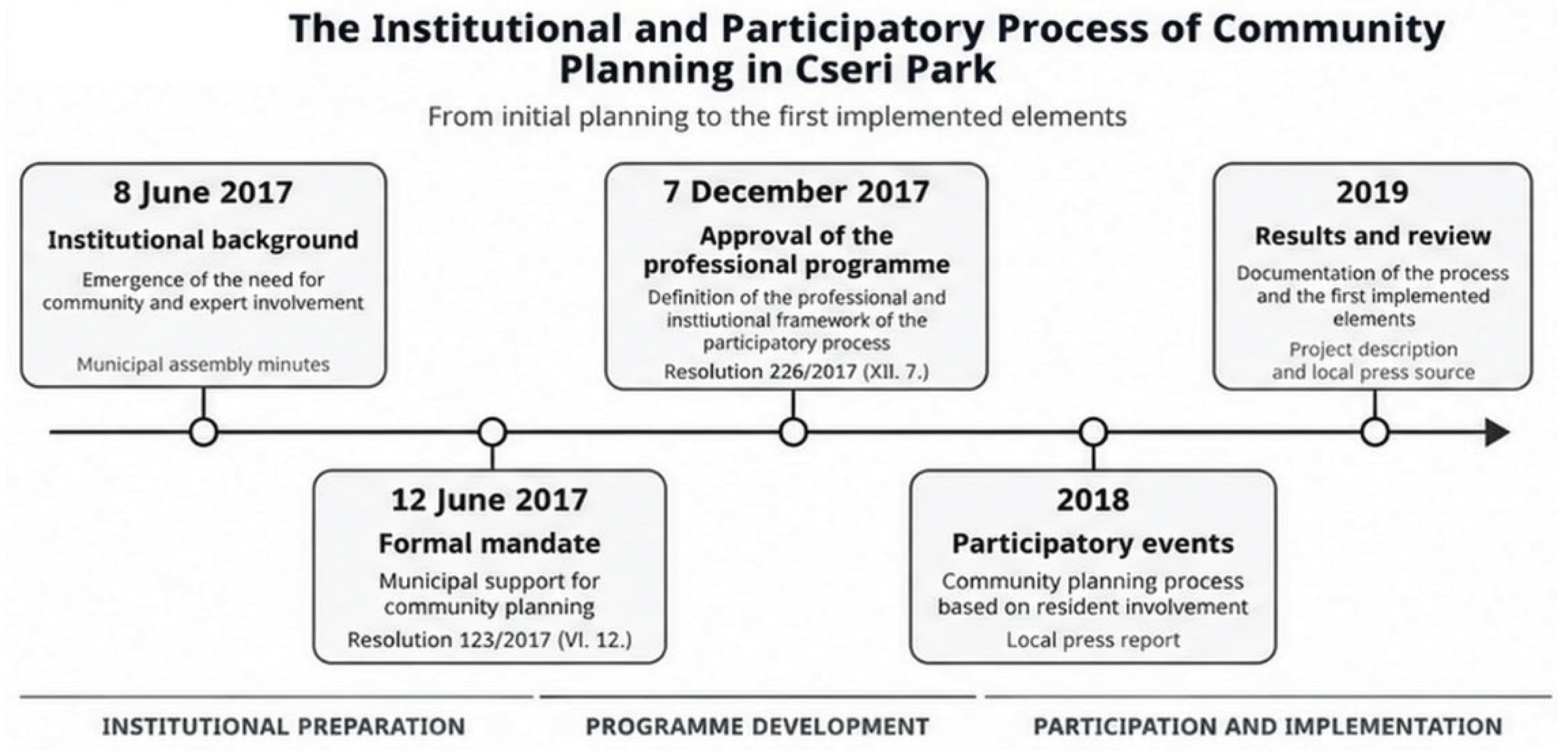
Figure 3.
Integrated logic of community conflict, restorative city, and community planning towards adaptive urban governance.
Figure 3.
Integrated logic of community conflict, restorative city, and community planning towards adaptive urban governance.
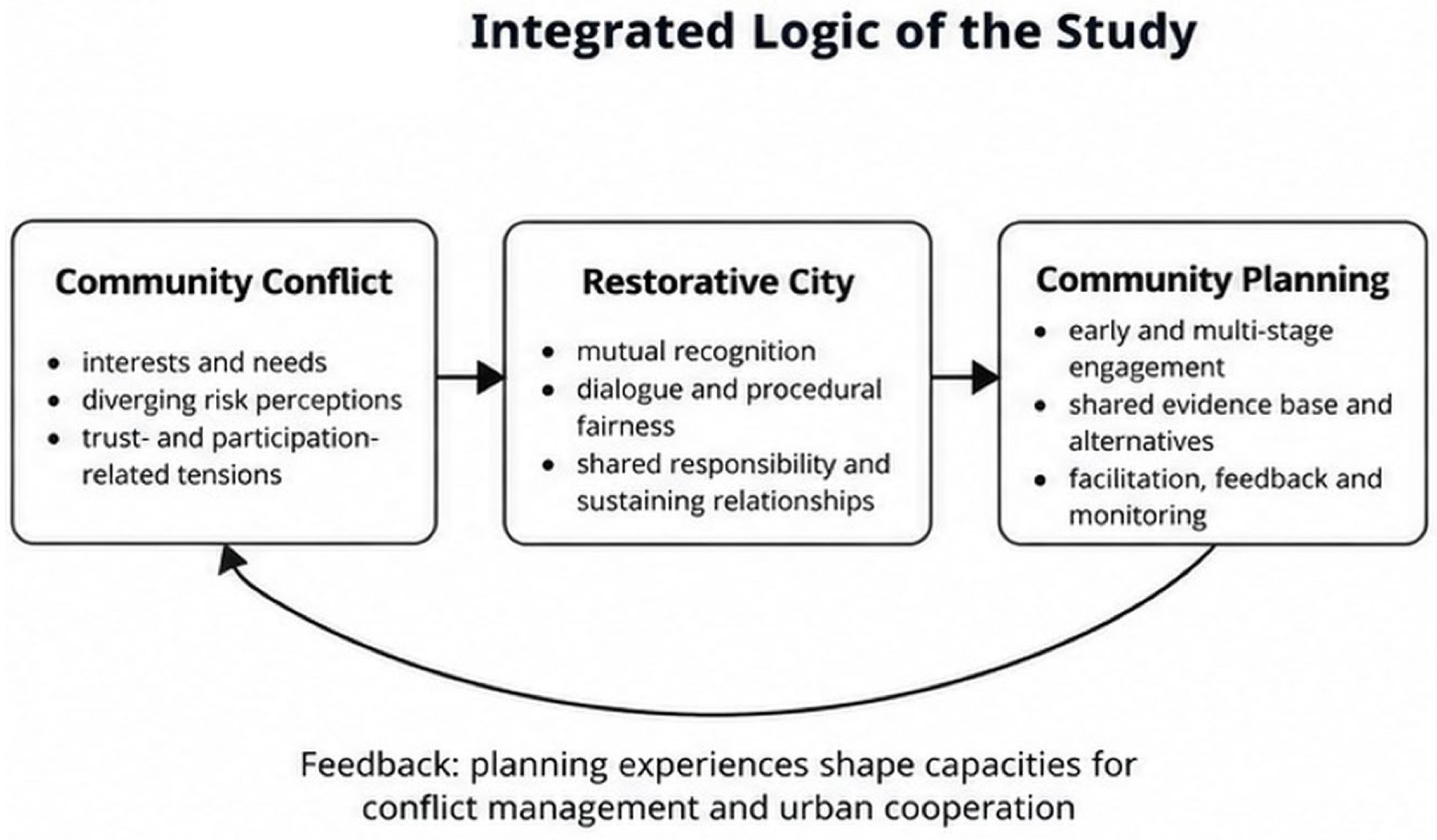

Table 1.
Empirical document base and its role in lesson transfer.
| Case | Source type | Source | Date | Analytical role |
|---|---|---|---|---|
|
Balokány-liget |
Municipal development document |
Pécs MJV: Target area action plan – East Pécs [32] |
2026 |
Development and urban structural context of the site |
| Balokány-liget | Local press |
PécsMa: report on the residents’ forum [33] |
18 July 2026 |
Residents’ questions, forum dynamics, and conflict intensity |
| Balokány-liget | Investigative press | Átlátszó: development proposal and residents’ responses [34] | 13 July 2026 |
Timing of participation, access to information, and stakeholder perceptions |
| Balokány-liget | National press | Telex: development concept and debate [35] | 19 July 2026 |
Public framing of developer and resident arguments |
| Cseri Park | General Assembly minutes |
Kaposvár General Assembly, 8 June 2017 [41] |
8 June 2017 |
Initiation of community planning; involvement of residents and experts; community-building objective |
| Cseri Park | Municipal resolution/minutes |
Kaposvár General Assembly, Resolution No. 123/2017 (VI. 12.), Point 7 [42] |
12 June 2017 |
Formal mandate for community planning and reporting requirement |
| Cseri Park | Municipal resolution |
Kaposvár General Assembly, Resolution No. 226/2017 (XII. 7.) [38] |
7 December 2017 |
Approval of the professional programme and authorization to initiate community planning |
| Cseri Park | Local press |
Sonline: Cseri Park to be renewed through community planning [40] |
19 October 2018 |
Idea collection, group prioritization, stakeholder groups, and planned feedback |
| Cseri Park | Planning-team project description |
Lépték-Terv: Cseri Park [39] |
2019 |
Description of the planning process, mediation support, and community events |
| Cseri Park | Local press |
Sonline: Kutyatár’s four-legged visitors also tested the dog park under construction [43] |
5 July 2019 |
Retrospective account of the duration of the process and functions emerging from community needs |
Table 2.
Three-level analytical framework.
| Analytical level | Core question | Key categories | Empirical output |
|---|---|---|---|
|
Community conflict |
What lies behind public positions? |
needs, interests, risks, local identity and cultural and community values, information and participation asymmetries, trust-related tensions |
conflict, needs, and place-value map of Balokány-liget |
|
Restorative city |
What is the quality of relationships required for collaborative problem-solving? |
identification of relational harm and needs, dialogue, mutual recognition, taking responsibility, trust-building, restoration of relationships, institutional and community cooperation |
normative criteria for transferability and longer-term relational outcomes |
|
Community planning |
What procedural mechanisms make these principles operational? |
early and multi-stage engagement, facilitation, shared evidence base, development of alternative solutions, feedback, monitoring |
adaptation of lessons from Cseri Park to Balokány-liget |
Table 3.
Documented needs and areas of common concern in Balokány-liget.
|
Stakeholder perspective |
Documented needs/expectations |
Element that can be reframed as a shared planning question |
|---|---|---|
|
Developer/municipal |
site use; cultural and urban activity; viable operational capacity; economic and organizational predictability; crime prevention |
What combination of functions and capacities can ensure viable operations while maintaining acceptable environmental impacts and impacts on local residents? |
|
Resident/community |
tranquillity; predictable noise and traffic impacts; parking and safety; green space; transparent decision-making; genuine influence; enforceable safeguards; consideration of cultural and community values associated with the place |
What operational conditions, limits, and monitoring points can make impacts predictable and manageable? Which place-based values should be preserved or carried forward in the planning process? What safety measures can contribute to the maintenance of a sense of security? |
|
Shared needs |
reliable information; clear responsibilities; verifiable commitments; orderly use of the site; functioning communication channels; consideration of the site’s distinctive character and community meanings; safety and crime prevention |
Shared evidence base, shared map of place-based values, multiple alternatives, reasoned feedback on decisions, monitoring, and review |
Table 4.
Restorative adaptation of lessons from Cseri Park to Balokány-liget.
|
Mechanism identified in Cseri Park |
Problem/need identified in Balokány-liget | Restorative principle | Proposed adaptation |
|---|---|---|---|
|
Institutional authorization of the process and early stakeholder engagement |
The conflict has already emerged; the actual scope for participation in decision-making and the institution responsible for the process are not clear to all stakeholders |
transparency; meaningful participation; responsibility |
Public process mandate: specification of decided, open, and conditional issues, decision-making responsibility, and feedback procedures |
|
Multi-stage participation |
A single large public forum cannot address all professional and trust-related issues |
dialogue; participation as a process |
Thematic workshops, small-group sessions, site visits, and repeated feedback rounds |
|
Dedicated mediation/facilitation support |
Levels of trust in the actors directly involved may vary; facilitating the discussion requires specific conflict-management expertise |
impartiality; mutual recognition |
Independent facilitator, preparatory consultations, and clearly defined procedural rules |
|
Integration of local and professional knowledge |
Contested claims concerning noise, traffic, environmental impacts, and operation; differing interpretations of the place-based values that should be preserved |
joint fact-finding; accessible information; mutual recognition |
Jointly defined assessment questions, measurement points, and evaluation criteria; shared map of place-based values |
| Community-building approaches involving multiple stakeholder groups |
Rigid developer and resident positions; dominance of the most visible actors |
relationship-building; inclusion |
Joint site visits, sharing of experiences of site use, smaller-scale meetings, and broader stakeholder engagement |
|
Feedback-based refinement and priority-setting |
Uncertainty as to whether participation has an impact and how competing proposals are evaluated |
responsibility; accountability; transparency |
Public proposal and decision matrix, justification of priorities, and identification of the responsible actor and deadline |
Table 5.
Proposed eight-step restorative community planning process for Balokány-liget.
| Step | Content | Primary objective/verifiable outcome |
|---|---|---|
|
1. Definition of the institutional framework for the process |
The municipality, owner/developer, and stakeholder representatives publicly specify what has already been decided, what remains open, who has the final decision-making authority, and how feedback will be provided. |
Transparency regarding the genuine scope of participation and increased predictability of the process. |
|
2. Stakeholder and needs mapping |
Identification of immediate neighbours, the wider neighbourhood, young people, older people, families, civil society organizations, cultural institutions, businesses, and actors responsible for mobility and public safety; separate documentation of developer and resident needs and of cultural and community values associated with the place. |
Reducing the dominance of the most visible actors and making visible the structure of needs underlying the conflict and the place-based values to be preserved. |
| 3. Preparatory restorative consultations | Exploration, in small groups or circle processes, of concerns, expectations, previous grievances, non-negotiable boundaries, and potential commitments. |
Identification of the needs underlying stated positions and of relational barriers. |
|
4. Joint site visit |
Joint inspection of residential buildings, parking areas, green spaces, cultural institutions, sites of former and current use, and locations likely to be affected by pedestrian, traffic, and noise impacts. |
Integration of local experience, cultural considerations, and professional knowledge within a shared spatial framework. |
| 5. Jointly defined assessment criteria |
Joint definition of issues related to noise, traffic, environmental impacts, economic considerations, and public safety, as well as relevant scenarios, measurement points, and acceptability criteria. |
Shared evidence base: measurability and transparency of contested claims. |
|
6. Integration of multiple alternatives |
Consideration of capacity, number of events, time restrictions, sound technology and orientation, park functions, mobility, green space, costs, reversibility, and preservation of local identity and cultural and community values. |
Establishing a balance among different interests and considerations. |
|
7. Reasoned decision and operational agreement |
The decision-maker publicly presents the evaluation of the alternatives and responses to community proposals; if the proposal is approved, the operational conditions, complaint-handling procedures, data provision, and responsibilities are formally specified. |
Traceability of the decision and institutionalization of responsibilities and accountable commitments. |
|
8. Monitored trial period and joint review |
A limited trial period with independent monitoring of noise, traffic, complaints, and environmental impacts, together with a predefined review point, and the possibility of modification. |
Adaptive operation, conditions that can be modified in light of practical experience, maintenance of cooperation after the decision, and strengthening of the city’s adaptive capacity. |
Disclaimer/Publisher’s Note: The statements, opinions and data contained in all publications are solely those of the individual author(s) and contributor(s) and not of MDPI and/or the editor(s). MDPI and/or the editor(s) disclaim responsibility for any injury to people or property resulting from any ideas, methods, instructions or products referred to in the content. |
© 2026 by the authors. Licensee MDPI, Basel, Switzerland. This article is an open access article distributed under the terms and conditions of the Creative Commons Attribution (CC BY) license.
Copyright: This open access article is published under a Creative Commons CC BY 4.0 license, which permit the free download, distribution, and reuse, provided that the author and preprint are cited in any reuse.