

Submitted:
30 September 2026
Posted:
02 October 2026
You are already at the latest version
Abstract
Derivation and optimum calculation of the Radius of dead compacted stars, relativistic and Non-relativistic Fermi-Dirac degeneracy pressure, quantum gravity pressure, energy, and the central temperature of particles in dead stars are main goals. Stars are born from collapsing gas clouds within a stellar nebula and die when nuclear fusion is suspended in the core, leaving dense remnants supported by quantum degeneracy pressure until gravity wins completely to form a black hole, superparticles, and a singularity sphere. Degeneracy pressure is a quantum rule. The Pauli exclusion principle states that identical particles called fermions cannot share the same space and quantum state at the same time. When matter is squeezed extremely tightly, these particles resist further compression without needing heat. Electron degeneracy pressure stops collapse in white dwarf stars; neutron degeneracy pressure suspends the collapse of neutron stars, Quark -gluons sustained the stability of quark stars; and superparticles keep the quantum gravity singularity and avoid a singularity of zero size with infinite density. In many modern approaches to quantum gravity theory, such as Loop Quantum Cosmology, Loop Quantum Gravity, and string theory, the infinite density and zero size of a singularity predicted by Einstein's classical general relativity are eliminated. Instead, the non-local or discrete nature of space-time at the Planck scale, superparticles, and atomic singularity scale introduces a powerful repulsive quantum force, preventing matter from collapsing into an infinitely small point and replacing the singularity with a high-density, finite quantum core, often described as a "Planck star", Planck singularity, a quantum bounce, or a quantum gravity singularity: a white, smooth ball of the steeply condensed state of matter and energy on the scale of an atom or subatomic particles.
Keywords:
relativistic and non-relativistic fermi gas pressure
; quantum gravity pressure and radius
; matter degeneracy pressure
; mass and radius of a collapsed star
; pressure and temperature of dead stars
; birth and death of stars
1. Introduction
Degeneracy pressure represents nature's ultimate defences mechanism against gravitational collapse, stemming directly from the laws of quantum mechanics. As a star exhausts its nuclear fuel, gravity squeezes its remaining matter into increasingly extreme densities. This forces particles into tightly packed quantum states, triggering a quantum pressure that fights back against gravity. The progression from white dwarfs to the theoretical interior of black holes illustrates a cosmic ladder of density, where each step involves smaller, more fundamental particles taking over to resist total collapse. As gravity increases, matter is crushed into its most fundamental building blocks. Electrons give way to composite neutrons, neutrons are crushed into their constituent quarks, and in hypothetical supersymmetric models, standard particles might transform into superparticles. Degeneracy pressure proves that quantum mechanics dictates the macro-structure of the universe. White dwarfs and neutron stars are essentially macroscopic quantum objects supported not by heat, but by the fact that fermions refuse to occupy the same quantum state. While electron, neutron, and quark degeneracy pressures have clear mathematical and physical limits that gravity can eventually overcome, the concept of superparticle degeneracy pressure represents a theoretical attempt by physicists to use supersymmetry (SUSY) to smooth out the unphysical "infinite density" of a black hole singularity into a finite, quantum-stabilized core. Loop Quantum Gravity (LQG) is a leading theoretical framework in physics that attempts to unify quantum mechanics and Albert Einstein’s general theory of relativity. Unlike its primary rival, String Theory, which introduces entirely new, unverified physical structures like extra dimensions, LQG takes a highly conservative approach. It seeks to quantize gravity directly by mathematically adapting the laws of general relativity to the quantum realm without adding extra components [1,2,3,4,5]. Loop Quantum Gravity (LQG) introduces discrete units of geometry ("quantum excitations") that create a fundamental limit to how tightly matter can be compressed, generating a repulsive quantum force that avoids the infinite collapse of a black hole core and singularity sphere.
The intersection of quantum mechanics and general relativity at a singularity is indeed one of the most profound frontiers in theoretical physics. In classical general relativity, a black hole singularity is a point of infinite density where the mathematics completely breaks down. Supergravity (SUGRA) and string theory resolve or redefine these pathological regions by utilizing highly ordered, mathematically stable structures known as BPS (Bogomol'nyi-Prasad-Sommerfield) black holes. Both paths lead into the deepest mysteries of quantum gravity, but let us start with BPS black holes and the attractor mechanism. This framework provides the solid, highly symmetric foundation of supersymmetric black holes, making it the perfect stepping stone before we examine how the fuzzball proposal completely redefines that picture. While the attractor mechanism beautifully demonstrates how macroscopic black hole entropy is entirely determined by its charges independent of the asymptotic moduli, it still treats the horizon as a smooth, classical surface that conceals an informational singularity. The fuzzball proposal, pioneered by Samir Mathur, fundamentally changes this picture by replacing the conventional horizon with a quantum bound state of fundamental strings and branes. According to String Theory, the Fuzzball proposals and higher-dimensional corrections suggest that black holes are actually dense quantum structures with finite volumes rather than zero-dimensional points. Fuzzballs and microstate geometries are string-theory proposals that model black holes as extended, dense quantum tangles of fundamental strings and branes, rather than as space surrounding a central point of zero size and infinite density as predicted by General Relativity [6,7,8,9,10,11,12,13,14,15]. The fuzzball paradigm and microstate geometry program in string theory proposed that actual black holes are horizonless, singularity-free quantum objects whose microstates span the entire size of the would-be event horizon.
Loop Quantum Gravity (LQG) is a prominent theoretical framework developed by Carlo Rovelli, Lee Smolin, and others that attempts to merge quantum mechanics and general relativity [16,17]. Unlike string theory, LQG does not try to be a "Theory of Everything" that explains all particles and forces. Instead, it focuses purely on the quantum nature of spacetime itself. Quantum gravity theories aim to replace the infinitely dense "singularity" at the center of a black hole with a smooth, finite quantum structure. In Albert Einstein's classical Theory of General Relativity, a black hole singularity is a point where matter is crushed to zero volume, causing spacetime curvature and density to become infinite and unknown physically. Because physics breaks down at infinities, scientists know general relativity is incomplete theory. Modern physics relies on two separate systems. General relativity explains large objects like stars and galaxies using smooth geometry. Quantum mechanics explains tiny particles like atoms using discrete packets of energy. These two mathematical frameworks clash when used together. Gravity breaks down inside black holes and at the start of the universe, where heavy mass is packed into a tiny space. Quantum Gravity still the most successful theory in explaining spacetime curvature at the edge of black holes and compacted stars. To resolve this mystery, quantum gravity theory (QGT) attempts to unify gravity with quantum mechanics [18,19]. Quantum Gravity Balance Radius and superparticle degeneracy pressure in the black hole singularity are main theoretical concepts introduced by astrophysicist Sabir Sadiq in 2026 to develop Quantum gravity theory [20]. It proposes that the singularity at the core of a black hole does not collapse into a zero-size point of infinite density as predicted by classical general relativity. Instead, the system stabilizes at a minimum finite radius where inward gravitational compression is perfectly counteracted by an outward quantum pressure. Quantum gravity is a theoretical framework that aims to unite general relativity and gravity, with quantum mechanics into a single, consistent rulebook.
The main objectives of this study are to derive and calculate the Radius of the dead stars R, relativistic and non-relativistic Fermi-Dirac degeneracy pressure, Quantum gravity pressure, and central temperature of particles in the compacted objects.
2. Relativistic Fermi-Dirac Degeneracy Pressure
Fermi-Dirac degeneracy pressure is a fundamental quantum-mechanical force that prevents the gravitational collapse of stars, independent of temperature. Pauli Exclusion Principle states that no two identical fermions, such as subatomic particles, can occupy the same quantum state simultaneously. Superparticles are ultra-massive particles that obey the Pauli exclusion principle, where two or more superparticles cannot occupy the same space in ultra-dense objects. Superparticles exert an outward force against the gravitational force of a black hole to sustain the black hole core and its singularity from further reduction and collapse. Pauli exclusion principle produces electron degeneracy pressure, Electrons are spin Fermions. Each momentum state can therefore contain two electrons, (g=2). Then, mass density calculates from the total mass per unit volume by multiplying the mass of a single particle (m) by the number density of the particles (n). At temperature (T=0), fermions fill all momentum states up to the Fermi momentum, yielding the ultra-relativistic equation of state.
From thermodynamics, pressure at zero temperature is the negative volume derivative of the total internal energy at constant particle number n. For any ultra-relativistic gas, the relationship between pressure (P) and energy density is:
Mass density equation:
Where is a density, m is mass of particles, and is a volume. Number density equation is:
is the Number density (Number of particles per unit volume), and is Total number of particles/molecules. The Fermi Momentum Equation is:
This is the fundamental quantum-mechanical origin of degeneracy pressure. The zero-temperature relation is also obtained directly in the relativistic treatment. Substitute the value of from eqn. (4) into eqn. (5) to get:
Electrons are fermions according to the Pauli Exclusion Principle, . In the ultra-relativistic limit, the energy of an electron is dominated by its momentum, so the energy-momentum relation simplifies to according to Fermi-Dirac Degenerate pressure of Particles in a compacted objects is . The number of states in the momentum space volume is: .
By using spherical momentum space . This is the First Step to derive Relativistic Fermi-Dirac Degenerate Pressure at Temperature zero Kelvin (T=0 K), where speed of particles approximately the speed of light. Accounting for 2 spin states per electron, at temperature (T= 0 K), all states are occupied from up to the Fermi momentum . Then, Therefore, the given value of the Number of particles N is: . Furthermore, if, Simplify the constants as before to: Then, Substitute the value of N into number density of particles at eqn. (4): Then, to find the total internal kinetic energy (U), integrate the energy of all electrons from momentum zero to
For the Ultra-relativistic ideal gas pressure: Pull out the constants and integrate
Substitute the expression for Fermi momentum from equation (5) into the energy equation U:
Hence, the expression should be:
From thermodynamics, pressure at absolute zero temperature is related to internal energy. Substitute the value of internal energy from eqn. (7) into eqn. (2) yields:
This is the standard equation of state for an ideal ultra-relativistic degenerate Fermi gas Pressure, applicable to systems such as the electron gas in highly relativistic white dwarf stars, Neutron degenerate pressure in Neutron stars, and other ultradense fermionic matter such as Quark degeneracy in Quark stars, and even Superparticles degeneracy pressure at the inner shells of black holes and Singularity sphere. Now simplify the coefficient: The Fermi-Dirac Degeneracy pressure equation of particles in the collapsed stars, such as white dwarfs, Quark stars, black holes, and Neutron stars, is:
Since then eqn.(8), and eqn. (9) simplified to:
It is a Fermi-Dirac degeneracy pressure equation, it represents the ultra-relativistic (extreme relativistic) degeneracy pressure, when the Fermi momentum is much larger than the rest mass of the particles. Under these extreme conditions, the velocity of a particle approaches the speed of light . The equation for the ultra-relativistic Fermi-Dirac degeneracy pressure has been used in collapsed stars, where particles move at speeds close to the speed of light, such as in massive white dwarfs, quark stars, inner shells of black holes, or neutron stars [21,22,23,24,25]. Degeneracy pressure is a quantum mechanical force that suspend dead stars from collapsing inwardly under their own immense gravity, and it arises directly from the Pauli Exclusion Principle, which states that no two identical fermions (such as electrons or neutrons) can occupy the same quantum state simultaneously.
3. Non-Relativistic Fermi Gas Degeneracy Pressure
The degeneracy pressure of a non-relativistic, ideal Fermi gas occurs due to the Pauli Exclusion Principle, which prevents identical fermions (like electrons or neutrons) from occupying the same quantum state. Even at absolute zero (T = 0 K), fermions are forced into higher energy states, creating a quantum mechanical pressure independent of temperature. In a Second Step, I should derive the Non-relativistic Fermi Degenerate Pressure, assume the total kinetic energy E is:
Thus, Hence,
, For a non- relativistic ideal Fermi degenerate gas,
. Then, substitute Fermi Momentum From Eqn. (5) in this pressure P equation: ,
Then, this gaseous degenerate pressure equation was simplified to:
This is the equation for the quantum degeneracy pressure of fermions (like electrons in a white dwarf star or neutrons in a neutron star) in the non-relativistic limit, where: (P) is the degeneracy pressure, the reduced Planck constant, m the mass of the fermion particles, and is the number density of particles in degeneracy pressure. Now simplify the coefficients: Hence,
Since then eqn.(11), and eqn. (12) simplified to:
It is the characteristic Non-relativistic degeneracy Fermi gas equation of state, such as the electron degeneracy pressure in a white dwarf. In a completely degenerate, non-relativistic Fermi gas (at absolute zero temperature, T = 0 K), the speeds of the particles are entirely dictated by the Pauli exclusion principle, which forces particles into higher energy levels as density increases [26,27,28,29,30]. The speeds of the particles are characterized by three primary metrics: the maximum speed (Fermi velocity), the average speed, and the root-mean-square (rms) speed. As gravity compresses a white dwarf toward the Chandrasekhar Limit, the degenerate electrons are squeezed so tightly that their speeds approach the speed of light (c). At this point, the matter becomes relativistically degenerate. When particles go relativistic, the pressure equation changes: Because the pressure growth slows down (4/3) power instead of (5/3), it can no longer keep up with the increasing gravitational pull of an increasing mass. If a white dwarf exceeds 1.44 solar masses, electron degeneracy pressure fails, causing the core to collapse into a neutron star or a supernova. Similarly, if a neutron star exceeds the TOV limit, neutron degeneracy pressure fails, resulting in an inevitable collapse into Quark star or a black hole.
The ideal Fermi gas model provides a strong foundation for simple electron degeneracy, but neutron star cores are far more complex. I am particularly interested in how we mathematically transition from a pure kinetic pressure to one dominated by strong nuclear forces (like nucleon-nucleon potentials or relativistic mean-field theories), and how this affects the maximum mass limit compared to the ideal case. As a compact object grows denser, its scaling shifts when matched against the gravitational pressure required to hold up a star (which naturally, an equation of state scaling exactly as yields a unique, fixed mass value. This mathematical boundary is the Chandrasekhar limit. If a white dwarf exceeds this mass, electron degeneracy pressure can no longer counter gravity, triggering collapse.
4. Quantum Gravity Pressure and Radius
In quantum gravity, the interplay between pressure and radius marks the point where classical General Relativity breaks down, and quantum mechanics prevents the formation of an infinitely dense singularity. In this step, I need to derive the gravitational pressure of particles in the collapsed stars by using TOV and Newtonian mechanics [31,32,33,34,35,36]. Then, the radius of collapsed stars, and spherical objects is . The Tolman-Oppenheimer-Volkoff (TOV) equation determines the pressure gradient required for a spherical body within specific matter to remain in hydrostatic equilibrium under general relativity.
Where: is a Pressure at radius r, is Mass-energy density at radius r, it is a total mass enclosed within radius r, G is a gravitational constant, c is the speed of light in a vacuum, and is the Pressure gradient with respect to radius r. Because this is a highly non-linear, coupled differential equation, there is no general analytical closed-form solution for P(r). In the non-relativistic (Newtonian) limit, the speed of a particle is much smaller than speed of light, it means . This implies that the pressure energy density is much smaller than the rest-mass energy density , and the gravitational field is weak .
The three bracketed terms represent corrections to Newtonian gravity. As a result, the three general relativistic correction brackets reduce to 1. At first Relativistic pressure contribution to inertia , Relativistic Pressure contribution to gravity , and Metric correction for Spacetime curvature . Where (R=r) is a Radial distance from the center of a collapsed star, such as white dwarf, neutron star, or black holes. This simplifies the TOV relation to the classical Newtonian equation of hydrostatic balance:
The Tolman–Oppenheimer–Volkoff (TOV) equation is a fundamental differential equation in general relativity that determines the structure of a static, spherically symmetric collapsed stars (such as a neutron star) in hydrostatic equilibrium. To solve for P(r), the TOV equation must be paired with the differential equation for mass conservation: Thus, Then, integrate with Differentiate pressure, the difference across radius r: Hence, the Differentiate pressure is: Since thus, TOV equation for spherical objects was simplified to derive Newtonian Gravitational pressure for the energetic particles in collapsed stars:
This expression precisely represents the central hydrostatic pressure at the core of a self-gravitating sphere and collapsed stars of uniform density and radius R under Newtonian gravity. The Newtonian limit of the TOV equation, provides the pressure scale balancing self-gravity inside a spherical object, that dependence on the gravitational constant G, density , and radius R. This scaling is the form typically used when balancing gravitational pressure against quantum pressure in the dead stars.
Suppose is a Magnitude of the force, is a change in displacement or radius of dead stars. Then is an angle between the force and the direction of displacement, since angle between force and displacement is zero . Assume P is a pressure, work done is W, mass of particles m in a compacted and confined system, mass density and M total enclosed mass within radius in the dead stars. Then, m is the mass of degenerate particles, and is the changeable in the speed of particles in dead stars. Then a work done W that converted into internal energy (E=U) is:
In physics, work is the measure of the energy transferred to or from an object when a force moves it through a displacement. If an object does not move, no work is done, even if you push hard and feel tired. Only the part of the force acting in the exact direction of motion counts. Positive work occurs when force and motion are in the same direction, adding energy to the object (like pushing a cart forward). Negative work occurs when force opposes motion, taking energy away (like friction slowing a rolling ball). An energy is required to displace an object while the total energy remains constant.
Rearrange eqn. (17) and following is a derivative with respect to r: The result changes slightly by a factor, Where and . Since relativistic pressure verified, and we can obtain the Quantum pressure, it is approximately :
Then, Set a quantum pressure at eqn. (18) equal to Newtonian gravitational pressure at eqn. (16) to find a Quantum Gravity Radius R.
, Rearranging this pressure balance to find the Quantum gravity radius:
Where R is a Quantum Gravity Radius of Particles in collapsed stars. The SI unit for R is the meter (m) or (fm), meaning R represents a length, Radius, dimension or wavelength of particles or distance between particles since at an enclosed mass of a confined system with an average density is , according to shape and size of objects. Assume a radially varying density for spherical symmetry system of celestial objects:
Where , then is the central radius of a system, and is the central density. Then r is the total radius of a collapsed system. Balancing Heisenberg's quantum degeneracy pressure against self-gravitational compression yields a stable minimum length scale, often called the quantum gravity balance radius. This equilibrium prevents matter from collapsing into a zero-size and avoids a mathematical Infinite density singularity. The balance between the quantum pressure of a particle with mass m, and gravitational pressure inside a medium with a density, to derive Quantum Gravity Balance Radius R is:
The Quantum Gravity Balance Radius (R) is a theoretical physics framework proposed by researcher Sabir Sadiq [37]. It addresses the "singularity problem" in general relativity by establishing a physical minimum radius for collapsed cosmic structures. In classical general relativity, when a massive star collapses into a black hole, gravity compresses matter into a mathematical point of zero radius and infinite density called a singularity. Sadiq's framework integrates quantum mechanics to eliminate this infinite zero-point. The theory posits that as matter compresses, Heisenberg’s quantum pressure increases. At an ultra-dense threshold, this quantum pressure reaches an equilibrium with inward gravitational compression. This balance defines the Quantum Gravity Balance Radius (R), preventing a true zero-size point and leaving a highly stable, highly compacted sphere instead. This work compares how different cosmic bodies resist gravitational collapse. Main Sequence Stars: Maintained by thermal gas and radiation pressure pushing outward against a gravity. White Dwarfs: Maintained by electron degeneracy pressure. Neutron Stars: Maintained by neutron degeneracy pressure. Black Hole Cores: Where standard degeneracy pressures fail, ultra-high Planck pressure or quantum gravity pressure acts as the ultimate repulsive force. It halts the collapse, stabilizing the singularity core into a compacted sphere roughly the size of an atom but with extreme density, spinning energy, temperature, and angular momentum. Superparticles are ultra-massive particles holding the core of a black hole from collapsing and annihilating. They provide ultimate pressure and temperature. Superparticles could be combined together as clusters of a steeply condensed state of matter and energy in the inner shells of a black hole; as a result, the black hole contains a compressed and compact state of matter and energy. It is different from an ordinary state of matter and energy. Ordinary matter and energy should be compressed and dragged immensely to reach the core of a black hole, typically at the singularity zone. In the inner shells beyond the event horizon, the Matter has been compressed steeply to form a compact black hole core.
5. Radius and Temperature of a Collapsed Star
A collapsed star, such as a white dwarf or a Neutron star, has an extremely small radius and a very high temperature compared to normal stars. The radius of a White dwarf is about the size of Earth (5600 km to 7,000 km) or larger than Earth’s radius. Its Surface temperatures range from 4,000 K to over 150,000 K initially, gradually cooling over billions of years. Neutron stars are extremely compact objects, typically about 12 km (roughly the size of a small city). Their surface temperatures exceed 42,000 K right after formation and can reach millions or billions of degrees in their interiors or during youth [38,39,40]. Quark stars have a theoretical radius of about 3 to 10 kilometers, or lower than this range, and surface temperatures that vary widely from 700,000°C to billions of degrees in active candidates, to lower degrees as they age. The central temperature of a quark star may exceed trillions of kelvins; as a result, its heart is filled with Quark-Gluon plasma fluid. The Protons, neutrons, and electrons should be annihilated once their temperature reaches trillions of kelvins. The heart of quark stars and black hole contained abundant state of matter called Quark gluons fluid. Then, Set quantum pressure at eqn. (10) equal to Newtonian gravitational pressure at eqn. (16) to find the Radius of a collapsed star R.
, then Rearranging a balance pressure to find the Collapsed Star with radius R.
Take the square root of both sides to solve for R, noting that The rearranged pressure equilibrium equation yields the Collapsed Star radius (R), typically the radius of white dwarf star, and neutron stars:
This equation represents a theoretical mass-radius relation for a relativistic white dwarf star (or a similar object supported by a degenerate Fermi gas). This equation defines an approximate radius (R) of a relativistic compact stellar object, such as a white dwarf, a neutron star, Quark stars, and black holes, supported by relativistic quantum degeneracy pressure. Superparticles or Quarks with mass m in degenerate pressure in the Quantum gravity core of a black hole singularity and quark stars. But Electron and neutron particles with mass m in degenerate pressure inside a white dwarf star, and neutron stars with extreme density. Then, G is a gravitational constant, and c is the speed of light in space. The value of a reduced Planck constant, is approximately The matter in an extreme Degeneracy pressure in the heart of collapsed stars. The Pauli exclusion principle, which states that identical fermions or subatomic particles (like Quarks, electrons, superparticles, protons, and neutrons) cannot occupy the same quantum state or the same space at the same time. When the extreme gravity of dead stars crushes matter violently, these particles fill up all available low-energy states, forcing subsequent particles into high-energy states and creating a powerful outward pressure that resists further collapse of celestial objects without needing a change in temperature or the role of temperature maybe not so necessary in quantum gravity balance. This equation represents a well-known semi-classical formula used to calculate the radius (R) of a white dwarf star, neutron star, quark star, super black hole particle, or a collapsed star due to degenerate fermion pressure. It works well since quantum pressures act against gravitational collapse to sustain the stability of a collapsed star. Then, Set quantum pressure at eqn. (13) equal to Newtonian gravitational pressure at eqn. (16) to find the Radius of a collapsed star R.
, then Rearranging an equilibrium pressure to find the Radius of a Collapsed Star R.
Take the square root of both sides to solve for R, noting that The rearranged pressure equilibrium equation yields the Collapsed Star radius (R), typically the radius of white dwarf star, strange Quark stars, black holes, and Neutron stars:
This equation represents a theoretical mass-radius relation for a non-relativistic white dwarf star (or a similar object supported by a degenerate Fermi gas). It maps out how the total radius (R) of the star scales according to its particle composition and mass. The white dwarfs have masses comparable to the Sun squeezed into a volume the size of Earth; the radius representing this dense carbon core is typically around 5,000 to 7,000 km, depending on the specific mass of the star. Instead of a thin "crust" of a specific thickness, the bulk interior, nearly 99% of the star's mass, consists of a degenerate carbon and oxygen mixture packed tightly into a crystalline lattice. The massive carbon-oxygen core is wrapped by a very thin outer envelope of helium shell roughly 30 miles or ~48 kilometers thick and an ultra-thin surface layer of hydrogen. Following necessary equation to calculate the central temperature in the core of a main-sequence star and typically describes extreme astrophysical environments such as the cores of collapsed stars, the newly formed stars, white dwarfs, neutron stars, or quark-gluon plasma stars.
When specifically used this equation in astrophysics to describe the conditions at the core of a star, this equation is called the ideal gas equation of state for the stellar center (or simply the stellar central temperature equation). Where is the central temperature of a star, m is the mass of particles in a degenerate pressure inside the collapsed star, is the central pressure of the dead stars, is the central density of stars, and is a Boltzmann constant. This equation plays a crucial role in calculating the central temperature of energetic particles in degeneracy pressure in the inner shells of collapsed stars. The central temperature of a collapsed star exceeds millions to trillions of degrees Celsius. The equation is the Ideal Gas Law rewritten for the core of a star to determine its central temperature. It is derived directly from the Ideal Gas Law.
Substitute eqn. (26) in eqn.(24) yields:
This expression corresponds to the theoretical mass-radius relation for a non-relativistic Compact Object, typically white dwarf stars.
Where R is a Radius, and M is the mass of a collapsed star. Then, m is the mass of particles such as electron , proton , neutron , and Quarks in a degeneracy pressure at the quantum gravity core of a dead star. Assume the mass of a white dwarf star is, . Then, eqn. (27) and eqn. (28) are inverse mass -radius relationships. Because white dwarfs are supported by electron degeneracy pressure, a quantum mechanical pressure that depends only on how tightly electrons are packed together, not on temperature. Then, adding mass increases the gravitational pull, forcing the electrons into a smaller volume to generate the higher pressure needed to balance the star. This unique relationship leads directly to the Chandrasekhar limit (around 1.4 solar masses). If added too much mass, the electrons would have to travel faster, approximately the speed of light, to maintain the necessary pressure, causing the star to collapse into a neutron star or black hole. Indeed, Equation 28 is a necessary Non-relativistic law for describing the white dwarfs.
6. Matter Degeneracy Pressure
Matter degeneracy pressure is a quantum mechanical force preventing the gravitational collapse of ultra-dense stellar remnants. It arises from the Pauli Exclusion Principle, which states that identical fermions (such as electrons, neutrons, or quarks) and even superparticles in black holes cannot occupy the same quantum state simultaneously. As gravity crushes matter tighter, these particles are forced into the lowest available energy states, creating a powerful outward pressure that does not depend on temperature. Electron degeneracy pressure balances gravity in the remnants of average-sized stars like our Sun. The Chandrasekhar limit is approximately 1.44 solar masses. If the Chandrasekhar limit is exceeded, Electron pressure fails via electron capture, triggering a collapse into a neutron star or a Type Ia supernova. Neutron degeneracy pressure along with repulsive strong nuclear force interactions supports cores left behind by massive supernova explosions. The Tolman–Oppenheimer–Volkoff (TOV) limit sits roughly between 2.2 and 3 solar masses. If mass of star exceeded, the TOV Limit, gravitational force overcomes neutron degeneracy, forcing further collapse. Quark degeneracy pressure is theorized to temporarily halt collapse if neutron degeneracy pressure breaks down, creating a soup of free, deconfined quarks. Highly speculative intermediate phase between a neutron star and a black hole; not yet definitively observed. Gravity completely overwhelms all known forms of degeneracy pressure and quantum resistance except superparticle degeneracy pressure. Matter collapses inward past the Schwarzschild radius into a quantum gravitational singularity surrounded by an event horizon from which nothing escapes. Quarks, neutrons, and electrons accumulate, compress and reduced in size at the surface of a black hole singularity due to violent quantum gravity degeneracy pressure. The electron, quark, and neutron particles deformed and behave like superparticles at the edge of a singularity sphere or in its compacted heart. Subatomic particles and quarks could be compressed steeply and deformed due to maximum gravity and temperature in the inner shells of a black hole and singularity sphere. Superparticles degeneracy pressure refers to a theoretical quantum mechanical pressure exerted by hypothetical particles or superparticles (like those proposed in supersymmetry or quantum gravity models) when particles forced into extreme confinement. In theoretical astrophysics, this concept is often used to describe what happens to matter at the most extreme scales imaginable, such as inside a black hole singularity.
Matter degeneracy pressure is a non-thermal quantum mechanical pressure that arises when fermions (such as electrons or neutrons) are compressed into highly dense states. This phenomenon is dictated strictly by the Pauli exclusion principle and the Heisenberg uncertainty principle, rather than thermal kinetic energy [41,42,43,44,45]. Then, Figure 1 is an infographic that explains the theoretical concept of Superparticles and the role of a Quantum Degeneracy Pressure in maintaining the stability of a black hole singularity, the Singularity sphere under extreme cosmic conditions. It breaks down the internal structure, surrounding fields, and fundamental physics that govern these hypothetical ultra-dense objects. Here is an overview of the key components shown in the diagram: Core Structure and Internal Layers, where Ultra-Dense Core: Located at the absolute center, this represents mass-energy concentrated into an infinitesimally small region. It features extreme density, temperature, and pressure. Particles Layers: Surrounding the core are layers of energetic electrons, quarks, neutrino, superparticles, photons, and other fundamental particles packed tightly together in highly compressed states. Superparticle Surface: The thin, ultra-dense outer boundary of the object where quantum mechanics dominates, and spacetime curvature becomes extreme. Fields and Quantum Mechanics, where Quantum Degeneracy Pressure: The outward-pushing force that arises when particles are compressed to extreme densities. Because of the Pauli exclusion principle, particles cannot occupy the same quantum state, forcing them into higher energy levels, reducing in radius, and creating a powerful pressure that resists further gravitational collapse, even at near-zero temperatures.
Degeneracy Pressure Field and Field Lines: The arrows radiating outward represent the flow of energy, momentum, and quantum interactions resisting gravitational compression. Quantum Field Structure: The interwoven grid-like structure maintaining the overall stability and coherence of the superparticle. Spacetime Curvature: The inward gravitational pulling force caused by extreme mass-energy warping the fabric of spacetime, which confines the superparticle's structure. Detailed Physical Concepts (Bottom Panels): Particle Composition: Shows the subatomic building blocks involved, including quarks (up, down, strange), electrons, and interacting neutrinos. Quantum Pressure: A visual model showing tightly packed spheres to illustrate how particles resisting identical quantum states generate degeneracy pressure. Spacetime Warping: A funnel grid of steeply warped dark matter particles the fabritons, and deformed ordinary matter particles illustrating how mass-energy curves spacetime to create extreme gravitational forces. Energy Density: is a glowing sphere highlighting how density and pressure reach unimaginable levels beyond normal matter. Scale Comparison: Compares the size of a superparticle and singularity ball roughly atomic-scale or smaller, with a standard atom, Radius=0.1 nm or radius of an atomic nuclei 2 fm, emphasizing how tiny and dense these structures are. Matter degeneracy pressure is a powerful quantum mechanical pressure that prevents collapsed stellar objects like white dwarfs, Quark stars, black holes, and neutron stars from collapsing completely into a zero size under their own immense gravity. Unlike ordinary thermal gas pressure in main-sequence stars, which depends entirely on temperature, degeneracy pressure is independent of temperature and arises solely due to the dense crowding of atoms, subatomic particles and superparticles.
Particles with half-integer spin (like electrons, protons, and neutrons) make up this matter. Pauli Exclusion Principle states that no two identical fermions can occupy the same quantum state at the same time. When matter is squeezed into a tiny space, particles fill up the lowest available energy states first. Once those low states are full, additional particles are forced into higher energy levels and must move at much faster speeds. These fast-moving particles strike their surroundings or resist compression, creating a strong outward push known as degeneracy pressure. Electron degeneracy pressure supports dead stars like white dwarfs against gravity, while neutron degeneracy pressure supports much denser neutron stars, and superparticles prevent further black hole compression. Unlike normal gas pressure, degeneracy pressure does not depend on heat; it relies entirely on particle density. This same quantum rule stops everyday solids and liquids from collapsing when you push on them.
6.1. Superparticles Degeneracy Pressure
Superparticle degeneracy pressure is a theoretical concept proposed in alternative phenomenological models to describe an extreme quantum-mechanical barrier hypothesized to halt gravitational collapse inside a black hole. Standard General Relativity predicts that once a collapsing stellar core exceeds the Tolman-Oppenheimer-Volkoff limit (roughly 2 to 3 solar masses), neutron degeneracy pressure fails. No known physical force can stop the inward contraction, leading standard models to culminate in a mathematical point of infinite density known as a gravitational singularity. In speculative extensions regarding the innermost core of black holes, researchers suggest that ultra-high density limits or quantum gravity effects might generate a novel form of degeneracy pressure. Rather than collapsing to an infinitely small geometric point, matter is theorized to stabilize into a confined, highly dense quantum sphere composed of fundamental or exotic constituents ("superparticles"). Pauli Exclusion Principle Similar to how electron degeneracy pressure supports white dwarfs and neutron degeneracy pressure suspended the gravitational collapse of neutron stars, a hypothetical superparticle pressure relies on quantum resistance preventing fermions from occupying identical states at the smallest spatial scales. Hydrostatic Balance Proponents of these models argue that an ultimate repulsive quantum pressure counterbalances immense gravitational pull, preserving a finite-sized core, comparable to the scale of subatomic dimensions or Planck-scale limits, instead of a true zero-volume singularity. Superparticle degeneracy pressure is a highly speculative, theoretical concept introduced in recent alternative physics papers to explain how a black hole's core might resist collapsing into an infinitely small point. In mainstream general relativity, a black hole core inevitably collapses into a mathematical singularity of infinite density. However, fringe models published in open-access preprint platforms suggest that the heart of a black hole contains a physical "singularity sphere" held in a state of hydrostatic equilibrium by the quantum mechanical pressure of exotic superparticles. Recent physics shows that black hole singularities might be resolved or replaced by quantum fluctuations, surface effects, a smooth ball of a Quantum gravity singularity that proposed by Sabir Sadiq, or transitions into white holes rather than acting as true physical infinities.
The concept of the black hole singularity has changed physically and avoids zero size and infinite density. Indeed, any model of a black hole singularity participates in the solution of a singularity illusion theoretically. The singularity mystery is still debated in science [46,47,48,49,50,51,52]. Holographic Complexity analyses black hole interiors and singularity avoidance using Krylov complexity and holographic dualities. Stronger quantum gravity effects lengthen the core-collapse formation time, suggesting a natural tendency toward singularity avoidance. Deep interior singularities are mathematically encoded in the analytic behaviour of boundary conformal field theory (CFT) correlators via stress tensor exchanges. The singularity at the center of a black hole is a surface rather than a single point, according to a study published by physicists Andrew J. S. Hamilton and Tyler. Their work challenges the popular conception of a zero-dimensional point singularity by analysing causal connectivity and mass instabilities inside the event horizon. In theoretical physics, a quantum gravity singularity refers to the hypothetical resolution of "infinite" gravitational points—like those at the center of black holes or the Big Bang—by replacing them with finite, quantum mechanical structures. In Albert Einstein's classical General Relativity, a singularity is a point where matter is crushed to zero volume, causing spacetime curvature and density to become infinite. However, physicists generally view these infinities not as physical realities, but as a "math placeholder" indicating that the classical laws of physics have completely broken down. A complete theory of Quantum Gravity aims to bridge this gap by uniting gravity with quantum mechanics, effectively erasing the concept of a classical mathematical singularity.
Problem 1: The density of a Cosmic Mass Singularity or Planck Singularity roughly, since a visible Universe has been collapsed into the size of an Atomic nuclei, find the quantum gravity balance radius R for a Particle with a Planck mass inside this cosmic singularity, determine the Quantum gravity pressure balance, and Temperature of these compressed particles ?.
In the First step, Substitute physical values and Planck density in the equation (19) to find a quantum gravity radius R of superparticles inside a Cosmic Singularity:
Then, a Quantum gravity radius could be:
The Quantum gravity Radius is: This is the Planck mass particle that approximately a Planck length is a compressed Superparticle in a degenerate pressure inside a Planck Singularity or a Planck density system. Then, substitute Planck density and physical values into an equation (21) or eqn. (22) to determine the Quantum Gravity Balance radius R for particle within a Planck mass m in a compacted system with a Planck density conditions:
Then, a Quantum gravity balance radius should be determined by:
It is approximately: It is slightly lower than a Planck length due to the higher density and gravity of the Planck singularity (Cosmic mass singularity).
The Schwarzschild radius of a Planck-mass particle is exactly two Planck lengths . Where insert values in: Then, the Schwarzschild radius is . This mass value corresponds to the Planck mass, making the result exactly twice the Planck length. The escape velocity from the surface of a Planck mass is approximately the speed of light. It is the tiniest Black hole or a normal superparticle that survived the capture of a Cosmic mass singularity or suspended inside the black hole singularity with mass of a Universe.
The quantum gravity radius is slightly lower than a Planck length due to higher density and powerful gravitational compression force in the lower shells of a Planck singularity. The Planck mass particles could be dragged and dropped steeply into the center of a Planck singularity; as a result, the singularity's radius, or Planck length of superparticle, was slightly reduced, making it smaller than the original Planck length. Eventually, Substitute Planck mass, physical values and Planck density in the equation (23) to find a quantum gravity radius R of particles in a Cosmic Mass Singularity:
The Quantum Gravity radius maybe determined by:
Then, a final value for a Quantum Gravity Radius is: Furthermore, substitute physical values in eqn. (24) to determine Quantum gravity balance radius of the superparticle, Hence,
Then, Quantum Gravity Radius is: it is approximately the Planck Length.
In the Second step, Substitute values in eqn. (10) to determine a Quantum pressure:
The value of a Quantum pressure is It is approximately the Planck Pressure. Furthermore, insert speed of light , quantum gravity balance radius R, and reduced Planck constant in equation (18) to find a quantum pressure :
Where is a Quantum pressure. Then, substitute Gravitational constant G, Planck Density and quantum gravity balance radius R in eqn. (16) to determine a Gravitational pressure :
Then, the Quantum Gravity Pressure Balance is approximately Gravitational pressure can exceed a quantum degeneracy pressure by any factor, when a celestial object gains enough mass to compress and reduce its volume, and overwhelming the Quantum repulsive force. Neutron stars, white dwarfs, and Quark stars collapse inwardly to form black holes since Gravitational pressure exceeds the Quantum pressure. Insert physical values in eqn. (13) to find central pressure of a black hole singularity: Then,
The final value of a Quantum pressure is equalized with a central pressure of the Planck mass particles in the heart of a Planck Singularity with mass of a Visible Universe is This value is on the Planck pressure scale, as the provided density and mass correspond to the Planck density and Planck mass, respectively. When matter is squeezed to extreme densities, particles fill up all available low-energy states. Further compression forces these particles into higher momentum and energy states, creating a powerful outward-pushing pressure.
In Final steps, substitute speed of light , quantum gravity balance radius R, reduced Planck constant and Boltzmann constant in equation (17) to find a temperature T which approximately the Planck Temperature . Then, Particle with radius R behave like waves , vibrating violently, and releases powerful photon particles.
Then, the surface temperature of an energetic particle with Planck mass is It is approximately the Planck Temperature . Insert values in the eqn. (17) to find a Quantum energy:
The photon energy, It is approximately the Planck energy it is roughly a thermal energy of the superparticles in the heart of a black hole singularity under degeneracy pressure. Quark-Gluons plasma fluid could be compressed and deformed steeply in the inner shells of a black hole to produce new state of matter and energy called superparticles. Substitute physical values in the eqn.(25) to determine the central temperature of a singularity ball, when the quantum pressure and central pressure are equalized to determine the central temperature of a cosmic mass singularity.
Then, central temperature of a black hole singularity is This formula calculates the temperature that approximately the Planck temperature, using alternative constant values or specific density (ρ) and pressure (P) variables, representing the fundamental upper limit of temperature in physics.
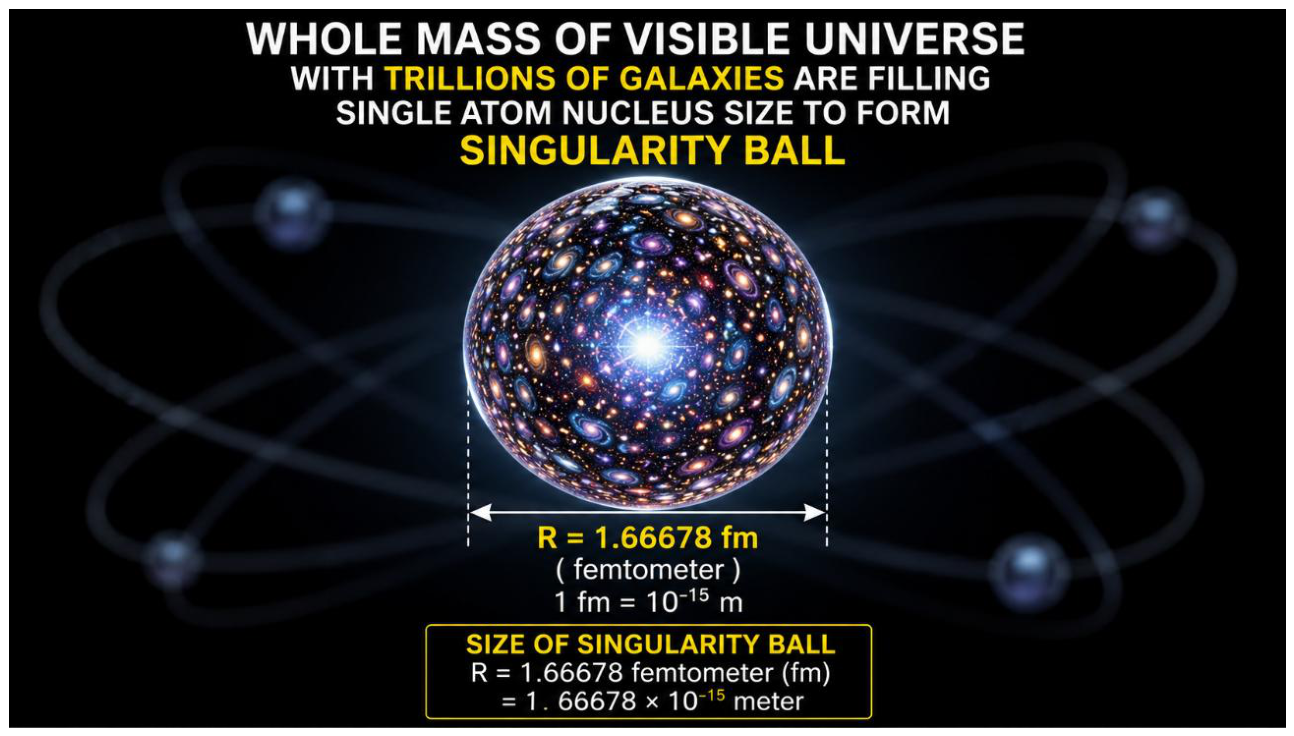
Figure 2.
Cosmic Mass Singularity.
6.2. Quark-Gluons Degeneracy Pressure
Quark-Gluons degeneracy pressure is the fundamental quantum mechanical force hypothesized to stabilize a quark star, an exotic compact object denser than a neutron star and white dwarfs but not massive enough to collapse into a black hole. Quark degeneracy pressure Like an electron degeneracy pressure in white dwarfs, neutron degeneracy pressure in neutron stars, and superparticle degeneracy pressure in the black hole singularity. It arises from the Pauli Exclusion Principle. Because quarks are fermions, no two identical quarks can occupy the same quantum state. When gravity compresses matter past the stability limit of a neutron star, the Tolman-Oppenheimer-Volkoff limit, neutrons dissolve into their constituent up and down quarks [53,54,55,56]. This creates a dense, free-flowing "soup" of deconfined quarks known as a quark-gluon plasma (QGP). According to the Pauli Exclusion Principle, the gravitational force presses quarks into an incredibly confined space; their positions become well-defined.
According to the Heisenberg Uncertainty Principle, this restriction forces their momentum (and kinetic energy) to fluctuate wildly. This high-velocity movement creates a powerful, temperature-independent quantum pressure. Quantum Chromodynamics (QCD) is the quantum field theory that describes the strong interaction between quarks and gluons. It describes the strong nuclear force that governs how quarks and gluons interact to build composite subatomic particles called hadrons, such as the protons and neutrons that make up the atomic nucleus. The basic up (u) and down (d) quarks that make up normal neutrons are highly unstable when compressed on a macro scale. Under the intense pressure inside the star, a process known as weak interaction converts roughly one-third of these up and down quarks into strange (s) quarks. This conversion lowers the overall Fermi energy of the system. Because a third flavour is introduced, the quarks can occupy lower energy states without violating the Pauli Exclusion Principle. This highly stable mixture of up, down, and strange quarks is called Strange Quark Matter (SQM). It is hypothesized to be the most stable ground state of matter in the universe.
Problem 2: The density of a Quark star with mass of two suns is , find the radius R of a quark star if a Particle with the mass of a charm Quark is approximately in degenerate pressure inside a Quark Star, determine the Quantum gravity pressure, and Temperature of compressed Quark particles in the Quantum gravity core of a Quark star?.
At first Step, Substitute Quark’s mass m, reduced Planck constant, speed of light, Gravitational constant, and Density of a Quark star in the eqn. (24) to determine the radius R of a Quark Star:
The radius of a Quark star can be determined since:
Then, the radius of a Quark star is: Quark-gluon stars (often called quark stars or strange stars) typically have masses between 1 and 7 solar masses and radii ranging from 4 to 8 kilometers. The radius of a Quark star or Quark-Gluons Plasma sphere could be reduced to few meters in the inner shells of a black hole. They are slightly smaller and more compact than standard neutron stars of similar mass because quark matter is bound more tightly by the strong force. In the Second step, Substitute physical values in eqn. (13) to determine a Quantum pressure or central pressure of the Quark star:
Then, The final value of a Quantum pressure is equalized with a central pressure of the Charm Quarks in the heart of a Quark Star: The Quark particles can withstand such a wild and extreme pressure in the core of Quark stars.
In a Third Step, substitute the physical values in eqn. (25) to calculate a central temperature of a Quark-Gluon star.
Then, central temperature of a Quark star approximately Then, the central temperature of particles with mass of charm quarks in the degeneracy pressure at the heart of a Quark star is roughly This incredibly high temperature scale (0.5 trillion Kelvin) typically describes extreme astrophysical environments such as the cores of newly formed neutron stars, and quark-gluon plasma fluid in the heart of quark stars. It is approximately the temperature of QGP fluid that recorded in LHC collider. Scientists at CERN’s Large Hadron Collider recorded a maximum temperature of about 5.5 trillion degrees Celsius (5.5 trillion Kelvin) during lead-ion collisions or merging proton particles, matching conditions last seen microseconds after the Big Bang. The atoms, ions, proton, neutron, and electron particles would be annihilated to form Quarks, positrons, neutrino particles, antimatter, immense gamma rays, high energy particles, and quark-gluon plasma fluid under violent conditions.
In Final steps, substitute speed of light , temperature, reduced Planck constant and Boltzmann constant in eqn.(17) to find a radius R of the concentrated Quarks or wavelength of a Photon particle by Quark Particles with radius R behave like waves , vibrating to radiate immense photon particles.
Then, radius or wavelength of a Quark particle or radiated photon particle is Insert Physical values in the equation (17) to find a Quantum energy of the concentrated quark particles or photon particles:
The slight mass of a charm particle is converted into photon energy during violent oscillations, Any conversion of mass to energy may increase the central temperature of stars. The standard rest mass energy of a charm quark is (1270 MeV). The Quark degeneracy pressure occurs at the heart of a Quark star, at density higher than those in standard neutron stars, potentially stabilizing Quark stars (or strange stars) if neutron degeneracy fails before collapsing into a black hole. Superparticle degeneracy pressure sustaining the black hole singularity. The black hole singularity is the final celestial object that survives due to superparticle degeneracy pressure.
6.3. Neutron Degeneracy Pressure
Neutron stars are among the most extreme objects in the universe. Their behaviour is governed by a delicate and violent balance between crushing gravity and repulsive quantum forces. Neutron degeneracy pressure (NDP) is a powerful quantum mechanical pressure that prevents a neutron star from collapsing under its own immense gravity. It arises from the Pauli Exclusion Principle, which dictates that no two identical fermions (such as neutrons, electrons, superparticles, or protons) can occupy the same quantum state simultaneously. When a massive star undergoes a supernova explosion, its core collapses. The gravity becomes so intense that it forces electrons and protons to fuse into neutrons via electron capture (inverse beta decay). Neutron degeneracy pressure is similar to electron degeneracy pressure (which supports white dwarfs), but it operates at a much higher scale of density. As gravity continues to compress the remaining core, the neutrons are packed incredibly tightly together. According to quantum mechanics, squeezing particles into a tiny volume forces them to occupy higher momentum states. Even at absolute zero temperature, these particles must move at extreme speeds because the lower-energy "slots" are filled. This rapid, high-momentum movement of tightly packed neutrons creates a massive outward force against gravity [57,58,59,60]. This force is independent of heat or thermal pressure, operating purely on quantum mechanics. The Quantum pressure balances gravity to compress and reduce size of the ultra-dense neutron star with 2-3 solar masses into a city-sized radius of roughly 10-14 kilometers. The density of a neutron star approximately the density of an atomic nuclei. The density of an atomic nucleus is approximately . A single teaspoon of this material would weigh about 6 billion tons on Earth. The neutron star has twin polar jets, powerful gravity, an electromagnetic field, and violent surface earthquakes driven by high thermal pressure, quantum repulsion against gravity, and rapid rotational energy. Violent "Equakes" the (Starquakes) occurred on the surface of a neutron star. The neutron star's surface consists of a rigid, ultra-dense crystalline iron crust. As the star gradually slows down its rapid spin, or as its powerful magnetic field twists, the crust undergoes immense stress. When the crust finally cracks, it causes a catastrophic starquake, releasing massive bursts of energy, energetic particles, and gamma radiation.
The internal structure of a neutron star changes dramatically from its surface to its center as gravity compresses matter to densities exceeding those of an atomic nucleus. The neutron star’s Atmosphere is an ultra-thin layer of plasma (micrometres to centimeters thick) composed mainly of hydrogen, helium, or carbon. The extreme gravity billions of times stronger than Earth's gravity, it compresses this gas layer tightly. Beneath the atmosphere sits an ocean-like layer of liquid light nuclei and electrons, just meters deep. An outer crust up to 0.5 kilometers deep, a solid, crystalline lattice of ionized atomic nuclei (mostly iron-56 at the surface, shifting to heavier, neutron-rich isotopes deeper down), it is surrounded by a sea of relativistic degenerate electrons. In the inner crust, 1- 2 km deep, extreme pressure forces spherical nuclei to deform and clump together into complex, geometric shapes known as nuclear pasta (categorized by shapes like gnocchi blocks, spaghetti rods, and lasagna sheets). In the outer core, 9 km deep, the crystal lattice completely dissolves into a uniform liquid. This layer consists of a superfluid of neutrons, mixed with a smaller population of superconducting protons and degenerate relativistic electrons and muons. In the inner core, the precise state of matter at the very center of a neutron star remains one of the greatest mysteries in modern astrophysics. Because densities here can exceed atomic-nucleus density. Leading theoretical models suggest the inner core contains Hyperons. The Hyperons are Particles containing strange quarks instead of just up and down quarks. Pion or Kaon Condensates are Exotic boson states that alter the star's stiffness. Deconfined Quark Matter: is a "quark soup" where protons and neutrons break apart entirely, freeing the up, down, and strange quarks into a color-superconducting plasma.
Problem 3: The density of a Neutron star with mass of two suns is roughly , find the radius R of a Neutron star if a Particle with the mass of a neutron particle is approximately in degenerate pressure inside a neutron Star, determine the Quantum gravity pressure, and Temperature of the concentrated neutron particles ?.
At first Step, Substitute Neutron’s mass m, reduced Planck constant, speed of light, Gravitational constant, and Density of a Neutron star in the eqn. (24) to determine the radius R of a collapsed neutron Star:
The radius of a Neutron star can be determined by using two equations:
Then, the radius of a Neutron star is roughly: Neutron stars have masses between 1.5 and 3 solar masses and radii ranging from 7 to 14 kilometers. In the Second step, Substitute physical values in eqn. (13) to determine a Quantum pressure or central pressure of the Neutron star:
Then, The final value of a Quantum pressure is equalized with a central pressure of the Neutron particles in the heart of a Neutron Star: In a Third Step, substitute the physical values in eqn. (25) to calculate a central temperature of a Neutron star.
Then, the central temperature of a neutron star is approximately Then, the central temperature of particles with mass of a neutron particle in the degeneracy pressure at the heart of a Neutron star is roughly This is incredibly high temperature scale, typically describes extreme astrophysical environments such as the cores of newly formed neutron stars.
In Final steps, substitute speed of light , temperature, reduced Planck constant and Boltzmann constant in eqn.(17) to find a radius R of the concentrated Neutron particles or wavelength of a released Photon particle by Neutron Particle with radius R behave like waves , vibrating to radiate photon particles.
Then, radius or wavelength of a neutron particle or radiated photon particle from its surface is Substitute Physical values in the equation (17) to find a Quantum energy of the neutron particles or radiated photon particles:
The tiny mass of a neutron particle is converted into thermal energy during violent oscillations of the neutron particles, where The standard rest mass energy of a neutron particle is exactly (939.565 MeV) or approximately , and Unified Atomic Mass Units (1.008665 u). Neutron degeneracy pressure is exceptionally strong, but it has a breaking point. If the remnant core of a dead star exceeds the Tolman-Oppenheimer-Volkoff (TOV) limit, roughly 2 to 2.3 solar masses, neutron degeneracy pressure can no longer withstand the crushing weight of gravity. At this point, the star suffers an unstoppable collapse and forms a Quark star or a black hole. A star can grow rapidly into a massive star by collecting mass from its surroundings. A massive star may burn its fuel in the shortest lifetime. A star with the mass of the Sun has a longer lifetime because it burns its fuel more slowly. A star with a mass 8 times the mass of the Sun has a lower lifetime and may collapse directly to form a black hole, after its fuel is exhausted.
6.4. Electron Degeneracy Pressure
Electron degeneracy pressure occurs in the heart of a white dwarf star and suspends the gravitational collapse in the dead stars with the mass of an average star as the Sun. The Chandrasekhar limit is the maximum mass of a stable white dwarf star can have, which is about 1.44 times the mass of our Sun. A typical white dwarf star has a radius of about 7,000 kilometers (roughly the size of Earth, or about 1% of the Sun's radius) and a central density ranging from . A white dwarf is the leftover core of a dead, low-mass star. Nuclear fusion has stopped inside the star. It is packed down to the size of Earth, but has a mass similar to the Sun. Main-sequence stars use heat to fight gravity. White dwarfs use electron degeneracy pressure. Electrons refuse to be squeezed into the same quantum state. This creates an outward push. If a white dwarf goes over 1.44 solar masses, electron pressure fails. The core collapses further; it can explode as a Type Ia supernova or collapse into a dense neutron star or black hole.
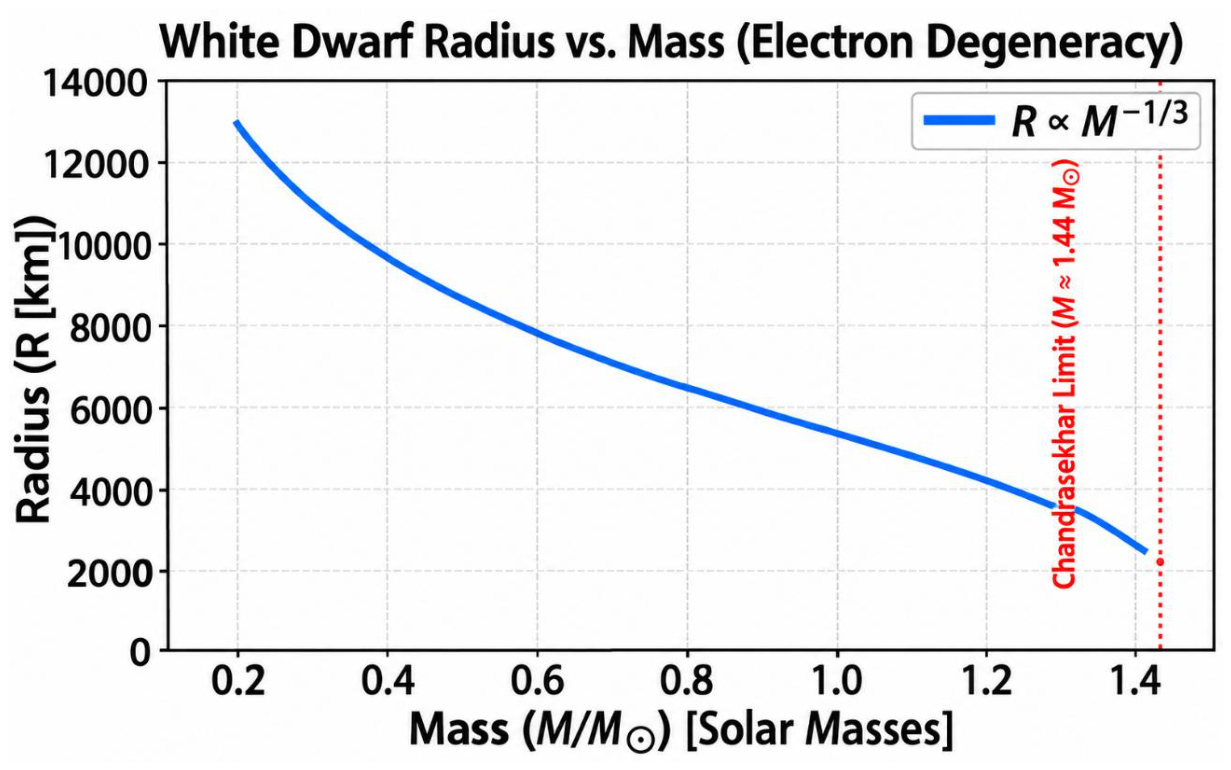
White dwarf stars are made of electron-degenerate matter, an ultra-dense plasma of carbon and oxygen nuclei stripped of their bound electrons. The core elements are mostly a mix of carbon and oxygen, the leftover ash from previous nuclear fusion. Some lower-mass white dwarfs may consist primarily of helium. Atoms are crushed so tightly by gravity that their outer electron shells overlap, freeing electrons to move about in a dense gas. As the white dwarf cools over billions of years, the carbon and oxygen in the core freeze into a giant, crystalline structure, essentially a cosmic diamond. They produce no new heat or energy through nuclear fusion [61,62,63,64]. They do not collapse under their own massive gravity because of electron degeneracy pressure. This is a quantum mechanical rule, the Pauli Exclusion Principle, where tightly packed electrons push back against compression. They pack about the mass of our Sun into a volume the size of planet Earth. A single teaspoon of white dwarf matter weighs several tons. The typical radius of a white dwarf star ranges from a maximum of about 10,000 to 14,000 kilometers, for low-mass white dwarfs, down to a minimum of about 2,000 to 4,000 kilometers for highly massive ones near the Chandrasekhar limit.
Problem 4: The central density of a white dwarf star with mass of a Sun could be , find the radius R of a white dwarf star if stabilized molecules or Particles with the mass of a fully ionised carbon-oxygen particle in degenerate pressure inside the heart of a white dwarf star, determine the Quantum gravity pressure, and central Temperature of electron particles in a degeneracy pressure at inner shells of a white dwarf stars ?.
Solution: Assume m is the mean mass per electron, defined by the chemical composition: , where is the atomic mass unit, . Then, is the mean molecular weight per electron, for a pure carbon-oxygen white dwarf star, , then Then, the mass m of fully ionised carbon-oxygen could be changed and reduced due to the huge gravity and thermal pressure of a white dwarf star during electron degeneracy pressure, therefor its new mass becomes . At first Step, Substitute mass of new particle m, reduced Planck constant, speed of light, Gravitational constant, and Density of a white dwarf star in the equation (24) to determine the radius R of a white dwarf Star:
The radius of a white dwarf star can be determined by inserting values in the above equation:
Then, the radius of a white dwarf star approximately: The radius of a white dwarf star is approximately an Earth’s radius. The mass and core density of a white dwarf star have been increased, and its radius could be reduced to 5000 kilometers or 2000 kilometers, approximately the radius of the Moon. In the Second step, Substitute physical values in eqn. (13) to determine a Quantum pressure of electron particles in a white dwarf star:
The value of a Quantum pressure or central pressure of a typical white dwarf star is roughly It is approximately 1 million or 100 million times the core pressure of the Sun. In a Third Step, substitute the physical values in eqn. (25) to calculate a core temperature of the white dwarf star.
Then, the central temperature of the electron particles in the degeneracy pressure during fully ionized Carbon-Oxygen ions at the heart of a white dwarf is roughly This is incredibly high temperature, typically describes extreme astrophysical environments such as the cores of newly formed white dwarfs.
In Final steps, substitute speed of light , temperature, reduced Planck constant and Boltzmann constant in eqn.(17) to find an orbital radius R of the electron particle in an atomic orbit or wavelength of a Photon particle by Thermal Electron Particles with an oscillation orbital radius R behave like waves , vibrating violently to radiate photon particles.
Then, an orbital radius or wavelength of an electron particle or photon particle is The classical radius of an Electron particle is , it is approximately the radius of an electron particle moving with a speed approximately the speed of light . Insert Physical values in the equation (17) to find a Quantum energy of the concentrated and vibrated electron particles or the photon particles:
This is a photon energy or thermal energy of an electron particle, The standard rest mass energy of an electron particle is (0.511 MeV). The mass, orbital radius, surface temperature, and energy of particles could be changed and reduced in extreme environments, such as Neutron stars, white dwarfs, quark stars, and an accretion disc of a black hole. Sirius B is a dense white dwarf star. Sirius A and Sirius B form a binary star system located just 8.6 light-years from Solar System in the constellation Canis Major. The Milky Way galaxy contains approximately billions of white dwarf stars. Canis Major is a prominent constellation in the southern celestial hemisphere that represents the larger dog following Orion the hunter. Sirius A is the brightest star in the night sky, also known as the Dog Star, located just 8.6 light-years from Earth. VY Canis Majoris is a massive red hypergiant star located roughly 3,900 light-years away.
Problem 5: The white dwarf star with mass of a Sun , find the radius R of a white dwarf star if Particles with the mass of a fully ionised carbon-oxygen particle or particles with mass of electron and protons or neutron in degenerate pressure inside the heart of a white dwarf star ?.
First Solution: Substitute values in the eqn. (27) to find the radius of a white dwarf star:
Hence, Then, the radius of a white dwarf star with mass of a sun is It is approximately the radius of the Earth.
Second Solution: Input the value of electron mass, proton or neutron mass, mass of Sun, Gravitational constant, and reduced Planck constant in eqn. (28) to find the radius of a white dwarf star:
Then, the radius of a white dwarf star is This is approximately 1.42 times the radius of the Earth, which perfectly aligns with the real-world scale of a white dwarf star or solar-mass white dwarf.
Problem 6: Find the radius of a pure, ionised carbon-oxygen white dwarf star with a mass 1.44 times the Sun's mass ?.
Solution: Suppose, is the mean molecular weight per electron, for a pure carbon-oxygen white dwarf star with mass 1.44 times mass of a Sun, , then Mass of electron particle . Calculation for Carbon and Oxygen ionised gas: Carbon-12 : Atomic mass (A=12), atomic number (Z = 6), giving A/Z= 12/6 = 2.0). Oxygen-16: Atomic mass (A=16), atomic number (Z = 8), giving (A/Z= 16/8 = 2). Because both dominant isotopes of carbon and oxygen have an (A/Z) ratio exactly equal to 2, any mixture of fully ionized carbon and oxygen yields an effective of precisely . Substitute physical values in eqn. (28) yields:
Then, the radius of a massive white dwarf star is This expression corresponds to the theoretical mass-radius relation for a non-relativistic white dwarf star at the Chandrasekhar mass limit (1.44 Sun). A stable white dwarf star has a maximum mass of about 1.44 solar masses (the Chandrasekhar limit) and a radius comparable to Moon, whereas crossing this limit causes a collapse into a much smaller and denser neutron star. Lower-mass white dwarfs have a larger physical volume because there is less gravitational pull to compress the electron gas. White dwarf stars have an inverse mass-radius relationship; more massive white dwarfs are physically smaller because increased gravity squeezes the electron degeneracy pressure into a tighter volume. Approximately 1.0 to 1.35 solar masses, typically featuring carbon-oxygen or oxygen-neon cores. The Radius of a white dwarfs about 2,800 to 14,000 kilometers, or significantly smaller than Earth, about the size of the Moon. High-mass white dwarfs pack near-solar amounts of mass into a volume closer to the size of a large moon or small planet. The absolute upper mass limit for any stable white dwarf is approximately 1.4 solar masses. As a white dwarf approaches this limit, its radius shrinks due to extreme relativistic gravitational compression. Over millions of years, a white dwarf may accrete enough mass from its surroundings to become a neutron star. The white dwarf star may radiate its thermal energy, and its radius is reduced after billions or trillions of years to form a black hole. A white dwarf's remnant core is called a black dwarf.
Figure 3.
Mass and radius of a white dwarf star within electron degeneracy pressure.
7. Birth and Death of Stars
In astrophysics, a star "dies" when it runs out of nuclear fuel to burn. Without the outward thermal pressure of fusion to fight gravity, the star collapses. What remains is a highly dense stellar remnant. The final state depends entirely on the initial mass of the star. The term dead stars can refer to astronomical stellar remnants (white dwarfs, neutron stars, and black holes). The life cycle of a star spans millions to trillions of years, beginning in a cloud of gas and dust and ending as a dense stellar remnant. Stars are born in a giant cloud of gas, mostly hydrogen and dust called a nebula, or molecular cloud. Gravity pulls the dust and gas together. The material gets denser and hotter, forming a baby star called a protostar. When the core gets hot, denser, and pressurized enough, hydrogen atoms fuse into helium. This nuclear fusion releases massive amounts of energy. Main-sequence stars are normal, stable stars that generate energy by fusing hydrogen into helium in their cores. The star shines steadily because outward thermal pressure from fusion balances the inward pull of gravity [65,66,67,68,69,70,71,72]. This is the longest phase of a star's life. Our Sun is currently in this phase. When its hydrogen fuel runs low, the core contracts and outer layers expand and cool, turning red, and an expanded low mass star called a red giant. The low mass star sheds its outer atmosphere into space, creating a glowing shell of gas called a Planetary nebula. A planetary nebula is a glowing shell of hot ionized gas and plasma cast off by a dying low-mass star, a sun-like star. The leftover dead core is a dense white dwarf that slowly cools over billions of years into a cold black dwarf. White dwarf stars are the incredibly dense, compact remnants left behind at the end of the life cycle of low- to intermediate-mass stars, including our own Sun. When a star exhausts its nuclear fuel, it sheds its outer layers into a beautiful planetary nebula, leaving behind a scorching, Earth-sized core that slowly cools over billions or trillions of years. "Fabriton" particles are theoretical dark matter particles. The fabriton is a newly named fundamental particle that constitutes dark matter and fills the "vacuum" space within atoms and the universe at large scales. The gravity is a distortion that occurred in the structure of a dark matter by direct influence of ordinary matter and energy [73,74,75]. The mass of a fabriton particle is approximately 10 billion times lower than the mass of an electron particle. The dark fabric could be distorted and vibrated by subatomic particles and celestial objects.
Massive stars burn through fuel much faster, fusing heavier elements in their cores up to iron. Massive stars expand outward to become red supergiant stars since nuclear fusion ceases in their cores. A red supergiant is an aging, massive star that has expanded to an enormous volume when nuclear fusion has ceased entirely. They are the largest stars in the universe by physical size, though they are not the most massive or the most luminous. Once an iron core forms, fusion stops producing energy. The core collapses violently and explodes in a supernova. The remaining core becomes either an ultra-dense neutron star or a black hole. Ejected material enriches future nebulae to form new generations of stars or planets. Massive stars are rare, brilliant celestial bodies with masses exceeding 2 to 8 times our Sun that burn through their nuclear fuel in just a few million years. They shine with hundreds of thousands to millions of times the power of the Sun and have surface temperatures over 10,000 Kelvin. While small stars live for billions of years, massive stars exhaust their core hydrogen in only a few million years due to extreme fusion rates. Intense stellar winds cause them to lose mass rapidly, enriching the surrounding space with heavy elements. Almost every element in the human body, except for hydrogen, was formed inside stars and scattered across the visible universe when massive stars collapse and explode.
8. Results and Discussion
Matter degeneracy pressure is a quantum-mechanical force that halts the gravitational collapse of dead stars when nuclear fusion ceases and thermal energy is reduced critically. Thermal energy and quantum forces contribute to the formation and evolution of stars and suspend the gravitational compression of stars to enhance their stability. According to Quantum Gravity theory, the Planck mass particle is a superparticle representing the theoretical limit where gravity becomes so intense that space and time break down at the fundamental Planck length under Planck density. But the Planck singularity is a cosmic mass singularity in which enough matter and energy are drawn inward and compressed in the inner shells of a supergiant black hole to form a cosmic mass singularity with a mass roughly equal to that of a visible universe. The density of a Planck singularity or cosmic mass singularity is about The radius of a superparticle with a Planck mass could be reduced to according to eqn. (24). It is approximately the Planck Length . The Planck length is the radius of a superparticle with a Planck mass particle in a cosmic singularity with a Planck density condition in the degeneracy pressure to keep the radius of a Planck Singularity in the size of an atom or an atomic nuclei. According to eqn. (13), the central pressure and quantum pressure of Superparticls in the cosmic mass singularity are equalized . It is approximately the quantum gravity balance pressure of particles in a cosmic mass singularity, , or it is approximately the value of a Planck pressure . The central temperature of a cosmic mass singularity is , it is slightly higher than a Planck temperature . Super-particles degeneracy pressure occurs in the heart of black holes and singularity balls to suspend the collapsing mass from collapsing inwardly to reach zero size under gravity. The radius of a black hole singularity is roughly the size of particles and atoms that is called a Quantum gravity singularity. A quantum gravity singularity refers to the theoretical breakdown of space and time at infinite density, where current physics fails and requires a combined theory of quantum mechanics and general relativity. General relativity predicts that gravity crushes matter to a point of zero volume and infinite density inside black holes. Quantum gravity is an unfinished theoretical framework that seeks to unite quantum mechanics with gravity, typically Newton's mechanics and Einstein's general relativity.
Unlike normal thermal gas pressure, degeneracy pressure depends almost entirely on density rather than temperature, meaning it persists even after a stellar remnant cools completely. The density of a Quantum gravity singularity with the mass of a galaxy that could be compressed steeply to the size of an Atom is The Quantum gravity balance radius of a superparticle with mass inside this compacted sphere of a singularity is according to eqn. (24). The central pressure of compressed superparticles inside this galactic singularity should be . Its central temperature is The stellar cluster has been compressed to the size of an Atom to form a Quantum gravity Singularity with a density . The Quantum gravity radius of a superparticle with mass inside this compacted sphere of a singularity approximately The quantum gravity balance pressure could be equalized with a central pressure of the condensed superparticles inside a singularity ball, it is about . Its central temperature extremely high, it is about The black hole singularity with mass of a massive star has been collapsed to the size of an Atom to form a Stellar Mass Singularity with a density . The Quantum gravity balance radius of an accelerated superparticle with mass inside this compacted sphere of a stellar singularity is approximately The quantum gravity balance pressure or central pressure of the superparticles inside a singularity sphere should be . Its central temperature is The black hole with mass of a Sun has a Schwarzschild radius (r=3 km). The average density of a one-solar-mass black hole within its event horizon is about . The particle with mass of a proton or Hydrogen atom should be trapped in the edge of this stellar mass black hole at distance (d=R=3767 meters=3.767 km) from its center. The central pressure or a quantum pressure of hydrogen atoms in an accretion disc of a black hole or in its interior shells approximately The maximum surface temperature of protons or hydrogen atoms in the core and inside an accretion disc of a black hole could be (4812905797101 K). The surface temperature of particles and cosmic radiation rise up rapidly to 4.81 trillion kelvins because of a black hole's powerful gravitational field. The black hole is a powerful natural particle collider and accelerator where protons and neutrons melt into quarks soup. The gas and dust particles could be dropped and spiral into a black hole, and heat up rapidly during violent collisions and condensation to produce Quark-Gluon plasma fluid state. The Quark star with mass of two Suns has been squeezed to radius (R=3885 m). The central density of a quark star is about . The quark particle with mass should be compressed in the heart of this Strange star. The central pressure or a quantum pressure of quark particles in its interior shells approximately Indeed, the central temperature of the compressed Quarks in the degeneracy pressure at the heart of a Quark star is . Protons and neutrons are normally held together steeply by the strong nuclear force. At this huge temperature and thermal energy, nuclear force cannot keep the atomic nuclei more stabilized, then protons and neutrons melt and break apart into a hot soup of free quarks and gluons that is called Quark-Gluons plasma fluid.
The Neutron star with mass of two Suns has been collapsed to radius (R=7787 m). The central density of a neutron star is about . The neutron particle with mass could be compressed in the heart of this collapsed star. The central pressure or a quantum pressure of neutron particles in its interior shells approximately Indeed, the central temperature of the compressed neutrons in the degeneracy pressure at the heart of a Neutron star is The star with mass of a Sun has been collapsed to radius (R=7000 km) to form a white dwarf star. It is approximately the size of Earth. The average central density of a white dwarf star is about . The electron particles with mass and proton particles in the fully ionised carbon-oxygen could be compressed in the heart of this collapsed star. The maximum central pressure or a quantum gravity pressure of Electron particles in its center approximately Indeed, the central temperature of the compressed electrons in the degeneracy pressure at the heart of a white dwarf star should be At a temperature of billions of kelvins, an electron's kinetic energy becomes so big that it moves at speeds extremely close to the speed of light, readily creating particle-antiparticle pairs, and positrons. At this temperature, the electrons, ions, and atoms form a fully ionized plasma fluid that vibrates or accelerates violently and emits an extreme amount of intense X-rays and gamma rays. This keeps the white dwarf glowing for billions or trillions of years. Stellar degeneracy pressure is a powerful, temperature-independent quantum mechanical pressure that halts the gravitational collapse of dead stars. It occurs when matter is compressed so tightly that particles are forced into their lowest possible energy states, triggering the Pauli Exclusion Principle, which states that no two identical fermions (like electrons or neutrons) can occupy the same quantum state immediately.

Table 1.
Pressure and Temperature of The Singularity and Collapsed Stars.
|
Density of Objects |
Radius of Superparticles and Collapsed Stars |
Central Pressure |
Central Temperature |
9. Conclusion
All stars are born from massive clouds of gas and dust called nebulae, but their ultimate fate depends entirely on their mass and gravity. Stellar nebulae, which are giant cosmic clouds of gas and dust where stars form. However, a star's initial mass acts as its ultimate destiny, dictating how long it lives, how it fuses fuel slowly or rapidly, and how it will eventually die. White dwarf stars are the hot, dense cores of dead lower-mass stars like our Sun. Electron degeneracy pressure pushes back against gravity. This pressure works only if the core stays below the Chandrasekhar limit, which is about 1.4 times the mass of our Sun. If a white dwarf gains too much mass, gravity and ultra-density cause electrons to smash into protons to form neutrons. Neutron degeneracy pressure stops the collapse in neutron stars. These tiny stars pack more than the mass of our Sun into a ball only 10 to 20 kilometers wide. They hold up under the Tolman–Oppenheimer–Volkoff limit of roughly 2 to 3 solar masses. If gravity exceeds neutron star limits, neutrons and protons might break apart into their individual quarks to form a Quark star. Quark degeneracy pressure from degenerate up, down, and strange quarks could theoretically support this ultra-dense phase of a star before a full collapse into a black hole. If the remaining mass of a dead star is 8 times the mass of the Sun, or it is too heavy for any quantum pressure to hold it up, gravity crushes everything. Superparticle degeneracy pressure can stop the collapse of matter past the Schwarzschild radius. Matter collapses into a single point of maximum density, on the scale of atoms or particles, called a quantum singularity, hidden behind an event horizon of a black hole.
Funding
This study is funded by myself.
Acknowledgments
Dear and Colleagues, I am Sabir Sadiq, a Physics Lecturer, Researcher in the Astronomy Field, Organizer, Volunteer, and General President of the Kurdistan Space Agency. We appreciate any academic and technological collaboration with the Kurdistan Space Agency.
Conflicts of Interest
I declare that I have no conflict of interests.
References
- Cendal, Á.; Garay, I.; Garay, L. J. From loop quantum gravity to cosmology: The two-vertex model. Phys. Rev. D. 2024, 109(12), 126011. [Google Scholar] [CrossRef]
- Bodendorfer, N.; Eder, K.; Zhang, X. Hamiltonian Theory: Generalizations to Higher Dimensions, Supersymmetry, and Modified Gravity. In Handbook of Quantum Gravity; Bambi, C., Modesto, L., Shapiro, I., Eds.; Springer: Singapore, 2023. [Google Scholar] [CrossRef]
- Thiemann, T.; Varadarajan, M. On Propagation in Loop Quantum Gravity. Universe 2022, 8, 615. [Google Scholar] [CrossRef]
- Gates, S. James, Jr.; Ketov, Sergei V.; Yunes, Nicolás. Seeking the Loop Quantum Gravity Barbero-Immirzi Parameter and Field in 4D, \(\mathcal{N} = 1\) Supergravity. Phys. Rev. D. 2009, vol. 80(no. 6), 065003. [Google Scholar] [CrossRef]
- Thiemann, T. The LQG string—loop quantum gravity quantization of string theory: I. Flat target space. Class. Quantum Gravity 2006, 23(6), 1923. [Google Scholar] [CrossRef]
- Jusufi, Kimet; Stojkovic, Dejan. "Theory and Phenomenology of a Four-Dimensional String–Corrected Black Hole. Universe 2022, 8(no. 3), 194. [Google Scholar] [CrossRef]
- Bena, C.-W.; Wang; Warner, N. P. Mergers and Typical Black Hole Microstates. JHEP 2006, arXiv:hep11 042. [Google Scholar]
- Mathur, S.D. The fuzzball proposal for black holes: an elementary review. Fortschr. Phys. 2005, 53, 793–827. [Google Scholar] [CrossRef]
- Banks, T.; Fischler, W.I.T.H.; Shenker, S. H.; Susskind, L. M theory as a matrix model: A conjecture. Phys. Rev. D55 1997, arXiv:hep, 5112–5128. [Google Scholar] [CrossRef]
- Mathur, S. D. Emission rates, the correspondence principle and the information paradox. Nucl. Phys. B 1998, arXiv:hep529, 295–320. [Google Scholar] [CrossRef]
- Bena; Kraus, P. Three Charge Supertubes and Black Hole Hair. Phys. Rev. D70 2004, arXiv:hep, 046003. [Google Scholar] [CrossRef]
- Bena; Warner, N. P. A Harmonic family of dielectric flow solutions with maximal supersymmetry. JHEP 0412 [hep-th]. 2004, arXiv:hep021. [Google Scholar]
- Gibbons, G.; Warner, N. Global structure of five-dimensional fuzzballs. Class.Quant.Grav. [hep-th]. 2014, arXiv:1305.095731, 025016. [Google Scholar] [CrossRef]
- Eperon, F. C.; Reall, H. S.; Santos, J. E. Instability of supersymmetric microstate geometries. JHEP [hep-th. 2016, arXiv:1607.0682810 031. [Google Scholar]
- Strominger. Black hole entropy from near-horizon microstates. JHEP 02 1998, arXiv:hep009. [Google Scholar]
- Rovelli, C. Loop Quantum Gravity. Living Rev. Relativ. 1998, 1(1), 1. [Google Scholar] [CrossRef] [PubMed] [PubMed Central]
- Rovelli, C.; Vidotto, F. Evidence for Maximal Acceleration and Singularity Resolution in Covariant Loop Quantum Gravity. Phys. Rev. Lett. 2013, arXiv:1307.3228111, 091303. [Google Scholar] [CrossRef] [PubMed]
- Tessarotto, M.; Cremaschini, C. Quantum Gravity Spacetime: Universe vs. Multiverse. Entropy 2025, 27, 1168. [Google Scholar] [CrossRef] [PubMed]
- DeWitt, B. S. Quantum theory of gravity. I. The canonical theory. Phys. Rev. 1967, 160(5), 1113–1148. [Google Scholar] [CrossRef]
- Sadiq, S. Distortion and Heating Galaxy Clusters by Supergiant Black Holes. Eng. Technol. J. 2026, 11(08), 11162–11181. [Google Scholar] [CrossRef]
- Carvalho, G.A.; Lobato, R.V.; Marinho, R.M.; et al. Unifying dark matter and dark energy as a Fermi gas in extra dimensions. Eur. Phys. J. C 86 2026, 23. [Google Scholar] [CrossRef]
- Lunkes, Christian; Brukner, Časlav; Vedral, Vlatko. Equation of State for Entanglement in a Fermi Gas. Phys. Rev. A 2005, 71(3), 034309. [Google Scholar] [CrossRef]
- Andronopoulos, E.; Gourgouliatos, K.N. Equation of State of Highly Asymmetric Neutron Star Matter from Liquid Drop Model and Meson Polytropes. Symmetry 2026, 18, 225. [Google Scholar] [CrossRef]
- Sadiq, S. Hydrostatic Balance of Stars and Black Hole Singularity. Preprints 2025. [Google Scholar] [CrossRef]
- Masood, W.; Eliasson, B.; Shukla, P. K. Electromagnetic wave equations for relativistically degenerate quantum magnetoplasmas. Phys. Rev. E 2010, 81(6), 066401. [Google Scholar] [CrossRef] [PubMed]
- Giannaka, P.; Kosmas, T. Electron Capture on Nuclei in Stellar Environment. Particles 2022, 5, 377–389. [Google Scholar] [CrossRef]
- Johnston, David C. "Thermodynamics of the Nonrelativistic Free-Electron Fermi Gas in One, Two, and Three Dimensions from the Degenerate to the Nondegenerate Temperature Regime. arXiv 2021, arXiv:2012.07689v2. [Google Scholar]
- Lopez-Boada, R.; Grave de Peralta, L. Some Consequences of a Simple Approach for Constructing a Theory of a Relativistic Fermi Gas. J. Mod. Phys. 2021, 12, 1966–1974. [Google Scholar] [CrossRef]
- Ghosh, A. Born-Kothari Condensation for Fermions. Entropy 2017, 19, 479. [Google Scholar] [CrossRef]
- Eddington, Arthur Stanley. The pressure of a degenerate electron gas and related problems. Proc. R. Soc. A 1935, 152(876), 253–272. [Google Scholar] [CrossRef]
- Bhattacharya, Prosad. Calculation of the TOV Limit Based on Neutron Degeneracy Pressure. Indian J. Adv. Phys. 2024, 4(no. 1), 4–7. [Google Scholar] [CrossRef]
- Zurek, W. H.; Page, D. N. “Black-hole Thermodynamics and Singular Solutions of the Tolman-Oppenheimer-Volkoff Equation”. Phys. Rev. D. 1984, 29(4), 628–31. [Google Scholar] [CrossRef]
- Luz, Paulo. Series solutions to the Tolman-Oppenheimer-Volkoff equations. Phys. Rev. D. 2026, vol. 114(no. 2), 024003. [Google Scholar] [CrossRef]
- Bittencourt, Eduardo; et al. Covariant Tolman–Oppenheimer–Volkoff Equations in Energy-Momentum Squared Gravity. Class. Quantum Gravity 2026, vol. 43(no. 15), 155027. [Google Scholar] [CrossRef]
- Adler, S. L.; Doherty, B. Dynamical gravastar simulated horizon from the Tolman–Oppenheimer–Volkoff equation initial value problem with relativistic matter. Int. J. Mod. Phys. D. 2025, 34(12), 2550056. [Google Scholar] [CrossRef]
- Casadio, Roberto; Lenzi, Michele; Micu, Octavian. Bootstrapping Newtonian Gravity. Phys. Rev. D. 2018, 98(10), 104016. [Google Scholar] [CrossRef]
- Sadiq, S. Quantum Gravity Balance Radius. Eng. Technol. J. 2026, 11(07), 10837–10856. [Google Scholar] [CrossRef]
- Tewari, B.; Charan, K.; Rani, J. Spherical Gravitational Collapse of Anisotropic Radiating Fluid Sphere. Int. J. Astron. Astrophys. 2016, 6, 155–165. [Google Scholar] [CrossRef]
- Sharma, Ranjan; Das, Shyam. Collapse of a Relativistic Self-Gravitating Star with Radial Heat Flux: Impact of Anisotropic Stresses. J. Gravity 2013, 2013(659605), 8 pages. [Google Scholar] [CrossRef]
- Jiménez, S.; Kománek, D.; Wünsch, R.; Palouš, J.; Ehlerová, S.; Martínez-González, S.; Srbljanović, A. The star formation factory revisited: I. The impact of metallicity on collapsing star-forming clouds. Astron. Astrophys. 2026, 709, A100. [Google Scholar] [CrossRef]
- Sadiq, S. Distortion and Heating an Accretion Disc of a Black Hole. Eng. Technol. Journal. 2026, 11(01), 8680–8696. [Google Scholar] [CrossRef]
- Pereira, S. H. Degeneracy pressure of mass dimension one fermionic fields and the dark matter halo of galaxies. Int. J. Mod. Phys. D. 2022, 31(07), 2250056. [Google Scholar] [CrossRef]
- Das, K.P.; Bhar, P.; Debnath, U. Anisotropic quark stars with an interacting quark equation of state in extra dimension. Eur. Phys. J. C 84 2024, 952. [Google Scholar] [CrossRef]
- Capellino, F.; et al. Fluid Dynamics of Charm Quarks in the Quark-Gluon Plasma. Phys. Rev. D. 2023, 108(11), 116011. [Google Scholar] [CrossRef]
- Gordeev, Andrew; et al. Quark Flavor Equilibration of the Quark-Gluon Plasma. Phys. Rev. C;APS J. 2026, vol. 113(no. 1), 014906. [Google Scholar] [CrossRef]
- Sadiq, S. Singularity Sphere in The Heart of a Black Hole. Trans. Eng. Comput. Sci. 2024, 12(3), 46–63. [Google Scholar] [CrossRef]
- Sadiq, S. Dynamical Phenomena of The Superparticles. Eng. Technol. J. 2026, 11(09), 11464–11478. [Google Scholar] [CrossRef]
- Sadiq, Sabir. “Singularity Bombardment by Superparticles”. Eng. Technol. J. 2025, 10(8), 6377–90. [Google Scholar] [CrossRef]
- Hamilton, Andrew J. S.; McMaken, Tyler. Black Hole Singularity Is a Surface Not a Point. Phys. Rev. D.;Crossref 2026, vol. 114(no. 2), 024088. [Google Scholar] [CrossRef]
- Moffat, J.W. Complex Riemannian Spacetime and Singularity-Free Black Holes and Cosmology. Axioms 2025, 14, 459. [Google Scholar] [CrossRef]
- Mohan, V. Black hole singularities from holographic complexity. J. High Energ. Phys. 2025, 275. [Google Scholar] [CrossRef]
- Chiba, Takeshi; Matsui, Hiroki; Murata, Keiju. Singularity avoidance in black hole interiors by quantum gravity effects. In Physical Review D; Crossref, 2026; vol. 113, no. 2, p. 026017. [Google Scholar] [CrossRef]
- Thoma, Markus H. The Quark–gluon Plasma Liquid. J. Phys. G. Nucl. Part. Phys. 2005, 31(1), L7–L13. [Google Scholar] [CrossRef]
- Jowett, John. Lead-ion collisions: The LHC achieves a new energy record. CERN Bulletin. Archived from the original on. November 2015.
- Müller, B. A New Phase of Matter: Quark-Gluon Plasma Beyond the Hagedorn Critical Temperature. In Melting Hadrons, Boiling Quarks - From Hagedorn Temperature to Ultra-Relativistic Heavy-Ion Collisions at CERN; Rafelski, J., Ed.; Springer: Cham, 2016. [Google Scholar] [CrossRef]
- Li, B.-L.; Yan, Y.; Ping, J.-L. Tidal deformabilities and radii of strange quark stars. Phys. Rev. D. 2021, 104(4), 043002. [Google Scholar] [CrossRef]
- Moustakidis, C. The Nuclear Physics of Neutron Stars. Symmetry 2024, 16, 658. [Google Scholar] [CrossRef]
- Annila, A. Neutron star characteristics from the neutron structure. Front. Phys. 2023, 11, 1286802. [Google Scholar] [CrossRef]
- Shapiro, S. L.; Teukolsky, S. A. Black Holes, White Dwarfs and Neutron Stars: The Physics of Compact Objects; Wiley-Interscience: New York, 1983. [Google Scholar]
- Lattimer, J. M.; Prakash, M. Neutron Star Structure and the Equation of State. Astrophys. J. 2001, vol. 550(no. 1), 426. [Google Scholar] [CrossRef]
- Sadiq, Sabir. Life Cycle of High Mass Star. Am. Sci. Res. J. Eng. Technol. Sci. 2024, vol. 97(no. 1), 11–29. [Google Scholar]
- Sadiq, Sabir. “Radiations Accumulation and Rapid Transition of Particles Inside the Black Holes”. Eng. Technol. J. 2025, 10(1), 3526–40. [Google Scholar] [CrossRef]
- Sadiq, S. “Black Holes Effect on Rapid Stellar Jumps and Tidal Disruptions of Stars”. Trans. Eng. Comput. Sci. 2024, 12(2), 21–35. [Google Scholar] [CrossRef]
- Sadiq, Sabir; Alias, Anuar. Black Holes Formations and Dark Fabric Distortions. Am. Sci. Res. J. Eng. Technol. Sci. 2022, vol. 87(no. 1), 168–187. [Google Scholar]
- Sadiq, S. A. Alias, “Gravity and Solar System Evolution. € Am. Acad. Sci. Res. J. Eng. Technol. Sci. (ASRJETS) 2022, vol. 90(no. 1), 214–237. [Google Scholar]
- Sadiq, Sabir. Life Cycle of a Low Mass Stars. Am. Sci. Res. J. Eng. Technol. Sci. 2023, vol. 93(no. 1), 60–82. [Google Scholar]
- Sadiq, S. Gravitational Lensing and Tidal Effects of a Planetary Mass Black Hole. Preprints 2026, 2026051288. [Google Scholar] [CrossRef]
- Sadiq, S. "Plasma Jets and Stellar Lightnings Involved in Coronal Heating Dynamics" Preprints. 2026. [Google Scholar] [CrossRef]
- Bowman, D.M.; van Saders, J.; Vink, J.S. The Structure and Evolution of Stars: Introductory Remarks. Galaxies 2023, 11(5), 94. [Google Scholar] [CrossRef]
- Sadiq, S. Angular Momentum and Surface Temperature of the Singularity and Superparticles. Eng. Technol. Journal. 2026, 11(06), 10514–10530. [Google Scholar] [CrossRef]
- Christodoulou, D. Reversible and Irreversible Transformations in Black Hole Physics. Phys. Rev. Lett. 1970, 25(22), 1596–1597. [Google Scholar] [CrossRef]
- Vertogradov, V.; Misyura, M. The Regular Black Hole by Gravitational Decoupling. Phys. Sci. Forum 2023, 7(1), 27. [Google Scholar] [CrossRef]
- Sadiq, S. “An Ordinary Matter and Celestial Objects Interaction with Dark Fabric Matter and Energy”. Eng. Technol. J. 2024, 9(12), 5734–5747. [Google Scholar] [CrossRef]
- Sadiq, S. Mass and Radius of a Fabriton Particle. Eng. Technol. J. 2025, 10(2), 3886–3899. [Google Scholar] [CrossRef]
- Green, Anne M. Astrophysical Uncertainties on the Local Dark Matter Distribution and Direct Detection Experiments. In Journal of Physics G: Nuclear and Particle Physics; IOPscience, 2017; vol. 44, no. 8, p. 084001. [Google Scholar] [CrossRef]
Figure 1.
Matter degeneracy pressure in collapsed objects.
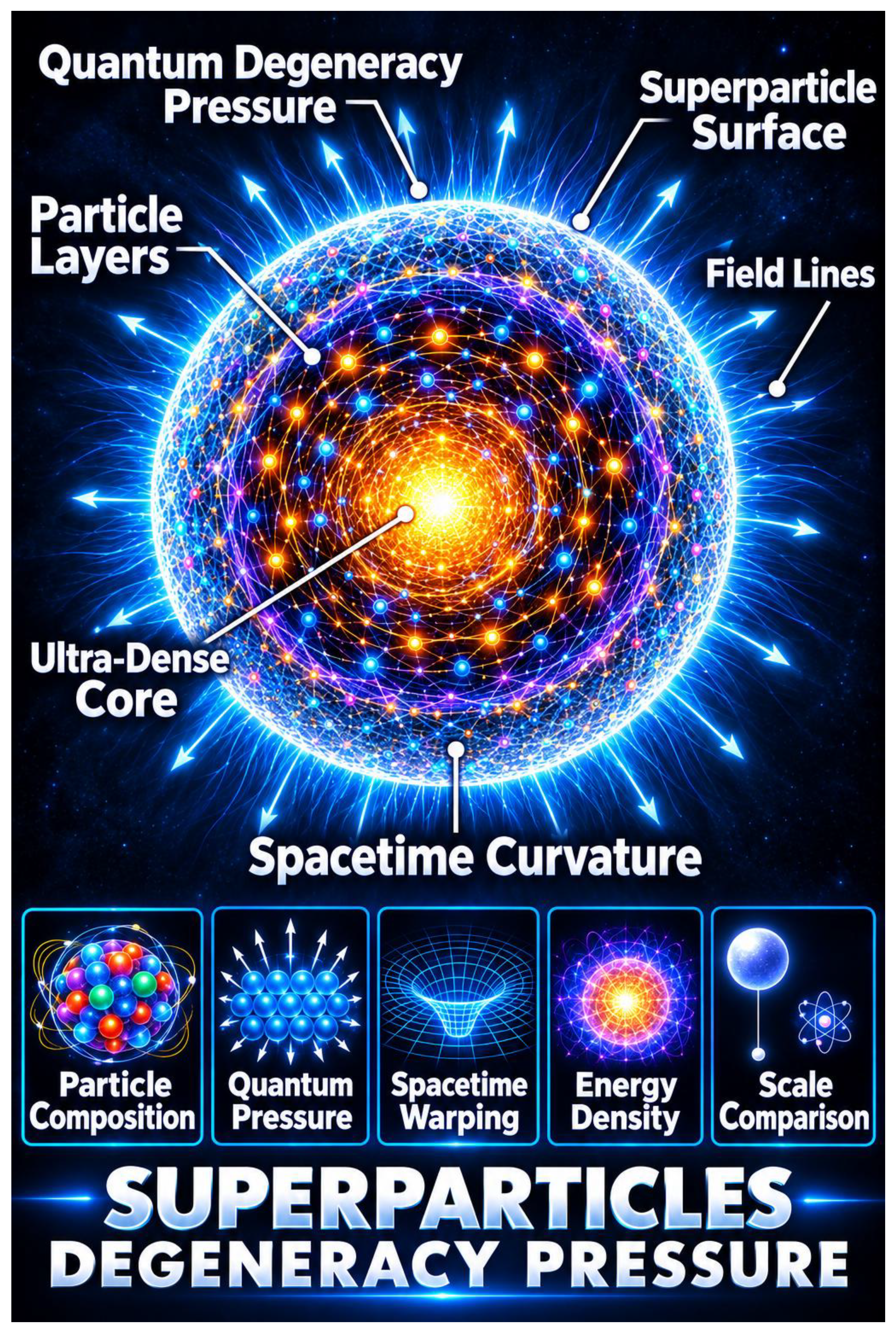
Disclaimer/Publisher’s Note: The statements, opinions and data contained in all publications are solely those of the individual author(s) and contributor(s) and not of MDPI and/or the editor(s). MDPI and/or the editor(s) disclaim responsibility for any injury to people or property resulting from any ideas, methods, instructions or products referred to in the content. |
© 2026 by the authors. Licensee MDPI, Basel, Switzerland. This article is an open access article distributed under the terms and conditions of the Creative Commons Attribution (CC BY) license (http://creativecommons.org/licenses/by/4.0/).
Copyright: This open access article is published under a Creative Commons CC BY 4.0 license, which permit the free download, distribution, and reuse, provided that the author and preprint are cited in any reuse.