
Submitted:
30 September 2026
Posted:
01 October 2026
You are already at the latest version
Abstract
Currently, hydrocarbon resins are mainly classified into styryl-based and benzocyclobutene (BCB)-based systems. Styryl-based hydrocarbon resins are cost-effective but generally show limited heat resistance, whereas BCB-based resins have relatively high cost. Moreover, these two systems seem to have mismatched curing temperature windows and limited mutual compatibility. Herein, we develop a cross-linkable hydrocarbon resin derivative BP-TVCH from biphenyl and 1,2,4-trivinylcyclohexane, rich in β-styryl moieties and allylic C-H bonds. Upon curing, the benzene rings are incorporated into the cross-linked network. The β-styryl moieties undergo homopolymerization, while the allylic C-H bonds participate in curing through chain-transfer reactions. The resulting resin can be co-cured with both styryl-based and BCB-based hydrocarbon resins. When composited with styrene-terminated polyphenylene ether (OPE-2st), the resulting CCL exhibits a dielectric loss of 0.00101–0.00105 and a high glass transition temperature (Tg) of up to 277 °C.
Keywords:
hydrocarbon resins
; copper-clad laminates (CCLs)
; low dielectric loss
; cross-linkable resin
; thermal stability
1. Introduction
With post-5G communication technologies continuously evolving toward higher frequency bands and the operating frequencies of AI chips steadily increasing, high-frequency and high-speed copper-clad laminates (CCLs) and IC packaging substrates are imposing increasingly stringent requirements on the dielectric properties of substrate materials. A relatively high dielectric constant (Dk) or large dielectric loss (Df) of the substrate exacerbates signal loss during high-speed transmission and may lead to issues such as device heating. To meet the demands of high-frequency and high-speed circuits, the development of resin matrices with low Dk and ultra-low Df has become an important research direction. Among the available options, the dielectric performance of hydrocarbon resins is second only to that of fluoropolymers such as polytetrafluoroethylene (PTFE), while hydrocarbon resins are significantly superior to fluorinated resins in key aspects, including thermal stability, mechanical properties, and copper foil adhesion. Consequently, hydrocarbon resins have emerged as preferred materials for high-frequency substrate applications.
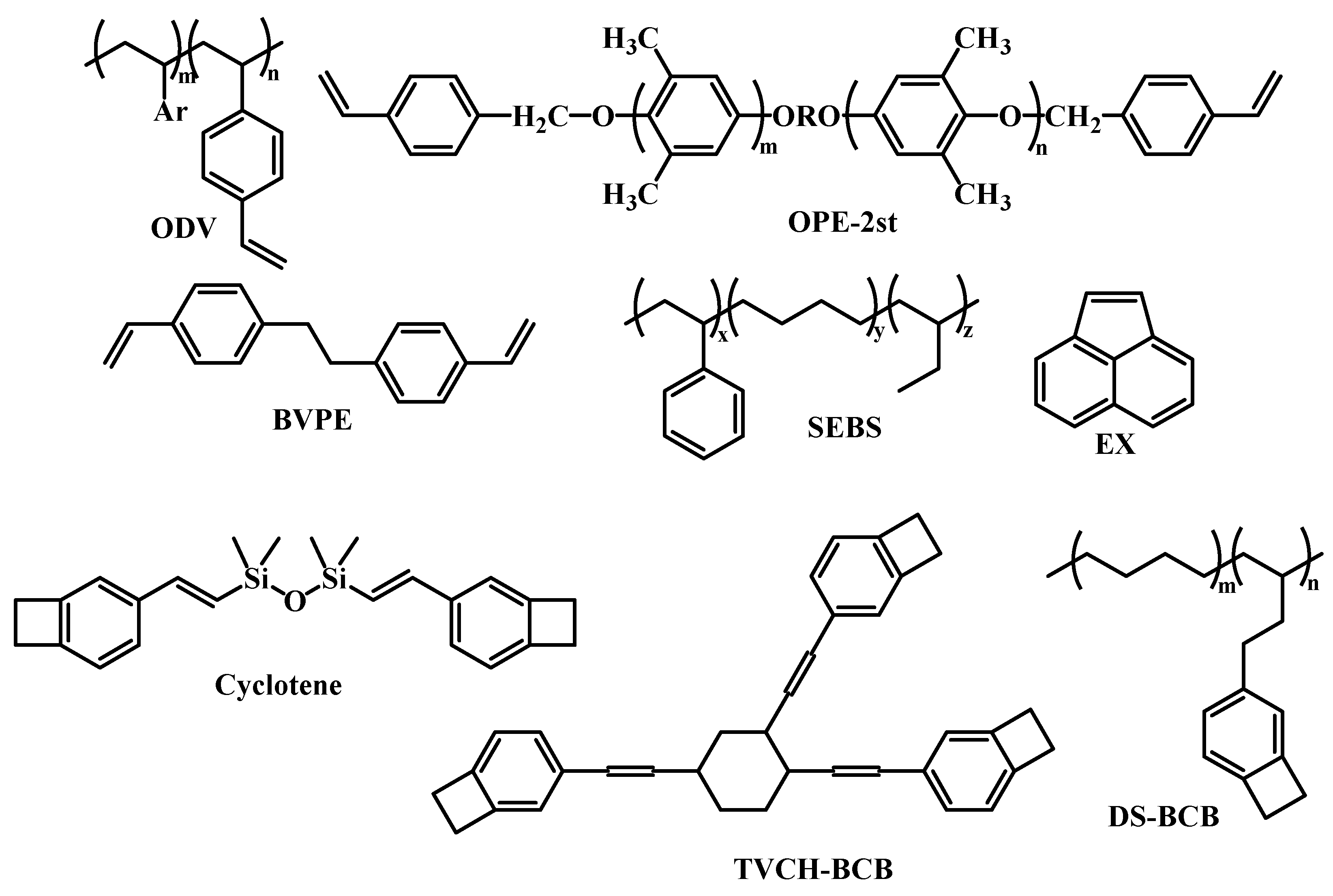
Figure 1.
Chemical structures of representative low-Dk/low-Df resins.
The research and application of hydrocarbon resins can be broadly divided into several stages:
First-generation matrices and modified PPO. Early hydrocarbon matrices based on polybutadiene, SBS, and SEBS [1,2] exhibit high coefficients of thermal expansion (CTEs) and insufficient heat resistance, often requiring blending with cyclo-olefin copolymers (COCs) [3] or poly(phenylene oxide) (PPO) [4,5]. Although PPO is not a pure hydrocarbon resin, its excellent thermal and mechanical properties (Df ~ 0.002) and early adoption by General Electric/Benz [6] established it as a key modifying resin. Modified PPOs for low-dielectric CCLs mainly include the early allyl PPO from Asahi Kasei [7], which exhibits good overall performance but requires a high curing temperature, and the currently mainstream styrene-terminated OPE-2st [8], which has a low synthesis cost and a curing window better matched to industrial processes.
Second-generation ODV, EX, and BVPE. Second-generation resins are represented by ODV (styrene–divinylbenzene copolymer) from Nippon Steel Chemical [9,10,11,12], in which DVB cross-linking improves heat resistance compared with polybutadiene-based systems. Pure ODV still requires blending with OPE-2st for M9-grade laminates such as Panasonic MEGTRON 9. To further enhance thermal stability, fused-ring systems [13] and acenaphthylene (EX)–ODV blends [12,14,15,16] were explored, with EX primarily serving to improve the heat resistance of ODV despite its higher degree of conjugation. Another promising styrene-type resin, 1,2-bis(vinylphenyl)ethane (BVPE) [17,18,19,20,21], can lower the curing temperature of allyl PPO and is increasingly favored by Chinese CCL manufacturers.
BCB resins and derivatives. Benzocyclobutene (BCB) resins deliver superior thermal and dimensional stability through ring-opening cross-linking. Dow’s CYCLOTENE® series [22] (centered on divinylsiloxane–BCB, DVS-BCB) exhibits Df ≈ 0.001 but suffers from a relatively large CTE. Recent derivatives include TVCH-BCB [23] and DS-BCB from Wuhan Disai [24] (mass-produced for M8/M9 CCLs), as well as BCB-terminated PPO [25], fluorene-based BCB [26], indene-based BCB oligomers [27], and three-arm BCBs that demonstrate a Dk as low as 1.83 with a CTE matched to that of copper [28].
Challenges and this work. Despite their advantages, BCB resins suffer from high synthesis costs and a curing-temperature mismatch with styrene-based hydrocarbon resins. To reduce costs, blending with other vinyl-containing resins such as SBS is often necessary; however, SBS exhibits poor heat resistance and is prone to phase separation with BCB, leading to degraded mechanical and dielectric properties. To address these limitations, this work reports a novel low-cost dendritic vinyl resin, BP-TVCH [29], which is rich in allylic C–H bonds and β-styryl moieties, enabling it to react with BCB resins and to copolymerize with styrene-type resins. After blending BP-TVCH with PPO, promising dielectric and thermal performance was achieved, as validated by a major CCL manufacturer.
2. Materials and Methods
2.1. Materials.
1,2,4-Trivinylcyclohexane (TVCH, Mw162), 4,4′-dibromobiphenyl (98%), palladium(II) acetate (Pd(OAc)2, 98%), and benzocyclobutene (BCB) were purchased from Sigma-Aldrich and used as received. Anhydrous N,N-dimethylformamide (DMF, 99.8%, water ≤ 50 ppm) was also obtained from Sigma-Aldrich. Toluene, styrene, anhydrous magnesium sulfate (MgSO4, ≥ 99.5%), dichloromethane (DCM, ≥ 99.8%), and methanol (anhydrous, 99.8%) were purchased from Guangzhou Chemical Reagent Factory and used without further purification unless otherwise specified. Tri-potassium phosphate (K3PO4) was dried under vacuum at 120 °C for 12 h prior to use. Deionized water (18.2 MΩ·cm) was prepared using a Milli-Q system.
2.2. Synthesis of BP-TVCH.
A mixture of TVCH (1.0 mol, 162 g), 4,4′-dibromobiphenyl (0.5 mol, 156 g), Pd(OAc)2 (1.8 mmol, 404 mg, 0.18 mol % relative to TVCH), and pre-dried K3PO4 (2.8 mol, 594 g) in anhydrous DMF (4.0 L) was stirred at 140 °C under argon for 48 h. After cooling, the reaction mixture was diluted with toluene (2 L) and washed with deionized water (3 × 2 L). The combined organic layer was dried over anhydrous MgSO4 and filtered. The crude product was purified by column chromatography on silica gel using toluene as eluent. The eluent was concentrated by rotary evaporation in a water bath, and the residue was washed with methanol (3 × 1 L). Final drying under oil-pump vacuum at 75 °C to constant weight gave a reddish-brown, viscous solid (195.2 g, 82% yield based on the oligomeric product).
2.3. CCL Fabrication.
Copper-clad laminates (CCLs) were prepared at Wazam New Materials Co., Ltd. A resin formulation comprising BP-TVCH, OPE-2st, complementary resins, and inorganic fillers [34] was dissolved in a suitable solvent (e.g., toluene or cyclohexanone) to prepare a homogeneous varnish. Woven glass fabrics (e.g., 2116 or 1080 style) were impregnated with the varnish, followed by air drying and thermal curing in an oven to produce prepregs with a controlled resin content (typically 30–60 wt%). The prepregs were stacked symmetrically with electrolytic copper foils (e.g., HTE or reverse-treated SI foil) and hot-pressed under vacuum at 180–220 °C and 2–5 MPa to form the final CCLs.
2.4. Measurements
Nuclear Magnetic Resonance (NMR). NMR spectra were recorded on a Bruker AVANCE III HD 600 spectrometer.
Thermogravimetric Analysis (TGA). TGA was performed on a TG 209 F3 thermogravimetric analyzer at a heating rate of 10 °C/min under nitrogen.
Differential Scanning Calorimetry (DSC). DSC was conducted on a Mettler Toledo DSC 3 using disposable high-pressure crucibles. Samples were heated from room temperature to 400 °C at 10 °C/min, cooled, and then subjected to a second heating scan to 400 °C at the same rate.
Thermomechanical Analysis (TMA). TMA was conducted on a TA Instruments TMA Q400 thermomechanical analyzer using a two-cycle temperature ramp to eliminate thermal history. The glass transition temperature (Tg) of the CCL samples was measured in the Z axis (thickness direction) according to IPC TM 650 2.4.24.
Dynamic Mechanical Analysis (DMA). DMA was carried out on a TA Discovery DMA 850 under nitrogen using single cantilever and three point bending modes. Temperature sweeps from 30 to 300 °C were performed at 3 °C/min and a fixed frequency of 1 Hz, with strain within the linear viscoelastic region. The glass transition temperature (Tg) was taken from the tan δ peak and cross checked with the inflection point of the storage modulus (E′) versus temperature plot on a semi log scale.
Dielectric Properties. Dissipation factors (Df). Df were measured with a Keysight E5071C vector network analyzer according to IPC TM 650 2.5.5.5.
3. Results
3.1. Synthesis of BP-TVCH
BP-TVCH was synthesized via Heck coupling of TVCH and 4,4′-dibromobiphenyl in a 2:1 molar ratio, as illustrated in Figure 2. The choice of 4,4′-dibromobiphenyl over 1,4-dibromobenzene was critical: the latter underwent incomplete conversion (residual reactant peaks were observed by NMR) and gave a much lower yield. In contrast, 4,4′-dibromobiphenyl afforded a crude yield of 92%, and after purification by column chromatography, a decolorized product was obtained in ~80% isolated yield.
It should be noted that TVCH contains three allylic C–H bonds; thus, the theoretical product is not a uniform trimer. For simplicity, it is depicted as a trimer in Figure 2. The reaction may also yield dimers, tetramers, pentamers, and other oligomers, but lower-molecular-weight fractions are readily removed during methanol washing. Furthermore, TVCH itself exists as multiple cis/trans isomers, resulting in inherently complex NMR spectra; consequently, the 1H-NMR spectrum of BP-TVCH is even more complicated (shown in Figure S1). Nevertheless, the key structural features are clearly identifiable: 1H-NMR (600 MHz, CDCl3) δ 7.5 (m, Ar–H), 7.4 (m, Ar–H), 6.5–6.2 (m, Ar–CH=CH), 5.8–4.8 (m, CH=CH2), 2.50–0.90 (m, cyclohexyl H). The appearance of the trans-olefinic signal at 6.5–6.2 ppm and aryl H signals at 7.55 and 7.35 ppm confirmed the successful Heck coupling between TVCH and 4,4′-dibromobiphenyl, while the signals at 4.8–5.8 ppm were assigned to the retained vinyl groups. It was found that BP-TVCH was not very stable during storage at room temperature, most likely due to the thermally sensitive β-styryl groups. Because TVCH moieties exhibit complicated spectra, we will elucidate the Heck coupling of alkenes and aryl halides in future studies.
3.2. Thermosetting Reaction of BP-TVCH
Currently, thermosetting hydrocarbon resins are mainly classified into two categories based on their crosslinking groups: styrene-based and benzocyclobutene (BCB)-type. Styrene derivatives (including acenaphthylene) undergo free-radical polymerization at elevated temperatures above 100–150 °C. It is generally accepted that the thermal polymerization of styrene involves a Diels–Alder reaction between two styrene groups to form a dimer, which then reacts with a third styrene molecule to generate two types of free radicals [30] (as shown in Figure 3a), thereby initiating the free-radical polymerization of styrene groups to yield a polymer with a polyethylene backbone. In contrast, BCB-type hydrocarbon resins primarily undergo ring-opening at 200–260 °C, initially generating o-quinodimethane, followed by the formation of minor amounts of 1,2,5,6-dibenzocyclooctadiene (DBCOD) [31] and a spirodimer [32]. The spirodimer further ring-opens and polymerizes to form poly-o-xylylene. BP-TVCH contains both allylic C–H bonds and β-styryl moieties, and its curing mechanism requires further investigation.
3.2.1. TGA Curve and DSC Trace BP-TVCH
Figure 4a shows the TGA curve of BP-TVCH recorded at a heating rate of 10 °C/min. ~10% mass loss was observed below 400 °C, which may be attributed partly to slight evaporation or release of volatile low-molecular-weight fractions. Substantial decomposition commenced above 450 °C, indicating that the resin undergoes progressive thermal curing during heating and therefore retains good thermal stability. Above 450 °C, the decomposition rate increased markedly, and the char yield at 600 °C was only about 5%. This suggests predominant alkane/cycloalkane cleavage with little condensed-aromatic (graphitization) formation.
Figure 4b shows the DSC trace of BP-TVCH at 10 °C/min. Because the TGA data indicated some mass loss between 200 and 400 °C, the measurement was performed in disposable high-pressure pans to suppress volatilization. The first heating scan exhibited two major exothermic events: a sharp exotherm centered at ~138 °C, assignable to polymerization/crosslinking of the β-styryl moieties, and a broad exotherm around 375 °C, assignable to polymerization involving the allylic C–H bonds. Allyl curing typically requires relatively high temperatures; for comparison, the cure exotherm of an allylated indene resin was reported near 320 °C [33]. In the second heating scan of BP-TVCH, no obvious endothermic or exothermic peaks were observed, indicating that the β-styryl moieties and allylic C–H bonds had largely reacted and that no significant depolymerization occurred. It should be noted that the DSC measurement was carried out at 10 °C/min, whereas CCL hot pressing usually employs a staged curing profile (e.g., 200 and 230 °C for several hours); therefore, the DSC results can only guide the design of the lamination process and should not be directly equated with the actual hot-pressing profile.
3.2.2. Gel Content of Cured BP-TVCH
It was found that BP-TVCH is a soluble, viscous soft solid that gradually cures upon heating in the absence of any initiator. As a molecule containing at least four allylic C–H bonds and two β-styryl moieties, complete crosslinking would theoretically yield a fully insoluble network. However, the curing rate was found to be relatively slow. Solvent-free BP-TVCH samples were heated at different temperatures for 6 h under nitrogen, followed by exhaustive ultrasonic extraction with dichloromethane (DCM) to determine the insoluble fraction (gel content), as shown in Figure 5. The insoluble fraction was only 2.3% after 6 h at 150 °C, increased to 23.3% at 210 °C, and reached nearly complete insolubility (≈100%) at 250 °C (all samples heated for 6 h), indicating a high degree of crosslinking at elevated temperatures.
The gel content data were difficult to interpret solely from the DSC trace. Although DSC revealed an exothermic peak at ~138 °C (assigned to β-styryl polymerization; Section 3.2.1), heating at 140 °C for 6 h produced almost no macroscopic gel. To clarify this discrepancy, gel permeation chromatography (GPC) was used to estimate the molecular weight of the product (Figure S2). The GPC trace exhibits a bimodal distribution: the main peak (retention time ~13.3 min) corresponds to the higher-molecular-weight fraction, while the secondary peak (~13.8 min) is consistent with lower-molecular-weight oligomers partially retained after methanol washing. Quantitative analysis gave Mn = 1728 Da (Ð = 1.208) for the major distribution and Mn = 678 Da (Ð = 1.029) for the minor one, collectively confirming the oligomeric nature of the product. These results indicate that BP-TVCH undergoes significant polymerization at 140 °C, but the resulting molecular weight remains too low to form a cross-linked gel network, accounting for its solubility. We speculate that the allylic C–H bonds act as chain-transfer sites, leading to lower-molecular-weight branched oligomers rather than an infinite network under these conditions.
3.2.3. Reactivity Study of Allylic C–H Bonds
To clarify the distinct roles of allylic C–H bonds in BP-TVCH during thermal curing, the reactivities of various model compounds were evaluated using 4,4′-dimethylbiphenyl as an internal standard to estimate the extent of conversion. The results are summarized in Table 1, and the corresponding NMR spectra are provided in the Supporting Information (Figure S3–S8).
It should be noted that because the model compounds used—TVCH, BCB, and styrene—are relatively volatile, reactions were conducted in screw-cap headspace vials to prevent loss of material. Additionally, 4,4′-dimethylbiphenyl exhibits poor solubility in TVCH at room temperature; therefore, the mixture was gently warmed prior to sampling, and deuterated chloroform (CDCl3) was added immediately for NMR analysis. After the reaction, the vials were allowed to cool thoroughly. Deuterated chloroform was then injected through the septum of the cap to dilute the reaction mixture. After complete dissolution, the vial was opened for sampling. This procedure was critical to minimize volatilization and ensure reliable quantitative data.
First, it was found that pure TVCH heated at 180 °C for 20 h showed almost no reaction, while heating at 210 °C for 20 h resulted in only a 3.6% decrease in the allylic proton integration. This indicates that the curability of BP-TVCH is not attributable to the allylic C–H bonds but rather to the β-styryl moieties. However, when TVCH and styrene were heated together at 180 °C for 20 h, a viscous liquid was obtained, which solidified into a soft solid upon cooling and was completely soluble in CDCl3. ^1H NMR comparison revealed that the allylic proton integration decreased by ~60%, while ~3–4% of styrene remained. This demonstrates that TVCH can participate in styrene polymerization. Although TVCH hardly homopolymerizes below 210 °C, its allylic C–H bonds exhibit significant chain-transfer characteristics in the presence of active radicals. However, the resulting allylic radicals have low reactivity, preventing the formation of high-molecular-weight polymers and leaving a small amount of unreacted styrene monomer.
For unsubstituted BCB heated at 180 °C for 20 h, the benzocyclobutene ring proton integration decreased by only 3.5%; at 210 °C for 20 h, it decreased by 52%. The formation of DBCOD via [4+4] cyclization [31] was observed, with the benzocyclobutene ring proton signal located at δ 3.06. When BCB and styrene were heated at 180 °C for 20 h, a hard solid was obtained that was fully soluble in CDCl3. ^1H NMR comparison showed that the cyclobutene ring proton integration decreased by ~12%, while almost no residual styrene peaks were detectable. This indicates that although BCB and styrene have mismatched polymerization windows, they still undergo partial polymerization, although it cannot be determined whether true copolymerization occurred.
When BCB and TVCH were heated at 210 °C for 20 h, a semisolid product was obtained. The allylic proton integration decreased by 16% (compared to only 3.6% for pure TVCH under the same conditions), and the benzocyclobutene ring proton integration decreased by 36% (lower than the 52% observed for pure BCB at 210 °C), with no characteristic DBCOD [31] peaks observed. It can therefore be concluded that BCB primarily undergoes ring-opening polymerization to form poly-o-xylylene [32], while TVCH acts as a chain-transfer agent, participating in the reaction and increasing its own conversion. Concurrently, the conversion of BCB is suppressed, and the [4+4] cyclization pathway is inhibited.
3.3. Performance of BP TVCH in Copper Clad Laminates (CCLs)
Although polyphenylene ether (PPO) typically exhibits a dielectric loss of ~0.002, its excellent thermal resistance and mechanical properties make it indispensable in M8 and M9 high-speed laminates. BP-TVCH is synthetically straightforward and cost-effective: its β-styryl moieties enable self-curing, while the allylic C–H bonds can copolymerize with styrene-based and BCB resins. Therefore, BP-TVCH was selected as an additive to blend with OPE-2st. CCLs were fabricated at Wazam New Materials, and their key properties are summarized in Table 2.
3.3.1. Interfacial Adhesion
The CCL demonstrated robust interfacial bonding between the resin and copper foil. For HTE (high-temperature electrolytic) copper foil, the peel strength was 0.280 N/mm at room temperature and 0.290 N/mm at elevated temperature. For SI copper foil, the values were 0.190 N/mm (room temperature) and 0.180 N/mm (elevated temperature). After thermal treatment, the peel strength showed no significant decline, confirming stable resin/copper interfacial adhesion. Additionally, the interlayer peel strength was 0.093 N/mm, indicating adequate bonding stability between prepreg layers. In summary, the CCL exhibits a stable copper-foil/resin interface without noticeable strength degradation after thermal exposure.
3.3.2. Thermal Dimensional Stability
The CTE was measured on a TA Instruments TMA Q400 (see Experimental Section; spectra in Figure S9–S11). The in-plane CTE (X/Y-CTE, 50–125 °C) was 10.93 and 10.96 ppm/°C, respectively, indicating good isotropic thermal expansion. The out-of-plane Z-CTE (α1) was 16.33 ppm/°C. Furthermore, the Z-directional dimensional change rate between 50 and 260 °C was only 0.4762%. These results demonstrate excellent thermal dimensional stability over a broad temperature range. For CCLs, a low Z-CTE is particularly advantageous as it mitigates thermal stress induced by CTE mismatch among the resin, copper, and glass fiber during thermal cycling and high-temperature PCB processing.
3.3.3. Thermomechanical Properties
The material exhibited a high glass transition temperature (Tg). DMA testing (Figure S12 and Figure S13) yielded Tg values of 277.58 °C (single-cantilever mode), 246.17 °C (three-point bending mode), and 260.23 °C (CTE method).
The storage modulus (E′) was also remarkable:
- Single-cantilever: 14.63 GPa at 50 °C, retaining 8.80 GPa at 250 °C;
- Three-point bending: 20.72 GPa at 50 °C, retaining 13.01 GPa at 250 °C.
This indicates that the material maintains high stiffness from 50 to 250 °C. Notably, under three-point bending, E′ at 250 °C still reached 13.01 GPa, demonstrating strong high-temperature structural stability of the crosslinked network. This combination of high Tg and excellent high-temperature modulus retention is one of the most noteworthy performance advantages of this system.
3.3.4. Dielectric Properties
At 10 GHz and a thickness of 0.135 mm, the CCL showed a dielectric loss (Df) of 0.00101 initially, with only a marginal rise to 0.00105 after 1 h, which remained stable through 24 h, confirming low and stable high-frequency dielectric loss.
4. Discussion
In this work, we developed BP-TVCH, a cross-linkable hydrocarbon resin derived from biphenyl and 1,2,4-trivinylcyclohexane, incorporating both β-styryl moieties and allylic C–H bonds. Upon curing, the benzene rings are embedded within the cross-linked network. Our results suggest that the allylic C–H bonds do not act as primary crosslinking sites but rather participate in the curing process mainly through chain-transfer reactions. This allows BP-TVCH to copolymerize with styryl and BCB-based resins, while the β-styryl moieties undergo homopolymerization to form the main network. When blended with OPE-2st, the resulting CCL achieves a dielectric loss of 0.00101–0.00105 at 10 GHz and a Tg of up to 277 °C. These findings suggest that building on the chain-transfer characteristics of allylic C–H bonds, further structural optimization and resin blending may offer opportunities for improved CCL performance.
Supplementary Materials
The following supporting information can be downloaded at the website of this paper posted on Preprints.org. Figure S1–S13.
Author Contributions
data curation and investigation, Zhaoji. Li.; supervision, writing—review and editing, Yueqi. Mo.
Institutional Review Board Statement
Not applicable.
Data Availability Statement
The data presented in this study are available from the corresponding author on reasonable request.
Acknowledgments
The authors thank Wazam New Materials for CCL fabrication and performance testing. The authors also thank Canton Oledking Optoelectronic Materials Co., Ltd. for their financial support. Mr. Jifu Deng and Daozhi Cao is gratefully acknowledged for their assistance with some of the experiments.
Conflicts of Interest
The authors declare no conflicts of interest.
References
- Wu, B.; Xu, Y.; Wu, N.; Tang, X. Effect of surface functionalized SiO2 particles filled polyolefin on the dielectric properties of laminates. Eur. Polym. J. 2021, 155, 110570. [Google Scholar] [CrossRef]
- Wu, B.; Mao, X.; Xu, Y.; Li, R.; Wu, N.; Tang, X. Improved dielectric and thermal properties of core-shell structured SiO2/polyolefin polymer composites for high-frequency copper clad laminates. Appl. Surf. Sci. 2021, 544, 148911. [Google Scholar] [CrossRef]
- Dong, J.; Wang, H.; Zhang, Q.; Yang, H.; Cheng, J.; Xia, Z. Hydrocarbon resin-based composites with low thermal expansion coefficient and dielectric loss for high-frequency copper clad laminates. Polymers 2022, 14, 2200. [Google Scholar] [CrossRef] [PubMed]
- Nishihata, T. Prepreg comprising high-dielectric-constant resin composition, and copper-clad laminate sheet. International Patent WO2010147083A1, 2010. [Google Scholar]
- Guo, Y.; Dai, Y.; Zhang, Y.; Dong, J.; Wang, H.; Zhang, Q.; Yang, H. MPPE/SEBS composites with low dielectric loss for high-frequency copper clad laminates applications. Polymers 2020, 12, 1875. [Google Scholar] [CrossRef] [PubMed]
- Benz, J.W., Jr. Electrical laminate and method of making same. U.S. Patent 3,483,058, 1969. [Google Scholar]
- Arai, T.; Oda, H.; Katayose, T. Allylated polyphenylene ether for low dielectric printed circuit boards. Circuit Technol. 1994, 9, 429–434. [Google Scholar] [CrossRef]
- Ishii, K.; Norisue, Y.; Ohno, D.; et al. Vinyl compound and cured product thereof. Japanese Patent JP2002216724A, 2002. [Google Scholar]
- Kawabe, M.; Kitajima, H.; Yano, H.; et al. Syntheses of multi-functional aromatic copolymers (PDVs) with controlled molecular architectures and development of novel low dielectric loss materials from PDVs. In Proceedings of Polytronic 2007; IEEE, 2007; pp. 57–62. [Google Scholar]
- Kawabe, M. Soluble polyfunctional vinyl aromatic polymer and method of producing the same. U.S. Patent 7,402,645 B2, 2008. Available online: https://patents.google.com/patent/US7402645B2.
- Bensaada, N.; Meghabar, R.; Belbachir, M. Synthesis and characterization of linear poly(divinylbenzene-co-ethylvinylbenzene) via a cationic solid catalyst. Orient. J. Chem. 2013, 29, 1631–1635. [Google Scholar] [CrossRef]
- Panasonic Intellectual Property Management Co.; Ltd. Resin composition, prepreg, film with resin, metal foil with resin, metal-clad laminate, and wiring board. International Patent WO2020017399A1, 2020. [Google Scholar]
- Nawa, K.; Ohkita, M.; Sone, Y.; et al. A novel heat-resistant and low dielectric copper-clad laminate using polycondensed fused-polynuclear aromatic resin. Circuit Technol. 1994, 9, 490–496. [Google Scholar] [CrossRef]
- Xu, Y.; Hu, J.; Hu, X. Novel polymer resin for high-frequency high-speed copper-clad plate. Chinese Patent CN113320245A, 2021. [Google Scholar]
- Lin, D.; He, Y.; Xiong, Z. Polyacenaphthylene curing agent, resin composition and laminated insulating film. Chinese Patent CN119638891A, 2025. [Google Scholar]
- Li, H.; He, Y.; Xiong, Z. Low-loss resin composition, prepreg, and copper-clad laminate. Chinese Patent CN119638905B, 2025. [Google Scholar]
- Amou, S.; Nagai, A.; Yamada, S.; et al. High frequency electronic components using low dielectric loss tangent insulating material. Japanese Patent JP2004087639A, 2004. [Google Scholar]
- Amou, S.; Yamada, S.; Takahashi, A.; et al. Mechanical and dielectric properties of cured 1,2-bis(vinylphenyl)ethane resin modified with poly(phenylene oxide). J. Appl. Polym. Sci. 2004, 92, 1252–1258. [Google Scholar] [CrossRef]
- Nunoshige, J.; Akahoshi, H.; Liao, Y.; et al. Mechanical and dielectric properties of a new polymer blend composed of 1,2-bis(vinylphenyl)ethane and thermosetting poly(phenylene ether) copolymer obtained from 2,6-dimethylphenol and 2-allyl-6-methylphenol. Polym. J. 2007, 39, 828–833. [Google Scholar] [CrossRef]
- Chen, C.-H.; Jheng, J.-K.; Juang, T.-Y.; et al. Structure-property relationship of vinyl-terminated oligo(2,6-dimethyl-1,4-phenylene ether)s (OPEs): Seeking an OPE with better properties. Eur. Polym. J. 2019, 117, 94–104. [Google Scholar] [CrossRef]
- Chen, Y.-C.; Reddy, K.S.K.; Lin, Y.-A.; et al. Tetrafluorophenylene-containing vinylbenzyl ether-terminated oligo(2,6-dimethyl-1,4-phenylene ether) with better thermal, dielectric, and flame-retardant properties for application in high-frequency communication. ACS Omega 2022, 7, 26396–26406. [Google Scholar] [CrossRef]
- Schrock, A.K. Room-temperature-processable siloxane-bridged bisbenzocyclobutene monomers. U.S. Patent 4,812,588, 1989. [Google Scholar]
- Mo, Y.; Zhou, D. Benzocyclobutene-substituted triethylenecyclohexane compound for organic dielectric material and preparation method thereof. Chinese Patent CN114478178A, 2022. [Google Scholar]
- Lei, Y.; Cheng, J.; Zou, L.; et al. Preparation of benzocyclobutene resin containing ethylenic bond. Chinese Patent CN115991808B, 2023. [Google Scholar]
- Zhou, Y.; Zou, J.; Tang, A. Benzocyclobutene alkyl-terminated polyphenylene ether resin and preparation method thereof. Chinese Patent Application CN121427082A, 2026. [Google Scholar]
- Gu, X.; Lu, G. 9,9-bis[alkylidene(benzocyclobutene)]fluorene derivative and thermosetting hydrocarbon resin: Preparation and application thereof. 2025. [Google Scholar] [PubMed]
- He, D.; Yue, J.; Xing, Y.; et al. Indene-containing benzocyclobutene resin, intermediates, compositions, and preparation methods and applications. 2026. [Google Scholar] [PubMed]
- Li, M.; Fan, L.; Sun, Q.; et al. Molecular topology-driven benzocyclobutene-based ultralow dielectrics with copper-matched low thermal expansion. Ind. Chem. Mater. 2025, 3, 596–606. [Google Scholar] [CrossRef]
- Mo, Y.Q.; Deng, J.F. Copper-clad laminate for high-frequency circuits, preparation method and organic dielectric slurry. Chinese Patent CN119369817B, 2025. [Google Scholar]
- Mayo, F.R. The dimerization of styrene. J. Am. Chem. Soc. 1968, 90, 1289–1295. [Google Scholar] [CrossRef]
- Jensen, F.R.; Coleman, W.E.; Berlin, A.J. Ring opening reactions of benzocyclobutene and derivatives. Tetrahedron Lett. 1962, 3, 15–18. [Google Scholar] [CrossRef]
- Errede, L.A. The dimerization of benzocyclobutene. J. Am. Chem. Soc. 1961, 83, 949. [Google Scholar] [CrossRef]
- Mathias, L.J.; Tregre, G.J. Synthesis, characterization, and cure of allyl and propargyl functionalized indene as a thermoset composite matrix resin. J. Appl. Polym. Sci. 1998, 68, 475–482. [Google Scholar] [CrossRef]
- Wang, Q.; Wang, H.; Zhang, C.; Zhang, Q.; Yang, H. Core-shell Sr2CeO4@SiO2 filled COC-based composites with low dielectric loss for high-frequency substrates. Polymers 2021, 13, 4006. [Google Scholar] [CrossRef] [PubMed]
Figure 2.
Synthesis of BP-TVCH.

Figure 3.
Thermal polymerization/curing mechanism of styrene (a) and BCB (b).
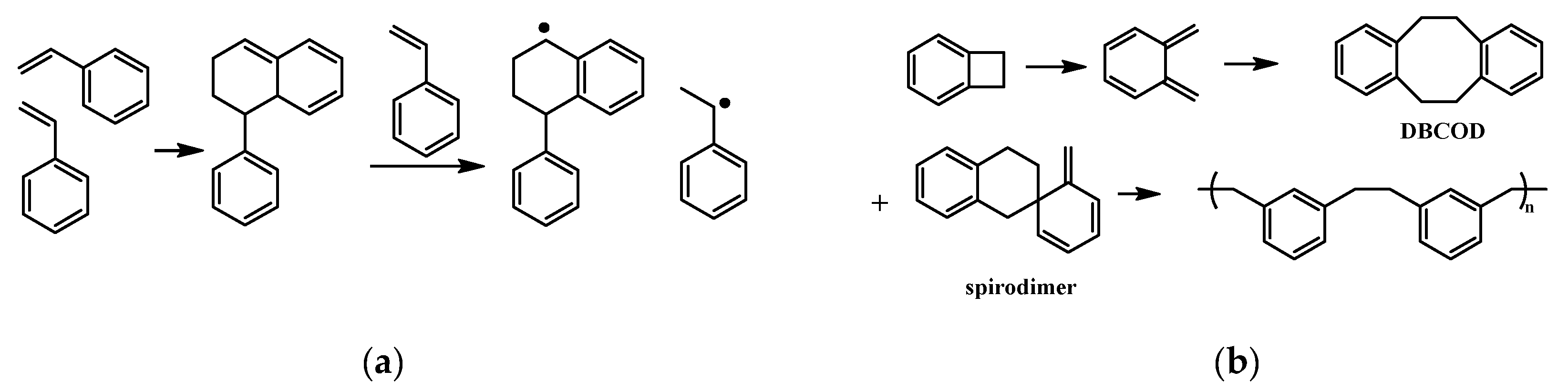
Figure 4.
TGA curve (a) and DSC trace (b) of BP-TVCH.
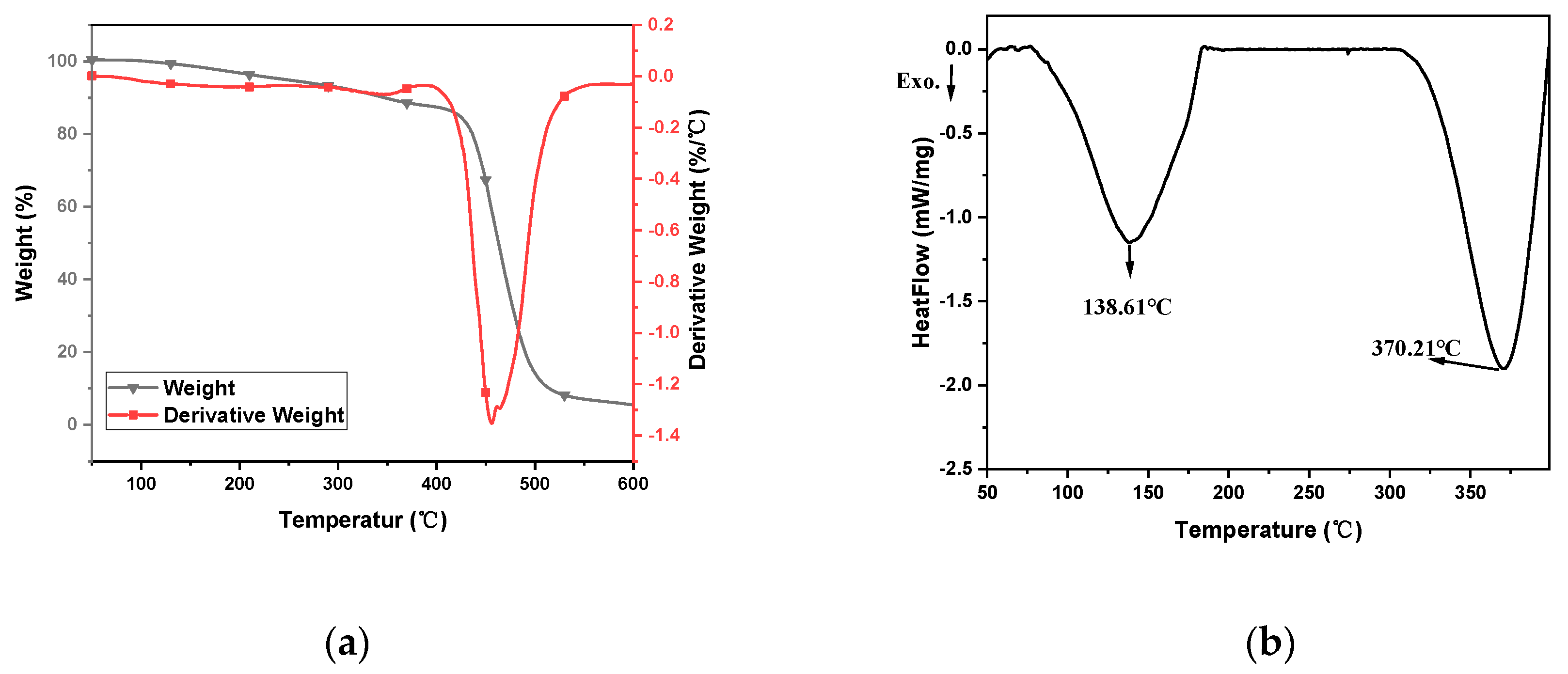
Figure 5.
Gel content of BP-TVCH after 6 h heating under nitrogen.
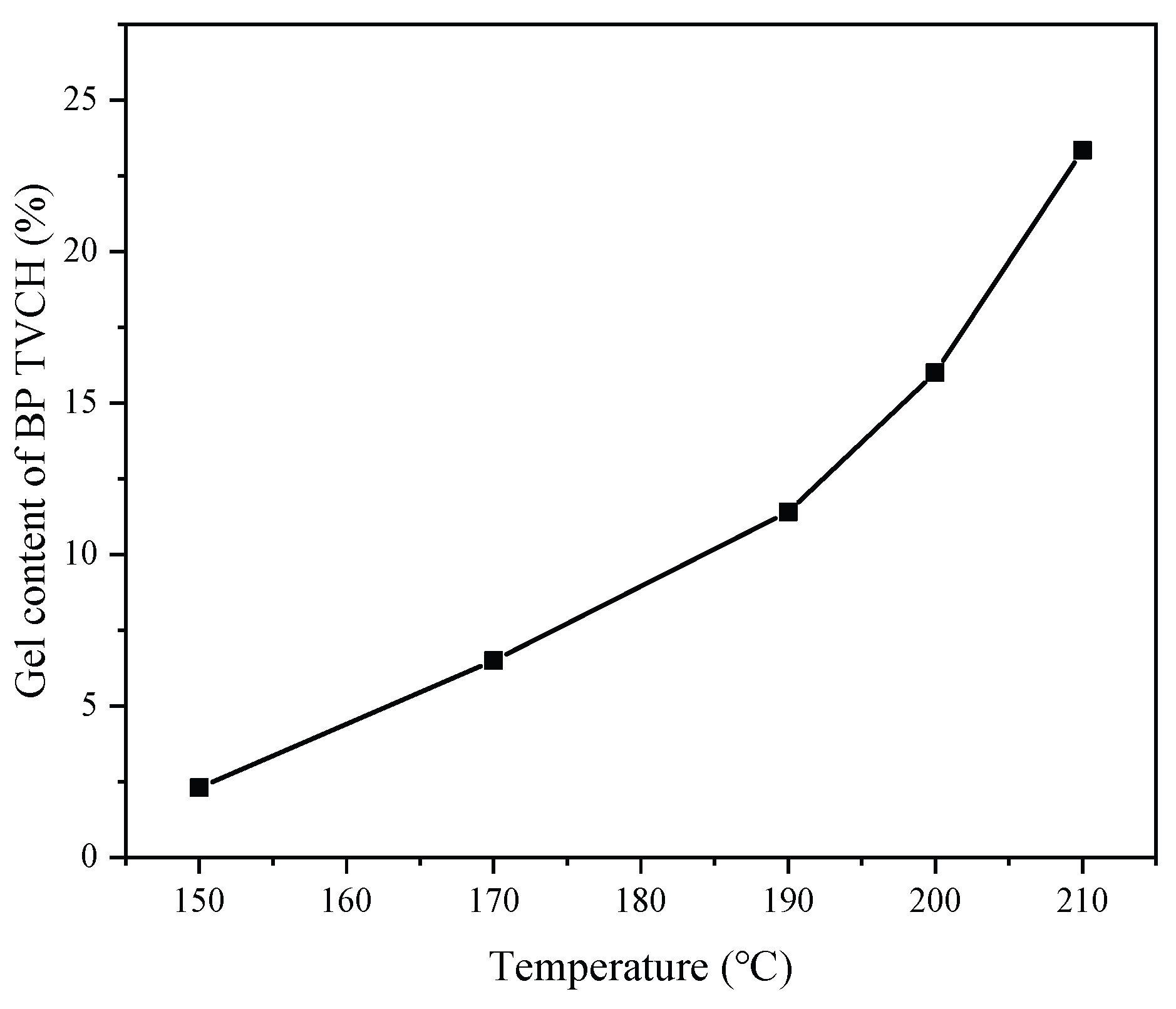

Table 1.
Reactivity of model compounds under different conditions.
| Reactant | Temperature * Time | Monitored Group | Conversion (%) | NMR spectra | |
|---|---|---|---|---|---|
| TVCH | 210℃*20hr | allylic | 3.6% | Figure S3 | |
| TVCH | styrene | 180℃*20hr | allylic | 60% | Figure S4 |
| vinyl | ~96% | Figure S4 | |||
| BCB | 180℃*20hr | cyclobutene | 3.5% | Figure S5 | |
| BCB | 210℃*20hr | cyclobutene | 52% | Figure S6 | |
| BCB | styrene | 180℃*20hr | cyclobutene | 12% | Figure S7 |
| vinyl | >99% | Figure S7 | |||
| TVCH | BCB | 210℃*20hr | allylic | 16% | Figure S8 |
| cyclobutene | 36% | Figure S8 | |||
Table 2.
Main performance of CCLs from BP TVCH and OPE-2st.
| Property | Item | Unit | Value | |
|---|---|---|---|---|
| Peeling strength (Hoz) |
ambient | N/mm | 0.280 (HTE*) | 0.190 (SI*) |
| thermal treatment | N/mm | 0.290 (HTE*) | 0.180 (SI*) | |
| interlayer | N/mm | 0.093 | ||
| CTE thk:1.2311mm |
X-CTE(50-125℃) | ppm/℃ | 10.93 | |
| Y-CTE(50-125℃) | ppm/℃ | 10.96 | ||
| Z-CTE (α1) | ppm/℃ | 16.33 | ||
| Total Z-CTE | % | 0.4762 | ||
| DMA(SC) thk:1.23mm | Storage Modulus (E’) 50℃ | GPa | 14.6254 | |
| Storage Modulus (E’) 250℃ | GPa | 8.8035 | ||
| DMA (TPB) thk:1.27mm | Storage Modulus (E’) 50℃ | GPa | 20.7222 | |
| Storage Modulus (E’) 250℃ | GPa | 13.0126 | ||
| Tg | DMA (SC) | ℃ | 277.58 | |
| DMA(TPB) | ℃ | 246.17 | ||
| CTE | ℃ | 260.23 | ||
| Tanδ Df (10G) thk: 0.135mm | initial | - | 0.00101 | |
| 1 hour | - | 0.00105 | ||
| 24 hour | - | 0.00105 | ||
* Note: HTE: a rougher copper foil, SI: a smoother copper foil, SC: Single Cantilever, TPB: Three-point bending, thk: thickness.
Disclaimer/Publisher’s Note: The statements, opinions and data contained in all publications are solely those of the individual author(s) and contributor(s) and not of MDPI and/or the editor(s). MDPI and/or the editor(s) disclaim responsibility for any injury to people or property resulting from any ideas, methods, instructions or products referred to in the content. |
© 2026 by the authors. Licensee MDPI, Basel, Switzerland. This article is an open access article distributed under the terms and conditions of the Creative Commons Attribution (CC BY) license (http://creativecommons.org/licenses/by/4.0/).
Copyright: This open access article is published under a Creative Commons CC BY 4.0 license, which permit the free download, distribution, and reuse, provided that the author and preprint are cited in any reuse.