

Submitted:
30 September 2026
Posted:
01 October 2026
You are already at the latest version
Abstract
The estimation of surface free energy (SFE) of a solid is a major issue in (bio)material and (bio)interfacial research. Here we show how combining Neumann and Gerson equations of state allows calculation of SFE and Girifalco-Good parameter (characterizing the interaction between the solid and the wetting liquid) analytically (in closed form) and in physically motivated fashion solely from the surface tension of the wetting liquid and its contact angle with the solid surface. This is significant enhancement compared to the traditional iterative solving of the equations of state or to their empirical fitting by high order polynomials. It is shown that the values of SFE calculated in closed-form fashion are in excellent agreement with the iteratively calculated ones and can open convenient opportunity for direct non-iterative computation of number of surface chemistry parameters.
Keywords:
surface free energy
; contact angle models
; single and multiple probe liquid methods
; Neumann equation of state
; Gerson equation of state
; Girifalco-Good interaction parameter
1. Introduction
The estimation of surface free energy (SFE) of polymers and other solid materials is of major interest in (bio)material and (bio)interfacial research [1,2,3,4]. The most commonly employed methods for this purpose are based on measurements of the contact angle formed between a probe liquid and the solid surface under investigation (Figure 1). However, SFE determination remains entangled with theoretical, computational and experimental challenges. Part of these challenges are related to the fact that SFE quantification involves parameters that are not directly experimentally accessible which greatly complicates its evaluation [5,6,7].
The solid-liquid, solid-vapor and liquid-vapor interfacial energies are commonly related via the Girifalco-Good equation [8,9,10,11]:
where: γlv - surface tension of the wetting liquid, γsv- solid-vapor surface tension (typically denoted as SFE), γsl- liquid-solid interfacial energy. Φ is the Girifalco–Good interaction parameter that quantifies the degree of similarity (in terms of surface energy and polarity matching) between the contacting entities. It decreases (0.5 < Φ < 1.15) away from unity with the attenuation of the interaction (i.e., increase in θ) between the liquid and the solid [8,9,10,11].
When combined with the Young equation
it yields:
where θ is the contact angle between the sessile droplet of wetting liquid and the solid surface.
γsv = γsl + γlvcosθ
Obviously if the value of Girifalco-Good parameter is known, SFE calculation from contact angle goniometry becomes routine. However, solving Equations (1) and (2) for Ф one obtains:
As solid-vapor and solid-liquid interfacial energies are not directly accessible, apparently Ф cannot be straightly calculated from the experimentally measurable surface tension of the wetting liquid and its contact angle with the solid surface. Hence, sophisticated approaches for γsv and Ф estimation were developed implementing single or multiple wetting liquids. Single wetting liquid methods relied on semi-empirical but theoretically grounded equations like Neumann (4) [12,13,14,15] and Gerson equation of state (5) [16,17,18,19,20,21]:
where β = 0.0001247 (m2/mJ)2 (or 0.0001247 (m/mN)2).
where a = 6.5 × 10⁻⁵ (m/mN)2and b = −0.010 (m/mN).
The parameters a, b and β are best fit estimates (hence semi-empirical) from extended dataset of contact angles measured between numerous liquids and solids of various polarity and interfacial energies. All the same, the derivations of Equations (5) and (6) stem from theoretically substantiated attempts to amend Berthelot’s combining rule while accounting the complex nonlinear dependence of Ф on the interfacial properties of both participants in the solid-liquid pair [14,16]. As justly summarized by Neumann [12,14], although not entirely analytical (as is none of the currently existing frameworks for SFE evaluation) the equations of state (EoS) are undoubtedly “physically motivated” [12].
Both equations gained traction (especially Equation (5)), however the two share the same limitation: as they cannot be solved analytically, γsv and Ф are obtained iteratively. Although iterative solvers are broadly available, this is cumbersome and off-putting for practitioners as a transparent closed-form solution for γsv is always preferable, both for explicit understanding of the calculation itself and for its rapid implementation in practical settings. Moreover, any uncertainty in the measurement of θ will also have impact on the error in γsv and an explicit expression for γsv will allow analysis of the propagation of uncertainties in a simple and efficient way. To partially mitigate these issues equations of state are often fitted by high order polynomials (f(θ, γlv)) where each numerical coefficient is high order polynomial (f(γlv)) itself [22,23]. Apart from being tedious, such an approach has no physical justification. However, up to now no theoretically grounded way for closed-form assessment of SFE based on the contact angle measurements with a single wetting liquid is reported.
Here we show that by combining the Girifalco-Good, Neumann and Gerson equations it becomes possible to obtain physically motivated closed-form estimation of the interaction parameter Ф which allows for instant non-iterative calculation of the solid surface free energy directly from the surface tension of the wetting liquid and its contact angle with the solid surface. Apart from removing significant practical hurdles in SFE calculation such closed-form expression might be of broader interest when elucidating the interplay between the liquid and solid interfacial properties in wetting phenomena.
2. Materials and Methods
Contact angle data between solids with diverse SFE and polarity and liquids with broad range of surface tension are obtained from the classical studies of Neumann [14,15,16,17,18,19,20] and Zdziennicka and Janczuk [24]. Preference was given to these sources as the values reported in them are known for their precision and are commonly used as a reference standard in the field. Neumann used PD-ADSA and sessile drop techniques for his measurements, while Zdziennicka and Janczuk relied primarily on sessile drop technique that is also the most used methodology in contact angle measurements today.
3. Results
1. Derivation of physically motivated closed form solution for Girifalco-Good parameter and for surface free energy calculation
As can be seen in Figure 2 (upper panel) for all practical purposes γsv values obtained by Equations (5) and (6) can be assumed equal (mean absolute difference< 0.2 mN/m; mean discrepancy = 0.086 mN/m with 95% confidence interval: -0.015 ÷0.17 mN/m) [22]. As emphasized by Neumann [12,14,15], such differences are merely a result of the different functional form of the equations of state and have no influence on their capability to fit real world data (see also Supplementary file, point I). Then obviously from Equations (4), (5) and (6) one obtains:
Taking the natural logarithm of both sides eliminates the exponentials:
After some algebraic manipulations this equation can be rearranged to a quadratic equation:
where the coefficients are:
A = a + β
B = b − aγlvcosθ − 2βγlv
The following physically meaningful root of the quadratic equation is obtained for the solid-vapor SFE that contains only the numerical coefficients a, b and β and the experimentally measurable quantities θ and γlv:
Equation (10) provides physically sound estimates across all relevant regimes (SFE ≥ 3 mN/m; see Figure S1 in the Supplementary Material). While it can yield negative values at extremely low surface energies (SFE < 2-3 mN/m as calculated via Equations (5) and (6))— where C < 0 or B2 < 4AC may occur—this regime lies well below the physical lower bound for both solid and liquid surface free energies. At such extremely low energies, cohesive forces are insufficient to maintain a stable interface, rendering the thermodynamic concepts of contact angle and surface free energy undefined. For context, the lowest reported experimental SFE for a solid layer is 6.7 mN/m (measured from a hexagonally close-packed alignment of trifluoromethyl (-CF₃) groups on a vapor-deposited layer of n-perfluoroeicosane [25]), while the theoretical lower limit for a smooth, flat surface is approximately 11.5 mN/m (corresponding to a maximum water contact angle of 120°) [12,25]. Nevertheless, we do not recommend using Equation (10) directly for SFE calculations, as such an approximation is unnecessary. Instead, it is best utilized as a conversion factor to determine the interaction parameter as defined in the exponential form of Φ (see point II in the Supplementary material for further discussion).
Thus, the quadratic root should be plugged in the expression for Gificalco-Good interaction parameter (see Equations (5) and (7)) provided by the Neumann equation of state when one obtains:
where coefficients A, B and C are defined in equations (9a-c). Because Equation (11) contains only experimentally measurable parameters it allows for direct analytical closed-form calculation of Ф once the contact angle of a wetting liquid with known surface tension is measured. As Ф is calculated as an exponent (as in Equation (7)) it remains strictly positive over the entire range of θ (0-180°) for any surface tension of the wetting liquid and its value remains in excellent agreement with the iteratively calculated Ф estimates obtained from the Neumann EoS (see point III in the Supplementary file).
Finally, after inserting Equation (11) in the Girifalco-Good equation the following hybrid Neumann-Gerson equation of state is obtained about γsv requiring only experimentally measurable parameters to calculate SFE:
As can be seen in Figure 2 (Bottom panel) the values of γsv calculated with Equation (12) are practically indistinguishable (mean absolute difference between the predictions of the two equations is less than 0.06 mN/m; mean discrepancy = -0.03 mN/m with 95% confidence interval: -0.044 ÷-0.019 mN/m) from the ones obtained with Equations (5) and (6). To put these numbers in perspective it should be considered that Neumann developed three equations of state based on the augmentation of the Berthelot’s combining rule (see point I in Supplementary file), that he considered to be virtually equivalent to each other. The mean discrepancy between Neumann’s own equations could reach 0.3 mN/m with 95% confidence interval: 0.47 and −0.30, i.e., the agreement of Equation (12) with Equation (5) was better than the one among Neumann’s own expressions.
However, in contrast to them, the estimates determined with Equation (12) are not computed iteratively but analytically directly from the experimentally measurable θ and γlv. Thus Equation (11) provides, to use the description coined by Neumann [12], physically motivated (as it is derived entirely from physically motivated predecessors) analytical closed-form solution of the Girifalco-Good equation.
2. Performance of Equation (12) on real world contact angle data compared to traditional surface energy estimation approaches
Table 1 summarizes the values of SFE calculated for variety of solid surfaces. As can be seen from practical point of view the values obtained iteratively with Neumann equation of state and calculated analytically via Equation (12) are essentially identical for all surfaces and for the entire range of probe liquid surface tensions and contact angles.
Table 2 is interesting that it presents data for a reasonably polar quartz surface with water contact angle of 26°. Once again there is excellent quantitative agreement in SFE values assessed iteratively with Equation (5) and computed in closed-form with Equation (12). For such hydrophilic surfaces apparent complication stems from the observation that Neumann equation of state (and respectively Equation (12)) yields different SFE for the same solid (i.e., γsv=f(γlv)) depending on the probe liquid that wetted the sample i.e., γsv is a function of γlv. Detailed discussion of the phenomenon is beyond the scope of the current study. Yet, it suffices to say that such result is in excellent agreement with the postulates of Frumkin–Derjaguin theory of wetting [26,27] assuming the universal formation of very thin (few nm), wetting liquid-specific, precursor film at the triple air-solid-liquid line of the sessile drop, i.e., that the contact angle based SFE estimates represent apparent SFE measuring the properties of the solid at the triple air/solid/liquid line, i.e., γsv =f(γlv), which is different from the SFE of the dry solid surface located away from the triple line. This apparent γsv =f(γlv) determined in contact angle studies, is nevertheless immensely useful as it reveals invaluable information about the chemical and structural dynamics of the solid surface. Furthermore, it is found that the average of the individual values of the solid surface free energy determined with distinct wetting liquids matches the value obtained with the model of Owens-Wendt (or of van Oss-Chaudhury-Good) [28,29,30,31,32,33,34]. The latter result is significant as it demonstrates that the controversies regarding SFE evaluations from single- and multiple wetting liquids are only apparent, and both approaches yield essentially identical estimates of γsv. Similar results were already demonstrated in number of studies [28,29,30,31,32,33,34,35,36].
4. Discussion
In the current study we combined Girifalco-Good, Neumann and Gerson equations to obtain a convenient new equation that provides closed-form solutions for the interaction parameter Ф and for the surface free energy γsv. Expectedly the newly derived Equation (12) shows excellent quantitative agreement with its predecessors Equations (5) and (6). In contrast to tedious high order polynomial fittings to the Neumann equation of state that have no physical justification [22,23], the newly derived equation inherits the “physical motivation”(a term originally coined by Neumann [12]) of its predecessors while providing possibility for immediate analytical non-iterative calculation of important physicochemical parameters.
This can be clearly seen for example when looking at the rigorous expression for Ф derived by Good and Girifalco [9,10,11]:
where: α1,2: Polarizability of molecules; μ1,2: Permanent dipole moment of molecules; I1,2: First ionization potential of molecules in phase 1 and 2 respectively and κT: Boltzmann constant multiplied by absolute temperature (kBT)
The problem is that while information about the molecular properties is often available for pure liquids, these parameters are very challenging to obtain for most solids and attempts to achieve so have frequently resulted in misleading results. Therefore, although this expression is theoretically rigorous, it is with limited practical applicability and that is the reason Neumann [12,14] and Gerson [16,17] started to look for alternative ways to formulate Ф. However, as already shown these expressions contained unknown quantities like γsv and γls and therefore Neumann and Gerson equations required iterative computations, while calculation of Ф directly from the surface tension of the wetting liquid and its contact angle with the studied surface remained elusive. Nevertheless, the values of Ф calculated from Equations (5) and (6) were found to be in good agreement with the values obtained by the rigorous expression based on molecular properties provided by Good and Girifalco [12,13,14,15,16].
From that point of view Equation (11) provides convenient opportunity as the interaction parameter values calculated from it match the Ф values computed iteratively with Equation (5) while doing so via direct calculation from the immediately available experimentally measurable γlv and θ. The existence of such opportunity is logical as the contact angle is an integral quantity, representing the manifestation of the individual molecular properties of both participants in the liquid-solid pair [9,10,11] as well as their interactions and combining Equation (5) and (6) allowed to untangle it in explicit form.
One of the reasons for implementing empirical high-order polynomial fittings to the equations of state is the fact that explicit expression for γsv allows transparent calculation of the propagation of uncertainty ( (dθ/dγsv )σθ ) in the value of the contact angle to the value of SFE [22,23]. This is possible here as well using Equation (14):
Where
Such in depth analysis is beyond the scope of the current study, but it can be seen that propagation of uncertainty in θ as specified by Equation (14) will be easier to calculate compared to 5th order polynomial fitting of an equation of state [22] where uncertainty propagation will take the form of (here A, B, C, D, E are high order polynomials themselves), i.e., it requires 24 fitted parameters and exhibits systematic edge amplification near the boundaries of the fitted range.
Equation (12) allows direct physically motivated closed-form calculation of SFE from the static contact angle of a sessile drop formed by liquid with known γlv over the surface of interest. Up to now no such opportunity was available as Equations (5) and (6) and other similar equations of state all required iterative computations.
The only option for analytical estimation from wetting with single liquid was provided by the equation of Chibowski [29,30,31,33] utilizing the advancing and receding contact angles (θa and θr):
However, Equation (15) comes with its own limitations as it assumes that Ф remains the same for both the “dry” solid surface in front of the advancing edge of the liquid drop and for the wetted surface left behind the drop receding edge. As pointed out by Neumann [12], such assumption is not necessarily correct as the composition and structure of the hydrated solid surface might be significantly altered compared to its non-hydrated state. Nevertheless, it is shown on multiple occasions that for surfaces with moderate contact angle hysteresis ( θa - θr≤ 20°) SFE estimates from Equation (14) and Equation (5) are in very good agreement [28]. Another limitation of Equation (15) is that it requires two contact angles instead of only one and measurement of contact angle hysteresis has its own methodological challenges.
Until very recently there was a tendency among the adherents of single- (applying equations of state) and multiple-wetting liquids (applying mainly Owens-Wendt and van Oss-Chaudhury-Good models) to be mutually dismissive about the theoretical justification of the “competing” approach [37]. Nowadays it became clear that the trend observed when applying Neumann equation of state that SFE of the solid depends on the surface tension and polarity of the wetting liquid is actually not a bug but a feature as it completely agrees with the underlying (and experimentally backed) assumptions of Frumkin–Derjaguin theory of wetting [26,27] about the existence of nanometrically thin precursor film, which emanates from the three-phase contact line region of the sessile droplet and instantaneously spreads ahead of the latter. Therefore, contact angle-based estimates represent apparent SFE characterizing the properties of the solid at the triple air/solid/liquid line, i.e., γsv =f(γlv), and are distinct from the SFE of the dry surface faraway from the contact line [38]. Thus γsv=f(γlv) behavior of Equation (5) (and Equation (12)) provides information about the differential interaction of the solid surface with wetting liquids of distinct nature and thus for the intrinsic features of the solid surface itself [31,33]. Furthermore, it was demonstrated that the single SFE value calculated via Owens-Wendt or van Oss-Chaudhury-Good models is identical with the mean value of the individual SFE obtained via Equation (5) with different wetting liquids for the same solid, thus removing the apparent controversy between the two approaches. The result is unsurprising as from mathematical point of view it is obvious that in Owens-Wendt (and van Oss-Chaudhury-Good) model “interactions with several types of diagnostic liquids are averaged” and the computed SFE “describes the mean properties of the force field in terms of its force components as well as its total value” [39]. Furthermore, in contrast to the popular belief that equation of state approach and surface tension component theories are incompatible and mutually exclusive, as we recently pointed out knowing γsv and combining it with Owens-Wendt model allows to calculate the surface tension components of the SFE in analytical closed-form manner via the equations (γd and γp are the dispersive and polar components of the solid (s) and liquid (l) surface energy):
Curiously this opportunity that was demonstrated back in the 1970s by Kloubek [40,41] and by Neumann [42] remained almost neglected in practice, although it offers some interesting opportunities that will be explored in our subsequent publication. Interested readers may refer to our recent review [28] for examples of the combined application of the equations of state and Equations (16) and (17). It should be noted that implementing Equations (12), (15) and (16) it becomes possible to obtain the dispersive () and non-dispersive () components of SFE as well as its total value in completely transparent analytical fashion merely from the contact angle and the surface tension of the wetting liquid avoiding any iterative or multiple regression calculations [28], which is significant advantage compared to the currently used approaches.
Equations of state, like Equations (5) and (6), are sometimes criticized for not being entirely analytical and relying on best fit constants β, a and b [43]. It should be kept in mind that at the moment no approach for calculation of SFE is free from this limitation as in Owens-Wendt and van Oss-Chaudhury-Good model the surface tension component values of the wetting liquids cannot be obtained analytically as well and there are significant discrepancies about their best values (and how to measure them) in the literature [44]. At the same time, it should be noted that the constants β, a and b emerged in the derivation of the equations of state not in an arbitrary fashion but as a result of a physical necessity while amending the Berthelot’s combining rule to account for the nonlinear dependence of Ф on the interfacial properties of both participants in the solid-liquid pair. Regarding β an expression matching Equation (5) was derived by Neumann from molecular parameters and a density depletion theory at the interface. It provided a physical explanation for β as a measure for the molecular packing of the solid interface at the three-phase contact line [12].
where δ2 is the area occupied by an atom in the liquid–solid interface, kB is Boltzmann’s constant, and T is temperature.
As the Gerson and Neumann models describe the same system, their constants cannot be independent. The following analysis will allow us to access the physical sense behind the constants a and b in Equation (6) as well as their relationship with Neumann’s β. For this purpose, let us return to the expression for (Equation (10)) and substitute the coefficients defined in Equations (9a-c) into it. Doing so one obtains:
Equation (19) allows for intriguing normalization and dimensionless reparameterization. Let us define:
- Fractional Interaction Parameter (α):
Consequently, .
- Dimensionless Constant (q):
- Universal Liquid Ratio r
To eliminate q as an independent parameter while remaining valid across liquids of varying surface tension γlv, let us define a universal system constant, relating interfacial state parameters:
Defining the dimensionless liquid parameter r as:
yields the exact relationship:
q = −rα
Substituting expressions (19a-e) into Equation (19) yields a notably simple relationship for :
This new equation (20) is remarkable as it allows us to have a glimpse into the interplay among the characteristics of the system. In the original equation (19), a, b, and βappear as independent parameters. Re-parameterization reveals that the system’s behavior does not depend on a, b, and β individually, but rather on two tightly coupled dimensionless groupings:
: Captures the intrinsic balance
between the linear and non-linear interfacial energy contributions.
: Links the internal material
constant Cba = −b/a directly to the external
probe liquid’s surface tension γlv.
This reveals a hidden link: changing the probe liquid (γlv) is mathematically equivalent to altering the system’s internal scale parameter (Cba). They do not act independently; they only ever interact as the single ratio r.
It should be specifically kept in mind that Equation (5) and (6) were developed while working with different datasets, i.e., while Neumann [12,13,14,15] used mainly his own carefully measured data, Gerson [16] gathered a very broad dataset from range of literature sources. Nevertheless, although using different data and working independently, both reached remarkably similar conclusions as can be seen from the overlap in the SFE values obtained by Equation (5) and Equation (6). This complete agreement between the two equations, as well as the concordance of their estimates with the models of Chibowski, Owens-Wendt and van Oss-Chaudhury good regarding the total value of SFE, strengthens the conviction in the overall validity of the approach and emphasizes that the hypothesized exclusiveness of the different approaches is largely apparent and that actually all these models can mutually complement each other and provide valuable information about the structure and dynamics of solid surface upon wetting.
5. Conclusions
Combining the Girifalco-Good, Neumann and Gerson equations allowed us to obtain a convenient new expression that provides closed-form solutions for the interaction parameter Ф and for the surface free energy γsv. This newly derived Neumann-Gerson equation shows excellent quantitative agreement with its predecessors. In contrast to tedious and physically unjustified fitting of high order polynomials to the Neumann equation of state, the newly derived equation inherits the physical motivation of its predecessors while providing possibility for immediate analytical non-iterative calculation of important physicochemical parameters. The explicit expression for γsv also allows analysis of the propagation of uncertainties in a simple and efficient way, thus also delivering the practical utility sought after the polynomial fittings of the equations of state.
Supplementary Materials
The following supporting information can be downloaded at the website of this paper posted on Preprints.org, Supplementary file with comments in two points and three figures.
Author Contributions
Conceptualization, G.A.G. and S.B.; methodology, G.A.G., and M.B.; validation, G.A.G., S.B. and K.L.; formal analysis, G.A.G. and M.B.; investigation, M.B.; data curation, G.A.G. and M.B.; writing—original draft preparation, G.A.G., S.B. and K.L.; writing—review and editing, G.A.G., S.B. and K.L.; visualization, M.B.; supervision, G.A.G. and S.B. All authors have read and agreed to the published version of the manuscript.
Funding
The research is supported by the No. BG16RFPR002-1.014-0015: “Clean Technologies for Sustainable Environment—Water, Waste, Energy for Circular Economy”, financed by the European Regional Development Fund through Bulgarian Programme “Research, Innovation and Digitalization for Smart Transformation” by the provision of equipment. M.B. acknowledges the support of project No. 80-10-97 from 7 April 2026 by Scientific Research Fund of Sofia University. S.B. acknowledges the Bulgarian National Science Fund, project KII-06-H97/4/05.12.2025/HypoVir for the financial support.
Data Availability Statement
Data available upon reasonable request.
Conflicts of Interest
The authors declare no conflicts of interest.
Abbreviations
The following abbreviations are used in this manuscript:
| θ | Contact angle |
| SFE, γsv | Surface free energy |
| EoS | Equation of State |
| Ф | Girifalco-Good interaction parameter |
| γlv | Wetting liquid surface tension |
| and | Dispersive component of the surface energy of the liquid (l) or the solid (s) |
| and | Polar component of the surface energy of the liquid (l) or the solid (s) |
References
- Karbowiak, T.; Debeaufort, F.; Voilley, A. Importance of Surface Tension Characterization for Food, Pharmaceutical and Packaging Products: A Review. Crit. Rev. Food Sci. Nutr. 2006, 46, 391–407. [Google Scholar] [CrossRef] [PubMed]
- Bangera, A.E.; Appaiah, K. A conditional justification for the determination of surface energy of solids using contact angle methods. Mater. Chem. Phys. 2019, 234, 168–171. [Google Scholar] [CrossRef]
- Rouxhet, P.G. Contact Angles and Surface Energy of Solids: Relevance and Limitations. In Advances in Contact Angle, Wettability and Adhesion; Scrivener Publishing LLC: Beverly, MA, USA, 2013; pp. 347–375. [Google Scholar]
- Eftimov, P.; Yokoi, N.; Peev, N.; Georgiev, G.A. Impact of Air Exposure Time on the Water Contact Angles of Daily Disposable Silicone Hydrogels. Int. J. Mol. Sci. 2019, 20, 1313. [Google Scholar] [CrossRef] [PubMed]
- Jańczuk, B.; Zdziennicka, A.; Szymczyk, K. Interface tension, interface Gibbs free energy and contact angle. Adv. Colloid Interface Sci. 2026, 355, 103931. [Google Scholar] [CrossRef] [PubMed]
- Żenkiewicz, M. Methods for the calculation of surface free energy of solids. J. Achiev. Mater. Manuf. Eng. 2007, 24, 137–145. [Google Scholar]
- Żenkiewicz, M. Comparative study on the surface free energy of a solid calculated by different methods. Polym. Test. 2007, 26, 14–19. [Google Scholar] [CrossRef]
- Girifalco, L.A.; Good, R.J. A Theory for the Estimation of Surface and Interfacial Energies. I. Derivation and Application to Interfacial Tension. J. Phys. Chem. 1957, 61, 904–909. [Google Scholar] [CrossRef]
- Good, R.J.; Girifalco, L.A.; Kraus, G. A Theory for Estimation of Interfacial Energies. II. Application to Surface Thermodynamics of Teflon and Graphite. J. Phys. Chem. 1958, 62, 1418–1421. [Google Scholar] [CrossRef]
- Good, R.J.; Girifalco, L.A. A Theory for Estimation of Surface and Interfacial Energies. III. Estimation of Surface Energies of Solids from Contact Angle Data. J. Phys. Chem. 1960, 64, 561–565. [Google Scholar] [CrossRef]
- Good, R.J. Surface free energy of solids and liquids: Thermodynamics, molecular forces, and structure. J. Colloid Interface Sci. 1977, 59, 398–419. [Google Scholar] [CrossRef]
- David, R.; Neumann, A.W. Contact Angle Patterns on Low-Energy Surfaces. Adv. Colloid Interface Sci. 2014, 206, 46–56. [Google Scholar] [CrossRef] [PubMed]
- Neumann, A.W.; David, R.; Zuo, Y. Applied Surface Thermodynamics; CRC Press: Boca Raton, USA, 2010. [Google Scholar] [CrossRef]
- Kwok, D.Y.; Neumann, A.W. Contact angle measurement and contact angle interpretation. Adv. Colloid Interface Sci. 1999, 81, 167–249. [Google Scholar] [CrossRef]
- Tavana, H.; Neumann, A.W. Recent progress in the determination of solid surface tensions from contact angles. Adv. Colloid Interface Sci. 2007, 132, 1–32. [Google Scholar] [CrossRef] [PubMed]
- Gerson, D.F. An empirical equation-of-state for solid-fluid interfacial free energies. Colloid Polym. Sci. 1982, 260, 539–544. [Google Scholar] [CrossRef]
- Gerson, D.F. Methods in surface physics for immunology. In Immunological Methods; Lefkovits, I., Pernis, B., Eds.; Academic Press: New York, NY, USA, 1981; Volume 2, pp. 105–138. [Google Scholar] [CrossRef]
- Gerson, D.F. Interfacial free energies, zeta potentials and thromboresistance in bovine and ovine carotid arteries. J. Dispers. Sci. Technol. 1985, 6, 91–108. [Google Scholar] [CrossRef]
- Gerson, D.F.; Capo, C.; Benoliel, A.M.; Bongrand, P. Adhesion, phagocytosis and cell surface energy. The binding of fixed human erythrocytes to rat macrophages and polymethylpentene. Biochim. Biophys. Acta 1982, 692, 147–156. [Google Scholar] [CrossRef] [PubMed]
- Gerson, D.F. Interfacial free energies of cells and polymers in aqueous media. In Physicochemical Aspects of Polymer Surfaces; Mittal, K.L., Ed.; Plenum Press: New York, NY, USA, 1983; Volume 1, pp. 229–240. [Google Scholar]
- Chattopadhyay, D.; Rathman, J.F.; Chalmers, J.J. Thermodynamic approach to explain cell adhesion to air-medium interfaces. Biotechnol. Bioeng. 1995, 48, 649–658. [Google Scholar] [CrossRef] [PubMed]
- Schuster, J.M.; Schvezov, C.E.; Rosenberger, M.R. Polynomial functions for direct calculation of the surface free energy developed from the Neumann equation of state method. Int. J. Adhes. Adhes. 2023, 124, 103370. [Google Scholar] [CrossRef]
- Deshmukh, R.R.; Shetty, A.R. Comparison of surface energies using various approaches and their suitability. J. Appl. Polym. Sci. 2008, 107, 3707–3717. [Google Scholar] [CrossRef]
- Zdziennicka, A.; Szymczyk, K.; Krawczyk, J.; Jańczuk, B. Some remarks on the solid surface tension determination from contact angle measurements. Appl. Surf. Sci. 2017, 405, 88–101. [Google Scholar] [CrossRef]
- Nishino, T.; Meguro, M.; Nakamae, K.; Matsushita, M.; Ueda, Y. The Lowest Surface Free Energy Based on -CF3 Alignment. Langmuir 1999, 15, 4321–4323. [Google Scholar] [CrossRef]
- Churaev, N.V.; Sobolev, V.D. Prediction of contact angles on the basis of the Frumkin-Derjaguin approach. Adv. Colloid Interface Sci. 1995, 61, 1–16. [Google Scholar] [CrossRef]
- Popescu, M.N.; Oshanin, G.; Dietrich, S.; Cazabat, A.M. Precursor films in wetting phenomena. J. Phys. Condens. Matter 2012, 24, 243102. [Google Scholar] [CrossRef] [PubMed]
- Georgiev, G.A.; Baluschev, S.; Eftimov, P.; Bacheva, M.; Landfester, K. Addressing the Apparent Controversies Between the Contact Angle-Based Models for Estimation of Surface Free Energy: A Critical Review. Colloids Interfaces 2024, 8, 62. [Google Scholar] [CrossRef]
- Chibowski, E.; Ontiveros-Ortega, A.; Perea-Carpio, R. On the interpretation of contact angle hysteresis. J. Adhes. Sci. Technol. 2002, 16, 1367–1404. [Google Scholar] [CrossRef]
- Chibowski, E. On some relations between advancing, receding and Young’s contact angles. Adv. Colloid Interface Sci. 2007, 133, 51–59. [Google Scholar] [CrossRef] [PubMed]
- Chibowski, E.; Terpilowski, K. Comparison of apparent surface free energy of some solids determined by different approaches. In Contact Angle, Wettability and Adhesion; CRC Press: Boca Raton, FL, USA, 2009; Volume 6, pp. 283–299. [Google Scholar]
- Schuster, J.M.; Schvezov, C.E.; Rosenberger, M.R. Analysis of the Results of Surface Free Energy Measurement of Ti6Al4V by Different Methods. Procedia Mater. Sci. 2015, 8, 732–741. [Google Scholar] [CrossRef]
- Chibowski, E.J. Surface free energy and wettability of silyl layers on silicon determined from contact angle hysteresis. Adv. Colloid Interface Sci. 2005, 113, 121–131. [Google Scholar] [CrossRef] [PubMed]
- Etzler, F.M. Determination of the Surface Free Energy of Solid Surfaces: Statistical Considerations. In Advances in Contact Angle, Wettability and Adhesion; Scrivener Publishing LLC: Beverly, MA, USA, 2018; pp. 299–329. [Google Scholar]
- Etzler, F.M. Determination of the surface free energy of solids: A critical review. Rev. Adhes. Adhes. 2013, 1, 3. [Google Scholar] [CrossRef]
- Etzler, F.M. Determination of the Surface Free Energy of Solid Surfaces: Can the Best Model be Found. In Advances in Contact Angle, Wettability and Adhesion; Scrivener Publishing LLC: Beverly, MA, USA, 2019; pp. 73–98. [Google Scholar]
- Kontogeorgis, G.M.; Kiil, S. Sixty Years with Theories for Interfacial Tension – Quo Vadis? In Introduction to Applied Colloid and Surface Chemistry; Kontogeorgis, G.M., Kiil, S., Eds.; John Wiley & Sons: Chichester, UK, 2016. [Google Scholar] [CrossRef]
- Feinerman, A.E.; Lipatov, Y.S. The Rule of Interfacial Equilibrium. J. Adhes. 1997, 60, 99–112. [Google Scholar] [CrossRef]
- Nyilas, E.; Morton, W.A.; Cumming, R.D.; Lederman, D.M.; Chiu, T.-H.; Baier, R.E. Effects of polymer surface molecular structure and force-field characteristics on blood interfacial phenomena. I. J. Biomed. Mater. Res. 1977, 11, 51–68. [Google Scholar] [CrossRef] [PubMed]
- Kloubek, J. Calculation of surface free energy components of ice according to its wettability by water, chlorobenzene, and carbon disulfide. J. Colloid Interface Sci. 1974, 46, 185–190. [Google Scholar] [CrossRef]
- Kloubek, J. Interaction of Polar Forces and Their Contribution to the Work of Adhesion. J. Adhes. 1974, 6, 293–301. [Google Scholar] [CrossRef]
- Spelt, J.K.; Neumann, A.W. Solid surface tension: The equation of state approach and the theory of surface tension components. Theor. Concept. Considerations. Langmuir 1987, 3, 588–591. [Google Scholar] [CrossRef]
- Siboni, S.; Della Volpe, C.; Maniglio, D.; Brugnara, M. The solid surface free energy calculation: II. The limits of the Zisman and of the “equation-of-state” approaches. J. Colloid Interface Sci. 2004, 271, 454–472. [Google Scholar] [CrossRef] [PubMed]
- Della Volpe, C.; Maniglio, D.; Siboni, S.; Morra, M. Recent theoretical and experimental advancements in the application of van Oss–Chaudury–Good acid–base theory to the analysis of polymer surfaces I. General aspects. J. Adhes. Sci. Technol. 2003, 17, 1477–1505. [Google Scholar] [CrossRef]
Figure 1.
Contact angle determination via the sessile droplet method. The challenges to estimate the value of Girifalco-Good parameter are among the major bottlenecks to accessing surface free energy of a solid surface.
Figure 1.
Contact angle determination via the sessile droplet method. The challenges to estimate the value of Girifalco-Good parameter are among the major bottlenecks to accessing surface free energy of a solid surface.
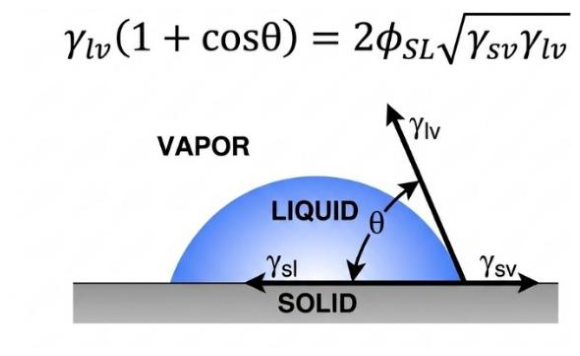
Figure 2.
Upper panel: Predicted values of surface free energy vs contact angle for wetting liquids with different surface tensions obtained from Neumann (Equation (5); points) and Gerson (Equation (6); solid line) equations of state. The mean absolute difference between the predictions of the two equations is less than 0.2 mN/m (mean discrepancy = 0.086 mN/m with 95% confidence interval: -0.015 ÷0.17 mN/m). Bottom panel: Predicted values of surface free energy vs contact angle for wetting liquids with different surface tensions obtained from Neumann equation of state (Equation (5); points) and Equation 12 (dashed line). The mean absolute difference between the predictions of the two equations is less than 0.06 mN/m (mean discrepancy = -0.03 mN/m with 95% confidence interval: -0.044 ÷-0.019 mN/m)).
Figure 2.
Upper panel: Predicted values of surface free energy vs contact angle for wetting liquids with different surface tensions obtained from Neumann (Equation (5); points) and Gerson (Equation (6); solid line) equations of state. The mean absolute difference between the predictions of the two equations is less than 0.2 mN/m (mean discrepancy = 0.086 mN/m with 95% confidence interval: -0.015 ÷0.17 mN/m). Bottom panel: Predicted values of surface free energy vs contact angle for wetting liquids with different surface tensions obtained from Neumann equation of state (Equation (5); points) and Equation 12 (dashed line). The mean absolute difference between the predictions of the two equations is less than 0.06 mN/m (mean discrepancy = -0.03 mN/m with 95% confidence interval: -0.044 ÷-0.019 mN/m)).
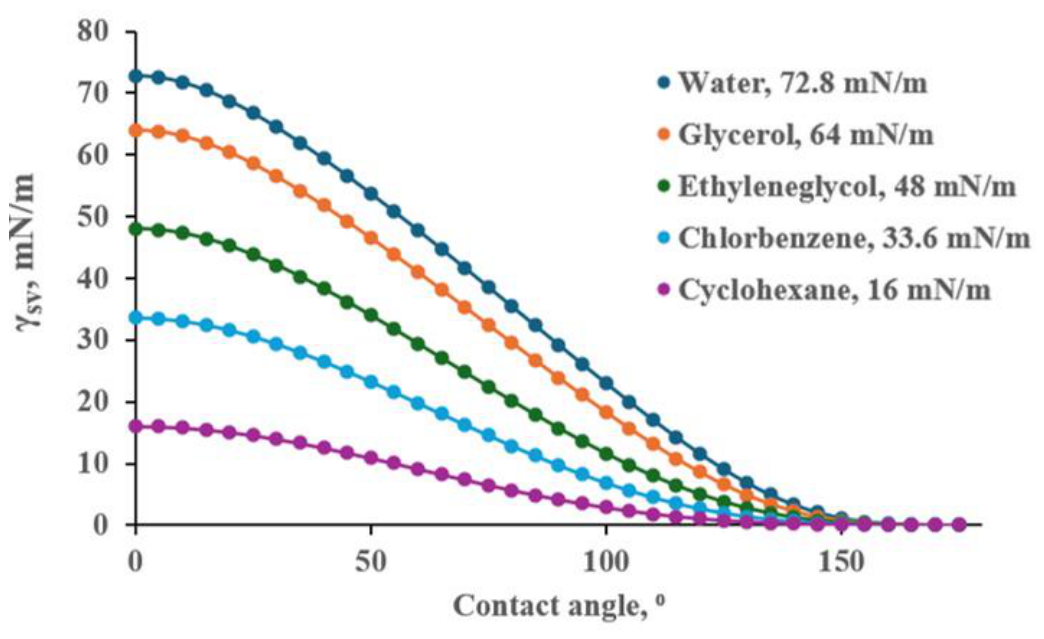
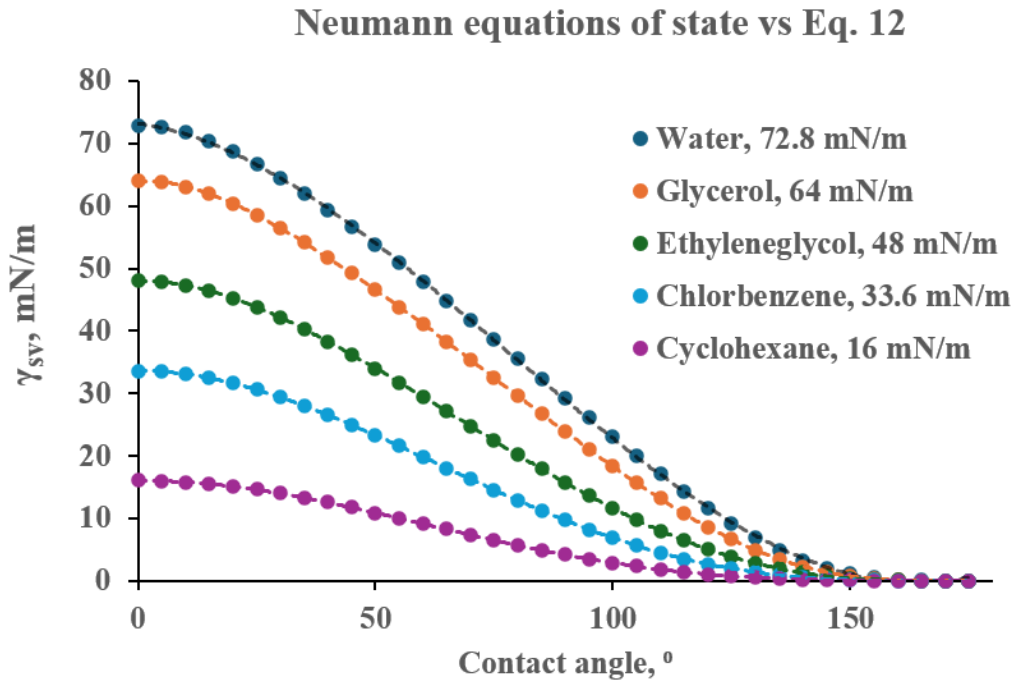

Table 1.
Contact angle data for wetting liquids with known surface tension over variety of solid substrates. SFE values calculated iteratively with the Neumann equation of state (Equation (5); values from reference [12,13,14,15]) and analytically by Equation (12) essentially coincide.
| Surface of a solid material | Wetting liquid | γlv, mN/m | θ, ° |
γsvfrom Neumann EoS, mN/m |
γsv fromEq.12, mN/m |
| Poly(propene-alt-N-methyl maleimide) | Diiodomethane | 49.98 | 30.71 | 43.7 | 43.65 |
| Glycerol | 65.02 | 60.25 | 41.7 | 41.7 | |
| Water | 72.7 | 69.81 | 41.8 | 41.85 | |
| Poly(propene-alt-N-(n-propyl)maleimide) | 1-Iodonaphthalene | 42.92 | 35.19 | 35.9 | 35.87 |
| 1-Bromonaphthalene | 44.31 | 30.75 | 38.6 | 38.6 | |
| 1,3-Diiodopropane | 46.51 | 39.98 | 37.1 | 37.08 | |
| 2,2’-Thiodiethanol | 53.77 | 54.04 | 36.5 | 36.49 | |
| Glycerol | 65.02 | 70.67 | 35.7 | 35.75 | |
| Water | 72.7 | 77.51 | 37 | 37.06 | |
| Polystyrene | Dimethyl sulfoxide | 42.68 | 50.67 | 29.7 | 29.7 |
| Diethylene glycol | 44.68 | 52.41 | 30.5 | 30.46 | |
| Ethylene glycol | 48.66 | 61.2 | 29.3 | 29.34 | |
| Formamide | 59.08 | 74.76 | 29.4 | 29.41 | |
| Glycerol | 63.11 | 78.38 | 30 | 30.01 | |
| Water | 72.7 | 88.42 | 30.2 | 30.16 | |
| FC725-coated silicon wafer | Dodecane | 25.64 | 71.02 | 11.8 | 11.86 |
| Hexadecane | 27.62 | 73.41 | 12.1 | 12.18 | |
| 3,3-Thiodipropanol | 39.83 | 90.48 | 11.9 | 12.06 | |
| Diethylene glycol | 45.16 | 94.47 | 12.5 | 12.7 | |
| Ethylene glycol | 48.66 | 100.05 | 11.6 | 11.86 | |
| 2,2’-Thiodiethanol | 53.77 | 101.07 | 13.2 | 13.38 | |
| Formamide | 59.08 | 106.89 | 12.7 | 12.8 | |
| Glycerol | 63.13 | 110.21 | 12.7 | 12.74 | |
| Water | 72.7 | 119.31 | 11.9 | 11.53 |
Table 2.
Contact angles [24] of wetting liquids with known surface tension over hydrophilic quartz surface. SFE calculated iteratively with Equation (5) and analytically by Equation (12) essentially coincide. The means of SFE calculated by Equation (5) [24] or Equation (12) match the value obtained by Owens-Wendt model [24], showing excellent agreement between the models (see main text for details).
Table 2.
Contact angles [24] of wetting liquids with known surface tension over hydrophilic quartz surface. SFE calculated iteratively with Equation (5) and analytically by Equation (12) essentially coincide. The means of SFE calculated by Equation (5) [24] or Equation (12) match the value obtained by Owens-Wendt model [24], showing excellent agreement between the models (see main text for details).
|
Wetting liquid |
γlv, mN/m | θ, ° | γsvfromNeumann EoS, mN/m | γsvfromEquation (12), mN/m | γsvfrom Owens-Wendt, mN/m |
| Water | 72.8 | 26 | 66.27 | 66.3 | 55.2 |
| Formamide | 58 | 20 | 54.69 | 54.7 | |
| Diiodomethane | 50.8 | 34 | 43.07 | 43.11 | |
| Mean SFE | 54.68 | 54.7 | |||
Disclaimer/Publisher’s Note: The statements, opinions and data contained in all publications are solely those of the individual author(s) and contributor(s) and not of MDPI and/or the editor(s). MDPI and/or the editor(s) disclaim responsibility for any injury to people or property resulting from any ideas, methods, instructions or products referred to in the content. |
© 2026 by the authors. Licensee MDPI, Basel, Switzerland. This article is an open access article distributed under the terms and conditions of the Creative Commons Attribution (CC BY) license (http://creativecommons.org/licenses/by/4.0/).
Copyright: This open access article is published under a Creative Commons CC BY 4.0 license, which permit the free download, distribution, and reuse, provided that the author and preprint are cited in any reuse.