
Submitted:
30 September 2026
Posted:
01 October 2026
You are already at the latest version
Abstract
Improving crop yield to feed rapidly growing population under the conditions of limited cultivable land and climate change is a global concern. Besides different genetic and environmental factors, plant carbon (C) and nitrogen (N) levels largely influence plant growth and development. Key genes from both C and N assimilation pathways have been utilized for overexpression aiming to improve yield in transgenic plants. However, majority of these studies primarily focused on molecular and biochemical characterization of transgenic plants, providing limited or no data on yield or other growth related parameters. In addition, there are cases where the same target transgene produced variable effect on the physiological traits of host plant. This review summarizes different studies where genes from C and/or N assimilation pathways have been utilized for heterologous expression in plants. More specifically, we aim to provide an overview of different genetic modifications to enhance C and N assimilation vis-à-vis their physiological consequences in transgenic plants. Further, significance of simultaneous enhancement of C and N assimilation in plants for higher yield is being discussed.
Keywords:
carbon
; nitrogen metabolism
; photosynthesis
; transgenic plants
Introduction
World population is projected to touch 7.6 billion marks in 2020, and by 2050 there will be 30 percent more people on the globe (Huang et al., 2002). Improving crop yield to meet the demands of an increasing world population for food, fodder and fuel is a central challenge for plant biologists. Adoption of high-yielding varieties, fertilizer application, and effective pest control has brought positive impact on the crop yields, which marked an era of green revolution (the 1940s to 1970s). However, the major crops like wheat, rice, soybean, etc., are now growing close to their biological limits for grain production, and seek further improvement in yield using future technologies. Advances in recombinant DNA technology have made it possible to transfer gene(s) of interest even from distantly related species into the crop plants. Since its time of inception, genetic modification of crops led to enhanced stress tolerance, disease control, improved shelf life, improved nutritional quality etc. in both model and crop plants. However, compared to these traits, plant yield is a complex phenomenon where series of genetic and environmental factors are at interplay. At molecular level, there is limited information on the key genetic components determining plant yield and hence it is difficult to pinpoint the genes for yield enhancement (Van Camp, 2005).
Crop yield is a function of both biomass production and grain yield (Sharma-Natu and Ghildiyal, 2005). Total biomass production is primarily dependent on the photosynthetic efficiency of the source tissues to produce energy reserves, whereas, the efficiency with which source tissue exports these reserves to the developing sink organs determines harvest index or grain yield. The capacity of different organs to behave as a source or sink may vary with the developmental stage of a plant. However, a generalized view of photosynthesizing tissue as “source” and developing grain or seed as “sink” has led genetic engineers to identify important targets participating across the source-sink cascade; genetic modification of which promises yield improvement. Plants harness solar energy to produce carbohydrates through the process of photosynthesis. Concurrently, adequate N nutrition is required to keep healthy photosynthetic machinery to maximize photoassimilate production. Therefore, engineering plants for efficient C and N assimilation provides the most obvious approach to increase plant yield by strengthening the “source” capacity. Series of efforts have been made to overexpress key genes from C and/or N metabolism with an objective of improving growth and yield in transgenic plants. Despite the close link and mutual cross talk between C and N metabolisms, limited research exists on simultaneous enhancement of both C and N assimilation in transgenic plants. The present review provides an overview of different strategies employed for genetic manipulations to improve C and/or N assimilation in plants. Major physiological consequences of these modifications, especially the effect on biomass production or seed yield is provided. Importantly, the need for co-operative modifciation of C and N asimialtion is being proposed as a promising approach for yield enhacement through transgenics.
Carbon Assimilation
Photosynthesis is a fundamental process by which plants fix atmospheric CO2 into organic C compounds. Enhancing photosynthetic CO2 assimilation has therefore been recognized as a promising approach to increase crop productivity (Simkin et al., 2019; Singer et al., 2020). Majority of agronomically important crops assimilate CO2 via C3 pathway which suffers from loss of fixed C via the process of photorespiration. Plants exhibiting C4 photosynthetic pathway, owing to the presence of carbon concentrating mechanism (CCM), inhibit photorespiration and therefore show higher efficiency for C fixation. The C4 advantage further augments under the conditions of high temperature or low water availability. Inefficiency of C3 plants is mainly attributed to the dual substrate affinity of its primary CO2 fixation enzyme, ribulose-1, 5-bis-phosphate carboxylase/oxygenase (Rubisco) (Lorimer, 1981). While carboxylase activity of Rubisco is responsible for CO2 fixation, its oxygenase activity drains fixed C through the process of photorespiration. According to an estimate, nearly 30% of previously fixed C could be lost via photorespiration (Peterhansel and Maurino, 2011). Furthermore, Rubisco has been characterized as a slow enzyme which needs to be synthesized in large amounts to support optimum photosynthetic rates. In C3 plants, Rubisco alone accounts for up to 50% of leaf soluble protein and 25% of leaf N. Rubisco of C4 plants operates under CO2 saturated environment and therefore requires less N (5 to 10% of total N) for its maintenance. (Carmo-Silva et al., 2015). Consequently, C4 plants show higher nitrogen use efficiency (NUE) as compared to the C3 plants. Therefore, besides ensuring higher CO2 assimilation, any improvement in Rubisco kinetics is likely to improve NUE of C3 plants.
Engineering Rubisco
Key kinetic parameters that define Rubisco catalysis are the relative specificity for CO2/O2 (SC/O), the Michaelis–Menten constants for CO2 (kc) and O2 (ko), and the maximum catalytic turnover rate (kcat). Substantial natural variation exists in the kinetic properties of Rubisco among different species (Zhu et al., 2010; Prins et al., 2016). For example, Rubisco from red algae is three times more specific for CO2 over O2 as compared to that of C3 plants (Uemura et al., 1997). Among higher plants, Rubisco from plants of dry habitats or the plants with evergreen or hemi-deciduous growth habit showed higher specificity for CO2 (Galmés et al., 2005). Rubisco of C4 plants operates at high CO2 environment due to the presence of CCM (Vats et al., 2011). Similarly, cyanobacteria and red algae have devised CCM through specialized structures, carboxysomes and pyrenoids, respectively (Badger and Spalding, 2000). Rubisco from these organisms are conditioned to possess higher catalytic turnover rate (kcat), albeit with lower CO2 specificity (Sage, 2002b; Andersson, 2008; Kubien et al., 2008; Carmo-Silva et al., 2010). Therefore, engineering Rubisco for both high catalytic rate and improved CO2 specificity could be a way to induce CO2 assimilation rates in C3 plants (Singh et al., 2014; Carmo-Silva et al., 2015; Cummins et al., 2018)
Different strategies employed for Rubisco engineering include overexpression of Rubisco genes, swapping native Rubisco units with more efficient homologs from other organisms and random or targeted mutations in Rubisco protein (Carmo-Silva et al., 2015). However, these efforts are primarily constrained by the structural complexities of Rubisco (Gutteridgel and Gatenby, 1995; Spreitzer and Salvucci, 2002). Rubisco is a hexadecamer protein consisting of eight nucleus-localized small subunits (RbcS) and eight plastidial large subunits (RbcL). It requires cooperation of 12 other subsidiary proteins for the correct assembly. The inability of native and foreign subunits to assemble correctly and structural incompatibility between the auxiliary or assembly protein are the major bottlenecks in the successful assembly of hybrid Rubisco (Hauser et al., 2015; Bracher et al., 2017; Lin and Hanson, 2018). Nevertheless, there are reports where functional Rubisco with improved catalysis could be developed in the transgenics. For example, transplastomic tobacco plants harboring homodimeric Rubisco from Rhodospirillum rubrum were fully autotrophic but required CO2 supplementation for the growth (Whitney and Andrews, 2001). A hybrid Rubisco consisting of sunflower RbcL and tobacco RbcS was able to support the growth of transformed tobacco and showed kinetic properties equivalent to that of Rubisco of source plants (Sharwood et al., 2008).Transgenic rice expressing sorghum RbcS produced an active hybrid Rubisco with higher kcat values, but did not affect CO2 assimilation capacity in the transgenic plants (Ishikawa et al., 2011). Lin et al. (2014) successfully developed transplastomic lines of tobacco harboring functional Rubisco from cyanobacteria, Synechococcus elongatus (Lin et al., 2014). For this, cyanobacterial RbcS and RbcL genes along with either cyanobacterial chaperone (RbcX) or carboxysomal protein (CcmM35) were transformed into tobacco. Transgenic lines were autotrophic and showed higher rates of CO2 fixation per unit of enzyme when grown with CO2 supplementation (Lin et al., 2014). A subsequent study showed that functional cyanobacterial Rubisco could be produced in transgenic tobacco without RbcX or CcmM35 transformation. In this study, cyanobacterial genes were tailored for enhanced expression which resulted in transgenic tobacco plants to grow at rates comparable to WT plants under elevated CO2 condition (Occhialini et al., 2016). Long et al. (2018) successfully encapsulated Rubisco of tobacco with carboxysomal like CCM upon replacement of endogenous Rubisco large subunit gene with cyanobacterial Form-1A Rubisco large and small subunit genes, along with two key genes encoding α-carboxysome structural proteins. The transformants were autotrophic at elevated CO2 but exhibited slightly lower Rubisco content with poor growth phenotype (Long et al., 2018). In transgenic maize, co-overexpression of RbcS and RbcL subunits along with the Rubisco assembly factor 1 (RAF1) chaperone, resulted in 30% increase in Rubisco content coupled with 15 % increase in CO2 assimilation rate (Salesse-Smith et al., 2018). Subsequent studies further suggested that RAF1 could play key role in Rubisco assembly in transgenic plants (Doron et al., 2020; Huang et al., 2020).
Directed evolution of Rubisco under laboratory conditions has emerged as an important tool for the selection of catalytically efficient Rubisco utilizing both photosynthetic and non-photosynthetic hosts (Mueller-Cajar and Whitney, 2008; Wilson and Whitney, 2017). In one such study, Rubisco variants with improved folding and catalytic efficiency were selected from artificially evolved cyanobacteria (Synechococcus PCC6301) (Greene et al., 2007). Similarly, a mutant cyanobacterial Rubisco was isolated from E. coli, which conferred higher photosynthesis rate in Synechocystis PCC6803 (Durão et al., 2015). A non-photosynthetic Rubisco with improved carboxylation properties was selected from archaea Methanococcoides burtonii which supported faster rates of CO2 assimilation and growth in transgenic tobacco (Wilson et al., 2016). Improved functional variants of Rubisco from Synechococcus were selected that conferred superior CO2 - dependent growth capabilities to a photosynthetic bacterium Rhodobacter capsulatus (Satagopan et al., 2019). Although offering limited success, efforts to improve Rubisco kinetics lend important directions to overcome the inefficiency of C3 Rubisco. With expanding knowledge base for known diversity in Rubisco kinetic properties (Orr et al., 2016; Prins et al., 2016) high-resolution structure-function models, and emerging information on the role of chaperone and ancillary proteins in Rubisco assembly (Erb and Zarzycki, 2018; South et al., 2018), the very idea of developing “smarter” Rubisco for enhanced C assimilation could be materialized in the near future.
Rubisco Activation
Synthesized Rubisco does not contain fully functional active site. It needs to be activated by binding of CO2 to the Lys residue near the active site (carbamylation) followed by the binding of Mg2+. Binding of sugar phosphates to the catalytic site of Rubisco inhibits carbamylation thereby prevents Rubisco activation. Chloroplast-localized enzyme Rubisco activase (RCA), catalyzes Rubisco activation by ATP-dependent removal of sugar-phosphates from active site of Rubisco (Streusand and Portis, 1987; Portis, 2003). Mate et al., (1996) observed that RCA deficient tobacco lines showed reduced Rubisco carbamylation which in turn resulted in lower CO2 assimilation capacity in the transgenic plants (Mate et al., 1996). In maize, a significant positive correlation was found between the RCA expression and grain yield (Morales et al., 1999; Zhang et al., 2019). These findings persuaded overexpression of RCA for higher CO2 assimilation and yield in transgenic plants. In one such effort, long isoforms of RCA was overexpressed which resulted in higher net photosynthetic rate and higher grain yield in transgenic rice (Wu et al., 2007). In Arabidopsis, replacement of endogenous RCA with a thermostable variant of RCA resulted in improved photosynthetic rate, higher biomass and seed yield under moderate heat stress (Kurek et al., 2007). Contrary to these results, transgenic rice overexpressing RCA from maize and barley showed reduced Rubisco content and lower photosynthetic rates as compared to the WT (Fukayama et al., 2012). Similarly, RCA expression was found to be negatively correlated with Rubisco content in transgenic rice overexpressing RCA from maize (Fukayama et al., 2018). Yamori et al. (2012) utilized antisense suppression of RCA expression to suggest that RCA could affect light induction of photosynthesis rather than affecting steady-state photosynthesis (Yamori et al., 2012). These studies, therefore, point towards the inconsistency of RCA overexpression in improving CO2 assimilation or yield in transgenic plants. Nevertheless, there is significant evidence to suggest usefulness of RCA overexpression in improving photosynthesis under extreme temperatures or in other stress conditions. Presence of multiple stress-responsive elements in the RCA promoter from rice (Chen et al., 2015); higher photosyntheis and biomass yield in transgenic Arabidopsis expressing thermostable variant of RCA (Kurek et al., 2007) and enhanced expression of RCA splicing variants during pre-hardening and cold acclimation in a freezing-tolerant genotype of Lolium perenne (Jurczyk et al., 2016), suggested efficacy of RCA overexpression in improving plant performance under extreme environment conditions.
Ribulose-1, 5-bisphosphate (RuBP) Regeneration
Following Rubisco-mediated primary carboxylation, Calvin cycle is proceeded by two distinct stages; reduction and regeneration phase (Figure 1). In the reduction phase, triose phosphates are produced by consuming ATP and NADPH, whereas in the regeneration phase, triose phosphates are used to produce ribulose-1,5-bis-phosphate (RuBP), a CO2 acceptor molecule of C3 cycle (Raines, 2003). Efforts were made to identify the enzymes catalyzing the rate-limiting step of C3 cycle. Utilizing gene silencing approach, it was shown that small reduction in the activities of fructose-1,6-bisphosphatase (FBPase) sedoheptulose-1,7-bisphosphatase (SPBPase) and transketolase (TK) significantly reduced the C flux through C3 cycle (Stitt and Sonnewald, 1995; Zrenner et al., 1996; Haake et al., 1999; Raines et al., 2000; Henkes et al., 2001). These results projected the possibility of improving photosynthetic CO2 assimilation through overexpression of FBPase, SBPase and TK. In line with these conjectures, overexpression of cyanobacterial enzyme FBP/SBPase, capable of hydrolyzing both FBP and SBP, resulted in enhanced photosynthetic efficiency in transgenic tobacco with a 1.5-fold increase in final dry matter as compared to the WT (Miyagawa et al., 2001). Transgenic tobacco plants overexpressing Arabidopsis SBPase showed enhanced photosynthesis rate in the young expanding leaves with 40% more leaf biomass as compared to the WT (Lefebvre et al., 2005). Transgenic tobacco with >1.7-fold increase in FBPase activity showed a 1.15-fold increase in photosynthesis rate, whereas, a 1.3-fold increase in SBPase activity resulted in 1.23- fold increase in photosynthesis rate in transgenic plants as compared to the WT plants (Tamoi et al., 2006). Feng et al. (2007) suggested that SBPase has a role in maintaining photosynthesis under heat or osmotic stress rather than in promoting photosynthesis under non-stressed conditions (Feng et al., 2007). In transgenic tomato, higher SBPase expression have shown to promote photosynthetic rates, total biomass, leaf area along with improved tolerance to chilling stress when compared with SBPase antisense and WT plants (Ding et al., 2016). Similarly, transgenic wheat overexpressing SBPase exhibited enhanced leaf photosynthesis and about 40% increase in total biomass and dry seed yield when grown in greenhouse conditions (Driever et al., 2017).
To increase both inorganic C transport and C-flux through Calvin cycle, cyanobacterial genes, inorganic carbon transporter B (ictB) and FBP/SBPase were co-overexpressed in rice. Co-overexpression of ictB and FBP/SBPase resulted in increase in photosynthesis, tiller number and grain weight in transgenic plants as compared to the WT and the single gene overexpressing plants (Gong et al., 2015). In yet another study, multiple genes of C3 cycle, ictB, SBPase, and fructose 1,6-bisphosphate aldolase (FBPA) were overexpressed in transgenic tobacco (Simkin et al., 2015). Transgenic lines co-overexpressing all the three genes (ictB+SBPase+FBPA) showed significant increase in CO2 assimilation and biomass yield as compared to those overexpressing ictB, SBPase, FBPA alone or in pairs (Simkin et al., 2015). Contrary to the results from overexpression of SBPase, FBPase and FBPA, overexpression of another gene from regeneration phase of Calvin cycle, TK, failed to promote photosynthesis or growth in transgenic plants. Transgenic tobacco overexpressing TK from Arabidopsis showed slower growth and chlorotic phenotype that could be rescued by thiamine supplementation (Khozaei et al., 2015). In yet another study, TK was co-overexpressed with Rubisco in transgenic rice aiming to metabolize excess of sedoheptulase 7-phosphate accumulated in Rubisco overexpressing plants. However, sharing similarity with individual overexpression of TK, co-overexpression of Rubisco and TK failed to produce any improvement in CO2 assimilation or yield in transgenic plants (Suzuki et al., 2017). Biochemical models predict that under saturating CO2 conditions, RuBP regeneration capacity rather than Rubisco carboxylation becomes limiting factor for photosynthesis (von Caemmerer and Farquhar, 1981). Therefore, it was speculated that higher activities of enzymes participating in RuBP regeneration could possibly stimulate photosynthetic rate or growth under elevated CO2 conditions. Transgenic tobacco overexpressing SBPase showed higher CO2 fixation with ~ 40% increase in biomass accumulation as compared to the WT when grown under high CO2 environment (Rosenthal et al., 2011). Similarly, overexpression of plastidial fructose 1,6-bisphosphate aldolase (FBPA) in transgenic tobacco resulted in higher photosynthesis and 70-120% increase in biomass under elevated CO2 conditions (Uematsu et al., 2012). These results showed that enhanced regeneration of RuBP, through overexpression of individual or multiple genes from regeneration phase of Calvin cycle could promote plant growth and yield under both ambient and elevated levels of CO2. These outcomes are in particular relevant to obtain higher yield from plants growing under CO2 enriched environment expected in the near future.
Transfer of C4-Like CCM in C3 Plants
Transfer of C4-like CCM in C3 plants has been another popular approach to overcome the inefficiency of C3 cycle. Besides showing 60% increase in the maximum photosynthetic efficiency, C4 plants also exhibit higher efficiency for water and N use as compared to the C3 plants. Using specialized anatomical features or “Kranz” anatomy, C4 plants brings spatial separation of the initial CO2 fixation and decarboxylation reaction between mesophyll and bundle sheath cells, respectively (Figure 2). Such a spatial division of C assimilation between the two specialized cells facilitates enrichment of Rubisco microenvironment with CO2 and hence minimizes photorespiration. As a matter of fact, C3 plants possess full complement of C4 genes, albeit affiliated to different functions in a C3 environment (Hibberd and Quick, 2002; Brown et al., 2010). Also, it has been shown that Kranz-like anatomy is not obligatory for the operation of C4-like CCM in plants (Sage, 2002a). These findings encouraged series of efforts to transfer C4 genes into C3 plants for higher photosynthetic efficiency and yield in transgenic plants as discussed below (Häusler et al., 2002; Raines, 2006; Ruan et al., 2012).
Phosphoenolpyruvate carboxylase (PEPCase) is positioned at the entry point of C4 pathway by catalyzing the initial carboxylation reaction of C4 cycle. Therefore, overexpression PEPCase from a C4 plant (C4- PEPCase) has been recognized as the primary step to establish C4-like trait in C3 plants (El-Sharkawy, 2009; Jiao et al., 2005; Ku et al., 1999; Miyao and Fukayama, 2003). In a pioneering work, Ku et al. (1999) showed that overexpression of intact maize PEPcase gene resulted in significant increase in PEPCase activity with concomitant reduction in O2 inhibition of CO2 assimilation in transgenic rice as compared to the WT (Ku et al., 1999). In another study, overexpression of maize PEPCase resulted in 55% increase in light saturated photosynthesis and 50% increase in carboxylation efficiency in transgenic rice (Demao et al., 2001). On the contrary, transgenic tobacco plants overexpressing maize PEPCase failed to produce any significant change in photosynthetic CO2 assimilation as compared to the WT (Hudspeth et al., 1992). Furthermore, it was shown that overexpression of maize PEPCase resulted in stimulation of respiration in light coupled with lower photosynthesis rates in transgenic rice (Fukayama et al., 2003). Despite this ambiguity over the potential of C4-PEPCase overexpression, time and again there are studies where overexpression of C4-PEPCase showed positive effect on photosynthesis and growth in transgenic plants. For example, transgenic rice overexpressing maize PEPCase showed up to 20% increase in photosynthetic rate as compared to the WT (Bandyopadhyay et al., 2007). In transgenic wheat, overexpression of maize PEPCase resulted in 40% increase in the photosynthesis rate and 25 to 50% increase in grain yield as compared to the WT (Kershanskaya and Teixeira, 2010). Hu et al. (2012) showed that overexpression of maize PEPCase gene resulted in 26% higher rate of photosynthesis and increased thousand-grain weight in transgenic wheat (Hu et al., 2012). Transgenic rice overexpressing PEPCase from a C4 millet showed 41.5 % higher rate of photosynthesis and produced more number of tillers as compared to the WT under upland conditions (Ding et al., 2013). Overexpression of PEPCase from sugarcane resulted in higher PEPCase activity and 24.2% increase in photosynthesis in indica rice (Hang2) when grown under high temperature conditions (Lian et al., 2014). Similarly, overexpression of maize PEPCase has shown to improve photosynthetic capacity and up to 6.5-16% higher shoot dry weight in transgenic Arabidopsis as compared to the WT (Kandoi et al., 2016). The gain in photosynthesis or yield associated with PEPCase overexpression is primarily attributed to high stomatal conductance and high intercellular CO2 concentration (Bandyopadhyay et al., 2007; Kershanskaya and Teixeira, 2010; Hu et al., 2012), improved tolerance to drought and high temperature conditions (Ding et al., 2013; Lian et al., 2014; Zhang et al., 2017) and elevation of total soluble proteins coupled with increased amino acids pool (Kandoi et al., 2016) in the transgenic plants.
In addition to the higher activity, catalysis and regulation of C4-PEPCase significantly influence the effect of its overexpression in C3 plants. In comparison to the C3 isoforms, C4-PEPCase showed strong regulation by reversible protein phosphorylation and also by the presence of various effectors such as glucose-6-phosphate (G-6-P), malate and aspartate. It has been shown that after phosphorylation, PEPCase becomes less sensitive to malate, a feedback inhibitor, and more sensitive to the G-6-P, an allosteric activator of PEPCase (Vidal and Chollet, 1997). Despite the fact that regulation of PEPCase has a paramount influence on establishing in vivo activity of C4-PEPCase in C3 environment, only few examples are available where this issue has been addressed. In one such study, it was shown that overproduced PEPCase showed activity regulation through protein phosphorylation in transgenic rice but in a manner opposite to that occurring in maize leaves, being dephosphorylated in the light and phosphorylated in the dark (Fukayama et al., 2003). Similarly, Taniguchi et al. (2008) reported nocturnal phosphorylation of maize PEPCase in transgenic rice (Taniguchi et al., 2008). Overexpression of phosphorylation-insensitive variant of PEPCase from Corynebacterium glutamicum resulted in higher rates of CO2 release in the dark or lower CO2 compensation point in transgenic potato (Gehlen et al., 1996; Hausler et al., 1999). Constitutive expression of PEPCase, engineered for increased substrate affinity and reduced allosteric inhibition, resulted in reduced growth and low tuber yield in potato (Rademacher et al., 2002). Transgenic Arabidopsis overexpressing cyanobacterial PEPCase with diminished sensitivity to feedback inhibition showed reduced growth with defects in amino acid metabolism (Chen et al., 2004).
Apart from PEPCase, other C4 genes viz. pyruvate orthophosphate dikinase (PPDK), malate dehydrogenase (MDH), phosphoenolpyruvate carboxykinase (PCK), NADP-malic enzyme (NADP-ME), have also been utilized for overexpression in C3 plants (Figure 2). PPDK is a plastidial enzyme catalyzing the conversion of pyruvate to phosphoenolpyruvate (PEP), initial acceptor of CO2 in C4 photosynthetic pathway. Overexpression of PPDK produced variable effects ranging from no change to a slight improvement in photosynthetic C assimilation in transgenic plants (Ishimaru et al., 1998; Wang and Li, 2008; Zhang et al., 2010). The chloroplast localized NADP-MDH catalyzes the conversion of PEPCase generated oxaloacetate into malate (Figure 2). In a recent work, it has been shown that overexpression of NADP-MDH conferred tolerance to salt stress without any notable difference in the CO2 assimilation or growth in transgenic Arabidopsis (Kandoi et al., 2018).
Depending upon the type of enzymes utilized for decarboxylation of C4 acids, C4 plants can be divided into three subgroups, NADP-ME, NAD-ME and PCK types. Maize and Flaveria belong to NADP-ME subgroup; where chloroplast localized NADP-ME catalyze the decarboxylation of C4 organic acids. Transgenic rice expressing maize NADP-ME cDNA under the control of Cab (light harvesting chlorophyll-a/b-binding protein) promoter from rice showed 20- to 70-fold increase in NADP-ME activity but developed aberrant chloroplast and agranal thylakoid membranes (Takeuchi et al., 2000). In a separate study, constitutive expression of maize NADP-ME resulted in reduced accumulation of malate and fumarate that promoted dark-induced senescence in transgenic Arabidopsis (Fahnenstich et al., 2007). Transformation of rice with PCK from Urochloa panicoides resulted in higher flux of CO2 towards 4C compounds without any difference in photosynthesis or growth of transgenic rice (Suzuki et al., 2000).
While single gene overexpression offered limited success, efforts were also made to co-overexpress multiple C4 genes to establish C4- like CCM in C3 plants. Co-overexpression of PEPCase and PPDK resulted in 35% increase in rate of photosynthesis in transgenic rice. However, this gain was not significantly different from that observed with individual overexpression of PEPCase and PPDK (Ku et al., 2000). Wang et al. (2014) showed that co-overexpression PEPCase and PPDK had a synergistic effect on photosynthesis rates being higher than that observed with individual overexpression of PEPCase and PPDK in transgenic Arabidopsis (Wang et al., 2012). In the same line, co-overexpression of PEPCase and PPDK resulted in 26.4% increase in photosynthesis rates in transgenic wheat whereas an increase of 13.3% and 4.5% was observed with individual overexpression of PEPCase and PPDK, respectively (Zhang et al., 2014). Co-overexpression of PEPCase and NADP-ME resulted in reduced electron requirement for CO2 assimilation under high light and high temperature conditions suggesting suppression of photorespiration in transgenic potato (Lipka et al., 1999). Transgenic potato co-overexpressing Corynebacterium glutamicum PEPCase (cppc) and Flaveria pringlei chloroplastic NADP-ME (FpME1) showed lower photorespiration when compared with WT or single gene overexpressing plants (Häusler et al., 2001). However, co-overexpression of cppc and FpME1 failed to produce similar results in transgenic tobacco where photorespiration was more inhibited in cppc overexpressing plants as compared to the cppc+FpME1 overexpressing plants (Häusler et al., 2001). Suzuki et al., (2016) showed that effect of co-overexpression of PEPCase and PCK was not significantly different from individual overexpression of PCK where both sets of transgenic plants showed higher flux of 14CO2 towards 4C compounds. Notably, co-overexpression of PEPCase and PCK resulted in reduced chlorophyll content and swollen thylakoid membranes which was not observed with overexpression of PEPCase or PCK alone (Suzuki et al., 2006). In an attempt to set off three important features (carboxylation, decarboxylation and substrate regeneration) of C4-cycle; maize PEPCase, sorghum MDH, rice ME and maize PPDK were co-overexpressed in different combinations in rice (Taniguchi et al., 2008). While individual overexpression of PPDK, MDH and ME did not affect the rate of CO2 assimilation, overexpression of PEPCase alone resulted in slightly reduced rate of photosynthesis. Furthermore, higher activities of all the four enzymes failed to produce any notable effect on photosynthesis or growth in transgenic rice (Taniguchi et al., 2008). More recently, co-overexpression of carbonic anhydrase (CA), catalyzing reversible hydration of CO2 into bicarbonate, along with PEPCase and PPDK resulted in significant increase in photosynthetic efficiency with 12% increase in grain yield in transgenic rice (Sen et al., 2017). The inconsistency of overexpressed C4 genes in improving photosynthesis or growth of transgenic plants suggest there are still missing links in the construction of C4-like CCM in C3 plants. Major constraints and possible solutions to overcome the complexities involved in successful transfer of C4 syndrome have been extensively reviewed (Kajala et al., 2011; Miyao et al., 2011; Peterhansel, 2011; Schuler et al., 2016; Li et al., 2017). Briefly, the site of overproduction of C4 enzymes, transcriptional and post-transcriptional regulation of C4 transgenes, metabolite transport across different organelles and challenging task of transferring C4-like anatomical features into C3 plants would need consideration to complement C3 plants with C4-like efficiency (Kajala et al., 2011; Peterhansel, 2011; Schuler et al., 2016).
Nitrogen Assimilation
Plant growth and development relies heavily on optimum N nutrition. Besides being a vital constituent of life supporting macromolecules like chlorophyll, amino acid, nucleotides, protein, etc., N is also required for the maintenance of healthy photosynthetic apparatus (Mcallister et al., 2012). Therefore, improving NUE is believed to be another promising avenue for yield enhancement in plants. In its simplest definitions, NUE can be understood as the yield per unit of available N. Key genes from N metabolism have been utilized for overexpression aiming to improve NUE in plants (Mcallister et al., 2012; Xu et al., 2012). Broadly, the whole process of N metabolism in plants can be categorized into three different steps: a) N uptake; b) N assimilation and c) N translocation or N remobilization (Figure 3). Different transgenic studies targeting individual steps of N metabolism for improved NUE and yield are discussed as follows.
N Uptake
In nature, several plants species exhibit a capacity to fix atmospheric N2 (Mus et al., 2016) while for others extracting N from the soil remains the only choice. Soil N is available either in inorganic form as nitrate and ammonium or in organic form as free amino acids or small peptides (Boudsocq et al., 2012). Nitrate and ammonium are the principal sources of inorganic N in the vast majority of agriculture systems. Besides optimizing root architecture and morphology, plants use several nitrate and ammonium transporters and channels to facilitate N acquisition from the soil (Ludewig et al., 2007; Krapp et al., 2014). Nitrate predominates in the aerobic soils, and its uptake is facilitated by both high and low-affinity transport system operating under low and high soil nitrate concentrations, respectively. Three types of nitrate transporters, NRT1 (nitrate transporter1), NRT2 (nitrate transporter 2), and CLC (chloride channel family) have been characterized from higher plants (Dechorgnat et al., 2011; Xu et al., 2012). Majority of NRT1 members belong to low-affinity transport system, whereas NRT2 constitutes high-affinity transport system. Members of CLC transporters are suggested to have a role in nitrate accumulation in the vacuole (Krapp et al., 2014). To accelerate the rate of nitrate uptake, genes of nitrate transporters were overexpressed aiming to improve growth and yield in transgenic plants. For example, overexpression of a high affinity transporter gene (OsNRT2.1) resulted in improved vegetative growth but without any change in N uptake in transgenic rice (Katayama et al., 2009). Fu et al., (2015 ) showed that LeNRT2.3 encodes a low-affinity nitrate transporter in tomato and its overexpression resulted in enhanced NO3- uptake with concomitant increase in biomass and fruit weight in transgenic tomato (Fu et al., 2015). Similarly, overexpression of OsNRT1.1b, a low-affinity nitrate transporter from rice, resulted in enhanced NO3- uptake and about 60 to 130% increase in shoot and root dry weight in transgenic rice (Fan et al., 2016). Overexpression of OsNRT2.3b, a spliced form of nitrate transporter OsNRT2.3, resulted in 40% increase in grain yield and NUE of transgenic rice as compared to the WT when grown under field conditions (Fan et al., 2016). A separate study showed that overexpression of OsNRT2.1 under the control of promoter of its partner protein (OsNAR2.1) resulted in significant increase in agronomic NUE by 128% in transgenic rice (Chen et al., 2016). Later studies showed that besides overexpression of NRT2, overexpression of gene encoding its partner protein (NAR2.1) also significantly increase grain yield and NUE in transgenic rice (Chen et al., 2017, 2019). Transgenic rice overexpressing OsNRT1.1A showed ~ 30 to 45% increase in the grain yield along with significant reduction in the maturation time as compared to the WT plants (Wang et al., 2018).
Ammonium assimilation requires less energy than nitrate and thus under low N conditions, plants prefer to take up ammonium over nitrate. Sharing similarity with nitrate uptake, plants utilize both low (AMT1) and high-affinity ammonium transporters (AMT2) for ammonium acquisition (Howitt and Udvardi, 2000). Limited studies are available where overexpression of AMT has shown effect on growth or yield of transgenic plants. In one such study, overexpression of rice ammonium transporter (OsAMT1-1) has resulted in the lower shoot and root biomass in transgenic rice as compared to the WT when grown with high ammonium nutrition (Hoque et al., 2006). Similarly, overexpression of AMT1-3, a high-affinity ammonium transporter from rice resulted in reduced growth in transgenic rice (Bao et al., 2015). Contrarily, overexpression of a high-affinity AMT1 transporter from rice has been shown to increase ammonium uptake along with higher grain yield in transgenic lines as compared to the WT when grown under suboptimal and optimal N conditions (Ranathunge et al., 2014). A recent study showed that overexpression of ZmAMT;1a resulted in higher root ammonium uptake in transgenic maize when grown under low ammonium nutrition (Zhao et al., 2018). Collectively, these studies showed that increasing the N uptake through overexpression N transporter genes scored fair success in improving NUE and yield in transgenic plants. Further insight into role and interaction of different N transporters would aid engineering plants for higher N use capacity. In particular, regulation of N transporters in response to different stimuli viz. concentration and form of available soil N, temperature or photosynthetic C availability, etc. need consideration for further optimization of overexpression of N transporters for maximum gains.
N Assimilation
After its uptake, N is assimilated into organic form to perform various functions in different organs and during different developmental stages of plants. While ammonium directly enters the assimilation process, nitrate is first reduced to ammonium before being assimilated into organic form. Reduction of nitrate into ammonium is catalyzed by combined activities of nitrate reductase (NR) and nitrite reductase (NiR) in two sequential steps. At first, NR catalyzes the reduction of nitrate into nitrite in the cytosol followed by NiR mediated reduction of nitrite to ammonium in the chloroplast. Ammonium is assimilated into amino acid through glutamine synthetase/glutamine-2-oxoglutarate aminotransferase (GS-GOGAT) cycle. In chloroplast, GS2 and Fd-GOGAT catalyze assimilation of ammonium released from nitrate reduction, photorespiration and amino acid catabolism. Cytosolic version of the cycle, participated by GS1 and NADH–GOAGT, is primarily involved in the recycling of ammonium released during plant senescence.
Nitrate reductase catalyzed reaction is often considered as a rate limiting step to affect overall nitrate assimilation, and therefore its overexpression has drawn attention to engineer plants for improved NUE. Studies have shown that NR overexpression resulted in higher levels of NR transcript and promoted N uptake, but without any significant improvements in NUE or yield in transgenic plants (Curtis et al., 1999; Djennane et al., 2002; Good et al., 2004). Zhao et al. (2013) showed that constitutive overexpression of NR resulted in higher seed protein content and seed weight in transgenic wheat suggesting role of higher NR activity in increasing the N-flux towards seeds during grain development (Zhao et al., 2013). The complexities associated with NR regulation either at transcriptional or translational level could possibly undermine the effect of NR overexpression in transgenic plants (Campbell, 1999; Heidari et al., 2011; Lea et al., 2006; Lillo et al., 2004; Nemie-Feyissa et al., 2013). After NR catalyzed reaction, next step in nitrate reduction is NiR mediated reduction of nitrite into ammonium. Antisense NiR plants showed accumulation of toxic levels of nitrite with defective plant growth suggesting significance of NiR in N assimilation in plants (Vaucheret et al., 1992; Morot-Gaudry-Talarmain et al., 2002). Overexpression of NiR resulted in induction of NR activity along with lower accumulation of both nitrate and nitrite in transgenic tobacco (Kyaing et al., 2012). In another study, transgenic tobacco overexpressing NiR from Arabidopsis showed increased leaf protein and higher chlorophyll content coupled with elevated NR activity and reduced levels of nitrate and nitrite as compared to the WT plants (Davenport et al., 2015). Sharing similarity with NR overexpression, understanding regulation of NiR, both at transcriptional or post-translational level, would be key to successfully utilize NiR overexpression for improved NUE and yield.
Ammonium resulting from nitrate reduction or that generated through metabolic processes is assimilated into amino acids via GS-GOGAT cycle. Co-localizations of quantitative trait loci (QTLs) for GS activity and important agronomic traits suggested the importance of GS in N assimilation, growth and yield in plants (Hirel et al., 2001; Obara et al., 2001). Notably, compared to other gene suites of N metabolism, overexpression of GS has received maximum attention (Thomsen et al., 2014; James et al., 2018). In many instances, overexpression of GS conferred superior growth in transgenic plants. For example, transgenic tobacco overexpressing GS1 showed higher shoot and dry weight, and increased leaf area as compared to the WT plants (Fuentes et al., 2001). Fuentes et al., (2001) showed that under low N conditions, GS overexpressing tobacco plants maintained photosynthesis rate comparable to those grown under normal N, while photosynthesis was drastically reduced in WT plants under low N conditions (Fuentes et al., 2001). Transgenic tobacco overexpressing plastidial GS2 exhibited higher growth rate and elevated biomass accumulation as compared to the WT plants (Migge et al., 2000). Overexpression of GS1 gene under the control of a CaMV35S promoter resulted in significant increase in fresh weight, dry weight and leaf protein levels in transgenic tobacco plants when compared with WT plants (Oliveira et al., 2002). Transgenic wheat overexpressing GS1 from bean (Phaseolus vulgaris) under the control of Rubisco small subunit (rbcS) promoter from rice showed higher root biomass and increased weight per grain (Habash et al., 2001). Transgenic maize with constitutive overexpression of Gln1-3 showed 30% increase in the kernel number leading to higher yield in transgenic plants (Martin et al., 2006). Overexpression of sorghum GS1 resulted in improved tillering and up to 2.1-fold increase in shoot vegetative mass in transgenic sorghum (Urriola and Rathore, 2014). Co-overexpression of cytosolic GS1 (OsGS1;1) and chloroplastic GS2 (OsGS2) genes resulted in enhanced tolerance to osmotic and salinity stress with concomitant improvement in grain filling and grain yield in transgenic rice (James et al., 2018). Transgenic wheat overexpressing chloroplastic isoform GS2 (TaGS2-2Ab) showed increase in the grain yield by ~ 13% and 5% over WT plants, when grown under low N and high N conditions, respectively (Hu et al., 2018). In transgenic barley, cisgenic overexpression of cytosolic GS1 (HvGS1-1), driven by its own promoter and terminator, resulted in significant increase in grain yield and NUE as compared to the WT plants when grown under different conditions of N supply and CO2 levels (Gao et al., 2019). These studies, therefore, suggest potential of GS overexpression in improving NUE and yield in transgenic plants. However, cases are also known where overexpression of GS failed to confer any growth advantage in transgenic plants (Fei et al., 2003; Cai et al., 2009; Thomsen et al., 2014). The inconsistency associated with GS overexpression could be due to imbalance between C and N metabolism, intricate regulation of overexpressed GS, or due to variable environmental conditions used for evaluation of transgenic plants. This ambiguity calls for refined strategies including cell or tissue-specific overexpression or multiple genes stacking for further optimization of GS overexpression for higher NUE and yield in transgenic plants (Thomsen et al., 2014). In comparison to GS, there are limited studies where overexpression of its partner, GOGAT, has been utilized for overexpression in transgenic plants. In one such study, overexpression of alfalfa NADH-GOGAT resulted in higher C and N content, and increased shoot dry weight in transgenic tobacco as compared to that in WT plants (Chichkova et al., 2001). In yet another study, overexpression of NADH-GOGAT showed up to 80% increase in grain weight in transgenic rice (Yamaya et al., 2002).
In addition to NR, NiR, GS, GOGAT, other genes participating in N assimilation viz. asparagine synthetase (AS), alanine aminotransferase (AlaAT) and aspartate aminotransferase (AspAT) were also utilised for overexpression in transgenic plants. In higher plants, AS catalyzes the formation of asparagine (Asn) and glutamate (Glu) from glutamine (Gln) and aspartate (Asp), and is encoded by a small gene family (ASN1, ASN2, ASN3) (Lam et al., 1998). Together with GS, AS is believed to play an important role in primary N metabolism in plants and hence overexpression of AS was attempted for improving NUE and yield in transgnic plants. In tobacco, overexpression of pea AS1 resulted in 10- to 100- fold increase in free Asn levels without any notable difference in the growth or yield of transgenic plants (Brears et al., 1993). In another study, overexpression of major Asn synthetase gene (ASN1) resulted in enhanced seed soluble protein and higher levels of free amino acids in flowers and developing siliques of transgenic Arabidopsis (Lam et al., 2003). Overexpression of Asn synthetase gene (asnA) from E.coli resulted in greater leaf number and increase in leaf area and dry weight in transgenic lettuce (Giannino et al., 2008). The AlaAT enzyme catalyzes the reversible transfer of an amino group from Glu to pyruvate to form alanine (Ala) and 2-oxoglutarate. Overexpression of barley AlaAT has shown to increase biomass and grain yield in transgenic canola and rice plants (Good et al., 2007; Shrawat et al., 2008; Beatty et al., 2013). In a recent work, overexpression of barley AlaAT has shown to improve grain yield in wheat but failed to produce any notable phenotypic difference in sorghum when grown under field conditions (Peña et al., 2017b). AspAT is a key enzyme involved in the synthesis of amino acid and plays important role in regulation of C and N metabolism in all organisms. In AspAT catalyzed reaction, α-amino group of Glu is transferred to oxaloacetate to form Asp. In Arabidopsis, there are five distinct isoforms of AspAT that are localized in the cytosol, mitochondria, plastids and the peroxisomes (Liepman and Olsen, 2004). Arabidopsis mutants deficient in cytosolic AspAT (AAT2) showed poor root growth and a dramatic reduction in the levels of Asp and Asn as compared to the WT plants (Miesak and Coruzzi, 2002). Recognizing the non-redundant role of cytosolic AspAT in primary N metabolism, its overexpression has been utilized to improve NUE and yield in transgenic plants. Overexpression of cytosolic AspAT from Panicum miliaceum has been shown to induce expression of native mitochondrial AspAT and PEPCase without any significant change in the growth of transgenic tobacco (Sentoku et al., 2000). Overexpression of AspAT from rice, encoding cytosolic, chloroplastic and mitochondrial AspAT isoenzymes, failed to produce any change in the growth or yield of transgenic rice (Zhou et al., 2009). Similarly, no significant improvement in NUE or growth was observed in transgenic Brassica napus overexpressing AspAT under the control of stress-inducible promoter (McAllister et al., 2016).
N Remobilization
N remobilization is a complex metabolic process that recycles organic N to developing sink and is recognized as one of the key determinants of plant productivity. Remobilization of leaf N during seed maturation is crucial for grain yield. Notably, N remobilized from senescing organs contributes to 50 to 90% of grain N content in wheat, rice and maize (Masclaux-Daubresse et al., 2010). It has been shown that synthesis of Gln in senescing organs is a key step in N recycling and that GS1 catalyzed reaction has significant influence on grain yield through N remobilization. Overexpression of Gln1-3 encoding cytosolic GS1 increased maize grain yield by 30% without any effect on shoot biomass suggesting Gln1-3 specifically participates in N remobilization during grain production (Martin et al., 2006). Arabidopsis mutant deficient in cytosolic GS (Gln1;2) exhibited lower seed yield due to reduction in number of siliques, seeds per silique, and seed dry weight as compared to that in WT plants (Guan et al., 2015). Similarly, triple-mutation affecting cytosolic GS genes (GLN1;1, GLN1;2, and GLN1;3) resulted in significant reduction in N remobilization with concomitant decrease in harvest index and vegetative biomass in Arabidopsis (Moison et al., 2018). Knockout of OsNADH-GOGAT2 resulted in reduced spikelet number per panicle along with 50% reduction in total N in leaf blade in rice, suggesting role of NADH-GOGAT in N remobilization during natural senescence (Tamura et al., 2011). Asparagine (Asn) generated through AS catalyzed reaction exhibits higher N/C ratio as compared to Gln which makes Asn an efficient and neutral carrier for long distance N transport in plants. Studies have established the role of AS in N remobilization and subsequent intra- and inter-tissue N transport in plants (Lam et al., 2003; Gaufichon et al., 2010). Constitutive overexpression of ASN1 resulted in significant increase in Asn levels with a concomitant increase in seed N content in transgenic Arabidopsis. The process of N remobilization is also participated by specific nitrate transporters and their overexpression showed positive effect on growth and yield of transgenic plants (Lezhneva et al., 2014; Fan et al., 2016b, 2017). In wheat, NAC transcription factor (NAM-B1) regulates multiple processes controlling remobilization of N, Zn and Fe during leaf senescence (Uauy et al., 2006). Collectively, these studies suggest that enhanced N remobilization through overexpression of corresponding genes could improve grain yield or grain quality in the transgenic plants.
Need for Simultaneous Enhancement of C and N Assimilation in Plants
Photosynthetic fitness demands adequate N nutrition, whereas optimum N assimilation relies on the product of photosynthesis. Therefore, mutual dependence and cross-talk between C and N metabolism in plants is quite obvious. Additionally, both the metabolisms share various metabolites and regulators in several steps of their assimilation or translocation pathways. Overexpression or suppression of rate limiting enzyme from one pathway is likely to exert its influence on another pathway which might alter metabolic equilibrium in transgenic plants. For example, overexpression of PEPCase with reduced sensitivity to malate inhibition resulted in metabolic perturbations leading to growth defects in transgenic potato and Arabidopsis (Chen, et al., 2004; Rademacher et al., 2002). Transgenic lotus corniculatus overexpressing GS showed early senescence owing to limitations of C- skeletons to support higher GS activity in transgenic plants (Vincent et al., 1997). Arabidopsis mutants lacking PEPCase genes, PPC1 and PPC2, showed reduction in the synthesis of malate and citrate, which in turn suppressed NH4+ assimilation and reduced nitrate levels as compared to the WT (Shi et al., 2015). Overexpression of high-affinity ammonium transporter, OsAMT 1-3, resulted in C and N imbalance leading to poor growth and yield in transgenic rice (Bao et al., 2015). The coordinated regulation of C and N assimilation was also observed in transgenic Arabidopsis overexpressing of cyanobacterial FBP/SBPAse were resulted in enhanced photosynthetic capacity coupled with higher sucrose and starch levels feedback inhibition of genes involved in Calvin cycle and induction of expression of genes involved in N metabolism.
Despite the fact that C and N metabolisms are tightly linked, there are limited numbers of studies where concomitant enhancement of both the metabolisms has been targeted. For example, overexpression of maize Dof1 transcription factor up-regulated the expression of multiple genes from C metabolism, which in turn induced NUE and growth in transgenic Arabidopsis and rice (Yanagisawa et al., 2004; Kurai et al., 2011). In yet another example, co-overexpression of Arabidopsis Dof1 and GS1 resulted in enhanced activities of enzymes of both C and N metabolisms leading to improved growth and seed yield in transgenic plants (Wang, et al., 2013). Pena et al. (2017) showed that overexpression of maize Dof1 under the control of a light-inducible had a positive effect on biomass and yield, whereas overexpression of Dof1 driven by constitutive promtoer resulted in lower photosynthesis, reduced biomass and height in transgenic plants of wheat and sorghum. The results therefore suggested the significance of promoter selection in optimising Dof1 overexpression for higher biomass and yield in transgenic plants (Peña et al., 2017a). Transgenic Arabidopsis overexpressing NADK2, catalyzing synthesis of NADP from NAD in chloroplast, showed higher accumulation of Calvin cycle metabolites coupled with higher levels of Glu and Gln, suggesting a co-operative modification of C and N metabolism in the transgenic plants (Takahashi et al., 2009). Overexpression of NLP 7 (NIN- like Protein 7) resulted in higher N uptake with concomitant increase in photosynthetic C assimilation, which in turn resulted in higher biomass accumulation in transgenic Arabidopsis and tobacco grown under both N-limiting and N-sufficient conditions (Yu et al., 2016). These studies suggested that overexpression of transcription factor could bring concomitant enhancement of C and N assimilation in transgenic plants by regulating multiple expression events. Co-overexpression of sucrose phosphate synthase (SPS) and GS has been attempted for concomitant enhancement of C and N metabolism in transgenic tobacco (Seger et al., 2014). However, transgenic plants co-overexpressing SPS+GS showed a phenotype similar to SPS transgenic lines suggesting sucrose to behave as a major determinant of plant growth irrespective of N assimilation in transgenic plants (Seger et al., 2014). These studies suggested that there is need for optimized multi-gene transformation strategies to achieve synchronous improvement of C and N assimilation. System model approach or integration of data on metabolomics and physiological consequences of previous gene overexpression studies could guide optimization of multi-gene transformation for co-operative modification of C and N metabolism in plants.
Engineering Photorespiration
Initiated by rubisco oxygenase activity, photorespiration run across three separate subcellular compartments; chloroplast, peroxisomes and mitochondria, participated by 16 enzymes and more than six transporters (Kisaki and Tolbert, 1969; Bauwe et al., 2010). Glycine decarboxylation in mitochondria is probably the most important step of the photorespiratory cycle that releases both CO2 and NH3, resulting in a net loss of C and N (Figure 4) (Peterhansel et al., 2013). At current atmospheric CO2 concentration and at 25ºC, nearly 30% of previously fixed C could be lost to the atmosphere through photorespiration (Sharkey, 1988; Sage et al., 2012). This loss further augments under conditions of high temperature or low water availability. In addition, plants invest significant energy to re-assimilate NH3 released during photorespiration (Peterhansel et al., 2010). Minimization of photorespiration has been recognized as a way to conserve both C and N in plants for improved growth (Betti et al., 2016).
Silencing of photorespiratory genes resulted in conditional lethal phenotype i.e. mutants could survive when supplemented with high CO2 or low O2 conditions (Somerville and Ogren, 1982; Somerville, 2001). Interestingly, overexpression of genes of photorespiration pathway stimulated photosynthesis rate in transgenic plants. For example, overexpression of glycine decarboxylase (GDC-H or GDC-L) resulted in improved photosynthesis and higher vegetative biomass in transgenic Arabidopsis as compared to the WT (Timm et al., 2012). It was suggested that higher GDC activity reduced the accumulation of steady-state levels of photorespiratory metabolites, which in turn stimulated C-flow through Calvin cycle in the transgenic plants (Timm and Bauwe, 2013). Transgenic rice overexpressing glycolate oxidase (GLO) showed improved photosynthesis as compared to the WT when grown under high light and high-temperature conditions (Cui et al., 2016). Co-overexpression of GDC-H with SBPAse, FBPA resulted in cumulative positive effect on CO2 assimilation, leaf area and biomass in transgenic Arabidopsis (Simkin et al., 2017).
Major research endeavors to improve Rubisco catalysis or to transfer of C4-like CCM into C3 plants aimed at minimizing photorespiration in plants. While Rubisco engineering suffered from structural complexities of Rubisco enzyme, various biochemical and anatomical complications hindered the successful installation of C4-like CCM into transgenic plants. Synthetic bypasses have been proposed to tackle the losses associated with photorespiration (Betti et al., 2016) (Figure 4). For simplification, these bypasses are herein referred to as “Kebeish”, “Maier” and “Carvalho” bypass, after the name of their inventors. Kebeish et al. (2007) introduced the E. coli glycolate catabolic pathway in Arabidopsis to facilitate the direct conversion of glycolate into glycerate in the chloroplast, which in turn resulted in improved photosynthesis, higher shoot and root biomass in transgenic plants (Kebeish et al., 2007). Similarly, transgenic Camelina sativa harboring ‘Kebeish’ bypass showed higher vegetative biomass and 57 to 73% increase in seed yield as compared to the WT plants (Dalal et al., 2015). In a second bypass proposed by Maier et al. (2012), complete glycolate catabolic cycle was introduced into chloroplasts of Arabidopsis, which conferred improved photosynthesis and higher plant dry weight in transgenic plants (Maier et al., 2012). Carvalaho et al. (2011) suggested a photosynthetic bypass to catalyze the conversion of glyoxylate into hydroxypyruvate in peroxisome through introduction of bacterial glyoxylate carboligase (gcl) and hydroxypyruvate isomerase (hyi) into transgenic tobacco (Carvalho et al., 2011). However, functional hyi protein could not be produced in transgenic tobacco, and transformed plants developed necrotic leaves with reduced C assimilation capacity as compared to the WT (Carvalho et al., 2011). Simulated energy balance models predicted that at saturating light and at ambient CO2 levels, ‘Kebeish’ bypass could increase photosynthetic rate by 8% as compared to the WT. Under similar conditions, photosynthesis rate would decline in ‘Maier’ bypass whereas it would largely remain unaffected in ‘Carvalho’ bypass (Xin et al., 2015). Therefore, it was suggested that proposed photorespiration bypasses need further evaluation under variable conditions to assess their efficacy in promoting growth in crop plants under field conditions (Betti et al., 2016).
Photorespiration is an integral part of primary C metabolism that interacts with many other metabolic pathways (Maurino and Peterhansel, 2010; Hodges et al., 2016). While photorespiration protects plants from high light, it supplies reducing power for nitrate assimilation (Wingler et al., 2000; Bloom et al., 2010). Photorespiration has been found to play an important role in short-term acclimation of plants in response to low CO2 availability (Eisenhut et al., 2017). Therefore, photorespiration seems indispensable for optimized metabolism in plants rather than merely a “wasteful” process.
Improved re-capture of photorespiratory evolved CO2 and NH3 could be a better strategy to conserve both C and N to benefit plant growth while keeping photorespiration in its place. However, there is no study where gene overexpression has shown to enhance the re-assimilation of both CO2 and NH3 evolved during photorespiration. Multi-gene transformations along with organelle-specific expression could be devised to minimize the loss of C and N during photorespiration.
Conclusion and Future Directions
Studies with overexpression of individual genes from either C or N metabolism showed that enhancing single step from either of the pathway has not always been successful in improving plant growth and yield. Besides mutual cross-talk between C and N metabolic pathways, the relative abundance of C and N pools has a significant influence in regulating the expression of number of genes. Also, C-N balance has paramount influence on important physiological processes viz. seeds germination, flowering initiation, grain filling etc.
This necessitates concomitant enhancement of C and N metabolism in transgenic plants for growth improvement. Success obtained with overexpression of Dof1 or NPL7 through concomitant enhancement of C and N assimilation capacity in transgenic plants clearly validated this hypothesis. Concomitant modification of C and N metabolisms becomes even more relevant under climate change scenario, when plants are expected to grow under high CO2 environment in the near future. Therefore, more rational multi-gene transformation strategies could be devised to promote plant growth through synchronous improvement in C and N assimilation in transgenic plants.
References
- Andersson, I. Catalysis and regulation in Rubisco. J. Exp. Bot. 2008, 59, 1555–1568. [Google Scholar] [CrossRef] [PubMed]
- Badger, M.R.; Spalding, M.H. CO2 acquisition, concentration and fixation in Cyanobacteria and Algae. In Photosyntheis; Springer: Netherlands, 2000; pp. 369–397. [Google Scholar]
- Bandyopadhyay, A.; Datta, K.; Zhang, J.; Yang, W.; Raychaudhuri, S.; Miyao, M.; Datta, S.K. Enhanced photosynthesis rate in genetically engineered indica rice expressing pepc gene cloned from maize. Plant Sci. 2007, 172, 1204–1209. [Google Scholar] [CrossRef]
- Bao, A.; Liang, Z.; Zhao, Z.; Cai, H. Overexpressing of OsAMT1-3, a high affinity ammonium transporter gene, modifies rice growth and carbon-nitrogen metabolic status. Int. J. Mol. Sci. 2015, 16, 9037–9063. [Google Scholar] [CrossRef] [PubMed]
- Bauwe, H.; Hagemann, M.; Fernie, A.R. Photorespiration: players, partners and origin. Trends Plant Sci. 2010, 15, 330–336. [Google Scholar] [CrossRef] [PubMed]
- Beatty, P.H.; Carroll, R.T.; Shrawat, A.K.; Guevara, D.; Good, A.G. Physiological analysis of nitrogen-efficient rice overexpressing alanine aminotransferase under different N regimes. Botany 2013, 91, 866–883. [Google Scholar] [CrossRef]
- Betti, M.; Bauwe, H.; Busch, F.A.; Fernie, A.R.; Keech, O.; Levey, M.; Ort, D.R.; Parry, M.A.; Sage, R.; Timm, S.; et al. Manipulating photorespiration to increase plant productivity: Recent advances and perspectives for crop improvement. J. Exp. Bot. 2016, 67, 2977–2988. [Google Scholar] [CrossRef] [PubMed]
- Bloom, A.J.; Burger, M.; Asensio, J.S.R.; Cousins, A.B. Carbon Dioxide Enrichment Inhibits Nitrate Assimilation in Wheat and Arabidopsis. Science 2010, 328, 899–903. [Google Scholar] [CrossRef] [PubMed]
- Boudsocq, S.; Niboyet, A.; Lata, J.C.; Raynaud, X.; Loeuille, N.; Mathieu, J.; Blouin, M.; Abbadie, L.; Barot, S. Plant Preference for Ammonium versus Nitrate: A Neglected Determinant of Ecosystem Functioning? Am. Nat. 2012, 180, 60–69. [Google Scholar] [CrossRef] [PubMed]
- Bracher, A.; Whitney, S.M.; Hartl, F.U.; Hayer-Hartl, M. Biogenesis and Metabolic Maintenance of Rubisco. Annu. Rev. Plant Biol. 2017, 68, 29–60. [Google Scholar] [CrossRef] [PubMed]
- Brears, T.; Liu, C.; Knight, T.J.; Coruzzi, G.M. Ectopic Overexpression of Asparagine Synthetase in Transgenic Tobacco. Plant Physiol. 1993, 103, 1285–1290. [Google Scholar] [CrossRef] [PubMed]
- Brown, N.J.; Palmer, B.G.; Stanley, S.; Hajaji, H.; Janacek, S.H.; Astley, H.M.; Parsley, K.; Kajala, K.; Quick, W.P.; Trenkamp, S.; et al. C4 acid decarboxylases required for C4 photosynthesis are active in the mid-vein of the C3 species Arabidopsis thaliana, and are important in sugar and amino acid metabolism. Plant J. 2010, 61, 122–133. [Google Scholar] [CrossRef] [PubMed]
- von Caemmerer, S.; Farquhar, G.D. Some relationships between the biochemistry of photosynthesis and the gas exchange of leaves. Planta 1981, 153, 376–387. [Google Scholar] [CrossRef] [PubMed]
- Cai, H.; Zhou, Y.; Xiao, J.; Li, X.; Zhang, Q.; Lian, X. Overexpressed glutamine synthetase gene modifies nitrogen metabolism and abiotic stress responses in rice. Plant Cell Rep. 2009, 28, 527–537. [Google Scholar] [CrossRef] [PubMed]
- Camp, W. Yield enhancement genes: Seeds for growth. Curr. Opin. Biotechnol. 2005, 16, 147–153. [Google Scholar] [CrossRef] [PubMed]
- Campbell, W.H. Nitrate reductase structure, function and regulation: Bridging the Gap between Biochemistry and Physiology. Annu. Rev. Plant Biol. 1999, 50, 277–303. [Google Scholar] [CrossRef] [PubMed]
- Carmo-Silva, A.E.; Keys, A.J.; Andralojc, P.J.; Powers, S.J.; Arrabaa, M.C.; Parry, M.A. Rubisco activities, properties, and regulation in three different C4 grasses under drought. J. Exp. Bot. 2010, 61, 2355–2366. [Google Scholar] [CrossRef] [PubMed]
- Carmo-Silva, A.E.; Scales, J.C.; Madgwick, P.J.; Parry, M.A. Optimizing Rubisco and its regulation for greater resource use efficiency. Plant, Cell Environ. 2015, 38, 1817–1832. [Google Scholar] [CrossRef] [PubMed]
- Carvalho, de. F.; Madgwick, P.J.; Powers, S.J.; Keys, A.J.; Lea, P.J.; Parry, M.A. An engineered pathway for glyoxylate metabolism in tobacco plants aimed to avoid the release of ammonia in photorespiration. BMC Biotechnol. 2011, 11, 111. [Google Scholar] [CrossRef] [PubMed]
- Chen, J.; Fan, X.; Qian, K.; Zhang, Y.; Song, M.; Liu, Y.; Xu, G.; Fan, X. pOsNAR2.1:OsNAR2.1 expression enhances nitrogen uptake efficiency and grain yield in transgenic rice plants. Plant Biotechnol. J. 2017, 15, 1273–1283. [Google Scholar] [CrossRef] [PubMed]
- Chen, J.; Qi, T.; Hu, Z.; Fan, X.; Zhu, L.; Iqbal, M.F.; Yin, X.; Xu, G.; Fan, X. OsNAR2.1 positively regulates drought tolerance and grain yield under drought stress conditions in rice. Front. Plant Sci. 2019, 10, 1–12. [Google Scholar] [CrossRef] [PubMed]
- Chen, J.; Zhang, Y.; Tan, Y.; Zhang, M.; Zhu, L.; Xu, G.; Fan, X. Agronomic nitrogen-use efficiency of rice can be increased by driving OsNRT2.1 expression with the OsNAR2.1 promoter. Plant Biotechnol. J. 2016, 14, 1705–1715. [Google Scholar] [CrossRef] [PubMed]
- Chen, L.M.; Li, K.Z.; Miwa, T.; Izui, K. Overexpression of a cyanobacterial phosphoenolpyruvate carboxylase with diminished sensitivity to feedback inhibition in Arabidopsis changes amino acid metabolism. Planta 2004, 219, 440–449. [Google Scholar] [CrossRef] [PubMed]
- Chen, Y.; Wang, X.M.; Zhou, L.; He, Y.; Wang, D.; Qi, Y.H.; Jiang, D.A. Rubisco activase is also a multiple responder to abiotic stresses in rice. PLoS One 2015, 10, 1–16. [Google Scholar] [CrossRef] [PubMed]
- Chichkova, S.; Arellano, J.; Vance, C.P.; Hernández, G. Transgenic tobacco plants that overexpress alfalfa NADH-glutamate synthase have higher carbon and nitrogen content. J. Exp. Bot. 2001, 52, 2079–2087. [Google Scholar] [CrossRef] [PubMed]
- Cui, L.L.; Lu, Y.; Li, Y.; Yang, C.; Peng, X.X. Overexpression of Glycolate Oxidase Confers Improved Photosynthesis under High Light and High Temperature in Rice. Front. Plant Sci. 2016, 7, 1–12. [Google Scholar] [CrossRef] [PubMed]
- Cummins, P.L.; Kannappan, B.; Gready, J.E. Directions for optimization of photosynthetic carbon fixation: Rubisco’s efficiency may not be so constrained after all. Front. Plant Sci. 2018, 9. [Google Scholar] [CrossRef] [PubMed]
- Curtis, I.S.; Power, J.B.; De Laat, A.M.M.; Caboche, M.; Davey, M.R. Expression of a chimeric nitrate reductase gene in transgenic lettuce reduces nitrate in leaves. Plant Cell Rep. 1999, 18, 889–896. [Google Scholar] [CrossRef]
- Dalal, J.; Lopez, H.; Vasani, N.B.; Hu, Z.; Swift, J.E.; Yalamanchili, R.; Dvora, M.; Lin, X.; Xie, D.; Qu, R.; et al. A photorespiratory bypass increases plant growth and seed yield in biofuel crop Camelina sativa. Biotechnol. Biofuels 2015, 8, 175. [Google Scholar] [CrossRef] [PubMed]
- Davenport, S.; Lay, P. Le; Sanchez-Tamburrrino, J.P. Nitrate metabolism in tobacco leaves overexpressing Arabidopsis nitrite reductase. Plant Physiol. Biochem. 2015, 97, 96–107. [Google Scholar] [CrossRef] [PubMed]
- Dechorgnat, J.; Nguyen, C.T.; Armengaud, P.; Jossier, M.; Diatloff, E.; Filleur, S.; Daniel-Vedele, F. From the soil to the seeds: The long journey of nitrate in plants. J. Exp. Bot. 2011, 62, 1349–1359. [Google Scholar] [CrossRef] [PubMed]
- Demao, J.; Xia, L.; Xueqing, H.; Wei, C.; Tingyun, K.; Maurice, K.S. The characteristics of CO2 assimilation of photosynthesis and chlorophyll fluorescence in transgenic PEPC rice. Chinese Sci. Bull. 2001, 46, 1080–1084. [Google Scholar] [CrossRef]
- Ding, F.; Wang, M.; Zhang, S.; Ai, X. Changes in SBPase activity influence photosynthetic capacity, growth, and tolerance to chilling stress in transgenic tomato plants. Sci. Rep. 2016, 6, 1–14. [Google Scholar] [CrossRef] [PubMed]
- Ding, Z.S.; Huang, S.H.; Zhou, B.Y.; Sun, X.F.; Zhao, M. Over-expression of phosphoenolpyruvate carboxylase cDNA from C4 millet (Seteria italica) increase rice photosynthesis and yield under upland condition but not in wetland fields. Plant Biotechnol. Rep. 2013, 7, 155–163. [Google Scholar] [CrossRef]
- Djennane, S.; Chauvin, J.-E.; Meyer, C. Glasshouse behaviour of eight transgenic potato clones with a modified nitrate reductase expression under two fertilization regimes. J. Exp. Bot. 2002, 53, 1037–1045. [Google Scholar] [CrossRef] [PubMed]
- Doron, L.; Xu, L.; Rachmilevitch, S.; Stern, D.B. Transgenic overexpression of rubisco subunits and the assembly factor RAF1 are beneficial to recovery from drought stress in maize. Environ. Exp. Bot. 2020, 177, 104126. [Google Scholar] [CrossRef]
- Driever, S.M.; Simkin, A.J.; Alotaibi, S.; Fisk, S.J.; Madgwick, P.J.; Sparks, C.A.; Jones, H.D.; Lawson, T.; Parry, M.A.J.; Raines, C.A. Increased sbpase activity improves photosynthesis and grain yield in wheat grown in greenhouse conditions. Philos. Trans. R. Soc. B Biol. Sci. 2017, 372. [Google Scholar] [CrossRef] [PubMed]
- Durão, P.; Aigner, H.; Nagy, P.; Mueller-Cajar, O.; Hartl, F.U.; Hayer-Hartl, M. Opposing effects of folding and assembly chaperones on evolvability of Rubisco. Nat. Chem. Biol. 2015, 11, 148–155. [Google Scholar] [CrossRef] [PubMed]
- Eisenhut, M.; Bräutigam, A.; Timm, S.; Florian, A.; Tohge, T.; Fernie, A.R.; Bauwe, H.; Weber, A.P.M. Photorespiration Is Crucial for Dynamic Response of Photosynthetic Metabolism and Stomatal Movement to Altered CO2 Availability. Mol. Plant 2017, 10, 47–61. [Google Scholar] [CrossRef] [PubMed]
- El-Sharkawy, M.A. Pioneering research on C4 leaf anatomical, physiological, and agronomic characteristics of tropical monocot and dicot plant species: Implications for crop water relations and productivity in comparison to C3 cropping systems. Photosynthetica 2009, 47, 163–183. [Google Scholar] [CrossRef]
- Erb, T.J.; Zarzycki, J. A short history of RubisCO: the rise and fall (?) of Nature’s predominant CO2 fixing enzyme. Curr. Opin. Biotechnol. 2018, 49, 100–107. [Google Scholar] [CrossRef] [PubMed]
- Fahnenstich, H.; Saigo, M.; Niessen, M.; Zanor, M.I.; Andreo, C.S.; Fernie, A.R.; Drincovich, M.F.; Flugge, U.I.; Maurino, V.G. Alteration of Organic Acid Metabolism in Arabidopsis Overexpressing the Maize C4 NADP-Malic Enzyme Causes Accelerated Senescence during Extended Darkness. Plant Physiol. 2007, 145, 640–652. [Google Scholar] [CrossRef] [PubMed]
- Fan, X.; Feng, H.; Tan, Y.; Xu, Y.; Miao, Q.; Xu, G. A putative 6-transmembrane nitrate transporter OsNRT1.1b plays a key role in rice under low nitrogen. J. Integr. Plant Biol. 2016a, 58, 590–599. [Google Scholar] [CrossRef] [PubMed]
- Fan, X.; Naz, M.; Fan, X.; Xuan, W.; Miller, A.J.; Xu, G. Plant nitrate transporters: From gene function to application. J. Exp. Bot. 2017, 68, 2463–2475. [Google Scholar] [CrossRef] [PubMed]
- Fan, X.; Tang, Z.; Tan, Y.; Zhang, Y.; Luo, B.; Yang, M.; Lian, X.; Shen, Q.; Miller, A.J.; Xu, G. Overexpression of a pH-sensitive nitrate transporter in rice increases crop yields. Proc. Natl. Acad. Sci. 2016b, 113, 7118–7123. [Google Scholar] [CrossRef] [PubMed]
- Fei, H.; Chaillou, S.; Hirel, B.; Mahon, J.D.; Vessey, K.J. Overexpression of a soybean cytosolic glutamine synthetase gene linked to organ-specific promoters in pea plants grown in different concentrations of nitrate. Planta 2003, 216, 467–474. [Google Scholar] [CrossRef] [PubMed]
- Feng, L.; Wang, K.; Li, Y.; Tan, Y.; Kong, J.; Li, H.; Li, Y.; Zhu, Y. Overexpression of SBPase enhances photosynthesis against high temperature stress in transgenic rice plants. Plant Cell Rep. 2007, 26, 1635–1646. [Google Scholar] [CrossRef] [PubMed]
- Fu, Y.; Yi, H.; Bao, J.; Gong, J. LeNRT2.3 functions in nitrate acquisition and long-distance transport in tomato. FEBS Lett. 2015, 589, 1072–1079. [Google Scholar] [CrossRef] [PubMed]
- Fuentes, S.I.; Allen, D.J.; Ortiz-Lopez, A.; Hernández, G. Over-expression of cytosolic glutamine synthetase increases photosynthesis and growth at low nitrogen concentrations. J. Exp. Bot. 2001, 52, 1071–1081. [Google Scholar] [CrossRef] [PubMed]
- Fukayama, H.; Hatch, M.D.; Tamai, T.; Tsuchida, H.; Sudoh, S.; Furbank, R.T.; Miyao, M. Activity regulation and physiological impacts of maize C 4-specific phosphoenolpyruvate carboxylase overproduced in transgenic rice plants. Photosynth. Res. 2003, 77, 227–239. [Google Scholar] [CrossRef] [PubMed]
- Fukayama, H.; Mizumoto, A.; Ueguchi, C.; Katsunuma, J.; Morita, R.; Sasayama, D.; Hatanaka, T.; Azuma, T. Expression level of Rubisco activase negatively correlates with Rubisco content in transgenic rice. Photosynth. Res. 2018, 137, 465–474. [Google Scholar] [CrossRef] [PubMed]
- Fukayama, H.; Ueguchi, C.; Nishikawa, K.; Katoh, N.; Ishikawa, C.; Masumoto, C.; Hatanaka, T.; Misoo, S. Overexpression of rubisco activase decreases the photosynthetic co2 assimilation rate by reducing rubisco content in rice leaves. Plant Cell Physiol. 2012, 53, 976–986. [Google Scholar] [CrossRef] [PubMed]
- Galmés, J.; Flexas, J.; Keys, A.J.; Cifre, J.; Mitchell, R.A.; Madgwick, P.J.; Haslam, R.P.; Medrano, H.; Parry, M.A. Rubisco specificity factor tends to be larger in plant species from drier habitats and in species with persistent leaves. Plant, Cell &Environment 2005, 28, 571–579. [Google Scholar] [CrossRef]
- Gao, Y.; de Bang, T.C.; Schjoerring, J.K. Cisgenic overexpression of cytosolic glutamine synthetase improves nitrogen utilization efficiency in barley and prevents grain protein decline under elevated CO2. Plant Biotechnol. J. 2019, 17, 1209–1221. [Google Scholar] [CrossRef] [PubMed]
- Gaufichon, L.; Reisdorf-Cren, M.; Rothstein, S.J.; Chardon, F.; Suzuki, A. Biological functions of asparagine synthetase in plants. Plant Sci. 2010, 179, 141–153. [Google Scholar] [CrossRef]
- Gehlen, J.; Panstruga, R.; Smets, H.; Merkelbach, S.; Kleines, M.; Porsch, P.; Fladung, M.; Becker, I.; Rademacher, T.; Häusler, R.E.; et al. Effects of altered phosphoenolpyruvate carboxylase activities on transgenic C3 plant Solanum tuberosum. Plant Mol. Biol. 1996, 32, 831–848. [Google Scholar] [CrossRef] [PubMed]
- Giannino, D.; Nicolodi, C.; Testone, G.; Frugis, G.; Pace, E.; Santamaria, P.; Guardasole, M.; Mariotti, D. The overexpression of asparagine synthetase a from E. coli affects the nitrogen status in leaves of lettuce (Lactuca sativa L.) and enhances vegetative growth. Euphytica 2008, 162, 11–22. [Google Scholar] [CrossRef]
- Gong, H.Y.; Li, Y.; Fang, G.; Hu, D.H.; Jin, W. Bin; Wang, Z.H.; Li, Y.S. Transgenic rice expressing Ictb and FBP/Sbpase derived from cyanobacteria exhibits enhanced photosynthesis and mesophyll conductance to CO2. PLoS One 2015, 10, 1–23. [Google Scholar] [CrossRef] [PubMed]
- Good, A.G.; Johnson, S.J.; De Pauw, M.; Carroll, R.T.; Savidov, N.; Vidmar, J.; Lu, Z.; Taylor, G.; Stroeher, V. Engineering nitrogen use efficiency with alanine aminotransferase. Botany 2007, 85, 252–262. [Google Scholar] [CrossRef]
- Good, A.G.; Shrawat, A.K.; Muench, D.G. Can less yield more? Is reducing nutrient input into the environment compatible with maintaining crop production? Trends Plant Sci. 2004, 9, 597–605. [Google Scholar] [CrossRef] [PubMed]
- Greene, D.N.; Whitney, S.M.; Matsumura, I. Artificially evolved Synechococcus PCC6301 Rubisco variants exhibit improvements in folding and catalytic efficiency. Biochem. J. 2007, 404, 517–524. [Google Scholar] [CrossRef] [PubMed]
- Guan, M.; Møller, I.S.; Schjørring, J.K. Two cytosolic glutamine synthetase isoforms play specific roles for seed germination and seed yield structure in Arabidopsis. J. Exp. Bot. 2015, 66, 203–212. [Google Scholar] [CrossRef] [PubMed]
- Gutteridgel, S.; Gatenby, A.A. Rubisco synthesis, assembly, mechanism, and regulation. Plant Cell 1995, 7, 809–819. [Google Scholar] [CrossRef]
- Haake, V.; Geiger, M.; Walch-Liu, P.; Engels, C.; Zrenner, R.; Stitt, M. Changes in aldolase activity in wild-type potato plants are important for acclimation to growth irradiance and carbon dioxide concentration, because plastid aldolase exerts control over the ambient rate of photosynthesis across a range of growth condition. Plant J. 1999, 17, 479–489. [Google Scholar] [CrossRef]
- Habash, D.Z.; Massiah, A.J.; Rong, H.L.; Wallsgrove, R.M.; Leigh, R.A. The role of cytosolic glutamine synthetase in wheat. Ann. Appl. Biol. 2001, 138, 83–89. [Google Scholar] [CrossRef]
- Hauser, T.; Popilka, L.; Hartl, F.U.; Hayer-Hartl, M. Role of auxiliary proteins in Rubisco biogenesis and function. Nat. Plants 2015, 1, 15065. [Google Scholar] [CrossRef] [PubMed]
- Häusler, R.E.; Hirsch, H.J.; Kreuzaler, F.; Peterhänsel, C. Overexpression of C4-cycle enzymes in transgenic C3 plants: a biotechnological approach to improve C3-photosynthesis. J. Exp. Bot. 2002, 53, 591–607. [Google Scholar] [CrossRef] [PubMed]
- Hausler, R.E.; Kleines, M.; Uhrig, H.; Hirsch, H.J.; Smets, H. Overexpression of phospho enol pyruvate carboxylase from Corynebacterium glutamicum lowers the CO compensation point (I- *) and enhances dark and light respiration in transgenic potato. J. Exp. Bot. 1999, 50, 1231–1242. [Google Scholar]
- Häusler, R.E.; Rademacher, T.; Li, J.; Lipka, V.; Fischer, K.L.; Schubert, S.; Kreuzaler, F.; Hirsch, H.J. Single and double overexpression of C(4)-cycle genes had differential effects on the pattern of endogenous enzymes, attenuation of photorespiration and on contents of UV protectants in transgenic potato and tobacco plants. J. Exp. Bot. 2001, 52, 1785–1803. [Google Scholar] [CrossRef] [PubMed]
- Heidari, B.; Matre, P.; Nemie-Feyissa, D.; Meyer, C.; Rognli, O.A.; Møller, S.G.; Lillo, C. Protein phosphatase 2A B55 and A regulatory subunits interact with nitrate reductase and are essential for nitrate reductase activation. Plant Physiol. 2011, 156, 165–72. [Google Scholar] [CrossRef] [PubMed]
- Henkes, S.; Sonnewald, U.; Badur, R.; Flachmann, R.; Stitt, M. A Small Decrease of Plastid Transketolase Activity in Antisense Tobacco Transformants Has Dramatic Effects on Photosynthesis and Phenylpropanoid Metabolism. Plant Cell 2001, 13, 535–551. [Google Scholar] [CrossRef] [PubMed]
- Hibberd, J.M.; Quick, W.P. Characteristics of C4 photosynthesis in stems and petioles of C3 flowering plants. Nature 2002, 415, 451–454. [Google Scholar] [CrossRef] [PubMed]
- Hirel, B.; Bertin, P.; Quilleré, I.; Bourdoncle, W.; Attagnant, C.; Dellay, C.; Gouy, A.; Cadiou, S.; Retailliau, C.; Falque, M.; et al. Towards a better understanding of the genetic and physiological basis for nitrogen use efficiency in maize. Plant Physiol. 2001, 125, 1258–1270. [Google Scholar] [CrossRef] [PubMed]
- Hodges, M.; Dellero, Y.; Keech, O.; Betti, M.; Raghavendra, A.S.; Sage, R.; Zhu, X.G.; Allen, D.K.; Weber, A.P. Perspectives for a better understanding of the metabolic integration of photorespiration within a complex plant primary metabolism network. J. Exp. Bot. 2016, 67, 3015–3026. [Google Scholar] [CrossRef] [PubMed]
- Hoque, M.S.; Masle, J.; Udvardi, M.K.; Ryan, P.R.; Upadhyaya, N.M. Over-expression of the rice OsAMT1-1 gene increases ammonium uptake and content, but impairs growth and development of plants under high ammonium nutrition. Funct. Plant Biol. 2006, 33, 153–163. [Google Scholar] [CrossRef] [PubMed]
- Howitt, S.M.; Udvardi, M.K. Structure, function and regulation of ammonium transporters in plants. Biochim. Biophys. Acta - Biomembr. 2000, 1465, 152–170. [Google Scholar] [CrossRef] [PubMed]
- Hu, L.; Li, Y.; Xu, W.; Zhang, Q.; Zhang, L.; Qi, X.; Dong, H. Improvement of the photosynthetic characteristics of transgenic wheat plants by transformation with the maize C 4 phosphoenolpyruvate carboxylase gene. Plant Breed. 2012, 131, 385–391. [Google Scholar] [CrossRef]
- Hu, M.; Zhao, X.; Liu, Q.; Hong, X.; Zhang, W.; Zhang, Y.; Sun, L.; Li, H.; Tong, Y. Transgenic expression of plastidic glutamine synthetase increases nitrogen uptake and yield in wheat. Plant Biotechnol. J. 2018, 16, 1858–1867. [Google Scholar] [CrossRef] [PubMed]
- Huang, F.; Kong, W.W.; Sun, Y.; Chen, T.; Dykes, G.F.; Jiang, Y.L.; Liu, L.N. Rubisco accumulation factor 1 (Raf1) plays essential roles in mediating Rubisco assembly and carboxysome biogenesis. Proc. Natl. Acad. Sci. U. S. A. 2020, 117, 17418–17428. [Google Scholar] [CrossRef] [PubMed]
- Huang, J.; Pray, C.; Rozelle, S. Enhancing the crops to feed the poor. Nature 2002, 418, 678–684. [Google Scholar] [CrossRef] [PubMed]
- Hudspeth, R.L.; Grula, J.W.; Dai, Z.; Edwards, G.E.; Ku, M.S.B. Expression of Maize Phosphoenolpyruvate Carboxylase in Transgenic Tobacco: Effects on Biochemistry and Physiology. Plant Physiol. 1992, 98, 458–464. [Google Scholar] [PubMed]
- Ishikawa, C.; Hatanaka, T.; Misoo, S.; Miyake, C.; Fukayama, H. Functional Incorporation of Sorghum Small Subunit Increases the Catalytic Turnover Rate of Rubisco in Transgenic Rice. Plant Physiol. 2011, 156, 1603–1611. [Google Scholar] [CrossRef] [PubMed]
- Ishimaru, K.; Ohkawa, Y.; Ishige, T.; Tobias, D.J.; Ohsugi, R. Elevated pyruvate, orthophosphate dikinase (PPDK) activity alters carbon metabolism in C3 transgenic potatoes with a C4 maize PPDK gene. Physiol. Plant. 1998, 103, 340–346. [Google Scholar] [CrossRef]
- James, Donald; Borphukan, Bhabesh; Fartyal, Dhirendra; Achary, V. M. M.; R., M.K. Transgenic Manipulation of Glutamine Synthetase: A Target with Untapped Potential in Various Aspects of Crop Improvement; Springer: Cham, 2018. [Google Scholar]
- James, D.; Borphukan, B.; Fartyal, D.; Ram, B.; Singh, J.; Manna, M.; Sheri, V.; Panditi, V.; Yadav, R.; Achary, V.M.M.; et al. Concurrent overexpression of OsGS1;1 and OsGS2 genes in transgenic rice (Oryza sativa L.): Impact on tolerance to abiotic stresses. Front. Plant Sci. 2018, 9, 1–19. [Google Scholar] [CrossRef] [PubMed]
- Jiao, D.M.; Li, X.; Ji, B.H. Photoprotective effects of high level expression of C4 phosphoenolpyruvate carboxylase in transgenic rice during photoinhibition. Photosynthetica 2005, 43, 501–508. [Google Scholar] [CrossRef]
- Jurczyk, B.; Pociecha, E.; Grzesiak, M.; Kalita, K.; Rapacz, M. Enhanced expression of Rubisco activase splicing variants differentially affects Rubisco activity during low temperature treatment in Lolium perenne. J. Plant Physiol. 2016, 198, 49–55. [Google Scholar] [CrossRef] [PubMed]
- Kajala, K.; Covshoff, S.; Karki, S.; Woodfield, H.; Tolley, B.J.; Dionora, M.J.A.; Mogul, R.T.; Mabilangan, A.E.; Danila, F.R.; Hibberd, J.M.; et al. Strategies for engineering a two-celled C4 photosynthetic pathway into rice. J. Exp. Bot. 2011, 62, 3001–3010. [Google Scholar] [CrossRef] [PubMed]
- Kandoi, D.; Mohanty, S.; Govindjee; Tripathy, B.C. Towards efficient photosynthesis: overexpression of Zea mays phosphoenolpyruvate carboxylase in Arabidopsis thaliana. Photosynth. Res. 2016, 130, 47–72. [Google Scholar] [CrossRef] [PubMed]
- Kandoi, D.; Mohanty, S.; Tripathy, B.C. Overexpression of plastidic maize NADP-malate dehydrogenase (ZmNADP-MDH) in Arabidopsis thaliana confers tolerance to salt stress. Protoplasma 2018, 255, 547–563. [Google Scholar] [CrossRef] [PubMed]
- Katayama, H.; Mori, M.; Kawamura, Y.; Tanaka, T.; Mori, M.; Hasegawa, H. Production and characterization of transgenic rice plants carrying a high-affinity nitrate transporter gene (OsNRT2.1). Breed. Sci. 2009, 59, 237–243. [Google Scholar] [CrossRef]
- Kebeish, R.; Niessen, M.; Thiruveedhi, K.; Bari, R.; Hirsch, H.J.; Rosenkranz, R.; Stäbler, N.; Schönfeld, B.; Kreuzaler, F.; Peterhänsel, C. Chloroplastic photorespiratory bypass increases photosynthesis and biomass production in Arabidopsis thaliana. Nat. Biotechnol. 2007, 25, 593–599. [Google Scholar] [CrossRef] [PubMed]
- Kershanskaya, O.I.; Teixeira, J.A. Photosynthetic Basis for Wheat Crop Improvement: Genetic Modification of Photosynthesis. Khazakistan Plant Sci. Biotechnol. Asian Aust. J. Plant Sci. Biotechnol. 2010, 4, 27–34. [Google Scholar]
- Khozaei, M.; Fisk, S.; Lawson, T.; Gibon, Y.; Sulpice, R.; Stitt, M.; Lefebvre, S.C.; Raines, C.A. Overexpression of Plastid Transketolase in Tobacco Results in a Thiamine Auxotrophic Phenotype. Plant Cell Online 2015, 27, 432–447. [Google Scholar] [CrossRef] [PubMed]
- Kisaki, T.; Tolbert, N.E. Glycolate and Glyoxylate Metabolism by Isolated Peroxisomes or Chloroplasts. Plant Physiol. 1969, 44, 242–250. [Google Scholar] [CrossRef] [PubMed]
- Krapp, A.; David, L.C.; Chardin, C.; Girin, T.; Marmagne, A.; Leprince, A.S.; Chaillou, S.; Ferrario-Méry, S.; Meyer, C.; Daniel-Vedele, F. Nitrate transport and signalling in Arabidopsis. J. Exp. Bot. 2014, 65, 789–798. [Google Scholar] [CrossRef] [PubMed]
- Ku, M.S.; Agarie, S.; Nomura, M.; Fukayama, H.; Tsuchida, H.; Ono, K.; Hirose, S.; Toki, S.; Miyao, M.; Matsuoka, M. High-level expression of maize phosphoenolpyruvate carboxylase in transgenic rice plants. Nat. Biotechnol. 1999, 17, 76–80. [Google Scholar] [CrossRef] [PubMed]
- Ku, M.S.; Ranade, U.; Hsu, T.P.; Cho, D.; Li, X.; Jiao, D.M.; Ehleringer, J.; Miyao, M.; Matsuoka, M. Photosynthetic performance of transgenic rice plants overexpressing maize C 4 photosynthesis enzymes. Stud. Plant Sci. 7 2000, 193–204. [Google Scholar] [CrossRef]
- Kubien, D.S.; Whitney, S.M.; Moore, P. V.; Jesson, L.K. The biochemistry of Rubisco in Flaveria. J. Exp. Bot. 2008, 59, 1767–1777. [Google Scholar] [CrossRef] [PubMed]
- Kurai, T.; Wakayama, M.; Abiko, T.; Yanagisawa, S.; Aoki, N.; Ohsugi, R. Introduction of the ZmDof1 gene into rice enhances carbon and nitrogen assimilation under low-nitrogen conditions. Plant Biotechnol. J. 2011, 9, 826–837. [Google Scholar] [CrossRef] [PubMed]
- Kurek, I.; Chang, T.K.; Bertain, S.M.; Madrigal, A.; Liu, L.; Lassner, M.W.; Zhu, G. Enhanced Thermostability of Arabidopsis Rubisco Activase Improves Photosynthesis and Growth Rates under Moderate Heat Stress. Plant Cell 2007, 19, 3230–3241. [Google Scholar] [CrossRef] [PubMed]
- Kyaing, M.S.; Guo, H.; Cheng, H. Nitrite reductase (nii2) gene has a positive role in nitrogen metabolism in tobacco. African J. Biotechnol. 2012, 11, 13645. [Google Scholar] [CrossRef]
- Lam., H.M.; Hsieh., M.H.; Coruzzi, G. Reciprocal regulation of distinct asparagine synthetase genes by light and metabolites in Arabidopsis thaliana. Plant J. 1998, 16, 345–353. [Google Scholar] [CrossRef] [PubMed]
- Lam, H.M.; Wong, P.; Chan, H.K.; Yam, K.M.; Chen, L.; Chow, C.M.; Coruzzi, G.M. Overexpression of the ASN1 gene enhances nitrogen status in seeds of Arabidopsis. Plant Physiol. 2003, 132, 926–935. [Google Scholar] [CrossRef] [PubMed]
- Lea, U.S.; Leydecker, M.T.; Quilleré, I.; Meyer, C.; Lillo, C. Posttranslational regulation of nitrate reductase strongly affects the levels of free amino acids and nitrate, whereas transcriptional regulation has only minor influence. Plant Physiol. 2006, 140, 1085–1094. [Google Scholar] [CrossRef] [PubMed]
- Lefebvre, S.; Lawson, T.; Fryer, M.; Zakhleniuk, O.V.; Lloyd, J.C.; Raines, C.A. Increased sedoheptulose-1, 7-bisphosphatase activity in transgenic tobacco plants stimulates photosynthesis and growth from an early stage in development. Plant Physiol. 2005, 138, 451–460. [Google Scholar] [CrossRef] [PubMed]
- Lezhneva, L.; Kiba, T.; Feria-Bourrellier, A.B.; Lafouge, F.; Boutet-Mercey, S.; Zoufan, P.; Sakakibara, H.; Daniel-Vedele, F.; Krapp, A. The Arabidopsis nitrate transporter NRT2.5 plays a role in nitrate acquisition and remobilization in nitrogen-starved plants. Plant J. 2014, 80, 230–241. [Google Scholar] [CrossRef] [PubMed]
- Li, Y.; Heckmann, D.; Lercher, M.J.; Maurino, V.G. Combining genetic and evolutionary engineering to establish C4 metabolism in C3 plants. J. Exp. Bot. 2017, 68, 117–125. [Google Scholar] [CrossRef] [PubMed]
- Lian, L.; Wang, X.; Zhu, Y.; He, W.; Cai, Q.; Xie, H.; Zhang, M.; Zhang, J. Physiological and photosynthetic characteristics of indica Hang2 expressing the sugarcane PEPC gene. Mol. Biol. Rep. 2014, 41, 2189–2197. [Google Scholar] [CrossRef] [PubMed]
- Liepman, A.H.; Olsen, L.J. Genomic Analysis of Aminotransferases in Arabidopsis thaliana. CRC. Crit. Rev. Plant Sci. 2004, 23, 73–89. [Google Scholar] [CrossRef]
- Lillo, C.; Meyer, C.; Lea, U.S.; Provan, F.; Oltedal, S. Mechanism and importance of Post-translational regulation of nitrate reductase. J. Exp. Bot. 2004, 55, 1275–1282. [Google Scholar] [CrossRef] [PubMed]
- Lin, M.T.; Hanson, M.R. Red algal Rubisco fails to accumulate in transplastomic tobacco expressing Griffithsia monilis RbcL and RbcS genes. Plant Direct2 2018. [Google Scholar] [CrossRef] [PubMed]
- Lin, M.T.; Occhialini, A.; Andralojc, P.J.; Parry, M.A.J.; Hanson, M.R. A faster Rubisco with potential to increase photosynthesis in crops. Nature 2014, 513, 547–550. [Google Scholar] [CrossRef] [PubMed]
- Lipka, V.; Häusler, R.E.; Rademacher, T.; Li, J.; Hirsch, H.J.; Kreuzaler, F. Solanum tuberosum double transgenic expressing phosphoenolpyruvate carboxylase and NADP-malic enzyme display reduced electron requirement for CO2 fixation. Plant Sci. 1999, 144, 93–105. [Google Scholar] [CrossRef]
- Long, B.M.; Hee, W.Y.; Sharwood, R.E.; Rae, B.D.; Kaines, S.; Lim, Y.L.; Nguyen, N.D.; Massey, B.; Bala, S.; von Caemmerer, S.; et al. Carboxysome encapsulation of the CO2-fixing enzyme Rubisco in tobacco chloroplasts. Nat. Commun. 2018, 9. [Google Scholar] [CrossRef] [PubMed]
- Lorimer, G.H. The carboxylation and oxygenation of Ribulose 1,5-bisphosphate: the primary events in photosynthesis and photorespiration. Annu. Rev. Plant Phsiology 1981, 32, 349–382. [Google Scholar] [CrossRef]
- Ludewig, U.; Neuhäuser, B.; Dynowski, M. Molecular mechanisms of ammonium transport and accumulation in plants. FEBS Lett. 2007, 581, 2301–2308. [Google Scholar] [CrossRef] [PubMed]
- Maier, A.; Fahnenstich, H.; von Caemmerer, S.; Engqvist, M.K.; Weber, A.P.; Flügge, U.I.; Maurino, V.G. Transgenic Introduction of a Glycolate Oxidative Cycle into A. thaliana Chloroplasts Leads to Growth Improvement. Front. Plant Sci. 2012, 3, 1–12. [Google Scholar] [CrossRef] [PubMed]
- Martin, A.; Lee, J.; Kichey, T.; Gerentes, D.; Zivy, M.; Tatout, C.; Dubois, F.; Balliau, T.; Valot, B.; Davanture, M.; et al. Two Cytosolic Glutamine Synthetase Isoforms of Maize Are Specifically Involved in the Control of Grain Production. Plant Cell 2006, 18, 3252–3274. [Google Scholar] [CrossRef] [PubMed]
- Masclaux-Daubresse, C.; Daniel-Vedele, F.; Dechorgnat, J.; Chardon, F.; Gaufichon, L.; Suzuki, A. Nitrogen uptake, assimilation and remobilization in plants: Challenges for sustainable and productive agriculture. Ann. Bot. 2010, 105, 1141–1157. [Google Scholar] [CrossRef] [PubMed]
- Mate, C.J.; von Caemmerer, S.; Evans, J.R.; Hudson, G.S.; Andrews, T.J. The relationship between CO2-assimilation rate, Rubisco carbamylation and Rubisco activase content in activase-deficient transgenic tobacco suggests a simple model of activase action. Planta 1996, 198, 604–613. [Google Scholar] [CrossRef] [PubMed]
- Maurino, V.G.; Peterhansel, C. Photorespiration: Current status and approaches for metabolic engineering. Curr. Opin. Plant Biol. 2010, 13, 248–255. [Google Scholar] [CrossRef] [PubMed]
- Mcallister, C.H.; Beatty, P.H.; Good, A.G. Engineering nitrogen use efficient crop plants: The current status. Plant Biotechnol. J. 2012, 10, 1011–1025. [Google Scholar] [CrossRef] [PubMed]
- McAllister, C.H.; Wolansky, M.; Good, A.G. The impact on nitrogen-efficient phenotypes when aspartate aminotransferase is expressed tissue-specifically in Brassica napus. New Negatives Plant Sci. 2016, 3, 1–9. [Google Scholar] [CrossRef]
- Miesak, B.H.; Coruzzi, G.M. Molecular and Physiological Analysis of Arabidopsis Mutants Defective in Cytosolic or Chloroplastic Aspartate Aminotransferase. Plant Physiol. 2002, 129, 650–660. [Google Scholar] [CrossRef] [PubMed]
- Migge, A.; Carrayol, E.; Hirel, B.; Becker, T.W. Leaf-specific overexpression of plastidic glutamine synthetase stimulates the growth of transgenic tobacco seedlings. Planta 2000, 210, 252–260. [Google Scholar] [CrossRef] [PubMed]
- Miyagawa, Y.; Tamoi, M.; Shigeoka, S. Overexpression of a cyanobacterial fructose-1,6-/sedoheptulose-1,7-bisphosphatase in tobacco enhances photosynthesis and growth. Nat. Biotechnol. 2001, 19, 965–969. [Google Scholar] [CrossRef] [PubMed]
- Miyao, M.; Fukayama, H. Metabolic consequences of overproduction of phosphoenolpyruvate carboxylase in C3 plants. Arch. Biochem. Biophys. 2003, 414, 197–203. [Google Scholar] [CrossRef] [PubMed]
- Miyao, M.; Masumoto, C.; Miyazawa, S.I.; Fukayama, H. Lessons from engineering a single-cell C 4 photosynthetic pathway into rice. J. Exp. Bot. 2011, 62, 3021–3029. [Google Scholar] [CrossRef] [PubMed]
- Moison, M.; Marmagne, A.; Dinant, S.; Soulay, F.; Azzopardi, M.; Lothier, J.; Citerne, S.; Morin, H.; Legay, N.; Chardon, F.; et al. Three cytosolic glutamine synthetase isoforms localized in different-order veins act together for N remobilization and seed filling in Arabidopsis. J. Exp. Bot. 2018, 69, 4379–4393. [Google Scholar] [CrossRef] [PubMed]
- Morales, A.; Ortega-Delgado, M.L.; Molina-Galán, J.; Sánchez De Jiménez, E. Importance of Rubisco activase in maize productivity based on mass selection procedure. J. Exp. Bot. 1999, 50, 823–829. [Google Scholar] [CrossRef]
- Morot-Gaudry-Talarmain, Y.; Rockel, P.; Moureaux, T.; Quiller, I.; Leydecker, M.; Kaiser, W.; Morot-Gaudry, J. Nitrite accumulation and nitric oxide emission in relation to cellular signaling in nitrite reductase antisense tobacco. Planta 2002, 215, 708–715. [Google Scholar] [CrossRef] [PubMed]
- Mueller-Cajar, O.; Whitney, S.M. Directing the evolution of Rubisco and Rubisco activase: First impressions of a new tool for photosynthesis research. Photosynth. Res. 2008, 98, 667–675. [Google Scholar] [CrossRef] [PubMed]
- Mus, F.; Crook, M.B.; Garcia, K.; Costas, A.G.; Geddes, B.A.; Kouri, E.D.; Paramasivan, P.; Ryu, M.H.; Oldroyd, G.E.; Poole, P.S.; et al. Symbiotic Nitrogen Fixation and the Challenges to Its Extension to Nonlegumes. Appl. Environ. Microbiol. 2016, 82, 3698–3710. [Google Scholar] [CrossRef] [PubMed]
- Nemie-Feyissa, D.; Królicka, A.; Førland, N.; Hansen, M.; Heidari, B.; Lillo, C. Post-translational control of nitrate reductase activity responding to light and photosynthesis evolved already in the early vascular plants. J. Plant Physiol. 2013, 170, 662–667. [Google Scholar] [CrossRef] [PubMed]
- Obara, M.; Kajiura, M.; Fukuta, Y.; Yano, M.; Hayashi, M.; Yamaya, T.; Sato, T. Mapping of QTLs associated with cytosolic glutamine synthetase and NADH-glutamate synthase in rice (Oryza sativa L.). J. Exp. Bot. 2001, 52, 1209–1217. [Google Scholar] [CrossRef]
- Occhialini, A.; Lin, M.T.; Andralojc, P.J.; Hanson, M.R.; Parry, M.A.J. Transgenic tobacco plants with improved cyanobacterial Rubisco expression but no extra assembly factors grow at near wild-type rates if provided with elevated CO2. Plant J. 2016, 85, 148–160. [Google Scholar] [CrossRef] [PubMed]
- Oliveira, I.C.; Brears, T.; Knight, T.J.; Clark, A.; Coruzzi, G.M. Overexpression of Cytosolic Glutamine Synthetase. Relation to Nitrogen, Light, and Photorespiration. Plant Physiol. 2002, 129, 1170–1180. [Google Scholar] [CrossRef] [PubMed]
- Orr, D.J.; Alcântara, A.; Kapralov, M. V.; John Andralojc, P.; Carmo-Silva, E.; Parry, M.A.J. Surveying rubisco diversity and temperature response to improve crop photosynthetic efficiency. Plant Physiol. 2016, 172, 707–717. [Google Scholar] [CrossRef] [PubMed]
- Peña, P.A.; Quach, T.; Sato, S.; Ge, Z.; Nersesian, N.; Changa, T.; Dweikat, I.; Soundararajan, M.; Clemente, T.E. Expression of the Maize Dof1 Transcription Factor in Wheat and Sorghum. Front. Plant Sci. 2017a, 8, 1–13. [Google Scholar] [CrossRef] [PubMed]
- Peña, P.A.; Quach, T.; Sato, S.; Ge, Z.; Nersesian, N.; Dweikat, I.M.; Soundararajan, M.; Clemente, T. Molecular and phenotypic characterization of transgenic wheat and sorghum events expressing the barley alanine aminotransferase. Planta 2017b, 246, 1097–1107. [Google Scholar] [CrossRef] [PubMed]
- Peterhansel, C. Best practice procedures for the establishment of a C4 cycle in transgenic C3 plants. J. Exp. Bot. 2011, 62, 3011–3019. [Google Scholar] [CrossRef] [PubMed]
- Peterhansel, C.; Horst, I.; Niessen, M.; Blume, C.; Kebeish, R.; Kürkcüoglu, S.; Kreuzaler, F. Photorespiration. 2010. [Google Scholar] [CrossRef]
- Peterhansel, C.; Krause, K.; Braun, H.P.; Espie, G.S.; Fernie, A.R.; Hanson, D.T.; Keech, O.; Maurino, V.G.; Mielewczik, M.; Sage, R.F. Engineering photorespiration: Current state and future possibilities. Plant Biol. 2013, 15, 754–758. [Google Scholar] [CrossRef] [PubMed]
- Peterhansel, C.; Maurino, V.G. Photorespiration Redesigned. Plant Physiol. 2011, 155, 49–55. [Google Scholar] [CrossRef] [PubMed]
- Portis, A.R. Rubisco activase - Rubisco’s catalytic chaperone. Photosynth. Res. 2003, 75, 11–27. [Google Scholar] [CrossRef] [PubMed]
- Prins, A.; Orr, D.J.; Andralojc, P.J.; Reynolds, M.P.; Carmo-Silva, E.; Parry, M.A. Rubisco catalytic properties of wild and domesticated relatives provide scope for improving wheat photosynthesis. J. Exp. Bot. 2016, 67, 1827–1838. [Google Scholar] [CrossRef] [PubMed]
- Rademacher, T.; Häusler, R.E.; Hirsch, H.J.; Zhang, L.; Lipka, V.; Weier, D.; Kreuzaler, F.; Peterhänsel, C. An engineered phosphoenolpyruvate carboxylase redirects carbon and nitrogen flow in transgenic potato plants. Plant J. 2002, 32, 25–39. [Google Scholar] [CrossRef] [PubMed]
- Raines, C.A. The Calvin Cycle revisited. Photosynth. Res. 2003, 75, 1–10. [Google Scholar] [CrossRef] [PubMed]
- Raines, C.A. Transgenic approaches to manipulate the environmental responses of the C3 carbon fixation cycle. Plant, Cell Environ. 2006, 29, 331–339. [Google Scholar] [CrossRef] [PubMed]
- Raines, C.A.; Harrison, E.P.; Olcer, H.; Lloyd, J.C. Investigating the role of the thiol-regulated enzyme sedoheptulose-1,7-bisphosphatase in the control of photosynthesis. Physiol. Plant. 2000, 110, 303–308. [Google Scholar] [CrossRef]
- Ranathunge, K.; El-Kereamy, A.; Gidda, S.; Bi, Y.M.; Rothstein, S.J. AMT1;1 transgenic rice plants with enhanced NH4+ permeability show superior growth and higher yield under optimal and suboptimal NH4+ conditions. J. Exp. Bot. 2014, 65, 965–979. [Google Scholar] [CrossRef] [PubMed]
- Rosenthal, D.M.; Locke, A.M.; Khozaei, M.; Raines, C.A.; Long, S.P.; Ort, D.R. Over-expressing the C3 photosynthesis cycle enzyme Sedoheptulose-1-7 Bisphosphatase improves photosynthetic carbon gain and yield under fully open air CO2 fumigation (FACE). BMC Plant Biol. 2011, 11, 123. [Google Scholar] [CrossRef] [PubMed]
- Ruan, C.J.; Shao, H.B.; Teixeira da Silva, J.A. A critical review on the improvement of photosynthetic carbon assimilation in C(3) plants using genetic engineering. Crit. Rev. Biotechnol. 2012, 32, 1–21. [Google Scholar] [CrossRef] [PubMed]
- Sage, R.F. C4 photosynthesis in terrestrial plants does not require Kranz anatomy. Trends Plant Sci. 2002a, 7, 283–285. [Google Scholar] [CrossRef] [PubMed]
- Sage, R.F. Variation in the kcat of Rubisco in C3 and C4 plants and some implications for photosynthetic performance at high and low temperature. J. Exp. Bot. 2002b, 53, 609–620. [Google Scholar] [CrossRef] [PubMed]
- Sage, R.F.; Sage, T.L.; Kocacinar, F. Photorespiration and the Evolution of C 4 Photosynthesis. Annu. Rev. Plant Biol. 2012, 63, 19–47. [Google Scholar] [CrossRef] [PubMed]
- Salesse-Smith, C.E.; Sharwood, R.E.; Busch, F.A.; Kromdijk, J.; Bardal, V.; Stern, D.B. Overexpression of Rubisco subunits with RAF1 increases Rubisco content in maize. Nat. Plants 2018, 4, 802–810. [Google Scholar] [CrossRef] [PubMed]
- Satagopan, S.; Huening, K.. A.; Tabita, F.R. Selection of Cyanobacterial (Synechococcus sp. Strain PCC 6301) RubisCO Variants with Improved Functional Properties That Confer Enhanced CO2-Dependent Growth of Rhodobacter capsulatus, a Photosynthetic Bacterium. MBio 2019, 10, e01537-19. [Google Scholar] [CrossRef] [PubMed]
- Schuler, M.L.; Mantegazza, O.; Weber, A.P. Engineering C4 photosynthesis into C3 chassis in the synthetic biology age. Plant J. 2016, 87, 51–65. [Google Scholar] [CrossRef] [PubMed]
- Seger, M.; Gebril, S.; Tabilona, J.; Peel, A.; Sengupta-Gopalan, C. Impact of concurrent overexpression of cytosolic glutamine synthetase (GS1) and sucrose phosphate synthase (SPS) on growth and development in transgenic tobacco. Planta 2014, 241, 69–81. [Google Scholar] [CrossRef] [PubMed]
- Sen, P.; Ghosh, S.; Sarkar, S.N.; Chanda, P.; Mukherjee, A.; Datta, S.K.; Datta, K. Pyramiding of three C4 specific genes towards yield enhancement in rice. Plant Cell. Tissue Organ Cult. 2017, 128, 145–160. [Google Scholar] [CrossRef]
- Sentoku, N.; Taniguchi, M.; Sugiyama, T.; Ishimaru, K.; Ohsugi, R.; Takaiwa, F.; Toki, S. Analysis of the transgenic tobacco plants expressing Panicum miliaceum aspartate aminotransferase genes. Plant Cell Rep. 2000, 19, 598–603. [Google Scholar] [CrossRef] [PubMed]
- Sharkey, T.D. Estimating the Rate of Photorespiration in Leaves. Physiol. Plant. 1988, 73, 147–152. [Google Scholar] [CrossRef]
- Sharma-Natu, P.; Ghildiyal, M.C. Potential targets for improving photosynthesis and crop yield. Curr. Sci. 2005, 1918–1928. [Google Scholar]
- Sharwood, R.E.; von Caemmerer, S.; Maliga, P.; Whitney, S.M. The Catalytic Properties of Hybrid Rubisco Comprising Tobacco Small and Sunflower Large Subunits Mirror the Kinetically Equivalent Source Rubiscos and Can Support Tobacco Growth. Plant Physiol. 2008, 146, 83–96. [Google Scholar] [CrossRef] [PubMed]
- Shi, J.; Yi, K.; Liu, Y.; Xie, L.; Zhou, Z.; Chen, Y.; Hu, Z.; Zheng, T.; Liu, R.; Chen, Y.; et al. Phospho enol pyruvate Carboxylase in Arabidopsis Leaves Plays a Crucial Role in Carbon and Nitrogen Metabolism. Plant Physiol. 2015, 167, 671–681. [Google Scholar] [PubMed]
- Shrawat, A.K.; Carroll, R.T.; DePauw, M.; Taylor, G.J.; Good, A.G. Genetic engineering of improved nitrogen use efficiency in rice by the tissue-specific expression of alanine aminotransferase. Plant Biotechnol. J. 2008, 6, 722–732. [Google Scholar] [CrossRef] [PubMed]
- Simkin, A.J.; Lopez-Calcagno, P.E.; Davey, P.A.; Headland, L.R.; Lawson, T.; Timm, S.; Bauwe, H.; Raines, C.A. Simultaneous stimulation of sedoheptulose 1,7-bisphosphatase, fructose 1,6-bisphophate aldolase and the photorespiratory glycine decarboxylase-H protein increases CO2 assimilation, vegetative biomass and seed yield in Arabidopsis. Plant Biotechnol. J. 2017. [Google Scholar] [CrossRef] [PubMed]
- Simkin, A.J.; López-Calcagno, P.E.; Raines, C.A. Feeding the world: Improving photosynthetic efficiency for sustainable crop production. J. Exp. Bot. 2019, 70, 1119–1140. [Google Scholar] [CrossRef] [PubMed]
- Simkin, A.J.; McAusland, L.; Headland, L.R.; Lawson, T.; Raines, C.A. Multigene manipulation of photosynthetic carbon assimilation increases CO2 fixation and biomass yield in tobacco. J. Exp. Bot. 2015, 66, 4075–4090. [Google Scholar] [CrossRef] [PubMed]
- Singer, S.D.; Soolanayakanahally, R.Y.; Foroud, N.A.; Kroebel, R. Biotechnological strategies for improved photosynthesis in a future of elevated atmospheric CO2. Planta 2020, 251. [Google Scholar] [CrossRef] [PubMed]
- Singh, J.; Pandey, P.; James, D.; Chandrasekhar, K.; Achary, V.; Kaul, T.; Tripathy, B.C.; Reddy, M.K. Enhancing C3 photosynthesis: an outlook on feasible interventions for crop improvement. Plant Biotechnol. J. 2014, 12, 1217–1230. [Google Scholar] [CrossRef] [PubMed]
- Somerville, C.R. An early Arabidopsis demonstration resolving a few issues concerning photorespiration. Plant Physiol. 2001, 125, 20–24. [Google Scholar] [CrossRef] [PubMed]
- Somerville, C.R.; Ogren, W.L. Genetic modification of photorespiration. Trends Biochem. Sci. 1982, 7, 171–174. [Google Scholar] [CrossRef]
- South, P.F.; Cavanagh, A.P.; Lopez-Calcagno, P.E.; Raines, C.A.; Ort, D.R. Optimizing photorespiration for improved crop productivity. J. Integr. Plant Biol. 2018, 60, 1217–1230. [Google Scholar] [CrossRef] [PubMed]
- Spreitzer, R.J.; Salvucci, M.E. RUBISCO: Structure, Regulatory Interactions, and Possibilities for a Better Enzyme. Annu. Rev. Plant Biol. 2002, 53, 449–475. [Google Scholar] [CrossRef] [PubMed]
- Stitt, M.; Sonnewald, U. Regulation of metabolism in transgenic plants. Annu. Rev. Plant Biol. 1995, 46, 341–368. [Google Scholar] [CrossRef]
- Streusand, V.J.; Portis, A.R. Rubisco Activase Mediates ATP-Dependent Activation of Ribulose Bisphosphate Carboxylase. Plant Physiol. 1987, 85, 152–154. [Google Scholar] [CrossRef] [PubMed]
- Suzuki, S.; Murai, N.; Burnell, J.N.; Arai, M. Changes in Photosynthetic Carbon Flow in Transgenic Rice Plants That Express C4-Type Phosphoenol pyruvate Carboxykinase from Urochloa panicoides. Plant Physiol. 2000, 124, 163–172. [Google Scholar] [CrossRef] [PubMed]
- Suzuki, S.; Murai, N.; Kasaoka, K.; Hiyoshi, T.; Imaseki, H.; Burnell, J.N.; Arai, M. Carbon metabolism in transgenic rice plants that express phosphoenolpyruvate carboxylase and/or phosphoenolpyruvate carboxykinase. Plant Sci. 2006, 170, 1010–1019. [Google Scholar] [CrossRef]
- Suzuki, Y.; Kondo, E.; Makino, A. Effects of co-overexpression of the genes of Rubisco and transketolase on photosynthesis in rice. Photosynth. Res. 2017, 131, 281–289. [Google Scholar] [CrossRef] [PubMed]
- Takahashi, H.; Takahara, K.; Hashida, S.N.; Hirabayashi, T.; Fujimori, T.; Kawai-Yamada, M.; Yamaya, T.; Yanagisawa, S.; Uchimiya, H. Pleiotropic Modulation of Carbon and Nitrogen Metabolism in Arabidopsis Plants Overexpressing the NAD kinase2 Gene. Plant Physiol. 2009, 151, 100–113. [Google Scholar] [CrossRef] [PubMed]
- Takeuchi, Y.; Akagi, H.; Kamasawa, N.; Osumi, M.; Honda, H. Aberrant chloroplasts in transgenic rice plants expressing a high level of maize NADP-dependent malic enzyme. Planta 2000, 211, 265–274. [Google Scholar] [CrossRef] [PubMed]
- Tamoi, M.; Nagaoka, M.; Miyagawa, Y.; Shigeoka, S. Contribution of fructose-1,6-bisphosphatase and sedoheptulose-1,7- bisphosphatase to the photosynthetic rate and carbon flow in the Calvin cycle in transgenic plants. Plant Cell Physiol. 2006, 47, 380–390. [Google Scholar] [CrossRef] [PubMed]
- Tamura, W.; Kojima, S.; Toyokawa, A.; Watanabe, H.; Tabuchi-Kobayashi, M.; Hayakawa, T.; Yamaya, T. Disruption of a Novel NADH-Glutamate Synthase2 Gene Caused Marked Reduction in Spikelet Number of Rice. Front. Plant Sci. 2011, 2, 1–9. [Google Scholar] [CrossRef] [PubMed]
- Taniguchi, Y.; Ohkawa, H.; Masumoto, C.; Fukuda, T.; Tamai, T.; Lee, K.; Sudoh, S.; Tsuchida, H.; Sasaki, H.; Fukayama, H.; et al. Overproduction of C4 photosynthetic enzymes in transgenic rice plants: An approach to introduce the C4-like photosynthetic pathway into rice. J. Exp. Bot. 2008, 59, 1799–1809. [Google Scholar] [CrossRef] [PubMed]
- Thomsen, H.C.; Eriksson, D.; Møller, I.S.; Schjoerring, J.K. Cytosolic glutamine synthetase: A target for improvement of crop nitrogen use efficiency? Trends Plant Sci. 2014, 19, 656–663. [Google Scholar] [CrossRef] [PubMed]
- Timm, S.; Bauwe, H. The variety of photorespiratory phenotypes - employing the current status for future research directions on photorespiration. Plant Biol. 2013, 15, 737–747. [Google Scholar] [CrossRef] [PubMed]
- Timm, S.; Florian, A.; Arrivault, S.; Stitt, M.; Fernie, A.R.; Bauwe, H. Glycine decarboxylase controls photosynthesis and plant growth. FEBS Lett. 2012, 586, 3692–3697. [Google Scholar] [CrossRef] [PubMed]
- Uauy, C.; Distelfeld, A.; Fahima, T.; Blechl, A.; Dubcovsky, J. A NAC gene regulating senescence improves grain protein, zinc, and iron content in wheat. Science 2006, 314 (80-. )., 1298–1301. [Google Scholar] [CrossRef] [PubMed]
- Uematsu, K.; Suzuki, N.; Iwamae, T.; Inui, M.; Yukawa, H. Increased fructose 1,6-bisphosphate aldolase in plastids enhances growth and photosynthesis of tobacco plants. J. Exp. Bot. 2012, 63, 3001–3009. [Google Scholar] [CrossRef] [PubMed]
- Uemura, K.; Miyachi, S.; Yokota, A. Ribulose-1,5-Bisphosphate Carboxylase/Oxygenase from Thermophilic Red Algae with a Strong Specificity for CO2 Fixation. Biochem. Biophys. Res. Commun. 1997, 233, 568–571. [Google Scholar] [CrossRef] [PubMed]
- Urriola, J.; Rathore, K.S. Overexpression of a glutamine synthetase gene affects growth and development in sorghum. Transgenic Res. 2014, 24, 397–407. [Google Scholar] [CrossRef] [PubMed]
- Vats, S.K.; Kumar, S.; Ahuja, P.S. CO2 sequestration in plants: Lesson from divergent strategies. Photosynthetica 2011, 49, 481–496. [Google Scholar] [CrossRef]
- Vaucheret, H.; Kronenberger, J.; Lepingle, A.; Vilaine, F.; Boutin, J.P.; Caboche, M. Inhibition of tobacco nitrite reductase activity by expression of antisense RNA. Plant J. 1992, 2, 559–569. [Google Scholar] [CrossRef]
- Vidal, J.; Chollet, R. Regulatory phosphorylation of C4 PEP carboxylase. Trends Plant Sci. 1997, 2, 230–237. [Google Scholar] [CrossRef]
- Vincent, R.; Fraisier, V.; Chaillou, S.; Limami, M.A.; Deleens, E.; Phillipson, B.; Douat, C.; Boutin, J.P.; Hirel, B. Overexpression of a soybean gene encoding cytosolic glutamine synthetase in shoots of transgenic Lotus corniculatus L. plants triggers changes in ammonium assimilation and plant development. Planta 1997, 201, 424–433. [Google Scholar] [CrossRef] [PubMed]
- Wang, J.; Li, R. Integration of C4-Specific ppdk Gene of Echinochloa to C3 Upland Rice and its Photosynthesis Characteristics Analysis. African J. Biotechnol. 2008, 7, 783–787. [Google Scholar]
- Wang, W.; Hu, B.; Yuan, D.; Liu, Y.; Che, R.; Hu, Y.; Ou, S.; Liu, Y.; Zhang, Z.; Wang, H.; et al. Expression of the nitrate transporter gene OsNRT1.1A/ OsNPF6.3 confers high yield and early maturation in rice. Plant Cell 2018, 30, 638–651. [Google Scholar] [CrossRef] [PubMed]
- Wang, Y.; Fu, B.; Pan, L.; Chen, L.; Fu, X.; Li, K. Overexpression of Arabidopsis Dof1, GS1 and GS2 Enhanced Nitrogen Assimilation in Transgenic Tobacco Grown Under Low-Nitrogen Conditions. Plant Mol. Biol. Report. 2013, 31, 886–900. [Google Scholar] [CrossRef]
- Wang, Y.M.; Xu, W.G.; Hu, L.; Zhang, L.; Li, Y.; Du, X.H. Expression of Maize Gene Encoding C 4-Pyruvate Orthophosphate Dikinase (PPDK) and C 4-Phosphoenolpyruvate Carboxylase (PEPC) in Transgenic Arabidopsis. Plant Mol. Biol. Report. 2012, 30, 1367–1374. [Google Scholar] [CrossRef]
- Whitney, S.M.; Andrews, T.J. Plastome-encoded bacterial ribulose-1,5-bisphosphate carboxylase/oxygenase (RubisCO) supports photosynthesis and growth in tobacco. Proc. Natl. Acad. Sci. 2001, 98, 14738–14743. [Google Scholar] [CrossRef] [PubMed]
- Wilson, R.H.; Alonso, H.; Whitney, S.M. Evolving Methanococcoides burtonii archaeal Rubisco for improved photosynthesis and plant growth. Sci. Rep. 2016, 6, 22284. [Google Scholar] [CrossRef] [PubMed]
- Wilson, R.H.; Whitney, S.M. Improving CO2 Fixation by Enhancing Rubisco Performance. In Directed Enzyme Evolution: Advances and Applications; Springer International Publishing, 2017; pp. 101–126. [Google Scholar]
- Wingler, A.; Lea, P.J.; Quick, W.P.; Leegood, R.C. Photorespiration: metabolic pathways and their role in stress protection. Philos. Trans. R. Soc. London B Biol. Sci. 2000, 355, 1517–1529. [Google Scholar] [CrossRef] [PubMed]
- Wu, H.R.; Li, L.B.; Jing, Y.X.; Kuang, T.Y. Over- and anti-sense expressions of the large isoform of ribulose-1,5-bisphosphate carboxylase/oxygenase activase gene in Oryza sativa affect the photosynthetic capacity. Photosynthetica 2007, 45, 194–201. [Google Scholar] [CrossRef]
- Xin, C.P.; Tholen, D.; Devloo, V.; Zhu, X.G. The Benefits of Photorespiratory Bypasses: How Can They Work? Plant Physiol. 2015, 167, 574–585. [Google Scholar] [CrossRef] [PubMed]
- Xu, G.; Fan, X.; Miller, A.J. Plant Nitrogen Assimilation and Use Efficiency. Annu. Rev. Plant Biol. 2012, 63, 153–182. [Google Scholar] [CrossRef] [PubMed]
- Yamaya, T.; Obara, M.; Nakajima, H.; Sasaki, S.; Hayakawa, T.; Sato, T. Genetic manipulation and quantitative-trait loci mapping for nitrogen recycling in rice. J. Exp. Bot. 2002, 53, 917–925. [Google Scholar] [CrossRef] [PubMed]
- Yamori, W.; Masumoto, C.; Fukayama, H.; Makino, A. Rubisco activase is a key regulator of non-steady-state photosynthesis at any leaf temperature and, to a lesser extent, of steady-state photosynthesis at high temperature. Plant J. 2012, 71, 871–880. [Google Scholar] [CrossRef] [PubMed]
- Yanagisawa, S.; Akiyama, A.; Kisaka, H.; Uchimiya, H.; Miwa, T. Metabolic engineering with Dof1 transcription factor in plants: Improved nitrogen assimilation and growth under low-nitrogen conditions. Proc. Natl. Acad. Sci. U. S. A. 2004, 101, 7833–7838. [Google Scholar] [CrossRef] [PubMed]
- Yu, L.H.; Wu, J.; Tang, H.; Yuan, Y.; Wang, S.M.; Wang, Y.P.; Zhu, Q.S.; Li, S.G.; Xiang, C.B. Overexpression of Arabidopsis NLP7 improves plant growth under both nitrogen-limiting and -sufficient conditions by enhancing nitrogen and carbon assimilation. Sci. Rep. 2016, 6, 27795. [Google Scholar] [CrossRef] [PubMed]
- Zhang, C.; Li, X.; He, Y.; Zhang, J.; Yan, T.; Liu, X. Physiological investigation of C4-phosphoenolpyruvate-carboxylase-introduced rice line shows that sucrose metabolism is involved in the improved drought tolerance; Elsevier Masson SAS, 2017. [Google Scholar]
- Zhang, H.; Xu, W.; Wang, H.; Hu, L.; Li, Y.; Qi, X.; Zhang, L.; Li, C.; Hua, X. Pyramiding expression of maize genes encoding phosphoenolpyruvate carboxylase (PEPC) and pyruvate orthophosphate dikinase (PPDK) synergistically improve the photosynthetic characteristics of transgenic wheat. Protoplasma 2014, 251, 1163–1173. [Google Scholar] [CrossRef] [PubMed]
- Zhang, J.; Bandyopadhyay, A.; Sellappan, K.; Wang, G.; Xie, H.A.; Datta, K.; Datta, S.K. Characterization of a C-4 maize pyruvate orthophosphate dikinase expressed in C-3 transgenic rice plants. African J. Biotechnol. 2010, 9, 234–242. [Google Scholar]
- Zhang, Y.; Zhou, Y.; Sun, Q.; Deng, D.; Liu, H.; Chen, S.; Yin, Z. Genetic determinants controlling maize rubisco activase gene expression and a comparison with rice counterparts. BMC Plant Biol. 2019, 19, 1–13. [Google Scholar] [CrossRef] [PubMed]
- Zhao, X.Q.; Nie, X.L.; Xiao, X.G. Over-Expression of a Tobacco Nitrate Reductase Gene in Wheat (Triticum aestivum L.) Increases Seed Protein Content and Weight without Augmenting Nitrogen Supplying. PLoS One 2013, 8, 1–11. [Google Scholar] [CrossRef] [PubMed]
- Zhao, Y.; Liu, Z.; Duan, F.; An, X.; Liu, X.; Hao, D.; Gu, R.; Wang, Z.; Chen, F.; Yuan, L. Overexpression of the maize ZmAMT1;1a gene enhances root ammonium uptake efficiency under low ammonium nutrition. Plant Biotechnol. Rep. 2018, 12, 47–56. [Google Scholar] [CrossRef]
- Zhou, Y.; Cai, H.; Xiao, J.; Li, X.; Zhang, Q.; Lian, X. Over-expression of aspartate aminotransferase genes in rice resulted in altered nitrogen metabolism and increased amino acid content in seeds. Theor. Appl. Genet. 2009, 118, 1381–1390. [Google Scholar] [CrossRef] [PubMed]
- Zhu, X.G.; Long, S.P.; Ort, D.R. Improving photosynthetic efficiency for greater yield. Annu. Rev. Plant Biol. 2010, 61, 235–261. [Google Scholar] [CrossRef] [PubMed]
- Zrenner, R.; Krause, K.P.; Apel, P.; Sonnewald, U. Reduction of the cytosolic fructose-1,6-bisphosphatase in transgenic potato plants limits photosynthetic sucrose biosynthesis with no impact on plant growth and tuber yield. Plant J. 1996, 9, 671–681. [Google Scholar] [CrossRef] [PubMed]
Figure 1.
A schematic diagram showing summarized Calvin cycle and various genes of the cycle utilized to enhance the C flow in transgenic plants. Rusbico: ribulose-1,5-bisphosphate carboxylase/oxygenase; RCA: rubisco activase; FBPase: fructose-1,6-bisphosphatase; SBPase: sedoheptulose-1,7-bisphosphatase; FBP/SBPase: fructose-1,6-/sedoheptulose-1,7-bisphosphatase; ictb: inorganic carbon transporter B; FBPA: fructose 1,6-bisphosphate aldolase; TK: transketolase; 3-PGA: 3-phosphoglyceric acid; G3P: glyceraldehyde-3-phosphate; RuBP: ribulose-1,5-bisphosphate. T, target gene; P, photosynthesis; B, biomass and S, seed or grain yield in transgenic plants. Adjacent to gene name in T column, arrow (↓) represents reduced expression and (↑) represents overexpression of the target gene. Colored box “ ” is used to show increase and “
 ” is used to show decrease in the values of the corresponding parameter in transgenic plants relative to the wild-type (WT) plants. Unfilled boxes “
 ” represents either no report or no change in the values of corresponding parameters between wild-type (WT) and transgenic plants.
” is used to show increase and “” is used to show decrease in the values of the corresponding parameter in transgenic plants relative to the wild-type (WT) plants. Unfilled boxes “” represents either no report or no change in the values of corresponding parameters between wild-type (WT) and transgenic plants.
Figure 1.
A schematic diagram showing summarized Calvin cycle and various genes of the cycle utilized to enhance the C flow in transgenic plants. Rusbico: ribulose-1,5-bisphosphate carboxylase/oxygenase; RCA: rubisco activase; FBPase: fructose-1,6-bisphosphatase; SBPase: sedoheptulose-1,7-bisphosphatase; FBP/SBPase: fructose-1,6-/sedoheptulose-1,7-bisphosphatase; ictb: inorganic carbon transporter B; FBPA: fructose 1,6-bisphosphate aldolase; TK: transketolase; 3-PGA: 3-phosphoglyceric acid; G3P: glyceraldehyde-3-phosphate; RuBP: ribulose-1,5-bisphosphate. T, target gene; P, photosynthesis; B, biomass and S, seed or grain yield in transgenic plants. Adjacent to gene name in T column, arrow (↓) represents reduced expression and (↑) represents overexpression of the target gene. Colored box “” is used to show increase and “” is used to show decrease in the values of the corresponding parameter in transgenic plants relative to the wild-type (WT) plants. Unfilled boxes “” represents either no report or no change in the values of corresponding parameters between wild-type (WT) and transgenic plants.
” is used to show increase and “” is used to show decrease in the values of the corresponding parameter in transgenic plants relative to the wild-type (WT) plants. Unfilled boxes “” represents either no report or no change in the values of corresponding parameters between wild-type (WT) and transgenic plants.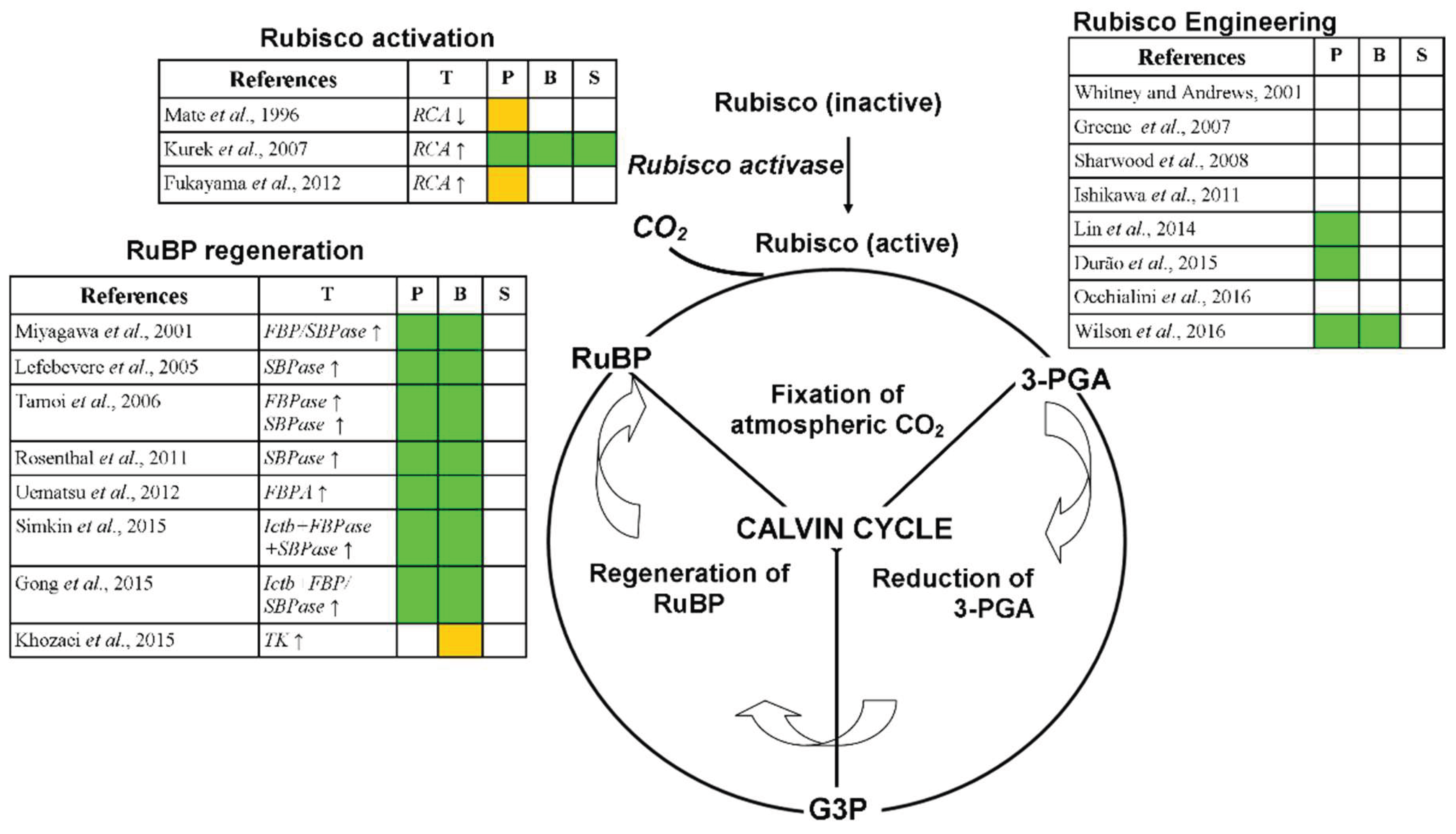
Figure 2.
A schematic diagram showing summary of C4 photosynthetic pathway and various C4 genes utilized for overexpression in transgenic plants. CA: carbonic anhydrase; PEPCase: phosphoenolpyruvate carboxylase; MDH: malate dehydrogenase; NADP-ME: NADP-malic enzyme; PPDK: pyruvate orthophosphate dikinase; PCK: phosphoenolpyruvate carboxykinase; OAA: oxaloacetate; PEP: phosphoenolpyruvate. T, target gene; P, photosynthesis; B, biomass and S, seed or grain yield in transgenic plants. Adjacent to gene name in T column, arrow (↑) represents overexpression of the target gene. Colored box, “” is used to show increase and “” is used to show a decrease in the value of the corresponding parameter in transgenic plants relative to the wild-type (WT) plants. Unfilled boxes “” represents either no report or no change in the values of corresponding parameters between wild-type (WT) and transgenic plants.* Depending upon the type of principal decarboxylating enzyme, C4 plants are characterized into three subtypes viz. NAD-ME, NADP-ME and PCK- type. For illustration, only NADP-ME subtype is shown in the diagram.
” is used to show increase and “” is used to show a decrease in the value of the corresponding parameter in transgenic plants relative to the wild-type (WT) plants. Unfilled boxes “” represents either no report or no change in the values of corresponding parameters between wild-type (WT) and transgenic plants.* Depending upon the type of principal decarboxylating enzyme, C4 plants are characterized into three subtypes viz. NAD-ME, NADP-ME and PCK- type. For illustration, only NADP-ME subtype is shown in the diagram.
Figure 2.
A schematic diagram showing summary of C4 photosynthetic pathway and various C4 genes utilized for overexpression in transgenic plants. CA: carbonic anhydrase; PEPCase: phosphoenolpyruvate carboxylase; MDH: malate dehydrogenase; NADP-ME: NADP-malic enzyme; PPDK: pyruvate orthophosphate dikinase; PCK: phosphoenolpyruvate carboxykinase; OAA: oxaloacetate; PEP: phosphoenolpyruvate. T, target gene; P, photosynthesis; B, biomass and S, seed or grain yield in transgenic plants. Adjacent to gene name in T column, arrow (↑) represents overexpression of the target gene. Colored box, “” is used to show increase and “” is used to show a decrease in the value of the corresponding parameter in transgenic plants relative to the wild-type (WT) plants. Unfilled boxes “” represents either no report or no change in the values of corresponding parameters between wild-type (WT) and transgenic plants.* Depending upon the type of principal decarboxylating enzyme, C4 plants are characterized into three subtypes viz. NAD-ME, NADP-ME and PCK- type. For illustration, only NADP-ME subtype is shown in the diagram.
” is used to show increase and “” is used to show a decrease in the value of the corresponding parameter in transgenic plants relative to the wild-type (WT) plants. Unfilled boxes “” represents either no report or no change in the values of corresponding parameters between wild-type (WT) and transgenic plants.* Depending upon the type of principal decarboxylating enzyme, C4 plants are characterized into three subtypes viz. NAD-ME, NADP-ME and PCK- type. For illustration, only NADP-ME subtype is shown in the diagram.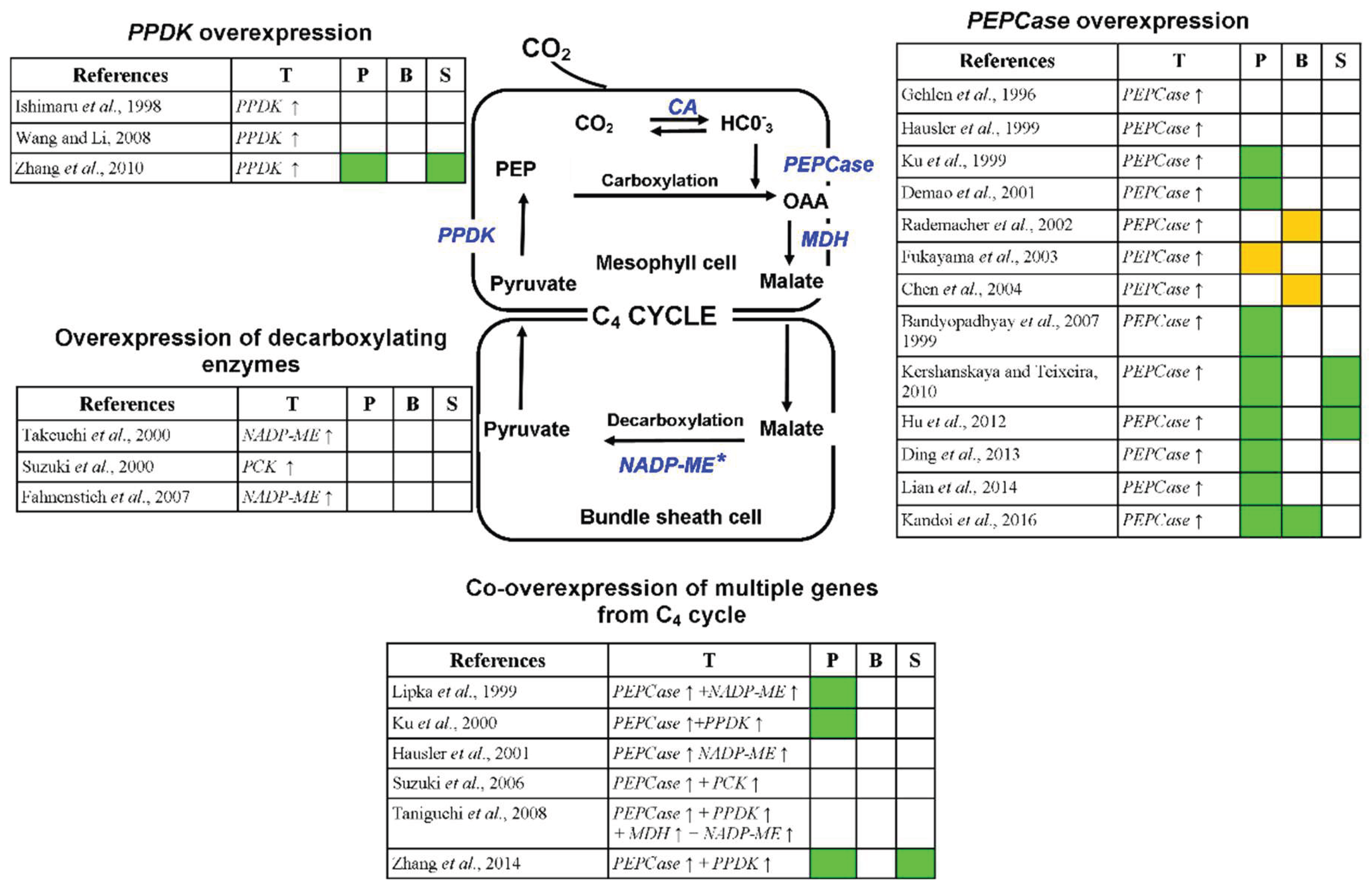
Figure 3.
A schematic diagram showing summary of N metabolic pathway and various genes utilized for engineering NUE in transgenic plants. NRT: nitrate transporter; AMT: ammonium transporter; NR: nitrate reductase; NiR: nitrite reductase; AlaAT: alanine aminotransferase; AspAT: aspartate aminotransferase; GOGAT: glutamine:2-oxoglutarate aminotransferase; GS: glutamine synthetase; AS: asparagine synthetase; Ala: alanine; pyr: pyruvate; 2-OG: 2-oxoglutarate; OAA: oxaloacetate; Asp: aspartate; Glu: glutamate; Gln: glutamine; Asn: aspargine. T, target gene; N, nitrogen use efficiency; B, biomass and S, seed or grain yield in transgenic plants. Adjacent to gene name in T column, arrow (↑) represents overexpression of the target gene. Colored box, “” is used to show increase and “” is used to show decrease in the value of corresponding parameter in transgenic plants relative to the wild-type (WT) plants. Unfilled boxes “” represents either no report or no change in the values of corresponding parameter between wild-type (WT) and transgenic plants.
” is used to show increase and “” is used to show decrease in the value of corresponding parameter in transgenic plants relative to the wild-type (WT) plants. Unfilled boxes “” represents either no report or no change in the values of corresponding parameter between wild-type (WT) and transgenic plants.
Figure 3.
A schematic diagram showing summary of N metabolic pathway and various genes utilized for engineering NUE in transgenic plants. NRT: nitrate transporter; AMT: ammonium transporter; NR: nitrate reductase; NiR: nitrite reductase; AlaAT: alanine aminotransferase; AspAT: aspartate aminotransferase; GOGAT: glutamine:2-oxoglutarate aminotransferase; GS: glutamine synthetase; AS: asparagine synthetase; Ala: alanine; pyr: pyruvate; 2-OG: 2-oxoglutarate; OAA: oxaloacetate; Asp: aspartate; Glu: glutamate; Gln: glutamine; Asn: aspargine. T, target gene; N, nitrogen use efficiency; B, biomass and S, seed or grain yield in transgenic plants. Adjacent to gene name in T column, arrow (↑) represents overexpression of the target gene. Colored box, “” is used to show increase and “” is used to show decrease in the value of corresponding parameter in transgenic plants relative to the wild-type (WT) plants. Unfilled boxes “” represents either no report or no change in the values of corresponding parameter between wild-type (WT) and transgenic plants.
” is used to show increase and “” is used to show decrease in the value of corresponding parameter in transgenic plants relative to the wild-type (WT) plants. Unfilled boxes “” represents either no report or no change in the values of corresponding parameter between wild-type (WT) and transgenic plants.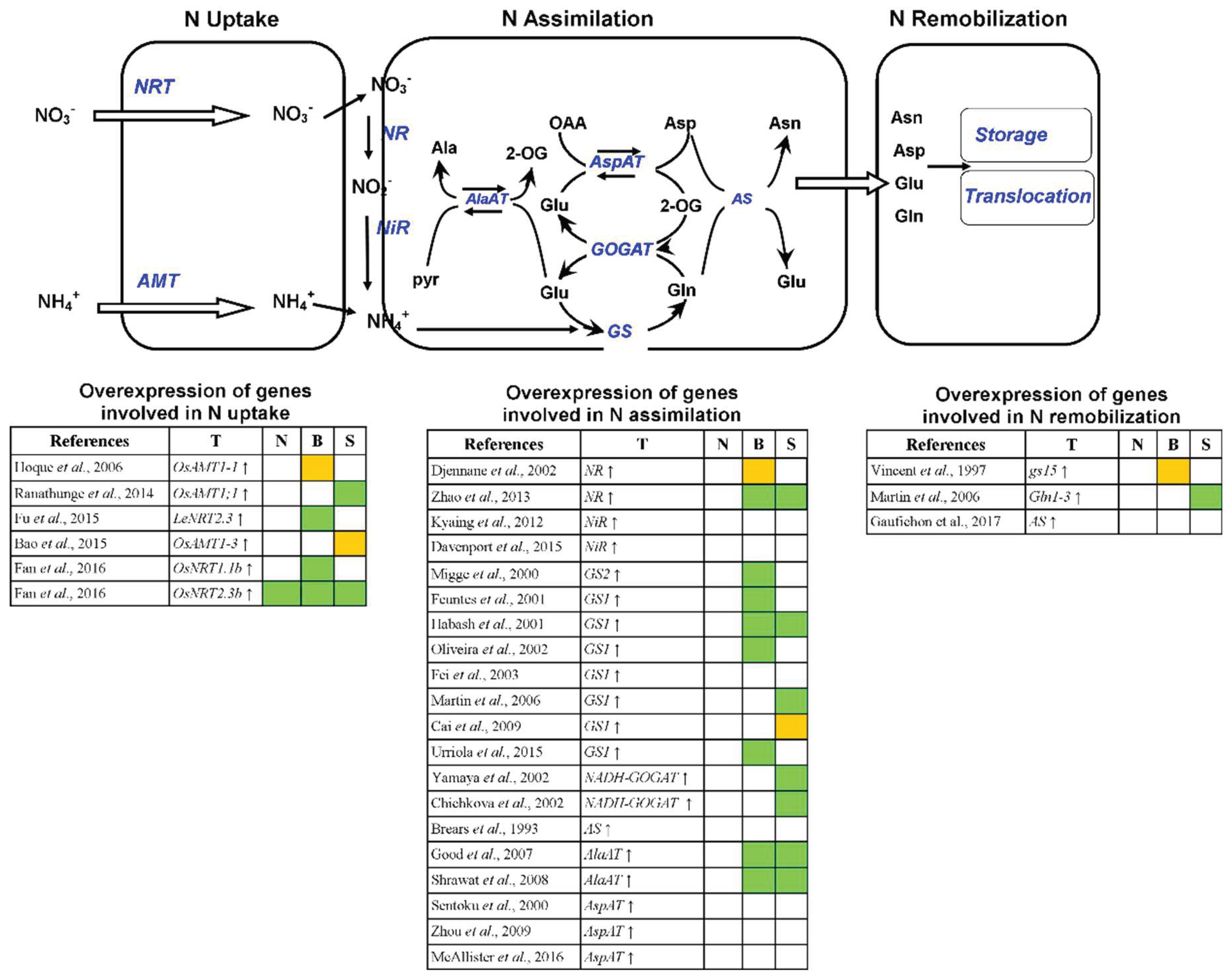
Figure 4.
A schematic diagram showing summary of photorespiration pathway and various genes utilized for engineering photorespiration in transgenic plants. PGP: phosphogycolate phosphatase; GLO: glycolate oxidase; SGAT: serine/glyoxylate aminotransferase; GDC/SHMT: glycine decarboxylase/serine hydroxymethyl transferase; HPR; hydroxypyruvate reductase; GK: glycerate kinase; Rubisco: ribulose-1,5-bisphosphate; GS: glutamine synthetase; GOGAT: glutamine:2-oxoglutarate aminotransferase; 2-PG; 2-phosphoglycolate; GL: glycolate; GX: glyoxylate; GLY: glycine; SER: serine; HP: hydroxypyruvate; GC: glycerate; Mal: malate; Pyr: pyruvate. T, target gene; P, photosynthesis; B, biomass and S, seed or grain yield in transgenic plants. Adjacent to gene name in T column, arrow (↑) represents overexpression of the target gene. Colored box, “” is used to show increase and “” is used to show decrease in the value of corresponding parameter in transgenic plants relative to the wild-type (WT) plants. Unfilled boxes “” are used in places where there is no report or where no change in the values of corresponding parameters was observed between wild-type (WT) and transgenic plants.
” is used to show increase and “” is used to show decrease in the value of corresponding parameter in transgenic plants relative to the wild-type (WT) plants. Unfilled boxes “” are used in places where there is no report or where no change in the values of corresponding parameters was observed between wild-type (WT) and transgenic plants.
Figure 4.
A schematic diagram showing summary of photorespiration pathway and various genes utilized for engineering photorespiration in transgenic plants. PGP: phosphogycolate phosphatase; GLO: glycolate oxidase; SGAT: serine/glyoxylate aminotransferase; GDC/SHMT: glycine decarboxylase/serine hydroxymethyl transferase; HPR; hydroxypyruvate reductase; GK: glycerate kinase; Rubisco: ribulose-1,5-bisphosphate; GS: glutamine synthetase; GOGAT: glutamine:2-oxoglutarate aminotransferase; 2-PG; 2-phosphoglycolate; GL: glycolate; GX: glyoxylate; GLY: glycine; SER: serine; HP: hydroxypyruvate; GC: glycerate; Mal: malate; Pyr: pyruvate. T, target gene; P, photosynthesis; B, biomass and S, seed or grain yield in transgenic plants. Adjacent to gene name in T column, arrow (↑) represents overexpression of the target gene. Colored box, “” is used to show increase and “” is used to show decrease in the value of corresponding parameter in transgenic plants relative to the wild-type (WT) plants. Unfilled boxes “” are used in places where there is no report or where no change in the values of corresponding parameters was observed between wild-type (WT) and transgenic plants.
” is used to show increase and “” is used to show decrease in the value of corresponding parameter in transgenic plants relative to the wild-type (WT) plants. Unfilled boxes “” are used in places where there is no report or where no change in the values of corresponding parameters was observed between wild-type (WT) and transgenic plants.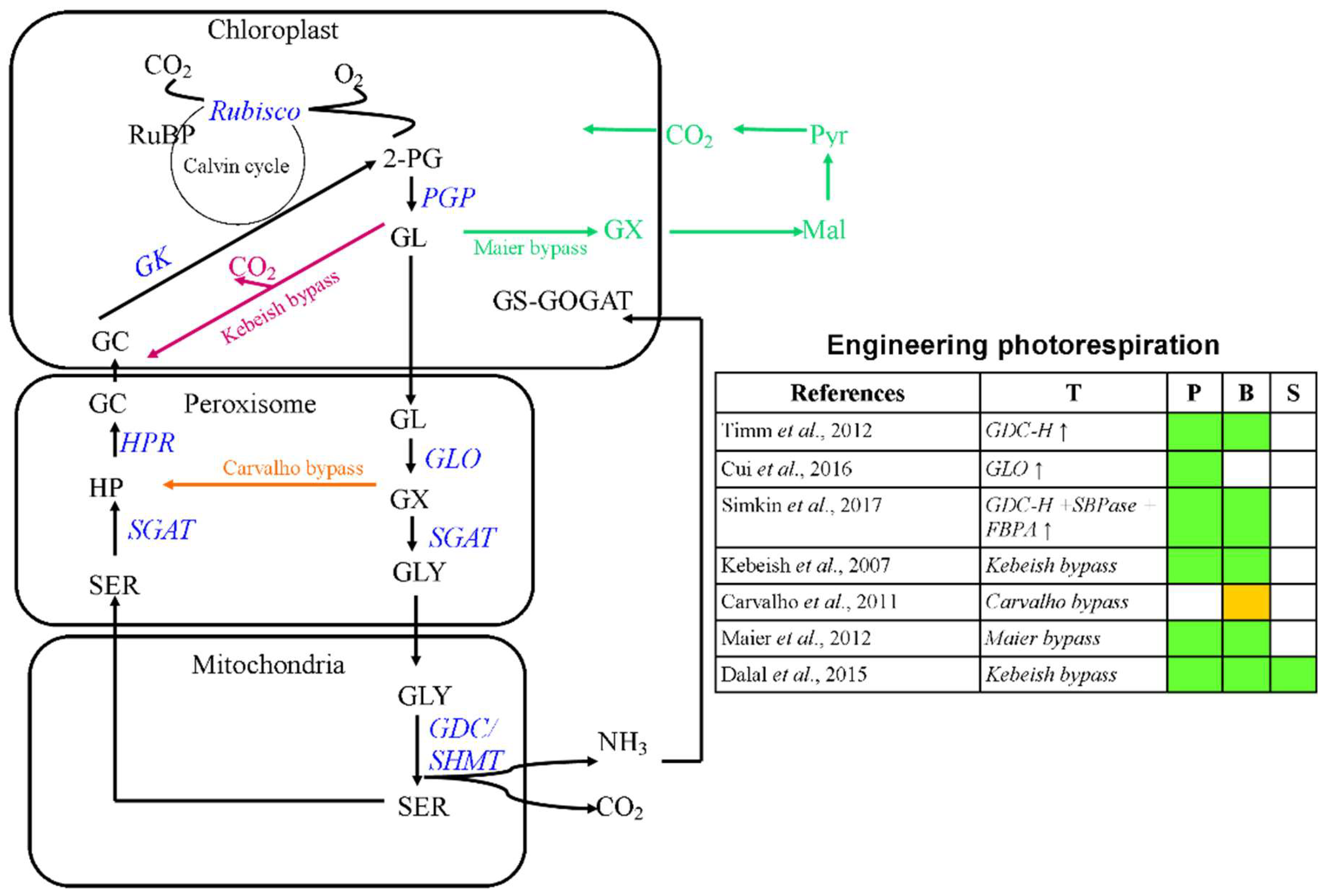
Disclaimer/Publisher’s Note: The statements, opinions and data contained in all publications are solely those of the individual author(s) and contributor(s) and not of MDPI and/or the editor(s). MDPI and/or the editor(s) disclaim responsibility for any injury to people or property resulting from any ideas, methods, instructions or products referred to in the content. |
© 2026 by the authors. Licensee MDPI, Basel, Switzerland. This article is an open access article distributed under the terms and conditions of the Creative Commons Attribution (CC BY) license (http://creativecommons.org/licenses/by/4.0/).
Copyright: This open access article is published under a Creative Commons CC BY 4.0 license, which permit the free download, distribution, and reuse, provided that the author and preprint are cited in any reuse.