

Submitted:
29 September 2026
Posted:
01 October 2026
You are already at the latest version
Abstract
Corrosion of steel reinforcement is still the main reason reinforced concrete structures fail before the end of their planned service life. Every early repair costs money, and it also adds new cement, steel, and emissions. This review examines protection methods that can extend service life while lowering environmental impact. It covers green and nano-enabled corrosion inhibitors, hydrophobic and polymer-modified surface treatments, autogenous, bacterial, and capsule-based self-healing systems, nanomaterials, and stimulus-responsive smart coatings. It also covers supplementary cementitious materials, limestone calcined clay cement, and alkali-activated binders as the first barrier against chlorides and carbon dioxide. The review then links these materials to durability-based design, probabilistic service-life models, life cycle assessment, machine learning, and sensor-based monitoring. Three findings stand out. First, most green inhibitors and smart coatings have been tested in pore solution or in short accelerated tests, and long-term data in real concrete are scarce. Second, a gain in chloride resistance only counts as a sustainability gain when it is expressed per year of service life, including maintenance. Third, data-driven models predict chloride transport well inside their training data, but few of them respect physical limits or report uncertainty. We propose a design loop that connects binder choice, added protection, probabilistic service-life prediction, and life cycle metrics, and that updates itself with monitoring data. The review closes with a ranked list of research gaps and practical steps for researchers, designers, and asset owners.
Keywords:
reinforced concrete
; chloride-induced corrosion
; carbonation
; green corrosion inhibitors
; surface treatment
; self-healing concrete
; smart coatings
; supplementary cementitious materials
; service life
; life cycle assessment
; machine learning
1. Introduction
Reinforced concrete carries most of the world’s bridges, ports, tunnels, and buildings. Its long life depends on a thin passive film that forms on the steel in the highly alkaline pore solution of concrete [1,2]. When chloride ions reach the steel in a high enough amount, or when carbonation lowers the pH, this film breaks down and corrosion starts [3,4,5]. The rust takes up more space than the steel it replaces. It cracks the cover, weakens the bond between steel and concrete, and reduces load capacity in bending and shear [6,7,8].
The cost of corrosion is not only financial. Each early repair brings new cement, new steel, traffic delays, and more emissions. Angst has argued that steel corrosion may be the weakest link for low-carbon concrete, because lowering the clinker content changes the alkaline buffer that protects the steel [9]. This creates a real tension. Designers want less clinker to cut carbon, but they also need the structure to last. A mix with a slightly higher initial footprint can still be the greener option if it doubles the service life [10,11]. We think this point is often missed when new materials are called “sustainable” based on their mix design alone.
Protection methods have moved well past calcium nitrite and epoxy-coated bars. Researchers now test plant extracts as inhibitors, silane and lithium-based surface treatments, bacteria that seal cracks, nanoparticles that refine the pore structure, and coatings that release inhibitors only when corrosion begins [12,13,14,15,16]. Design practice has also changed. Codes and researchers are moving from fixed cover and water-to-binder rules toward performance-based and probabilistic service-life design [11,17,18]. Machine learning now appears in most durability journals, often to predict chloride diffusion from mix proportions [19,20,21].
Several good reviews already exist. They cover green inhibitors [12,22,23], concrete surface treatments [24], self-healing concrete [25,26], corrosion assessment and control [27], and durable concrete in chloride environments [28]. Most of them, however, look at one family of methods at a time. What is still missing, in our view, is a review that puts the protective measure, the service-life model, and the life cycle metric in the same frame. A green inhibitor that works for five years in the field is not green if the structure needs major repair at year twenty.
This review tries to close that gap. It has five aims: (i) explain the corrosion processes that each protection method targets; (ii) assess the evidence for eco-friendly inhibitors, surface treatments, self-healing systems, nanomaterials, and smart coatings; (iii) discuss supplementary cementitious materials (SCMs) and low-carbon binders as the first line of defense; (iv) connect these materials to durability-based design, life cycle assessment (LCA), predictive modeling, and multi-scale evaluation; and (v) identify research gaps. Figure 1 shows how the review is organized.
2. Review Approach
This is a critical narrative review. We identified sources through database and web searches and through backward citation tracking of recent reviews. Search terms combined “steel corrosion”, “reinforced concrete”, “chloride”, “carbonation”, “green inhibitor”, “surface treatment”, “self-healing”, “nanomaterial”, “smart coating”, “supplementary cementitious material”, “service life”, “life cycle assessment”, and “machine learning”. We kept peer-reviewed journal papers, RILEM state-of-the-art reports, and standard reference books. We gave priority to studies in which steel was embedded in mortar or concrete. We included a few studies in acid or neutral saline media only where they explain a mechanism that also matters in concrete, and we say so where we use them. The final set has 100 sources published between 1993 and 2026.
We read each study with three questions in mind. Where does the method act: on transport, on the chemistry at the steel surface, on the steel itself, or on cracks? How long was the test, and was it done in solution, mortar, concrete, or a real structure? Did the authors report anything that can feed a service-life or life cycle model, such as a diffusion coefficient, a chloride threshold, or a corrosion rate? These questions shape the tables and the critical comments in each section.
3. Corrosion of Steel in Concrete: What Protection Must Address
3.1. Passivity and the Steel–Concrete Interface
Fresh concrete has a pore solution pH of roughly 12.5 to 13.5. At this pH, carbon steel forms a thin, protective oxide film [1]. The film is not perfect, and the zone around the bar is not uniform. Mill scale, rust from storage, air voids, and bleed water under horizontal bars all change the local conditions [29,30]. RILEM TC 262-SCI reviewed how these local features affect the start of chloride-induced corrosion. The committee showed that several of these effects are still unclear and that test results often conflict [31]. Steel surface condition alone can shift the onset of corrosion, as Boubitsas and Tang found when they compared bars with different surface states [32]. For protection design, the lesson is simple. Any method that improves or stabilizes the interface, such as a good inhibitor or a dense, well-cured cover, has value beyond what bulk tests show.
3.2. Chloride-Induced Corrosion
Chlorides come from seawater, de-icing salts, or contaminated mix materials. They move into concrete by diffusion, capillary suction, and permeation, and wet–dry cycles speed up the process near the surface [4,28]. Part of the chloride binds to the cement paste. Aluminate phases can form Friedel’s salt, and calcium silicate hydrate adsorbs chloride on its surface. Only the free chloride drives corrosion, so binding lowers the risk [33,34].
Corrosion starts when the chloride content at the steel passes a critical value, often called the chloride threshold. This value is not a material constant. A widely cited review found a very wide spread of reported thresholds, caused by different test methods, steel surfaces, binders, and exposure conditions [3]. Researchers keep proposing better ways to measure it. Examples include potential monitoring during slow chloride uptake in slag concretes [35], a short-term test for systems with corrosion-inhibiting admixtures [36], and regression models that link the threshold to the water-to-binder ratio and to the fly ash and slag contents [37,38]. We see the threshold as the single largest source of uncertainty in chloride service-life models, and it deserves more attention than it gets in green-material papers.
Exposure zone matters as much as the material. In the tidal and splash zones of marine structures, repeated wetting and drying moves chloride inward by capillary suction and then leaves it behind as the water evaporates. This creates a surface “convection zone” where Fick’s law does not hold, and the depth of this zone grows when load-induced microcracks are present [28]. Temperature and relative humidity also change the rate of transport, so the same concrete can have very different service lives in a hot, humid coast and in a cool, dry inland site [39]. For protection design, this means that surface treatments and self-healing agents are most useful exactly where the convection zone is deepest, while SCMs and low water-to-binder ratios govern the slower diffusion deeper in the cover [4,28].
3.3. Carbonation-Induced Corrosion
Carbon dioxide from the air reacts with calcium hydroxide and other hydrates. This lowers the pH near the steel to about 9, and the passive film is lost over a wide area [1]. The corrosion rate then depends mostly on moisture and oxygen. Sánchez Montero and co-workers followed carbonation-induced corrosion in real elements. They found that the average corrosion rate in elements with unacceptable section loss was about eight times higher than in cracked elements without section loss [40]. This means that the propagation phase is not steady, and a single corrosion rate in a model can mislead.
Chloride and carbonation often act together, for example in coastal cities or in car parks. Carbonation can release bound chloride and raise the free chloride at the steel [5,28]. Jiang et al. compared macrocell corrosion under carbonation, admixed chloride, and chloride penetration. At the same anodic potential drop, the macrocell current was higher for chloride-induced corrosion than for carbonation. Concretes with slag and fly ash were less affected by chloride contamination than plain Portland cement concrete, most likely because they bind more chloride [41].
3.4. Propagation, Cracking, and Structural Effects
Once corrosion starts, the rate depends on concrete resistivity, moisture, oxygen supply, temperature, and the ratio of anode to cathode area. Otieno et al. reviewed corrosion-rate models and showed that many are hard to transfer between laboratory and field conditions [42]. Cracks make things worse. They act as fast paths for water and chloride, and numerical models built from tests on cracked and coated concrete show strong local attack at the crack [43,44]. At the member level, corrosion reduces flexural capacity [6,7] and shear capacity when stirrups corrode [8]. Fibers can change both corrosion resistance and bond behavior [45].
3.5. What This Means for Protection
Service life is usually split into an initiation phase and a propagation phase (Figure 2) [1,17]. Most sustainable strategies try to lengthen initiation. They slow chloride or carbon dioxide transport, raise the threshold, or seal cracks. A smaller group works during propagation. These include migrating inhibitors, smart coatings that respond to a pH or potential change, and repair guided by monitoring. Table 1 summarizes where each family of methods acts and what limits it.
4. Corrosion Inhibitors
4.1. Conventional Inorganic and Organic Inhibitors
Corrosion inhibitors are chemicals that slow corrosion when present at a small dose. In concrete, they are either mixed into fresh concrete or applied to the surface of existing structures so that they migrate toward the steel [27,49]. They are grouped by the reaction they block: anodic, cathodic, or mixed. Calcium nitrite is the classic anodic inhibitor and the usual benchmark. It helps oxidize ferrous ions and repair the passive film. Its main drawbacks are toxicity concerns and the need to keep a high nitrite-to-chloride ratio. At too low a dose, an anodic inhibitor can make local attack worse [12,28].
Organic inhibitors work mostly by adsorbing on the steel and forming a film that blocks charge transfer or water access. Ormellese et al. screened 80 organic compounds in synthetic pore solution. They then carried the nine best substances, mainly amines, aminoalcohols, carboxylates, and amino acids, into long-term tests in concrete [50]. The same group later used atomistic simulations to study how a triethylenetetramine-based inhibitor film sits on the passive layer and competes with chloride [58]. This kind of molecular work is useful because it explains why some molecules survive in pore solution and others do not.
Migrating corrosion inhibitors are attractive for existing structures because they need no demolition. Their weak point is proof of arrival. Several reviews point out that it is hard to confirm how much inhibitor reaches the steel and how long it stays there [22,49]. Test methods matter here as well. Karuppanasamy and Pillai showed that some accelerated chloride tests are not suitable for systems with anion-containing inhibitors, and they proposed a modified short-term threshold test [36].
4.2. Green Inhibitors from Plants and Wastes
Green inhibitors are made from plant extracts, food waste, or other natural sources. Their molecules usually contain nitrogen, oxygen, sulfur, or phosphorus, along with aromatic rings or double bonds. These features let them adsorb on the steel and form a protective layer [12,23]. Table 2 lists studies that tested such extracts with steel in concrete or in conditions close to it.
The results look promising. Bambusa arundinacea leaf extract reduced corrosion of steel in concrete [59]. Olive leaf extract gave protection in concrete contaminated with seawater [62]. Maize gluten meal extract was studied with both electrochemical tests and theoretical calculations, which helped explain how its molecules bind to steel [63]. Neem (Azadirachta indica) leaf extract was compared with three commercial inorganic inhibitors under a chloride environment, and it did not change the fresh or hardened properties of the concrete in that study [64]. Other work combined plant extracts with silver nanoparticles [60] or used eco-addition inhibitors in reinforced concrete [61].
We still urge caution. Casanova et al. compared green inhibitors with nitrite and separated accelerated tests from long-term tests. They found that the evidence from long-term tests is much thinner [12]. Many studies with very high inhibition efficiencies were done in acid solution, such as fenugreek seed extract for steel in phosphoric acid [65]. Those numbers do not transfer to pH 13. Natural extracts also vary with harvest, region, and extraction method. Some contain sugars that may delay cement setting. Few papers report chemical stability of the extract in pore solution over years. Zomorodian and Behnood proposed selection criteria that weigh efficiency, toxicity, cost, and compatibility with concrete [22]. We support that approach and suggest adding one more criterion: the inhibitor’s effect on the chloride threshold measured in mortar or concrete, not only its efficiency in solution.
4.3. Encapsulated and Nano-Enabled Inhibitors
A free inhibitor can leach out, react with cement phases, or be used up before corrosion starts. Encapsulation tries to fix this. The inhibitor is loaded into micro- or nanocontainers, such as layered double hydroxides, halloysite tubes, or polymer capsules, and it is released when a trigger appears, such as a drop in pH or the arrival of chloride [16,28,54]. Koleva showed that tailored polymeric nanomaterials can change the corrosion products and the protective layer on steel in cement-based systems, which points to self-healing of the steel surface itself [67]. This is an exciting direction. However, almost all data come from laboratory specimens, and dosage, cost, and effects on hydration need more study before field use.
4.4. Testing, Dosage, and Interaction with Binders
The way an inhibitor is tested decides what its result means. Tests in synthetic pore solution are fast and good for screening, but they leave out the cement paste, the steel–concrete interface, and the slow transport of chloride through the cover [12,50]. Tests in mortar or concrete are slower but closer to practice. Accelerated tests that drive chloride with an electric field can distort the result for inhibitors that carry an electric charge, which is why modified threshold tests have been proposed [36]. We recommend that any new inhibitor be reported with at least three results: its efficiency in pore solution, its effect on the chloride threshold in mortar or concrete, and its effect on setting time and 28-day strength.
Inhibitors and SCMs are often used together, and they can help each other. The SCM slows chloride ingress, so the inhibitor is used up more slowly, and the inhibitor adds a chemical barrier where the SCM is weak, for example under carbonation. There can also be conflict. Alumina-rich SCMs such as metakaolin may adsorb part of an organic inhibitor and reduce the amount that reaches the steel [28]. Very few studies test inhibitor type and binder type in a full factorial design. Until they do, designers cannot assume that the benefits add up [22,49].
5. Surface Treatments and Coatings
5.1. Concrete Surface Treatments
Surface treatments protect the cover concrete, which is the zone that decides how fast chlorides and carbon dioxide reach the steel. They fall into three groups: film-forming coatings, pore blockers, and hydrophobic impregnations such as silanes and siloxanes [24,68]. External coatings designed for both concrete and steel protection were studied as early as the 1990s [69].
Silane-based treatments are the best documented. Coppola et al. studied a silane-based surface-applied corrosion inhibitor. It cut the non-steady-state migration coefficient by 30% to 60% in accelerated tests. In natural diffusion tests, the apparent diffusion coefficient fell by about 75%. Resistivity data showed that the main mechanism was water repellence [13]. In a marine setting, surface treatments changed both the chloride diffusion coefficient and the capillary absorption of the cover [70]. Silane can also be added to the mix as a hydrophobic admixture, and this also affects steel corrosion [71]. Newer lithium-based and nano-modified waterproof coatings on mortar have shown resistance to salt attack [14]. Polymer-modified cementitious coatings have been followed for years in chloride exposure, which gives rare long-term evidence [72].
Hydrophobic treatments have a known weak spot: cracks. Dai et al. showed that the benefit of water-repellent impregnation depends strongly on whether the concrete is cracked [51]. Treatments also age and need to be reapplied. In our view, a surface treatment should be treated in life cycle studies as a maintenance cycle, with its own reapplication interval and its own emissions, not as a one-time addition.
5.2. Coatings on the Steel and Alternative Reinforcement
Steel-level protection includes changes to steel chemistry and coatings on the bar [73]. Epoxy-coated bars work well when the coating is intact, but damage during transport and placing can create local weak spots. Bio-based coatings are being explored. For example, chitosan–gum Arabic nanocomposite coatings on mild steel in saline media raised the water contact angle from about 51° to about 101° and gave good barrier protection [66]. That test was not in concrete, so it shows promise rather than proof. Non-metallic reinforcement, such as glass, basalt, or carbon fiber-reinforced polymer bars, removes electrochemical corrosion altogether but brings new questions on bond, brittleness, and long-term resin degradation [28]. Fibers in the concrete also affect cracking and bond under corrosion [45].
5.3. Electrochemical Protection and Repair
Electrochemical methods act on the steel directly. Cathodic protection shifts the steel potential so that it no longer corrodes, either with an impressed current or with sacrificial anodes. Electrochemical chloride extraction draws chloride ions out of the cover with a temporary current, and realkalization restores a high pH in carbonated concrete [1,27]. These methods are well proven in the field and can stop active corrosion without removing sound concrete, which saves material and waste. Their sustainability depends on energy use over the years of operation, on the life of the anodes, and on side effects such as changes in pore structure near the steel. Polder et al. pointed out that such non-traditional methods often face non-technical barriers, including owner habits and procurement rules, as much as technical ones [74]. In a life cycle view, a cathodic protection system is a maintenance stream with its own energy and replacement schedule, and it should be modeled that way in Equation (3).
6. Self-Healing Systems
6.1. Why Cracks Matter for Corrosion
Concrete cracks under load, shrinkage, and temperature change. Cracks give chloride, water, and oxygen a short path to the steel [43,51]. Self-healing concrete aims to close these paths without human work. Van Tittelboom and De Belie grouped the approaches into autogenous healing, which relies on continued hydration and calcium carbonate precipitation, and autonomous healing, which uses added agents such as bacteria, capsules, or vascular networks [25]. A later review by De Belie et al. described how self-healing fits into damage management of structures [26].
6.2. Bacterial and Biogenic Healing
Jonkers et al. used alkali-resistant, spore-forming bacteria as a healing agent. The bacteria turn a calcium source into calcium carbonate that fills cracks [15]. Achal et al. showed that biogenic treatment improved durability and repaired cracks in concrete [75]. For corrosion, the most useful evidence comes from transport tests. Ling and Qian found that healed cracks in bacterial concrete reduced chloride transmission during electromigration [52]. Bacteria-based healing has also been combined with steel fibers [76].
6.3. Capsule-Based and Nanomaterial-Assisted Healing
Capsule systems release polymers or mineral agents when a crack breaks the capsule. Nanomaterials can support both healing and densification, and their sustainability depends on dosage, energy use in production, and service-life gain [53]. Koleva’s work links self-healing of the matrix with self-healing of the steel surface layer [67].
6.4. Critical View
Most self-healing studies measure crack closure, water flow, or strength recovery. Fewer measure chloride profiles at the steel depth or corrosion current. Visual closure at the surface does not prove that the crack is sealed at the bar. We recommend that future work report at least one transport measure at the steel depth and one electrochemical measure, such as corrosion potential or polarization resistance, on healed and unhealed specimens. Without this, we cannot put self-healing into a service-life model.
7. Nanomaterials
Nano-silica, nano-titania, nano-clay, carbon nanotubes, and graphene-based materials have been added to cement-based materials to refine pores, act as nucleation sites for hydration products, and block ion transport [28,53]. Nano-silica and carbon nanotubes have also been used to improve seawater sea-sand concrete, which is important for island construction where fresh water and river sand are scarce [28]. Nanoparticles can also serve as inhibitor carriers or as active agents, as in the Elaeis guineensis and silver nanoparticle system [60].
Three problems slow adoption. First, nanoparticles clump together, so mixing energy and dispersants matter as much as dosage. Second, results vary a lot between studies because of differences in particle type, surface treatment, and test method. Third, the production of some nanomaterials is energy-intensive, and their health and environmental effects are not fully known. A nanomaterial that cuts chloride diffusion by a large fraction may still be a poor choice if its production footprint cancels the service-life gain. This is exactly why we argue for life cycle evaluation per year of service life (Section 11).
8. Smart Coatings
Smart or active coatings do more than block the environment. They sense a change and respond. The main triggers are pH, redox potential, chloride, and mechanical damage [77,78]. Shchukin and Möhwald described coatings with nanoreservoirs that release inhibitors when corrosion begins [54]. Vimalanandan et al. built a redox-responsive coating that releases its inhibitor when the potential at a defect shifts, which gives protection only where and when it is needed [55]. Liu et al. reviewed self-healing coatings based on micro- and nanocarriers and discussed how loading capacity and release rate can be controlled [16].
Most smart coating research targets steel in air or water, not steel inside concrete. Transfer to concrete brings new conditions: very high pH, calcium-rich pore solution, abrasion during casting, and the need for good bond. We see two realistic paths. One is smart coatings on the bar with carriers stable at pH 13. The other is cementitious or hybrid surface coatings that carry encapsulated inhibitors near the concrete surface. Both need long-term tests in real concrete before they can enter design.
9. Supplementary Cementitious Materials and Low-Carbon Binders
9.1. How SCMs Affect Corrosion
SCMs such as fly ash, ground granulated blast-furnace slag, silica fume, metakaolin, and calcined clay replace part of the clinker. They lower the carbon footprint and, in most cases, improve resistance to chloride [46,79,80]. They work in three ways. They refine the pore structure and so lower the diffusion coefficient. Alumina-rich SCMs bind more chloride. They raise the electrical resistivity of concrete, which slows corrosion once it starts [46,81]. Abd El-Fattah et al. confirmed that the chloride binding capacity of concrete changes with the type of cementitious system [34].
The same reactions have a cost. Pozzolanic reactions consume calcium hydroxide, which lowers the alkaline reserve and can speed up carbonation [9,46]. So an SCM that is excellent in a marine splash zone may be weak in a dry, carbonation-dominated setting. Huang et al. summarized practical replacement ranges of about 5% to 15% for silica fume, 5% to 10% for metakaolin, and 20% to 30% for fly ash, while noting that no single SCM is best for all exposures [28]. Table 3 compares the main binder options.
9.2. Limestone Calcined Clay Cement
Limestone calcined clay cement (LC3) combines clinker, calcined clay, and limestone. It can cut clinker content by about half while giving similar strength [47,83]. Its dense pore structure and high alumina content give strong resistance to chloride. Pillai et al. combined service-life estimates and LCA for LC3 concrete. They reported that LC3 mixes can be designed to reach annual emissions of about 1.6 to 5 kg CO2-eq per cubic meter per year of service life, similar to fly ash concrete and much lower than plain Portland cement concrete in their case [10]. The carbonation resistance of LC3 is lower, so cover and curing matter more.
9.3. Alkali-Activated Binders and Emerging SCMs
Alkali-activated materials and geopolymers use industrial by-products with little or no clinker [48]. Adding slag to fly ash-based geopolymer concrete improved its durability indicators in several studies [84,85], and sea sand has been tested in fly ash geopolymer mortars [86]. The corrosion of steel in these binders is less understood than in Portland systems. Pore solution chemistry, sulfide content in slag systems, and carbonation behavior all differ. Standards and long-term field data are also limited. Snellings et al. reviewed new SCM sources, such as calcined clays of lower grade and recycled concrete fines, which will matter as fly ash and slag supplies shrink [82]. Aggressive water exposures, including acid and sulfate, add further limits for all these binders [87].
9.4. Optimizing the Binder for Performance and Footprint
Choosing a binder is now a multi-objective problem. Hafez et al. built a data-driven tool that weighs functional, economic, and environmental properties of blended cement concrete [88]. Moro et al. proposed a performance-based concept that selects sustainable concretes for chloride exposure by checking both the required service life and the global warming potential [11]. Machine learning with Bayesian tuning has been used to predict the strength of eco-friendly concrete with slag and recycled aggregate, which helps screen mixes quickly [89]. We think this kind of joint screening should become routine.
9.5. Seawater, Sea Sand, and Local Materials
In many coastal and island regions, fresh water and river sand are scarce. Using seawater and sea sand saves these resources, but it adds chloride to the concrete from day one. With ordinary steel, this is a serious risk, because the initial chloride content C0 in Equation (1) is no longer zero. Two routes are being explored. One is to pair seawater sea-sand concrete with non-metallic reinforcement, which removes the steel corrosion problem but raises questions about bond and long-term resin durability [28]. The other is to use binders that bind more chloride, such as slag-rich systems, or alkali-activated systems in which sea sand has been tested [34,86]. For hot and arid coastal regions, such as the Arabian Gulf, where high temperature, high salinity, and wet–dry cycling occur together, we see this as one of the most practical research areas in the field.
10. Durability-Based Design and Service-Life Modeling
10.1. Chloride Ingress Models
Most service-life models for chloride exposure use Fick’s second law. For a semi-infinite medium with a constant surface chloride content, the chloride content C at depth x and time t is:
where C0 is the initial chloride content, Cs is the surface chloride content, and D is the apparent diffusion coefficient. Corrosion starts when C at the steel depth reaches the threshold Ccrit. Setting C0 = 0 and solving for the initiation time ti gives:
C(x,t) = C0 + (Cs − C0) · [1 − erf( x / (2√(D·t)) )]
ti = x² / (4 · D · z²), with z = erf⁻¹(1 − Ccrit/Cs)
Khan et al. reviewed these solutions and noted that the Fick-based solution tends to be conservative compared with more detailed models [18]. The water-to-cement ratio changes several inputs at once, including D, Ccrit, tensile strength, and corrosion rate [90]. Temperature and relative humidity also change chloride transport and so the predicted service life [39]. Load-induced damage matters too; bending load changes the diffusion coefficient of steel fiber-reinforced concrete [91].
10.2. Illustrative Calculation
To show how protection methods enter Equation (2), we ran a simple calculation. The values are illustrative, not measured data. We assumed Cs = 3.0% and Ccrit = 0.4% by binder mass, C0 = 0, a cover of 50 mm, and a constant D. Step 1: Ccrit/Cs = 0.4/3.0 = 0.133, so erf(z) = 0.867 and z = 1.061. Step 2: 4z² = 4 × 1.127 = 4.51. Step 3: for D = 2.0 × 10⁻¹² m²/s, ti = (0.05)² / (4.51 × 2.0 × 10⁻¹²) = 2.77 × 10⁸ s, or about 8.8 years. Table 4 and Figure 3 show the same calculation for a binder with a lower D and for that binder with a hydrophobic surface treatment, which we modeled as halving the effective D. This is a conservative choice next to the roughly 75% reduction in apparent diffusion coefficient reported by Coppola et al. [13].
The calculation shows why initiation-phase measures are so powerful. Initiation time scales with the square of the cover and inversely with D. Cutting D by a factor of four through the binder choice raises ti by a factor of four. Adding a treatment that halves D again doubles it. Real structures are less tidy. D falls with age, Cs builds up over time, and Ccrit is uncertain. Still, the example makes clear that the protection method and the design model are not separate topics.
10.3. Probabilistic and Performance-Based Design
Deterministic calculations hide uncertainty. Probabilistic design treats D, Cs, Ccrit, and cover as random variables and reports the probability that corrosion has started by a given time. Leng et al. added the maximum phenomenon, meaning that the first corrosion point along a long member governs, to a time-variant probabilistic model for marine structures [92]. Angst critically examined how well current models predict the time to corrosion initiation and argued that many of their assumptions, especially a fixed Ccrit, are weak [17]. Angst and co-authors listed present and future durability challenges, including the move toward performance-based rules [93]. Earlier research groups built linked models of corrosion that span transport, electrochemistry, and structural response [94].
For the propagation phase, models need a corrosion rate. Otieno et al. showed that rate models are still weak and that field rates vary widely [42]. The work of Sánchez Montero et al. on changing corrosion rate during carbonation-induced propagation shows that a constant rate can mislead [40]. We therefore suggest that designers treat the propagation phase as a reserve, not as a planned part of the service life, unless monitoring is in place.
11. Life Cycle Assessment and Life-Cycle Thinking
LCA of concrete often uses 1 m³ of concrete as the functional unit. This is simple, but it ignores service life. A better unit for durability studies is the emission per year of service life, which we can write as:
where GWP_initial is the global warming potential of the materials and construction, GWP_maintenance,i is the footprint of each repair or reapplication, and t_SL is the service life. Pillai et al. used this idea for LC3 concrete and showed that ranking changes once service life is included [10]. Moro et al. applied a similar performance-based logic to chloride exposure [11]. Huang et al. reported that life cycle cost analyses from selected case studies suggest fiber-reinforced polymer bars in seawater sea-sand concrete may cut total life cycle cost by about 30% over 100 years. They also stressed that this depends on maintenance frequency, exposure, discount rate, and material prices [28].
GWP_annual = [ GWP_initial + Σ GWP_maintenance,i ] / t_SL
Three points need care. First, maintenance scenarios must be realistic, including reapplication of surface treatments and inhibitors. Second, the service life in the denominator should come from a probabilistic model, and its uncertainty should flow into the LCA. Third, non-traditional assessment and maintenance methods can extend the life of aging structures, and they should be part of the comparison [74]. Angst has also warned that low-carbon binders only help if they do not shorten service life through faster corrosion [9]. We fully agree. A per-year metric with uncertainty bounds is, in our view, the fairest way to compare a green inhibitor, a surface treatment, an SCM, and a non-metallic bar on the same scale.
One more issue affects SCM-based designs. Fly ash and slag are by-products of other industries, and LCA practitioners disagree on how much of the upstream impact should be allocated to them. The choice can change the ranking of blended concretes. We suggest that durability studies report results with and without economic allocation, so that readers can see how sensitive the conclusion is. As supplies of fly ash and slag fall, emerging SCMs such as calcined clays will make this issue less important, but it has not gone away yet [82,88].
12. Predictive Modeling, Monitoring, and Multi-Scale Evaluation
12.1. Machine Learning for Chloride Transport and Corrosion
Machine learning (ML) is now widely used to predict chloride diffusion and corrosion from mix design and exposure data. Table 5 summarizes representative studies. Al Fuhaid and Alanazi compared adaptive neuro-fuzzy inference, artificial neural networks, support vector machines, and extreme learning machines for concrete with SCMs. The support vector model performed best, with R² of 0.955 in training and 0.951 in testing [19]. Hosseinzadeh et al. cleaned a dataset of 1073 experimental results. Extreme gradient boosting (XGBoost) reached R² = 0.94 and support vector regression reached R² = 0.91 for the chloride migration coefficient. They also built classification models and a web tool [20]. Liu et al. optimized several models with particle swarm optimization to predict the chloride diffusion coefficient of silica fume concrete and analyzed feature importance [21].
ML has also been used for corrosion itself. Ahmad et al. trained artificial neural networks on 72 data points with sodium chloride content (0% to 4%), inhibitor dosage (0% to 5%), and exposure time as inputs. The feedforward network reached a correlation coefficient of 0.998 in testing, but the mean absolute percentage error was about 30% [95]. That pair of numbers shows why a single fit metric is not enough. Song et al. used interpretable ML to predict maximum corrosion depth and rank influence factors [96]. Bayesian-tuned XGBoost has been applied to eco-friendly concrete with slag [89].
We see three recurring weaknesses. First, datasets are small and drawn from many labs with different test methods, so the models can learn the lab rather than the material. Second, few models respect physical limits, such as the fact that D should not rise when the water-to-binder ratio falls. Third, very few report uncertainty or test on truly new data. Physics-informed neural networks, which build Fick’s law into the loss function, and explainable methods such as SHAP are promising answers [28]. A very high R² on a random test split should not be read as proof that a model will work on a new structure.
12.2. Monitoring and Non-Destructive Testing
Monitoring closes the loop between prediction and reality. Half-cell potential mapping remains the most common field method, and RILEM guidance explains how to read it [56]. Polarization resistance measurements give the corrosion rate on site, but they need good control of the polarized area [97,98]. Electrical resistivity is a simple indicator of both transport and corrosion risk [81]. Daniyal and Akhtar reviewed these assessment methods and noted that each has limits, so a combination is best [27].
New sensors can stay inside the concrete. Embedded cement-based acoustic emission sensors have been used for both active and passive monitoring of corrosion [99]. Piezoelectric cement sensors have tracked rebar corrosion in concrete [100]. Digital twins can combine these data streams with models and update service-life estimates as new data arrive [57]. Polder et al. discussed technical and non-technical barriers to using such methods for aging structures [74]. In our view, sensor lifetime inside alkaline concrete is still the main practical limit.
Each monitoring method answers a different question. Potential mapping shows where corrosion is likely. Polarization resistance estimates how fast it is going. Resistivity shows how easily ions and current can move. Embedded sensors give a time history at a few points [56,81,97,99]. No single method gives the full picture, so data fusion is needed [27,28]. For sustainable protection, monitoring has a second role. It tells the owner whether a green inhibitor, a surface treatment, or a self-healing system is still working after years of service. This is the field evidence that the literature now lacks.
12.3. Multi-Scale Evaluation
Corrosion spans many scales. At the molecular scale, simulations explain how inhibitor films form on the passive layer [58]. At the micro scale, the steel–concrete interface controls where corrosion starts [29,31]. At the meso scale, cracks and heterogeneity create local hot spots [43,44]. At the member scale, section loss and bond loss govern capacity [6,8]. At the network scale, asset managers need probabilities and costs [74,92]. Few studies link more than two of these scales. A sustainable protection method should be judged at the scale where its benefit is claimed and at the scale where decisions are made.
13. An Integrated Framework for Sustainable Protection
Based on this review, we propose the design loop shown in Figure 4. It has seven steps. (1) Define the exposure class and the target service life. (2) Select the binder, water-to-binder ratio, and cover, using SCMs, LC3, or alkali-activated binders where suitable. (3) Add targeted protection only where the model shows it is needed, such as a surface treatment in splash zones or an inhibitor at joints. (4) Run a probabilistic service-life model, with ML surrogates where they are validated. (5) Compute the annual GWP from Equation (3), including planned maintenance. (6) Build and monitor with sensors, non-destructive testing, and, where justified, a digital twin. (7) Update the model with monitoring data and plan maintenance. If the reliability or annual GWP target is not met in step 5, the designer returns to steps 2 and 3.
The loop is not new in its parts. What we think is new is the rule that every protection choice must pass through both the service-life model and the per-year LCA before it is called sustainable. This forces green inhibitors, coatings, and self-healing agents to report the data that designers need, such as changes in D, Ccrit, or corrosion rate, and their own service life.
To make this practical, Table 7 proposes a minimum reporting checklist for papers on new protection methods. None of the items is hard to measure, but together they would let a designer place the method into Equations (2) and (3) without guessing.
14. Research Gaps and Future Directions
Table 6 lists the main gaps we found, ranked by how much they block practical use. The first three gaps are, in our view, the most urgent.
Several further directions deserve attention. Climate change will raise temperatures and change moisture and carbon dioxide levels, which will speed up both carbonation and chloride transport [28,39]. Service-life models should include climate scenarios. Seawater sea-sand concrete with non-metallic bars may help island and coastal construction, but it needs long-term bond and durability data [28,86]. Open, well-documented datasets on chloride transport, thresholds, and corrosion rates would help the ML community far more than new algorithms. Finally, collaboration between corrosion scientists, materials engineers, structural engineers, and LCA practitioners is still rare. The Special Issue that this review is written for is a good place to build that bridge.
15. Conclusions
This review examined sustainable approaches to corrosion protection in reinforced concrete and linked them to design, life cycle, and modeling tools. The main conclusions are as follows.
(1) Corrosion protection and sustainability cannot be judged apart. A method is only green if it lowers emissions per year of service life, including maintenance. Service-life-normalized LCA, as shown for LC3 concrete, should become standard.
(2) Green inhibitors from plant and waste sources show good results in concrete for several extracts, such as bamboo leaf, olive leaf, maize gluten meal, and neem. Most evidence is still short-term. Results from acid solutions should not be used to claim performance in concrete.
(3) Silane-based surface treatments have the strongest quantitative evidence among surface methods, with large cuts in chloride diffusion. Their benefit drops in cracked concrete, and reapplication must be counted in LCA.
(4) Self-healing, nanomaterials, and smart coatings are promising but are not yet ready for design. They need tests that report chloride at the steel depth and electrochemical measures, not only crack closure or strength.
(5) SCMs and LC3 give the largest and most reliable reduction in chloride diffusion per unit of carbon saved. Their lower alkaline reserve means carbonation must be checked for each exposure.
(6) The chloride threshold is the largest single uncertainty in service-life prediction. Better threshold data would improve every other part of the design loop.
(7) Machine learning models predict chloride transport well within their data. They need physics constraints, uncertainty estimates, and tests on independent data before they guide design. Monitoring and digital twins can keep these models honest over the life of a structure.
We hope the proposed design loop helps researchers report the data that designers need, and helps designers choose protection methods that make both technical and environmental sense.
Author Contributions
Conceptualization, M.A. AL; methodology, M.A. A.M; investigation, Z.S, A.M; writing—original draft preparation, M.A., A,M and A.L.; writing—review and editing, M.A., A,M and A.L.; visualization, M.A. All authors have read and agreed to the published version of the manuscript.
Funding
This work was supported by the Deanship of Scientific Research, King Faisal University, Saudi Arabia, Grant No. kfu151619.].
Data Availability Statement
No new experimental data were created in this review. The illustrative calculation in Section 10.2 can be reproduced from Equations (1) and (2) with the inputs given in Table 4.
Conflicts of Interest
The authors declare no conflicts of interest.
Abbreviations
| AAM | alkali-activated material |
| ANN | artificial neural network |
| Ccrit | critical chloride content (chloride threshold) |
| Cs | surface chloride content |
| D | apparent chloride diffusion coefficient |
| GWP | global warming potential |
| LC3 | limestone calcined clay cement |
| LCA | life cycle assessment |
| MCI | migrating corrosion inhibitor |
| ML | machine learning |
| SCM | supplementary cementitious material |
| SVM | support vector machine |
| XGBoost | extreme gradient boosting |
References
- Bertolini, L.; Elsener, B.; Pedeferri, P.; Redaelli, E.; Polder, R. Corrosion of Steel in Concrete: Prevention, Diagnosis, Repair, 2nd ed.; Wiley-VCH: Weinheim, Germany, 2013. [Google Scholar]
- Angst, U.M. Challenges and opportunities in corrosion of steel in concrete. Mater. Struct. 2018, 51, 4. [Google Scholar] [CrossRef]
- Angst, U.; Elsener, B.; Larsen, C.K.; Vennesland, Ø. Critical chloride content in reinforced concrete—A review. Cem. Concr. Res. 2009, 39, 1122–1138. [Google Scholar] [CrossRef]
- Glass, G.K.; Buenfeld, N.R. Chloride-induced corrosion of steel in concrete. Prog. Struct. Eng. Mater. 2000, 2, 448–458. [Google Scholar] [CrossRef]
- Zivica, V. Corrosion of reinforcement induced by environment containing chloride and carbon dioxide. Bull. Mater. Sci. 2003, 26, 605–608. [Google Scholar] [CrossRef]
- Pogaku, P.; Bommisetty, J. Effect of corrosion on residual flexural capacity of corroded RCC members of standard grades. J. Build. Pathol. Rehabil. 2022, 7, 77. [Google Scholar] [CrossRef]
- Sathe, S.; Patil, S. Experimental analysis and behavior of corrosion-damaged fly ash blended reinforced concrete beam under flexural loading. J. Build. Pathol. Rehabil. 2023, 8, 97. [Google Scholar] [CrossRef]
- Sathe, S.; Patil, S. Influence of deteriorated stirrups on the shear performance of RC beams incorporating fly ash and enhanced with carbon fiber-reinforced polymer strengthening. Innov. Infrastruct. Solut. 2024, 9, 123. [Google Scholar] [CrossRef]
- Angst, U.M. Steel corrosion in concrete—Achilles’ heel for sustainable concrete? Cem. Concr. Res. 2023, 172, 107239. [Google Scholar] [CrossRef]
- Pillai, R.G.; Gettu, R.; Santhanam, M.; Rengaraju, S.; Dhandapani, Y.; Rathnarajan, S.; Basavaraj, A.S. Service life and life cycle assessment of reinforced concrete systems with limestone calcined clay cement (LC3). Cem. Concr. Res. 2019, 118, 111–119. [Google Scholar] [CrossRef]
- Moro, F.; et al. Performance-based concept for the selection of sustainable concretes exposed to chlorides. Struct. Concr. 2025. [Google Scholar] [CrossRef]
- Casanova, L.; Ceriani, F.; Messinese, E.; Paterlini, L.; Beretta, S.; Bolzoni, F.M.; Brenna, A.; Diamanti, M.V.; Ormellese, M.; Pedeferri, M. Recent advances in the use of green corrosion inhibitors to prevent chloride-induced corrosion in reinforced concrete. Materials 2023, 16, 7462. [Google Scholar] [CrossRef] [PubMed]
- Coppola, L.; Coffetti, D.; Crotti, E.; Gazzaniga, G.; Pastore, T. Chloride diffusion in concrete protected with a silane-based corrosion inhibitor. Materials 2020, 13. [Google Scholar] [CrossRef] [PubMed]
- Zang, J.; Pan, C.; Li, X.; Chen, K.; Chen, D. Research on salt corrosion resistance of lithium-based protective coating on mortar substrate. Materials 2023, 16, 3463. [Google Scholar] [CrossRef] [PubMed]
- Jonkers, H.M.; Thijssen, A.; Muyzer, G.; Copuroglu, O.; Schlangen, E. Application of bacteria as self-healing agent for the development of sustainable concrete. Ecol. Eng. 2010, 36, 230–235. [Google Scholar] [CrossRef]
- Liu, T.; Ma, L.; Wang, X.; Wang, J.; Qian, H.; Zhang, D.; Li, X. Self-healing corrosion protective coatings based on micro/nanocarriers: A review. Corros. Commun. 2021, 1, 18–25. [Google Scholar] [CrossRef]
- Angst, U.M. Predicting the time to corrosion initiation in reinforced concrete structures exposed to chlorides. Cem. Concr. Res. 2019, 115, 559–567. [Google Scholar] [CrossRef]
- Khan, M.U.; Ahmad, S.; Al-Gahtani, H.J. Chloride-induced corrosion of steel in concrete: An overview on chloride diffusion and prediction of corrosion initiation time. Int. J. Corros. 2017, 2017, 5819202. [Google Scholar] [CrossRef]
- Al Fuhaid, A.F.; Alanazi, H. Prediction of chloride diffusion coefficient in concrete modified with supplementary cementitious materials using machine learning algorithms. Materials 2023, 16, 1277. [Google Scholar] [CrossRef] [PubMed]
- Hosseinzadeh, M.; Mousavi, S.S.; Hosseinzadeh, A.; Dehestani, M. An efficient machine learning approach for predicting concrete chloride resistance using a comprehensive dataset. Sci. Rep. 2023, 13, 15024. [Google Scholar] [CrossRef] [PubMed]
- Liu, W.; Liu, G.; Zhu, X. Applicability of machine learning algorithms in predicting chloride diffusion in concrete: Modeling, evaluation, and feature analysis. Case Stud. Constr. Mater. 2024, 21, e03573. [Google Scholar] [CrossRef]
- Zomorodian, A.; Behnood, A. Review of corrosion inhibitors in reinforced concrete: Conventional and green materials. Buildings 2023, 13, 1170. [Google Scholar] [CrossRef]
- Popoola, L.T. Progress on pharmaceutical drugs, plant extracts and ionic liquids as corrosion inhibitors. Heliyon 2019, 5, e01143. [Google Scholar] [CrossRef] [PubMed]
- Pan, X.; Shi, Z.; Shi, C.; Ling, T.-C.; Li, N. A review on concrete surface treatment Part I: Types and mechanisms. Constr. Build. Mater. 2017, 132, 578–590. [Google Scholar] [CrossRef]
- Van Tittelboom, K.; De Belie, N. Self-healing in cementitious materials—A review. Materials 2013, 6, 2182–2217. [Google Scholar] [CrossRef] [PubMed]
- De Belie, N.; Gruyaert, E.; Al-Tabbaa, A.; et al. A review of self-healing concrete for damage management of structures. Adv. Mater. Interfaces 2018, 5, 1800074. [Google Scholar] [CrossRef]
- Daniyal, M.; Akhtar, S. Corrosion assessment and control techniques for reinforced concrete structures: A review. J. Build. Pathol. Rehabil. 2020, 5, 1. [Google Scholar] [CrossRef]
- Huang, H.; Xing, Z.; Li, Z.; Xing, X.; Jiang, M.; Huang, Q.; Huang, C.; Jiang, M.; Hui, D. Critical review on durable concrete in chloride-containing environments: Material design, monitoring, and life-cycle management. Coatings 2026, 16, 558. [Google Scholar] [CrossRef]
- Angst, U.M.; Geiker, M.R.; Michel, A.; Gehlen, C.; Wong, H.; Isgor, O.B.; Elsener, B.; Hansson, C.M.; François, R.; Hornbostel, K.; et al. The steel–concrete interface. Mater. Struct. 2017, 50, 143. [Google Scholar] [CrossRef]
- Page, C.L. Initiation of chloride-induced corrosion of steel in concrete: Role of the interfacial zone. Mater. Corros. 2009, 60, 586–592. [Google Scholar] [CrossRef]
- Angst, U.M.; Geiker, M.R.; Alonso, M.C.; Polder, R.; Isgor, O.B.; Elsener, B.; Wong, H.; Michel, A.; Hornbostel, K.; Gehlen, C.; et al. The effect of the steel–concrete interface on chloride-induced corrosion initiation in concrete: A critical review by RILEM TC 262-SCI. Mater. Struct. 2019, 52, 88. [Google Scholar] [CrossRef]
- Boubitsas, D.; Tang, L. The influence of reinforcement steel surface condition on initiation of chloride induced corrosion. Mater. Struct. 2015, 48, 2641–2658. [Google Scholar] [CrossRef]
- Glass, G.K.; Buenfeld, N.R. The influence of chloride binding on the chloride induced corrosion risk in reinforced concrete. Corros. Sci. 2000, 42, 329–344. [Google Scholar] [CrossRef]
- Abd El-Fattah, H.; Abd El-Zaher, Y.; Kohail, M. A study of chloride binding capacity of concrete containing supplementary cementitious materials. Sci. Rep. 2024, 14. [Google Scholar] [CrossRef] [PubMed]
- Garcia, V.; François, R.; Carcasses, M.; et al. Potential measurement to determine the chloride threshold concentration that initiates corrosion of reinforcing steel bar in slag concretes. Mater. Struct. 2014, 47, 1483–1499. [Google Scholar] [CrossRef]
- Karuppanasamy, J.; Pillai, R.G. A short-term test method to determine the chloride threshold of steel–cementitious systems with corrosion inhibiting admixtures. Mater. Struct. 2017, 50, 205. [Google Scholar] [CrossRef]
- Yu, B.; Chen, X.; Wang, Z.; et al. Development and validation for prediction model of critical chloride content in reinforced concrete using key material parameters. Mater. Struct. 2026, 59, 159. [Google Scholar] [CrossRef]
- Li, Y.; Zhu, Y.X.; Zhu, X.C.; Ge, Y.; Stirnemann, L. Chloride ion critical content in reinforced concrete. J. Wuhan Univ. Technol. Mater. Sci. Ed. 2007, 22, 737–740. [Google Scholar] [CrossRef]
- de Medeiros-Junior, R.A.; de Lima, M.G.; de Medeiros, M.H.F. Service life of concrete structures considering the effects of temperature and relative humidity on chloride transport. Environ. Dev. Sustain. 2015, 17, 1103–1119. [Google Scholar] [CrossRef]
- Sánchez Montero, J.; Saura Gómez, P.; Torres Martín, J.E.; Chinchón-Payá, S.; Rebolledo Ramos, N. Variation of corrosion rate, Vcorr, during the carbonation-induced corrosion propagation period in reinforced concrete elements. Materials 2024, 17, 101. [Google Scholar] [CrossRef] [PubMed]
- Jiang, Z.; Li, S.; Fu, C.; Dong, Z.; Zhang, X.; Jin, N.; Xia, T. Macrocell corrosion of steel in concrete under carbonation, internal chloride admixing and accelerated chloride penetration conditions. Materials 2021, 14, 7691. [Google Scholar] [CrossRef] [PubMed]
- Otieno, M.; Beushausen, H.; Alexander, M. Prediction of corrosion rate in reinforced concrete structures—A critical review and preliminary results. Mater. Corros. 2012, 63, 777–790. [Google Scholar] [CrossRef]
- Hiemer, F.; Jakob, D.; Keßler, S.; Gehlen, C. Chloride induced reinforcement corrosion in cracked and coated concrete: From experimental studies to time-dependent numerical modeling. Mater. Corros. 2018, 69, 1526–1538. [Google Scholar] [CrossRef]
- Zausinger, C.; Müller, N.; Gilch, F.; Osterminski, K.; Gehlen, C. Carbon steel electrodes within chloride induced reinforcement corrosion in cracked concrete: Approximation to deterministic system response. Mater. Corros. 2023. [Google Scholar] [CrossRef]
- Deng, Y.; Yang, Y. An experimental study on corrosion resistance and bond behavior of reinforced concrete structures with various fibers. KSCE J. Civ. Eng. 2024, 28, 5593–5603. [Google Scholar] [CrossRef]
- Lothenbach, B.; Scrivener, K.; Hooton, R.D. Supplementary cementitious materials. Cem. Concr. Res. 2011, 41, 1244–1256. [Google Scholar] [CrossRef]
- Scrivener, K.; Martirena, F.; Bishnoi, S.; Maity, S. Calcined clay limestone cements (LC3). Cem. Concr. Res. 2018, 114, 49–56. [Google Scholar] [CrossRef]
- Provis, J.L.; van Deventer, J.S.J. (Eds.) Alkali Activated Materials: State-of-the-Art Report, RILEM TC 224-AAM; RILEM State-of-the-Art Reports; Springer: Dordrecht, The Netherlands, 2014; Vol. 13. [Google Scholar]
- Söylev, T.A.; Richardson, M.G. Corrosion inhibitors for steel in concrete: State-of-the-art report. Constr. Build. Mater. 2008, 22, 609–622. [Google Scholar] [CrossRef]
- Ormellese, M.; Bolzoni, F.; Lazzari, L.; Brenna, A.; Pedeferri, M. Organic substances as inhibitors for chloride-induced corrosion in reinforced concrete. Mater. Corros. 2011, 62, 170–177. [Google Scholar] [CrossRef]
- Dai, J.-G.; Akira, Y.; Wittmann, F.H.; Yokota, H.; Zhang, P. Water repellent surface impregnation for extension of service life of reinforced concrete structures in marine environments: The role of cracks. Cem. Concr. Compos. 2010, 32, 101–109. [Google Scholar] [CrossRef]
- Ling, H.; Qian, C. Effects of self-healing cracks in bacterial concrete on the transmission of chloride during electromigration. Constr. Build. Mater. 2017, 144, 406–411. [Google Scholar] [CrossRef]
- Huseien, G.F.; Shah, K.W.; Sam, A.R.M. Sustainability of nanomaterials based self-healing concrete: An all-inclusive insight. J. Build. Eng. 2019, 23, 155–171. [Google Scholar] [CrossRef]
- Shchukin, D.G.; Möhwald, H. Self-repairing coatings containing active nanoreservoirs. Small 2007, 3, 926–943. [Google Scholar] [CrossRef] [PubMed]
- Vimalanandan, A.; Lv, L.-P.; Tran, T.H.; Landfester, K.; Crespy, D.; Rohwerder, M. Redox-responsive self-healing for corrosion protection. Adv. Mater. 2013, 25, 6980–6984. [Google Scholar] [CrossRef] [PubMed]
- Elsener, B.; Andrade, C.; Gulikers, J.; Polder, R.; Raupach, M. Half-cell potential measurements—Potential mapping on reinforced concrete structures. Mater. Struct. 2003, 36, 461–471. [Google Scholar] [CrossRef]
- Wang, Q.; Huang, B.; Gao, Y.; Jiao, C. Current status and prospects of digital twin approaches in structural health monitoring. Buildings 2025, 15, 1021. [Google Scholar] [CrossRef]
- Raffaini, G.; Catauro, M.; Ganazzoli, F.; Bolzoni, F.; Ormellese, M. Organic inhibitors to prevent chloride-induced corrosion in concrete: Atomistic simulations of triethylenetetramine-based inhibitor film. Macromol. Symp. 2021, 395, 2000231. [Google Scholar] [CrossRef]
- Asipita, S.A.; Ismail, M.; Majid, M.Z.A.; Majid, Z.A.; Abdullah, C.; Mirza, J. Green Bambusa arundinacea leaves extract as a sustainable corrosion inhibitor in steel reinforced concrete. J. Clean. Prod. 2014, 67, 139–146. [Google Scholar] [CrossRef]
- Asaad, M.A.; Ismail, M.; Tahir, M.M.; Huseien, G.F.; Raja, P.B.; Asmara, Y.P. Enhanced corrosion resistance of reinforced concrete: Role of emerging eco-friendly Elaeis guineensis/silver nanoparticles inhibitor. Constr. Build. Mater. 2018, 188, 555–568. [Google Scholar] [CrossRef]
- Anitha, R.; Chitra, S.; Hemapriya, V.; Chung, I.-M.; Kim, S.-H.; Prabakaran, M. Implications of eco-addition inhibitor to mitigate corrosion in reinforced steel embedded in concrete. Constr. Build. Mater. 2019, 213, 246–256. [Google Scholar] [CrossRef]
- Ben Harb, M.; Abubshait, S.; Etteyeb, N.; Kamoun, M.; Dhouib, A. Olive leaf extract as a green corrosion inhibitor of reinforced concrete contaminated with seawater. Arab. J. Chem. 2020, 13, 4846–4856. [Google Scholar] [CrossRef]
- Zhang, Z.; Ba, H.; Wu, Z.; Zhu, Y. The inhibition mechanism of maize gluten meal extract as green inhibitor for steel in concrete via experimental and theoretical elucidation. Constr. Build. Mater. 2019, 198, 288–298. [Google Scholar] [CrossRef]
- Valdez-Salas, B.; Vazquez-Delgado, R.; Salvador-Carlos, J.; Beltran-Partida, E.; Salinas-Martinez, R.; Cheng, N.; Curiel-Alvarez, M. Azadirachta indica leaf extract as green corrosion inhibitor for reinforced concrete structures: Corrosion effectiveness against commercial corrosion inhibitors and concrete integrity. Materials 2021, 14, 3326. [Google Scholar] [CrossRef] [PubMed]
- Abdel-Gaber, A.M.; Ezzat, A.; Mohamed, M.E. Fenugreek seed and cape gooseberry leaf extracts as green corrosion inhibitors for steel in the phosphoric acid industry. Sci. Rep. 2022, 12, 22251. [Google Scholar] [CrossRef] [PubMed]
- Al Kiey, S.A.; Hasanin, M.S.; Heakal, F.E.-T. Green and sustainable chitosan–gum Arabic nanocomposites as efficient anticorrosive coatings for mild steel in saline media. Sci. Rep. 2022, 12. [Google Scholar] [CrossRef] [PubMed]
- Koleva, D.A. An innovative approach to control steel reinforcement corrosion by self-healing. Materials 2018, 11, 309. [Google Scholar] [CrossRef] [PubMed]
- Almusallam, A.A.; Khan, F.M.; Dulaijan, S.U.; Al-Amoudi, O.S.B. Effectiveness of surface coatings in improving concrete durability. Cem. Concr. Compos. 2003, 25, 473–481. [Google Scholar] [CrossRef]
- Swamy, R.N.; Tanikawa, S. An external surface coating to protect concrete and steel from aggressive environments. Mater. Struct. 1993, 26, 465–478. [Google Scholar] [CrossRef]
- Medeiros, M.H.F.; Helene, P. Surface treatment of reinforced concrete in marine environment: Influence on chloride diffusion coefficient and capillary water absorption. Constr. Build. Mater. 2009, 23, 1476–1484. [Google Scholar] [CrossRef]
- Tittarelli, F.; Moriconi, G. The effect of silane-based hydrophobic admixture on corrosion of reinforcing steel in concrete. Cem. Concr. Res. 2008, 38, 1354–1357. [Google Scholar] [CrossRef]
- Brenna, A.; Bolzoni, F.; Beretta, S.; Ormellese, M. Long-term chloride-induced corrosion monitoring of reinforced concrete coated with commercial polymer-modified mortar and polymeric coatings. Constr. Build. Mater. 2013, 48, 734–744. [Google Scholar] [CrossRef]
- Singh, D.D.N.; Venugopalan, T. Understanding the corrosion and remedial measures to control the deterioration of reinforcement steel bars by modification in their chemistry and application of surface coatings. Trans. Indian Inst. Met. 2013, 66, 677–687. [Google Scholar] [CrossRef]
- Polder, R.; Peelen, W.H.A.; Courage, W. Non-traditional assessment and maintenance methods for aging concrete structures—Technical and non-technical issues. Mater. Corros. 2012, 63, 1147–1153. [Google Scholar] [CrossRef]
- Achal, V.; Mukerjee, A.; Sudhakara Reddy, M. Biogenic treatment improves the durability and remediates the cracks of concrete structures. Constr. Build. Mater. 2013, 48, 1–5. [Google Scholar] [CrossRef]
- Helal, Z.; Salim, H.; Ahmad, S.S.E.; Elemam, H.; Mohamed, A.I.H.; Elmahdy, M.A.R. Sustainable bacteria-based self-healing steel fiber reinforced concrete. Case Stud. Constr. Mater. 2024, 20, e03389. [Google Scholar] [CrossRef]
- Montemor, M.F. Functional and smart coatings for corrosion protection: A review of recent advances. Surf. Coat. Technol. 2014, 258, 17–37. [Google Scholar] [CrossRef]
- Hughes, A.E.; Mol, J.M.C.; Zheludkevich, M.L.; Buchheit, R.G. (Eds.) Active Protective Coatings: New-Generation Coatings for Metals. In Springer Series in Materials Science; Springer: Dordrecht, The Netherlands, 2016; Vol. 233. [Google Scholar]
- Juenger, M.C.G.; Siddique, R. Recent advances in understanding the role of supplementary cementitious materials in concrete. Cem. Concr. Res. 2015, 78, 71–80. [Google Scholar] [CrossRef]
- De Belie, N.; Soutsos, M.; Gruyaert, E. (Eds.) Properties of Fresh and Hardened Concrete Containing Supplementary Cementitious Materials: State-of-the-Art Report of the RILEM Technical Committee 238-SCM, Working Group 4; RILEM State-of-the-Art Reports; Springer: Cham, Switzerland, 2018; Vol. 25. [Google Scholar]
- Azarsa, P.; Gupta, R. Electrical resistivity of concrete for durability evaluation: A review. Adv. Mater. Sci. Eng. 2017, 2017, 8453095. [Google Scholar] [CrossRef]
- Snellings, R.; Suraneni, P.; Skibsted, J. Future and emerging supplementary cementitious materials. Cem. Concr. Res. 2023, 171, 107199. [Google Scholar] [CrossRef]
- Ghazy, M.F.; El Said, A.M.; Abd Elaty, M.; Al Rwashdeh, A.A. A comprehensive review of limestone calcined clay cement (LC3): Environmental and properties benefits, challenges, opportunities, and future directions. Results Eng. 2025, 28, 108319. [Google Scholar] [CrossRef]
- Bellum, R.R.; Al Khazaleh, M.; Pilla, R.K.; Choudhary, S.; Venkatesh, C. Effect of slag on strength, durability and microstructural characteristics of fly ash-based geopolymer concrete. J. Build. Pathol. Rehabil. 2022, 7, 1–15. [Google Scholar] [CrossRef]
- Nagajothi, S.; Elavenil, S.; Angalaeswari, S.; Natrayan, L.; Mammo, W.D. Durability studies on fly ash based geopolymer concrete incorporated with slag and alkali solutions. Adv. Civ. Eng. 2022, 2022, 7196446. [Google Scholar] [CrossRef]
- Rashad, A.M.; Gharieb, M. An investigation on the effect of sea sand on the properties of fly ash geopolymer mortars. Innov. Infrastruct. Solut. 2021, 6, 53. [Google Scholar] [CrossRef]
- Alexander, M.; Bertron, A.; De Belie, N. (Eds.) Performance of Cement-Based Materials in Aggressive Aqueous Environments: State-of-the-Art Report, RILEM TC 211-PAE; RILEM State-of-the-Art Reports; Springer: Dordrecht, The Netherlands, 2013; Vol. 10. [Google Scholar]
- Hafez, H.; Teirelbar, A.; Tošić, N.; Ikumi, T.; de la Fuente, A. Data-driven optimization tool for the functional, economic, and environmental properties of blended cement concrete using supplementary cementitious materials. J. Build. Eng. 2023, 67, 106022. [Google Scholar] [CrossRef]
- Al-Taai, S.R.; Azize, N.M.; Thoeny, Z.A.; Imran, H.; Bernardo, L.F.A.; Al-Khafaji, Z. XGBoost prediction model optimized with Bayesian for the compressive strength of eco-friendly concrete containing ground granulated blast furnace slag and recycled coarse aggregate. Appl. Sci. 2023, 13, 8889. [Google Scholar] [CrossRef]
- Liang, Y.Q.; Wang, L.C. Effect of water-to-cement ratio on service life of reinforced concrete structures in chloride environment. Struct. Concr. 2021, 22, 2748–2760. [Google Scholar] [CrossRef]
- Wang, Q.; Sun, W.; Guo, L.; Gu, C.; Zong, J. Modeling chloride diffusion coefficient of steel fiber reinforced concrete under bending load. Adv. Civ. Eng. 2018, 2018, 3789214. [Google Scholar] [CrossRef]
- Leng, Y.; Lu, Z.-H.; Li, C.-Q.; Zhao, Y.-G. Time-variant probabilistic assessment of corrosion initiation of marine concrete structures considering maximum phenomenon. Constr. Build. Mater. 2021, 272, 121967. [Google Scholar] [CrossRef]
- Angst, U.; Hooton, R.D.; Marchand, J.; Page, C.L.; Flatt, R.J.; Elsener, B.; Gehlen, C.; Gulikers, J. Present and future durability challenges for reinforced concrete structures. Mater. Corros. 2012, 63, 1047–1051. [Google Scholar] [CrossRef]
- Schießl, P.; Osterminski, K. DFG-research-group: Modelling reinforcement corrosion—Overview of the project. Mater. Corros. 2006, 57, 911–913. [Google Scholar] [CrossRef]
- Ahmad, S.; Ahmad, S.; Akhtar, S.; et al. Data-driven assessment of corrosion in reinforced concrete structures embedded in clay dominated soils. Sci. Rep. 2025, 15, 22744. [Google Scholar] [CrossRef] [PubMed]
- Song, Y.; et al. Interpretable machine learning for maximum corrosion depth and influence factor analysis. npj Mater. Degrad. 2023, 7, 9. [Google Scholar] [CrossRef]
- Andrade, C.; Alonso, C.; Polder, R.; Cigna, R.; Vennesland, Ø.; Salta, M.; Raharinaivo, A.; Elsener, B. Test methods for on-site corrosion rate measurement of steel reinforcement in concrete by means of the polarization resistance method. Mater. Struct. 2004, 37, 623–643. [Google Scholar] [CrossRef]
- Nygaard, P.V.; Geiker, M.R.; Elsener, B. Corrosion rate of steel in concrete: Evaluation of confinement techniques for on-site corrosion rate measurements. Mater. Struct. 2009, 42, 1059–1076. [Google Scholar] [CrossRef]
- Guo, R.; Zhang, X.; Lin, X.; Huang, S. Active and passive monitoring of corrosion state of reinforced concrete based on embedded cement-based acoustic emission sensor. J. Build. Eng. 2024, 89, 109276. [Google Scholar] [CrossRef]
- Pan, H.H.; Ke, M.C.; Cheng, Y.S.; Hsu, H.H. Rebar corrosion monitoring in concrete using piezoelectric cement sensors. In Interdisciplinary Symposium on Smart & Sustainable Infrastructures; Springer Nature: Cham, Switzerland, 2023; pp. 1140–1149. [Google Scholar]
Figure 1.
Structure of this review. Corrosion mechanisms (Section 3) set the targets. Material-level protection methods (Section 4, Section 5, Section 6, Section 7, Section 8 and Section 9) act on those targets. Design and life-cycle tools (Section 10, Section 11 and Section 12) decide whether a method is truly sustainable. Section 13 and Section 14 bring the parts together.
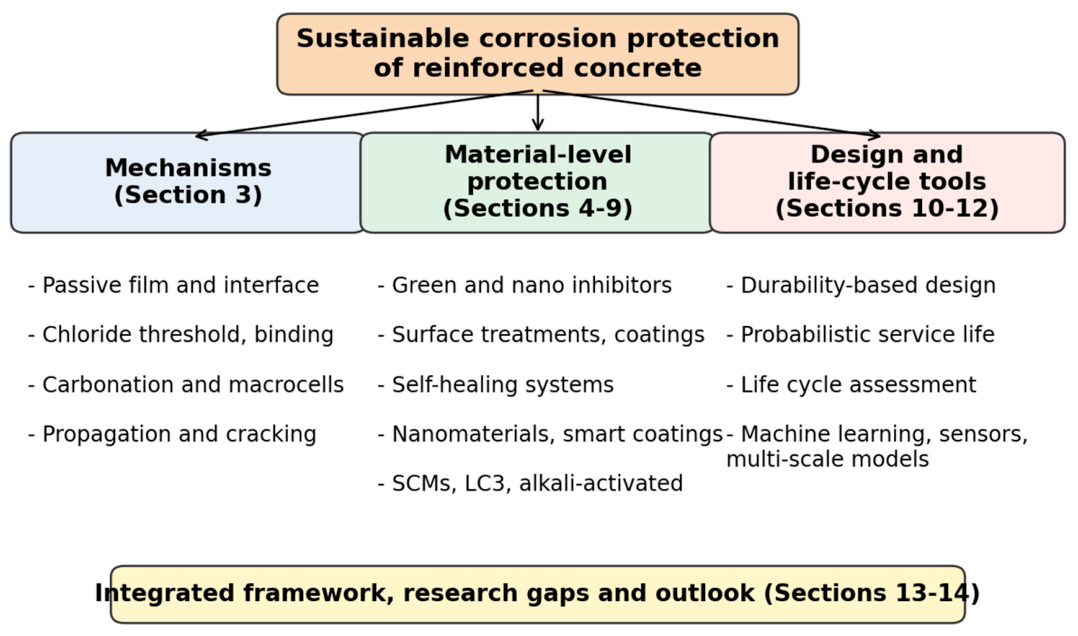
Figure 2.
Schematic two-stage model of corrosion damage in reinforced concrete, showing where sustainable protection strategies act. The curve is qualitative; it is adapted from the two-stage concept described in [1].
Figure 2.
Schematic two-stage model of corrosion damage in reinforced concrete, showing where sustainable protection strategies act. The curve is qualitative; it is adapted from the two-stage concept described in [1].
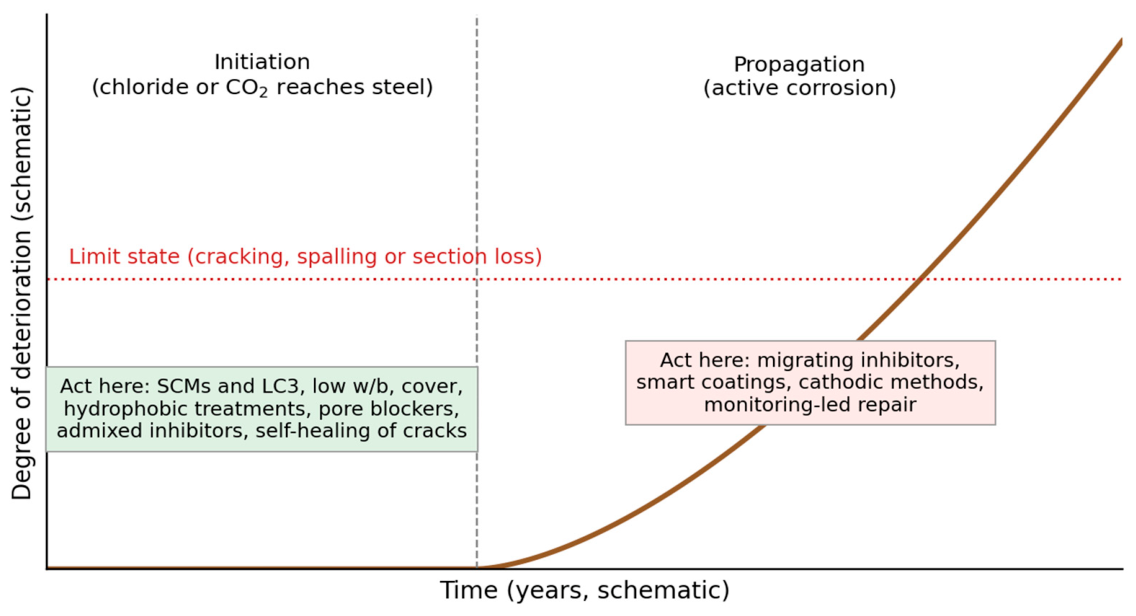
Figure 3.
Illustrative time to corrosion initiation from Equation (2) versus apparent chloride diffusion coefficient for three cover depths (Cs = 3.0%, Ccrit = 0.4% by binder mass, constant D). Points mark the three cases in Table 4. Values are for illustration only.
Figure 3.
Illustrative time to corrosion initiation from Equation (2) versus apparent chloride diffusion coefficient for three cover depths (Cs = 3.0%, Ccrit = 0.4% by binder mass, constant D). Points mark the three cases in Table 4. Values are for illustration only.
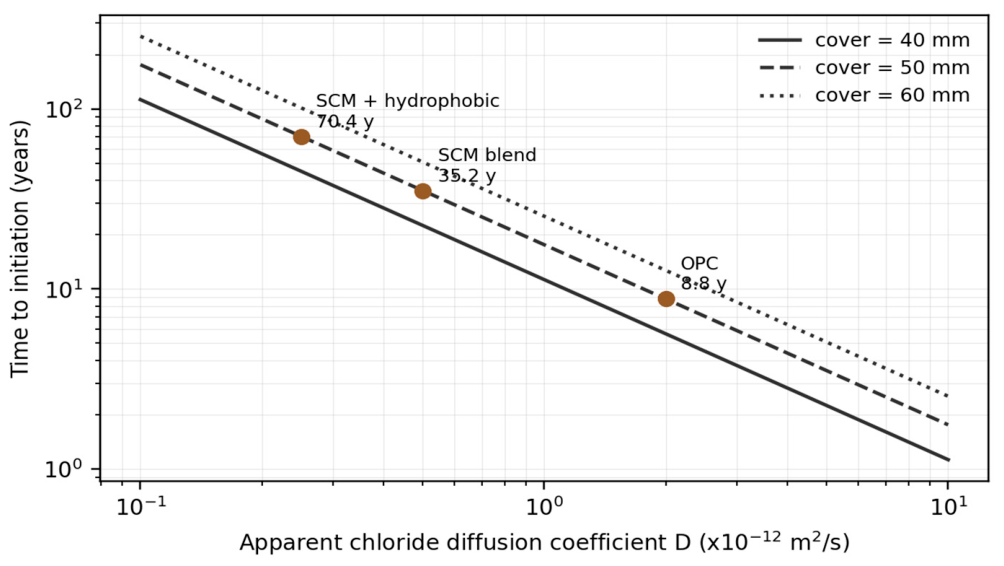
Figure 4.
Proposed design loop that links material choice, added protection, probabilistic service-life prediction, life cycle assessment, and monitoring.
Figure 4.
Proposed design loop that links material choice, added protection, probabilistic service-life prediction, life cycle assessment, and monitoring.
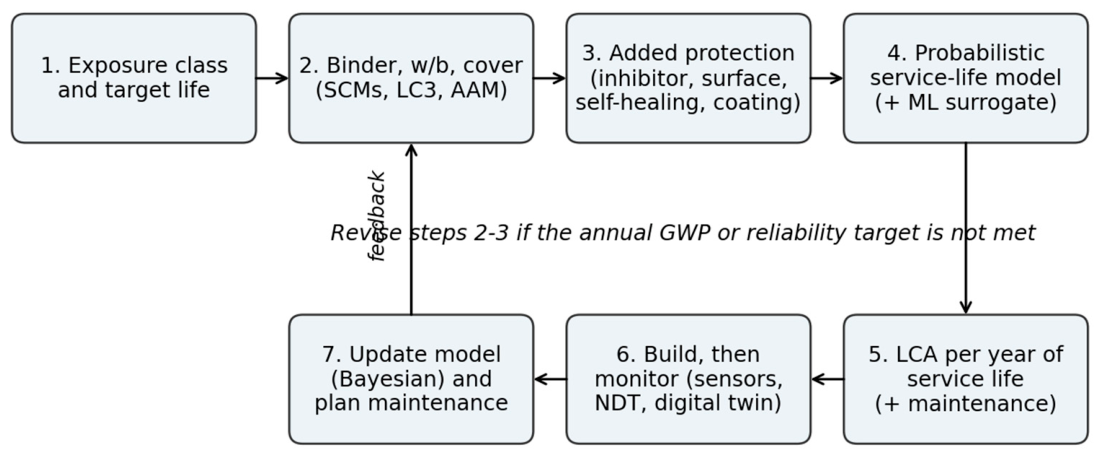

Table 1.
Main families of sustainable corrosion-protection methods, the corrosion stage they act on, and their main limits.
Table 1.
Main families of sustainable corrosion-protection methods, the corrosion stage they act on, and their main limits.
| Method | Main mechanism | Stage | Sustainability benefit | Main limits [refs] |
|---|---|---|---|---|
| SCMs, LC3, alkali-activated binders | Pore refinement, chloride binding, higher resistivity | Initiation, and slows propagation | Less clinker; longer initiation | Lower alkaline reserve, faster carbonation, supply limits [46,47,48] |
| Conventional inhibitors (nitrite, amines, migrating types) | Passive film repair or adsorbed film | Initiation (migrating types: existing structures) | Life extension without demolition | Toxicity (nitrite), dose control, proof of arrival at steel [49,50] |
| Green inhibitors (plant or waste extracts) | Adsorption of heteroatom-rich molecules | Initiation | Renewable, low toxicity | Batch variation, short tests, possible effect on setting [12,22] |
| Surface treatments (silane, pore blockers, coatings) | Water repellence, pore blocking, barrier film | Initiation | Low material use; suits retrofit | Loss of benefit at cracks, aging, reapplication [13,24,51] |
| Self-healing (autogenous, bacterial, capsules) | Crack sealing by carbonate or polymer | Initiation after cracking | Fewer repairs | Corrosion benefit rarely measured; cost [15,25,52] |
| Nanomaterials | Densification, nucleation, inhibitor carriers | Initiation | Effective at small doses | Dispersion, production energy, health data [28,53] |
| Smart coatings | Release of inhibitor on pH, redox, or chloride trigger | Initiation and early propagation | Protection on demand | Stability at pH 13, scale-up, field data [16,54,55] |
| Monitoring and predictive models | Early detection, model updating | Both | Maintenance at the right time | Sensor life, data quality, model validity [56,57] |
Table 2.
Selected green inhibitors and bio-based coatings reported for steel corrosion protection. Outcomes are summarized as reported by the authors; test media differ and results are not directly comparable.
Table 2.
Selected green inhibitors and bio-based coatings reported for steel corrosion protection. Outcomes are summarized as reported by the authors; test media differ and results are not directly comparable.
| Source Material | Test System | Reported Outcome | Ref. |
|---|---|---|---|
| Bambusa arundinacea leaf extract | Steel in reinforced concrete | Reduced corrosion; proposed as a sustainable admixed inhibitor | [59] |
| Elaeis guineensis extract with silver nanoparticles | Reinforced concrete | Improved corrosion resistance of embedded steel | [60] |
| Plant-based eco-addition inhibitor | Steel embedded in concrete | Mitigated corrosion of reinforcing steel | [61] |
| Olive leaf extract | Reinforced concrete contaminated with seawater | Acted as a green inhibitor under seawater contamination | [62] |
| Maize gluten meal extract | Steel in concrete, with theoretical calculations | Inhibition mechanism explained by combined experiments and calculations | [63] |
| Neem (Azadirachta indica) leaf extract | Reinforced concrete in simulated chloride media | Compared with three commercial inorganic inhibitors; no change to concrete integrity | [64] |
| Fenugreek seed and cape gooseberry leaf extracts | Steel in phosphoric acid | Effective in acid; not directly transferable to alkaline concrete | [65] |
| Chitosan–gum Arabic nanocomposite (coating) | Mild steel in saline media | Water contact angle rose from about 51° to about 101°; good barrier protection | [66] |
Table 3.
Qualitative comparison of binder options for corrosion protection. Replacement ranges follow [28]; performance depends on mix design, curing, and exposure.
Table 3.
Qualitative comparison of binder options for corrosion protection. Replacement ranges follow [28]; performance depends on mix design, curing, and exposure.
| Binder | Chloride resistance | Carbonation | Clinker/CO2 saving | Notes [refs] |
|---|---|---|---|---|
| Fly ash (about 20–30%) | Lower D with age; added binding | Can increase (less portlandite) | Moderate to high | Slow early strength; long curing needed [46,79] |
| Ground granulated blast-furnace slag | Strong binding (alumina); lower D | Can increase | High | Supply may fall with steel decarbonization [35,46,82] |
| Silica fume (about 5–15%) | Strong pore refinement | Can increase at high dose | Low (small dose) | Cost; sensitive to curing [28,80] |
| Metakaolin (about 5–10%) | Binding and refinement | Can increase | Moderate | Higher water demand [28,80] |
| Limestone calcined clay cement (LC3) | Very low D; good binding | Lower than Portland cement | About half the clinker | Cover and curing matter more [10,47,83] |
| Alkali-activated and geopolymer binders | Varies; can be good with slag | Often faster | Very high | Limited standards and steel passivity data [48,84,85] |
Table 4.
Illustrative time to corrosion initiation from Equation (2) with Cs = 3.0% and Ccrit = 0.4% by binder mass, C0 = 0, and constant D. Values are for illustration only, not measured data.
Table 4.
Illustrative time to corrosion initiation from Equation (2) with Cs = 3.0% and Ccrit = 0.4% by binder mass, C0 = 0, and constant D. Values are for illustration only, not measured data.
| Case | D (×10⁻¹² m²/s) | Cover (mm) | ti (years) |
|---|---|---|---|
| Portland cement concrete (reference) | 2.0 | 50 | 8.8 |
| SCM blend | 0.5 | 50 | 35.2 |
| SCM blend + hydrophobic treatment (D halved) | 0.25 | 50 | 70.4 |
| SCM blend, reduced cover | 0.5 | 40 | 22.5 |
| SCM blend, increased cover | 0.5 | 60 | 50.7 |
Table 5.
Representative machine learning studies on chloride transport and corrosion. Metrics are as reported by the authors on their own data splits.
Table 5.
Representative machine learning studies on chloride transport and corrosion. Metrics are as reported by the authors on their own data splits.
| Study | Target | Data | Models | Reported performance |
|---|---|---|---|---|
| Al Fuhaid and Alanazi [19] | Chloride diffusion coefficient, SCM concrete | Literature data with C3A, slag, fly ash | ANFIS, ANN, SVM, ELM | SVM best: R² = 0.955 (train), 0.951 (test) |
| Hosseinzadeh et al. [20] | Chloride migration coefficient and resistance class | 1073 cleaned experimental results | XGBoost, SVM, RF, LightGBM | XGBoost R² = 0.94; SVM R² = 0.91; classification accuracy up to 0.97 |
| Liu et al. [21] | Chloride diffusion coefficient, silica fume concrete | Literature data | BP-ANN, SVR, GP, XGBoost, RF with PSO | Model comparison and feature analysis |
| Ahmad et al. [95] | Corrosion rate of steel in cementitious composites in clay soils | 72 data points; NaCl 0–4%, inhibitor 0–5%, 30–180 days | Feedforward and cascade-forward ANN | Feedforward: R = 0.998, MAPE = 30.43% |
| Song et al. [96] | Maximum corrosion depth | Corrosion depth data | Interpretable ML | Ranking of influence factors |
| Al-Taai et al. [89] | Compressive strength of eco-friendly concrete | Slag and recycled aggregate mixes | XGBoost with Bayesian tuning | Screening tool for low-carbon mixes |
Table 6.
Main research gaps, ranked by how much they block practical use, with suggested actions.
| # | Gap | Why It Matters | Suggested Action |
|---|---|---|---|
| 1 | Few long-term tests of green inhibitors and smart coatings in real concrete | Short solution tests overstate benefit; designers cannot use them | Multi-year exposure of reinforced specimens; report change in Ccrit and corrosion rate |
| 2 | Large uncertainty in the chloride threshold | Controls predicted initiation time more than any other input | Agreed test methods; report distributions, not single values [3,36] |
| 3 | LCA studies that ignore service life and maintenance | Can rank short-lived options as green | Use GWP per year of service life with probabilistic t_SL, Equation (3) |
| 4 | Self-healing studies without corrosion measures | Crack closure at the surface does not prove protection at the bar | Measure chloride at bar depth and corrosion potential or rate |
| 5 | Unknown interaction between inhibitors and SCMs | Adsorption on hydrates may reduce inhibitor supply | Factorial tests of inhibitor type and binder type |
| 6 | Limited steel corrosion data and standards for alkali-activated binders | Blocks use of very low-carbon binders in reinforced members | Pore solution, passivity, and long-term exposure studies |
| 7 | Small, mixed ML datasets without physics or uncertainty | High R² does not mean good field predictions | Open datasets, physics-informed models, independent validation |
| 8 | Short life of embedded sensors | Monitoring stops before the structure needs it | Durable sensor materials and self-sensing concrete |
| 9 | Unknown footprint and safety of nanomaterials | Production may cancel service-life gains | Include nanomaterial production in LCA; health data |
| 10 | Climate change not in service-life models | Warmer, wetter, higher-CO2 futures speed deterioration | Climate scenarios in probabilistic design [39] |
Table 7.
Proposed minimum reporting checklist for studies on sustainable corrosion-protection methods.
Table 7.
Proposed minimum reporting checklist for studies on sustainable corrosion-protection methods.
| Item | What to Report | Used in |
|---|---|---|
| Test medium and duration | Solution, mortar, concrete, or field; exposure length in days or years | Judging transfer to practice |
| Transport property | Change in apparent D or migration coefficient versus a reference mix | Equation (2), initiation time |
| Chloride threshold | Ccrit with and without the method, measured with steel embedded | Equation (2), initiation time |
| Corrosion rate | Polarization resistance or mass loss after initiation | Propagation phase |
| Effect on concrete | Setting time, strength, and shrinkage | Structural design checks |
| Durability of the method | Expected life of the treatment, inhibitor, or coating; reapplication interval | Maintenance terms in Equation (3) |
| Environmental data | Dose per m³ and production footprint of the added material | GWP_initial in Equation (3) |
| Uncertainty | Number of specimens, scatter, and variability between batches | Probabilistic design |
Disclaimer/Publisher’s Note: The statements, opinions and data contained in all publications are solely those of the individual author(s) and contributor(s) and not of MDPI and/or the editor(s). MDPI and/or the editor(s) disclaim responsibility for any injury to people or property resulting from any ideas, methods, instructions or products referred to in the content. |
© 2026 by the authors. Licensee MDPI, Basel, Switzerland. This article is an open access article distributed under the terms and conditions of the Creative Commons Attribution (CC BY) license.
Copyright: This open access article is published under a Creative Commons CC BY 4.0 license, which permit the free download, distribution, and reuse, provided that the author and preprint are cited in any reuse.