

Submitted:
21 September 2026
Posted:
01 October 2026
You are already at the latest version
Abstract
Local legislatures play a critical role in lawmaking, budgeting, oversight, and translating societal demands into public policy, yet formal decentralization may coexist with executive dominance, information asymmetry, strategic inertia, and bureaucratic passivity. This study examines how executive dominance contributes to strategic inertia in Indonesian local legislatures and explores how public leadership and multidimensional institutional capacities can facilitate transformation toward substantive public value. A qualitative comparative-exploratory multiple-case study was conducted involving 35 informants selected through purposive and supplementary snowball sampling. Data were collected through semi-structured interviews, non-participant observation, and documentary analysis and examined using comparative thematic analysis incorporating open, axial, selective, and cross-case coding. Five interconnected themes emerged: executive dominance and structural dependence; strategic inertia and bureaucratic passivity; public leadership as a mechanism for disrupting inertia; multidimensional institutional, individual, budgetary, and regulatory capacity; and the transition from procedural compliance to substantive public value. The findings indicate that leadership can disrupt entrenched legislative routines, but sustainable transformation depends on complementary institutional capacities that strengthen autonomy, inclusion, responsiveness, and accountability. The study contributes an integrated explanatory framework linking structural dependence, organizational inertia, public leadership, multidimensional capacity strengthening, and substantive public value in local legislative governance.
Keywords:
bureaucratic passivity
; collaborative governance
; local legislatures
; public leadership
; public value
; strategic inertia
1. Introduction
Decentralization has reshaped public governance by transferring substantial administrative, fiscal, policy, and representative responsibilities to subnational institutions. Within decentralized systems, local legislatures occupy a critical position because they are expected to formulate legislation, scrutinize executive action, allocate public resources, and translate societal demands into authoritative policy decisions. These responsibilities have become increasingly consequential as local governments confront complex socioeconomic challenges, fiscal constraints, technological disruption, and rising expectations for transparent, inclusive, and responsive governance (Chohan, 2022; Liu & Zhang, 2024). Contemporary public administration scholarship therefore increasingly evaluates governmental institutions not merely by procedural compliance or administrative outputs, but by their capacity to generate substantive public value through institutional capability, stakeholder engagement, and collaborative action (Grant, 2021; Sørensen et al., 2021; Thabit et al., 2025). In this perspective, effective local legislatures are not simply formal lawmaking bodies; they are governance institutions whose autonomy and organizational capacity can substantially influence the quality of local public policy.
Formal decentralization, however, does not necessarily produce institutionally autonomous or strategically capable legislatures. Authority may be formally transferred without corresponding improvements in organizational resources, technical expertise, information access, accountability mechanisms, or analytical capacity. Under these conditions, decentralization can coexist with substantive institutional dependence, particularly when executive agencies retain superior information, permanent bureaucratic expertise, technical personnel, and policy-development resources (Salvador & Sancho, 2023; Workman et al., 2024). Such asymmetries may encourage legislatures to rely on executive-generated information and policy initiatives rather than independently identifying policy problems and developing alternatives. Research on bureaucratic inertia similarly suggests that established organizational arrangements and routines can inhibit adaptation even when institutional environments demand change (Aksom, 2022; Fathani et al., 2024). Consequently, the existence of formal legislative authority should be distinguished from the organizational capacity required to exercise that authority effectively.
This distinction is particularly important in the Indonesian context. Regional Houses of Representatives (dewan perwakilan rakyat daerah, DPRD) formally exercise legislative, budgeting, and oversight responsibilities, yet their institutional authority may not always be accompanied by equivalent technical and analytical capacity. Executive institutions generally possess permanent bureaucratic structures, specialized personnel, administrative information, and continuous involvement throughout the policy cycle. Such conditions may create information and resource asymmetries that restrict the legislature’s ability to formulate and scrutinize policy independently. The resulting institutional pattern can foster a reactive legislative culture in which lawmakers depend heavily on executive policy initiatives instead of functioning as autonomous policy actors.
This study conceptualizes these interconnected problems through strategic inertia and bureaucratic passivity. Strategic inertia refers to the persistence of organizational routines and decision patterns despite changing policy demands, whereas bureaucratic passivity describes reluctance or limited institutional capacity to exercise available authority proactively. These conditions can manifest through dependence on executive proposals, inadequate legislative drafting and policy-analysis capabilities, weak long-term planning, limited transparency, insufficient accountability, absenteeism, procedural delay, and reactive policymaking. Importantly, these manifestations should not be understood merely as isolated shortcomings of individual actors. They may constitute a mutually reinforcing organizational configuration in which structural dependence constrains institutional agency and established routines reproduce that dependence over time.
Public leadership provides one theoretical perspective for understanding how such patterns might be disrupted. Leadership research emphasizes that actors can influence organizational outcomes even within institutional constraints, although the effects of leadership vary according to organizational setting, administrative traditions, and institutional conditions (Fathani et al., 2024). For local legislatures, public leadership should therefore not be reduced to individual charisma or formal political authority. It can instead be conceptualized as a relational and institutional capacity through which actors mobilize resources, bridge organizational boundaries, strengthen technical capabilities, coordinate stakeholders, and redirect organizational attention toward collective outcomes. This interpretation recognizes an important tension in the literature: structural explanations emphasize path dependence, resource asymmetry, and institutional constraints, whereas leadership perspectives emphasize agency and the capacity of actors to initiate organizational change. Understanding legislative transformation consequently requires attention to the interaction between agency and institutional structure rather than treating either as independently determinative.
Collaborative governance and public-value scholarship extend this argument by emphasizing that leadership operates within broader configurations of actors, resources, and institutional arrangements. Collaboration cannot be assumed to generate improved governance simply because stakeholders are formally included. Its effectiveness depends on institutional design, meaningful participation, distribution of authority, access to information, and mechanisms through which competing interests and public values are negotiated (Christensen, 2024). Public-value research similarly suggests that meaningful participation, dialogue, integrative leadership, strategic management capability, organizational resources, and institutional design operate as interconnected governance components rather than isolated instruments (Bryson et al., 2023; Pini et al., 2026). This perspective challenges approaches that assume that leadership development, increased funding, regulatory reform, technical training, or stakeholder participation alone can resolve institutional dysfunction.
Despite these theoretical advances, important gaps remain. First, public leadership research continues to face an individual–institutional disconnect: leadership scholarship emphasizes organizational agency, whereas institutional perspectives emphasize rules, resources, structural constraints, and path dependence. Less is understood about how leadership produces institutional transformation when limited individual capacity and restrictive organizational structures coexist. Second, collaborative governance research provides substantial insight into leadership and institutional design, but legislative environments characterized by executive dominance, information asymmetry, technical dependence, and rigid procedural arrangements remain comparatively underexplored. Third, responses to legislative dysfunction frequently emphasize discrete interventions, despite growing evidence that public-value creation depends on interconnected governance capacities. Comparative qualitative evidence explaining how leadership interacts with these capacities to produce different institutional trajectories is also limited.
To address these gaps, this study examines how executive dominance contributes to strategic inertia and bureaucratic passivity in Indonesian local legislatures and how public leadership can mobilize institutional transformation. It conceptualizes leadership as a mediating and mobilizing mechanism operating through four interconnected dimensions: institutional, individual, budgetary, and regulatory capacity. The study therefore advances an explanatory pathway connecting executive dominance and structural dependence → strategic inertia and bureaucratic passivity → public leadership → multidimensional capacity strengthening → substantive public value. Rather than assuming that leadership independently generates change, this framework embeds leadership within the institutional and resource configurations that enable or constrain legislative agency.
Using a qualitative comparative multiple-case approach, the study consequently seeks to explain the mechanisms through which leadership and complementary capacities can shift local legislatures from compliance-oriented behavior toward more autonomous, collaborative, responsive, and public-value-oriented governance. The principal findings indicate that executive dominance and structural dependence can reinforce strategic inertia, while boundary-spanning leadership, stakeholder mobilization, and changes in organizational routines can help disrupt these patterns. However, leadership intervention alone is insufficient: sustainable transformation depends on the complementary development of institutional, individual, budgetary, and regulatory capacities. The study thus contributes to public leadership, collaborative governance, legislative studies, and public-value scholarship by explaining institutional transformation as an interconnected process rather than the product of a single reform instrument.
2. Theoretical Framework
This study develops an integrated theoretical framework to explain how public leadership can disrupt strategic inertia and bureaucratic passivity within local legislative institutions. Rather than treating legislative performance as the product of leadership, organizational structure, or resources in isolation, the framework combines perspectives on institutional and structural dependence, strategic inertia, public leadership, collaborative governance, multidimensional institutional capacity, and public value. The central proposition is that executive–legislative asymmetries create structural conditions that may reproduce passive organizational routines, while public leadership can function as a mobilizing mechanism for change when supported by complementary institutional capacities. This approach is particularly appropriate for local legislatures because formal authority does not necessarily correspond to the informational, technical, financial, and regulatory capacity required to exercise that authority independently.
2.1 Executive Dominance and Structural Dependence
The first theoretical component concerns executive dominance and structural dependence. Institutional perspectives emphasize that organizational behavior is shaped by rules, established routines, resource distributions, information structures, and path-dependent arrangements. In local governance, legislatures and executive institutions may possess formally distinct authority while having unequal capacities to exercise it. Executive organizations generally benefit from permanent bureaucracies, specialized personnel, administrative information, technical expertise, and continuous involvement throughout the policy cycle. Legislatures may consequently become dependent on executive institutions for policy data, technical analysis, regulatory drafting, and policy alternatives (Pierre et al., 2024; Salvador & Sancho, 2023; Workman et al., 2024).
Structural dependence is therefore conceptualized here as more than formal executive control. It refers to an asymmetric institutional relationship in which unequal access to information, expertise, resources, and agenda-setting capacity constrains the legislature’s ability to exercise its formal authority autonomously. Such asymmetries can become self-reinforcing: dependence on executive information reduces opportunities to develop independent analytical capacity, while limited internal capacity further increases dependence on executive resources. The framework consequently treats information asymmetry, resource asymmetry, agenda-setting dominance, and legislative dependency as interconnected manifestations of executive dominance.
2.2. Strategic Inertia and Bureaucratic Passivity
The second component is strategic inertia, understood as the persistence of organizational routines and decision-making patterns despite changing environmental or policy demands. Institutional inertia research suggests that established organizational arrangements can constrain adaptation and reproduce existing administrative behavior even when change becomes necessary (Aksom, 2022; Fathani et al., 2024). In this study, strategic inertia is closely associated with bureaucratic passivity, defined as reluctance or limited institutional capacity to exercise available authority proactively.
Importantly, inertia does not imply complete organizational inactivity. Legislative meetings may occur, documents may be processed, and procedural requirements may be fulfilled while substantive initiative remains weak. Strategic inertia may therefore manifest through passive compliance, repeated procedural delays, weak accountability, limited transparency, and reactive policymaking. This distinction separates procedural activity from strategic agency: an institution can remain administratively active while lacking the capacity or willingness to independently identify problems, formulate alternatives, and initiate policy responses. This conceptualization provides the first causal connection in the framework: executive dominance and structural dependence can create organizational conditions conducive to strategic inertia and bureaucratic passivity.
2.3. Public Leadership as a Mechanism of Institutional Change
The framework next positions public leadership as a mechanism capable of disrupting established patterns of inertia. Leadership in this context is not limited to formal authority, individual charisma, or hierarchical command. It is conceptualized as a relational and institutional capacity through which actors mobilize resources, connect organizational boundaries, coordinate stakeholders, strengthen organizational capabilities, and redirect collective attention toward public purposes. This interpretation is consistent with contemporary public leadership scholarship emphasizing that leadership outcomes depend on institutional and organizational contexts rather than individual leaders alone (Fathani et al., 2024; Hendren et al., 2023).
Four mechanisms are particularly important: boundary spanning, stakeholder mobilization, collaborative platforms, and internal leadership intervention. Boundary-spanning leadership creates connections between legislators, executive officials, academics, civil society, experts, and affected communities. Stakeholder mobilization expands access to alternative information and expertise. Collaborative platforms create institutional spaces for deliberation, while internal leadership interventions—such as clearer expectations, monitoring, follow-up mechanisms, and organizational coordination—can alter passive routines. Public leadership is therefore theorized as an intermediary mechanism connecting structural conditions with organizational change rather than as an independent solution to institutional dysfunction.
2.4. Collaborative Governance and Public Leadership
Collaborative governance complements the leadership perspective by explaining how public organizations interact with actors located beyond conventional organizational boundaries. Collaborative governance emphasizes that meaningful collaboration depends not merely on the presence of multiple stakeholders but also on institutional design, leadership, participation, distribution of authority, dialogue, and the capacity to negotiate competing public values (Christensen, 2024).
This perspective is particularly relevant in executive-dominated legislative environments. Inviting stakeholders into policy processes does not automatically reduce structural dependence or improve policy outcomes. Participation may remain symbolic when stakeholders enter deliberations too late, lack relevant information, or have little opportunity to influence policy substance. Similarly, legislators may receive valuable external evidence but lack the technical capability to translate it into viable regulatory alternatives. Collaboration therefore operates effectively only when stakeholder participation is connected to organizational capacity and actual decision-making processes.
The framework consequently rejects a simple assumption that “more collaboration” necessarily generates better governance. Instead, collaborative governance is conceptualized as an institutional mechanism through which leadership can diversify information, mobilize expertise, broaden participation, and reduce dependence on a single source of policy knowledge.
2.5. Multidimensional Capacity for Institutional Transformation
Leadership and collaboration alone may produce temporary changes without altering the institutional conditions responsible for inertia. The framework therefore incorporates multidimensional capacity as the organizational architecture required to institutionalize transformation. Four mutually reinforcing dimensions are identified: institutional, individual, budgetary, and regulatory capacity.
Institutional capacity encompasses strategic planning, transparency, accountability, monitoring mechanisms, and organizational routines. Individual capacity refers to legislators’ and supporting officials’ competence in legislative drafting, policy analysis, data interpretation, budgeting, and evidence-informed deliberation. Budgetary capacity concerns sufficient resource autonomy to support independent policy analysis, research, expertise, and oversight. Regulatory capacity refers to institutional rules, legal safeguards, discretion, and regulatory arrangements that permit responsible policy innovation.
These dimensions are theoretically complementary rather than substitutable. Technical training may have limited impact when legislators lack access to information or independent analytical resources. Additional financial resources may fail to produce change without accountability mechanisms. Institutional reform may remain procedural when personnel lack analytical competence, while capable actors may avoid innovation when regulatory uncertainty discourages responsible discretion. Institutional transformation therefore depends on the alignment and interaction of multiple capacities, rather than the isolated strengthening of one dimension.
2.6. Substantive Public Value as the Transformational Outcome
The final theoretical component is public value. Public-value perspectives shift attention from administrative outputs toward whether governance institutions generate outcomes that are substantively responsive, inclusive, legitimate, accountable, and connected to societal needs. Public value is therefore particularly appropriate for evaluating legislative transformation because an increase in legislative activity does not necessarily indicate improvement in governance. Producing more regulations, holding more meetings, or completing procedures more rapidly may have limited value if policy processes remain dependent, inaccessible, or disconnected from community problems.
Within this framework, substantive public value is reflected through legislative autonomy, inclusive policymaking, responsiveness to community needs, outcome-oriented governance, transparency, and accountability. Public value thus constitutes the downstream outcome of institutional transformation rather than a direct consequence of leadership alone. Recent public-value scholarship similarly emphasizes the interaction of participation, dialogue, leadership, strategic management, resources, and institutional design in generating public value (Bryson et al., 2023; Pini et al., 2026).
2.7. Integrated Theoretical Model
Integrating these theoretical perspectives produces the study’s central explanatory pathway:
Executive Dominance and Structural Dependence → Strategic Inertia and Bureaucratic Passivity → Public Leadership → Multidimensional Capacity for Institutional Transformation → Substantive Public Value
The model proposes that executive dominance, expressed through information, technical-resource, and agenda-setting asymmetries, can reinforce legislative dependence and institutionalize passive organizational routines. Public leadership provides a mechanism for interrupting this trajectory through boundary spanning, stakeholder mobilization, collaborative deliberation, and organizational behavioral change. However, the sustainability of this change depends on institutionalizing institutional, individual, budgetary, and regulatory capacities. When these capacities reinforce one another, local legislatures are better positioned to move from procedural compliance toward greater autonomy, meaningful inclusion, responsiveness, accountability, and substantive public value.
The framework is therefore recursive rather than strictly linear. As represented in the manuscript’s conceptual model, contextual conditions—including political dynamics, legal and regulatory frameworks, socioeconomic conditions, and citizen expectations—can shape each stage, while feedback and continuous learning can reinforce institutional adaptation, accountability, and transparency. The theoretical contribution lies in connecting structural and agency-based explanations: leadership matters, but its transformative effects are conditioned by institutional structures and complementary capacities. This integrated perspective provides the theoretical basis for examining how, through which mechanisms, and under what institutional conditions public leadership can disrupt strategic inertia and facilitate public-value-oriented transformation in local legislatures.
3. Materials and Methods
3.1. Study Setting and Period
The study was conducted at the Regional House of Representatives (Dewan Perwakilan Rakyat Daerah, DPRD) of Takalar Regency, South Sulawesi, Indonesia, from April to August 2026. The setting was selected because it provided an appropriate institutional context for examining executive–legislative relations, strategic inertia, bureaucratic passivity, and the role of public leadership in local legislative governance. The study focused on legislative processes involving relevant DPRD actors, executive-government representatives, legislative-support personnel, academics and policy experts, civil-society representatives, and other stakeholders with direct knowledge of local legislative processes.
3.2. Data Collection
Data were collected using three complementary techniques: semi-structured interviews, non-participant observation, and documentary analysis. This methodological triangulation was employed to capture participants’ experiences and perceptions while also examining institutional practices and documentary evidence related to executive–legislative relations, strategic inertia, bureaucratic passivity, public leadership, and institutional capacity.
Semi-structured interviews constituted the primary source of data. Interviews were conducted with participants representing legislative actors, legislative-support personnel, executive-government representatives, academics and policy experts, and civil-society or stakeholder representatives. The interview guide covered executive dominance and structural dependence, information and resource asymmetries, strategic inertia, bureaucratic passivity, public leadership, collaborative governance, multidimensional institutional capacity, and the creation of substantive public value. Open-ended questions and follow-up probes were used to obtain detailed explanations and clarify participants’ experiences. The semi-structured interview guide is provided in Appendix A (Table 1).
Non-participant observation was conducted to complement the interview data by examining institutional interactions, deliberative processes, and organizational practices relevant to legislative governance. Documentary analysis was also undertaken using relevant institutional and policy documents to provide contextual information and support triangulation across data sources. Interview, observation, and documentary materials were systematically organized for subsequent qualitative analysis. Audio recording was undertaken only with participants’ permission, and confidentiality safeguards were applied throughout data collection and data management.
3.3. Data Analysis
Data were analyzed using comparative thematic analysis informed by open, axial, and selective coding. The analytical process was iterative and combined within-case interpretation with cross-case and stakeholder-level comparisons. During open coding, interview transcripts were examined line by line to identify meaningful units related to executive dominance, legislative dependency, strategic inertia, bureaucratic passivity, leadership practices, institutional barriers, stakeholder relations, and organizational change. Axial coding was subsequently used to establish relationships among categories, while selective coding integrated these categories into higher-order explanatory themes. NVivo was used to support systematic data organization, coding, retrieval, comparison, and analytical memoing. Analytical credibility was strengthened through methodological and source triangulation, comparison across stakeholder groups, documentary verification, examination of negative or contradictory evidence, and maintenance of an analytical audit trail.
3.4. Ethical Considerations
The study was conducted in accordance with established ethical principles for research involving human participants. Ethical approval was obtained from Universitas Bosowa (Approval No. 062c/1.02/DIRPM-UNIBOS/IV/2026, dated 15 April 2026). Participation was voluntary, and informed consent was obtained from all participants before data collection. Participants were informed about the study objectives and procedures, the voluntary nature of participation, confidentiality protections, their right to decline individual questions, and their right to withdraw without adverse consequences. Audio recording was undertaken only with explicit permission. Given the political and institutional sensitivity of executive–legislative relations, identifying information was separated from research transcripts, participant codes were used throughout analysis and reporting, and quotations were reviewed to minimize the risk of deductive identification. Digital recordings, transcripts, field notes, and analytical files were maintained in access-controlled storage and were accessible only for research purposes.
3.5. Data Availability Statement
The data supporting the findings of this study are not publicly available because they contain potentially identifiable and institutionally sensitive qualitative information concerning executive–legislative relations and participants’ professional experiences. De-identified data that do not compromise participant confidentiality may be made available by the corresponding author upon reasonable request, subject to ethical requirements, participant consent, and applicable institutional restrictions. Interview recordings, complete transcripts, and materials that could enable direct or deductive identification of participants will not be publicly deposited.
3.6. Generative Artificial Intelligence Statement
No generative artificial intelligence tools were used in the study design, participant recruitment, data collection, coding, data analysis, or interpretation of the findings. Any use of AI-assisted tools during manuscript preparation was limited to language-related editing and did not generate or modify the research data, analytical findings, or scientific conclusions.
4. Results
The qualitative analysis identified five interconnected themes explaining how executive–legislative structural relations were associated with strategic inertia and how public leadership and institutional capacity could support organizational transformation. The themes were: (1) executive dominance and structural dependence; (2) strategic inertia and bureaucratic passivity; (3) public leadership as a mechanism for disrupting inertia; (4) multidimensional capacity for institutional transformation; and (5) transition from procedural compliance to substantive public value. Collectively, the themes formed an explanatory pathway from structural constraints to organizational behavior, leadership intervention, capacity strengthening, and public-value-oriented outcomes.
4.1. Participant Characteristics
The study involved 35 informants representing actors positioned across the local legislative governance system. Participants comprised legislative members and leaders (IL), legislative secretariat and support personnel (LS), executive or government representatives (EX), academic and legal-policy experts (AE), and civil-society or stakeholder representatives (CS). Participants varied in age, educational attainment, and professional experience, allowing the analysis to incorporate perspectives from actors occupying different institutional positions. Participant characteristics are summarized in Table 2.
4.2. Overview of the Qualitative Findings
As summarized in Table 3, the five major themes were not analytically isolated. Executive dominance and structural dependence provided conditions under which passive legislative behavior could persist. Public leadership emerged as a mechanism for disrupting established organizational routines, while institutional, individual, budgetary, and regulatory capacities provided the supporting architecture required to sustain change. The resulting trajectory was characterized by stronger legislative autonomy, greater inclusion, improved responsiveness, and a stronger orientation toward substantive public value.
4.3. Executive Dominance and Structural Dependence
The first theme comprised four interrelated dimensions: information asymmetry, technical and resource asymmetry, executive agenda-setting dominance, and legislative dependency. Participants described unequal access to policy information, technical expertise, administrative resources, and policy-development capacity between executive and legislative institutions. Legislative actors frequently received information after policy proposals had already been substantially developed, reducing their opportunity to independently verify evidence and formulate alternatives.
This information asymmetry was reinforced by disparities in permanent technical expertise and administrative infrastructure. Executive agencies possessed specialized units and personnel engaged continuously with particular policy areas, whereas comparable analytical resources were not always available within the legislature. Executive influence consequently extended beyond information provision to policy initiation and agenda formation. The combined effect was a structural form of legislative dependency in which technical explanations, supporting data, and regulatory details remained substantially reliant on executive agencies.
The findings therefore indicate that executive dominance was not manifested solely through explicit hierarchical control. Rather, it was reproduced through interconnected asymmetries in information, expertise, administrative resources, and agenda-setting capacity. These conditions constrained the legislature’s ability to independently formulate and scrutinize policy.
4.4. Strategic Inertia and Bureaucratic Passivity
The second theme captured the organizational consequences associated with structural dependence. Five manifestations were identified: passive compliance, strategic delay, weak internal accountability, limited transparency, and reactive policymaking. Strategic inertia did not imply complete institutional inactivity. Formal meetings and legislative procedures continued, but participants described situations in which procedural completion received greater attention than substantive examination of whether proposals addressed underlying public problems.
Strategic delay emerged through repeated postponement of deliberations and decisions, particularly where disagreement was accompanied by reluctance to resolve contested issues. Weak internal accountability further contributed to this pattern when irregular attendance or limited participation did not generate sufficiently strong institutional consequences. Participants also identified restricted access to committee-level deliberations as a transparency constraint, limiting external understanding of how decisions were reached.
These conditions culminated in reactive policymaking. Legislative institutions were described as responding more frequently to proposals already presented to them than independently initiating policy based on systematic analysis of community problems. Taken together, these findings indicate that bureaucratic passivity was organizationally embedded rather than attributable solely to individual reluctance.
4.5. Public Leadership as a Mechanism for Disrupting Inertia
The third theme demonstrated how public leadership could interrupt established patterns of passivity. Five interconnected mechanisms were identified: boundary-spanning leadership, stakeholder mobilization, collaborative platforms, direct leadership intervention, and organizational behavioral change. Boundary-spanning practices brought legislative actors into closer interaction with government officials, academics, civil-society organizations, and community representatives, thereby broadening the sources of information and expertise available during policy deliberation.
Stakeholder mobilization became particularly consequential when external actors contributed evidence and alternative perspectives rather than merely attending formal consultations. Collaborative forums also enabled stakeholders to participate before legislative processes reached their final stages, increasing opportunities for their contributions to influence policy substance. Internally, leadership interventions included clearer deadlines, monitoring of follow-up actions, and stronger attention to unresolved issues.
These mechanisms were associated with behavioral changes among organizational actors. Rather than waiting for instructions, support personnel were increasingly encouraged to identify emerging problems and prepare relevant information proactively. Public leadership therefore operated through both external connectivity and internal behavioral activation, providing a mechanism for moving legislative organizations from reactive toward more proactive routines.
4.6. Multidimensional Capacity for Institutional Transformation
The fourth theme showed that leadership intervention alone was insufficient to sustain organizational change. Institutional transformation depended on the interaction of institutional, individual, budgetary, and regulatory capacities. At the institutional level, participants emphasized strategic planning, transparent procedures, clear responsibilities, monitoring, and accountability mechanisms as necessary for converting individual reform initiatives into durable organizational routines.
Individual capacity included competence in legal drafting, policy analysis, data interpretation, budgeting, and evidence-informed deliberation. However, individual competence required adequate organizational resources. Budgetary capacity was particularly important for financing independent research, technical analysis, and expert assistance; without these resources, dependence on executive-generated information could persist. Regulatory capacity was also necessary because uncertainty regarding the legitimate exercise of administrative discretion could discourage actors from undertaking policy innovation. The central finding was therefore one of complementarity. Training alone could not overcome institutional constraints; financial resources without accountability mechanisms could be insufficient; and capable actors might remain reluctant to innovate when regulatory safeguards were unclear. Sustainable institutional transformation required alignment among the four capacity dimensions
4.7. Transition from Procedural Compliance to Substantive Public Value
The fifth theme represented the outcome-oriented dimension of institutional transformation. Five elements characterized this transition: legislative autonomy, inclusive policymaking, responsiveness to community needs, outcome-oriented governance, and public value creation. Greater internal analytical capacity strengthened the legislature’s ability to critically assess executive proposals rather than relying exclusively on assumptions and evidence supplied by government agencies.
Inclusive policymaking was associated with involving communities and external stakeholders early enough for their contributions to influence policy substance. Responsiveness similarly required legislative priorities to begin from societal problems rather than merely reproduce programs already contained in administrative documents. Participants also distinguished substantive legislative performance from the quantity of regulations produced, emphasizing whether regulations addressed the problems they were intended to resolve.
Public value consequently emerged from the interaction of transparency, inclusion, responsiveness, legislative autonomy, accountability, and substantive policy outcomes. The findings suggest a movement away from an exclusive emphasis on procedural completion toward governance concerned with the substantive consequences of legislative action.
4.8. Integrated Model of Institutional Transformation
Taken together, the five themes indicate an interconnected process rather than a series of independent findings. Executive dominance and structural dependence created conditions in which information, technical-resource, and agenda-setting asymmetries reinforced legislative dependency. These structural conditions were manifested organizationally through strategic inertia and bureaucratic passivity. Public leadership provided a mechanism for disrupting these routines through boundary spanning, stakeholder mobilization, collaborative spaces, stronger follow-up mechanisms, and proactive organizational behavior.
Sustainable change, however, depended on multidimensional capacity strengthening. Institutional, individual, budgetary, and regulatory capacities jointly provided the conditions for greater analytical independence and organizational responsiveness. The resulting explanatory pathway is presented in Figure 1:
The model incorporates contextual influences and a feedback and continuous-learning mechanism, indicating that institutional transformation is iterative rather than strictly linear
5. Discussion
This study examined how executive dominance contributes to strategic inertia and bureaucratic passivity in local legislative governance and how public leadership, supported by multidimensional institutional capacity, can disrupt these patterns and facilitate a transition toward substantive public value. The findings indicate an interconnected process rather than a set of isolated organizational problems. Executive dominance was expressed through information asymmetry, unequal technical and administrative resources, agenda-setting influence, and legislative dependency. These structural conditions were associated with passive compliance, strategic delay, weak internal accountability, limited transparency, and reactive policymaking. Public leadership emerged as a mechanism capable of interrupting these patterns through boundary spanning, stakeholder mobilization, collaborative platforms, and changes in internal organizational routines. However, sustainable transformation depended on the complementary development of institutional, individual, budgetary, and regulatory capacities.
5.1. Executive Dominance as a Structural Source of Legislative Inertia
The first important finding is that executive dominance should not be understood simply as direct political control over the legislature. Rather, it operates through structural asymmetries in information, expertise, administrative resources, and agenda-setting capacity. The findings showed that legislative actors frequently depended on executive institutions for technical data, specialized knowledge, policy analysis, and regulatory information. As these forms of dependence accumulated, the legislature’s formal authority did not necessarily translate into equivalent substantive capacity to formulate or scrutinize policy independently.
This finding reinforces the distinction between formal decentralization and substantive institutional autonomy developed in the theoretical framework. Existing research suggests that transferring formal authority to subnational institutions does not automatically generate autonomous or capable governance institutions when resources, information, and administrative expertise remain unevenly distributed (Salvador & Sancho, 2023; Workman et al., 2024). The present findings extend this argument by demonstrating how these asymmetries can become mutually reinforcing within legislative settings. Information dependency may increase reliance on executive expertise; limited expertise can subsequently reduce the legislature’s capacity to independently generate policy alternatives; and this reduced capacity can further consolidate executive agenda-setting influence.
Theoretically, this suggests that executive dominance is better conceptualized as a relational and resource-dependent condition than as a purely hierarchical phenomenon. This distinction matters because institutional reform directed exclusively at formal authority may have limited effects when the underlying distribution of information, expertise, and analytical resources remains unchanged. Strengthening legislative autonomy therefore requires attention not only to statutory mandates but also to the institutional infrastructure through which those mandates are exercised.
5.2. Strategic Inertia as an Organizational Process
The findings also refine the meaning of strategic inertia in public institutions. Strategic inertia did not appear as complete inactivity. Legislative activities continued, meetings were conducted, and procedural requirements were fulfilled. The more consequential pattern was a disconnection between procedural activity and substantive policy initiative. Passive compliance, delayed decisions, weak accountability, limited transparency, and reactive policymaking could therefore coexist with apparently functioning administrative procedures.
This interpretation is consistent with institutional perspectives suggesting that organizational inertia is reproduced through established routines and institutional arrangements rather than simply through individual resistance to change (Aksom, 2022; Fathani et al., 2024). The findings add an important legislative dimension to this literature by showing that procedural compliance itself may become part of the mechanism through which inertia persists. An organization can satisfy formal administrative expectations while remaining strategically dependent and insufficiently responsive to emerging public problems.
This result also qualifies explanations that attribute legislative passivity primarily to individual motivation or competence. Although individual behavior remains relevant, the findings indicate that passivity is embedded in broader organizational arrangements. Weak accountability may normalize limited participation, information asymmetry may discourage independent scrutiny, and repeated dependence on externally prepared proposals may institutionalize reactive policymaking. Strategic inertia should consequently be understood as an organizationally reproduced condition, not merely an aggregation of passive individual behaviors.
5.3. Public Leadership as a Mechanism for Disrupting Inertia
The third major finding concerns the role of public leadership. The analysis showed that leadership was associated with institutional change when it operated through boundary spanning, stakeholder mobilization, collaborative deliberation, clearer organizational expectations, monitoring, and proactive information preparation. Leadership therefore functioned less as an attribute of a single officeholder and more as a relational mechanism connecting actors, resources, knowledge, and organizational processes.
This finding is consistent with contemporary public leadership perspectives emphasizing the importance of institutional context and cross-boundary interaction (Fathani et al., 2024; Hendren et al., 2023). It also supports collaborative-governance scholarship in which leadership contributes to creating arenas for interaction, coordinating stakeholders, and mobilizing resources that no single organization possesses independently (Christensen, 2024). In the present study, bringing legislators, government officials, academics, civil-society actors, and other stakeholders into shared policy spaces expanded the information and perspectives available to legislative deliberation.
However, the findings also reveal an important qualification. Stakeholder presence alone does not constitute meaningful collaboration. The timing and substantive character of participation matter. External actors were potentially more influential when they contributed evidence and alternative perspectives before policy positions became fixed. This observation supports the broader collaborative-governance argument that institutional design determines whether participation becomes substantive or merely symbolic.
Public leadership therefore appears to perform two interconnected functions. Externally, it spans organizational boundaries and mobilizes alternative sources of knowledge and legitimacy. Internally, it alters routines by establishing expectations, monitoring follow-up, and encouraging anticipatory rather than reactive behavior. This combination explains why leadership can operate as a mechanism connecting structural conditions to organizational transformation.
5.4. Why Leadership Alone Is Insufficient
One of the most important findings is that leadership intervention by itself was insufficient for sustainable transformation. Participants’ accounts pointed consistently toward the complementarity of institutional, individual, budgetary, and regulatory capacities. Institutional capacity provided planning, accountability, transparency, and organizational routines; individual capacity supplied analytical, legal, fiscal, and deliberative competence; budgetary capacity enabled independent research and technical assistance; and regulatory capacity provided legitimate institutional space for discretion and innovation.
This finding addresses the individual–institutional gap identified in the theoretical framework. Leadership-centered explanations may overstate the capacity of individual actors to transform institutions when organizational resources and rules remain unchanged. Conversely, structural explanations may underestimate the ability of leadership to mobilize existing resources, create new relationships, and initiate changes in routines. The findings suggest that these perspectives are complementary rather than competing.
The relationship can be understood as one of capacity complementarity. Improving individual competence through training may have limited consequences when legislators lack independent data, research funding, or institutional authority to apply that competence. Increasing budgetary resources may likewise have limited impact when accountability mechanisms are weak. Regulatory flexibility may not stimulate innovation when actors lack technical expertise, while technically competent actors may avoid innovation when the boundaries of legitimate discretion remain unclear. Thus, no single capacity appears sufficient to overcome strategic inertia.
This multidimensional interpretation extends public-value scholarship emphasizing that leadership, strategic management, organizational resources, institutional arrangements, and stakeholder participation operate as interconnected components of public-value creation (Bryson et al., 2023; Pini et al., 2026). The practical implication is that legislative reform should be designed as an institutional system rather than as a collection of isolated interventions.
5.5. From Procedural Compliance to Substantive Public Value
The fifth finding concerns the endpoint of institutional transformation. Participants did not define improvement simply as producing more regulations or completing legislative processes more quickly. Instead, improved governance was associated with greater legislative autonomy, meaningful stakeholder inclusion, responsiveness to community problems, transparency, accountability, and attention to substantive policy outcomes.
This finding is particularly relevant to public-value theory. A legislature may generate substantial administrative output without necessarily generating equivalent public value. The number of regulations enacted, meetings conducted, or procedures completed provides information about organizational activity but does not establish whether legislative decisions respond effectively to societal problems. Public value therefore introduces a more substantive criterion for assessing institutional performance.
The findings further suggest that legislative autonomy and collaboration are not necessarily contradictory. Greater autonomy does not require institutional isolation from executive agencies or external stakeholders. Rather, substantive autonomy involves possessing sufficient analytical and institutional capacity to evaluate competing evidence, scrutinize executive proposals, engage external expertise, and formulate independent judgments. Collaboration can strengthen autonomy when it diversifies information and reduces excessive dependence on a single institutional source.
Similarly, public participation contributes more directly to public value when it occurs sufficiently early to influence policy substance. This distinguishes meaningful inclusion from consultation conducted after major decisions have effectively been determined. The movement from procedural compliance toward substantive public value therefore involves changes not only in outputs but also in how legislative problems are defined, whose knowledge enters deliberation, and how policy success is evaluated.
5.6. An Integrated Explanation of Institutional Transformation
Taken together, the findings support the integrated explanatory model presented in Figure 1. The model proposes the following sequence:
The contribution of this model lies in connecting structural, behavioral, leadership, capacity, and outcome perspectives within a single explanatory architecture. Executive dominance establishes structural constraints; strategic inertia represents their organizational manifestation; public leadership provides an intervention mechanism; multidimensional capacity determines whether change can become institutionally sustainable; and substantive public value represents the broader governance outcome. The findings further indicate that the process is recursive rather than strictly linear because feedback, institutional learning, and contextual conditions can reshape each stage.
This integrated interpretation helps reconcile two perspectives that are sometimes treated separately in public administration: structure and agency. Institutional structures constrain what legislative actors can realistically accomplish, but those structures are not necessarily immutable. Leadership can mobilize actors and resources to modify routines and relationships. At the same time, leadership effects become sustainable only when they are embedded in organizational capacities, rules, and resource arrangements. Institutional transformation is therefore neither entirely leader-driven nor structurally predetermined.
5.7. Theoretical and Practical Implications
The study makes several theoretical contributions. First, it conceptualizes executive dominance as a multidimensional structural relationship involving information, expertise, resources, and agenda-setting rather than solely formal authority. Second, it distinguishes strategic inertia from simple inactivity by demonstrating how procedural activity can coexist with substantive passivity. Third, it positions public leadership as a mediating and mobilizing mechanism rather than an autonomous determinant of institutional transformation. Fourth, it advances a multidimensional capacity perspective in which institutional, individual, budgetary, and regulatory capacities interact to condition the sustainability of reform. Finally, it connects these mechanisms to substantive public value, thereby linking organizational transformation with broader governance outcomes.
Practically, the findings suggest that strengthening local legislatures requires more than leadership training or procedural reform. Reform strategies should simultaneously strengthen independent policy-analysis capacity, legislative and support-staff competence, access to credible information, resources for independent research and expertise, internal accountability and transparency mechanisms, regulatory clarity, and institutionalized channels for meaningful stakeholder engagement. Importantly, these mechanisms should reduce excessive dependence without eliminating constructive executive–legislative collaboration.
5.8. Limitations and Future Research
The findings should be interpreted within the boundaries of the study’s qualitative design and institutional context. The analysis focuses on local legislative governance and is intended to explain mechanisms and institutional processes rather than provide statistical generalization to all DPRDs in Indonesia. Participant accounts may also reflect role-specific interpretations of executive–legislative relationships, although triangulation across interviews, observations, documentary materials, and stakeholder categories was used to strengthen analytical credibility.
Future studies could test and refine the proposed model across a larger and more diverse set of local legislatures. Comparative research across municipalities, regencies, provinces, and national institutional settings could examine whether different political, fiscal, and regulatory environments alter the relationship between executive dominance and legislative inertia. Longitudinal studies would be particularly valuable for determining whether leadership-induced changes persist across electoral cycles and leadership transitions. Mixed-methods research could additionally operationalize the principal constructs identified here and examine relationships among executive dependence, leadership practices, institutional capacity, legislative autonomy, and public-value outcomes quantitatively.
Future research should also investigate possible boundary conditions. Public leadership may have different effects depending on political fragmentation, party dynamics, fiscal autonomy, bureaucratic professionalization, digital information capacity, civil-society strength, and regulatory arrangements. Examining these conditions would clarify when multidimensional capacity strengthening successfully converts leadership intervention into durable institutional transformation.
Overall, the findings suggest that overcoming strategic inertia in local legislatures is not principally a matter of replacing passive routines with more active leadership. It requires changing the institutional conditions that reproduce passivity. Public leadership can initiate and coordinate this process, but its contribution becomes sustainable when leadership is reinforced by institutional, individual, budgetary, and regulatory capacities. Under these conditions, local legislatures can move beyond procedural compliance toward greater autonomy, inclusion, responsiveness, accountability, and substantive public value.
6. Conclusions
This study demonstrates that strategic inertia and bureaucratic passivity in local legislative governance are closely associated with structural asymmetries between legislative and executive institutions. Executive dominance operates through unequal access to information, technical expertise, administrative resources, and agenda-setting capacity, which can reinforce legislative dependency and reactive policymaking. Public leadership can disrupt these patterns by spanning institutional boundaries, mobilizing stakeholders, strengthening collaborative deliberation, and encouraging more proactive organizational behavior. However, leadership alone is insufficient to sustain institutional transformation. Durable change requires the complementary strengthening of institutional, individual, budgetary, and regulatory capacities.
The study therefore advances an integrated pathway from executive dominance and structural dependence to strategic inertia, public leadership intervention, multidimensional capacity strengthening, and substantive public value. Institutional transformation should ultimately be assessed not merely through procedural completion or the quantity of legislative outputs, but through greater legislative autonomy, meaningful stakeholder inclusion, responsiveness to community needs, transparency, accountability, and substantive policy outcomes. Future research should examine this explanatory model across different legislative and political contexts and through longitudinal and mixed-methods designs to determine how leadership and institutional capacities interact over time.
Author Contributions
Author Contributions: Conceptualization, N.R., M.M. and S.S.; methodology, N.R., S.S. and A.B.; software, N.R. and N.N.; validation, M.M., S.S. and A.B.; formal analysis, N.R., M.S. and N.N.; investigation, N.R., M.M., M.S. and N.N.; resources, M.M. and A.B.; data curation, N.R., M.S. and N.N.; writing—original draft preparation, N.R. and S.S.; writing—review and editing, N.R., M.M., S.S., A.B., M.S. and N.N.; visualization, S.S. and N.N.; supervision, S.S. and A.B.; project administration, N.R. and M.M.; funding acquisition, N.R. All authors have read and agreed to the published version of the manuscript.
Funding
This research received no external funding. The APC was funded by the authors.
Institutional Review Board Statement
The study was conducted in accordance with the Declaration of Helsinki and approved by the Ethics Committee of Universitas Bosowa (protocol code 062c/1.02/DIRPM-UNIBOS/IV/2026; date of approval: 15 April 2026).
Informed Consent Statement
Informed consent was obtained from all subjects involved in the study.
Data Availability Statement
The data supporting the findings of this study are not publicly available due to privacy, confidentiality, and ethical restrictions, as the qualitative data contain potentially identifiable and institutionally sensitive information concerning executive–legislative relations and participants’ professional experiences. De-identified data that do not compromise participant confidentiality may be made available from the corresponding author upon reasonable request, subject to ethical requirements, participant consent, and applicable institutional restrictions. Interview recordings, complete transcripts, and other materials that could enable direct or deductive identification of participants will not be publicly deposited.
Acknowledgments
The authors gratefully acknowledge the Regional House of Representatives (dewan perwakilan rakyat daerah, DPRD) of Takalar Regency and all participants who contributed their time, experiences, and perspectives to this study. The authors also acknowledge the administrative and institutional support that facilitated the research process. During the preparation of this manuscript, the authors used ChatGPT (OpenAI) for language editing, improving clarity, and refining the academic presentation of the manuscript. The tool was not used for data collection, coding, data analysis, or interpretation of the findings. The authors reviewed and edited the output and take full responsibility for the content of this publication.
Conflicts of Interest
The authors declare no conflicts of interest.
Abbreviations
The following abbreviations are used in this manuscript:
| Abbreviation | Definition |
| AE | Academic/Legal-Policy Expert |
| Bapemperda | Badan Pembentukan Peraturan Daerah (Regional Regulation Formation Agency) |
| CS | Civil Society/Stakeholder Representative |
| DPRD | Dewan Perwakilan Rakyat Daerah (Regional House of Representatives) |
| EX | Executive/Government Representative |
| IL | Legislative Member/Leader |
| KI | Key Informant |
| LS | Legislative Secretariat/Support Personnel |
| NVivo | Qualitative Data Analysis Software |
| Pansus | Panitia Khusus (Special Committee) |
| Ranperda | Rancangan Peraturan Daerah (Draft Regional Regulation) |
Appendix A
Appendix A.1
The semi-structured interview guide was developed to explore participants’ experiences and perceptions of executive–legislative relations, strategic inertia, bureaucratic passivity, public leadership, institutional capacity, and public value in local legislative governance. Questions were adapted to participants’ institutional roles, and follow-up probes were used where necessary to clarify experiences and obtain contextual detail.

Table A1.
Semi-structured interview guide and analytical domains.
| Analytical Domain | Guiding Interview Questions |
|---|---|
| Executive dominance and structural dependence | How would you describe the relationship between the DPRD and the executive in legislative decision-making? What factors influence the balance of authority, information, and resources between these institutions? |
| Information and resource asymmetry | To what extent does the DPRD have independent access to policy information, technical expertise, administrative support, and other resources required for legislative functions? |
| Strategic inertia | Are there situations in which legislative processes tend to maintain existing routines despite changing policy or community needs? What factors contribute to this condition? |
| Bureaucratic passivity | How does bureaucratic or administrative behavior affect legislative initiative, responsiveness, oversight, and decision-making? |
| Public leadership | What forms of leadership contribute to overcoming institutional passivity or established routines? How do legislative actors mobilize internal and external stakeholders? |
| Collaborative governance | How are executive agencies, civil society, academics, community representatives, and other stakeholders involved in legislative processes? |
| Institutional capacity | What institutional arrangements support or constrain the DPRD in performing its legislative, budgeting, oversight, and representative functions? |
| Individual capacity | What knowledge, skills, expertise, and professional competencies are required to strengthen legislative performance? |
| Budgetary capacity | How do financial resources and budgetary arrangements affect legislative autonomy and institutional performance? |
| Regulatory capacity | To what extent do existing rules and procedures facilitate or constrain legislative initiative and institutional transformation? |
| Public value | What changes would indicate that legislative processes are becoming more responsive, inclusive, transparent, accountable, and beneficial to the public? |
| Institutional transformation | What reforms or institutional changes are necessary to reduce strategic inertia and strengthen the substantive role of the DPRD? |
References
- Afandi, M. N.; Tri Anomsari, E.; Novira, A.; Sudartini, S. Collaborative governance in a mandated setting: shifting collaboration in stunting interventions at local level. Development Studies Research 2023, 10(1), 2212868. [Google Scholar] [CrossRef]
- Akerboom, M.; Groeneveld, S.; Kuipers, B. Leadership in Public Sector Interorganizational Networks: A Synthesis of the Literature and Propositions Based on a Multiple Case Study. Perspectives on Public Management and Governance 2024, 7(4), 113–123. [Google Scholar] [CrossRef]
- Aksom, H. Institutional inertia and practice variation. Journal of Organizational Change Management 2022, 35(3), 463–487. [Google Scholar] [CrossRef]
- Angen, M. J. Evaluating Interpretive Inquiry: Reviewing the Validity Debate and Opening the Dialogue. Qualitative Health Research 2000, 10(3), 378–395. [Google Scholar] [CrossRef] [PubMed]
- Bauer, Z.; AbouAssi, K.; Johnston, J. Cross-sector collaboration formality: the effects of institutions and organizational leaders. Public Management Review 2022, 24(2), 159–181. [Google Scholar] [CrossRef]
- Benn, A. The administrative politics of unilateral action: Measuring delegation and discretion in the executive branch. Presidential Studies Quarterly 2024, 54(1), 4–24. [Google Scholar] [CrossRef]
- Bryson, J. M.; Crosby, B. C.; Barberg, B. Public value governance and strategic public management. In Handbook on Strategic Public Management; Edward Elgar Publishing, 2023; pp. 92–113. [Google Scholar] [CrossRef]
- Chohan, U. W. Legislative Oversight of Bureaucracy. In Global Encyclopedia of Public Administration, Public Policy, and Governance; Springer International Publishing, 2022; pp. 7612–7616. [Google Scholar] [CrossRef]
- Christensen, I. Understanding Tradeoffs in the Institutional Design and Leadership of Collaborative Governance. Public Performance & Management Review 2024, 47(2), 263–290. [Google Scholar] [CrossRef]
- Cifolelli, S.; Berardi, M.; Russo, A.; Ziruolo, A. Strategic public management for sustainable development: public value co-creation experiences. Public Money & Management 2025, 45(7), 679–691. [Google Scholar] [CrossRef]
- Fathani, A. T.; Putera, R. E.; Mohamed, N. The perils of bureaucratic inertia: A step toward enhancing government management. JURNAL TRIAS POLITIKA 2024, 8(1), 49–59. [Google Scholar] [CrossRef]
- Fatimah, M.; Haryanto, H.; Dwi Retnandari, N. Central-Local Government Relations in Regional Planning and Budgeting in Indonesia: Between Autonomy and Control. Policy & Governance Review 2024, 8(2), 131. [Google Scholar] [CrossRef]
- Grant, B. The particular applicability of public value creation to local government. International Journal of Public Administration 2021, 44(10), 835–844. [Google Scholar] [CrossRef]
- Head, B. W. Reconsidering expertise for public policymaking: The challenges of contestability. Australian Journal of Public Administration 2024, 83(2), 156–172. [Google Scholar] [CrossRef]
- Hendren, K.; Newcomer, K.; Pandey, S. K.; Smith, M.; Sumner, N. How qualitative research methods can be leveraged to strengthen mixed methods research in public policy and public administration? Public Administration Review 2023, 83(3), 468–485. [Google Scholar] [CrossRef]
- Higgs, M. J.; Kuipers, B. S.; Steijn, B. Change leadership and change embeddedness in public organizations: Connecting macrolevel reform to microlevel implementation. Public Administration 2023, 101(3), 902–916. [Google Scholar] [CrossRef]
- Kim, S.; Sullivan, A. Connecting the composition of collaborative governance structure to community-level performance in homeless services. Public Administration Review 2023, 83(4), 734–749. [Google Scholar] [CrossRef]
- Liu, G.; Zhang, Z. Improving public service in economic downturns. In Handbook Of Public Service Delivery; Edward Elgar Publishing, 2024; pp. 340–358. [Google Scholar] [CrossRef]
- Osborne, S. P.; Powell, M.; Cui, T.; Strokosch, K. Value Creation in the Public Service Ecosystem: An Integrative Framework. Public Administration Review 2022, 82(4), 634–645. [Google Scholar] [CrossRef]
- Parkkinen, J. Integrative public leadership: A systematic review. International Journal of Public Sector Management 2025, 38(4), 426–447. [Google Scholar] [CrossRef]
- Pierre, J.; Carelli, D.; Peters, B. G. The four worlds of politics and administration in the EU: how institutional arrangements shape the struggle against antimicrobial resistance. Journal of European Public Policy 2024, 31(12), 4088–4115. [Google Scholar] [CrossRef]
- Pini, B.; Petroni, A.; Bigliardi, B. Technological Innovation and Sustainability in Public Administration: A Systematic Review and Research Agenda. Administrative Sciences 2026, 16(2), 80. [Google Scholar] [CrossRef]
- Pradana, I. P. Y. B.; Susanto, E.; Kumorotomo, W. Bibliometric analysis of public sector innovation. Jurnal Ilmu Sosial Dan Ilmu Politik 2022, 25(3), 297–315. [Google Scholar] [CrossRef]
- Qi, H.; Ran, B. Paradoxes in collaborative governance. Public Management Review 2024, 26(10), 2728–2753. [Google Scholar] [CrossRef]
- Rahman, N.; Juharni; Mustafa, D.; Mustaking; Suprapto. Digital governance, public leadership and social inequality in Indonesia: a mixed-methods study. Cogent Social Sciences 2026, 12(1), 2717876. [Google Scholar] [CrossRef]
- Rahman, S.; Teicher, J.; Cox, J. W.; Alam, Q. Slipstreaming for Public Sector Reform: How Enterprising Public Sector Leaders Navigate Institutional Inertia. Journal of Public Administration Research and Theory 2023, 33(1), 4–18. [Google Scholar] [CrossRef]
- Riani, R.; Rachmawati, I.; Nur, T. Organizational capacity of the Cooperative, UMKM, Industry and Trade Office of Sukabumi City in the development of micro, small and medium enterprises. DIA: Jurnal Administrasi Publik 2024, 22(1), 404–416. [Google Scholar] [CrossRef]
- Rodríguez Bolívar, M. P. Advancing public administration research: integrating digital governance, institutional resilience, and participatory pathways for public value. International Review of Administrative Sciences 2026, 92(2), 167–195. [Google Scholar] [CrossRef]
- Salvador, M.; Sancho, D. Local Governments Facing Turbulence: Robust Governance and Institutional Capacities. Social Sciences 2023, 12(8), 462. [Google Scholar] [CrossRef]
- Sardo, A.; Rode, P.; Cerruti, G.; Mateos Durán, A. D. The legitimacy of city networks in international multi-stakeholder governance. Cities 2026, 107528. [Google Scholar] [CrossRef]
- Sørensen, E.; Bryson, J.; Crosby, B. How public leaders can promote public value through co-creation. Policy & Politics 2021, 49(2), 267–286. [Google Scholar] [CrossRef]
- de Souza, M. G. S.; Oriol, E. de C.; Avellaneda, C. N. The path ahead for integrative public leadership: A systematic review and call for future research. International Journal of Public Leadership 2024, 20(3–4), 308–329. [Google Scholar] [CrossRef]
- Stephens, W.; van Steden, R.; Schoonmade, L. Boundary spanning in local governance: A scoping review. Administration & Society 2024, 56(2), 99–144. [Google Scholar] [CrossRef]
- Thabit, S.; Sancino, A.; Mora, L. Strategic public value(s) governance: A systematic literature review and framework for analysis. Public Administration Review 2025, 85(3), 885–906. [Google Scholar] [CrossRef]
- Vandersmissen, L.; George, B. Strategic planning in public organizations: Reviewing 35 years of research. International Public Management Journal 2024, 27(4), 633–658. [Google Scholar] [CrossRef]
- Virtanen, P.; Jalonen, H. Public value creation mechanisms in the context of public service logic: an integrated conceptual framework. Public Management Review 2024, 26(8), 2331–2354. [Google Scholar] [CrossRef]
- Wiegelmann, T.; Weltzien, P. Practice Briefing: Mergers and Acquisitions in real estate asset management (Part 3b): post-merger integration – governance and operating model, strategic planning and value capture, and stakeholder communication. Journal of Property Investment & Finance 2026, 44(1), 79–91. [Google Scholar] [CrossRef]
- Wijaya, I.; Suprapto, S.; Rakhman, B.; Herianto, D.; Yulianti, S.; Agriyanto, D.; Akmal, A.; Kasman, K.; Rahman, K.; Sembe, S. K. L.; Ifrah, I.; Ismail, I.; Azhari, Y.; Armansyah, B.; Usman, S. Rethinking Public Sector Accountability in Digital Transformation: A Critical Integrative Review. Australasian Accounting, Business and Finance Journal 2026, 20(3). [Google Scholar] [CrossRef]
- Workman, S.; Robinson, S. E.; Bark, T. Organisation, information processing, and policy change in US federal bureaucracies. Policy & Politics 2024, 52(2), 278–297. [Google Scholar] [CrossRef]
- Yudarwati, G. A.; Gregory, A. Improving government communication and empowering rural communities: Combining public relations and development communication approaches. Public Relations Review 2022, 48(3), 102200. [Google Scholar] [CrossRef]
- (Lippincott & Poindexter, 2019) Lippincott, T., & Poindexter, E. K. (2019). Title of the unpublished manuscript [Unpublished manuscript/Manuscript in preparation/Manuscript submitted for publication]. Department Name, Institution Name.
- (Harwood 2008) Harwood, John. 2008. Title of the Cited Article. Available online: URL (accessed on Day Month Year). [CrossRef]
Figure 1.
Process model for overcoming strategic inertia in local legislatures.
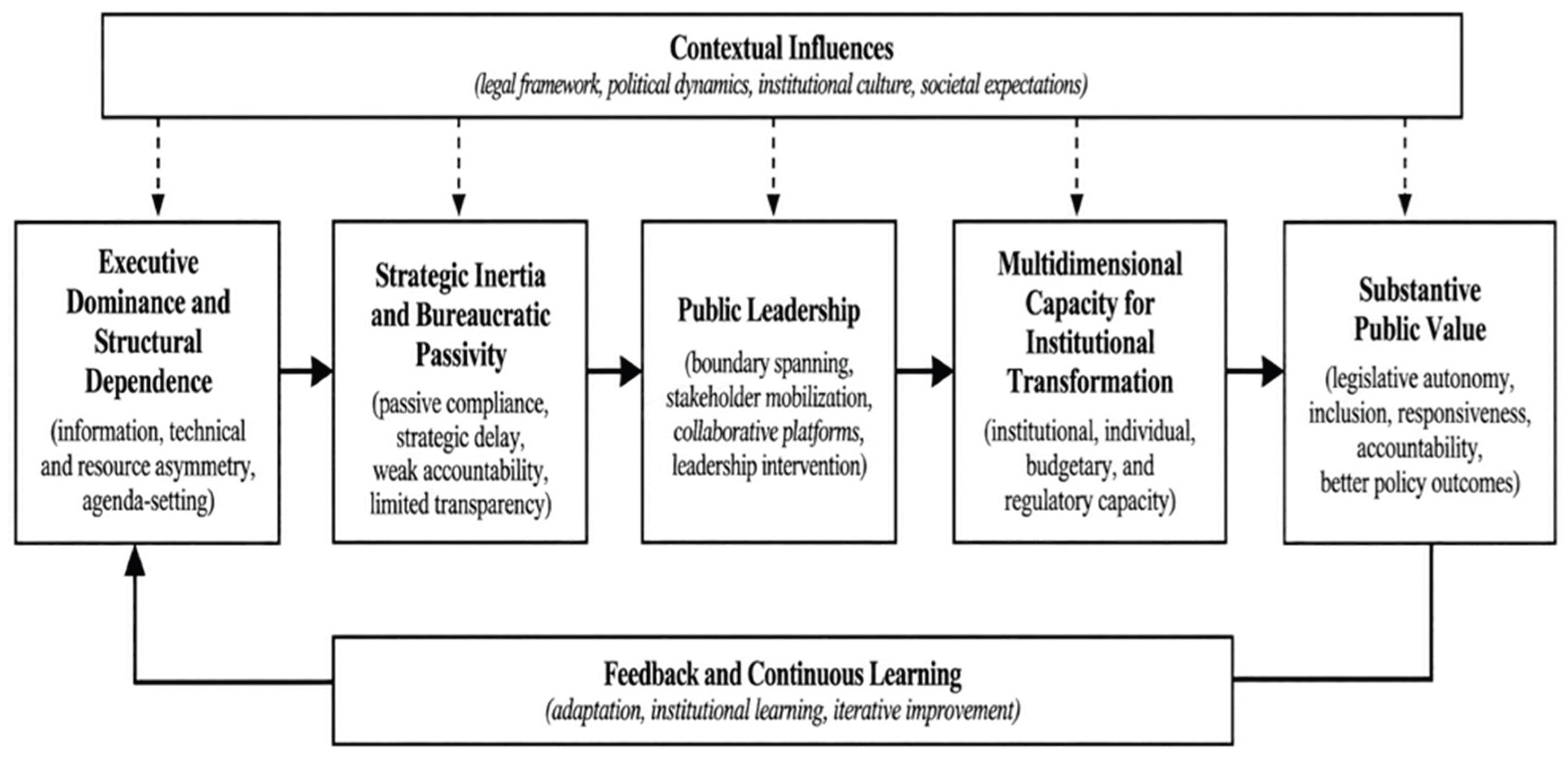
Table 1.
Semi-structured interview guide and analytical domains.
| Analytical Domain | Guiding Interview Questions |
|---|---|
| Executive dominance and structural dependence | How would you describe the relationship between the DPRD and the executive in legislative decision-making? What factors influence the balance of authority, information, and resources between these institutions? |
| Information and resource asymmetry | To what extent does the DPRD have independent access to policy information, technical expertise, administrative support, and other resources required for legislative functions? |
| Strategic inertia | Are there situations in which legislative processes tend to maintain existing routines despite changing policy or community needs? What factors contribute to this condition? |
| Bureaucratic passivity | How does bureaucratic or administrative behavior affect legislative initiative, responsiveness, oversight, and decision-making? |
| Public leadership | What forms of leadership contribute to overcoming institutional passivity or established routines? How do legislative actors mobilize internal and external stakeholders? |
| Collaborative governance | How are executive agencies, civil society, academics, community representatives, and other stakeholders involved in legislative processes? |
| Institutional capacity | What institutional arrangements support or constrain the DPRD in performing its legislative, budgeting, oversight, and representative functions? |
| Individual capacity | What knowledge, skills, expertise, and professional competencies are required to strengthen legislative performance? |
| Budgetary capacity | How do financial resources and budgetary arrangements affect legislative autonomy and institutional performance? |
| Regulatory capacity | To what extent do existing rules and procedures facilitate or constrain legislative initiative and institutional transformation? |
| Public value | What changes would indicate that legislative processes are becoming more responsive, inclusive, transparent, accountable, and beneficial to the public? |
| Institutional transformation | What reforms or institutional changes are necessary to reduce strategic inertia and strengthen the substantive role of the DPRD? |
Table 2.
Participant categories in the qualitative study (n = 35).
| Participant category | Code | n |
|---|---|---|
| Legislative members/leaders | IL | 12 |
| Legislative secretariat/support personnel | LS | 7 |
| Executive/government representatives | EX | 6 |
| Academic/legal-policy experts | AE | 5 |
| Civil society/stakeholder representatives | CS | 5 |
| Total | 35 |
Table 3.
Major themes and subthemes identified in the qualitative analysis.
| Major theme | Principal subthemes |
|---|---|
| Executive dominance and structural dependence | Information asymmetry; technical and resource asymmetry; executive agenda-setting dominance; legislative dependency |
| Strategic inertia and bureaucratic passivity | Passive compliance; strategic delay; weak internal accountability; limited transparency; reactive policymaking |
| Public leadership as a mechanism for disrupting inertia | Boundary-spanning leadership; stakeholder mobilization; collaborative platforms; leadership intervention; organizational behavioral change |
| Multidimensional capacity for institutional transformation | Institutional capacity; individual capacity; budgetary capacity; regulatory capacity; interaction among capacities |
| Transition from procedural compliance to substantive public value | Legislative autonomy; inclusive policymaking; responsiveness; outcome-oriented governance; public value creation |
Disclaimer/Publisher’s Note: The statements, opinions and data contained in all publications are solely those of the individual author(s) and contributor(s) and not of MDPI and/or the editor(s). MDPI and/or the editor(s) disclaim responsibility for any injury to people or property resulting from any ideas, methods, instructions or products referred to in the content. |
© 2026 by the authors. Licensee MDPI, Basel, Switzerland. This article is an open access article distributed under the terms and conditions of the Creative Commons Attribution (CC BY) license (http://creativecommons.org/licenses/by/4.0/).
Copyright: This open access article is published under a Creative Commons CC BY 4.0 license, which permit the free download, distribution, and reuse, provided that the author and preprint are cited in any reuse.