
Submitted:
29 September 2026
Posted:
01 October 2026
You are already at the latest version
Abstract
For nearly a century, piezoelectric materials have been extensively studied for their diverse applications, including sensors, actuators, energy harvesting systems, and biomedical devices. This paper explores the piezoelectric effect, along with the advantages and limitations of various material groups with a particular focus on the composite materials; and suggests potential solutions to address some of their challenges. This was done through combining information from a number of papers providing an overview of piezoelectric research. This study showed that while composites offer significant advantages in terms of performance, they also present certain challenges like low Curie temperatures, the difficulty to fabricate at nanoscale levels, and poor resistance to high temperatures and moisture; with the major challenge being the difficulty to balance flexibility and piezoelectricity in polymer composites. It was found that by incorporating the 3-3-3 connectivity design, both flexibility and high piezoelectric performance could be achieved. This means that this connectivity design is a viable solution for composites, without compromising between flexibility and a high piezoelectric constant. Future directions of research could focus on advancing material development, improving fabrication techniques, and integrating emerging technologies.
Keywords:
piezoelectric effect
; ceramics
; polymers
; connectivity
; structure
1. Introduction
The rapid advancements in science and engineering have created a growing demand for ultra-high precision positioning and motion control technologies. Piezoelectric actuators excel in this field by offering nanometer-scale resolution, fast response times, and resistance to magnetic interference [1]. For these reasons, there has been continuous research and development in the area of the piezoelectric effect ever since its discovery and demonstration in 1880 by Curie brothers [2].
Since its inception, piezoelectric materials have been divided into three groups: single crystal quartz, ceramics, and polymers. Each group has their inherent advantages and disadvantages, and over the last decades these materials have been combined to introduce a fourth group: composites. These composites were first introduced in 1972 by Kitayama-Nakamura in Japan [3], and combined several of the advantages of the ceramics & polymers. However, composite materials suffer from their own disadvantages, particularly in the usable temperature range.
This literature review aims to give an understanding of the piezoelectric effect and the performance advantages & limitations of related composites, particularly in relation to their material composition and performance degradation, while also examining potential solutions to some of these challenges. To achieve this, the review first provides an overview of the general piezoelectric effect in Section III. Then, Section IV takes a deep dive into three of the four main groups of piezoelectric materials—ceramics, polymers, and composites. Next, Section V explores potential future research directions, followed by Section VI, which presents the key findings alongside a summary of this review.
2. Method
A systematic search was conducted using Google Scholar, Connected Papers, and IEEE Xplore to identify appropriate sources for this literature review. The search was performed using advanced search options with the keywords: ’piezoelectric effect’, ’ceramic’, ’polymer’, composites’, ’limitations’, and ’performance’. To ensure the relevance of the literature, the publication date was restricted to 2019-2025 to filter out older sources.
Next, the abstracts of all retrieved articles were reviewed. Only articles that discussed at least one of the three materials (ceramics, polymers, or composites) in the context of piezoelectric actuators were included. In addition, articles that provided an explanation of the material properties, benefits, and challenges were selected. To gain further insight into the relevance and key findings of the articles, their conclusions were examined.
To gain broader perspectives, in particular on future developments, the discussion sections of selected articles were analyzed; with preference given to those that provided insights into advances and potential improvements in piezoelectric materials.
Finally, the selected articles were used to write the literature review.
3. The Piezoelectric Effect
The piezoelectric effect, defined by the decade long standing IEEE standard on piezoelectricity [4], may be classified as a linear electromechanical interaction; with the direct effect defined as the generation of electric charge in response to applied mechanical stress, and the indirect effect defined as the reverse [1,5]. Piezoelectricity only occurs in crystal structures that do not contain a point of symmetry at their center, often referred to as non-centrosymmetric. These non-centrosymmetric structures can either be found in nature, like quartz and berlinite, or can be engineered, like barium titanate. Figure 1 illustrates the direct piezoelectric effect by showing how external mechanical forces cause electric charges to separate and form a dipole in non-centrosymmetric materials, generating an electric field [5].
Piezoelectric materials are used in two primary modes of operation, as shown in Figure 2: longitudinal mode (), and transverse mode (). In the longitudinal mode, the compressive forces are parallel to the electric field, whereas in the transverse mode, the compressive forces are perpendicular to the electric field. Generally, is greater than , resulting in a higher voltage when bending in the longitudinal mode [5].
To determine the best material for specific applications, various Figures of Merit (FOMs) are used as listed below:
- Piezoelectric Charge/Strain : represents the relationship between charge density x and applied stress T, or between strain S and electric field E[5].
- Piezoelectric Voltage : represents the relationship between the induced electric field E and the externally applied stress T [5].
- Electromechanical Coupling Factor (): it is the ratio of stored energy to input energy for both the direct and indirect piezoelectric effects [5].
- Mechanical Quality Factor : it is defined as the ratio of energy stored and energy lost in a piezoelectric resonator, particularly in relation to rise in temperature [6].
- Acoustic Impedance : it describes the efficiency of sound wave coupling, based on material density and sound speed v [7].
- Curie Temperature: it is a transition temperature , above which the dipoles or dipole-like structure randomly orient themselves, leading to a complete loss of the piezoelectric response in the material [6,8]. A higher Curie temperature is preferred, since the piezoelectric constant monotonically increases with temperature until this transitional temperature [8].
4. Piezoelectric Materials
This section presents key piezoelectric materials, with a focus on ceramics, polymers, and composites. Although piezoelectric crystals are widely used, they are not included in this review due to the primary focus on composite materials.
4.1. Piezoelectric Ceramics
Ceramics are widely used as piezoelectric materials because they offer affordability, stability, and high piezoelectric performance. Piezoelectric ceramics often exhibit crystal structures of the form ABX, with A & B being positively charged ions, and X being a negatively charged ion. This gives them high electromechanical coupling coefficients, high piezoelectric constants, chemical stability, and high Curie temperatures; making these ceramics very attractive for the field of transducers, sensors, and actuators. However, this crystal structure also causes them to be stiff and brittle, making them unable to undergo extensive deformations [3,5]. Common commercially used piezoelectric ceramics are barium titanate (BT), aluminum nitride (AlN), and lead zirconate titanate (PZT); each with unique properties suitable for different applications. However, PZT remains the most widely used piezoelectric ceramic due to its superior performance and versatility [9,10].
However, there are downsides associated with piezoelectric ceramics, which significantly limits its use in certain applications. PZT’s high stiffness results in high resonant frequencies, making it unsuitable for harvesting energy from low-frequency environmental vibrations. Moreover, ceramics have the disadvantage that they can contain hazardous properties or lead compounds. Its possible lead content limits its use in biomedical applications, such as implants, due to potential health risks and environmental concerns [9,10]. New materials are being developed to make lead-free ceramics that also meet the desired piezoelectric properties [9].
4.2. Piezoelectric Polymers
Although the piezoelectric effect was traditionally associated with ceramics, the first non-ceramic material to exhibit this property was wood, discovered by Eiichi Fukada in the 1950s [11]. The discovery of polyvinylidene fluoride (PVDF) by Heiji Kawai in 1969 led to significant interest in piezoelectric polymers [12]. The polymers are classified into two types, semi-crystalline or amorphous. Semi-crystalline polymers, like PVDF, have ferroelectric crystals dispersed in an amorphous matrix. When exposed to high electric fields or poling—a process that enhances the piezoelectric properties of materials by exposing the material to high temperatures in combination with high electric fields [5]—their dipoles realign, enhancing their piezoelectric properties. In contrast, amorphous polymers lack the structured order needed for a strong piezoelectric response.
Present day piezoelectric polymers are increasingly recognized for their potential in various applications. They offer advantages such as flexibility, light weight, and shock absorption; making them suitable for wearable sensors. Additionally, they are biocompatible, ideal for biomedical applications, and can endure significant mechanical strain.
This makes them well-suited for dynamic environments, unlike stiff and brittle ceramics [5].
However, these materials have limitations. They lack mechanical strength, making them unsuitable for heavy loads. Their piezoelectric response decays faster than ceramics, and they cannot withstand high temperatures; this limits their use in extreme conditions. Most significantly, their relatively low piezoelectric coefficients reduce their efficiency in energy harvesting and sensing applications [5].
4.3. Composites
Piezoelectric composites are created by combining piezoelectric polymers and ceramics. By arranging these materials in a specific manner, their performance is improved for specific applications. This optimized structure improves flexibility, and increases the piezoelectric charge/strain constant, making them well-suited for applications requiring high sensitivity and flexibility [5].
Piezoelectric composite properties are adjusted through material proportions, connectivity, and structure. For example, polymers have low piezoelectric constants, but excellent acoustic compatibility with tissue and water; making them suitable for bio-electronics. In contrast, ceramics like PZT offer high piezoelectric constants, but poor acoustic compatibility and toxicity due to lead. Combining polymers with lead-free ceramics enhances piezoelectric performance, flexibility, and acoustic properties, making them promising for bio-electronic applications [5].
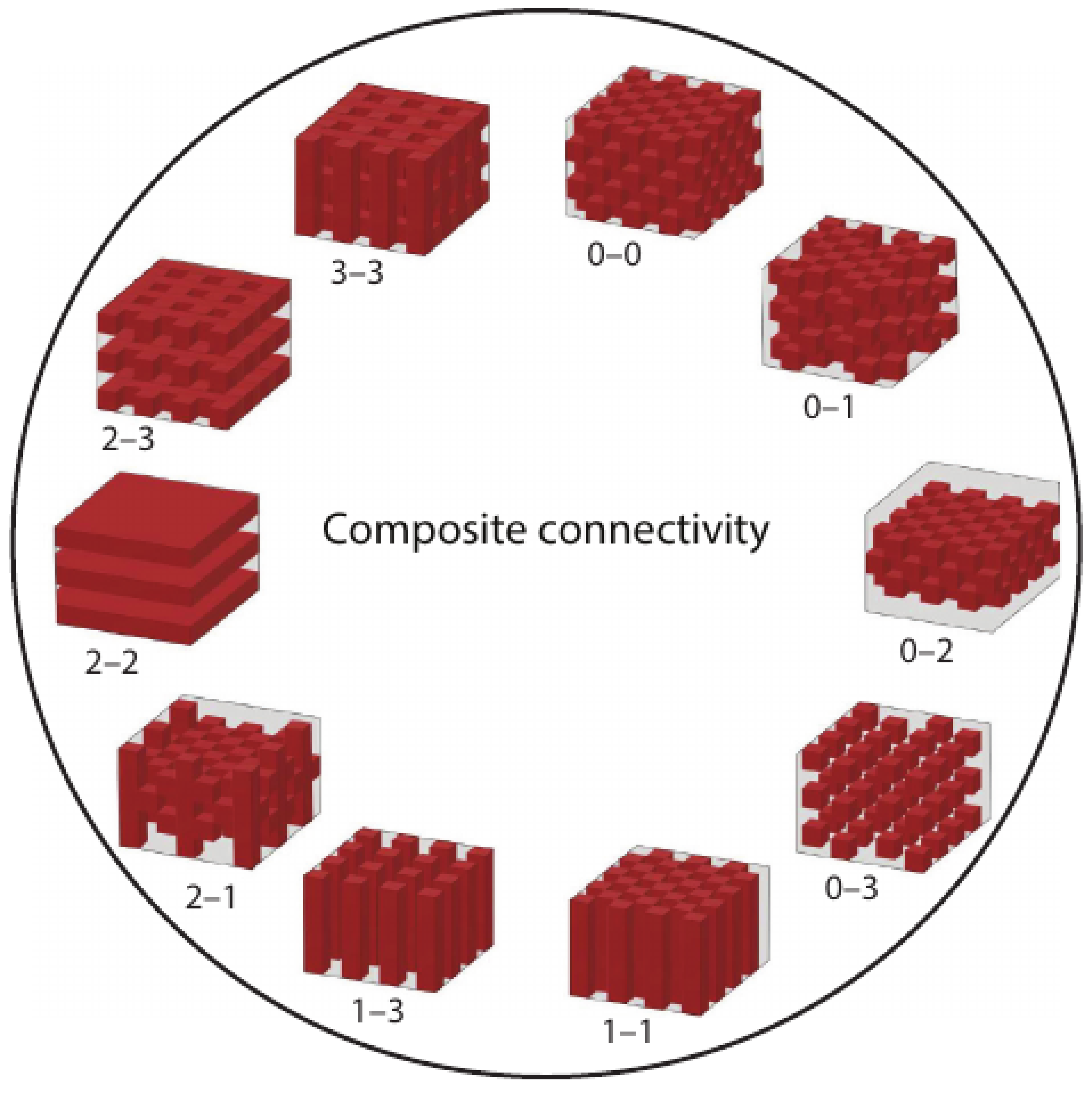
These piezoelectric composites consist of two phases: an active phase, typically ceramics used to generate the piezoelectric effect, and a passive phase, usually polymers used to enhance the mechanical flexibility and reduce acoustic impedance mismatch. Their connectivity, defined by m–n patterns, influences mechanical, electrical, and piezoelectric properties of the composite. Connectivity ranges from 0–0 (isolated particles) to 3–3 (fully interconnected networks), as illustrated in Figure 3. With 1–3 and 2–2 being the most common in practical applications due to their ease of manufacturing [2,5,8,13].
Engineers tailor phase connectivity in piezoelectric composites to balance piezoelectric response and flexibility for specific applications. The 1–3 type, with rod-like active structures in a passive matrix, is ideal for medical imaging and sonar due to its strong electromechanical coupling. In contrast, 2–2 composites—with alternating active and passive layers—provide better control over in-plane vibrations for directional piezoelectric responses. Choosing the right connectivity enhances acoustic impedance matching, mechanical durability, and overall efficiency, and is dependent on application [2,5,13].
Contemporary piezoelectric composites are increasingly explored for flexible energy harvesters in self-powered electronics, but face key challenges. First of all, their charge constant is much lower than monocrystalline ceramics, while lacking the flexibility of pure polymers. Nanoscale fabrication is also difficult, making material transfer to flexible substrates challenging [2,5,13]. Second, their low Curie temperature, usually ranging from 130–170°C, limits their use in extreme environments. Their performance is further reduced due to poor stress transfer from the polymer matrix to the ceramic phase [5].
Third of all, balancing flexibility and piezoelectric performance is difficult. Flexible 0–3 composites suffer from poor strain transfer, while high-performance composites are less flexible. The 3–3–3 connectivity design improves strain transfer while maintaining both properties [14].
5. Future Directions
Piezoelectric composites integrate the advantages of both polymers and ceramics. This makes them suitable for a wide range of applications, including energy harvesting, flexible electronics, and biomedical devices. Future research in this field can be broadly categorized into four key directions: Material developement, advancements in fabrication techniques, integration with emerging technologies, and application driven research.
Material development remains a major focus, particularly in the transition from lead-based ceramics like PZT to lead-free alternatives like potassium sodium niobate (KNN) and barium zirconate titanate (BZT), who offer environmental benefits [13]. Additionally, ongoing research explores biocompatible piezoelectric biomaterials to enhance their applicability in biomedical devices [15].
Alongside material advancements, there is growing interest in the development of advanced fabrication methods, such as 3D printing and nanoscale engineering, which enable the creation of highly efficient piezoelectric structures with enhanced performance [16].
Another significant research direction is the integration of piezoelectric materials with emerging technologies. One promising area is their fusion with AI and machine learning, which could lead to the development of self-powered sensing systems with adaptive learning capabilities. By combining energy harvesting with intelligent algorithms, these systems can process data and make informed decisions, paving the way for self-powered intelligent technologies [17].
Application-driven research is another critical focus in the field of piezoelectric composites, particularly in the development of flexible and stretchable piezoelectric materials. These advancements are particularly valuable for wearable electronics, biomedical implants, and soft robotics, where adaptability and efficiency are essential [18].
6. Conclusions
This article aimed to review the piezoelectric effect, the different material groups—ceramics, polymers and composites—and their respective advantages and disadvantages. This was done with an emphasis on composites, which offer great potential in enhancing the material properties to suit specific applications. However, composites also have their limitations, such as challenges in nanoscale fabrication, difficulty in transferring materials onto flexible substrate without damage, low Curie temperatures, and diminished performance due to poor stress transfer from the polymer matrix to the ceramic active component. This is especially present when the active component is inter-connected in a constrained number of dimensions.
The results of this research show that 3-3-3 connectivity design with a dielectric transition layer helps overcome the challenge of balancing flexibility and piezoelectric performance in composites; making them more suitable for advanced flexible electronics. Looking ahead, future directions can focus on material development, advancements in fabrication techniques, integration with emerging technologies, and application driven research. These efforts will help contribute to the creation of more efficient, sustainable, and intelligent systems across various fields.
References
- X. Zhou et al., “Review on piezoelectric actuators: materials, classifications, applications, and recent trends”, Frontiers of Mechanical Engineering, vol. 19, no. 1, Jan. 2024. [CrossRef]
- S. KATZIR, “The Discovery of the Piezoelectric Effect”, Archive for History of Exact Sciences, vol. 57, no. 1, pp. 61–91, Jan. 2003. [CrossRef]
- H. Dong, Z. Zhu, Z. Li, M. Li, and J. Chen, “Piezoelectric Composites: State-of-the-Art and Future Prospects”, JOM, vol. 76, no. 1, pp. 340–352, Nov. 2023. [CrossRef]
- "IEEE Standard on Piezoelectricity," in ANSI/IEEE Std 176-1987, vol., no., pp.0_1-, 1988. [CrossRef]
- M. Habib, I. Lantgios, and K. Hornbostel, “A review of ceramic, polymer and composite piezoelectric materials”, Journal of Physics D: Applied Physics, vol. 55, no. 42, p. 423002, Aug. 2022. [CrossRef]
- Z. Chen, L. Song, and W. Cao, “Characterization of high-power mechanical quality factor of piezoelectric ceramic discs under self-heating condition”, Journal of Materials Research and Technology, vol. 23, pp. 5040–5049, Mar. 2023. [CrossRef]
- W. Heywang, K. Lubitz, and W. Wersing, Piezoelectricity. Berlin, Heidelberg: Springer Berlin Heidelberg, 2008. [CrossRef]
- Giurgiutiu, V. (2014). Piezoelectric Materials: Effect of Temperature. In: Hetnarski, R.B. (eds) Encyclopedia of Thermal Stresses. Springer, Dordrecht. [CrossRef]
- A. Khorsand Zak, S. T. Yazdi, M. E. Abrishami, and A. M. Hashim, “A review on piezoelectric ceramics and nanostructures: fundamentals and fabrications”, Journal of the Australian Ceramic Society, Jan. 2024. [CrossRef]
- H. Jin et al., “Review on Piezoelectric Actuators Based on High-Performance Piezoelectric Materials”, IEEE Transactions on Ultrasonics, Ferroelectrics, and Frequency Control, vol. 69, no. 11, pp. 3057–3069, Nov. 2022. [CrossRef]
- E. Fukada, “Piezoelectricity of Wood”, Journal of the Physical Society of Japan, vol. 10, no. 2, pp. 149–154, Feb. 1955. [CrossRef]
- H. Kawai, “The Piezoelectricity of Poly (vinylidene Fluoride)”, Japanese Journal of Applied Physics, vol. 8, no. 7, p. 975, Jul. 1969. [CrossRef]
- P. Kabakov, T. Kim, Z. Cheng, X. Jiang, and S. Zhang, “The Versatility of Piezoelectric Composites”, Annual Review of Materials Research, vol. 53, no. 1, pp. 165–193, Jul. 2023. [CrossRef]
- A. Safari, “Overcoming the limits of piezoelectric composites”, National Science Review, vol. 10, no. 9, Aug. 2023. [CrossRef]
- S. Chen et al., “Piezoelectric Biomaterials Inspired by Nature for Applications in Biomedicine and Nanotechnology”, Advanced Materials, Jul. 2024. [CrossRef]
- F. Lv, Z. Hong, Z. Ahmad, H. Li, Y. Wu, and Y. Huang, “Design of Flexible Piezoelectric Nanocomposite for Energy Harvesters: A Review”, Energy Material Advances, vol. 4, Jan. 2023. [CrossRef]
- A. Alagumalai et al., “Self-powered sensing systems with learning capability”, Joule, vol. 6, no. 7, pp. 1475–1500, Jul. 2022. [CrossRef]
- J. Zhang, J. Wang, C. Zhong, Y. Zhang, Y. Qiu, and L. Qin, “Flexible Electronics: Advancements and Applications of Flexible Piezoelectric Composites in Modern Sensing Technologies,” Micromachines, vol. 15, no. 8, p. 982, Jul. 2024. [CrossRef]
Figure 1.
Polarization of a molecule & production of an electric field due to compressive forces [5].
Figure 1.
Polarization of a molecule & production of an electric field due to compressive forces [5].
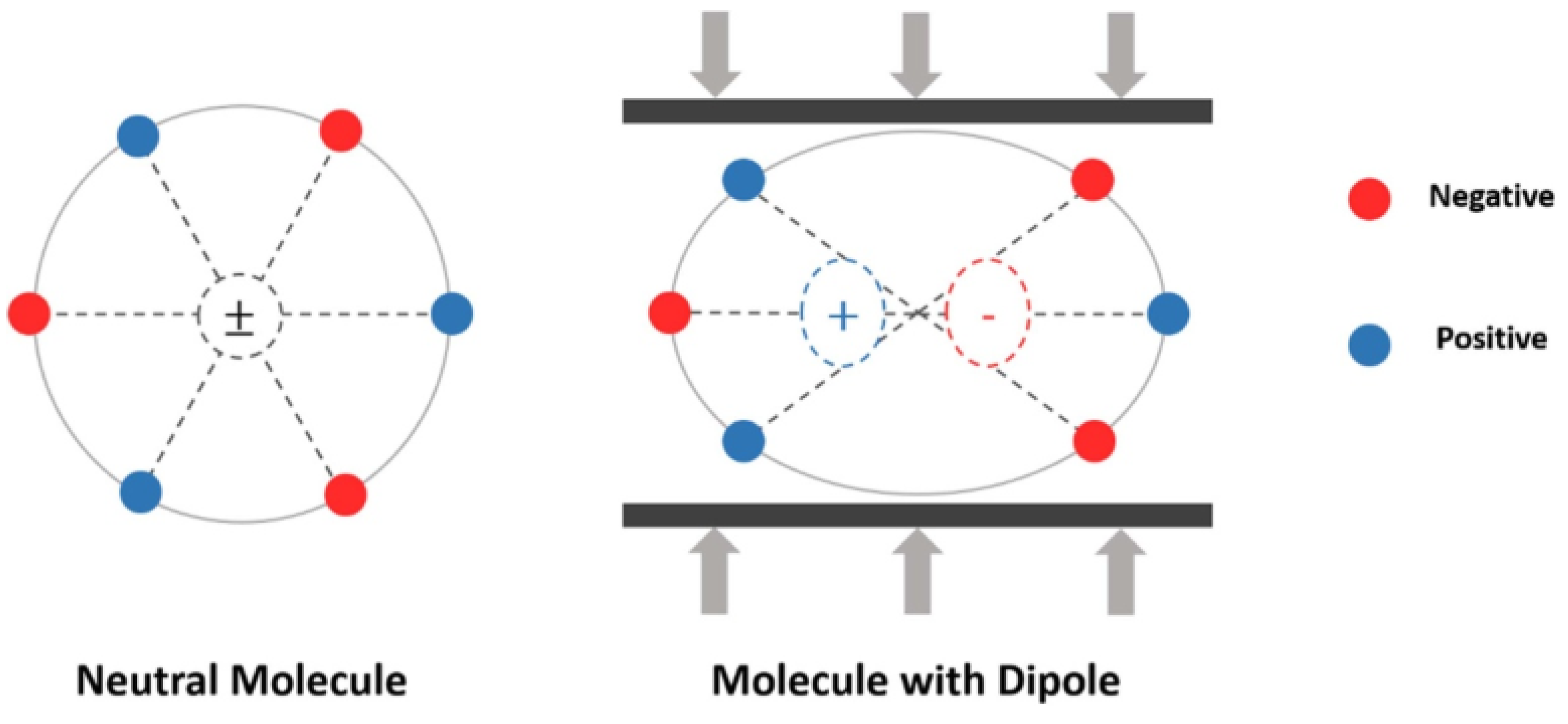
Figure 2.
Primary bending modes for piezoelectric materials: and [5].
Figure 2.
Primary bending modes for piezoelectric materials: and [5].
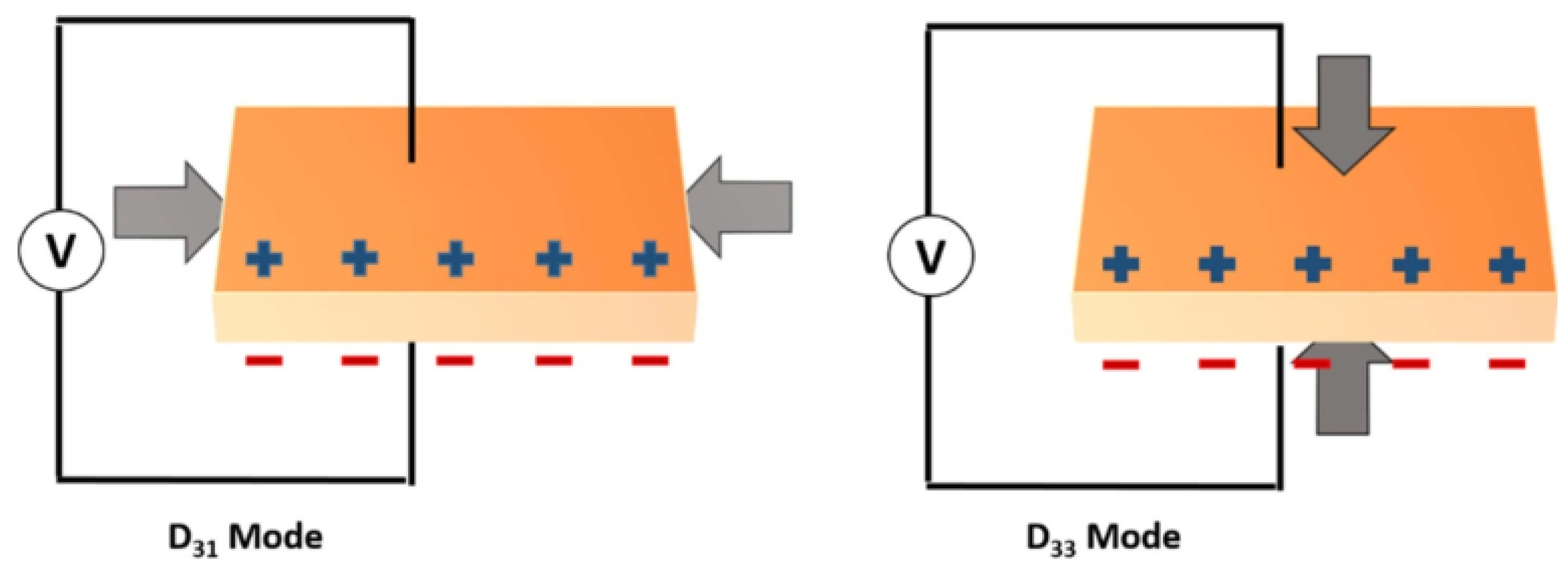
Figure 3.
Representation of the ten connectivity classifications of two-phase composites. The red section represents the active phase, and the grey outline the passive phase [13].
Figure 3.
Representation of the ten connectivity classifications of two-phase composites. The red section represents the active phase, and the grey outline the passive phase [13].
Disclaimer/Publisher’s Note: The statements, opinions and data contained in all publications are solely those of the individual author(s) and contributor(s) and not of MDPI and/or the editor(s). MDPI and/or the editor(s) disclaim responsibility for any injury to people or property resulting from any ideas, methods, instructions or products referred to in the content. |
© 2026 by the authors. Licensee MDPI, Basel, Switzerland. This article is an open access article distributed under the terms and conditions of the Creative Commons Attribution (CC BY) license (http://creativecommons.org/licenses/by/4.0/).
Copyright: This open access article is published under a Creative Commons CC BY 4.0 license, which permit the free download, distribution, and reuse, provided that the author and preprint are cited in any reuse.