
Submitted:
30 September 2026
Posted:
30 September 2026
You are already at the latest version
Abstract
The Middle Group (MG) chromitites of the Bushveld Complex host a substantial, largely untapped platinum-group element (PGE) resource, yet remain far less studied than the dominant UG2 chromitite and Merensky Reef. This review synthesises the published literature on the MG1–MG4A seams, covering stratigraphic setting, silicate and sulphide gangue mineralogy, platinum-group mineral and base-metal-sulphide relationships, and the comminution, flotation and comparative-metallurgy factors distinguishing MG processing from UG2 and Merensky practice, including the mineralogical drivers of circuit configuration and methods used to diagnose PGE losses to tailings. Four persistent gaps are identified: (i) absence of a reef-resolved PGM inventory across MG1–MG4A; (ii) limited data linking comminution and mineralogy to flotation reagent selectivity; (iii) an almost complete absence of published ore-blending studies; and (iv) a fragmented evidence base for MG-specific tailings reprocessing. Two recent, reef-resolved experimental studies from this research group are presented as a first step toward closing gaps (i) and (ii), and a three-part research agenda is set out a factorial blend-design programme, a standardised automated-mineralogy protocol, and an integrated gravity–magnetic–flotation circuit for MG tailings aimed at closing the remaining gaps and advancing Middle Group ore toward the geometallurgical maturity already achieved for UG2 and Merensky ore.
Keywords:
Middle Group chromitite
; Bushveld Complex
; platinum-group minerals
; base metal sulphides
; comparative metallurgy
; circuit configuration
; tailings valorisation
; ore blending
; flotation
; comminution
; review
1. Introduction
1.1. Background and Economic Context
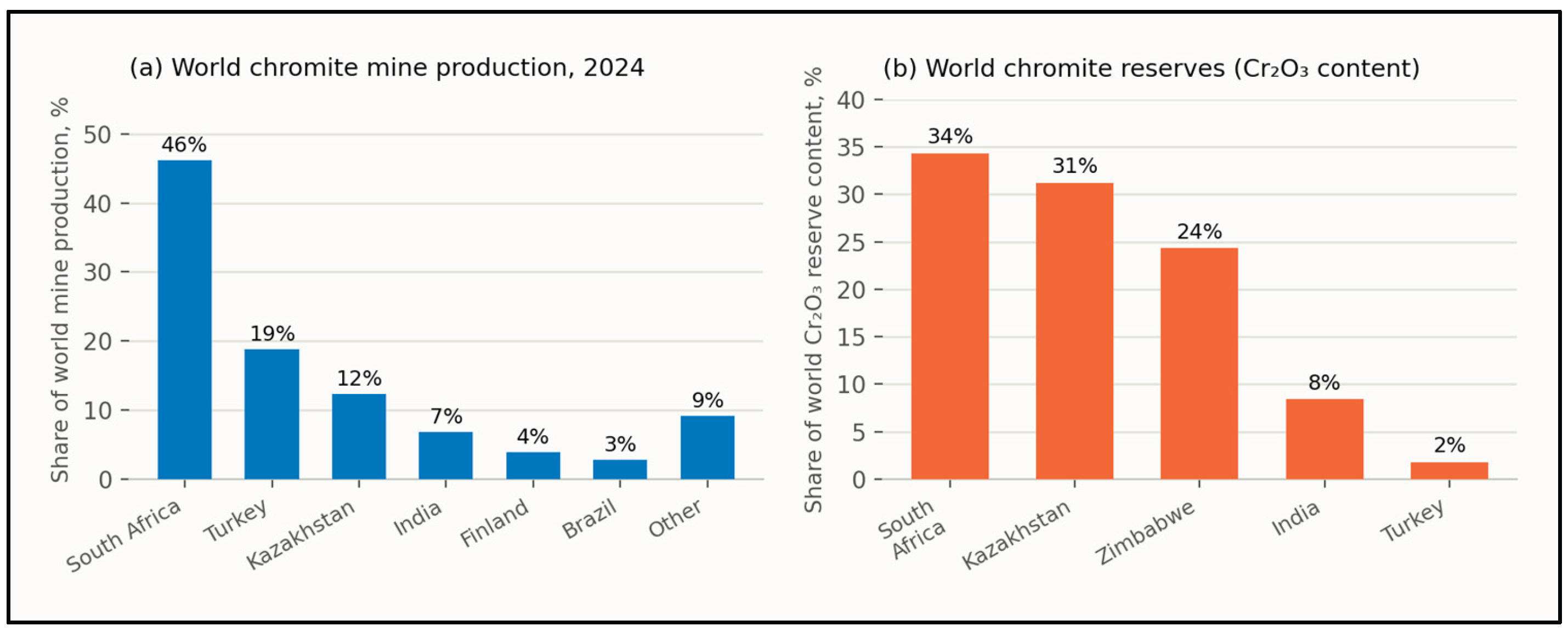
The Bushveld Igneous Complex, the world's largest layered mafic–ultramafic intrusion, hosts the majority of the world's known platinum-group element (PGE) resources and a substantial share of its chromite resources [1]. South Africa alone accounted for approximately 45% of world chromite production and around 40% of the global chromite reserve base in 2008, with domestic production of roughly 9.6 Mt against a reserve base of some 150 Mt [2]. The Bushveld Complex is estimated to host approximately 75% of the world's platinum resources, 52% of its palladium and 82% of its rhodium [2], making it, by a wide margin, the world's single most important PGE province.
Within the Bushveld Complex itself, PGE resources are unevenly distributed between the three principal reef horizons: the Merensky Reef accounts for approximately 32% of contained platinum, the UG2 chromitite approximately 58%, and the Platreef the remaining 10% [2]. Historically, PGE extraction has concentrated almost exclusively on the Merensky Reef and UG2, reflecting their relatively high and consistent grade, well-established mineralogy, and decades of operating history and metallurgical optimisation. As these higher-grade resources mature, deepen and deplete, and as producers face rising extraction costs and increasingly stringent tailings and water-management obligations, attention has progressively turned to alternative PGE-bearing horizons within the Critical Zone, including the Middle Group (MG) chromitite seams (MG1 through MG4A). Unlike UG2 and Merensky ore, MG chromitite is not the primary target of any dedicated concentrator on the scale of the major UG2/Merensky operations; where it is processed at all, it is typically mined as a secondary chromite product, blended with other feed, or reprocessed from historic tailings, rather than treated as a geometallurgically characterised ore in its own right. This economic and operational context a genuine, well-documented PGE and chromite endowment that remains commercially under-exploited relative to its Bushveld counterparts is the central motivation for this review.
Figure 1.
(a) World chromite mine production and (b) world chromite reserves (Cr₂O₃ content), by country [3].
Figure 1.
(a) World chromite mine production and (b) world chromite reserves (Cr₂O₃ content), by country [3].
1.2. Scope and Objectives of the Review
This review synthesises the currently available published literature on MG chromitite geology, mineralogical composition and characterisation, and metallurgical processing, and identifies where the evidence base is thin, contradictory, or simply absent. Its scope is deliberately restricted to the MG1–MG4A seam package of the Critical Zone; the Lower Group (LG) and Upper Group (UG1–UG3) chromitites, and the Merensky Reef, are discussed only where a direct comparison illuminates what is, or is not, distinctive about MG ore. The objective is threefold: first, to consolidate a fragmented literature drawing on dedicated MG studies, generalisations carried over from UG2/Merensky work, and, where such generalisation has not been directly verified for MG ore, to flag it as such; second, to identify, explicitly and systematically, where MG chromitite differs mineralogically and metallurgically from the better-studied Bushveld reefs, since these differences are precisely what determine whether UG2/Merensky process knowledge can be safely transferred to MG ore or must be re-derived; and third, to set out a concrete, prioritised research agenda capable of closing the most consequential of the identified gaps.
1.3. Paper Structure and Methodology
This review is based on a structured survey of the peer-reviewed and grey literature (theses, conference proceedings and industry technical reports) on MG chromitite geology, mineralogy and processing, supplemented by two primary geochemical data sources used throughout Section 2 and Section 3: a comprehensive PhD thesis reporting microprobe, SEM-EDX and mineral liberation analysis (MLA) data for the MG1–MG4C chromitite sequence at the Helena mine, eastern Bushveld Complex [4], and a multi-sector regional dataset of 465 whole-rock and 41 microprobe chromite analyses spanning the Lower and Middle Group chromitites across six structural sectors of the Complex [2]. Where a claim originates in a source that could not be independently verified against a traceable bibliography entry, this is flagged explicitly as an AUTHOR QUERY in the relevant section, following the convention established in the companion papers in this series.
The remainder of this review is organised as follows. Section 2 sets out the stratigraphic and structural setting of the MG1–MG4A seams within the Critical Zone. Section 3 reviews their silicate, sulphide and platinum-group mineralogy. Section 4 addresses metallurgical processing, culminating in a dedicated comparative-metallurgy treatment of MG ore against UG2 and Merensky practice and a discussion of the mineralogical drivers of circuit configuration and of methods used to diagnose PGE losses to tailings. Section 5 sets out four persistent gaps in the literature identified across Section 2, Section 3 and Section 4. Section 6 proposes a three-part strategic research agenda for the remaining work. Section 7 concludes.
2. Stratigraphic Setting and Geological Characteristics
2.1. The Critical Zone of the Bushveld Complex
The Bushveld Complex comprises three principal lithological units: mafic to ultramafic sills of the Rustenburg Layered Suite (RLS); the granophyres and granites of the overlying Lebowa Granite Suite and Rashoop Granophyre Suite; and associated volcanic rocks of the Rooiberg Group [1,5]. The RLS itself, dated to approximately 2.06 Ga [6], is the largest known layered intrusion, covering roughly 65,000 km² with a thickness of 7–9 km, and is exposed in five structurally distinct limbs (Western, Eastern, Northern, Far Western and the largely concealed Bethal limb) [1]. Vertically, the RLS is subdivided into the Marginal, Lower, Critical, Main and Upper Zones on the basis of cumulate mineralogy [1]. In the type stratigraphy of the north-western Bushveld, the Marginal Zone (0–800 m thick) is dominated by norite with minor pyroxenite; the overlying Lower Zone (800–1300 m thick) comprises orthopyroxenites, harzburgites and dunites; and the Critical Zone (1300–1800 m thick) is itself divided into a Lower Critical Zone, consisting primarily of orthopyroxenites, chromitites and some harzburgites, and an Upper Critical Zone, marked by the incoming of cumulus plagioclase [2].
The Middle Group chromitites occur within the Critical Zone, below the economically dominant UG2 seam and above the Lower Group chromitites, within a repetitively layered sequence of chromitite, pyroxenite, norite and anorthosite attributed to periodic magma replenishment and fractional crystallisation [1,7]. The mechanism by which individual chromitite layers were deposited on the chamber floor has long been contested, with competing models invoking gravity settling and in-situ crystallisation directly on the floor, versus kinetic sieving, metasomatic replacement or sill-like emplacement of chromite-laden slurry at depth within the pre-existing cumulate pile [7]. A recent, field-based re-examination of this question is directly relevant to the Middle Group specifically. Latypov, Chistyakova and Letsoele [8] document previously unreported 'magmatic dropstones' angular to tabular blocks of fine-grained melanorite/orthopyroxenite, ranging from centimetre-scale fragments to tabular bodies up to ~1 m thick and ~10 m long within the layered sequences that directly host the UG1, UG2 and MG2 chromitites of the Critical Zone. These blocks indent the chromitite and anorthosite layers beneath them and are draped by younger layers above, demonstrating that they fell through a resident melt column onto an already-differentiated, coherent chamber floor. Because the dropstones physically disrupt and are subsequently buried by chromitite layering at the MG2 horizon, their occurrence is presented as direct field evidence against the formation of massive Middle Group chromitite at depth within the cumulate pile, and in favour of chromite deposition directly on the temporary chamber floor from an episodically replenished, chromite-only-saturated magma [8]. This is among the more direct, MG-specific pieces of evidence bearing on chromitite-layer genesis identified in the course of this review, and materially narrows the set of formation models that remain viable for the MG seams specifically, as opposed to Bushveld chromitites in general.
2.2. Stratigraphy of the MG1–MG4A Chromitite Seams
The Middle Group comprises four principal chromitite horizons, although multiple layers of each may develop: MG1, MG2 (subdivided in places into MG2a, MG2b and MG2c), MG3 (with a local MG3a split) and MG4 (with a local MG4a split) [2]. The base of the Upper Critical Zone is defined by the appearance of cumulus plagioclase in a 1–3 m thick anorthosite marker, except at the eastern extremity of the western limb where this marker is absent. The MG1 and MG2 chromitites lie below this first anorthosite, hosted in feldspathic pyroxenites of the Lower Critical Zone, whereas the MG3 and MG4 chromitites occur above it, in norites of the Upper Critical Zone [2]. This lower/upper subdivision is geologically consequential rather than merely descriptive: it places MG1–MG2 and MG3–MG4 in different host-rock associations, and as the mineral-chemical data reviewed in Section 3.1 show on either side of a marked, upward compositional shift.
Regional compilation of borehole and outcrop data across the Eastern Limb, South-Western Limb, North-Western Limb and Far Western Bushveld sectors shows that not all MG horizons are developed, or have been documented, everywhere: MG1 and MG3 are the most consistently reported layers across sectors, while MG2a/b/c and MG4/4a are more sector-restricted, and the MG0 horizon (below MG1) is recognised only locally [2]. This uneven along-strike development is a first-order control on resource classification and is discussed further, together with seam-thickness variability, in Section 2.3. Figure 2 illustrates this sector-by-sector variability directly, showing the chromitite horizons and principal rock units intersected in representative boreholes across the Eastern, South-Western and North-Western Bushveld sectors.
Detailed stratigraphic and mineral-chemical logging of the full MG1–MG4C interval at the Helena mine (eastern Bushveld) confirms and refines this regional picture at reef scale [4]. Two shifts to more primitive orthopyroxene compositions (higher Mg#) are recorded, at the MG2B and MG4A horizons specifically, interpreted as pulses of more primitive magma entering the chamber at these levels a pattern that independently corroborates the chromite-chemistry evidence for episodic magma replenishment discussed in Section 3.1 [4].
Chromite chemistry itself provides an independent, regionally consistent record of this stratigraphic evolution. Across the 41 microprobe chromite analyses and six sectors compiled by Naldrett et al. [2], massive chromite from the Lower Group and lower Middle Group horizons (LG1–MG2a) defines a coherent trend of increasing Cr₂O₃ content and Cr/Fe ratio with stratigraphic height, attributed principally to reciprocal Cr–Fe²⁺ exchange between spinel and liquid; above the MG2a horizon this trend reverses, with Cr/Fe ratio and Cr₂O₃ content both declining slightly through the MG3–MG4a interval as the chemical potential of Al₂O₃ is buffered by the arrival of cumulus plagioclase [2]. This chromite-chemistry inflection sits at essentially the same stratigraphic level as the anorthosite marker used to define the base of the Upper Critical Zone (above), and independently corroborates it as a genuine petrogenetic boundary rather than an artefact of lithostratigraphic naming. PGE tenor tracks the same stratigraphic transition even more sharply: whole-rock Pt content is low (10–30 ppb) and relatively constant through the LG1–LG4 chromitites, jumps by more than an order of magnitude to 500–1000 ppb at LG5–LG6a, and rises further to 1000–2000 ppb through the MG2–MG4a interval before declining slightly in the UMG-1/UMG-2 chromitites above [2]. The (Pt+Pd)/(Rh+Ru+Ir+Os) ratio shows a parallel step-change, from 0.1–0.3 in the LG1–LG4 chromitites to 0.9–10 from LG5 upward, a pattern independently documented by earlier workers and interpreted as reflecting a change in the dominant PGE-concentration mechanism at this stratigraphic level rather than simple progressive enrichment [2]. Because the MG horizons sit entirely above this LG4/LG5 transition, every MG chromitite inherits the higher, Pt-enriched side of this step-change a first-order reason why MG ore, despite its low sulphur content (Section 3.3), nonetheless carries a metallurgically significant PGE tenor.
2.3. Along-Strike Morphological and Structural Variability
Field and borehole mapping across the Western and Eastern limbs shows that individual MG seams vary substantially in thickness, layer count and internal stratigraphy along strike. The MG1 seam, for example, is reported as a single layer everywhere it has been documented, but ranges from as little as 0.5–0.6 m thick at some Western Limb localities to 1.2–1.8 m elsewhere; the MG2 package similarly varies from a single 0.5 m layer to three layers totalling up to 2.8 m, and the intervening anorthosite parting between MG2 and MG3 ranges from 0.5 m to 5–10 m. This along-strike variability in seam thickness, layer count and interburden composition is a first-order consideration for resource estimation and mine planning, and implies that mineralogical or metallurgical characterisation performed on one locality's MG seam cannot automatically be assumed to represent the same seam elsewhere in the Complex.
This locality dependence is corroborated at a regional scale by the sector-by-sector chromitite inventory compiled by Naldrett et al. [2] (Section 2.2), which shows that the specific complement of MG horizons present, and by extension the thickness and internal layering of the MG package as a whole, differs systematically between the Eastern, South-Western, North-Western and Far Western Bushveld sectors. Structurally, drilling immediately north of a major east–west trending fault in the North-Western Bushveld has been shown to disrupt the normal stratigraphic correlation of chromitite layers below the UG2 across a MG3-hosting borehole, including local absence of expected units and steep, fault-related contact dips, demonstrating that post-depositional faulting can locally override primary stratigraphic continuity as a control on MG seam correlation [2].
3. Mineralogical Profiles and Assemblages
3.1. Silicate and Sulphide Gangue Mineralogy
Middle Group chromitites are silicate-dominated rocks in which chromite is typically a subordinate, though locally major, phase. Reported assemblages are consistently dominated by orthopyroxene (enstatite/bronzite) and plagioclase feldspar, with chromite, talc, serpentine, chlorite, mica and minor sulphides making up the remainder [9]. A reef-resolved XRD and modal-mineralogy dataset for the MG1–MG4A sequence specifically reported in a companion paper in this series confirms this general pattern and further shows that talc and serpentine, the two principal secondary alteration phases, are unevenly distributed between reefs, with implications for flotation gangue management discussed in Section 4.2. Independent XRD characterisation of South African MG-seam plant tailings corroborates the same gangue and chromite mineralogy at bulk-plant scale, identifying magnesiochromite and chromite as the dominant Cr-bearing phases alongside catena-silicate (pyroxene-group), spinel, magnesioferrite, fayalite, quartz and magnetite, with a bulk specific gravity of 3.5 [10]. Figure 3 places this MG gangue assemblage alongside the modal mineralogy reported in the literature for the Merensky Reef, UG2 and Platreef, illustrating that MG ore's chromite-rich, orthopyroxene-bearing gangue signature is distinct from that of the two better-studied Bushveld reefs, a distinction taken up in the comparative-metallurgy discussion of Section 4.3.
Detailed microprobe characterisation of intercumulus plagioclase within the MG1–MG4C chromitite layers at Helena mine resolves this gangue assemblage further and identifies systematic stratigraphic trends not previously reported at reef scale [4]. Plagioclase occurs as two compositionally distinct populations in every chromitite layer analysed: a volumetrically dominant, calcium-rich population (average An₆₆₋₉₂, i.e. bytownite to anorthite) and a subordinate, sodium-rich population (average An₉₋₃₈, i.e. albite–oligoclase) found exclusively as silicate inclusions within chromite grains rather than in the intercumulus matrix. The anorthite content (%An) of the Ca-rich population increases upward through the Lower Critical Zone (MG1–MG2), consistent with reverse fractionation, before reversing to a marked decrease in %An (i.e. evolution toward more sodic compositions) through the MG3–MG4 interval of the Upper Critical Zone, before increasing sharply again within the MG4C layer itself [4]. Associated orthopyroxene is intercumulus to chromite (locally poikilitically enclosing it) and plots within the enstatite field; its magnesium number (Mg#) decreases gently upward through the sequence, consistent with progressive fractional crystallisation, punctuated by two localised reversals to higher Mg# at the MG2B and MG4A horizons that are interpreted as pulses of primitive magma recharge (Section 2.2) and that coincide with independent evidence for magma replenishment from chromite chemistry [4]. Both plagioclase and orthopyroxene show geochemically coherent element correlations (e.g. negative CaO–Na₂O correlation in plagioclase, consistent with coupled substitution and, over a restricted MG3–MG4A interval, fractional crystallisation) rather than random scatter, indicating that the silicate gangue assemblage, and not only the chromite itself, carries a coherent primary petrogenetic signal that is in principle recoverable at reef scale. Locally elevated Fe content (approximately 4–6 wt% Fe₂O₃) is observed in plagioclase immediately adjacent to base metal sulphide (BMS) grains, attributed to secondary, post-magmatic overprinting rather than primary crystallisation chemistry [4]; this secondary alteration halo is discussed further, together with the BMS assemblage itself, in Section 3.3.
3.2. Platinum-Group Mineral (PGM) Distribution and Modes of Occurrence
Ore-microscopy studies of MG chromitites from the Western Limb identify laurite (RuS₂) as a dominant PGE-bearing phase, typically occurring as inclusions within chromite grains, alongside PGE-sulfarsenides and PGE-sulphides in inter-cumulus silicates [13]. Subsequent work on the Eastern Bushveld Complex identified Pt–Fe alloys, laurite and braggite/cooperite as the dominant PGE minerals in MG chromitites there [14], while a detailed study of the Lower and Middle Group chromitites of the western Bushveld Complex confirmed a PGE-sulphide-dominated assemblage with laurite as the most common discrete PGM [12]. A complementary study of flotation concentrates from the LG-6 and MG-1/2 chromitites of the eastern Bushveld Complex [15] independently corroborates this picture, identifying cooperite/braggite, laurite, malanite/cuprorhodsite, sulfarsenides, sperrylite and Pt–Fe alloys as the dominant PGM, with base-metal sulphides present only as minor, mainly interstitial grains and the great majority of the PGE inventory hosted as discrete PGM rather than in solid solution in sulphides.
Most recently, an automated-mineralogy (MLA) study of a western-limb MG1–4 chromite tailings sample identified 15 discrete PGM species by SEM/EDX across 160 intersected grains, and found the PGM population to be dominated by the PGE-sulphides braggite and cooperite (63.6 vol% combined, of which braggite (Pt,Pd,Ni)S alone accounted for 47.9 vol%), followed by laurite RuS₂ (17.3 vol%), PGE-sulfarsenides (10.4 vol%, principally ruarsite and irarsite), PGE-alloys (4.1 vol%, principally ferroplatinum), PGE-bismuth tellurides (3.3 vol%, principally michenerite) and PGE-arsenides (1.3 vol%, including sperrylite) [16]. For the MG1–4 chromite tailings sample, 95 of 118 measured PGM grains (81% by number) had an equivalent circular diameter below 6 µm, and the 3–6 µm size class alone carried the largest single share of PGM volume (26.4%); by mode of occurrence, 66.5 vol% of PGMs were liberated, 27.3 vol% were attached to or locked within silicate or oxide gangue composite particles, and 5.8 vol% were fully locked within gangue or oxide particles, with a combined liberation index (floatable-mineral area over total particle area) of 0.8–1.0 for 66.7 vol% of the population against a poorly liberated (<0.2) fraction of 30.8 vol% [16]. Correspondingly, 64.4 vol% of PGM grains fell into the fast-floating category, with the remainder split across slow-floating and non-floating categories. Fine PGM grain size, combined with a high proportion of grains locked within or complexly associated with silicate and chromite gangue, is repeatedly identified as the principal constraint on PGM recovery from MG ore, since ultra-fine, enclosed grains are effectively inaccessible to flotation reagents regardless of collector chemistry [16]. Independent MLA characterisation of the same PGM population by association type at Helena mine, discussed together with the BMS assemblage in Section 3.3, finds 25–48% of MG chromitite PGM associated with BMS, of which 1.7–25.5% are entirely enclosed within sulphide [4] a figure the primary literature explicitly contrasts with the substantially higher BMS-association reported for the Merensky Reef (Section 3.3), underscoring that MG PGM occurrence follows a distinct mineralisation pathway from the two better-studied Bushveld reefs rather than a scaled-down version of the same process. Table 1 sets this MG PGM speciation alongside literature values for the Merensky Reef, UG2 and Platreef, grouped into broad mineral classes (sulphides, tellurides, arsenides, alloys and other/unclassified phases).
3.3. Base Metal Sulphide (BMS) Relationships
The base metal sulphide (BMS) assemblage of the MG chromitites is thin, texturally varied and in contrast to the Merensky Reef a subordinate rather than dominant host of the PGE inventory. SEM-EDX and MLA characterisation of the MG1–MG4C sequence at Helena mine identifies chalcopyrite, pentlandite, pyrite and millerite (a low-temperature, secondary Ni-sulphide) as the principal BMS phases, with pyrrhotite present only in trace amounts [4]. The relative abundance of these phases varies systematically with stratigraphic height: chalcopyrite abundance decreases from MG1 to MG2B while pyrite and pentlandite increase over the same interval; the MG3 and MG4A chromitites host proportionally more pyrite relative to chalcopyrite than the MG2C chromitite; and, in the silicate-rich fraction specifically, pentlandite dominates in the lowermost layers (MG1–MG2C) while millerite interpreted as a pentlandite alteration product stable below approximately 379 °C dominates in the layers above (MG3–MG4C), with pentlandite becoming correspondingly scarce [4]. This BMS assemblage, and in particular the near-total absence of pyrrhotite, is broadly consistent with earlier petrographic work identifying chalcopyrite as the most abundant BMS in MG chromitites, with pyrite common, pyrrhotite essentially absent, and pentlandite comparatively rare [17] a distinctive Bushveld MG signature, since pyrrhotite is normally regarded as part of the primary magmatic BMS assemblage in layered intrusions.
Chemically, the BMS phases show measurable deviation from ideal stoichiometry consistent with post-magmatic modification: analysed pentlandite carries approximately 6 wt% more Ni than the norm composition, while chalcopyrite scatters around, but does not depart substantially from, its norm composition [4]. Maximum thermal stability limits for the assemblage chalcopyrite to 557 °C, pentlandite to 610 °C, pyrite to 743 °C together with millerite's low-temperature (<379 °C) stability field, constrain the alteration of this assemblage to a relatively low-temperature, likely sub-solidus to hydrothermal, overprint rather than a primary magmatic feature [4].
The relationship between this BMS assemblage and the PGM population is central to understanding MG mineralisation and directly informs the comparative-metallurgy discussion in Section 4.3. High-resolution X-ray computed tomography of Merensky Reef chromitites shows that 95–97% of PGM are closely associated with BMS, predominantly located at grain boundaries between sulphide and other phases, with less than 0.7% entirely enclosed within sulphide [18]. By contrast, MLA characterisation of the MG chromitite sequence at Helena mine finds only 25–48% of PGM associated with BMS, of which a comparatively larger proportion (1.7–25.5%) is entirely enclosed within sulphide [4]. Since the Merensky Reef BMS assemblage is dominated by pyrrhotite and pentlandite with only minor chalcopyrite and pyrite the converse of the chalcopyrite/pyrite-dominated, pyrrhotite-poor MG assemblage documented above a straightforward extrapolation would predict the Merensky assemblage to favour Os-, Ir-, Ru- and Rh-bearing PGM (laurite, Rh-bearing phases) over Pt–Pd sulphides, and the MG assemblage the reverse; the MG PGM population does not show this pattern (Section 3.2), and SEM data show that only a very small proportion of the total PGE budget (under 1% of modal composition) resides in solid solution within the BMS itself [4]. This mismatch between BMS chemistry and PGM speciation indicates that BMS composition alone is not a reliable predictor of PGM assemblage in MG chromitite, and that PGM formation is governed at least as much by local, interface-scale phenomena as by the bulk chemistry of the associated sulphide [4,18]. Figure 4 sets the two figures side by side: MG chromitite carries roughly half the BMS-associated PGM fraction of the Merensky Reef, at best.
A further, and metallurgically consequential, contrast with the two better-studied Bushveld reefs concerns bulk sulphur content and its implications for the orthomagmatic PGE-collection model, in which an immiscible sulphide liquid scavenges PGE from a larger volume of silicate magma at a mass ratio described by the 'R-factor' (Naldrett, 1989, as discussed in [4]). The MG chromitites at Helena mine are markedly sulphur-poor, averaging only 28–78 ppm S, compared with approximately 926 ppm S reported for eastern-limb UG2 chromitite and 3400–4080 ppm S for western-limb Merensky Reef chromitites (Barnes and Maier, 2002, as reported in [4]). This order-of-magnitude difference implies that the MG chromitites could not have achieved a high R-factor through sulphide-liquid collection alone, and is consistent with an alternative or supplementary mineralisation mechanism direct chromite-controlled PGM nucleation combined with localised sulphur saturation, rather than large-volume sulphide-liquid scavenging previously proposed for other sulphur-poor chromitites below the UG2 [4]. This sulphur deficit, and its mechanistic consequences for how and where PGE are hosted, is one of the clearest first-order distinctions between MG ore and its two better-studied Bushveld counterparts, and is taken up directly in the comparative-metallurgy discussion of Section 4.3. Figure 5 shows the scale of this difference: on a logarithmic axis, MG chromitite carries roughly one to two orders of magnitude less bulk sulphur than UG2 and Merensky Reef chromitite respectively.
4. Metallurgical Processing Dynamics and Current Precedents
4.1. Comminution Behaviour and Liberation Kinetics
Comminution circuits for Bushveld PGM ore, including MG material, typically comprise two- or three-stage mill–float (MF2/MF3) circuits, with IsaMill-type fine grinding increasingly used either to improve mainstream flotation recovery (mainstream-inert grinding) or to boost concentrate grade in cleaner circuits (ultrafine grinding). Comminution behaviour of MG ore specifically has received limited dedicated study; a companion paper in this series provides Bond Ball and Rod Work Index, Bond Crushability Index, Uniaxial Compressive Strength, Bond Abrasion Index and JK drop-weight data for the MG1–MG4A sequence, and finds that comminution hardness varies substantially between reefs independently of bulk chromite content a finding with direct implications for plant design that has not, to our knowledge, been previously reported for this ore type. Table 2 situates this comminution behaviour within a broader comparative evaluation of lithology, comminution resistance, PGE/BMS grain size and liberation kinetics across the four principal Bushveld ore types.
A working industrial precedent for combined chromite/PGE recovery from Middle Group-bearing material already exists on the eastern limb. Sylvania Platinum Ltd. operates four plants (Doornbosch, Steelpoort, Lannex and Tweefontein) treating a combination of current chrome-mine arisings and historic tailings-dump stockpiles (average grade 1.5–5 g/t 4E) sourced from the LG-6 seam (Doornbosch, Steelpoort) and the MG-1, and locally MG-2, seams (Lannex, Tweefontein) [15]. Comminution and particle liberation are achieved by ball milling, after which the stream is split by gravity cyclone into a chromite-rich and a PGE-rich fraction: the chromite-rich fraction is upgraded through a series of spiral concentrators to a final product of 44% Cr₂O₃, while the PGE-rich fraction reports to a conventional flotation bank producing a high-grade PGE concentrate (flotation feed sized approximately 100% <75 µm, 80% <53 µm) at PGE recoveries close to 40% [15]. This flowsheet demonstrates, at commercial scale, that MG-bearing material can be processed as a dedicated gravity/flotation circuit distinct from a conventional mill–float PGM plant, and provides a concrete industrial reference point against which any future dedicated Middle Group comminution–flotation circuit design could be benchmarked (Section 6.3).
4.2. Flotation Performance and Reagent Selectivity
Because Middle Group ore is typically not treated in a dedicated plant but is processed through the same concentrator circuits, and largely the same reagent suites, used for UG2 ore, the substantial published literature on UG2 flotation reagent practice is directly transferable to MG ore rather than merely analogous to it. This is the basis on which this section draws primarily on O'Connor and Alexandrova's [24] comparative review of PGM flotation practice in South Africa and Russia, which we were able to obtain and verify directly for this review, rather than on the less traceable general reagent statements found in some MG-specific sources (see the query below).
O'Connor and Alexandrova [24] report that South African PGM flotation is generally conducted at the ore's natural pH of 8–9, using sodium isobutyl xanthate (SIBX) as the dominant collector with dosages reported as high as 100–300 g/t specifically for the low-sulphide, telluride/arsenide-rich Platreef ore, where high dosages are needed to recover the slower-floating telluride and arsenide PGMs Dowfroth 250 frother (40–60 g/t), carboxymethyl cellulose (CMC) depressant (200–300 g/t), copper sulphate activator (≈40 g/t, though its use is reportedly declining industry-wide) and sodium ethyl dithiophosphate (≈60 g/t), the latter now thought to act more as a froth modifier than a classical co-collector. Chromite is identified as the principal gangue-management challenge for UG2-type ore specifically, comprising 20–60% of the ore by mass and requiring the flotation concentrate to be held below approximately 3% chromite to avoid degrading downstream smelting performance; chromite is naturally hydrophilic and is understood to report to the concentrate predominantly by mechanical entrainment rather than true flotation [24].
Gangue and water chemistry are increasingly recognised as significant factors in PGM flotation selectivity: higher process-water ionic strength has been linked to increased froth stability, mass pull and water recovery, with corresponding gangue dilution [25]. This mechanism is of particular relevance to Middle Group ore given its variable talc and serpentine content (Section 3.1), though it has not, to our knowledge, been tested directly on MG material specifically. Two further aspects of flotation behaviour identified in this review and its companion mineralogical paper the influence of talc, serpentine and chlorite gangue on flotation selectivity, and the difficulty of recovering PGM species that respond poorly to conventional xanthate collection are not unique to the Bushveld Complex. A recent review of flotation of oxidised, near-surface Main Sulphide Zone ore from the Great Dyke, Zimbabwe [26] provides a directly relevant analogue on both counts, despite concerning a geologically distinct PGM deposit, because the underlying mineral-surface and gangue-chemistry mechanisms are general rather than deposit-specific. Nyabeze et al. [26] show that alteration-derived phyllosilicates degrade flotation selectivity for oxidised PGM ore through several coupled mechanisms acting simultaneously: talc's natural hydrophobicity drives non-selective froth recovery, while serpentine and chlorite increase pulp viscosity, alter froth drainage and increase entrainment and water recovery. They further review sulfidisation the electrochemical conversion of oxidised mineral surfaces to a sulfide-like layer capable of adsorbing conventional thiol collectors and hydroxamate collectors as emerging strategies for recovering valuable metals hosted outside a readily floatable sulphide matrix. While Middle Group ore is not reported as being oxidised in the same sense as near-surface Great Dyke material, the underlying problem valuable-metal grains hosted outside a readily floatable sulphide matrix is structurally the same challenge identified for the silicate- and chromite-hosted PGM fraction of MG ore in Section 3.2 and Section 3.3, and represents a plausible, untested avenue for future MG-specific reagent development.
4.3. Comparative Metallurgy: Distinguishing MG Processing from UG2 and Merensky Operations
Section 2 and Section 3 establish that MG chromitite differs from UG2 and Merensky ore along several independent, geologically grounded axes: stratigraphic position and host lithology (Section 2.2), bulk sulphur content and BMS mineralogy (Section 3.3), and PGM–sulphide association (Section 3.2 and Section 3.3). This subsection draws these threads together explicitly, since the metallurgical treatment of MG ore currently relies heavily on process knowledge developed for UG2 and Merensky material, and the validity of that transfer depends precisely on which of these differences turn out to be metallurgically consequential.
The most consequential single distinction is sulphur content and its consequence for PGE hosting. Merensky Reef chromitites (3400–4080 ppm S) and UG2 chromitite (926 ppm S) both carry substantially more sulphur than MG chromitite (28–78 ppm S, Section 3.3), and in the Merensky Reef specifically this translates into a PGM population that is overwhelmingly BMS-associated (95–97%; [18]), concentrated at BMS grain boundaries. Because conventional PGM flotation reagent suites (Section 4.2) are optimised around collecting BMS and BMS-attached PGM, a reef in which the great majority of PGE is BMS-hosted is, in principle, well matched to that collection strategy. MG ore is not such a reef: only 25–48% of its PGM are BMS-associated (Section 3.3), with the balance either liberated or hosted in silicate and chromite gangue (Section 3.2). This means that a conventional xanthate-based flotation circuit tuned to Merensky- or UG2-type BMS-hosted PGE inherently addresses a smaller fraction of the total MG PGE inventory than it does for the reefs it was originally optimised against, independent of any difference in liberation or reagent dosage a structural, mineralogically grounded reason to expect lower maximum attainable PGE recovery from MG ore under an unmodified UG2/Merensky reagent regime, rather than a reason attributable to inferior operating practice.
The second axis of difference is gangue mineralogy and its associated chemistry. UG2 ore's principal metallurgical challenge is chromite entrainment control (Section 4.2), managed by holding concentrate chromite content below approximately 3% [24]; this challenge is shared by MG ore, which is also chromite-hosted, but MG ore additionally carries the talc/serpentine/chlorite variability documented in Section 3.1, with the attendant hydrophobic-recovery and viscosity/entrainment mechanisms reviewed for analogous oxidised PGM ore in Section 4.2 [26]. Because this phyllosilicate gangue fraction is not a first-order concern for fresh UG2 or Merensky ore in the same way, MG-specific gangue-management strategy cannot simply be inherited from UG2 practice, even though the reagent suite itself (SIBX, CMC, copper sulphate) is shared.
The third axis is comminution behaviour. As noted in Section 4.1, comminution hardness of MG ore varies substantially between individual reefs independently of bulk chromite content a form of intra-reef heterogeneity that complicates the direct transfer of a single UG2- or Merensky-calibrated comminution circuit design to MG material, and that has, to our knowledge, no directly published UG2 or Merensky equivalent at comparable reef resolution.
Taken together, these three axes indicate that MG ore is not simply a lower-grade or smaller-scale analogue of UG2 or Merensky ore that can be processed by directly importing UG2/Merensky reagent suites and circuit designs, but a mineralogically and geochemically distinct ore type that happens to share a broadly similar reagent chemistry with UG2. The one point of genuine commercial convergence identified in this review is the Sylvania Platinum gravity/flotation flowsheet (Section 4.1), which explicitly treats LG-6 and MG-1/2 material through a dedicated, non-standard circuit rather than a conventional UG2-type mill–float plant [15] itself indirect commercial evidence that MG ore's distinct mineralogical character has already been recognised, in practice, as warranting departure from standard UG2/Merensky processing. A direct, side-by-side geometallurgical comparison of MG, UG2 and Merensky ore matched for sample provenance, reagent regime and analytical method has not, to our knowledge, been published, and represents a further, specific research need beyond the four gaps identified in Section 5, since it is a precondition for rigorously establishing which elements of UG2/Merensky process knowledge can, and cannot, be safely transferred to Middle Group ore. Table 3 summarises the three comparative-metallurgy axes developed above.
Which circuit configuration is appropriate for a given Bushveld PGM ore is not an arbitrary engineering choice: it follows directly from the ore's own mineral characteristics. As a recent review of PGM tailings valorisation puts it, metallurgical plant design and processing of Bushveld Complex PGE ores is primarily dependent on the ore's physical, petrographic and mineral characteristics, with the treatment flowsheet ultimately driven by the mineral characteristics of the dominant gangue, the potential PGM recovery, energy and reagent input requirements, and asset reliability [27]. Applied to the three axes of difference identified above, this principle explains why MG ore has, in practice, attracted a circuit configuration distinct from the UG2/Merensky mill–float baseline. Because MG PGM occur predominantly in silicates rather than in chromite (Section 3.2 and Section 3.3), chromite can be removed from the MG process stream by gravity separation without stripping PGM value alongside it an option that is far less attractive for UG2 ore, where chromite is itself the dominant host phase and PGM are more evenly distributed between silicate, chromite-boundary and BMS sites. Tharisa Minerals exploits precisely this distinction on its Eastern Bushveld MG operation: run-of-mine ore is crushed and milled, chromite is removed by a primary spiral gravity circuit ahead of flotation, the chromite-depleted stream reports to PGM rougher and cleaner flotation, and a secondary spiral circuit recovers a further, ultra-fine chromite concentrate from the flotation tailings because the PGMs in the MG ore mined by Tharisa Minerals occur in the silicates and are not associated with chromite, early chrome removal does not compromise downstream PGM recovery [28]. Figure 6 contrasts this gravity-integrated configuration with the generic mill–float (MF2) circuit used for UG2, Merensky and Platreef ore, and makes explicit the same structural point developed through Section 3 and Section 4: MG ore's distinct mineralogy does not merely change reagent dosages within a shared flowsheet, it changes which unit operations belong in the flowsheet at all, and in which order.
4.4. Diagnosing PGE Losses to Tailings: Deportment, Size-by-Size Assay and Mineralogical Monitoring
Understanding why value minerals report to tailings, rather than simply quantifying how much PGE is lost, requires characterising the rejected material directly rather than inferring its properties from head-grade and recovery figures alone [27]. Two mechanisms dominate the wider literature on PGM flotation tailings: surface oxidation of value minerals, which renders them less amenable to conventional thiol collection, and incomplete liberation, whereby PGM remain partially or wholly enclosed within gangue or oxide particles and cannot be exposed to reagents regardless of dosage [27]. The latter mechanism is directly analogous to the silicate- and chromite-hosted PGM fraction already documented for MG ore in Section 3.2 and Section 3.3: value PGE minerals reporting to tailings elsewhere in the Bushveld are predominantly associated with silicates, and PGM directly associated with silicates float very slowly and ultimately deport to the tailings as partially liberated grains or grains enclosed within gangue [27] a description that could stand, essentially unchanged, as a summary of the MG-specific liberation data already reviewed in Section 3.2 [16]. Across Bushveld PGM ore generally, flotation recovery of 85–88% is achievable for high-grade, fresh ore, falling below 70% for low-grade or weathered material, and a tailings grade of approximately 0.3–0.5 g/t 4E PGE is considered, in general, not extractable by flotation irrespective of feed grade a practical floor set by liberation and surface chemistry rather than by reagent optimisation [27]. Ultrafine grinding (80% passing <20 µm) in cleaner/recleaner circuits, and mainstream inert grinding (80% passing <45 µm) ahead of the main flotation bank the same IsaMill-type technology already discussed for Bushveld PGM circuits generally in Section 4.1 has been shown to reduce plant tailings grade to approximately 0.5–0.6 g/t 4E PGE at 88% recovery, by improving the liberation of partially locked, silicate-hosted PGM without generating excessive additional ultrafines [27]; this is a direct, quantitative illustration of why the fine-grinding route already flagged as relevant to MG ore (Section 4.1) is also the route most directly targeted at the specific loss mechanism silicate-locked PGM that dominates MG tailings.
Two complementary investigative approaches recur throughout this literature. The first is size-by-size (screen) assay of tailings material, which apportions the bulk tailings grade between size fractions to separate liberated from locked value: in one documented case, of a 0.5 g/t 4E plant tailings grade, size-by-size assay attributed 0.35 g/t 4E to locked PGM particles and only 0.15 g/t 4E to liberated PGM or PGM–BMS composites (Rule and Anyimadu, 2007, as reported in [27]) a direct, quantitative demonstration that a single bulk tailings grade conflates two metallurgically distinct populations with different retreatment prospects. No published size-by-size assay of MG-specific tailings was identified in the course of this review; given that Section 3.2 already documents a bimodal MG PGM population (66.5 vol% liberated versus 27.3 vol% attached to or locked within gangue; [16]), a size-by-size assay campaign on MG tailings is a direct, low-cost extension of existing sample material that would translate this liberation-index data into the size-fraction grade breakdown that Section 6.3's integrated circuit design requires. The second approach is mineralogical characterisation of tailings material sampled over time, since historic tailings deposits reflect the feed grade, gangue mineralogy and processing technology of the vintage in which they were deposited, rather than of current run-of-mine ore: legacy Bushveld PGE tailings average approximately 0.78 g/t 3E and 0.81 g/t 4E across decades of accumulated deposition [27], and, specifically for chromite-bearing tailings dams comparable to MG material, chromite and phyllosilicate alteration-mineral content have been shown to differ systematically and consistently between historic tailings-dam material and corresponding current run-of-mine feed ([29]; Section 5.4). Tracking this kind of mineralogical drift explicitly, vintage by vintage within a single MG-associated tailings deposit, rather than treating tailings mineralogy as a single bulk average, would extend the single-snapshot characterisation already available for MG tailings ([10,16]; Section 3.2 and Section 5.4) into the kind of time-resolved dataset needed to determine whether near-surface and deep tailings-dam material should be treated as a single reprocessing feed or scheduled separately. Complementary plant-scale flotation-circuit modelling tools, such as SUPASIM, provide a further diagnostic route by reconciling laboratory floatability measurements with observed plant recovery to locate where in a circuit rather than only how much value is being lost [30]; such modelling has not, to our knowledge, been applied to MG ore or MG tailings specifically, and represents a further methodological avenue for the integrated tailings study proposed in Section 6.3.
5. Identified Gaps in Current Literature
5.1. Gap 1: Absence of Reef-Resolved PGM Inventories Across the MG1–MG4A Sequence
Detailed PGM speciation, size distribution and mode-of-occurrence data exist for MG tailings material [16] and, at reef scale, for individual horizons at Helena mine on the eastern limb [4], but a single, complete, directly comparable dataset generated with consistent methodology and spanning fresh ore, concentrate and tailings across all four MG horizons (MG1–MG4A) on one locality has not been published. This is a significant limitation, since Section 2.3 establishes that individual MG seams vary substantially in thickness and internal stratigraphy along strike, and Section 3.2 and Section 3.3 show that PGM speciation and BMS association differ measurably between adjacent horizons at the one locality where they have been logged in detail [4]; without a reef-resolved dataset it is not possible to determine how far single-locality or single-horizon findings generalise across the MG1–MG4A package as a whole.
5.2. Gap 2: Lack of Direct Comminution–Mineralogy–Flotation Reagent Selectivity Links
Comminution and flotation behaviour of Bushveld PGM ore are generally studied separately, and where linked studies exist they typically concern UG2 or Merensky material. For Middle Group ore specifically, comminution hardness data (Section 4.1), mineralogical characterisation (Section 3.1, Section 3.2 and Section 3.3) and flotation reagent practice (Section 4.2) have, to our knowledge, not previously been reported jointly, on the same sample suite, in a form that would allow comminution and mineralogical variability to be directly linked to flotation reagent selectivity and dosage requirements for MG ore. This absence is a direct obstacle to the geometallurgical modelling needed to design a dedicated MG processing circuit, since it leaves open whether observed differences in flotation performance between MG horizons (where reported at all) reflect mineralogical differences, comminution-related liberation differences, or reagent-dosage effects.
5.3. Gap 3: Scarcity of Data on Ore-Blending Interactions (Additive vs. Non-Additive Effects)
Combining ore types of differing metallurgical character whether different MG seams, or MG blended with UG2 or Merensky feed is common industrial practice, generally on the assumption that blended metallurgical performance is the mass-weighted average of the individual components' performance. Evidence from other bulk-mineral industries suggests this additivity assumption does not always hold: blending studies on coal, for example, have found the Hardgrove Grindability Index to behave additively in some cases and strongly non-additively in others, particularly where the blended components differ substantially in the property being measured. No published, dedicated experimental study of MG-specific ore-blending behaviour testing whether flotation recovery, comminution hardness or reagent consumption of a blended MG feed is additive, antagonistic or synergistic was identified in the course of this review. Given that Middle Group ore is by nature typically processed as a blend of several seams, and that Section 4.3 identifies substantial mineralogical differences even between individual MG horizons, this represents a significant and directly addressable gap in the published literature.
5.4. Gap 4: Fragmented Evidence Base for MG-Specific Tailings Reprocessing
Several independent lines of evidence indicate that MG-associated tailings represent a viable secondary resource, but no single published study integrates them. Commercially, the Sylvania Platinum gravity/flotation circuit described in Section 4.1 already demonstrates that historic LG-6/MG-1/2 chrome tailings can be worked as a standalone chromite/PGE resource, achieving PGE recoveries near 40% from a dedicated, non-conventional flowsheet [15]. At laboratory scale, recent process-mineralogical work on comparable Bushveld chromite tailings dams [29] shows chromite contents of 43–67 wt% and phyllosilicate alteration-mineral (talc, serpentine, chlorite) contents that are consistently higher in tailings dams than in the corresponding run-of-mine feed, and finds that roughly half of the recoverable PGE inventory in such tailings is refractory to conventional sulphide flotation split between sulphide locked within silicate or chromite gangue and PGM associated with, but not liberated from, BMS, with a substantial proportion concentrated below 10 µm. They further demonstrate that sodium metasilicate (NaSi), used as a gangue dispersant/depressant in place of, or alongside, conventional CMC, can materially improve both concentrate grade and recovery on this material, in one case lifting 4E recovery from 57% to 71% while simultaneously improving the Cr₂O₃:4E selectivity ratio [29]. Separately, the automated-mineralogy characterisation of an actual MG1–4 tailings sample's PGM speciation and liberation (Section 3.2, [16]) quantifies exactly the kind of refractory, fine-grained, gangue-locked PGM population that a NaSi-type reagent strategy would need to address. Beyond these four results, Section 4.4 identifies two further investigative approaches size-by-size assay and time-resolved mineralogical monitoring of tailings that are well established for Bushveld PGM tailings generally [27] but have not yet been applied to MG-specific material, and that would sharpen any future integrated retreatment study of the kind proposed in Section 6.3. Finally, a dedicated South African case study demonstrates that the chromite fraction of Middle Group-type tailings can additionally be recovered through a purely physical, non-flotation route: a two-stage shaking-table/induced-roll magnetic-separator circuit, optimised by response surface methodology on genuine MG-seam plant tailings (19.86% Cr₂O₃, Cr/Fe 1.07), achieved 67.01% chromite recovery at 37% Cr₂O₃ and Cr/Fe 1.52 from the shaking table alone, rising to 79.02% recovery, 46.15% Cr₂O₃ and Cr/Fe 2.08 above the Cr/Fe ≥ 2 threshold generally required for ferrochrome-grade product when combined with magnetic separation [10]. Together, these four independent results (Sylvania's commercial precedent, McFadzean et al.'s refractory-PGE/NaSi laboratory evidence, Baloyi et al.'s PGM liberation data, and Kaseba's validated gravity/magnetic chromite circuit) demonstrate that MG tailings-specific reprocessing is both technically demonstrated, piecemeal, and economically plausible, but that no single study integrates PGM flotation, chromite gravity/magnetic recovery and detailed mineralogical characterisation on one MG1–MG4A tailings sample suite. Section 6.3 sets out how these four results could be combined into such an integrated study.
Table 4 summarises these four gaps against the current state of evidence.
6. A Strategic Research Agenda for Middle Group Chromitites
Section 5 and Section 6 together show that two of the four identified gaps are now being actively addressed by this research group on one sample suite, while two ore-blending behaviour and integrated tailings reprocessing (Section 5.3 and Section 5.4) remain effectively untouched in the published literature. This section sets out a three-part research agenda, prioritised in the order in which the evidence reviewed in Section 2, Section 3, Section 4 and Section 5 suggests it would be most productively pursued.
6.1. Factorial Blend-Design Frameworks for Mixed MG Horizons
Closing Gap 3 (Section 5.3) requires a dedicated experimental blend-design programme rather than incidental commentary on blending within a single-reef study. We propose a factorial or simplex-lattice mixture-design study, informed directly by the reef-to-reef liberation and comminution-hardness heterogeneity already demonstrated for the MG1–MG4A suite, that systematically varies the mass proportion of MG1, MG2, MG3 and MG4A (and, as a second phase, MG ore blended with UG2 or Merensky feed) in the flotation feed, and measures PGE recovery, concentrate grade, chromite entrainment and reagent consumption against the mass-weighted-average prediction derived from each component's individually measured performance. Liberation index, and hence expected floatability, differs substantially between individual MG reefs at comparable bulk grade, a mixture design of this kind is a precondition for determining whether blended MG performance is genuinely additive in which case existing single-reef data could, in principle, be used to predict blend performance directly or shows the kind of non-additive behaviour documented for blending in other bulk-mineral industries (Section 5.3), in which case blend ratio itself becomes a plant-design variable requiring its own optimisation. Design-of-experiments methodology already well established in other bulk-mineral blending literature (e.g. coal Hardgrove Grindability Index studies) provides a directly transferable statistical framework for this work.
6.2. Standardising Automated Mineralogy Datasets
Closing Gap 1 (Section 5.1) at a resolution that can be generalised across the Middle Group, rather than remaining locality-specific, requires that the automated-mineralogy (MLA/SEM-EDX) methodology already applied independently to MG tailings [16], to the Helena mine reef sequence [4], and to the MG1–MG4A suite in the companion papers in this series be consolidated into a single, standardised acquisition and classification protocol common PGM species classification scheme, consistent liberation-index and association-type definitions, and comparable particle-size binning so that datasets generated by different research groups, on different sample suites and localities, can be directly compared rather than only qualitatively cross-referenced, as has been necessary throughout Section 3.2 and Section 3.3 of this review. A standardised protocol of this kind would allow the single-locality, single-suite datasets already available (Section 3.2 and Section 3.3) to be extended, by independent research groups working to the same standard, into the genuinely reef-resolved, multi-locality inventory that Gap 1 requires, without each new study needing to re-establish basic classification conventions from first principles.
6.3. Designing an Integrated Gravity–Magnetic–Flotation Circuit for MG Tailings Reprocessing
Closing Gap 4 (Section 5.4) requires combining, on a single MG1–MG4A tailings sample suite, the four independent results reviewed in Section 5.4: Sylvania Platinum's demonstrated commercial gravity/flotation flowsheet for LG-6/MG-1/2 material (Section 4.1; [15]), the refractory-PGE and NaSi-reagent findings from comparable Bushveld chromite tailings dams [29], the fine-grained, gangue-locked PGM liberation data available for actual MG1–4 tailings [16], and the validated shaking-table/magnetic-separator chromite-recovery circuit developed specifically on MG-seam plant tailings [10]. We propose an integrated circuit concept in which chromite is first recovered from tailings by the gravity/magnetic route already validated by Kaseba [10] a reagent-free, low-cost step that reduces the mass and chromite load reporting downstream with the resulting chromite-depleted stream then treated by a conventional or NaSi-modified flotation circuit informed by the refractory-PGE characterisation of McFadzean et al. [29], targeting specifically the fine (<10 µm), gangue-locked PGM fraction already quantified by Baloyi et al. [16] for MG1–4 tailings. The pilot programme should incorporate the two diagnostic approaches identified in Section 4.4 size-by-size assay of the tailings feed at each processing stage, and time-resolved mineralogical monitoring across the sampled tailings profile so that the resulting circuit is benchmarked against a size- and vintage-resolved grade breakdown rather than against bulk tailings grade alone. Piloting such a circuit on a single, well-characterised MG1–MG4A tailings suite, with mineralogical characterisation at each stage using the standardised protocol, would deliver the first genuinely integrated MG tailings-reprocessing study identified as absent in Section 5.4, while directly building on, rather than duplicating, the four independent lines of evidence already available.
7. Conclusions and Outlook
Middle Group chromitites represent a strategically important but comparatively under-studied PGE resource within the Bushveld Complex, situated within a Critical Zone stratigraphy whose broad geological framework is well established but whose reef-specific detail stratigraphic position of individual MG horizons, along-strike morphological variability, and reef-to-reef mineralogical heterogeneity has only recently begun to be resolved at the resolution needed for geometallurgical planning. This review has shown that MG ore's silicate-dominated gangue mineralogy, PGE-sulphide-dominated but comparatively BMS-poor PGM assemblage, and markedly lower bulk sulphur content collectively distinguish it, on geological and mineralogical grounds, from the better-studied UG2 chromitite and Merensky Reef, and that this distinctiveness has direct, quantifiable metallurgical consequences (Section 4.3) rather than being a matter of academic classification alone. Two companion experimental papers in this series begin to close the most immediately addressable gaps in reef-resolved PGM inventory and comminution–mineralogy–flotation linkage; closing the remaining gaps in ore-blending behaviour and integrated tailings reprocessing will require the dedicated blend-design, standardised-mineralogy and integrated-circuit studies. Addressing these gaps is a prerequisite for developing a robust, ore-specific geometallurgical model capable of supporting sustainable exploitation of this resource as higher-grade Bushveld reserves continue to deplete, and for establishing, on rigorous comparative grounds rather than by inherited assumption, which elements of decades of UG2 and Merensky process knowledge can, and cannot, be safely transferred to the Middle Group chromitites.
Author Contributions
Conceptualization, P.C.S.; methodology, P.C.S.; investigation, P.C.S., M.L.T. and M.M.R.; resources, P.C.S. and M.M.R.; writing—original draft preparation, P.C.S.; writing—review and editing, M.L.T. and M.M.R.; supervision, M.M.R.; project administration, P.C.S. All authors have read and agreed to the published version of the manuscript.
Funding
This research received no external funding.
Institutional Review Board Statement
Not applicable.
Informed Consent Statement
Not applicable.
Data Availability Statement
No new primary data were generated for this review. The literature data discussed are available in the cited sources.
Acknowledgments
During the preparation of this manuscript, the author(s) used Claude (Anthropic) for figure preparation, and citation verification. The authors have reviewed and edited the output and take full responsibility for the content of this publication.
Conflicts of Interest
The authors declare no conflicts of interest.
Abbreviations
The following abbreviations are used in this manuscript:
| MG | Middle Group |
| PGE | Platinum-group element(s) |
| PGM | Platinum-group mineral(s) |
| BMS | Base-metal sulphide(s) |
| UG2 | Upper Group 2 chromitite |
| RLS | Rustenburg Layered Suite |
| XRD | X-ray diffraction |
| QEMSCAN | Quantitative Evaluation of Minerals by Scanning Electron Microscopy |
| MLA | Mineral liberation analysis |
| SEM-EDX | Scanning electron microscopy with energy-dispersive X-ray spectroscopy |
| CMC | Carboxymethyl cellulose |
| SIBX | Sodium isobutyl xanthate |
| 4E | Four-element PGE basket (Pt+Pd+Rh+Au) |
| MF2/MF3 | Two-/three-stage mill–float circuit |
References
- Cawthorn, R.G.; Eales, H.V.; Walraven, F.; Uken, R.; Watkeys, M.K. The Bushveld Complex. In Geology of South Africa; Johnson, M.R., Anhaeusser, C.R., Thomas, R.J., Eds.; Geological Society of South Africa, Council for Geoscience: Johannesburg, South Africa; Pretoria, South Africa, 2006; pp. 261–281. [Google Scholar]
- Naldrett, A.J.; Kinnaird, J.; Wilson, A.; Yudovskaya, M.; McQuade, S.; Chunnett, G.; Stanley, C. Chromite composition and PGE content of Bushveld chromitites: Part 1 – the Lower and Middle Groups. Appl. Earth Sci. (Trans. Inst. Min. Metall. B) 2009, 118(3/4), 131–159. [Google Scholar] [CrossRef]
- U.S. Geological Survey. Mineral Commodity Summaries 2026: Chromium; U.S. Geological Survey: Reston, VA, USA, 2026. [Google Scholar]
- Kottke-Levin, J. A Geochemical Study of the Middle Group Chromitites, Helena Mine, Bushveld Complex, South Africa. Ph.D. Thesis, University of the Free State, Bloemfontein, South Africa, 2011. [Google Scholar]
- South African Committee for Stratigraphy (SACS). Stratigraphy of Southern Africa, Part 1. Lithostratigraphy of South Africa, South West Africa/Namibia and the Republics of Bophuthatswana, Transkei and Venda. In Geological Survey of South Africa Handbook 8; Geological Survey of South Africa: Pretoria, South Africa, 1980. [Google Scholar]
- Walraven, F.; Armstrong, R.A.; Kruger, F.J. A chronostratigraphic framework for the north-central Kaapvaal Craton, the Bushveld Complex and Vredefort structure. Tectonophysics 1990, 171, 23–48. [Google Scholar] [CrossRef]
- Naldrett, A.; Wilson, A.; Kinnaird, J.; Yudovskaya, M.; Chunnett, G. The origin of chromites and related PGE mineralization in the Bushveld Complex: new mineralogical and petrological constraints. Mineral. Depos. 2012, 47, 209–232. [Google Scholar] [CrossRef]
- Latypov, R.; Chistyakova, S.; Letsoele, C. Massive chromitites of the Bushveld Complex, South Africa: A critical review of existing hypotheses. Earth-Sci. Rev. 2024, 256, 104858. [Google Scholar] [CrossRef]
- Maruli, M.; Nheta, W. Characterisation of South African Chromite Middle Group Seams. Mater. Metall. Min. Eng. (MMME) 2020. [Google Scholar] [CrossRef]
- Kaseba, C.N.Y.L. Optimization of Chromite Recovery from a South African Chromite Middle Group Seam Plant Tailings. Master's Dissertation, University of Johannesburg, Johannesburg, South Africa, 2023. [Google Scholar]
- Schouwstra, R.P.; Kinloch, E.D.; Feather, C.E. A short geological review of the Bushveld Complex. J. South. Afr. Inst. Min. Metall. 2000, 100(2), 101–122. [Google Scholar]
- Junge, M.; Oberthür, T.; Osbahr, I.; Gutter, P. Platinum-group elements and minerals in the Lower and Middle Group chromitites of the western Bushveld Complex, South Africa. Miner. Depos. 2016, 51, 841–852. [Google Scholar] [CrossRef]
- Merkle, R.K.W. Platinum-group minerals in the middle group of chromitite layers at Marikana, western Bushveld Complex: indications for collection mechanism and postmagmatic modification. Can. J. Earth Sci. 1992, 29, 209–221. [Google Scholar] [CrossRef]
- Kotzé, E.; Gauert, C. PGE-bearing minerals in chromitites of the Critical Zone (LG-6 to UG-3A) on Winterveld 293KT, Eastern Bushveld Complex. In Proceedings of the IMA 2014, Abstract Volume. Johannesburg, South Africa, 2014; p. 105. [Google Scholar]
- Oberthür, T.; Junge, M.; Rudashevsky, N.; de Meyer, E.; Gutter, P. Platinum-Group Minerals in the LG and MG Chromitites of the Eastern Bushveld Complex, South Africa. Miner. Depos. published online. 2016, 51(1), 71–87. [Google Scholar] [CrossRef]
- Baloyi, N.P.; Nheta, W.; Sibanda, V.; Safari, M. Mineralogical Insights into PGM Recovery from Middle Group (1–4) Chromite Tailings. Minerals 2024, 14, 924. [Google Scholar] [CrossRef]
- von Gruenewaldt, G.; Hatton, C.J.; Merkle, R.K.W.; Gain, S.B. Platinum-group element–chromitite associations in the Bushveld Complex. Econ. Geol. 1986, 81, 1067–1079. [Google Scholar] [CrossRef]
- Godel, B.; Barnes, S.-J. Platinum ore in three dimensions: Insights from high-resolution X-ray computed tomography. Geology 2010, 38, 1127–1130. [Google Scholar] [CrossRef]
- Dzvinamurungu, T.; Viljoen, K.S.; Knoper, M.W.; Meyer, F.M. Geometallurgical characterisation of Merensky Reef and UG2 at the Marikana Mine, Bushveld Complex, South Africa. Miner. Eng. 2013, 52, 74–81. [Google Scholar] [CrossRef]
- Solomon, N.; Viljoen, K.S.; Maritz, J. Challenges Related to the Processing of Fines in the Recovery of Platinum Group Minerals (PGMs). Minerals 2021, 11(5), 533. [Google Scholar] [CrossRef]
- Becker, M.; de Villiers, J.; Bradshaw, D. The mineralogy and crystallography of chromite from the UG2 reef, Bushveld Complex, South Africa. Miner. Eng. 2010, 23(4), 325–332. [Google Scholar]
- Corrans, I.J.; Harris, A.M.; Twidle, T.R. First operational treatment plant for the UG2 chromitite reef. Proc. 12th CMMI Congr. 1982, Vol. 2, 641–647. [Google Scholar]
- Liddell, K.S.; McRae, L.B.; Dunne, R.C. Process design for the flotation of platinum-group minerals from the UG-2 reef. J. South. Afr. Inst. Min. Metall. 1986, 86(11), 461–478. [Google Scholar]
- O'Connor, C.; Alexandrova, T. The Geological Occurrence, Mineralogy, and Processing by Flotation of Platinum Group Minerals (PGMs) in South Africa and Russia. Minerals 2021, 11, 54. [Google Scholar] [CrossRef]
- Corin, K.C.; Reddy, A.; Miyen, L.; Wiese, J.; Harris, P.J. The effect of ionic strength of plant water on gangue recovery in a platinum bearing ore. Miner. Eng. 2011, 24, 131–137. [Google Scholar] [CrossRef]
- Nyabeze, T.S.; Chipise, L.; Moimane, T.M.; Manono, M.S. A critical review on flotation of oxidised PGM ores in view of the processing of Great Dyke ores: A focus on sulfidisation and collectors. Miner. Eng. 2026, 249, 110710. [Google Scholar] [CrossRef]
- Gibson, B.A.K.K.; Nwaila, G.; Manzi, M.; Ghorbani, Y.; Ndlovu, S.; Petersen, J. The valorisation of platinum group metals from flotation tailings: A review of challenges and opportunities. Miner. Eng. 2023, 201, 108216. [Google Scholar] [CrossRef]
- Tharisa Minerals. Tharisa Minerals: Our Operations. Tharisa plc corporate website. Available online: https://www.tharisa.com/tharisa-minerals.php (accessed on 26 September 2026).
- McFadzean, B.; Becker, M.; Geldenhuys, S.; Patterson, N. Understanding the Nature of Challenges Posed in PGM Recovery from Secondary Tailings Resources. J. South. Afr. Inst. Min. Metall. 2026, 126(2), 119–124. [Google Scholar] [CrossRef]
- Hay, M.P. Using the SUPASIM flotation model to diagnose and understand flotation behaviour from laboratory through to plant. Miner. Eng. 2005, 18(8), 762–771. [Google Scholar] [CrossRef]
Figure 2.
The chromitite horizons and principal rock units intersected in representative boreholes across the Eastern, South-Western and North-Western Bushveld sectors (modified after [2]).
Figure 2.
The chromitite horizons and principal rock units intersected in representative boreholes across the Eastern, South-Western and North-Western Bushveld sectors (modified after [2]).
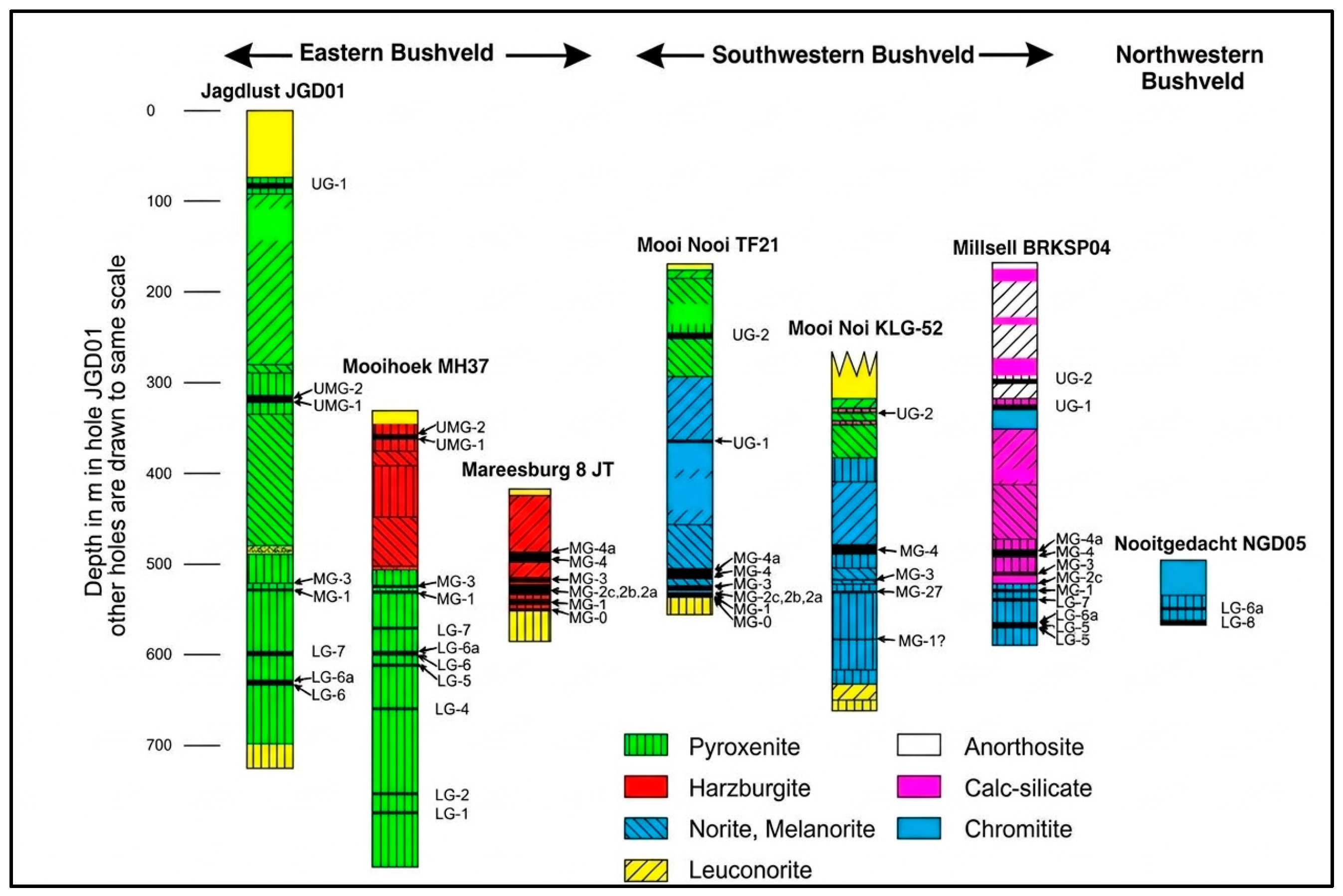
Figure 3.
Modal gangue mineralogy of Bushveld Merensky Reef, UG2, Platreef and Middle Group (MG) ore bodies, compiled from the literature [4,11,12].
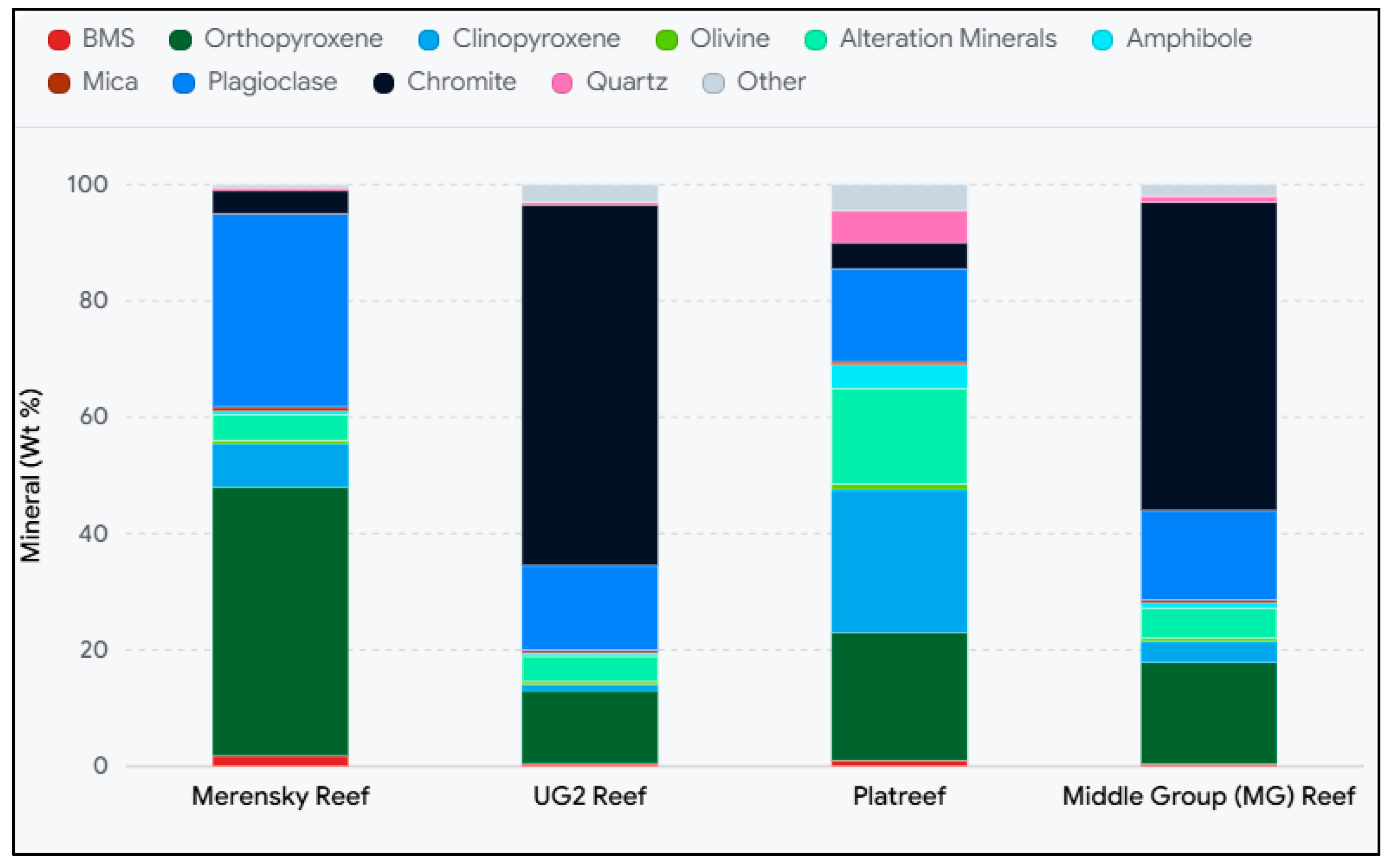
Figure 4.
Proportion of PGM associated with base-metal sulphide: Middle Group chromitite [4] versus Merensky Reef chromitite [18].
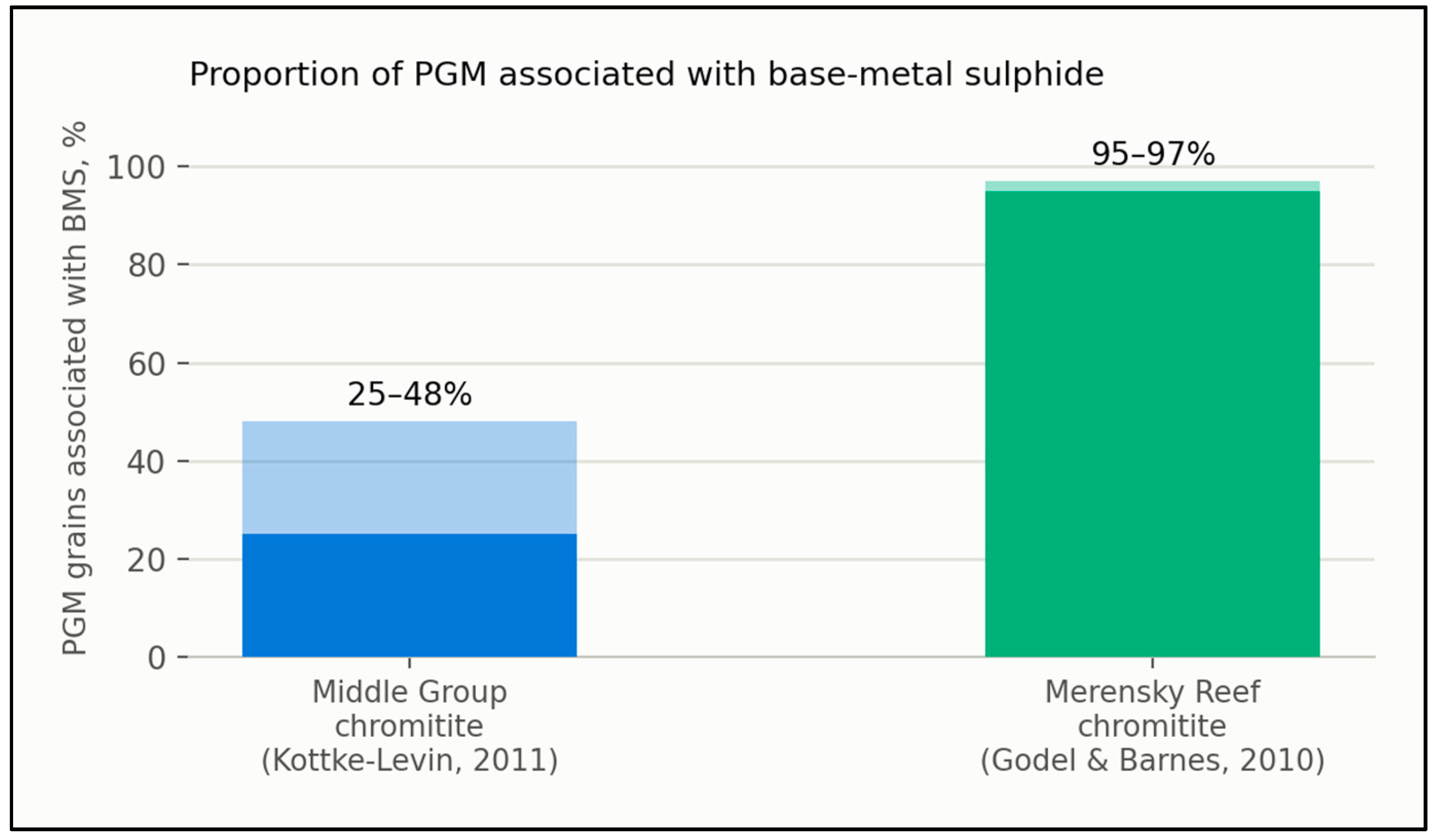
Figure 5.
Bulk sulphur content of Middle Group, UG2 and Merensky Reef chromitite (log scale).
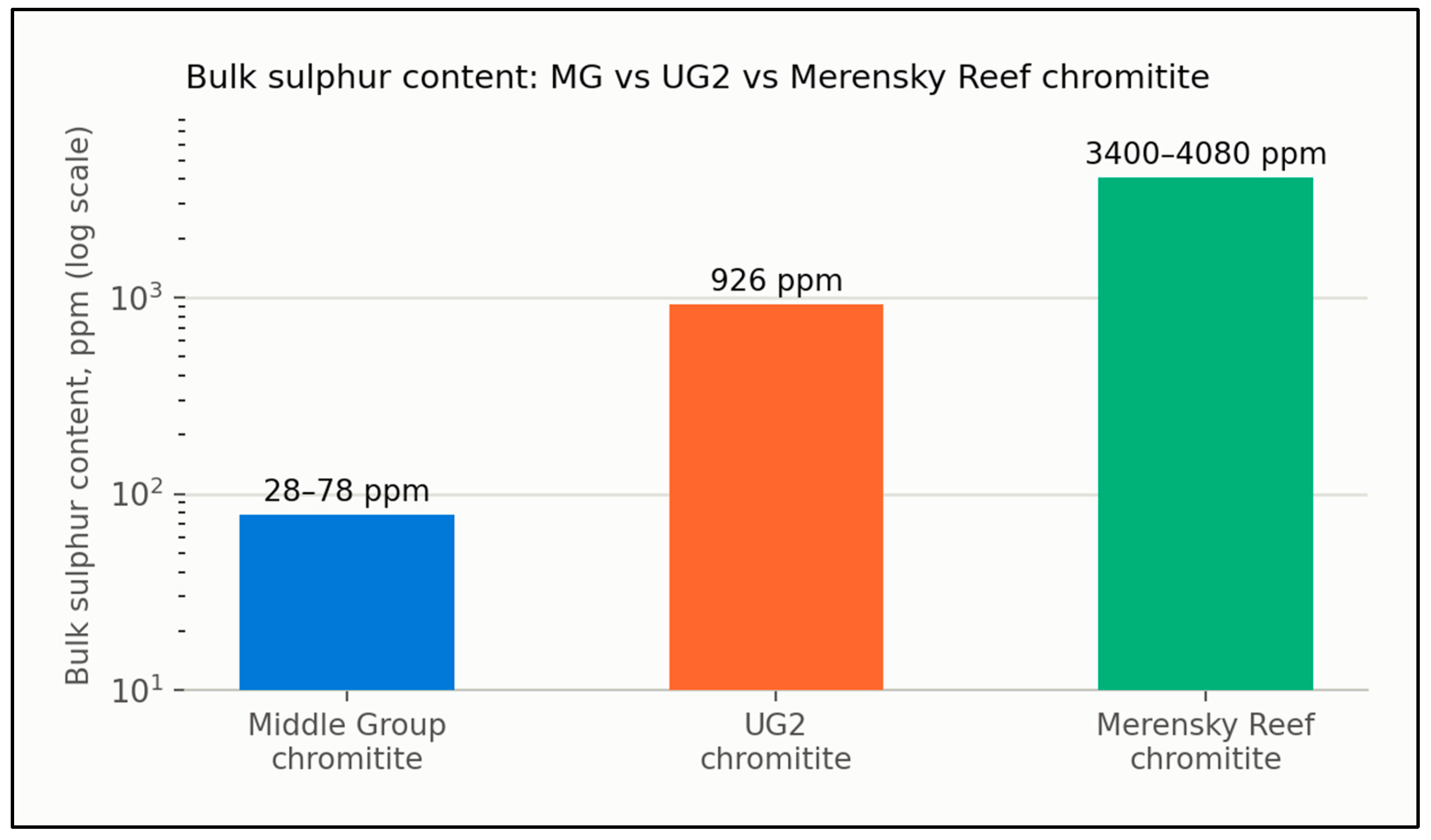
Figure 6.
(a) Baseline mill–float (MF2) circuit typically used for UG2, Merensky and Platreef ore. (b) Gravity-integrated circuit for Middle Group ore, after the process configuration reported for Tharisa Minerals' Eastern Bushveld operation [28], in which spiral gravity concentrators bracket the PGM flotation stage.
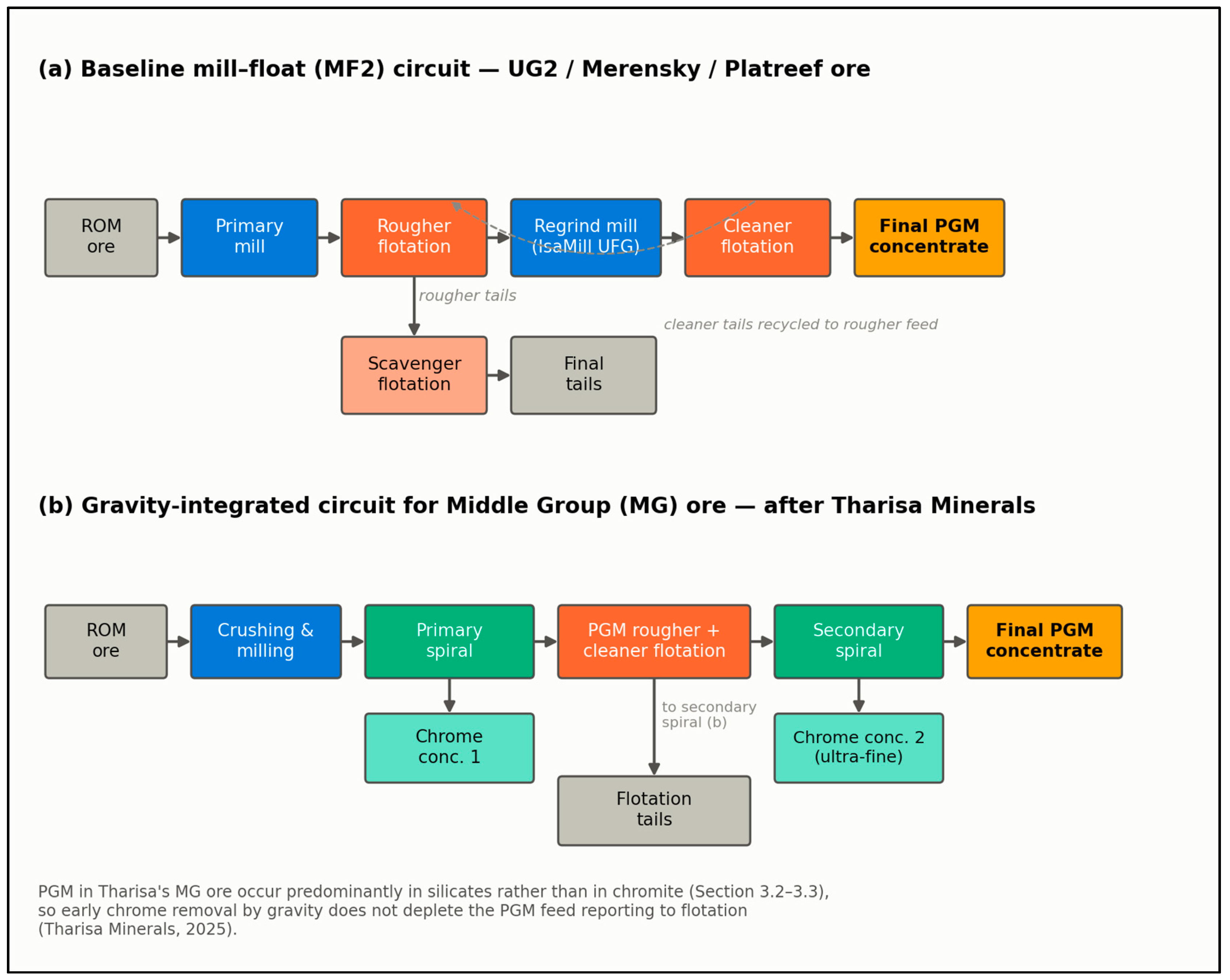

Table 1.
Approximate distribution of PGM mineral classes (vol.% of PGM population) across Bushveld ore bodies [4,11,12,16].
| Ore body / mineral class | Sulphides | Tellurides | Arsenides | Alloys | Rest |
|---|---|---|---|---|---|
| Merensky Reef | 36 | 30 | 7 | 7 | 20 |
| UG2 | 70 | <5 | <5 | 20 | <5 |
| Middle Group (MG) | 85 | 3 | 5 | 4 | 3 |
| Platreef | 3 | 30 | 21 | 26 | 20 |
Table 2.
Comparative lithology, comminution and liberation characteristics of Bushveld ore bodies [11,16,19,20,21,22,23].
| Metric / Reef | Merensky Reef | Platreef | UG2 Reef | Middle Group (MG) Reef |
|---|---|---|---|---|
| Primary lithology | Coarse-grained feldspathic pyroxenite. | Heterogeneous pyroxenite, serpentinite and xenoliths. | Chromitite (60–90% chromite) with minor silicates. | Chromitite (high-iron chromite, pyroxene, feldspar). |
| Comminution resistance | High Bond Work Index (BWI); governed by hard silicates. | Highly variable BWI due to altered zones and country-rock mixing. | High reduction ratio; failure driven by microcracked grain boundaries. | Comminution hardness varies substantially between reefs, independent of bulk chromite content. |
| PGE/BMS grain size | Coarse base-metal sulphides (BMS) and associated PGM. | Highly variable; fine-to-coarse tellurides, arsenides and alloys. | Fine-grained PGM concentrated at grain boundaries or locked in silicates. | Predominantly ultra-fine (<6 µm for 81% of grains by number) and often locked in gangue [16]. |
| Liberation kinetics | Relatively rapid liberation at a coarse primary grind. | Slow and progressive; requires staged multi-mill configurations. | Staged liberation; managed via MF2/MF3 circuits to limit over-grinding. | Reef-dependent: 63–74 vol% fully liberated versus 10–34 vol% poorly liberated across MG1–MG4A. |
Table 3.
Summary of the three comparative-metallurgy axes distinguishing Middle Group ore from UG2 and Merensky Reef ore.
Table 3.
Summary of the three comparative-metallurgy axes distinguishing Middle Group ore from UG2 and Merensky Reef ore.
| Axis | UG2 | Merensky Reef | Middle Group (MG) |
|---|---|---|---|
| Bulk sulphur content | ≈926 ppm S | 3400–4080 ppm S | 28–78 ppm S one to two orders of magnitude lower (Section 3.3) |
| PGM–BMS association | Not separately quantified in this review | 95–97% of PGM BMS-associated [18] | Only 25–48% of PGM BMS-associated [4] |
| Principal gangue-management challenge | Chromite entrainment; concentrate held <≈3% chromite [24] | Coarse silicate gangue; comparatively minor chromite issue | Chromite entrainment plus variable talc/serpentine/chlorite content (Section 3.1) |
| Reagent chemistry | SIBX, CMC, copper sulphate [24] | SIBX, CMC, copper sulphate [24] | Same reagent suite as UG2, but not verified as optimised for MG mineralogy specifically |
| Comminution hardness | Relatively well characterised at plant scale | Relatively well characterised at plant scale | Varies substantially between individual reefs, independent of chromite content. |
Table 4.
Summary of identified research gaps in the Middle Group chromitite literature.
| Gap | Current state of evidence | Suggested next step |
|---|---|---|
| Reef-resolved PGM inventory | Detailed for MG tailings [16] and, at reef scale, for individual horizons at Helena mine [4]; a companion paper now provides reef-resolved data for one MG1–MG4A suite (Section 6.1), but cross-locality validation is still absent | Independent replication study across multiple MG localities, using the standardised protocol proposed in Section 6.2 |
| Comminution–flotation linkage | Reported jointly for one MG1–MG4A suite (Section 6.2); largely separate for MG ore elsewhere in the literature | Replicate on additional sample sets; extend to plant-scale verification |
| Ore-blending additivity | No dedicated MG-specific study identified | Factorial/simplex-lattice blend-design testwork across MG1–MG4A (and UG2/Merensky) proportions (Section 6.1) |
| MG tailings-reprocessing potential | Commercial flotation precedent (Sylvania); refractory-PGE/NaSi evidence from analogous tailings [29]; PGM speciation/liberation for one MG1–4 tailings sample [16]; a validated gravity/magnetic chromite circuit for MG-seam tailings [10] evidence is real but fragmented across separate studies and sample sets | Single integrated study combining PGM flotation, chromite gravity/magnetic recovery, size-by-size assay and time-resolved mineralogical monitoring on one MG1–MG4A tailings suite (Section 4.4 and Section 6.3) |
Disclaimer/Publisher’s Note: The statements, opinions and data contained in all publications are solely those of the individual author(s) and contributor(s) and not of MDPI and/or the editor(s). MDPI and/or the editor(s) disclaim responsibility for any injury to people or property resulting from any ideas, methods, instructions or products referred to in the content. |
© 2026 by the authors. Licensee MDPI, Basel, Switzerland. This article is an open access article distributed under the terms and conditions of the Creative Commons Attribution (CC BY) license (http://creativecommons.org/licenses/by/4.0/).
Copyright: This open access article is published under a Creative Commons CC BY 4.0 license, which permit the free download, distribution, and reuse, provided that the author and preprint are cited in any reuse.