

Submitted:
29 September 2026
Posted:
30 September 2026
You are already at the latest version
Abstract
Malaysia's tourism sector has moved from crisis response to strategic repositioning since the COVID-19 pandemic. This article reviews 66 scholarly sources published between 2023 and 2026 that address tourism management in Malaysia. Using a structured thematic classification, the corpus is organised into six domains: (1) post-pandemic recovery, resilience, and governance; (2) destination image, marketing, competitiveness, and visitor experience; (3) smart tourism and digital technologies; (4) social media, user-generated content, and generational markets; (5) sustainable tourism and ecotourism; and (6) niche and special-interest tourism. The review shows that research attention has shifted from pandemic impact assessment toward technology-enabled experience design, sustainability-oriented competitiveness, and market diversification. Three cross-cutting patterns emerge: the growing centrality of memorable experience, satisfaction, and revisit intention as outcome variables; the convergence of digital and sustainability agendas; and a persistent reliance on cross-sectional, tourist-side survey designs. Significant gaps remain in supply-side and community perspectives, longitudinal evidence, evaluation of policy instruments, and the environmental costs of digitalisation. An integrative framework and a research agenda are proposed to guide future work and policy.
Keywords:
Malaysia
; tourism management
; post-pandemic recovery
; smart tourism
; destination competitiveness
; sustainable tourism
; ecotourism
; revisit intention
1. Introduction
Tourism is a major contributor to Malaysia's economy, and the sector was among those most severely disrupted by pandemic-era border closures and mobility restrictions. As international and domestic travel resumed, scholarship began to ask a different set of questions: not only how much demand had been lost, but how destinations, firms, and communities could rebuild in ways that are more resilient, digital, and sustainable (Hampton et al., 2023; Othman & Rosli, 2023b; Lam et al., 2026).
Between 2023 and 2026 the Malaysian tourism literature expanded quickly and diversified in topic, method, and publication outlet. Studies range from macro-level analyses of tourist arrivals and sector risk (Ortega et al., 2023; Lee et al., 2024) to micro-level investigations of memorable experiences among young travellers (Shaharuddin et al., 2026). Regional policy assessments, such as the Asian Development Bank's analysis of smart tourism ecosystem readiness in Southeast Asia (Bank et al., 2024), place Malaysia in a wider ASEAN context. Despite this growth, the literature is fragmented across sub-fields, and no recent synthesis connects recovery, technology, marketing, and sustainability into a single management-oriented view.
This review addresses that gap. It is guided by four questions:
RQ1. What themes and topics have dominated Malaysian tourism management research since 2023?
RQ2. How has the emphasis shifted over the 2023–2026 period?
RQ3. What conceptual and methodological patterns characterise this literature?
RQ4. What gaps should future research and destination management address?
The article contributes (a) a thematic map of the recent literature, (b) an integrative framework linking recovery, digitalisation, sustainability, and visitor outcomes, and (c) a prioritised research agenda.
2. Review Method
This is a thematic (narrative) review of a defined corpus, not a systematic database search under PRISMA protocols. The corpus comprises 66 sources published between 2023 and 2026, all concerned with tourism management in Malaysia or with Southeast Asian contexts that include Malaysia. Sources include journal articles, edited-book chapters, conference and proceedings papers, institutional-repository reports, and a doctoral thesis and a master's-level dissertation.
The procedure had four steps:
Corpus definition. Sources were included if they were published 2023–2026 and addressed tourism destinations, demand, supply, technology, policy, or sustainability in Malaysia.
Coding. Each source was assigned a primary theme according to its main research focus, based on its title, stated scope, and publication venue.
Synthesis. Sources within each theme were compared for shared constructs, contexts, and study designs.
Integration. Cross-theme relationships were mapped into a conceptual framework and gap analysis.
Because each source was assigned a single primary theme, several studies overlap domains (for example, smart tourism technologies and revisit intention). Where the discussion below describes what a study examined, it reflects the stated focus of that work; readers seeking effect sizes, samples, or detailed findings should consult the original publications.
3. Overview of the Corpus
Table 1 shows the distribution of the corpus by theme, and Table 2 shows its distribution across publication years.
Two trends are visible. First, recovery-focused work is concentrated in 2023 (6 of 16 sources), consistent with an early emphasis on assessing pandemic impacts. Second, smart tourism output peaks in 2024 (8 of 18 sources), after which output in this theme is steadier while its topics become more specific, for example, memorable experiences, user-generated content trust, and young consumers (Kaviyarasi, 2026; Shaharuddin et al., 2026; Yusoff & Hasan, 2026). The 2026 counts reflect sources available at the time of writing and may be incomplete.
4. Thematic Synthesis
4.1. Post-Pandemic Recovery, Resilience, and Governance
The largest early cluster examines how Malaysian tourism has reset after the pandemic. Hampton et al. (2023) provide an empirical account of the post-COVID sector in Malaysia, while Ortega et al. (2023) and Lee et al. (2024) analyse tourist arrivals and the risk–return profile of the tourism industry during and after the shock. Othman and Rosli (2023b) ask what comes next for the sector, and Liang and Lian (2024) interpret the pandemic through the tourist destination life cycle, drawing on stakeholder perspectives to discuss recovery strategies. Broader treatments of the "new normal" and sector recovery (Iștoc et al., 2023; Varma, 2023; Azharudin & Osman, 2024) and of regional recovery through sustainable tourism across ASEAN (Kibtiah, 2024) situate Malaysia in comparative contexts.
Later work reframes recovery as a question of capability. Studies of tourist resilience and destination brand equity (Dan et al., 2025) and of flexibility, digital transformation, and value creation among tourism SMEs (Hninn et al., 2025) treat resilience as something built through branding and organisational adaptation, rather than a return to pre-pandemic conditions. Policy-oriented contributions examine governance, innovation, and policy challenges in the post-pandemic period (Lam et al., 2026) and risk in tourism marketing (Sulaiman et al., 2026). Ng and Bhutia (2025) link digital technologies and sustainable practices to recovery, foreshadowing the convergence discussed in Section 5. Book-length overviews (Thirumoorthi & Tajudeen, 2026c) consolidate the national picture.
Synthesis. The literature moves from measuring loss (2023) to building resilience and governance capacity (2025–2026). However, most recovery studies are descriptive or cross-sectional, and few assess whether specific recovery policies achieved their objectives.
4.2. Destination Image, Marketing, Competitiveness, and Visitor Experience
A second cluster treats competitiveness and image as the foundation of sustained demand. Bibliometric analyses map the field itself: Othman and Rosli (2023c) trace tourism research trends in Malaysia, and Wu and Omar (2025) examine destination competitiveness scholarship. Empirical studies test determinants of competitiveness and attractiveness, including national parks in Sarawak (Thong et al., 2023) and enjoyment as a mediator of destination attractiveness in Iskandar Malaysia (Fong et al., 2025). Razak et al. (2026) argue that sustainable practices drive long-term competitiveness, and Jamel et al. (2025) rethink heritage tourism competitiveness through innovation.
Marketing and image research examines how communication shapes intentions. Karunanithi and Kemat (2024) study destination image and government tourism campaigns in relation to domestic hotel tourism growth, Zhenning and Kuppusamy (2024) examine destination marketing factors, image, and revisit intention, and Zuraimi and Hafiz (2025) investigate media features in restoring destination image after a crisis. Al-Khaled (2023) provides an operational framework for rural destination management and marketing organisations. On the visitor side, Othman et al. (2024) connect tourist satisfaction to industry improvement, and Zubir and Sukı (2026) propose a satisfaction-led strategy that converts visitor growth into destination retention in Penang.
Synthesis. Image, satisfaction, and revisit intention operate as the dominant explanatory chain. A notable movement across the period is from generic image models toward context-specific competitiveness (national parks, heritage cities, urban–regional destinations) and toward retention rather than volume as the management goal.
4.3. Smart Tourism and Digital Technologies
Smart tourism is the largest theme (18 sources) and the most conceptually developed. Foundational and framework-oriented contributions include Malaysia's smart tourism framework (Tee, 2024), the conceptualisation of smart tourism in developing smart destinations (Mei, 2023), a framework combining smart tourism attributes with the technology acceptance model (Muharis et al., 2024), and a smart tourism technology framework for tourist experience and psychological behaviour (Peong et al., 2023). Regional readiness is assessed by Bank et al. (2024) for Southeast Asia, and Shanmugam et al. (2024) analyse technology advancement and smart tourism strategies in Malaysia's post-pandemic industry.
Empirical work connects technology to experience and behavioural outcomes. Peong et al. (2024) study smart tourism technologies, destination image, and memorable experiences as drivers of revisit intention; Wei (2024) examines how smart tourism technology shapes satisfaction and revisit intentions; Liu et al. (2024) discuss technology's role in customer experience and satisfaction; and Shaharuddin et al. (2026) and Kaviyarasi (2026) focus on young travellers and young consumers. Application-level studies show how technology is embedded in local contexts: mobile applications for promoting local products in Pasir Gudang (Alias, 2025), an intelligent digital platform for rural community tourism (Wei et al., 2023), a Smart Mosque Information System for religious tourism (Sa'ari et al., 2025), and technology in bleisure travel (Islam et al., 2024). Wider surveys cover digital tourism across ASEAN during COVID-19 (Salam, 2023), technology-driven tourism (Thirumoorthi & Tajudeen, 2026b), and artificial intelligence and Tourism 4.0 in relation to environmental and governance impacts (Kalhoro et al., 2025).
Synthesis. Three points stand out. (i) Technology acceptance and experience models dominate, with memorable experience frequently positioned as the mediator between technology and revisit intention. (ii) Applications increasingly target local products, rural communities, and faith-based tourism, extending smart tourism beyond urban hubs. (iii) Evidence on governance, data, and environmental effects is thinner (Kalhoro et al., 2025), leaving open how smart destination initiatives should be regulated and evaluated.
4.4. Social Media, User-Generated Content, and Generational Markets
Digital communication is treated as both a marketing channel and a source of trust. Abumandil et al. (2023) examine social media usage as a moderator between perceived website value, motivational factors, and sustainable travel agents. Alshamayleh (2025) discusses social media and technology marketing for tourism revitalisation and tourist intention, while Yusoff and Hasan (2026) focus on trust in user-generated content within smart tourism development. Generational segments receive growing attention: Gengeswari et al. (2024) examine what matters most for millennials' domestic travel intention after COVID-19, and Ahmad (2026) studies Generation Z's travel decision-making and digital influence.
Synthesis. This is the smallest cluster but the one closest to demand-side behaviour. The shift from general social media effects (2023) to trust, credibility, and generational differences (2026) indicates a maturing field, although the number of studies remains limited relative to the importance of digital word-of-mouth.
4.5. Sustainable Tourism and Ecotourism
Sustainability research addresses destinations, stakeholders, and indicators. Ahmad (2023) discusses ecotourism's role in sustainable development and economic demand, and Jasrotia and Chanchaichujit (2024) consider how sustainable tourism can rejuvenate destinations. Stakeholder management is analysed for Penang Hill (Salman et al., 2023). Environmental performance and visitor outcomes are linked in studies of ecological sustainability, satisfaction, and revisit intention in Langkawi (Shamim et al., 2024) and of the ecotourism experience and destination loyalty in Selangor (Amit et al., 2025). Indicator development and management appear in Gausmian et al. (2025), who examine ecotourism indicators for biodiversity management. Thong's programme of work on Sarawak addresses supply-side drivers of ecotourism competitiveness at a UNESCO World Heritage Site (Thong, 2024) and destination resources in totally protected areas (Thong et al., 2025). Hanafiah et al. (2026) examine destination attractiveness, environmentally responsible behaviour, place attachment, and perceived value at Kilim Karst Geoforest Park, and Nazirullah et al. (2026) address responsible practices in Malaysia.
Synthesis. Sustainability is now framed as a competitive resource rather than a constraint: ecological quality, responsible behaviour, and place attachment are analysed as antecedents of satisfaction, loyalty, and competitiveness. East Malaysian protected areas and geoheritage sites gain visibility, but conservation outcomes (biodiversity, carrying capacity, community benefits) are less frequently measured than visitor perceptions.
4.6. Niche and Special-Interest Tourism
Niche segments illustrate diversification. Health and medical tourism are examined through satisfaction and revisit intention (Almodawer et al., 2024), destination branding and medical tourist behaviour (Nwobodo, 2024), and the recovery of healthcare travel within ASEAN (Yusof & Liew, 2023). Othman and Rosli (2023a) explore dark tourism as a potentially growing sector, and a book-length treatment covers niche tourism in Malaysia more broadly (Thirumoorthi & Tajudeen, 2026a). Related segments appear under other themes, including religious tourism (Sa'ari et al., 2025), bleisure (Islam et al., 2024), and heritage tourism (Jamel et al., 2025; Zubir & Sukı, 2026).
Synthesis. Niche tourism is positioned as a route to higher-value and more resilient demand. However, studies are dispersed across segments, with no output in this cluster in 2025 within the corpus, and comparative evidence on which niches deliver the greatest economic and social returns is lacking.
5. Integrative Discussion
5.1. An Integrative Framework
Read together, the six themes describe a common logic. Recovery and governance conditions (Theme 1) set the institutional context. Destination image and competitiveness (Theme 2), smart technologies (Theme 3), and digital communication (Theme 4) act as management levers, while sustainability (Theme 5) and niche portfolios (Theme 6) shape the destination's resource base and market position. These levers influence the visitor outcomes that the literature most often measures: memorable experience, satisfaction, revisit intention, and loyalty.
Figure 1.
Integrative Framework of Malaysia’s Post-Pandemic Tourism Research.
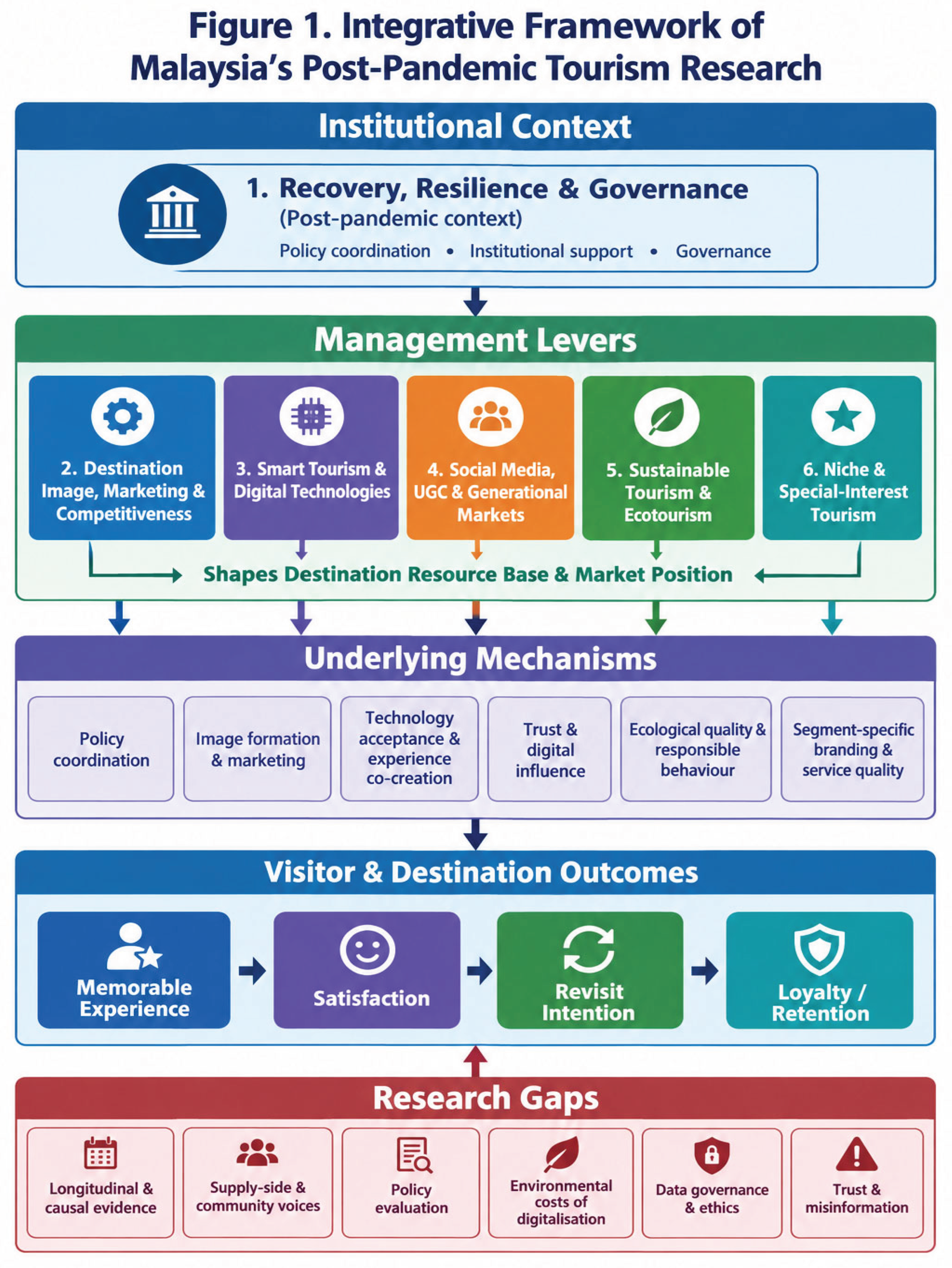

Table 3.
Integrative framework: levers, mechanisms, and outcomes.
| Management lever | Typical mechanism examined | Common outcome variables | Illustrative sources |
|---|---|---|---|
| Governance and resilience capacity | Policy coordination, SME flexibility, brand resilience | Recovery, brand equity, competitiveness | Dan et al. (2025); Hninn et al. (2025); Lam et al. (2026) |
| Destination image and campaigns | Image formation, media features, marketing mix | Domestic tourism growth, revisit intention | Karunanithi & Kemat (2024); Zhenning & Kuppusamy (2024); Zuraimi & Hafiz (2025) |
| Smart tourism technologies | Technology acceptance, experience co-creation | Memorable experience, satisfaction, revisit intention | Peong et al. (2024); Wei (2024); Shaharuddin et al. (2026) |
| Social media and UGC | Trust, moderation of perceived value, generational influence | Travel intention, decision-making | Abumandil et al. (2023); Yusoff & Hasan (2026); Ahmad (2026) |
| Sustainability and ecotourism | Ecological quality, responsible behaviour, stakeholder management | Loyalty, satisfaction, competitiveness | Shamim et al. (2024); Hanafiah et al. (2026); Thong et al. (2025) |
| Niche portfolio | Segment-specific branding and service quality | Satisfaction, revisit intention, diversification | Almodawer et al. (2024); Nwobodo (2024) |
5.2. Convergence of the Digital and Sustainability Agendas
Several sources explicitly join technology with sustainability: Ng and Bhutia (2025) on digital technologies and sustainable practices in recovery, Kalhoro et al. (2025) on AI and Tourism 4.0 for sustainable transformation, and Abumandil et al. (2023) on sustainable travel agents. This convergence is promising, but it is largely conceptual. Empirical tests of whether digital tools actually reduce environmental pressure, or improve community outcomes, are scarce.
5.3. Methodological Patterns
Most empirical studies use cross-sectional, questionnaire-based designs, frequently analysed with structural equation modelling or similar techniques, and concentrate on tourists as respondents. Bibliometric and framework papers form a second group (Othman & Rosli, 2023c; Wu & Omar, 2025; Muharis et al., 2024; Tee, 2024). Qualitative, longitudinal, and experimental approaches, and evaluations that use administrative or behavioural data, are comparatively rare. Geographic coverage is uneven: Peninsular urban and heritage sites (Kuala Lumpur, Penang, Selangor, Johor, Langkawi) are better represented than most rural areas, although Sarawak receives sustained attention through Thong's work.
6. Research Gaps and Agenda
Table 4.
Principal gaps and recommended research directions.
| Gap | Evidence in the corpus | Recommended direction |
|---|---|---|
| Limited longitudinal and causal evidence | Predominance of cross-sectional surveys | Panel studies, quasi-experiments, and event-based analyses of recovery and campaign effects |
| Underrepresentation of supply-side and community voices | Few studies of operators, SMEs, and residents (e.g., Hninn et al., 2025; Salman et al., 2023) | Multi-stakeholder and participatory designs; community-benefit metrics |
| Weak policy evaluation | Policy discussed conceptually (Lam et al., 2026) | Assessment of specific national and state instruments and campaign outcomes |
| Environmental cost of digitalisation | Conceptual treatment (Kalhoro et al., 2025) | Life-cycle and impact studies of smart tourism and AI deployment |
| Data governance and ethics in smart destinations | Focus on adoption rather than regulation | Studies of privacy, platform power, and inclusion |
| Thin evidence on trust and misinformation | Few UGC studies (Yusoff & Hasan, 2026) | Experimental and content-analytic work on credibility and influencer effects |
| Fragmented niche research | Segment-by-segment studies | Comparative studies on yield, seasonality, and resilience across niches |
| Uneven geography | Concentration on selected urban and heritage areas | Comparative studies including rural, east-coast, and Borneo destinations |
| Conservation outcomes rarely measured | Emphasis on visitor perceptions in ecotourism | Integrating ecological indicators (Gausmian et al., 2025) with visitor and community data |
7. Implications for Destination Management and Policy
Manage for retention and value, not only volume. Evidence on satisfaction, memorable experience, and revisit intention supports investment in service quality and experience design (Zubir & Sukı, 2026; Peong et al., 2024).
Tailor smart tourism to place. Successful applications are embedded in local products, communities, and cultural contexts (Alias, 2025; Wei et al., 2023; Sa'ari et al., 2025).
Treat sustainability as a competitive asset. Ecological quality and responsible behaviour are linked to satisfaction and loyalty in protected-area and geopark settings (Shamim et al., 2024; Hanafiah et al., 2026).
Strengthen digital communication and trust. Managing user-generated content and targeting generational segments require credible, transparent communication (Yusoff & Hasan, 2026; Ahmad, 2026).
Support SME capability. Flexibility, digital transformation, and value creation are associated with resilience among small tourism firms (Hninn et al., 2025).
Build monitoring and evaluation into policy. Destination agencies should adopt indicators that connect visitor outcomes with environmental and community results.
8. Conclusions
The 2023–2026 literature on Malaysian tourism management reflects a sector in transition. Early work documented the pandemic's effects and the requirements for recovery; more recent work emphasises technology-mediated experience, sustainability-based competitiveness, and diversified markets. The dominant explanatory chain runs from image and smart technology through memorable experience and satisfaction to revisit intention. The main weaknesses are methodological narrowness, limited supply-side and community evidence, and scarce policy evaluation. Addressing these gaps, especially through longitudinal, multi-stakeholder, and impact-oriented designs, would allow Malaysian tourism scholarship to inform practice more directly and to test whether digital and sustainable strategies deliver on their promise.
9. Limitations
This review is limited to a defined corpus of 66 sources and does not constitute an exhaustive systematic search. Thematic coding assigned one primary theme per source and drew on each source's title, stated scope, and venue, so some nuance and cross-cutting content may be underrepresented. The corpus mixes peer-reviewed articles, book chapters, proceedings, and repository documents of varying rigour, and no formal quality appraisal was applied. Sources from 2026 may not be fully indexed. Findings should be verified against the original publications before being cited as empirical claims.
References
- Abumandil, M.; Obaid, T.; Najwani, A.; Saidin, S. S.; Abu-Naser, S. S. The moderating effect of social media usage on the relationship between the perceived value of the websites and motivational factors on sustainable travel agents. In PhilPapers (PhilPapers Foundation); 2023; Available online: https://philpapers.org/archive/ABUTME.pdf.
- Ahmad, S. Y. Promoting sustainable development: Ecotourism’s multifaceted role and economic demand. The International Islamic University Malaysia Repository (The International Islamic University Malaysia). 2023. Available online: http://irep.iium.edu.my/106181/1/ICLET%202023.pdf.
- Ahmad, S. Y. Generation Z travel decision-making and digital influence in Malaysia. The International Islamic University Malaysia Repository (The International Islamic University Malaysia). 2026. Available online: https://irep.iium.edu.my/129106/8/Irep%20Gen%20Z.pdf.
- Alias, Z. Z. M. Smart tourism as a catalyst for smart city development: A case study on mobile application utilization for promoting local products in Pasir Gudang, Johor, Malaysia. UiTM Institutional Repositories (Universiti Teknologi MARA). 2025. Available online: https://ir.uitm.edu.my/id/eprint/136099/1/136099.pdf.
- Al-Khaled, A. A. S. Operational framework for rural tourism destination management and marketing organizations. In Business, Management and Economics; 2023; Available online: https://www.intechopen.com/chapters/88619.
- Almodawer, Y.; Alam, S. S.; Sinniah, S.; Ali, M. H. Health tourism in Malaysia: Understanding the drivers of satisfaction and revisit intention. In Tourism Recreation Research; 2024; Available online: https://www.tandfonline.com/doi/full/10.1080/02508281.2024.2379686.
- Alshamayleh, H. Z. Marketing through social media and technology to revitalize the tourism sector: A path to sustainable growth and increased tourist intention. Journal of Information Systems Engineering and Management. 2025. Available online: https://jisem-journal.com/index.php/journal/article/view/8794.
- Amit, N.; Supian, K.; Ishak, B.; Abdullah, S. H. S.; Rauf, R. K. A. Exploring the ecotourism experience and ecotourism destination loyalty in Selangor: Reliability and factor analysis approach. Environment-Behaviour Proceedings Journal. 2025. Available online: https://ebpj.e-iph.co.uk/index.php/EBProceedings/article/view/6805.
- Azharudin, M. Z.; Osman, A. F. Post-Covid tourism transition. 2024. Available online: https://www.taylorfrancis.com/books/9781003491736/chapters/10.4324/9781003491736-12.
- Bank, A. D.; Weltman, T.; Sciacca, A. G.; Hwang, Y.-H.; Schipani, S. Smart tourism ecosystem development readiness in Southeast Asia. 2024. Available online: https://www.adb.org/publications/smart-tourism-ecosystem-southeast-asia.
- Dan, J. C.; Liu, T.; Wang, S.; Hu, Z.; Puskaran, K. K. Examining the impact of tourist resilience on destination brand love and destination brand equity in post pandemic era: Evidence from Malaysia. Journal of Contemporary Management Studies. 2025. Available online: https://jcms.utm.my/index.php/jcms/article/view/32.
- Fong, S.-F.; Tan, H.-S.; Low, S.-M.; Choi, S.-L. Driving factors to tourism destination attractiveness in Iskandar Malaysia: The mediating role of enjoyment. International Journal of Business and Society. 2025. Available online: https://publisher.unimas.my/ojs/index.php/IJBS/article/view/9544.
- Gausmian, M. H.; Bidin, S.; Ajuhari, Z. Ecotourism indicators for sustainable biodiversity management in Malaysia. E-Bangi Journal of Social Science and Humanities. 2025. Available online: http://ejournal.ukm.my/ebangi/article/download/90305/18104.
- Gengeswari, K.; Janjua, Z. ul A.; Magdalene, B.; San, E. L.; Chin, K. K.; Xiang, L. H.; Chyi, S. P. Domestic travel intention post COVID-19 pandemic – What matters the most to millennials? Greater South Information System. 2024. Available online: https://gresis.osc.int//doi/10.60692/459xv-zdy88.
- Hampton, M. P.; Jeyacheya, J.; Nair, V. Post-COVID tourism revealed: Evidence from Malaysia. Annals of Tourism Research. 2023. Available online: https://linkinghub.elsevier.com/retrieve/pii/S0160738323001445.
- Hanafiah, M. H.; Belly, T.; Zulkurnain, Z.; Azinuddin, M.; Kusumah, G. The interplay of destination attractiveness, environmentally responsible behaviour, place attachment, and perceived value: Case of Kilim Karst Geoforest Park, Malaysia. International Journal of Geoheritage and Parks. 2026. Available online: https://linkinghub.elsevier.com/retrieve/pii/S257744412600033X.
- Hninn, P. P.; Choong, Y. O.; Seow, A. N. Navigating challenges: How flexibility, digital transformation, and value creation drive resilience in tourism SMEs. Advances in Hospitality and Tourism Research (AHTR). 2025. Available online: https://dergipark.org.tr/en/pub/ahtr/article/1537391.
- Iștoc, E. M.; Mateescu, M. A.; Băleanu, D. N. Marketing of tourism destinations in the post-Covid era – Challenges of the new normal; Research Papers in Economics: RePEc, 2023; Available online: https://stec.univ-ovidius.ro/html/anale/RO/2023-i1/Section%204/14.pdf.
- Islam, Md. T.; Kumar, J.; Konar, R. How technology is revolutionizing the bleisure experiences of tourists in Malaysia. In Advances in Hospitality, Tourism and the Services Industry (AHTSI) Book Series; 2024; Available online: https://services.igi-global.com/resolvedoi/resolve.aspx?doi=10.4018/979-8-3693-4354-8.ch008.
- Jamel, N. E. S. M.; Jie, O. J.; Shahar, N. bin. From preservation of innovation: Rethinking heritage tourism competitiveness in Malaysia. International Journal of Research and Innovation in Social Science. 2025. Available online: https://rsisinternational.org/journals/ijriss/view/from-preservation-of-innovation-rethinking-heritage-tourism-competitiveness-in-malaysia.
- Jasrotia, A.; Chanchaichujit, K. Rejuvinating destinations through sustainable tourism. In Advances in Hospitality, Tourism and the Services Industry (AHTSI) Book Series; 2024; Available online: https://services.igi-global.com/resolvedoi/resolve.aspx?doi=10.4018/979-8-3693-6819-0.ch021.
- Kalhoro, M.; Yong, H. N. A.; Senadjki, A. Artificial intelligence and Tourism 4.0 for sustainable transformation: A systematic review of environmental and governance impacts; Environment and Resource: Explora, 2025; Available online: https://accscience.com/journal/EER/2/4/10.36922/EER025320058.
- Karunanithi, S. A. L.; Kemat, B. B. Exploring the interplay between perceived destination image, government tourism campaigns, and domestic hotel tourism growth: Insights from post-COVID-19 Malaysia. Journal of Digitainability, Realism & Mastery (DREAM). 2024. Available online: https://dreamjournal.my/index.php/DREAM/article/view/289.
- Kaviyarasi, K. Smart tourism behavioral intention among young consumers in Malaysia. In UUM Electronic Theses and Dissertation [eTheses]; Northern University of Malaysia, 2026; Available online: https://etd.uum.edu.my/12206/3/s833393_02.pdf.
- Kibtiah, T. M. Literature of recovery ASEAN economy through a sustainable tourism sector in the post COVID-19. In Zenodo; CERN European Organization for Nuclear Research, 2024; https://zenodo.org/doi/10.5281/zenodo.13829047. [Google Scholar]
- Lam, J. M. S.; Ariffin, A. A. M.; Millanyani, H.; Leng, O. Y.; Samsi, S. Z. M.; Yee, G. C. Malaysia’s post pandemic tourism recovery: Governance, innovation and policy challenges. In Veredas Do Direito; 2026; Available online: https://revista.domhelder.edu.br/index.php/veredas/article/view/4857.
- Lee, S.-N.; Tan, C.-H.; Ho, S.-B. The COVID-19 pandemic effect on risk and return of Malaysian tourism industry. The European Proceedings of Social & Behavioural Sciences, 2024; Available online: https://www.europeanproceedings.com/article/10.15405/epsbs.2024.05.83.
- Liang, T. K. L. T. K.; Lian, J. C. K. The impacts of the COVID-19 pandemic on the life cycle of tourist destination and the recovery strategies from the perspectives of tourism stakeholders in Malaysia. UMS Institutional Repository (Universiti Malaysia Sabah). 2024. Available online: https://eprints.ums.edu.my/id/eprint/43201/1/FULL%20TEXT.pdf.
- Liu, Z.; Duraipandi, O.; Yuan-yuan, L.; Zhigao, L.; Ma, Y. Discussion on the role of technology in the tourism sector in Malaysia for uplifting customer experience and satisfaction. International Journal of Computational and Experimental Science and Engineering. 2024. Available online: https://ijcesen.com/index.php/ijcesen/article/view/3732.
- Masroor, Z.; Shiva, A. The socio-technical road to tourism recovery in the post-pandemic world. Journal of Quality Assurance in Hospitality & Tourism. 2023. Available online: https://www.tandfonline.com/doi/full/10.1080/1528008X.2023.2181278.
- Mei, X. Y. Smart tourism in developing smart destinations. 2023. Available online: https://www.taylorfrancis.com/books/9781003335924/chapters/10.4324/9781003335924-16.
- Muharis, M.; Ahmad, E. M.; Norhanim, A. R. A framework to assess the effects of smart tourism attributes and technology acceptance model on travel experience in Malaysia. In Zenodo; CERN European Organization for Nuclear Research, 2024; https://zenodo.org/doi/10.5281/zenodo.14195340. [Google Scholar]
- Nazirullah; Som, A. P. M.; Nawaz, I.; Momani, H. R.; Alkilany, S. B.; Khan, Y. K. F. A.; Rahman, S. Responsible practices in Malaysia. 2026. Available online: https://www.emerald.com/books/book/21363/chapter/109769490/Responsible-Practices-in-Malaysia.
- Ng, K. M.; Bhutia, L. D. Leveraging digital technologies and sustainable practices for post-pandemic tourism recovery. In IGI Global eBooks; 2025; Available online: https://services.igi-global.com/resolvedoi/resolve.aspx?doi=10.4018/979-8-3693-9107-5.ch006.
- Nwobodo, S. Medical tourism in Malaysia: An investigation of the destination branding factors and its influence on the behaviour of medical tourists. Swinburne Research Bank (Swinburne University of Technology). 2024. Available online: https://swinburne.figshare.com/articles/thesis/Medical_tourism_in_Malaysia_an_investigation_of_the_destination_branding_factors_and_its_influence_on_the_behaviour_of_medical_tourists/26298019.
- Ortega, E. R.; Zaifuzaman, A. R. S.; Yusof, N. M. Malaysia’s tourist arrivals amidst the COVID-19 pandemic. Malaysia Journal of Invention and Innovation. 2023. Available online: https://journal.academicapress.org/aps/index.php/mjii/article/view/36.
- Othman, A. K.; Abas, M. K. M.; Mat, A.; Abu-Jarad, I.; Yunus, N. M. Promoting and improving the tourism industry in Malaysia through tourist satisfaction. Information Management and Business Review. 2024. Available online: https://ojs.amhinternational.com/index.php/imbr/article/view/4225.
- Othman, M. H.; Rosli, Z. M. Dark tourism in Malaysia: A growing sector? UiTM Institutional Repositories (Universiti Teknologi MARA). 2023a. Available online: https://ir.uitm.edu.my/id/eprint/100483/1/100483.pdf.
- Othman, M. H.; Rosli, Z. M. Post-COVID-19 pandemic: What is next for the tourism sector in Malaysia? In UiTM Institutional Repositories (Universiti Teknologi MARA); 2023b; Available online: https://ir.uitm.edu.my/id/eprint/100484/1/100484.pdf.
- Othman, M. H.; Rosli, Z. M. Trends in tourism research in Malaysia: A bibliometric analysis. Journal of Tourism, Hospitality and Environment Management. 2023c. Available online: http://www.jthem.com/PDF/JTHEM-2023-31-03-05.pdf.
- Peong, K. K.; Peong, K. P.; Yeo, S. F.; Solarin, S. A.; Tan, C. L.; Lim, K. B. The impact of smart tourism technologies and destination image on tourists’ intention to revisit Malaysia: The mediator role of memorable tourists’ experiences. In Studies in Systems, Decision and Control; 2024; Available online: https://link.springer.com/10.1007/978-3-031-54379-1_79.
- Peong, K. K.; Yeo, S. F.; Peong, K. P.; Tan, C. L.; Solarin, S. A.; Lim, K. B. Smart tourism technology framework: A gateway to enhancing tourists’ experiences and psychological behaviour. 2023. Available online: https://ieeexplore.ieee.org/document/10248730/.
- Razak, N. S. A.; Aspiranti, T.; Rosli, A. A. F. Reframing tourism competitiveness: The role of sustainable tourism practices in driving long-term destination success. In Veredas Do Direito; 2026; Available online: https://revista.domhelder.edu.br/index.php/veredas/article/view/7890.
- Sa’ari, H.; Mohammad, A. A.; Othman, R. Smart Mosque Information System (SMIS): A framework for digital Da’wa and religious tourism in Malaysia. International Journal of Academic Research in Business and Social Sciences. 2025. Available online: https://hrmars.com/IJARBSS/article/view/26428/Smart-Mosque-Information-System-SMIS-A-Framework-for-Digital-Dawa-and-Religious-Tourism-in-Malaysia.
- Salam, U. Digital tourism in ASEAN during COVID-19 pandemic. SOSIO DIALEKTIKA. 2023. Available online: https://publikasiilmiah.unwahas.ac.id/index.php/SD/article/view/9798.
- Salman, A.; Jaafar, M.; Mohamad, D.; Khoshkam, M.; Rahim, R. A.; Nor, S. A. M. Stakeholder management for sustainable ecotourism destinations: A case of Penang Hill Malaysia. Journal of Ecotourism. 2023. Available online: https://www.tandfonline.com/doi/full/10.1080/14724049.2023.2282365.
- Shaharuddin, N. A.; Shukor, N. S. N. M.; Azlan, N. A. Z.; Zin, N. H. M.; Nor, M. S. M.; Wahab, S. A. A.; Kodri, A. N. M. Enhancing memorable tourist experiences among young travelers through smart tourism technologies in Kuala Lumpur, Malaysia. International Journal of Research and Innovation in Social Science. 2026. Available online: https://rsisinternational.org/journals/ijriss/view/enhancing-memorable-tourist-experiences-among-young-travelers-through-smart-tourism-technologies-in-kuala-lumpur-malaysia.
- Shamim, N. M.; Ismail, A. N. N.; Rosely, N.; Thani, A. K. A. The impact of ecological sustainability on tourists’ satisfaction and revisit intention: A case study in Langkawi, Malaysia. Greater South Information System. 2024. Available online: https://journals.scholarpublishing.org/index.php/ASSRJ/article/view/16648.
- Shanmugam, K.; Rana, M. E.; Kong, Z. A comprehensive analysis of technological advancements and smart tourism strategies in Malaysia’s post-pandemic tourism industry. 2024. Available online: https://ieeexplore.ieee.org/document/10459443/.
- Sulaiman, Z.; Rahim, M. A. R. A.; Mas’od, A.; Abdullah, M.; Fahim, N. A.; Hassan, N. B. Risk and tourism marketing in Malaysia (2000–2030); 2026; Available online: https://www.taylorfrancis.com/books/9781003558286/chapters/10.4324/9781003558286-9.
- Tee, M. K. A. Malaysia’s smart tourism framework. In Advances in Hospitality, Tourism and the Services Industry (AHTSI) Book Series; 2024; Available online: https://services.igi-global.com/resolvedoi/resolve.aspx?doi=10.4018/979-8-3693-1978-9.ch003.
- Thirumoorthi, T.; Tajudeen, F. P. Dynamics of niche tourism in Malaysia. 2026a. Available online: https://www.emerald.com/books/book/21429/Dynamics-of-Niche-Tourism-in-Malaysia.
- Thirumoorthi, T.; Tajudeen, F. P. Technology-driven tourism. 2026b. Available online: https://www.emerald.com/books/book/21429/chapter/112842446/Technology-driven-Tourism.
- Thirumoorthi, T.; Tajudeen, F. P. Tourism in Malaysia. 2026c. Available online: https://www.emerald.com/books/book/21429/chapter/112841975/Tourism-in-Malaysia.
- Thong, J. Z.; Lo, M. C.; Ramayah, T.; Mohamad, A. A. Revisiting perceived determinants of tourism destination competitiveness among tourists: The case of national parks in Sarawak, Malaysia. Turyzm/Tourism. 2023. Available online: https://czasopisma.uni.lodz.pl/tourism/article/view/14911.
- Thong, J. Z. Determining the drivers of sustainable ecotourism destination competitiveness from a supply-side perspective: A case of UNESCO World Heritage Site in Sarawak, Borneo, Malaysia. Enlightening Tourism. A Pathmaking Journal. 2024. Available online: https://www.uhu.es/publicaciones/ojs/index.php/et/article/view/8245.
- Thong, J. Z.; Lo, M. C.; Ramayah, T.; Mohamad, A. A. Destination resources as precursors of ecotourism competitiveness: A study of totally protected areas in Sarawak, Malaysia during COVID-19 pandemic. Universiti Malaysia Sarawak (UNIMAS) Data4Research. 2025. Available online: https://data4research.unimas.my/citation?persistentId=doi:10.60767/FK2/EUGDSG.
- Varma, H. Strategizing the post-Covid tourism sector recovery; Apple Academic Press eBooks, 2023; Available online: https://www.taylorfrancis.com/books/9781003429722/chapters/10.1201/9781003429722-6.
- Wei, B. T. Z. Revisit ready: How smart tourism tech shapes satisfaction and revisit intentions in Malaysia. Pakistan Journal of Life and Social Sciences (PJLSS). 2024. Available online: https://pjlss.edu.pk/pdf_files/2024_2/15012-15030.pdf.
- Wei, L. Z.; Vijayasingam, V. C.; Kaur, P. Empowering local communities through an intelligent digital platform for rural tourism in Malaysia. 2023. Available online: https://ieeexplore.ieee.org/document/10563724/.
- Wu, T.; Omar, S. I. Malaysia’s tourism destination competitiveness: A bibliometric analysis. Information Management and Business Review. 2025. Available online: https://ojs.amhinternational.com/index.php/imbr/article/view/4504.
- Yusof, N.; Liew, H. M. Recovery and rebuilding of healthcare travel at post COVID-19: Malaysia and the ASEAN Economic Community. In Advances in Social Science, Education and Humanities Research; 2023; Available online: https://www.atlantis-press.com/doi/10.2991/978-2-38476-076-3_10.
- Yusoff, M.; Hasan, W. N. W. Trust in user-generated content for smart tourism development in Malaysia. In Planning Malaysia; 2026; Available online: https://www.planningmalaysia.org/index.php/pmj/article/download/2051/1727.
- Zhenning, H.; Kuppusamy, M. The influence of destination marketing factors on destination image and intention to revisit. 2024. Available online: https://www.taylorfrancis.com/books/9781003606642/chapters/10.4324/9781003606642-149.
- Zubir, Z. B.; Sukı, N. M. From visitor growth to destination retention: A satisfaction-led strategy for post-pandemic heritage tourism in Penang. International Journal of Research and Innovation in Social Science. 2026. Available online: https://rsisinternational.org/journals/ijriss/view/from-visitor-growth-to-destination-retention-a-satisfaction-led-strategy-for-post-pandemic-heritage-tourism-in-penang.
- Zuraimi, N. S. M.; Hafiz, K. A. The impact of media features on tourism: Recovering the destination image in the aftermath of crisis in Malaysia. Journal of Tourism Hospitality and Environment Management. 2025. Available online: https://gaexcellence.com/jthem/article/view/6593.
Table 1.
Thematic classification of the reviewed literature (n = 66).
| Theme | n | Share | Representative sources |
|---|---|---|---|
| 1. Post-pandemic recovery, resilience, and governance | 16 | 24.2% | Hampton et al. (2023); Lee et al. (2024); Dan et al. (2025); Lam et al. (2026) |
| 2. Destination image, marketing, competitiveness, and visitor experience | 12 | 18.2% | Karunanithi & Kemat (2024); Fong et al. (2025); Wu & Omar (2025); Zubir & Sukı (2026) |
| 3. Smart tourism and digital technologies | 18 | 27.3% | Peong et al. (2023, 2024); Tee (2024); Wei (2024); Shaharuddin et al. (2026) |
| 4. Social media, user-generated content, and generational markets | 5 | 7.6% | Abumandil et al. (2023); Gengeswari et al. (2024); Yusoff & Hasan (2026) |
| 5. Sustainable tourism and ecotourism | 10 | 15.2% | Salman et al. (2023); Shamim et al. (2024); Thong et al. (2025); Hanafiah et al. (2026) |
| 6. Niche and special-interest tourism | 5 | 7.6% | Almodawer et al. (2024); Nwobodo (2024); Othman & Rosli (2023a) |
Table 2.
Distribution of sources by theme and publication year.
| Theme | 2023 | 2024 | 2025 | 2026 | Total |
|---|---|---|---|---|---|
| 1. Recovery, resilience, governance | 6 | 4 | 3 | 3 | 16 |
| 2. Destination image, marketing, competitiveness | 3 | 3 | 4 | 2 | 12 |
| 3. Smart tourism and digital technologies | 4 | 8 | 3 | 3 | 18 |
| 4. Social media, UGC, generational markets | 1 | 1 | 1 | 2 | 5 |
| 5. Sustainable tourism and ecotourism | 2 | 3 | 3 | 2 | 10 |
| 6. Niche and special-interest tourism | 2 | 2 | 0 | 1 | 5 |
| Total | 18 | 21 | 14 | 13 | 66 |
Disclaimer/Publisher’s Note: The statements, opinions and data contained in all publications are solely those of the individual author(s) and contributor(s) and not of MDPI and/or the editor(s). MDPI and/or the editor(s) disclaim responsibility for any injury to people or property resulting from any ideas, methods, instructions or products referred to in the content. |
© 2026 by the authors. Licensee MDPI, Basel, Switzerland. This article is an open access article distributed under the terms and conditions of the Creative Commons Attribution (CC BY) license (http://creativecommons.org/licenses/by/4.0/).
Copyright: This open access article is published under a Creative Commons CC BY 4.0 license, which permit the free download, distribution, and reuse, provided that the author and preprint are cited in any reuse.