

Submitted:
29 September 2026
Posted:
30 September 2026
You are already at the latest version
Abstract
Biomedical research requires repeated judgments about what heterogeneous evidence supports. This Perspective proposes a sequential workflow in which quantitative bioinformatics identifies candidates, semantic decision models organize and prioritize evidence, and large language models provide subsequent analysis before human experts interpret the findings and make the final decisions. Jev and Laya illustrate bounded question-answering interfaces that could help concentrate more costly analysis on relevant candidates. Across molecular, cellular, tissue, individual and population scales, this workflow offers a practical path to focus expert attention on the evidence and candidates most likely to matter. An accompanying question catalogue and AI assistant skill make the approach ready for prospective evaluation. By combining computational efficiency with expert judgment, semantic decision models could help biomedical researchers explore more evidence, ask sharper questions and make better-informed decisions.
Keywords:
semantic decision models
; biomedical informatics
; evidence provenance
; human judgment
; evaluation
Introduction
Bioinformatics has long served as a funnel in biomedical discovery, transforming large volumes of measurements into manageable sets of candidates and hypotheses for further investigation. Quality control, statistical analysis, annotation and prioritization progressively organize data into findings that researchers can examine in independent datasets or test experimentally. In genomics, for example, variant annotations, inheritance patterns and phenotype information help prioritize candidate disease genes. Similar workflows guide the selection of molecular signatures, cell populations and tissue regions for follow-up studies. The value of this funnel depends on narrowing the search while retaining biologically informative signals.
Many decisions within this process require contextual interpretation that numerical thresholds alone cannot provide. A statistically associated gene may lack experimental support in the relevant tissue. A functional assay may test a mechanism different from the one implicated by a candidate variant. Two studies may report similar molecular changes while examining different specimens, perturbations or disease stages. Resolving these distinctions requires connecting computational results with evidence distributed across publications, experimental metadata and clinical narratives. Researchers often make these judgments repeatedly, reviewing similar questions for each candidate and returning to earlier assessments as new evidence becomes available.
Large language models (LLMs) can assist with parts of this interpretive work. Applications include extracting social determinants of health from clinical notes [1] and assigning cell-type annotations from gene-expression markers [2]. Such uses extend computational analysis to information that is difficult to capture in structured annotations. Applying LLMs repeatedly across large candidate sets, however, also introduces computational cost and latency. Autoregressive models ordinarily generate responses through successive decoding steps (Figure 1A). For questions with predefined answers, constrained outputs can limit response format [3], and direct scoring of single-token labels can reduce decoding when tokenization and access to output probabilities permit. These alternatives matter when considering how much computation a particular judgment requires.
Semantic decision models (SDMs) address such questions through an interface that pairs supplied evidence with an explicit question and a predefined set of answers (Figure 1B). An assay report, for instance, could be assessed for whether its findings support a proposed disease mechanism, with options representing supporting, conflicting or insufficient evidence. The answer and its associated probabilities can then be recorded alongside the source material for subsequent analysis. I use the term operationally, to describe this form of evidence assessment. It overlaps with text classification and natural-language inference, including clinical applications developed around patient histories and trial reports [4,5]. The question-and-answer definitions specify what the model is being asked to judge.
Jev and Laya provide concrete implementations of this interface. TypeSafe describes Jev as answering independent questions over shared context and returning typed choices, scores and probabilities without generating text; the documentation consulted does not specify its backbone architecture (https://docs.typesafe.ai/introduction). Laya’s English checkpoint uses a ModernBERT encoder with a decision head and a default 512-token input budget shared by the questions, answer options and evidence. Its model card reports weak zero-shot performance and overconfidence in base checkpoints (https://huggingface.co/convaiinnovations/laya). Although Laya offers an API compatible with Jev’s serving format, the models require separate evaluation of accuracy, calibration and the amount of evidence they can accommodate. Biomedical applications must also account for the qualifications that may be lost when evidence is shortened to fit the input.
Here, I propose extending the bioinformatics funnel by placing semantic evidence assessment between quantitative analysis and more extensive LLM analysis (Figure 1C). Quantitative methods identify candidates; explicit contextual questions then help organize the evidence and prioritize material for LLM analysis. Human experts review the resulting interpretations against the source evidence and decide which conclusions and candidates warrant further investigation. Across molecular, cellular, tissue, individual and population scales, I examine where these repeated judgments arise and how they could be incorporated into existing research workflows. The accompanying question catalogue and AI assistant skill (https://github.com/hylixinsights/Jev-biomedicine) provide a starting point for testing whether this additional stage preserves useful candidates while reducing the computation and review effort needed to investigate them.
A Sequential Workflow Ending with Human Judgment
Quantitative methods first establish measured features and candidate sets. Semantic assessment then organizes evidence through explicit questions about relevance, compatibility and evidential support. Its outputs help prioritize the material for subsequent LLM analysis. The LLM is the penultimate stage: it can integrate findings, compare interpretations and identify evidence gaps in the prioritized material. Human experts always perform the final interpretation and decide which conclusions to accept, revise or reject and which candidates warrant further investigation. Expert judgment is the endpoint for every completed assessment, including cases in which both models appear confident.
The economic rationale is to reserve more extensive LLM analysis for a focused set of candidates and evidence. This sequence is attractive when preprocessing and semantic assessment cost less than the downstream work they avoid. That advantage is a hypothesis: semantic assessment adds computation, and longer contexts, model adaptation or correction of errors may offset savings. Comparisons must include efficient LLM alternatives such as constrained outputs and single-token label scoring. The full workflow, including final expert review, determines whether the added stage is worthwhile.
Prioritization must remain inspectable and reversible. Records assigned low priority and the reasons for doing so remain accessible to the expert, along with source passages, conflicting evidence and missing information. The final assessment can restore a candidate, request additional evidence or return work to an earlier stage. The diagram shows the order of analysis, while allowing such iteration. A high model score does not authorize automatic acceptance, and an unsupported model answer must not become an irreversible scientific exclusion.
Question design determines what the intermediate output means. Asking whether a passage reports an association differs from asking whether the association is causal, independently replicated or relevant to another tissue. Keeping these judgments separate helps the LLM and the expert distinguish observations from interpretations. Context preparation must preserve decisive qualifications; a short, validly formatted answer can still misrepresent the evidence.
Questions Across Biomedical Scales
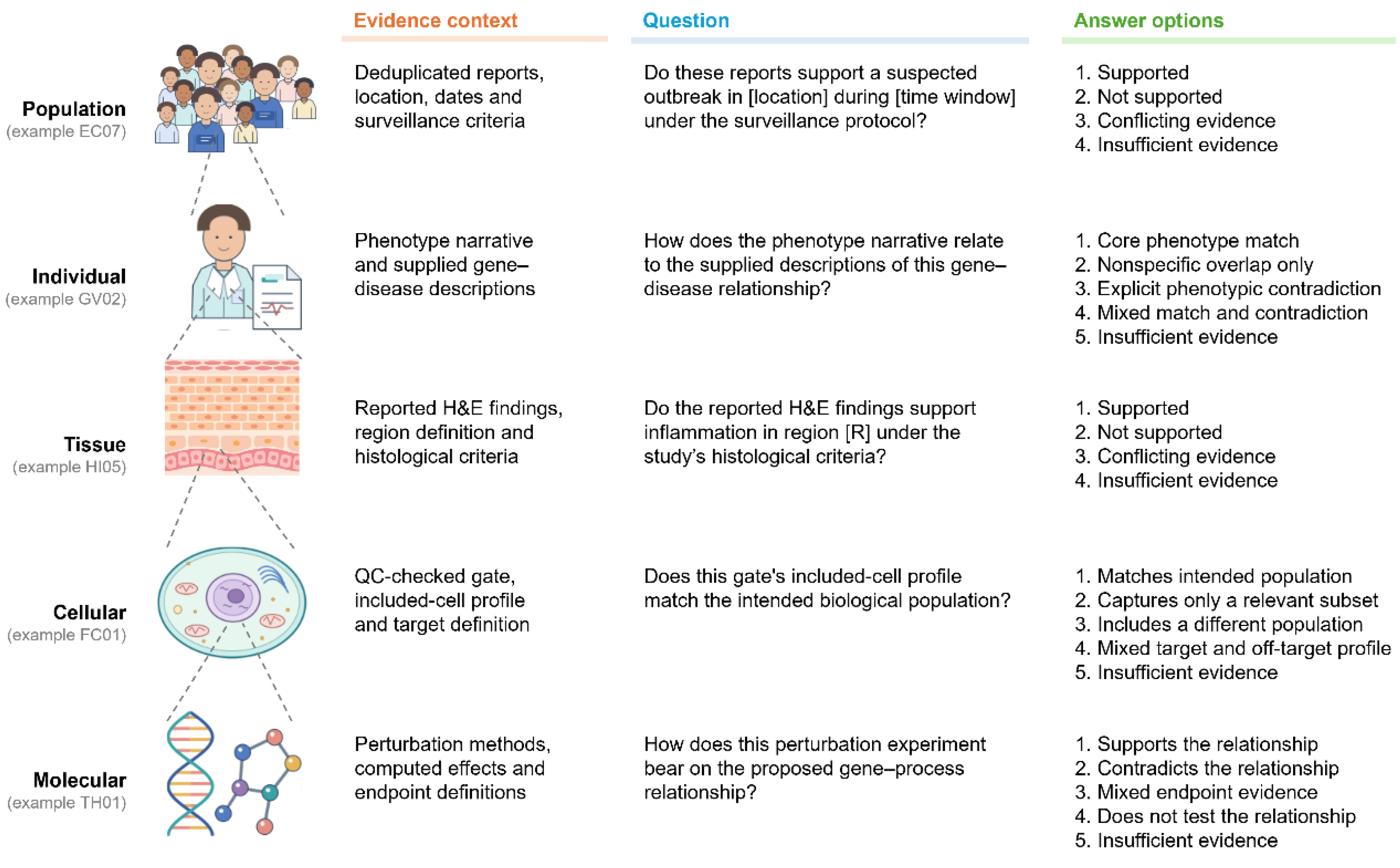
Across scales, the recurring task is to organize evidence for a specified claim before expert interpretation (Figure 2). Language models can propose functions for gene sets [6], and GeneAgent incorporates database-based verification [7]. A bounded question could first assess whether an experiment bears on a gene–process relationship in the relevant system. Subsequent LLM analysis could compare supporting and conflicting findings. The expert determines whether the evidence justifies a biological interpretation or further experimentation.
Variant interpretation makes the necessary distinctions explicit. ClinGen recommendations separate disease mechanism, assay applicability, assay validity and interpretation of the variant result [8]. Bounded assessments can organize these components for subsequent synthesis and expert review. At the cellular scale, GPT-4 has been evaluated for annotation from single-cell marker genes [9]. Separating lineage support, activation state and conflicting markers could make provisional annotations easier to assess. For cytometry, a question may concern whether a technically valid gate represents the intended population; quality control and gate construction remain upstream tasks.
Tissue interpretation depends on composition and spatial organization, as illustrated by cellular neighborhoods in colorectal cancer [10]. Semantic assessment would operate on reported features and analysis results, rather than raw images. Histological inflammation, radiological patterns and pathogen detection require distinct questions and reference standards. LLM synthesis can bring these contextual assessments together, while the specialist judges whether the combined evidence supports the proposed interpretation.
Clinical extraction and trial eligibility assessment offer related precedents at the individual scale [1,7]. A disease mention may concern a family member, a negated finding or a previous episode. Organizing these distinctions can support LLM synthesis of a record, but the final interpretation requires appropriate expertise. At the population scale, event-based surveillance already separates collecting, filtering, verifying and assessing reports [11]. Questions about duplicate reports, geography and observation periods could organize material for subsequent analysis and final public health assessment. Such textual judgments do not replace quantitative transmission estimation or causal analysis.
Evaluating the Complete Workflow
A model can answer individual questions accurately and still contribute little to the research workflow. Evaluation therefore needs to examine both the answers it produces and the decisions experts make with their help. For a bounded question, the reference answer concerns what the supplied evidence supports. An experiment may provide insufficient evidence for a mechanism that later work confirms. Expert annotation should reflect this distinction, using agreed definitions of support, contradiction and insufficient evidence. Disagreements deserve examination because they may reveal missing information or ambiguity in the question itself. Where answer options overlap, the criteria for choosing between them need to be settled before evaluation. Testing on carefully curated contexts helps isolate errors in the model’s judgment; starting from the original records also exposes problems in retrieval, extraction and preparation of the evidence.
The way data are divided should reflect where the workflow is expected to be used [12]. Passages from the same article, cells from the same donor and closely related experiments can carry information across development and test sets, making performance appear better than it will be on new material. Question wording, model selection, calibration and prioritization thresholds should all be established using development data. Even holding out entire sources leaves open the possibility that a model encountered them during pretraining. Evaluation on later material, together with controls that remove decisive evidence, can help assess how much the answers depend on the context actually supplied.
Small changes to the evidence offer another way to examine that dependence. Changing the reported tissue, negating a finding or removing a control may alter what an experiment supports. Reordering irrelevant sentences should leave the answer unchanged. Experts can specify these expectations in advance and use paired examples alongside naturally occurring records to examine whether a model notices the distinctions that matter biologically. Its probabilities also need calibration on relevant data [13]. Here, insufficient evidence and model abstention have different meanings: the former describes a limitation of the material, whereas the latter indicates that the model cannot answer reliably. Preserving both outcomes gives subsequent analysis and expert review a clearer account of what remains unresolved.
Comparisons with existing methods help establish which tasks benefit from semantic assessment. Rules, task-specific classifiers, natural-language inference models and LLMs with constrained outputs are all relevant alternatives. ConText, for example, uses rules to identify negation, temporality and experiencer in clinical narratives [14], while structured generation can enforce an output format [3]. These methods should receive the same evidence and use the same answer definitions. Class-specific precision and recall are particularly useful when biologically interesting candidates are rare and overall accuracy could conceal their loss [15].
The next question is whether any benefit survives when the model becomes part of a complete workflow. This requires comparing expert assessment with conventional tools, expert assessment assisted by an LLM, and the proposed sequence of semantic assessment, LLM analysis and final expert judgment. Comparable access to evidence and consistent task definitions make the results interpretable, while independent adjudication provides a reference for the final decisions. Evaluation should track useful candidates retained or mistakenly deprioritized, alongside the volume of LLM processing, elapsed time, expert effort and total cost. Counterbalancing case assignments can reduce learning effects. It is also worth examining when experts overturn model suggestions and when they accept incorrect ones. Placing a human at the end of the process does not, by itself, establish that the decisions have improved.
Understanding these outcomes requires a record of how each case was handled. Source passages and evidence identifiers should remain connected to the question, answer definitions, model versions and prioritization criteria, as well as to the LLM analysis and the expert’s final decision and rationale. This record supports auditing, although it cannot establish that the model’s reasoning faithfully followed the evidence. Experts need access to the underlying material so they can check qualifications or findings omitted from a synthesis. For sensitive inputs, reporting should also explain where processing occurred, who had access and how the data were retained. Existing guidance on computational benchmarking and LLM reporting provides a basis for documenting these choices [16,17].
A Resource for Prospective Evaluation
The initial version of the accompanying catalogue contains 65+ proposed questions across biomedical domains (Supplementary Table S1). The table defines identifiers, decision units and answer meanings; the repository adds evidence requirements, provenance fields and proposed follow-up actions. These actions are preparatory suggestions within the present framework; final interpretation and decisions remain with the expert. The author-curated catalogue is a starting point for task design, not a systematically sampled taxonomy or validated benchmark. Its definitions require expert review, including resolution of overlapping responses and adaptation to each decision unit.
The accompanying AI assistant skill helps prepare evidence-linked inputs and an implementation handoff. Unrun examples retain execution_status as “not_run” and null predictions. A synthetic GV04 example illustrates how a bounded answer can inform, but not settle, interpretation. An intronless construct may contain the relevant transcript sequence, supporting “Relevant sequence in an artificial construct”, while remaining unsuitable for testing a proposed splicing mechanism. That editorially expected label is neither a model prediction nor assay validation. It identifies information for subsequent synthesis; the expert judges the assay’s relevance to the biological claim.
Community contributions should refine operational definitions, supply difficult cases and develop independently annotated evaluation sets. Evaluations should establish which questions transfer across settings and whether their outputs help experts reach better-supported conclusions with less total effort. The catalogue provides hypotheses for that work. It does not establish that Jev or Laya already improves biomedical research or replaces any part of final expert responsibility.
Conclusions
Semantic decision models could extend the bioinformatics funnel by organizing contextual evidence before more extensive LLM analysis. The proposed sequence ends with human experts, who interpret the evidence, assess the model-assisted synthesis and make the final decisions. Its value depends on preserving useful candidates and reducing the total cost of reaching well-supported judgments. Jev, Laya and the accompanying catalogue offer starting points for comparative investigation. Demonstrating those benefits requires evaluation of the complete workflow, including the quality and effort of final human assessment.
Supplementary Materials
The following supporting information can be downloaded at website of this paper posted on Preprints.org.
Author Contributions
H.I.N. conceived the perspective and wrote the manuscript.
Funding
This work was supported by the São Paulo Research Foundation (FAPESP), grant 2023/18337-3.
Data Availability Statement
The catalogue, AI assistant skill, documentation and synthetic examples are available at https://github.com/hylixinsights/Jev-biomedicine. This Perspective and Supplementary Table S1 refer to catalogue 1.1.0. No new experimental dataset, model predictions or biomedical performance benchmark is reported.
Acknowledgments
ChatGPT (OpenAI, including Codex) and Claude (Anthropic) assisted with drafting, language editing, reference organization and revision of the manuscript, catalogue, Supplementary Table S1 and AI assistant skill. Outputs were assessed during revision by checking claims against primary sources and provider documentation, cross-checking catalogue entries against Table S1 and figure labels, and distinguishing proposals from executed analyses. The author takes responsibility for the final content, interpretations and references.
Conflicts of Interest
H.I.N. is Chief Executive Officer of Hylix, a consulting startup company (https://hylix.app), whose GitHub organization hosts the accompanying resource. The author declares no relationship with TypeSafe or Convai Innovations.
References
- Guevara M, Chen S, Thomas S, Chaunzwa TL, Franco I, Kann BH, et al. Large language models to identify social determinants of health in electronic health records. Npj Digit Med. 2024;7: 6. [CrossRef]
- Hou W, Ji Z. Assessing GPT-4 for cell type annotation in single-cell RNA-seq analysis. Nat Methods. 2024;21: 1462–1465. [CrossRef]
- Li L, Dong Y, Wang G, Xu Z, Jiang A, Chen T. XGrammar-2: Dynamic and Efficient Structured Generation Engine for Agentic LLMs. Proceedings of the ACM Conference on AI and Agentic Systems. New York, NY, USA: Association for Computing Machinery; 2026. pp. 1009–1022. [CrossRef]
- Romanov A, Shivade C. Lessons from Natural Language Inference in the Clinical Domain. In: Riloff E, Chiang D, Hockenmaier J, Tsujii J, editors. Proceedings of the 2018 Conference on Empirical Methods in Natural Language Processing. Brussels, Belgium: Association for Computational Linguistics; 2018. pp. 1586–1596. [CrossRef]
- Jullien M, Valentino M, Frost H, O’Regan P, Landers D, Freitas A. NLI4CT: Multi-Evidence Natural Language Inference for Clinical Trial Reports. In: Bouamor H, Pino J, Bali K, editors. Proceedings of the 2023 Conference on Empirical Methods in Natural Language Processing. Singapore: Association for Computational Linguistics; 2023. pp. 16745–16764. [CrossRef]
- Evaluation of large language models for discovery of gene set function | Nature Methods. [cited 29 Sept 2026]. Available: https://www.nature.com/articles/s41592-024-02525-x.
- Wang Z, Jin Q, Wei C-H, Tian S, Lai P-T, Zhu Q, et al. GeneAgent: self-verification language agent for gene-set analysis using domain databases. Nat Methods. 2025;22: 1677–1685. [CrossRef]
- Brnich SE, Abou Tayoun AN, Couch FJ, Cutting GR, Greenblatt MS, Heinen CD, et al. Recommendations for application of the functional evidence PS3/BS3 criterion using the ACMG/AMP sequence variant interpretation framework. Genome Med. 2019;12: 3. [CrossRef]
- Hou W, Ji Z. Assessing GPT-4 for cell type annotation in single-cell RNA-seq analysis. Nat Methods. 2024;21: 1462–1465. [CrossRef]
- Schürch CM, Bhate SS, Barlow GL, Phillips DJ, Noti L, Zlobec I, et al. Coordinated Cellular Neighborhoods Orchestrate Antitumoral Immunity at the Colorectal Cancer Invasive Front. Cell. 2020;182: 1341-1359.e19. [CrossRef]
- Early detection, assessment and response to acute public health events: implementation of early warning and response with a focus on event-based surveillance. [cited 29 Sept 2026]. Available: https://www.who.int/publications/i/item/WHO-HSE-GCR-LYO-2014.4.
- Bernett J, Blumenthal DB, Grimm DG, Haselbeck F, Joeres R, Kalinina OV, et al. Guiding questions to avoid data leakage in biological machine learning applications. Nat Methods. 2024;21: 1444–1453. [CrossRef]
- Guo C, Pleiss G, Sun Y, Weinberger KQ. On Calibration of Modern Neural Networks. Proceedings of the 34th International Conference on Machine Learning. PMLR; 2017. pp. 1321–1330. Available: https://proceedings.mlr.press/v70/guo17a.html.
- Harkema H, Dowling JN, Thornblade T, Chapman WW. ConText: An algorithm for determining negation, experiencer, and temporal status from clinical reports. J Biomed Inform. 2009;42: 839–851. [CrossRef]
- Saito T, Rehmsmeier M. The Precision-Recall Plot Is More Informative than the ROC Plot When Evaluating Binary Classifiers on Imbalanced Datasets. PLOS ONE. 2015;10: e0118432. [CrossRef]
- Weber LM, Saelens W, Cannoodt R, Soneson C, Hapfelmeier A, Gardner PP, et al. Essential guidelines for computational method benchmarking. Genome Biol. 2019;20: 125. [CrossRef]
- Gallifant J, Afshar M, Ameen S, Aphinyanaphongs Y, Chen S, Cacciamani G, et al. The TRIPOD-LLM reporting guideline for studies using large language models. Nat Med. 2025;31: 60–69. [CrossRef]
Figure 1.
Sequential computational support for final expert interpretation. (A) Autoregressive generation, with single-token label scoring as an alternative baseline for closed tasks. (B) A bounded-output interface, without specifying SDMs’ architecture. (C) Quantitative analysis supplies candidates and evidence. Semantic assessment prioritizes this material before LLM analysis, aiming to reduce the workload and computational cost of that stage. The LLM provides the penultimate analysis. Human experts interpret the evidence and make the final decisions in every completed assessment. Model outputs and prioritization remain provisional and inspectable. Any cost advantage requires task-specific evaluation. ChatGPT assisted with diagram revisions and label alignment.
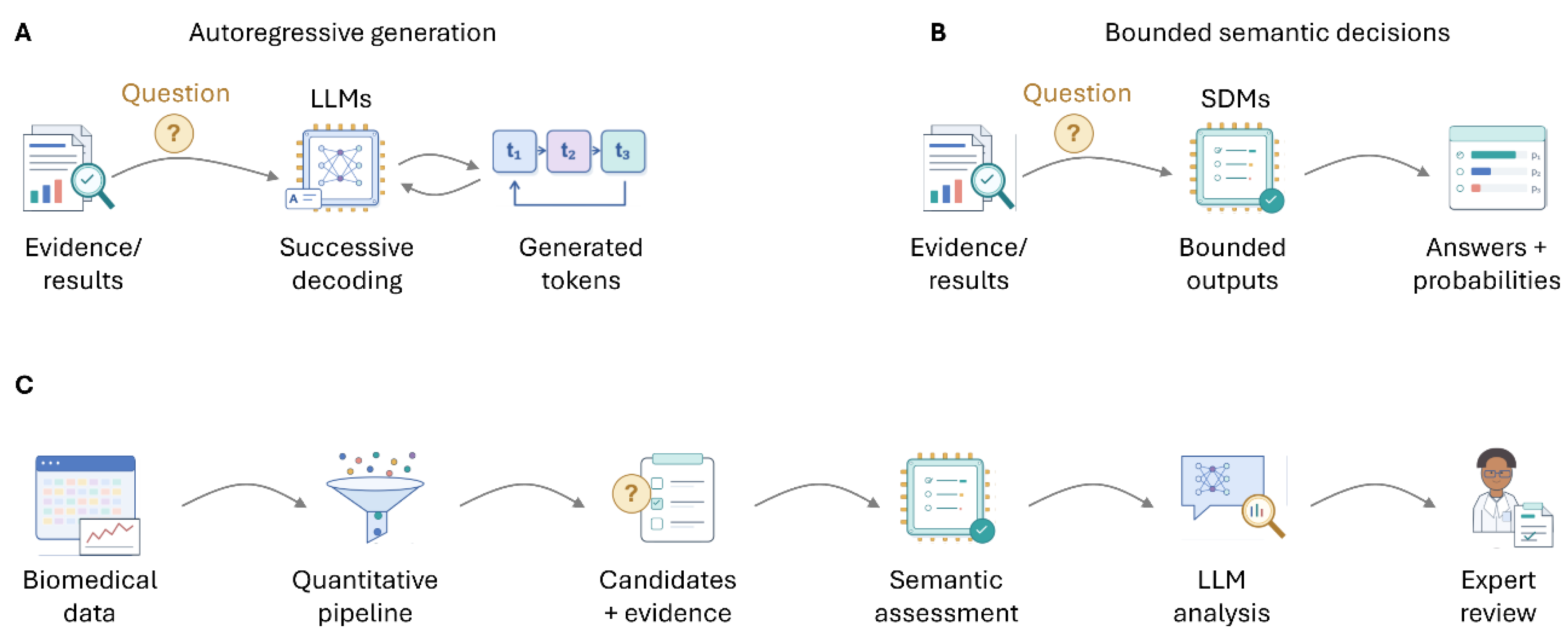
Figure 2.
Proposed contextual questions across biomedical scales. Examples reproduce catalogue entries EC07, GV02, HI05, FC01 and TH01. Bracketed placeholders require case-specific values; Supplementary Table S1 provides answer definitions. Inputs are reported findings and processed context, requiring upstream specialist analysis. The answers are intermediate assessments for subsequent LLM analysis and final human interpretation and decision. Scales represent units of analysis rather than a causal sequence. All tasks require validation. ChatGPT assisted with diagram revisions and label alignment.
Disclaimer/Publisher’s Note: The statements, opinions and data contained in all publications are solely those of the individual author(s) and contributor(s) and not of MDPI and/or the editor(s). MDPI and/or the editor(s) disclaim responsibility for any injury to people or property resulting from any ideas, methods, instructions or products referred to in the content. |
© 2026 by the author. Licensee MDPI, Basel, Switzerland. This article is an open access article distributed under the terms and conditions of the Creative Commons Attribution (CC BY) license.
Copyright: This open access article is published under a Creative Commons CC BY 4.0 license, which permit the free download, distribution, and reuse, provided that the author and preprint are cited in any reuse.