
Submitted:
29 September 2026
Posted:
30 September 2026
You are already at the latest version
Abstract
Virtual modeling can connect abstract disciplinary knowledge with experimentation, problem solving, and reflective activity, yet multi-institutional evidence on its joint contribution to creative thinking and digital-pedagogical competence in pre-service teacher education remains limited. This multi-institutional quasi-experimental study evaluated a structured virtual modeling-based instructional system implemented from 2023 to 2026 at three higher education institutions in Uzbekistan. The intervention integrated 2D/3D simulations, model-based learning, problem-based and project-based learning, SCAMPER, Peer Instruction, Mind Mapping, reflective tasks, and a creative problem-modeling sequence. Aggregate baseline distributions were comparable between experimental (n = 226) and control (n = 222) groups, χ²(2) = 0.41, p = 0.814. At final evaluation, experimental (n = 231) and control (n = 225) distributions differed substantially, χ²(2) = 57.72, p < 0.001, Cramér’s V = 0.36. The odds of attaining at least a medium developmental level were higher in the experimental group (OR = 4.93, 95% CI 3.22–7.56), with a consistent association across institutions. These findings support virtual modeling as a pedagogically integrated approach for strengthening creative-professional and digital-pedagogical development in pre-service teachers, while causal interpretation remains limited by the non-randomized design.
Keywords:
virtual modeling
; creative thinking
; digital-pedagogical competence
; pre-service teachers
; teacher education
; educational technology
; quasi-experimental study
; higher education
1. Introduction
Digital transformation has altered expectations for higher education and, in particular, for teacher education. Future teachers are expected to combine disciplinary understanding with pedagogical judgment and the capacity to select, design, and evaluate technology-supported learning experiences. Powerful teacher preparation therefore requires coherent links between theory, practice, reflection, and authentic professional activity [1]. The technological pedagogical content knowledge (TPACK) framework similarly conceptualizes effective technology integration as an interaction among technological, pedagogical, and content knowledge rather than as technical proficiency alone [2]. Subsequent reviews have shown both the continuing influence of TPACK and the need to treat it as a situated, dynamic, and context-dependent form of professional knowledge [3,4].
International digital-competence frameworks reinforce this pedagogical orientation. DigCompEdu organizes educator competence around professional engagement, digital resources, teaching and learning, assessment, learner empowerment, and the facilitation of learners’ digital competence [5]. Systematic reviews in higher education show that digital competence has become a core component of contemporary teaching, but they also identify persistent gaps between basic technology use and pedagogically meaningful integration [6,7,8,9]. Evidence from pre-service teacher education further suggests that digital competence develops most effectively when explicit instruction is combined with integrated practice and modeling by teacher educators [10], while meta-analytic evidence indicates that teacher-education interventions can improve TPACK when learning experiences deliberately connect technology with pedagogy and content [11].
Digital-pedagogical competence alone is not sufficient for contemporary professional preparation. Teachers must also interpret unfamiliar situations, generate alternative explanations, design multiple solutions, evaluate consequences, and revise decisions. These capabilities overlap with creative thinking. Divergent thinking is commonly used as an indicator of creative potential, although it should not be equated with creative achievement [12]. Reviews of creativity assessment emphasize dimensions such as originality, fluency, flexibility, and elaboration [13]. Quantitative evidence shows that creativity can be strengthened through systematic training [14], while reviews of creative learning environments highlight the importance of learner autonomy, flexible use of space and time, collaboration, and appropriately challenging tasks [15]. Learning environments that deliberately provide these affordances are more likely to support student creativity [16].
Theoretical accounts of creativity also underline the interaction between personal capabilities and the social or instructional environment. Componential theory treats creativity as emerging from domain-relevant skills, creativity-relevant processes, and task motivation [17,42]. Broader reviews argue that creativity should be understood as a multilevel phenomenon shaped by cognitive, motivational, social, and contextual influences [43]. Assessment practices can either constrain or support creative risk taking, particularly when students perceive that only one predetermined response is acceptable [44]. Experimental work shows that structured cognitive creativity training can enhance creative thinking skills [45], whereas teachers’ beliefs about creativity affect whether creative behaviors are recognized and encouraged in classrooms [46]. These perspectives imply that an intervention intended to develop creativity should alter both the tasks students perform and the pedagogical conditions under which ideas are generated, tested, and evaluated.
Virtual modeling provides a plausible bridge between digital-pedagogical competence and creative thinking. Model-based learning asks learners to construct, manipulate, test, compare, and revise representations in order to explain phenomena and reason about relationships that may not be directly observable. A major review of modeling-based learning in science education identifies cognitive, metacognitive, social, material, and epistemological contributions of modeling activity [18]. Virtual laboratories further allow learners to revisit experiments, change parameters, visualize processes, and regulate the pace of inquiry; an umbrella review reports positive potential for self-regulated learning when virtual laboratories are pedagogically structured rather than used as stand-alone demonstrations [19].
Evidence on creativity is also increasingly favorable. A meta-analysis of virtual technologies reported a moderate positive effect on students’ creativity and found stronger effects when virtual environments were combined with inquiry-discovery and task-driven approaches [20]. STEM project-based learning has likewise shown positive effects on creativity in meta-analytic evidence [21]. Together, these findings suggest that the instructional value of virtual technology depends not simply on immersion or visualization, but on the cognitive work that technology enables: asking questions, manipulating representations, generating alternatives, receiving feedback, and revising solutions.
The present intervention therefore integrates virtual modeling with active-learning strategies. Problem-based learning (PBL) is organized around complex problems that require learners to identify knowledge gaps, gather evidence, and develop defensible solutions [22,23]; meta-analytic evidence in higher education indicates that PBL can strengthen critical thinking [24]. Project-based learning (PjBL) extends inquiry into sustained cycles of design, production, and evaluation. Studies in STEM contexts associate PjBL with positive attitudes and achievement [25,26], while recent meta-analytic evidence links STEM PjBL to creativity [21]. Peer Instruction encourages conceptual articulation and revision through peer explanation [27], Mind Mapping can support cognitive organization and learning outcomes [28], and flipped-learning designs can create additional class time for active problem solving when implemented with appropriate structure [29,30]. Gamification can also support motivational and behavioral engagement, although its effects depend strongly on design choices and alignment with learning goals [31,32].
Simulation-based teacher preparation offers additional support for this integrated approach. Recent quasi-experimental work shows that sustained simulation-based teaching practicum can improve pre-service teachers’ TPACK, classroom-management, and lesson-planning skills [33]. Such evidence strengthens the argument that virtual environments are most educationally productive when they are embedded in authentic professional tasks, repeated practice, feedback, and reflection rather than treated as isolated digital experiences.
Within Uzbekistan and the broader regional context, emerging work has examined computer modeling, digitalization, creativity, and technology-supported independent learning. Turaeva demonstrated the use of computer models for developing students’ creative thinking and later described a creativity-oriented physics-teaching approach combining visual simulations, interactive models, and problem-based tasks [34,35]. Akmalova, Xaydarov, and Pardaeva discussed the development of students’ intellectual competence under higher-education digitalization [36], while Akmalova examined intellectual potential in digitally mediated higher education [37]. Pardaeva and colleagues addressed the creation of software products for organizing independent work through distance-education technologies [38]. These studies provide locally relevant conceptual support, but they do not constitute evidence for the effectiveness of the specific intervention evaluated here.
Three gaps therefore motivate the present study. First, creative thinking and digital competence are frequently examined as separate outcomes, whereas fewer studies evaluate an intervention explicitly designed to develop both within teacher education. Second, many virtual- or simulation-based studies are confined to one course, one platform, or one institution, limiting evidence about consistency across institutional contexts. Third, technology effects are sometimes discussed as properties of the tools themselves even though reviews show that outcomes depend strongly on pedagogical design [19,20,21,33]. A multi-institutional quasi-experimental design is therefore useful for examining whether a structured instructional system is associated with a similar developmental pattern across distinct settings while acknowledging the limitations of non-randomized educational research [39].
The pedagogical logic of the intervention follows a structured sequence: problem recognition → interaction with a virtual model → hypothesis formulation and testing → analysis of results → generation of a creative solution → reflective conclusion. The sequence is supported by systemic, activity-based, competence-based, learner-centered, and creative-reflective principles. It integrates model-based learning (MBL), PBL, PjBL, the authors’ KMT-M creative problem-modeling technology, SCAMPER, Peer Instruction, Mind Mapping, case-based learning, Socratic dialogue, flipped-learning elements, and virtual experimentation. The intended outcome is not merely improved use of digital tools but a combined creative-professional capability in which pre-service teachers can analyze a modeled process, justify interpretations, generate alternatives, translate insights into pedagogical decisions, and reflect on those decisions.
The aim of this study was to determine whether this structured virtual modeling-based instructional system was associated with more favorable creative-professional and digital-pedagogical developmental outcomes among pre-service teachers than conventional instruction, and whether the pattern was consistent across three participating institutions. The study addressed three research questions: (RQ1) Do experimental and control groups differ in developmental-level distributions after the intervention? (RQ2) Is the direction and magnitude of the association consistent across the three institutions? (RQ3) Does the intervention produce a larger shift from low developmental levels toward medium and high levels than the change observed under conventional instruction? Based on the literature, three hypotheses were specified: H1, baseline distributions would not differ materially between groups; H2, final distributions would favor the experimental condition; and H3, institution-stratified effects would be directionally consistent.
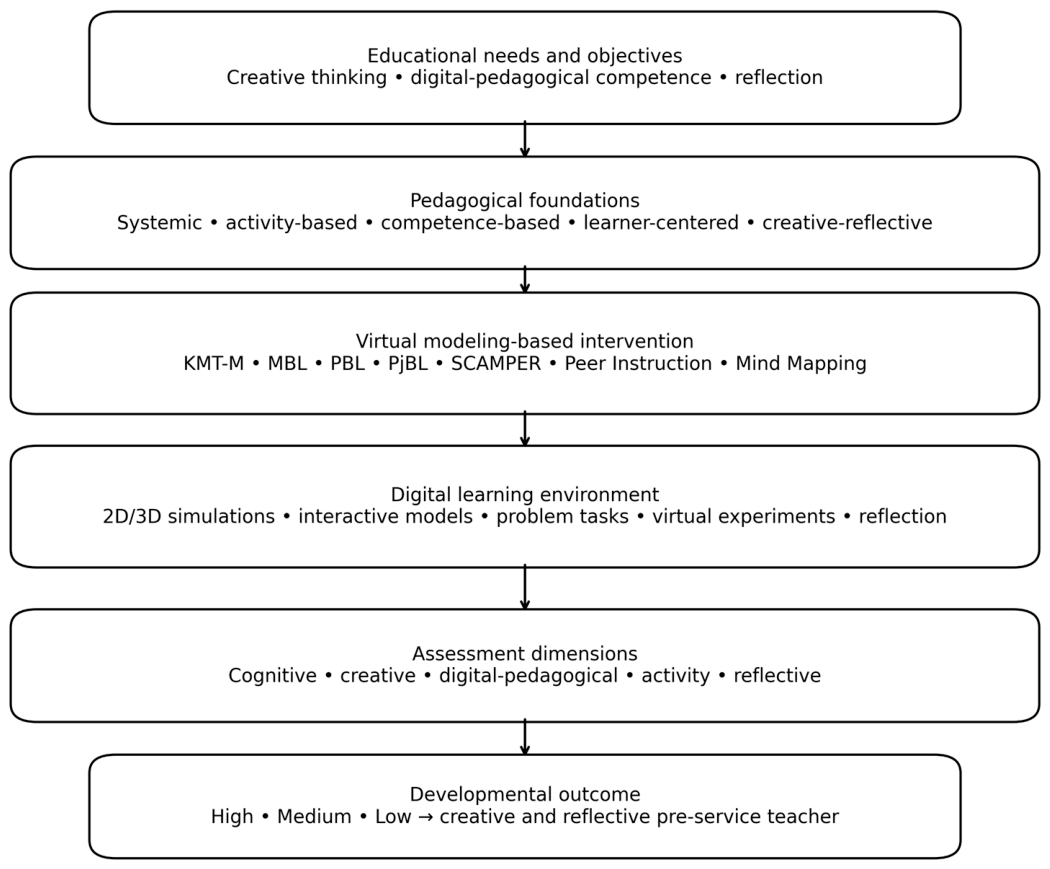
Figure 1.
Conceptual framework of the virtual modeling-based instructional system for developing creative thinking and digital-pedagogical competence in pre-service teachers.
Figure 1.
Conceptual framework of the virtual modeling-based instructional system for developing creative thinking and digital-pedagogical competence in pre-service teachers.
2. Materials and Methods
2.1. Study Design
The study used a multi-institutional, non-equivalent-group quasi-experimental design conducted between 2023 and 2026. The pedagogical experiment was organized in three stages: an identifying (baseline) stage, a formative implementation stage, and a final evaluation stage. Experimental groups received the virtual modeling-based instructional system, whereas control groups continued with conventional instructional arrangements. Random assignment of individual students was not feasible because intact educational groups were used; consequently, the design supports cautious intervention-associated inference rather than definitive causal attribution [39]. Baseline distributions were examined explicitly to assess initial group comparability. The design was non-randomized; therefore, the analysis estimates associations with the intervention rather than causal effects.
2.2. Setting and Participants
The study was conducted with first-year students enrolled in teacher-education programs at three higher education institutions in Uzbekistan: Shahrisabz State Pedagogical Institute (ShDPI), Qarshi State University (QarDU), and Termiz State Pedagogical Institute (TermDPI). At baseline, 448 students were represented in the aggregate dataset (experimental n = 226; control n = 222). At the final stage, 456 students were represented (experimental n = 231; control n = 225). The increase reflects expansion of the participating academic groups during the formative and final stages. Analyses therefore focus on comparable group-level developmental distributions rather than assuming one-to-one individual pairing across all stages.

Table 1.
Participant distribution across institutions and study stages.
| Institution | Group | Baseline n | Final n |
|---|---|---|---|
| ShDPI | Experimental | 79 | 80 |
| ShDPI | Control | 76 | 77 |
| QarDU | Experimental | 75 | 77 |
| QarDU | Control | 74 | 75 |
| TermDPI | Experimental | 72 | 74 |
| TermDPI | Control | 72 | 73 |
| Total | Experimental | 226 | 231 |
| Total | Control | 222 | 225 |
2.3. Virtual Modeling-Based Intervention
The intervention was designed as a pedagogical system rather than as the use of a single software package. Virtual models and 2D/3D simulations were used within an applied-didactic module covering particle motion, diffusion, heat transfer, isoprocesses, and thermodynamic phenomena. Learning activities required students to manipulate virtual models, interpret changes in model parameters, propose and test hypotheses, compare alternative explanations, generate pedagogically appropriate solutions, and produce reflective conclusions.
The central KMT-M (Creative Problem System-Modeling) technology linked virtual model interaction with a problem situation, hypothesis testing, creative solution generation, and reflective evaluation. It was supplemented by MBL, PBL, PjBL, SCAMPER, Peer Instruction, Mind Mapping, flipped-learning elements, Socratic dialogue, case-study tasks, the Six Thinking Hats technique, and virtual experimentation. The intervention was implemented in lectures and practical sessions, with students working individually and in small groups.
Table 2.
Core components of the virtual modeling-based instructional system.
| Component | Operationalization in the intervention |
|---|---|
| Virtual modeling | 2D/3D models and simulations; parameter manipulation; visualization of physical processes |
| KMT-M | Problem recognition → model interaction → hypothesis testing → creative solution → reflection |
| MBL/PBL/PjBL | Model-based reasoning, problem solving, and project-oriented production of solutions |
| Creativity methods | SCAMPER, Mind Mapping, Six Thinking Hats, alternative-solution generation |
| Collaborative methods | Peer Instruction, small-group discussion, Socratic dialogue, case study |
| Reflection and assessment | Reflective tasks, self-evaluation, peer evaluation, teacher/expert evaluation |
2.4. Outcome Framework and Assessment
The outcome framework combined six pedagogical criteria: didactic, methodological, cognitive, creative, activity-oriented, and outcome-related criteria. For the present article, these criteria were interpreted as a composite indicator of creative-professional development incorporating creative thinking, digital-pedagogical competence, model-based reasoning, and professional reflection. Evidence was collected through diagnostic tests, observation, questionnaires, practical-task scores, reflective assignments, and final assessment results.
Performance was originally represented on a 100-point scale and interpreted through four levels: creative (90–100), partially exploratory (71–89), productive (60–70), and reproductive (<60). For the aggregate statistical analysis reported here, these categories were consolidated into three developmental levels: High (90–100), Medium (60–89), and Low (<60). For descriptive mean-score comparisons, the three levels were coded 5, 4, and 3, respectively. This coding was used only to summarize ordinal developmental distributions and does not imply interval-level measurement of the underlying constructs.
2.5. Statistical Analysis
Primary inferential analyses were performed on the aggregate counts documented in the original experimental records. Baseline and final 2 × 3 contingency tables (group × developmental level) were evaluated using Pearson’s chi-square test of independence, and Cramér’s V was reported as an effect-size measure [40]. For an interpretable binary contrast, High and Medium levels were combined and compared with the Low level; odds ratios (ORs), risk ratios (RRs), and 95% confidence intervals were calculated. Institution-specific 2 × 2 tables were then combined with the Mantel-Haenszel method to estimate a pooled odds ratio adjusted for institution, and a Breslow-Day test was used to examine homogeneity of the institution-specific odds ratios.
To evaluate change over time without assuming individual matching, difference-in-differences (DiD) contrasts were calculated for the proportions classified at the High and Low levels, using large-sample standard errors for independent proportions because the baseline and final cohorts were not identical. Level-coded means (High = 5, Medium = 4, Low = 3) were retained only as descriptive summaries of the original evaluation framework and were not treated as validated interval-scale measures. Statistical significance was evaluated at α = 0.05.
2.6. Use of Generative Artificial Intelligence in Manuscript Preparation
OpenAI ChatGPT (GPT-5.6 Sol, accessed 28 September 2026) was used after data collection to assist with language refinement, manuscript organization, literature organization, preparation of publication graphics, and code-supported statistical reporting. The tool was not used to generate original participant data, assign participants to study groups, or replace the underlying study records. Numerical results reported in this manuscript were derived from aggregate counts documented in the study materials. The authors retain responsibility for verification, interpretation, and final presentation of all analyses and text.
2.7. Ethical Considerations
Before implementation, institutional permission to conduct the pedagogical experiment was granted by the authorized dean’s offices of two participating institutions. The activities were embedded in regular course/module instruction and consisted exclusively of educational procedures; no medical, clinical, or health-related intervention was performed. Participant-level information used for research reporting was anonymized, and statistical results were presented in aggregated form. On the basis of the study’s regular educational context, non-medical character, and use of anonymized educational data, the authorized dean’s offices confirmed that separate formal ethical review was not required (institutional reference numbers and dates withheld for double-anonymized review and to be supplied to the Editorial Office). The study was conducted in accordance with applicable institutional requirements and ethical principles relevant to educational research.
3. Results
3.1. Baseline Comparability and Final Developmental Distributions
At baseline, the experimental and control groups showed closely similar developmental distributions. The experimental group included 34 students at the High level (15.0%), 70 at the Medium level (31.0%), and 122 at the Low level (54.0%); the control group included 33 High (14.9%), 63 Medium (28.4%), and 126 Low (56.8%). The baseline group-by-level association was not statistically significant, χ²(2) = 0.41, p = 0.814, Cramér’s V = 0.03, supporting practical comparability of the aggregate distributions before implementation.
At the final stage, the distributions diverged substantially. In the experimental group, 63 students (27.3%) were at the High level, 127 (55.0%) at the Medium level, and 41 (17.7%) at the Low level. In the control group, 37 students (16.4%) were High, 72 (32.0%) Medium, and 116 (51.6%) Low. The final group-by-level association was statistically significant, χ²(2) = 57.72, p < 0.001, with Cramér’s V = 0.36, indicating a moderate-to-large association in the context of a 2 × 3 table [40].
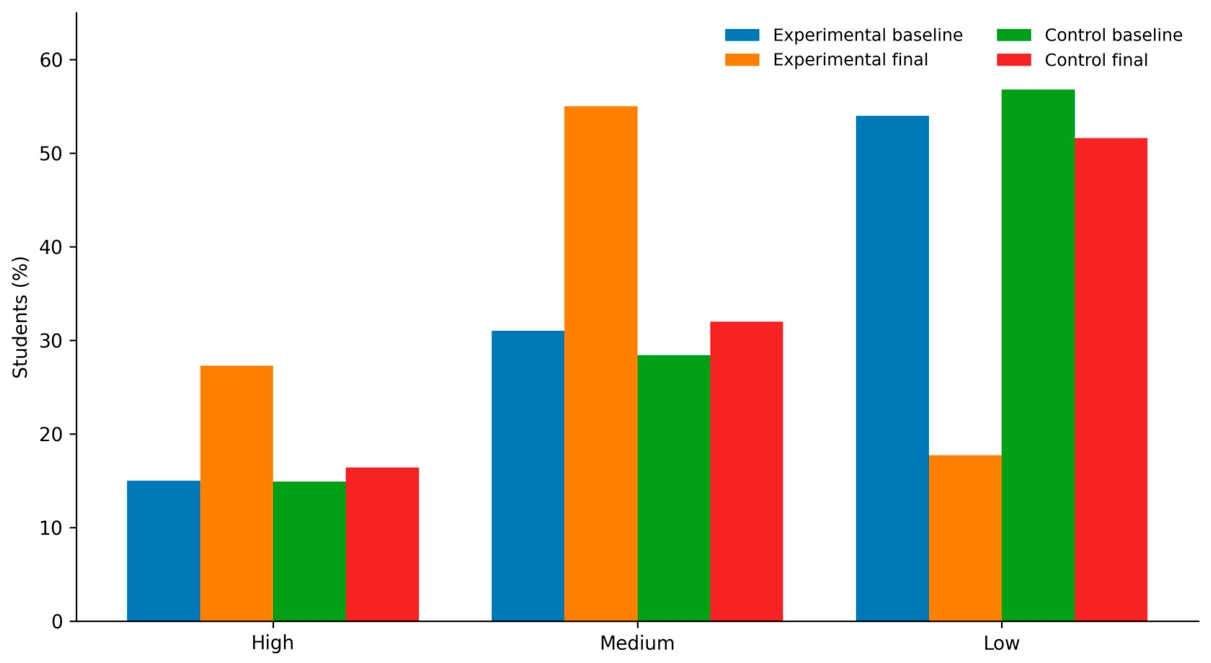
Table 3.
Aggregate developmental-level distributions at baseline and final evaluation.
| Stage | Group | n | High n (%) | Medium n (%) | Low n (%) |
|---|---|---|---|---|---|
| Baseline | Experimental | 226 | 34 (15.0) | 70 (31.0) | 122 (54.0) |
| Baseline | Control | 222 | 33 (14.9) | 63 (28.4) | 126 (56.8) |
| Final | Experimental | 231 | 63 (27.3) | 127 (55.0) | 41 (17.7) |
| Final | Control | 225 | 37 (16.4) | 72 (32.0) | 116 (51.6) |
Figure 2.
Developmental-level distributions at baseline and final evaluation for experimental and control groups.
Figure 2.
Developmental-level distributions at baseline and final evaluation for experimental and control groups.
3.2. Effect Magnitude
When High and Medium levels were combined and contrasted with the Low level, the baseline odds ratio was OR = 1.12 (95% CI 0.77–1.62), consistent with negligible initial group differences. At the final stage, the odds of attaining at least a Medium level rather than remaining at the Low level were 4.93 times higher in the experimental group than in the control group (OR = 4.93, 95% CI 3.22–7.56). The corresponding risk ratio was RR = 1.70 (95% CI 1.46–1.97), showing that the probability of being at least Medium was approximately 70% higher in the experimental group at final evaluation.
Change contrasts further clarified the pattern. The proportion at the High level increased from 15.0% to 27.3% in the experimental group and from 14.9% to 16.4% in the control group, yielding a difference-in-differences estimate of +10.65 percentage points (z = 2.09, p = 0.037). The Low-level proportion decreased from 54.0% to 17.7% in the experimental group and from 56.8% to 51.6% in the control group, producing a DiD estimate of −31.03 percentage points (z = −4.94, p < 0.001). Descriptively, level-coded means changed from 3.611 to 4.095 in the experimental group and from 3.581 to 3.649 in the control group; these coded means are reported only as summaries of the ordinal categories.
Table 4.
Overall statistical comparison of experimental and control groups.
| Statistic | Baseline | Final/Change |
|---|---|---|
| Pearson χ² (df = 2) | 0.41 | 57.72 |
| p-value | 0.814 | <0.001 |
| Cramér’s V | 0.03 | 0.36 |
| OR: ≥Medium vs. Low (95% CI) | 1.12 (0.77–1.62) | 4.93 (3.22–7.56) |
| RR: ≥Medium vs. Low (95% CI) | 1.06 (0.87–1.31) | 1.70 (1.46–1.97) |
| DiD: High-level proportion | — | +10.65 percentage points (p = 0.037) |
| DiD: Low-level proportion | — | −31.03 percentage points (p < 0.001) |
| Mantel-Haenszel pooled OR | — | 4.94 (3.22–7.58); p < 0.001 |
| Breslow-Day homogeneity | — | p = 0.840 |
3.3. Institution-Specific Final-Stage Results
The direction of the final-stage association was consistent across all three institutions. At ShDPI, χ²(2) = 22.36, p < 0.001, Cramér’s V = 0.38; at QarDU, χ²(2) = 19.81, p < 0.001, Cramér’s V = 0.36; and at TermDPI, χ²(2) = 15.93, p < 0.001, Cramér’s V = 0.33. When High and Medium were contrasted with Low, institution-specific odds ratios were 5.57 (95% CI 2.65–11.72), 5.27 (95% CI 2.46–11.33), and 4.16 (95% CI 2.02–8.54), respectively. The Mantel-Haenszel pooled odds ratio was 4.94 (95% CI 3.22–7.58; p < 0.001), and the Breslow-Day homogeneity test was non-significant (p = 0.840), providing no evidence that the binary intervention association differed materially across institutions.
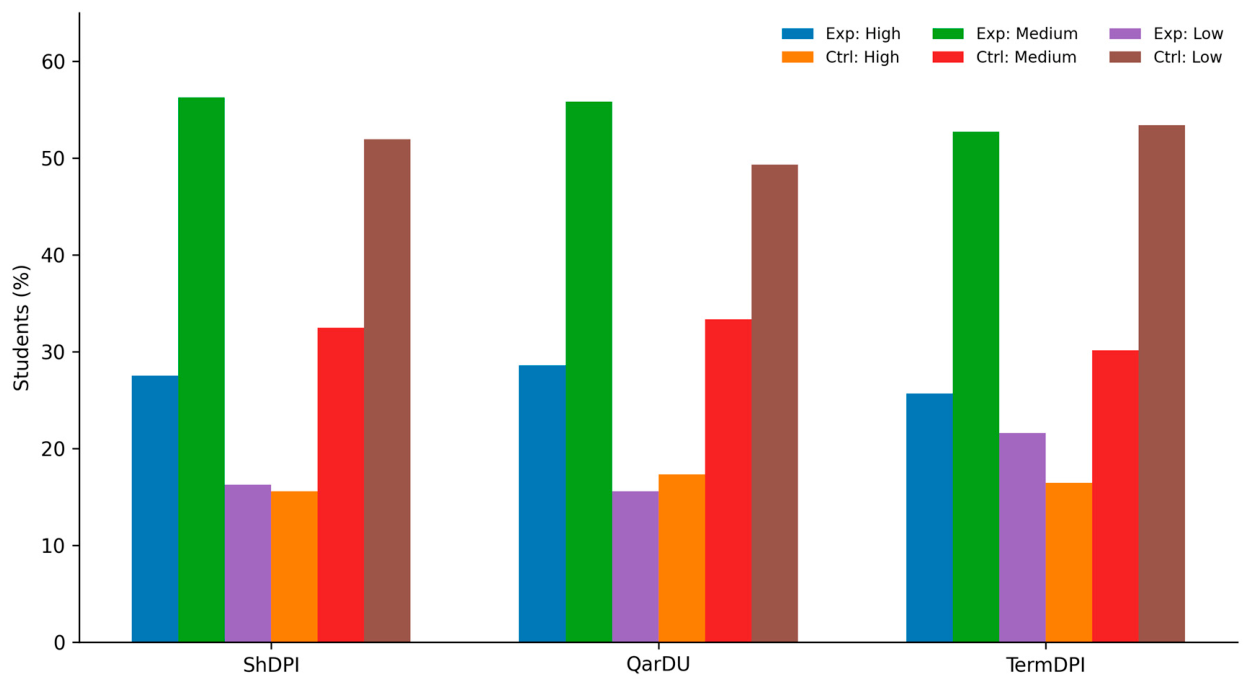
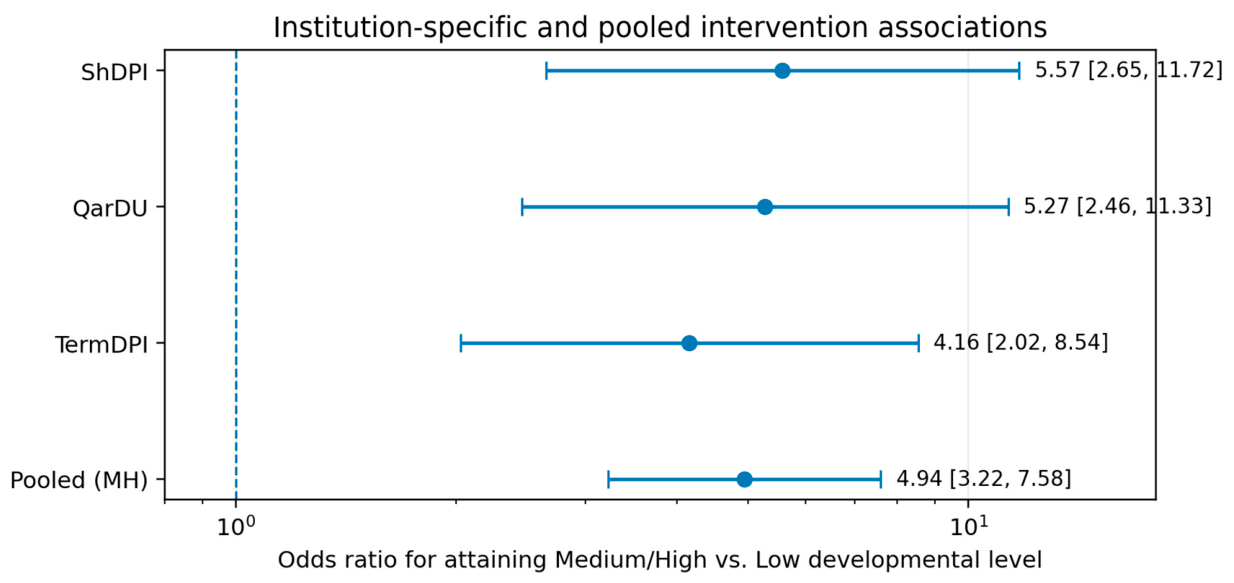
Table 5.
Institution-specific final-stage developmental distributions and association tests.
| Institution | Experimental: High/Medium/Low (%) | Control: High/Medium/Low (%) | χ² | p | Cramér’s V |
|---|---|---|---|---|---|
| ShDPI | 27.50 / 56.25 / 16.25 | 15.58 / 32.47 / 51.95 | 22.36 | <0.001 | 0.38 |
| QarDU | 28.57 / 55.84 / 15.58 | 17.33 / 33.33 / 49.33 | 19.81 | <0.001 | 0.36 |
| TermDPI | 25.68 / 52.70 / 21.62 | 16.44 / 30.14 / 53.42 | 15.93 | <0.001 | 0.33 |
Figure 3.
Institution-specific final-stage developmental distributions in experimental and control groups.
Figure 3.
Institution-specific final-stage developmental distributions in experimental and control groups.
Figure 4.
Institution-specific and Mantel-Haenszel pooled odds ratios for attaining at least a Medium developmental level rather than remaining at the Low level at final evaluation. Error bars denote 95% confidence intervals.
Figure 4.
Institution-specific and Mantel-Haenszel pooled odds ratios for attaining at least a Medium developmental level rather than remaining at the Low level at final evaluation. Error bars denote 95% confidence intervals.
4. Discussion
The purpose of this study was to evaluate a structured virtual modeling-based instructional system designed to develop creative thinking and digital-pedagogical competence among pre-service teachers across three higher education institutions. Four findings are central. First, experimental and control groups were closely comparable at baseline. Second, final developmental distributions differed substantially, with a much smaller Low-level proportion and larger Medium/High proportions in the experimental group. Third, the magnitude of the final association was educationally meaningful as well as statistically significant: students in the experimental condition had nearly five times the odds of attaining at least a Medium developmental level. Fourth, the institution-stratified analysis yielded a pooled OR of 4.94 and no evidence of effect heterogeneity, suggesting that the direction of the association was stable across the three participating institutions.
The pattern is consistent with contemporary accounts of creativity as a developable capacity rather than a fixed trait. Creativity training has shown positive effects across diverse settings [14], and creative learning environments are characterized by autonomy, flexible exploration, collaboration, and challenging tasks [15,16]. Componential theory further emphasizes the joint role of knowledge, creativity-relevant processes, and motivation [17,42], while broader creativity research stresses the interaction of cognitive and contextual factors [43]. The present intervention operationalized these principles by requiring students to generate hypotheses, manipulate models, compare outcomes, justify alternatives, and reflect on the adequacy of their solutions. Such a design is also consistent with evidence that assessment practices influence whether students take creative risks [44], that structured cognitive training can enhance creative thinking [45], and that teachers’ conceptions of creativity shape classroom opportunities for creative behavior [46].
Virtual modeling may have contributed through several complementary mechanisms. Model-based learning externalizes relationships that are otherwise abstract, enabling learners to test and revise explanatory representations [18]. Virtual laboratories can support self-regulation by allowing repetition, parameter manipulation, and learner-controlled pacing [19]. Most directly, the meta-analysis by Wang et al. found that virtual technologies are associated with creativity gains, particularly when combined with inquiry-discovery and task-driven pedagogies [20]. The present study extends that literature by evaluating a longer, multi-institutional teacher-education intervention in which virtual modeling was embedded within a broader instructional system rather than treated as an isolated technological exposure.
The active-learning components of the intervention provide another plausible explanation. PBL requires students to define ill-structured problems, identify knowledge gaps, and integrate evidence [22,23], and meta-analytic evidence indicates positive effects on critical thinking [24]. PjBL places these processes within extended cycles of design and production; STEM PjBL has been associated with favorable attitudes and achievement [25,26] and, more recently, with creativity [21]. Peer Instruction can improve learning through conceptual explanation and peer comparison [27], while Mind Mapping can assist knowledge organization [28]. Flipped-learning designs can increase time available for interactive problem solving [29,30], and gamification may strengthen engagement when game elements are aligned with instructional objectives [31,32]. The observed outcomes should therefore be interpreted as the result of an integrated pedagogical ecology rather than as the isolated effect of a single method.
From a teacher-education perspective, the results also align with TPACK and DigCompEdu. Both frameworks reject a purely technical conception of digital competence and emphasize purposeful pedagogical technology use [2,3,4,5]. Reviews of higher-education digital competence similarly distinguish operational digital skills from pedagogical competence [6,7,8,9]. Momdjian et al. show that direct instruction, integrated practice, and modeling all matter for pre-service teachers’ digital competence [10], while meta-analytic evidence indicates that teacher-education interventions can strengthen TPACK [11]. The present intervention required participants not only to operate virtual models but to use them for explanation, task design, problem solving, peer interaction, and reflection, thereby linking technological action with pedagogical reasoning.
The multi-institutional consistency is particularly relevant because simulation and technology-enhanced teacher-education studies are often local and short-term. Recent quasi-experimental evidence demonstrates that sustained simulation-based practicum can improve TPACK, lesson planning, and classroom-management skills [33]. In the present study, the Breslow-Day test provided no evidence of meaningful heterogeneity across institutions, and all three institution-specific odds ratios pointed in the same direction. This does not prove that the intervention would generalize unchanged to other contexts, but it reduces the likelihood that the overall finding was driven by a single institution.
The regional literature provides complementary contextual support. Turaeva’s studies on computer models and creativity in physics education [34,35] are closely aligned with the model-based and creativity-oriented components of the intervention. Akmalova, Xaydarov, and Pardaeva [36] and Akmalova [37] emphasize intellectual development under higher-education digitalization, while Pardaeva and colleagues [38] address digitally supported independent learning. These sources are useful for contextualizing the study within Uzbekistan, although they should not be treated as independent validation of the current intervention because the present quasi-experiment tests a more complex, multi-component instructional system.
Several methodological limitations qualify interpretation. First, the design used non-equivalent groups rather than individual random assignment, so unmeasured selection and cohort effects cannot be excluded even though the aggregate baseline distributions were nearly identical [39]. Second, baseline and final sample sizes differed slightly because the study field expanded and some students entered at later stages; consequently, individual-level paired change could not be estimated. The DiD analyses therefore compare group-level proportions rather than within-person trajectories. Third, the principal outcome is a researcher-developed composite developmental classification incorporating creative thinking, digital-pedagogical competence, model-based reasoning, and professional reflection. Although educationally grounded, it is not equivalent to a standardized creativity test or externally validated digital-competence scale. Fourth, the intervention combined multiple methods, so the design cannot identify the independent contribution of KMT-M, MBL, PBL, PjBL, SCAMPER, Peer Instruction, Mind Mapping, flipped learning, or gamification. Finally, the inferential analyses were conducted from the documented aggregate counts because stable participant-level longitudinal records were not available for the present manuscript. This limits within-person modeling and prevents analysis of individual trajectories or covariate-adjusted treatment effects.
These limitations also define priorities for future research. Prospective studies should maintain stable participant identifiers, collect validated measures of divergent thinking and digital-pedagogical competence, and record implementation fidelity. Cluster-randomized or stronger quasi-experimental designs could better address causal inference, while multilevel models could separate student-, class-, and institution-level variation. Factorial or dismantling designs would help determine which components of the instructional system contribute most strongly to outcomes. Qualitative observation, reflective journals, and process data from the virtual environment could further clarify how model manipulation, feedback, peer interaction, and reflection generate learning. Finally, replication across additional institutions and disciplines would establish whether the present pattern extends beyond first-year teacher-education contexts.
5. Conclusions
This multi-institutional quasi-experimental study found a strong and consistent association between participation in a structured virtual modeling-based instructional system and more favorable creative-professional and digital-pedagogical developmental outcomes among pre-service teachers. Aggregate baseline distributions were comparable, whereas final distributions favored the experimental condition across all three institutions. The pooled odds of attaining at least a Medium developmental level were approximately five times higher in the experimental condition, and the largest longitudinal contrast was the marked reduction in the Low-level category. The findings support the pedagogical integration of virtual modeling with problem-based, project-based, collaborative, creativity-oriented, and reflective learning strategies. They should not, however, be interpreted as proof that virtual technology alone caused the observed gains. The non-randomized design, changing cohort composition, internally developed outcome classification, and multi-component intervention require cautious causal interpretation. Future studies using stable longitudinal samples, validated measures, implementation-fidelity indicators, and stronger experimental controls are needed to establish mechanisms and generalizability.
Author Contributions
Removed for double-anonymized peer review.
Funding
This research received no external funding.
Institutional Review Board Statement
Separate formal ethical review was determined not to be required for this pedagogical study because the intervention was conducted within regular university teaching activities, involved no medical, clinical, or health-related procedures, and the research analyses used anonymized and aggregated educational data. This determination was confirmed by the authorized dean’s offices of two participating institutions. Institutional identities, reference numbers, and dates are withheld in the blinded manuscript and will be supplied to the Editorial Office in the non-blinded documentation.
Informed Consent Statement
Verbal informed consent for participation was obtained from all participants because the study was conducted within regular teaching activities and no separate written consent form was used.
Data Availability Statement
The aggregate data supporting the reported statistical analyses are contained within the article. Participant-level educational records are not publicly available because of privacy and institutional data-protection restrictions. De-identified data supporting the conclusions of this article may be made available on reasonable request from the corresponding author, subject to institutional authorization and the consent conditions applicable to the original data collection.
Acknowledgments
During the preparation of this manuscript, the authors used OpenAI ChatGPT (GPT-5.6 Sol, accessed 28 September 2026) for language refinement, structural drafting, literature organization, assistance with figure preparation, and statistical reporting. The authors reviewed and edited the output and take full responsibility for the content of this publication.
Conflicts of Interest
The authors declare no conflicts of interest.
References
- Darling-Hammond, L. Powerful Teacher Education: Lessons from Exemplary Programs; Jossey-Bass: San Francisco, CA, USA, 2006. [Google Scholar]
- Mishra, P.; Koehler, M.J. Technological pedagogical content knowledge: A framework for teacher knowledge. Teach. Coll. Rec. 2006, 108, 1017–1054. [Google Scholar] [CrossRef]
- Voogt, J.; Fisser, P.; Pareja Roblin, N.; Tondeur, J.; van Braak, J. Technological pedagogical content knowledge—A review of the literature. J. Comput. Assist. Learn. 2013, 29, 109–121. [Google Scholar] [CrossRef]
- Schmid, M.; Brianza, E.; Mok, S.Y.; Petko, D. Running in circles: A systematic review of reviews on technological pedagogical content knowledge (TPACK). Comput. Educ. 2024, 214, 105024. [Google Scholar] [CrossRef]
- Redecker, C. European Framework for the Digital Competence of Educators: DigCompEdu; Publications Office of the European Union: Luxembourg, 2017. [Google Scholar] [CrossRef]
- Zhao, Y.; Pinto Llorente, A.M.; Sánchez Gómez, M.C. Digital competence in higher education research: A systematic literature review. Comput. Educ. 2021, 168, 104212. [Google Scholar] [CrossRef] [PubMed]
- Basilotta-Gómez-Pablos, V.; Matarranz, M.; Casado-Aranda, L.A.; Otto, A. Teachers’ digital competencies in higher education: A systematic literature review. Int. J. Educ. Technol. High. Educ. 2022, 19, 8. [Google Scholar] [CrossRef]
- Fernández-Batanero, J.M.; Román-Graván, P.; Montenegro-Rueda, M.; López-Meneses, E.; Fernández-Cerero, J. Digital teaching competence in higher education: A systematic review. Educ. Sci. 2021, 11, 689. [Google Scholar] [CrossRef]
- Basantes-Andrade, A.; Casillas-Martín, S.; Cabezas-González, M.; Naranjo-Toro, M.; Guerra-Reyes, F. Standards of teacher digital competence in higher education: A systematic literature review. Sustainability 2022, 14, 13983. [Google Scholar] [CrossRef]
- Momdjian, L.; Manegre, M.; Gutiérrez-Colón, M. A study of preservice teachers’ digital competence development: Exploring the role of direct instruction, integrated practice, and modeling. Eval. Program Plan. 2025, 109, 102538. [Google Scholar] [CrossRef] [PubMed]
- Ning, Y.; Zhou, Y.; Wijaya, T.T.; Chen, J. Teacher education interventions on teacher TPACK: A meta-analysis study. Sustainability 2022, 14, 11791. [Google Scholar] [CrossRef]
- Runco, M.A.; Acar, S. Divergent thinking as an indicator of creative potential. Creat. Res. J. 2012, 24, 66–75. [Google Scholar] [CrossRef]
- Alabbasi, A.M.A.; Paek, S.H.; Kim, D.; Cramond, B. What do educators need to know about the Torrance Tests of Creative Thinking: A comprehensive review. Front. Psychol. 2022, 13, 1000385. [Google Scholar] [CrossRef] [PubMed]
- Scott, G.; Leritz, L.E.; Mumford, M.D. The effectiveness of creativity training: A quantitative review. Creat. Res. J. 2004, 16, 361–388. [Google Scholar] [CrossRef] [PubMed]
- Davies, D.; Jindal-Snape, D.; Collier, C.; Digby, R.; Hay, P.; Howe, A. Creative learning environments in education—A systematic literature review. Think. Ski. Creat. 2013, 8, 80–91. [Google Scholar] [CrossRef]
- Richardson, C.; Mishra, P. Learning environments that support student creativity: Developing the SCALE. Think. Ski. Creat. 2018, 27, 45–54. [Google Scholar] [CrossRef]
- Hennessey, B.A.; Amabile, T.M. Creativity. Annu. Rev. Psychol. 2010, 61, 569–598. [Google Scholar] [CrossRef] [PubMed]
- Louca, L.T.; Zacharia, Z.C. Modeling-based learning in science education: Cognitive, metacognitive, social, material and epistemological contributions. Educ. Rev. 2012, 64, 471–492. [Google Scholar] [CrossRef]
- Sapriati, A.; Suhandoko, A.D.J.; Yundayani, A.; Abdul Karim, R.; Kusmawan, U.; Mohd Adnan, A.H.; Suhandoko, A.A. The effect of virtual laboratories on improving students’ self-regulated learning: An umbrella systematic review. Educ. Sci. 2023, 13, 222. [Google Scholar] [CrossRef]
- Wang, Y.; Liu, W.; Yu, X.; Li, B.; Wang, Q. The impact of virtual technology on students’ creativity: A meta-analysis. Comput. Educ. 2024, 215, 105044. [Google Scholar] [CrossRef]
- Kwon, H.; Lee, Y. A meta-analysis of STEM project-based learning on creativity. STEM Educ. 2025, 5, 275–290. [Google Scholar] [CrossRef]
- Hmelo-Silver, C.E. Problem-based learning: What and how do students learn? Educ. Psychol. Rev. 2004, 16, 235–266. [Google Scholar] [CrossRef]
- Barrows, H.S. The essentials of problem-based learning. J. Dent. Educ. 1998, 62, 630–633. [Google Scholar] [CrossRef]
- Liu, Y.; Pásztor, A. Effects of problem-based learning instructional intervention on critical thinking in higher education: A meta-analysis. Think. Ski. Creat. 2022, 45, 101069. [Google Scholar] [CrossRef]
- Tseng, K.H.; Chang, C.C.; Lou, S.J.; Chen, W.P. Attitudes towards science, technology, engineering and mathematics (STEM) in a project-based learning environment. Int. J. Technol. Des. Educ. 2013, 23, 87–102. [Google Scholar] [CrossRef]
- Han, S.; Capraro, R.; Capraro, M.M. How STEM project-based learning affects high, middle, and low achievers differently: The impact of student factors on achievement. Int. J. Sci. Math. Educ. 2015, 13, 1089–1113. [Google Scholar] [CrossRef]
- Balta, N.; Michinov, N.; Balyimez, S.; Ayaz, M.F. A meta-analysis of the effect of Peer Instruction on learning gain: Identification of informational and cultural moderators. Int. J. Educ. Res. 2017, 86, 66–77. [Google Scholar] [CrossRef]
- Shi, Y.; Yang, H.; Dou, Y.; Zeng, Y. Effects of mind mapping-based instruction on student cognitive learning outcomes: A meta-analysis. Asia Pac. Educ. Rev. 2023, 24, 303–317. [Google Scholar] [CrossRef]
- van Alten, D.C.D.; Phielix, C.; Janssen, J.; Kester, L. Effects of flipping the classroom on learning outcomes and satisfaction: A meta-analysis. Educ. Res. Rev. 2019, 28, 100281. [Google Scholar] [CrossRef]
- Strelan, P.; Osborn, A.; Palmer, E. The flipped classroom: A meta-analysis of effects on student performance across disciplines and education levels. Educ. Res. Rev. 2020, 30, 100314. [Google Scholar] [CrossRef]
- Sailer, M.; Homner, L. The gamification of learning: A meta-analysis. Educ. Psychol. Rev. 2020, 32, 77–112. [Google Scholar] [CrossRef]
- Bai, S.; Hew, K.F.; Huang, B. Does gamification improve student learning outcome? Evidence from a meta-analysis and synthesis of qualitative data in educational contexts. Educ. Res. Rev. 2020, 30, 100322. [Google Scholar] [CrossRef]
- Kelleci Alkan, Ö.; Kulaksız, T.; Aksoy, N.C.; Durmaz, B.N.; Uçar, F.M.; Özcan, M.; Kalkavan, B. Simulation-based learning approach in teaching practicum to support pre-service teachers’ teaching skills. Educ. Inf. Technol. 2026, 31, 3897–3923. [Google Scholar] [CrossRef]
- Turaeva, S.R. Use of computer models in the educational process and development of students’ creative thinking. Tamaddun Nuri 2024, 6(57), 224–227. [Google Scholar] [CrossRef]
- Turaeva, S.R. Technology for directing physics lectures towards the development of creative thinking. Eur. Int. J. Pedagog. 2025, 5(7), 86–91. [Google Scholar] [CrossRef]
- Akmalova, A.; Xaydarov, A.; Pardayeva, G. Development of students’ intellectual competence in the conditions of digitalization of higher education. O‘zMU Xabarlari 2024, 1(1.1.1), 40–43. [Google Scholar] [CrossRef]
- Akmalova, A. Increasing the intellectual potential of students in the conditions of digitalization. Acta NUUz 2024, 1(1.4), 56–59. [Google Scholar] [CrossRef]
- Pardayeva, G.; Norqulova, D.; Suyunova, O.‘. Methodology for creation of software products based on distance education technologies in organizing independent work. Acta NUUz 2024, 1(1.6), 135–137. [Google Scholar] [CrossRef]
- Shadish, W.R.; Cook, T.D.; Campbell, D.T. Experimental and Quasi-Experimental Designs for Generalized Causal Inference; Houghton Mifflin: Boston, MA, USA, 2002. [Google Scholar]
- Cohen, J. Statistical Power Analysis for the Behavioral Sciences, 2nd ed.; Lawrence Erlbaum Associates: Hillsdale, NJ, USA, 1988. [Google Scholar]
- World Medical Association. World Medical Association Declaration of Helsinki: Ethical principles for medical research involving human subjects. JAMA 2013, 310, 2191–2194. [Google Scholar] [CrossRef] [PubMed]
- Amabile, T.M. The social psychology of creativity: A componential conceptualization. J. Pers. Soc. Psychol. 1983, 45, 357–376. [Google Scholar] [CrossRef]
- Mumford, M.D. Where have we been, where are we going? Taking stock in creativity research. Creat. Res. J. 2003, 15, 107–120. [Google Scholar] [CrossRef]
- Beghetto, R.A. Does assessment kill student creativity? Educ. Forum 2005, 69, 254–263. [Google Scholar] [CrossRef]
- Ritter, S.M.; Mostert, N. Enhancement of creative thinking skills using a cognitive-based creativity training. J. Cogn. Enhanc. 2017, 1, 243–253. [Google Scholar] [CrossRef]
- Kettler, T.; Lamb, K.N.; Willerson, A.; Mullet, D.R. Teachers’ perceptions of creativity in the classroom. Creat. Res. J. 2018, 30, 164–171. [Google Scholar] [CrossRef]
Disclaimer/Publisher’s Note: The statements, opinions and data contained in all publications are solely those of the individual author(s) and contributor(s) and not of MDPI and/or the editor(s). MDPI and/or the editor(s) disclaim responsibility for any injury to people or property resulting from any ideas, methods, instructions or products referred to in the content. |
© 2026 by the authors. Licensee MDPI, Basel, Switzerland. This article is an open access article distributed under the terms and conditions of the Creative Commons Attribution (CC BY) license (http://creativecommons.org/licenses/by/4.0/).
Copyright: This open access article is published under a Creative Commons CC BY 4.0 license, which permit the free download, distribution, and reuse, provided that the author and preprint are cited in any reuse.