

Submitted:
30 September 2026
Posted:
30 September 2026
You are already at the latest version
Abstract
The surname Reinach is attached to two families of the early twentieth century. In Germany the phenomenologist Adolf Reinach (1883–1917), and in France the brothers Joseph (1856–1921), Salomon (1858–1932) and Théodore Reinach (1860–1928). This study reconstructs both lines from original civil and community records held in Mainz, Frankfurt, Kassel, Mannheim and Paris. Adolf and the three brothers descend from two sons of Herz Reinach of Mainz (c. 1710–1793/1798): Adolf from Markus (c. 1752–1835), the brothers from Jacob «Jekel» (c. 1748–1820). Adolf was therefore a third cousin once removed of each of the three brothers. A second link runs through the mothers: Adolf's grandmother Fanny Büding and the brothers' mother Julie Büding were first cousins, granddaughters of the Kassel banker Moses Joseph Büding. Through this line Adolf was also a second cousin once removed of the brothers. By Wright's path method the expected shared autosomal DNA is 1.95 per cent, four fifths of it from the Büding ancestors. Five consanguineous marriages in the two families do not alter this value.
Keywords:
Reinach family
; Mainz
; Jewish genealogy
; Adolf Reinach
; Joseph Reinach
; Salomon Reinach
; Théodore Reinach
; Büding
; coefficient of relationship
; civil registration
1. Introduction
The surname Reinach is associated with two groups of scholars who never appear in the same biography. In Germany, Adolf Reinach was a close collaborator of Edmund Husserl in Göttingen and a central figure of the early phenomenological movement. In France, the three sons of the banker Hermann-Joseph Reinach, known collectively as «les frères Reinach» (“the Reinach brothers”), occupied prominent places in the political, academic, and cultural life of the Third Republic.
The standard biography of Adolf Reinach opens with a short account of the French Reinachs. Schuhmann and Smith (1987) note that the family appears in Mainz in the eighteenth century, that «the descendants of Jacques Reinach spread from Mainz to Frankfurt and from there to Paris» and then describe Hermann-Joseph’s marriage to Julie Büding and the careers of the three brothers. In the next paragraph they say that Adolf’s mother was the daughter of Heinrich Hirschhorn and «Fanny, née Büding». The same author’s entry in the Neue Deutsche Biographie gives Adolf’s parents and grandparents without mentioning the French branch (Schuhmann 2003). The current reference entry (Salice, DuBois, and Smith 2024) describes him as born «into a prominent Jewish family in Mainz». On the French side, a 1982 thesis on Joseph Reinach describes an uncle–nephew structure within the Mainz family, without archival citations (Casset 1982).
The relationships of the Paris brothers with the other members of the French family are well known: their uncle Baron Adolf von Reinach, their cousin Baron Jacques de Reinach and their own descendants (Simon-Nahum 1987; Basch, Espagne, and Leclant 2008; van Dam 2011). They are not discussed except where they bear on the question of this article.
This article asks a simple question: were Adolf Reinach and the brothers Joseph, Salomon and Théodore Reinach related, and if so, how closely? The answer comes in two parts: the paternal line through the Reinach surname, and a maternal line through the Büding family of Kassel.
2. The Four Men
2.1. Adolf Reinach (1883–1917)
Adolf Bernhard Philipp Reinach was born in Mainz on 23 December 1883, at five in the afternoon, in his parents’ dwelling at Emmerich-Josephstraße 2 1/10. His father, Wilhelm Markus Reinach, at that date a merchant and later a factory owner, declared the birth in person two days afterwards; his mother was Pauline Eugenie Hirschhorn (D000431).
He studied law, psychology and philosophy in Munich, where he took his doctorate under Theodor Lipps with a dissertation on the concept of cause in criminal law; the reference works give the date of the degree as 1904 (Schuhmann 2003) or 1905 (Salice, DuBois, and Smith 2024), and the dissertation was printed in Leipzig in 1905. He moved to Göttingen and habilitated there under Husserl’s sponsorship in 1909. His monograph on the a priori foundations of civil law (1913) holds an analysis of promising and other social acts that predates later theories of speech acts. He married Anna Stettenheimer before the registrar of Stuttgart on 14 September 1912 (D000109). He volunteered for the army in 1914, was baptised a Protestant in 1916 and was killed near Diksmuide, in Flanders, on 16 November 1917. His collected writings were published by his students in 1921; a critical edition appeared in 1989 (Reinach 1989). Main biographical references: Schuhmann and Smith (1987); Schuhmann (2003); Salice, DuBois, and Smith (2024).
2.2. Joseph Reinach (1856–1921)
Joseph Hermann Reinach was born in Paris on 30 September 1856 and died there on 18 April 1921. A lawyer and journalist, he directed Léon Gambetta’s cabinet in 1881–1882 and sat in the Chamber of Deputies for Digne, in the Basses-Alpes, from 1889 to 1898 and again from 1906 to 1914. He was among the first public figures to demand a revision of the trial of Captain Dreyfus and wrote the Histoire de l’Affaire Dreyfus (1901–1911). Main biographical references: Casset (1982); Basch, Espagne, and Leclant (2008); Assemblée nationale, Base Sycomore.
2.3. Salomon Reinach (1858–1932)
Salomon Hermann Reinach was born in Saint-Germain-en-Laye on 29 August 1858 and died in Boulogne-Billancourt on 4 November 1932. An archaeologist, philologist and historian of art and religions, he was a member of the École française d’Athènes from 1880 to 1882, excavating at Myrina, and secretary of the archaeological commission of Tunisia from 1883 to 1885. He joined the Musée des Antiquités nationales at Saint-Germain-en-Laye in 1886, became deputy curator in 1893 and director in 1902, a post he held until his death. He was elected to the Académie des Inscriptions et Belles-Lettres in 1896 and taught at the École du Louvre. His works include the Répertoire de la statuaire grecque et romaine, Cultes, mythes et religions and Orpheus (1909). Main biographical references: Duchêne (1996; 2009); Basch, Espagne, and Leclant (2008).
2.4. Théodore Reinach (1860–1928)
Théodore Reinach was born in Saint-Germain-en-Laye on 3 July 1860 and died in Paris on 28 October 1928. A member of the Paris bar from 1881 to 1886, he worked as a historian of antiquity, numismatist, epigraphist, and musicologist. He edited the Revue des études grecques, published the musical hymns of Delphi in 1893, was elected to the Académie des Inscriptions et Belles-Lettres in 1909, sat in the Chamber of Deputies for the Savoie from 1906 to 1914, held the chair of ancient numismatics at the Collège de France from 1924, and built the Villa Kérylos at Beaulieu-sur-Mer. Main biographical references: Cagnat (1931); Callataÿ (2008); van Dam (2011).
3. Sources and Methods
3.1. Sources
The reconstruction rests on original records. The principal series were the civil registers of Mainz, for 1798–1875 and for the births of 1872–1900 (images of the Stadtarchiv Mainz registers); the Jewish community registers of Kassel (Hessisches Hauptstaatsarchiv Wiesbaden, Bestand 365, consulted online through Arcinsys), which also hold the index cards of the Mainz Memorbuch; the Jewish community registers of Mannheim (Generallandesarchiv Karlsruhe, 390); the Frankfurt birth, marriage and death registers from Institut für Stadtgeschichte Frankfurt am Main (2026); the civil registers of Paris (Archives de Paris); the Légion d’honneur dossiers of the three brothers (Archives nationales); and the civil marriage register of Stuttgart. The oldest family document is the Hebrew deed of gift of 18 March 1779, preserved in a private family archive in England and discussed in section 4.2.
Published biographies, genealogical dictionaries and online family trees were used as leads only. No link in the genealogy presented here rests on a secondary source alone.
3.2. Standards of Evidence
The work followed rules close to the Genealogical Proof Standard (Board for Certification of Genealogists 2019). Each parent–child link in the two lines requires at least one original record that names the parents. Where sources disagree, the disagreement is noted. Uncertain readings are shown in square brackets. Direct quotations from records are given in the original language, between guillemets, followed by an English translation in parentheses.
Two rules govern negative findings. First, a search for a name in a digitised collection is accepted as negative only after a control word — a term that must occur in the material, such as the name of the town — has returned results in the same collection; otherwise, the absence measures the absence of searchable text and not the absence of the person. Second, where a collection has a surname index, the index was screened in full rather than queried name by name, and the count recorded. The second rule is what allows a statement of absence: the sweep of the Mainz birth index for 1872–1900 returned forty entries for the surname Reinach, of which exactly three are children of Wilhelm Markus Reinach and Pauline Eugenie Hirschhorn.
3.3. The Database and the Use of an AI Assistant
All data were entered into a relational database kept as a single spreadsheet workbook with linked tables for persons, documents, sources, citations, relationships, events, places, research questions, and hypotheses. Every record carries a code (R for persons, D for documents, S for sources, L for relationships, Q for questions, H for hypotheses), and every statement about a person cites the document or source that supports it. The database is versioned: each working session ends with a new numbered version, a change log and an automated integrity audit (references to existing records, relationships, chronology, coverage of persons by citations, correspondence between records and archived image files, and uniqueness of codes). Every fifth version, five person records were re-read manually against their documents. The images of all documents are archived under their codes. The version used for this article is number 299, of 17 September 2026.
The research was carried out with the assistance of Claude, a large language model developed by Anthropic, used through the Claude application (models Claude Opus 5 and Claude Fable 5.1). The model was used to read and transcribe records in German, French and Hebrew script, to translate them, to enter structured data, to write and run the audit and calculation scripts, to search digitised collections and to draft correspondence with archives. The author defined the questions, took all decisions on evidence and is responsible for the conclusions. Every record cited in the Appendix is available as an image for independent verification.
The readings were verified in three ways, according to the archive. For Frankfurt, no reading from images was involved: the Institut für Stadtgeschichte supplied an official transcription of the entries, with archival references, and the text used here is that transcription (D000185). For Stuttgart, the Stadtarchiv located and supplied the marriage record of 1912 (D000109), and the place and date of the marriage are those stated by the archive. For all other records — the Mainz registers consulted through Ancestry, the Kassel and Mannheim community registers, the Paris registers and the Légion d’honneur dossiers — the model produced a first transcription from the image, and the author verified every name, date, age, address, declarant and marginal note against the image himself. Readings that remained uncertain after this verification are shown in square brackets.
3.4. Calculation of Relatedness
The expected genetic relatedness between two persons was calculated as Wright’s coefficient of relationship (Wright 1922), which corresponds to the expected fraction of the autosomal genome shared identical by descent (Malécot 1948). For each ancestor common to the two persons, and for each pair of lines of descent that meet only in that ancestor, the contribution is (½)^(n₁+n₂), where n₁ and n₂ are the numbers of generations separating each person from the ancestor. Contributions are summed over all such ancestors and paths. Ancestors reached only through another common ancestor are not counted (for instance, Herz Reinach’s father). The inbreeding of common ancestors was taken as zero. Contributions from the Reinach couple (Herz and Sara) and from the Büding couple (Moses Joseph Büding and Mariane Gans) were kept separate.
The result is an expectation, not a measurement. Recombination is random and actual sharing varies widely around the mean, increasingly so for distant relatives (Donnelly 1983; Hill and Weir 2011). For comparison with commercial tests, 1 per cent of the genome was taken as approximately 70 centimorgans (cM), following the convention of the Shared cM Project (Bettinger 2020).
4. Results
4.1. The Database
Version 299 contains 419 person records, 437 document records, 250 sources, 549 relationships, 2,912 citations, 389 events, 47 places, 247 research questions and 29 hypotheses. More than 150 documents are entries from civil or Jewish community registers of births, marriages and deaths; the rest include archival dossiers, police registration records, letters, newspaper notices, photographs of gravestones and family objects. The documents come from archives in Germany, France and Brazil, among others. The database was built for a broader history of the family, and most of its records concern persons outside the lines discussed here.
4.2. Two Lines from One Couple
Figure 1 shows the two lines of descent, and, in the centre, the Büding link described in section 4.3. Both Reinach lines begin with Herz Reinach, of Mainz, born about 1710, and his wife Sara.
The couple appear together in one document. On 18 March 1779 — 1 Nisan 5539 — Herz, son of Jacob Reinach, and his wife Sara, daughter of Herz, gave their son Meier half of the house they lived in, «zur goldnen Flasch» (“at the Golden Flask”), in the Judengasse of Mainz, before the rabbi Tebele Scheyer (D000192). The deed is in Hebrew and is preserved in a private family archive in England. It is known here through a six-line German regest made for the archive’s owners. Sara’s patronymic comes from that regest and is the only sign of her family.
Meier is the Markus Reinach of the civil records: it is the Hebrew name of the son who, fifty-six years later, was registered at death as «Sohn des verstorbenen Handelsmanns Herz Jakob Reinach und der verstorbenen Sara» (“son of the late merchant Herz Jakob Reinach and of the late Sara”). No record of the marriage of Herz and Sara has been found, and none is to be expected. Before the introduction of civil registration in Mainz in 1798, a Jewish marriage left no public act.
The German line stayed in Mainz for five generations. Markus Reinach, a merchant, died there on 3 April 1835; his son Leo (1799–1891) married Maria Anna Feist of Bingen in 1824; their son Hermann (1825–1906), a wine merchant and later honorary citizen of Mainz, was the father of Wilhelm Markus (1849–1931), the father of Adolf.
The French line left Mainz in the third generation. Jekel’s son Joseph Jacob (1781–1856) married Thérèse May, of Frankfurt, on 4 November 1804, in Mainz. The family appears in Frankfurt from 1811; he took the Jewish citizen’s oath there in 1812. Their twin sons were born in Frankfurt on 4 December 1814: Adolf, later Baron von Reinach and a banker in Frankfurt, and Hermann-Joseph, who settled in Paris and was the father of Joseph, Salomon, and Théodore.
Every parent–child link in Figure 1 is supported by at least one original record naming the parents (Appendix A). The decisive point is that Jekel and Markus were brothers. Three independent civil records establish it:
- The death record of Jekel, Mainz, 3 July 1820 (D000196), describes him as «ehelicher Sohn des verstorbenen Handelsmannes Herz Reinach und der verstorbenen Sara» (“legitimate son of the late merchant Herz Reinach and of the late Sara”).
- The death record of Markus, Mainz, 3 April 1835 (D000037), describes him as «Sohn des verstorbenen Handelsmannes Herz Jakob Reinach und der verstorbenen Sara» (“son of the late merchant Herz Jakob Reinach and of the late Sara”). In both records the clerk left the mother’s surname as a row of dots. The declarant in 1835 was Leonhard Reinach, merchant, 52, «Neffe des Verstorbenen» (“nephew of the deceased”): a son of Jekel reporting the death of his uncle.
- The death record of Markus’s wife, Johanna Belmont, Mainz, 25 September 1810 (D000395), was declared by Bernard-Jacques Reinach, a son of Jekel, who is described as «neveu de la défunte» (“nephew of the deceased”).
The two branches continued to meet. On 29 January 1813 Jekel’s son Leonard-Jacques married Markus’s daughter Caroline in Mainz; both fathers were present, consented and signed (D000279). In 1834 a grandson of Jekel married a granddaughter of Markus. Markus, aged eighty-two, was present and consented. Leo Reinach, Adolf’s great-grandfather, witnessed the act as «Oheim der Braut und Vetter des Bräutigams» (“uncle of the bride and cousin of the groom”), and a second witness, Michael Reinach, as «Bruder der Braut und Vetter des Bräutigams» (“brother of the bride and cousin of the groom”) (D000410).
When Leonard-Jacques (Leonhard Jacob) died, on 2 February 1851, two relatives declared the death: Doctor Herrmann Reinach, landowner, 50, a grandson of Jekel, «Neffe des Verstorbenen» (“nephew of the deceased”), and Leo Reinach, leather manufacturer, 51, Adolf’s great-grandfather and a son of Markus, «Schwager und Vetter desselben» (“his brother-in-law and cousin”): brother-in-law as brother of the widow Caroline, cousin as the son of Markus to the son of Jekel (D000281).
At the end of the German line, Adolf’s own parentage now rests on his civil birth record (D000431). The Mainz registrar recorded on 25 December 1883 the declaration of Wilhelm Markus Reinach, merchant, that his wife Pauline Eugenie née Hirschhorn had given birth in his dwelling two days before to a son named Adolf Bernhard Philipp. The record carries no marginal note. His marriage record of 1912 (D000109) and his Munich police registration (D000105) confirm the same parents; the police card, however, gives the mother’s first name as «Fanny», which is the name of her mother, and is wrong.
Two further records of the same registry office belong to the same family and confirm the household. The birth record of Adolf’s sister Pauline, of 17 August 1879 (D000432), and that of his brother Heinrich, of 1888 (D000282), were declared by the same father, from the same address, Emmerich-Josephstraße 2 1/10, where the three children were born; the house still stands and is a protected monument. The address, ambiguous in the register entry of 1883, is written plainly in that of 1879. The father’s occupation is given as merchant in 1879 and 1883 and as factory owner in 1888.
On the French side, the Frankfurt death register of 1856 names Joseph Jacob as «ehelicher Sohn des verstorbenen Jacob Herz Reinach zu Mainz und dessen verstorbenen Ehefrau Hanni gebornen Hamburg; geboren im Jahr 1781 zu Mainz» (“legitimate son of the late Jacob Herz Reinach of Mainz and of his late wife Hanni née Hamburg; born in the year 1781 at Mainz”) (D000185). This matches Jekel’s death record of 1820, which describes him as the widower of Nannette Hamburg, and the death record of Nannette Hamburg, «épouse du Sieur Jaques Reinach» (“wife of Mr Jaques Reinach”), of 1811 (D000420).
By this line alone, Adolf stood five generations below Herz and the three brothers four. Adolf’s grandfather Hermann and the brothers’ father Hermann-Joseph were second cousins; Adolf was a third cousin once removed of Joseph, Salomon and Théodore.
4.3. A Second Link Through the Büding Family of Kassel
The two lines are joined a second time, through the mothers (Figure 1, centre).
Moses Joseph Büding (c. 1749–1811) was a court agent and founder of the banking house M. J. Büding in Kassel. His wife was Mariane Gans (c. 1752–1832). The link rests on the following records:
- Adolf’s mother, Pauline Eugenie, was born in Mannheim on 26 October 1851, one of twins, «eheliche Kinder des Bürgers und Handelsmanns Heinrich Hirschhorn dahier und der Fanny geb: Büding» (“legitimate children of the citizen and merchant Heinrich Hirschhorn of this town and of Fanny née Büding”) (D000216).
- Fanny Büding, of Kassel, born 26 September 1822, married Heinrich Hirschhorn in 1846; the marriage register names her as the legitimate daughter of the banker Jacob Moses Büding and of the late Hannche née Rothschild (D000222).
- Julie Büding, born in Kassel on 7 August 1825, married Hermann-Joseph Reinach in Frankfurt on 31 October 1853; the register describes her as «aus Cassel in Kurhessen, eheliche Tochter des dasigen Bürgers und Banquiers Salomon Moses Büding und dessen Ehefrau Henriette, gebornen Heynemann» (“from Cassel in Electoral Hesse, legitimate daughter of Salomon Moses Büding, citizen and banker of that town, and of his wife Henriette, née Heynemann”) (D000185). Her death record in Paris, 1870, names the same parents (D000379).
- Jacob Moses and Salomon Moses were brothers, sons of Moses Joseph Büding and Mariane Gans. The Kassel marriage record of their brother Meyer Moses Büding, 1811, names the groom as the son of Moses Joseph Büding and Mariane Gans and lists Joseph, Salomon and Jacob Büding as witnesses, «Brüder des Bräutigams» (“brothers of the groom”). All three signed with the surname — «Joseph Moses Büding», «Salomon Moses Büding», «Jacob Moses Büding» — and gave their ages as twenty-nine, twenty-five and twenty-three (D000220).
Fanny and Julie were therefore first cousins. Adolf’s mother and the three brothers were second cousins, and Adolf was a second cousin once removed of each brother. Through the Büding line Adolf was closer to them than through the Reinach surname.
The 1811 record does not state whether the Büding brothers had the same mother. Mariane Gans was Moses Joseph’s wife at his death (D000219), and no other wife is known; they are treated here as full siblings.
4.4. Consanguineous Marriages
Five marriages between relatives are documented in the two families (Table 1). Two joined the German and French branches directly; three took place within a branch.
The marriage of 1848 lies on Adolf’s own line. Pauline Feist was the daughter of Benjamin Feist, brother of Hermann’s mother Maria Anna Feist: two independent records of 1841 and 1871 give Benjamin the same parents as Maria Anna, and in 1841 Leo Reinach signed as Benjamin’s brother-in-law (D000428, D000429). Adolf’s father Wilhelm Markus was thus the child of first cousins. This does not change Adolf’s relatedness to the French line, because the Feist ancestors are not ancestors of the brothers.
A consanguineous marriage changes the relatedness between two persons only when the couple are ancestors of one of them and the ancestors shared by the spouses are also ancestors of the other. None of the five marriages meets both conditions for Adolf and the three brothers. The 1884 marriage meets them for Joseph’s son Adolphe, who descends from Herz by two paths.
4.5. Expected Genetic Relatedness
The expected relatedness is the same for Joseph, Salomon, and Théodore because they were full brothers. Between Adolf and each of them it is 1.95 per cent of the autosomal genome, or about 137 cM.
This total is the sum of four paths (Appendix B). The Reinach couple, Herz and Sara, contributes 0.39 per cent: Adolf stands five generations below them and the brothers four, so each of the two paths contributes (½)^9. The Büding couple, Moses Joseph Büding and Mariane Gans, contributes 1.56 per cent: Adolf stands four generations below them and the brothers three, so each path contributes (½)^7. The Büding share is four times the Reinach share because the Büding couple is one generation closer to each of the two men.
For comparison, Adolf’s expected sharing with the brothers’ father, Hermann-Joseph, is 0.78 per cent, and with their first cousin, Baron Jacques de Reinach, 0.39 per cent; neither descends from the Büding family. With Joseph’s son Adolphe, who descends from Herz by two paths and from the Büding couple by one, it is 1.07 per cent.
The expected 137 cM is close to the empirical mean reported for second cousins once removed, 122 cM, with an observed range of 14 to 353 cM (Bettinger 2020).
5. Discussion
The records answer the question in the affirmative, and in two ways. Adolf Reinach and the brothers Joseph, Salomon and Théodore descended from the same Mainz couple, Herz and Sara Reinach, through their sons Markus and Jekel. They also descended from the same Kassel couple, Moses Joseph Büding and Mariane Gans, through their sons Jacob Moses and Salomon Moses. The closer relationship, and most of the expected genetic sharing, comes through the mothers and not through the surname.
The earlier literature had most of the pieces. Schuhmann and Smith (1987) described the French family and named both Büding women in successive paragraphs without drawing the connection. Their short account also holds two dates that the records correct: Hermann-Joseph married Julie Büding in Frankfurt on 31 October 1853, not in 1850 (D000185), and Théodore died in 1928, not in 1923 (D000265). The uncle–nephew structure described by Casset (1982) agrees with the civil records.
The double relationship is an example of the dense web of marriages among Jewish merchant and banking families of Mainz, Frankfurt, Kassel and Mannheim. The families that appear in these two lines alone include Belmont, Hamburg, May, Feist, Gans, Rothschild, Heynemann and Hirschhorn. Relationships not yet identified probably exist, for instance through the family of Sara, wife of Herz, of whom only her father’s name is known. Ashkenazi Jews also share long segments of DNA identical by descent from a small founding population, even without a known common ancestor (Carmi et al. 2014). For both reasons, the values calculated here are more likely to underestimate than to overestimate the real sharing.
The reconstruction has limits. The date of death of Herz Reinach is known only to lie between 1793 and 1798. The deed of 1779 is known only through a short regest; Sara’s patronymic rests on that regest alone. If Jacob Moses and Salomon Moses Büding were half-brothers rather than full brothers, the Büding share would fall by half and the total to 1.17 per cent; the ages declared for the two brothers in different records are not fully consistent (Salomon 25 and Jacob 23 in 1811; Jacob 42 in 1832), and this remains an open question. The French records of 1856, 1860 and 1870 give Julie Büding as 30, 31 and 42, which would place her birth between 1826 and 1829; the Frankfurt marriage register gives 7 August 1825. The Frankfurt date, from the record closest to the event, is used here. These limits bear on the two ends of the reconstruction — the eighteenth-century couples — and not on the links between them, each of which rests on an original record naming the parents.
The paternal link could be tested genetically. All the Reinach men in Figure 1 are joined to Herz by unbroken chains of father-to-son transmission. If no recorded paternity is wrong, they all carried the same Y chromosome. A Y-DNA comparison between living male-line descendants of the two branches could confirm a common paternal ancestor. An autosomal test at this distance would be less informative, because the Reinach signal is small and mixed with the Büding link and with Ashkenazi endogamy.
Adolf, a German soldier, died in Flanders in November 1917. Adolphe, Joseph’s son, died as a French soldier in August 1914. They were cousins.
6. Conclusions
Adolf Reinach, the phenomenologist, is related to Joseph, Salomon and Théodore Reinach. Through the Reinach name he was their third cousin once removed, descending from Markus Reinach while they descended from Markus’s brother Jekel, both sons of Herz Reinach of Mainz. Through his mother he was also their second cousin once removed, because his grandmother Fanny Büding and their mother Julie Büding were first cousins. The expected autosomal DNA shared between Adolf and each brother is 1.95 per cent, four fifths of it inherited from the Büding family of Kassel.
Author Contributions
The author, F.d.C.R., was solely responsible for all stages of the work: conceptualization, methodology, software, validation, formal analysis, investigation, resources, data curation, writing—original draft preparation, writing—review and editing, visualization and project administration. The author has read and agreed to the published version of the manuscript.
Funding
This research received no external funding.
Institutional Review Board Statement
Not applicable.
Informed Consent Statement
Not applicable.
Data Availability Statement
The data presented in this study — database version 299, the images of all documents cited in the Appendices, and the script used for the calculation of relatedness — are held by the author and are available on request. The records themselves are public documents held in the repositories named in Appendix A.
Acknowledgments
The author thanks Dr. Michael Matthäus (Institut für Stadtgeschichte Frankfurt am Main), whose transcription of eight Frankfurt register entries established the passage of the family from Mainz to Frankfurt; Carola Bolte and Prof. Dr. Wolfgang Dobras (Stadtarchiv Mainz), for the Mainz registers and for the house of the eighteenth-century family; Renate Rosenau (Arbeitsgemeinschaft Juden im Alzeyer Land, Altertumsverein für Alzey und Umgebung), who traced the deed of 1779 to the family archive that holds it and photographed it, and the keepers of that archive, who have preserved it; Prof. Dr. Andreas Lehnardt (Johannes Gutenberg-Universität Mainz), for his edition of the Mainz Memorbuch and for his readings of the Hebrew entries of the oldest generations; Joelle Meyer (Sèvres), for sharing her own research on the Mainz generations; Richard Jappe (Stadtarchiv München), for the Munich police registration of Adolf Reinach; Nadine Bednarz (Stadtarchiv Stuttgart), for the marriage record of 1912, which also corrected the place of that marriage as given in the literature; Michel Goldschmidt (GenAmi), who shared Frankfurt records of the Reinach and Kann families and raised the question of Jekel’s date of death; and Ayelet Rubin (National Library of Israel), who located the manuscript of the Mainz Memorbuch in the Ktiv catalogue. The author further thanks the staff of the Hessisches Hauptstaatsarchiv Wiesbaden, the Generallandesarchiv Karlsruhe, the Archives de Paris and the Archives nationales, whose registers and dossiers are used here, and the Stadtarchiv Mainz, whose civil registers underlie most of Appendix A. During the preparation of this manuscript the author used Claude (Anthropic; models Claude Opus 5 and Claude Fable 5.1) for the purposes described in section 3.3. The author has reviewed and edited the output and takes full responsibility for the content of this publication.
Conflicts of Interest
The author declares no financial conflicts of interest. The author is a great-nephew of Adolf Reinach and a male-line descendant of the German branch; this personal connection is the origin of the research and is disclosed here, and it did not alter the standards of evidence set out in section 3.2.
Appendix A. Records Supporting Each Link
Codes refer to the author’s database (version 299). «Via Ancestry» means images of the original registers of the Stadtarchiv Mainz consulted online.
A.1. The Common Ancestors and the Two Brothers
| Link | Record | Repository and reference | What the record states |
| Herz × Sara as a couple | D000192 | Belmont family archive, Winchester (UK), no shelfmark | Hebrew deed of 18 March 1779 (1 Nisan 5539): Herz, son of Jacob Reinach, and his wife Sara, daughter of Herz, give half of their house «zur goldnen Flasch», in the Judengasse, to their son Meier Reinach, before the rabbi Tebele Scheyer [known through a six-line German regest only; the Hebrew original has not yet been read] |
| Herz × Sara → Jekel | D000196 | Stadtarchiv Mainz, Sterberegister 1820 Nr. 543 (via Ancestry) | Death of Jakob Reinach, merchant, 72, widower of Nannette Hamburg, «ehelicher Sohn des verstorbenen Handelsmannes Herz Reinach und der verstorbenen Sara», 3 July 1820; mother’s surname left as dots |
| Herz × Sara → Markus | D000037 | Stadtarchiv Mainz, Sterberegister 1835 Nr. 302 (via Ancestry) | Death of Markus Reinach, Rentner, 82, widower of Johanna Belmont, «Sohn des verstorbenen Handelsmannes Herz Jakob Reinach und der verstorbenen Sara», 3 April 1835; mother’s surname as dots; declarant Leonhard Reinach, merchant, 52, «Neffe des Verstorbenen» |
| Jekel and Markus as kin (supporting) | D000395 | Stadtarchiv Mainz, décès 1810 nº 782 (via Ancestry) | Death of Jeanne Belmon, wife of Marc Reinach; declared by Bernard-Jacques Reinach, «neveu de la défunte», 25 September 1810 |
| Jekel and Markus as kin (supporting) | D000279 | Stadtarchiv Mainz, mariages 1813 nº 16 (via Ancestry) | Marriage of Leonard-Jacques, son of Jacques Reinach and the late Nannette Hambourg, to Caroline, daughter of Marc Reinach and the late Jeanne Belmon; both fathers present and signing, 29 January 1813 |
| Jekel and Markus as kin (supporting) | D000410 | Stadtarchiv Mainz, Heiratsregister 1834 Nr. 247 (via Ancestry) | Marriage of Herrmann Reinach (grandson of Jekel) and Johanna Reinach (granddaughter of Markus), 9 December 1834; Markus, 82, present and consenting; witnesses Leo Reinach, «Oheim der Braut und Vetter des Bräutigams», and Michael Reinach, «Bruder der Braut und Vetter des Bräutigams» |
| Jekel and Markus as kin (supporting) | D000281 | Stadtarchiv Mainz, Sterberegister 1851 Nr. 110 (via Ancestry) | Death of Leonhard Jacob Reinach, Rentner, 70, husband of Caroline née Reinach, son of Jacob Reinach and Nannette Hamburg, 2 February 1851; declarants Herrmann Reinach, «Neffe des Verstorbenen», and Leo Reinach, «Schwager und Vetter desselben» |
A.2. German Line
| Link | Record | Repository and reference | What the record states |
| Markus × Johanna Belmont → Leo | D000012 | Stadtarchiv Mainz, Heiratsregister 1824 Nr. 137 (via Ancestry) | Marriage of Leo Reinach, 25, son of the merchant Markus Reinach and the late Johanna Belmont, to Maria Anna Feist of Bingen; Markus present and signing, 29 December 1824 |
| Markus × Johanna Belmont → Leo (confirming) | D000397 | Stadtarchiv Mainz, Sterberegister 1891 Nr. 864 (via Ancestry) | Death of Leo Reinach, son of the late Markus Reinach and Johanna Belmont, 13 July 1891 |
| Leo × Maria Anna Feist → Hermann | D000010 | Stadtarchiv Mainz, Geburtsregister 1825 Nr. 900 (via Ancestry) | Leo Reinach declares the birth of a son, Herrmann, to his wife Maria Anna Feist, 14 November 1825 |
| Hermann × Pauline Feist (marriage) | D000016 | Stadtarchiv Mainz, Heiratsregister 1848 Nr. 195 (via Ancestry) | Marriage of Hermann Reinach and Pauline Feist, 12 December 1848 |
| Hermann × Pauline Feist → Wilhelm Markus | D000207 | Stadtarchiv Mainz, Geburtsregister 1849 Nr. 1049 (via Ancestry) | Hermann Reinach, wine merchant, 24, declares the birth of Wilhelm Marcus to his wife Pauline née Feist, 17 October 1849 |
| Wilhelm Markus × Pauline Eugenie Hirschhorn (marriage) | D000399 | Stadtarchiv Mainz, Sterberegister 1932 Nr. 223 (via Ancestry) | Death of Pauline Eugenie Reinach née Hirschhorn, born in Mannheim, widow of Wilhelm Markus Reinach; marginal note «H. Mannheim 27. Aug. 1878 Nº 278» |
| Wilhelm Markus × Pauline Eugenie → Adolf (principal) | D000431 | Standesamt Mainz, Geburtsregister 1883 Nr. 1902 (via Ancestry) | Birth of Adolf Bernhard Philipp, 23 December 1883 at 5 p.m., in the dwelling of the father; declared on 25 December 1883 by the merchant Wilhelm Markus Reinach, of Emmerich-Josephstraße 2 1/10, of the mother Pauline Eugenie née Hirschhorn, his wife; signed by the father; no marginal note |
| Wilhelm Markus × Pauline Eugenie → Adolf (confirming) | D000109 | Standesamt Stuttgart, Heiratsregister 1912 Nr. 1712 | Civil marriage of Dr. phil. Adolf Bernhard Philipp Reinach, born Mainz 23 December 1883, son of the factory owner Wilhelm Markus Reinach and Pauline Eugenie née Hirschhorn, to Anna Stettenheimer; the father signs as witness, 14 September 1912 |
| Wilhelm Markus × Pauline Eugenie → Adolf (confirming) | D000105 | Stadtarchiv München, Polizeimeldebogen | Munich registration of Adolf Reinach, 1902–1913, naming his father Wilhelm and his mother as «Fanny geb. Hirschhorn» (“Fanny née Hirschhorn”) [the mother’s first name is wrong in this record; «Fanny» was her mother’s name] |
| Wilhelm Markus × Pauline Eugenie → Pauline (household) | D000432 | Standesamt Mainz, Geburtsregister 1879 Nr. 1356 (via Ancestry) | Birth of Pauline, 16 August 1879 at 9.30 p.m., in the dwelling of the father; same declarant and same address; two marginal notes, of 12 June 1939 and of August 1946 |
| Wilhelm Markus × Pauline Eugenie → Heinrich (household) | D000282 | Standesamt Mainz, Geburtsregister 1888 Nr. 859 (via Ancestry) | Birth of Heinrich, declared by the father, factory owner, at the same address |
A.3. French Line
| Link | Record | Repository and reference | What the record states |
| Jekel × Nannette Hamburg (marriage) | D000420 | Stadtarchiv Mainz, décès 1811 nº 824 (via Ancestry) | Death of «Nannette Hamburg, épouse du Sieur Jaques Reinach, commerçant», 2 December 1811 |
| Jekel × Nannette Hamburg → Joseph Jacob | D000185 | Institut für Stadtgeschichte Frankfurt, A.34.02 STA 12-7 Bd. 81 p. 182 nº 315 (official transcription, 2026) | Death of Joseph Jacob Reinach, «ehelicher Sohn des verstorbenen Jacob Herz Reinach zu Mainz und dessen verstorbenen Ehefrau Hanni gebornen Hamburg; geboren im Jahr 1781 zu Mainz», 2 April 1856 |
| Joseph Jacob × Thérèse May → Hermann-Joseph | D000185 | Institut für Stadtgeschichte Frankfurt, H.13.51 Nr. 54 p. 714 nº 950–951 (official transcription, 2026) | Birth of twin sons of Joseph Jacob Reinach and Thérèse May, Frankfurt, 4 December 1814 |
| Hermann-Joseph × Julie Büding (marriage) | D000185 | Institut für Stadtgeschichte Frankfurt, A.34.02 STA 11-4 Bd. 33 p. 311 (official transcription, 2026) | Marriage of Hermann Reinach and Julie Büding, «aus Cassel in Kurhessen, eheliche Tochter des dasigen Bürgers und Banquiers Salomon Moses Büding und dessen Ehefrau Henriette, gebornen Heynemann», born there 7 August 1825, 31 October 1853 [a Paris extract of 1856 gives 2 November 1853] |
| Hermann-Joseph × Julie → Joseph | D000173 | Archives nationales, Légion d’honneur, LH//2288/39 | Extract of the reconstituted birth record: born Paris 30 September 1856, son of Hermann Joseph Reinach, rentier, 41, and Julie Büding, 30 |
| Hermann-Joseph × Julie → Salomon | D000174 | Archives nationales, Légion d’honneur, 19800035/237/31499 | Certified extract of the birth record, Saint-Germain-en-Laye, naming Hermann Joseph Reinach, rentier, and Julie Buding |
| Hermann-Joseph × Julie → Théodore | D000175 | Archives nationales, Légion d’honneur, LH//2288/42 | Extract of birth record nº 160 of 1860, Saint-Germain-en-Laye: born 3 July 1860, son of Hermann Joseph Reinach, propriétaire, 45, and Julie Büding, 31 |
| Hermann-Joseph × Julie → Théodore (confirming) | D000263 | Archives de Paris, mariages 8e, V4E 6103, acte 228, 16 March 1886 | Marriage of Théodore Reinach; parents Hermann-Joseph Reinach and Julie Büding; witnesses include his brother Joseph and his cousin Jacques de Reinach |
A.4. Büding Line
| Link | Record | Repository and reference | What the record states |
| Moses Joseph Büding × Mariane Gans | D000219 | HHStAW Abt. 365 Nr. 482, death nº 35 of 1811 | Death of the banker Moses Joseph Büding, 62, husband of Mariane née Gans, 23 August 1811 |
| Moses Joseph × Mariane → Jacob Moses and Salomon Moses | D000220 | HHStAW Abt. 365 Nr. 482, marriage nº 51 of 1811 | Marriage of Meyer Moses Büding, son of Moses Joseph Büding and Mariane Gans; witnesses Joseph (29), Salomon (25) and Jacob (23) Büding, «sämtlich Negocianten zu Cassell und Brüder des Bräutigams» (“all merchants at Cassel and brothers of the groom”); signatures «Joseph Moses Büding», «Salomon Moses Büding», «Jacob Moses Büding» |
| Jacob Moses × Hannche Rothschild → Fanny | D000222 | GLA Karlsruhe 390 Nr. 2862, Trauungs-Register Mannheim 1846 nº 14 | Marriage of Gustav Sigmund Heinrich Hirschhorn and Fanny Büding of Cassel, born 26 September 1822, daughter of the banker Jacob Moses Büding and the late Hannche née Rothschild; celebrated at Weinheim, 1 December 1846, by the district rabbi Salomon Fuchs of Heidelberg |
| Fanny × Heinrich Hirschhorn → Pauline Eugenie | D000216 | GLA Karlsruhe 390 Nr. 2862, Geburtsbuch Mannheim 1851 nº 32–33 | Birth of twins Emil Otto and Pauline Eugenie, «eheliche Kinder des Bürgers und Handelsmanns Heinrich Hirschhorn dahier und der Fanny geb: Büding», 26 October 1851 |
| Salomon Moses × Henriette Heynemann → Julie | D000185 | see A.3 | Julie’s parents named in her marriage record of 1853 |
| Salomon Moses × Henriette Heynemann → Julie (confirming) | D000379 | Archives de Paris, décès 8e, V4E 950, acte 945 | Death of Julie Buding, wife of Hermann Joseph Reinach, daughter of Salomon Buding and Henriette Heinemann, 22 May 1870 |
A.5. Feist Link in the German Line (1848 Marriage)
| Link | Record | Repository and reference | What the record states |
| Parents of Maria Anna Feist | D000400 | Stadtarchiv Mainz, Sterberegister 1885 Nr. 600 (via Ancestry) | Death of Maria Anna Reinach née Feist, born in Bingen, daughter of the late Jakob Joseph Feist and Jakobine née Friedberg |
| Parents of Benjamin Feist, father of Pauline | D000428 | Stadtarchiv Mainz, Heiratsregister 1841 Nr. 215 (via Ancestry) | Marriage of Benjamin Feist, son of Jacob Joseph Feist and Jacobina Friedberg; witness Leo Reinach, «Schwager desselben» (“his brother-in-law”), 17 November 1841 |
| Parents of Benjamin Feist (confirming) | D000429 | Stadtarchiv Mainz, Sterberegister 1871 Nr. 1123 (via Ancestry) | Death of Benjamin Feist, widower of Sara Loewenthal and of Johanna Dreifuss, son of Jakob Joseph Feist and Jakobina Friedberg, 28 May 1871 |
Appendix B. Paths Between Adolf and Théodore Reinach
The same four paths apply to Joseph and Salomon.
| Common ancestor | Path from Adolf (n₁) | Path from Théodore (n₂) | Contribution |
| Herz Reinach | Wilhelm Markus – Hermann – Leo – Markus – Herz (5) | Hermann-Joseph – Joseph Jacob – Jekel – Herz (4) | (½)^9 = 0.195% |
| Sara Reinach | same (5) | same (4) | (½)^9 = 0.195% |
| Moses Joseph Büding | Pauline Eugenie – Fanny – Jacob Moses – Moses Joseph (4) | Julie – Salomon Moses – Moses Joseph (3) | (½)^7 = 0.781% |
| Mariane Gans | same (4) | same (3) | (½)^7 = 0.781% |
| Total | 1.953% |
References
- Assemblée nationale. Base de données des députés français depuis 1789 (Sycomore). Entries «Joseph Reinach» and «Théodore Reinach». Assemblée nationale: Paris, n.d. Available online: https://www2.assemblee-nationale.fr/sycomore/.
- Basch, Sophie; Espagne, Michel; Leclant, Jean (Eds.) Les frères Reinach: colloque réuni les 22 et 23 juin 2007 à l’Académie des Inscriptions et Belles-Lettres; Académie des Inscriptions et Belles-Lettres: Paris, 2008. [Google Scholar]
- Bettinger, Blaine T. The Shared cM Project, version 4.0. DNA Painter. 2020. Available online: https://dnapainter.com/tools/sharedcmv4.
- Board for Certification of Genealogists. 2019. Genealogy Standards, 2nd ed. Nashville, TN: Ancestry.com, an imprint of Turner Publishing Company.
- Cagnat, René. Notice sur la vie et les travaux de M. Théodore Reinach. Comptes rendus des séances de l’Académie des Inscriptions et Belles-Lettres 1931, 75, 374–93. [Google Scholar]
- de Callataÿ, François. Théodore Reinach, entre histoire ancienne et engagements contemporains. In Les frères Reinach; Basch, Sophie, Espagne, Michel, Leclant, Jean, Eds.; Académie des Inscriptions et Belles-Lettres: Paris, 2008; pp. 61–76. [Google Scholar]
- Carmi, Shai; Hui, Ken Y.; Kochav, Ethan; Liu, Xinmin; Xue, James; Grady, Fillan; Guha, Saurav; et al. Sequencing an Ashkenazi Reference Panel Supports Population-Targeted Personal Genomics and Illuminates Jewish and European Origins. Nature Communications 2014, 5, 4835. [Google Scholar] [CrossRef] [PubMed]
- Casset, Catherine. Joseph Reinach avant l’affaire Dreyfus: un exemple de l’assimilation politique des juifs de France au début de la Troisième République; Thèse, École nationale des chartes: Paris, France, 1982. [Google Scholar]
- Donnelly, Kevin P. The Probability That Related Individuals Share Some Section of Genome Identical by Descent. Theoretical Population Biology 1983, 23, 34–63. [Google Scholar] [CrossRef] [PubMed]
- Duchêne, Hervé (Ed.) Salomon Reinach, Cultes, mythes et religions; Robert Laffont: Paris, 1996. [Google Scholar]
- Duchêne, Hervé. Reinach, Salomon. In Dictionnaire critique des historiens de l’art actifs en France de la Révolution à la Première Guerre mondiale; Sénéchal, Philippe, Barbillon, Claire, Eds.; Institut national d’histoire de l’art: Paris, 2009. [Google Scholar]
- Hill, William G.; Weir, Bruce S. Variation in Actual Relationship as a Consequence of Mendelian Sampling and Linkage. Genetics Research 2011, 93, 47–64. [Google Scholar] [CrossRef] [PubMed]
- Malécot, Gustave. Les mathématiques de l’hérédité; Masson: Paris, 1948. [Google Scholar]
- Reinach, Adolf. Sämtliche Werke: Textkritische Ausgabe in 2 Bänden; Schuhmann, Karl, Smith, Barry, Eds.; Philosophia: Munich, 1989. [Google Scholar]
- Salice, Alessandro; DuBois, James; Smith, Barry. Adolf Reinach. In The Stanford Encyclopedia of Philosophy; Zalta, Edward N., Nodelman, Uri, Eds.; Stanford University: Stanford, 2024. [Google Scholar]
- Schuhmann, Karl. Reinach, Adolf. In Neue Deutsche Biographie; Duncker & Humblot: Berlin, 2003; Volume 21, pp. 343–44. [Google Scholar]
- Schuhmann, Karl; Smith, Barry. Adolf Reinach: An Intellectual Biography. In Speech Act and Sachverhalt: Reinach and the Foundations of Realist Phenomenology; Mulligan, Kevin, Ed.; Nijhoff: Dordrecht, 1987; pp. 1–27. [Google Scholar]
- Simon-Nahum, Perrine. Une famille d’intellectuels juifs en république: les Reinach. Revue des études juives 1987, 146, 245–54. [Google Scholar]
- van Dam, Sophie S. Clio’s hoop: de Frans-joodse geschiedschrijving van Théodore Reinach (1860–1928). Ph.D. thesis, Universiteit van Amsterdam, Amsterdam, The Netherlands, 2011. [Google Scholar]
- Wright, Sewall. Coefficients of Inbreeding and Relationship. The American Naturalist 1922, 56, 330–38. [Google Scholar] [CrossRef] [PubMed]
Figure 1.
The two Reinach lines and the Büding link. Brown lines: descent from Herz and Sara Reinach of Mainz, through their sons Markus (German line, left) and Jacob «Jekel» (French line, right). Blue lines: descent from Moses Joseph Büding and Mariane Gans of Kassel, through their sons Jacob Moses and Salomon Moses, to Pauline Eugenie Hirschhorn, mother of Adolf, and Julie Büding, mother of Joseph, Salomon and Théodore. Black lines: children of the marriages of 1878 and 1853, which join the lines. Each row is one generation. «c.» marks a birth year calculated from an age declared in a record, except for Herz Reinach, whose birth year is an estimate from family trees; his death is known only to lie between 1793 and 1798. The records supporting each link are listed in Appendix A.
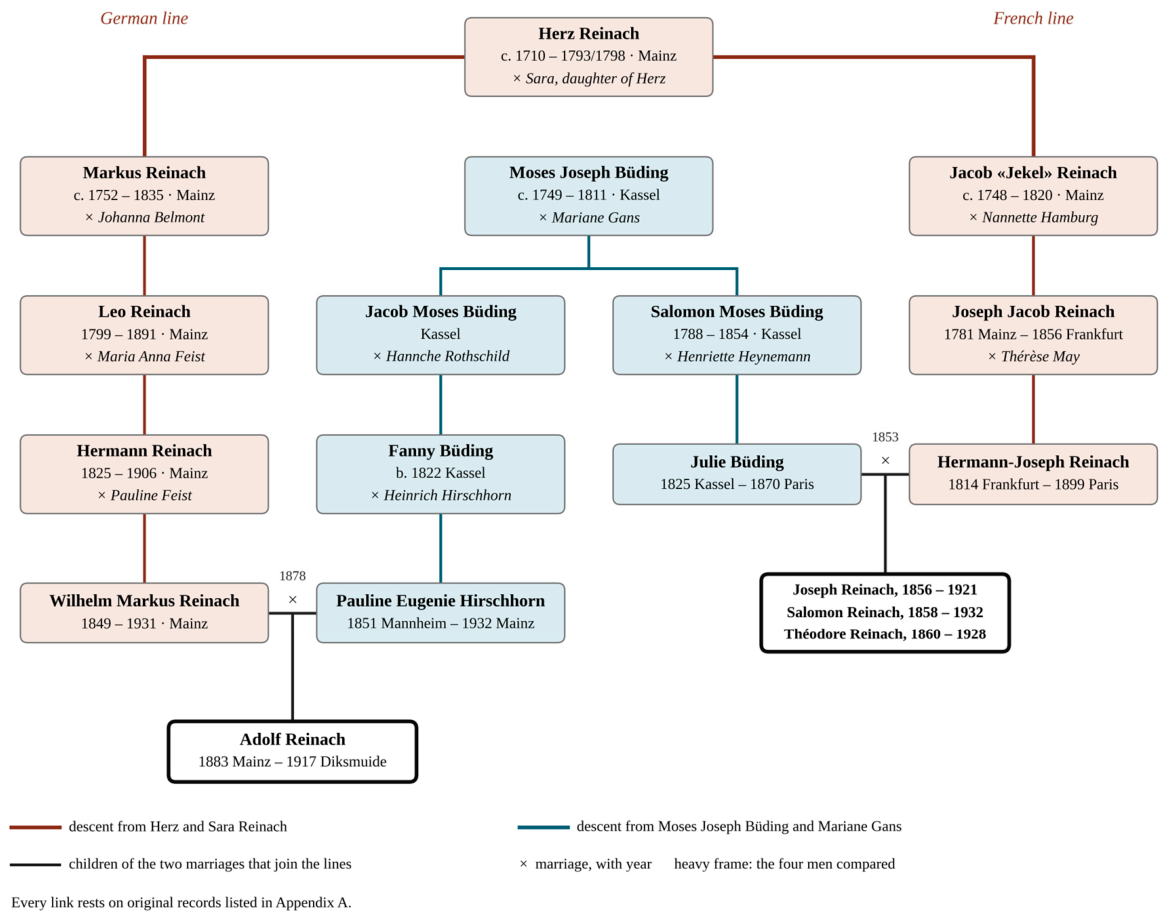

Table 1.
Documented consanguineous marriages.
| Date and place | Spouses | Relationship | Record | Effect on Adolf × brothers |
|---|---|---|---|---|
| 29.01.1813, Mainz | Leonard-Jacques Reinach (son of Jekel) × Caroline Reinach (daughter of Markus) | First cousins, across branches | D000279 | None: no descendants in either line |
| 09.12.1834, Mainz | Herrmann Reinach (grandson of Jekel; not Adolf’s grandfather) × Johanna Reinach (granddaughter of Markus) | Second cousins, across branches | D000410 | None: no descendants in either line |
| 12.12.1848, Mainz | Hermann Reinach × Pauline Feist | First cousins through the Feist family | D000016, D000428, D000429 | None (see text) |
| 11.12.1850, Mainz | Felix Reinach × Maria Feist (both grandchildren of Markus) | First cousins | D000388 | None: no descendants in either line |
| 15.09.1884, Paris | Joseph Reinach × Henriette de Reinach (daughter of his first cousin Jacques) | First cousin once removed | D000380 | None: affects only their son Adolphe |
Disclaimer/Publisher’s Note: The statements, opinions and data contained in all publications are solely those of the individual author(s) and contributor(s) and not of MDPI and/or the editor(s). MDPI and/or the editor(s) disclaim responsibility for any injury to people or property resulting from any ideas, methods, instructions or products referred to in the content. |
© 2026 by the authors. Licensee MDPI, Basel, Switzerland. This article is an open access article distributed under the terms and conditions of the Creative Commons Attribution (CC BY) license (http://creativecommons.org/licenses/by/4.0/).
Copyright: This open access article is published under a Creative Commons CC BY 4.0 license, which permit the free download, distribution, and reuse, provided that the author and preprint are cited in any reuse.