
Submitted:
29 September 2026
Posted:
30 September 2026
You are already at the latest version
Abstract
Higher Education institutions are urged to move beyond embedding sustainability awareness into the curriculums, to effectively transferring it into practice. Yet the evidence on how to transfer awareness into actionable practice particularly within a specific discipline such as Engineering remains uncertain. The paper brings together two rounds of survey research conducted with undergraduate engineering students at the Applied Science University, Bahrain, to investigate students’ awareness and engagement levels in Sustainable development. The study develops a discipline-embedded framework for closing the gap between what engineering students know about sustainability and what they actually do. The first round (N = 44) measured the awareness, attitudes and self-reported pro-environmental behavior among the College of Engineering students. Outcomes reveal high awareness and favorable attitudes to sustainability but a “commitment gap” related to modest engagement in campus sustainability activities and pro-environmental practices. The second round (N = 45) investigated the barriers and motivators to participation and identified time pressure, weak event visibility and uncertain perceived impact as the major leading obstacles to this gap. Skill development opportunities, personal interest and discipline relevance were the leading motivators. Building on the survey outcomes, and on a three-year review of the College of Engineering’s own sustainability initiatives, the study proposes an integrated ENGAGE framework- Experiential learning, Networked mentorship, Guided curriculum integration, Accessible participation, Grounded communication, and Embedded policy- tailored to engineering education. The study also suggetss a three-year monitoring protocol, with for tracking whether the framework measurably narrows the commitment gap over time. A worked case study applying the ENGAGE framework and involving the redesign of a single sustainability-focused workshop is presnted to guide on the implementation of the framework. The novelty of the work lies an implementation model grounded in a measurement plan and study case example that turns the framework into something that can be evaluated rather than merely advocated.
Keywords:
ENGAGE
; sustainable development goals
; engineering education
; environmental sustainability
; student engagement
; commitment gap
; experiential learning
; curriculum integration
1. Introduction
The Sustainability has moved, over roughly the past decade, from a topic occasionally mentioned in strategic plans to something universities are expected to demonstrate, report on, and increasingly be measured against. The United Nations’ 2030 Agenda, with its 17 Sustainable Development Goals (SDGs) and 169 targets, remains the reference framework for that expectation [1]. Goal 4 places education at the centre of the agenda, and target 4.7 in particular calls for learners everywhere to acquire the knowledge, values and skills needed to support sustainable development [2,3]. Higher education institutions sit awkwardly close to this target: they are expected simultaneously to teach it, model it in their own operations, and produce graduates who carry it into industry [4].
Engineering programmes occupy a particularly consequential position within that expectation. Engineers design the buildings, infrastructure, energy systems and industrial processes that determine a country’s material footprint for decades after graduation, so how engineering students are taught to think about sustainability – and whether that thinking survives contact with a job – matters more than the size of any one cohort would suggest. Yet much of the empirical literature on student sustainability engagement is either generic, drawing on mixed-discipline samples, or focused on awareness and attitudes rather than on what happens once a student is asked to actually show up to something [5,6,7,8,9,10,11]. Few studies follow a single engineering student population across time: from measuring what they know, to why they do not act on it, to testing whether a designed intervention changes that.
This paper is an attempt to do exactly that within one institution. The College of Engineering (CoE) at Applied Science University (ASU) in Bahrain has, over the past several academic years, invested visibly in campus sustainability – a green-campus programme, sustainability-themed coursework, and a growing calendar of guest lectures, site visits and student competitions. Two structured surveys were fielded to gauge whether that investment was reaching students in a way that mattered to them. The first survey [12], administered in November–December 2023 to 44 engineering students, measured sustainability and SDG awareness, attitudes and self-reported behaviour; it found that students understood sustainability reasonably well and expressed positive attitudes toward it, but that actual participation in sustainability-related campus activity was low – a “commitment gap” between knowing and doing. The second survey [13], administered a year later (September–October 2024) to 45 students, went after the mechanics of that gap directly, asking what specifically got in the way of participation and what would make students more likely to take part.
Read together, the two studies tell a fairly consistent story: engineering students are not indifferent to sustainability, and the commitment gap is not primarily a motivation problem. It looks more like a design problem – one of timing, visibility and relevance to the student’s own discipline – which is, in principle, a solvable one. What neither paper did, on its own, was turn that diagnosis into something an engineering programme could act on, and then check whether the action worked.
That is the contribution of the present paper, and its point of departure from the two studies it builds on. Three things are new here. First, the paper integrates the awareness/attitude data (Phase 1) with the barriers/motivators data (Phase 2) into a single diagnostic picture, rather than treating them as two separate findings. Second, it proposes an integrated “ENGAGE” framework that is explicitly discipline-embedded rather than generic: it is built around, and grounded against, the kinds of activity an engineering college already runs – guest-speaker sessions mapped to specific modules, site visits to construction and manufacturing facilities, competitions and internships. Third, rather than stopping at a set of recommendations, the paper specifies a three-year monitoring protocol, with concrete indicators and data sources, for testing whether the framework closes the gap it is meant to close.
The paper is organised as follows. Section 2 reviews the wider literature on sustainability engagement in higher education and situates the commitment-gap concept within it, with attention to engineering-specific findings. Section 3 details the three-phase research design. Section 4 reports the Phase 1 and Phase 2 results and their cross-phase synthesis, followed by a discussion in section 5. Section 6 presents the ENGAGE framework and the suggsted monitoring protocol and an implementation study case. Section 7, Section 8 and Section 9 close with implications for practice, limitations and conclusions.
2. Literature Review
The idea that raising awareness is not the same as changing behaviour is not new to sustainability-education research, but it keeps reappearing because it keeps being confirmed. Zsóka et al. [8], working with Hungarian secondary and university students, found solid environmental knowledge sitting alongside comparatively modest everyday pro-environmental behaviour. Similar patterns have been reported among university students in south-eastern Texas [6], Greece [14], Vietnam [15], Obudu in Nigeria [16], and among Chinese university students, where Fu et al. [5] traced pro-environmental behaviour on the Tianjin University campus to a mix of personal motivation, social pressure and cultural habit rather than knowledge alone [17]. Students tend to overstate environmental awareness compared to real actions, showing an inconsistency. While knowledge increases, it does not always translate into action [18].
Within the Gulf Cooperation Council (GCC) region a study of architecture and planning students at the University of Dammam in Saudi Arabia [19] revealed that students there were aware of, and concerned about, campus sustainability, yet only a minority reported willingness to participate in related initiatives. A similar study from Saudi Arabia reported the same knowledge-action gap [20] . Another study in the United Arab Emirates reported high awareness about sustainability but limited competency in apllying particular SDG principles [21]. Across the studied literaure vrious teminology were used to decribe the problem – knowledge-action gap, attitude-behaviour gap, commitment gap – but the underlying finding is consistent enough that it now reads as an established regularity rather than a novel discovery [18].
Education for Sustainable Development (ESD), as articulated in UNESCO’s learning objectives for the SDGs [2] and grounded in target 4.7 of the 2030 Agenda [1,3], was conceived partly as a response to that gap: the objectives are explicit that ESD should build not just cognitive understanding but socio-emotional and behavioural competence as well [4,22]. Universities have taken up that brief unevenly. Curricular integration – embedding sustainability content and SDG-aligned projects into existing courses rather than treating it as an add-on – is one of the more consistently recommended responses [23,24,25] and there is a small amount of engineering-specific work on how to do this: Abd-Elwahed and Al-Bahi [26] propose a teaching and assessment framework for building sustainability awareness directly into engineering curricula, one of the few studies that treat engineering education as needing its own approach rather than borrowing wholesale from the generic higher-education sustainability literature. Atallah [27] proposes a theoretical framework that positions community engagement as a central driver of sustainable higher education outcomes..
Beyond the curriculum, campus-level interventions have been studied with mixed but generally encouraging results. Hamid et al. [28] found that social media use broadened sustainability understanding among students and staff and functioned as a practical channel for communicating campus policy. González-Ramírez et al. [29] surveyed students’ willingness to pay a dedicated “green fee,” finding a modest but real appetite (a mean willingness to pay of roughly $13–$15) that suggests students are not entirely unwilling to invest personally in sustainability, provided the ask is concrete. Bethurem et al. [30], studying efforts to reduce single-use water bottles on a US campus, found the main obstacle was not attitude but infrastructure – the absence of refill stations – a finding that maps closely onto what Phase 2 of the present study identifies as “perceived lack of impact” and practical access barriers, rather than disinterest. Nguyen Dang et al.’s work on a university green roof [31] adds a further nuance: students with more technical knowledge of the installation tended to weigh its environmental benefits more heavily, while less-informed users emphasised its social benefits – suggesting that depth of discipline-relevant knowledge shapes how students value an intervention, not just whether they show up to it.
What is comparatively underdeveloped in this literature, and what motivates the present paper, is the step after diagnosis. Many of the studies above end with recommendations – integrate the curriculum, communicate better, offer incentives – that are broadly sensible and also broadly generic, in the sense that they would read the same way for a business school as for an engineering college. A smaller number of studies propose frameworks with named stages or pillars [25,32], but few of these are built specifically around the activity types an engineering programme already runs as a matter of course – site visits, accreditation-mapped guest lectures, design competitions, internships – and fewer still pair the framework with a concrete plan for measuring whether it works once implemented.
Within this context, the paper builds on two study investigations on engineering students. The Phase 1 study [12] documented high SDG awareness (68% of respondents had heard of the SDGs; 70% correctly identified that there are 17 goals) alongside low participation (27% had taken part in any campus sustainability event), replicating the awareness-action gap reported elsewhere in the literature but with the added specificity of engineering-related SDGs (SDG 6, 7, 9, 11 and 13). The Phase 2 study [13] moved from documenting the gap to explaining it, finding that practical constraints – chiefly time (44.5% rating it a major or significant barrier) and event visibility (40%) – rather than disinterest were the dominant obstacles, and that discipline relevance was a particularly strong lever: 76% of respondents said they would be more likely to participate if activities were tied to their field of study. That last finding is, in a sense, the hinge on which the present paper turns: if discipline relevance is what students say would move them, the framework built in response should be organised around discipline-specific activity, not generic sustainability programming borrowed from elsewhere on campus. That is the gap in the existing literature that this paper sets out to close.
3. Methodology
3.1. Overall Research Design
The methodology is developed in three phase assessments (Figure 1). Phase 1 and Phase 2 are two previous independently developed survey studies conducted with undergraduate engineering students in the CoE at ASU. Phase 3, (i) synthesises the Phase 1 and Phase 2 findings into a single diagnostic account of the commitment gap, (ii) design an ENGAGE framewrok based on auditing three years of the CoE’s sustainability activities and their respective engagement rates, (iii) recommends a three-year monitoring protocol for tracking engagement outcomes, and (vi) presents a study exmaple on a re-design of a “GIS for Sustainble Development” training workshop based on the ENGAGE diagnosis.
3.2. Phase 1: Assessing Student’s Awareness, Attitudes and Self-Reported Engagement in SDGs
Phase 1 study used a Sustainability Questionnaire, developed through a literature review and faculty/student focus groups and hosted on Microsoft Forms, structured in three sections. Section 1 (19 items, a mix of yes/no, Likert-scale and open-ended questions) gauged general sustainability and SDG awareness. Section 2 (two sets of eight Likert-scale items) measured, respectively, attitudes toward and self-reported frequency of specific sustainability-related behaviours (energy and water conservation, recycling, community participation, and so on). Section 3 (five items) probed knowledge, attitude and engagement specifically with five SDGs judged most relevant to engineering disciplines: SDG 6 (Clean Water and Sanitation), SDG 7 (Affordable and Clean Energy), SDG 9 (Industry, Innovation and Infrastructure), SDG 11 (Sustainable Cities and Communities) and SDG 13 (Climate Action). All 127 registered CoE students – across the Civil Engineering, Architectural Engineering, Mechanical Engineering and Electrical and Electronic Engineering programmes, were invited by email; 44 responded (34.6% response rate), during a window open November–December 2023. Responses were coded and analysed descriptively in Microsoft Excel.
3.3. Phase 2: Assessing Barriers and Motivators to Engagement in Sustainability Initiatives
Phase 2 followed roughly a year later with a Sustainability Engagement Questionnaire, again hosted on Microsoft Forms and approved by the CoE, structured in six sections: demographics; awareness and understanding; participation and engagement; barriers to participation (Likert-scale and open items covering time, information, interest, relevance and perceived impact); motivators for participation; and open suggestions for improvement. Seventy-three students – primarily the two most recent graduating cohorts (AY 2022/2023 and AY 2023/2024) from the Civil Engineering and Architectural Engineering programmes – were invited; 45 responded (37.2% response rate), during a window open September–October 2024. As in Phase 1, data were coded and analysed descriptively in Excel, with open-ended responses reviewed thematically.
3.4. Phase 3: Synthesis and Design of the ENGAGE Framework
Phase 1 and Phase 2 datasets were re-read jointly rather than sequentially: each barrier and motivator identified in Phase 2 was cross-referenced against the corresponding awareness, attitude or behaviour item in Phase 1 to identify where the two datasets reinforced, qualified, or added nuance to one another. This cross-reading is the basis for the designed ENGAGE framework presented in Section 6.
To ground the framework’s discipline-specific components in something concrete rather than theoratical, an audit for the CoE’s own activity calendar and end-of-year reporting for AY 2023/2024, AY 2024/2025 and AY 2025/2026, covering guest-speaker sessions, site visits, workshops, competitions, internships and summer training placements across the four engineering programmes was performed and a monitoring protocol was designed to specify how these activity categories would be tracked prospectively, with baseline, process and outcome indicators, over a three-year window period.
4. Results
4.1. Phase 1: Awareness, Attitudes and Engagement
4.1.1. Sample
Table 1 summarises the Phase 1 and Phase 2 samples side by side. Phase 1 respondents were drawn overwhelmingly from the Civil Engineering (47.7%) and Architectural Engineering (45.5%) programmes, reflecting their larger enrolment relative to the newly launched Mechanical and Electrical/Electronic Engineering programmes at that time (4.5% and 2.3% respectively). Sixty-six percent of respondents were female, consistent with the College’s broader gender enrolment pattern. Half of the sample were in their final undergraduate year or had graduated in the preceding cohort, meaning the sample skewed toward students with more, rather than less, exposure to the curriculum.
4.1.2. Awareness
Students reported comparatively strong general sustainability literacy: 84% could define sustainability in their own words, most commonly in terms of meeting present needs without compromising the ability of future generations to meet their own; 68% had heard of the UN SDGs; and 70% correctly identified that there are 17 goals. Seventy-three percent could name at least three SDGs unprompted, most often No Poverty, Quality Education, and Sustainable Cities and Communities. Awareness thinned considerably, however, once the question turned from the SDGs in the abstract to sustainability activity on the ASU campus specifically: only 30% reported being aware of any campus sustainability initiative, and only 27% had participated in one (Figure 2).
4.1.3. Evaluating Attitudes and Self-Reported Engagement (Behaviour)
Attitudes were consistently favourable and, on several items, close to unanimous: roughly three-quarters of respondents strongly agreed or agreed with reducing food waste and reducing single-use plastics, and a similar share endorsed practising water conservation in daily activities (Figure 3). Willingness to educate themselves about sustainable living was similarly high. Agreement was noticeably softer, however, on the one item that required collective rather than individual action – participating in community or campus clean-up initiatives – where agreement dropped to roughly a quarter of respondents and a comparable share actively disagreed.
A similar pattern held for self-reported frequency of specific behaviours (Figure 4). Individually convenient, cost-saving actions scored well: only 9.1% of students said they rarely chose energy-efficient appliances and lighting, and 38.6% said they always reduce paper use. Actions that were more visibly social, or that depended on infrastructure the student does not personally control – using public transportation or carpooling instead of driving, in particular – were the weakest link, with roughly half of respondents reporting they rarely or never did so.
4.1.4. Engagement with Engineering-Specific SDGs
Across the five selected SDGs, knowledge and attitude levels consistently outpaced actual engagement. SDG 6 (Clean Water and Sanitation) had the highest reported knowledge, with 87% of students describing their understanding as very high, compared with 41% for SDG 7 (Affordable and Clean Energy) and SDG 9 (Industry, Innovation and Infrastructure). Attitude levels were strongly positive across all five SDGs, ranging from 64% to 98% reporting a very high attitude level depending on the goal. Engagement levels were consistently lower than either knowledge or attitude for every SDG, with high-or-very-high engagement ranging from 18–64% depending on the goal, and SDG 7 – the goal with the clearest existing foothold in the engineering curriculum through energy-systems coursework – recording the strongest engagement of the five despite not leading on knowledge.
4.2. Phase 2: Barriers and Motivators
4.2.1. Sample
The Phase 2 sample (N = 45) was drawn from the Civil Engineering (49%) and Architectural Engineering (51%) programmes only, with 76% female respondents and a similarly senior-skewed profile (55% in Level 6 or graduated).
4.2.2. General Awareness and Records of Prior Participation
Self-reported SDG knowledge was, if anything, higher than in Phase 1 – 55.6% described themselves as very knowledgeable about the SDGs – yet 67% of Phase 2 respondents reported not having participated in any campus sustainability initiative, closely replicating the Phase 1 finding a year on and reinforcing that the gap is stable rather than a one-off artefact of a single cohort.
4.2.3. Identification of Major Barriers to Participation
Asked directly what got in the way, students converged on a small number of practical obstacles rather than a diffuse lack of interest (Figure 5). Lack of time was the most cited barrier, rated major or significant by 44.5% of respondents combined; insufficient information about events followed (major or significant for 40%); lack of interest was rated a major barrier by 24.4% but a somewhat significant one by a further 37.8%, suggesting interest is uneven across the student body rather than uniformly absent; and lack of visible impact of participation was cited as a major barrier by 24.4% of respondents. Notably, perceived irrelevance of initiatives was the barrier students were least likely to endorse – 24.4% rated it not a barrier at all – which, read alongside the time and information findings, points toward a logistical rather than attitudinal explanation for low participation.
4.2.4. Identification of Major Motivators to Participation
When asked what would motivate participation, students most often cited opportunities to develop new skills (27%) and personal passion for environmental issues (25%), followed by networking with like-minded peers (18%), recognition or incentives such as certificates (16%), and support from faculty or staff (12%) (Figure 6). Consistent with the barrier findings, 76% of respondents said they would be more inclined to participate if initiatives were tailored to their field of study, and 71% said embedding sustainability into coursework would increase their willingness to engage.
Preferences for activity type and timing reinforce the same picture. Students most preferred workshops and training sessions (58%) and community service projects (24%) over passive formats such as awareness campaigns (4%) (Figure 7); and preferred timing clustered around the afternoon (29%) and morning (25%) slots, with Semester I and the summer semester favoured over other points in the academic calendar (Figure 8).
4.3. Integrated Diagnosis of the Commitment Gap
Not a knowledge deficit: Phase 1’s awareness figures (68–87% depending on the specific measure) leave little room for the argument that students simply do not know enough; Phase 2’s barrier data confirm this by showing that lack of interest and perceived irrelevance – the two barriers closest to an attitude problem – were consistently rated the weakest obstacles of the set.
Strongly discipline-conditional: Phase 1’s finding that engagement with SDG 7 (Affordable and Clean Energy) was comparatively strong, and Phase 2’s finding that 76% of students want activities tied to their field, point in the same direction: students engage more when sustainability content sits inside, rather than beside, their engineering identity.
Logistical before motivational: Time and information – not disinterest – were the leading barriers in Phase 2, and the behaviours that scored worst in Phase 1 (community clean-ups, public transport use) were precisely those requiring coordinated group action or infrastructure the student does not personally control, rather than those requiring more conviction.
The three above observations confirm that the commitment gap cannot be directly linked to communications-only or incentives-only justifications. Accordingly, these observation justify the need for a framework that treats discipline relevance, logistics and motivation as co-equal design problems – the ENGAGE framework structure adopted in Section 6.
5. Discussion
The pattern that is emerging from this research sits comfortably alongside the wider literature reviewed. Zsóka et al.’s finding that Hungarian students’ environmental knowledge outpaced their behaviour [8], Abubakar et al.’s near-identical result among Dammam architecture and planning students [19], and Bethurem et al.’s conclusion that infrastructure, not attitude, was the binding constraint on bottled-water reduction [30]. What the ASU data add to that picture is specificity about which lever matters most for an engineering cohort. The 76% of Phase 2 respondents who said discipline-tailored activities would increase their participation is a larger figure than is typically reported for generic “make it more relevant” survey items, and it is corroborated indirectly by the Phase 1 finding that SDG 7 engagement – the one SDG with the clearest existing foothold in the engineering curriculum – outperformed the other four on engagement even though it did not lead on knowledge. Read together, this suggests the relevant unit of intervention is not “sustainability education” in general but sustainability content routed through a student’s own programme: a civil engineering student is arguably more likely to act on a message about SDG 11 (Sustainable Cities) delivered through a design-studio brief than the same message delivered through a campus-wide poster campaign, even if the poster technically reaches more students
The logistical finding is, in a sense, the more actionable of the two. Time and information problems are, unlike deep-seated attitudes, the kind of obstacle an institution can address directly and relatively cheaply – through scheduling, calendar design and communication channels – without first needing to change how students feel about sustainability. That the CoE already runs a substantial calendar of discipline-adjacent activity (guest-speaker sessions mapped to specific modules, site visits to construction and manufacturing sites, competitions, internships) is therefore a genuinely useful starting position: the raw material Phase 2 respondents said they wanted – skill-building, discipline relevance, tangible outcomes – already exists in the College’s activity mix. The open question, which this paper cannot yet answer empirically, is whether that existing activity is explicitly framed around the SDGs at all, or whether it runs in parallel to the sustainability agenda rather than as part of it. If a site visit to a construction site, for instance, is not explicitly connected in students’ minds to SDG 9, 11 or 13, then simply running more of them may raise participation numbers without narrowing the commitment gap Phase 1 and Phase 2 were designed to measure. This is the specific design problem the framework in Section 6 tries to solve: not more activity, but activity that is legibly connected to the SDGs it is meant to advance.
The clean-up and public-transport findings in Phase 1 deserve a second look for a related reason: both are behaviours that depend on coordinated action or infrastructure beyond an individual student’s control, and both were the weakest items in an otherwise favourable attitude profile. This is consistent with Phase 2’s motivator data, where networking with like-minded individuals and faculty or staff support were named as levers – students appear to be signalling that collective-action behaviours need collective-action scaffolding (a group to join, a faculty member modelling the behaviour, a visible peer network), rather than simply more individual encouragement. A framework that addresses only individual-level motivation – more badges, more posters – would be poorly matched to this part of the diagnosis; one that also builds peer and faculty infrastructure is better matched to it.
Finally, it is worth being explicit about what this discussion does not claim. The commitment gap identified in Phase 1 and explained in Phase 2 is real and well-evidenced within this sample, but neither survey establishes a causal mechanism, and neither can, on its own, tell us whether the ENGAGE framework can actually narrow the gap once implemented. Accordigly we design a monitoring protocol to guide on how to track the progress in narrowing the commitment gap rather than treating the framework as self-evidently sufficient.
6. The ENGAGE Framework
6.1. A Discipline-Embedded Students’ Engagement Framework
Building on the outcomes of this research we propose an integrated ENGAGE framework- Experiential learning, Networked mentorship, Guided curriculum integration, Accessible participation, Grounded communication, and Embedded policy (Figure 9) for translating engineering students’ sustainability awareness into sustained engagement. The framework is grounded on six interconneted components (strands) touching on the discipline, logistics and motivation dimensions of the gap and should be integrated in combination rather than any one alone (Figure 10).
- E – Experiential & Industry-Linked Learning: This is the framework’s discipline-specific component, well grounded in literature [33] and the one most directly grounded in Phase 2’s finding that discipline-tailored, hands-on formats are what students say they want. It covers guest-speaker sessions mapped to specific modules, site visits to construction sites and manufacturing facilities, internships and summer training. The task for this component is less to invent new activity than to make the SDG connection in each of these events explicit to students – naming the relevant goal in the session title, the site-visit brief, or the workshop description – so that participation in an activity a student would likely attend anyway also registers, in their own mind, as sustainability engagement.
- N – Networked Faculty & Peer Mentorship: Addressing the collective-action gap (community clean-ups, carpooling, etc.) requires visible role-modelling and peer infrastructure, not just individual encouragement: this requires faculty to model and embed sustainability into their own research and mentoring. It also extends to explicitly include sustainability-ambassador roles for example from student-led structures such as the ASU Engineering Club, and the existing ASU-ICE Student Chapter.
- G – Guided Curriculum Integration: SDG themes should be embedded inside existing modules – design studios, capstone and graduation projects, laboratory briefs – rather than delivered as a stand-alone sustainability elective [34]. The CoE’s own graduation-project practice already gestures toward this: external jurors reviewing AY 2024/2025 architectural engineering graduation projects specifically noted alignment with Bahrain’s Vision 2030 and the SDGs, suggesting the mechanism – embedding SDG criteria into capstone assessment – is workable within the existing programme structure and simply needs to be made deliberate and consistent across cohorts and modules, rather than emerging incidentally in some projects and not others.
- A – Accessible & Flexible Participation: Given that time pressure was the single most cited barrier in Phase 2, activities should be offered in varied formats and time slots – short, single-session commitments alongside longer ones, morning and afternoon options, and activity scheduled around Semester I, II and the summer semester, rather than concentrated into a narrow band of the academic calendar. Certificates, digital badges, or inclusion of sustainability participation in co-curricular records respond directly to the 16% of Phase 2 respondents who named recognition as a motivator, and align with the professional-certification pathways the CoE already runs and which could plausibly be extended to include a recognised sustainability-engagement credential of similar standing.
- G – Grounded Strategic Communication: Insufficient information about events was the second most-cited barrier in Phase 2 (40% major or significant). Given that guest-speaker sessions and site visits already exist at meaningful scale, the communication problem here is arguably one of framing and channel rather than volume: promoting activities through the channels and language students said they respond to, and explicitly labelling SDG-relevant sessions as such in event titles and calendars, rather than leaving the sustainability connection implicit.
- E – Embedded Policy & Green Infrastructure: Students’ behaviour is also shaped by what the institution itself visibly does, not only by what it says. Continued investment in green-campus infrastructure and sustainability-oriented policy reinforces the credibility of the other five strands; a college that asks students to reduce single-use plastics while visibly doing the same in its own operations sends a more coherent message than one that asks without modelling.
Taken as a set, these six strands are designed to answer the three-part diagnosis presented earlier: the “E – Experiential & Industry-Linked Learning” and “G – Guided Curriculum Integration” strands respond to the discipline-relevance finding, the “A – Accessible & Flexible Participation” and “G – Grounded Strategic Communication” strands respond to the logistical and visibility finding, and the last two strands “N – Networked Faculty & Peer Mentorship”and “E – Embedded Policy & Green Infrastructure” respond to the motivational and collective-action findings.
6.2. The Monitoring Protocol for Tracking Students’ Engagement
A framework that is never evaluated is, in practice, indistinguishable from a list of good intentions. This section specifies a three-year monitoring protocol (Figure 11) for tracking whether the ENGAGE framework measurably narrows the commitment gap. The monitoring protocol is a generic design to be adopted by any institution implementing the ENGAGE framework. The first year (Year 0) is the baseline reference point against which the subsequent three tracked years (1–3) are compared. ASU has completed its own review and monitoring activity from baseline through Year 2. The study case provided in section 6.3 (re-designed GIS workshop) is an example on how the framework may be implemented.
Year 0 – Baseline audit. Colleges need to establish a pre-intervention reference point (baseline) before any ENGAGE-aligned changes begin. This step involves preparing a college a current-state inventory mapped against each of the six ENGAGE letters — not a generic activity count, but specifically: what curriculum touchpoints exist (G), what experiential/industry activity exists (E), what communication channels are used (G), what recognition mechanisms exist (A), what mentorship structures exist (N), what policy/infrastructure signals exist (E). Such information may be collected from multiple sources including the existing institutional records (annual reports, event calendars, module handbooks) and do not necessaritly involve a new data-collection exercise. A college adopting this protocol should ideally capture one full academic year of activity records before any framework-aligned changes are introduced. A before-ENGAGE diagnosis profile, structured the same way as Table 3 (before/after by component) is a typical deliverable institutions must prepare.
Year 1 – Roll-out. The first full year of deliberate implementation across the six components of the ENGAGE framework, tracking the process indicators - detailed in Table 2 - against the Year 0 baseline. Such indicators typically include— activities delivered and activities count, proportion of activities explicitly SDG-framed, breadth of participating programmes/departments, attendance rates, etc. Such process indicators show delivery and not the impact. To ensure successful implementation of the framework and institutional growth in sustainability engagement, a recommended starting strategy is to target small number of flagship activities redesigned across all six components rather than attempting institution-wide change at once. The example described in section 6.3 is a good example.
Year 2 – Scale-up. The objective of this monitoring period is to extend the redesigned activities and programmes based on the outcomes of the monitoring period Year 1. Same process indictors may be used to track effectiveness and change. A college would expect an uneven movement across indicators — some grow, some don’t — and this is exactly why multiple indicators are tracked rather than one. Is is recommended piloting the outcome-indicator instrument (pre/post survey) on a subset during this year, so it’s validated before the full Year 3 push.
Year 3 – Consolidation and outcome evaluation. This is the year where actual evidence of gap-narrowing gets collected. The protocol’s final year would compare cumulative process and outcome indicators against the Year 0 baseline, using a repeat of the Phase 1/Phase 2 survey instruments (or a condensed combined version of the two) to test directly whether self-reported commitment-gap measures have narrowed. Two categories of indicator are specified, in line with standard programme-evaluation practice of separating what was delivered from what changed (Table 2). Outcome indicators are typically. This stage is the same before/after logic already demonstrated in Section 6.3, scaled from one activity to the whole institution.
Data sources are, deliberately, ones the College already generates in the normal course of running these activities – attendance registers, the Microsoft Forms survey infrastructure used in both prior phases, and existing event-reporting appendices of the kind already compiled for the College’s own annual reflection reports – so that the monitoring burden sits on top of existing administrative practice rather than requiring a new data-collection system.
6.3. Worked Example: Applying ENGAGE to a Sustainability Workshop
The following is a worked example on how the generic ENGAGE framework can be implemented and applied to one activity. The example is drawn on a “GIS for Sustainable Development” workshop typically offered on campus for engineering students. The workshop is linked to SDG 9 (Industry, Innovation and Infrastructure), SDG 11 (Sustainable Cities and Communities), and SDG 13 (Climate Action). Prior to its redesign, the GIS workshop was delivered as a standalone, single-session activity, announced by email only and no reference to the SDG framing was circulated among students. The workshop training was perfomed using standard example datasets common in US GIS textbooks, and unconnected to any assessed coursework. Under this format, 6 of 45 invited students attended (13.3%) during the AY 2023/2024.
Applying ENGAGE, the workshop was rebuilt across all six components. It was tied to four modules including the graduation project with some modules embedding a coursework assessment that required students to apply GIS directly on a study case tied to environmental sustainabiltiy. Also the SDG framing was explicitly mentioned on the promotional material and shared invites (G). The hands-on exercises were redesigned around real ASU green campus data rather than generic international examples (E), directly connecting the technical content to the institution’s own infrastructure (E, second instance). Promotion was extended from a single email to peer encouragement channels, WhatsApp groups and Instagram, actively driven by student ambassadors and the Engineering Club (N, G). Certificates were introduced, alongside the embedded module assessment, as a recognition mechanism (A). The re-designed workshop was offered again during the AY 2024-2025 attendance rose to 23 of 45 invited students (51.1%) though the session’s scheduling remained fixed due to logitical matters at that time. Table 3 summarises the ENGAGE diagnosis and the redesigned components of the GIS workshop.

Table 3.
Pre- and post-design of a “GIS for Sustainable Development” training workshop based on ENGAGE framework.
Table 3.
Pre- and post-design of a “GIS for Sustainable Development” training workshop based on ENGAGE framework.
| # | Component | Before ENGAGE | After ENGAGE |
|---|---|---|---|
| E | Experiential & Industry-Linked Learning | ✗ Classical lecture format; exercises used generic textbook example data (US-standard datasets) | ✓ Hands-on exercises using real ASU campus data. SDG framing: SDG 9 (Industry, Innovation and Infrastructure), SDG 11 (Sustainable Cities and Communities), and SDG 13 (Climate Action). |
| N | Networked Faculty & Peer Mentorship | ✗ No peer or faculty structure; email-only announcement | ✓ Actively promoted and supported by student ambassadors and the Engineering Club |
| G | Guided Curriculum Integration | ✗ Standalone workshop; no module linkage, no assessment | ✓ Tied to four modules, including the graduation project; some modules embedded a coursework (CW) assessment requiring GIS use. |
| A | Accessible & Flexible Participation | ✗ Single fixed session; no certificate; no credit | Partial ✓ — certificates issued and a CW assessment embedded; timing moved to an afternoon slot after teaching hours (matching Phase 2’s stated preference); however, still offered as a single session only, with no multiple time-slot options |
| G | Grounded Strategic Communication | ✗ Official email only | ✓ Expanded to peer encouragement, WhatsApp groups and Instagram, alongside ambassador and Engineering Club channels |
| E | Embedded Policy & Green Infrastructure | ✗ No link to campus operations; used generic international examples | ✓ Hands-on dataset was ASU’s own operational/campus data related to green campus initiatives, directly linking the exercise to the institution’s own infrastructure. |
A pre-workshop poll (n = 12–13 of the 23 attendees) established a real baseline: half of respondents had never previously heard of GIS, yet the same group already rated GIS as important for sustainable engineering (4.3/5) and for engineering practice generally (4.7/5) — a pattern consistent with this paper’s broader finding that the commitment gap is not an attitude problem (Figure 12 and Figure 13).
A post-workshop questionnaire (Figure 14), administered immediately after the session and mirroring the structure of the pre-workshop poll, found that 75% of respondents reported high confidence in using GIS for basic spatial analysis, 80% rated the workshop as useful for understanding GIS and its applications, and 87% reported being highly motivated to apply GIS in future sustainability-related projects. A direct pre/post comparison on identical metrics is not possible, since the pre-workshop instrument measured general importance ratings (4.3–4.7/5) and self-reported prior exposure rather than task-specific confidence; even so, the shift from a baseline in which half of attendees had never heard of GIS to a post-session cohort reporting high confidence, usefulness and motivation is consistent with the attendance gain (13.3% → 51.1%) as a joint signal that the ENGAGE-redesigned format reached and engaged a meaningfully different population of students than the original format did.
7. Implications for Practice
For engineering programme leaders, four implications follow reasonably directly from the diagnosis and framework above.
- Build around existing activity rather than a parallel track. A great deal of the infrastructure Phase 2 respondents said they wanted – discipline-relevant, hands-on, skill-building activity – already exists in most engineering colleges in the form of guest lectures, site visits and competitions; the missing piece is often the explicit SDG framing rather than the activity itself.
- Design communication as deliberately as programming. With information gaps rated a leading barrier even in a college running a substantial activity calendar, supply of opportunity does not automatically produce awareness of it.
- Match the intervention to the behaviour type. Collective-action behaviours (clean-ups, shared transport, peer-led initiatives) likely need different scaffolding – faculty visibility, peer structures – than individual behaviours (recycling, energy use), which respond more readily to information and convenience.
- Build monitoring in from the outset, even modestly. Using data the institution already collects avoids the alternative of running activities and simply hoping engagement improves, which leaves no way to distinguish a genuinely effective intervention from one that merely feels effective to the staff running it.
8. Limitations and Future Work
Several limitations bear on how the findings here should be read. Both underlying surveys drew on convenience samples from a single institution, with modest response rates (34.6% and 37.2%) and sample sizes (N = 44 and N = 45) typical of single-college survey research but not large enough to support subgroup analysis by programme with confidence. Both instruments relied on self-reported behaviour, which is a reasonable proxy for actual behaviour but not equivalent to it, and neither phase used a control or comparison group, so the commitment gap described here is a within-sample pattern rather than a causally isolated effect.
The institutional activity audit is descriptive and drawn from the College’s own administrative records rather than an independent count, and – as stated repeatedly above – it documents activity supply, not confirmed SDG framing or measured student outcomes; the extent to which existing guest-speaker sessions and site visits are already perceived by students as SDG-relevant is itself an open empirical question the monitoring protocol is designed to answer, not one this paper resolves. Finally, the ENGAGE framework and the monitoring protocol are, by design, forward-looking proposals rather than tested interventions; their value should be judged once Year 1–3 data under the protocol become available, and the author intend this paper as the first step in that longer study rather than as its conclusion. Future work should also examine whether the discipline-relevance effect found here for engineering students replicates in other applied disciplines, and whether the relative weight of logistical versus motivational barriers shifts as students progress from early to final years of study.
9. Conclusions
Three years of investigation research with engineering students at ASU converge on a consistent finding: students are reasonably well informed about sustainability and the SDGs, hold favourable attitudes toward them, and are nonetheless underrepresented in the activities meant to translate that awareness into action – not primarily because they do not care, but because of time pressure, weak event visibility, and activity that does not always read as connected to their own discipline. This paper has argued that closing that commitment gap is less a matter of persuading students to care more, and more a matter of redesigning how existing engineering-college activity – guest lectures, site visits, competitions, coursework – is framed, scheduled and communicated so that it visibly counts as sustainability engagement rather than running alongside it.
The ENGAGE framework proposed here is an attempt to specify that redesign concretely, anchored in what the CoE already runs rather than in generic sustainability programming; the three-year monitoring protocol proposed alongside it is an attempt to ensure the next iteration of this research can say, with actual data, whether the redesign worked. Universities are not short of frameworks for sustainability engagement; what is comparatively scarce is evidence, collected over time, that any particular framework changed anything. Closing that evidentiary gap, using the ENGAGE monitoring protocol, is the explicit purpose of the planned follow-up study.
Funding
This research received no external funding.
Data Availability Statement
The sustainability assessment questionnaires for phase 1 and phase 2 investigation along with the pre- and post-workshop diagnosis questionnaires are available from the author upon request.
Acknowledgments
The author gratefully acknowledge the approval granted by the senior management of the ASU for distributing the sustainability questionnaires. This paper and the research behind it would not have been achievable without the enthusiastic and substantial participation of the students from the CoE. During the preparation of this manuscript, the author used ChatGPT and Claude (Anthropic, claude.ai, Claude Sonnet model) to support manuscript proofreading and language editing. The author has reviewed and edited the output and take full responsibility for the content of this publication.
Conflicts of Interest
The author declares no conflicts of interest.
References
- United Nations Transforming Our World: The 2030 Agenda for Sustainable Development; 2015.
- UNESCO Education for Sustainable Development Goals: Learning Objectives; 2017.
- United Nations Decade of Action for the Sustainable Development Goals Available online: https://www.un.org/sustainabledevelopment/decade-of-action/.
- Cullingford, Cedric.; Blewitt, John. The Sustainability Curriculum ; 1st ed.; Routledge: London, 2013; ISBN 9781849773287.
- Fu, L.; Zhang, Y.; Xiong, X.; Bai, Y. Pro-Environmental Awareness and Behaviors on Campus: Evidence from Tianjin, China. Eurasia Journal of Mathematics, Science and Technology Education 2018, 14, 427–445. [CrossRef]
- Msengi, I.; Doe, R.; Wilson, T.; Fowler, D.; Wigginton, C.; Olorunyomi, S.; Banks, I.; Morel, R. Assessment of Knowledge and Awareness of “Sustainability” Initiatives among College Students. Renewable Energy and Environmental Sustainability 2019, 4, 6. [CrossRef]
- Alsaati, T.; El-Nakla, S.; El-Nakla, D. Level of Sustainability Awareness among University Students in the Eastern Province of Saudi Arabia. Sustainability (Switzerland) 2020, 12, 1–15. [CrossRef]
- Zsóka, Á.; Szerényi, Z.M.; Széchy, A.; Kocsis, T. Greening Due to Environmental Education? Environmental Knowledge, Attitudes, Consumer Behavior and Everyday pro-Environmental Activities of Hungarian High School and University Students. J. Clean. Prod. 2013, 48, 126–138. [CrossRef]
- Emanuel, R.; Adams, J.N. College Students’ Perceptions of Campus Sustainability. International Journal of Sustainability in Higher Education 2011, 12, 79–92. [CrossRef]
- Amran, A.; Perkasa, M.; Satriawan, M.; Jasin, I.; Irwansyah, M. Assessing Students 21st Century Attitude and Environmental Awareness: Promoting Education for Sustainable Development through Science Education. J. Phys. Conf. Ser. 2019, 1157. [CrossRef]
- Karaelmas, D.; Başkır, M.B.; Tekdamar, K.; Cengiz, C.; Cengiz, B. University Students’ Perceptions on Climate Change Awareness and Sustainable Environments Through an Unsupervised Clustering Approach. Sustainability (Switzerland) 2025, 17. [CrossRef]
- Hdeib, R.; Aouad, M.; Awawdeh, S.; Mahfoodh, S.A. Assessing Students’ Awareness, Attitudes, and Actions Towards Sustainable Development Goals (SDGs). In Proceedings of the 2024 ASU International Conference in Emerging Technologies for Sustainability and Intelligent Systems, ICETSIS 2024; Institute of Electrical and Electronics Engineers Inc., 2024; pp. 188–194.
- Hdeib, R.; Aouad, M.; Awawdeh, S.; Mahfoudh, S.A. Closing the Commitment Gap: Enhancing Student Engagement in Sustainable Development Goals. 2024 International Conference on Decision Aid Sciences and Applications, DASA 2024 2024. [CrossRef]
- Karvounidi, M.D.; Fousteris, A.E.; Alexandropoulou, A.P. Environmental Sustainability: From Awareness to Action. A Case Study from Greek Universities; 2024; Vol. 2025;.
- Nguyen, T.L. Awareness of Climate Change Among University Students: A Case Study at FPT University. KnE Social Sciences 2023. [CrossRef]
- Ndomah, B.N.; Oduntan, A.S. Environmental Awareness and Attitude towards Environmental Sustainability among Students of Federal College of Education, Obudu, Cross River State-Nigeria. International Journal of Social Science and Economics 2022, 2, p1. [CrossRef]
- Grossmann, A.; Kriehn, T.; Arikök, M. The Technical Knowledge Paradox - How Environmental Understanding Creates Action Barriers Among German University Students. European Journal of Sustainable Development 2026, 15, 75. [CrossRef]
- Kollmuss, A.; Agyeman, J. Mind the Gap: Why Do People Act Environmentally and What Are the Barriers to pro-Environmental Behavior? Environ. Educ. Res. 2002, 8, 239–260. [CrossRef]
- Abubakar, I.R.; Al-Shihri, F.S.; Ahmed, S.M. Students’ Assessment of Campus Sustainability at the University of Dammam, Saudi Arabia. Sustainability (Switzerland) 2016, 8. [CrossRef]
- Aldawsari, N.D.; Nemt-allah, M.A.; Abdellatif, M.S. Environmental Education Awareness in Light of Sustainable Development Goals and Its Relationship with Environmental Responsibility Among University Students. Sustainability (Switzerland) 2025, 17. [CrossRef]
- Elmassri, M.; Pajuelo, M.L.; Jabbar, T.A.; Taher, F.H.; Al Shamsi, A.; Arif, S.M.; Aldhaheri, M.; Elrazaz, T. The Paradox of Sustainability in Higher Education: High Awareness but Limited Competency in Applying SDG 12 Principles. Sustainability (Switzerland) 2025, 17. [CrossRef]
- Sidiropoulos, E. The Influence of Higher Education on Student Learning and Agency for Sustainability Transition. Sustainability (Switzerland) 2022, 14. [CrossRef]
- Barth, M.; Michelsen, G.; Rieckmann, M.; Thomas, I. Routledge Handbook of Higher Education for Sustainable Development. Routledge Handbook of Higher Education for Sustainable Development 2015, 1–480. [CrossRef]
- Gosselin, D.; Parnell, R.; Smith-Sebasto, N.J.; Vincent, S. Integration of Sustainability in Higher Education: Three Case Studies of Curricular Implementation. J. Environ. Stud. Sci. 2013, 3, 316–330. [CrossRef]
- Ralph, M.; Stubbs, W. Integrating Environmental Sustainability into Universities. High. Educ. (Dordr). 2014, 67, 71–90. [CrossRef]
- Abd-Elwahed, M.S.; Al-Bahi, A.M. Sustainability Awareness in Engineering Curriculum through a Proposed Teaching and Assessment Framework. Int. J. Technol. Des. Educ. 2021, 31, 633–651. [CrossRef]
- Atallah, F.A. Community Engagement Drives Sustainable Higher Education Outcomes in GCC Countries: An Integrated Three-Pillar Framework for Culturally Adapted Implementation. Frontiers in Sustainability 2026, 7, 1–16. [CrossRef]
- Hamid, S.; Ijab, M.T.; Sulaiman, H.; Md. Anwar, R.; Norman, A.A. Social Media for Environmental Sustainability Awareness in Higher Education. International Journal of Sustainability in Higher Education 2017, 18, 474–491. [CrossRef]
- González-Ramírez, J.; Cheng, H.; Arral, S. Funding Campus Sustainability through a Green Fee—Estimating Students’ Willingness to Pay. Sustainability (Switzerland) 2021, 13, 1–15. [CrossRef]
- Bethurem, M.; Choate, B.; Bramwell, S. Stop Piling on: Assessing Efforts to Reduce Single-Use Water Bottles at Allegheny College. Sustainability (Switzerland) 2021, 13. [CrossRef]
- Nguyen Dang, H.A.; Legg, R.; Khan, A.; Wilkinson, S.; Ibbett, N.; Doan, A.T. Users’ Perceptions of the Contribution of a University Green Roof to Sustainable Development. Sustainability (Switzerland) 2023, 15, 1–11. [CrossRef]
- Brinkhurst, M.; Rose, P.; Maurice, G.; Ackerman, J.D. Achieving Campus Sustainability: Top-down, Bottom-up, or Neither? International Journal of Sustainability in Higher Education 2011, 12, 338–354. [CrossRef]
- Kolb, D.A.. Experiential Learning : Experience as the Source of Learning and Development; Prentice-Hall, 1984; ISBN 0132952610.
- de Graaff, E.K.A. Characteristics of Problem-Based Learning. International Journal of Engineering Education 2003, 19, 657–662.
Figure 1.
Flow diagram of the research methodology in three phases: diagnosis (Phase 1), explanation (Phase 2), and design-and-tracking (Phase 3).
Figure 1.
Flow diagram of the research methodology in three phases: diagnosis (Phase 1), explanation (Phase 2), and design-and-tracking (Phase 3).
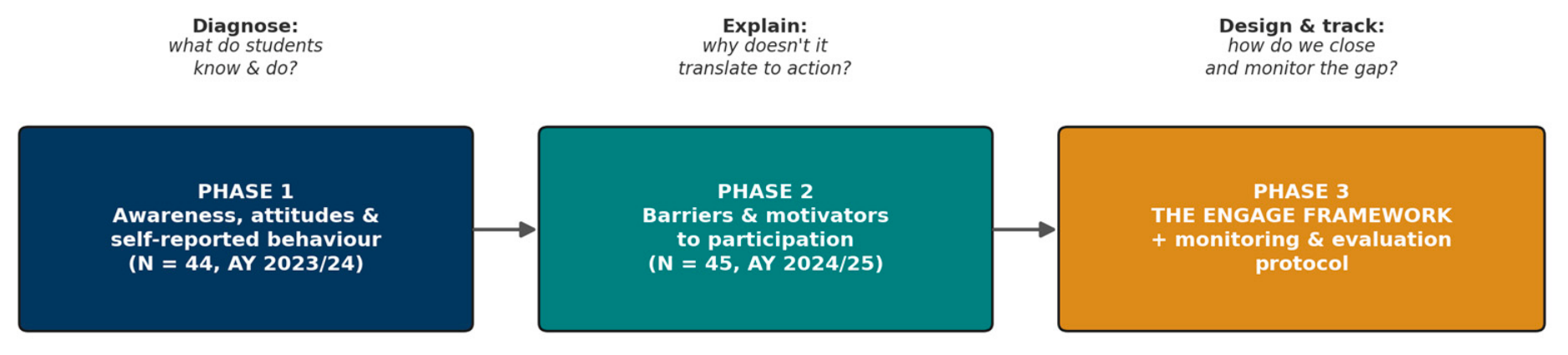
Figure 2.
Sustainability and SDG awareness levels for Phase 1 research sample.
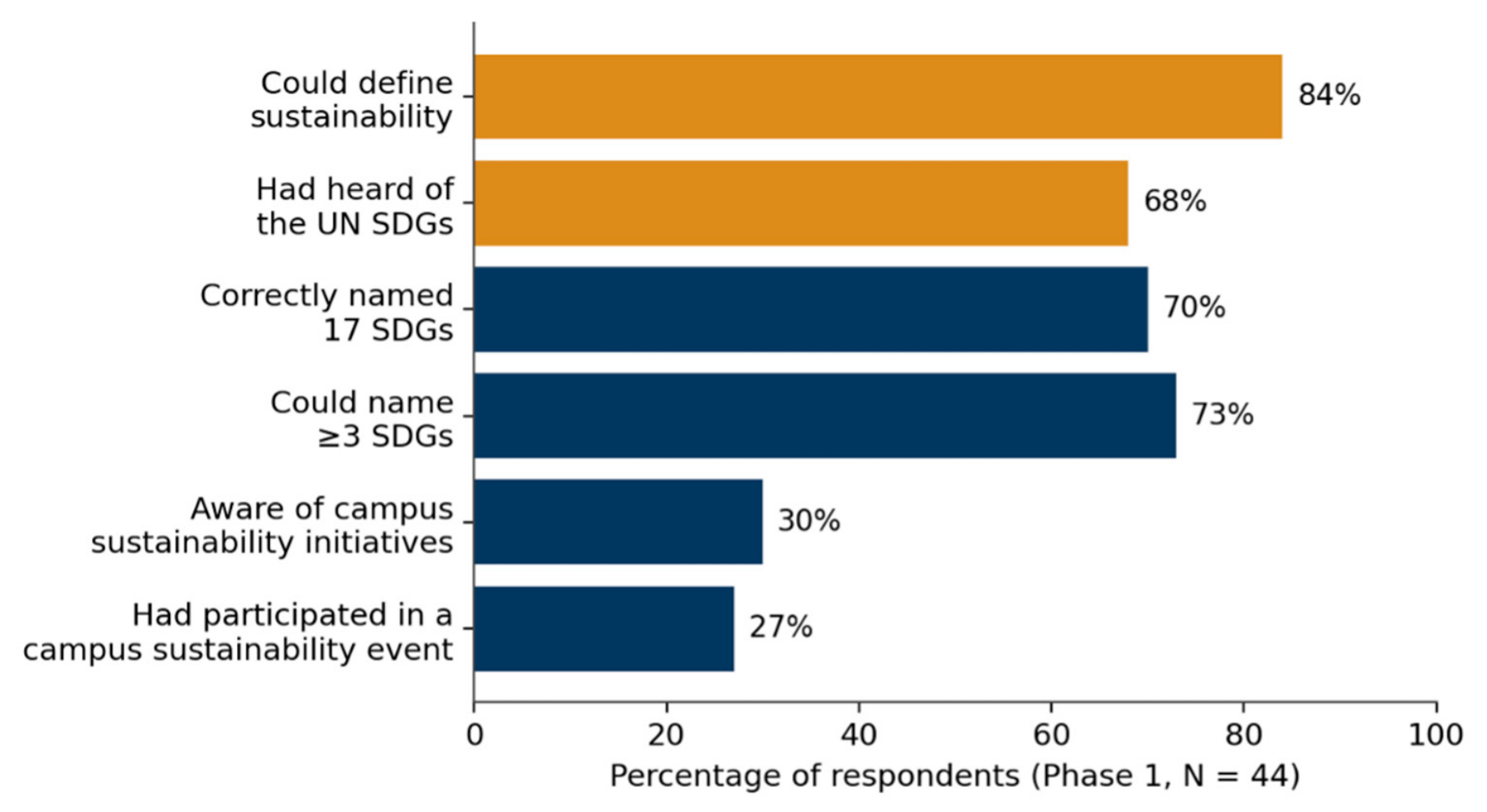
Figure 3.
Attitudes and self-reported sustainability engagement in pro-environmental practices on a five-point Likert scale (Strongly Disagree – Strongly agree), Phase 1.
Figure 3.
Attitudes and self-reported sustainability engagement in pro-environmental practices on a five-point Likert scale (Strongly Disagree – Strongly agree), Phase 1.
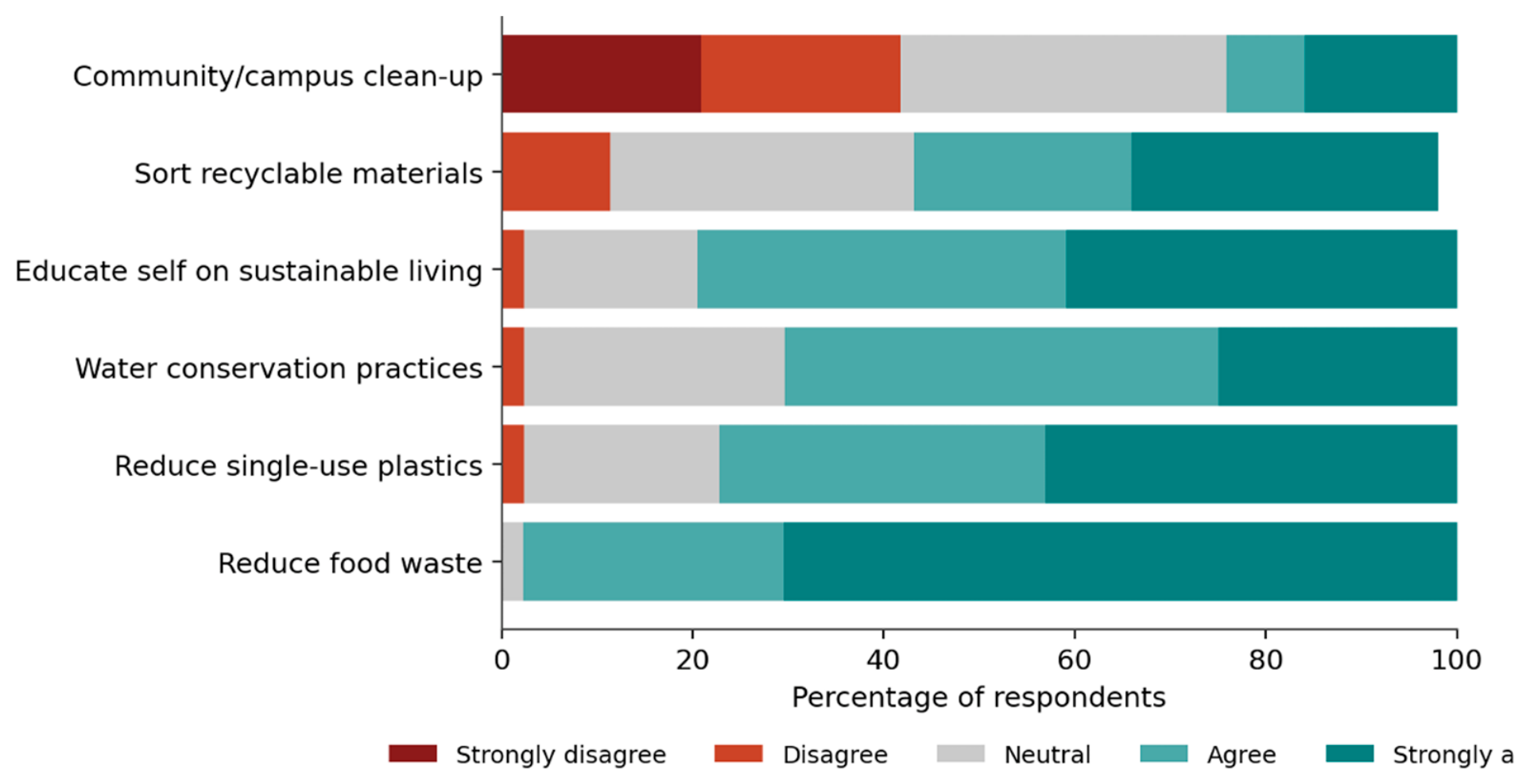
Figure 4.
Self-reported frequency of selected pro-environmental behaviours, Phase 1 (Never – Always scale).
Figure 4.
Self-reported frequency of selected pro-environmental behaviours, Phase 1 (Never – Always scale).
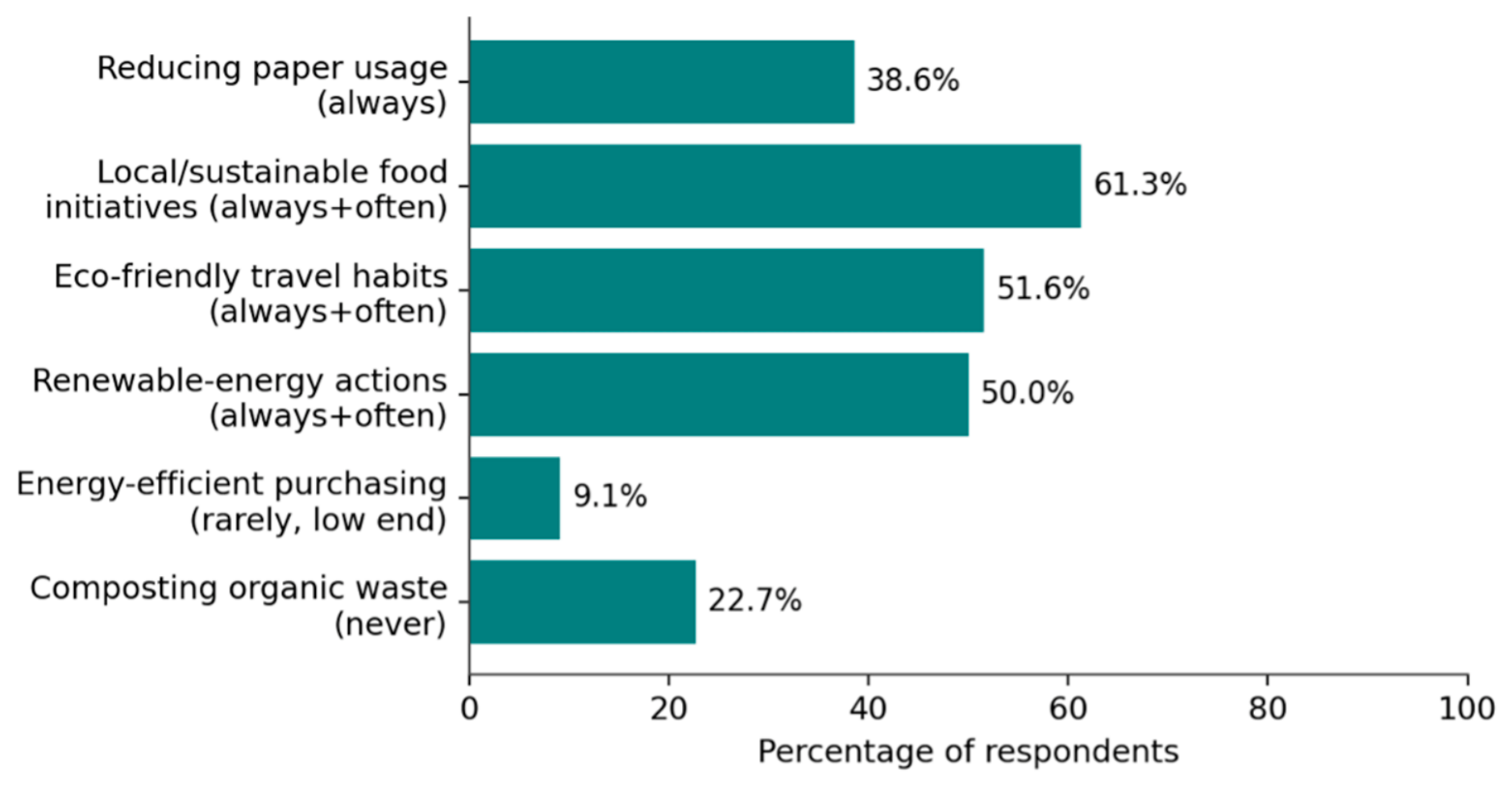
Figure 5.
Major barriers to participation in sustainability initiatives, as rated by students, Phase 2 (selected significant severity levels as reported).
Figure 5.
Major barriers to participation in sustainability initiatives, as rated by students, Phase 2 (selected significant severity levels as reported).
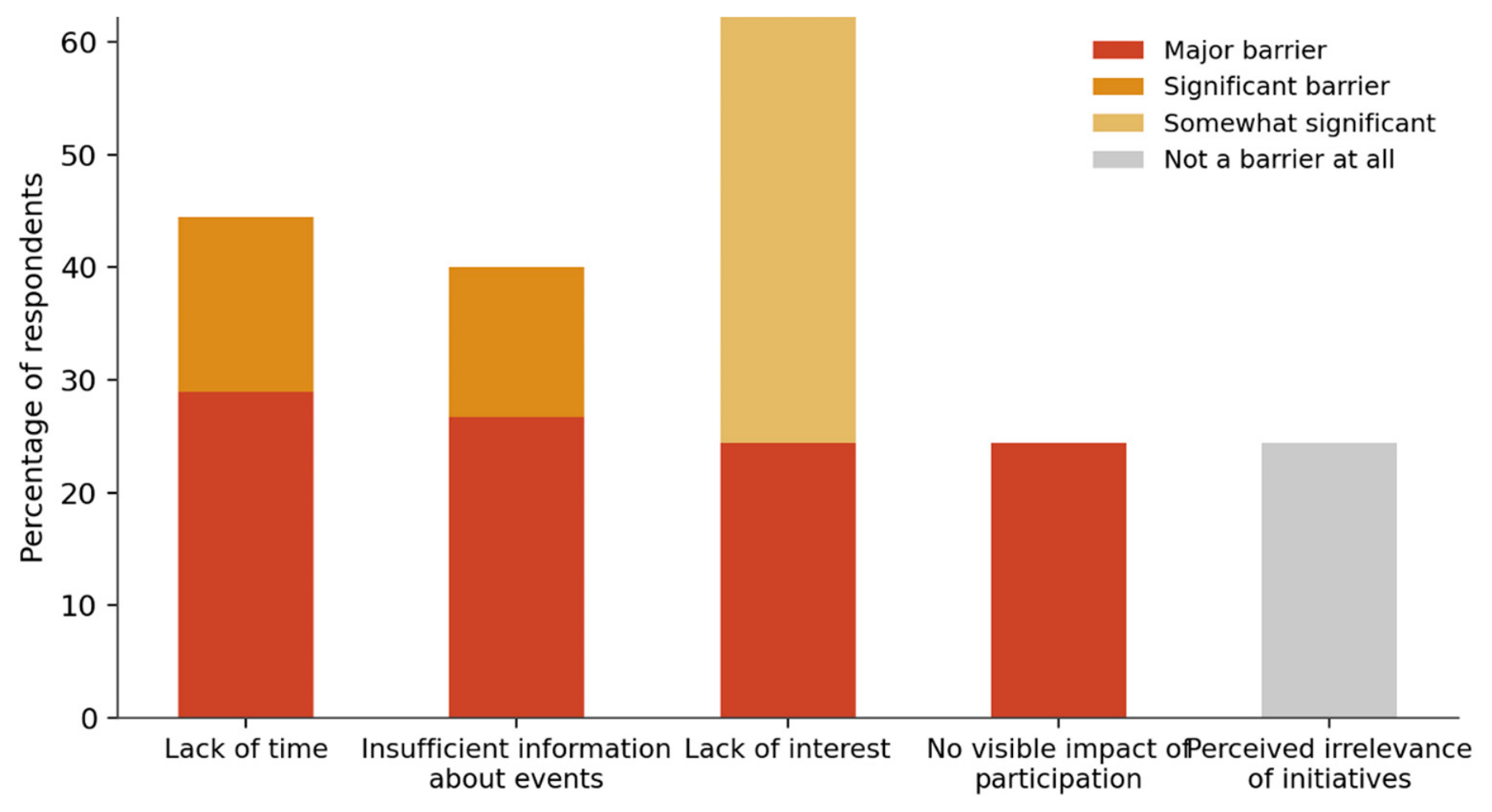
Figure 6.
Major motivators to participation in sustainability initiatives, as rated by students, Phase 2.
Figure 6.
Major motivators to participation in sustainability initiatives, as rated by students, Phase 2.
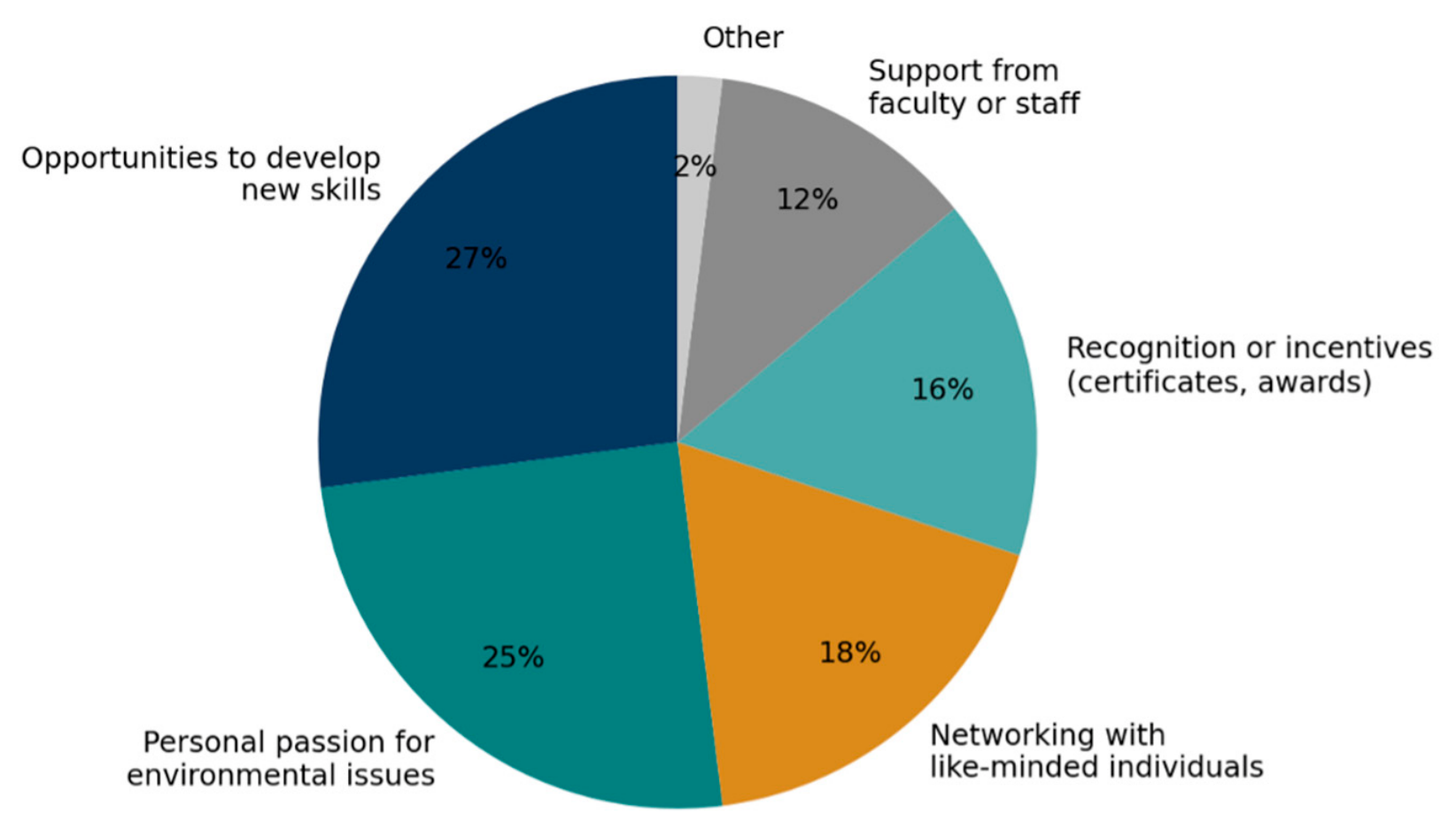
Figure 7.
Preferred type of sustainability initiatives, as rated by students, Phase 2.
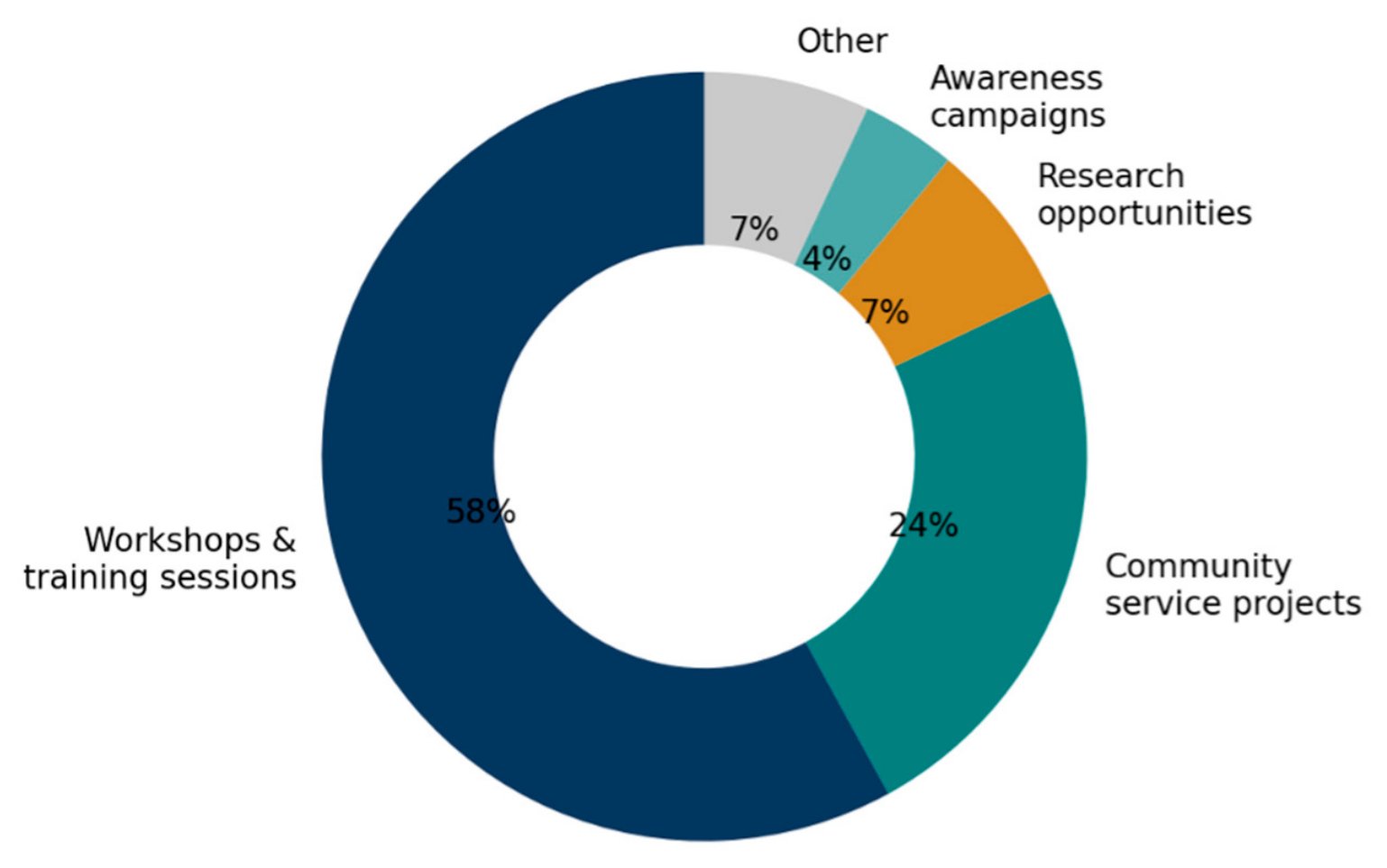
Figure 8.
Preferred timing of sustainability events, as rated by students, Phase 2.
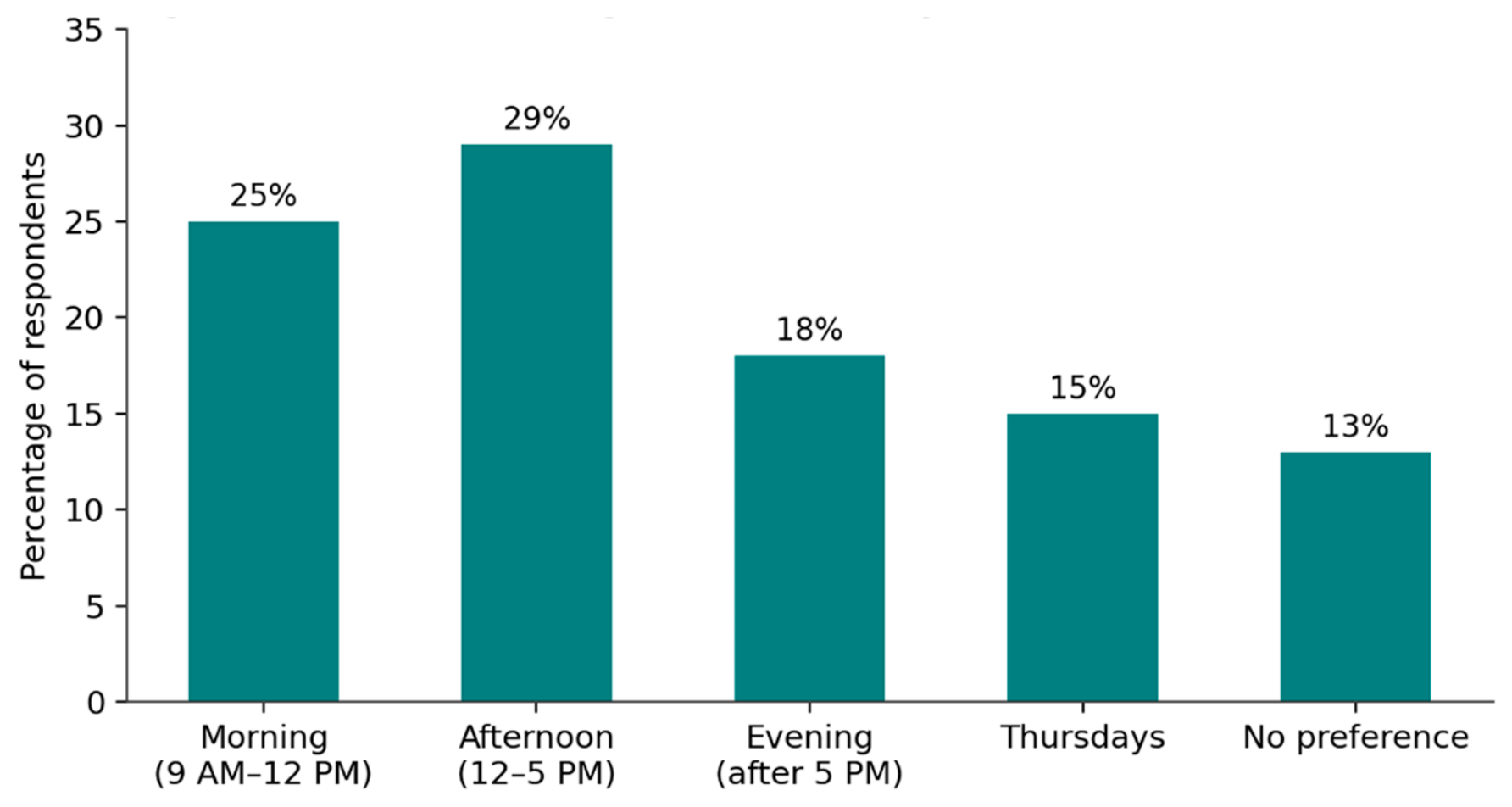
Figure 9.
The proposed ENGAGE framework: a discipline-embedded model for engineering-student SDG engagement, linked to its monitoring and evaluation cycle.
Figure 9.
The proposed ENGAGE framework: a discipline-embedded model for engineering-student SDG engagement, linked to its monitoring and evaluation cycle.
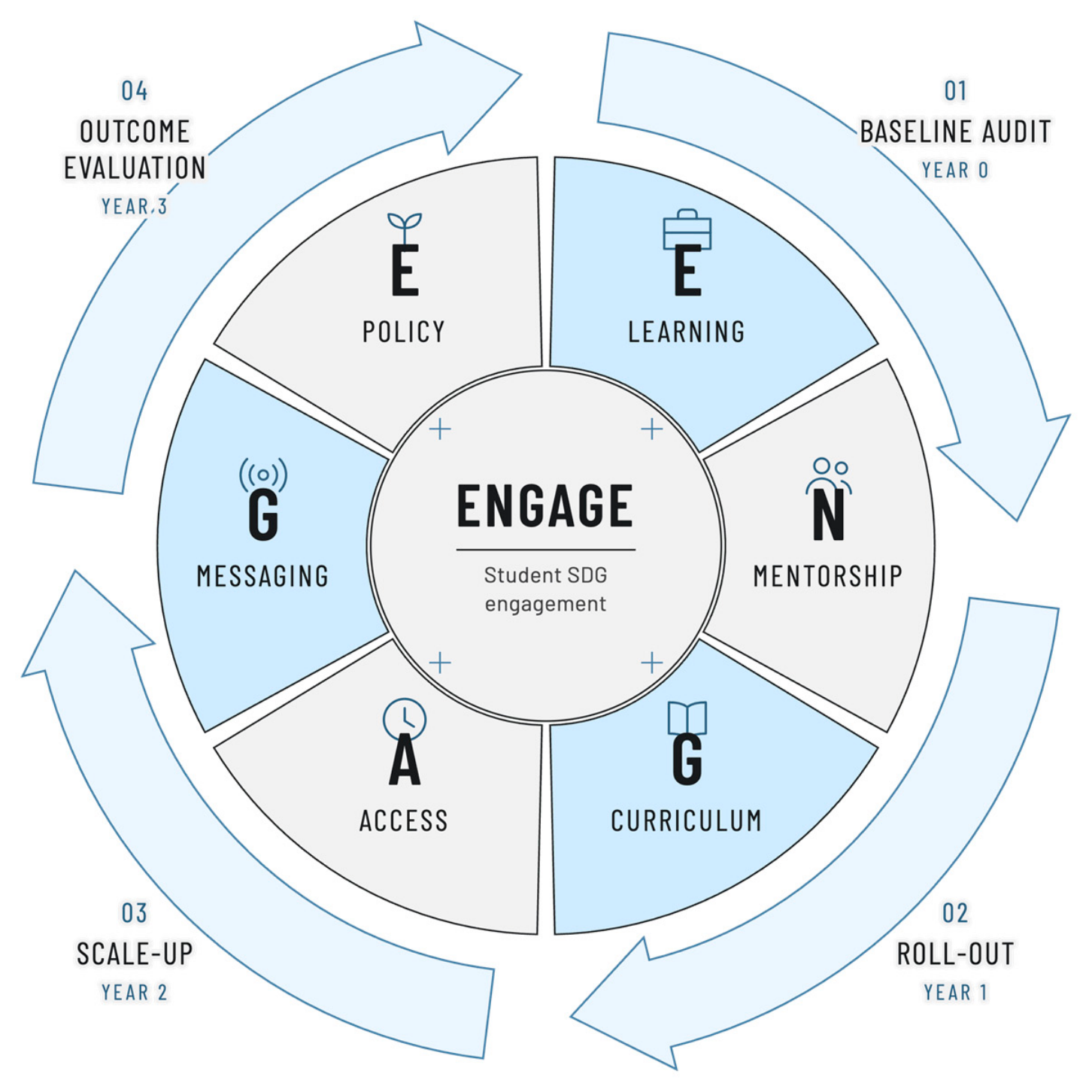
Figure 10.
Description the proposed integrated ENGAGE framework structured in six interconnected components (strands).
Figure 10.
Description the proposed integrated ENGAGE framework structured in six interconnected components (strands).
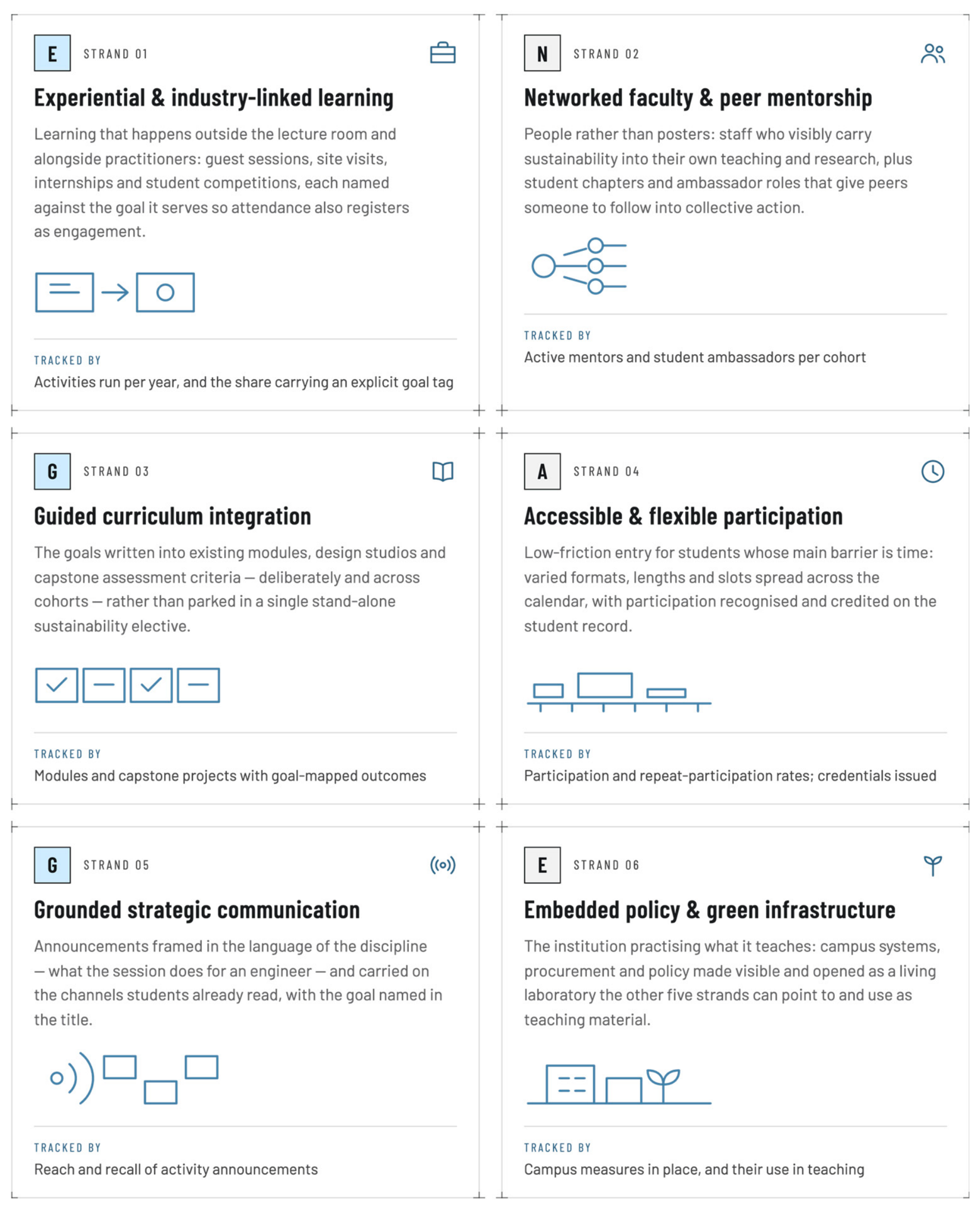
Figure 11.
The proposed 3-years monitoring protocol for tracking students’ engagement in sustainable development.
Figure 11.
The proposed 3-years monitoring protocol for tracking students’ engagement in sustainable development.
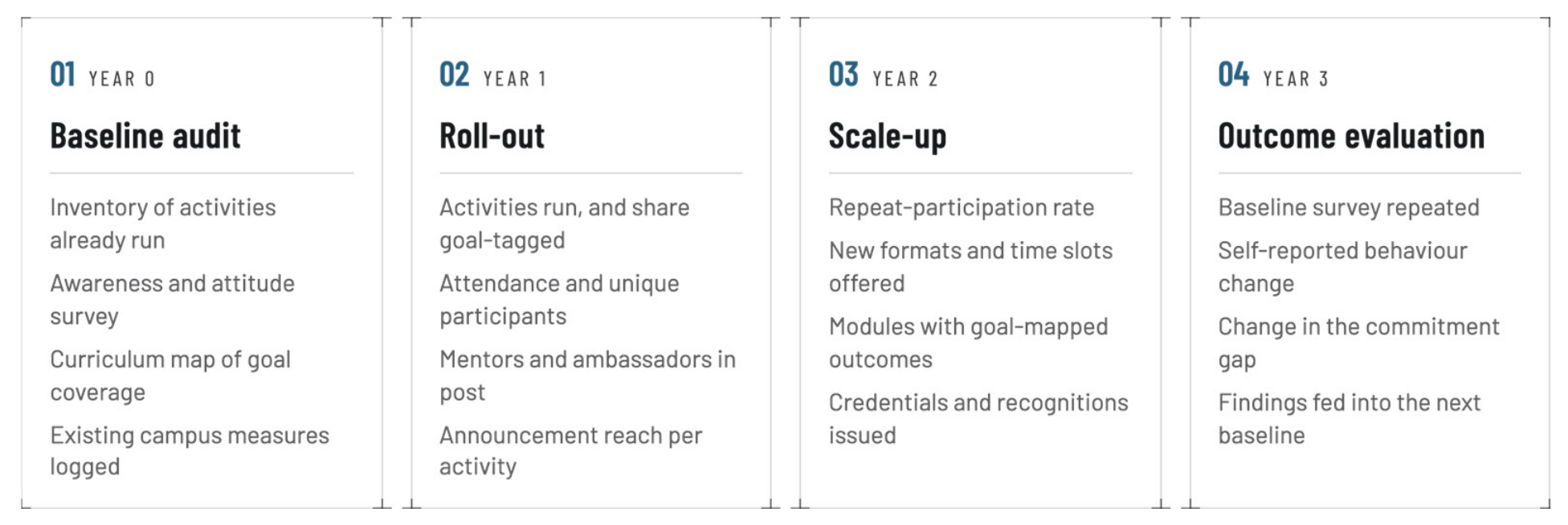
Figure 12.
Attendance rates in the GIS training workshop before and after the re-design.
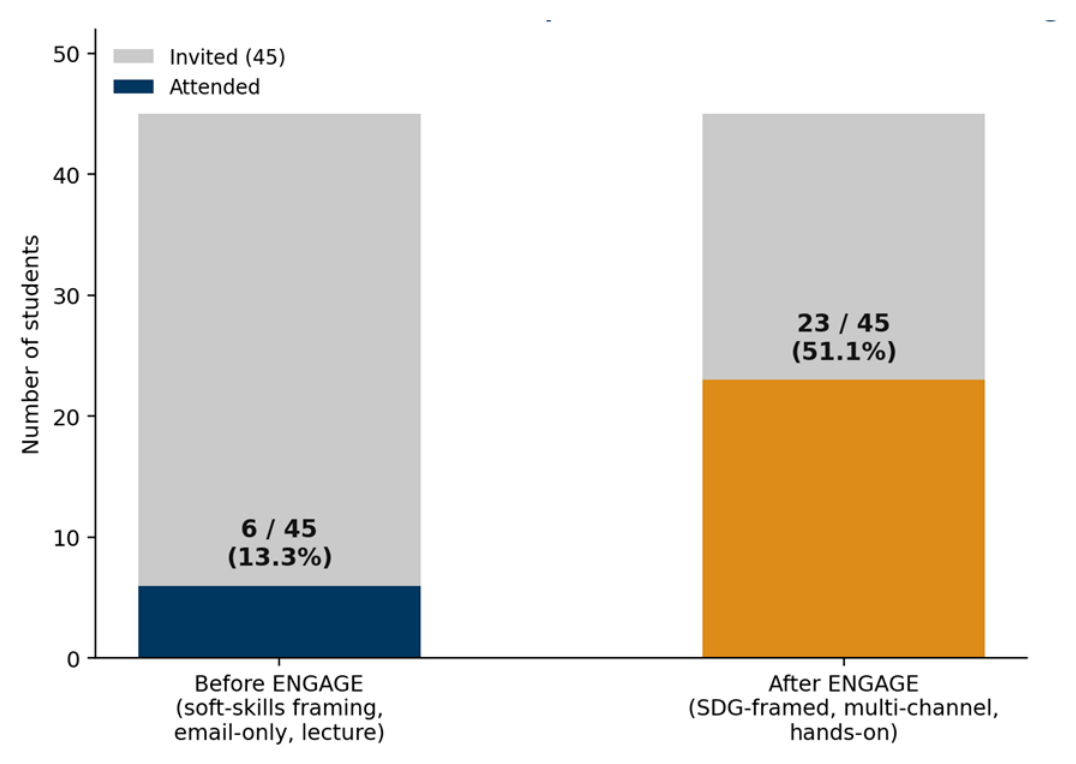
Figure 13.
Pre-workshop responses of participants in the re-designed GIS workshop.
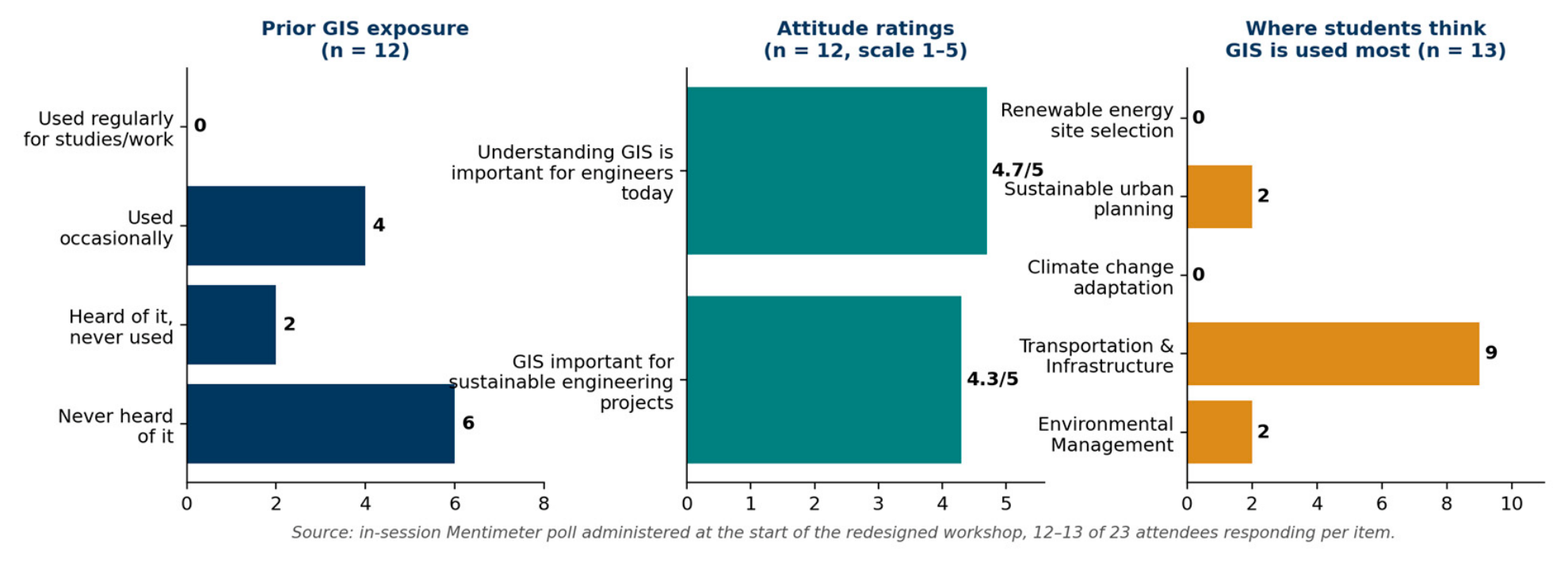
Figure 14.
Post-workshop responses of participants in the re-designed GIS workshop.
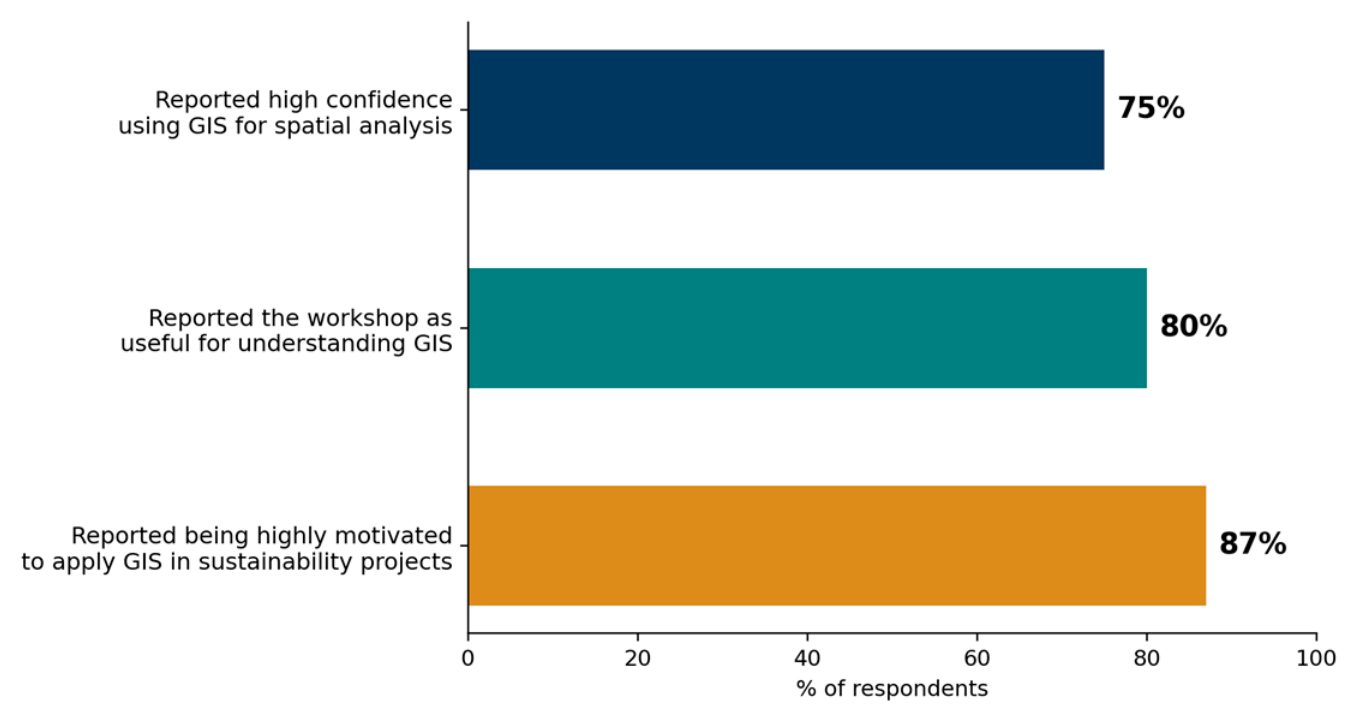
Table 1.
Demographic characteristics of Phase 1 and Phase 2 samples.
| Characteristic | Category | Phase 1 (N = 44) | Phase 2 (N = 45) |
|---|---|---|---|
| Gender | Female | 66% | 76% |
| Male | 34% | 24% | |
| Programme | Civil Engineering | 47.7% | 49% |
| Architectural Engineering | 45.5% | 51% | |
| Mechanical Engineering | 4.5% | — | |
| Electrical & Electronic Engineering | 2.3% | — | |
| Academic level | Level S (Year 1) | 11.4% | 16% |
| Level 4 (Year 2) | 15.9% | 11% | |
| Level 5 (Year 3) | 22.7% | 18% | |
| Level 6 (Year 4) | 25% | 31% | |
| Graduate | 25% | 24% | |
| Survey | Invited / responded | 127 / 44 | 73 / 45 |
| Response rate | 34.6% | 37.2% |
Table 2.
Proposed monitoring process and outcome indicators for the three-year monitoring protocol .
Table 2.
Proposed monitoring process and outcome indicators for the three-year monitoring protocol .
| Type | Indicator | Data source |
|---|---|---|
| Process | Number of guest-speaker sessions, site visits, campus sustainability events and competition entries offered per semester, per programme | Event logs, CoE annual activity reports |
| Process | Proportion of activities explicitly framed around a named SDG | Event titles / briefs, communication materials |
| Process | Breadth of participation across the CE, AE, ME and EEE programmes | Attendance registers |
| Outcome | Proportion of students attending at least one sustainability-framed activity per semester | Attendance registers |
| Outcome | Repeat-participation rate (whether students who attend once return) | Attendance registers, MS Forms |
| Outcome | Pre/post score on a condensed commitment-gap instrument (drawing on Phase 1 and Phase 2 items) | Repeat survey administration at start and end of the 3-year window |
| Outcome | Proportion of capstone / graduation projects with an explicit, assessed SDG-alignment component | Graduation-project assessment records |
Disclaimer/Publisher’s Note: The statements, opinions and data contained in all publications are solely those of the individual author(s) and contributor(s) and not of MDPI and/or the editor(s). MDPI and/or the editor(s) disclaim responsibility for any injury to people or property resulting from any ideas, methods, instructions or products referred to in the content. |
© 2026 by the authors. Licensee MDPI, Basel, Switzerland. This article is an open access article distributed under the terms and conditions of the Creative Commons Attribution (CC BY) license (http://creativecommons.org/licenses/by/4.0/).
Copyright: This open access article is published under a Creative Commons CC BY 4.0 license, which permit the free download, distribution, and reuse, provided that the author and preprint are cited in any reuse.