

Submitted:
27 September 2026
Posted:
30 September 2026
You are already at the latest version
Abstract
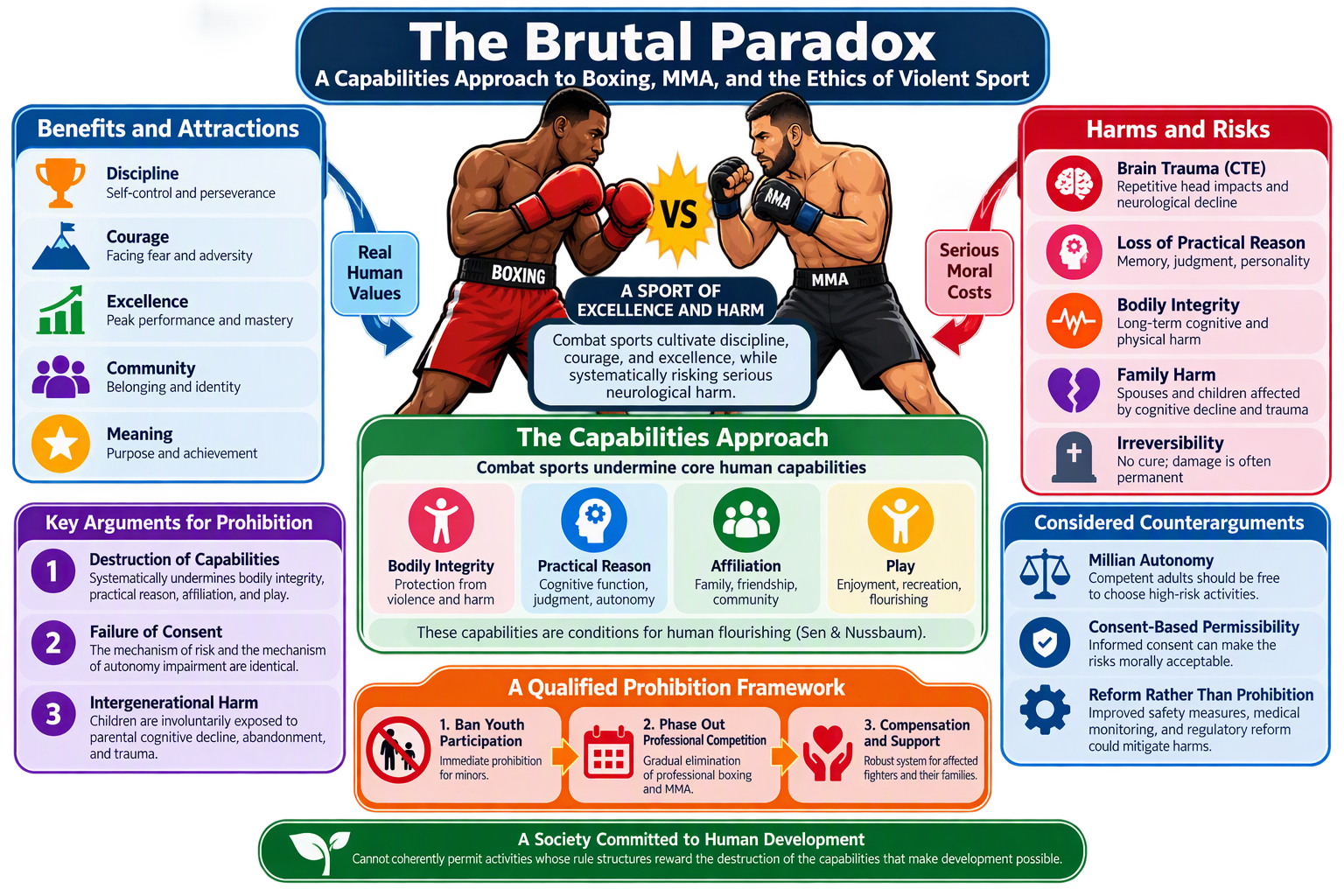
This paper examines whether sports whose rule structures reward the infliction of bodily harm—paradigmatically boxing and mixed martial arts—can be justified within a framework of human development understood through the capabilities approach. I argue that these sports generate a distinctive normative problem: they systematically undermine the very capabilities—bodily integrity, practical reason, affiliation, and play—that Sen and Nussbaum identify as conditions of human flourishing. The medical evidence on chronic traumatic encephalopathy (CTE) and repetitive head trauma establishes a strong prima facie case against their permissibility, though significant evidentiary uncertainties remain. I then examine three lines of defence: Millian autonomy, consent-based moral permissibility, and the claim that reform rather than prohibition is the appropriate response. While the autonomy objection has considerable force for competent adults, it fails to address the intergenerational dimension of the harm: children of fighters are involuntarily exposed to parental cognitive decline, abandonment, and trauma. Moreover, the consent of fighters is undermined by the fact that the mechanism of risk and the mechanism of autonomy impairment are identical. I conclude that a qualified prohibition is justified: an immediate ban on youth participation, a phased elimination of professional competition, and a robust system of compensation and support. The argument is not that fighters are irrational or that their courage is unworthy of respect, but that a society committed to human development cannot coherently permit activities whose rule structures reward the destruction of the capabilities that make development possible.
Keywords:
capabilities approach
; human flourishing
; combat sports
; boxing
; mixed martial arts (MMA)
; practical reason
; bodily integrity
; autonomy
; informed consent
; chronic traumatic encephalopathy (CTE)
; public health ethics
; intergenerational harm
Copyright: This open access article is published under a Creative Commons CC BY 4.0 license, which permit the free download, distribution, and reuse, provided that the author and preprint are cited in any reuse.