

Submitted:
27 September 2026
Posted:
30 September 2026
You are already at the latest version
Abstract
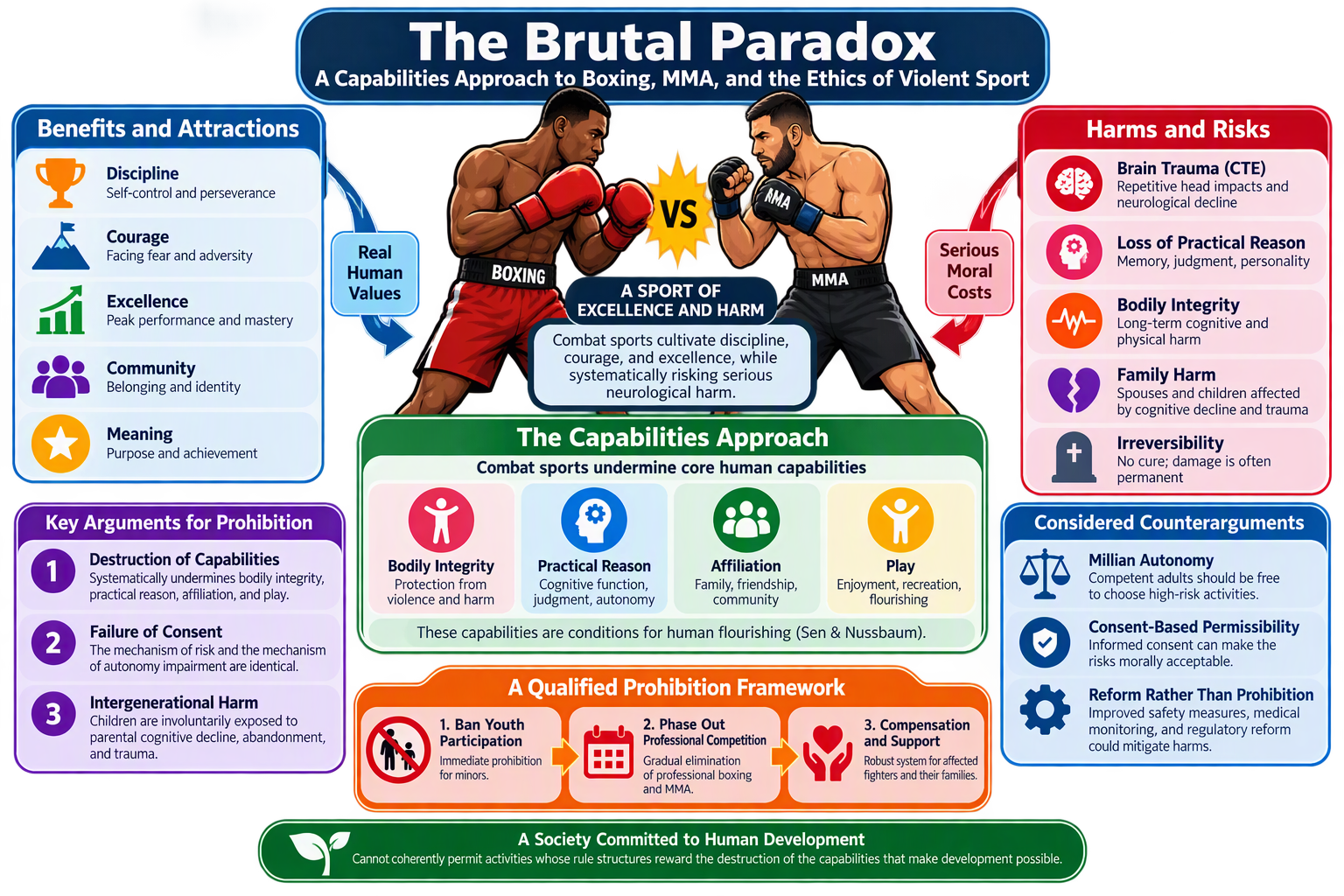
This paper examines whether sports whose rule structures reward the infliction of bodily harm—paradigmatically boxing and mixed martial arts—can be justified within a framework of human development understood through the capabilities approach. I argue that these sports generate a distinctive normative problem: they systematically undermine the very capabilities—bodily integrity, practical reason, affiliation, and play—that Sen and Nussbaum identify as conditions of human flourishing. The medical evidence on chronic traumatic encephalopathy (CTE) and repetitive head trauma establishes a strong prima facie case against their permissibility, though significant evidentiary uncertainties remain. I then examine three lines of defence: Millian autonomy, consent-based moral permissibility, and the claim that reform rather than prohibition is the appropriate response. While the autonomy objection has considerable force for competent adults, it fails to address the intergenerational dimension of the harm: children of fighters are involuntarily exposed to parental cognitive decline, abandonment, and trauma. Moreover, the consent of fighters is undermined by the fact that the mechanism of risk and the mechanism of autonomy impairment are identical. I conclude that a qualified prohibition is justified: an immediate ban on youth participation, a phased elimination of professional competition, and a robust system of compensation and support. The argument is not that fighters are irrational or that their courage is unworthy of respect, but that a society committed to human development cannot coherently permit activities whose rule structures reward the destruction of the capabilities that make development possible.
Keywords:
capabilities approach
; human flourishing
; combat sports
; boxing
; mixed martial arts (MMA)
; practical reason
; bodily integrity
; autonomy
; informed consent
; chronic traumatic encephalopathy (CTE)
; public health ethics
; intergenerational harm
1. Introduction: The Paradox
Combat sports occupy a peculiar position in contemporary culture. They are celebrated for producing discipline, courage, and excellence while simultaneously being organised around practices that inflict traumatic brain injury. This is the brutal paradox: the same activity that cultivates certain virtues systematically undermines the neurological substrate of practical reason, memory, and personality. The question this paper addresses is normative rather than empirical: can a just society permit, regulate, or celebrate sports whose rule structures reward the infliction of bodily harm?
The paper proceeds as follows. Section 2 establishes the empirical basis for concern, drawing on the medical literature on CTE and repetitive head trauma while acknowledging its limitations. Section 3 develops the theoretical framework, drawing on the capabilities approach of Amartya Sen and Martha Nussbaum, supplemented by Mill’s harm principle and public health ethics. Section 4 presents the case for prohibition, focusing on three arguments: the destruction of capabilities, the failure of consent, and the intergenerational harm to children. Section 5 examines the strongest counterarguments: Millian autonomy, consent-based moral permissibility, and the reformist alternative. Section 6 proposes a qualified prohibition framework. Section 7 concludes.
2. The Empirical Basis: What the Evidence Shows—and What It Does Not
2.1. The Medical Evidence on Brain Trauma
The medical literature on repetitive head trauma in combat sports is substantial and growing. Studies from the Boston University CTE Center report that a high proportion of studied former boxers showed neuropathological signs of CTE, a degenerative tauopathy associated with repetitive head impacts. A 2022 study found that 41% of retired professional fighters met criteria for traumatic encephalopathy syndrome (TES), the clinical condition associated with CTE (Bernick et al., 2022). Those with TES showed significantly smaller hippocampal volumes and faster rates of brain volume decline.
Neuroimaging research has documented structural brain changes in fighters, including reductions in thalamic volume and other subcortical structures (Bernick et al., 2022). Chronic traumatic brain injury associated with boxing occurs in approximately 20% of professional boxers (Jordan, 2000). The most common neurological problems in former boxers include dysarthria (49%), gait disturbances (44%), and memory loss (36%), with frank dementia in 17% of cases (Da Broi, 2023).
2.2. The Limits of the Evidence
It is important, however, to be precise about what the evidence does and does not establish. A 2025 systematic review and meta-analysis found that CTE neuropathologic change was not associated with suicide in former athletes, and concluded that “the best available evidence suggests that CTE-NC is not associated with depression, suicidality, or suicide” (Iverson, 2025). A separate systematic review of sport-related concussion concluded that “more research is needed to better understand the prevalence of chronic traumatic encephalopathy and other neurological conditions and diseases, and the extent to which they are related to concussions and/or repetitive neurotrauma sustained in sports” (Manley et al., 2017).
It is also important to acknowledge the methodological limitations of post-mortem CTE studies. The Boston University brain bank and similar repositories rely on donated tissue, which may introduce selection bias: families who suspect that a deceased relative suffered from CTE may be more likely to donate, and the samples may not be representative of all fighters. These studies therefore may not provide reliable prevalence estimates for the population of former fighters as a whole. They establish that CTE occurs in fighters and that the neuropathology is associated with repetitive head trauma, but they do not establish the base rate of the disease.
These caveats matter for the normative argument. The case for prohibition does not rest on the claim that every fighter will develop dementia, or that CTE invariably causes suicide. It rests on the claim that combat sports are structured to reward the infliction of repetitive head trauma, that this trauma is causally implicated in a range of serious neurological harms, and that the predictability of these harms—even if their precise incidence remains uncertain—generates a strong moral reason for restriction. The evidence is sufficient to establish a serious prima facie case; it is not sufficient to establish that every participant will be catastrophically harmed.
3. Theoretical Framework: Capabilities, Harm, and Public Health
3.1. The Capabilities Approach
Amartya Sen and Martha Nussbaum have developed the capabilities approach as an alternative to purely economic or utilitarian measures of human development. On this view, development is not merely the growth of GDP or the satisfaction of preferences; it is the expansion of the real freedoms that people have to do and to be what they have reason to value. Nussbaum identifies a list of central capabilities that are necessary conditions for a life worthy of human dignity, including:
- Life: being able to live to the end of a human life of normal length.
- Bodily integrity: being able to move freely, to be secure against violent assault, and to have opportunities for sexual satisfaction and choice in reproduction.
- Bodily health: being able to have good health, including adequate nourishment and shelter.
- Practical reason: being able to form a conception of the good and to engage in critical reflection about the planning of one’s life.
- Affiliation: being able to live with and toward others, to recognise and show concern for other human beings.
- Play: being able to laugh, to play, and to enjoy recreational activities.
The capabilities approach has been applied to sport in recent years, particularly in the context of Sport for Development and Peace, where participation is understood as a means of expanding capabilities for marginalised groups (Darnell & Dao, 2017). Sport can enhance capabilities by promoting physical health, social belonging, and the development of practical reason through disciplined practice.
It is important to clarify the theoretical commitments of this framework at the outset. The capabilities approach differs from classical liberalism in a crucial respect: it treats certain human powers as objective conditions of dignity rather than merely objects of preference satisfaction. On this view, the fact that a person consents to or prefers a particular state of affairs does not settle the question of whether that state of affairs is compatible with human flourishing. Capabilities are not merely subjective goods; they are the real freedoms that enable a person to live a life worthy of human dignity. This distinction is central to the argument that follows, and it explains why the capabilities approach may justify restrictions on activities that competent adults have chosen to undertake.
The present argument follows Nussbaum’s more substantive account of central capabilities and practical reason rather than Sen’s more deliberately open-ended framework. Sen resists strong objective rankings among capabilities, preferring to leave the weighting of different freedoms to democratic deliberation. Nussbaum, by contrast, develops a thicker conception of the central capabilities and their interrelations, treating practical reason as architectonic. This paper adopts Nussbaum’s framework because the argument requires a substantive account of which capabilities are most fundamental and why their destruction is especially serious.
3.2. The Capabilities Critique of Combat Sports
The problem with combat sports, on this framework, is that their rule structures reward practices that undermine the expansion of capabilities. They do not merely fail to promote capabilities; they actively incentivise their destruction. The rules of boxing reward actions that render one’s opponent unconscious through cranial trauma; the rules of MMA reward actions that incapacitate one’s opponent through strikes, submissions, and ground-and-pound. Both sports treat the opponent’s body—and especially the opponent’s brain—as a legitimate target.
This raises a fundamental question about the nature of bodily integrity as a capability. Nussbaum’s capability of bodily integrity includes “being able to be secure against violent assault, including sexual assault and domestic violence.” A critic might object that bodily integrity protects against coercive violence, not consensual violence, and that a boxer who enters the ring willingly has waived any claim to bodily integrity.
This objection, however, misconstrues the nature of capabilities. Capabilities are not merely preference satisfactions or subjective states; they are objective conditions that are necessary for a life worthy of human dignity. As Nussbaum argues, capabilities are “substantial freedoms” that are not reducible to the satisfaction of individual preferences. A person can genuinely prefer to have her bodily integrity violated—as in cases of internalised oppression or self-harm—without thereby eliminating the harm. The question is not whether the fighter prefers to be punched in the head, but whether the practice of punching people in the head is compatible with the social conditions that enable human flourishing.
Moreover, the capability of bodily integrity is not merely about the absence of external interference; it is about the presence of conditions that enable a person to live with dignity. A society that celebrates and rewards the deliberate infliction of brain trauma is one in which the value of bodily integrity is systematically demeaned. The fighter who consents to violence is not exercising his autonomy in a vacuum; he is participating in a practice that normalises the destruction of the very capability that autonomy presupposes. As Anderson et al. (2023) argue, impact sport organisations effectively “groom” participants into accepting brain trauma as an inevitable part of their activity.
Beyond bodily integrity, combat sports also undermine practical reason—the capacity that grounds moral agency and informed consent. Practical reason occupies a special normative status among the capabilities because it conditions the exercise of many others. A person who cannot form a conception of the good, who cannot engage in critical reflection about her life, or who cannot control her impulses is unable to exercise the other capabilities in a meaningful way. Nussbaum treats practical reason as architectonic: it is not merely one capability among many but the capability that organises and integrates the rest. A fighter who has sustained cumulative brain damage may lose the capacity to evaluate risks, control impulses, and engage in the critical reflection that Nussbaum identifies as central to a dignified life. The destruction of practical reason is therefore not merely one harm among many; it is a harm that undermines the very foundation of human agency.
The capability of affiliation is also implicated in combat sports in two distinct ways. First, fighters are often separated from their families for extended periods during training camps, and the cognitive and behavioural changes associated with CTE can severely impair their capacity for meaningful relationships. The capacity to recognise and show concern for others—to participate in relationships of mutual care and respect—is diminished when the brain regions responsible for empathy, impulse control, and emotional regulation are damaged. Second, the intergenerational harm to children of fighters—discussed in Section 4.3—raises concerns about the capability of affiliation, as children may be deprived of the stable, caring relationships that are necessary for healthy development. The capability of affiliation is thus not merely an individual good; it is the foundation of the family and community relationships that sustain human flourishing across generations.
Finally, the capability of play is placed under tension. Nussbaum defines play as the ability to laugh, to play, and to enjoy recreational activities. Combat sports create tension within this capability because the enjoyment generated by the activity is inseparable from practices that expose participants to serious harm. As Nussbaum emphasises, play should contribute positively to flourishing—it should be a source of joy and self-expression—rather than requiring systematic bodily deterioration as the price of participation. This does not mean that spectators are sadists or that fighters do not experience genuine joy in their craft; it means that the capability of play is compromised when its exercise is inseparable from the infliction of traumatic injury.
3.3. The Harm Principle and Its Limits
The standard liberal objection to banning risky activities is grounded in Mill’s harm principle: the only justification for interfering with an individual’s liberty is to prevent harm to others. On this view, competent adults should be free to engage in combat sports, provided they understand the risks and consent to them. Warburton (1998) has made precisely this argument in the context of boxing, contending that “the move from medical evidence about the risk of brain damage to the conclusion that boxing should be banned is not warranted” and that the BMA’s arguments “are a combination of inconsistent paternalism and legal moralism”.
This objection has considerable force. It is not sufficient to show that an activity is dangerous to justify prohibiting it; mountaineering, motor racing, and many other activities carry substantial risks of death and injury. If we banned everything that carried a significant risk of harm, we would have to ban much of what makes life meaningful.
However, the harm principle is not a knock-out argument in this context. As critics of Millian libertarianism have pointed out, the distinction between self-regarding and other-regarding harms is far from clear in complex societies. If autonomy is always to trump collective interests, we would have no motorcycle helmet legislation, no seat belt laws, and no restrictions on tobacco advertising. The BMA’s opposition to boxing is based on medical evidence of the injuries caused by the sport, including brain damage, acute brain haemorrhage, and permanent sight and hearing loss.
The more fundamental point is that the harm principle presupposes a clear demarcation between the harm a person does to themselves and the harm they do to others. In combat sports, this demarcation is difficult to sustain. The fighter who sustains brain damage does not merely harm himself; he may harm his children, his spouse, his community, and the public health system that must care for him. The self is not an isolated monad; it is constituted by relationships and responsibilities. A liberal framework that treats the individual as the sole proprietor of his own body may fail to capture the social embeddedness of human flourishing.
3.4. Public Health Ethics and Proportionality
Public health ethics provides a complementary framework. Unlike clinical ethics, which is organised around individual autonomy and informed consent, public health ethics is concerned with the health of populations and the structural conditions that produce health and disease. Public health interventions, such as seat belt laws, smoking bans, and vaccination mandates, are justified not by the consent of each individual affected but by the collective benefits of reduced harm.
From a public health perspective, combat sports are a vector of neurological disease. They produce a population of individuals with elevated rates of CTE, cognitive impairment, and dementia. They impose costs on families, communities, and health systems. Several major medical organizations, including the British Medical Association and the Australian Medical Association, have advocated prohibitions or substantial restrictions on boxing.
However, public health ethics does not license any intervention that promises to reduce harm. It requires that interventions satisfy conditions of proportionality: the harm must be substantial, the intervention must be effective, and the intervention must not impose disproportionate burdens on affected populations. A critic might ask: why prohibition rather than taxation, regulation, mandatory insurance, shorter careers, or enhanced medical screening?
Recent philosophical work has further emphasized the importance of assessing relative harms across sporting activities when considering ethical classification and regulatory responses. Oldham (2024), for example, argues that ethical evaluation of sport should take seriously differences in the magnitude and distribution of harms, rather than treating all sporting risks as morally equivalent. Such analyses suggest that the mere existence of risk is insufficient to justify prohibition, but they also support closer scrutiny of activities whose risks are unusually severe, systematic, and resistant to mitigation.
The proportionality argument for prohibition rests on three considerations. First, the production of harm is a central and rewarded feature of the practice itself, not merely an incidental by-product. Combat sports are not like smoking, where the harm is a side effect of a practice that has other dimensions; the rule structure of boxing rewards actions that foreseeably produce brain trauma as a means to victory. Regulation can reduce the incidence of harm, but it cannot eliminate the fact that the activity is constituted around a rule-rewarded mechanism of harm. Because the mechanism of concern is embedded within the rules themselves, less restrictive interventions cannot fully address the central ethical problem.
Second, the evidence suggests that regulation has been insufficient. Despite decades of medical warnings, rule changes, and safety equipment, boxers continue to die in the ring and develop CTE at elevated rates. The problem is not a lack of regulation but the nature of the activity itself. As Dixon (2001) notes, “impose a single legal restriction that would effectively eliminate boxing’s main medical risk: a complete ban on blows to the head” would fundamentally change the sport; it would no longer be boxing.
Third, the intergenerational dimension of the harm makes prohibition more proportionate than regulation. Regulation that targets individual fighters may reduce their exposure to harm, but it does not address the harm to their children, who are involuntarily exposed to the consequences of parental brain injury. A public health intervention that protects children from preventable harm is presumptively proportionate, even if it imposes costs on adults who wish to participate in the activity.
The public health framing also addresses the intergenerational dimension of the harm. When a fighter sustains brain damage, the costs may be borne not only by the fighter but by his children, who may experience neglect, abuse, and the loss of a parent to cognitive decline. The public health system bears the costs of treating the consequences of combat sports, costs that are not borne entirely by the promoters and organisations that profit from the violence.
4. The Case for Prohibition
4.1. The Destruction of Capabilities
The first argument for prohibition is that combat sports systematically undermine the capabilities that are necessary for human flourishing. This is not a contingent feature of the sports that could be eliminated through better safety equipment or rule modifications; it is embedded in their rule structures. Although boxing is officially defined in terms of scoring points and winning contests, its rule structure rewards and incentivises actions whose foreseeable purpose is neurological incapacitation. A sport that eliminated head trauma would no longer be boxing or MMA; it would be something else entirely.
The distinctive wrong of combat sports, on this analysis, is not merely that they destroy capabilities but that they destroy practical reason—the architectonic capability upon which the exercise of many other capabilities depends. Bodily integrity is violated, affiliation is compromised, and play is degraded, but the destruction of practical reason is the harm that makes the others so serious. A person whose capacity for practical reason is impaired cannot meaningfully exercise the other capabilities, because practical reason is what enables a person to form a conception of the good and to pursue it. The destruction of practical reason is therefore the central harm that combat sports inflict.
The capabilities approach provides a principled basis for distinguishing combat sports from other dangerous activities. Mountaineering may risk life and limb, but it does not have as its rule-structured aim the destruction of the climber’s practical reason. Motor racing may risk death, but it does not require the racer to inflict brain damage on an opponent. The distinctive wrong of combat sports is that their rule structures reward the destruction of practical reason as the means to victory.
4.2. The Failure of Consent
The second argument is that consent to combat sports is morally problematic. This is not because fighters are irrational or poorly informed—although the economic pressures and limited alternatives that drive many fighters into the sport are relevant. It is because the mechanism that produces the risk is identical to the mechanism that impairs the capacity for autonomy.
In most risky activities, the risk and the potential autonomy impairment are distinct. A mountaineer may fall and sustain a head injury that impairs her autonomy, but the fall is not the means by which she climbs. A smoker may develop a stroke that impairs her autonomy, but the stroke is not the means by which she smokes. In boxing and MMA, by contrast, the means of participation—repeated blows to the head—are the same physical process that produces the autonomy impairment. The fighter consents to being punched in the head; being punched in the head is what causes the brain damage; the brain damage is what undermines the capacity for practical reason. The activity to which one consents systematically undermines the conditions of valid consent.
Anderson, Turner, Hardwicke, and Parry (2023) have argued that neither children nor adults on their behalf are legally able to give informed consent for participation in sports that intentionally structure brain trauma into their practice. They describe impact sport organisations as effectively “grooming children into sustaining and accepting brain trauma” and characterise adults who provide brain-traumatising versions of these sports as “complicit in a form of child abuse that we term brain abuse”.
For adults, the argument is more subtle but still powerful. The neurological damage that fighters sustain progressively impairs their capacity for practical reason. A fighter who has sustained multiple concussions may experience personality changes, impulsivity, depression, and cognitive decline—all of which undermine the capacity for informed decision-making. This is not to say that fighters are never capable of consenting. At the outset of a career, a young fighter may be fully competent to weigh the risks and benefits. But as the career progresses, the cumulative trauma erodes that competence. The consent that was valid at the beginning may become invalid over time, yet the fighter continues to fight because the sport has become constitutive of his identity and because the economic and social pressures to continue are overwhelming.
4.3. Intergenerational Harm: A Precautionary Argument
The third argument is that combat sports raise serious concerns about harm to children—both the children who participate in them and the children of adult fighters. The case of child participants is the more straightforward: if the argument for prohibition on the grounds of consent failure is valid for adults, it is a fortiori valid for children. Children cannot consent to activities that will cause them permanent neurological damage. The American Medical Association (2014) has adopted policy recommending that children and adolescents not participate in boxing. The Anderson et al. argument provides a rigorous ethical basis for this recommendation.
The case of children of adult fighters is more novel and more difficult. These children are involuntary participants in the brutal paradox. They did not choose to be born to fighters; they did not consent to the violence that may define their families. Yet they may bear the consequences of their parents’ choices.
It is important to be clear about the evidentiary status of this argument. The evidence here is largely anecdotal, and this is a genuine limitation. The widely reported cases of fighters’ children experiencing abandonment, addiction, and trauma are illustrative but do not establish population-level effects. Dedicated longitudinal studies of fighters’ children have not been conducted. These cases are included here not as empirical proof but as illustrations of the kinds of harms that the precautionary argument anticipates.
However, the absence of systematic evidence does not mean the concern is unfounded. It means that the research has not yet been done. The intergenerational transmission of trauma is a well-established phenomenon in other contexts—children of Holocaust survivors, children of combat veterans, and children of parents with substance use disorders all show elevated rates of psychological distress and psychopathology (Yehuda et al., 2018). There are strong theoretical reasons to anticipate similar risks for children of fighters with CTE. The cognitive and behavioural changes associated with CTE—impulsivity, aggression, depression, memory loss—directly impair the capacity for responsive parenting. A father who cannot remember his child’s birthday, who flies into rages without provocation, or who is too depressed to engage with his family may inflict a form of harm on his children that they did not choose and cannot escape.
This is therefore a precautionary argument rather than a demonstrated causal argument. Given what is already known about parental cognitive impairment, acquired brain injury, and intergenerational trauma, there are strong theoretical reasons to anticipate risks for fighters’ children even though dedicated longitudinal studies have not yet been conducted. The capabilities approach provides a framework for articulating this concern. Children have a capability for affiliation—for loving relationships with caregivers who are present, responsive, and stable. When a parent’s brain is damaged by combat sports, this capability may be compromised. The child may be deprived of the conditions necessary for healthy development. This is a harm that the child did not consent to and that the parent may not have foreseen. It is a harm that the state has a legitimate interest in preventing, even in the absence of definitive evidence.
4.4. Distinguishing Combat Sports from Other Dangerous Activities
A critic might object that the argument developed here proves too much. Elite military service, professional rugby, and certain forms of extreme adventure sport also damage practical reason and bodily integrity, yet the paper does not argue for banning them. If the criterion is the destruction of capabilities, why single out combat sports?
This objection has gained increasing attention in recent sport-philosophy debates. Ramsay (2024), for example, questions whether combat sports are morally distinguishable from other high-risk athletic activities, arguing that many non-combat sports also expose participants to substantial risks of serious injury. Such arguments challenge the assumption that danger alone is sufficient to establish the ethical distinctiveness of boxing and mixed martial arts.
The answer lies in the distinction between risk as a by-product and harm as a rule-rewarded mechanism. In military service, rugby, and adventure sports, the risk of injury is a foreseeable consequence of activities whose primary purpose is something else: defending a nation, competing in a team sport, or testing one’s limits against nature. The harm is not the point of the activity; it is a cost that participants accept in pursuit of other goods. In boxing and MMA, by contrast, the rule structure rewards actions that foreseeably produce brain trauma as the mechanism through which victory is achieved. A boxer who systematically avoids targeting the head places himself at a substantial competitive disadvantage; a fighter who refuses to inflict damage is not competing effectively within the logic of the sport.
The distinction is therefore not between dangerous and non-dangerous activities. Nor is it simply between activities that intentionally or unintentionally cause harm. Rather, it concerns the role that harm plays within the structure of the practice. In combat sports, neurological harm is not merely a risk accepted by participants; it is tied to the strategic means by which success is pursued. Victory is achieved, at least in part, through actions designed to impair an opponent’s capacity to continue competing.
This distinction does not mean that military service or rugby are morally unproblematic. It means that the case for prohibiting them would require a different argument, one that weighs the goods they produce against the harms they impose. Oldham’s (2024) analysis of relative risk in sport reminds us that dangerous activities may warrant different regulatory responses depending on both the magnitude and the structure of their harms. The present argument is that combat sports occupy a distinctive position because the capability losses at issue are linked directly to a rule-rewarded mechanism of victory rather than arising primarily as unintended side effects of participation.
For this reason, the capabilities approach can justify a qualified prohibition of combat sports without thereby committing itself to prohibiting every activity that carries a risk of injury. The relevant distinction is not danger alone, but the institutionalisation and reward of actions that foreseeably undermine the practical reason and bodily integrity of one’s opponent.
5. The Case Against Prohibition
5.1. Millian Autonomy
The strongest objection to prohibition is that it violates individual autonomy. Competent adults should be free to engage in risky activities, including combat sports, provided they understand the risks and consent to them. Warburton’s argument is that the move from medical evidence to prohibition is not logically warranted and that consistent application of the prohibitionist logic would lead to absurd consequences.
This objection has real force, and it should not be dismissed lightly. A society that prohibits boxing and MMA while permitting mountaineering, motor racing, and American football is open to the charge of inconsistency. If the criterion is the risk of serious harm, then many activities would have to be prohibited. If the criterion is the intentional infliction of harm on another person, then boxing and MMA are distinguishable—but the distinction between intended and foreseeable harm is not always morally decisive.
Moreover, there is a valuable tradition in liberal political philosophy that treats autonomy as the fundamental value and views paternalism as presumptively wrong. On this view, the role of the state is to provide information and ensure that consent is informed, not to override the choices of competent adults. The fighter who chooses to enter the ring is exercising his autonomy in a way that the state should respect, even if the choice is one that many of us would not make.
The capabilities approach does not deny the value of autonomy. It offers a different account of what autonomy requires and what can justify restricting it. On the capabilities view, autonomy is not merely the absence of external interference; it is the presence of the real freedoms that enable a person to form and pursue a conception of the good. These freedoms depend on certain objective conditions—including bodily integrity and practical reason—that are not themselves matters of individual preference. When an activity systematically destroys those conditions, it undermines the very basis of autonomous choice. The capabilities approach therefore provides a principled basis for restricting activities that destroy the conditions of autonomy, even when individuals have chosen to participate in them. This is not paternalism in the pejorative sense; it is a recognition that autonomy is not self-sustaining and that its conditions must be protected.
5.2. Consent-Based Moral Permissibility
A related but distinct argument is that combat sports are morally permissible because the violence is consensual. Kershnar and Kelly (2019) have argued that MMA fighting “is not necessarily wrong and is often, as far as we can tell, permissible” because “MMA-violence does not infringe on anyone’s moral right or violate another side-constraint”. On this view, the right not to be harmed can be waived, and fighters waive that right when they enter the ring.
This argument has the advantage of simplicity, but it faces serious difficulties. First, as noted above, the consent of fighters is undermined by the fact that the mechanism of risk and the mechanism of autonomy impairment are identical. Second, the consent of fighters does not extend to their children, who are involuntarily exposed to the consequences of parental brain injury. Third, the consent of fighters does not extend to the public health system that must bear the costs of their care, or to the communities that are affected by the normalisation of violence.
Even if we accept that competent adults can consent to violence, the question remains whether the state should permit activities that impose such substantial external costs. The liberal tradition has always recognised that autonomy is not absolute and that the state may regulate activities that impose harms on others. The question is not whether fighters have the right to harm themselves, but whether they have the right to harm their children, their communities, and the public purse.
5.3. The Reformist Alternative
A third objection is that prohibition is not the appropriate response; reform is. Dixon (2001) has argued that we should “impose a single legal restriction that would effectively eliminate boxing’s main medical risk: a complete ban on blows to the head”. This would preserve the sport while eliminating its most dangerous feature. Similarly, some have argued that better safety equipment, stricter medical oversight, and shorter careers could reduce the risks of combat sports without eliminating them.
The reformist alternative has practical appeal. A complete ban on blows to the head would be easier to enforce than a complete ban on boxing, and it would preserve the employment of fighters and the cultural traditions of the sport. However, it faces a fundamental objection: a ban on blows to the head would fundamentally change the nature of the sport. Boxing without head blows is no longer boxing; it is a different activity altogether. If the rule structure of boxing rewards the infliction of cranial trauma, then eliminating head blows eliminates boxing. The reformist alternative is therefore not a genuine alternative to prohibition; it is a proposal for a different sport.
Moreover, the reformist alternative does not address the intergenerational concern. Even if head blows were banned, fighters would still sustain concussions, still experience cognitive decline, and still raise concerns about the consequences for their families. The reformist alternative may reduce the harm, but it does not eliminate it.
6. A Qualified Prohibition
The argument of this paper does not lead to an unqualified prohibition of all contact sports. The capabilities approach does not entail that every activity that carries a risk of harm should be banned. It entails that activities whose rule structures reward the destruction of capabilities—activities that treat the violation of bodily integrity and practical reason as the means to victory—are presumptively impermissible.
On this basis, I propose a qualified prohibition with three components:
First, an immediate ban on youth participation. No child under 18 should be permitted to participate in boxing, MMA, or any sport in which blows to the head are a primary component. This is justified by the argument that children cannot consent to activities that will cause them permanent neurological damage, and by the capabilities approach’s emphasis on the special vulnerability of children and the importance of protecting their developmental potential.
Second, a phased elimination of professional competition. Professional boxing and MMA should be phased out over a period of, say, ten to fifteen years, with a transition programme providing retraining, pension access, and healthcare for current fighters. This is justified by the argument that the consent of adult fighters is undermined by the fact that the mechanism of risk and the mechanism of autonomy impairment are identical, and by the intergenerational concern.
A reviewer might ask: if the practice is genuinely incompatible with human flourishing, why allow another decade or more of it? The answer is that justice toward current participants requires a gradual transition. Fighters who have spent their lives in the sport cannot be expected to exit overnight without economic devastation. A phased approach allows them to plan for retirement, access retraining, and receive compensation for the harm they have sustained. It also allows the cultural institutions around combat sports—gyms, promoters, communities—to adapt. The specific timeframe of ten to fifteen years is illustrative rather than prescriptive; the appropriate period would depend on empirical assessment of the economic and social costs of transition, and would need to be determined through democratic deliberation rather than philosophical fiat. The moral case for prohibition is compatible with a pragmatic recognition that the transition must be managed fairly.
Third, a robust system of compensation and support. All former fighters should receive lifetime neurological monitoring and treatment, funded by a levy on the revenue generated by combat sports during the transition period. The Michael Watson precedent—where a brain-damaged boxer won damages against the British Boxing Board of Control (Watson v British Boxing Board of Control Ltd. [2001] QB 1134)—establishes that regulators bear legal responsibility for the harm they permit. This principle should be extended to all combat sports.
This framework is not a perfect solution. It does not address the harm to fighters who have already sustained brain damage, and it does not eliminate the underground economy of illegal fighting that would likely emerge. But it represents a principled response to the brutal paradox: a recognition that a society committed to human development cannot coherently permit activities whose rule structures reward the destruction of the capabilities that make development possible.
7. Conclusion
The brutal paradox is that sports celebrated for producing heroes systematically undermine the very qualities that make heroism meaningful. The capabilities approach provides a framework for understanding why this matters. Boxing and MMA do not merely fail to promote human development; they actively undermine it. They violate bodily integrity, impair practical reason, compromise affiliation, place the capability of play under tension, and raise serious concerns about intergenerational harm to children who never chose to be part of the violence.
The central claim of this paper is not merely that combat sports are dangerous, but that they challenge a capabilities-based conception of human development because the mechanism through which participants pursue achievement is intertwined with the erosion of the capabilities that make achievement meaningful. The fighter who pursues excellence through the infliction of brain trauma is simultaneously destroying the neurological substrate of the practical reason that makes excellence possible. This is the brutal paradox in its starkest form.
The autonomy objection has real force, and it should not be dismissed. But it fails to recognise that autonomy is not a solitary achievement; it is sustained by social conditions, including the integrity of the brain and the stability of families. When combat sports damage the neurological substrate of autonomy and raise concerns about harms to children, the autonomy objection loses some of its grip. The capabilities approach provides a principled basis for restricting activities that destroy the conditions of autonomy, even when individuals have chosen to participate in them.
If the capabilities framework developed here is persuasive, contemporary societies face a difficult question about whether certain forms of organised violence can be reconciled with commitments to human development and human flourishing. The capabilities approach does not resolve this question completely, but it points toward a response: a qualified prohibition that protects children, compensates the harmed, and acknowledges that some activities may be incompatible with a commitment to human flourishing.
References
- American Medical Association. Policy H-470.995: Boxing; American Medical Association, 2014. [Google Scholar]
- Anderson, E.; Turner, G.; Hardwicke, J.; Parry, K. Sport structured brain trauma is child abuse. Sport, Ethics and Philosophy 2023. [Google Scholar] [CrossRef]
- Bernick, C.; Shan, G.; Zetterberg, H.; Banks, S. Determining the incidence of traumatic encephalopathy syndrome and its association with brain volume loss in professional fighters. British Journal of Sports Medicine 2022, 56(15), 854–860. [Google Scholar]
- British Medical Association. Public health and private liberty—A far more complex picture. BMJ 2011, 343, d6937. [Google Scholar] [PubMed]
- Da Broi, M. The spectrum of acute and chronic consequences of neurotrauma in professional and amateur boxing. Brain and Spine 2023, 4, 102743. [Google Scholar] [CrossRef] [PubMed]
- Darnell, S. C.; Dao, M. S. Considering sport for development and peace through the capabilities approach. Third World Thematics 2017, 2(1), 23–41. [Google Scholar] [CrossRef]
- Dixon, N. Boxing, paternalism, and legal moralism. Social Theory and Practice 2001, 27(2), 323–344. [Google Scholar] [CrossRef]
- Iverson, G. L. Chronic traumatic encephalopathy neuropathologic change is not associated with suicide in former athletes. Scandinavian Journal of Medicine & Science in Sports 2025, 35(6), e70086. [Google Scholar] [CrossRef] [PubMed]
- Jordan, B. D. Chronic traumatic brain injury associated with boxing. Seminars in Neurology 2000, 20(2), 179–185. [Google Scholar] [CrossRef] [PubMed]
- Kershnar, S.; Kelly, R. M. Rights and consent in mixed martial arts. Journal of the Philosophy of Sport 2019, 47(1), 105–120. [Google Scholar] [CrossRef]
- Manley, G.; Gardner, A. J.; Schneider, K. J.; Guskiewicz, K. M. A systematic review of potential long-term effects of sport-related concussion. British Journal of Sports Medicine 2017, 51(12), 969–977. [Google Scholar] [CrossRef] [PubMed]
- Nussbaum, M. C. Creating capabilities: The human development approach; Harvard University Press, 2011. [Google Scholar]
- Oldham, A. C. Scales of ignorance: an ethical normative framework to account for relative risk of harm in sport categorization. Journal of the Philosophy of Sport 2024, 51(3), 496–514. [Google Scholar] [CrossRef]
- Pho, A.; White, B. A. A critical note on a purported disanalogy between cycling and mixed martial arts. Journal of the Philosophy of Sport 2022, 49(2), 177–194. [Google Scholar] [CrossRef]
- Ramsay, M. The shared innocence of cycling and mixed martial arts: a reply to Pho and White. Journal of the Philosophy of Sport 2024, 51(1), 145–162. [Google Scholar] [CrossRef]
- Sailors, P. R. Utilitarian arguments against dangerous sports. Journal of the Philosophy of Sport 2014, 41(3), 339–353. [Google Scholar]
- Sen, A. Development as freedom; Oxford University Press, 1999. [Google Scholar]
- Warburton, N. Freedom to box. Journal of Medical Ethics 1998, 24(1), 56–60. [Google Scholar] [CrossRef] [PubMed]
- Watson v British Boxing Board of Control Ltd. [2001] QB 1134.
- Weimer, S. On the alleged intrinsic immorality of mixed martial arts. Journal of the Philosophy of Sport 2017, 44(2), 258–275. [Google Scholar] [CrossRef]
- Weinberg, J. D. Consensual violence: Sex, sports, and the politics of injury; University of California Press, 2016. [Google Scholar]
- Yehuda, R.; et al. Intergenerational transmission of stress. Nature Reviews Neuroscience 2018, 19, 535–549. [Google Scholar] [CrossRef] [PubMed]
Disclaimer/Publisher’s Note: The statements, opinions and data contained in all publications are solely those of the individual author(s) and contributor(s) and not of MDPI and/or the editor(s). MDPI and/or the editor(s) disclaim responsibility for any injury to people or property resulting from any ideas, methods, instructions or products referred to in the content. |
© 2026 by the authors. Licensee MDPI, Basel, Switzerland. This article is an open access article distributed under the terms and conditions of the Creative Commons Attribution (CC BY) license (http://creativecommons.org/licenses/by/4.0/).
Copyright: This open access article is published under a Creative Commons CC BY 4.0 license, which permit the free download, distribution, and reuse, provided that the author and preprint are cited in any reuse.