
Submitted:
28 September 2026
Posted:
29 September 2026
You are already at the latest version
Abstract
Increasing climate variability and the growing frequency of extreme weather events pose serious challenges to agricultural productivity worldwide. Drought is among the most limiting abiotic stresses because it restricts nutrient uptake, reduces photosynthetic effi-ciency, and ultimately lowers crop yield. Arbuscular mycorrhizal fungi (AMF) form symbiotic associations with plant roots and can improve plant performance under wa-ter-deficit conditions. This proceeding paper examines the physiological and biochemical mechanisms through which AMF may enhance wheat tolerance to drought stress. Overall, AMF symbiosis was associated with greater chlorophyll retention, reduced accumulation of osmotic stress indicators, and higher antioxidant activity, suggesting improved cellular protection under drought. These observations highlight the potential value of AMF as a sustainable biological strategy for strengthening wheat resilience under climate variability.
Keywords:
arbuscular mycorrhizal fungi
; AMF
; drought stress
; climate variability
; wheat
1. Introduction
In recent decades, agricultural systems and ecosystems have become increasingly vulnerable to climate change and global warming. Extreme weather events, shifts in rainfall patterns, and water shortages have intensified pressure on crop productivity. Among abiotic stresses, drought remains one of the most important constraints on crop production, plant morpho-physiological performance, and ecosystem stability [1]. Bread wheat (Triticum aestivum L.), one of the world’s most important cereal crops, is particularly sensitive to water scarcity, which can adversely affect biomass production, nutrient absorption, grain productivity, and overall yield. As a result, sustainable biological approaches that enhance crop resilience under environmental stress have attracted increasing research attention.
Arbuscular mycorrhizal fungi (AMF) are among the most important beneficial soil microorganisms because they form symbiotic associations with the roots of most terrestrial plants. Their extensive hyphal networks can improve water and nutrient uptake and enhance plant tolerance to drought through biochemical, physiological, and molecular pathways, including improved osmotic regulation, protection of chlorophyll pigments, and activation of antioxidant defence systems [2,3]. Previous studies have shown that AMF can promote wheat performance under water-limited conditions by supporting photosynthetic activity, reproductive development, and grain filling [4,5]. Accordingly, the objective of this study was to investigate the effects of AMF on selected physiological and morphological responses of bread wheat under water-deficit conditions, with particular attention to photosynthesis, osmotic regulation, growth, and antioxidant activity.
2. Methods
Wheat plants (cultivar Chamran) were cultivated under controlled conditions, and four experimental treatments were applied: (1) well-watered non-mycorrhizal plants (control), (2) drought-stressed non-mycorrhizal plants, (3) well-watered AMF-inoculated plants, and (4) drought-stressed AMF-inoculated plants. Funneliformis mosseae, a widely studied AMF species known to enhance plant tolerance to abiotic stress, was used for inoculation [8]. Soil moisture in drought treatments was maintained at approximately 35–40% of field capacity, whereas control plants were maintained at approximately 75% of field capacity. Soil moisture was monitored regularly by pot weighing and adjusted through controlled irrigation throughout the treatment period. All treatments were conducted with three independent replicates in a completely randomized design. Data from physiological and biochemical measurements were analyzed using one-way analysis of variance (ANOVA), and mean comparisons were conducted using an appropriate post hoc multiple-comparison test at p < 0.05.
This design made it possible to examine both the independent and combined influences of drought stress and AMF colonization on wheat growth and physiological performance. Morphological measurements included shoot growth, root growth, fresh and dry biomass, spike development, and grain weight. Microscopic examination of root samples from inoculated and non-inoculated plants confirmed fungal colonization and characteristic AMF structures. Physiological and biochemical measurements included chlorophyll a, chlorophyll b, total chlorophyll, proline in leaf and root tissues, carbohydrate content, protein content, malondialdehyde (MDA), and catalase activity in roots and leaves. These variables were selected because they are widely recognized indicators of drought-induced stress and adaptive physiological responses in plants [3,9].
3. Results and Discussion
The physiological and biochemical profiles of wheat plants under the control, drought, drought + mycorrhiza, and mycorrhiza treatments are presented in Table 1. Overall, drought stress reduced chlorophyll content and increased stress-associated metabolites such as proline, whereas AMF inoculation improved chlorophyll retention, moderated several stress responses, and enhanced antioxidant activity. Catalase activity was also elevated in AMF-associated treatments, suggesting a stronger antioxidant defence response. These findings are consistent with previous reports indicating that AMF can promote drought tolerance through metabolic, regulatory, and physiological adjustments [10,11].
Table 1 shows that chlorophyll a and chlorophyll b were significantly reduced under drought conditions relative to the control, reflecting impairment of the photosynthetic system. However, AMF inoculation improved chlorophyll retention under both drought and non-drought conditions, with the highest chlorophyll values observed in the mycorrhiza treatment. This finding suggests that AMF helps preserve the photosynthetic apparatus and reduce drought-induced physiological damage, consistent with earlier studies reporting improved chlorophyll stability and photosynthetic performance under AMF symbiosis [12,13].
Proline accumulation increased markedly in leaves and roots under drought stress, confirming the activation of osmotic adjustment mechanisms. In contrast, AMF-colonized plants exposed to drought showed lower proline levels than drought-stressed non-mycorrhizal plants, suggesting partial alleviation of stress. Carbohydrate contents in leaves and roots were also generally higher in AMF-associated treatments, particularly under drought, indicating a possible role in osmotic regulation and carbon metabolism. Together, these results support the view that AMF contributes to improved metabolic balance and stress adaptation in wheat under water-deficit conditions [13,14].
Catalase activity also increased under drought stress and was particularly enhanced in AMF-associated treatments. Leaf catalase activity was highest in the drought + mycorrhiza treatment, while root catalase activity was also elevated under drought. These responses are consistent with activation of antioxidant defence mechanisms that help control reactive oxygen species during water stress. In contrast, MDA values remained relatively stable across treatments, suggesting that lipid peroxidation and membrane damage were limited under the experimental conditions. Similar AMF-associated antioxidant responses have been reported in plants exposed to drought and other abiotic stresses [5,15].
In addition, a correlation heatmap was used to analyze relationships among the measured physiological and biochemical variables (Figure 1). Carbohydrate content, protein levels, and catalase activity showed positive associations, suggesting coordinated metabolic and antioxidant responses under drought stress. By contrast, chlorophyll a, chlorophyll b, and total chlorophyll were negatively associated with stress-related variables such as proline, indicating that increased stress intensity corresponded with reduced photosynthetic performance. Proline was positively associated with several stress-response variables, highlighting its role in osmotic adjustment under drought. Associations involving MDA were comparatively weak, suggesting that oxidative damage was effectively controlled, especially in AMF-treated plants. Overall, the correlation pattern supports the beneficial role of AMF in improving drought tolerance through integrated physiological and biochemical mechanisms.
4. Conclusion
This study demonstrates that arbuscular mycorrhizal fungi can contribute meaningfully to improved wheat resilience under drought conditions. AMF inoculation was associated with improved plant growth, better chlorophyll retention, moderated osmotic stress responses, and enhanced antioxidant activity in water-limited plants. Root microscopy confirmed successful fungal colonization and supported the functional basis of these responses. Overall, AMF represents a promising biological strategy for strengthening sustainable agricultural adaptation to climate variability and drought stress in wheat production.
Funding
This research received no external funding.
Data Availability Statement
Data supporting the findings of this study are available from the corresponding author upon reasonable request.
Acknowledgments
The author is grateful to University Canada West for providing support and a respectful academic environment. This manuscript is submitted as a proceeding paper based on the author’s presentation at the 1st International Online Conference on Earth Science (IOCEA 2026). ChatGPT (OpenAI) and Grammarly were used only for language editing and proofreading. The final scientific content was reviewed and approved by the author.
Conflicts of Interest
The author declares no conflict of interest.
Abbreviations
The following abbreviations are used in this manuscript:
| AMF | Arbuscular Mycorrhizal Fungi |
| MDA | Malondialdehyde |
| ANOVA | Analysis of Variance |
References
- Pons, C.; et al. Effects of drought and mycorrhiza on wheat and aphid infestation. Ecol. Evol. 2020, 10(19), 10481–10491. [Google Scholar] [CrossRef]
- Pellegrino, E.; et al. Responses of wheat to arbuscular mycorrhizal fungi: a meta-analysis of field studies from 1975 to 2013. Soil Biol. Biochem. 2015, 84, 210–217. [Google Scholar] [CrossRef]
- Batool, A.; et al. Battle of Arbuscular Mycorrhizal Fungi Against Drought Stress: A Gateway to Sustainable Agriculture. J. Fungi 2025, 12(1), 20. [Google Scholar] [CrossRef]
- Duan, H.-X.; et al. Arbuscular mycorrhizal fungus activates wheat physiology for higher reproductive allocation under drought stress in primitive and modern wheat. Eur. J. Agron. 2024, 161, 127376. [Google Scholar] [CrossRef]
- Shi, H.; Lu, Z.; Polle, A. Physiology and Transcriptomics Reveal Divergent Strategies of Mycorrhiza-Mediated Drought Adaptation in Poplar. Plant Cell Environ. 2026. [Google Scholar] [CrossRef]
- Begum, N.; et al. Role of arbuscular mycorrhizal fungi in plant growth regulation: implications in abiotic stress tolerance. Front. Plant Sci. 2019, 10, 1068. [Google Scholar] [CrossRef]
- Bhantana, P.; et al. Arbuscular mycorrhizal fungi and its major role in plant growth, zinc nutrition, phosphorous regulation and phytoremediation. Symbiosis 2021, 84(1), 19–37. [Google Scholar] [CrossRef]
- Moradi Tarnabi, Z.; et al. Impact of arbuscular mycorrhizal fungi (AMF) on gene expression of some cell wall and membrane elements of wheat (Triticum aestivum L.) under water deficit using transcriptome analysis. Physiol. Mol. Biol. Plants 2020, 26(1), 143–162. [Google Scholar] [CrossRef]
- Ahmad, H.M.; et al. Plant growth-promoting rhizobacteria eliminate the effect of drought stress in plants: a review. Front. Plant Sci. 2022, 13, 875774. [Google Scholar] [CrossRef]
- Hashem, A.; et al. Arbuscular mycorrhizal fungi enhances salinity tolerance of Panicum turgidum Forssk by altering photosynthetic and antioxidant pathways. J. Plant Interact. 2015, 10(1), 230–242. [Google Scholar] [CrossRef]
- Zhang, S.; et al. Arbuscular mycorrhizal fungi improve maize growth and antioxidant activity by modulating phytohormone contents and metabolic pathways under drought stress. Plant Physiol. Biochem. 2025, 110676. [Google Scholar] [CrossRef]
- Li, J.; et al. Arbuscular mycorrhizal fungi alleviate drought stress in C3 (Leymus chinensis) and C4 (Hemarthria altissima) grasses via altering antioxidant enzyme activities and photosynthesis. Front. Plant Sci. 2019, 10, 499. [Google Scholar] [CrossRef]
- Abdelaal, K.; Alaskar, A.; Hafez, Y. Effect of arbuscular mycorrhizal fungi on physiological, bio-chemical and yield characters of wheat plants (Triticum aestivum L.) under drought stress conditions. BMC Plant Biol. 2024, 24(1), 1119. [Google Scholar] [CrossRef]
- Samanta, I.; et al. Arbuscular mycorrhizal fungi–a natural tool to impart abiotic stress tolerance in plants. Plant Signal. Behav. 2025, 20(1), 2525843. [Google Scholar] [CrossRef]
- Ye, Q.; Wang, H.; Li, H. Arbuscular Mycorrhizal Fungi Enhance Drought Stress Tolerance by Regulating Osmotic Balance, the Antioxidant System, and the Expression of Drought-Responsive Genes in Vitis vinifera L. Aust. J. Grape Wine Res. 2023, 2023(1), 7208341. [Google Scholar] [CrossRef]
Figure 1.
Physiological and biochemical variables in wheat under different treatments as correlation heatmap. Note. Red indicates positive correlations, while green indicates negative correlations. Color intensity represents the strength of the correlation between variables. Strong positive associations were observed among carbohydrate content, protein levels, and catalase activity, whereas chlorophyll-related parameters showed negative associations with stress indicators such as proline and malondialdehyde (MDA).
Figure 1.
Physiological and biochemical variables in wheat under different treatments as correlation heatmap. Note. Red indicates positive correlations, while green indicates negative correlations. Color intensity represents the strength of the correlation between variables. Strong positive associations were observed among carbohydrate content, protein levels, and catalase activity, whereas chlorophyll-related parameters showed negative associations with stress indicators such as proline and malondialdehyde (MDA).
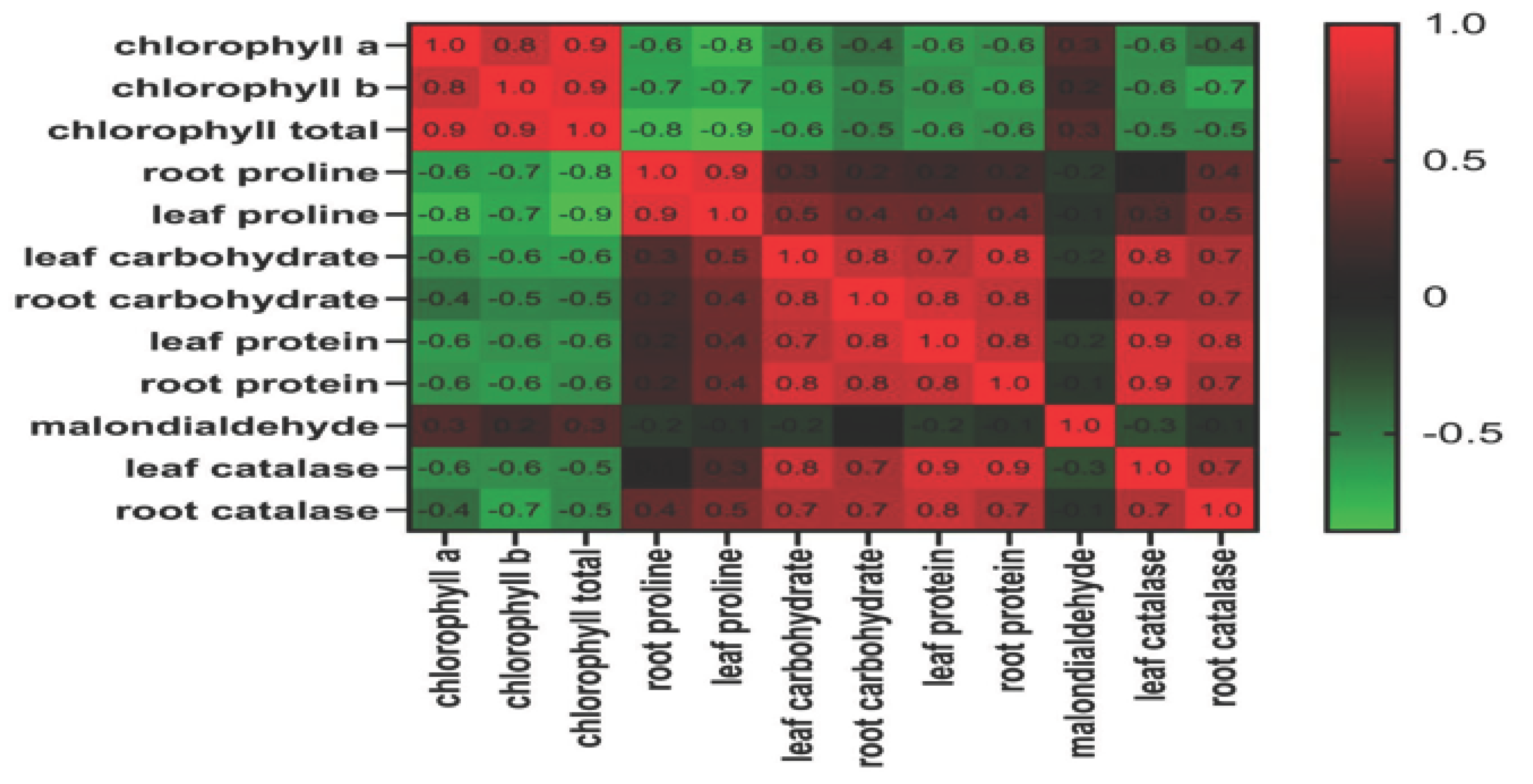

Table 1.
Biochemical and physiological responses of wheat plants under different treatments.
| Parameter | Control | Drought | Drought + Mycorrhiza | Mycorrhiza |
|---|---|---|---|---|
| Chlorophyll a (mg g⁻¹ FW) | 6.3ᵃ | 4.4ᵇ | 5.4ᶜ | 7.4ᵈ |
| Chlorophyll b (mg g⁻¹ FW) | 3.0ᵃ | 1.7ᵇ | 1.9ᵇ | 3.3ᵃ |
| Leaf Proline (mg g⁻¹ FW) | 16.0ᵃ | 25.5ᵇ | 18.8ᵃ | 13.5ᵃ |
| Root Proline (mg g⁻¹ FW) | 24.0ᵃ | 35.0ᵇ | 22.5ᵃ | 16.0ᶜ |
| Leaf Catalase (mg g⁻¹ FW) | 0.20ᵃ | 0.32ᵇ | 0.55ᶜ | 0.25ᵈ |
| Root Catalase (mg g⁻¹ FW) | 0.30ᵃ | 1.40ᵇ | 1.40ᵇ | 0.95ᵇ |
| Leaf Carbohydrate (mg g⁻¹ FW) | 4.5ᵃ | 6.2ᵇᶜ | 7.2ᵇ | 5.2ᵃᶜ |
| Root Carbohydrate (mg g⁻¹ FW) | 27.0ᵃ | 31.0ᵃ | 35.0ᵇ | 28.5ᵃ |
| MDA (µmol g⁻¹ FW) | 3.0ᵃ | 3.1ᵃ | 3.0ᵃ | 3.2ᵃ |
Note. Different superscript letters within rows indicate statistically significant differences among treatments based on one-way ANOVA followed by a post hoc multiple-comparison test (p < 0.05).
Disclaimer/Publisher’s Note: The statements, opinions and data contained in all publications are solely those of the individual author(s) and contributor(s) and not of MDPI and/or the editor(s). MDPI and/or the editor(s) disclaim responsibility for any injury to people or property resulting from any ideas, methods, instructions or products referred to in the content. |
© 2026 by the authors. Licensee MDPI, Basel, Switzerland. This article is an open access article distributed under the terms and conditions of the Creative Commons Attribution (CC BY) license (http://creativecommons.org/licenses/by/4.0/).
Copyright: This open access article is published under a Creative Commons CC BY 4.0 license, which permit the free download, distribution, and reuse, provided that the author and preprint are cited in any reuse.